What does this mean: “Nature-based solutions to achieve California’s climate change and biodiversity goals”?

In October 2020, Governor Newsom signed Executive Order N-82-20 “enlisting California’s vast network of natural and working lands – forests, rangelands, farms, wetlands, coast, deserts and urban greenspaces – in the fight against climate change. A core pillar of Governor Newsom’s climate agenda, these novel approaches will help clean the air and water for communities throughout the state and support California’s unique biodiversity.”

The California Natural Resources Agency has invited the public to tell them what you think that means.  They are holding a series of virtual on-line workshops (register here) and they are inviting the public to complete a survey (available here) by the deadline of May 14, 2021.  Recordings of workshops that have already taken place are available HERE.   Email address for feedback and questions is californianature@resources.ca.gov.
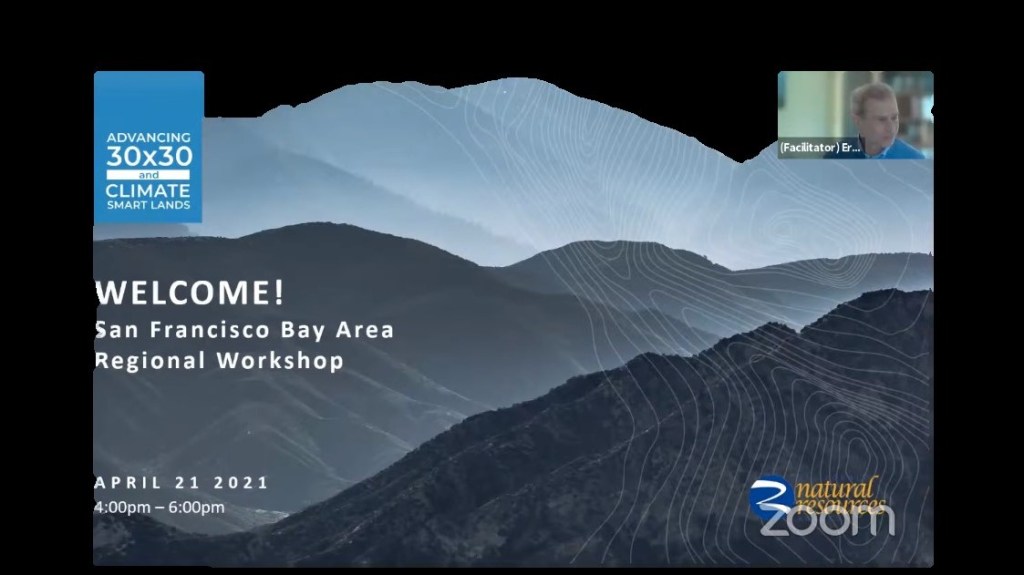
Click on picture to see San Francisco Bay Area regional workshop

I attended one of the workshops and I’ve read the material available on their website.  This is what little I can tell you about the project.  There seem to be three elements to this initiative:

  • The Natural and Working Lands Climate Smart Strategy will “expand climate smart land management across California to achieving carbon neutrality and reduce climate risks to communities and ecosystems and build climate resilience across California.”
  • The 30X30 initiative establishes a state goal of conserving at least 30 percent of California’s land and coastal waters by 2030, while “safeguarding our State’s economic sustainability and food security, protecting and restoring biodiversity.” Conservation measures will focus on a “broad range of landscapes, including natural areas and working lands, in partnership with land managers and natural resource user groups while building climate resilience and reducing risk from extreme climate events.”  Projects will also “expand equitable outdoor access and recreation for all Californians.”  Approximately 22% of land in California is presently protected, but only 16% of our coastal waters. 
  • “The California Biodiversity Collaborative will bring together groups and leaders from across our state to take bold action to maintain California’s extraordinary natural richness. This Collaborative was a directive set forth in Governor Newsom’s 30×30 Executive Order and is the next generation of the State’s Biodiversity Initiative.”

I have no idea what these vague commitments mean when they are translated into specific land acquisitions and funded projects, but I know that non-governmental organizations see this as an opportunity to obtain funding for what they want. 

Only 10% of the audience for the San Francisco Bay Region workshop was the general public. Over 50% of the 280 people at the workshop (by far the largest constituency at the workshop) I attended were employees of non-governmental organizations.  The California Invasive Plant Council (Cal-IPC) asked their members to attend the workshops and participate in them:  “This is a critical opportunity to make sure the need for invasive plant management is heard, loud and clear. We encourage you to attend to learn more about 30×30 and share your ideas.”  These are Cal-IPC’s suggestions for participants:  “Several points to consider making: (1) the definition of “protected” — and the metrics used to measure 30×30 success — need to include adequate funding for ongoing stewardship; (2) funding for the Weed Management Area (WMA) program is critical for county collaborations staying on top of high priority invasive plants across jurisdictional boundaries; (3) wildfire fuels reduction should follow best practices, including control of invasive plants, so that habitat is enhanced, not damaged.” California Native Plant Society is also asking its membership to participate in the 30 X 30 public outreach effort in support of CNPS objectives.

If you have your own priorities for how your tax dollars are used, you may want to participate in this public process as well because the projects will have an impact on land management practices throughout the State of California.  Please consider attending a workshop and completing the long, complex, and vague on-line survey by May 14, 2021.  I have no idea if the California Natural Resources Agency will take the public’s input into consideration, but I know this:  If you don’t participate, you will take whatever you get. 

What I WANT it to mean

This initiative is going to be a major public investment and non-governmental non-profit organizations see it as an opportunity to fund their projects.  The disparate goals of this initiative are often in conflict.  If climate change solutions and related wildfire hazard reduction goals conflict with biodiversity goals, addressing climate change hazards must be the top priority because all life is threatened by the consequences of climate change.  The public must understand that when the climate changes, the vegetation changes.  The ranges of native plants and animals have changed and will continue to change in response to climate change.  Native vegetation is not inherently less flammable than non-native vegetation.
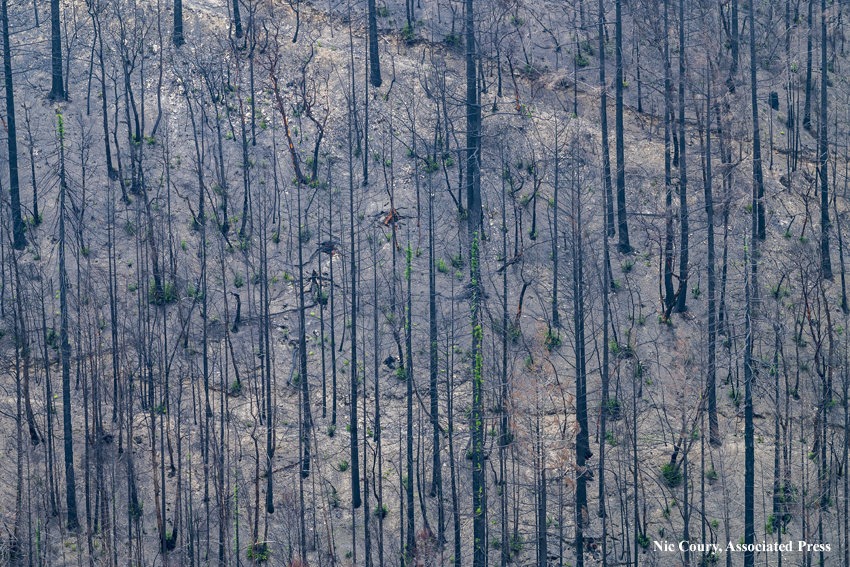
On August 18, 2020, the CZU Lightning Complex Fire swept through Big Basin Redwoods State Park, burning over 97% of the land, forested in native redwood trees. (AP Photo/NicCoury published by CA State Parks)

The native plant movement is a form of climate change denial.  We cannot replicate the landscape of 250 years ago, as native plant advocates wish, because it is not adapted to the current and anticipated climate.  Biodiversity is appropriately defined as all species of plants and animals, regardless of their origins.  Forests are major carbon sinks, whether they are native or considered non-native by people with a short-term perspective of nature and evolution.
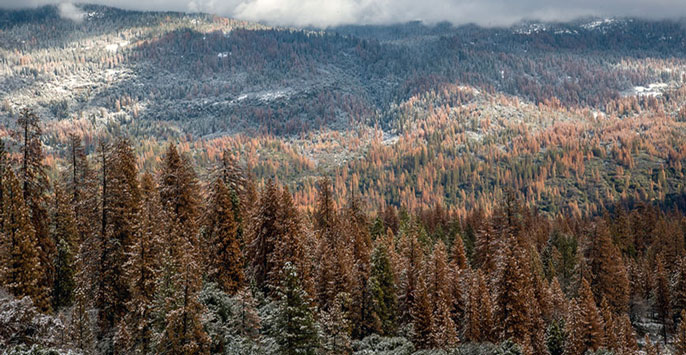
Over 160 million native conifers have died in California in the past 8 years. They were killed by high temperatures, drought, and native bark beetles. All of these factors are consequences of climate change.

The survey for this project is not user friendly.  Within its constraints, here is a sample of the specific points I was able to make:  “Do not fund projects that use pesticides, including herbicides.  Do not replace established vegetation that does not require irrigation with vegetation that will require irrigation to become established.  Do not fund projects that will require recreational access restrictions. Stop eradicating non-native spartina marsh grass with herbicides because it protects wetlands year around from storm surges.  Where afforestation is possible, plant only trees that are adapted to the current and anticipated climate. Fund projects that protect residential communities from coastal flooding and salt-water incursion into ground water. Fuels management projects must assume that native and non-native vegetation is equally flammable because flammability is unrelated to the origin of plants.  If climate solutions conflict with biodiversity goals, climate solutions should be the top priority because all life is threatened by climate change.  If fuels management goals conflict with biodiversity goals, fire safety should be the top priority.”
Michael Soulé: The consequences of crisis conservation

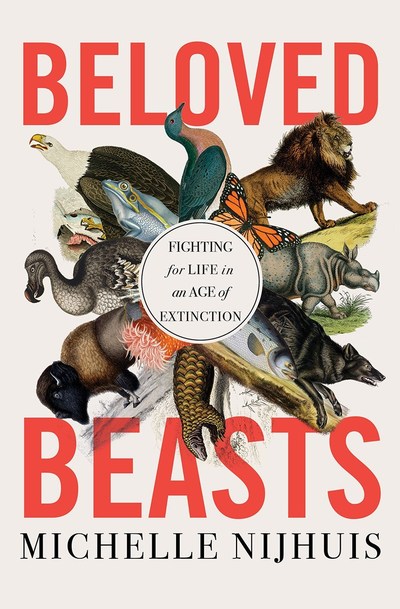
Recently published Beloved Beasts is a collection of brief biographies of major figures in conservation, starting with Carl Linnaeus, the creator of the system of classifying plant and animal species in the 18th Century that is still used today.  I was most interested in the chapter about Michael Soulé because I knew the least about him.  I heard Soulé speak at the California Native Plant Society conference in 2015.  He was very angry about the criticism of invasion biology that had recently emerged and was getting louder.  He wasn’t having it!

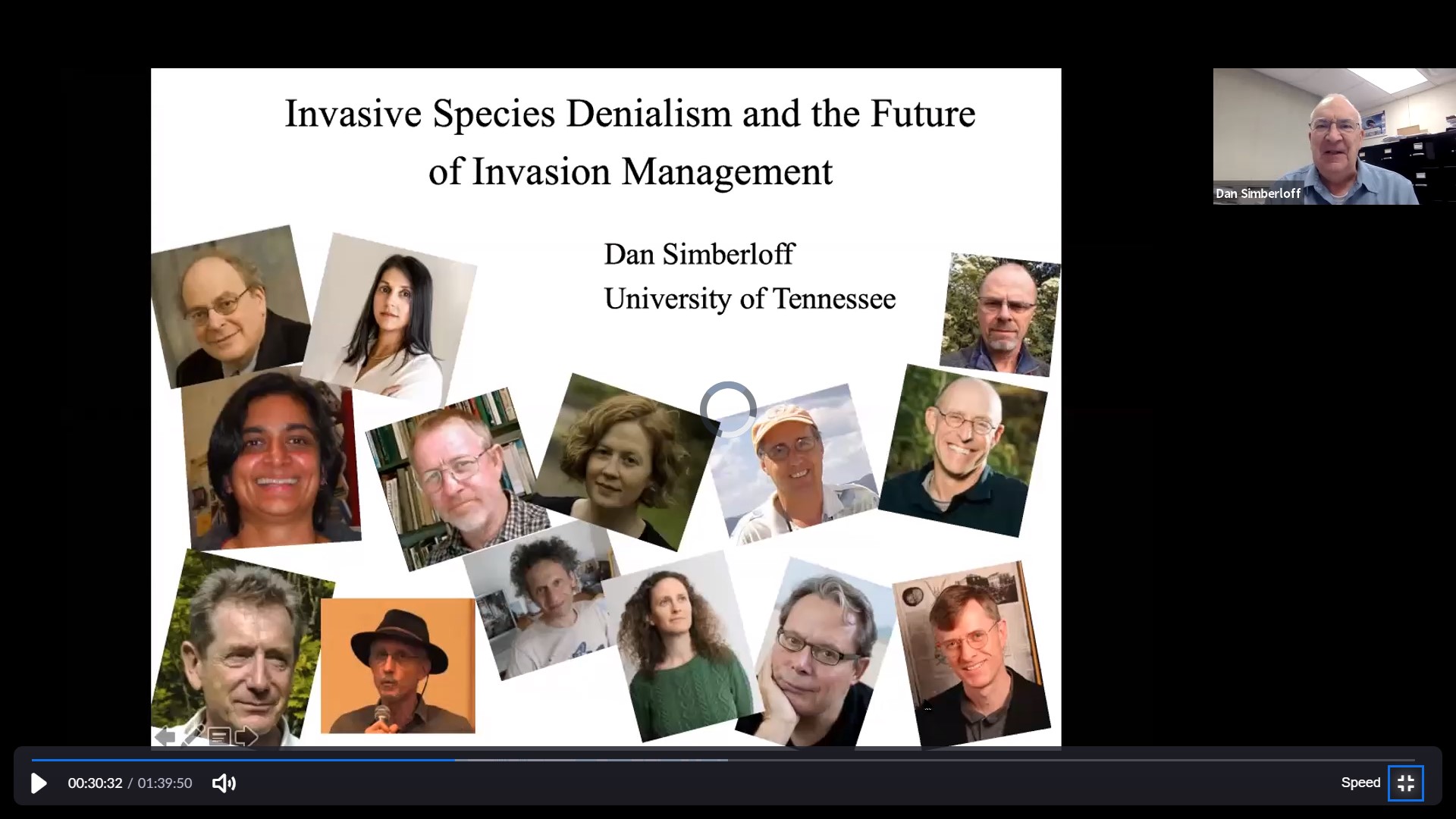
Daniel Simberloff is an ally of Michael Soulé’s. This is Simberloff’s rogues gallery of critics of invasion biology shown at the most recent conference of the California Invasive Plant Council in October 2020. The chorus of critics is bigger than it was in 2015 when Soulé spoke to the California Native Plant Society.

Beloved Beasts explained that Soulé was one of the first academic scientists to engage in political activism in support of his beliefs about conservation and he was an active participant in the major turning points in conservation science and practice.  His approach was unique at the time because data and analysis took a back seat to what he called “crisis conservation.”  Most academic scientists are reluctant to take their knowledge into the realm of public policy.  As a student of Paul Ehrlich, the author of Population Bomb, Soulé was a member of the doom and gloom crowd.  He and his colleagues believed that human population was devouring the planet.  They said we can’t wait for careful analysis, we must act.

Crisis Conservation

Crisis conservation requires a top-down strategy.  The “experts” want the authority to dictate conservation strategies so they can be implemented quickly without the interference of the public who is considered the source of environmental problems, not the solution.  I encountered this attitude over 20 years ago when I objected to plans to transform the public parks of San Francisco into native plant gardens in which the public was not welcome.  In a heated debate over the 700-page plan for this transformation, the leading light of the native plant movement in San Francisco admitted that he had not read the plan and did not intend to read it.  He said, “We know what needs to be done and we just want to be left alone to do it.” He was as angry about the public’s interference as Michael Soulé was about other academic scientists questioning his opinion that non-native plants and animals must be eradicated.

The author of Beloved Beasts explains the disadvantages of the top down approach to conservation in a chapter about conservation projects in Namibia.  The goal of these projects is to preserve wildlife, including critically endangered animals such as rhinos.  Initially, protected areas were created that excluded indigenous people and rangers were hired to patrol and enforce prohibitions against hunting.  It quickly became apparent that the people who lived there could not be prevented from hunting, particularly during extreme droughts in which starvation was the only alternative to hunting.  A handful of rangers were no match for a much larger population of residents who were more familiar with the land and the animals living there. 

Over time, project leaders realized that a new strategy was needed that would include the participation and accommodation of the people.  The residents were given the authority to organize themselves into community conservation groups that set hunting quotas and enforced them themselves.  Cooperative relationships with hunting tourism organizations provided revenue to the residents to compensate them for the loss of some of the food they had hunted in the past.  These conservations groups were possible because indigenous people usually care as much about wild animals as foreign visitors do. 

The tragedy of the commons

The narrative of the tragedy of the commons was central to the beliefs of Soulé and his allies and it supported their authoritarian approach to conservation projects.  The tragedy of the commons assumes that a shared resource will be depleted by its users absent legal regulation and enforcement.  As popularized by Garrett Hardin in 1968, “Ruin is the destination toward which all men rush, each pursuing his own best interest in a society that believes in the freedom of the commons.  Freedom in a commons brings ruin to all.”  That viewpoint justifies authoritarian control over the people who share a resource, who are presumed to be irresponsible users of the resource.

Community conservation projects in Namibia are not consistent with the dire predictions of the tragedy of the commons because the indigenous people cared as much about the wild animals as the foreign visitors of the animals.  Many examples have existed and still do exist where members of a community with regulated access to a common resource co-operate to exploit those resources prudently without collapse. Elinor Ostrom was awarded the 2009 Nobel Prize in Economic Science for demonstrating this concept in her book Governing the Commons, which included examples of how local communities were able to do this without top-down regulations or privatization.

Elinor Ostrom had a unique understanding of the complexity of human society and she was deeply suspicious of conservation strategies portrayed as a magic bullet.  According to Beloved Beasts, “She knew how corrosive panaceas could be; all her data could not dislodge Hardin’s metaphor from the public imagination, and the tragedy of the commons remains a powerful panacea for optimism.”  Beloved Beasts endorses Ostrom’s viewpoint:  “The great challenge of conservation is to sustain complexity, in its many forms, and by doing so protect the possibility of a future for all life on earth.  And for that, there are no panaceas.”

At the core of the native plant movement is the mistaken belief that the existence of non-native plants is the sole obstacle to the survival of native plants.  This is an oversimplification of complex ecosystems that are undergoing rapid change and are evolving and adapting to those changes.  Eradicating non-native plants and animals is not a panacea.  In fact, in many cases futile attempts at eradication are doing far more harm than good. 

Unintended Consequences

The unintended consequences of many conservation projects are the cost of the top-down strategies used to design the projects.  The “experts” frequently do not realize the limits of their knowledge. The “crisis” mentality prevents the careful analysis needed to prevent disastrous outcomes.

green crab

A failed effort to eradicate green crabs in a lagoon in Marin County is a case in point.  After years of killing adult green crabs, the total crab population exploded to 30 times its original size.  The failure of the project was studied by scientists who were not responsible for the original project.  They knew that adult crabs eat their young.  When the adults were killed, the unchecked population of young crabs exploded.  Genetic studies also determined that the green crabs in the lagoon are related and connected to green crab populations in adjacent bodies of water.  The green crab population in the Bay Area is a regional, not a local issue.  Taking a longer view of the issue also revealed fluctuations in the population over the long-term, suggesting that a crisis response is inappropriate over time.  Such fluctuations in abundance are common in nature.  The second team of scientists recommended a new, much less aggressive management approach that aims to keep the population below 40% capacity.

The professor and ecologist who revised the strategy explained what he learned from the experience:  “A failure in science often leads to unexpected directions. We slapped our foreheads at the time, but with thought and understanding, it’s told us a lot about what we shouldn’t be doing and provided a way forward for us. The world should get less focused on total eradication and work toward functional eradication.”

Sacrificing common animals in service of rare animals

Crisis conservation is committed to preserving species rather than individual animals.  Those who subscribe to that agenda are willing to sacrifice individual lives. For example, native barred owls are being shot because they are perceived to be competitors of rare spotted owls.  We are sacrificing common animals to save rare animals. 

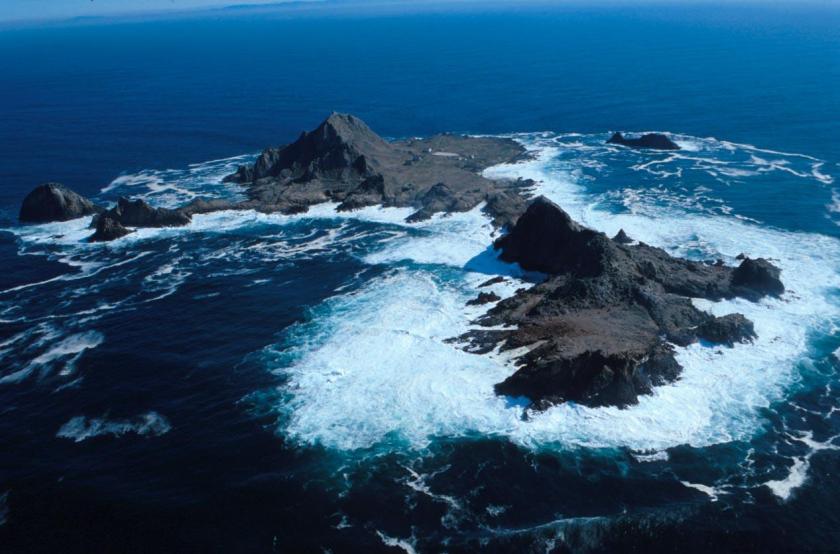
Farallon Islands, NOAA. Click on the picture to see a brief video about the Farallons eradication project and the email address of the California Coastal Commission to comment on the project.

A proposed project on the Farallon Islands is an example of a project that will sacrifice hundreds of individual birds and marine mammals based on the belief that one species of rare sea bird will benefit.  The project will aerial drop 1.5 tons of rodenticide on the Farallon Islands with the intention of killing mice.  The mice don’t eat birds or chicks, but they are the preferred prey of a small population of burrowing owls who eat chicks of the rare sea bird.  The project claims that the burrowing owls won’t visit the Farallons if the mice are eradicated.  The project admits that there will be “collateral” damage from the rodenticide that is likely to be eaten by hundreds of non-target birds and marine mammals.  This loss seems worthwhile to the promoters of this project.  It seems entirely unjustified to me and many others. 

The message of Beloved Beasts

Beloved Beasts makes a strong case for a conservation strategy that considers the needs of humans and values the lives of individual animals.  Such a strategy requires greater appreciation of the complexity of nature and animal societies, including human society.  It is suspicious of simple solutions that often have unintended consequences.  For all these reasons Beloved Beasts is entirely consistent with the mission of Conservation Sense and Nonsense.  I recommend it to you with enthusiasm. 

Looking for Godot: Finding achievable restoration goals

There are chemical and non-chemical approaches to native plant restoration. Neither succeeds.  Non-chemical methods are labor-intensive, which makes them prohibitively expensive.  Chemicals are cheaper and they kill non-native plants, but they don’t restore native plants because they kill them and damage the soil. Either strategy must be repeated continuously to be maintained. This article is the 25-year story of reaching the conclusion that neither chemical nor non-chemical approaches are capable of restoring native plants on a landscape scale.  Where do we go from here?

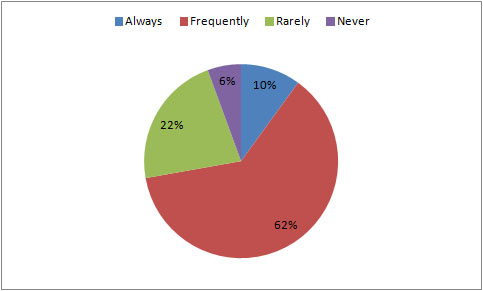
In 2014, the California Invasive Plant Council (Cal-IPC) conducted a survey of land managers to learn what methods they were using to control plants they considered “invasive.”  The Cal-IPC survey reported that herbicides are used by 94% of land managers and 62% use them frequently.  Glyphosate was the most frequently used herbicide by far. In 2014, no other eradication method was used more frequently than herbicides.

Frequency of herbicide use by land managers in California to kill “invasive” plants. Source California Invasive Plant Council, 2014

We have learned a great deal about the dangers of herbicides since 2014. 

  • The World Health Organization has categorized the most frequently used herbicide—glyphosate—as a probable carcinogen.
  • The manufacturer of glyphosate, Monsanto-Bayer, was successfully sued by terminally ill users of glyphosate.  These product liability lawsuits resulted in multi-million dollar awards for damages. The awards were reduced on appeal but ultimately upheld.  Monsanto has agreed to pay more than $10 billion to settle close to 100,000 product liability claims. 
  • The US Environmental Protection Agency has finally published its Biological Evaluation (BE) of the impact of glyphosate products (all registered formulations of glyphosate products were studied) on endangered animals (mammals, birds, amphibians, reptiles, fish, invertebrates) and plants. The BE reports that 1,676 endangered species are “likely adversely affected” by glyphosate products. That is93% of the total of 1,795 endangered species evaluated by the study. Both agricultural and non-agricultural uses of glyphosate products were evaluated by the BE. Although only endangered plants and animals were evaluated by the BE, we should assume that all other plants and animals are likewise harmed by glyphosate because the botanical and physiological functions of plants and animals are the same, whether or not they are endangered. 

How have land managers responded to the dangers of herbicides?

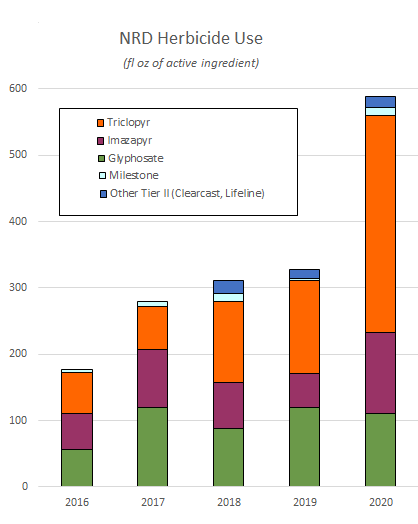
San Francisco’s Recreation and Park Department has increased the use of herbicides in public parks every year since 2016.  In 2020, herbicide use increased significantly from 243 applications in 2019 to 295 applications in 2020.  SF RPD has been spraying herbicides on non-native plants for over 20 years.  They have been using hazardous herbicides on some 50 target plant species year after year. The longer they use them, the more resistance to the herbicides the plant develops.

Herbicides used by Natural Resource Division of San Francisco Recreation and Parks Department. Source San Francisco Forest Alliance based on public records of pesticide use

Chris Geiger, director of the integrated pest management program at the San Francisco Department of the Environment, told San Francisco Public Press that although the city has reduced its use of glyphosate outside parks, it won’t ban glyphosate because it hasn’t found a more efficient or safer alternative for controlling some weeds. He said, “In habitat management, there are certain plants you cannot remove from a natural area by hand.”

San Francisco’s IPM program recently published  “Pest Prevention by Design Guide” that illustrates the bind they are in with respect to promoting native plants while trying to reduce pesticide use.  On the one hand, the Guide promotes the use of native plants in landscape design plans by making the usual claim that “Native species are generally best suited to supporting local insect populations and ecosystems.”  On the other hand, the Guide recommends the use of “pest resistant” species that are not eaten by insects and grazing animals and are capable of outcompeting weeds.  Can’t have it both ways, folks!!  

East Bay Regional Park District has made a commitment to phase out the use of glyphosate in developed areas such as parking lots, playgrounds and picnic areas.  However, EBRPD remains committed to using glyphosate and other herbicides to eradicate non-native plants on undeveloped park land. In 2020, no glyphosate was used in developed areas, but about 23 gallons of glyphosate were used to eradicate non-native plants on undeveloped park land. Twenty-one gallons of triclopyr were also used to eradicate non-native shrubs and to prevent non-native trees from resprouting after they were cut down. They continued the 15-year effort to eradicate spartina marsh grass with imazapyr. A few other selective herbicides were used on other eradication projects. (2)

In the San Francisco Bay Area, most land managers are still committed to using herbicides, particularly in so-called “natural areas,” regardless of the damage herbicides do to human health, wildlife, and native plants.  In fact, the City of Oakland is planning to begin using herbicides on 2,000 acres of public parks and open spaces for the first time to implement its vegetation management plan.  The vegetation management plan is both a fuels reduction program and a “resource protection” program, which is a euphemism for native plant “restoration.”

Given what we now know about the dangers of herbicides, why are public land managers still committed to using herbicides?  The City of Oakland explains in the EIR for its vegetation management plan why it is proposing the use of herbicides where they were prohibited in the past:

“It is estimated that if the City were to rely on hand removal and mechanical treatments in place of herbicide, it would cost the City up to 40 times more to treat these areas than under the VMP. The cost for herbicide treatments, not including any associated physical treatments, is approximately $250-$500 per acre. This reflects a range of potential vegetation conditions, vegetation types, and densities. The cost for hand removal and mechanical treatments is estimated at approximately $1,000-$4,000 per acre, using the same range of site-specific conditions.” (page 5-9)

In other words, herbicides are the preferred method of killing non-native plants because it is the cheapest method.  However, there is another reason why herbicides are preferred to non-chemical methods.  There isn’t a non-chemical method that is more effective than using herbicides.

Looking for an alternative to herbicides

As we should expect, new information about glyphosate has increased the public’s awareness of the dangers of pesticides.  California Invasive Plant Council has responded to the public’s growing awareness and concern about the herbicides to which they are exposed in our public parks and open spaces.  They recently published a comprehensive 300-page brochure entitled “Best Management Practices for Non-Chemical Weed Control.”  (1) Many highly qualified land managers participated in the preparation of this credible publication.  The Cal-IPC brochure is credible because it frankly admits that no method of eradication is without problems.  Irrigation and intensive planting are required for good results, but without continuing regular maintenance the results are only temporary.  Few land managers have the resources needed for success.

If you wonder why herbicides are the preferred method of eradicating non-native plants, reading Cal-IPC’s brochure about non-chemical methods will tell you why.  There is no non-chemical method that achieves better results than using herbicide. 

Herbicides are not a magic bullet

Herbicides are the most frequently used method of killing non-native plants, but using herbicides does NOT result in a native landscape.  “Lessons learned from invasive plant control experiments:  a systematic review and meta-analysis,” analyzed 355 studies published from 1960 to 2009 to determine which control efforts were most effective at eradicating the target plants and which method was most successful in restoring native plants. The analysis found that “More than 55% of the studies applied herbicide for invasive plant control.” Herbicides were most effective at reducing invasive plant cover, “but this was not accompanied by a substantial increase in native species,” because, “Impacts to native species can be greatest when programs involve herbicide application.”  It’s not possible to kill non-native plants without simultaneously killing native plants and damaging the soil.

Reaching a dead—and deadly—end

Public land managers in the San Francisco Bay Area have been trying to restore native landscapes for over 25 years.  Every project begins by eradicating non-native plants, usually with herbicides.  Our public parks have been poisoned repeatedly, but native landscapes have not replaced the plants that were killed.  Meanwhile, we have learned that herbicides are dangerous to our health and animals who live in our parks. 

Oyster Bay is a park in San Leandro that was built on a former garbage dump on landfill in the San Francisco Bay.  The garbage was capped with barren soil and many acres were planted with native bunch grass, as shown in these photos.  This “restoration” method is called competitive planting. The bunch grasses did not survive and the ground was quickly colonized by weeds that were then sprayed with herbicides. 

The only viable alternative to using herbicides to “restore” native plants is to change the goals for native plant restorations such that herbicides won’t be required: 

  • An exclusively native landscape cannot be achieved where native plants have never existed, such as the many parks along the bay waterfront that were built on landfill.  It is an unrealistic goal.
  • Given that no effective method of achieving this unrealistic goal has been found after 25 years and the most popular method is poisoning our environment, it is time to stop trying.
  • Smaller, achievable goals must be set.  Landscape scale projects should be abandoned and replaced with small scale projects where native plants already exist. 
  • Smaller areas can be managed without using herbicides because they will be affordable to manage with labor-intensive methods that are more expensive.
  • If smaller projects are more successful, they will be less controversial.  The projects are unpopular partly because they aren’t successful. 

The native plant movement in the San Francisco Bay Area has bitten off more than it can chew.  Native plant advocates need to back out of their dead end and regroup with plans that are less destructive and more realistic.  As the Economist magazine said in 2015, “you can garden in a garden, but you can’t garden nature.”


(1) California Invasive Plant Council is offering free video training for non-chemical methods of killing “invasive” plants on May 4, 2021, 1-5 pm.  Sign up HERE. 

(2) 2020 IPM Report, East Bay Regional Park District available HERE.   

Computer models predict the future? Garbage in, garbage out

Computer modeling is an increasingly popular tool used in ecological studies.  The rapidly changing climate is putting pressure on scientists to predict the trajectory of the change and the impacts those changes will have on the environment.  However, a computer model is only as predictive as the assumptions used to build it.  In other words, “garbage in, garbage out.”

That sets the stage for a study published in 2018 that predicted that “grassland may be a more reliable carbon sink than forests in California.”(1) The study was quickly adopted by native plant advocates as a weapon in their battle to destroy non-native trees in favor of grassland they prefer. (2) They prefer grassland because it was the pre-settlement coastal landscape.  They don’t acknowledge that burning by Native Americans and grazing by native ungulates were the primary reasons why grassland did not succeed to shrubs and forests prior to settlement. Pre-settlement grassland was as much a human creation as any modern landscape.

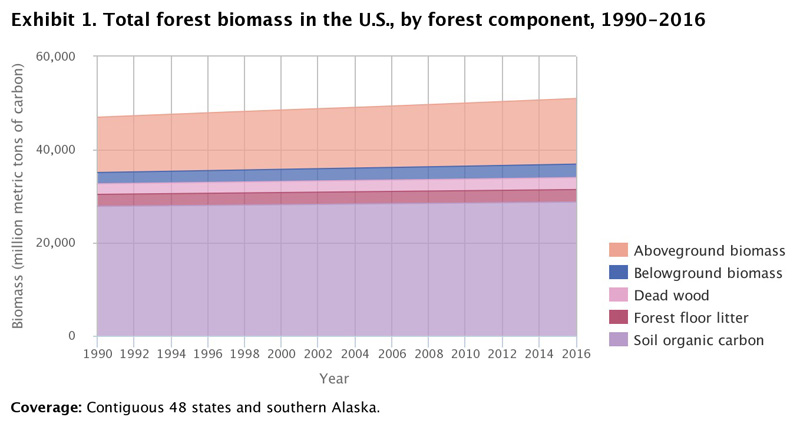
Source: US EPA, 2018

Most carbon storage is below ground, in roots and soil.  That is true of both grassland and forests. If the forest burns, the carbon it has stored in soil remains, just as the below ground carbon sink of grassland remains. 

The study (1) that claims grassland may be a more reliable carbon sink than forests reaches its erroneous conclusion by comparing below ground carbon storage in grassland with above ground carbon storage in forests. It’s a classic case of inappropriately comparing apples with oranges to the disadvantage of forests.  It seemed such an unlikely comparison that I asked the study’s authors to confirm they had compared below ground carbon storage in grassland with above ground carbon storage in forests.  They confirmed that they did, indeed, make that inappropriate comparison.

The study also bolsters its mistaken conclusions by erroneously claiming that forests are more likely to burn than grasses:

“The fire resistance for grasses is 0.5 while that of trees range from 0.1−0.3, making grasses more resistant to wildfires than trees, which is roughly consistent with field-observations since in the event of a wildfire, when compared to trees, a smaller fraction of the biomass of grass is damaged.” (1)

However, the study cited as the source of this statement (3) says exactly the opposite:

“The fraction of individuals killed depends upon the prescribed PFT fire resistance, which represents the PFT survivorship during a fire (see Table 1). In the fire model, grasses and litter are fully consumed.” (3)

Table 1 PFT parameter values for fire resistance
PFTFire Resistance (%)
Woody
Tropical broad-leaved evergreen12.0
Tropical broad-leaved raingreen50.0
Temperate needle-leaved evergreen12.0
Temperate broad-leaved evergreen50.0
Temperate broad-leaved summergreen12.0
Boreal needle-leaved evergreen12.0
Boreal summergreen12.0
Grasses
C3 grass100.0
C4 grass100.0

Table 1 is consistent with this statement in the abstract of the cited study:  “Estimated litter moisture is the main driver of day‐to‐day fire probability.”  (3) Forests retain more moisture in the soil and leaf litter because of the shade provided by the tree canopy.  I wrote to the study author again, asking “where is the source of your statement that grasses are more fire resistant than trees?”  He did not reply.
If a study doesn’t seem to make sense, or it contradicts other sources of information, it is worthwhile to look under the hood.  What is driving the model?  Is it fueled by hot air?  Is it serving an activist agenda? Are cited studies accurately quoted? 

Some truth emerges from the model’s black box

Despite the erroneous assumptions of the computer model used by this study, there is some truth in the conclusions it reaches.  Vegetation type conversions are occurring now and they will continue as the climate continues to change because when the climate changes, the vegetation changes. We are presently witnessing the transition of native conifers at high altitudes to lower altitude hardwood trees. Although these changes will occur gradually and there will be many intermediary transitions, the fact is that grassland is more likely to survive than forests in a warmer, drier climate in the long run. 

The Guardian has published a comprehensive report about the loss of forests all over the world.  In the Rocky Mountains, one-third of places where trees burned 20 years ago are now occupied by shrubs and flowers.  About 15% of forests in the Rocky Mountains are not expected to grow back if killed by fire because the climate is no longer suitable for them.  About half of existing forests in Alberta, Canada are expected to vanish by 2100.  The “megadrought” in south-western US is expected to convert 30% of forests to shrubland or another type of ecosystem.

In the short run, the loss of forests can be mitigated by reforestation with tree species that are better adapted to a warmer, drier climate.  The study (1) acknowledges the potential for mitigation to preserve forest ecosystems:  Factors such as species traits, biodiversity, rapid evolution, and human management intervention could alter our model-based findings from the projections provided here. Consequently, our results indicate the potential direction of change as opposed to predictions that consider the full ensemble of ecological, physiological and management factors that can alter pathways and responses of ecosystems to climate change.”

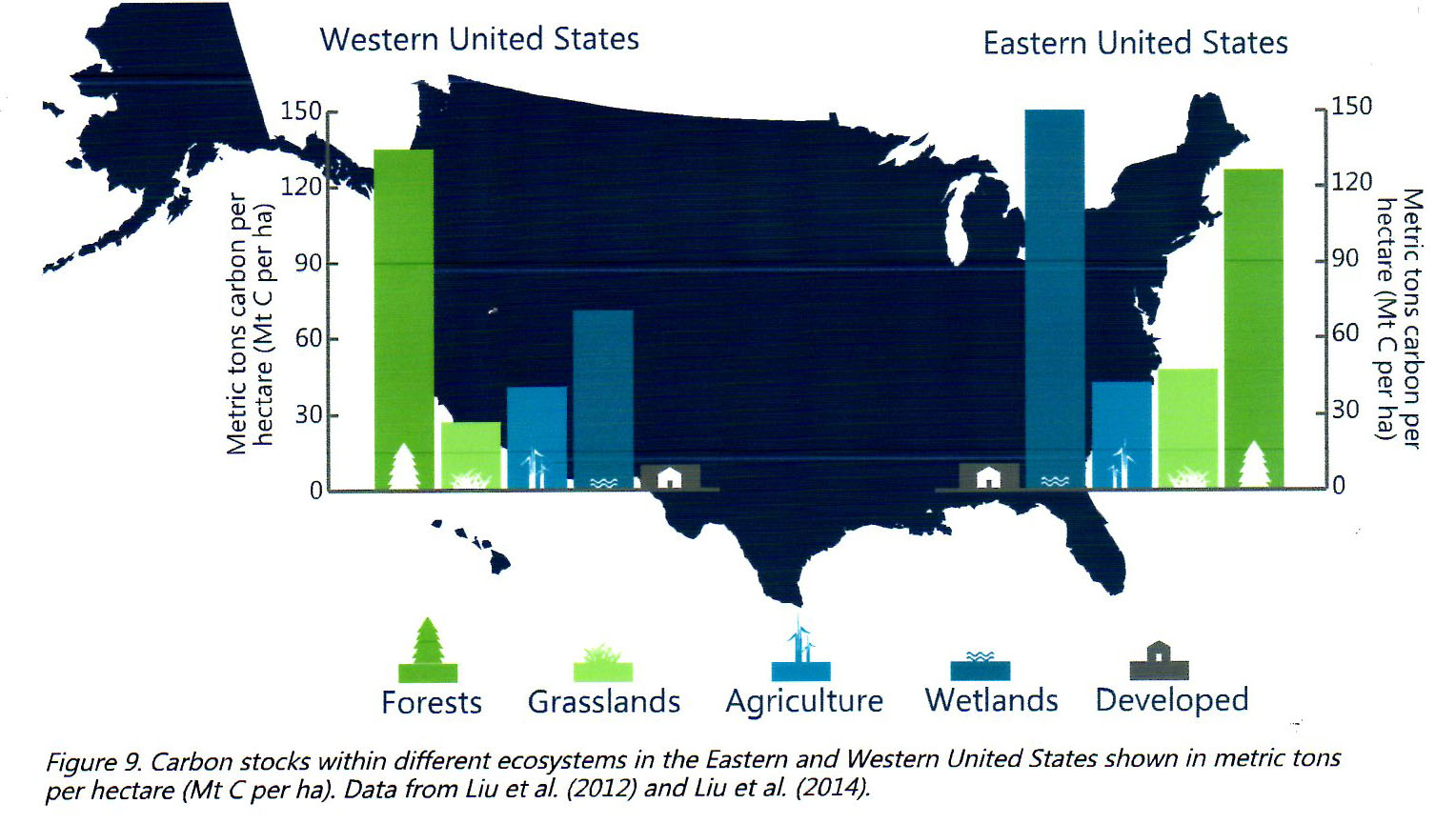
From the standpoint of carbon storage, it is not good news that grassland is likely to inherit hot, dry lands previously occupied by forests.  Forests and wetlands store more carbon than grasslands, as the above chart in a USDA publication about carbon storage shows.  Sustaining below ground carbon sinks will depend on carbon sequestration by above-ground plants and trees.  Because above-ground carbon sequestration is primarily dependent upon the biomass, forests will always do a better job than grassland in the long run.  In the short-run, grassland will grow back more quickly than forests, but it will never achieve comparable biomass. 

Forests are presently absorbing about one-quarter of all human carbon emissions annually. Forests make a significant contribution to reducing carbon emissions, but planting trees is not a panacea as long we continue to burn fossil fuels to generate energy. The loss of carbon-sequestering capabilities of forests will exacerbate climate change in the long-run.  It’s one of many dreaded feedback loops that are reaching tipping points:  the impacts of climate change are destroying the mechanisms that mitigate climate change. 

The study (1) acknowledges that by the end of the 21st Century, under current climate conditions (warming limited to 0.3⁰ – 1.7⁰ Centigrade) forests will have removed 5 times more net carbon (carbon storage minus carbon loss) per hectare from the atmosphere than grassland in California.  See Table 1 in the study (1).  Thus, the study agrees that forests store more carbon than grassland.

From the standpoint of wildlife, it is not good news that grassland is likely to replace forests in a warmer climate. The insects, birds, and animals that live in the forest will lose their habitat. Forests are home to over 80% of terrestrial species.  We will lose our shade in a warming climate and our windbreak. 

Not an argument for destroying forests

This study (1) is unfortunately being used by the native plant movement to advocate for the preemptive destruction of healthy urban forests that are not more likely than native forests to burn in wildfires.  Virtually all wildfires in California occur in native vegetation. There is no advantage to destroying healthy forests that are expected to live for another 100-200 years.  We don’t amputate our limbs to avoid breaking them.  Nor should we destroy our forests before they die.

(1)“Grasslands may be more reliable carbon sinks than forests in California,” Pawlok Dass, Benjamin Z Houlton, Yingping Wang and David Warlind, 10 July 2018, Environmental Research Letters, Volume 13, Number 7 

(2) “Importance of Grasslands for Carbon Storage,” Yerba Buena Chapter of California Native Plant Council, Quarterly Newsletter, March 2021, page 6. 

(3) “The role of fire disturbance for global vegetation dynamics: coupling fire into a dynamic global vegetation model,” Thonicke K, Venevsky S, Sitch S and Cramer W 2001,  Glob. Ecol. Biogeogr.10 661–77

The founding error of American environmentalism

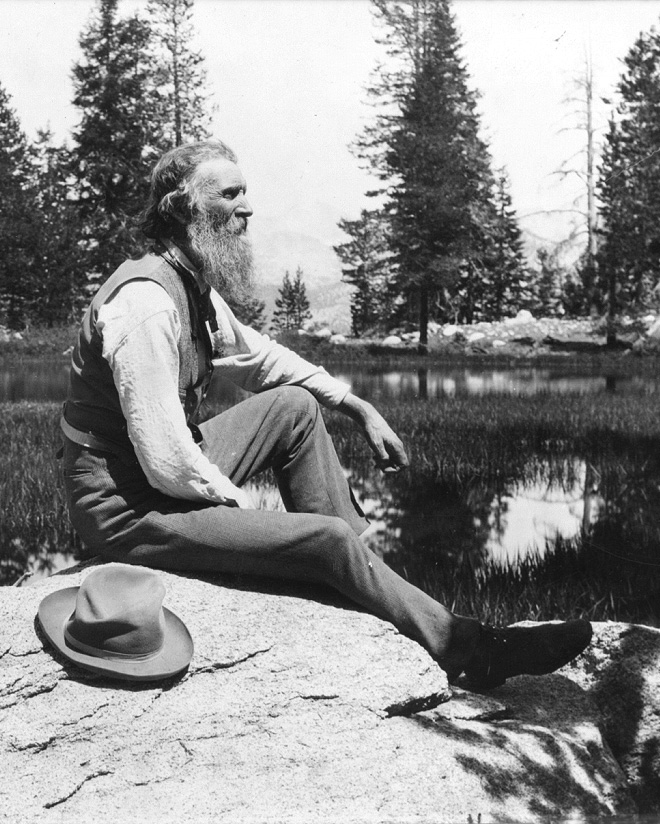
The Sierra Club, like many American institutions, is trying to come to grips with systemic racism.  The Club was founded in 1892 under the leadership of John Muir who “…made derogatory comments about Black and Indigenous peoples that drew deeply on harmful racist stereotypes, though his views evolved later in his life,” according to Sierra Club executive director Michael Brune in his letter of July 2020 to Club members (available HERE).

John Muir is the founder of the Sierra Club.

Author and activist, Rebecca Solnit, follows up on the roots of racism in the American environmental movement in the most recent edition of Sierra Magazine, the national magazine for Club members.  Her telling of events reveals the founding error of the native plant movement that was based on the mistaken assumption that European settlers were entering a pristine landscape that had been unaltered by humans.  The goal of the native plant movement has therefore been to replicate the pre-settlement landscape, presumed to be the ideal landscape.

Early settlers were well aware that they were entering occupied land.  After all, the settlers had to dispossess Native Americans to occupy the land.  But that reality was quickly forgotten, enabling “the lovers of the beauty of the American landscape who reimagined the whole continent before 1492 as an empty place where, as the Wilderness Act of 1964 puts it, ‘the earth and its community of life are untrammeled by man, where man himself is a visitor who does not remain.’” (1)

John Muir’s lack of respect for Indigenous culture prevented him from understanding that he was looking at the results of Indigenous land management when he admired Yosemite Valley:  “The word garden occurs over and over in the young John Muir’s rapturous account of his summer in the Sierra Nevada in 1869. ‘More beautiful, better kept gardens cannot be imagined,’ he declared. When he saw Yosemite Valley from the north rim, he noted, ‘the level bottom seemed to be dressed like a garden.’ He assumed he knew who was the gardener in the valley and the heights, the meadows and the groves: ‘So trim and tasteful are these silvery, spiry groves one would fancy they must have been placed in position by some master landscape gardener. . . . But Nature is the only gardener able to do work so fine.’” (1)

In fact, Yosemite Valley looked like a garden to John Muir, because it was a garden, the garden tended by Native Americans for thousands of years:

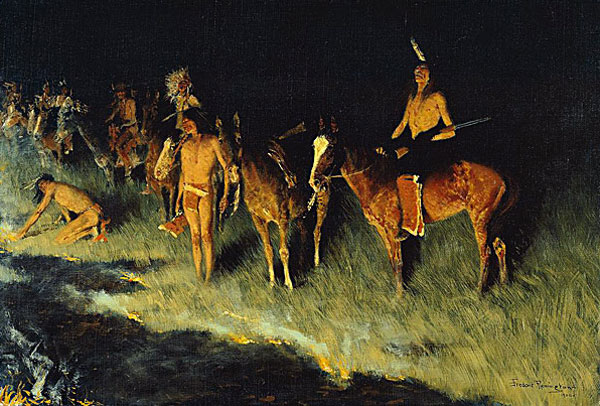
“Native Americans as hunters, gatherers, agriculturalists and horticulturalists, users of fire as a land-management technique, and makers of routes across the continent played a profound role in creating the magnificent North American landscape that Europeans invaded. Their use of fire helped maintain plants and spaces that benefited these first human inhabitants—including increasing animal populations, causing plants to put forth new growth in the form of straight shoots suitable for arrow making and basket making, and keeping forests open and underbrush down. In Yosemite Valley, burning encouraged oak trees and grasslands to flourish; conifers have since overtaken many meadows and deciduous groves. The recent fires across the West are most of all a result of climate change—but more than a century of fire suppression by a society that could only imagine fire as destructive contributed meaningfully.” (1)

Native Americans setting grass fire, painting by Frederic Remington, 1908

Solnit correctly describes the consequences of this founding error on the development of environmentalism:  “Had he been able to recognize and convey that the places he admired so enthusiastically looked like gardens because they were gardens, the plants in them encouraged, the forests managed by the areas’ Native people, the history of the American environmental movement might have been different.”  (1)

Solnit believes there are three significant losses to American society and the environmental movement because of the initial lack of respect for Native Americans and their cultural practices.  The first was the greatest loss to Native Americans because disrespect for them as people and a functioning society made it easier to justify dispossessing and marginalizing them.  The second was the loss to American society that would have benefitted from understanding and emulating their accomplishments.  And the third loss was the founding error of American conservation policy that is based on the mistaken assumption that the pre-settlement landscape is the ideal landscape because it was unchanged by humans.

Several recent scientific studies have found that lands occupied by indigenous people in Australia, Brazil, and Canada have much more biodiversity than lands that have been designated as “protected areas” by governments.  Typically, indigenous people have been forced out of the protected areas, based on the assumption of traditional conservation that humans harm the environment.  As the Coordinator of Indigenous Organizations of the Amazon River Basin explains in a recent article in New York Times, “If you’re going to save only the insects and the animals and not the Indigenous people, there’s a big contradiction [because] we’re one ecosystem.”

A new conservation ethic

Our conservation goals require a major revision to right this wrong.  New goals must acknowledge that humans have altered every place on the planet for thousands of years.  New goals will acknowledge that nature is dynamic, that changes in nature are usually impossible to reverse, and that they have both positive and negative impacts. New goals will be adapted to the current environment, such as higher temperatures and drought.  New land management strategies can be informed by those used by Native Americans, but replicating the landscapes of 500 years ago will remain out of reach because underlying conditions have been fundamentally altered by evolution and the activities of modern society.

A new conservation ethic can honor the traditions of Native Americans as well as the sovereignty of nature.  We must stop damaging nature in the futile effort to replicate a landscape that was as much a human creation as the landscape of the Anthropocene era. 


(1) “Unfinished Business:  John Muir in Native America,” Rebecca Solnit, Sierra Magazine, March/April 2021

An Australian friend of eucalyptus

An Australian sheep farmer (we would say “rancher”), Jane Pye, spotted our defense of eucalyptus and got in touch:

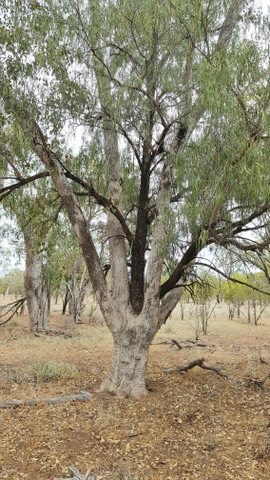
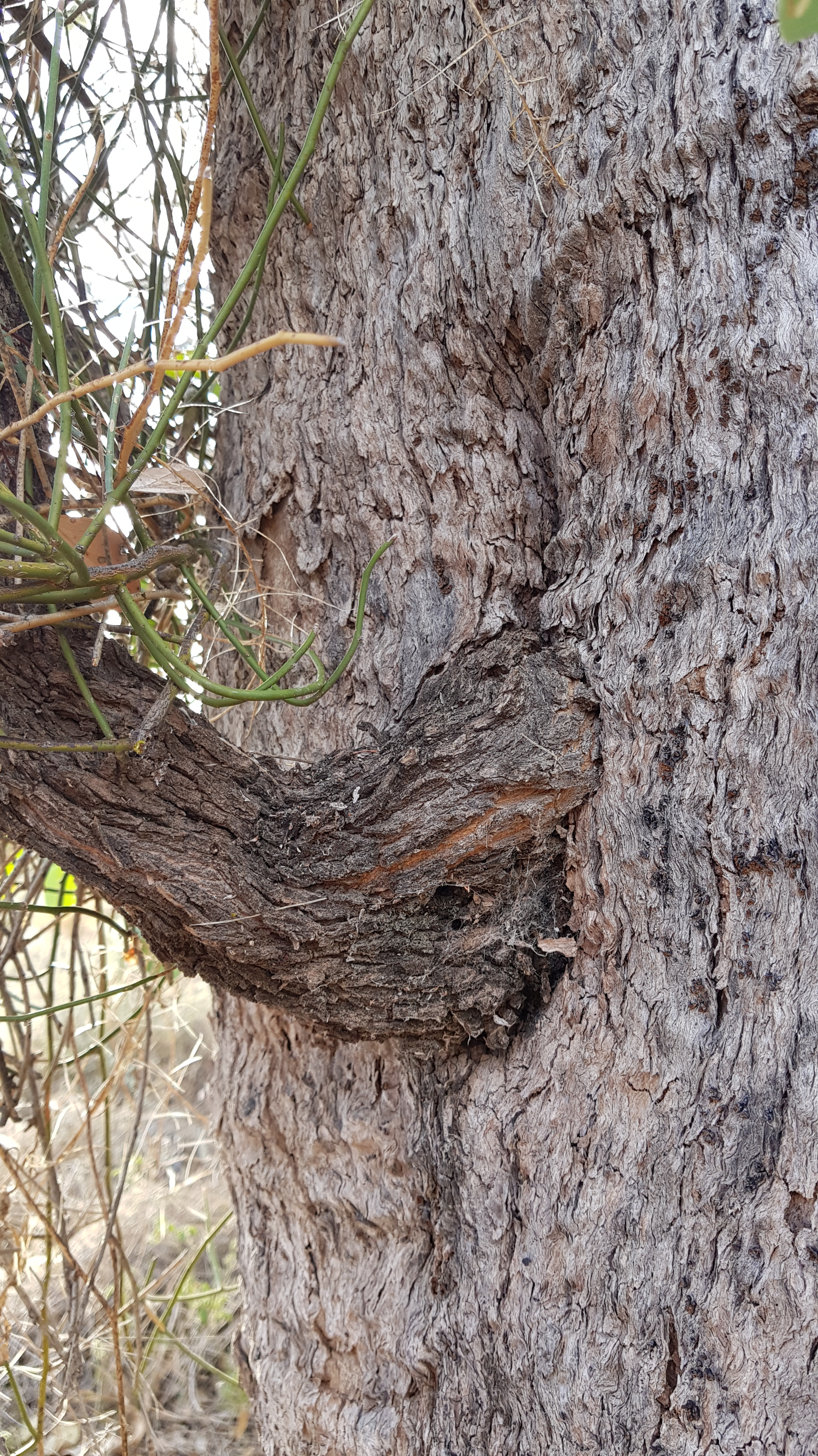
“G’day, I stumbled across the SFFA website researching ‘allelopathy’ in eucalypts and was amazed to find so much antipathy towards gum trees over there – like an arboreal cane toad! What I really wanted to know is do you have any evidence of ‘positive allelopathy’ re eucalypts?  I live in the Australian outback with areas of dry sclerophyll forest. The commonest eucalypt here (Eucalyptus populnea) is often surrounded by native scrub trees & bushes. Strangely some of these box trees also have other trees growing out of their trunks which I think were planted there by the traditional owners (Aboriginal). These Tree in Trees are found in clusters around the old indigenous campsites, which are in turn found around good natural water catchments or native wells.”

My article debunking the popular myth that eucalyptus is allelopathic was republished by the San Francisco Forest Alliance (SFFA).  The myth of allelopathy is that eucalyptus emits a chemical that prevents the germination of other species, eliminating competition with eucalyptus for resources such as water.  But Jane’s experience with eucalyptus goes beyond debunking allelopathy in eucalyptus.  She has documented many examples of different tree species that have seemingly been planted inside the cavities of eucalyptus trees.  The eucalypts are a sheltering host to the guest tree species.  Clearly, eucalyptus is not inhospitable to other plant species.

Wilga (Geijera parviflora) guest in Bimblebox (Eucalyptus populnea) host.

Apophyllum anomalum guest growing from Bimblebox (Eucalyptus populnea) host

Jane believes that these “trees in trees” were intentionally planted by indigenous Aboriginal “farmers.”  She believes that this is one of many techniques that were developed by Aboriginal people to manage the land and vegetation to provide food and cultural implements.  She explains on her website:

“After years of admiring and speculating about these scar trees, I have finally gotten around to photographing most of them. I spend many days in the paddocks mustering sheep and some of these trees are like old friends. They are an important link to our Aboriginal past and a reflection on how innovative and resilient these people were. Surviving out here west of Walgett with our unpredictable climate of harsh droughts and random floods is still tough but these people managed their environment and thrived.

“So I dedicate this website to Freddie Walford, an Aboriginal stockman we had who taught us some bush lore and like many of his people, died too young. I will always remember his natural affinity with livestock, his love of polocrosse and his quiet humour and grace. He never spoke much about the scar trees but did say if I was ever to see bones inside an old coolabah [Eucalyptus coolabah], I should go as fast as possible in the opposite direction! This website aims to increase knowledge and record these trees but not to display any pictures or information that is culturally secret or sacred.”

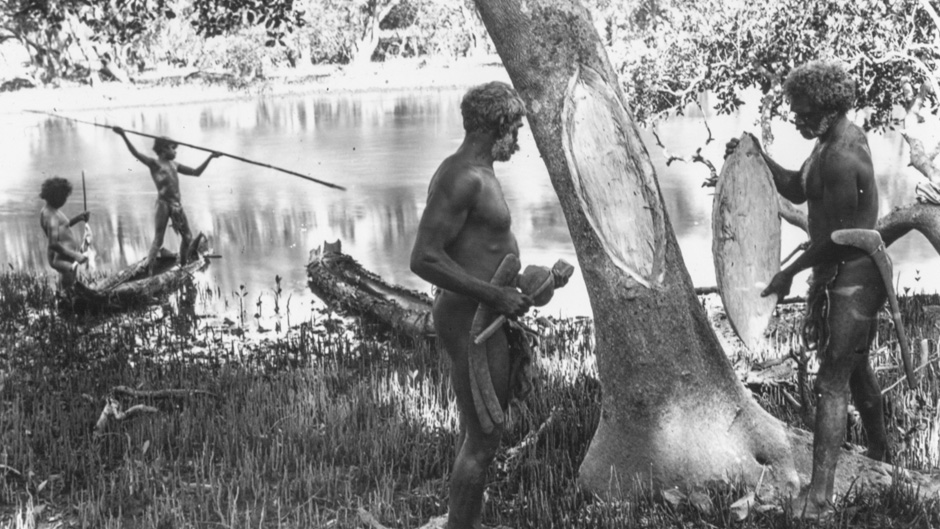
Australian aborigines. Photo by Thomas Dick, 1920

The land management practices of Australian Aborigines were very similar to those of indigenous Californians for much the same reason.  These were hunter-gatherer cultures living in similar climates with seasonal drought.  They moved around as seasons changed and their diets changed accordingly.  Both cultures used fire as one of their primary tools.  Periodic fires refreshed the grasses that fed the grazing animals they hunted.  The primary grazers in Australia were kangaroos and other marsupials; deer and other ungulates are the original grazers in California.

Native Americans setting grass fire, painting by Frederic Remington, 1908

The land management practices of indigenous people are enjoying a renaissance.  A recent study of Aboriginal land management in Australia said, “Indigenous agency and governance is driving innovations in land management worldwide that provide more equitable solutions and strategic approaches to looking after the lands, waters and all living things, particularly in the face of climate change.”

Such intentional burns are now seen as a way to keep the brushy fuels that carry fire to a minimum, reducing wildfire hazards.  Cal Fire’s new “Wildfire and Forest Resilience Plan” and the Governor’s recent annual budget proposal tell us that more prescribed burns are planned in California to reduce fuel loads and fire hazards:  “CAL FIRE will expand its fuels reduction and prescribed fire programs to treat up to 100,000 acres by 2025, and the California Department of Parks and Recreation and other state agencies will also increase the use of prescribed fire on high risk state lands.”

It has taken hundreds of years to appreciate the value of indigenous land management and its context in their culture.  When Europeans arrived in both America and Australia, settlers assumed that their culture was superior to indigenous culture.  Early settlers made no attempt to learn from indigenous people, which was the settler’s loss.  Indigenous people had learned to live off the land, in most cases without cultivating crops and without domesticated animals.  Rather, indigenous people learned what was edible and what had medicinal value.  The first European settlement in America, Jamestown, ended quickly with starvation, because the settlers weren’t able to understand what the land offered them.  In Australia, knowledge of indigenous land management was also delayed by the cultural taboos of the indigenous people that prohibited the revelation of many of their cultural practices outside their ancestral clans.

 Wildfire in Australia

Jane also had some interesting observations about wildfires in Australia that are consistent with our experience in California:

I’m sorry to hear eucalypt forests are being destroyed over there as they are wonderfully useful trees. We don’t have many fires in inland Australia. It’s more of a coastal / high rainfall problem. We just don’t get the fuel build up as it’s a semi-arid region and we have thousands of merino sheep eating the grass and shrubs. There have been no fires on this property in over a century and probably much longer. We also have efficient native grazers – kangaroos and wallabies and now also goats that are increasingly common as an alternative to sheep.”

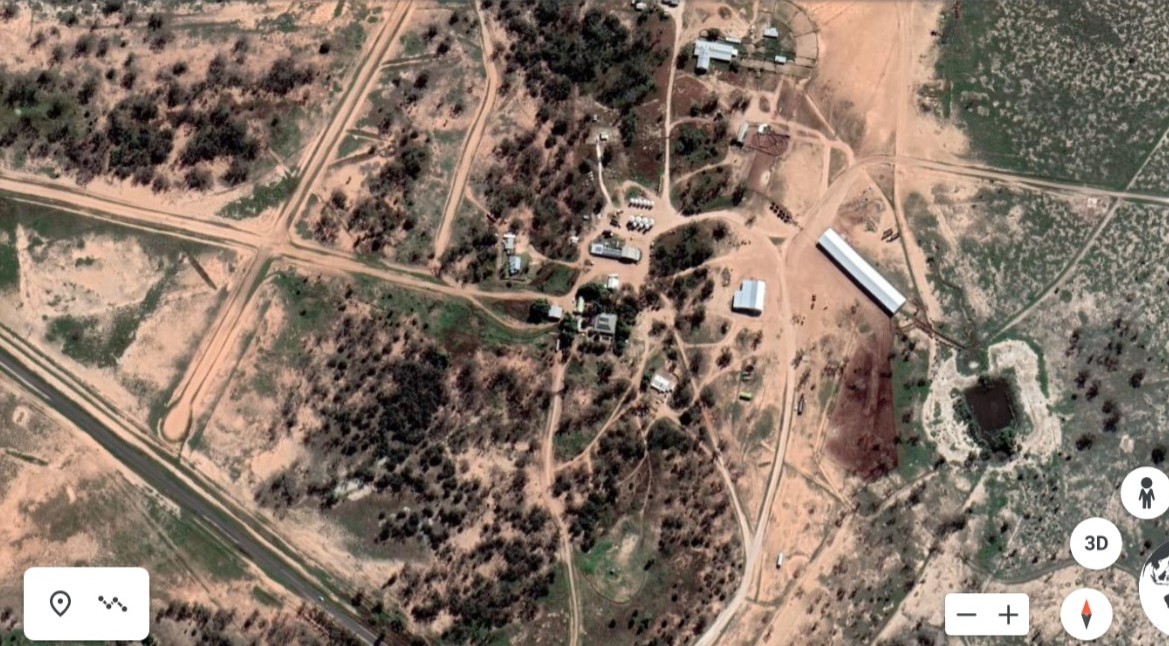
Jane Pye’s home. Gingie Station, Walgett, NSW, Australia. There are many places in California’s Central Valley that look much the same.

This is the strategy that I promote on this website.  If we reduce ground fuels that ignite easily, we can prevent most fires from igniting tree canopies that are harder to ignite.  Fire travels fast on the ground if given a continuous field of dry grass during the dry season.  Grazing animals are a far safer way of reducing these grassy ground fuels than the herbicides that are often used.  Herbicides leave a dead, dry thatch on the ground that is very flammable and grazing does not.

Walgett, Australia. Average Hi Temp 80 degrees. Average Lo Temp 54 degrees. Average rainfall 19 inches.

“Also we are very used to fire over here and many people regard those foolish enough to build in fire prone areas have only themselves to blame. Some of our small coastal towns are totally surrounded by National park and State forest and only have one road in – that’s why there were so many images of people sheltering on beaches last summer. It’s a hard issue but better hazard reduction burns and more fire fighting aircraft seem to be the way forward here. Also better fire retardant building materials.”

These observations are also consistent with the strategy that makes sense to me.  We must learn to live with fire because it is an essential element in Mediterranean ecosystems.  We can’t prevent it, but we can work around it with zoning that prevents building in extremely hazardous areas, using fire retardant building materials, and creating safe evacuation routes.

Thanks, mate!

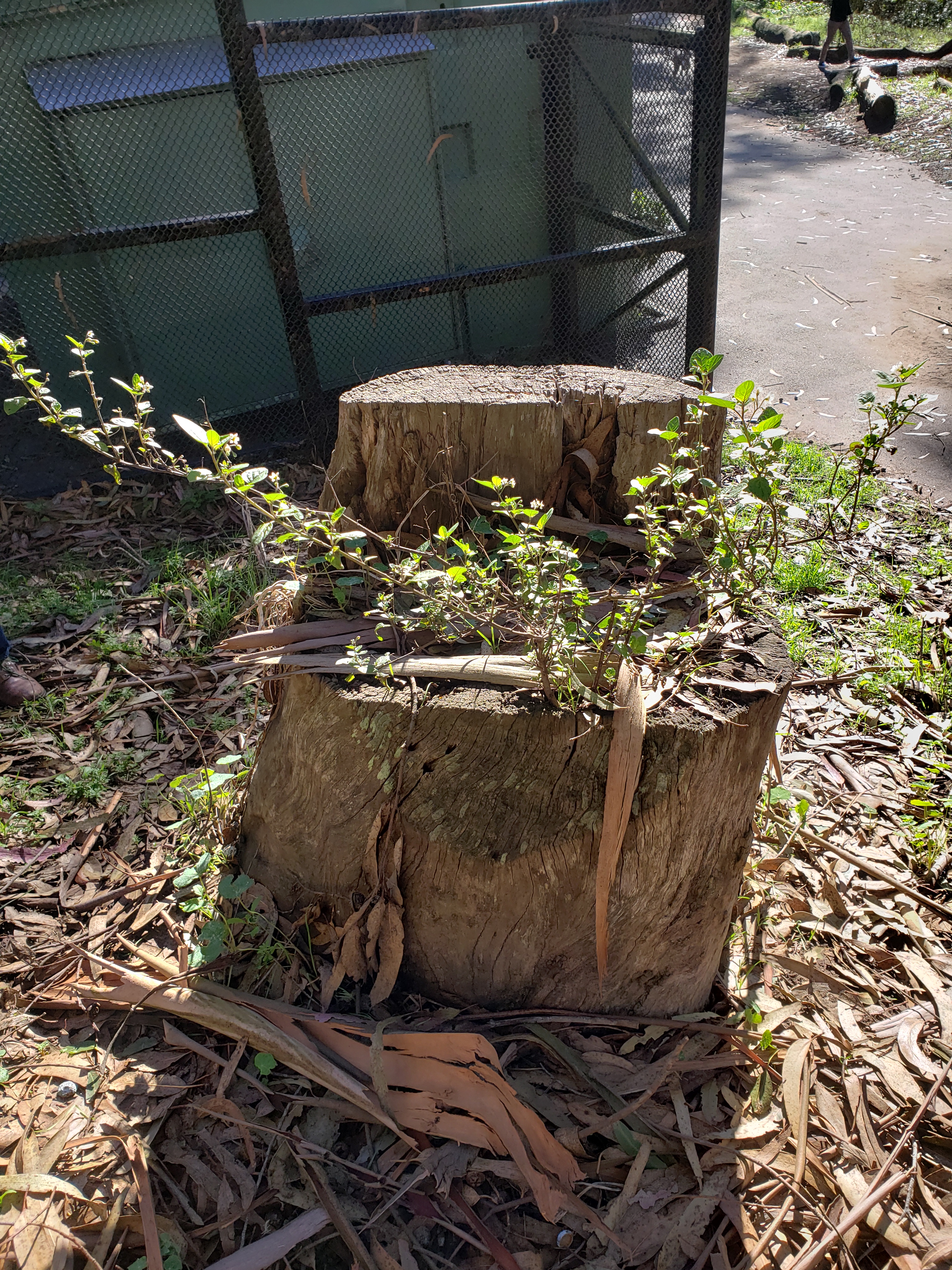
 Alerted by Jane, I noticed this woody shrub sprouting from a eucalyptus stump in Stern Grove a few days after I heard from Jane.  Clearly, eucalyptus does not retard the growth of other species.

Stern Grove, San Francisco

Many thanks to Jane for getting in touch with us.  Thanks for her admiration of eucalyptus and Aboriginal culture.  I’ve had some lovely email chats with Jane.  Perhaps you would like to drop her a line to thank her as well:  janepye6@gmail.com

Nobody cares where a pretty wildflower is from

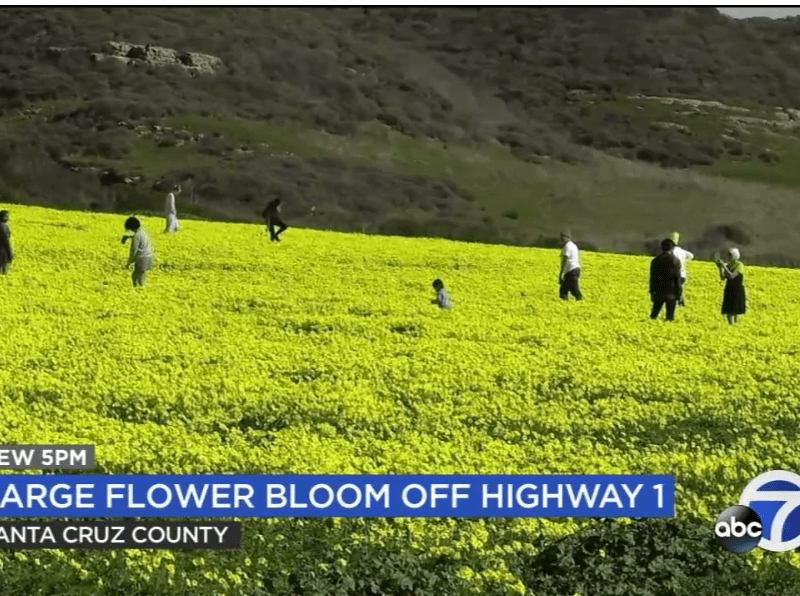
The feel-good ending of the local news broadcast on Channel 7 (ABC) on February 17, 2021, featured this video of a huge field of oxalis (Bermuda buttercup, Oxalis pes-caprae) blooming on the roadside of Highway 1 in Santa Cruz County.  People were stopping along the road to admire the bright yellow blooms of spring and photograph them.  No one said anything about where the plant “belongs,” and no bad words were spoken about this useful plant that native plant advocates love to hate.

Click on the picture to activate the video

Despite its beauty and utility, oxalis is sprayed with one of the most toxic herbicides on the market in public parks and open spaces in the Bay Area.  San Francisco’s Recreation and Parks Department has been spraying oxalis in several public parks for over 15 years.  San Francisco Forest Alliance (SFFA) published a brilliant article about this pointless and destructive crusade that was republished by Conservation Sense and Nonsense in 2015.  That article about the many benefits of oxalis is one of the most popular articles on this blog; it has been viewed by over 10,000 readers and many more on the SFFA website.  We invite you to visit it and we summarize it briefly here:

  • Oxalis blooms briefly in early spring and dies back before summer begins, leaving the ground to other plants. It does not kill other plants, rather it co-exists briefly during its annual bloom.
  • Oxalis is very useful to pollinators and its tuberous roots (bulbils) are eaten by ground dwelling animals such as gophers.
  • Oxalis is called sour-grass because of its pleasant-tasting tang and it is often eaten by children.
  • Triclopyr is the active ingredient in the herbicide that is used on oxalis during its blooming season. It damages the soil by killing beneficial fungi and microbes, and it is toxic to many animals.

The annual poisoning of oxalis on Mount Davidson was recently videotaped by Ron Proctor and published by the San Francisco Forest Alliance. A crew of 5 men was hired to do the deed.  Ironically, this spraying of oxalis on Mount Davidson in San Francisco was taking place at the same time that tourists were admiring oxalis in a neighboring county.

Click on picture to activate the video.

Oxalis is not an isolated example of a non-native plant that is admired by the public, but hated by native plant advocates and public land managers who do their bidding.  As a member of the Sierra Club, I receive emails alerting me to opportunities to advocate for the protection of the environment.  The most recent email featured a picture of a yellow wildflower in the foreground of a photograph of a Bay Area landscape:

The yellow wildflower in the foreground is Black Mustard (Brassica nigra).  I responded to the Sierra Club’s email:

“The plant in the foreground of your photograph appears to be Brassica nigra:  ‘Brassica nigra, or black mustard, is an annual plant cultivated for its black or dark brown seeds, which are commonly used as a spice. It is native to tropical regions of North Africa, temperate regions of Europe, and parts of Asia.’ Wikipedia

“I hope the use of this photo in this Sierra Club email to its members means that the Sierra Club is finally prepared to accept the reality of the presence of non-native plants in our public parks and open spaces.  The Sierra Club’s support for unnecessary and destructive eradication projects has been regrettable, particularly because they require the use of harmful herbicides.  I hope this email is an indication that the Sierra Club is finally ready to reconsider this futile crusade.”

I received this disappointing reply from the Sierra Club:  The staffer who puts together our newsletter isn’t a plant buff and wouldn’t have known the difference. But I am a plant buff and review the newsletter and know the difference between a mustard and a native plant. I somehow just overlooked that photo entirely. Thanks for bringing it to my attention. I’ll be more careful in my review of the newsletter in the future (look more carefully at the photos). And we’ll change the online version.”

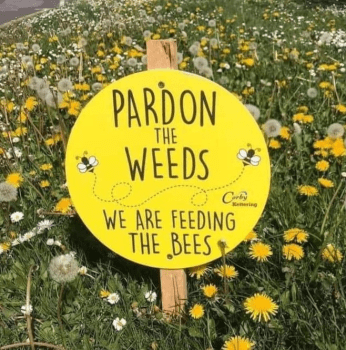
The beauty and resilience of weeds

Dandelion by Mona Caron. Click on the picture to see more murals by Mona Caron.  Mona is a Swiss artist who became a muralist in her adoptive hometown San Francisco, California.  She is best known for her multi-story murals celebrating the rebellious resilience of weeds.

 The Bottom Line

The general public doesn’t care where plants came from.  The public recognizes and values beauty wherever it is found.  Unfortunately, our public lands are in the death grip of the native plant movement and environmental organizations that should be objecting to the use of herbicides in our public parks and not promoting that destructive agenda.  The crusade against non-native plants has been responsible for spraying our public lands with dangerous pesticides for over 20 years.  They have little to show for their toxic crusade, perhaps because the herbicides damage the soil and make the survival of native plants even less likely.


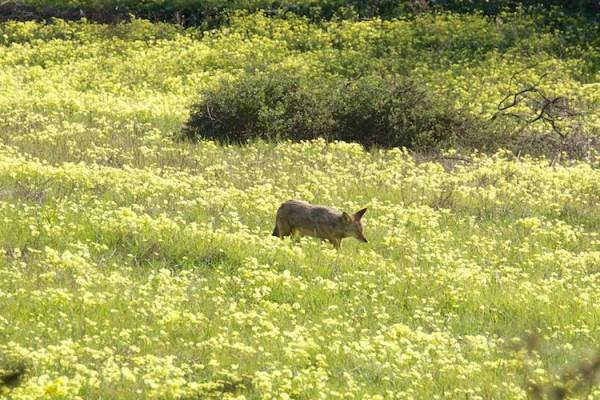
The featured photo at the top of this article was taken in Glen Canyon, another public park in San Francisco where oxalis has been sprayed annually for many years.  The copyright photo of a coyote in a field of oxalis was taken by Janet Kessler and is shown with her permission.

Fact vs. Fiction: The real threats to native plants in California

The enduring fiction of the native plant movement is that the existence of non-native plants threatens the existence of native plants by “crowding out” native plants.  If that were true, we should expect to see some evidence of such a causal relationship after 250 years of steadily increasing numbers of non-native plant species.  But we don’t. 

Marcel Rejmanek (UC Davis) is the author of the most recent report on plant extinctions in California, published in 2017.  At that time there were 13 plant species and 17 sub-species native to California known to be globally extinct and another 30 species and sub-species extirpated in California but still found in other states.  Over half the globally extinct taxa were reported as extinct over 100 years ago.  Although grassland in California had been converted to Mediterranean annual grasses by grazing domesticated animals decades before then, most of the plants now designated as “invasive” in California were not widespread over 100 years ago.

Most of the globally extinct plant species had very small ranges and small populations.  The smaller the population, the greater the chances of extinction.  Most of the globally extinct plants were originally present in lowlands where most of the human population and habitat destruction are concentrated. Although there are many rare plants at higher altitudes, few are extinct.  Plants limited to special habitats, like wetlands, seem to be more vulnerable to extinction. The primary drivers of plant extinction in California are agriculture, urbanization and development in general.

Non-native plants are the innocent bystanders to disturbance

“Invasive species” are mentioned only once in the inventory of extinct plants published by California Native Plant Society and only in combination with several other factors. However, the identity of this “invasive species” is not clear.  Rejmanek suggests that the “invasive species” rating refers to animal “invasions” by predators and grazers.  He says, “Indeed, one needs quite a bit of imagination to predict that any native plant species may be driven to extinction by invasive plants per se.” (1)

Although climate change is not cited as the cause of any of the known plant extinctions in California, Rejmanek predicts that climate change is likely to be a factor in the future, not only because of the impact of drought and higher temperatures, but also because non-native plants may be better adapted to changed conditions.

There are over 1,000 naturalized non-native plant species in California.  Their presence is associated with human disturbance.  Naturalized non-native plants are a symptom of disturbance, not the cause.  The impact of non-native plants on native plants cannot be separated from other factors that created the conditions for success of non-native plants.

Specialized insects are exaggerated

Another popular fiction among native plant advocates who love to hate non-native plants is that specialized insects—especially pollinators—require specific native plant species. Again, the record of plant extinctions in California does not support that myth:  “…there is no indication that the loss of pollinators was an important factor in plant species extinctions in California. [For example, one of the native plant species extirpated in California] has many documented non‐specialized pollinators. There does not seem to be any particular dispersal mode associated with presumably extinct plants in California.” (1)

Putting plant extinctions into context

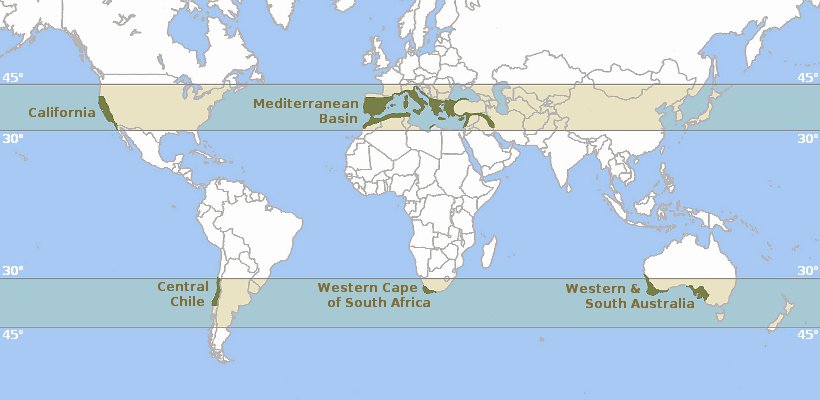
Mediterranean Climates are found in coastal temperate zones. Mediterranean climates are characterized by hot dry summers and mild wet winters.

Setting sub-species aside, there are 5,280 identified native plant species in California and 28 known extinctions of native plant species, including 15 plant species known to still exist in other states.  Only .53% of California native plants are known to be extinct in California, about one-half of one-percent.  Does that seem like a lot?  Rejmanek compared the extinction rate in California with other Mediterranean climates.  The extinction rate of native plants in California is similar to those in the European Mediterranean Basin, South Africa, and Australia, but a little greater than the rate in Chile, where there are fewer endemic plants that exist only in Chile.  Endemism is associated with small native ranges and small populations that are more vulnerable to extinction.

Why are there many endemic plants in California?

About 40% of native plant species in the California Floristic Province are endemic, found only in California and in most cases only in small areas within California, including our off-shore islands.  Their small populations in isolated geographic areas, sometimes within unique ecosystems, such as alkaline sinks, make them particularly vulnerable to extinction.

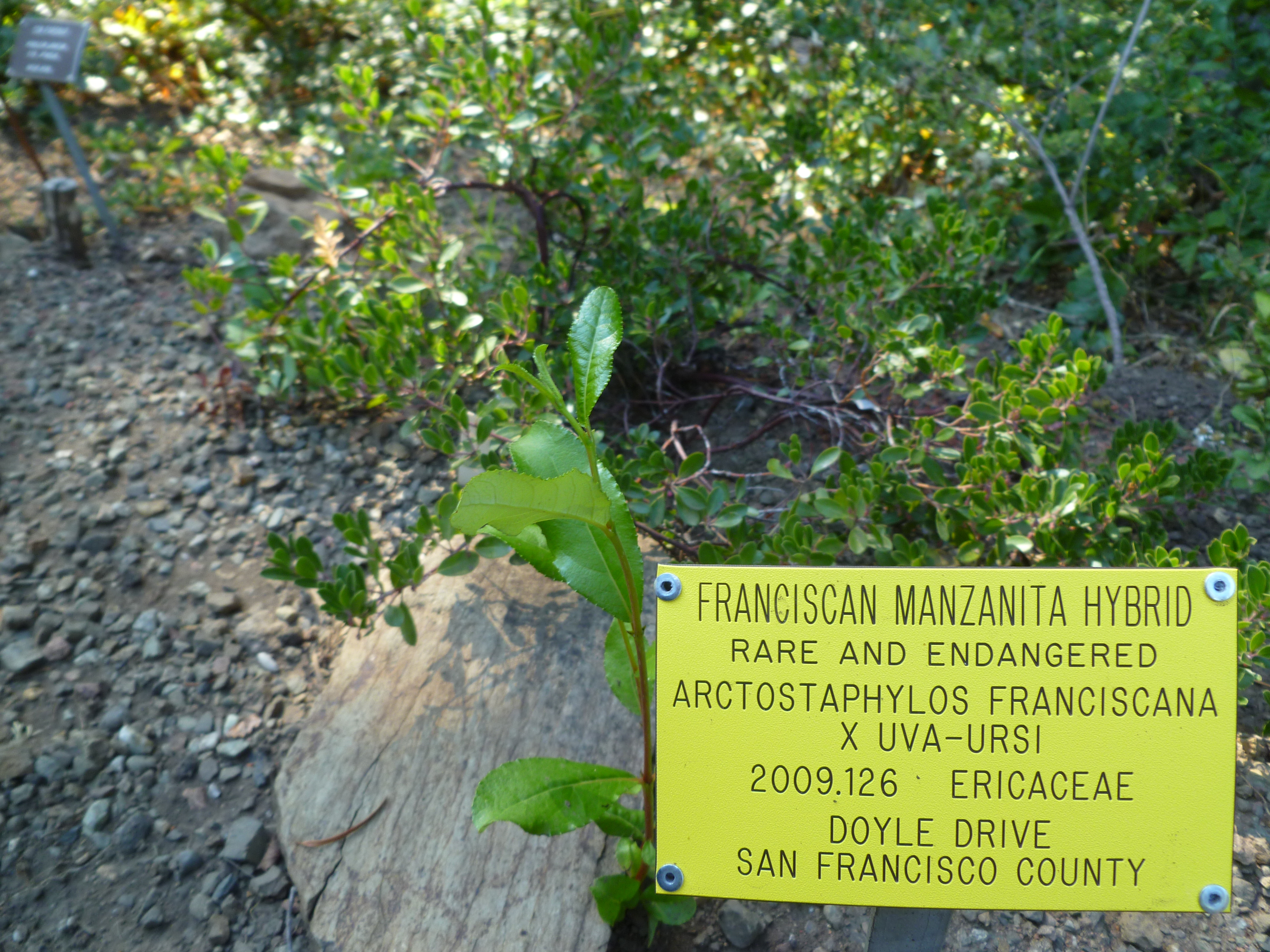
The evolutionary history of endemic plant species explains why there are so many in California.  Endemic plants are close relatives to plants that exist elsewhere and are sometimes plentiful where they came from.  For example manzanita is a genus of chaparral shrub that is plentiful in California, but there are also many rare endemic manzanita species that occur only in small areas and small populations.  There are several endangered manzanita species in the Bay Area (pallid, Raven’s, Franciscan).

Franciscan manzanita is one of 2 endangered manzanita species in San Francisco. There is one individual plant left of each of these two manzanita species. There are many endemic plants and insects in San Francisco and several are now extinct. San Francisco has a complex, diverse geology and topography and it is surrounded on 3 sides by water, creating many small, isolated microclimates in which many endemics have evolved.

The geography of California explains why the evolution of a plant species diverged from its plentiful ancestors to become an endemic species in a small geographic area.  Plants move around in a wide variety of ways, most natural, without the aid of humans.  Their seeds are dispersed by animals and birds that eat them or inadvertently carry them to another location.  Sometimes their seeds are carried on the wind or brought to islands by storms and currents.

When a plant arrives in a new location that is isolated from its original home and therefore cannot mate with its relatives, it begins its own, independent evolutionary history.  Each successive generation is reacting to its new environment, rewarding its fitness with its new home with a successful new generation.  Each generation rolls the genetic dice, its genome drifting away from its ancestors in a random way.  Occasionally a mutation will occur that alters the evolutionary trajectory.  Eventually, the plant in its new home is sufficiently genetically distinct that taxonomists are ready to call it a separate species.  Naming a new species is a judgment call, often questioned by some taxonomists, called “lumpers” as opposed to the “splitters” who are ready to name it a new species.

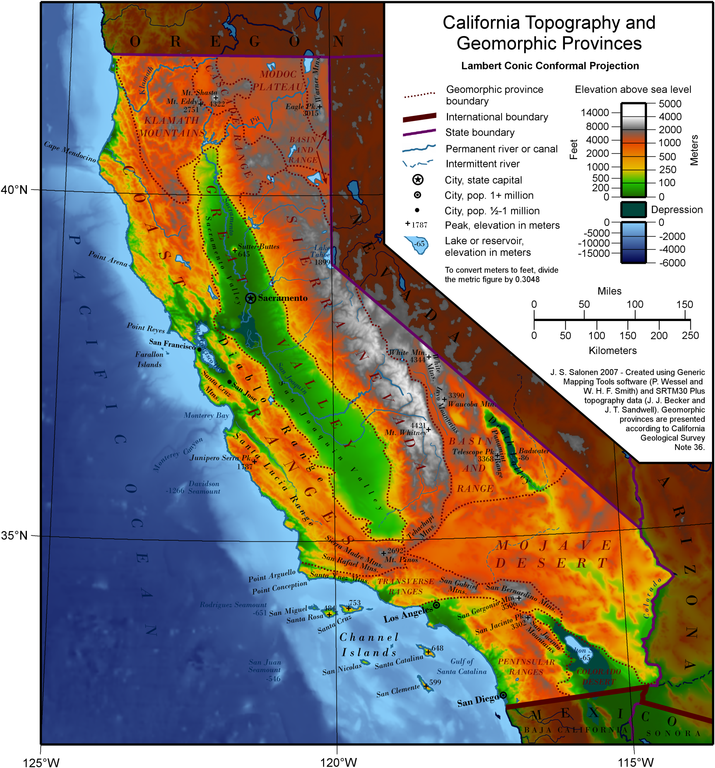
The factors that result in endemic species are many, but broadly speaking they are mobility and, ironically, isolation.  California is one of the most geographically diverse states in the country, with corridors for mobility, but many barriers that create isolation.  Gordon Leppig describes California’s geographic diversity in Beauty and the Beast:  California Wildflowers and Climate Change, published by California Native Plant Society:  “The state’s natural wonders include five deserts, the highest and lowest points in the continental United States, the third-longest state coastline (about one thousand miles), the most national parks (nine), the most federally designated wilderness areas (more than 140), the highest percentage of wilderness in the contiguous United States (14%), the most diverse conifer assemblage outside the Himalayas, the most federally listed species….”  The multitude of different ecosystems with unique microclimates produces one of the most diverse floras in the world.

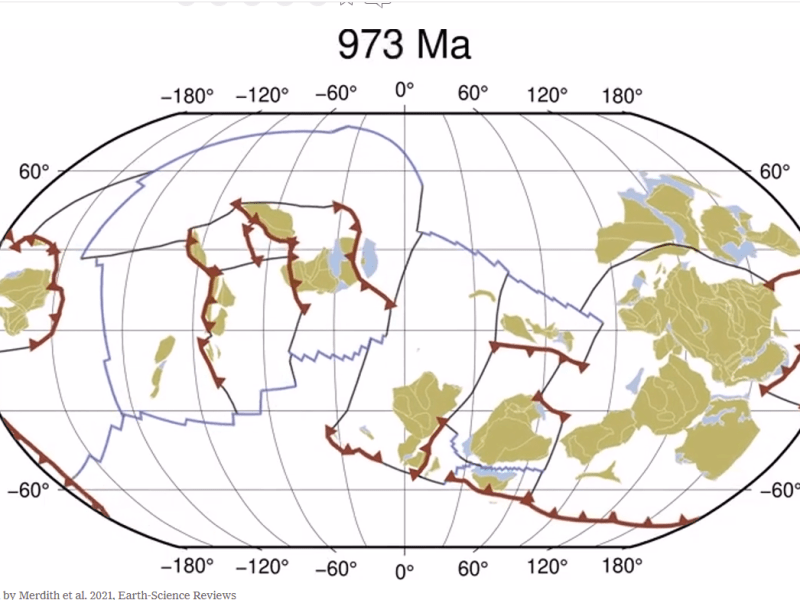
Click on the picture to watch the movement of tectonic plates over one billion years. Watch California slowly emerge as the jigsaw puzzle takes shape. California is the edge of two tectonic plates that collide and grind past one another perpetually, uplifting and dropping the land into fractured geomorphic pieces.

Human activities penetrate the barriers that created genetic isolation in the past.  Our roads become corridors for the biological exchange that threatens small, isolated pockets of rare plants.  Trade and travel has ended the isolation of off-shore islands.  Our roads and dams also create new barriers for mobility.  In other words, we are altering pre-settlement corridors and creating new ones.  We should expect consequences for our ecosystems for the changes we have made.

Given the number of rare and endemic plants in California and the changes in the environment required to accommodate nearly 40 million human Californians, it seems that extinction of less than one-half of one percent of native plants is a surprisingly small loss. 


(1) Marcel Rejmanek, “Vascular plant extinctions in California: A critical assessment,” Diversity and Distributions, Journal of Conservation Biogeography, 2017

Migration: Life on the move

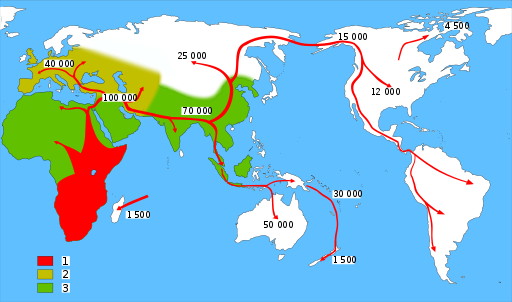
Sonia Shah’s recently published book, The Next Great Migration: The Beauty and Terror of Life on the Move, takes a deep dive into the past to trace the ancient history of migrating life on Earth. For as long as life has existed on Earth, life has been on the move, as needed to survive the constantly changing environment in which all plants and animals live.

1 Homo sapiens
2 Neanderthals
3 Homo erectus

Shah’s is an ambitious attempt to tell this story, not confined to human migration, but encompassing plants and animals as well because all of these migrations are connected. Scientists speculate the earliest migrations of human ancestors, some 100,000 years ago out of Africa, were in pursuit of the migrating animals that humans hunted.  On balance, the movements of plants and animals are beneficial to life on Earth because they are necessary to survive. When they aren’t beneficial, the problems are usually short-lived and humans are usually unable to stop them because nature is more powerful than we are.

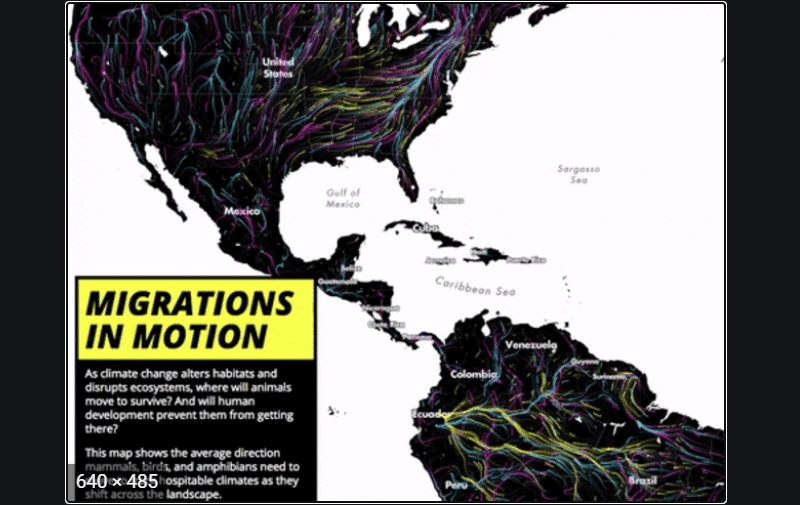
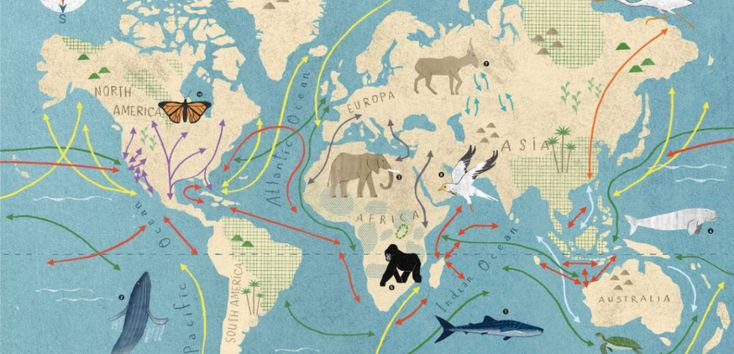
Click on map for animated movement of animals in response to changing climate conditions.

Migrations are even more frequent at a time of rapid and extreme climate change. As crops fail in the withering heat and drought caused by global warming, farmers are abandoning their farms to find the food they need to survive. Hence, Shah’s prediction that we are about to witness the “next great migration” because of the challenges of climate change. When the climate changes, the vegetation changes. When the vegetation changes, animals must move to find the food they need. Humans wish to put ourselves in a special category that denies our kinship with animals. But we are as dependent upon our food as any animal and the changing climate will challenge our existence as much as other forms of life.

Shah also traces the brief history of human knowledge of migrations about which little was known before the development of the scientific tools to study it.  Paleontology could dig up fossils that would raise more questions than answers about the residents of deep time, but it wasn’t until the development of molecular analysis that fossils could inform scientists of the evolutionary history of and close relationships among plants and animals that reflect migrations in the distant past.  New technology is capable of tracing the movements of animals that were unknown in the distant past, when animals seemed to mysteriously disappear at the end of one season and returned at the beginning of another season.

Invasion Biology is based on ignorance of migration

The fact that animal migration was largely unknown led to some fundamental misunderstandings about nature, including the unfortunate rise of nativism in the natural world that was spawned by the mistaken hypotheses of invasion biology. Shah explained the consequences of inadequate knowledge of migration in a recently published article in New York Times Magazine:

“When scientists considered movements across barriers and borders, they characterized them as disruptive and outside the norm, even in the absence of direct evidence of either the movements themselves or the negative consequences they purportedly triggered…Influential subdisciplines of biological inquiry focused on the negative impact of long-distance translocations of wild species, presuming that the most significant of these occurred not through the agency of animals on the move but when human trade and travel inadvertently deposited creatures into novel places.  The result, experts in invasion biology and restoration biology said, could be so catastrophic for already-resident species that the interlopers should be repelled or, if already present, eradicated, even before they could cause any detectable damage.”

In turn, Invasion Biology spawned pointless and destructive eradication projects

Conservation Sense and Nonsense has followed the destructive and futile attempts to eradicate plants and animals that nativists say “don’t belong here:”

  • Hawaii is an extreme case of attempts to eradicate non-native plants and animals: frogs, owls, egrets, seals, fruit trees, mangroves, parrots, etc.  These eradication projects often do more harm than good.  The “logic” for these projects is muddled, partly because the Hawaiian Islands emerged from the sea as barren volcanoes.  The question of “what belongs there” is a matter of opinion and debate in Hawaii and elsewhere.

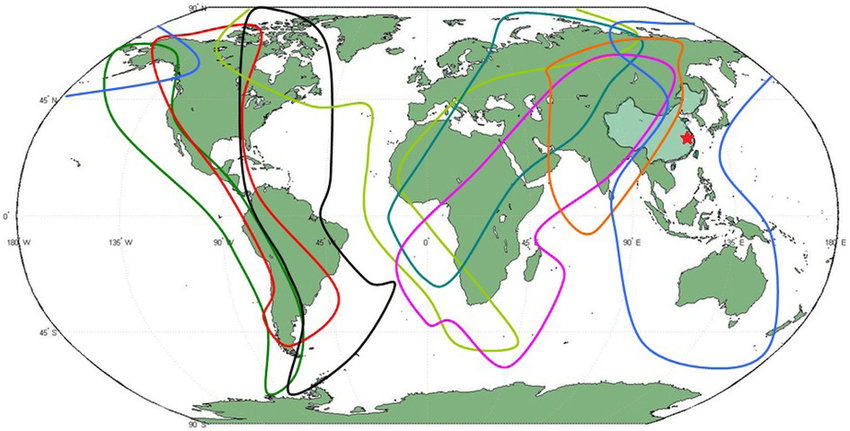
Bird migration routes

Migration enables survival

I hope that improved knowledge of migration will help people understand that migration is a natural phenomenon that is essential to the survival of all life on Earth.  Migration enables life to adapt to changes in the environment, facilitating evolution and reducing frequency of extinction.

Cal Fire grant has created fire hazards in the East Bay Hills

Hoping to get the public’s attention, I will begin this story with its ending.  This is the concluding paragraph of my formal complaint to Cal Fire about its grant to UC Berkeley for a project that has increased fire hazards in the East Bay Hills, caused other significant environmental damage, and created conditions for further damage:

“In conclusion, the grant application for this project makes a commitment to reducing greenhouse gas emissions that is based on the assumption that a biofuels plant will generate electricity from the wood debris.  Such a plant has not been built and UC Berkeley apparently does not intend to build such a plant.  Other claims made in the grant application about carbon storage are based on inaccurate claims about carbon storage.  Grant guidelines state, “Failure to meet the agreed upon terms of achieving required GHG reduction may result in project termination and recovery of funds.”  In other words, Cal Fire should terminate this project and recover any funds that have been remitted to UC Berkeley.  The project is a misuse of grant funds because it will increase fire hazards and increase greenhouse gas emissions.  Without imputing motives, on the face of it, the grant application looks fraudulent.”

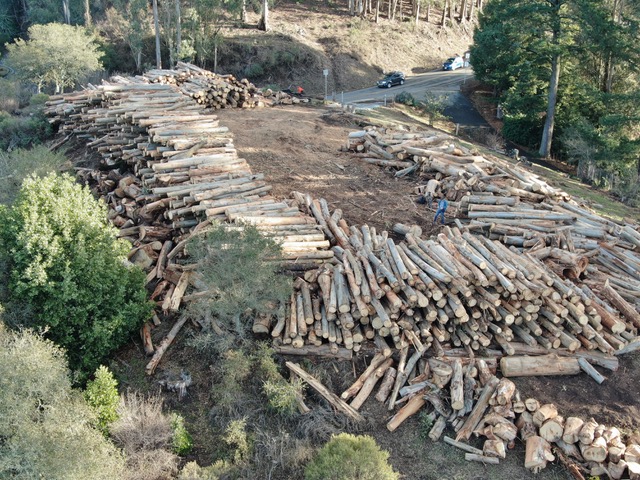
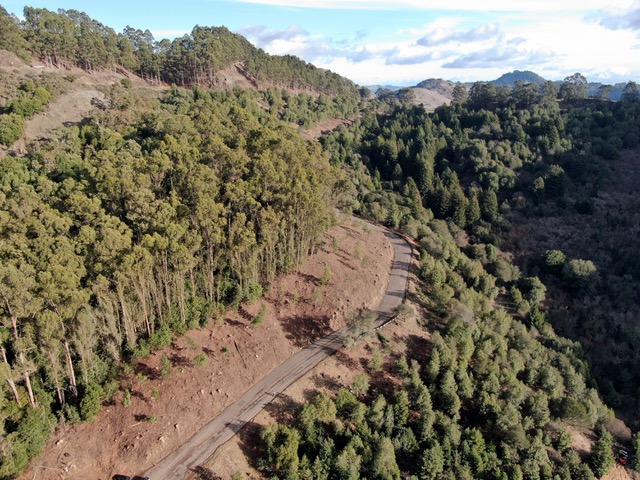
I published an article about this project last week that I invite you to revisit if you need a reminder of a project that has clear cut all non-native trees 100 feet on the north side of Claremont Ave. in Berkeley, leaving equally flammable native trees in place on the south side.  Huge piles of wood chips and logs are stacked along the road that were supposed to have been disposed of by generating electricity in a biofuels plant.  No such biofuels plant exists and there are no plans to build it.  The disposition of these potential bonfires is at the moment unknown.

The source of the funding for Cal Fire grants is California’s carbon cap-and-trade law that is intended to reduce greenhouse gas emissions, primarily carbon emissions.  Therefore, the grant application required the applicant to prove that the project would reduce greenhouse gas emissions to qualify for the grant.  The grant application submitted by UC Berkeley claimed to meet this requirement by making a commitment to use the grant to build a biofuels plant. The biofuels plant would have generated electricity by burning wood fuel instead of burning fossil fuels. In fact, the project has significantly increased greenhouse gas emissions by destroying large, mature, healthy trees.  The carbon the trees have stored throughout their lifetimes is now being released into the atmosphere as the wood debris decays along the roadside.

UC Berkeley made other inaccurate claims about carbon storage in order to qualify for the grant:

  • Statements made in the grant application about carbon loss and storage by planting oaks are not accurate:
    1. Coast Live Oaks (CLO) do not live for “hundreds of years,” as erroneously claimed by the grant application. USDA plant data base says CLOs live about 250 years in the wild.  However, that estimate of longevity does not take into account that Sudden Oak Death has killed over 50 million oaks (CLOs and tan oaks) in California in the past 15 years.
    2. Blue Gum eucalyptus lives in its native range 200-400 years. It has lived in California for 160 years, where it has fewer predators than in its native range.
    3. The grant application states that carbon storage will be increased by “changing species composition to hardwoods.” In fact, eucalyptus is also a hardwood tree, making this an inaccurate, discriminatory distinction.
    4. Above-ground carbon storage in trees is largely a function of biomass of the tree. Therefore, larger trees store more carbon.  It follows that carbon storage is not increased by destroying large, mature, healthy trees and replacing them with saplings of smaller trees, such as oaks.  The carbon lost by destroying mature trees is never recovered by their smaller replacements with shorter lifespans.
  • Plans to plant oaks where non-native trees have been clear cut willfully ignore the realities of the accelerating epidemic of Sudden Oak Death (SOD) in the East Bay Hills. According to the press release for the 2020 SOD Blitz, “…overall the rate of SOD infections increased in the wildland urban interface, in spite of reduced rainfall. This is the first time in 13 years of SOD Blitz survey that infection rates increase in spite of reduced rainfall, suggesting SOD is becoming endemic at least on the Central coast of California.”  As Cal Fire knows, dead trees are a greater fire hazard than living trees.
  • The grant budget commits the grantee (UCB) to pay “volunteers” to plant oaks.  That budget line item is described in the budget narrative as being funded by volunteer, non-profit organizations over which UC Berkeley has no authority. A “volunteer” is, by definition, not required to perform the assigned task.  It follows, that calculations regarding carbon storage resulting from this project are not ensured by the project because the planting of oak trees is not ensured by the project.  The “cost” of this line item in the budget seems more theoretical than real.
  • Planting young trees will require frequent irrigation that is not funded by the grant. Given continuing and worsening drought, planting young trees without making a commitment to irrigating them is throwing good money after bad.  Rainfall to date is 26% of the previous year.  Rainfall the previous year was less than half the year before that.  Oaks are not more drought tolerant than eucalyptus that are native to an equally dry climate.

The grant application also displays ignorance of trees and the functions they perform in the environment. 

  • The trees that remain on the north side of the road are now more vulnerable to windthrow because they have lost protection from their neighbors on their windward side. Trees develop their defenses against the wind while they grow in response to the wind to which they are exposed.  In California, most wildfire events are associated with high winds, making windthrow and wildfire probable simultaneous events.
  • The run off from the eroded hillside will undoubtedly pollute the creek on the south side of the road with sediment and road run off.

Claremont Ave. west of Grizzly Peak Blvd, December 2020. Photo by Doug Prose.

The project is not a suitable evacuation route

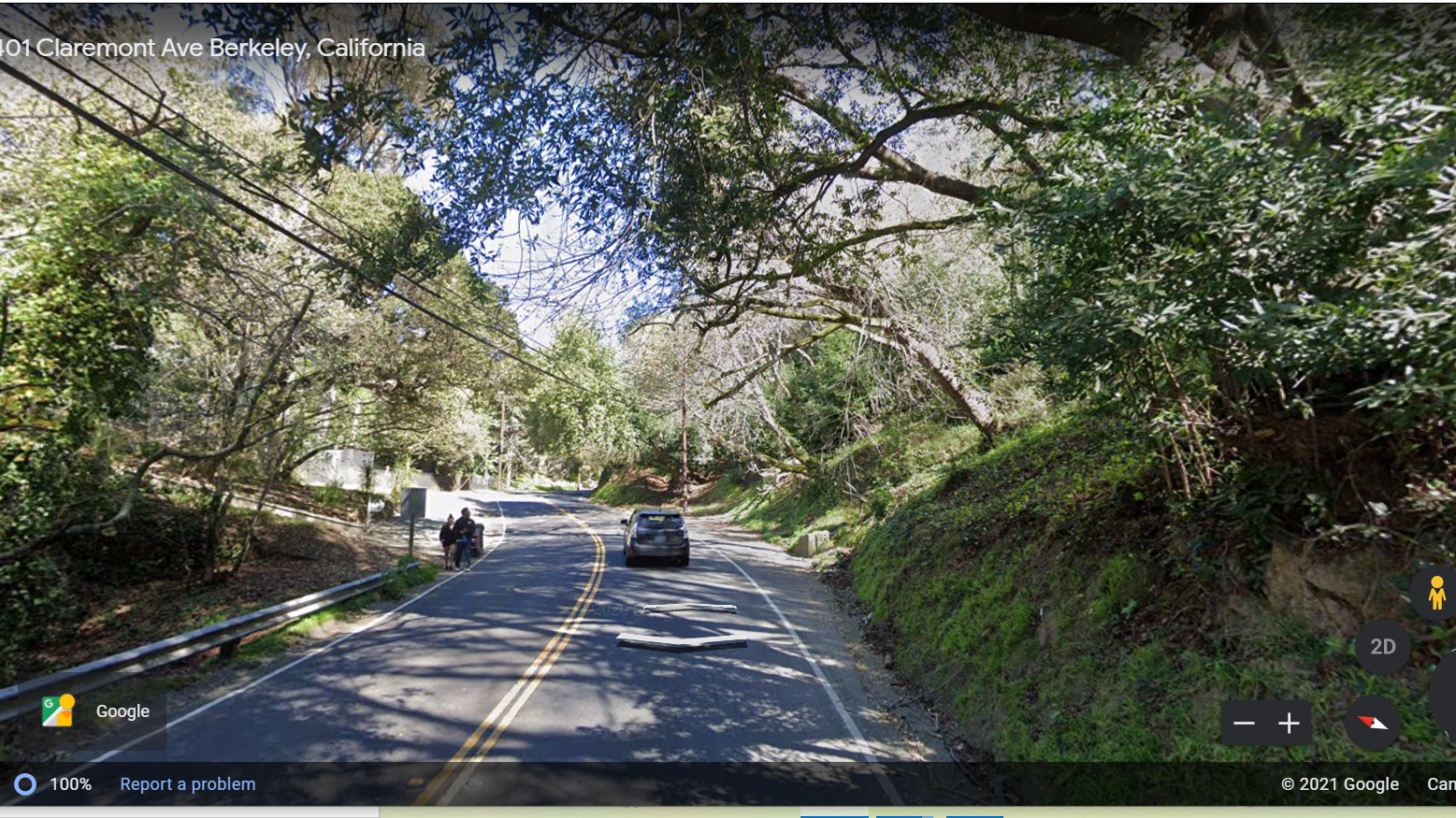
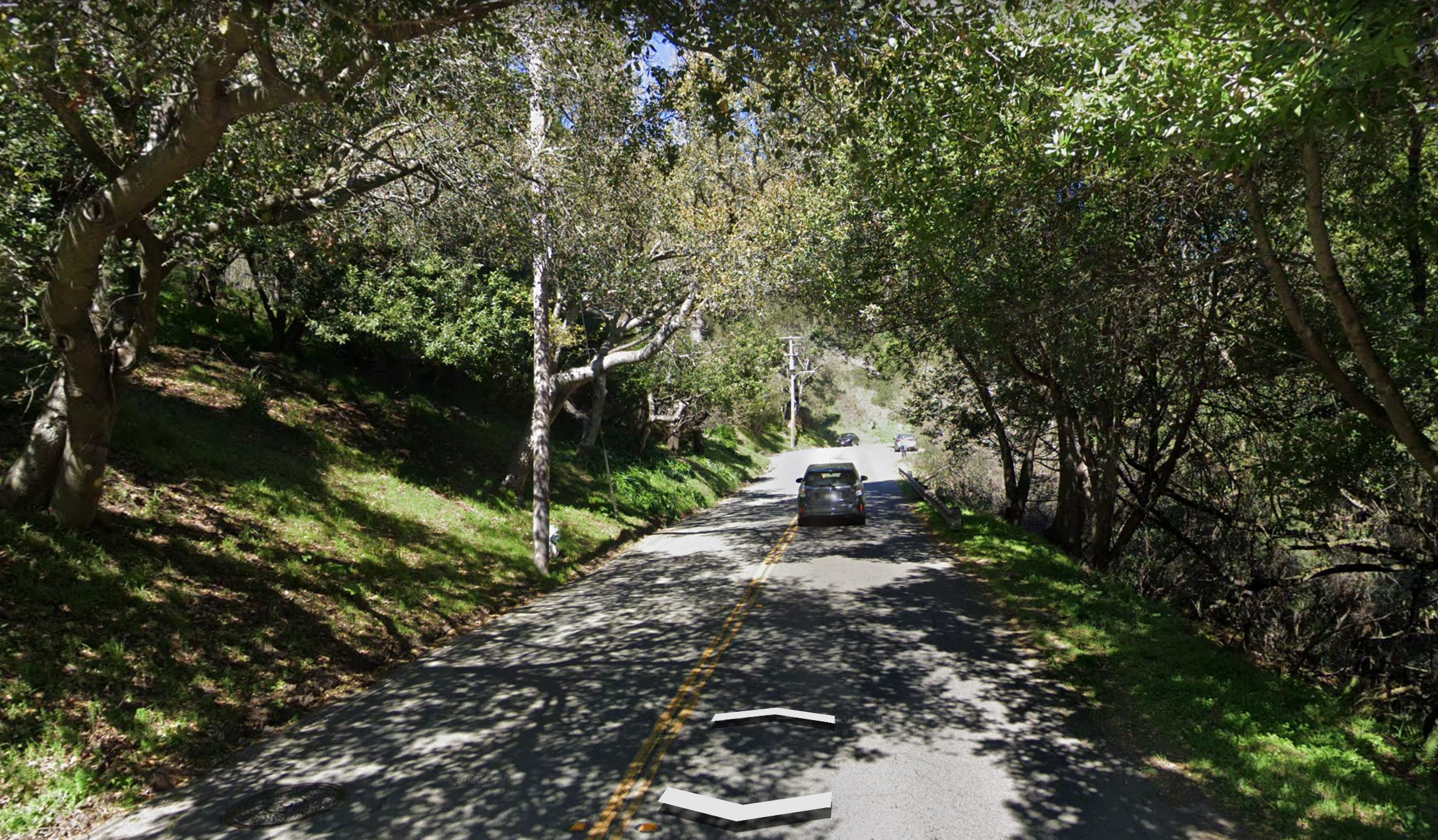
Claremont Ave, west of the Cal Fire/UCB project is a residential neighborhood, heavily wooded with native trees that overhang the road.   Source Google Earth.

The justification for this project was to provide an evacuation route. It is a premise that makes little sense. There are no residences east of Grizzly Peak Blvd, where the project begins. The residential community on Claremont Ave. is downhill, west of the project. If the residential community needs to evacuate, it won’t be fleeing up hill. Residents will need to flee downhill, through a tunnel of native trees. The roadside through the residential community is heavily wooded in native oaks, bays, and buckeyes. High voltage power lines overhang the road.  Nothing has been done to clear that road for possible evacuation.  This residential community would benefit from the creation of a safe evacuation route, not the pointless project that was done.

Claremont Ave, west of Cal Fire/UCB project is heavily wooded with native trees that overhang the road.  There are also high-voltage power lines hanging over the road.  Source Google Earth.

What’s next?

I received the following promising reply from Cal Fire by the end of the day I sent the complaint:  We are in receipt of your email dated 1/14/2021 in regards to a Fire Prevention Grant awarded to the University of California Berkeley (UCB).  We will promptly begin investigating your concerns and allegations of UCB non-compliance with the grant’s guidelines and contractual agreement.  I will respond to you within 30 days with the results of our findings.  CAL FIRE takes the grant assistance programs very seriously so we will investigate thoroughly.”

What’s done cannot be undone.  The best we can hope for is that the strategy used to reduce fuel loads on Claremont Ave. won’t be used elsewhere.  My primary goal is to prevent this destructive approach from being used on 300 miles of roadside in Oakland, as the supporters of the UCB project on less than one mile on Claremont Ave are demanding.

Governor Newsom has proposed that the State budget should invest an additional $1 billion in reducing fire hazards in California.  The proposal includes $512 million for landscape-scale vegetation projects.  Cal Fire will probably administer those grants.  It is critically important that Cal Fire improve its evaluation of grant applications to avoid funding disastrous projects such as the project done by UC Berkeley on Claremont Ave.  There are many worthwhile projects that deserve funding, such as providing the residential community on Claremont Ave a safe evacuation route.