Island eradications in the Bay Area rear their ugly head again

The Farallon Islands are a National Wildlife Sanctuary just 27 miles off the coast of San Francisco, where millions of birds and marine animals are legally protected.  Plans of the US Fish and Wildlife Service (USFWS) to aerial bomb 1.3 metric tons of rodenticide to kill mice on the Farallon Islands originated over 5 years ago.
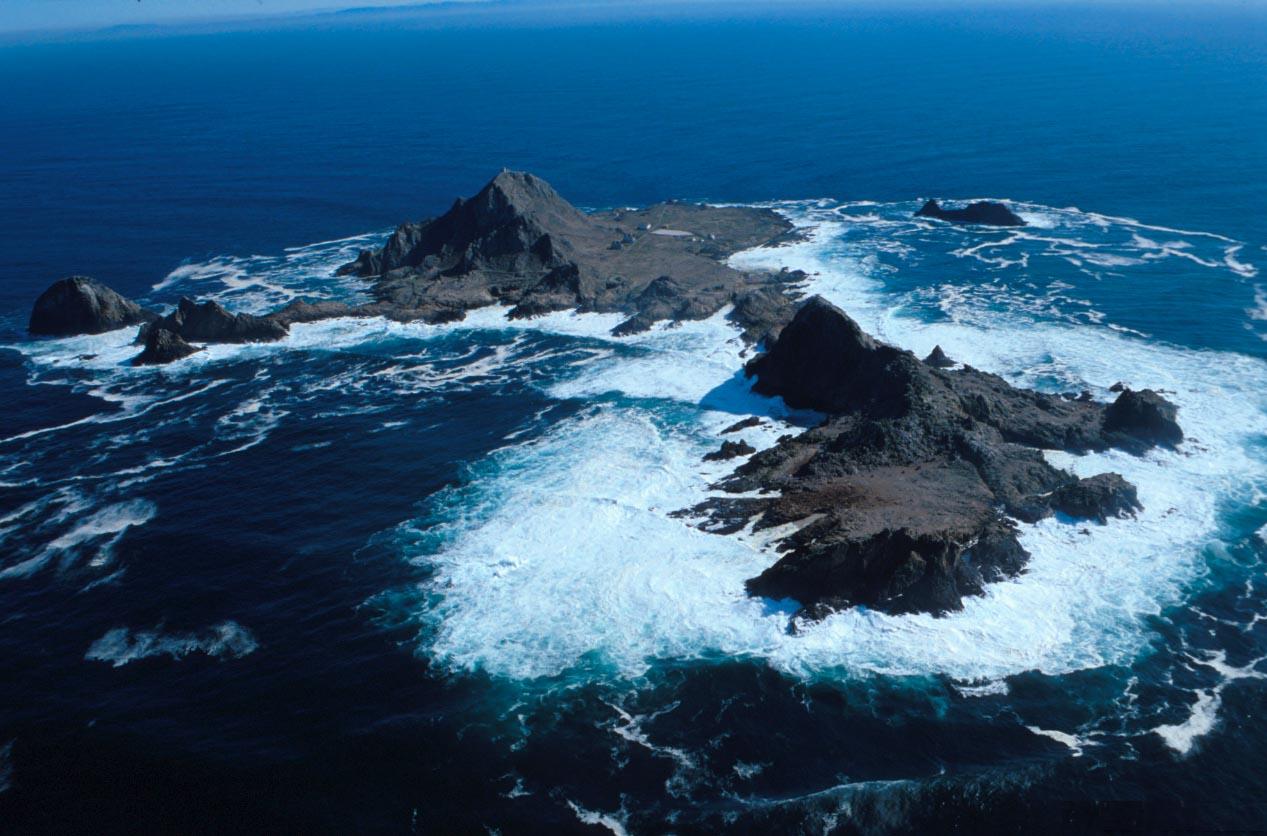
Farallon Islands, NOAA

The stated purpose of this project was to protect the ashy storm petrel, a legally protected species of concern.  The mice are not a direct threat to the petrel.  Rather, USFWS claims that another legally protected species of concern, the burrowing owl, eats the chicks of the petrel when the population of mice dwindles.  Because the average population of burrowing owls on the Farallons is said to be only 6 burrowing owls, the scale of their predation of petrel chicks seems minimal given that their preferred prey is mice.  USFWS theorizes that if the mice are killed, the burrowing owls will leave the Farallons.  This rather fanciful scenario is less credible than the more likely outcome that the burrowing owls will either be killed by the poison or eat yet more petrel chicks if their mice diet is eliminated.

Aside from the convoluted and questionable rationale for this project, the main concern is the anticipated collateral damage caused by aerial bombing huge quantities of rodenticide (brodifacoum).  The planned rodenticide is an anti-coagulant that is highly persistent and causes all vertebrate animals (mammals, reptiles, birds, fish, etc.) to bleed to death.  Death is not quick; the poisoned animals stumble around before dying and are easy prey for other animals that are then killed by the poison.  Dead, poisoned mice are equally attractive food for some birds.  The poison pellets are also as appealing to other animals as to mice.  Even the supporters of this project readily admit that many animals other than mice are likely to be killed directly by the rodenticide or as secondary victims.  “Stuff happens,” they say with a shrug.

The author of the Environmental Impact Statement is the same organization—Island Conservation—that will implement the project, if and when it is approved.  This conflict of interest seems one of many unwise decisions made by US Fish and Wildlife Service.

The opposition to this project has been loud and clear.  Maggie Sergio, who reported this project on Huffington Post, published a petition in opposition to the project that was signed by over 32,000 people.  And many prestigious organizations including the EPA, American Bird Conservancy, City of San Francisco, The Ocean Foundation, and several retired USFWS scientists, have also criticized the project.  Yet, five years later approval of the Revised Draft Environmental Impact Statement is still pending. Theoretically this project is still alive.

Farallons project comes to life again

The Farallons project has always seemed to us so ill-advised and misconceived that we could not believe it would materialize.  We have therefore not covered it since 2014 when we republished Maggie Sergio’s Huffington Post article and asked people to sign her petition.

Unfortunately, we were under-estimating the power and influence of the supporters of this project.  Bay Nature, a local nature magazine, recently published an article about the Farallons project and island eradications in general.  That article seems to assume there is consensus that mice must be eradicated on the Farallons and that the only question is the method that will be used (more about Bay Nature’s proposed method later).  And the California Invasive Plant Council (Cal-IPC) has published an endorsement of island eradications—including the Farallons—in its most recent newsletter (available here: Cal-IPCNews_Summer2016).  Cal-IPC’s preferred strategy for eradications is aerial application of rodenticide.  Therefore, our concern about the proposed Farallons project has once again been elevated to crisis levels.  When two local organizations, which claim to advocate for conservation endorse the Farallons project, we must take it seriously.

History of island eradications

Since learning about plans to eradicate mice using rodenticides, we have learned that the practice originated in New Zealand, where poison applications began over 60 years ago to kill a wide range of non-native animals.  Bill Benfield tells the entire story of eradications in New Zealand in his book, At War With Nature.  (1) We have relied on that valuable resource for this article.  That history is relevant to us because there are some striking similarities between the North American and New Zealand versions of invasion biology, the ideology that drives eradication attempts in North America and New Zealand.
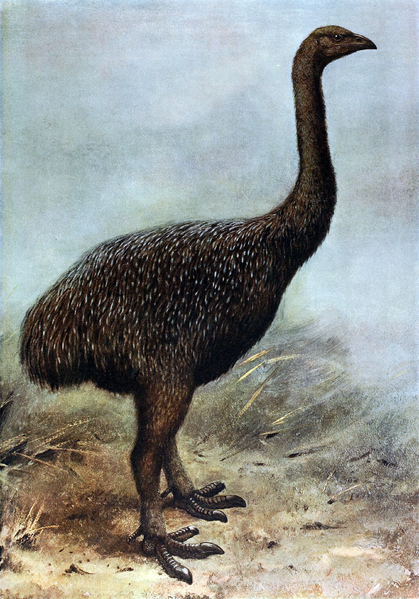
The moa was a huge flightless bird that was hunted to extinction by Polynesians when they occupied New Zealand.

Humans occupied New Zealand more recently than their arrival in North America.  Prior to their arrival, New Zealand was inhabited by many flightless birds that were successful because they had no predators.  The moa was the largest of those birds.  Although it has been extinct for hundreds of years, palaeontologists tell us the moa was about 12 feet tall and weighed about 500 pounds.  It was easy prey for the first humans who arrived in New Zealand about 800 hundred years ago from Polynesian islands.  As most sea-faring humans do, they unintentionally brought with them a species of rat, the kiore.

The climate of New Zealand is much colder than the Polynesian home of the first humans and their agriculture was not well suited to the climate of their new home.  The moa quickly became the main source of food for the humans. The moa were rapidly driven to extinction by hunting, which forced the humans to retreat to the northern end of New Zealand where the climate is milder and their agriculture was more successful.

Although there is some debate about the size and range of the moa population, Dr. Graeme Caughley reported that the moa population was very large and widely spread, based on a calculation of the available sustainable bio-mass.  He believes moa populations existed in all vegetation types, including forests where they would have browsed the forests.  Intense browsing of the forests would have encouraged the growth of the slower growing and unpalatable browse-resistant trees that became the forest giants. The faster growing species of trees were the palatable browse- tolerant species that were held back by browse, allowing the growth of slower growing trees that would in time become the forest giants.  The moa also would have spread the seeds of the trees they ate and inhibited the growth of an understory.  In other words, the forest that humans found when they arrived in New Zealand around 1200 AD was adapted to the big population of moa.

In the absence of moa the composition of the forest quickly responded to the absence of browsing.  Fast growing trees that were formerly held back by browse were no longer at a disadvantage compared to slow growing and unpalatable browse-resistant trees; the forest under-story became denser.  The composition of the forest that was found by Europeans when they arrived in New Zealand several hundred years later was in transition. 

Forest in New Zealand

The first humans on New Zealand did not have a written language.  The landscape they found when they arrived is not recorded in history and is only known to the extent that archaeological and paleontological evidence is accurately used to reconstruct it.  As all human science does, these disciplines are continually evolving and therefore did not inform the earliest versions of ecology that spawned the eradication movement on New Zealand.  In other words, the forest found by Europeans when they arrived in New Zealand is still considered the pristine ideal that ecologists wish to replicate.  In fact, that landscape was just as modified by human habitation as any modern, “novel” ecosystem.

This fantasy of a pristine, pre-human landscape is similar to the fantasy in North America that the landscape found by Europeans when they arrived on the East Coast in the 16th century and the West Coast in the 18th Century was the “natural” landscape, unaltered by humans.  They are just as mistaken in that assumption as they are in New Zealand. Native Americans actively managed the landscape to serve their horticultural and cultural needs.  The consequences of that fantasy have been just as deadly and destructive in New Zealand as they have been here in California.

The deadly crusade in New Zealand

Europeans brought many animals with them to New Zealand, just as they did to North America.  They brought both domesticated animals such as sheep and wild animals such as deer that they could hunt.  The deer browse the forest, just as they do here, and the impact they have on the forest is similar to the impact moa had on the forest. The deer and other browsers are the functional substitute for the extinct moa. Fast growing palatable species of trees are disadvantaged by browsing and these are the trees that early ecologists considered the “natural” forests of New Zealand because they were the trees that were found when Europeans arrived. 
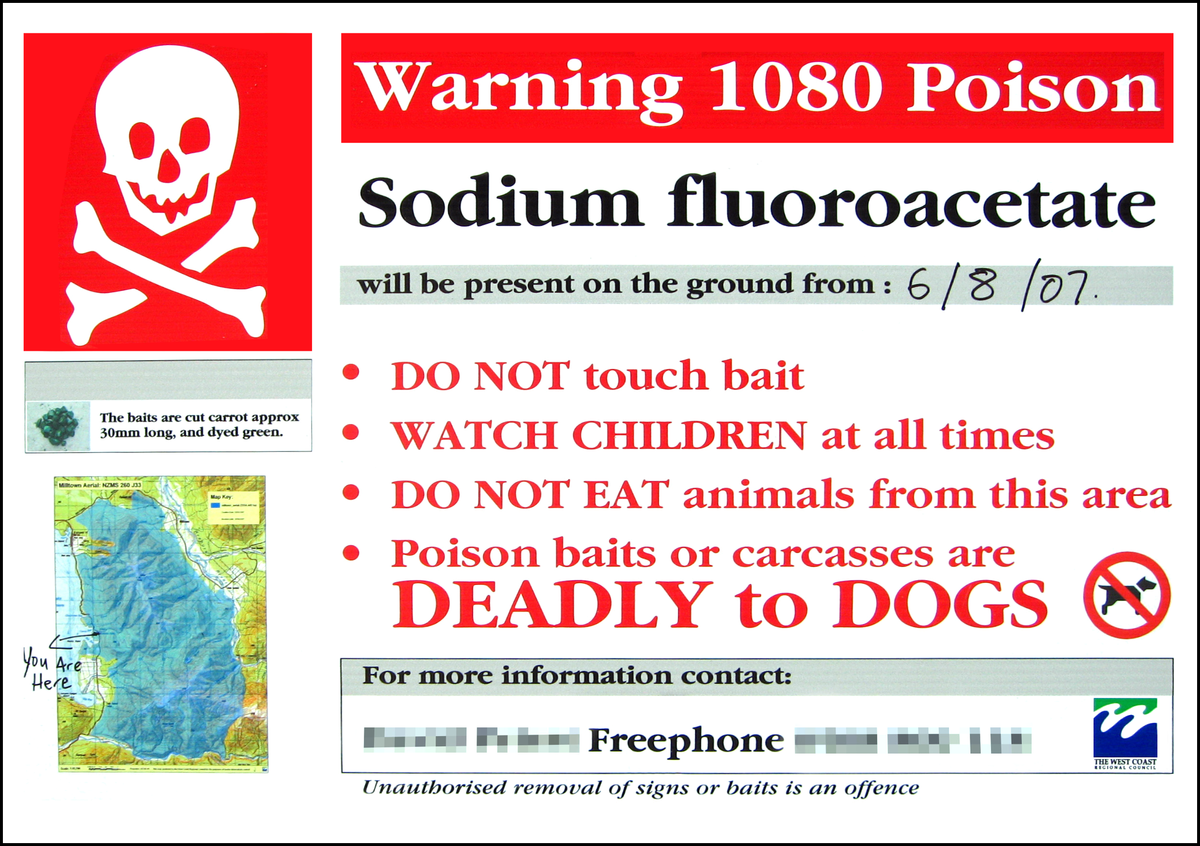
1080 Poison Warning in New Zealand
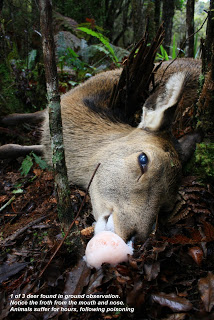
Deer poisoned by 1080. Graff Brothers, New Zealand
Graf Brothers, New Zealand

Hence, aerial poisoning of the land began over 60 years ago to kill all browsing animals in New Zealand except domesticated animals kept behind fences.  Smaller non-native animals such as possum are also targets for eradication because they are assumed to be predators of the few flightless birds that remain in New Zealand.  This accusation is refuted by Bill Benfield who tells us that possum are primarily vegetarians and that a study of the contents of possum stomachs found no evidence of bird predation.  Possum are also accused of being carriers of bovine TB, a disease that infects domesticated animals.  However, recent laboratory tests find no evidence that possum are infected with bovine TB, beyond minute levels.  In any case, the possum population is small because it is a species that rears only one pup per year, so its population would grow only slowly if they weren’t being exterminated in New Zealand.

The killing fields

A different poison is used in New Zealand–called Compound 1080–that operates in a different way than anti-coagulant rodenticide.  It kills indiscriminately any life form that requires oxygen.  It was developed as an insecticide in Europe, and was initially used in the US where it was briefly used to kill coyotes and other wildlife considered inconvenient predators until its use was severely restricted because of its extreme toxicity.  It is entirely banned in California, which is why our local version of island eradications use anti-coagulant rodenticide instead of 1080.
Graff Brothers DVD available on Amazon
Graf Brothers DVD available on Amazon

1080 is a slow, grisly killer of EVERYTHING: insects, fish, mammals, birds, amphibians, etc.  It is just as likely to kill native animals as non-native animals and it does.  This indiscriminate killing of every living thing in New Zealand was described in chilling detail by Elizabeth Kolbert in the New Yorker.  It is also visible in the videos of the Graf brothers for those with a strong stomach.  HERE is one of many of their videos.

Exporting death

We could turn a blind eye to what is happening in New Zealand if this strategy were not being exported all over the “civilized” world.  Amazingly, such island eradications have happened in many places and are being proposed in many places where local resistance is trying to prevent them from being implemented.  What have we learned from the projects that have been done?  The record is sketchy because very little after-the-fact monitoring of completed projects has been done.  What we DO know, suggests that it is not in the interests of the promoters of these projects to monitor the outcome of their projects because the results are consistently deadly and unsuccessful.

Killing one species of plant or animal does not restore an ecosystem

Readers of Million Trees will not be surprised to learn that killing one species does not magically “restore” an ecosystem to some historic ideal because ecosystems are very complex and their occupants live in communities with many, complex interactions that are not perfectly understood by humans, even humans calling themselves invasion biologists.

One study of islands off the coast of New Zealand compared the vegetation structure and ecosystems of three island systems: islands that never had rats, islands with rats, and islands on which rats had been “controlled.” They concluded that, “The extent to which structure and function of islands where rats have been eradicated will converge on uninvaded islands remains unclear…Since most impacts of rats were mediated through seabird density, the removal of rats without seabird recolonization is unlikely to result in a reversal of these processes. Even if seabirds return, a novel plant community may emerge.” (2)

There are many other factors that prevent the re-creation of historical landscapes, such as climate change.  There are undoubtedly many factors that are not known to us, which prevents us from “fixing” something we do not understand.  In any case, many of us don’t consider it necessary to “fix” something that we don’t consider broken.

Collateral damage and incompetent execution

In those few cases when after-the-fact monitoring was done, there is considerable evidence that many non-target animals were killed and the water was polluted.

In the case of Rat Island, off the coast of Alaska, no monitoring was planned after the aerial bombing of 46 metric tons of anti-coagulant rodenticide to kill rats.  However, neighbors of Rat Island demanded an investigation when they saw dead birds and animals floating in the vicinity of the island after the project was done.  That investigation (available HERE) was done by USFWS Law Enforcement.  The investigation found that the manufacturer’s recommendations regarding dosage were exceeded, that instructions to collect dead rats so they would not be eaten by birds were not followed, and that hundreds of birds died, including many legally protected bald eagles.  The investigation was not done until 7 months after the project was completed.  We should assume that the number of dead animals found would have been greater if the investigation had been done promptly after the project was completed.

Palmyra Atoll. USFWS

In the case of Palmyra Island, off the coast of Hawaii, the scientific study conducted after the aerial bombing of rodenticides reported, “We documented brodifacoum [rodenticide] residues in soil, water, and biota, and documented mortality of non-target organisms. Some bait (14–19% of the target application rate) entered the marine environment to distances 7 m from the shore. After the application commenced, carcasses of 84 animals representing 15 species of birds, fish, reptiles and invertebrates were collected opportunistically as potential non-target mortalities. In addition, fish, reptiles, and invertebrates were systematically collected for residue analysis. Brodifacoum residues were detected in most (84.3%) of the animal samples analyzed. Although detection of residues in samples was anticipated, the extent and concentrations in many parts of the food web were greater than expected.” (3)

The rats return

The most damning evidence of all is that after killing untold numbers of animals, including those not meant to be killed, and poisoning the environment with a deadly toxin that bioaccumulates and persists in our bodies, the rat population often returns to pre-project levels within a few years. 

Henderson atoll in the Pacific is an example of such a failure.  Eighty tons of rodenticide pellets were aerial bombed on Henderson in 2011.  Apparently, at least two rats survived, one presumably male and one presumably female.  Within a few years the rat population had returned to pre-projects levels of 50,000 to 100,000 rats.

The rats were said to have been introduced to Henderson over 800 years ago.  Surely they had reached some balance between population size and available food sources.  Rats are an ancient species that would not be here if they completely wiped out their food sources.  Rat population growth is modulated by available food sources.  Hence, when almost completely eradicated, the rats rapidly reproduced back to equilibrium with food sources.

Claims that the Henderson project was urgently needed to prevent the extinction of a bird species with which rats had co-existed for over 800 years were bogus.  If rats had not exterminated the birds within 800 years, they weren’t likely to do so before this pointless project killed tens of thousands of animals, probably including many birds.

Like most “restoration” projects, claims are made about a conservation crisis that is often just an emotional appeal without any scientific basis.  Money is raised and spent in response to these fabricated crises and many “non-profit,” untaxed organizations subsist on these campaigns.  In the case of New Zealand, the poison they are using is manufactured by the government, creating an unholy financial incentive for these eradication projects. 

The failure of the extermination attempt on Henderson is not an isolated incident.  Lehua is one of the Hawaiian islands on which extermination was attempted and failed.  An evaluation of that attempt was published in 2011 to determine the cause of the failure so that a subsequent attempt would be more successful.  That evaluation included this report on the success of similar attempts all over the world:  “An analysis of 206 previous eradication attempts against five species of rodents on islands using brodifacoum or diphacinone is presented in an appendix to this report. For all methods, 19.6% of 184 attempts using brodifacoum failed, while 31.8% of 22 attempts using diphacinone failed.”  Brodifacoum and diphacinone are both anti-coagulant rodenticides.  Diphacinone is considered less toxic and less persistent than brodifacoum.

The silver bullet?

The “restoration” industry is meeting with a great deal of public opposition.  Because some of the opposition is based on concerns about polluting the environment with pesticides–such as herbicides used to kill plants and rodenticides used to kill animals–the “restoration” industry is looking for a less controversial method of accomplishing their deadly goals.

This brings us back to the recently published article in Bay Nature about island eradications.  The article informs us that a genetic modification of mice is now being developed, which would drive that species to extinction by ensuring that all off-spring would be males, thereby ending reproduction of the species. This method has a seductive appeal because it would not poison the environment.  However, it is an insidious proposal and we will let some of the commenters on the Bay Nature article tell us why, because some of them sound like knowledgeable scientists with ethical concerns:

  • Has the conservation movement lost its mind? Gene drive is unsafe, unproven and unethical. It is the most insane idea I have heard of in my 20 years reporting on genetic engineering. And it is presented here with no critical analysis, scientific, ethical, or environmental. I have spent my life in conservation and want to do all I can for to stop extinction but using extinction to stop extinction? Gene Drive is a technology that says one species (us) gets to decide which other species live or die. This is not populations that will be eradicated, it is aimed at an entire species. Who likes pests like rats or mosquitoes? But think. What’s next? Could this be a cynical ploy to use conservation to test this dangerous technology? Because once accepted it can then be used for many far less “acceptable purposes – such as a bioweapon.” – Claire Cummings
  • “The Alison Hawkes article reminds me (as a Kiwi i.e. New Zealander) of the mad and dangerously flawed science that is rampant in New Zealand. And just because it’s labelled science, don’t unquestioningly believe in it. Scientists here have to operate under a commissioned, paid science regime. The science becomes warped and inaccurate. Too often pseudo science (e.g. New Zealand’s destructive 1080 programme) intrudes and disrupts the natural ecosystem with disastrous consequences.  In NZ, objectives are often founded on unrealistic goals, i.e. turning NZ ‘s ecological clock back to 500AD. That’s impossible while humans and mad science remain.” – Tony Orman
  • It is extremely disappointing to see Bay Nature carry an article on such a controversial and risky plan with such lack of balance or even basic journalistic diligence. Contrary to the impression presented here CRISPR CAS9 gene drives are highly immature – it being barely 15 months since the first proof of principle of the ‘mutagenic chain reaction’s shown and they already have generated enormous controversy including a 200 page National Academy of Sciences Study that warned against open release and growing discussions at the Convention on Biological Diversity where there have been strong calls for a moratorium on this risky new technology.” – Jim Thomas

It seems that destructive “restoration” techniques are developing faster than human common sense can keep up with.  What can we do to slow it down?  What can we do to prevent the pointless poisoning of our environment and the needless killing of defenseless animals and harmless plants?  I don’t know the answer, but I will keep asking the questions and I hope my readers will as well. 

Update:  The Final Environmental Impact Statement for the mouse eradication project on the Farallon Islands was published on March 15, 2019.  The Final Environmental Impact Statement recommends the original plan as the “preferred alternative.”  In other words, despite intense opposition to this plan, its implementation is now eminent. 

No public comments are allowed on a Final Environmental Impact Statement, so there’s nothing further we can say about what seems to be an unnatural disaster in the making.  At this stage of a project, lawsuits are the only way to stop it.  I don’t know if anyone is willing and able to sue. 


  1. William F Benfield, At War With Nature: Corporate Conservation and the Industry of Extinction, 2015, available on Amazon.com in digital format
  2. Christa Mulder et.al., “Direct and indirect effects of rats: does rat eradication restore ecosystem functioning of New Zealand seabird islands?” Biological Invasions, August 2009, 1671-1688
  3. William Pitt, et. al., “Non-target species mortality and the measurement of brodifacoum rodenticide residues after a rat (Rattus rattus) eradication on Palmyra Atoll, tropical Pacific,” Biological Conservation, May 2015, 36-46

Engineering Eden: The contradictory mission of the National Park Service

engineering edenThe history of our national parks is also the history of land management practices in America because they are the places we have made the strongest commitment to preserve and protect.  Engineering Eden (1) tells the story of how land management practices have changed since the inception of our national park system in 1872, when Yellowstone National Park was created.  This article is based on Engineering Eden.

The law that created Yellowstone National Park contained a contradictory mandate that foretold the conflicting land management practices of the National Park Services (NPS) that are still evident today:  “On the one hand, it ordained that Yellowstone was to be a ‘public park or pleasuring-ground for the benefit and enjoyment of the people.’  On the other, its minders were instructed to ‘provide for the preservation, from injury or spoliation, of all…natural curiosities, or wonders within said park, and their retention in their natural condition.’” (1)  Several generations of NPS leadership interpreted this contradictory mandate differently.

Bears as entertainment

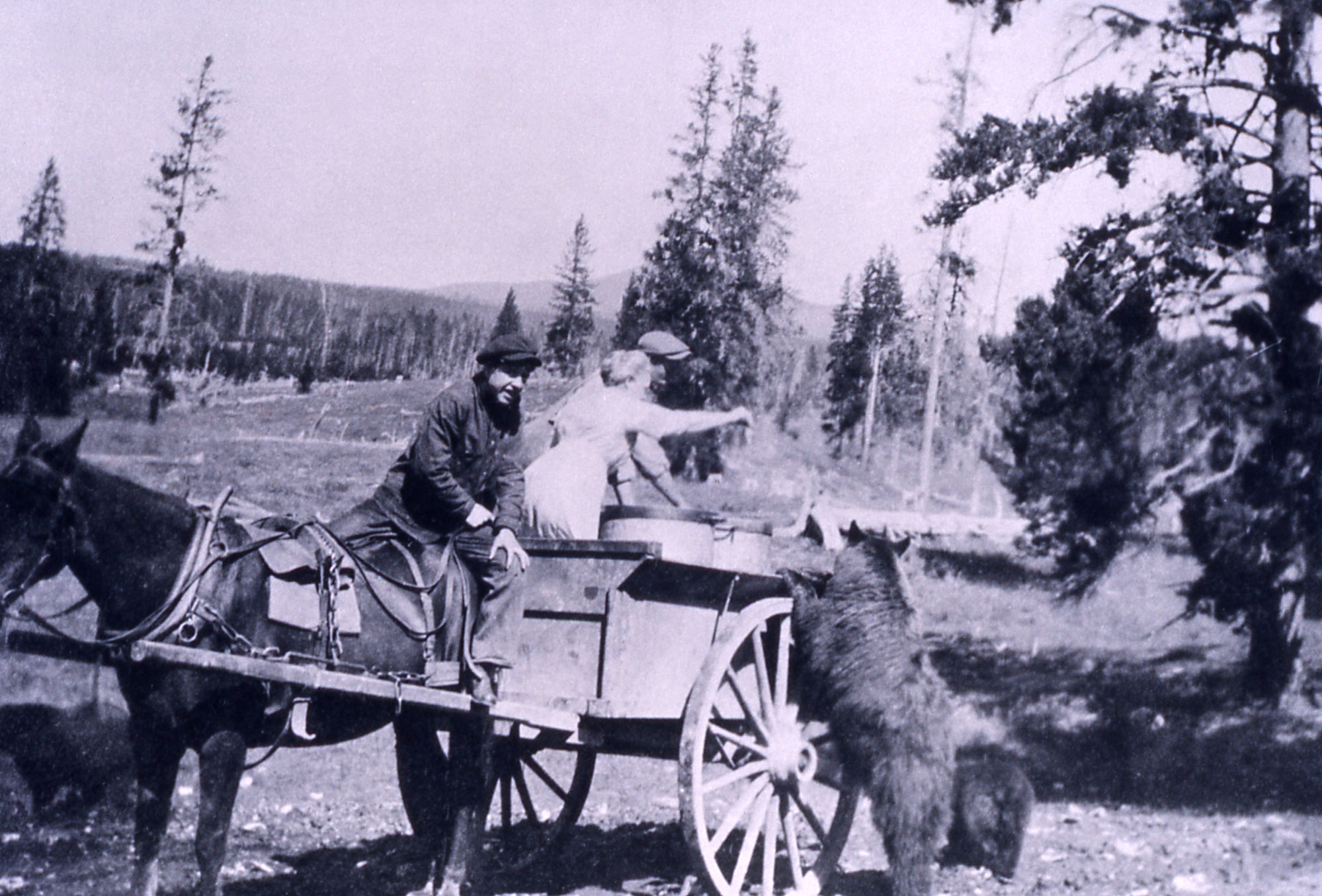
Initially, the emphasis was on the recreational function of the parks, as huge, elaborate hotels and visitor facilities were built.  Visitors to these remote locations had to be fed and waste management was not more sophisticated in the parks than anywhere else in the 19th century.  Huge garbage dumps quickly developed and they drew black and grizzly bears out of the forests for the easily available food.  Over time, these garbage dumps became stage shows for visitors to gather at the end of the day in amphitheaters built for that purpose to watch the bears arrive for a scheduled “feeding” at the dumps.

Bears being fed by visitors at Yellowstone National Park

Visitors were also not discouraged from feeding the bears by hand in their campsites and along the roads in the parks.  The bears’ expectations of food from the visitors sometimes resulted in injuries:  Between 1931 and 1939 there were 527 injuries such as “slashes and bites to arms, and mangled extremities that had been holding the food” at Yellowstone.

Predator control

The US Forest Service is the sister agency of the National Park Service.  It was created in 1881 in response to a growing concern that the country was consuming its forests at an unsustainable rate.  Its mission was the creation of a forest reserve.  These forest preserves provided grazing leases to privately owned herds of cattle and sheep and the forest service took responsibility for controlling predators of the domesticated animals.

The forest service was joined in this mission by the Biological Survey of the Department of the Interior, which reported in 1919 that it had “wiped out 11,000 coyotes in California, Oregon, Nevada, Idaho and Utah.  In 1917 the Survey killed 98 wolves, 1,437 coyotes, and 138 bobcats in Wyoming alone.  By 1920…the agency extended its deadly franchise to eastern meadowlarks, accused of eating oats and corn in South Carolina; robins in the cherry orchards of New York; grebes, loons, terns, gulls, bitterns, and three species of herons feeding at fish hatcheries; and mergansers that were supposedly depleting trout streams in Michigan.” (1)

In 1918, the NPS director ordered the staff at Yellowstone Park to cooperate with the Biological Survey in killing predators.  This order escalated the killing of predators at Yellowstone:  “From 1904 to 1935, 4,352 coyotes, 121 cougars, and 132 wolves were killed in Yellowstone.”  (1)

The consequences of losing predators

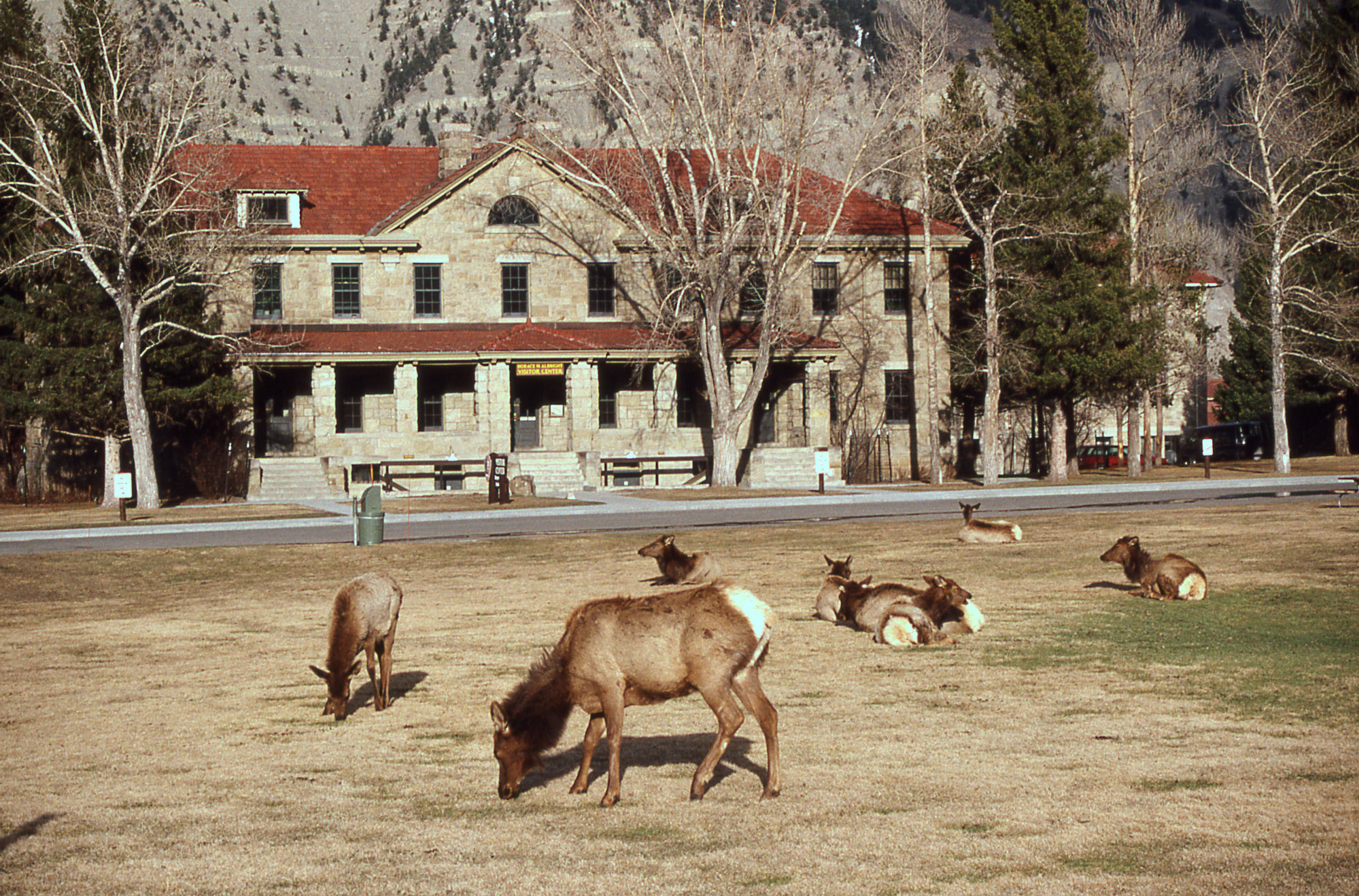
The loss of predators quickly resulted in an explosion in the population of their prey, particularly elk.  The growing population of elk browsed vegetation—“they gnawed on aspen saplings, stripped the bark of mature trees, chewed on conifer boughs, willows, currant bushes, and sagebrush”– turning beautiful landscapes into threadbare landscapes.  The loss of vegetation also reduced populations of beavers, pronghorn, deer, and bighorn sheep. The loss of those species had other consequences for the complex ecology of Yellowstone, such as the loss of wetlands maintained by beaver ponds.  Finally, the elk population grew beyond their food sources and emaciated, dying elk contributed to the unsightly consequences of destroying their predators.

Elk in Yellowstone National Park

The reaction of the park service managers to the exploding elk population was initially to move elk around the country to places where they had existed in the past.  Point Reyes National Seashore is one of the places where elk were reintroduced and the consequences there are much the same as they were in Yellowstone.  That is, the predators of elk no longer exist in Point Reyes National Seashore (PRNS) so there are now more elk there than can be supported by existing vegetation.  There is now a controversy about the fate of the elk at PRNS and consequent lawsuit that is another story and yet to be resolved.

When opportunities to move elk were exhausted they began to kill elk at Yellowstone.  Beginning in the 1930s thousands of elk were shot in Yellowstone to reduce the population.  Hunters in neighboring communities complained about these killings because they had enjoyed the overflow of elk outside of park boundaries where elk became prey for hunters.

Academic science comes to the rescue

Meanwhile, the science of ecology was taking shape.  The Ecological Society of America (ESA) was founded in 1915 and it passed a resolution in 1921 opposing the introduction of non-native species such as game fish to national parks.  ESA was quickly joined by the American Association for Advancement of Science, which issued a report in 1925 about the value of retaining “original conditions” in the national parks.   These organizations began to lobby for more scientific management of the national parks and their requests coincided with the development of the academic science of ecology.

UC Berkeley played an important role in the transition of park management policy from one that emphasized recreational uses of the parks to one that emphasizes conservation and preservation.  In 1962 Stewart Udall, Secretary of the Interior, appointed Starker Leopold to chair an Advisory Board on Wildlife Management for the National Park Service.  Starker Leopold, son of Aldo Leopold, was a member of the faculty at UC Berkeley forestry department.

The Leopold Report, as it is still known today, is now the guiding principle of the National Park Service:  “He called upon the Park Service to ‘restore or re-create’ natural processes and life communities to bring about conditions as close as possible to those that had been seen by the first Euro-American explorers.  The effect would be to display ‘vignettes of primitive America’ for the visiting public.” (1)

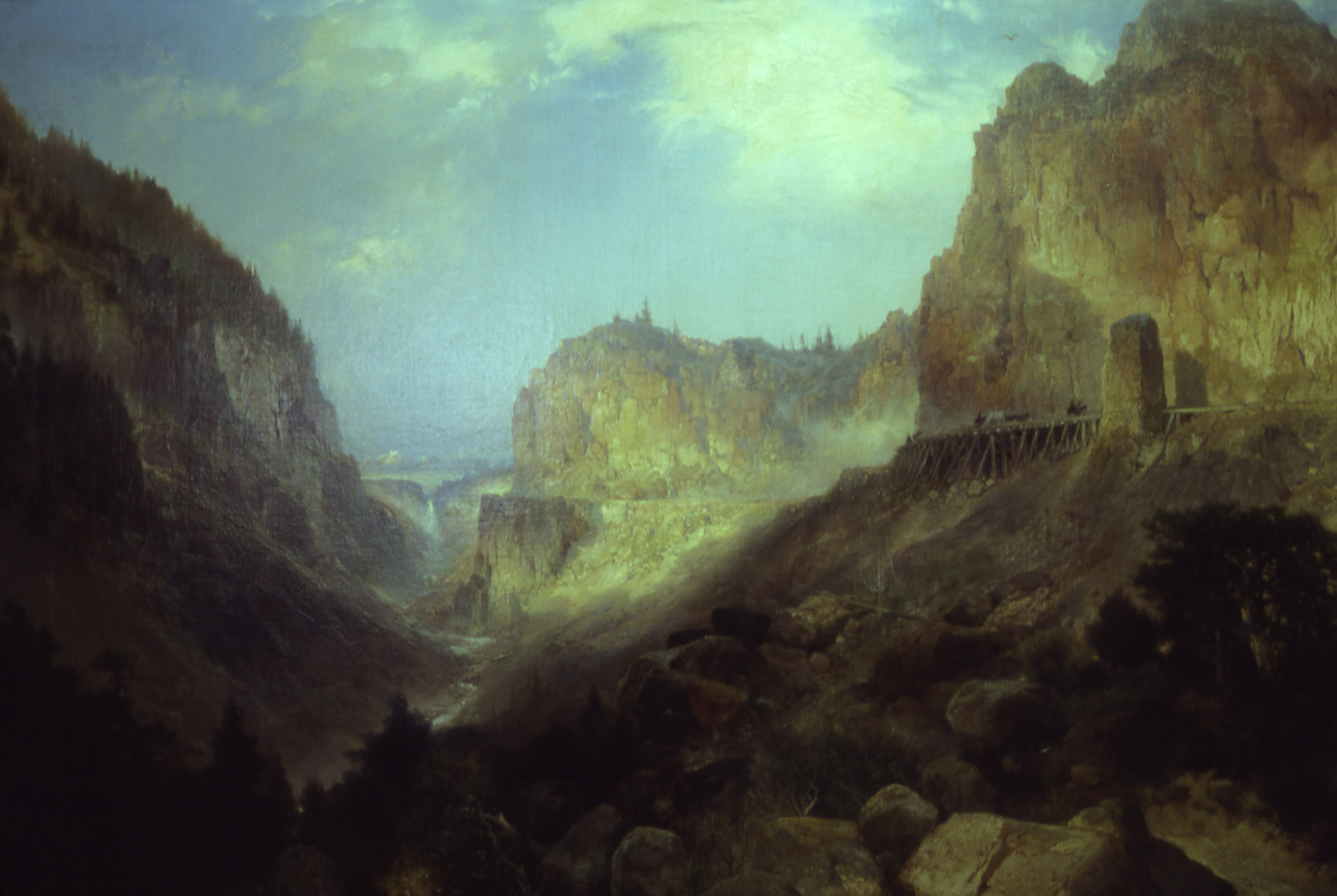
Painting of Yellowstone by Thomas Moran

Restoring natural processes to Yellowstone

The management at Yellowstone took the Leopold Report seriously.  They set as their top priority the closing of garbage dumps at Yellowstone, based on their belief that the bears would quickly return to the forests.  They were advised by wildlife biologists studying the bears against making that change quickly without transitional accommodations such as stocking the forests with the carrion of the elk that were being killed.  Management shut down the biologists’ research project and removed tracking devices and identification tags from the bears that had been studied.

Park managers had never been rigorous in requiring visitors to keep their food in places inaccessible to bears.  The bears now associated food with humans and quickly became aggressive in seeking food where they expected to find it…in campsites, in cars, in cabins.  In some years, the situation was exacerbated by drought that caused the blueberry crop to fail.  And the exploding elk population also decimated the crop of currents.  So, the bears had little recourse for food except the human sources that had been freely available to them for over fifty years.

In retrospect, the consequences of these decisions seem entirely predictable.  There were many spectacularly grisly killings and maiming of human visitors by grizzly bears.  But as sad and unnecessary as those deaths were, it is even sadder to learn that hundreds of bears were killed by park rangers trying to keep visitors safe.  Bears that threatened people or destroyed properties such as cabins and cars were repeatedly darted with sedatives and moved into the forests.  They quickly returned to the same locations and were eventually killed by rangers.

By the late 1970s the number of black and grizzly bears in Yellowstone, Yosemite, and Glacier national parks had dwindled to the point that their extinction was predicted.

A new strategy is found

Starker Leopold continued to have a profound influence on the management of the national parks when he installed one of his graduate students, David Graber, in the management of Yosemite Park.  Graber is responsible for introducing a bear-proof food locker into the national park system that broke the bears’ association of humans with food.  Rigorous enforcement of rules that prohibit feeding bears and require use of the food lockers was also needed.  Eventually, the equivalent of this food locker was also invented for backpacking in the back country.

The author of Engineering Eden speculates that the personal quality that enabled David Graber to find a solution to a deadly situation was humility.  He describes Graber’s uncertainty about the many management decisions he was required to make as he worked on the thorny issues he faced, such as the question of where and when to conduct the prescribed burns that are considered necessary in our national parks to reduce wildfire hazards and to mimic the ecological benefits of fire.  He begged his mentor, Starker Leopold, for an updated Leopold Report that would provide greater guidance for the decisions he was making.  Leopold declined, while expressing confidence in Graber’s decisions and noting that uncertainty is inherent in “managing” nature.

A tribute to humility

We end this story with a tribute to Mr. Graber and to the virtue of humility in land management decisions.  In contrast to that humility, the Center for Biological Diversity (CBD) has applied to US Fish and Wildlife Service to reintroduce grizzly bears to California.  Grizzly bears have been absent in California since 1924 at a time when the human population was minuscule compared to the 39 million people who live here now.

At first glance, you might think CBD’s request misanthropic, given that some people would surely lose their lives to the bears.  But this would overlook the inevitable fact that more bears are likely to die in their encounters with humans.  The bears are ultimately the losers in conflicts with humans.

Humility requires that we defer to Mr. Graber to evaluate the request to reintroduce grizzlies to California.  Mr. Graber told the LA Times that, “…the possibility of grizzly reintroduction is exciting, but ultimately unmanageable.  ‘If there was a place to put them, I would be arguing very strongly to put them there,’ Graber said, ‘I’m sorry that there are so many people here.’”


(1) Jordan Fisher Smith, Engineering Eden, Crown New York, 2016

If animals love non-native trees, why don’t humans?

We are please to publish a guest post by Bev Jo, a fellow friend of our urban forest.  This is how Bev Jo describes her intimate relationship with nature and the creatures who live in nature:

“As a marginalized human, I identify with and feel protective of plants and animals who are feared and hated for no rational reason.

I was taught to fear spiders, but when I was eight I realized I couldn’t live in such terror, so decided to change. After observing and learning about spiders, fear turned to love. I’ve handled or petted so many spider species, scorpions, etc. with no problem. Without fear of nature, the entire world opens up. I’ve since had wonderful communication with wild species, from fish to spiders, insects, scorpions, rattlesnakes, raccoons, rats, skunks, and opossums. I’ve also learned to befriend plants like Poison Oak.

One of my goals is to help others overcome their fear of nature, so I regularly lead nature hikes. I want to tell everyone, please don’t let fear or hatred lead you to kill anyone, plant or animal.”


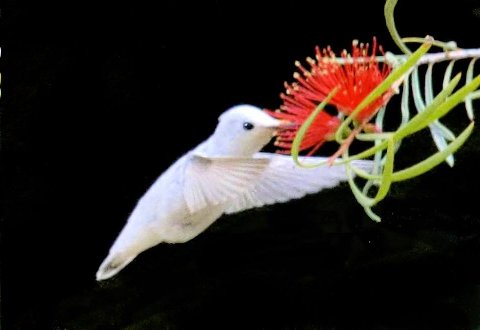
Rare leucistic female Anna's hummingbird, at the Santa Cruz botanical gardens, eating from an Australian Grevillea, June 6, 2016. By Raymond Chu
Rare leucistic female Anna’s hummingbird, at the Santa Cruz botanical gardens, eating from an Australian Grevillea, June 6, 2016. By Raymond Chu

I’ve heard the propaganda meant to terrify us into hating beautiful exotic trees and plants because they supposedly harm wildlife, cause fires, and degrade ecosystems. Yet I know the harm caused by other myths and I love plants. I appreciate how many species grow in the Bay Area, from botanical gardens and elaborate landscaping to city street trees and simple yards in neighborhoods. The diversity here is amazing.

I’ve also noticed that few native trees are well-suited as street trees and in landscaping, while many introduced species are beautiful to see in our semi-tropical area. People have learned that if they want to attract birds, butterflies, etc. they need to plant non-natives, which continue feeding animals throughout the year because there is always something in bloom.

On a friend’s street, I was astounded to hear the sound of birds like nothing I’ve heard elsewhere because of a few Australian bottlebrush trees pruned into a lollypop shape, which isn’t attractive, but provides safe homes for countless birds.

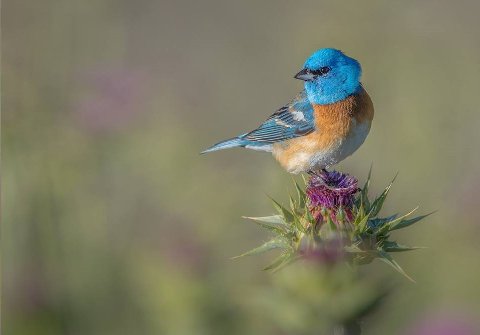
Lazuli bunting at Rancho San Antonio on milk thistle, April 2016. Courtesy Greg Barsh

Hummingbirds seem to be increasing as people plant more of these trees, exotic sages, and other plants. The list of non-native plants that nurture birds in our cities is astounding. And some of these plants are adapting to our environment and native animals.

While many of our native trees are dying from human-introduced and caused diseases and insect infestations, we are lucky to live in an area with such plant diversity. Even if all the oaks die from Sudden Oak Death, and conifers die from bark beetle infestation, we still have a wonderful variety of healthy, mature trees which are immune to those diseases and infestations.

I recently learned that in the Midwest where I grew up, the ash tree I so loved as a child is being killed by an insect infestation caused by humans.  So, combined with other diseases, a large part of the US east of the Mississippi might eventually be treeless.

Hummingbird in eucalyptus flower. Courtesy Melanie Hofmann

Our plant diversity ensures we will continue to have beautiful trees in the Bay Area – except for the danger from a few humans motivated by an irrational hatred of non-native plants. Even while we are dealing with serious drought, these fanatics want to kill the trees which are the most likely to survive, while other parts of the world are desperate to save the trees they have.

The nativists (who, of course, are predominantly non-native) are using xenophobic politics.  They are hypocritical because they want to keep their fruit trees, vegetable and herb gardens, and exotic ornamentals as well as their pets and non-native domesticated animals while they demand that wild non-native animals be killed. And of course they won’t remove themselves. Nor are nativists demanding the elimination of California’s extensive agricultural industry that is based on growing non-native species for the rest of the US, nor the non-native honeybees essential for pollination.

The myth of fire risk is the con for destroying our parks but nativist ideology is also being used by the East Bay Regional Park District (EBRPD) and UC Berkeley as the rationale for getting millions of dollars in FEMA money to kill at least 400,000 healthy non-native trees and poison our public lands. The Sierra Club has sued to kill even more trees.

East Bay Regional Park District (EBRPD) is also hypocritical because they landscape their headquarters with primarily non-native species such as eucalyptus, olive, and Hedera canariensis (ivy). UC Berkeley, whose goal seems to be to turn our forested East Bay hills into highly flammable barren dry grasslands and more construction, has similarly landscaped their entire campus with exotic trees. It’s only the animals that are being deprived of the plants they need for shelter, nesting, and food.

One of the myths is that the exotic trees do not help native animals but many animals have adapted to and need eucalyptus.   Raptors, like golden eagles, hawks, and great horned owls prefer to nest in Blue Gum eucalyptus because they are very tall trees with an open canopy, safer for young raptors to learn to fly in than the shorter, dense coast live oak and bay laurel forests. I had no idea how vulnerable these raptors were until I read about juvenile peregrine falcons dying from hitting branches as they were learning to fly. It’s easy to think of such graceful birds as having good flight control, but they don’t when young. Even watching California condor adults trying to safely land on cliffs and trees was a revelation because they had to struggle so hard.

After seeing red-shouldered hawks nesting in sycamores at Sunol Regional Wilderness, I realized how similar those trees are in appearance to eucalyptus: tall, open, and easy to navigate. But sycamores don’t grow in many places, while eucalyptus can grow anywhere. I’m guessing many of our raptors have expanded their range because of eucalyptus. Even in our relatively barren Oakland urban neighborhood, we see nesting red-shouldered hawks only because of one stand of magnificent eucalyptus.

A Quest documentary on KQED interviewed EBRPD’s Wildlife Manager Doug Bell who explained that golden eagles in the Bay Area are declining because they can’t reproduce quickly enough to counter the high numbers killed each year by the wind turbines at Altamont.    The film shows golden eagles nesting in eucalyptus, yet nothing was said about EBRPD cutting down eucalyptus. If people care about golden eagles, how can anyone want to kill the tree that most ensures their survival?  If more eucalyptus were planted on the many now-barren grassland hillsides, would we be able to stabilize golden eagles’ population?

Remember that EBRPD is the same agency that responded in writing to our questions about their toxic pesticide, Garlon, by calling it “Garland.” (Try looking up epidemiological studies on “Garland.”) Garlon is the herbicide that is sprayed on the stumps of eucalyptus trees after they are destroyed to prevent them from resprouting.

European honeybee on Eurasian Himalayan blackberry, which provides so much food for humans and wild animals. By Bev Jo

We have also been told by EBRPD employees that glyphosate is completely safe, even though it’s classified by World Health Organization as a probable human carcinogen.  It is banned in many countries and some US cities, and is in our bodies, against our will.

EBRPD had recently planned aerial spraying of Briones Regional Park to kill the beautiful little yellow star thistle, which blooms like sunshine on the dry, desolate hillsides in summer. When we objected, they gave us ridiculous reasons, such as helping the boy scouts camp or preventing bicyclists’ tires from being punctured. Why not just stay on the designated trails rather than erode the park and run over animals? When a friend suggested using goats, they actually said it was too steep for goats!  EBRPD has temporarily stopped the spraying plan, “for now.” Their massive amount of pesticide spraying next to the bay, reservoirs, and creeks is horrifying and unnecessary.

Marin Municipal Water District is able to maintain their enormous open space without using herbicides by mowing or just leaving the plants to die back when the rains stop.

When EBRPD said that all their pesticides were EPA approved, I responded “so was thalidomide.” Their spokesman had no idea what that was, so I said “so were all the pesticides now banned, like chlordane, which Rachel Carson wrote about.”

Then I was told that they are protecting endangered animals by their spraying. No, they are killing them. I’ve seen a California newt dying a terrible death after crawling through a sprayed area. I’ve seen yellow-billed magpies collecting nesting material from sprayed areas.

We can only imagine what other animals are being harmed. We have not heard any rational explanation for spraying poison next to endangered ridgeway rail habitat at Martin Luther King Jr. Shoreline Park. The May-June parks EBRPD newsletter implied their plan to kill trees and spray poison would somehow help the endangered Alameda whipsnake. Nothing we were told by the EBRPD representatives made sense, including that their applicators are well-trained.

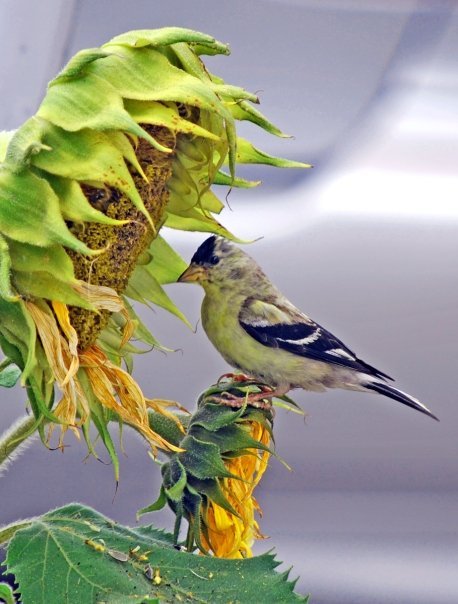
Native Goldfinch with non-native sunflower which provides important seeds for native birds. By Melanie Hoffman.
Native Goldfinch with non-native sunflower who provides important seeds for native birds. By Melanie Hoffman.

Even plants which are rarely seen and are sold in specialty produce stores, like the beautiful artichoke relative, cardoon (artichoke thistle), with its electric blue flower, are being sprayed, leaving the non-native grasses and poison hemlock to spread. The nativist fanaticism is extreme when tiny forget-me-nots are pulled off fragile steep hillsides, as happened at Huckleberry Botanical Regional Preserve, causing erosion.

Do they really think that people prefer seeing enormous swaths of ugly, poisoned earth, as seen at Del Valle Regional Park that had just been lush, velvety green? Why not just let the green go brown naturally as it does every year? They don’t care about the increased fire hazard from the burnt, dry, poisoned plants they leave behind.
One of the ironies about the nativists is how little they seem to know. I went on one of their nature hikes at twilight to see the soaproot lily/amole (now in the genus Chlorogalum), because they said it only bloomed at night. Yet soaproot blooms in the daytime all over the Bay Area and I could show it to anyone, any time. The only other mass of wildflowers in that dry, brown hillside, were edible wild mustard, which these nativist “naturalists” called “trash.”  On another paid wildflower hike to a preserve, the nativist kept belaboring which species were terrible because they are non-native (like the “expert” herself), and misnamed several of the species we were there to see. This land is now a heavily grazed pasture, so we’re lucky to see any flowers at all.

These are some of the experiences I’ve had with nativists. I wouldn’t care that they know so little about plants except that they are wielding the power to destroy the trees, wildflowers, animals, and entire ecosystems that we love and should be caring for.

Once our beautiful forests are destroyed, the wildlife will die from hunger and loss of habitat and we will be left with flammable, ugly hillsides covered in poisoned stumps.

We should nurture and love rather than kill the exotic plants we are lucky to have.  They provide cleaner air and offset global warming.  They are doing so much for so many species, including us.

Bev Jo

Sierra Club: Puppetmaster of Destruction

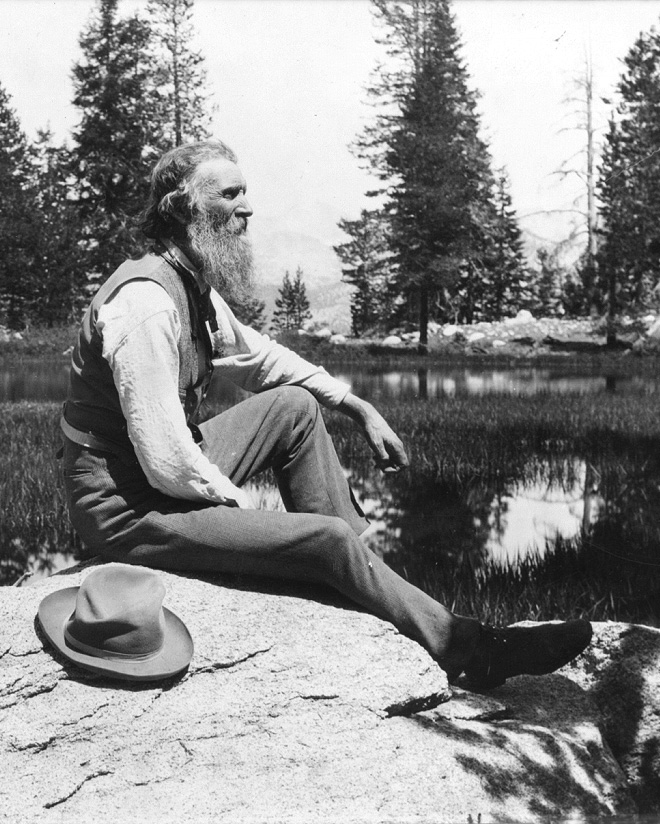
John Muir is the founder of the Sierra Club. He would disgusted by the Club's advocacy for deforestation. He planted eucalyptus trees on his property in Martinez. He was as fond of eucalyptus as those who fight for their preservation.
John Muir is the founder of the Sierra Club. He would be disgusted by the Club’s advocacy for deforestation. He planted eucalyptus trees on his property in Martinez. He was as fond of eucalyptus as those who fight for their preservation.

We are grateful to Marg Hall, member of the Forest Action Brigade for this guest post about the role the Sierra Club is playing in the destruction of our urban forest and the poisoning of our public lands.


For the past year, members of the Forest Action Brigade have been spotlighting the Sierra Club as part of a larger campaign to stop the destruction of the trees in the East Bay Hills. This article answers the question: “Why focus on the Sierra Club?”

Long associated with environmental stewardship, the Sierra Club is a major player in local politics. Because so many Bay Area residents prioritize environmental protection, the Sierra Club enjoys lots of political capital, a ton of money, a deep bench of litigators, and the respect and fear of local politicians. They also have an entrenched leadership that pretends to be democratic, but in fact pushes around grass roots environmentalists, suppresses internal debate and dictates to local land managers.

As readers of Million Trees well know, the SF Bay Chapter of the Sierra Club supports deforestation and the use of pesticides in the East Bay Hills. Some of us have concluded that they not only support this project, but are a major behind-the-scenes driver.

I first heard about the Club’s support for local deforestation about 6 years ago at a FEMA scoping hearing for the project Environmental Impact Statement.  Naïve me, I thought, “Oh good! the Sierra Club is here, and certainly they will weigh in on the right side of this issue.”   This is where my education began. The speaker representing the Sierra Club explained that they support this project and of course they will use pesticides, because that’s the only way to rid our parks of unwanted vegetation.  Wow! Pesticides?  “Unwanted plants”?

Until then, I had been a Club member for a number of years, thinking that the Sierra Club did good things. Before voting in our very complicated local elections, I’d check to see who and what they endorsed.  I supported bond measure CC (which the EBRPD uses in part to fund their eucalyptus tree removal) back in 2004 because, well, what could be wrong with increasing funding for the East Bay Regional Parks District (EBRPD)? Nowhere in the ballot measure did they mention pesticides.  And as a former building inspector, the “fire hazard” reduction part sounded good. I thought the discussion in favor of native plants meant not planting English style lawns or plants in your garden that need lots of water. That sounded reasonable for a water scarce region.

Like so many of my neighbors, I’m neither a botanist nor a wildlife biologist, but I love the local parks and visit them almost daily.  I trusted the Sierra Club to “protect” the environment. I suspect a lot of folks do the same.  Now, after delving deeply into this local issue, I know better.  The local Sierra Club has a fanatical obsession with eradication, with waging a war on non-native plants in our local parks. This agenda drives much of their work. Many voters follow their lead, basing decisions in the voting booth on blind faith. Politicians go along with the Sierra Club agenda in order to gain Club endorsement.  Land managers must follow the lead of their elected bosses.  All one needs to do is invoke the label “non-native,” and weapons of war are deployed: ground troops of weed pullers, tree cutters, pesticide sprayers, imported “biologics” (bugs and germs), and even, on occasion, aerial bombardment of pesticides. Other mainstream environmental organizations (The World Wildlife Fund, Audubon Society) also participate in this war, but it’s the local Sierra Club that provides the propaganda and the political clout behind this horrible deforestation plan. It’s the Sierra Club that sits down on a regular basis with the managers of the East Bay Regional Park District to dictate the terms under which they must operate.  And when the EBRPD fails to fall in line, the Sierra club pulled out the big guns and sued in an attempt to force them to cut down all of the eucalyptus trees in the project areas, rather than a “thinning” plan that EBRPD preferred.

Here’s an example of the kind of hold that the Sierra Club has over the EBRPD.  Through a public records request, we obtained a letter (dated April 28, 2015) to the parks district governing board from Norman LaForce, long time Chairperson of the Sierra Club’s Public Lands Committee. The letter laid out in great detail the kind of compliance he expects in order for the EBRPD to obtain Sierra Club endorsement of Measure CC renewal (which expires in 2020).  Mr LaForce is perhaps the single most influential person promoting the local club’s nativist agenda. (emphasis added)

“The Sierra Club played a major and key role in the creation of Measure CC and the projects for which money would be spent….

“…Vegetation management that restores native habitat is less costly than programs that merely thin non-natives.  Native habitat that is restored in the fire prone areas that are currently eucalyptus plantations is less costly to maintain on an annual basis than a program of thinning non-native eucalyptus and other non-native trees.

“Hence, the Sierra Club believes it is critical that in any renewal of Measure CC funding for vegetation management should be increased for the removal of non-natives such as eucalyptus and their replacement with restored native habitat. If the Park District wants to continue with a program that merely thins the non-native ecualyputs (sic) and other non-ntaive (sic) trees, then it must find other funds for those purposes. Future tax money from a renewal of Measure CC funds should not be used to thin eucalyptus but must be allocated to the restoration of native habitat.”

The letter goes on to detail the Sierra Club’s position on a variety of other issues and projects, most of which involve “restoration”, which sounds good, but is a code word for removal of non-native plants by any means necessary, including the use of herbicides. Here’s a link to the complete letter:  Sierra Club dictates terms of Measure CC endorsement

I want to it make clear that we are environmentalists.  We support some of the same goals as the Sierra Club: opposition to XL pipeline, fracking, refinery expansion, use of coal, environmental racism.  We are not right wing climate deniers—one of the arguments Sierra Club uses to marginalize us.  The Sierra Club is on the wrong side of this issue and we want them to stop bullying local officials into this war against trees. John Muir, who loved eucalyptus trees, would weep at this travesty.

Marg Hall, Forest Action Brigade

Land Management: The Good, the Bad, and the Ugly

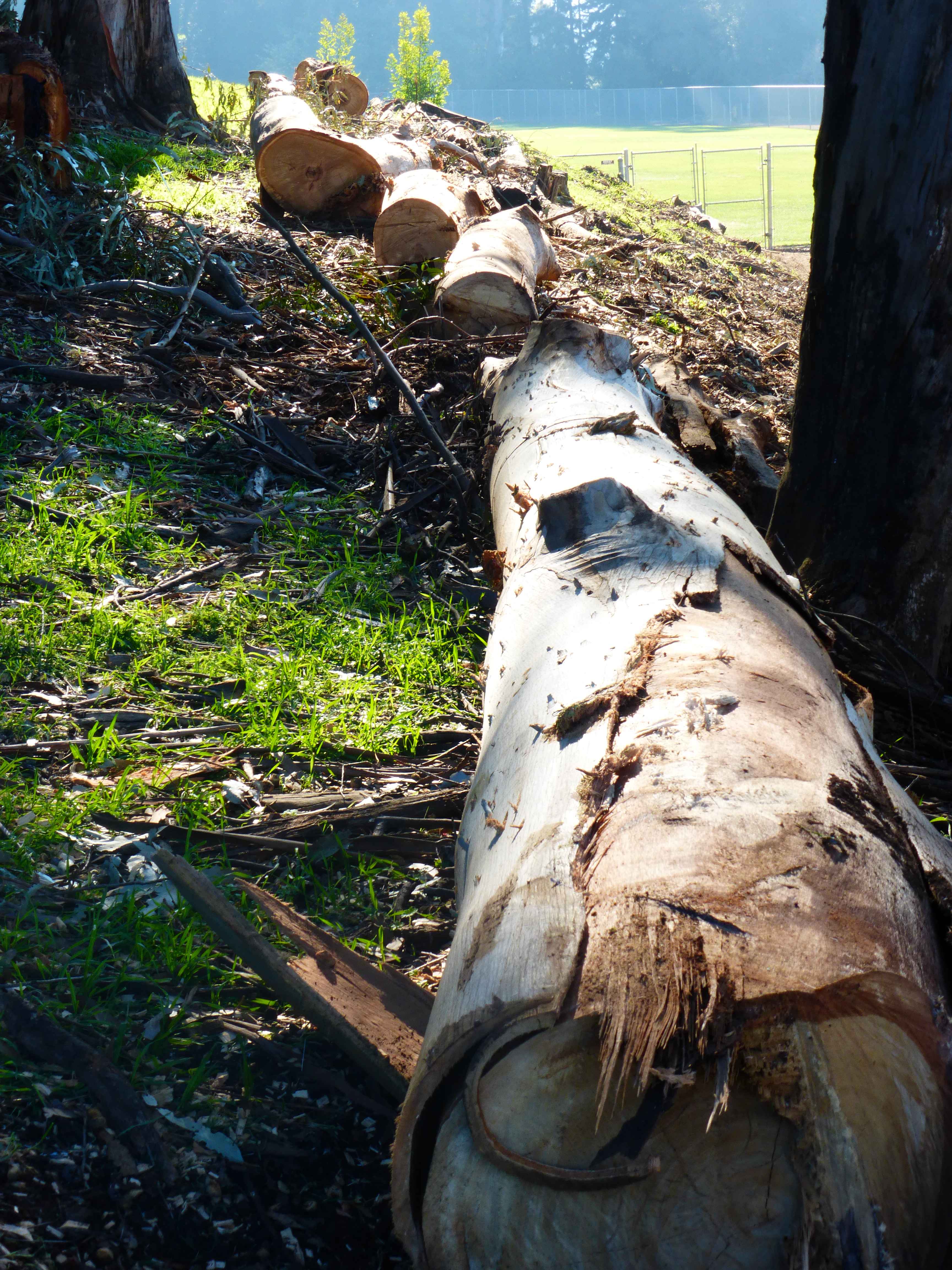
In January 2015, UC Berkeley destroyed about 25 eucalyptus trees at the top of Dwight Way, above the intersection of Sports Lane.  We visited the area shortly after the trees were destroyed and told our readers about the project.  We also reported that the project was an example of the huge gap between policy and practice in UC Berkeley’s tree removal projects.  The following is an excerpt from a letter that a member of the public sent to FEMA about this project, detailing the discrepancies between UC Berkeley’s theoretical commitments to “best management practices” and their actual land management practices:

  • Green dye is added to Garlon and sprayed on the stump of the tree shortly after it is cut down. January 2015
    Green dye is added to Garlon and sprayed on the stump of the tree shortly after it is cut down. January 2015

    “The stumps of the trees that were removed have been dribbled with green dye, indicating they were sprayed with herbicide to prevent them from resprouting.  However, no herbicide application notices were posted at the site as required by law* and as described in the Final Environment Impact Statement for the FEMA grants: “In addition to the herbicide application measures, the subapplicants would follow procedures for public notification and education, including posting the timing, location, and appropriate amounts and types of pesticides or other chemicals to be applied at least 24 hours in advance.” (EIS, page 5.10-14)

  • “The Final EIS also states that “in general” most tree removals will be done “from August to November to avoid the wet season and the bird nesting and fledging season.” (EIS page 3-34) This commitment made by UC Berkeley in the EIS has been violated by this round of tree removals in January after heavy rains.
  • “In addition to the approximately 25 trees that were recently destroyed, we counted over 100 stumps that have been destroyed in this area in the past. This area is not described in the Cumulative Impact Section (EIS 6.0) of the EIS. In other words, cumulative impact of the proposed FEMA projects is underestimated by the EIS.
Tree removals, Dwight Way and Sports Lane. January 2015

Consequences of tree removals

One of our readers contacted us in late May 2016, suggesting that we revisit this location to see the consequences of tree removals in January 2015.  So, we went to take a look.  The scene some 18 months later is a stark reminder of why we are opposed to the destruction of all non-native trees in the East Bay Hills.

Dwight Way and Sports Lane. May 2016

Where all of the trees were destroyed in January 2015, the ground is now completely covered in non-native weeds.  There are several species of thistle and poison hemlock that are over 6 feet tall.

Dwight Way and Sports Lane. May 2016

In some places, the trees were only thinned and the tree canopy is still intact.  The shaded forest floor is significantly less covered in tall weeds.

Dwight Way and Sports Lane. May 2016

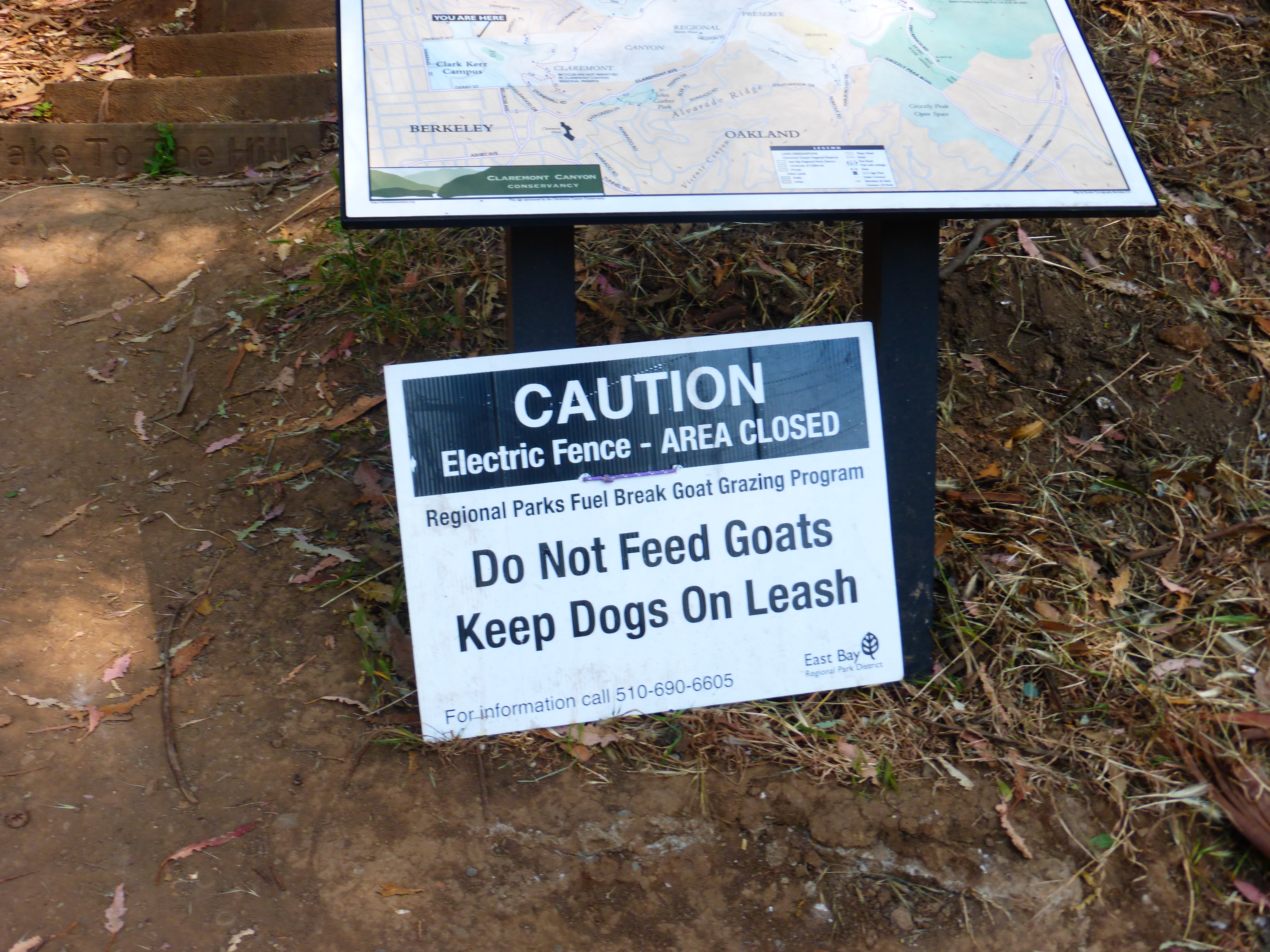
We also saw the evidence of attempts at weed control.  In some places there was a sharp dividing line between dead weeds and green weeds, suggesting that the brown areas had been sprayed with herbicide.  In other places, the grassy weeds seemed to be have been cut down, perhaps with a weed whacker.  A sign indicated that goats were also being used to graze the weeds.

Dwight Way and Sports Lane. May 2016

Misguided choices create more maintenance issues

When the tree canopy is destroyed, increased sunlight creates opportunities for weeds to colonize the bare ground.  Once the weeds take over, land managers are forced to use herbicides to reduce the weed growth.  The only alternatives to using herbicide are more costly, such as hand-operated mechanical methods or renting goat herds.  This is a man-made problem that could have been avoided by leaving the tree canopy intact.

However, we don’t want to leave our readers with the impression that we support the radical thinning of our eucalyptus forest.  We are opposed to such thinning because the herbicide that is used to prevent the trees from resprouting is mobile in the soil.  It kills the tree by killing its roots.  In a dense eucalyptus forest, the roots of the trees are intertwined.  The herbicide used on one tree travels through the intertwined roots and damages surrounding trees that were not destroyed.

The herbicide also damages mycorrhizal fungi in the soil because they are extensions of the tree’s roots.  Mycorrhizal fungi play an important role in forest health because they transfer moisture and nutrients from the soil to the tree.  Therefore, the success of a succession landscape is handicapped by the damage done to the soil.

Also, the trees develop their defenses against the wind as they grow in a specific location with specific wind conditions.  If they are suddenly exposed to a great deal more wind because they have lost the protection provided by their neighbors, the result is often catastrophic windthrow.  That is, the chance that a tree will fall down greatly increases when it is exposed suddenly to more wind than it grew in.

The idea of “thinning” is an appealing compromise to a heated controversy.  However, the consequences of thinning must be weighed against the entirely theoretical benefit of reduced fire hazard.  The cost/benefit analysis does not make a strong argument in favor of radical thinning.

The continuum from Good to Bad land management

East Bay Regional Park District began to implement its “Wildfire Hazard Reduction and Resource Management Plan” in 2011, after the Environmental Impact Report for the plan was approved.  According to a presentation made by Fire Chief McCormack to the Executive Committee of the Board of Directors on June 3rd, there are 3,100 acres of park land to be treated for fuels management over the life of the plan, of which 863 acres will be done by the end of 2016 and 64 acres will be done in 2017.  The Fire Chief said, in answer to a question, that 1,360 acres (44%) of the total acres are forested with eucalyptus.

Tilden Park, Recommended Treatment Area TI001, June 5, 2016

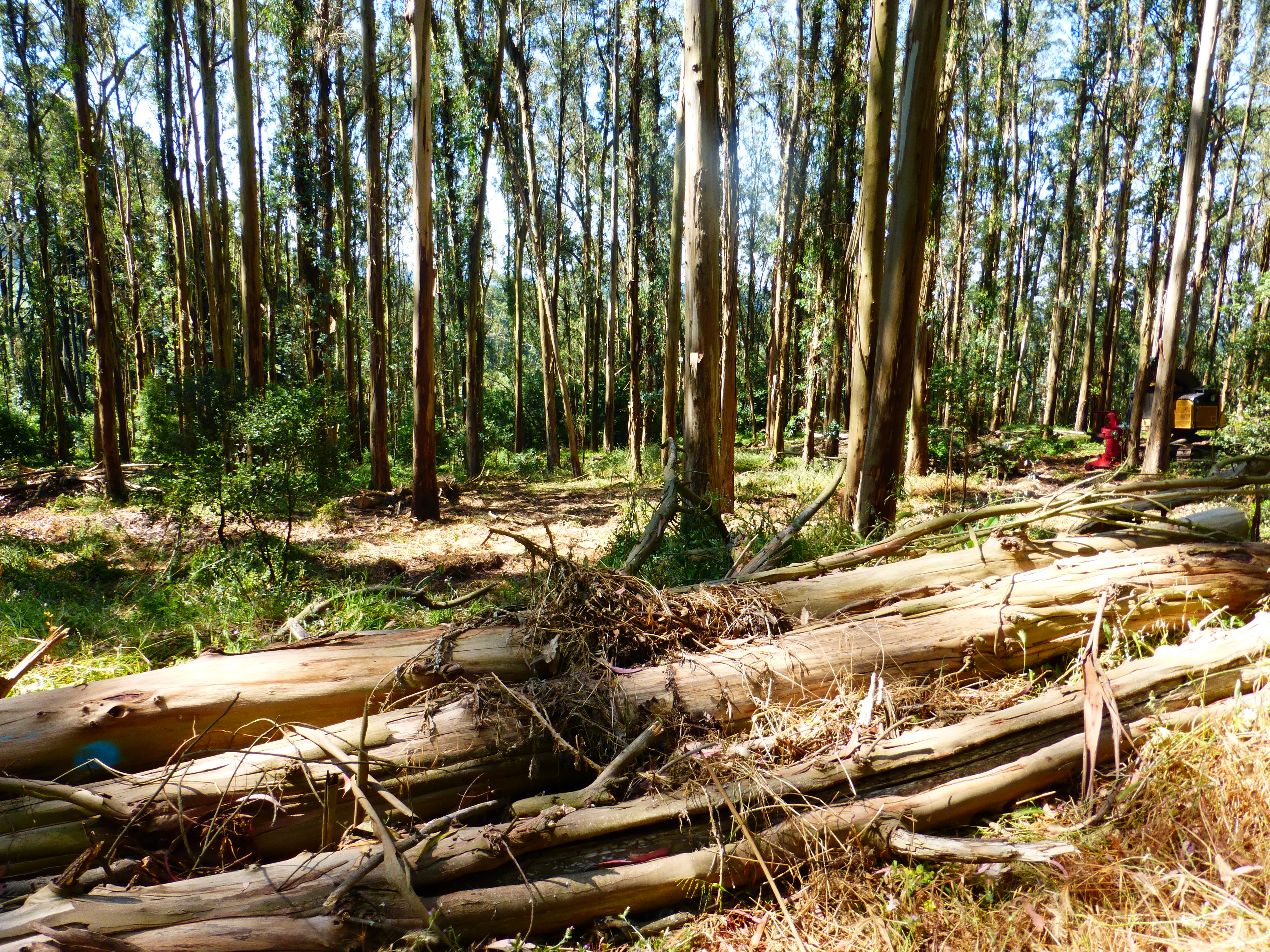
We went to see one of the “initial treatment” projects in Tilden Park on June 5th.  “Recommended Treatment Area” TI001 is along Nimitz Way, which is a paved road/path on the ridgeline.  About 17 acres of it is heavily forested in eucalyptus on both sides of the road.  The project apparently started recently and is not yet completed, judging by the presence of a lot of heavy equipment still on site.  So, these observations of this project should be considered preliminary:

  • The smallest trees are being cut down and those immediately adjacent to the road.
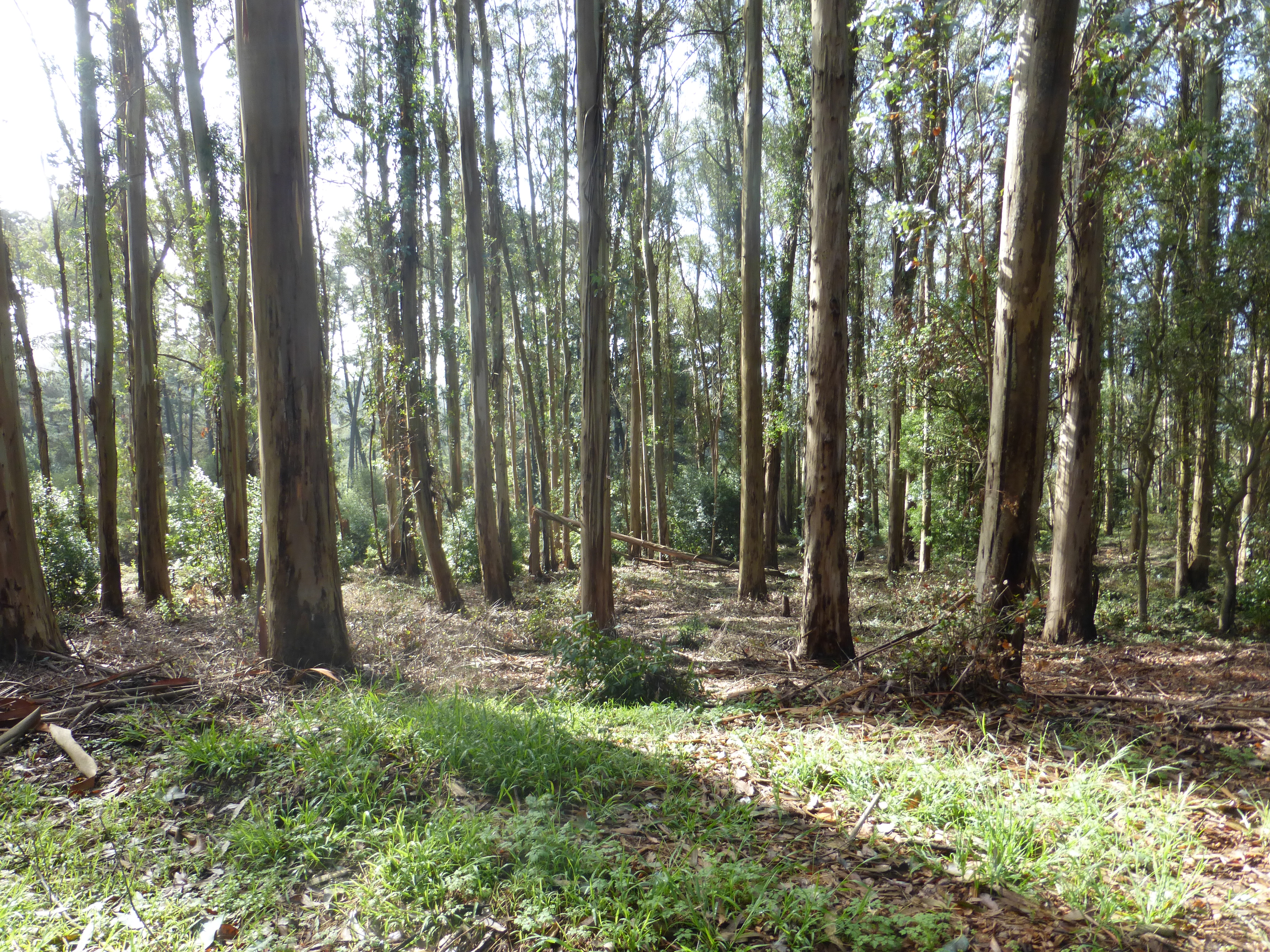
  • The tree canopy is intact. That is, the forest floor is still shaded.
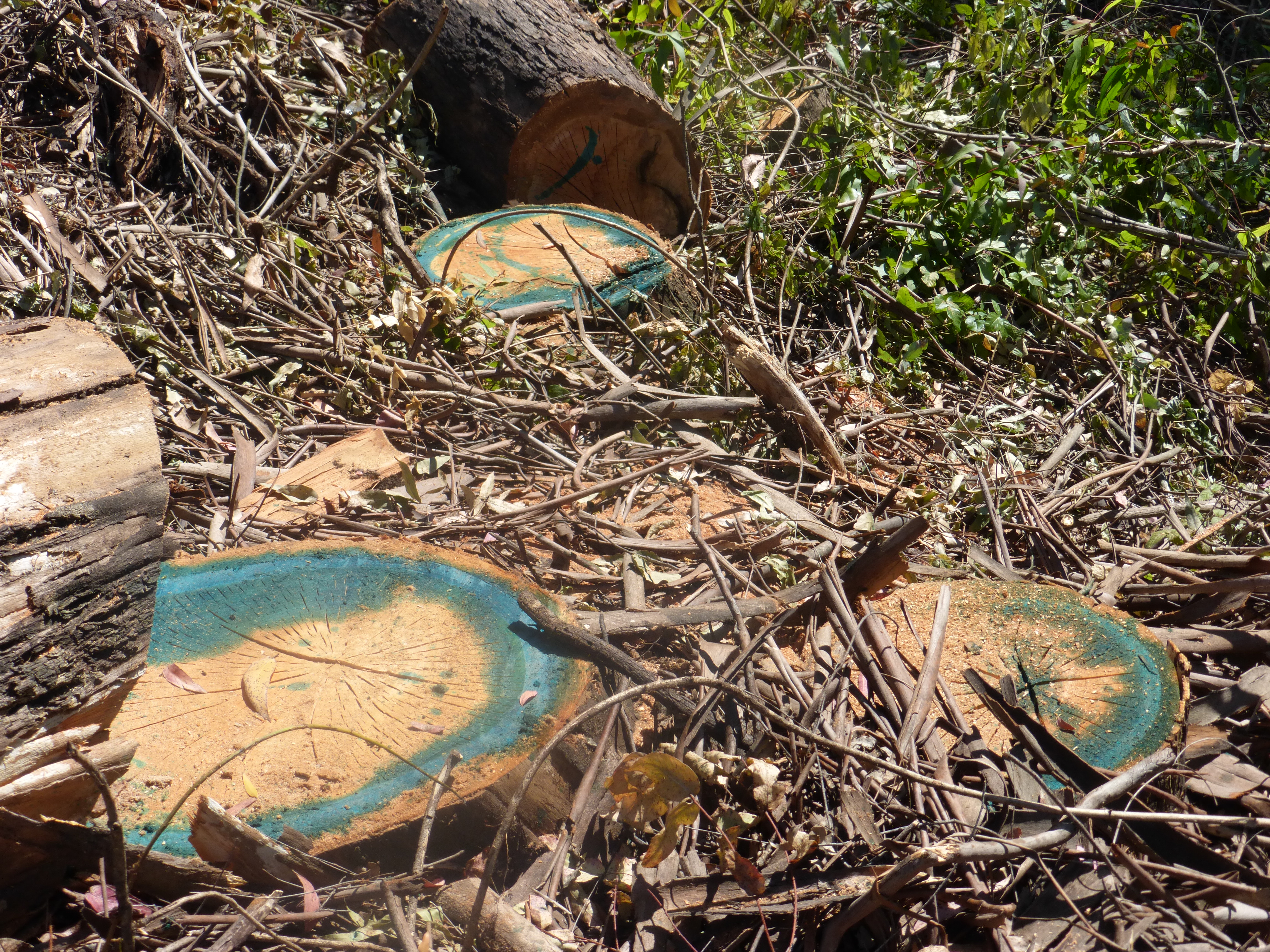
  • The stumps were sprayed with herbicide, judging by the blue dye on the stumps.
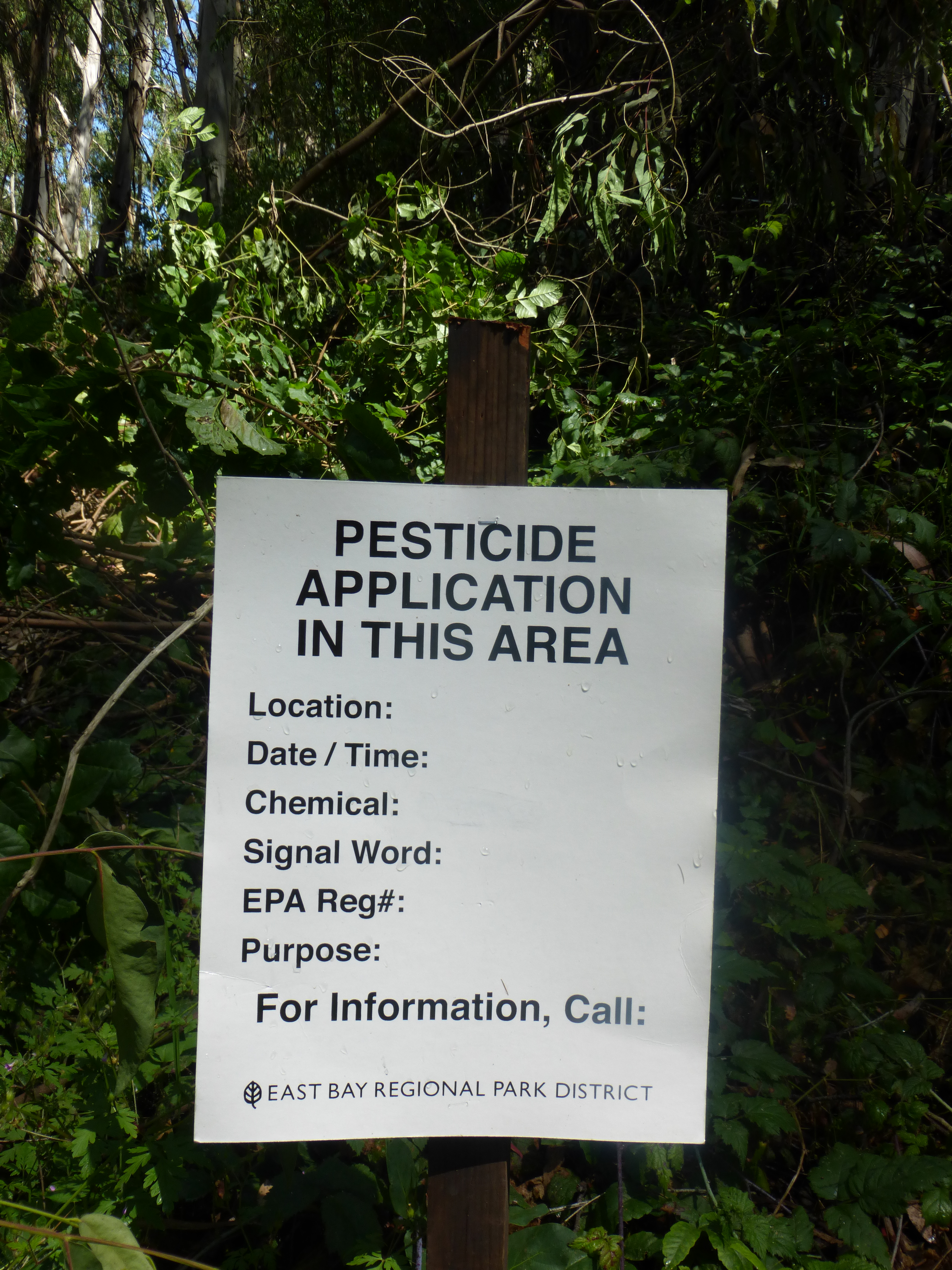
  • There were pesticide application notices, but they had been wiped clean. Presumably there was information on those notices during the spraying and perhaps for some time after the spraying, then the information was removed.

P1030688

P1030677

We must say that we were not horrified by what we saw.  There are still a lot of trees left and we are encouraged that the forest floor is still shaded.  As we have reported, when the eucalyptus forest is clear-cut the bare ground is quickly colonized by non-native weeds, which then must be sprayed with herbicide.  Since we don’t know the tree density prior to the project and what it will be when the project is complete, we can’t say what percentage of the trees were destroyed.

We plan to visit this area again after a year or so to answer these questions:

  • Is there evidence that the trees that remain were damaged or killed by the use of herbicides on the neighboring trees that were destroyed?
  • Is there evidence of fallen trees, suggesting that increased wind in the forest caused windfall?

One of our concerns about these projects was not addressed by what we saw.  The beginning of June is still in the height of bird breeding and nesting season.  We heard the calls of many nesting birds, including quail.  We are surprised and disappointed that this project began before the end of nesting season, which is the end of July.  We also wonder if some effort was made to check for nesting birds before trees were cut down.  There is no mention in the requests for proposal that the company doing the work was required to do such nest surveys before the work began.

We are describing a project that is not yet complete.  If many more trees are destroyed, it’s possible that the tree canopy will be destroyed and the forest floor will not be shaded.  If the tree canopy is intact when the project is complete, we consider this project less damaging than the clear-cuts being done by UC Berkeley and being demanded by the lawsuit of the Sierra Club.  On the continuum from Good to Bad projects, East Bay Regional Park District is closer to Good than to Bad.  EBRPD also deserves credit for supplying more information to the public about their projects than other land managers, including posting pesticide application notices.


*Last week we reported that we recently learned that pesticide application notices are not required by California law before, during, or after the spraying of Garlon or glyphosate for non-agricultural purposes.  You can read about that HERE.


Update:  On October 18, 2016, we went to see the result of “initial treatment” of Recommended Treatment Area TI001 in Tilden Park.  We confirmed with East Bay Regional Park District that initial treatment is complete, although they reserve the right to destroy more trees “if we discover something we missed this summer.” 

Our over-all impression of the project is not substantially changed from our first visit in June 2016, shortly after the project began.  These are our observations:

  • The project is accurately described by the “prescription” for the Recommended Treatment Area TI001. The prescription is available on EBRPD’s website HERE.
  • With the exception of a few small areas at the ends of the project area, trees were thinned rather than clear-cut. The trees are on average about 25 feet apart.
  • The canopy is still intact and the forest floor is shaded, though not heavily.
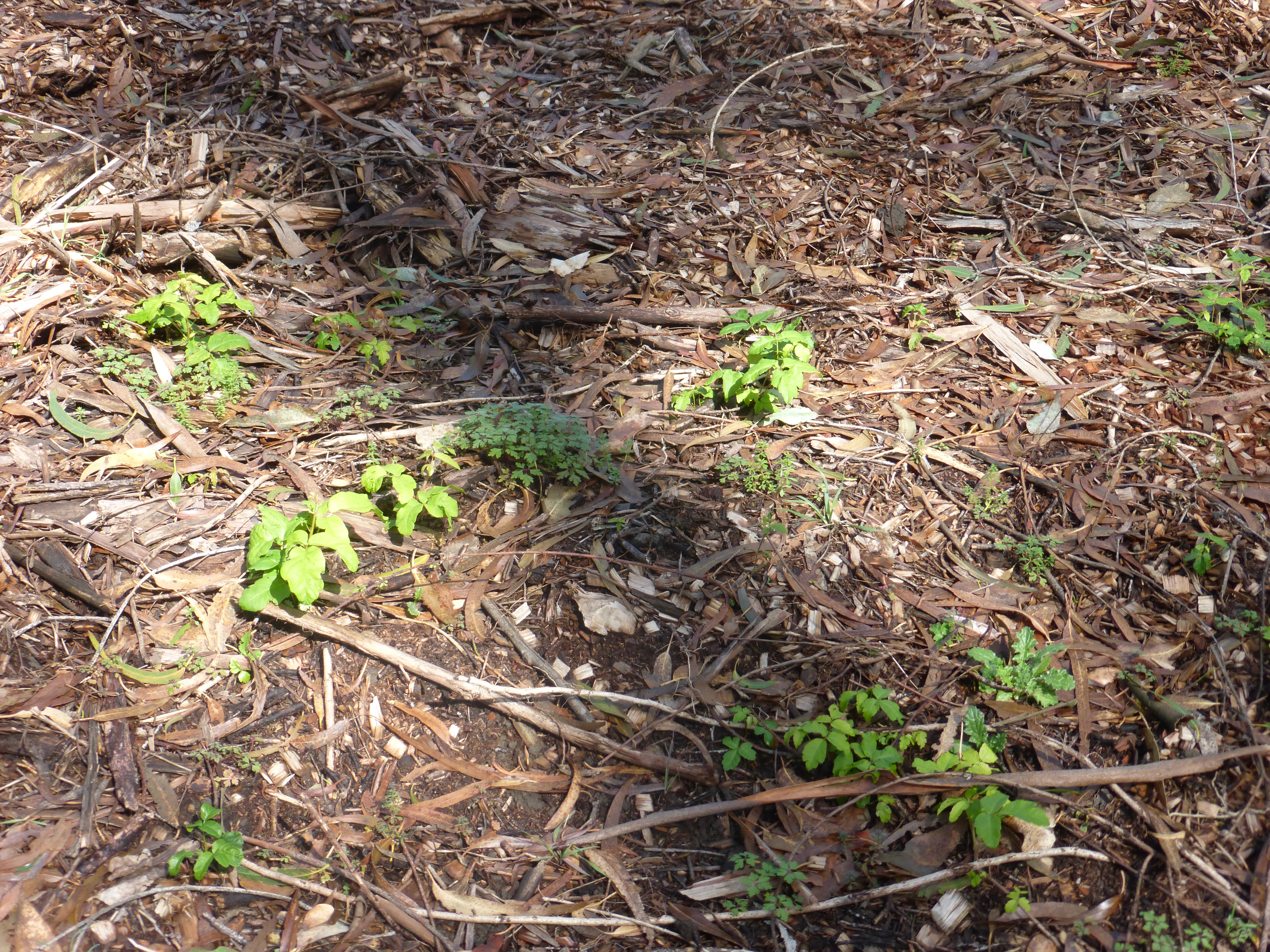
  • New growth of poison oak and blackberry is already emerging from the leaf litter.
Initial treatment of Recommended Treatment Area TI001 in Tilden Park, October 2016
New sprouts of poison oak in TI 001.

As we have said before, maintaining the canopy should suppress the growth of weeds and retain moisture in the leaf litter.  If so, fire hazards are not substantially increased by this type of treatment.

However, a few of our objections to these projects remain:

  • Pesticides were used to prevent the trees from resprouting and also sprayed on the understory to destroy the fuel ladder to the trees.
  • The pesticides that are used are known to damage the soil, which could damage the trees that remain as well as whatever plants remain.
  • The trees that remain are now more vulnerable to windthrow.
  • Valuable habitat has been lost and wildlife may have been harmed by the pesticides that were used and will be used going forward.

In conclusion, even radical thinning is preferable to clear cuts.  However, the benefits of thinning are questionable, particularly because of the pesticides used by these projects.

Site 29: A preview of the implementation of FEMA grants in the East Bay Hills

Site 29, May 2016
Site 29, May 2016

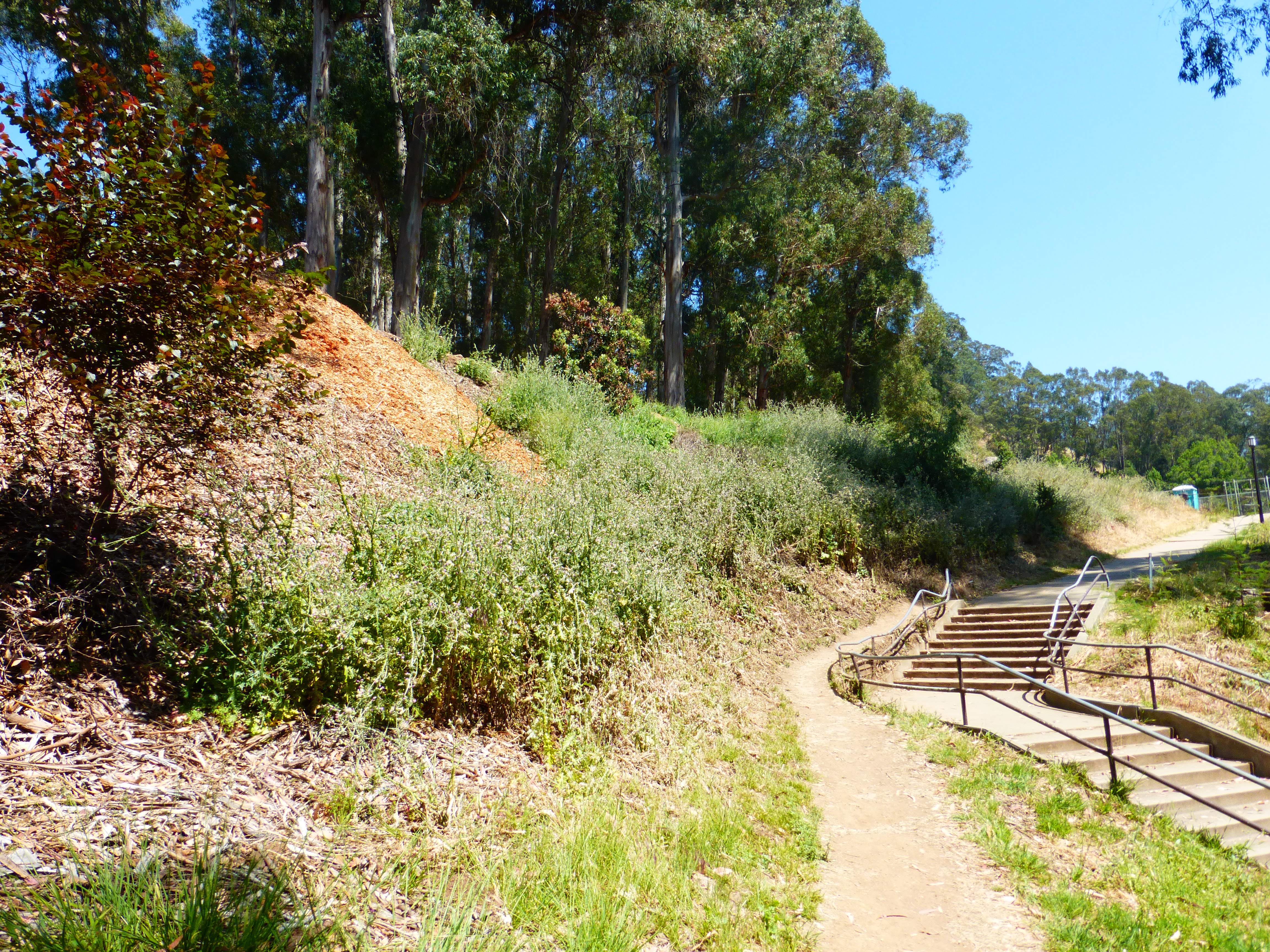
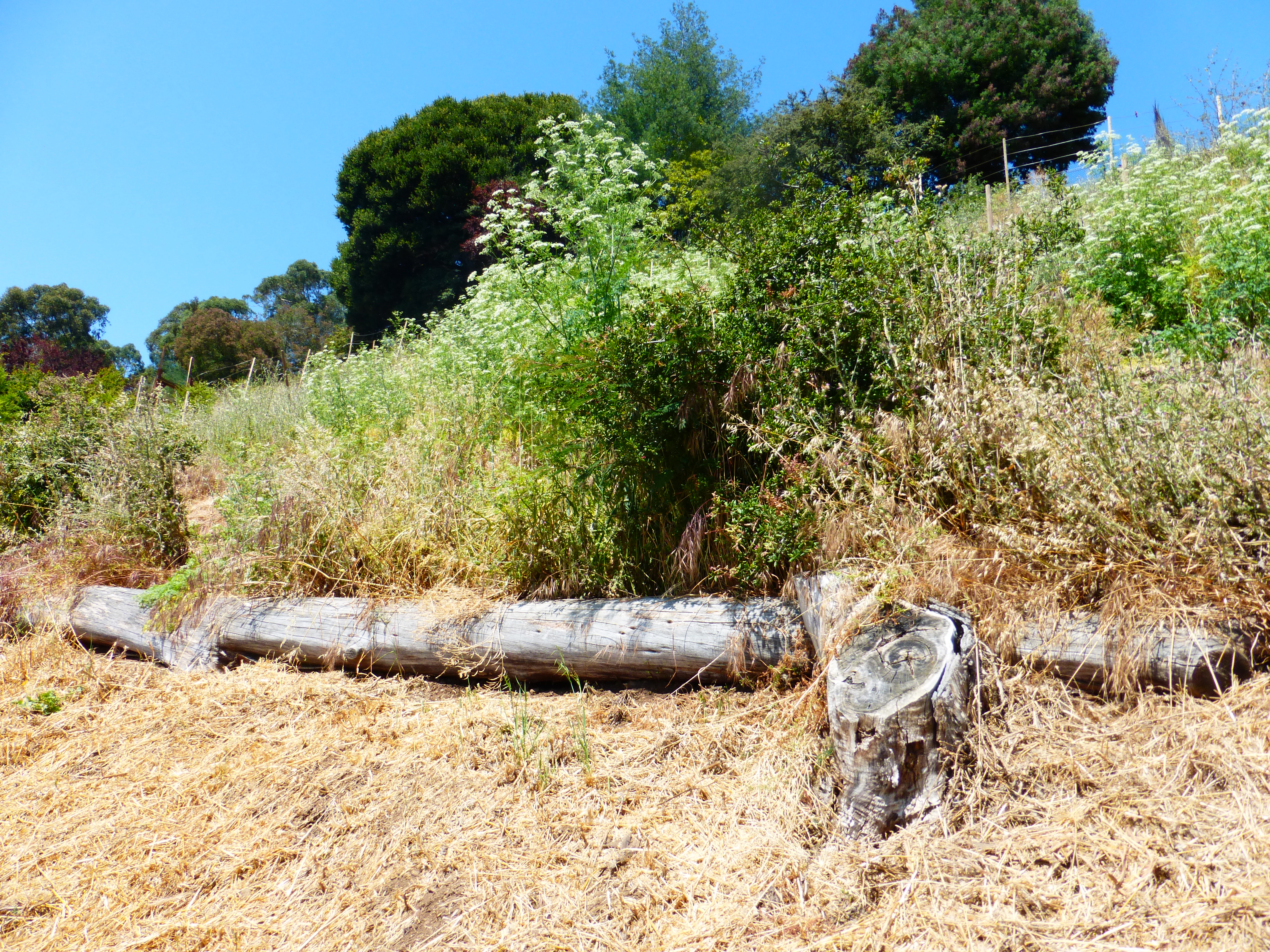
Site 29 is identified by the mile marker on Claremont Ave, just west of the intersection with Grizzly Peak Blvd.  All the eucalyptus trees were destroyed there about 10 years ago.  The trees that were destroyed were chipped and piled on site as mulch intended to prevent the growth of weeds.  The trunks of the trees line the road, log reminders of the forest that was destroyed.

The site was adopted by the Claremont Canyon Conservancy (CCC).   CCC has planted many redwood trees there and they consider it their showcase for their advocacy to destroy all eucalyptus trees in Claremont Canyon and elsewhere in the East Bay Hills.  The Sierra Club and CCC have collaborated in the effort to convince the public that if the eucalyptus trees are destroyed, a lovely garden of native plants and trees will replace the eucalyptus forest.  They also want you to believe that their garden will be less flammable than the eucalyptus forest.

There are several flaws in this rosy prediction.  The first problem is that Site 29 is ecologically unique.  It is a riparian corridor with a creek running through it.  Therefore, more water is available there than on the sunny hills where eucalyptus forests grow.  It is a canyon with steeply sloping sides that provide protection from sun and wind, which helps retain moisture.  In other words, conditions at Site 29 are ideal for the landscape that CCC and its friends are trying to achieve.

Claremont Canyon Conservancy sign says, "“These coastal redwoods…have been planted by volunteers as part of a habitat restoration to create a native and fire-resistant environment in Claremont Canyon.” The sign is planted in wood chip mulch and obscured by poison hemlock and milk thistle, which are both non-native.
Claremont Canyon Conservancy sign at Site 29 says, ““These coastal redwoods…have been planted by volunteers as part of a habitat restoration to create a native and fire-resistant environment in Claremont Canyon.” The sign is planted in wood chip mulch and obscured by poison hemlock and milk thistle, which are both non-native.

Site 29 is also unique because CCC has planted many trees there and they have sponsored many work parties to maintain the site.  CCC has not made a commitment to plant all 2,000 acres of the East Bay Hills on which all non-native trees will be destroyed by the FEMA grant projects.  Nor have any of the land owners made a commitment to plant those acres after the trees are destroyed.

So, given the ideal landscape conditions, the planting, and maintenance invested by CCC, how successful is Site 29?  Is it a lovely native plant garden?  Is it less flammable than the eucalyptus forest it replaced?  This is our photo essay of Site 29 that answers those questions.  But photos can be deceiving, so we invite you to visit yourself.  Just drive east on Claremont Ave until you reach mile marker 29, park your car beside the road and take a walk.

The reality of Site 29

Milk thistle at Site 29, April 2016

When we visited Site 29 in late April the milk thistle was thriving, but not yet in bloom.  The striking zebra pattern of the leaves makes it an attractive plant, in our opinion, and this lazuli bunting seems to agree that it is a plant worthy of admiration.  It is, however, not a native plant.

Lazuli bunting at Rancho San Antonio on milk thistle, April 2016. Courtesy Greg Barsh

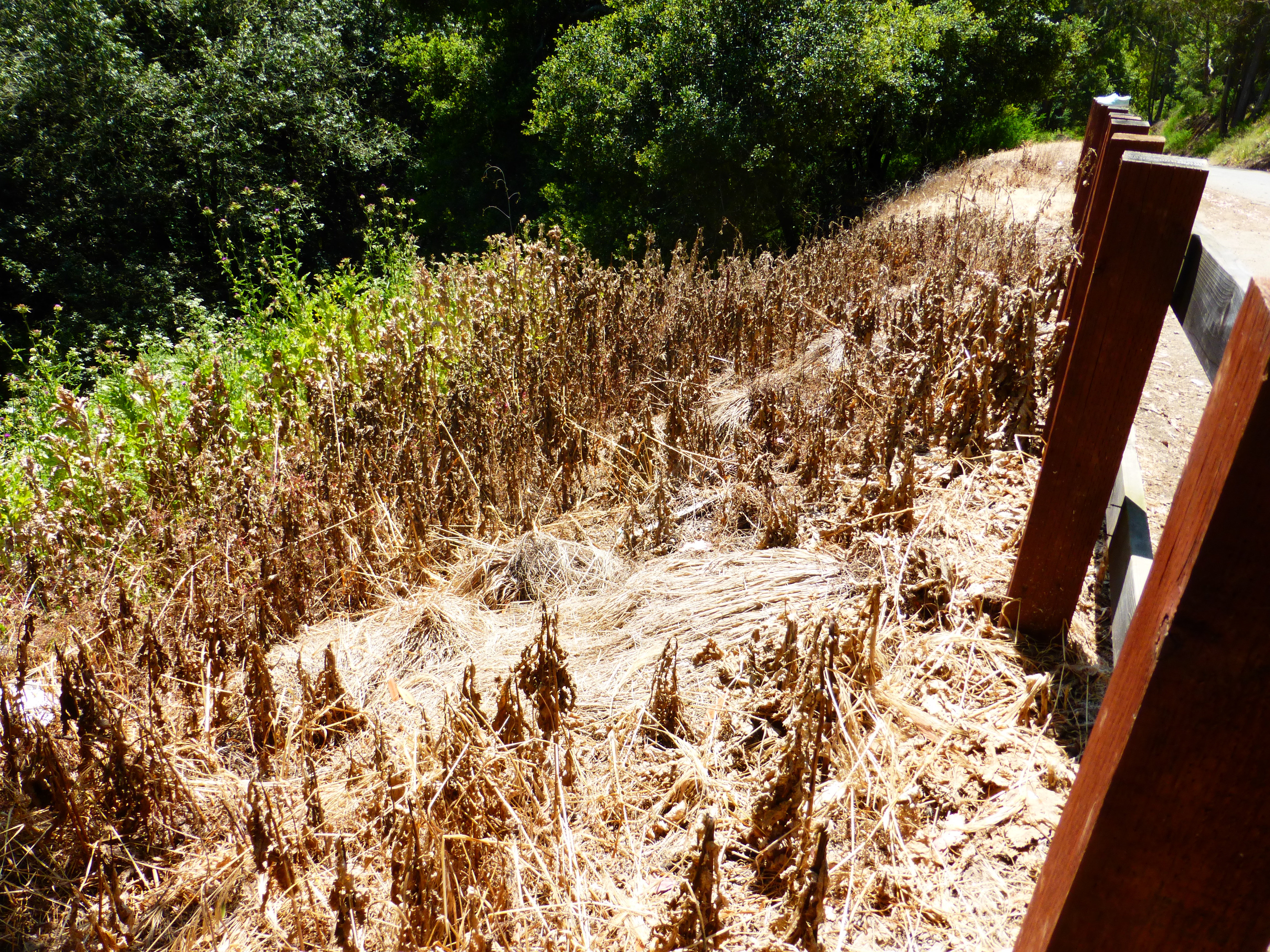
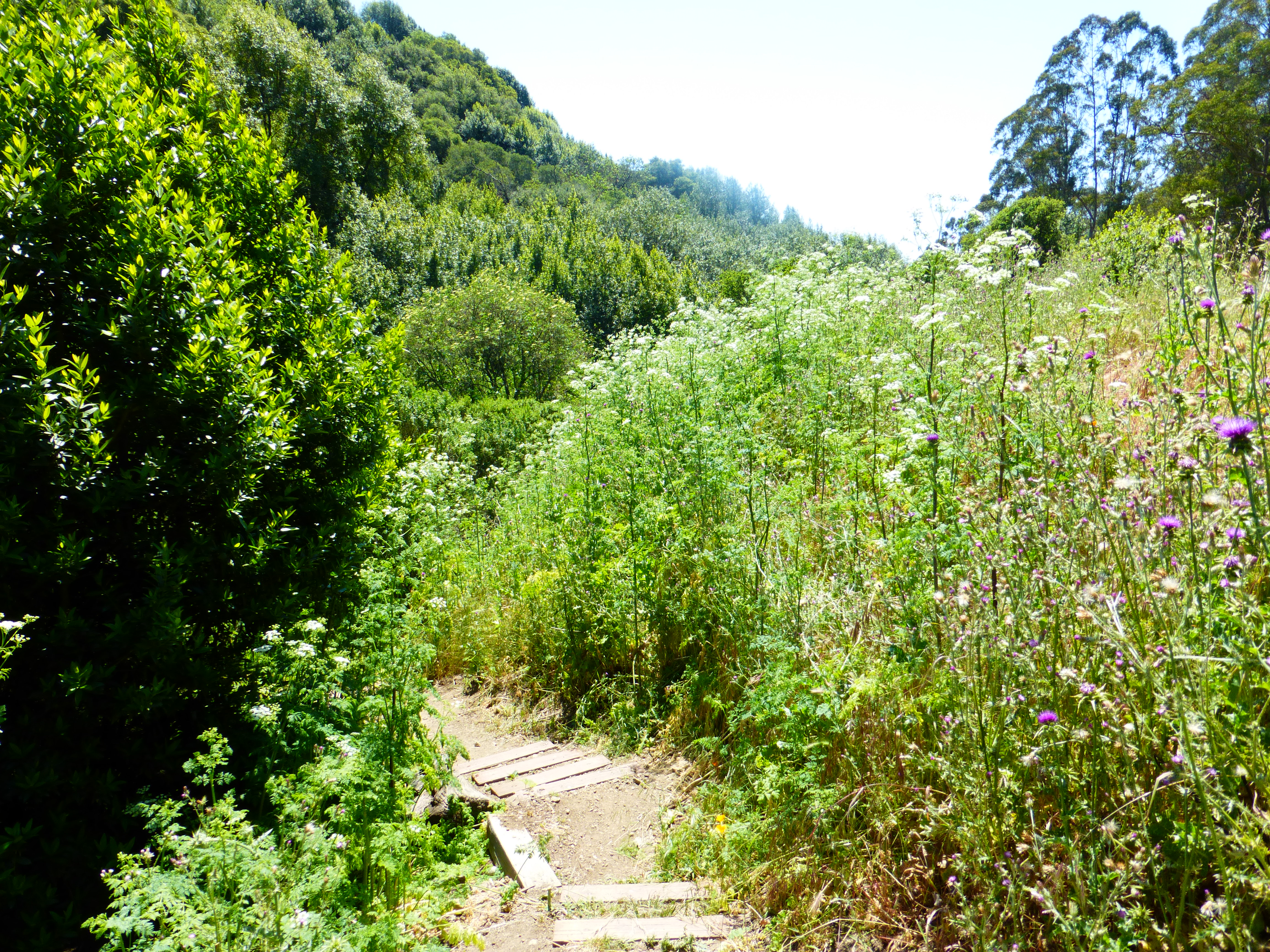
When we visited Site 29 a month later, in late May, it was a very different scene.  The milk thistle had been sprayed with herbicide along the road, to a width of about six feet, providing a stark contrast between the dead vegetation and the still green weeds.  Poison hemlock now grows along the trail into the canyon to a height of about 8 feet, joining the thistles as the landscape of Site 29.  The piles of wood chips are still visible, but are mostly covered with non-native annual grasses and other weedy shrubs.

Dead milk thistle, Site 29, May 2016
The trail down into the canyon is lined by 8-foot tall poison hemlock at Site 29.

More fantasies face harsh realities

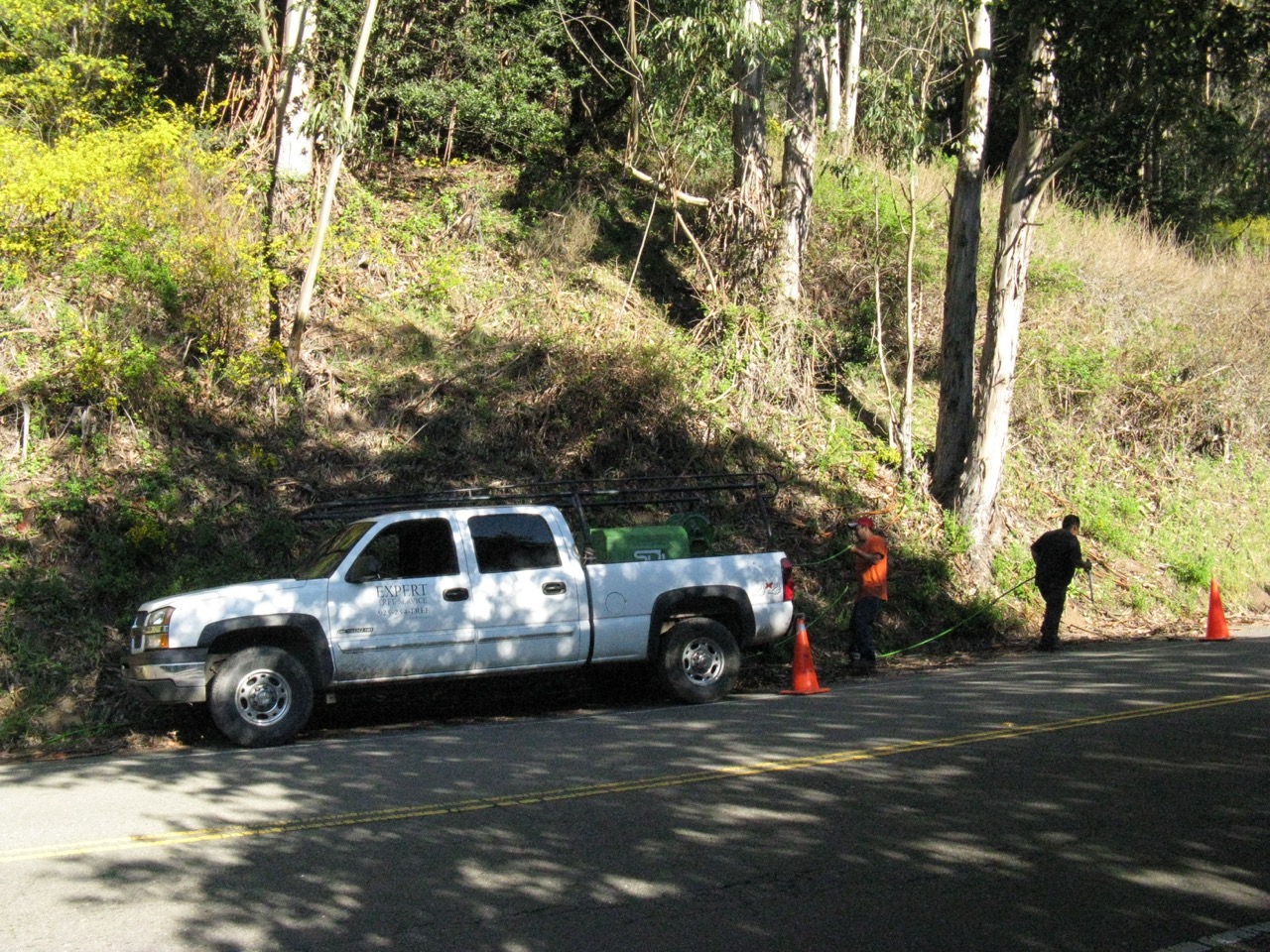
The contractors who apply herbicides on UC Berkeley properties have been photographed many times spraying herbicides at Site 29 and elsewhere.  When they are observed spraying herbicides there are not any pesticide application notices to inform the public of what is being applied and when the application is taking place.  So, unless you see them doing it, you don’t know that you are entering a place that has been sprayed with herbicide.  Several days later, you know that herbicides have been applied only because the vegetation is dying and soon looks dead.

Herbicide spraying at mile marker 29 on Claremont Ave.
Herbicide spraying on UC Berkeley property on Claremont Ave.

When the Environmental Impact Statement for the FEMA projects was published, the land managers claimed they would use “best management practices” in their pesticide applications, including posting notices in advance of spraying that would remain in place during the spraying and for some time after the spraying.  That assurance turns out to be meaningless.  Herbicides are being applied without any public notification before, during, or after application.

We were under the mistaken impression that posting application notices was required by California law.  We therefore asked those who observed herbicide applications without posted signs to report the incidents as violations of California law.

The Alameda County Agricultural Department is responsible for enforcement of California’s laws regarding pesticide use in Alameda County.  They have informed us that no notices of pesticide application are required for non-agricultural applications of glyphosate (RoundUp) or Garlon (triclopyr; the herbicide sprayed on the stumps of trees that are destroyed to prevent them from resprouting).  The manufacturers of these products say they dry within 24 hours, which is the definition of when re-entry is permitted.  Notification is not required for pesticides for which re-entry is permitted within 24 hours, even while the pesticide is being sprayed.

Would you like more Site 29s?

The eucalyptus forest at Site 29 was destroyed over 10 years ago.  Therefore, it is a preview of what we can expect when eucalyptus is destroyed on 2,000 more acres of public land in the East Bay Hills.  So, what can we learn from Site 29?

Site 29 had every advantage:  plenty of water, protection from wind and sun, planting of native trees, and maintenance by a volunteer neighborhood association.  Even with all those advantages, unshaded areas in which trees were destroyed at Site 29 are dominated by non-native weeds that are more flammable than a shady eucalyptus forest.  And because the weeds are flammable, they must be repeatedly sprayed with herbicides along the roads where ignition is most likely to occur.  Dead vegetation is more flammable than living vegetation, so the logic of the spraying seems muddled.

Most of the 2,000 acres of public land on which eucalyptus forests will be destroyed do not have a water source, or protection from wind and sun.  Nor will trees be planted or maintenance provided.  They are going to look much worse than Site 29 and they will be more flammable.

Site 29 is an opportunity for us to say,”NO, this is NOT the landscape we want.  PLEASE do not destroy our eucalyptus forests!!”

GIVE US A VOTE!! Results of letter to Sierra Club members

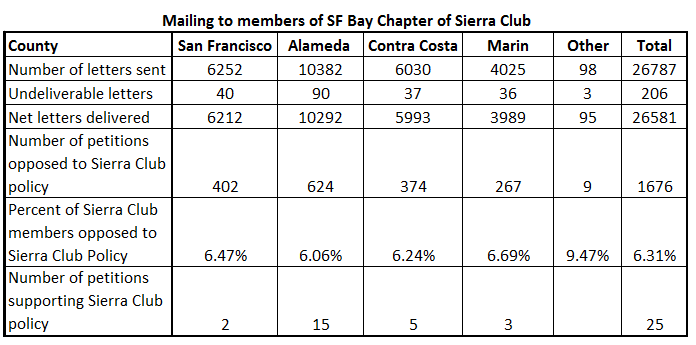
Our readers will recall that California law enabled a member of the Sierra Club to send a letter to over 26,000 members of the San Francisco Bay Chapter of the Sierra Club about the chapter’s support for deforestation and pesticide use in the East Bay Hills. Today we’re reporting the result of that letter and the next step in the long, tortuous path to changing the chapter’s policy on these issues. The letter and enclosed postcard petition are available HERE and HERE: Letter to Sierra Club members and Letter to Sierra Club members – postcard petition

To date, this is the number of postcard petitions that have been received:

sierraclub petition table

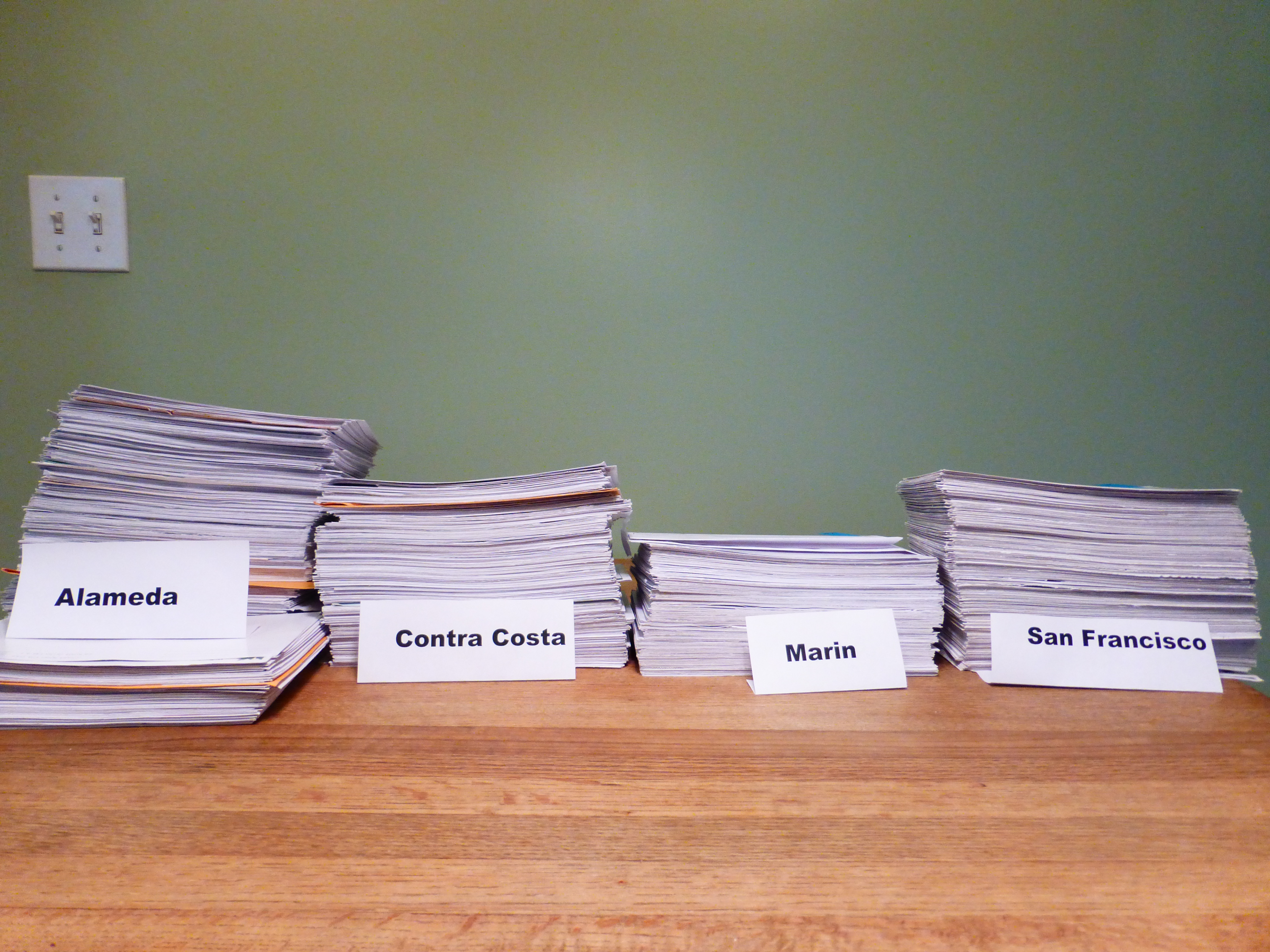
Since many couples have joint memberships, the actual number of Club members who signed the postcard petition is greater than the number of postcards.  The postcard petitions represent the opposition of 1,823 members to Sierra Club policy.  Many members also added written messages on the postcard petition, which are available HERE: Petition Comments


Postcard petitions to Sierra Club

The Sierra Club is now obligated to give us a VOTE on this issue!

According to the Sierra Club bylaws, critics of the Club’s policy regarding the destruction of our urban forest and pesticide use are now entitled to a formal vote on the issues.  The Sierra Club reports:  “More than 45,000 members nationwide voted” in the 2016 election for the Club’s National Board of Directors.  Let’s say 46,000 voted.  Two percent (2%) of 46,000 is 920. Nearly twice as many (1,823) Sierra Club members have indicated their opposition to the Club’s policy regarding the destruction of our urban forest and pesticide use.   Thus the results of the postcard petition now obligate the Sierra Club to conduct a formal vote on the issues:

“11.2. Except as provided in Bylaw 5.10, whenever a number of members of the Club equal at least to two percent (2%) of the number of ballots cast at the immediately preceding annual election for Directors shall request in writing that a resolution be adopted by the Club, the Board may adopt the resolution by majority vote, unless the petition specifically requests a vote of the membership or such a vote is required by law or these Bylaws; if the resolution is not so adopted, the Board shall certify it to the Secretary for a vote of the members.”

The author of the letter to Sierra Club members informed the leadership of the Sierra Club of the number of postcard petitions received and requested a formal vote on the issues, as provided by the Club’s by-laws.

How to get the attention of the Sierra Club?

We have planned a demonstration at the national headquarters of the Sierra Club on Monday, June 13, 2016, at noon.  Unless the Sierra Club agrees to conduct a formal vote on the issues before that date, we plan to tell the Sierra Club to let its members decide whether the Club should continue to support deforestation and pesticide use on public lands.

Noon 12:00 pm
Monday June 13, 2016
2100 Franklin St. (at 21st Street), Oakland
Sierra Club National Office (13th Floor)
(Close to 19th Street BART Station)

We hope that those who care about deforestation and pesticide use in the East Bay will join us for this peaceful demonstration.  A leaflet that you can print and post or distribute for this demonstration is available HERE: Flyer for demonstration  Please help us make the case that the bylaws of the Sierra Club obligate the club to give the membership a formal vote on these issues.

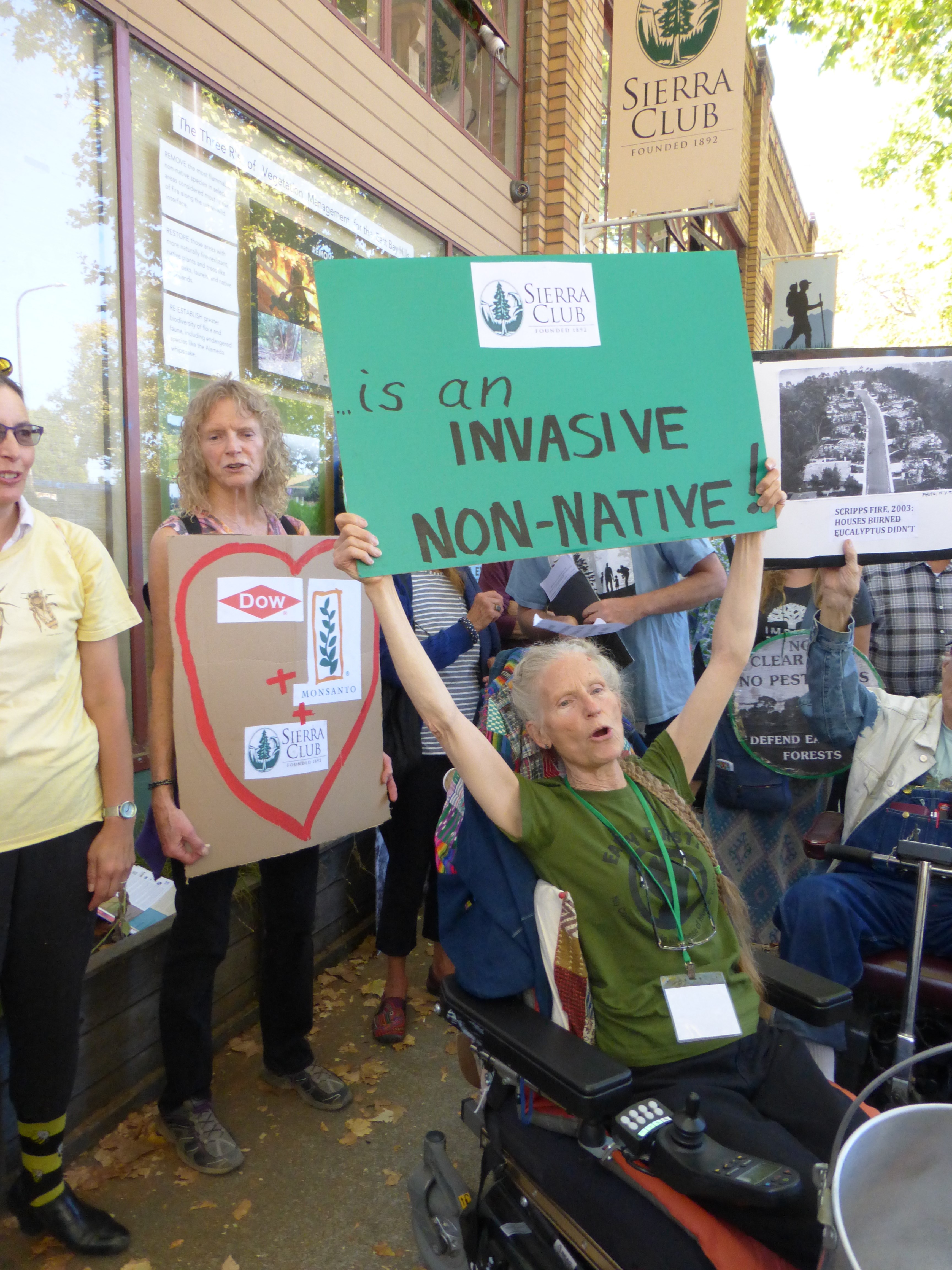
Sierra Club protest, August 25, 2015. About 80 people attended the peaceful protest.
Sierra Club protest, August 25, 2015. We delivered an on-line petition to Bay Chapter headquarters of the Sierra Club on these issues that now has over 2,800 signatures on it.

Why focus on the Sierra Club?

Opponents of the deforestation projects in the East Bay Hills may wonder why so much time and energy is spent on trying to change the policy of the Sierra Club on this matter.  Sometimes, Million Trees wonders too.

So, we will take a minute to explain that the Sierra Club has filed a lawsuit that demands immediate eradication of 100% of non-native trees on over 2,000 acres of public land.  East Bay Regional Parks District (EBRPD) is the biggest of the three land owners engaged in these projects.  EBRPD prefers to thin its eucalyptus forests from an average of 650 trees per acre to about 60-80 of the biggest trees per acre.  Although that seems to be the destruction of too many trees, it is clearly preferable to destroying EVERY non-native tree (eucalyptus, Monterey pine, and acacia) on about 1,600 acres of park land in the East Bay, which is what the Sierra Club lawsuit demands.   The other two land owners (UC Berkeley and City of Oakland) have always planned to destroy 100% of the non-native trees on about 500 acres of their land.  The Club’s lawsuit demands that they do so immediately, rather than phase some of the tree removals over a period of 10 years.

Furthermore, the Sierra Club is influential with public policy makers, including elected officials.  We believe that some decision-makers would be less likely to support these destructive projects if the Sierra Club would quit demanding the destruction of our urban forest.  In a liberal, environmentally conscious community such as ours, the Club’s promise of endorsement (or threat of non-endorsement) of a particular candidate for elected office is a powerful tool to impose the Club’s will on our decision makers.

Finally, we believe that the policy of the local chapter of the Sierra Club that demands destruction of much of our urban forest and douses our public lands with pesticides compromises the important mission of the national Sierra Club.  The national Sierra Club is appropriately focused on addressing the causes of climate change.  Climate change is the environmental issue of our time and the Sierra Club is one of the most important tools we have to address that issue.  Deforestation is a major cause of climate change.  The policy of the local chapter is therefore a contradiction of the mission of the Sierra Club.

“The Forest Unseen”

Forest UnseenDavid George Haskell, the author of The Forest Unseen, is a professor of biology at University of the South in southeastern Tennessee.  (1) He chose a circle of old-growth forest near his home, about a meter in diameter, to observe for a year.  He chose that spot at random because there was a suitable rock close by on which he could sit to smell, listen, and watch the forest.  He called this spot his forest mandala.

“Mandala” means “circle” in Sanskrit.  It is a spiritual and ritual symbol representing the universe.  It is often used as a method of meditation by Buddhist monks who sit for many hours creating a painting of a mandala, using colored chalk that is destroyed upon completion.  The mandala is therefore also a symbol of the ephemeral quality of life and an apt metaphor for the ever-changing forest that is teeming with life.

In 43 short chapters, Haskell shares his observations with us.  Sometimes he sits back and observes the big picture: the sound of the birds, the rustle of the wind, and the smell of blooming or decomposing vegetation.  Sometimes he lays on his belly with magnifying lens in hand and observes the activities of the smallest insects.  He seeks the answer to this question, “Can the whole forest be seen through a small contemplative window of leaves, rocks, and water?”  This reader believes Haskell has succeeded in finding the universal truths of the forest in the microcosm of his forest mandala.

mandala
Mandala

There is a multitude of fascinating biological, evolutionary, and ecological stories in Haskell’s book that defy summary, so I have selected one episode that seems most fitting to the mission of Million Trees.  Also, we must let Haskell speak for himself because his writing is more eloquent than ours.

“To love nature and to hate humanity is illogical”

One hot day in August, Haskell is startled by the bright white of a golf ball in his forest mandala.  His mandala is located below a bluff on which there is a golf course, so golf balls are not surprising here.  Still they are unsettling and they present a dilemma:

“…should I remove the balls or leave them nestled in place?  Removing them would break my rule about not meddling in the mandala.  But taking them away would restore the mandala to a more natural state and might make room for another wildflower or fern.  Discarded golf balls have nothing to contribute to the mandala.  They don’t decompose and release their nutrients.  They don’t become another species’ habitat.  The grand cycle of energy and matter seems to halt when it reaches a dumped golf ball.

“My first impulse, therefore, is to restore the mandala to ‘purity’ by removing the plastic balls.  But this impulse is problematic for two reasons.  First, removing the balls will not cleanse the mandala of industrial detritus.  Acidity, sulfur, mercury, and organic pollutants rain in continually.  Every creature in the mandala carries in its body a sprinkling of alien molecular golf balls.  My own presence here has undoubtedly added strands of worn clothing fiber, alien bacteria, and exhaled foreign molecules.  Even the genetic code of the mandala’s inhabitants is stamped by industry.  Flying insects, in particular those whose ancestors have come near humans, carry resistance genes for many pesticides.  Removing golf balls would merely tidy up the most visually obvious of these human artifacts, preserving an illusion of the forest’s ‘pristine’ separation from humanity.

“The impulse to purify might fail on a second, deeper level.  Human artifacts are not stains imposed on nature.  Such a view drives a wedge between humanity and the rest of the community of life.  A golf ball is the manifestation of the mind of a clever, playful African primate.  This primate loves to invent games to test its physical and mental skill.  Generally, these games are played on carefully reconstructed replicas of the savanna from which the ape came and for which its subconscious still hankers.  The clever primate belongs in this world.  Maybe the primate’s productions do also.

“As these able apes get better at controlling their world, they produce some unintended side effects, including strange new chemicals, some of which are poisonous to the rest of life.  Most apes have little idea of these ill effects.  However, the better-informed ones don’t like to be reminded of their species’ impact on the rest of the world, especially in places that don’t yet seem to be overly damaged.  I am such an ape.  Therefore, when a golf ball in the woods strikes my eyes, my mind condemns the ball, the golf course, the golfers, and the culture that spawned them all.

“But, to love nature and to hate humanity is illogical.  Humanity is part of the whole.  To truly love the world is also to love human ingenuity and playfulness.  Nature does not need to be cleansed of human artifacts to be beautiful or coherent.  Yes, we should be less greedy, untidy, wasteful, and shortsighted. But let us not turn responsibility into self-hatred.  Our biggest failing is, after all, lack of compassion for the world.  Including ourselves.

“Therefore, I resolve to leave the golf balls in the mandala.  I’ll continue removing strange plastic objects from the rest of the forest, but not from here.  There is value in keeping a patina of ‘naturalness’ along hiking trails and in gardens.  Our harried eyes need a visual break from the productions of industry.  Keeping the woods trash-free is a symbol of our desire to be more careful members of life’s community.  But there is also value in the discipline of participating in a world as it is, discarded golf balls and all.”

A new “restoration” ethic

We hope this episode in The Forest Unseen resonates with you as it did with us.  There is a generosity of spirit in it that we believe should inspire ecological restorations.  It is an ethic that is inclusive and respects the role of humans in nature.  We believe that ecological restorations based on this viewpoint would be less destructive and more constructive.  We would feel more welcome in restorations that reflect this viewpoint than the projects in which we only feel a sense of loss.


(1) David George Haskell, The Forest Unseen:  A Year’s Watch in Nature, Penguin Books, 2012

Lesson Learned: Don’t prune trees during breeding/nesting season

This article is reposted with permission from CoyoteYipps, a blog about San Francisco’s urban coyotes. It is a timely reminder that spring is breeding/nesting season for birds. 

There isn’t a hard-and-fast rule about when birds breed, build their nests, and raise their nestlings.  The general “rule” in the Bay Area is that most birds are nesting between February and August.  However, as the climate changes, we should expect outliers and we should be watchful for them. 

This story illustrates that pruning trees during nesting season is risky business.  We commend the author of this story for correcting a serious mistake and bringing this story to a happy ending.

We attended the Western Conference of the International Society of Arborists in Anaheim, California last week.  One of many excellent presentations we heard was about what arborists need to know about taking care of trees without harming wildlife. 

The presentation was made by an employee of HortScience in the San Francisco Bay Area.  HortScience is the arboriculture company that does most of the evaluations of trees for San Francisco’s Recreation and Park Department.  They are therefore influential in determining the future of the Bay Area’s urban forest.

HortScience has developed a protocol for arborists to avoid harming wildlife when they are working on trees.  The draft protocol is available HERE.  The author of the protocol is taking public comments on the draft until the end of May:  ryan@hortscience.com.  When the protocol is completed, HortScience plans to offer training to arborists to help them protect the birds in our urban forest.

We hope that people who are knowledgeable about birds will look at the draft and make suggestions for improving it to be most effective.  Thanks for your help to protect the birds in our urban forest.


MY HUMMINGBIRD ADVENTURE by LAUREL ROSE

I learned a valuable lesson this weekend: Do Not Prune or Remove Trees in Spring!  

Over the past couple years, I’ve been removing a row of unattractive honeysuckle trees along the fence line to let more light into our shady yard and plant some ferns & other foliage. The trees all had long skinny bare trunks with foliage starting at about 15- 20 feet up so all I could see was fallen leaves on top of compacted dirt and 8 pencil-thin tree trunks.

skinny trees (copyright Laurel Rose)

This weekend 7 and 8 were scheduled for removal. After getting 7 out of the ground, root and all, my friend and & I were getting ready to start breaking the trunk & branches down to 4 foot size segments required by the city for the green waste bins. I had a hand saw and my friend was using my mini electric chain saw for the job. I kept a safe distance in a far corner of the yard and we got to work. 2 branches into it, the chainsaw turns off and I hear “Oh Noooo! Oh my god! Nooo!” then, “chirp, chirp chirp”!

Tiny hummingbird nest on a twig
This is how I found the nest (copyright Laurel Rose)

The tree had a hummingbird nest camouflaged and expertly woven very securely onto a few twig size branches. Both my friend and I love & respect nature so we were a little frantic and horrified at the thought of nearly chainsawing through this little womb-like nest cradling 2 chicks. I found a little box and cushioned it with soft material scraps and toilet paper and placed the nest inside very carefully. It took a good hour for us to calm down and stop focusing on how thoughtless we had been to choose April to remove a tree. Even ugly trees with sparse foliage provide habitat and serve a s food source. My friend, a somewhat burly guy named Terry but whose friends call him “Bubba” was on the verge of tears telling me, “I searched for a nest before sawing off each branch. . .” . Even if one of us has noticed it, it did not resemble a typical storybook nest.
I called every organization and person I could think of for help on that Saturday evening: Golden Gate Audubon Society, Wild Care, and Janet. I was able to listen to a recorded instructions for caring for a injured chick. I kept them inside for the night in a warm dark spot away from my curious little dog who likes to be a part of everything I do whenever possible. As soon as it was light outside, I placed the box up high in the area where the tree had been. Within 20 minutes, mom showed up and fed her hungry babies and I watched as she gathered nectar from the flowers overhead on tree number 8 (which will stay in my yard).

Baby hummingbird (copyright Laurel Rose)
DAY 1: a few hours after discovery

We estimated the age to be between 2 & 3 weeks and were told that hummingbird chicks leave the nest at 23 days old. A couple days before this happens, a stronger chick pushes the weaker out of the nest and it dies because mom will not feed it on the ground. The reason this happens is because the nest is very small and is needed as a “launching pad”. Once the other chick takes flight, mom will continue to feed her baby for several days, teaching how and where to find all the best nectar & bugs before she chases it away to find its own territory. Since they are in a box, neither one will be pushed out of the nest and mom will continue to feed them both. I’m not sure if this may have any negative or unforeseen consequences but I like that idea!

Two hummingbird chicks in the nest
Two hummingbird chicks on the first day
Two Hummingbird chicks
Second Day – Hummingbird chicks
Box put up to rescue hummingbird nest
A safe space for a hummingbird nest

Day 2: I secured a new box in the other Honeysuckle tree because we were having some very windy days.


Box fastened into tree to rescue a hummingbird nest
Box fastened well against the wind

Day 3: I wasn’t sure if Mama was feeding her chicks with the new placement of the box with a different type of access, but I caught her in the act (see video below)


Mama hummingbird entering box to feed chicks in rescued nest
Mama hummingbird entering to feed the chicks – click for video (copyright Laurel Rose)
Hummingbird chick near fledging

Day 4: They changed so much from one day to the next

Two hummingbird fledglings

Day 5: Just before I left late Thursday morning, I went to check on the chicks and snapped this photo. They looked like they were ready to spread their wings. I might have made them a little nervous putting the camera up so close but wondered if they were contemplating their first flight.

Hummingbird chicks just before departing nest

When I came home in the early evening, the first thing I did was check the box and it was empty. I stood there for several minutes wondering how such a tiny creature with only 23 days of life can survive on their own. That’s when I heard chirping above and looked up- there was mama with 1 chick shoulder to shoulder on a branch.

hummingbird sitting in chain link fence
Hummingbird sitting in chain link fence

hummingbird-in-wire-2I looked around for the other chick and had noticed what I thought was a leaf caught in one of the links on the fence, but a closer look told me otherwise.

Maybe the little guy didn’t feel quite ready, or maybe he wanted to say goodbye. He let me get real close and looked at me with that one little eye as I said some encouraging words and slowly reached in my back pocket for my camera. I snapped one photo and he flew to the branch up above where his family was.

Today would be Day 8. I’ve been seeing what I believe to be this same little chick hanging out in the honeysuckle tree where the box was. A few hours ago, I observed the mama arrive and feed the chick patiently waiting on a little branch.

If you would like to invite hummingbirds to your yard I would not recommend those feeders with sugar water because they must be cleaned every 3- 4 days or they can make the hummingbirds very sick. It’s much better and healthier to provide their natural food sources and plant things like honeysuckle, sage, fuchsia, Aloe vera and other long tubular flowers that provide both nectar as well as habitat for insects that serve as protein. Hummingbirds also need a place to perch during the day & sleep at night that offers some protection from wind & rain- usually trees. You can also hang a perch up high in a tree near the flowers and you can encourage nesting by providing materials by hanging a “Hummer Helper” you can purchase and fill with store bought material or even dog and cat hair — the “Hummer Helper” is actually just a “suet feeder” which you can buy for a lot less. The best time to start is May. The Hummingbird Society has a lot more tips and information on their website.

*One last note about trimming trees- the safest time is in the Fall during the months of September- December

Fire scientist says, “…eucalyptus did not burn with high intensities leading to home destruction”

We have the pleasure of publishing a guest post by a member of the team that is trying to prevent the pointless destruction of the urban forest in the East Bay Hills.  This article is an example of the expertise and dedication of our team.  It also makes another contribution to the considerable body of evidence that eucalyptus has been inappropriately blamed for the 1991 Oakland fire and that destroying our urban forest will not reduce fire hazards.  (emphasis added)


April 24, 2016

Jack Cohen is a fire scientist at the US Forest Service fire lab in Missoula Montana.  For decades he has researched fire behavior in the Wildland Urban Interface areas (WUI). His research includes scores of post-fire investigations, as well as controlled experiments in the only forest fire lab in this country.  WUI fire poses a unique set of challenges to local fire departments. Mr Cohen’s research has informed nationwide strategies on how to prevent and manage fire in the WUI setting.

He concludes that it is neither desirable nor realistic to attempt complete suppression of catastrophic fires, or to expect fire departments to fully defend WUI areas. We live, after all, in a fire dependent natural environment, and have over the years constructed many combustible structures within heavily vegetated and dry areas. He does believe it is possible to construct and maintain buildings to resist ignition, (by addressing the Home Ignition Zones) and that this effort will do much more towards preserving human life and property than remote fuel treatment, or poorly focused fire suppression efforts.

As part of my work as a building inspector and engineer, I spent 18 years studying, developing and enforcing building codes in the East Bay, including the WUI areas of Berkeley. In years following the 1991 Oakland hills fire, both local and national bodies incorporated the findings of Mr. Cohen’s ground-breaking research into building regulations for new construction.  “…destruction in the WUI is primarily the result of the flammability of the residential areas themselves, rather than the flammability of the adjacent wildlands…Research has shown that a home’s characteristic and its immediate surroundings principally determine the WUI ignition potential during extreme wildfire behavior.” (1)

It’s my opinion that the removal of eucalyptus trees from the hills will not advance, and may even worsen, fire hazard mitigation. The trees are not the problem. As for firebrands emitted during a fire, they are generated in all vegetation types. The best strategy to save homes is to harden structures to prevent ignition and maintain surrounding defensible space. Still, I wondered about the often-repeated claim by local officials that these eucalyptus trees are to blame for the 1991 fire, and that they present a major threat to fire safety. So, I asked Jack. Here’s his private email response. He included some photos, worth taking a look at. His website follows, including links to his extensive research: http://www.firewise.org/wildfire-preparedness/wui-home-ignition-research/the-jack-cohen-files.aspx?sso=0
Marg Hall
Berkeley, Ca

  1. Elizabeth Reinhardt, Robert Keane, David Calkin, Jack Cohen, “Objectives and considerations for wildland fuel treatment in forested ecosystems of the interior western United States,” Forest Ecology and Management, 256 (2008) 1997-2006.

(Here attach emails, but remove our addresses)

From: “Cohen, Jack -FS”
Date: March 25, 2016 3:38:38 PM PDT
To: Margaret Hall
Subject: RE: 1991 Oakland Hills fire

Marg—

Thank you for your generous words of support for the research I’ve done!

I did a quick analysis of Oakland Hills as part of an internal effort to better understand the contribution of firebrand ignitions. I used video footage as my window to the event and did not do a site examination. This effort did not generate a written report. However, it became abundantly clear the Oakland residential fire disaster was similar to more recent disasters where eucalyptus is significantly present. I have attached 5 photos (poor quality) showing that the “gasoline” tree remains unconsumed adjacent to/surrounding destroyed houses as with all the other disasters I’ve examined (refer to my reports). The first 2 photos are from the 2009 Melbourne, Victoria fires that destroyed many structures with 173 civilian fatalities in Kinglake and Marysville in the hills north of Melbourne (I did a site visit but these are not my photos). The unconsumed tree vegetation is eucalyptus. The next 3 photos (not mine) are from the 2003 San Diego County fires. All of the destroyed homes and the burning wood roof home have adjacent eucalyptus – not burning in the tree canopy with high intensities. This is consistent with all the disaster examinations I’ve done (internal reports and published) regardless of the tree species. The common characteristics initiating the disastrous losses in high density residential development are extreme wildfire conditions in surrounding wildlands producing firebrand showers that ignite homes directly and surface fuels within the community to produce significant firebrands from burning homes/structures and adjacent trees that were ignited by the burning homes. This indicates that the eucalyptus trees did not burn with high intensities (or any intensity) leading to home destruction. This strongly suggests that eliminating eucalyptus and replacing it with some other vegetation would not prevent future WU fire disasters because the problem was inappropriately defined as a eucalyptus vegetation problem and not a home ignition-home ignition zone problem.

This is my perspective in answer to your question. Hope that helps. If you have further questions please feel free to ask.

Cheers—

Jack

Melbourne, Victoria, Australia, 2009
San Diego County, California, 2003
San Diego County, California 2003
San Diego County, California, 2003

From: Margaret Hall
Sent: Sunday, March 13, 2016 3:09 PM
To: Cohen, Jack -FS
Subject: 1991 Oakland Hills fire

Dear Mr. Cohen,

I am a retired building inspector/civil engineer in the SF Bay Area and am familiar with your work on home ignition zones. After the 1991 fire, we (City of Berkeley) adopted a building code ordinance which focused on hardening structures against wild land/urban interface fire. When I began to learn of your research, I realized retrospectively how very helpful that information was in developing our code. Thanks for all your great work!

There is a debate in our community about a plan to remove large quantities of eucalyptus stands in the East Bay hills. Some firefighters remember that the many wood shingle roofs were the primary contributor to the spread of that fire. Other folks remember events quite differently and blame the trees. I’ve got two questions:

  1. Did you study the1991 Oakland HIlls fire? If so, can I have a copy of your report? (if it’s not in electronic form, I’m happy to pay for copying/mailing as needed)
  1.  Do you have any fire-science based information on the dangers represented by a specific tree species (in this case E globulus) as compared to other vegetation types? Is there any basis in science for calling eucalyptus trees “gasoline trees”?

Full disclosure: I am opposed to this plan. I don’t think it will reduce the fire danger, especially as the goal of this plan is to replace forested areas with very dry ignitable “grasslands and shrubs”. Also, I’m not happy about the prospect of escalating the use of herbicides in heavily used regional parks, herbicides required to prevent the trees from re-sprouting and suppress unwanted vegetation.

Please let me know if I need to file a formal public records request, and if so, in what format you need that. Again, thanks for your great research. I love watching your videos and the way you are able to make geeky fire science accessible to firefighters and to the public.
Sincerely,

Marg Hall
Berkeley, Ca