“The Forest Unseen”

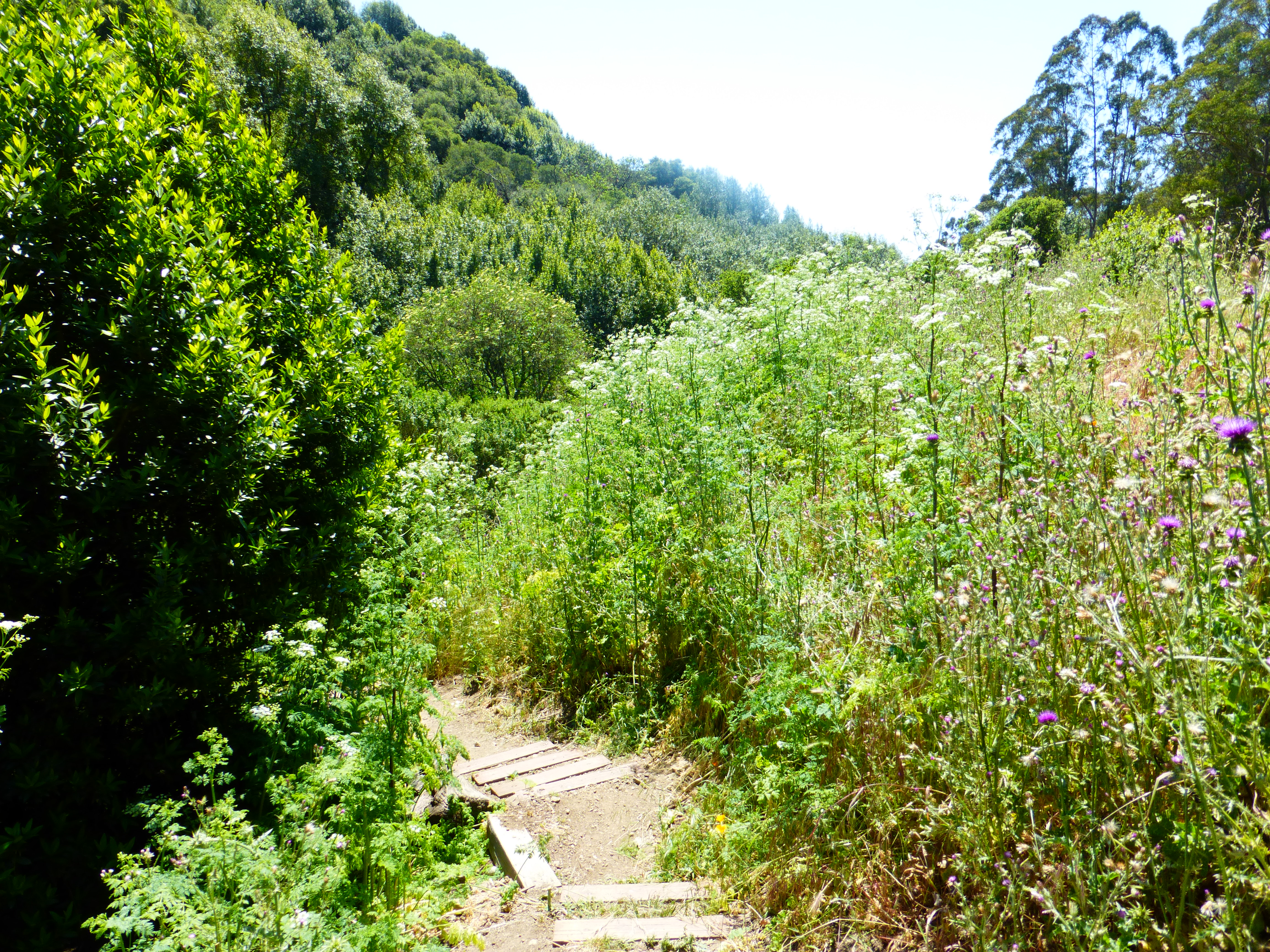
Forest UnseenDavid George Haskell, the author of The Forest Unseen, is a professor of biology at University of the South in southeastern Tennessee.  (1) He chose a circle of old-growth forest near his home, about a meter in diameter, to observe for a year.  He chose that spot at random because there was a suitable rock close by on which he could sit to smell, listen, and watch the forest.  He called this spot his forest mandala.

“Mandala” means “circle” in Sanskrit.  It is a spiritual and ritual symbol representing the universe.  It is often used as a method of meditation by Buddhist monks who sit for many hours creating a painting of a mandala, using colored chalk that is destroyed upon completion.  The mandala is therefore also a symbol of the ephemeral quality of life and an apt metaphor for the ever-changing forest that is teeming with life.

In 43 short chapters, Haskell shares his observations with us.  Sometimes he sits back and observes the big picture: the sound of the birds, the rustle of the wind, and the smell of blooming or decomposing vegetation.  Sometimes he lays on his belly with magnifying lens in hand and observes the activities of the smallest insects.  He seeks the answer to this question, “Can the whole forest be seen through a small contemplative window of leaves, rocks, and water?”  This reader believes Haskell has succeeded in finding the universal truths of the forest in the microcosm of his forest mandala.

mandala
Mandala

There is a multitude of fascinating biological, evolutionary, and ecological stories in Haskell’s book that defy summary, so I have selected one episode that seems most fitting to the mission of Million Trees.  Also, we must let Haskell speak for himself because his writing is more eloquent than ours.

“To love nature and to hate humanity is illogical”

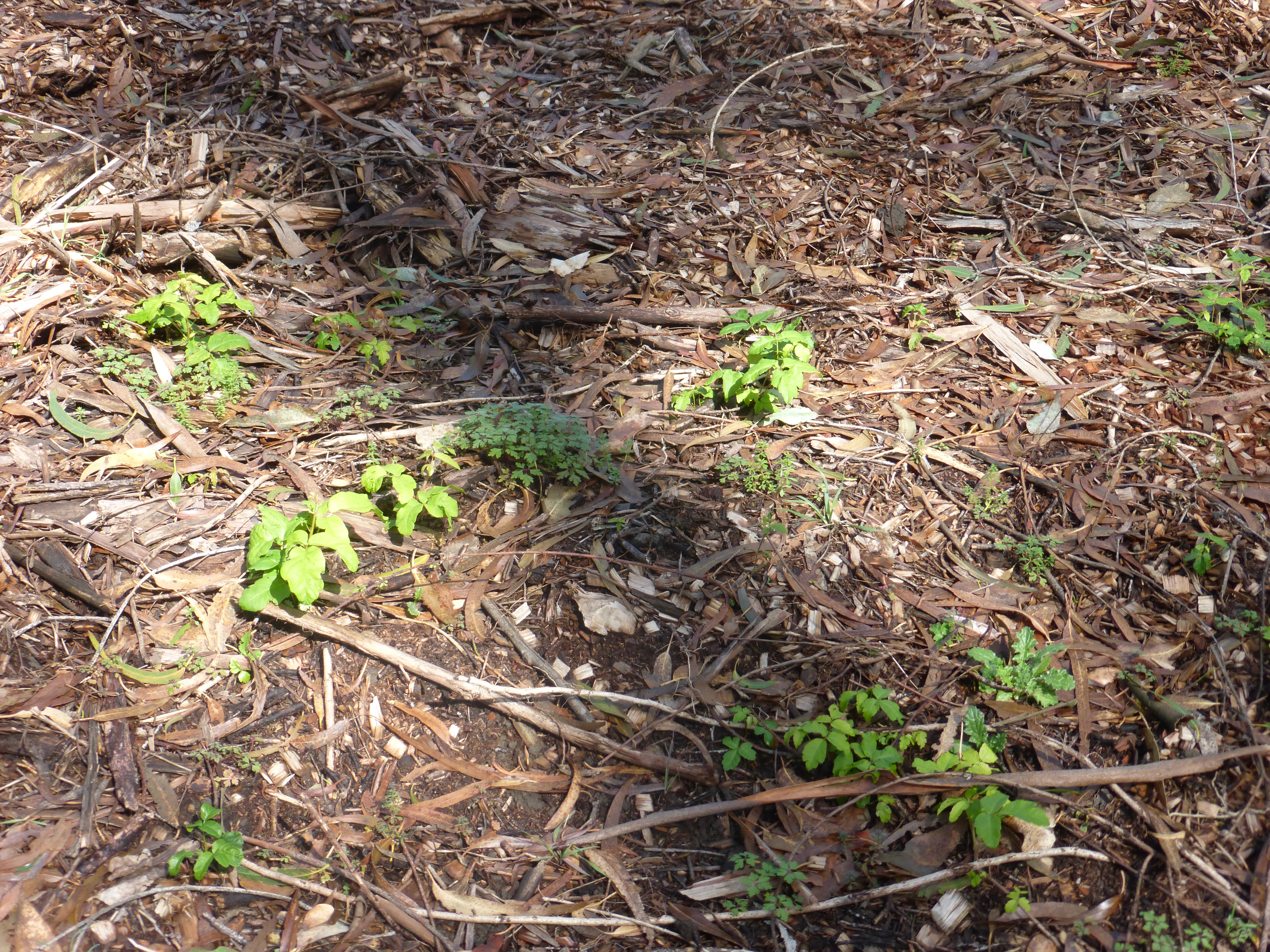
One hot day in August, Haskell is startled by the bright white of a golf ball in his forest mandala.  His mandala is located below a bluff on which there is a golf course, so golf balls are not surprising here.  Still they are unsettling and they present a dilemma:

“…should I remove the balls or leave them nestled in place?  Removing them would break my rule about not meddling in the mandala.  But taking them away would restore the mandala to a more natural state and might make room for another wildflower or fern.  Discarded golf balls have nothing to contribute to the mandala.  They don’t decompose and release their nutrients.  They don’t become another species’ habitat.  The grand cycle of energy and matter seems to halt when it reaches a dumped golf ball.

“My first impulse, therefore, is to restore the mandala to ‘purity’ by removing the plastic balls.  But this impulse is problematic for two reasons.  First, removing the balls will not cleanse the mandala of industrial detritus.  Acidity, sulfur, mercury, and organic pollutants rain in continually.  Every creature in the mandala carries in its body a sprinkling of alien molecular golf balls.  My own presence here has undoubtedly added strands of worn clothing fiber, alien bacteria, and exhaled foreign molecules.  Even the genetic code of the mandala’s inhabitants is stamped by industry.  Flying insects, in particular those whose ancestors have come near humans, carry resistance genes for many pesticides.  Removing golf balls would merely tidy up the most visually obvious of these human artifacts, preserving an illusion of the forest’s ‘pristine’ separation from humanity.

“The impulse to purify might fail on a second, deeper level.  Human artifacts are not stains imposed on nature.  Such a view drives a wedge between humanity and the rest of the community of life.  A golf ball is the manifestation of the mind of a clever, playful African primate.  This primate loves to invent games to test its physical and mental skill.  Generally, these games are played on carefully reconstructed replicas of the savanna from which the ape came and for which its subconscious still hankers.  The clever primate belongs in this world.  Maybe the primate’s productions do also.

“As these able apes get better at controlling their world, they produce some unintended side effects, including strange new chemicals, some of which are poisonous to the rest of life.  Most apes have little idea of these ill effects.  However, the better-informed ones don’t like to be reminded of their species’ impact on the rest of the world, especially in places that don’t yet seem to be overly damaged.  I am such an ape.  Therefore, when a golf ball in the woods strikes my eyes, my mind condemns the ball, the golf course, the golfers, and the culture that spawned them all.

“But, to love nature and to hate humanity is illogical.  Humanity is part of the whole.  To truly love the world is also to love human ingenuity and playfulness.  Nature does not need to be cleansed of human artifacts to be beautiful or coherent.  Yes, we should be less greedy, untidy, wasteful, and shortsighted. But let us not turn responsibility into self-hatred.  Our biggest failing is, after all, lack of compassion for the world.  Including ourselves.

“Therefore, I resolve to leave the golf balls in the mandala.  I’ll continue removing strange plastic objects from the rest of the forest, but not from here.  There is value in keeping a patina of ‘naturalness’ along hiking trails and in gardens.  Our harried eyes need a visual break from the productions of industry.  Keeping the woods trash-free is a symbol of our desire to be more careful members of life’s community.  But there is also value in the discipline of participating in a world as it is, discarded golf balls and all.”

A new “restoration” ethic

We hope this episode in The Forest Unseen resonates with you as it did with us.  There is a generosity of spirit in it that we believe should inspire ecological restorations.  It is an ethic that is inclusive and respects the role of humans in nature.  We believe that ecological restorations based on this viewpoint would be less destructive and more constructive.  We would feel more welcome in restorations that reflect this viewpoint than the projects in which we only feel a sense of loss.


(1) David George Haskell, The Forest Unseen:  A Year’s Watch in Nature, Penguin Books, 2012

Lesson Learned: Don’t prune trees during breeding/nesting season

This article is reposted with permission from CoyoteYipps, a blog about San Francisco’s urban coyotes. It is a timely reminder that spring is breeding/nesting season for birds. 

There isn’t a hard-and-fast rule about when birds breed, build their nests, and raise their nestlings.  The general “rule” in the Bay Area is that most birds are nesting between February and August.  However, as the climate changes, we should expect outliers and we should be watchful for them. 

This story illustrates that pruning trees during nesting season is risky business.  We commend the author of this story for correcting a serious mistake and bringing this story to a happy ending.

We attended the Western Conference of the International Society of Arborists in Anaheim, California last week.  One of many excellent presentations we heard was about what arborists need to know about taking care of trees without harming wildlife. 

The presentation was made by an employee of HortScience in the San Francisco Bay Area.  HortScience is the arboriculture company that does most of the evaluations of trees for San Francisco’s Recreation and Park Department.  They are therefore influential in determining the future of the Bay Area’s urban forest.

HortScience has developed a protocol for arborists to avoid harming wildlife when they are working on trees.  The draft protocol is available HERE.  The author of the protocol is taking public comments on the draft until the end of May:  ryan@hortscience.com.  When the protocol is completed, HortScience plans to offer training to arborists to help them protect the birds in our urban forest.

We hope that people who are knowledgeable about birds will look at the draft and make suggestions for improving it to be most effective.  Thanks for your help to protect the birds in our urban forest.


MY HUMMINGBIRD ADVENTURE by LAUREL ROSE

I learned a valuable lesson this weekend: Do Not Prune or Remove Trees in Spring!  

Over the past couple years, I’ve been removing a row of unattractive honeysuckle trees along the fence line to let more light into our shady yard and plant some ferns & other foliage. The trees all had long skinny bare trunks with foliage starting at about 15- 20 feet up so all I could see was fallen leaves on top of compacted dirt and 8 pencil-thin tree trunks.

skinny trees (copyright Laurel Rose)

This weekend 7 and 8 were scheduled for removal. After getting 7 out of the ground, root and all, my friend and & I were getting ready to start breaking the trunk & branches down to 4 foot size segments required by the city for the green waste bins. I had a hand saw and my friend was using my mini electric chain saw for the job. I kept a safe distance in a far corner of the yard and we got to work. 2 branches into it, the chainsaw turns off and I hear “Oh Noooo! Oh my god! Nooo!” then, “chirp, chirp chirp”!

Tiny hummingbird nest on a twig
This is how I found the nest (copyright Laurel Rose)

The tree had a hummingbird nest camouflaged and expertly woven very securely onto a few twig size branches. Both my friend and I love & respect nature so we were a little frantic and horrified at the thought of nearly chainsawing through this little womb-like nest cradling 2 chicks. I found a little box and cushioned it with soft material scraps and toilet paper and placed the nest inside very carefully. It took a good hour for us to calm down and stop focusing on how thoughtless we had been to choose April to remove a tree. Even ugly trees with sparse foliage provide habitat and serve a s food source. My friend, a somewhat burly guy named Terry but whose friends call him “Bubba” was on the verge of tears telling me, “I searched for a nest before sawing off each branch. . .” . Even if one of us has noticed it, it did not resemble a typical storybook nest.
I called every organization and person I could think of for help on that Saturday evening: Golden Gate Audubon Society, Wild Care, and Janet. I was able to listen to a recorded instructions for caring for a injured chick. I kept them inside for the night in a warm dark spot away from my curious little dog who likes to be a part of everything I do whenever possible. As soon as it was light outside, I placed the box up high in the area where the tree had been. Within 20 minutes, mom showed up and fed her hungry babies and I watched as she gathered nectar from the flowers overhead on tree number 8 (which will stay in my yard).

Baby hummingbird (copyright Laurel Rose)
DAY 1: a few hours after discovery

We estimated the age to be between 2 & 3 weeks and were told that hummingbird chicks leave the nest at 23 days old. A couple days before this happens, a stronger chick pushes the weaker out of the nest and it dies because mom will not feed it on the ground. The reason this happens is because the nest is very small and is needed as a “launching pad”. Once the other chick takes flight, mom will continue to feed her baby for several days, teaching how and where to find all the best nectar & bugs before she chases it away to find its own territory. Since they are in a box, neither one will be pushed out of the nest and mom will continue to feed them both. I’m not sure if this may have any negative or unforeseen consequences but I like that idea!

Two hummingbird chicks in the nest
Two hummingbird chicks on the first day
Two Hummingbird chicks
Second Day – Hummingbird chicks
Box put up to rescue hummingbird nest
A safe space for a hummingbird nest

Day 2: I secured a new box in the other Honeysuckle tree because we were having some very windy days.


Box fastened into tree to rescue a hummingbird nest
Box fastened well against the wind

Day 3: I wasn’t sure if Mama was feeding her chicks with the new placement of the box with a different type of access, but I caught her in the act (see video below)


Mama hummingbird entering box to feed chicks in rescued nest
Mama hummingbird entering to feed the chicks – click for video (copyright Laurel Rose)
Hummingbird chick near fledging

Day 4: They changed so much from one day to the next

Two hummingbird fledglings

Day 5: Just before I left late Thursday morning, I went to check on the chicks and snapped this photo. They looked like they were ready to spread their wings. I might have made them a little nervous putting the camera up so close but wondered if they were contemplating their first flight.

Hummingbird chicks just before departing nest

When I came home in the early evening, the first thing I did was check the box and it was empty. I stood there for several minutes wondering how such a tiny creature with only 23 days of life can survive on their own. That’s when I heard chirping above and looked up- there was mama with 1 chick shoulder to shoulder on a branch.

hummingbird sitting in chain link fence
Hummingbird sitting in chain link fence

hummingbird-in-wire-2I looked around for the other chick and had noticed what I thought was a leaf caught in one of the links on the fence, but a closer look told me otherwise.

Maybe the little guy didn’t feel quite ready, or maybe he wanted to say goodbye. He let me get real close and looked at me with that one little eye as I said some encouraging words and slowly reached in my back pocket for my camera. I snapped one photo and he flew to the branch up above where his family was.

Today would be Day 8. I’ve been seeing what I believe to be this same little chick hanging out in the honeysuckle tree where the box was. A few hours ago, I observed the mama arrive and feed the chick patiently waiting on a little branch.

If you would like to invite hummingbirds to your yard I would not recommend those feeders with sugar water because they must be cleaned every 3- 4 days or they can make the hummingbirds very sick. It’s much better and healthier to provide their natural food sources and plant things like honeysuckle, sage, fuchsia, Aloe vera and other long tubular flowers that provide both nectar as well as habitat for insects that serve as protein. Hummingbirds also need a place to perch during the day & sleep at night that offers some protection from wind & rain- usually trees. You can also hang a perch up high in a tree near the flowers and you can encourage nesting by providing materials by hanging a “Hummer Helper” you can purchase and fill with store bought material or even dog and cat hair — the “Hummer Helper” is actually just a “suet feeder” which you can buy for a lot less. The best time to start is May. The Hummingbird Society has a lot more tips and information on their website.

*One last note about trimming trees- the safest time is in the Fall during the months of September- December

Fire scientist says, “…eucalyptus did not burn with high intensities leading to home destruction”

We have the pleasure of publishing a guest post by a member of the team that is trying to prevent the pointless destruction of the urban forest in the East Bay Hills.  This article is an example of the expertise and dedication of our team.  It also makes another contribution to the considerable body of evidence that eucalyptus has been inappropriately blamed for the 1991 Oakland fire and that destroying our urban forest will not reduce fire hazards.  (emphasis added)


April 24, 2016

Jack Cohen is a fire scientist at the US Forest Service fire lab in Missoula Montana.  For decades he has researched fire behavior in the Wildland Urban Interface areas (WUI). His research includes scores of post-fire investigations, as well as controlled experiments in the only forest fire lab in this country.  WUI fire poses a unique set of challenges to local fire departments. Mr Cohen’s research has informed nationwide strategies on how to prevent and manage fire in the WUI setting.

He concludes that it is neither desirable nor realistic to attempt complete suppression of catastrophic fires, or to expect fire departments to fully defend WUI areas. We live, after all, in a fire dependent natural environment, and have over the years constructed many combustible structures within heavily vegetated and dry areas. He does believe it is possible to construct and maintain buildings to resist ignition, (by addressing the Home Ignition Zones) and that this effort will do much more towards preserving human life and property than remote fuel treatment, or poorly focused fire suppression efforts.

As part of my work as a building inspector and engineer, I spent 18 years studying, developing and enforcing building codes in the East Bay, including the WUI areas of Berkeley. In years following the 1991 Oakland hills fire, both local and national bodies incorporated the findings of Mr. Cohen’s ground-breaking research into building regulations for new construction.  “…destruction in the WUI is primarily the result of the flammability of the residential areas themselves, rather than the flammability of the adjacent wildlands…Research has shown that a home’s characteristic and its immediate surroundings principally determine the WUI ignition potential during extreme wildfire behavior.” (1)

It’s my opinion that the removal of eucalyptus trees from the hills will not advance, and may even worsen, fire hazard mitigation. The trees are not the problem. As for firebrands emitted during a fire, they are generated in all vegetation types. The best strategy to save homes is to harden structures to prevent ignition and maintain surrounding defensible space. Still, I wondered about the often-repeated claim by local officials that these eucalyptus trees are to blame for the 1991 fire, and that they present a major threat to fire safety. So, I asked Jack. Here’s his private email response. He included some photos, worth taking a look at. His website follows, including links to his extensive research: http://www.firewise.org/wildfire-preparedness/wui-home-ignition-research/the-jack-cohen-files.aspx?sso=0
Marg Hall
Berkeley, Ca

  1. Elizabeth Reinhardt, Robert Keane, David Calkin, Jack Cohen, “Objectives and considerations for wildland fuel treatment in forested ecosystems of the interior western United States,” Forest Ecology and Management, 256 (2008) 1997-2006.

(Here attach emails, but remove our addresses)

From: “Cohen, Jack -FS”
Date: March 25, 2016 3:38:38 PM PDT
To: Margaret Hall
Subject: RE: 1991 Oakland Hills fire

Marg—

Thank you for your generous words of support for the research I’ve done!

I did a quick analysis of Oakland Hills as part of an internal effort to better understand the contribution of firebrand ignitions. I used video footage as my window to the event and did not do a site examination. This effort did not generate a written report. However, it became abundantly clear the Oakland residential fire disaster was similar to more recent disasters where eucalyptus is significantly present. I have attached 5 photos (poor quality) showing that the “gasoline” tree remains unconsumed adjacent to/surrounding destroyed houses as with all the other disasters I’ve examined (refer to my reports). The first 2 photos are from the 2009 Melbourne, Victoria fires that destroyed many structures with 173 civilian fatalities in Kinglake and Marysville in the hills north of Melbourne (I did a site visit but these are not my photos). The unconsumed tree vegetation is eucalyptus. The next 3 photos (not mine) are from the 2003 San Diego County fires. All of the destroyed homes and the burning wood roof home have adjacent eucalyptus – not burning in the tree canopy with high intensities. This is consistent with all the disaster examinations I’ve done (internal reports and published) regardless of the tree species. The common characteristics initiating the disastrous losses in high density residential development are extreme wildfire conditions in surrounding wildlands producing firebrand showers that ignite homes directly and surface fuels within the community to produce significant firebrands from burning homes/structures and adjacent trees that were ignited by the burning homes. This indicates that the eucalyptus trees did not burn with high intensities (or any intensity) leading to home destruction. This strongly suggests that eliminating eucalyptus and replacing it with some other vegetation would not prevent future WU fire disasters because the problem was inappropriately defined as a eucalyptus vegetation problem and not a home ignition-home ignition zone problem.

This is my perspective in answer to your question. Hope that helps. If you have further questions please feel free to ask.

Cheers—

Jack

Melbourne, Victoria, Australia, 2009
San Diego County, California, 2003
San Diego County, California 2003
San Diego County, California, 2003

From: Margaret Hall
Sent: Sunday, March 13, 2016 3:09 PM
To: Cohen, Jack -FS
Subject: 1991 Oakland Hills fire

Dear Mr. Cohen,

I am a retired building inspector/civil engineer in the SF Bay Area and am familiar with your work on home ignition zones. After the 1991 fire, we (City of Berkeley) adopted a building code ordinance which focused on hardening structures against wild land/urban interface fire. When I began to learn of your research, I realized retrospectively how very helpful that information was in developing our code. Thanks for all your great work!

There is a debate in our community about a plan to remove large quantities of eucalyptus stands in the East Bay hills. Some firefighters remember that the many wood shingle roofs were the primary contributor to the spread of that fire. Other folks remember events quite differently and blame the trees. I’ve got two questions:

  1. Did you study the1991 Oakland HIlls fire? If so, can I have a copy of your report? (if it’s not in electronic form, I’m happy to pay for copying/mailing as needed)
  1.  Do you have any fire-science based information on the dangers represented by a specific tree species (in this case E globulus) as compared to other vegetation types? Is there any basis in science for calling eucalyptus trees “gasoline trees”?

Full disclosure: I am opposed to this plan. I don’t think it will reduce the fire danger, especially as the goal of this plan is to replace forested areas with very dry ignitable “grasslands and shrubs”. Also, I’m not happy about the prospect of escalating the use of herbicides in heavily used regional parks, herbicides required to prevent the trees from re-sprouting and suppress unwanted vegetation.

Please let me know if I need to file a formal public records request, and if so, in what format you need that. Again, thanks for your great research. I love watching your videos and the way you are able to make geeky fire science accessible to firefighters and to the public.
Sincerely,

Marg Hall
Berkeley, Ca


Why poisoning the soil contributes to failed “restorations”

We are members of an international team of people who are concerned about the destructive consequences of ecological “restorations.”  Trees, Truffles, and Beasts (1) was recommended to us by one of our collaborators in Australia because the book was written by several academic scientists in Australia and the Pacific Northwest of the United States.  The book compares and contrasts the forests of these disparate locations and finds that below the ground, they have much in common.

Much more is known about the important ecological functions performed by forests above ground than below ground.  However, there are many equally important things happening below ground that are essential to the health of forests:

  • The soil is inhabited by millions of microbes that decompose organic matter, making it available to plants as nutrients. These microbes recycle dead plants and wood back into usable material for living plants.
  • Nitrogen is essential to plant growth. Microbes and fungi in the soil convert nitrogen in the atmosphere into forms needed for plant growth.  Specific plant species (e.g., legumes, such as acacia and lupine), called nitrogen “fixers,” are mediators in this process.
  • Fungi in the soil deliver water and nutrients from the soil to the roots of trees in exchange for carbohydrates provided by the trees. This symbiotic relationship is essential for the health of trees and in the absence of fungi, tree growth and development are severely retarded.
  • Most carbon is stored in the soil, and soil fungi play a role in converting atmospheric carbon dioxide into carbon that is stored in the soil. “Recent research has shown that mycorrhizal fungi hold 50 to 70 percent of the total carbon stored in leaf litter and soil on forested islands in Sweden.” (2)

Relationships between animals and forests

The animals that live in the forests contribute to forest health and forests also benefit the animals.

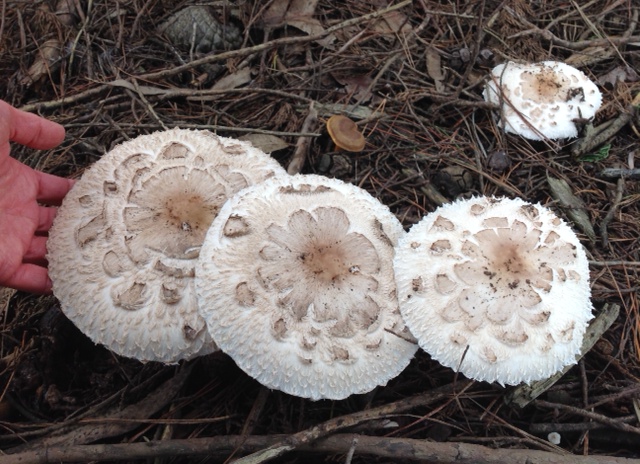
Mature Parasol mushrooms - note hand for size comparison
Mature Parasol mushrooms – note hand for size comparison

Fungi in the soil produce “fruiting bodies” that are their means of reproducing.  Fruiting bodies above ground are called mushrooms.  Fruiting bodies below ground are called truffles.  In both cases, they are important sources of food for animals.  The animals in Australia are different from those living in the Pacific Northwest, but they have in common that the fruiting bodies of fungi are equally important sources of food for them.

In the case of mushrooms above ground, dispersal of their spores is accomplished primarily by wind.  But in the case of truffles, dispersal of their spores is dependent upon the animals that eat them and “deposit” them elsewhere.  So, animals are crucial to the reproductive cycle of fungi that fruit below ground.

Long-footed potoroo is an Australian marsupial that eats primarily mushrooms and truffles.
Long-footed potoroo is a rare Australian marsupial that eats primarily mushrooms and truffles.

In their search for truffles, the animals also till the forest floor, which contributes to the decomposition of leaf litter and the dispersal of nutrients into the soil.  As the animals defecate in the forest, they are also making contributions to forest health and there are species of microbes and insects that specialize in the use of animal feces.

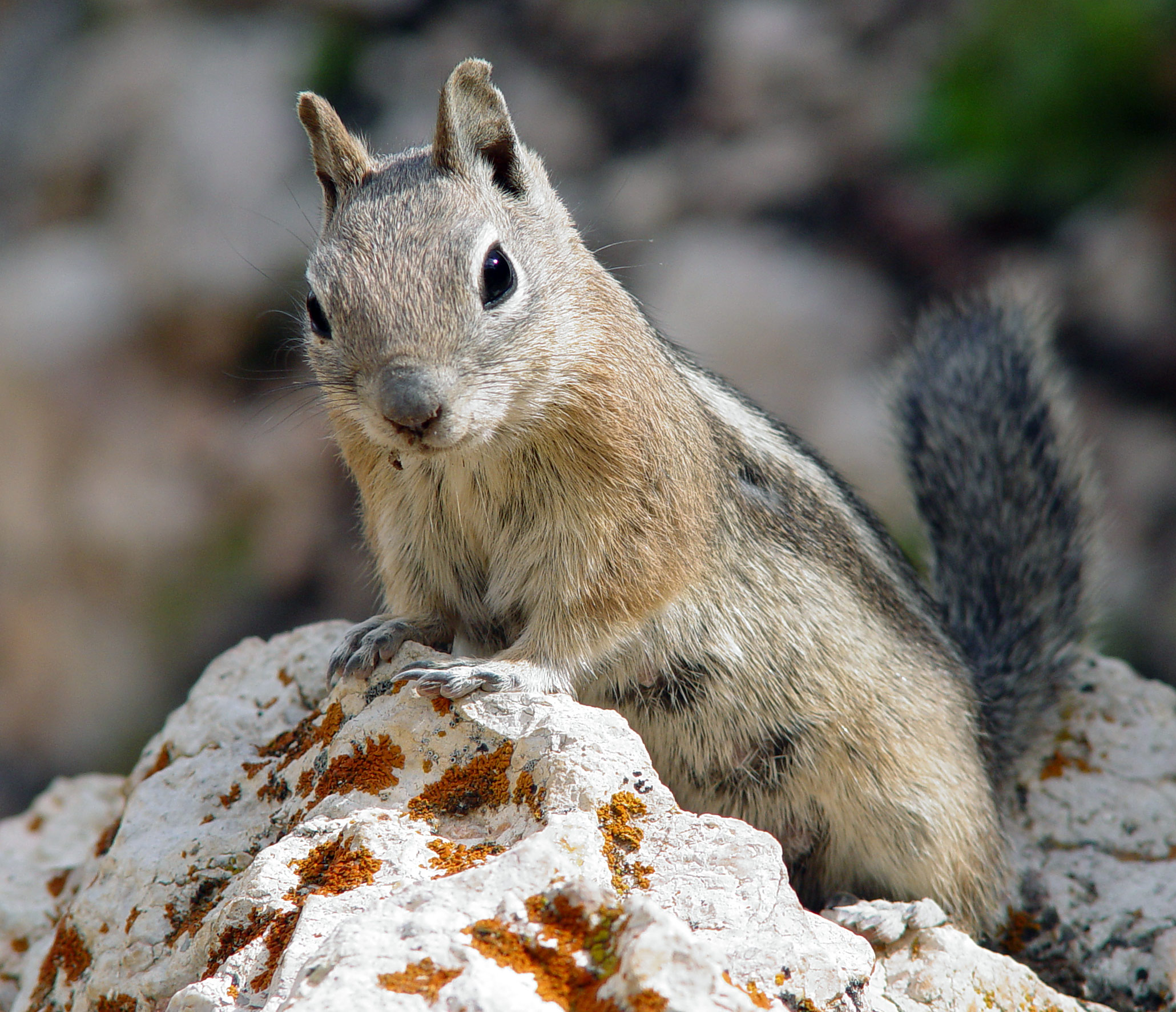
Golden mantled ground squirrel, Western North America. Prefers to eat mushrooms and truffles.
Golden mantled ground squirrel, Western North America. Prefers to eat mushrooms and truffles. Creative Commons

What happens to the forest ecosystem when it is clear cut?

The forest is a complex and delicate ecosystem.  When the forest is destroyed, we should not be surprised to learn that this ecosystem is destroyed.  Here are a few of the consequences of clear-cutting a forest:

The Bay Area is often blanketed in fog. Courtesy Save Mount Sutro Forest.
  • The forest precipitates fog and the shade provided by the canopy retains that moisture on the forest floor. When we destroy the forest, we lose that source of moisture.  The ground dries out in the sunshine.  The fruiting bodies of fungi—mushrooms and truffles—require moisture to bloom and they die quickly in the absence of moisture.
  • The herbicide (Garlon) used to prevent the trees from resprouting is known to damage the mycorrhizal fungi that are essential to forest health. The herbicide that is applied to the tree stump immediately after the tree is destroyed, travels though the cambium layer of the tree down through the roots of the tree.  The tree is killed by killing its roots.  Mycorrhizal fungi are essentially extensions of the root system.  When roots are killed, so are the mycorrhizal fungi.  In the absence of mycorrhizal fungi, the survival of “replacement” plants is compromised.
  • The loss of fruiting bodies as food for animals reduces animal populations and the contributions they make to forest health.
  • Glyphosate is the herbicide most commonly used to foliar spray non-native vegetation that colonizes the unshaded ground after a clear cut. Glyphosate was originally developed as an anti-bacterial agent.  Glyphosate kills bacteria in the soil (and in the mammalian gut, 4) that are playing a role in recycling nutrients to plants (and in digesting our food). (3)

Prescribed burning is another land management method used to eradicate “invasive” plants.  In addition to polluting the air, releasing carbon into the atmosphere, and increasing the risk of wildfire, prescribed burns also damage the soil:  “Prescribed burning in California pine forest decreased the ectomycorrhizal biomass by almost 90 percent in the upper organic layers of the soil as compared to unburned sites.  A decrease of that magnitude in the mycorrhizal energy source of the fungi would affect not only fungal fruiting but also fungal populations.”  (1)

In the absence of fungi and bacteria, the soil is essentially sterile and is no longer capable of contributing to the health of a new generation of plants and animals to replace the forest.

Eucalyptus forest in California and Australia

Trees, Truffles, and Beasts was written by academic foresters who are primarily concerned about the destructive consequences of destroying native forests and replacing them with timber plantations, often of another, faster growing species.  Ironically, in the case of old growth eucalyptus forests in Australia, the choice of replacement species is often Monterey pines.  Since some of the species of mycorrhizal fungi are specific to certain species or types of trees, this change of species is not successful without the inoculation of appropriate species of fungi.  For example, some of the mycorrhizal fungi that grow on the roots of conifers are not found on eucalyptus species.

Before writing this article, we corresponded with the authors of Trees, Truffles, and Beasts to confirm that fungi are found in the eucalyptus forests of California.  Since eucalyptus was brought to California as seeds, rather than potted plants, we needed confirmation that our eucalyptus forests are also enjoying the benefits of mycorrhizal fungi.  We are grateful that the authors replied.  They report that eucalyptus forests in California are populated with fungi, including some species that are native to Australia, which implies that some eucalyptus were imported from Australia with native soil.  Therefore, we can assure our readers that our description of how the forest functions applies to the eucalyptus forest in California, as well as in Australia.

Predicting the consequences of destroying our urban forest

Plans to destroy non-native forests on 2,000 acres of public land in the East Bay will result in a dry, barren landscape populated primarily by non-native annual grasses.  Fantasies that the forest will be magically replaced by a landscape of native plants and trees are just that…fantasies.  Every reputable source of information about the planned project predicts this outcome, from the US Forest Service to the Audubon Society and the California Native Plant Society.  There are many reasons why this outcome is predictable:

  • UC Berkeley's "Vegetation Management"
    UC Berkeley’s “Vegetation Management”

    The ground will be covered by as much as 24 inches of wood mulch, which will retard the germination of any plant. The plants most likely to penetrate this physical barrier are those that are most competitive, such as broom and other non-native weeds considered “invasive.”

  • The moisture available to plants will be reduced by the loss of fog drip and shade provided by the tree canopy. Fog drip in eucalyptus and Monterey pine forests in the East Bay has been measured at 10 inches per year. (5) Young plants and trees require more water than established plants, so the water deficit will retard the growth of a new landscape.
  • The climate of the San Francisco Bay Area has changed in the 250 years since the arrival of Europeans. Plants that were native at that time are no longer competitive in the warmer, drier climate and an atmosphere higher in nitrates and carbon dioxide.  The rapidly changing climate is making the concept of “native” increasingly irrelevant.

And now we know that the damage that will be done to the soil and the forest floor by the destruction of our urban forest will further handicap the successful establishment of a new landscape.  Aside from the physical damage done by removing hundreds of thousands of trees with heavy equipment, the herbicides used to kill trees and plants considered undesirable by the perpetrators of this devastating project will sterilize the soil.  The resulting weed-dominated moonscape will probably recover in hundreds of years, although the eventual outcome is impossible to predict in our rapidly changing environment.  Neither the supporters of this project nor its critics will live to see the recovery.


  1. Chris Maser, Andrew W. Claridge, James M. Trappe, Trees, Truffles, and Beasts, Rutgers University Press, 2008
  2. https://en.wikipedia.org/wiki/Mycorrhizal_fungi_and_soil_carbon_storage
  3. http://www.nytimes.com/2013/09/20/business/misgivings-about-how-a-weed-killer-affects-the-soil.html?ref=todayspaper&_r=1
  4. http://www.fooddemocracynow.org/blog/2015/apr/13
  5. Harold Gilliam, Weather of the San Francisco Bay Region, UC Press, 2002


“Beyond Words: What animals think and feel”

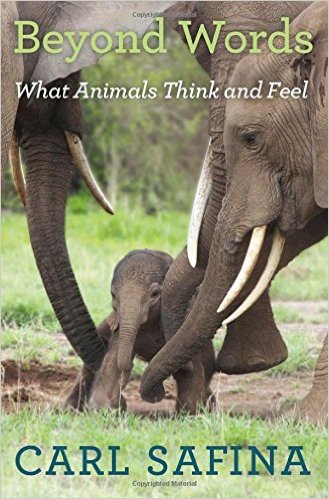
Beyond WordsBeyond Words, by Carl Safina, was written by an animal lover for other animal lovers.  His mission is to convince his readers that animals are capable of the full range of emotions experienced by humans and that their communities are often as complex and varied as human communities.  His hope is that humans who understand the feelings and capabilities of animals, will therefore treat them with the respect they deserve.  It is a worthy cause and not hard to sell to this animal lover.

Inadequate scientific inquiry

Safina begins by lamenting the sorry state of scientific inquiry into animal behavior.  He speculates that the dominance of humans in the environment fostered a condescending attitude toward animals that prevented scientific inquiry of the animal kingdom until very recently.  Animals were perceived by humans as utilitarian objects to be exploited for food and transport or destroyed if perceived as a threat or a competitor.  This attitude is still prevalent in human societies.

One of the first studies of animal behavior was Jane Goodall’s long association with a community of chimpanzees.  When she wrote papers about her observations, she faced extreme resistance to their publication.  One of the most common reactions of the academic scientists to studies of animal behavior has been to dismiss them as anthropomorphic projections of human feelings and motivation.

Observing animals

The lack of respect for animal studies among academic scientists has created opportunities for many volunteer and non-scientist observers to break new ground as reporters of animal behavior.  Safina visited several communities of animal observers and shares their experiences with us:

  • He watches elephants in Africa as they go about their business under the watchful eyes of park rangers trying to protect them from poachers.
  • He joins teams of volunteer observers of wolves in Yellowstone National Park.
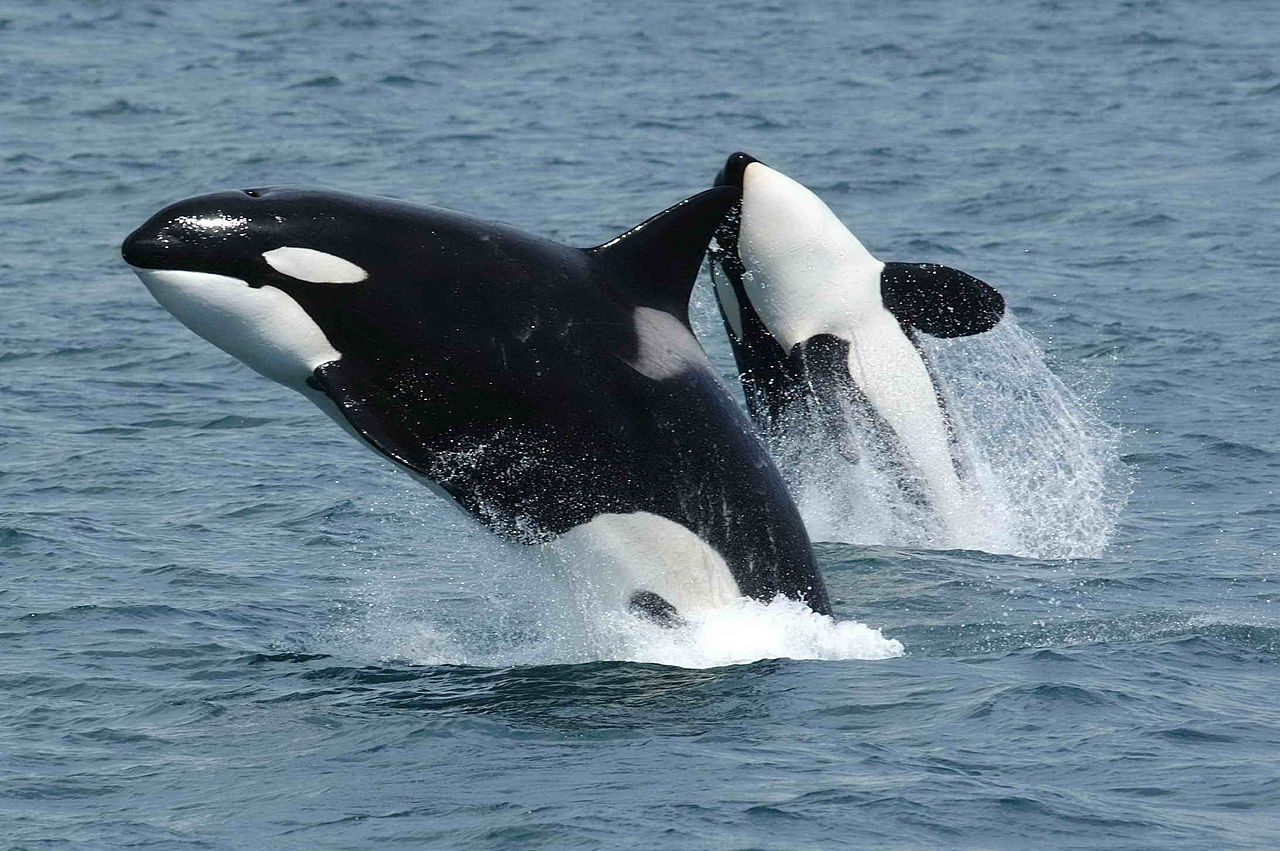
  • He follows orcas (AKA killer whales) with researchers in Puget Sound in Washington State.

Emotional lives of elephants

Unfortunately, elephant populations in Africa are being decimated by poachers because of the value of ivory.  Observers of elephant communities therefore have many opportunities to witness the grief that accompanies every loss of a beloved member of the community.  Here are a few observations of the behavior of elephants in response to the loss of a comrade:

  • “The elephants cautiously extend their trunks, touching the body gently, as if obtaining information. They run their trunk tips along the lower jaw and the tusks and the teeth:  the parts that would have been most familiar in life and most touched during greetings…” (1)
  • “Elephants sometimes cover dead elephants with soil and vegetation, making them, I think, the only other animals who perform simple burials…When sport hunters shot a large male elephant, his companions surrounded his carcass. The hunters returned hours later to find that the others had not only covered their dead comrade with soil and leaves but had plastered his large head wound with mud.” (1)
  • “…a matriarch named Eleanor, ailing, collapsed. Another matriarch, Grace, rapidly approached her with facial glands streaming from emotion.  Grace lifted Eleanor back fully onto her feet.  But Eleanor soon collapsed again.  Grace appeared very stressed, and continued trying to lift Eleanor.  No success.  Grace stayed with Eleanor as night fell.  During the night, Eleanor died.  The next day an elephant named Maui started rocking Eleanor’s body with her foot.  During the third day, Eleanor’s body was attended by her own family, by another family, and by Eleanor’s closest friend…A week after her death, Eleanor’s family returned and spent half an hour with her.” (1)
  • “When a female named Tonie gave birth to a stillborn baby, she stayed with her dead child for four days, alone in the heat, guarding it from the lions who wanted it.” (1)

A full range of human emotions are implicit in these incidents, such as loyalty to one’s friends and family and maternal love.

Social structure of animal communities

There is as much variety in the structure of animal communities as there is in human communities.  Elephant communities are matriarchal.  The oldest female is the leader of the group and the group is composed only of females and their offspring.  When male elephants reach maturity they wander on their own, interacting with matriarchal families only when the females are in heat.  Leadership is conferred on the oldest female because she is the most experienced member of the group.  She is therefore in the best position to make important decisions about where the group will go for food and how they will respond to threats from their predators.  The quality of that leadership can vary based on the personal attributes of the oldest female, but seniority is the only apparent criterion for that role.

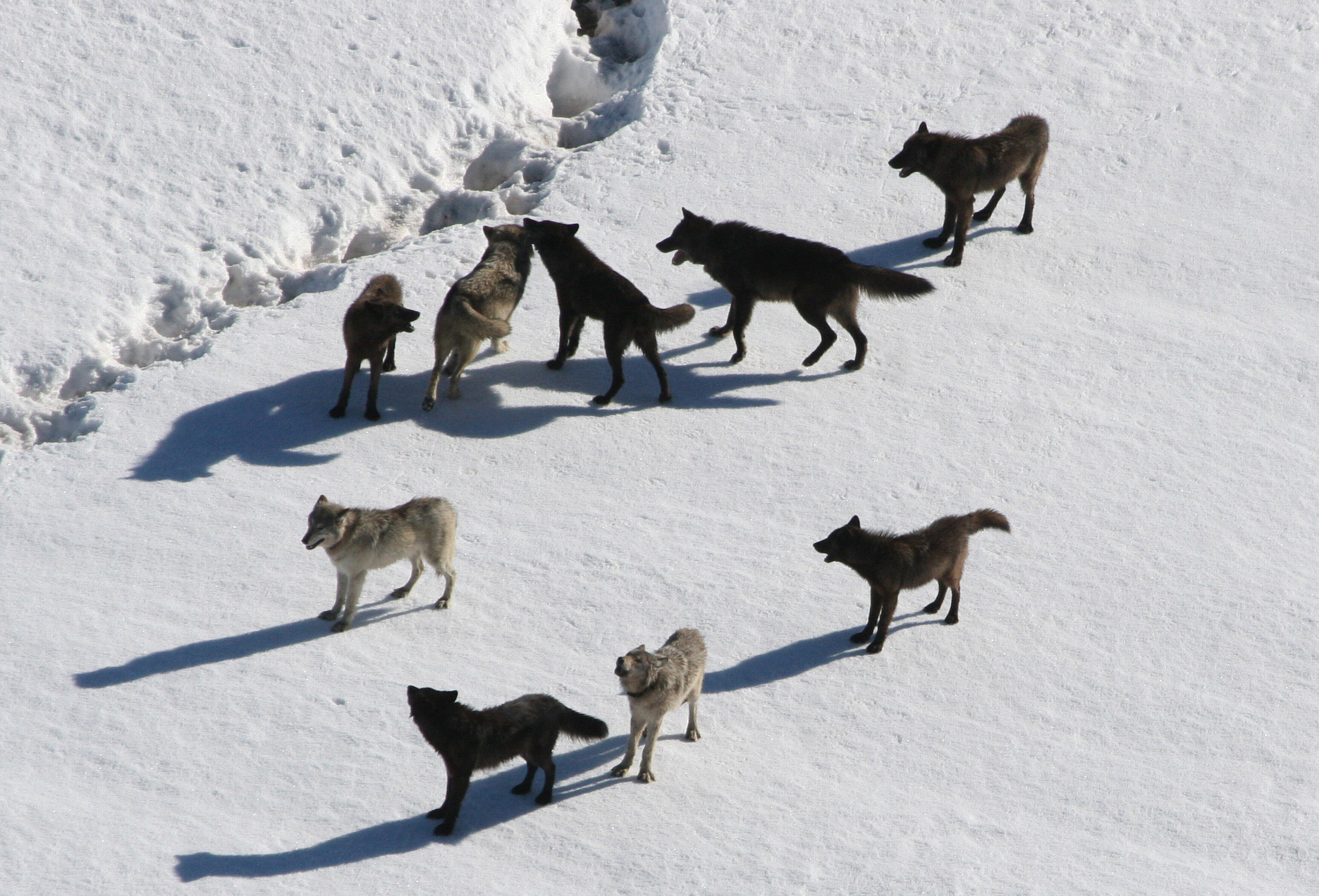
Pack of Gray Wolves, Yellowstone National Park

In contrast, the leadership of the wolf pack is the male and female alpha pair.  That status is achieved by virtue of physical strength and dominance; in some cases leadership is more magnanimous than it is dominant.  The male and female young of the alpha pair are also members of the pack, but personalities or loss of key members can splinter the pack.  There is intense competition for hunting territory and mates between packs and sometimes within packs.  This competition is often physical, and results in the death of members of the pack.  Safina tells us that as many wolves are killed by other wolves, as are killed by humans with guns.

The wolf pack resembles human families and communities.  Sibling rivalry is common.  Tribal competition between packs resembles human secular and sectarian wars.  The volunteer observers of wolves in Yellowstone Park are extremely dedicated to their task.  They explain their obsession by pointing out that the lives of wolves are much like watching a soap opera.

Individuality

While it is possible to generalize about the behavior and social structure of animal communities, we must also keep in mind that there is much individual variation.  Just as humans have distinctly different personalities, so too do animals.  Safina often turns to his dogs to illustrate this variability within species and we can do the same.  Our family has lived with nine dogs, usually in pairs.  No two dogs were exactly alike.  One was as shy as another was gregarious even though they were the same breed.  Some were obsessed with catching balls; others were completely uninterested in them.  Some were very attached and responsive to their human guardians, while others were independent.

In addition to the variability of personalities in animal communities, their social structures may vary just as human societies vary.  Some orca pods stay close within a home range in Puget Sound and eat an exclusively fish diet.  Other orca pods travel long distances and eat exclusively other marine mammals such as seals.  Human societies vary widely in many ways, such as the range from extreme individualism of American society to a more communal society in places like Iceland.                                                                                                                                                                                                                                                                                                               Domestication

Safina tells us that our dog companions evolved from wolves.  Less shy members of wolf communities were willing to approach human settlements where they could often find discarded food.  In exchange, dogs alerted humans to the presence of predators.  This partnership developed over thousands of years.  While the dogs were domesticated by that relationship, they changed physically to conform to the requirements of their new, less active life, becoming cuddlier to accommodate the preferences of humans.

Likewise, humans have been domesticated by changes in their lifestyles.  Hunters and gatherers had to be much more observant about their surroundings than humans in agricultural communities.  Hunters were always wary that they could easily be the hunted.  Gatherers were always looking for edible plants; knowing the difference between edible and inedible plants was a matter of life and death.  The territorial range of agricultural communities is small compared to that of foraging communities.

Bad news for animals

Animals are often the losers when human populations grow and their communities expand into animal habitats.  In the case of elephants, the value of ivory is threatening their future in Africa.  In the case of wolves, their appetite for domesticated animals makes them targets of ranchers.  When endangered status of wolves is removed, wolves are quickly killed when they stray out of national park boundaries.  Wolf packs must travel great distances to find the prey they need and the park boundary is only an abstraction that does not restrain their movements.

Orcas in Puget Sound

The threats to orcas in Puget Sound are many and are associated with many anthropogenic changes in the environment.  Agricultural runoff from industrial sized feed lots and pesticide applications pollute the water.  Pesticides are also used to kill marsh grasses so that huge clam beds can be installed on the shores of Puget Sound.  Human sewage is sometimes inadequately treated before it reaches the sound.  All of these sources of pollution are a factor in declining populations of salmon.

Salmon populations have also declined because dams have blocked access to their spawning streams and the streams they used to reach them have been channeled and diverted into culverts.  Overfishing is another factor in declining salmon populations.  Global warming has increased water temperatures in oceans, which has disrupted the entire ocean food web.

All this results in less food for orcas.  Consequently, orca reproduction has declined significantly and infant mortality of orcas has soared.  The future of orcas in Puget Sound is very much in doubt.

Food for thought

Carl Safina has written an excellent book that we recommend to our readers without reservation.  We guarantee that it will warm your heart to read about animal communities that share both the positive and the negative aspects of human societies.  We hope it will make you reflect, as it did us, about the ways in which the activities of humans intrude on the lives of animals.  Thank you, Mr. Safina, for giving us this opportunity to learn more about our animal friends.


(1) Carl Safina, Beyond Words: What animals think and feel, Henry Holt & Co., 2015

Bees are harmed by nativism

As our readers know, there are many reasons why we are opposed to the projects that are billed as native plant “restorations” but, in fact, often do a great deal of damage to the environment.  Of the many bogus justifications for these harmful projects, one of the most patently false is that the projects benefit wildlife.  Today, we are publishing a letter from one of our readers about the many ways in which nativism is harmful to bees.

“I thought of you, and your ongoing fight against short-sighted nativism, yesterday as I was doing research for a project on bees. I was interviewing a second-generation beekeeper, who’s working closely with geneticists and entomologists to develop hardy strains of bees, and he mentioned two things I thought might help to highlight how the actions of groups like the NAP may actually be contributing to colony collapse:

  1. The chemicals they use. Of course, it’s been broadly publicized that glyphosate and neonicotinoids are harmful to bees, and the AG industry folks (and possibly the native plant folks?) counter that they are far less deadly to honey bees than other types of herbicides and pesticides…but the beekeeper I spoke with indicated that saying something is “less deadly” to bees misses the harm these chemicals do to colonies by weakening their ability to fight viruses, mites, etc. Bees foraging in chemical-laden fields bring residues of these compounds back to the hive, to the queen, which he likened to “placing a pregnant woman in a refinery.” The result is a dramatically shortened lifespan for the queen and a colony that’s less strong and healthy, with lower resistance to common diseases. So the chemical may not kill the bees outright, but it still contributes to their death in the end.
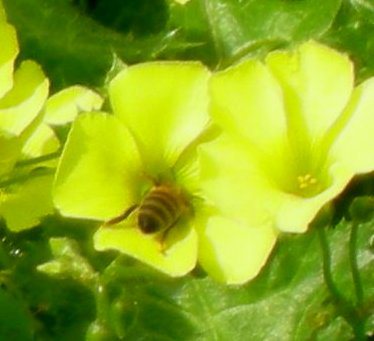
  2. Honeybee on oxalis flower, another non-native plant being eradicated with herbicide.
    Honeybee on oxalis flower, another non-native plant being eradicated with herbicide.

    Honey bees are not native to America; they’re European. And the push to eradicate non-native “weeds” has decimated their forage…essentially starving them out. He cited the case of yellow star thistle, which, he said, may have come over from Europe in the wool of sheep. Highly invasive, it used to be everywhere in CA, and it was an important source of nectar and pollen for honeybees. Then, a few decades ago, the government introduced weevils to control the plant, in the process depriving the bees of a vital food source. Beekeepers have had to range further and further afield to find areas with adequate forage for their bees.

Bumblebee on Cotoneaster, Albany Bulb. Another target for eradication.

Of course, big agriculture (subsidized by the government) has contributed to the problem as well, by plowing up land that used to grow clover and alfalfa in favor of corn (for ethanol) and soybeans. But, for me anyway, this information about non-native bees needing non-native plants was a revelation…. a real ‘a-ha’ moment that I thought could be useful in waking up well-meaning folks who may equate “native plants” with “good for bees.”

Oh, and the beekeeper also told me that one third of the food Americans eat is pollinated by honey bees….are we willing to reduce our food supply by 1/3 for the sake of “restoring” a landscape native to a time when agriculture was not prominent in California?”

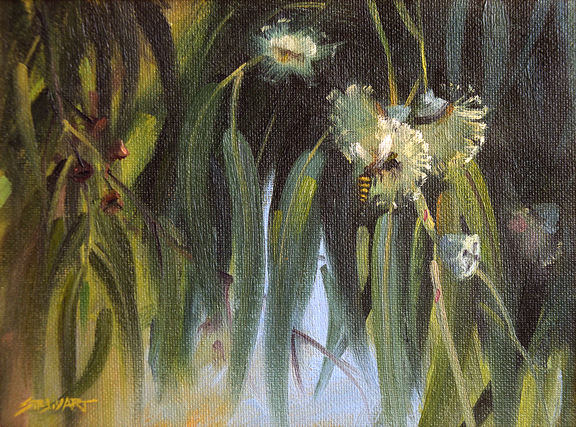
The value of yellow star-thistle to bees is but one example of the value of non-native plants to insects and other animals.  In the case of bees, the eradication of hundreds of thousands of eucalyptus trees all over California has deprived bees and hummingbirds of one of the few sources of winter nectar in California.  Eucalyptus blooms from December to May, at a time when there are few other sources of nectar.  HERE is an article about the loss of this important resource to bee keepers in California.

Eucalyptus and bee. Painting by Brian Stewart.

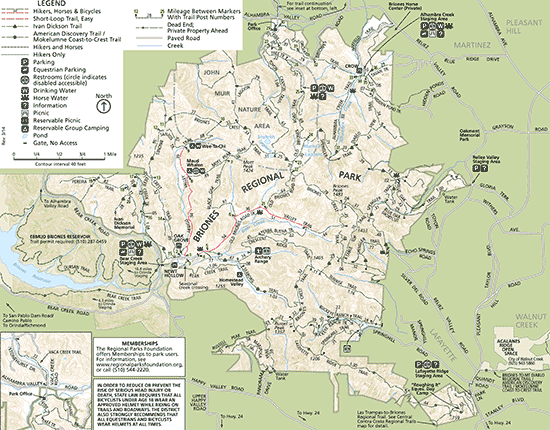
Yellow star-thistle is one of many eradication targets of nativists in California.  East Bay Regional Park District (EBRPD) has been trying to eradicate it in their parks for decades.  We recently learned that EBRPD was planning an aerial spraying of herbicide from a helicopter on 200 acres of yellow star thistle in Briones Park.   This was a particularly controversial herbicide application for several reasons:

  • Briones Park is adjacent to the watershed surrounding Briones Reservoir, which stores the drinking water of surrounding communities.briones_450w_32c
  • The herbicide EBRPD was planning to use was Milestone, which is known to be very mobile and persistent in the soil. For that reason, the State of New York refused to approve the sale of Milestone because they were concerned about contamination of ground water.
  • Aerial spraying of pesticides by helicopter is the most dangerous application method because it greatly increases the chances of drift into non-target areas, including residential areas.

Our team of collaborators jumped into action to prevent this spraying from being done.  We organized a telephone and email campaign directed to responsible staff and Board members at both East Bay Regional Park District and East Bay Municipal Water District, which is responsible for drinking water in the East Bay.

I am pleased to report that EBRPD announced within a few days of our campaign that they were permanently cancelling this aerial application of herbicides at Briones Park.  They will continue to try to eradicate yellow star thistle using other methods.

Lessons learned

When pesticides are used in native plant “restorations,” the claim that such projects are beneficial seem utterly dishonest.  Beneficial to whom?  Certainly not the animals and humans who are exposed to these toxic chemicals.

If the public does not want public land managers to use pesticides on our public lands, we must object when they do.  If we don’t object, we get the land management we deserve.  You will be alerted to such opportunities to participate in these campaigns to influence land managers by “liking” Facebook pages:  “Death of a Million Trees” and “Save the East Bay Hills.”

It is a team effort to learn about what is happening in our public lands and to participate in the decisions that affect our communities.  We are therefore grateful to the reader who shared her conversation with a beekeeper.  We encourage others to share their knowledge so that we can be as effective as possible.  Knowledge is power!

It’s a small world: Meeting 1991 Oakland fire survivors in Seattle

Andrew Cockburn speaking at a conference in Seattle, March 30, 2016

I attended a conference in Seattle last week about the many sources of pollution in our water and what that means for the seafood we eat:  “Clean Waters = Healthy Seafood.”  I always learn something new at these conferences, but this was also a case of serendipity.

Andrew Cockburn was the keynote speaker at the conference. He is the author of “Weed Whackers:  Monsanto, glyphosate, and the war on invasive species,” published by Harper’s Magazine in September 2015 (available here: Cockburn – Weed Whackers ).  The 1991 fire in the Oakland hills is used in that article as an example of how native plant advocates use “cover stories” such as flammability to convince the public to eradicate non-native plants and trees.  And so, that fire was mentioned in passing at our table of conference attendees.

Tilden Park, Berkeley. Courtesy Save the East Bay Hills

Much to my surprise, a couple at our table volunteered that they are survivors of that fire.  They defended eucalyptus trees, based on their experience.  I asked them to write up their experiences to share with our readers and here is what they sent for publication:

“I grew up in Virginia and spent some time in Colorado, Florida, Bermuda, the Philippines, and Japan while in the Navy.  I was living in South Carolina in 1989 when I made my first trip to the SF Bay Area.  It was in late October, just after the earthquake.  I had come to the Bay Area to interview for a job with the Environmental Protection Agency.  I was hired and moved to San Francisco in January 1990.

Initially, I was living on a sailboat near Brisbane, but by June I had rented a studio apartment in a small Montclair house in the Oakland Hills.  From the beginning, I was smitten with my new home.  While having lived in a variety of places, I was drawn to the mystical aspects of the area.  I was especially drawn to the volcanoes, redwoods, and eucalyptus.  Even now, 26 years later, I am taken back to my early days in the Bay Area when I see or smell a eucalyptus tree.  I remember the excitement of the new work and meeting my wife who is a Bay Area native.

We were married in June 1991, and lived together in the Montclair studio.  It was a truly magical, but short-lived time for us.  The fire came in October.  We understand that some transient campers started it in a canyon near the Caldecott tunnel on Saturday.  The Fire Department thought they had extinguished the fire, but the Santa Ana winds on Sunday whipped new life into the embers, which in turn caused the massive wildfire.  Our home was destroyed.  As uninsured newlywed renters, it was devastating.  Fortunately though, we survived, as did our cats.  Some of our friends and neighbors were not so fortunate.

We stayed in our home through most of the day as the fire moved through the area.  When the fire got close we knew we had to go and so our neighbors and we evacuated.  It was hot and dry before the fire and everything burned.    The only things left standing in our neighborhood on Monday were brick chimneys.

That was a long time ago in our lives.  We live near Seattle, WA now.  It came as a shock to learn last week that there is an effort underway to remove the eucalyptus from the East Bay.  We are told that it is because the eucalyptus “exploded” during the 1991, firestorm.  Well, I can tell you that they did burn with fervor, but so did everything else including the more native trees and plants.  The eucalyptuses, while not being “native”, have established themselves as a solid part of the Bay Area.  It would not be the same there without the eucalyptus and to scapegoat them for the 1991, firestorm is short sighted.  The same hot and dry conditions and large supply of fuel on the ground will be ripe for a repeat whether or not the eucalyptuses are there.”

Scott West
Special Agent-in-Charge, Retired
Criminal Investigation Division
US Environmental Protection Agency

Scott doesn’t mention in this account that the fire was very hard on marriages and he was pleased to tell me that his very recent marriage was made immediately stronger by the ordeal of finding a new place to live and replacing all of their belongs.  So, when his wife, Suzanne, chimed in with the following addition to Scott’s story, it seemed a fitting example of the teamwork that began in 1991 and continues to this day:

“No, I think you covered it quite well. One thing you could add is that after the fire in October, we purchased a home in the Hayward hills (Dec 1991) and it backed up to a fence line which contained a big grove of eucalyptus trees.  We had no fear of these trees posing a huge fire threat, and we had just been through the biggest area fire in anyone’s memory. We loved that grove and the wildlife that lived there and were frequent visitors to our yard – deer, fox, raccoons. We also had 3 indoor/outdoor cats and I swear that the grove was the reason we never had any major issue with fleas.”

Thanks,
Suzanne West
Executive Director
Sarvey Wildlife Care Center

And Scott, adds to their shared memory:

“Good point Suzanne.

That grove was illegally cut while we lived there and it was a blow to us.  We loved those trees.  And don’t forget the opossum.”

Scott

I am very grateful for Scott and Suzanne’s willingness to tell us their story.  We know they are not alone in their assessment of the 1991 fire.  We have received many similar comments over the many years we have worked on this issue from other survivors of the 1991 fire.  We do not think the Wests’ experiences are unique.

Seattle
View of Seattle from the Space Needle, with Mount Rainier in the distance. It was a beautiful day on March 29, 2016.


Dialogue with native plant advocates

We believe that greater dialogue with native plant advocates would create more opportunities to find a compromise that would resolve the conflict about deforestation and pesticide use on our public lands.  Unfortunately, in the many years in which we have been engaged in the effort to prevent the destruction of our urban forest, we have found few such opportunities.

The Sierra Club is an extreme example of an organization that has isolated itself from all dissenting views on this issue.  Therefore, we were very excited that a member of the Sierra Club was able to send a letter to members, which we hoped would create new opportunities for dialogue with the Club and its allies on this issue.  (That letter is available HERE: Letter to Sierra Club members )

We are publishing today one of the responses that the author of the letter to Sierra Club received from a Sierra Club member.  We will also publish the reply to that letter.  We believe this dialogue is an example of the danger of isolating ourselves from those with whom we disagree.  When we refuse to discuss the issues, we deprive ourselves of opportunities to learn and we exacerbate conflict.

This is the letter sent by a native plant advocate to the author of the letter sent by a fellow Sierra Club member (we have removed his name because we do not have permission to publish):


img014 (1)


And this is the reply to that letter.  We have removed the author’s name because the letter was sent on behalf of hundreds of people who share her views.  Using her name more than necessary, inappropriately personalizes the issue.  This should be a public policy debate, not a personal vendetta.

Thank you for your letter of March 15, 2016, regarding my letter to Sierra Club members in the San Francisco Bay Area.

I am writing to provide you with the documentation about which you have questions:

Attachment A:  David Nowak’s “Historical Vegetation Change in Oakland…” states that, “Trees in riparian woodlands covered approximately 1.1% of Oakland’s preurbanized lands — redwood stand 0.7%, and coast live oak stand 0.5%.  Original forest cover is estimated at 2.3%…”  David Nowak has been employed by the US Forest Service since earning his Ph.D. degree from UC Berkeley.

I also recommend another visit to the Oakland Museum where you will find a touch screen map of historic vegetation of Oakland and surrounding communities in the East Bay.  It will confirm that the East Bay hills were not forested prior to settlement.

Attachment B:  The Environmental Assessment for the Strentzel-Muir Gravesite Plan at the John Muir National Historic Site in Martinez, California confirms that John Muir planted eucalyptus on his property.  The document also confirms the intentions of the National Park Service to retain eucalyptus on the property.  The entire document is available here:

Click to access Strentzel-Muir-Gravesite-Plan.pdf

Attachment C:  This is a holiday greeting card sent by John Muir to a personal friend in 1911, in which he depicts eucalyptus and describes it in poetic verse.

Christmas Card from John Muir

There are many reasons why eucalyptus was planted in California.  I recommend the history of the trees of California by Jared Farmer, Trees in Paradise:  A California History, for a more complete understanding of why eucalyptus was planted in California.  Mr. Farmer also describes John Muir’s fondness for eucalyptus.

We all have a right to our opinions, Mr. [redacted].  However, it is not in anyone’s interests to be misinformed of the facts regarding our urban forest.

Please let me know if there are any other statements in my letter for which you require documentation.

Sincerely,

[redacted]

Cc: Michael Brune and Aaron Mair

No, this is NOT an April Fool’s joke.  These are actual letters sent by actual people.  We will publish a more comprehensive report of feedback from Sierra Club members to the letter from a fellow member in late April.

“The Next Major Fire in the East Bay Hills”

We are re-publishing an excerpt of Dave Maloney’s report, “The Next Major Fire in the East Bay Hills” that was written and published by Save the East Bay Hills.  Thanks to Save the East Bay Hills for making this important report available to the readers of Million Trees.  If you haven’t visited the website of Save the East Bay Hills, we recommend that you do.  Its strong suit is the “Take Action” page, where you will find many specific suggestions for what you can do to help us prevent the destruction of our urban forest.


Dave Maloney is the former Chief of Fire Prevention for the U.S. Army at the Oakland Army Base. He is a retired firefighter from the Oakland Fire Department. He holds lifetime certification from the California State Fire Marshal’s Office as a Fire Investigator, and lifetime certification from the U.S. Dept. of Defense as a Fire Inspector. He was a member of the 1991-92 Emergency Preparedness and Community Restoration Task Force (the Oakland-Berkeley Mayors’ Firestorm Task Force) which investigated the 1991 Oakland Hills Fire. He is currently a wildland fire prevention consultant.

The plan to deforest thousands of acres of East Bay public lands:

  • ​“ignores the U.S. Forest Service analysis dated September 27, 2013, which recommends against removing Eucalyptus trees;”
  • “violates the recommendations made by the 1991/1992 Task Force on Emergency Preparedness and Community Restoration, commonly known as the Oakland/Berkeley Mayors’ Fire Storm Task Force;”
  • “has no basis in fire science;”
  • “violates fundamental principles of Wildland Fire Prevention;”
  • “is ideologically motivated;” and,
  • “creates the conditions for a perfect firestorm.”

Specifically, Maloney states that, “The EBRPD, UC Berkeley (UCB), and the City of Oakland (Oakland) deforestation plan will create an enormous belt of grass and chaparral that will stretch from Richmond to Castro Valley to the eastern edge of Contra Costa County. This grassland belt will be many times more flammable than wooded terrain.” In fact, “the speed of grass fires can be at least twice that of fires involving trees, especially if there are only a few trees, or none, to act as windbreaks.”

Why? “All trees perform three vital functions in preventing or slowing the spread of grass and chaparral fires: they collect, with their leaves, moisture from the night air and drip it on the natural vegetation beneath them; the tops (canopies) of the trees create shade so this moisture is not evaporated by the sun by mid day; [and] they act as windbreaks which slow the velocity of the wind that pushes grass and chaparral fires.” As a result, “Removing trees of any species and wanting grasses and chaparral to replace them greatly increases the chance of a catastrophic, unstoppable fire.”

Chief Maloney further notes, “that any claims by proponents of deforestation that this will reduce the risk of fire “typified opinionated misinformation being spread by those with quotable positions.” In fact, Maloney argues that proponents know they are not being truthful, but are intentionally “exploiting the public’s fear of wildfire and misrepresenting fire hazard mitigation as a strategy to achieve their goals” which has nothing to do with fire and everything to do with wanting to return the hills to the largely treeless appearance they had during the pre-Colombian period.

For example, he states that their “claim that Eucalyptus trees are more flammable than other trees — and more flammable than grasses — is untrue and now dangerously misleading.” “One example of their true intentions is revealed by their refusal to tell the public that the California Bay Laurel tree, which they consider ‘native’ to the Bay Area has more volatile oil than any Eucalyptus tree. For years we’ve been hearing that the volatile oils of the Eucalyptus trees make them a supreme fire hazard. Yet the Bay Laurel contains 7.6% volatile oils of the samples tested, according to the Journal of Agricultural and Food Chemistry (1974). The amount of volatile oils in Eucalyptus trees range from 1 to 7% of the samples tested. But no Bay Laurel trees are to be cut down — nor ever mentioned.”

Even if this were not true, he notes that “essential/volatile oils of any tree [are] irrelevant to the flammability of a tree…” for two primary reasons. First, “Every species of tree in the East Bay hills is at least 30% water. This moisture is far greater than the amount of essential/volatile oil in any tree. It overwhelms by far any chance the essential/volatile oil has to set the tree on fire.” Second, “the volatile/essential oil in any tree cannot sustain heat long enough to ignite the highly dense wood of the tree.”

That is why “only 1% of all wildland fires start in trees. The other 99% start in grasses, bushes and shrubs. (The Oakland Hills fire of 1991 started in grass.) And only 8% of all wildland fires catch trees on fire. This means that 91% of all wildland fires do not involve trees at all but are restricted to grasses, bushes and shrubs. If we decrease the amount of trees in the hills and replace them with grasses we will have dramatically increased the chances of a wildland fire occurring.”

Instead of clear cutting trees, what should be done to reduce fire risk?

Maloney notes that the “Task Force on Emergency Preparedness and Community Restoration, commonly known as the 1991 Oakland/Berkeley Mayors’ Fire Storm Task Force,” of which he was a member, investigated “the causes of the ’91 fire and mak[d]e recommendations to prevent its recurrence. The committee spent hundreds of hours analyzing data and examining the burned areas.” Its February, 1992 report noted that “the most important factor in reducing fire danger from vegetation is not removing specific species but regular ongoing maintenance” such as “regular brush removal.” Not surprisingly, the “recommendations have been ignored by U.C. Berkeley, the City of Oakland and the East Bay Regional Park District.”

“Ignorance and influence are the parents of disaster,” he writes. “The Sierra club, the California Native Plant Society, Claremont Canyon Conservancy and others are very influential organizations. They are misusing their influence by attempting to lead the public into supporting the destruction of our East Bay forests and the creation of grassy, fire prone East Bay hills. And they are being very disrespectful to the entity of fire and the laws of physics which tell us how that entity behaves.” Instead, they are exploiting the 1991 tragedy in a manner that “imperils the public” and “endangers the firefighters who will be called to fight the fires” that will be caused by “improper wildfire hazard management” that puts “ideology ahead of fire science.”

Indeed, similar deforestation occurred in Australia, leading to predictable and catastrophic fires, exactly what proponents of deforestation threaten here.

The full report is available by clicking here.

For his alternative proposal, click here.

Another opportunity to influence the Sierra Club to STOP advocating for deforestation and pesticide use

On February 8, 2016, letters were sent to members of the Sierra Club in San Francisco from another Club member.  That letter is available HERE:  Letter to Sierra Club members.  The letter contained a postcard petition on which members were invited to express their opinion of the Club’s support for deforestation and pesticide use in the San Francisco Bay Area.  That petition is available HERE:  Letter to Sierra Club members – postcard petition.

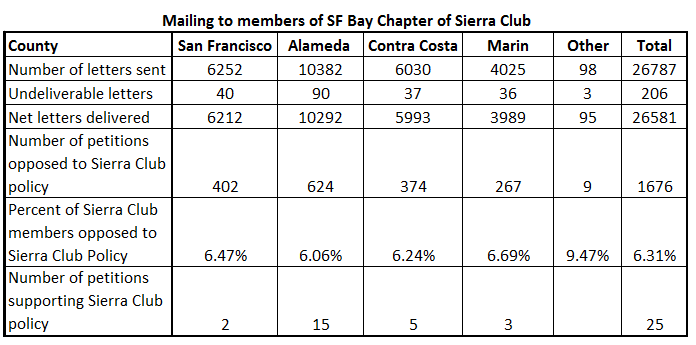
The author of the letter reports that she has received 380 postcard petitions from Club members in San Francisco, indicating their opposition to the Club’s policy on these issues.  Only ONE postcard expressed support for the Club’s policy.  The letter was sent to 6,252 members, but undeliverable letters resulted in a net of 6,216 letters received.  This suggests that at least 6% of Club members in San Francisco are opposed to the Club’s policy.  Here are some (not all) of the comments that members wrote on their postcard petitions to the Sierra Club:

“SF native is windy sandy hills with poison oak!”

“Should the Sierra Club continue with its current position, I will cancel my membership” [several similar comments]

“If this native plant bullshit continues I’ll donate my dues to save the eucalyptus grove”

“I am strongly opposed!! (and have been for months)”

“Sierra Club member since 1975.  The idea to destroy our trees is absurd.  What would Golden Gate Park be without trees?  Sand Dunes!”

“These people would cut down every tree on SF streets & Golden Gate Park”

“Fanatical purists!  Should we plant more poison oak?!”

“If you want to go back to the habitats before get rid of people, buildings & cars.  Chop down & poison those instead of plants that were here before you were born.”

“I read your arguments for supporting this senseless destruction, and found them anachronistic and short-sighted…a 19th Century approach to conservation.”

“This same kind of “restoration” has been tried on a pilot basis in Glen Canyon, near my home, and has failed miserably.”

East Bay Hills
This antique postcard of the Claremont Hotel shows the treeless landscape of the East Bay Hills that the Sierra Club demands be recreated by destroying all non-native trees.

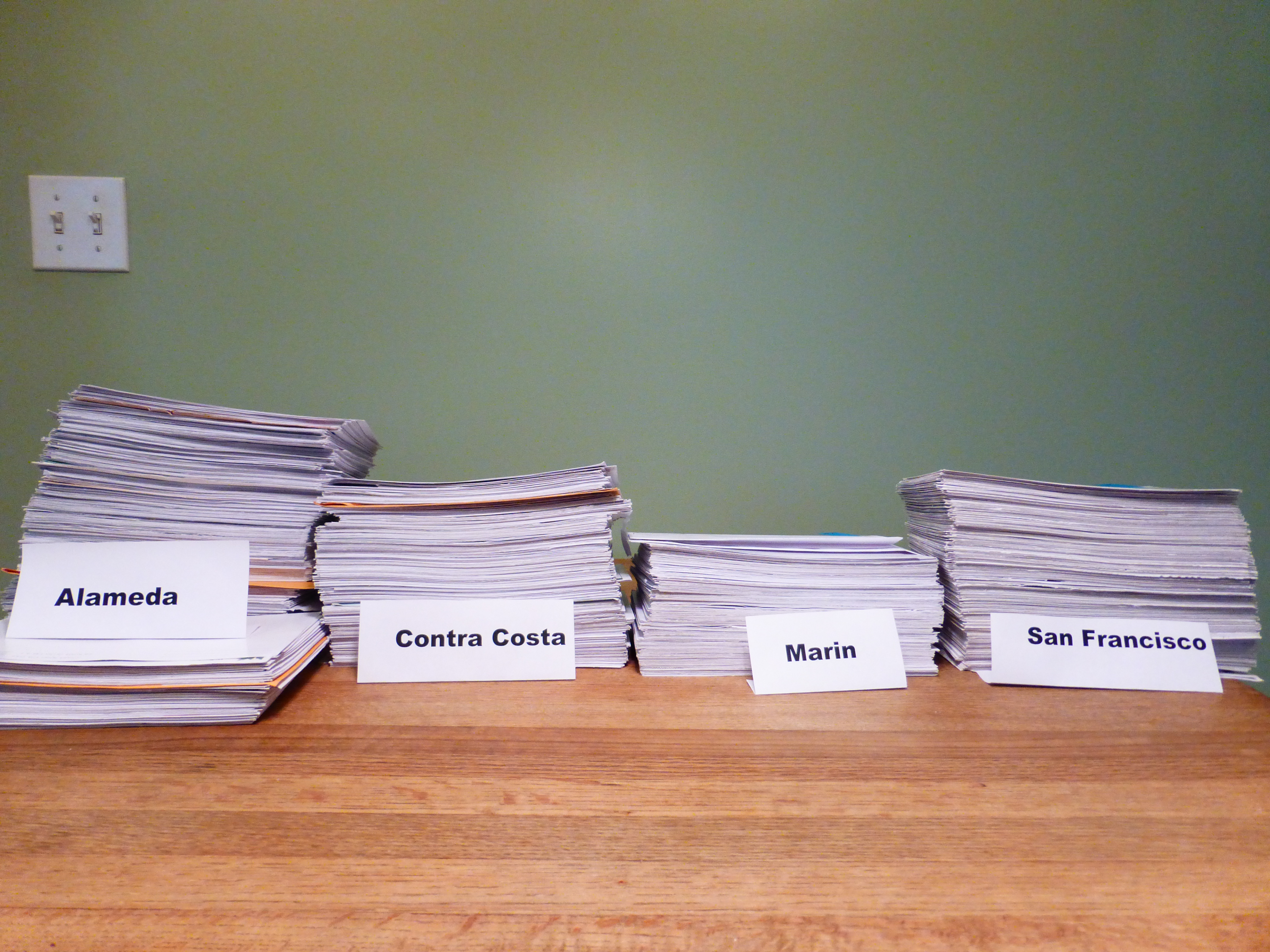
The author of the letter intended to send her letter to all members of the San Francisco Bay Chapter of the Sierra Club.  The Bay Chapter includes Alameda, Contra Costa, and Marin Counties, in addition to San Francisco City/County.  Unfortunately, the staff of Sierra Club did not understand the composition of the Bay Chapter and therefore her letter was initially only sent to members in San Francisco.  It took one month to correct that error.

The letter was sent to over 20,000 Club members in Alameda, Contra Costa, and Marin Counties on March 8, 2016.  We will report the response to the letter in April.

What you can do to influence the Sierra Club

Meanwhile, there is something Sierra Club members can do to influence the Club’s policies.  The national Sierra Club is conducting its annual election of Board Members now.  Ballots have been sent to all Club members with the roster of candidates.  The roster of candidates and an electronic ballot are also available HERE.  You must vote by April 27, 2016.  If you are a Sierra Club member, we suggest that you look carefully at the qualifications and opinions of the candidates before making your choice.

To help you make the best choice, a member of our team has asked all candidates the following questions:

  • What is your opinion of destroying non-native trees?
  • What is your opinion of pesticide use in public parks and open spaces?

Here are the replies that were received from the candidates:

Susana Reyes

What is your opinion of destroying non-native trees? “Just the mere thought of cutting a tree upsets me greatly. I can’t offer a position about destroying non-native trees without considering the different factors that may come into play – like climate conditions, types of landscape, threats to biodiversity, invasive or not, fire threats – just to name a few. It also depends on the land management practices in the areas where non-native trees exist. There ought to be other options to destroying non-native trees. I would think very carefully about destroying non-native trees especially if only a fraction display traits that harm or displace native species and disrupts the ecological landscape”

What is your opinion of pesticide use in public parks and open spaces?  “I strongly oppose pesticide use in our parks and open spaces. I am all too familiar with herbicide “Roundup” for example and its use to stop unwanted plants. Another one is rodenticide which is used to kill rats in parks/open spaces. In Los Angeles, our beloved mountain lion, P22, who calls Griffith Park home, was sickened last year with mange as this poison worked its way up the food chain. Many of the chem Research has shown links to certain types of cancer, developmental disorders, and physical disabilities. Pesticides end up in our drinking water, watersheds, and rivers/lakes. The use of toxic pesticides to manage pest problems has become a common practice around the world. Pesticides are used almost everywhere and therefore, can be found in our food, air, and water.”

Robin Mann

“Let me just note that I am running for reelection to the Board because I believe I can contribute to the Club’s progress towards its major goals for the environment and for ensuring a strong and effective organization into the future. 

Being a strong and effective organization, in the case of the Sierra Club, requires among other things ensuring a broad and engaged grassroots presence everywhere.  And we know that strong grassroots engagement necessarily means people coming together to resolve local issues that often have competing considerations.  Our policies and our approach generally allow some latitude to ensure the local context is being taken into account.  I wouldn’t want to try to dictate the solution for all situations. 

My understanding from my work with the Club’s efforts to strengthen resiliency in the face of mounting climate change impacts is that restoring native vegetation is desirable, and can contribute to restoring greater ecological balance.  And my understanding from my work on the ground with organizations doing habitat restoration is that sometimes HERBICIDES are needed as a last resort to enable newly planted natives to become established. 

If you are speaking of herbicides being used in public parks and open spaces, my view is they generally should not be used for maintenance purposes as non-toxic alternatives are available.  For habitat and vegetation reestablishment I would defer to those designing the project with the expectation that herbicides would be minimized, used responsibly, and any exposure to park users avoided. 

If you are speaking of pesticide use for insects or other “nuisance” species, I expect that in most instances a non-toxic management alternative is available, and so the burden should be on the public entity to justify use of a pesticide for maintenance purposes.”

Luther Dale:

“I have to say I do not know the context of these issues nor knowledge sufficient to give you a good answer. There are so many environmental issues and I accept that I can’t be knowledgable about them all. I do know a lot about some issues and know how to listen and learn about issues new to me. Thanks for your passion about these and other environmental problems and for your work to care for the earth.”

Mike O’Brien:

What is your opinion of destroying non-native trees?  “I have strong concerns about invasive species crowding out and changing native ecosystems in detrimental ways.  That said, we have already made significant and irreversible impacts to many ecosystems.  I don’t believe a policy of eliminating all non-native trees simply because they are non-native makes sense at this point.  Rather, it should be taken on a case by case basis where we consider what the impacts are of the non-native species and any work should typically be done in conjunction with a plan to restore native trees and habitat.”

What is your opinion of pesticide use in public parks and open spaces?  “Strong preference to zero use of pesticides. There have been occasions where serious threats from invasive species have proved practically impossible to overcome without targeted use of pesticides, but this should be a rare exception as opposed normal operating” procedure.

Judy Hatcher:

“As you probably noticed from my candidate profile, I’m the ED of Pesticide Action Network, so I’m not in favor of pesticides–especially highly hazardous ones–in public spaces or anywhere else. I think the issue of non-native trees is specific to particular contexts and environments. But it’s unfortunate that the damage non-native plants and animals cause lead communities to demand increased use of pesticides and herbicides, which have negative consequences for human health as well as for the natural environment.

PAN focuses on industrial agriculture, so we don’t do a lot around non-native plants except for how they impact farming (hello, RoundUp!).”

If there are other environmental issues of concern to you, you can also ask the candidates questions:

Susana Reyes,  susanareyes1218@gmail.com

Robin Mann, robinlmann@gmail.com

Joseph Manning, josephmanning92@gmail.com

David Scott, david.scott@sierraclub.org

Luther Dale, lutherdale@hotmail.com

Mike O’Brien, mjosierraclub@gmail.com

Judy Hatcher Judyh08@gmail.com

PARTICIPATE in democracy!

As the presidential primary election rages on around us, we are reminded of how important it is to participate in our democracy.  When we don’t participate, we are handing our power to those who do.  Our country and our environment are in peril.  Please step up and exercise your rights by voting in the election of the national Board of the Sierra Club if you are a member.