Who supports the Sierra Club agenda?

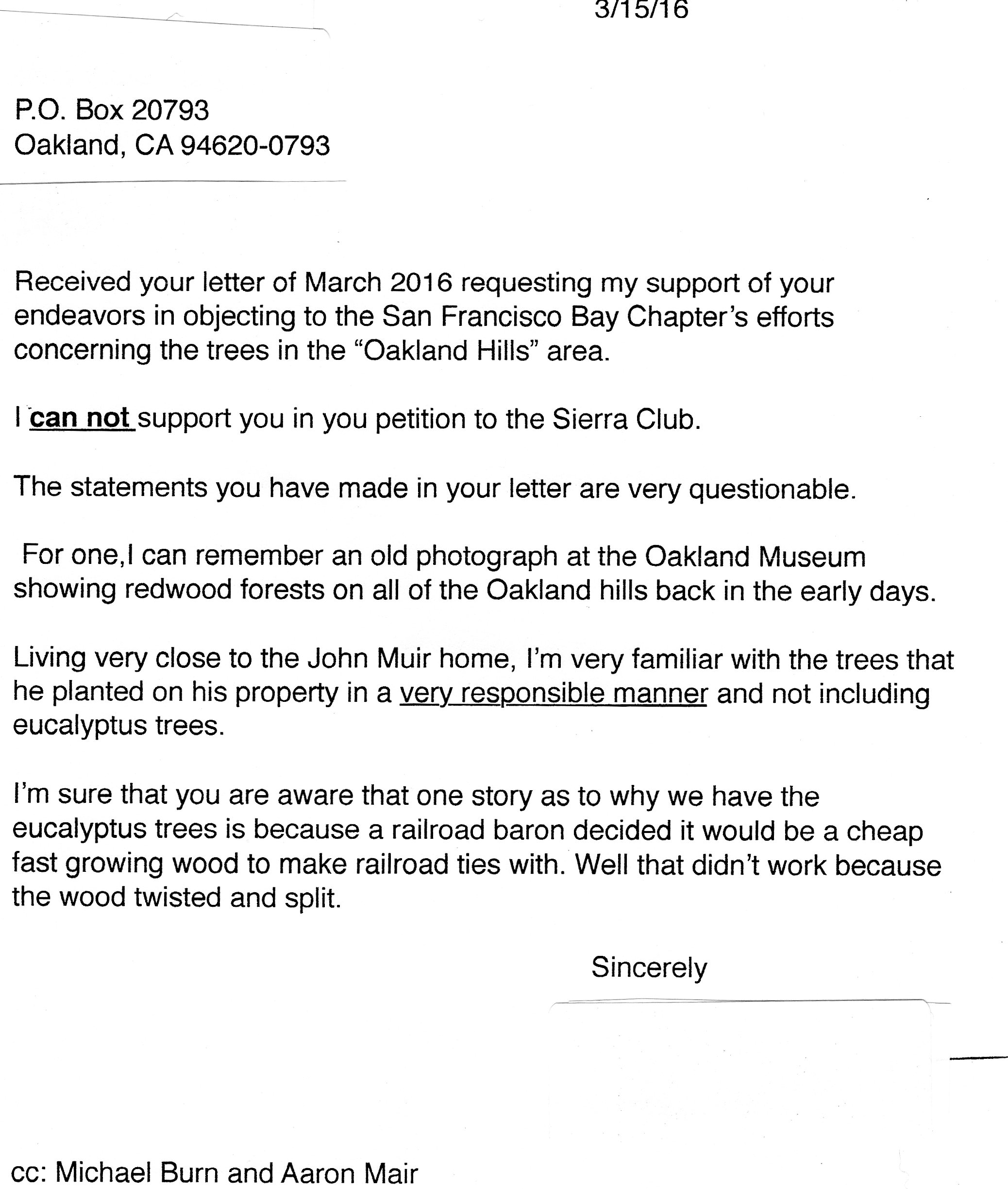
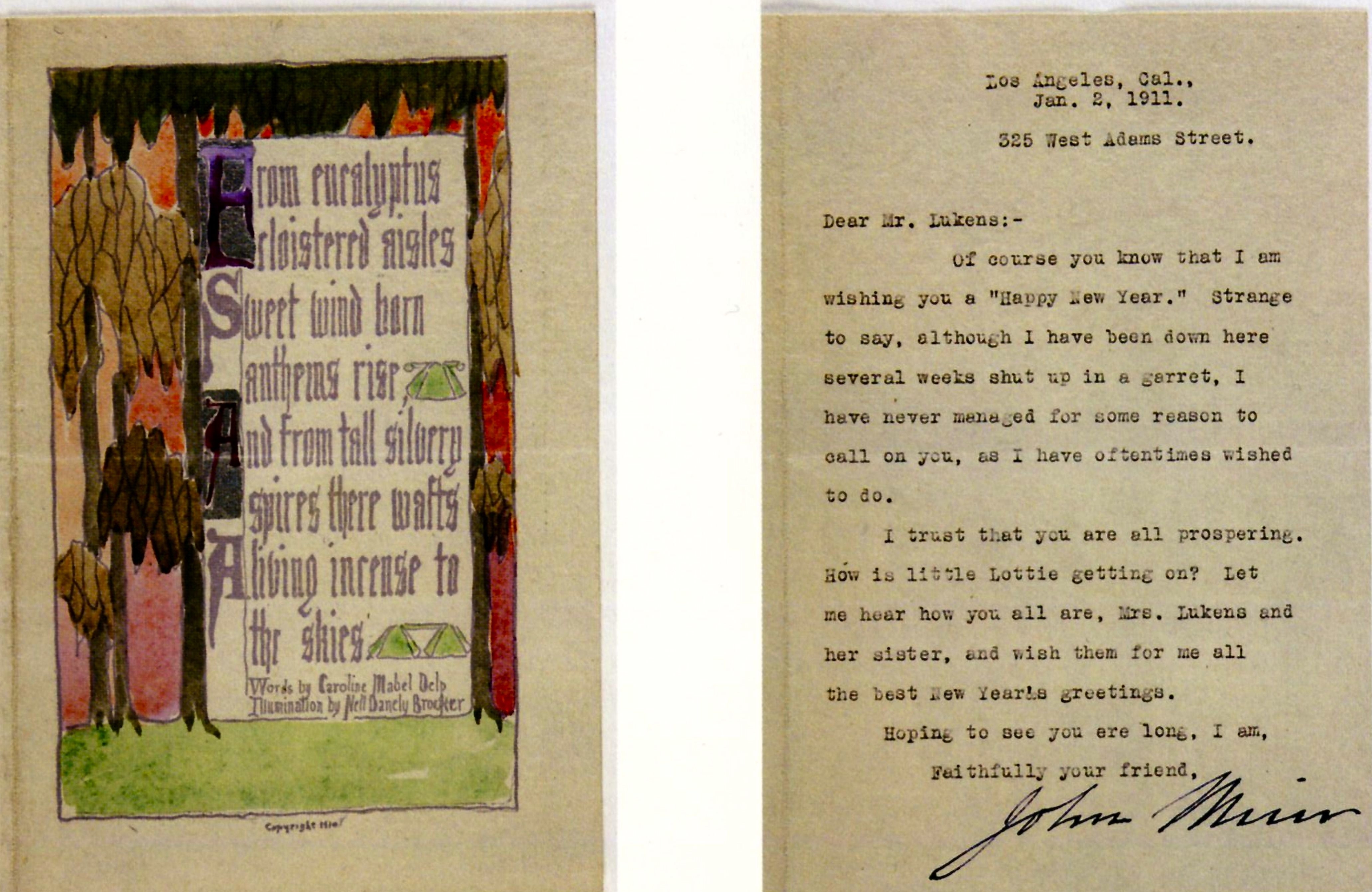
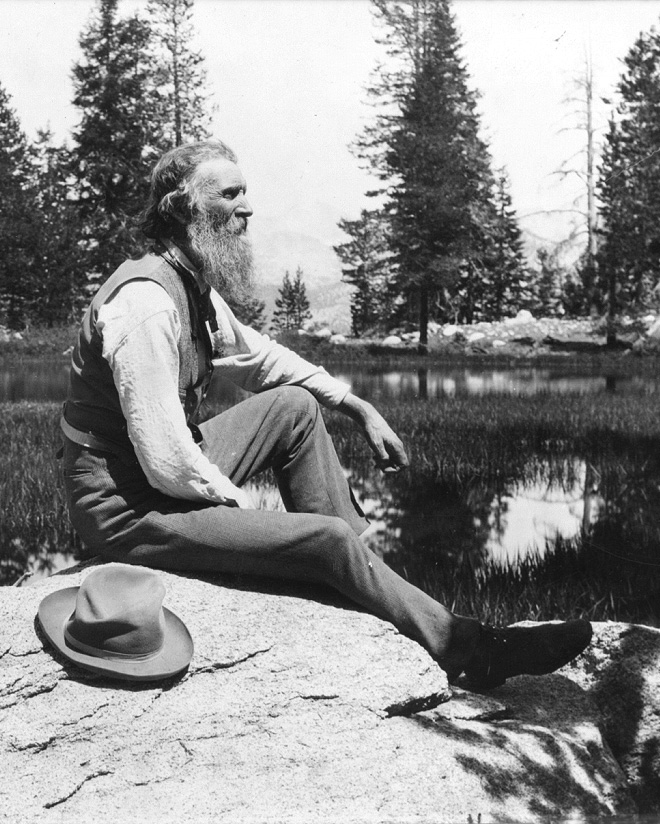
John Muir is the founder of the Sierra Club. He would disgusted by the Club's advocacy for deforestation. He planted eucalyptus trees on his property in Martinez. He was as fond of eucalyptus as those who fight for their preservation.
John Muir is the founder of the Sierra Club. He would be disgusted by the Club’s advocacy for deforestation. He planted eucalyptus trees on his property in Martinez. He was as fond of eucalyptus as those who fight for their preservation today.

In this post we continue to deconstruct the Sierra Club’s “pre-buttal” to the letter from a Sierra Club member to fellow members.  We will examine the following claim that other environmental organizations support the Sierra Club’s agenda to destroy all non-native trees on 2,000 acres of public land in the East Bay Hills, and to use pesticides to do it:

“Members should know that this strategy also has the support of many fire experts and other environmental organizations, including the Golden Gate Audubon Society, the California Native Plant Society, and the Claremont Canyon Conservancy.” (1)

In 2009, Sierra Club, Golden Gate Audubon Society, and the California Native Plant Society co-signed an “Environmental Green Paper” entitled “Managing the East Bay Hills Wildland/Urban Interface to Preserve Native Habitat and Reduce the Risk of Catastrophic Fire.”  This suggests that at that point in time, these three organizations were in agreement about those issues.

However, by the time the Draft Environmental Impact Statement (DEIS) for the FEMA projects that will implement that policy was published in 2013, their public comments on the DEIS suggest that their opinions diverged significantly.  Here are some of the comments they made that suggest substantial disagreement with the planned project.

California Native Plant Society predicts the result of FEMA projects

California Native Plant Society (CNPS) public comment on the DEIS (excerpt):

“The FEMA grants require monitoring and weed maintenance for years to come. Yet the FEMA grants do not supply funding for any of the follow up weed abatement. The East Bay Regional Park District, City of Oakland, and UC Berkeley have great trouble keeping up with acres of weedy species now in their stewardship purview. There just isn’t money available for comprehensive management of weedy invasives. This is demonstrated by the many acres of weedy ‘fuels managed’ areas, including fire roads. What mechanism is being instituted by FEMA in this DEIS to guarantee a commitment of money and personnel for management of greatly increased acreages of newly created annual weedy grassland?” (2)

The rhetorical question asked by CNPS suggests that they share our skepticism about the outcome of the FEMA projects.  The project is not providing any funding for planting native plants or maintaining them in the long run.  CNPS seems to agree with us that the likely outcome of this project will be non-native annual grasses.

The CNPS comment also seems to share our opinion that the annual grasses that are the likely colonizers of the bare ground will be a fire hazard:  “…exotic annual grassland, known for drying out the top layer of soil, and extending the fire season with dried out flashy surface fuel that can act like a fuse to ignite other areas.”  (2)

The CNPS prediction of the landscape resulting from the FEMA grants is in stark contrast to the rosy prediction of the Sierra Club.  The Club claims that native plants will magically emerge from the bare ground after non-native plants and trees are destroyed, without being planted.

Audubon Society “does not support” the FEMA project

Audubon Society’s public comment on the FEMA DEIS identifies many of the same issues that have been raised by critics of the project:

“The proposed tree removals may lead to colonization by broom or other invasive plants with little value to native birds and wildlife, unless native plants are reintroduced.  Although the amount of herbicide to be used on each tree is rather small, the total amount to be used by the project is very large. We believe that alternative methods to prevent resprouting should be used near water and perhaps in other specific circumstances…There is no support for the conclusion that native vegetation will return on its own.  This plan may not result in an increase in native trees and plants…Heavy mulching will delay or prevent the growth of native species.” (3)

In fact, the Audubon Society states explicitly that it does not support the plan as proposed by the DEIS (emphasis added):

“In spite of our approval of the general concept of the plan, the Golden Gate Audubon Society does not support this plan as drafted for the following reasons:

1) The plan calls for the removal of both non-native and native trees and brush with no plans to replant cleared areas with native vegetation;

2) The plan would use herbicides indiscriminately, rather than relying on more benign control of re-sprouting where herbicides are contra-indicated.” (3)

Clearly, the Audubon Society does not agree with the Sierra Club about the FEMA projects.  The Audubon Society agrees with the critics of this project that dangerous amounts of herbicide will be used and the outcome of the project will not be a landscape of native plants.  While the Sierra Club keeps telling us that “minimal amounts of herbicide will be used,” the Audubon Society has done its homework and can see that huge amounts of herbicide will be used.

Who supports the Sierra Club’s position on the FEMA grants?

The California Native Plant Society and the Audubon Society do not agree with the Sierra Club about the FEMA projects.  The fact that they did not join the Sierra Club’s lawsuit demanding 100% eradication of non-native trees in the project acres is another indication that they do not share the Club’s opinion of the projects. 

Update:  Although CNPS did not join the Sierra Club lawsuit against FEMA, it has indicated its support for the suit on its website:   “The East Bay Chapter of the California Native Plant Society strongly supports the litigation action by SPRAWLDEF and the Sierra Club, against FEMA’s surprising Record of Decision regarding fuels management in the East Bay Hills.” 

Despite the fact that CNPS understands that the resulting landscape will be predominantly highly flammable non-native annual grasses, it apparently wants all non-native trees to be destroyed.  We don’t understand why CNPS was surprised by the final version of the Environmental Impact Statement, since it was virtually unchanged from the draft on which they submitted a written public comment.

We learned of CNPS’s support for the Sierra Club lawsuit from a member of the Club’s leadership.  Although this information doesn’t literally contradict what we have reported, we post it here in the interests of full disclosure. 

Although the Claremont Canyon Conservancy agrees with the Sierra Club about the FEMA projects, we note that they did not join the Club’s lawsuit either.  The only organization that joined the Sierra Club lawsuit is SPRAWLDEF (Sustainability, Parks, Recycling, and Wildlife Legal Defense Fund). (4) SPRAWLDEF (5) is a non-profit organization created and run by Norman LaForce, the Sierra Club officer who claims to be one of the primary authors of the FEMA projects (6).  SPAWLDEF has sued other public agencies, including the East Bay Regional Park District.

Update:  SPRAWLDEF’s tax return for 2011 reports $250,000 of income for legal settlements from environmental lawsuits.  The tax return is signed by Norman LaForce.

The role of lawsuits in the funding of environmental organizations

Lawsuits against the various governmental agencies have become an important source of revenue for environmental organizations.  The Center for Biological Diversity (CBD) has mastered this strategy.  The New York Times reports (7) that CBD had filed 700 lawsuits when the article was published in March 2010, and they were successful in those suits 93% of the time, according to CBD.  Those suits forced the government to list 350 endangered species and designate 120 million acres of critical habitat for their recovery.  Revenue generated for CBD by these suits was $1.4 million in 2008, compared with $7.6 million from contributions and grants.

Sharp Park, Pacifica, CA. Photo by Erica Reder, SF Public Press

Brent Plater is a former CBD lawyer who created a non-profit in San Francisco, Wild Equity Institute.  He has sued San Francisco several times about Sharp Park, where he believes that closing the golf course would benefit the endangered red-legged frog.  He has not succeeded in making that case to our judiciary, losing every case. Despite losing, he and his collaborators were awarded $385,809 for “legal expenses” by the court, according to the San Francisco Chronicle: “It turns out that Plater and his organization can win by losing.  Take the ruling in U.S. District Court on July 1, 2013, which, by any measure, rates as a legal smackdown of the institute. As Judge Susan Illston said in her ruling, ‘plaintiffs did not prevail on a single substantive motion before the Court.’” (8)   So, even when they lose, they can walk away with a sizeable chunk of change.  To be clear, it is the taxpayers of San Francisco who paid Wild Equity for suing the City of San Francisco.

So, ponder for a minute the interesting relationship between SPRAWLDEF and the Sierra Club.  The person who connects them is Norman LaForce, who is both a lawyer and an officer in the Sierra Club.  If these organizations prevail in their lawsuit against FEMA, will Norman LaForce share in the spoils?  One wonders.


(1) http://sierraclub.org/san-francisco-bay/hillsfacts

(2) https://www.fema.gov/media-library/assets/documents/100411.  FEMA DEIS, Appendix R, Part 1, page 681

(3) https://www.fema.gov/media-library/assets/documents/100411.  FEMA DEIS, Appendix R, Part 5, page 3834

(4) Sierra Club and SPRAWLDEF lawsuit against FEMA available HERE:  Sierra Club lawsuit against FEMA projects

(5) http://www.buzzfile.com/business/Sustainability,-Park,-Recycling,-and-Wildlife-Legal-Defense-Fund-(sprawldef)-510-526-4362

(6) https://milliontrees.me/2015/11/27/public-opposition-to-pesticide-use-in-our-public-parks/

(7) http://www.nytimes.com/gwire/2010/03/30/30greenwire-brazen-environmental-upstart-brings-legal-musc-82242.html?pagewanted=all

(8) http://www.sfchronicle.com/bayarea/nevius/article/Nevius-6378333.php

The court’s award of legal expenses is available here:  https://docs.justia.com/cases/federal/district-courts/california/candce/3:2011cv00958/239217/189.  The award seems to have been made in recognition of the fact that the lawsuit forced the Recreation and Park Department to apply for a permit for park maintenance that results in an “incidental take” of red-legged frog eggs.


Will the real “gasoline tree” please stand up?

The Sierra Club has said many silly things in defense of its lawsuit demanding 100% destruction of all non-native trees on 2,000 acres of public land in the East Bay Hills, and Million Trees has responded to many of them (1).  Now Sierra Club has provided a new batch of ridiculous statements in its “pre-buttal” to the letter from a Chapter member to fellow Chapter members.

The winner of the intense competition for silliest statement

Sierra Club’s silliest statement:  “Eucalyptus trees are called “gasoline trees” in Australia for their tendency to explode in fireballs at very high temperatures.[ii]” (2)

You would not hear such a statement in Australia about ANY tree (eucalyptus or otherwise) because Australians do not use the word “gasoline.”  What Americans call “gasoline,” is called “petrol” in Australia (and Britain, New Zealand, etc.).  (3)

So, the next question is, do Australians call eucalyptus trees “petrol trees?”  The answer is, “NO, they do NOT call eucalyptus trees “petrol trees.”  A Google search for “petrol tree” directs the searcher to an article about a tree that is being grown in Australia as a source of diesel fuel.  The Brazilian tree Copaifera langsdorfii produces “natural diesel.”  Australian farmers have planted 20,000 of these trees with the expectation that “in 15 or so years they’ll have their very own oil mine growing on their farmland.” (4)

The Sierra Club provides a citation for its statement about “gasoline trees.”  The citation is a paper by Carol Rice, the primary author of the East Bay Regional Park District’s “Wildfire Hazard Reduction and Resource Management Plan.”  So, we might expect her to claim that eucalyptus is very flammable and she does.  However, she does not call them “gasoline trees” (nor does she claim that Australians do) nor does she claim that eucalyptus “explodes in fireballs.”

Wildfires in Mediterranean climates

The Sierra Club also provides a brief film clip of a wildfire in Australia.  The film clip is narrated by an American who claims that “firemen call eucalyptus gasoline trees.”  We hear Australians describing the fire, but they don’t say anything about “gasoline trees.”

Let’s compare that film clip in Australia with wildfires here in California.  Our most recent local wildfire was in September 2015, in Lake County about 100 miles north of San Francisco.  The Lake County fire destroyed about 1,200 buildings, killed 4 people, and burned over 76,000 acres.  HERE is a film clip of that fire, taken from the dashboard camera of a county sheriff driving through the fire.

Wildfire in California. Bureau of Land Management
“Native” trees burning in a Wildfire in California. Bureau of Land Management.

As we would expect, the Lake County fire looks very much like the fire in Australia because that’s what wildfires look like.  Most start in dry grass and move quickly through the fine fuel.  If it is a wind-driven fire, it will move into tree canopies and it will jump over roads.  The fire in Lake County burned predominantly native vegetation.  You will not see any eucalyptus trees burning in the film clip of the fire.

Wildfire behavior in California and southern portions of Australia are similar because their climates are similar.  They share a Mediterranean climate in which winter rains produce copious herbaceous vegetation that dries out during the long, dry summer months.  The green grass of winter becomes the fine fuel of summer.  It ignites easily and if conditions are right (high winds and temperatures and low humidity) quickly becomes a wildfire in which everything burns.  The native vegetation that survives these conditions must be adapted to periodic fire.  Therefore, native vegetation in California and in Australia are both adapted to periodic fire.  Destroying our non-native vegetation will not reduce fire hazards because native vegetation is equally flammable.

Many native trees are as flammable as eucalyptus trees. The leaves of native bay laurel trees contain twice as much oil as eucalyptus leaves.  A cord of native oak wood contains more BTUs (measure of heat energy) than a cord of eucalyptus wood.  Native redwoods are taller than eucalyptus and are therefore as likely to cast embers over long distances.  There is as much fine fuel in the oak-bay woodland as there is in the eucalyptus forest.

What is a “gasoline tree?”  It is a rhetorical device.

A Google search for “gasoline tree” turns up a mixed bag of American nativists using that term to describe eucalyptus, and sites about tree species being grown for biofuel as a substitute for gasoline.

Calling eucalyptus trees “gasoline trees” is a rhetorical device.  A native plant advocate probably made it up, then it was shared in their closed community until it became a “fact” in their minds.  It is a means of generating fear.  It is a tool used by native plant advocates to support their demand to destroy all non-native trees in California.   Name-calling does not alter the fact that if the trees are removed, the landscape will be much more flammable. They will be replaced by grasses and shrubs that will be easily-ignited fine fuels and result in fast-moving fires.

Preview

This is the second of a series of articles, debunking the latest batch of inaccurate statements made by the Sierra Club in its “pre-buttal” to the letter from a Club member to other Club members.  Stay tuned!


(1) https://milliontrees.me/2015/10/09/sierra-club-cannot-hide-behind-its-smokescreen/

https://milliontrees.me/2015/10/30/who-are-the-climate-change-deniers/

https://milliontrees.me/2016/02/12/despicable-behavior-the-sierra-club-sinks-to-a-new-low-2/

(2) http://sierraclub.org/san-francisco-bay/hillsfacts

(3)  Australian dictionary:  http://www15.uta.fi/FAST/US1/REF/aust-eng.html

(4)  http://www.treehugger.com/renewable-energy/the-diesel-tree-grow-your-own-oil.html


Despicable behavior: The Sierra Club sinks to a new low

If you’re a member of the San Francisco Bay Chapter of the Sierra Club, you will soon receive a letter from a fellow Club member exposing the Club’s advocacy for deforestation and pesticide use on public lands in the Bay Area. It will also contain a postcard which you can return to express your opinion of the Club’s policy.

The Sierra Club is worried. They’ve already issued a “pre-buttal” in the form of a note tucked into their newspaper, the Yodeler (available here: SierraClub – Yodeler Insert) that directed members to read their on-line “pre-buttal.”  Their “pre-buttal” is factually inaccurate, for which the national Sierra Club takes no responsibility.

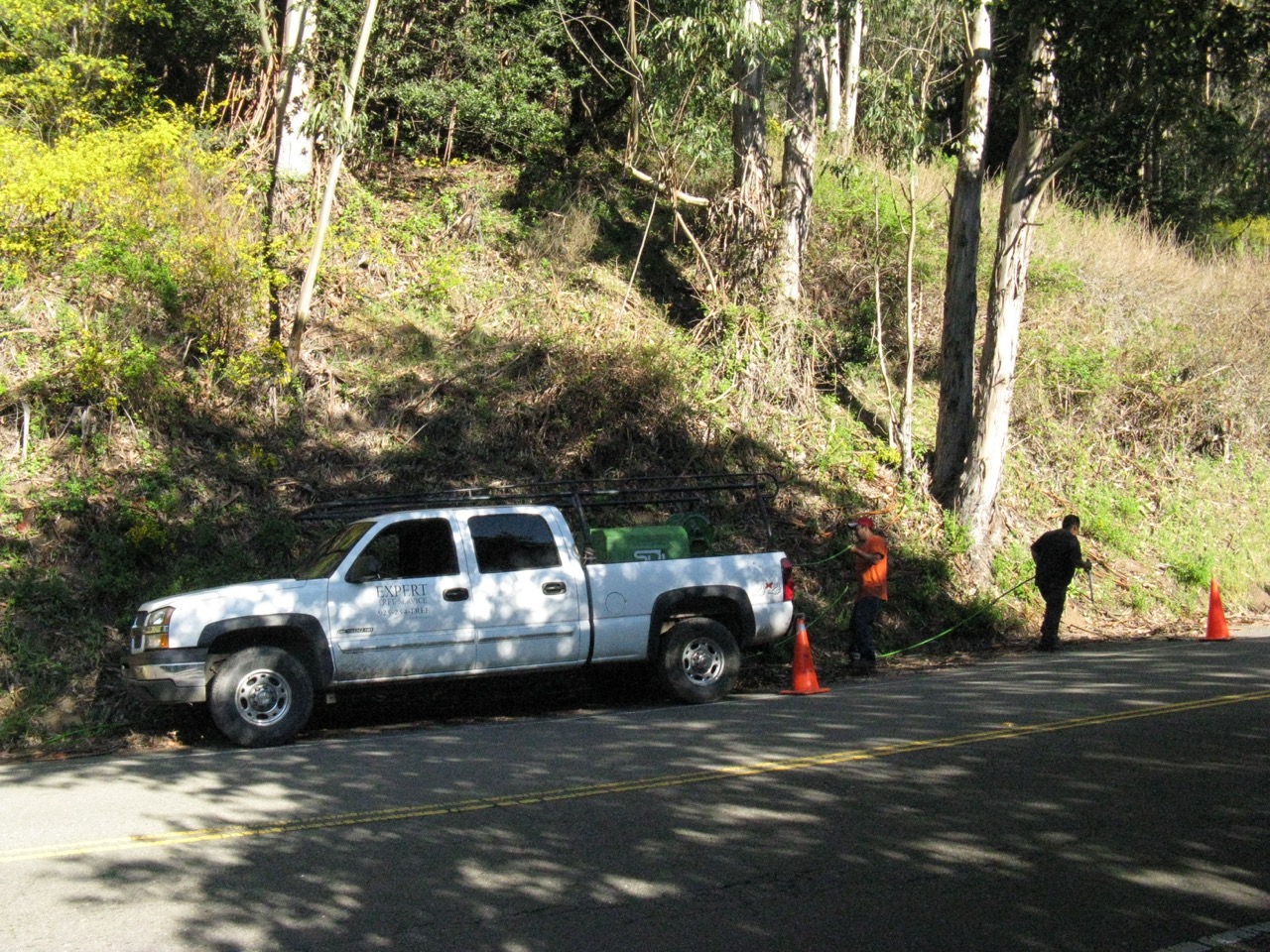
Herbicide spraying in one of the project areas

Why would they allow an opposing letter through to their membership?

The Sierra Club didn’t allow the member’s letter to go to their mailing list out of any interest in members hearing both sides of the story. It’s the law.

California State law requires that non-profit organizations with elected boards, such as the Sierra Club, enable their members to communicate with fellow members. This doesn’t mean they release their members’ contact information. The letter must be given to the non-profit organization, which uses a third-party direct mailing company. In this case, the mailing was arranged with the national headquarters of the Sierra Club, which manages the mailing list of the entire membership.

The Bay Area Chapter of the Sierra Club has 6,300 members, so it is expensive to take advantage of this privilege. All the more reason to be outraged by the fact that the Chapter pre-emptively sabotaged this effort to communicate with its membership.

Here’s the story

We will let the author of the letter to the Chapter members tell you what happened by publishing her report to the many people who are collaborating in the effort to prevent the destruction of our urban forest (emphasis added):

January 27, 2016

Friends, I am writing to tell you the fate of my letter to the members of the San Francisco Bay Chapter of the Sierra Club. My letter has not been sent yet, but it probably will be soon. The local chapter inserted a printed letter into the published version of the Yodeler informing members that they would be receiving my letter. That letter told them to go to the Chapter website to see a point-by-point “pre-buttal” to my letter. That is available on-line HERE.

I sent the staff in the national headquarters the email below and copied the Chapter staff who signed the letter in the Yodeler. You can read that email to see what I asked for. Now I have had a conversation with Bruce Hamilton who is in the legal office of national headquarters and I am writing to tell you the final outcome:

Mr. Hamilton freely admits that he gave my letter to the Chapter before my letter was sent. He did not see anything wrong with having done that. He says that the national headquarters assumes no responsibility for what the Chapter has done nor anything they say in their “pre-buttal.” I pointed out that I have provided evidence that the Club has refused to meet with us. He says the national headquarters takes no responsibility for ascertaining the facts. He has refused to request that the Chapter remove their “pre-buttal” from the website or revise it in any way. I told him that I would consult a lawyer about what “remedies are available to me.” [Redacted personal information]

So that is the fate of my letter to the members of the local Chapter of the Sierra Club. One hopes that members will now be so curious about my letter that they may actually read it! [Redacted personal comments]

In solidarity,

Mary McAllister


From: Mary McAllister
Sent: Wednesday, January 27, 2016 6:50 AM
To: michelle.epstein@sierraclub.org ; bruce.hamilton@sierraclub.org
Cc: Michelle Myers

Subject: Letter to members of the San Francisco Bay Chapter

Dear Mr. Hamilton and Ms. Epstein,

As you know, I have been trying to arrange a mailing to the members of the San Francisco Bay Chapter for some months. My letter has not yet been sent, yet the Bay Chapter has preemptively sabotaged my letter with an insert in the printed Yodeler alerting people to read the Chapter’s on-line prospective rebuttal to a letter that has not yet been sent.

The on-line “pre-buttal” starts by claiming that the Sierra Club has never refused to meet with me. I have attached [available here:  sierra-club-petition-to-national-leadership] my letters to the Sierra Club requesting a meeting that were sent in November. Those letters were sent certified and I have the return receipts, proving that the Club received my request for a meeting. The Club did not reply to those letters.

Also, below is my email correspondence with a member of the Chapter Conservation Committee attempting to get this issue on the agenda of the Conservation Committee in September 2015. This request was also ignored or denied. Since no one responded to me, I do not know which. [These emails are available here: Sierra Club – Conservation Committee]

These are just two of the most recent attempts to discuss this issue with the Chapter. I have a much longer paper trail of attempts that go back several years, including an email from someone representing Mr. Brune.

If the Chapter and/or the national Club are now willing to meet with us, I am still ready and willing to do so.

Meanwhile, I ask that the on-line “pre-buttal” be removed until my letter is actually sent and received by Chapter members. The well has already been poisoned, but this is the only remedy available to me at this time.

When my letter has been sent and received by members, I hope that the Chapter rebuttal will be more accurate than what is presently on-line. The Chapter leadership has been sent a multitude of studies, reports from environmental consultants and government professionals such as the US Forest Service. They therefore know—or should know—that nothing they are saying in their “pre-buttal” is accurate. I would be happy to present all these materials to you and others in a meeting.

I am one of hundreds of people who have been fighting for the preservation of our urban forest in the San Francisco Bay Area for nearly 15 years. Please understand that although I am required by law to make this request as an individual member, I do so on behalf of thousands of people who share my commitment.

Mary McAllister

The bottom line

We are still trying to get the facts out to all Sierra Club members, and to all those who recognize that its views are out of step with the environmental realities of the 21st century.

We hope that those who are still members of the Bay Area Chapter of the Sierra Club will read the letter from a fellow member and send the postcard expressing their opinion of Chapter policy regarding deforestation and pesticide use. Thank you for reading this post.

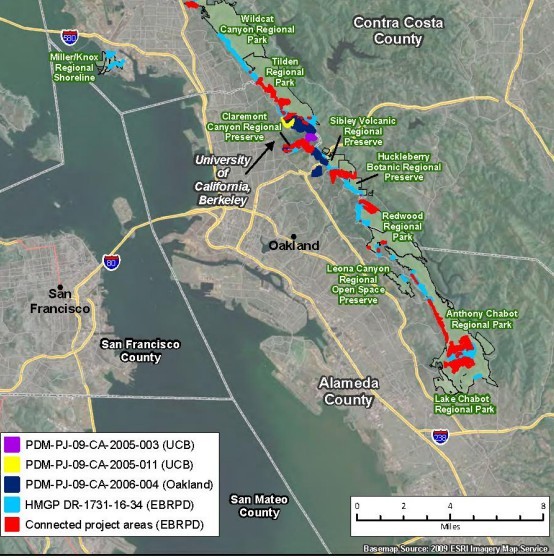
As a reminder: The map below shows all the areas that are affected by this massive deforestation scheme that will fell nearly half a million trees. It’s a travesty that the Sierra Club is not only supporting these projects, but has also filed a lawsuit demanding that they be even more destructive than planned.

FEMA Project Areas
FEMA Project Areas

Irrational fears threaten bats and trees

The Secret Lives of Bats is appropriately named because our knowledge of bats is limited by the fact that they are active at night while we sleep and their activities are shrouded by darkness.  The author of this engaging little book, Merlin Tuttle, devoted his life, from the time he was a teenager, to the study and conservation of bats.  Although he learned a great deal about bats in the 60 years he has studied them, it is his accomplishments in bat conservation that are most inspiring and impressive.

A few bat facts

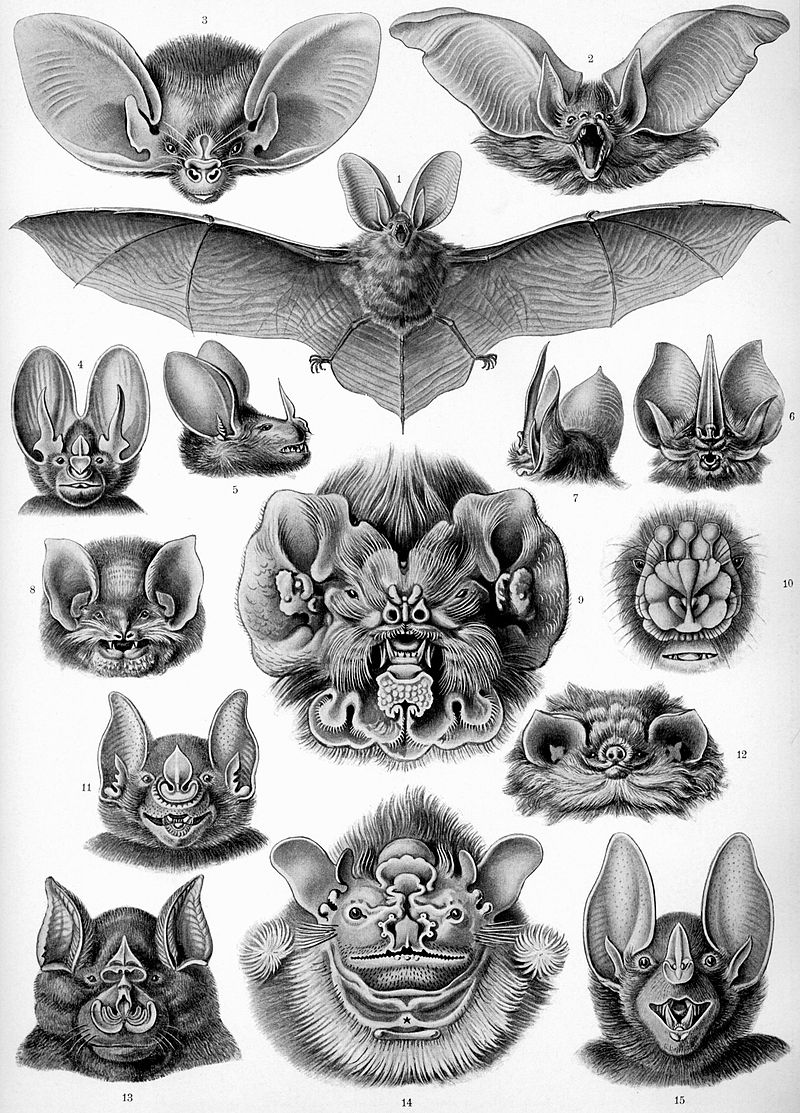
"Chiroptera" from Ernst Haeckel's Kunstformen der Natur, 1904
“Chiroptera” from Ernst Haeckel’s Kunstformen der Natur, 1904

There are nearly 1,300 species of bats and they are distributed all over the world, with the exception of Polar Regions.  We can’t describe the entire range of variation in the characteristics of such a diverse order (Chiroptera), so we will describe them only in general terms:

  • Bats are the only flying mammal. Their pups are born live and are generally fed breast milk by their mothers.
  • Many bat species live in caves and migrate from cold caves where they hibernate in winter to warmer caves where their pups are born.
  • Seventy percent of bat species eat insects. Bats in the US are insectivores.  Most remaining bat species eat fruit and live in tropical regions.  There are three bat species, called vampire bats that eat exclusively blood.   There are also a few species of carnivorous bats such as those that eat fish or frogs.
  • Many bat species live 20 to 30 years.
  • Most bat species use echolocation to find their prey in the darkness. See a video of a bat finding a moth, using echolocation HERE.

Local bat facts

There are 17 bat species in coastal California.  A study of foraging bats in 22 of San Francisco’s municipal parks found 4 species of insectivore bats.  The amount of forest edge and distance to water were the factors best explaining species richness and foraging activity.  The study found no correlation between bat foraging and the percent of native of plants, implying that there is no correlation between insect populations and native plants.

Why are bats important?

Insect-eating bats reduce insect populations, which reduces agricultural pests and disease-carrying mosquito populations.  A study in Arizona and New Mexico found that crop pests made up to two-thirds of free-tailed bats’ diets.  Another study found free-tailed bats feasting on migrating moths in Texas thousands of feet aboveground.  Tuttle estimates that “a single bat easily can consume more than 20 moths in a night, each carrying 500 to 1,000 eggs that otherwise would be laid on crops.  A density of 5,000 to 10,000 caterpillars per acre of cotton exceeds the threshold for pesticides.  Yet 20 moths can lay from 10,000 to 20,000 eggs.  If even half hatched to become caterpillars, they still could force a farmer to spray an acre of crop.”  (1)  Reduced populations of crop pests means fewer pesticides, which reduces farmers’ costs and toxicity exposure to consumers.

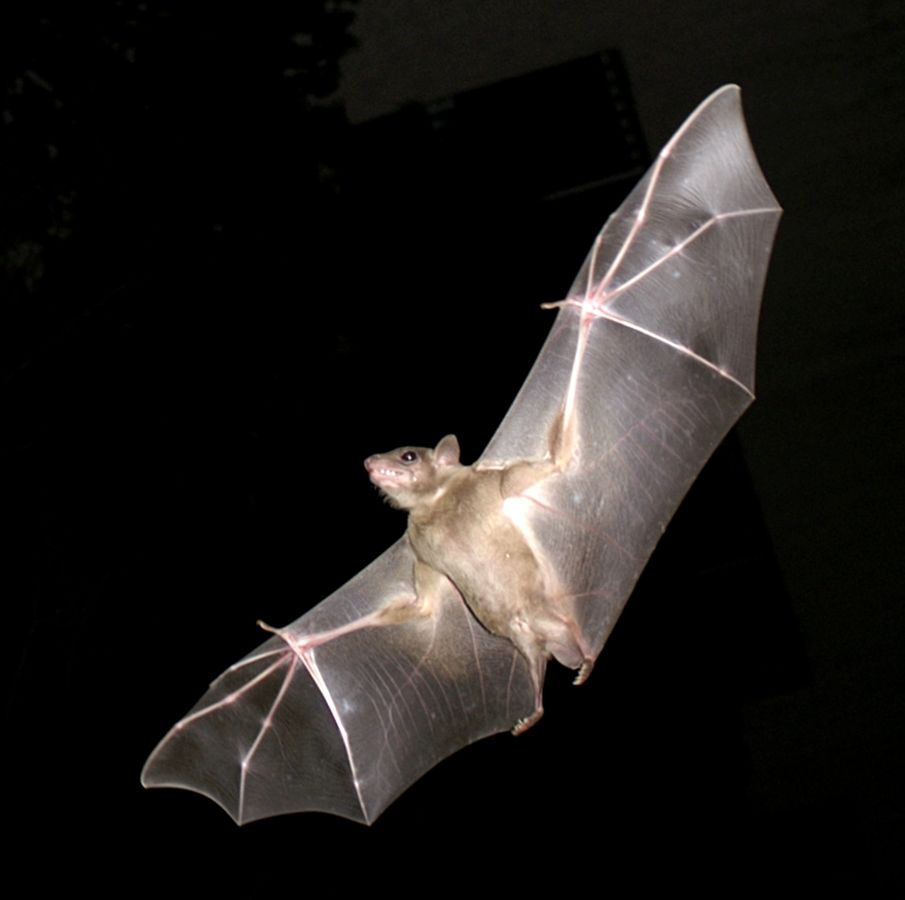
Common fruit bat. This photo makes it clear that the wings of a bat are also its hands. Creative Commons

Fruit-eating bats are important pollinators and dispersers of seeds.  There are some species of plants that can only be pollinated by bats because of the shape of the flower and the fact that it blooms only at night.

Although birds are also dispersers of seeds, the germination success of the seeds they disperse is probably less than those dispersed by bats because most bird species poop while perched, unlike bats that usually poop while flying.  Seeds deposited on open ground are more likely to germinate than seeds deposited in the shade of tree canopy.  Therefore, bats probably play a vital role in the reforestation of fallow agricultural land.

Bad raps about bats

So, as useful as bats are, why are their colonies often threatened with destruction?

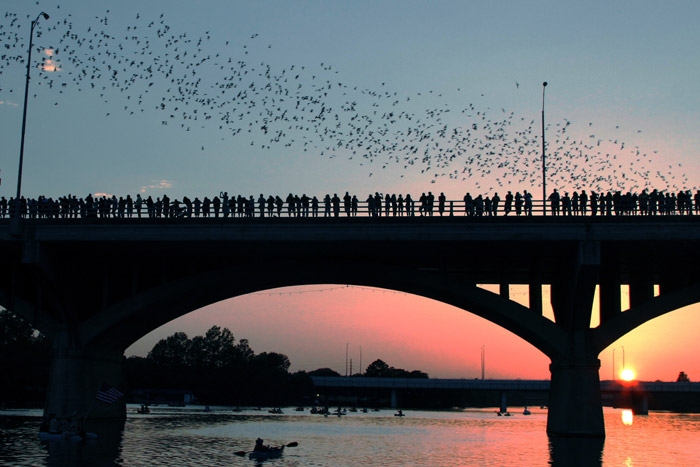
Bats departing from Congress Ave Bridge, Austin Texac
Bats departing from Congress Ave Bridge, Austin Texas

In the past, ignorance of the valuable functions performed by bats was the usual reason why their colonies are destroyed. The fact that the lives of bats are largely unseen contributes to that ignorance.  The colony of Brazilian free-tailed bats in Austin, Texas is a case in point.  In 1984, 1.5 million Brazilian free-tailed bats took up residence under a bridge in Austin, Texas.  “Newspaper headlines screamed, ‘Bat colonies sink teeth into city.’  They claimed that hundreds of thousands of rabid bats were invading and attacking the citizens of Austin.”  (1)

Tuttle was the curator of mammals at the Milwaukee Public Museum in Wisconsin at the time.  He had recently founded Bat Conservation International.  He quit his job and moved his fledging enterprise to Austin, where he was not warmly received.  But Tuttle is an engaging fellow and his knowledge of and fondness for bats is contagious.  Tuttle is equally modest, so he gives the bats full credit for convincing the public that bats need not be feared.  Within two months of his arrival, he turned the media coverage around.

The colony of Brazilian free-tailed bats in Austin is now internationally famous and a major tourist attraction.  Every evening at dusk, crowds form to witness the departure of the bats to forage for the evening.  My family has witnessed this moving event.  It is, indeed, a spectacle, on par with watching and listening to the raucous honking of huge flocks of Aleutian geese departing at dawn from their roosts for agricultural fields in Humboldt County.  Nature makes the best performance art.

Our federal Centers for Disease Control and Prevention informs us that we have little to fear from rabid bats:  “Most bats don’t have rabies. For example, even among bats submitted for rabies testing because they could be captured, were obviously weak or sick, or had been captured by a cat, only about 6% had rabies.”

Anthropogenic problems and bad solutions

There are only three species of vampire bats in tropical regions, but only one is considered a problem because it has a preference for mammals.  The population of this species of bat has grown because of the introduction of large herds of domesticated cattle.  The bats deplete the blood of the cattle and can spread diseases.  Reluctantly, Tuttle admits that these bat populations must be controlled.

So, his mission where vampire bats are causing problems for ranchers was to educate the ranchers about how to identify and find the bats.  There are other species of bats living in these areas that are performing valuable functions and unfortunately they roost in big colonies that are easy for the ranchers to find.  The ranchers were dynamiting or destroying these colonies because they were unable to distinguish them from the bats that were causing their problems.  Unfortunately, the vampire bats roost independently, hiding in trees.  So, they are more difficult for the ranchers to find.  With Tuttle’s help, tactics were devised to find the individually roosting vampire bats in order to reduce their populations.

New challenges for bats

Tuttle and his compatriots have accomplished a great deal in the past 60 years to increase our knowledge of bats and the important roles they play in nature.  He has convinced many people that it is not in their interests to destroy bat colonies on their properties.  However, he closes his book with two new challenges to bats:

  • Wind turbines are killing as many bats as they are birds. We must carefully study the design and placement of wind turbines to reduce this threat to our winged neighbors.
  • White-nosed syndrome is a fungus that has killed tens of thousands of bats in caves, particularly in the North East of the US. The fungus seems to live in a fairly narrow temperature range, so we are hopeful that it will not continue to spread rampantly.

The danger of misinformation

Millions of bats needlessly lost their lives because people were afraid of them.  Much progress has been made to inform the public of the value of bats.  Is this starting to sound familiar?  It should.  Millions of eucalyptus trees have been destroyed because people were needlessly afraid of them.  Please help us spread the word about the value of our trees.


(1) Merlin Tuttle, The Secret Lives of Bats, Houghton Mifflin Harcourt, 2015.  A favorable review of this book is also available in the New Yorker.

Alexander von Humboldt: “The Invention of Nature”

Portrait of Alexander von Humboldt by Joseph Stieler, 1843

Alexander von Humboldt made so many contributions to science that we cannot do him justice here.  We will therefore focus on his study of nature and put his accomplishments in that area into the context of historical events and his personal views of those events.  We draw from Andrea Wulf’s The Invention of Nature in this article. (2)

Humboldt is considered the originator of the scientific concept of biogeography, “the study of the distribution of species and ecosystems in geographic space and through (geological) time.” (1)  In other words, biogeography attempts to explain why species are where they are.  It is therefore relevant to the mission of Million Trees, which is to make the case that species belong wherever they persist without human management and without regard to how they got there.

The journey begins

Alexander von Humboldt was born in 1769 in what was then Prussia and is now Germany.  Under the thumb of a domineering mother, he was required to spend most of his twenties as a mining inspector.  In that capacity, he mastered the science of geology that he put to good use throughout his long life.

At the age of 27, he was freed from his obligations to his mother by her death.  With the help of his inheritance he began his travels to satisfy his intense curiosity about the world.  He brought along on his journeys the tools of measurement that existed at that time.  He made detailed recordings of his measurements wherever he went and they were the basis of comparing the many places he visited.

His journey began in the mountains of Europe and they became the baseline of his comparisons throughout his journeys.  But his movements in Europe were hampered by the political situation.  Revolutionary France was expanding its empire with a series of wars in Europe that prevented him from visiting many places of interest to him.  After several failed attempts to join voyages to other places, the King of Spain granted Humboldt a passport to the Spanish colonies in South America to collect the flora and fauna of the New World.

Humboldt set sail from Spain in June 1799, along with “a great collection of the latest instruments, ranging from telescopes and microscopes to a large pendulum clock and compasses—forty-two instruments in all, individually packed with protective velvet-lined boxes—along with vials for storing seeds and soil samples, reams of paper, scales and countless tools.” (2)

Journey of Alexander von Humboldt in the New World, 1799-1804. Creative Commons - Share Alike
Journey of Alexander von Humboldt in the New World, 1799-1804. Creative Commons – Share Alike

Finding unity in nature

Alexander von Humboldt collecting plants at the foot of Chimborazo. Painting by Friedrich George Weitsch

Humboldt and his companions climbed every mountain they encountered, taking precise measurements of altitude, temperature, and samples of soil and plants as they gained altitude.  As he accumulated data from each climb he began to see a pattern in what he encountered.  Humboldt’s new, revolutionary idea of nature fell into place for him as he climbed Chimborazo in Ecuador to an unprecedented height of 19,413 feet, about 1,000 feet shy of the summit:  “Nature, Humboldt realized, was a web of life and a global force…Humboldt was struck by this ‘resemblance which we trace in climates the most distant from each other.’ (2)

Humboldt's Naturegemälde
Humboldt’s Naturegemälde

Humboldt called the graphic depiction of his theory Naturegemälde which means roughly “painting of nature.”  His drawing shows that plants are distributed according to their altitudes and latitudes, from subterranean mushroom species to the lichens that grow below the snow line.  In similar latitudes, palms grow in the tropical zone at the foot of the mountain.  Oaks and shrubs prefer the temperate climate above the tropical zone.  Naturegemälde illustrated for the first time that “nature is a global force with corresponding climate zones across continents.” (2)

Addendum:  In 2012 – 210 years after Humboldt climbed Chimborazo – a scientific expedition surveyed the vegetation on Chimborazo and compared that survey to Humboldt’s survey in 1802.  They found that the vegetation has moved to higher altitudes on average 500 meters.   This movement of plants to higher elevations (and latitudes in other examples) is a response to climate change, which requires plant and animal species to move in order to survive.  It is one of many examples of why the concept of “native plants” is meaningless at a time of rapid climate change. (3)

Humboldt’s theory of the unity of nature, connected in a global web of life, required an interdisciplinary approach of which few of his contemporaries were capable.  He drew equally from his fund of knowledge about astronomy, botany, geology, and meteorology.  Sadly, as human knowledge has expanded exponentially in over 300 years, an interdisciplinary approach to science has become unattainable.  Scientific inquiry has become increasingly narrowly specialized, preventing the global view that informed Humboldt’s studies.  The “big picture” is lost in the compartmentalization of science into isolated, specialized scientific disciplines.

Socio-political context of Humboldt’s travels

We cannot fully appreciate Humboldt’s scientific accomplishments without mentioning his interest in and concern for the human realm.  Humboldt was 20 years old when the French Revolution occurred in 1789.  He was thrilled and delighted by the prospect of liberty and equality for the French people.  His admiration for the French made Paris his home for much of his life.  He believed that science would thrive in such an atmosphere of freedom of thought and action.

As Humboldt travelled in the New World, he brought this standard of freedom and liberty along with him.  New Spain was lacking in that regard.  He believed that the cultural accomplishments of the indigenous people were sadly devalued.  He was disgusted by the oppression of the indigenous people and the lack of basic human rights of the colonists.  He observed the consequences of this oppression in the colonial landscape.  Mineral riches were ravaged and forests were razed for the cash crops that impoverished the settlers.  The colonial government required them to grow monocultures such as indigo (blue dye), in lieu of the crops needed to feed the population.

Humboldt was one of the first scientists to observe the destructive consequences of deforestation.  Forests were cleared for agricultural fields.  Wood was the fuel of the time, providing heat and light.  Later forests would fuel ships, trains and industrial steam engines.  Where forests were cleared, the land quickly dried out because trees recycle water into the atmosphere.  Erosion and desertification are the eventual consequences of deforestation.

For the same reason that Humboldt admired the French Revolution, he also admired the new American republic that had only recently gained its independence from Britain and was founded on democratic principles.  He went far out of his way to visit the United States to consult with the young democracy.

Thomas Jefferson was the President at the time and they spent much valuable time together.  The Spanish jealously guarded all useful information about New Spain because the United States was clearly a rival in the New World.  Humboldt brought the Americans much useful information about their competitor because he not only wished to be helpful to their young enterprise, he firmly believed in universal access to information.

However, there was one horrible blot on the reputation of the United States that made Humboldt queasy.  He abhorred slavery in his own country as well as in the United States.  As much as he enjoyed the company of Thomas Jefferson and respected his intelligence, he was scandalized by the scale of enslavement on Jefferson’s Virginia plantation.

Humboldt’s concern for the welfare of humans extended to all races, ethnicities, and classes.  Just as he embraced all nature as worthy of his attention, his view of humanity was equally generous and inclusive.  We venture to guess that he would be as mystified by the pointless distinction between “native” and “non-native” plants and animals as we are.

Humboldt’s legacy

When Humboldt returned to Europe in 1804 at the age of 35, his reputation as an important scientist was already established by the correspondence in which he had engaged during the 5-year voyage.  He returned with the detailed record of his travels, including specimens:

“[He] returned with trunks filled with dozens of notebooks, hundreds of sketches and tens of thousands of astronomical, geological and meteorological observations.  He brought back some 60,000 plant specimens, 6,000 species of which almost 2,000 were new to European botanists—a staggering figure, considering that there were only 6,000 known species by the end of the eighteenth century.” (2)

He spent 21 years publishing over 30 volumes about his 5-year journey in the New World.  Not only were these books widely read, they influenced many of the greatest scientists and thinkers who succeeded him:

  • Charles Darwin’s correspondence with Humboldt and many references to Humboldt’s publications in his own work are evidence of Humboldt’s influence on Darwin’s work. Just as Humboldt’s journey inspired his theory of the unity of nature, Darwin’s journey around the globe was the inspiration for his theory of evolution.  Readers of Darwin’s early work observed the similarity of his writing style with that of Humboldt.
  • Humboldt was equally influential in the writings of Henry David Thoreau. Thoreau published an unsuccessful book shortly after his two-year reclusive experience on Walden Pond.  Then he learned from Humboldt’s books to observe and record the workings of nature, which eventually transformed his writings into the nature writing that made him famous.  The records he kept of the climate on Walden Pond are still used as a reference point for the climate change that has occurred in the past 150 years.
  • George Perkins Marsh is considered the first American environmentalist. His book Man and Nature was the first to express alarm in 1864 about American deforestation.  The writings of Humboldt were the first to alert Marsh to this issue and as they did for Humboldt this issue was brought into focus by extensive travels.  Marsh could see America’s future in Egypt where thousands of years of intensive agriculture left the land bare and unproductive.

Invention of NatureThis is but a short list of important scientists all over the world who were influenced and inspired by the writings of Alexander von Humboldt long after his death in 1859 at the age of 89.  We encourage our readers to read Andrea Wulf’s The Invention of Nature:  Alexander von Humboldt’s New World for the full story.  We have reported on other books by Andrea Wulf—The Brother Gardeners and The Founding GardenersMs. Wulf turns botanical history into a gripping story.

What is Humboldt’s message to Million Trees?

Alexander von Humboldt delivers a powerful message that fits well with our mission.  He saw the world and its inhabitants as fitting together in a harmonious and comprehensible manner.  He was always looking for the connections between seemingly disparate elements in nature and finding them wherever he looked.  His egalitarian hopes for humanity fit perfectly with his perception of nature as working together to make a web of life with humans as a part of that web.

We would like to think that Million Trees shares the Humboldtian viewpoint and we hope that our readers agree.  We hope that the New Year will bring more harmony to nature and those who live within it.


(1) Wikipedia https://en.wikipedia.org/wiki/Biogeography

(2) Andrea Wulf, The Invention of Nature:  Alexander von Humboldt’s New World, Alfred A. Knopf, New York, 2015

(3) Morueta-Holme N, Engemann K, Sandoval-Acuña P, Jonas JD, Segnitz RM, Svenning JC, “Strong upslope shifts in Chimborazo’s vegetation over two centuries since Humboldt,”  Proc Natl Acad Sci U S A. 2015 Oct 13;112(41):12741-5.  Available HERE.


2015 Annual Report (prepared by WordPress)

The WordPress.com stats helper monkeys prepared a 2015 annual report for this blog.

Here’s an excerpt:

The concert hall at the Sydney Opera House holds 2,700 people. This blog was viewed about 52,000 times in 2015. If it were a concert at Sydney Opera House, it would take about 19 sold-out performances for that many people to see it.

Click here to see the complete report.

Subirdia: Birds adapt to the Anthropocene

christmas-holly-4This article is our Christmas present to our readers.  We celebrate the holidays with good news about the birds living in cities all over the world.

Subirdia was written by John Marzluff, an academic ornithologist at University of Washington. (1)  He reports many years of his research and that of his graduate students about the birds that live in urban and suburban Seattle as well as surrounding forest reserves.  He also reports on countless studies of bird populations in similar settings all over the world.  All of those studies reach remarkably similar conclusions.

It took me a long time to read this book because its introduction was off-putting.  Virtually every plant and animal was preceded by the qualifier of “native” or “non-native.”  The implication of the introduction was that the most important feature of every plant and animal is whether or not it is native.  As our readers know, we consider the nativity of plant and animal species largely irrelevant.  All plants and animals are at home in our ideal nature.

Owl nesting in eucalyptus, courtesy urbanwildness.com

When I finally got around to reading Subirdia I was pleasantly surprised.  Although the author has a preference for native plants and animals, in fact, his research and that of others does not justify his obsession.  Where birds are actually found in the greatest numbers is where the habitat is most diverse, not necessarily exclusively native.

Suburbia is very birdy

The conventional wisdom is that cities are inhospitable places for birds and other wildlife.  After all, haven’t we paved over much of their habitat, interrupted their movements by fragmenting their habitat, and drained or covered water resources? In fact, bird populations in urban areas all over the world are both plentiful and diverse.

After years of counting numerous bird species in his hometown of Seattle, the author of Subirdia wondered if Seattle might be unique because it is heavily forested.  After conducting similar surveys in 10 cities around the world, Marzluff is convinced that birds are successfully adapting to rapid urbanization of human society.  The urban centers of cities in North and Central America, New Zealand and Europe support an average of 23 bird species.  He found the least number of bird species (11) in Auckland, New Zealand and the greatest number (31) in St. Andrews, Scotland.

Starling in breeding plumage. Creative Commons - Share Alike
Starling in breeding plumage. Creative Commons – Share Alike

Another popular myth about the loss of bird diversity in the Anthropocene is that the globalization of human civilization produces “homogenized” nature.  That is, many people believe that bird populations may not be in decline, but there are a few hardy species that dominate everywhere.  Again, Marzluff’s studies do not corroborate that belief.  Five bird species are found in cities all over the world (house sparrows, starlings, Canadian geese, mallard ducks, and rock pigeons).  However, these ubiquitous species are not the predominant bird species he found in cities.  Of the 151 different bird species he found in the 10 cities he visited, 75% of them were unique to each of the cities.   “Homogenization is barely perceptible.” (1)

Comparing bird populations in cities with nature reserves

Marzluff also compared bird populations in cities with undeveloped nature preserves.  Once again, cities still look like good homes for birds.  He finds twice as many bird species in Ketchikan, Alaska as in the nearby wildlands along the Naha River, “a remote wilderness fifty miles away…that required powerboat, kayak, and hiking to attain.” (1)

He also visited Yellowstone National Park, a 2.2 million acre protected area within an undeveloped ecosystem of nearly 20 million acres, where he counted 26 bird species in four days.  From there, he flew to New York City where he counted 31 bird species in Central Park in only three days.  Historical records of bird surveys in Central Park and Yellowstone National Park indicate that about 200 bird species have been found in both parks since the late 19th century.  “From a bird’s perspective, a large park created by human hands or by nature is not all that different.”  (1)

Accommodating birds in cities

Marzluff’s concluding chapters advise city dwellers how to encourage and support birds.  His “ten commandments” for accommodating birds make no mention of planting native plants or eradicating non-native plants:

  • “Do not covet your neighbor’s lawn.”
  • “Keep your cat indoors.”*
  • “Make your windows more visible to birds that fly near them.”
  • “Do not light the night sky.”
  • “Provide food and nest boxes.”
  • “Do not kill native predators.”
  • “Foster a diversity of habitats and natural variability within landscapes.”
  • “Create safe passage across roads and highways.”
  • “Ensure that there are functional connections between land and water.”
  • Enjoy and bond with nature where you live, work, and play!”

Marzluff expresses a strong preference for native plants throughout his book, but his research in Seattle is inconsistent with that preference:  “The forests of Seattle and its suburbs now embrace 141 species of trees, including 30 native species and ornamentals from North and South America, Europe, Asia, and Africa.  Some are problematic invaders, but in total they provide a diverse menu of foods and nesting and roosting sites for birds.”  (1)

Why a preference for natives?

Garter snake in eucalyptus leaf litter. Courtesy Urban Wildness

Another academic scientist in Washington State, Linda Chalker-Scott, directly addresses the vexing question of why public policies which mandate the use of native plants have proliferated despite the lack of evidence that they are superior in any way.  She focuses on this question:  “Do native and nonnative woody species differ in how they affect species diversity?”  Her literature search found 120 studies from 30 countries that quantified the biodiversity of birds, insects, mammals, reptiles, and other plants in woody plants and trees in urban landscapes.

The analysis of these studies reveals that “the science does not support the supposition that native plantings are required for biodiversity…it is clear that an automatic preference for native trees when planning in urban areas is not a science-based policy.” (2) The assumption that native plants are superior to non-native plants is based on these misconceptions:

  • The definitions of native and alien species are value judgments, not science-based concepts.
  • Native plants are often poorly suited to environmental conditions in urban areas, such as compacted soil and changes in the climate. Conversely, introduced plants are often well suited to these urban conditions.
  • Many introduced plants provide valuable ecological benefits. For example, they often provide food, pollen, and nectar resources during winter months when native plants are dormant.
  • Tropical milkweed is not native to California. (Asclepias curassavica) Creative Commons
    Tropical milkweed is not native to California. (Asclepias curassavica) Creative Commons

    Doug Tallamy is the academic scientist most closely associated with the native plant ideology. His claim that insects require native plants is based on his mistaken assignment of nativity to an entire genus, when only a few species within that genus are actually native.  For example, there are over 35 species of milkweed in the genus Asclepias, but only two species are native to California.  Most members of the milkweed family are useful to monarch butterflies.  It is therefore not accurate to claim that monarchs require native plants.  They have lived all over the world for over 200 years in some places where there are no native species of milkweed.

Chalker-Scott’s meta-analysis of 120 studies concurs with Mr. Marzluff:  “The published research overwhelmingly identifies diversity, structure, and function as the most important vegetation characteristics for enhancing community biodiversity…In fact, sometimes landscapes require the inclusion of exotic trees and control of natives to maintain diversity.” (2)

Doing more harm than good

Our readers know that we do not begrudge the preference of native plant advocates for native plants.  We encourage them to plant whatever they want.  We only ask that they stop destroying the plants they don’t like.  That request is based on our belief that they are doing far more harm to our public lands than any perceived benefit of native plants.  Much of that harm is caused by the widespread use of herbicides to destroy non-native vegetation.  These herbicides are known to damage the soil and they migrate in the soil, damaging neighboring plants that are not targeted.  These issues are surely a factor in the conspicuous lack of success of their “restorations.”  There is also mounting evidence of the toxicity of herbicides to bees, birds, and other animals including humans.

But there is another, equally important reason why we object to the futile attempts to eradicate non-native plants.  They are providing valuable habitat for wildlife.  Even when they are replaced by native plants after being destroyed, the animals that depended upon them are not necessarily restored to the landscape.  In fact, few projects plant natives after the eradication of non-natives.

Japanese honeysuckle. Attribution William Rafti

A recently published study (3) of the removal of Amur honeysuckle (Lonicera maackii) is an example of the loss of valuable habitat.  The hypothesis of this study was that “invasion of urban habitats by exotic plants was the underlying mechanism driving changes in bird-plant networks.”  The study tested this hypothesis by comparing forest plots dominated by honeysuckle with those in which honeysuckle had been removed and the surrounding forest habitat replicated.  They measured nesting birds, nest predators, and nest survival.

They found that the lowest overall nest survival rates were found in the plots in which honeysuckle had been removed.  In other words, “…removal of invasive honeysuckle from urban forests did not restore network structure to that of rural landscapes.”  The authors concede, “This finding was not consistent with our original hypothesis that invasion of forests by the exotic Amur honeysuckle was responsible for the urban-associated changes in bird-plant networks.”  They conclude, “The degree to which native communities can be restored following removal of exotic plants remains unclear.” 

Actually, we think it is quite clear that eradicating non-native plants does not benefit man or beast. We marvel that the fantasy persists that there is some theoretical benefit to killing harmless plants, despite the consistent lack of evidence of any benefit and the considerable evidence of the harm of such attempts. 


*Like most ornithologists, Marzluff comes down hard on cats as killers of birds in his book.  However, he cites just one study about predation of fledglings.  The study used radio transmitters to determine the fate of 122 newly fledged birds over a period of two years.

The results do not justify the demonization of cats:  “Only 20 percent of radio-tagged birds died during our study.  Birds such as Cooper’s hawks and mammals such as Townsends’ chipmunks, ermine, and Douglas squirrels were the most likely predators.  The most notorious of all bird predators, the out-of-the-house cat, was implicated in only one death, though we could never be entirely sure which mammal or which bird had killed the fledging.”  (1) Marzluff credits a neighborhood coyote for controlling the cat population.  Frankly, that doesn’t make sense.  Chipmunks and squirrels are just as likely to be prey for the coyotes.

We have reported on similar studies which reach the same conclusions.  A meta-analysis of 8 studies of nest predators of song birds in North America used video cameras to identify the predators of 242 depredation events.  Only one of those nest predators was a cat.

We have no objection to the general advice to keep your cat indoors. (We have never had a cat and don’t plan to.)  However, we think that estimates of birds killed by cats are greatly exaggerated.  Humans seem to have an unfortunate desire to look for scapegoats and cats seem to fit the bill for bird lovers.

  1. John M. Marzluff, Welcome to Subirdia, Yale University Press, 2014
  2. Linda Chalker-Scott, “Nonnative, Noninvasive Woody Species Can Enhance Urban Landscape Biodiversity,” Arboriculture & Urban Forestry, 2015, 41(4): 173-186
  3. Amanda D. Rodewald, et. al., “Does removal of invasives restore ecological networks? An experimental approach,” Biological Invasions, March 2015

The Economist: “You can garden in a garden. You cannot garden nature.”

For those who may not be familiar with The Economist magazine, let us introduce this venerable publication to you.  The Economist is a weekly news magazine published in Britain continuously since 1843.  It has a readership of over 1.5 million and about half of its readers are in America.  Its viewpoint is fiscally and politically moderate (it endorsed Ronald Reagan and Bill Clinton) and socially liberal (it supports same-sex marriage and immigration).  It is widely read by the business community and public policy makers.  In other words, it is an influential, mainstream source of information.

Therefore, The Economist’s recent articles about invasion biology represent a significant step forward in the effort to stop the pointless and damaging crusade against harmless non-native plants and animals.  The following is an excerpt from the editorial version of a longer article in the December 5, 2015 edition of The Economist.  We have added emphasis and a few photos.


“In Defense of Invaders”

“EVERYBODY loves to hate invasive species. Americans battle rampant plants such as kudzu, a Japanese vine; Europeans accuse the American grey squirrel of spreading disease and damaging forests. As The Economist went to press, a scientific committee was expected to sign off on Europe’s first invasive-species blacklist. Cross-border trade in 37 species will be banned (the list is bound to grow longer as conservationists add more troublemakers). Where it is not already too late to wipe out these alien invaders, EU member states will be required to do so.

“Europeans are restrained in comparison with other countries. The international list of invasive species—defined as those that were introduced by humans to new places, and then multiplied—runs to over 4,000. In Australia and New Zealand hot war is waged against introduced creatures like cane toads and rats. In 2013 New Zealand used helicopters to drop a poison known as 1080 on 448,000 hectares of land—an area about the size of Yosemite and Sequoia national parks put together. Just four public objections were recorded.

“Some things that are uncontroversial are nonetheless foolish. With a few important exceptions, campaigns to eradicate invasive species are an utter waste of money and effort—for reasons that are partly practical and partly philosophical.

Rhodedenron ponticum, one of only a dozen plants considered invasive in Britain. Wikimedia Commons

“Start with the practical arguments. Most invasive species are neither terribly successful nor very harmful. Britons think themselves under siege by foreign plants like Japanese knotweed, Rhododendron ponticum and Himalayan balsam. In fact Britain’s invasive plants are not widespread (see article), not spreading especially quickly, and often less of a nuisance than vigorous natives such as bracken. The arrival of new species almost always increases biological diversity in a region; in many cases, a flood of newcomers drives no native species to extinction. One reason is that invaders tend to colonise disturbed habitats like polluted lakes and post-industrial wasteland, where little else lives. They are nature’s opportunists.

Honeybee in non-native wild mustard

New arrivals often turn out to be useful, even lovely. Americans fret about the decline of a vital crop-pollinator known as the American honey bee. Apis mellifera is actually an invader from the Old World: having buzzed from Africa to Europe, it was brought to America by colonists and went wild. Invasive plants provide food and nests for vulnerable natives; invasive animals can help native species by killing their predators, as the poisonous cane toad has done in Australia.

Another practical objection to the war on invasive species is that they are fiendishly hard to eradicate. New Zealand will not get rid of its rats any more than Britain could wipe out its grey squirrels. Culls tend to have a short-term effect at best. It is, however, sometimes possible to get rid of troublesome immigrants on tiny oceanic islands. Because the chances of success are higher, and because remote islands often contain rare species, efforts there are more worthwhile.

“The philosophical rationale for waging war on the invaders is also flawed. Eradication campaigns tend to be fuelled by the belief that it is possible to restore balance to nature—to return woods and lakes to the prelapsarian idyll that prevailed before human interference. That is misguided. Nature is a perpetual riot, with species constantly surging, retreating and hybridising. Humans have only accelerated these processes. Going back to ancient habitats is becoming impossible in any case, because of man-made climate change. Taking on the invaders is a futile gesture, not a means to an achievable end.

“No return to Eden”

“A rational attitude to invaders need not imply passivity. A few foreign species are truly damaging and should be fought… It makes sense to keep out pathogens… Fencing off wildlife sanctuaries to create open-air ecological museums is fine, too….You can garden in a garden. You cannot garden nature.”

Public opposition to pesticide use in our public parks

On November 19, 2015, a visitor to Mount Davidson park in San Francisco video recorded a pesticide application that is available here:

glyphosate spraying on Mt Davidson - nov 19, 2015

One of the people who saw that video reported several concerns regarding that pesticide application to the city employees who are responsible for the regulation of pesticide use in San Francisco.  Here is the email he sent to Kevin Woolen in the Recreation and Park Department and Chris Geiger in the Department of the Environment:

To:  Kevin Woolen  kevin.woolen@sfgov.org

Dear Mr. Woolen,

I understand that you are responsible for the records of pesticide applications on properties managed by San Francisco’s Recreation and Park Department.  I have heard you speak at public meetings, so I am aware that you have some expertise in that area.  Therefore, I am writing to you about a pesticide application on Mt. Davidson on November 19, 2015.  That pesticide application was recorded by this video:  https://www.facebook.com/ForestAlliance/videos/934479473312166/?fref=nf

I have several concerns about this pesticide application:

  • One of the herbicides that was sprayed was Stalker with the active ingredient imazapyr. I notice that most of the spraying was done around a tree, which was not a target of the application according to the posted Pesticide Application Notice.  As you may know, imazapyr is not supposed to be sprayed under and around non-target trees according to the manufacturer’s label:  http://www.cdms.net/ldat/ld01R013.pdf:  “Injury or loss of desirable trees or other plants may result if Stalker is applied on or near desirable trees or other plants, on areas where their roots extend, or in locations where the treated soil may be washed or moved into contact with their roots”

Here is a newspaper article about unintentional damage done to trees by spraying an imazapyr herbicide beneath them:  http://www.mlive.com/news/grand-rapids/index.ssf/2012/09/no_quick_fix_for_herbicide_dam.html

  • The Pesticide Application Notice says that the application method will be “spot treatment/daub cut stem.” This does not seem to be an accurate description of the application method on November 19th.  It seems that “backpack sprayer” would be a more accurate description of this particular pesticide application.
  • The Pesticide Application Notice says that Himalayan blackberries were one of the targets of this Pesticide Application. As you know, birds and other wildlife cannot read the signs that are posted to warn the public about these applications.  Can you assure me that the Himalayan blackberries were no longer fruiting?  Does the Recreation and Park Department have a policy against spraying vegetation when there are fruits eaten by birds and other wildlife?  If not, would the Recreation and Park Department consider adopting such a policy?
  • Although Garlon was not used in this particular pesticide application, it is often used in San Francisco’s so-called “natural areas.” Therefore, it is worth mentioning that Garlon is also known to be mobile in the soil and there are documented incidents of it damaging non-target trees when it has been sprayed on the stumps of nearby trees after they were destroyed.

Thank you for your consideration.  I hope you will share my concerns with the staff and contractors who are engaged in these pesticide applications.

Cc:  Chris Geiger  chris.geiger@sfgov.org

This is not an isolated incident.  Park visitors in San Francisco have been complaining for years about pesticide use in parks that were designated as “natural areas” over 15 years ago.  Ironically, those areas were never sprayed with pesticides before being designated as “natural areas.”  In fact, they really were natural areas prior to being officially designated as such.  Plants and animals lived in peace in those places before being “managed” by people who are committed to eradicating all non-native plants in many of San Francisco’s parks.

What can you do about it?

If you are opposed to pesticide use in San Francisco, or you object to the pointless destruction of harmless plants that are useful to wildlife, here are a few things you can do to express your opinion and influence the public policy that allows pesticide use in the public parks of San Francisco:

  • You can join over 11,000 people who have signed a petition to prohibit the use of pesticides in public parks. The petition is HERE.  The San Francisco Chronicle reported on pesticide use in San Francisco’s parks and the petition against that use.  (Available HERE)
  • You can sign up HERE to be notified of the annual meeting in which pesticide policy in San Francisco is discussed for subsequent approval by the Environment Commission. That meeting has been scheduled in December in past years.  Update:  The annual meeting has been announced.   “Annual Public Hearing on Pest Management Activities on City Properties and San Francisco’s Draft 2016 Reduced-Risk Pesticide List 4:30-7:00 pm
    Wednesday, December 16, 2015 Downstairs Conference Room, 1455 Market St. (near 11th St.; Van Ness MUNI stop)”  The meeting agenda is available HERE.
  • You can apply for one of the two vacant seats on the Environment Commission. These seats have been vacant for nearly a year.  In the past, the Environment  Commission has actively promoted pesticide use in San Francisco’s “natural areas.”  Qualifications and duties of commissioners are available HERE.
  • Appointments to the Environment Commission are made by Mayor Ed Lee. If you don’t want to serve on the Environment Commission, you can write to Mayor Lee (mayoredwinlee@sfgov.org) and ask him to appoint people to the Commission who do not support the use of pesticides in San Francisco’s public parks.

The parks of San Francisco belong to the people of San Francisco.  They have paid to acquire those properties for public use and they are paying the salaries of those who are “managing” the parks.  If you don’t like how parks are being managed, you have the right to express your opinion.  Our democracy works best when we participate in the public policy decisions that affect us.

What does this have to do with the East Bay?

Our readers in the East Bay might wonder what this incident has to do with you.  Parks in the East Bay are also being sprayed with herbicides for the same reasons.  HERE are reports of pesticide use by the East Bay Regional Park District.

Many of the pesticide applications on the properties of EBRPD are done by the same company that sprayed herbicides on Mount Davidson on November 19, 2015.  That company is Shelterbelt Builders.  You can see their trucks in the above video.  Pesticide use reports of San Francisco’s Recreation and Park Department often report that pesticide applications were done by Shelterbelt.

Shelterbelt began the eradication of non-natve vegetation in Glen Canyon in November 2011

Shelterbelt Builders is based in the East Bay.  One of its owners is Bill McClung who is a member of the Claremont Canyon Conservancy and a former officer of that organization.  The Claremont Canyon Conservancy is the organization that is demanding the eradication of all non-native trees on public land in the East Bay Hills.  Here is a description of Mr. McClung’s responsibilities on Shelterbelt’s website:

“Bill McClung joined Shelterbelt in 1997 to help refocus Shelterbelt on native plant restoration and open land management/fire safety.  After his house burnt down in the 1991 Oakland Fire, this former book publisher became interested in how wildland and fire are managed in the East Bay Hills.  He became a member of the Berkeley Fire Commission in 1994 and has a strong interest in the vegetation prescriptions of the Fire Hazard Program & Fuel Reduction Management Plan for the East Bay Hills issued in 1995 by the East Bay Hills Vegetation Management Consortium and the East Bay Regional Park District Wildfire Hazard Reduction and Resource Management Plan Environmental Impact Report of 2009/10.  He has managed many properties in the East Bay where wildfire safety and native habitat preservation are twin goals, and continues to work on interesting and biologically rich lands in the Oakland Hills.”

Claremont Canyon Conservancy

The Claremont Canyon Conservancy held their annual meeting on November 15, 2015.  Oakland’s Mayor, Libby Schaaf, was one of the speakers.  Although she took questions at the end of her presentation, one of the officers of the Conservancy called on the questioners.  There were many people in the audience who are opposed to the FEMA projects that will destroy over 400,000 trees in the East Bay Hills and many of us tried to ask questions.  With one exception, the person controlling the questions only called on known, strong supporters of the FEMA project.  Therefore, those who wished to express their opposition to the FEMA projects to the Mayor were denied that opportunity.  Fortunately, there were many demonstrators outside the meeting who could not be denied that opportunity.

Demonstration at meeting of Claremont Canyon Conservancy, November 15, 2015

Norman LaForce was the other main speaker at the meeting.  He is an elected officer of the Sierra Club and he identified himself as one of the primary authors of the project to destroy all non-native trees in the East Bay Hills.  (An audio recording of his complete presentation is available here: https://milliontrees.me/wp-content/uploads/2015/11/norman-laforce-sierra-club-11-15-15.m4a ) This is the paraphrased portion of his presentation specifically about the herbicides that will be used by the FEMA project:

“Part of the FEMA program will be to use herbicides in a concentrated, careful program of painting or spraying herbicides to prevent the trees from resprouting. It may need to be done more than once but ultimately the suckers give up.   There is no other way to do that cost effectively.

People are saying that glyphosate causes cancer.  Radiation causes cancer but when people get cancer they are often treated with radiation.  Nobody tells them they can’t have radiation because it causes cancer.

There are a lot of people of a certain age in this room who are probably taking Coumadin as a blood thinner for a heart condition.  Coumadin is rat poison.  Nobody tells them they can’t take Coumadin.*

You must take dosage and exposure into consideration in evaluating the risks of pesticides.

Nature Conservancy used glyphosate on the Jepson Prairie.

State Parks used Garlon on Angel Island when they removed eucalyptus.

The European Union says that glyphosate does not cause cancer, so I don’t know if it does.  I’m not going to take a position on that.

Now they are saying that red meat causes cancer.

We need to put aside the question of pesticides.  They will be used properly.  We must proceed in a scientific manner.”

We leave it to our readers to interpret Mr. LaForce’s justification for pesticide use.  He seems to be suggesting that pesticides are good for our health.  There are instances in which pesticides do more good than harm, but using them to kill harmless plants in public parks isn’t one of them, in our opinion.  Since many chemicals accumulate in our bodies throughout our lives, it is in our interests to avoid exposure when we can.  If we must take Coumadin for our health, that’s all the more reason why we should avoid unnecessary exposure to rat poison when we can.

Connecting the dots

We have tried to connect the dots for our readers.  Here are the implications of what we are reporting today:

  • Pesticide applications in San Francisco are probably damaging the trees that are not the target of those applications. The food of wildlife may be poisoned by those pesticide applications.
  • You can influence the public policy that is permitting pesticide use in San Francisco.
  • The same company that is spraying pesticides in San Francisco is also doing so in the East Bay.
  • That company is also actively engaged in the attempt to transform the landscape in the San Francisco Bay Area to native plants. They have an economic interest in native plant “restorations.”
  • The Sierra Club is actively promoting the use of pesticides on our public lands.

*Coumadin is prescribed for people who are at risk of heart attack or stroke caused by blood clots.  Coumadin thins the blood and suppresses blood coagulation.  Rat poison kills animals by bleeding them to death.  There is a fine line between preventing blood clots and bleeding to death.  Therefore, people who take Coumadin have frequent blood tests to check that the dosage is at the optimal level.  Rat poisons are killing many animals that are not the target of the poison.  Animals such as owls, hawks, vultures are often killed by eating dead rodents that have been poisoned.  We should not conclude that rat poison is harmless because humans are using it in carefully controlled doses.  Herbicides being sprayed in our public lands are not being closely monitored as Coumadin use is.


Monarch myths revisited

Debunking the myths of nativism—especially those that justify the eradication of non-native trees—is the task we have assigned ourselves, which requires us to revisit a few of the misconceptions about monarch butterflies in California.

Monarch Butterfly. Creative Commons

When application for endangered status for monarchs was filed in August 2014, a few new monarch myths emerged and have since been faithfully repeated by native plant advocates who are demanding the eradication of our urban forests.  The monarch migration in California is using predominantly non-native trees, which should afford those trees some protection.  Unfortunately, it has only produced more convoluted theories that deny the value of non-native plants and trees to monarchs.

Myth #1:  The California migration of monarch butterflies prefers native trees for their winter roost. 

Monarch butterflies roosting in eucalyptus tree.

A study of the trees used by monarch butterflies for their winter roost in over 300 different sites in California reported that the vast majority of monarchs are using eucalyptus:

“Three types of trees were used most frequently by roosting monarchs:  eucalyptus (75% of the habitats primarily Eucalyptus globulus), pine (20% of the habitats; primarily Pinus radiata), and cypress (16% of the Cupressus macrocarpa).  Twelve other tree species were identified…with a combined prevalence of only 10%.” (Three different studies by different authors are the source of these data, therefore they don’t add up to 100%.) (1)

Unfortunately, this fact has been obscured by a small study of a few selected sites used by monarchs during their migration.  Griffiths and Villanova (2) observed the monarch migration in a few sites in Monterey and San Luis Obispo counties.  They report that the monarchs moved around among three tree species including eucalyptus, suggesting to them that Monterey pine and cypress are equally important to the monarchs.  While we don’t doubt that this may be true, we don’t think we can generalize from this study because it was conducted in the small native range of Monterey pine and cypress.

The California migration of monarchs spends the winter months roosting in tall trees in 17 counties along the coast of California, from Mendocino County in the north to San Diego County in the south. (1) Most of that expanse is outside the native range of Monterey pine and cypress.  Griffiths and Villanova do not acknowledge that both Monterey pine and cypress are being eradicated outside their native range for the same reason that eucalyptus is being eradicated, i.e., they are considered “alien invaders” where they have been planted outside their native range.  Here in the San Francisco Bay area, for example, 500 Monterey pines were destroyed on the Marin headlands a few years ago and an untold number of Monterey pines will be destroyed by the FEMA projects in addition to those that have already been destroyed here.

If, in fact, monarchs do have a preference for Monterey pines and cypress for their winter roost, they do not have that option outside of the small native range of those trees in Monterey County. 

For the record, we should tell you that we are just as opposed to the pointless destruction of Monterey pine and cypress outside their small native range as we are opposed to the destruction of eucalyptus.

There is paleontological evidence (fossil cones) that Monterey pines lived in the San Francisco Bay Area several times in the distant past.  That finding was reported (4) in Fremontia, the journal of the California Native Plant Society.  The author asked that Monterey pines be allowed to remain where they lived in the past because the species is threatened in its small native range.  Unfortunately, her advice has been ignored by native plant advocates, who continue to demand that all Monterey pines be destroyed where they have been planted outside their present native range.  This extreme viewpoint is one of the reasons why native plant advocates have earned their reputation as fanatics.

Myth #2:  The California migration of monarch butterflies used exclusively native trees before eucalyptus was planted in California.

Those who wish to discount the value of eucalyptus to overwintering monarchs often assume the California monarch migration predates the planting of eucalyptus in California in mid-19th century.  That assumption supports their claim that all of our eucalyptus can be destroyed without having a negative impact on monarch butterflies.   In fact, there is no historical record of the monarch migration until the mid-19th century.  The historical record of the monarch migration was reported by Vane-Wright (3), who tells us the California monarch migration is probably a 19th century expansion of the range of the eastern monarch migration, from east of the Rocky Mountains to Mexico.  Recent molecular analysis of the monarch migration confirms that the eastern and western migration of monarchs in North America are genetically identical, suggesting that the populations might be dispersing east and west from their Mexican winter roost. (5)

Monarch caterpillar on milkweed. Tilden Botanical Garden

Monarch butterflies are not usually eaten by birds because their host plant contains a toxin that makes birds sick and the monarch’s warning colors broadcast that fact.  The warning colors of butterflies that are toxic to birds are often mimicked by other species of butterflies to confer that protection.  There is a monarch mimic, the Viceroy, in the eastern US, which occurs in California only in a tiny bit of riparian habitat in southeast California.  “The lack of mimics suggests the [monarch] may not have been here long enough for any to evolve.” (6)

Myth #3: Non-native species of milkweed is harmful to monarch butterflies.

Monarch butterflies lay their eggs on milkweed and their larvae, the caterpillar, feeds exclusively on milkweed.  Many native plant advocates believe that the monarch requires a native species of milkweed.  They are mistaken in that assumption.  Wikipedia lists over 35 species of milkweed (genus Asclepias) all over the world and many are known to be used by the widely dispersed populations of monarchs.

The dispersal of monarchs from their original range in North America is approximately 200 years old, according to molecular analysis of populations across the Pacific Ocean (Hawaii, Samoa, Fiji, New Caledonia, New Zealand, Australia) and across the Atlantic (Spain, Portugal, Morocco).  These dispersals are assumed to have been aided by human transportation of both milkweeds and monarchs and extreme weather events.  “For example, monarchs were recorded in Australia in 1870 and were most probably carried there on cyclonic winds from a source population in New Caledonia.” (7)  These populations do not migrate and are therefore genetically distinct from the ancestral population of North American monarchs as a result of genetic drift.

In many of the homes of new populations of monarch butterflies there was no native species of milkweed before being introduced simultaneously with the monarch populations.  Although there are numerous members of the milkweed family native to Australia, monarchs do not appear to utilize the native species, preferring the introduced species of milkweed.

Tropical milkweed (Asclepias curassavica) Creative Commons

In California, a tropical species of milkweed is popular with gardeners (Asclepias curassavica).  Unlike the native species of milkweed, tropical milkweed does not die back in winter.  Gardeners therefore tend to prefer the tropical milkweed because it makes a colorful contribution to their gardens year around.

Of course, native plant advocates prefer native species of milkweed and they justify their preference by claiming that tropical milkweed is harmful to monarchs.  They claim that the monarch parasite (Ophryocystis elektroscirrha) can accumulate on tropical milkweed because it doesn’t die back during the winter.  Tropical milkweed is the only milkweed available in winter.  The parasite disrupts some winter breeding of monarchs, but that breeding would not occur in the absence of tropical milkweed.  If more monarchs are the goal, tropical milkweed is making a contribution to the monarch population.

New scientific research debunks the myth that tropical milkweed is harmful to monarchs.  Leiling Tao et.al. (8) studied monarch lifespans when they fed on a variety of milkweed species.  They looked at both resistance to monarch parasite (O. elktroscirrha) infection and tolerance once infected.  They found a complex interaction between species of milkweed the monarchs fed on and the amount of mycorrhizal fungi on the roots of the milkweed.  But one result was clear:  monarchs raised on tropical milkweed (A. curassavica) lived as long, or longer than, monarchs raised on other species of milkweed.  They were less likely to be infected, and once infected, tolerated the infection well.  In short, there is nothing about tropical milkweed as a host that is detrimental to monarch survival in the presence of parasites.

Native plant advocates also speculate that tropical milkweed can disrupt the migratory patterns of monarchs because it is available when native milkweed is not available.  Given that monarchs have persisted for 200 years all over the world, using exclusively non-native milkweed and without migrating, this seems an unnecessarily pessimistic concern.  Neither native milkweed species, nor migration are essential to the survival of monarchs as a species.

Peek under the cover story

As we often do on Million Trees, we have taken a peek under the cover story being used by native plant advocates to justify the eradication of non-native plants and trees.  Once again, we find a lot of pessimistic speculation, but little evidence that eradicating non-native plants will benefit wildlife, or conversely that wildlife can only survive in native habitat.  Yes, it was a tedious journey to that conclusion and we thank you for your patience if you have persevered to our optimistic conclusion that wildlife is far more resourceful and resilient than nativism wishes to believe.


(1) Dennis Frey and Andrew Schaffner, “Spatial and Temporal Pattern of Monarch Overwintering Abundance in Western North America,” in The Monarch Butterfly Biology and Conservation, Cornell University Press, 2004.

(2) Jessica Griffiths and Francis Villablanca, “Managing monarch butterfly overwintering groves:  Making room among the eucalyptus,” California Fish and Game 101(1): 40-50; 2015. Summary also available HERE.

(3) Richard Vane-Wright, “The Columbus Hypothesis:  An Explanation for the Dramatic 19th Century Range Expansion of the Monarch Butterfly,” in Biology and Conservation of the Monarch Butterfly,Natural History Museum of Los Angeles County, 1993.

(4) Constance Millar, “Reconsidering the Conservation of Monterey Pine,” Fremontia, Vol. 26, No. 3, July 1998

(5) Justine I. Lyons, et. al., “Lack of genetic differentiation between monarch butterflies with divergent migration destinations,” Molecular Ecology, (2012) 21, 3433-3444

(6) Art Shapiro, Field Guide to Butterflies of the San Francisco Bay and Sacramento Valley Regions, California Natural History Guides, UC Press, 2007.

(7) Amanda Pierce, et. al., “Serial founder effects and genetic differentiation during worldwide range expansion of monarch butterflies,” Proceedings of the Royal Society of Britain, 281: 2014.2230.

(8) LeilingTao, et. al., “Disease ecology across soil boundaries:  effects of below-ground fungi on above-ground host—parasite interactions,” Proceedings of Royal Society of Britain, 282: 2015.1993.