Who are the climate change deniers?

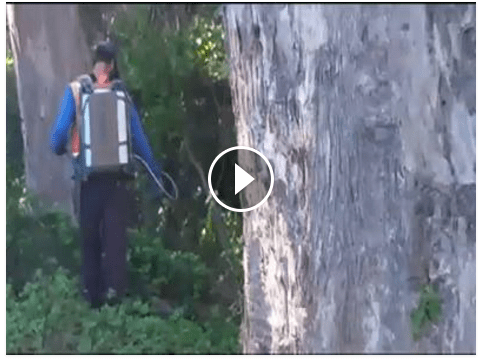
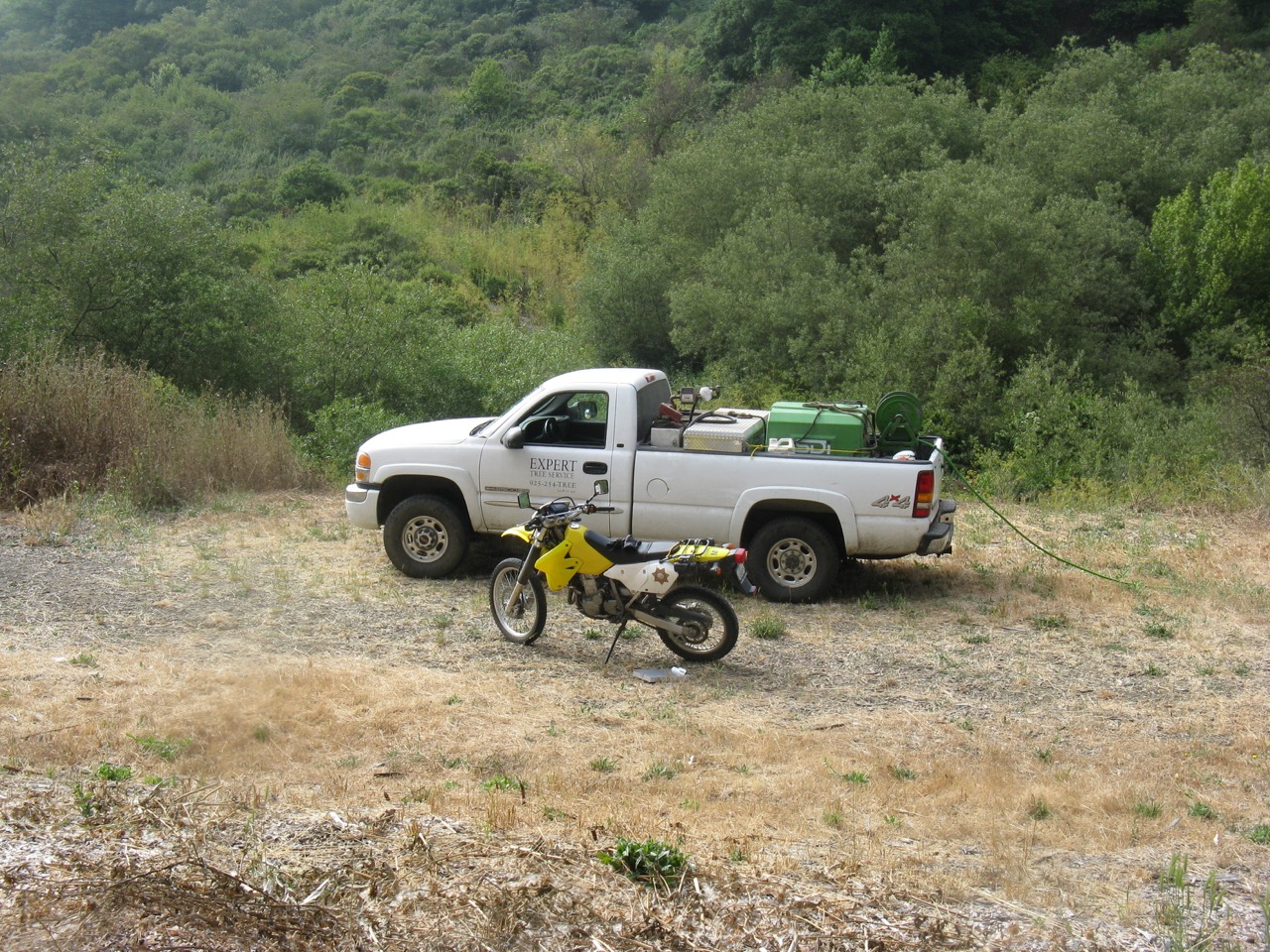
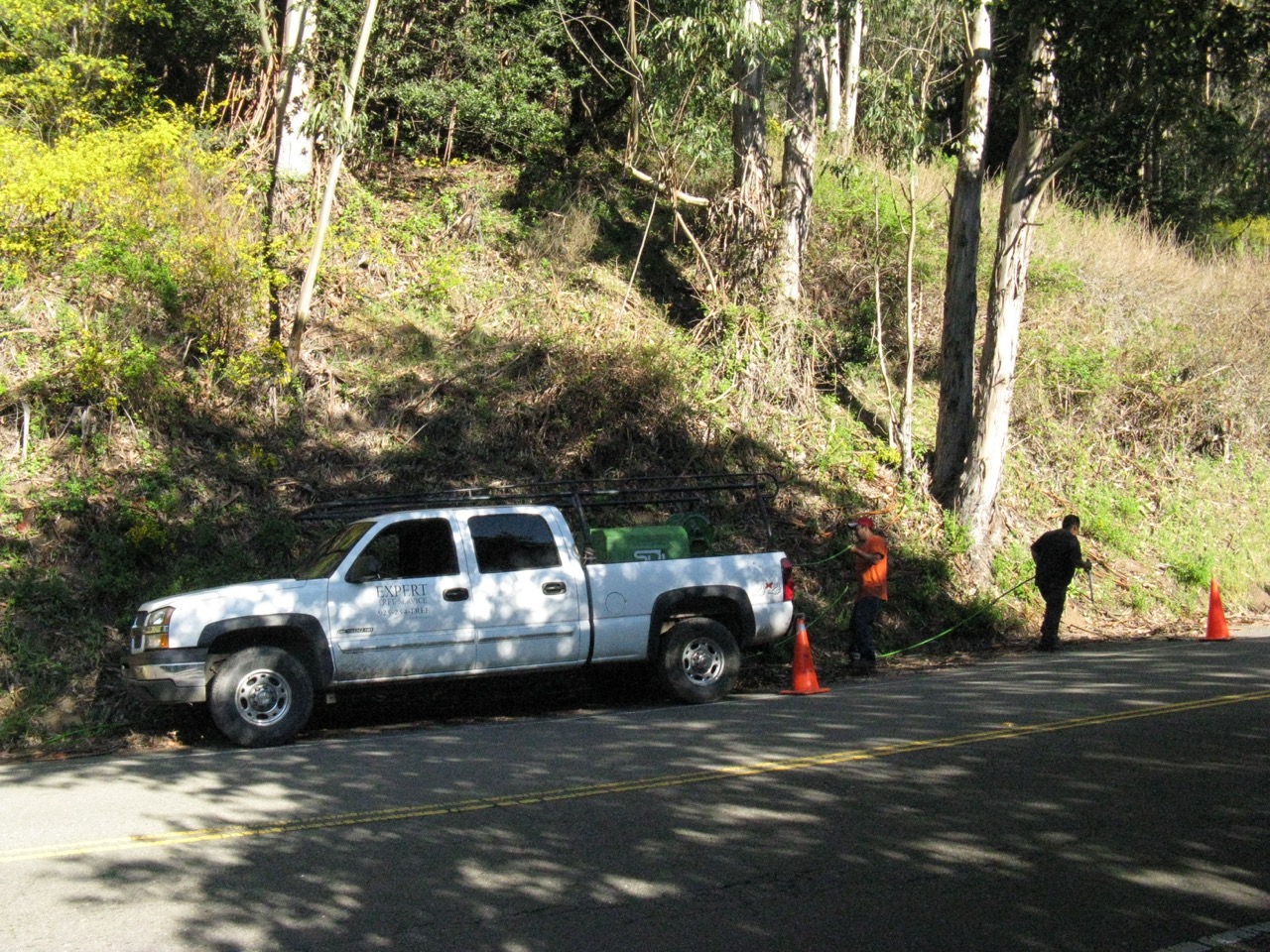
The FEMA projects in the East Bay Hills, which will destroy hundreds of thousands of trees if and when they are implemented, are not unprecedented. Many similar projects have been implemented by UC Berkeley and East Bay Regional Park District.  UC Berkeley destroyed at least 18,000 trees over 10 years ago and another 600 trees in August 2014.  Our experience with those projects is one of the reasons why we are opposed to more tree destruction on an even bigger scale.  Although land managers have attempted to reassure us about the implementation of the FEMA grant projects, we know from experience that their assurances are contradicted by the reality of their actual practices, which have been photographed by hikers in the Hills. Signpost 29 - November 2010 This photo was taken in November 2010 at signpost 29 on Claremont Blvd, which is one of the places where UC Berkeley destroyed all the non-native trees about 10 years ago and the Claremont Canyon Conservancy has been actively engaged in an effort to restore native vegetation. The truck belongs to Expert Tree Company, which is the contractor that removed the trees and sprayed herbicides.   There is a big tank of herbicide on the truck bed from which a hose extends. At the end of that hose someone is spraying herbicides on the weeds that colonize the unshaded ground when the tree canopy is destroyed.  No notice of pesticide* application is posted, as required by California law. (1) Signpost 29 - April 2012 This photo was taken in April 2012 on the opposite side of the road from signpost 29 on Claremont Blvd. This is one of the FEMA project areas where UC Berkeley intends to destroy all non-native trees.  The same truck, with the same tank of herbicide is parked beside the road and someone is spraying herbicide along the road. Again, no notice of pesticide application is posted, as required by California law. When the draft Environmental Impact Statement for the FEMA projects was published in May 2013, the public was told that all pesticide applications would be posted in advance, as required by California law.

So, the pesticide applications immortalized by these photographs are a record of violations of State law as well as broken commitments made in the Environmental Impact Statement for the FEMA projects.  But they are much more than that.  They are also a photographic record that large quantities of pesticides are being sprayed.  The truck is carrying a big tank of herbicide to which a hose is attached and from which herbicide is being sprayed.  This is obviously irrefutable evidence that claims of supporters of the FEMA projects that “minimal” amounts of herbicide are being used are untrue.  

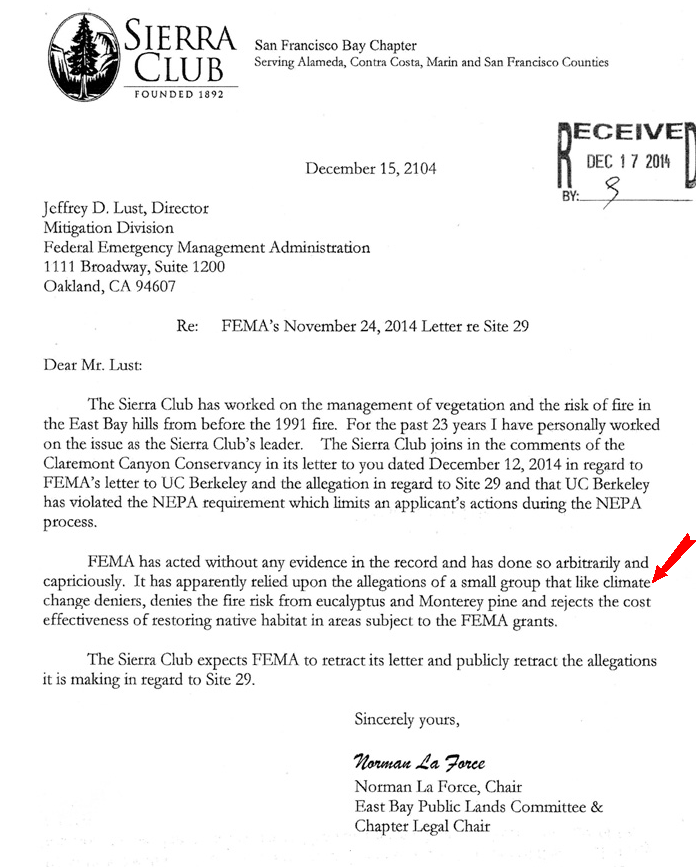
These incidents were reported to FEMA because they violated the law as well as the commitments made by the Environmental Impact Statement. FEMA followed up on that incident.  They reported the incident to the California Office of Emergency Services, which in turn notified UC Berkeley of the violation of the law.  UC Berkeley defended its actions and several supporters of the FEMA project also came to UC’s defense, including the Claremont Canyon Conservancy and the Sierra Club. Here’s the letter that the Sierra Club sent to FEMA about this incident: sierra-club-letter dec 17 2014 arrow

Sierra Club likens us to climate change deniers

We won’t waste your time justifying the complaint that UC Berkeley violated the law regarding pesticide applications. The fact that there was no pesticide application notice posted where pesticides were being sprayed is prima facie evidence that the law was violated. Our focus in this post is on the accusation of the Sierra Club (in their letter above) that those who oppose this destructive project are “like climate change deniers.”  This accusation was repeated more recently by the author of this letter, Norman LaForce, in an interview on KPFA in which he used the same phrase to describe the opposition to the destruction of our urban forest (available HERE at 33:44).  

Since the Sierra Club refuses to discuss the issues directly with those who oppose this project, perhaps they are unaware of the absurdity of this description. In fact, our opposition to this project is partially based on our concerns regarding climate change. The trees that will be destroyed by this project are storing millions of tons of carbon that will be released into the atmosphere, contributing to climate change.  Most of the trees that will be destroyed are expected to live at least another 200 years, so destroying them prematurely will needlessly exacerbate climate change.

Supporters of the FEMA projects are climate change deniers

The irony of the Sierra Club’s accusation is that the description fits them perfectly. Their support for the destruction of our urban forest is a demonstration of their denial of the realities of climate change.

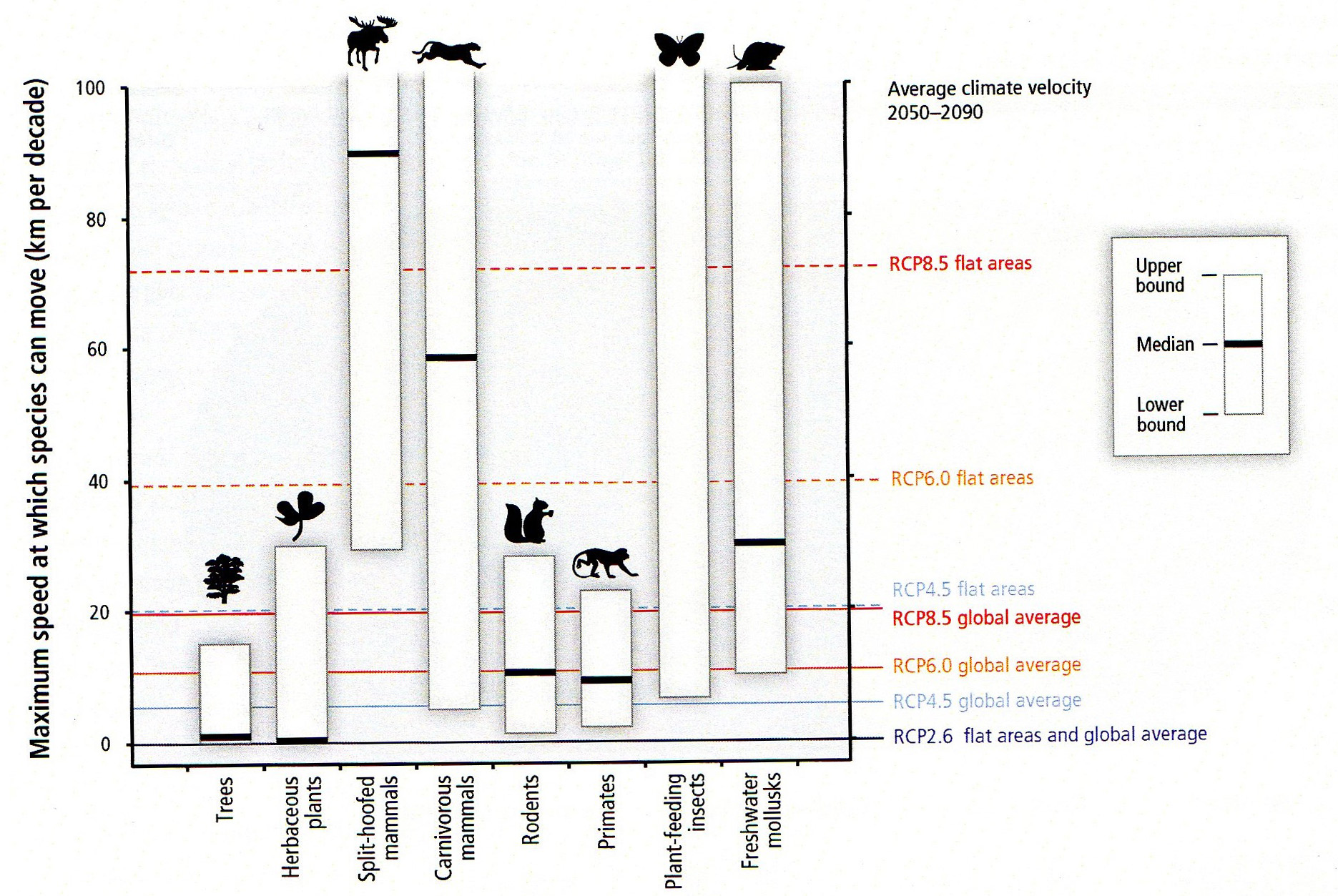
The ranges of native plants and animals have already changed in response to changes in the climate. In the Northern Hemisphere native ranges have moved north and to higher altitudes.  Scientists predict more changes in the climate in the future.  Therefore, they predict that native ranges will continue to change for the foreseeable future. The United Nations’ Intergovernmental Panel on Climate Change has published the following graphic illustration of the range changes that will be required for various types of plants and animals in the future if they are to survive:

Adaptation to Climate Change. IPCC

On the vertical axis, the graph depicts the ability of plants and animals to move, measured in kilometers per decade.  The horizontal lines depict the need of plants and animals to move in response to various scenarios of climate change, i.e., the greater the change in the climate, the further ranges must move.  The bars depict the ability of plants and animals to move and the height of each bar informs us of the variable ability of plants and animals to move.  Trees are the least able to move, unless we have the wisdom to plant them outside their native ranges—at higher latitudes or elevations–where they are more likely to survive in the future.

Supporters of the deforestation of the East Bay Hills do not acknowledge that the ranges of native plants have changed and will continue to change. They demand that we “restore” a landscape that existed in the San Francisco Bay Area 250 years ago, a landscape that is no longer adapted to the existing environment and will become progressively less well adapted in the future.

Climate change has killed millions of trees in California

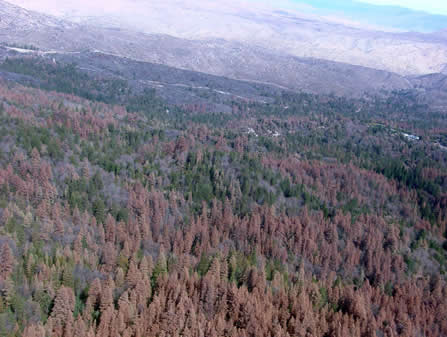
The Los Angeles Times joined a scientist with the Carnegie Institution for Science, Greg Asner, in a flight over the native forests of California. The scientist is using spectrometry to measure the amount of moisture in the trees, which is a proxy for the health of trees, ranging from dead to stressed to healthy.  These measurements suggest that 120 million trees in California are dead or likely to die soon, which is about 20% of the state’s forests. Especially trees in lower elevations are in “big trouble.”  Asner predicts that oak forests in the Sierra foothills are likely to be treeless grassland in the near future.  He tells us that nearly 6 billion trees in the West died from 1997 to 2010 because of drought and bark beetle. As forests convert to grassland and scrub, the landscape releases stored carbon and its ability to store carbon in the future is greatly reduced because carbon storage is largely a function of above-ground biomass.

Dead trees in San Bernardino County, California

Contrast this actual scenario with the fantasy of native plant advocates who predict that when hundreds of thousands of trees are destroyed in the East Bay Hills, native plants and trees will magically emerge from 2 feet of wood chips to colonize the bare ground without being planted. One would be tempted to laugh at such an unlikely outcome if the reality were not so alarming.  Native plants and trees that lived in the San Francisco Bay Area 250 years ago are unlikely to survive here even if planted and irrigated.  To expect them to return without being planted is a bad joke.

Tree loss exacerbates drought

In addition to the loss of stored carbon, the loss of our tree canopy will also contribute to drought. Deforestation causes droughts because trees have an essential role in the water cycle that returns moisture to the atmosphere, then returns the moisture to the earth as precipitation. This cycle is not perfectly understood and so we are grateful to the NY Times for publishing an excellent article entitled, “Deforestation and Drought, Cutting down trees leads to climate change,” which explains “Trees take up moisture from the soil and transpire it, lifting it into the atmosphere. A fully grown tree releases 1,000 liters of water vapor a day into the atmosphere…The water vapor creates clouds, which are seeded with volatile gases…emitted by the trees to form rain.” Deforestation in the Amazon is expected to have an impact on the climate in places as far away as California. A climate scientist says, “reducing deforestation and replanting forests should be priorities not just in Brazil but in North America and beyond for many reasons, including the health of climate systems.”

When we discuss this issue with the supporters of deforestation in the Bay Area, they always pooh-pooh our concerns, saying that their projects are too small to have any effect on the climate. What they don’t seem to understand, or prefer to ignore, is that such projects are going on all over the country. Here in California, eucalyptus and Monterey pine have been destroyed in San Diego, Los Angeles, Santa Cruz, San Luis Obispo, Monterey, Sonoma, Bolinas and probably many places of which we are not aware. And we hear about new projects all the time. These intentional projects to destroy trees are in addition to the millions of native trees that have died in the past few years because of the drought and millions of native trees that were destroyed by wildfires this summer. It is unconscionable that we are voluntarily destroying hundreds of thousands of healthy trees at such a time.

And so we ask you, “Who are the climate change deniers”? We think the supporters of the FEMA projects in the East Bay Hills—including the Sierra Club—are the climate change deniers.


*Herbicides are pesticides. Pesticide is a global term which covers a multitude of specific pesticides aimed at a variety of targets.  Herbicides are the pesticides designed to kill plants.  Other pesticides include insecticides, fungicides, rodenticides, etc.  We provide this definition, because many native plant advocates do not seem to understand the definition of the word “pesticide.”  Many mistakenly believe that herbicides are not accurately called pesticides.

(1) “Pesticide Use Compliance Guide for Employers and Businesses,” Department of Pesticide Regulation, October 2010.  California Code of Regulations, Title 3, Division 6, Number 6618 (3CCR 6618)

Sierra Club cannot hide behind its smokescreen

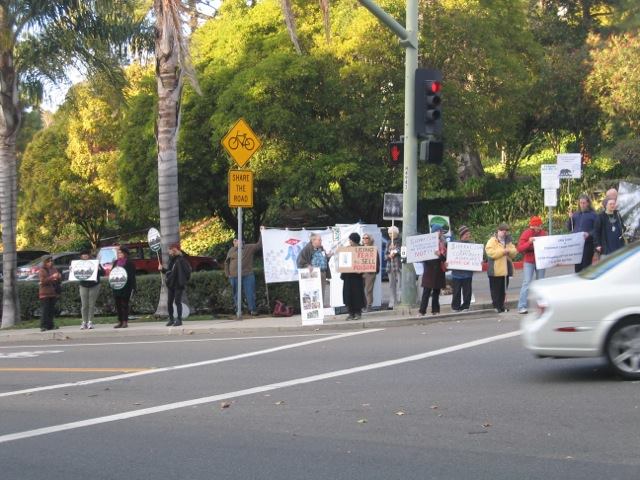
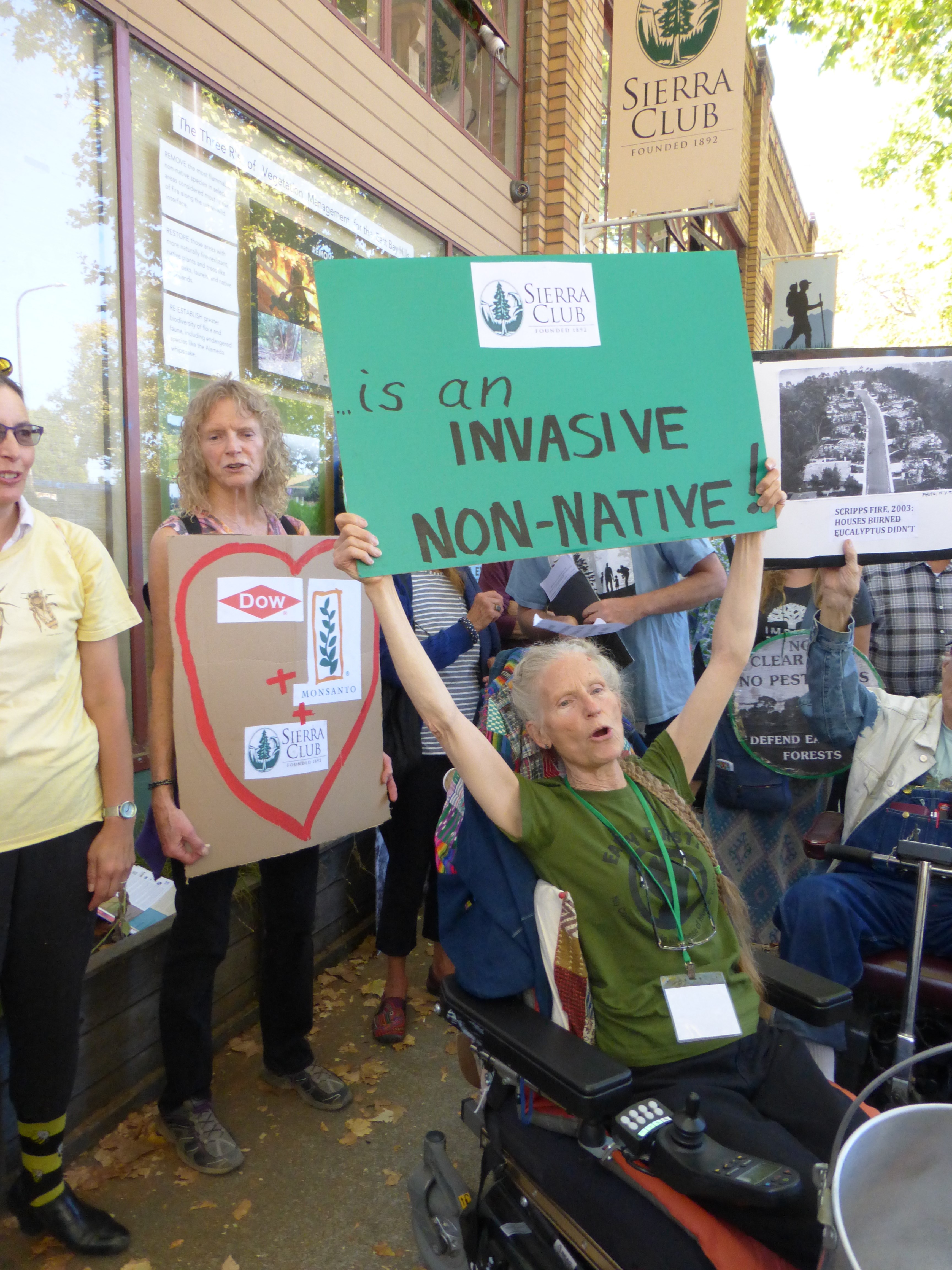
On August 25, 2015, opponents of the projects in the East Bay Hills which will destroy hundreds of thousands of trees staged a protest at the headquarters of the Bay Area chapter of the Sierra Club and delivered a petition.  The petition (available HERE) asks the Sierra Club to quit advocating for deforestation and pesticide use in the San Francisco Bay Area and to drop its lawsuit which demands eradication of 100% of all non-native trees on 2,059 acres of public land in the East Bay.  The protest was successful as measured by the size of the crowd and the even-handed media coverage of the protest.

Sierra Club protest, August 25, 2015. About 80 people attended the peaceful protest.

Update:  HERE is a 14 minute video of the demonstration at Sierra Club headquarters on August 25, 2015.  The video includes an attempt to discuss the issue with a Sierra Club staff member.  Note the factual rebuttals to some of the claims the staff member makes in that conversation.  Also, note the final rallying cry, “Poll your membership on this issue.”  We will report soon on the follow up to that request.  Please stay tuned.  

However, although the protest has produced a flurry of defensive propaganda from the Sierra Club, it has not created new opportunities for dialogue with them.  We tried to get the issue on the agenda of the Conservation Committee following the protest and once again our request was denied. We were also denied the opportunity to publish a rebuttal to articles in their newsletter about the projects. It is still not possible to post comments on the on-line version of the Yodeler, although each article dishonestly invites readers to “leave a comment.”

And so, open letters to the Sierra Club are the only means of communication available to us.  Here are our replies to the latest round of propaganda published in the Yodeler on September 16, 2015 (available HERE).  Excerpts from the Sierra Club article are in italics and our replies follow.


“The preferred strategy for vegetation management in the East Bay hills entails removing the most  highly flammable, ember-generating trees like eucalyptus in phases — only in select areas considered most at risk for fire along the urban-wild interface.”

Preferred by whom?  Neither fire experts nor the public think this project is a good idea, let alone the Sierra Club’s more extreme version of the project demanded by its suit.  Over 13,000 public comments on the Environmental Impact Statement were sent to FEMA, of which 90% were opposed to this project according to FEMA.  More recently, a petition in opposition to this project has over 64,000 signatures on it.  This project is NOT the “preferred strategy for vegetation management in the East Bay hills.”

Eucalyptus is not more flammable than many other trees, including native trees: 

  • A study by scientists in Tasmania found that the leaves of blue gum eucalypts were more resistant to ignition than other species of Tasmanian vegetation tested. The study credits the “hard cuticle” of the leaf for its ability to resist ignition. (1)
  • The National Park Service, which has destroyed tens of thousands of eucalypts and other non-native trees, states that eucalyptus leaves did not ignite during a major fire on Mount Tam.  (2)
  • The leaves of native bay laurel trees contain twice as much oil as eucalyptus leaves (3)  and the fuel ladder to their crowns is much lower than eucalyptus, increasing the risk of crown fires. The “Wildfire Hazard Reduction and Resource Management Plan” of the East Bay Regional Park District states explicitly that bay laurel is very flammable and recommends selective removal.
  • Eucalyptus contributed more fuel to the 1991 fire in Oakland because a deep and prolonged freeze the winter before the fire caused eucalyptus and other exotic vegetation to die back. The dead leaf litter was not cleaned up, which contributed to the fire hazard.  Such deep freezes are rare in the Bay Area.  There has not been such a freeze for 25 years and another is unlikely in the warming climate.

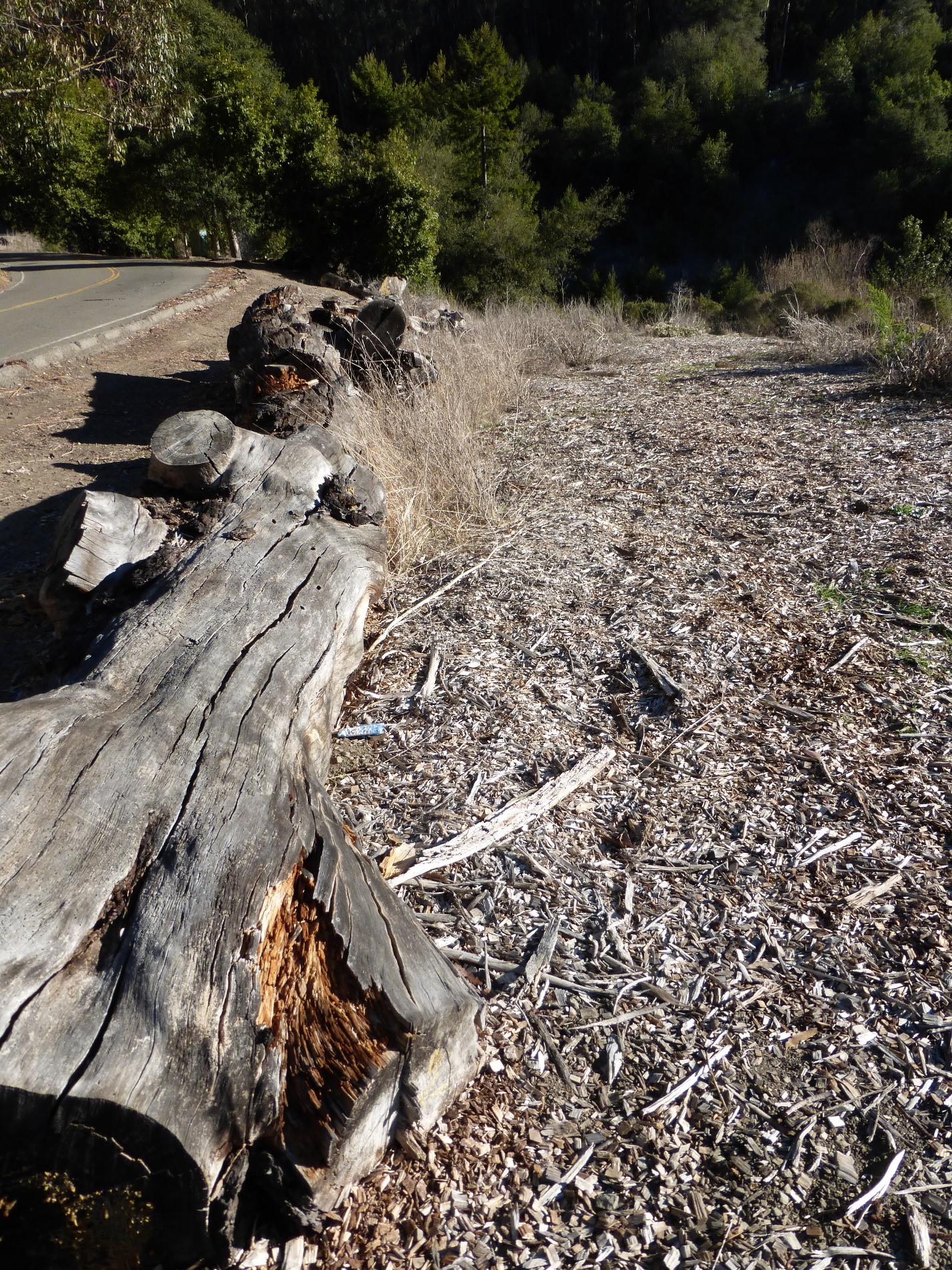
    Eucalyptus logs line the roads where UC Berkeley has destroyed trees. Do they look less flammable than living trees?
    Eucalyptus logs line the roads where UC Berkeley has destroyed trees. Do they look less flammable than living trees?
  • Ordinarily, eucalyptus does not contribute more fuel to the forest floor than native oak-bay woodland. This is confirmed by the National Park Service, which includes logs in the calculation of fuel loads. (2) Logs are extremely difficult to ignite.  The so-called “fire hazard mitigation projects” are leaving all the eucalyptus logs on the ground when the trees are destroyed, suggesting that they aren’t considered a fire hazard.  The National Park Service also separates the fuel loads of oaks and bays, which when combined are equal to the fuel load of eucalyptus.  Since our native woodland in the East Bay is a mixture of oaks and bays, it is appropriate to combine them when comparing their fuel loads to eucalyptus.
  • Eucalypts are sometimes blamed for casting more embers than native trees because they are taller than the oak-bay woodland. However, redwoods are as tall, if not taller, and they were also observed burning in the 1991 fire:  On Vicente Road, “Two redwoods up the street caught fire like matchsticks.” (4)  Yet, the Sierra Club is not suggesting that redwoods be destroyed to eliminate the risk of casting embers.

The Sierra Club now says the trees will be removed “in phases,” yet in its suit against the FEMA grants it objects to the phasing of tree removals.  The main focus of their suit is opposition to the “unified methodology” which proposes to remove trees over the 10 year period of the grant on only 29 acres of the total project acreage of 2,059.  To those who objected to this project, that small concession is little consolation, but for the Sierra Club it was a deal-breaker.  Their suit demands that all non-native trees be removed immediately on all project acres. 

If the Sierra Club withdraws its suit against the FEMA projects, it is free to tell another story, as it attempts to do in its Yodeler article.  As long as that suit remains in play, the Sierra Club is stuck with that version of reality.

“Once the flammable non-native trees are removed, less flammable native species can reclaim those areas and provide for a rebound of biodiversity. This model of fire prevention can summarized as the the [sic] “Three R’s”:

REMOVE the most flammable non-native trees in select areas most at risk for fire;

RESTORE those areas with more naturally fire-resistant native trees and plants; and

RE-ESTABLISH greater biodiversity of flora and fauna, including endangered species like the Alameda whipsnake.”

This is a stunning display of ignorance of the project as well as the natural history of the San Francisco Bay Area:

  • The FEMA projects do not provide for any planting or funding for planting after the trees are removed. FEMA’s mission is fire hazard mitigation, not landscape transformation.  The scientists who evaluated the FEMA projects said that a native landscape is not the likely result of the project:  “However, we question the assumption that the types of vegetation recolonizing the area would be native.  Based on conditions observed during site visits in April 2009, current understory species such as English ivy, acacia, vinca sp., French broom, and Himalayan blackberry would likely be the first to recover and recolonize newly disturbed areas once the eucalyptus removal is complete.  These understory species are aggressive exotics, and in the absence of proactive removal there is no evidence to suggest that they would cease to thrive in the area, especially the French broom which would be the only understory plant capable of surviving inundation by a 2-foot-deep layer of eucalyptus chips.” (5)
  • The US Forest Service evaluation of the FEMA projects stated that the resulting landscape would be more flammable than the existing landscape: “Removal of the eucalyptus overstory would reduce the amount of shading on surface fuels, increase the wind speeds to the forest floor, reduce the relative humidity at the forest floor, increase the fuel temperature, and reduce fuel moisture.  These factors may increase the probability of ignition over current conditions.” (6)
  • The US Forest Service evaluation predicts that the resulting landscape will be “a combination of native and non-native herbaceous and chaparral communities.” Despite the overwhelming evidence that wildfires in California start and spread rapidly in herbaceous vegetation such as dry grass, the myth persists that all non-native trees must be destroyed to reduce fire hazards.  An analyst at CAL FIRE has explained to the Center for Investigative Reporting that the reason why wildfires were so extreme this summer is because of the heavy rains in December 2014, which grew a huge crop of grass:  “The moisture did little to hydrate trees and shrubs. But it did prompt widespread growth of wild grasses, which quickly dry out without rain.  ‘They set seed, they turn yellow and they are done,’ said Tim Chavez, a battalion chief and fire behavior analyst with CAL FIRE. ‘All that does is provide kindling for the bigger fuels.’” (7) We know that more dry grass starts more wildfires, yet the Sierra Club demands that we destroy the tree canopy that shades the forest floor and produces leaf litter, which together suppress the growth of the grasses in which fires ignite. 
  • The claim that native plants are “naturally fire resistant” is ridiculous. Native vegetation in California—like all Mediterranean climates—is fire adapted and fire dependent. The wildfires all over the west this summer occurred in native vegetation.  There are over 200 species of native plants in California that will not germinate in the absence of fire and persist for only 3-5 years after a fire. (8) Although all native vegetation is not equally flammable, many species are considered very flammable, such as coyote brush, bay laurel, and chamise.  To say otherwise is to display an appalling ignorance of our natural history.

    When did "environmentalism" devolve into demonizing trees?
    When did “environmentalism” devolve into demonizing trees?
  • There is no evidence that the destruction of our urban forest will result in greater “biodiversity.” There are many empirical, scientific studies that find equal biodiversity in eucalyptus forest compared to native forests.  There are no studies that say otherwise, yet the Sierra Club and their nativist friends continue to make this claim without citing any authority other than their own opinions.  (9, 10, 11)  Bees, hummingbirds, and monarch butterflies require eucalyptus trees during the winter months when there are few other sources of nectar. Raptors nest in our tall “non-native” trees and an empirical study finds that their nesting success is greater in those trees than in native trees.

The Sierra Club’s 3Rs can best be summarized as “repeat, repeat, repeat.”  Their 3Rs are based on 3 Myths:  (1) eucalyptus trees are the most serious fire hazard; (2) “native” vegetation is categorically less flammable than “non-native” vegetation, and (3) native vegetation will magically return to the hills when trees are clearcut and the hills are poisoned with herbicide.  All available evidence informs us that these are fictions that exist only in the minds of the Sierra Club leadership and their nativist friends.

 “The Sierra Club’s approach does NOT call for clearcutting. Under “Remove, Restore, Re-establish” thousands of acres of eucalyptus and other non-natives will remain in the East Bay hills. Our proposal only covers areas near homes and businesses where a fire would be most costly to lives and property. In fact, removing monoculture eucalyptus groves and providing for the return of native ecosystems will create a much richer landscape than the alternative — thinning — which requires regularly scraping away the forest floor to remove flammable debris.”

The Sierra Club’s suit against FEMA demands that all eucalyptus and Monterey pine be removed from 2,059 acres of public property.  While it is true that the project acres are not 100% of all land in the East Bay, with respect to the project acres, it is accurate to describe the Sierra Club’s suit as a demand for an immediate clearcut of all non-native trees.

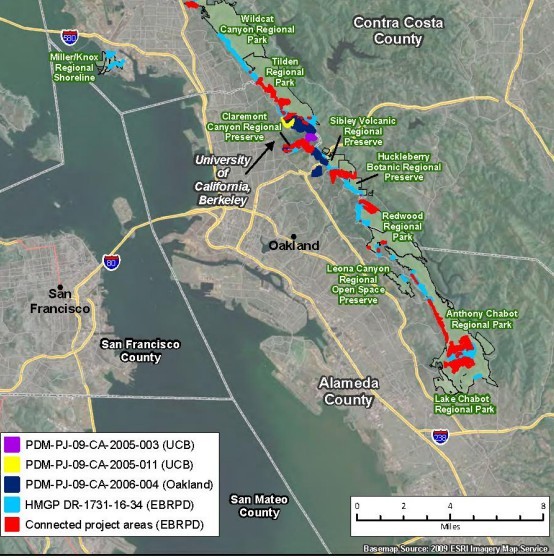
FEMA Project Areas
FEMA Project Areas

Most of the project acres are nowhere near homes and buildings.  They are in parks and open spaces with few structures of any kind.  CAL FIRE defines “defensible space” required around buildings to reduce property loss in wildfires.  CAL FIRE requires property owners to clear flammable vegetation and fuel within 100 feet of structures.  Using that legal standard, the FEMA project should not require the removal of all trees from project acres.

As we said earlier, Sierra Club’s description of the landscape that will result from the removal of the tree canopy is contradicted by scientists who evaluated the FEMA project.  And their prediction that “thinning” would “require regularly scraping away the forest floor to remove flammable debris” is not consistent with the predictions of those scientists who have advised that the loss of shade and moisture resulting from the complete loss of the tree canopy will encourage the growth of flammable vegetation and require more maintenance than the existing landscape.

“Our preferred approach does NOT focus on eucalyptus merely because they are non-natives. Rather, it is because they pose a far higher fire risk than native landscapes. Eucalyptus shed ten to fifty times more debris per acre than grasslands, native live oak groves, or bay forests — and that debris, in the form of branches, leaves, and long strips of bark, ends up draped in piles that are a near-optimal mixture of oxygen and fuel for fire. Eucalyptus trees ignite easily and have a tendency to dramatically explode when on fire. Also, eucalyptus embers stay lit longer than embers from other vegetation; coming off trees that can grow above 120 feet tall, those embers can stay lit as the wind carries them for miles.”

The Sierra Club’s suit demands the eradication of Monterey pine as well as eucalyptus.  The scientists who evaluated the FEMA projects stated that there is no evidence that Monterey pine is particularly flammable and they questioned why they were targeted for eradication:  “The UC inaccurately characterizes the fire hazard risk posed by the two species however…Monterey pine and acacia trees in the treatment area only pose a substantial fire danger when growing within an eucalyptus forest [where they provide fire ladders to the eucalyptus canopy].  In the absence of the eucalyptus overstory, they do not pose a substantial fire hazard.”  (5)  It is not credible that the Sierra Club’s demand that these tree species be entirely eradicated has nothing to do with the fact that they are not native to the Bay Area.  If flammability were truly their only criterion, they would demand the eradication of native bay laurel trees.  If fear of lofting embers from tall trees were their only concern, they would demand the eradication of redwoods.

As we said earlier, redwoods looked as though they were exploding when they ignited in the 1991 fire.  And we are seeing wildfires all over the west this fire season in which native trees look as though they are exploding when they ignite.  That’s what a crown fire looks like, regardless of the species.

It defies reason to think that an ember is capable of traveling miles and still be in flames on arrival.  In fact, Sierra Club’s suit says “non-native trees can cast off burning embers capable of being carried up to 2,000 feet in distance.”  That’s a fraction of the distance the Sierra Club now claims in its hyperbolic description of the issues in the Yodeler.  Surely we can all use a little common sense to consider how unlikely it is that a fragment of a tree small enough to be carried in the wind could travel miles while remaining on fire.  Likewise, we must ask why fragments of eucalyptus trees are likely to burn longer than any other ember of equal size.  We are not provided with any reference in support of these fanciful claims other than the opinions of the authors.

“Any herbicide use to prevent the regrowth of eucalyptus once they’ve been cut down (they quickly sprout suckers otherwise) would be hand applied in minimal amounts under strict controls. Any herbicide application must undergo a full environmental review to prevent impacts on humans, wildlife, and habitat. There are also methods other than herbicide that can be used to prevent regrowth, and the Sierra Club encourages the agencies that manage the land where fire mitigation occurs to explore these alternatives to find the most sustainable, responsible option.”

Once again, the Sierra Club is stuck with the public record which describes the FEMA projects:

  • East Bay Regional Park District has stated in the Environmental Impact Statement for the FEMA project that it intends to use 2,250 gallons of herbicide to prevent the regrowth of eucalyptus.  (12)  This estimate does not include the herbicides that will be used by UC Berkeley or the City of Oakland.  Nor does it include the herbicides that will be needed to kill flammable non-native vegetation such as fennel, hemlock, broom, radish, mustard, etc.  Surely, we can all agree that thousands of gallons of herbicide cannot be accurately described as “minimal.”
  • The Sierra Club now seems to be suggesting that further environmental review will be required for herbicide use by this project. They are mistaken in that belief.  The Environmental Impact Statement for this project is completed and it admits that the project will have “unavoidable adverse impacts” on “human health and safety” and that there will be “potential adverse health effects of herbicides on vegetation management workers, nearby residents, and users of parks and open space.”  The Sierra Club’s smoke screen cannot hide that conclusion.
  • The FEMA grants have been awarded to the three public land owners and they explicitly provide for the use of herbicides to prevent eucalyptus and acacia from re-sprouting. There is nothing in the Environmental Impact Statement that indicates that “methods other than herbicide can be used to prevent regrowth,” as the Sierra Club now belatedly opines in its latest propaganda.  If the Sierra Club wants other methods to be considered, we could reasonably expect they would make such a demand in their suit against FEMA, along with all their other demands.  They do not make such a demand in their suit.  Therefore, claims that other methods are being explored are not credible.
  • Sierra Club’s claim that herbicides will be applied “with strict controls” is not credible because there is no oversight of pesticide application or enforcement of the minimal regulations that exist in the United States. After 25 years of working for the EPA, E.G. Vallianatos wrote in 2014 of his experience with pesticide regulation in Poison Spring:  “…the EPA offered me the documentary evidence to show the dangerous disregard for human health and the environment in the United States’ government and in the industries it is sworn to oversee…powerful economic interests have worked tirelessly to handcuff government oversight.”

The Sierra Club has also explicitly endorsed the use of herbicides in the public comments they have submitted on these projects and in other articles in the Yodeler:

  • Sierra Club’s written public comment on Scoping for the FEMA EIS: “We are not currently opposed to the careful use of Garlon as a stump treatment on eucalyptus or even broom when applied by a licensed applicator that will prevent spread into adjacent soils or waters.”  Norman La Force (on Sierra Club letterhead), September 12, 2010
  • “There is no practical way to eliminate eucalyptus re-sprouting without careful use of herbicides.” Yodeler, May 25, 2013

Obfuscation and insincere backpedaling

The latest Yodeler article about the FEMA projects is a lot of hot air.  It makes claims about the issues for which it provides no evidence and for which considerable contradictory evidence exists.  It contradicts previous statements the Sierra Club has made.  Most importantly, as long as Sierra Club’s suit remains in play, the demands the Sierra Club makes in that public document cannot be denied.  If the Sierra Club wishes to back away from its previous positions, it must start by withdrawing its suit, which demands that 100% of all non-native trees in the FEMA project areas be destroyed immediately.  Withdrawal of the suit would be a most welcome start on the long healing process that is required to mend the damage the Sierra Club has done to its reputation as an environmental organization in the San Francisco Bay Area.  However, the Sierra Club will not be able to reclaim its status as an environmental organization without renouncing all pesticide use on our public lands. 

The Sierra Club has isolated itself from reality.  Its leadership refuses to speak with anyone with whom they disagree.  They have become the victims of incestuous amplification.  They apparently do not read the documents they use to support their opinions.  For example, the Sierra Club suit claims the California Invasive Plant Council (Cal-IPC) has classified blue gum eucalyptus as “moderately” invasive.  In fact, Cal-IPC’s rating of blue gum eucalyptus is “limited.”  This reflects the fact that a study of aerial photographs of Bay Area parks and open spaces, taken over a 60 year period find that eucalyptus and Monterey Pine forests were smaller in the 1990s than they were in the 1930s.  (13)

We will send our petition soon to the national leadership of the Sierra Club.  If you have not yet signed our petition, we hope you will consider doing so now. 


  1. Dickinson, K.J.M. and Kirkpatrick, J.B., “The flammability and energy content of some important plant species and fuel components in the forests of southeastern Tasmania,” Journal of Biogeography, 1985, 12: 121-134.
  2. “The live foliage proved fire resistant, so a potentially catastrophic crown fire was avoided.” http://www.nps.gov/pore/learn/management/upload/firemanagement_fireeducation_newsletter_eucalyptus.pdf
  3. Ron Buttery et. al., “California Bay Oil. I. Constituents, Odor Properties,” Journal Agriculture Food Chemistry, Vol. 22, No 5, 1974.
  4. Margaret Sullivan, Firestorm: the study of the 1991 East Bay fire in Berkeley, 1993
  5. URS evaluation of UCB and Oakland FEMA projects
  6. FEMA DEIS – evaluation of US Forest Service
  7. https://www.revealnews.org/article/rampant-california-wildfires-can-be-blamed-on-last-decembers-rain/?utm_source=Reveal%20Newsletters&utm_campaign=2d4c52ebf5-The_Weekly_Reveal_09_24_159_23_2015&utm_medium=email&utm_term=0_c38de7c444-2d4c52ebf5-229876797
  8. Jon Keeley, Fire in Mediterranean Ecosystems, Cambridge University Press, 2012
  9. https://milliontrees.me/2011/02/04/biodiversity-another-myth-busted-2/
  10. https://milliontrees.me/2013/04/09/biodiversity-of-the-eucalyptus-forest/
  11. https://milliontrees.me/2013/11/22/invertebrates-such-as-insects-are-plentiful-in-the-eucalyptus-forest/
  12. See Table 2.1 in Appendix F: http://www.fema.gov/media-library-data/1416861356241-0d76d1d9da1fa83521e82acf903ec866/Final%20EIS%20Appendices%20A-F_508.pdf
  13. William Russell and Joe McBride, “Vegetation Change and Fire Hazard in the San Francisco Bay Area Open Spaces,” Landscape and Urban Planning, 2003

H is for Hawk: A journey into the natural world

H is for HawkOnce in a great while we treat ourselves to a diversion from our beat in ecology, but we rarely stray far from the natural world.  In the case of H is for Hawk, we were attracted by rave reviews and a bird as the central character.  The author, Helen Macdonald, is an academic historian and poet.  Her writing is exquisite and her intimate relationship with her hawk is informed by a lifetime of experience as a falconer.

Helen finds herself in the grip of a profound grief at the loss of her much-loved father, who died suddenly and prematurely.  After stumbling about for some months, she assigns herself a difficult task as her path out of despair.  Although she has trained many birds of prey since childhood, she has never trained a goshawk because of their fearsome reputation as both vicious and temperamental.

She seeks guidance from a classic book by T.H. White, best known for his novels about the legends of King Arthur.  He has a brief, but intense relationship with a goshawk which he describes in grim detail in The Goshawk.  He blunders through an ultimately failed attempt to train his goshawk.  His confrontational attempt to tame the wild bird informs Helen’s partnership with her hawk.

Helen retreats to a dark apartment with a freezer full of dead chicks to feed Mabel, the unlikely name she chooses for her goshawk.  It is a long, slow process of gaining the bird’s trust, requiring patience and intense focus.  First trips outdoors are fraught with peril.  Hunting is first done on a long leash, to ensure the bird’s return.  When the bird is freed from the leash to hunt on her own, we share Helen’s terror that the bird may not return.

Helen must run as fast as she can to follow the bird as it chases its prey.  She is often confronted by dense thickets as the bird soars above her, oblivious to the obstacles Helen encounters on the ground.  It is after such a heart-pounding chase that Helen has an encounter with humans, which is the point of this post.

Origins of the inhabitants

At the end of a challenging hunt, Helen and Mabel encounter a herd of deer.  Helen describes the scene:

“The running deer and the running hare.  Legacies of trade and invasion, farming, hunting, settlement.  Hares were introduced, it is thought, by the Romans.  Fallow deer certainly were.  Pheasants, too, brought in their burnished hordes from Asia Minor.  The partridges possessing this ground were originally from France, and the ones I see here were hatched in game-farm forced-air incubators.  The squirrel on the sweet chestnut?  North America.  Rabbits?  Medieval introductions.  Felt, meat, fur, feather, from all corners.  But possessing the ground, all the same.”

On this bucolic scene, a couple appears and admires the herd of deer:  “The deer.  Special, aren’t they, those ones.  Rare…A herd of deer.  Doesn’t it give you hope?  Isn’t it a relief that there’re things still like that, a real bit of Old England still left, despite all those immigrants coming in?”

The encounter with the deer is ruined for Helen by this xenophobic comment:

It is a miserable walk.  I should have said something.  But embarrassment had stopped my tongue.  Stomping along, I start pulling on the thread of darkness they’d handed me.  I think of the chalk-cult countryside and all its myths of blood-belonging, and that hateful bronze falcon, of Göring’s plans to exclude Jews from German forests.  I think of the Finnish goshawks that made the Brecklands home, and of my grandfather, born on the Western Isles, who spoke nothing but Gaelic until he was ten.  And the Lithuanian builder I’d met collecting mushrooms in a wood who asked me, bewildered, why no one he’d met in England knew which were edible, and which were not.  I think of all the complicated histories that landscapes have, and how easy it is to wipe them away, put easier, safer histories in their place.”

She goes on to describe historical landscapes in Britain, both distant and recent, but changing always.  She concludes, “Old England is an imaginary place, a landscape built from words, woodcuts, films, paintings, picturesque engravings.”  Our brief life span denies us any meaningful perspective on the landscape, nor are we capable of imagining future landscapes.  In our rapidly changing climate, the landscape will surely be radically different, yet many are unwilling to predict that change.  Some demand the historical landscape that is no longer adapted to the present climate, let alone the one predicted for the near future.

We find in Helen MacDonald a kindred spirit.  We enjoy and appreciate the landscape and its inhabitants that exist now, regardless of their origins.  They are all welcome in our natural world.

Adventures in the Anthropocene

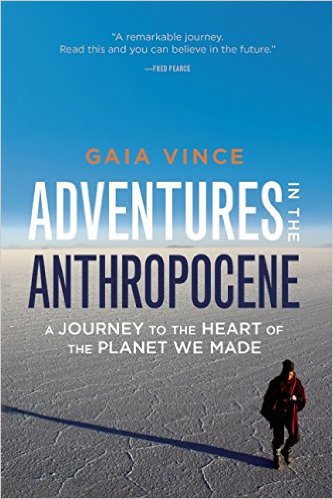
Adventures in the AnthropoceneAdventures in the Anthropocene:  A Journey to the Heart of the Planet We Made is, indeed, a journey. (1) Its author, Gaia Vince, traveled the globe for two years to witness first-hand the impact of human civilization on the planet.  It is an even-handed account, in which grim realities are described but are balanced with optimistic predictions of the innovations that will ultimately enable us to cope with them.

Ms. Vincent takes us to remote corners of the Earth where undeveloped communities are further impoverished by climate change and related changes in the environment.  Rising temperatures and reduced rainfall have forced many agricultural communities off their ancestral lands and into a more marginal existence.  In Bolivia, for example, former farmers have been displaced into brutal mines where life span is typically shortened by health and safety hazards.  Some Pacific and Indian Ocean islands have been drowned by rising sea levels, forcing mass evacuations onto those that remain.  Their protective reefs are dissolving in the increasingly acidic ocean.

Meanwhile, enterprising people are responding to threats their communities are facing.  In the Indian Himalayas, for example, artificial glaciers are being created to replace those that are melting.  Glaciers were the irrigation system that enabled agriculture in marginal conditions.  Torrential downpours caused by climate change are frozen on dammed, flat plains to create artificial glaciers that perform the same function.  In a remote village in Nepal, a villager returns from his Western education to bring his impoverished community into the 21st century by creating a wi-fi network that provides internet access.  The internet brings education to a village that could not afford teachers.  It is powered by a small hydroelectric generator in a glacial stream.  The stream is expected to disappear when the glacier melts in a decade or two, a problem yet to be solved.

These stories and a multitude of others are both sobering and inspiring, but we will focus on the issues relevant to Million Trees.

Harvesting fog with trees

The coast of Peru is one of the driest places on the earth.  There are places in Peru where no rain has been recorded.  The city of Lima is near the coast and its climate is similar to San Francisco.  There is little rain, but there is a great deal of fog.  Lima, like many cities in undeveloped countries, is surrounded by shanty towns in which poor people build make-shift shacks and live without modern services such as water, power, and sewage systems.

Demonstrating once again, that poverty is sometimes the mother of invention, the people of one of these shanty towns are attempting to grow a forest on their sand dune.  The trees are being irrigated with water harvested by huge fog nets, which are also supplying the community with drinking and washing water.  Within four years, the community expects the trees to be large enough to harvest the fog without the help of the fog nets, “producing a self-sustaining run-off that will replenish ancient wells and provide water for the community for the first time in 500 years.” (1)

Sutro forest on a typical summer day. Courtesy Save Sutro Forest.

This is a familiar scenario to the readers of Million Trees.  Fog drip in the eucalyptus forests in San Francisco has been measured at over 16 inches per year.  In the driest months of the year, soil moisture in San Francisco’s eucalyptus forest has been measured at over 10%, while soil moisture in grassland was only 2% and 4% in shrubs.  (2)

The value of forests and the dangers of deforestation

Each chapter of Adventures in the Anthropocene is devoted to a different ecosystem.  Each ecosystem is introduced with a description of the importance of that ecosystem and the way in which is it being compromised by the activities of humans in the Anthropocene.  Here are a few excerpts from the chapter about forests, which will be familiar to the readers of Million Trees.

  • “Forests play an important role in local and global climate. The world’s forests absorb 8.8 billion tonnes of carbon dioxide each year through photosynthesis—about one-third of humanity’s greenhouse gas emissions.”
  • “…their canopies provide shelter from the sun and wind, making forests much wetter, cooler environments than surrounding treeless areas. This nurtures streams and rivers, provides habitat for a range of amphibians and other life, helps cool the regional and global atmosphere, and recycles water.”
  • “Although forests help create the climate, they are also exquisitely sensitive to it—and the smaller a forest gets, the less resilient it is. When trees are chopped down, sunlight enters in the gap and dries the soils. Drought upsets the forests’ delicate water cycle—trees start to die and the entire ecosystem can tip from rainforest to grass-dominated savannah.”
  • “Deforestation emits carbon dioxide from soils and decaying plant matter, and is responsible for around 20% of all carbon dioxide emissions.”

One point bears repeating because it is relevant to our local version of deforestation.  In some cases, native plant advocates have succeeded in their demand to destroy 100% of our urban forest because it is predominantly non-native.  In other cases, they have only been able to convince land managers to “thin” the forests, although “thinning” does not seem an accurate description of destruction of 90% of the trees.  In any case, we should all understand that the ultimate likely outcome of the “thinning” strategy is an eventual clear-cut because “when trees are chopped down, sunlight enters in the gap and dries the soils….trees start to die and entire ecosystem can tip” from forest to grassland.  The drying of the soil is only one factor in this prediction.  The remaining trees also will be vulnerable to wind throw.  And the herbicides used to prevent the destroyed trees from resprouting are mobile in the soil and are likely to damage the trees that remain.  Plans to “thin” the forest are either based on ignorance or are a strategy designed to achieve the same goals as a clear-cut with less public opposition.

Are invasive species a problem?

We were gratified that there was barely a mention of “invasive” species in the detailed accounts of the impact of human civilization on the planet.  The conventional wisdom that “invasive” species are one of the primary causes of species extinction is waning and this book reflects that fact. 

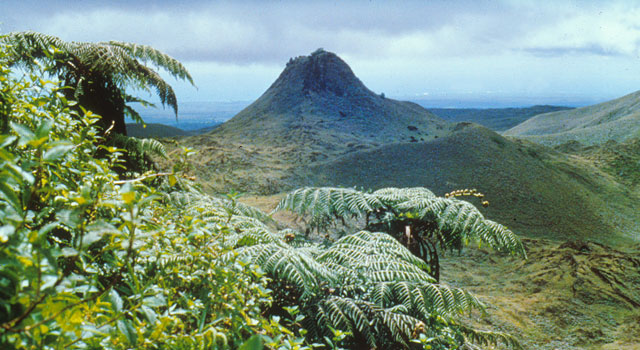
Galapagos Islands
Galapagos Islands

The pros and cons of introduced plant species are debated in the context of the Galapagos Islands, where biodiversity is worshipped because it was instrumental in Darwin’s theory of evolution.  Ms. Vince interviewed the conservationist who has been battling invasive plant species on the Galapagos for 20 years.  He recently decided that attempts to eradicate introduced plants are futile and he now calls them native plants.  His surrender to this reality is controversial, but he is resolute.  He is supported in this decision by scientists who have studied novel ecosystems and find ecological value in them.  The rebuttal to such defense of novel ecosystems is that the globalization of ecosystems is homogenizing the world’s biota.

Ms. Vince concludes that proponents of eradicating non-native plants are losing the battle against the “McDonaldization” of nature:  “From the Galapagos to Hawaii, conservationists are switching tack and starting to embrace the introduced species of Anthropocene ecosystems…” because “In some places, invasives have enhanced the landscapes, reducing erosion, providing handy cash crops or food and habitat for other wildlife.”

We can only hope that our local version of “conservation” in the San Francisco Bay Area will catch up with this new realistic perspective in time to save our urban forests from being needlessly destroyed.

Epilogue

The final chapter of Adventures in the Anthropocene is an epilogue, which takes place in 2100 in London.  The author’s son muses at the age of 87 about which of his mother’s many predictions occurred in the 21st Century.  As we would expect, it was a tumultuous century, one in which drastic changes were made to accommodate the changing climate.

We notice that 22nd Century vegetation of London is tropical:  “Now, carpets of sedges and mosses fill the spaces, interspersed by grasses grazed by capybara, and the planted fig and mango trees, noisy with wild birds.”     We marvel that people claiming to be environmentalists are blissfully unaware of the fact that the native plants they are demanding we restore are not adapted to current climate conditions, let alone the climate foreseen in the near future.

We conclude with the final paragraph of Adventures in the Anthropocene, because it is the most optimistic prediction in this excellent book:

…the world has become a kinder place.  The terrible wars, the famines, the terrorism, extremism and hate, the drownings and deaths of hundreds of thousands of migrants the humanitarian crises…they seem to be over now…The great global mix-up of people that has occurred as a result of climate migration, urbanization, and online networks has produced a new, socially mobile, egalitarian society.  The world’s giant cities force people to live together in close but diverse communities, and it has generated a spirit of cooperation.”

We look forward to a time of greater equality for humanity as well as for the natural world, when the meaningless and unnecessary distinction between native and non-native will be retired from our vocabulary.


(1) Gaia Vince, Adventures in the Anthropocene:  A Journey to the Heart of the Planet We Made, Milkweed Editions, 2014

(2) Kevin M. Clarke, et. al., “The influence of urban park characteristics on ant communities,” Urban Ecosyst, 11:317-334, 2008

Wise words about fire hazards

The Hills Conservation Network has published a new petition addressed to the mayor and city council members of the City of Oakland:

“To Mayor Libby Schaaf and all members of the Oakland City Council:

We request you stand up for the community, the environment, the trees and all the animals who live in the urban forest. Clear-cutting pine, eucalyptus and acacia and then dousing the hills with a decade of TOXIC herbicides is a bad idea. Species neutral fire prevention, backed by good science that focuses on ground fuels is where FEMA money should go”

That petition is available HERE.
This is a very astute comment by a recent signer of the petition:

“I work with a recently retired fire chief and spoke at length with him about this tree cutting plan. He has decades of experience with urban, suburban and forest/wildland fires. He was clear that cutting the trees WILL INCREASE the fire hazard because ALL wildland fires START in dry grass/underbrush, not in trees. Fires spread to trees  ONLY when they are allowed to get out of control. This is not a new concept. That is why the underbrush is cut in forests.

I lived in Montclair during the firestorm. Those of us here then know the real reasons the fire got out of control: A) The original small GRASS fire was not fully put out or watched; B) many hoses could not be hooked up so there was NO water in a number of places; C) they fought it house to house rather than setting – as they did days later- a perimeter to stop it; D) there were NO evacuation orders; E) the streets are narrow and in many places the fire trucks could not get through because of the parked cars.

After the fire there were specific plans to widen the roads, allow parking on only one side of narrow roads, change the hydrant connections, limit the size of homes as well as many other preventative measures. The streets are the same and it appears other lessons from that fire have not been learned.

Ours is a FOREST environment. The solution to forest fires is NOT to clear cut the forest.

I also lived in Lake Tahoe. A forest fire started near our home. The fire department had a full perimeter set up within 15 minutes and fought the fire in from the perimeter to keep if from spreading. It was out in 30 minutes. THEY are TRAINED to fight these types of fires. The Oakland Fire Department was NOT. Hopefully they are now.

I also lived in Reno Nevada where there is only scrub brush and grass. I lived through the worst fires imaginable during those years. I have never seen such fast spreading, out-of-control fires as those created by dry grass and scrub brush. It was MUCH harder to put out, must faster moving and YES those fires burn many homes just as quickly.

The Eucalyptus in our hills keep the ground WET, YEAR ROUND, just feel under them, even now, in this drought because they collect and drip the moisture from the air. They also PREVENT the highly dry grass from growing. They are very dense and not fast burning, Pine are especially resistant to fire. All around our hills are mosses, ferns, molds and damp soils because of the Pine and Eucalyptus forests. This moisture is key to protecting our forest.

If these trees are cut down they cannot be put back when the reality of the error is recognized. If you truly wish to restore the area to its ‘natural’ state then either replant redwoods or perhaps flood with sea water to bring it back to ‘what it was.’

This planned tree cutting will live in history as one of the most devastating destructions of a unique, beautiful and rare environment. This is an area that hundreds of thousands of folks visit for its serenity, wildlife, and forest shade.

It is has also been the cherished home to many of us residents for decades; a home we choose in large part because of the trees.”

Million Trees and the San Francisco Forest Alliance also published a petition to the Sierra Club about their support for deforestation and poisoning of our urban forests in the San Francisco Bay Area.  Here is one of the comments that was posted by a signer of that petition:

Tyehimba Peyton from Lathrop, CA signed this petition on Aug 25, 2015.

“I am a retired Oakland Fire Department Fire Chief and believe that removing the trees does not reduce, but in fact increases fire danger to the Oakland hills.”

It is a fiction that native plants are less flammable than non-native plants.  All the fires raging in Western states this summer are occurring in native vegetation.  They start in dry grass, which ignites easily and they move rapidly through the dry grass.  When they reach shrubs, they generate more heat.  Trees are rarely involved unless it is a wind-driven fire.  Anyone with knowledge of fires in California and without a nativist agenda knows that the planned projects in the East Bay Hills will increase fire hazards, not decrease them.

Fire truck called to hose down steaming pile of wood chips, September 3, 2015
Fire truck called to hose down steaming pile of wood chips, September 4, 2015

Save the East Bay Hills recently reported on their Facebook page an incident, which demonstrates that creating huge piles of dead wood chips will also contribute to fire hazards.  The planned projects will chip the hundreds of thousands of trees they intend to destroy and spread them on the ground.  These huge piles of wood chips have the potential for spontaneous combustion as illustrated by this incident:

“Today on Skyline Blvd. in Oakland, we witnessed an incident that demonstrates just how much the plan to cut down 400,000 trees in the East Bay Hills and spread their chipped remains in thick carpets will imperil the welfare of hills residents by vastly increasing the risk of fire.

At noon, just down the street from Redwood Regional Park, Oakland Fire Chief Vegetation manager, Vince Crudele, and several firefighters were called to the scene after a neighbor reported that a large mulch pile from a pine tree that was recently cut down had begun steaming. Firefighters hosed down the mulch pile with water to cool it and explained to us that the steam was the result of heat from the composting debris. 

This, of course, begs the question: if the heat from just one tree composting (on a very cool day) is sufficient to warrant the intervention of the Oakland Fire Department, what is going to happen when thick piles of mulch from many thousands of trees and spanning thousands of acres begin to compost in direct sunlight and on hot days? Or, more to the point, how on earth is the current “fire abatement” plan a fire abatement plan?

In fact, it isn’t. It is, according to former Oakland firefighter and Chief of Fire Prevention for the Oakland Army base, ‘a land transformation disguised as a wildfire hazard mitigation plan.. [that] will endanger firefighters and the general public.’

Please sign our petitions to prevent this dangerous plan from being implemented.

Beyond the War on Invasive Species

Tao Orion is the author of Beyond the War on Invasive Species:  A Permaculture Approach to Ecosystem Restoration, the latest in the rapidly growing literature about the futile and destructive attempts to eradicate non-native species.  Ms. Orion will give a workshop at a PLACE for Sustainable Living on Thursday, September 17, 2015:

“Rethinking Invasive Species from a Permaculture Perspective”

Thursday, September 17, 2015, 6-8 pm

PLACE for Sustainable Living

1121 64th St, Oakland, CA 94608

Donations $12-$25 requested

Update:  This is the answer PLACE for Sustainable Living gave to a question about wheelchair accessibility:  “It is not wheel chair accessible yet – we have carried wheelchair persons up the steps with their wheelchairs – we can arrange for that. And the yard is filled with chipwood, wheel chairs have rolled over fine, but not sure if everyone in them can push through. Our friend, male, can push through fine.”  Please contact PLACE for Sustainable Living directly if you have specific questions about accessibility.  (addendum dated 9/10/15)

Update #2:  Ms. Orion’s presentation has been cancelled because the venue is not wheelchair accessible.  CUIDO (an organization which represents disabled people) asked that it be moved to a facility with wheelchair accessibility or cancelled.  Such a facility could not be found, so it has been cancelled.  

Update #3:  Some adjustments have been made in plans for Ms. Orion’s presentation which are apparently acceptable to at least some members of the disabled community.  Ms. Orion has therefore decided against cancelling it.  Sorry for the confusion.

Ms. Orion is visiting the Bay Area from the Willamette Valley in Oregon, where she has a small farm in the country.  She has a degree in agroecology and sustainable agriculture from UC Santa Cruz and she has studied at the Columbines School of Botanical Studies in Eugene, Oregon.  She teaches permaculture design at Oregon State University and a non-profit sustainable-living educational organization.  She has also worked as a permaculture designer for ecological restorations.

Beyond the War on Invasive Species

Beyond the War on Invasive SpeciesThe first chapter of Ms. Orion’s book is a breakthrough because it is an explicit indictment of pesticides used by so-called “restoration” projects.  Although previously published books were critical of invasion biology and the ecological industry it spawned, pesticides were barely mentioned in them.  In contrast, it is primarily the use of pesticides in ecological “restorations” that convinced Ms. Orion that the war on invasive species is doing more harm than good.

Concern about unwanted plants – AKA weeds – is as old as human engagement in agriculture, that is, thousands of years old. And most of the plant and animal species now considered “invasive” were introduced by humans to serve a variety of purposes, including aesthetics, such as mute swans and multiflora roses.  Some of these introduced plants and animals had unintended consequences such as competing with native plants and animals for available resources.  Concern – even regret – about these introductions has increased greatly in the past 25 years.  Attempts to manage these introductions has escalated from import limitations to fines and penalties and finally to attempts to eradicate plants and animals with pesticides.

The role of the pesticide industry in the escalating war on “invasive” species

Ms. Orion turns to the public record to make the case that the current focus on eradicating introduced species using pesticides was influenced by business interests.  She points out that the federal Invasive Species Advisory Committee is a consortium of academic, professional, and business interests, including at least two people who are employed by manufacturers of pesticides.  They make invasive species management policy recommendations to the National Invasive Species Council (NISC), created by Executive Order in 1999.  The federal government is spending over $1 billion annually on research and control of “invasive” species, including pesticide applications.

National Invasive Species Council

The NISC is modeled after the California Exotic Pest Plant Council, created in 1992.  That Council is now known as the California Invasive Plant Council (Cal-IPC).  Cal-IPC brought together representatives from government agencies and non-profit environmental organizations, as well as manufacturers of pesticides and spray equipment:  “Monsanto has sponsored Cal-IPC since its inception and both DuPont and Dow AgroSciences have also supported the group.”  (1)

The first annual conference of Cal-IPC in 1993 featured an employee of Monsanto, Dr. Nelroy Jackson.  Jackson’s presentation to Cal-IPC stated that “chemical weed control is the optimal method for control and removal of exotic plant species during…most native habitat restoration projects.” 

Jackson’s involvement in escalating attempts to eradicate introduced species is troubling, but is not the only example of such collaboration between the “restoration” industry and the manufacturers of pesticides.  The Weed Science Society, which advocates for “research, education, and awareness of weeds in managed and natural ecosystems,” has employees of Dow Agrosciences, Syngenta, and Dow Chemical on its board of directors.  Those manufacturers of pesticides, as well as Monsanto, Bayer Crop Science, Dupont, and BASF Corp are also donors to the weed society, at the highest levels of donations.

The manufacturers of pesticides also influence the “restoration” industry by investing and participating in the consulting firms that write environmental impact reports for ecological “restoration” projects, such as Tetra Tech (which wrote the draft Environmental Impact Report for San Francisco’s so-called Natural Areas Program).

The manufacturers of pesticides influence public policy regarding ecological “restoration” by making large tax-deductible contributions to many land-grant universities that conduct research on agriculture:  “A 2012 Report from Food and Water Watch found that nearly 25% of funding for agricultural research at public universities comes from private companies.”  (1) This is one of many reasons why there is so little research done on non-chemical approaches to ecological restoration.

As disturbing as this collaboration between the government and the pesticide industry is, the evidence of the relationships between trusted non-profit environmental organizations and corporate interests is even more so.  Nature Conservancy, National Audubon Society, and Ducks Unlimited all have close relationships with the manufacturers of pesticides and receive funding from them.

Ms. Orion then describes the use of pesticides by the “restoration” industry.  She also describes some of the damage pesticides are known to do, such as killing microbes in the soil and binding minerals in the soil.  She describes the persistence and mobility of pesticides in the environment.  She describes the inadequacy of testing and regulation of pesticides in the United States.  These issues are well known to the readers of Million Trees, so we won’t repeat them here, but new readers can click on the blue links to visit posts about those issues.

All introduced species are presumed to be harmful

Ms. Orion’s next chapters are more similar to the books that precede hers.  There are several examples of specific “invasions” that illustrate the point that “invasive” species are usually symptoms of changes in the environment, rather than causes of those changes.  Attempting to eradicate them does not reverse the changes in the environment and often causes more environmental damage.  “Invasive” species are often performing valuable ecological functions that are not understood until they are eradicated.  We have reported many examples of these issues and won’t repeat them here.  However, Ms. Orion’s telling of the history of Asian Carp in the Mississippi River and the Great Lakes was new to us and is well worth a retelling.

Song dynasty painting attributed to Liu Cai (c.1080–1120). Contains various types of fish and other marine animals, such as goldfish, perch, catfish, carp, minnows, bass, and shrimp.

Asian carp has been a mainstay in the diet of the Chinese for several thousand years, according to their historical literature.  Asian carp are well adapted to aquaculture techniques, so they have the potential to replace or supplement other sources of protein.  They were introduced to the Midwest in the early 1800s and they spread throughout the Mississippi River many decades ago.  Although they are prevalent in the Mississippi River, they have not driven any native fish to extinction.  Yet, despite their usefulness and the lack of evidence that they have caused any harm, they suddenly became the latest invasion crisis when it was feared they would soon enter the Great Lakes.  A government fisheries biologist put that fear into perspective:

“We are trying to keep invasive Chinese carps out of the Great Lakes, to protect an invasive (yet purposefully stocked) Pacific salmon fishery, which was stocked as a management tool to control hyper-abundant alewifes, another invasive fish species, because the native piscivore, the Lake Trout, was nearly wiped out by another invasive species, the sea lamprey, because people built the Welland Canal around Niagara Falls to promote intercontinental shipping deep into the Great Lakes basin.” (1)

It makes the head spin to follow the “logic” of this sequence of events, which we paraphrase, “we solved one problem by creating another, then we solved that problem by creating another…ad infinitum.“  This is an ecosystem that has been radically altered by man, including reversing the flow of the Chicago River which connects the Mississippi River to the Great Lakes to solve Chicago’s sewage problems.   The water is warmer, polluted with agricultural runoff, and there is no longer a seasonal, cleansing water surge.  These changes in the environment set the stage for the arrival of Asian Carp in the Great Lakes.  The habitat for native fish has been radically altered such that removal of Asian carp from the river is an irrelevant, inconsequential improvement of habitat needed by native fish.

Despite what would seem overwhelming evidence that Asian carp could be a valuable food source and that being rid of them is unlikely to benefit anyone, here is a brief list of what has been done so far to try to prevent them from entering the Great Lakes:

Fish kill using rotenone. http://www.encyclopedia.com/doc/1E1-X-rotenone.html
  • US Army Corps of Engineers constructed a submerged electric fence to shock and kill the fish as they enter the Great Lakes. The fence cost millions of dollars but is largely ineffective.
  • The Illinois Department of Natural Resources dumped 2,200 gallons of rotenone into sanitary and ship canals feeding into the Great Lakes. This poison kills all gilled animals. The result:  “Among the tens of thousands of dead fish, researchers found one Asian carp.” (1) This fiasco cost $3 million.
  • Other researchers have suggested a system of strobe lights and bubble and sound barriers to stop the northward migration of Asian carp.

Permaculture philosophy

Ms. Orion’s closing chapters reflect her training in permaculture design.  She considers the tending of the wild by Native Americans a model for ideal stewardship of the land.  And she advocates for land management strategies that reflect the realities of our changed environment and are sustainable into the future.  We will let her speak for herself:

“Holistic restoration planning requires an honest accounting of what has come to pass as well as a comprehensive view of what we can do about it.  The problems are complex, and the solutions are likely to be more so…Navigating from a paradigm that views invasive species as scourges to one that looks at them as opportunities for deeper ecological and economic engagement will take time and commitment, especially because the old paradigm is so entrenched politically, economically, and academically.  The tide is shifting though, as more and more of us are coming to realize that the herbicide-based eradication approach to restoration is outmoded—a futile attempt to regain an imagined past—and we need to be focusing our time, resources, and energy on adapting to the future.” (1)

Please show your support for Tao Orion and her book by attending her workshop on Thursday, September 17th.


(1) Tao Orion, Beyond the War on Invasive Species:  A Permaculture Approach to Ecosystem Restoration, Chelsea Green Publishing, 2015 

The medical establishment takes a stand on GMOs that enable more herbicide use

The majority of the scientific community has, until recently, considered genetically modified (GM) food safe to eat.  The Pew Research Center conducted a survey in which they compared the opinions of scientists regarding GM food to the opinions of the general public.  The scientists in the survey were members of the American Association of the Advancement of Science, an elite group of scientists.  Eighty-eight percent of the sampled scientists considered GM food safe to eat, compared to only 37% of the general public.  This survey was published in January 2015, reflecting recent attitudes toward GM food.

That opinion has changed, at least among some medical professionals, according to an article recently published by the New England Journal of Medicine (NEJM). (1)  NEJM is America’s premier medical journal, with the highest standards of journalistic ethics for the studies they choose to publish.  The article in NEJM was co-authored by a professor of preventive medicine and a professor of crop and soil science.  They conclude that GMOs have enabled huge increases in the use of herbicides by agriculture, posing hazards to public health.  The genetic modification itself is not to blame.  Rather it is the increased use of herbicides that are a matter of concern.

The authors trace the sequence of events that changed their opinion of GM foods from benign to a public health hazard.

What is “genetic modification?”

Genetic modification of plants and animals occurs naturally and has as long as life has existed on Earth.  When two closely related species interbreed, the result is a hybrid, which sometimes persists in nature and often ultimately results in a new species.  For example, there are hundreds of species, sub-species, and varieties of Manzanita in California because it is a species that freely hybridizes.  Sycamore trees are another plant that hybridizes freely.  Historically, such hybridizing events were not considered harmful.

Genetic modification is not fundamentally different from selective breeding in which humans have been engaged since the advent of agriculture and domestication of animals thousands of years ago.  Individual plants and animals with characteristics considered valuable were bred by humans to enhance the usefulness of plants or animals to humans.  Ancestor plants of corn were barely edible, but corn has become one of our staple foods as a result of breeding.

DNA analysis greatly enhanced the ability of humans to genetically modify plants and animals to make them more useful to humans.  Now scientists can import DNA into plants and animals from virtually anywhere in the biosphere.  Some of those modifications have been very beneficial, such as increasing crop yields, or enabling plants to survive in warmer climates, etc.  In 2000 and 2004, the American Academy of Sciences evaluated GM foods and concluded that they did not pose any unique hazards of human health.

Genetic modification becomes the enabler of herbicides

So what has changed that makes the medical establishment decide that GM foods are a matter of concern?  Beginning in the 1990s genetically modified crop seeds were developed that enable the crop to tolerate unlimited amounts of herbicide, particularly glyphosate (AKA Roundup).  Ninety percent of corn and soybeans grown in the United States is grown from these seeds.  Consequently, glyphosate use in the United States has increased from .4 million kilograms in 1974 to 113 million kilograms in 2014.

Rare ears of organic corn.  Courtesy A Really Small Farm
Rare ears of organic corn. Courtesy A Really Small Farm

Unfortunately, weeds are smarter than we are.  The more herbicide we use, the smarter the weeds get.  The evolutionary pressure of the chemical onslaught on the weeds has produced glyphosate-resistant weeds on nearly 100 million acres in 36 states.  There is always enough genetic variation in any large population of plants and insects to ensure that a few individuals will survive whatever we spray on them.  Those survivors will breed to produce the next generation, which ensures that the next generation will be more likely to survive the next onslaught of chemicals.  Over time, the population of weeds and insects capable of surviving our chemicals gets bigger and stronger.

One bad decision begets another

You might think we would abandon this chemical warfare in favor of a less poisonous, more effective long-term strategy.  You would be wrong because you’re not thinking like a corporation which manufacturers chemicals and the seeds that ensure their use.  Of course, their strategy is to make the chemicals stronger and stronger.  That strategy might make sense if we weren’t living on the same planet with all that poison or eating the food that has been sprayed with them.

The medical profession draws the line

In response to herbicide-resistant weeds, the manufacturers of pesticides have developed a new herbicide which combines glyphosate and 2,4D into a product called “Enlist Duo.”  You may recognize 2,4D as one of the ingredients in Agent Orange, used during the Vietnam War to defoliate the battle field and incidentally to poison our troops and generations of Vietnamese.  Enlist Duo was approved by the Environmental Protection Agency in 2014.  In 2015, the World Health Organization (WHO) classified glyphosate as a “probable human carcinogen” and 2,4D as a “possible human carcinogen.” 

US Army helicopter spraying Agent Orange over Vietnam. Public Domain

This escalation of chemical warfare on America’s food supply has sent some members of the medical community over the edge:

“These developments suggest that GM foods and the herbicides applied to them may pose hazards to human health that were not examined in previous assessments.  We believe that the time has therefore come to thoroughly reconsider all aspects of the safety of plant biotechnology.  The National Academy of Sciences has convened a new committee to reassess the social, economic, environmental, and human health effects of GM crops.  This development is welcome, but the committee’s report is not expected until at least 2016.” (1)

In view of these concerns, the authors of the article in NEJM advise the EPA to withdraw its approval of Enlist Duo, a decision which “was made in haste…based on poorly designed and outdated studies and on an incomplete assessment of human exposure and environmental effects.” The authors also suggest that we “revisit the United States’ reluctance to label GM foods.”  They suggest that it is time to join 64 other countries around the world that require labeling of GM foods.


(1) Philip J. Landrigan, M.D., and Charles Benbrook, Ph.D., “GMOs, Herbicides, and Public Health,” New England Journal of Medicine, August 20, 2015.

Do you think a small dose of poison won’t hurt you? Think again.

In our previous post we told our readers about the strategies used by opponents of government regulation to prevent or delay regulation by undermining the science that informs us of environmental and health risks.  In this post, we will focus on the inadequacy of pesticide regulation in the US and the arguments used to justify inadequate regulation.

Paracelsus coined the adage "the dose makes the poison" in the 16th Century
Paracelsus coined the adage “the dose makes the poison” in the 16th Century

Pesticide regulation in the US—like all regulation of chemicals—is based on an assumption that there is a threshold of exposure below which the chemical is safe.  This assumption is often summarized as “the dose makes the poison.”  This old adage originates with a Renaissance medic who died in 1541 and it was employed at the dawn of the nuclear era to reassure the public that they were not being harmed by radiation.  Since radiation occurs naturally in the environment, some low level of exposure is assumed to be harmless.  (1)

But can we assume that the same is true of pesticides?  Does every pesticide have some threshold dose below which it is harmless?  There are many reasons why we cannot assume that there are safe levels of exposure to pesticides.

Bioaccumulation and Biomagnification

BiomagnificationMany chemicals accumulate in our bodies throughout our lives. Researchers at Brown University tested the blood of over 3,000 women between the ages of 16-49 for levels of mercury, lead, and PCBs. These three chemicals are known to harm brain development of fetuses and babies. The sample was designed to represent the national population of 134.4 million women of childbearing age. Here’s what they found:

  • “Nearly 23 percent of American women of childbearing age met or exceeded the median blood levels for all three chemical pollutants [combined].” (2)
  • “As women grew older, their risk of exceeding the median blood level in two or more of these pollutants grew exponentially to the point where women aged 30 to 39 had 12 times greater risk and women aged 40-49 [born before these chemicals were banned] had a risk 30 times greater than those women aged 16 to 19.(2)
  • The chemicals that accumulate in a woman’s body do not stop there. They are passed from one generation to the next in mother’s milk and across the placenta to her unborn child.  If we stopped all new discharges today and cleaned up all the PCBs already in the environment, “it would take six generations…until PCBs would no longer be detectable in the bodies of our offspring.” (3)
  • “Fish and alcohol consumption also raised the risk of having higher blood levels. Women who ate fish more than once a week during the prior 30 days had 4.5 times the risk of exceeding the median in two or more of these pollutants.” (2)

PCB  is an organochlorine (organic–carbon-based–chemicals that contain one or more chlorine atoms), as are all products derived from chlorine, such as polyvinyl chloride (PVC) and some pesticides, such as DDT.  Organochlorines accumulate in the fatty tissue of living things (bioaccumulation), magnifying in concentration as they are eaten by their predators (biomagnification).   Animals at the top of the food chain—such as humans—therefore receive larger doses of these chemicals than animals at the bottom of the food chain.

Some chemicals are not easily metabolized by our bodies and many persist in the environment for long periods of time, which contributes to the cumulative effect of each individual exposure:  “The increased stability of many organochlorines makes them more resistant to the body’s metabolic processes, so they are retained in the body for longer, may accumulate to higher and higher concentrations over time, and will cause more severe toxic effects for a longer period of time than if they were more easily metabolized.” (3)

In other words, a single dose of a chemical may not be harmful, but the accumulation of many doses from a variety of sources over a long period of time is much more likely to be harmful. 

Multiple exposure sources

Even if there were some safe dose of a particular chemical, we should assume that we are also exposed to multiple sources of that chemical, of which we may be unaware.  Taking organochlorines as an example of chemicals known to be toxic and to accumulate, if we are exposed to an organochlorine pesticide, we might also be exposed to organochlorine by-products of pulp paper manufacturers, and/or dry cleaning processes, and/or hazardous wastes generated by incinerators, and/or the PVC plumbing in our homes, and/or detergents and water disinfectants, etc.

Many of these chemicals are airborne and are found at high concentrations far from where they were applied:  “Airborne deposition of atrazine [herbicide] into the Great Lakes has become so significant that there is now about 36,000 kilograms of the pesticide in Lake Superior water…the bulk of organochlorine pesticides and other persistent pollutants that enter the waters of the Great Lakes come from as far away as the southeastern United States and Latin America.” (3)  These chemicals are volatized from where they were discharged, they travel on atmospheric currents and are deposited by rain and snow in colder regions where they stay.  Polar regions are the ultimate sink for persistent organochlorines, where they are far more persistent than in warmer climates, e.g., atrazine has a half life of 60 days at room temperature, but does not degrade at all below 43° F.

Mixture of glyphosate and aminopyralid sprayed on ivy in Glen Canyon Park, San Francisco

There are over 80,000 chemicals on the market of which only a small fraction have been tested and there are thousands more that are formed as accidental by-products, such as dioxins. These chemicals interact in unknown and unpredictable ways about which little is known: “Less than 0.25 percent of studies have evaluated the effects of mixtures of more than two chemicals.” (3)  Even if there were some safe level of exposure to a single chemical, that would tell us nothing about the synergistic (multiplicative or exponential effect by which the whole is greater than the sum of its parts) or additive effects of the multiple chemicals to which we are exposed.  A recent study by an international team of 174 scientists at leading research institutions reported that a “cocktail” of common chemicals found at exposure levels in the environment today can trigger the cellular mutations that result in cancer.

Limitations of testing

In the small minority of cases in which a chemical has been tested for toxicity, that test is only as accurate as the test protocol/test parameters/test procedures, etc.  There are many methodological limits of toxicological analysis:

  • Tests are conducted on laboratory animals in which the dose is limited to a single chemical. As we said before, in the real world, humans and other animals are subjected to many chemicals simultaneously in doses that are unknown and unknowable, because little testing is done of contamination in the environment.
  • Tests are done for relatively short periods of time, compared to the long lives of humans during which chemicals accumulate in our bodies.
  • The chemical threshold deemed “safe” is not the dose at which no adverse affect occurred. It is only the dose at which no adverse affect was observed:  “Subclinical affects—reduced fertility, compromised immune systems, and reduced intelligence, for example—are not observed not because they have not occurred but because they are seldom sought.” (3) In other words, the testing regimen does not test for many potential health problems.
  • The testing regimen also is limited to certain species and certain stages of development. For example, bees are the only species of insect on which pesticide tests are required and they are only tested at the adult stage.  Bee keepers will tell you that larvae stages of bee development are far more vulnerable to pesticides than adult bees, yet no tests are required on that stage of development.  Bees are probably less vulnerable to pesticides than caterpillars which eat vegetation, but caterpillars are not tested.  If caterpillars are killed, there are no moths and butterflies.
  • The test is only as accurate as the analytical tool. The test may not be sensitive enough to detect injury.  The history of lead regulation is an illustration of the evolving science of toxicology testing.  Lead poisoning was first detected in the 1920s among workers exposed to lead.  The first established threshold for lead exposure was 80 micrograms of lead per deciliter of blood.  In the 1960s Australian physicians reported a connection between lead levels in children and lead in household paint.  Industries with an economic interest in the issue organized a defense of their products, which prevented further regulation until the late 1970s when the threshold was lowered to 60 micrograms per deciliter.  A few years later, the threshold was reduced further to 40 micrograms, then 35 micrograms, then 30 micrograms, then 25 micrograms.  “In the 1990s the safe level for children was reduced to 10 micrograms…Today it is understood…that exposure to less than 10 micrograms per deciliter also impairs cognitive development, and there is most likely no threshold at all.” (3)

Manipulation and Obfuscation

The tests of toxicity required by law are conducted on a small minority of the tens of thousands of chemicals on the market.  When the tests required by law are conducted, they are inadequate to accurately determine toxicity.  So, in those rare cases when tests indicate that a chemical is harmful at the doses being used, you might think its use would be prohibited by law.  You would be wrong.  Regulation is prevented, even when tests clearly indicate that a chemical is harmful.

Atrazine is only one of many examples of how regulation is prevented by the disinformation campaigns of the manufacturers of chemicals and the industries which use them.  Professor Tyrone Hayes was hired by the manufacturer of atrazine to test the toxicity of that chemical on frogs, the animal that Professor Hayes studies.  Professor Hayes quickly reported that atrazine caused hermaphroditism and sterility in frogs.  Atrazine is a known endocrine (hormone) disrupter.  Very small quantities of hormones are capable of producing cascading effects throughout our bodies.  Despite this well known physiological fact, the primary means used by the manufacturer of atrazine to discredit Professor Hayes’ research was to argue about the doses that were used in his study:  “Atrazine is unlikely to have an adverse impact on frogs at existing levels of exposure” (4)  This criticism of Professor Hayes’ research is bogus because the dose he used was taken directly from the environment in which atrazine is used and contaminates surrounding water bodiesHe and his students continued the work, travelling to farming regions throughout the Midwest, collecting frogs in ponds and lakes, and sending three hundred pails of frozen water back to Berkeley. In papers in Nature and in Environmental Health Perspectives, Hayes reported that he had found frogs with sexual abnormalities in atrazine-contaminated sites in Illinois, Iowa, Nebraska, and Wisconsin.” (5)

African clawed frog was used in human pregnancy tests. Creative Commons

In our recent debate with a reader who does not believe that pesticides are harmful to humans, his response to this information about the affects of atrazine on frogs was that he does not care about frogs.  So, let’s take a moment to think about why this research should be a matter of concern to us, even if we don’t care about frogs.  One of the frogs that Professor Hayes used in his research on atrazine was the African clawed frog.  The reason why he used that particular species is that, although it is not a native frog, it is very commonly found in nature because it was used for decades in pregnancy tests on humans.  If the urine of a pregnant woman is injected into a female African clawed frog, the frog quickly lays eggs.   In other words, the reproductive and endocrine system of frogs is closely related to that of humans.  If the reproductive and developmental system of frogs is adversely affected by atrazine, we should assume that humans are probably also affected.

Agent Orange was used in Vietnam from 1965-1969 to defoliate the battlefield to make the guerilla enemy more visible.  It was discontinued when scientists reported that it caused birth defects in mice.  Subsequently, Vietnam veterans reported severe health problems that were suspected to be a result of exposure to Agent Orange.  The manufacturers of Agent Orange quickly circled the wagons.  With the active participation of the government, they were able to prevent compensation of Vietnam veterans for their health problems for over 20 years.  This was achieved by direct manipulation of the research data.  Specifically, exposed workers and soldiers were put into the unexposed control group so that no statistical difference in the groups was apparent. (3)

There are multitudes of ways to cook the books.  Atrazine and Agent Orange are two examples in which the manipulation was discovered.  We will never know how many more there are that we don’t know about.

Cost-benefit analysis

Current federal law regulating toxic chemicals requires a cost-benefit analysis be taken into consideration before a chemical can be taken off the market.  In the case of pesticides, the manufacturers and the primary users of pesticides have successfully defended against regulation by claiming that agricultural productivity would be drastically reduced and the price of food drastically increased without continued use of pesticides.  However, there is considerable evidence to the contrary:

  • Despite massive pesticide use, some 37 percent of all US crop production is lost to pests—significantly more than was lost before the advent of synthetic pesticides.” (3)
  • In 1989, the US National Academy of Science’s Board on Agriculture reported, “Reduced use of these [chemical] inputs lowers production costs and lessens agriculture’s potential adverse environmental and health effects without necessarily decreasing—and in some cases increasing—per acre crop yields and the productivity of livestock management systems.” (3)
  • “In Germany…a long-term study of 44 farms has found that yields of wheat, oats, and rye have steadily increased over a 17-year period following the farmers’ transition to strictly organic agriculture.” (3)
  • “While yields stay more or less the same, the impact on farmers’ profits can be very positive [because] pesticides account for as much as 20 percent of the variable costs of crop production.” (3)

As strong as the case is against economic benefits of pesticide use by agriculture, the case is much stronger against pesticide use for ecological “restorations.”  There is no empirical evidence that there is any benefit to ecological “restorations.”  They do not increase biodiversity.  They do not benefit wildlife.  If there is no benefit, there is no justification for using pesticides for this purpose.

We apologize for the length of this post.  After spending several months studying the issues, we felt compelled to take you on our journey to the inevitable conclusion.  There is no justification for using pesticides for the sole purpose of eradicating non-native plants because they are not doing any harm and therefore there is no benefit to killing them, particularly with harmful pesticides.


 (1) Naomi Oreskes & Erik Conway, Merchants of Doubt, Bloomsbury Press, 2010

(2) Marcella Remer Thompson, Kim Boekelheide, “Multiple environmental chemical exposures to lead, mercury, and polychlorinated biphenyls among child-bearing-aged women: Body burden and risk factors,” Elsevier, November 16, 2012

(3) Joe Thornton, Pandora’s Poison, MIT Press, 2000

(4) Jon Entine, “Scared to Death:  How chemophobia threatens public health,” A position paper of American Council on Science and Health, 2011

(5) Rachel Aviv, “A Valuable Reputation,” New Yorker, February 10, 2014

Merchants of Doubt: Why isn’t our government regulating pesticide use?

A few months ago, we had a long email “conversation” with a reader who is opposed to the destruction of our urban forest, but does not believe that pesticides are harmful to the environment. He is an intelligent and well-informed person and we were intrigued by some of the arguments he used.  We read and considered every resource he sent in support of his opinion.  Then we read the resources suggested by our collaborators with greater knowledge of pesticides.

Glyphosate application, Glen Park, San Francisco.

We have decided to report some of what we learned because of the recent decision of the World Health Organization (WHO) to classify glyphosate as a “probable human carcinogen.”  Glyphosate is the herbicide used most often by land managers to eradicate plants they consider “invasive.”  It is also considered the least toxic of the many herbicides they use.  Some countries are reacting to the WHO decision by banning use of glyphosate.  The Marin Municipal Water District has announced that it will quit using glyphosate (and other herbicides) to eradicate non-native plants on Mt.  Tamalpais.  The City of San Francisco recently announced that it has reclassified glyphosate from Tier II (more hazardous) to Tier I (most hazardous)Why isn’t our federal government or our land managers in the East Bay questioning the use of this pesticide?  Our reading in the past few months answers this question. 

Merchants of Doubt

Merchants of Doubt (1) is about a small group of people (mostly men) who have influenced public policy in the past 60 years by undermining the science upon which these policies should be based.  They were physical scientists who were involved in the development of weapons during WW II and the Cold War that followed.  As such they were deeply committed to militaristic solutions to international threats and they perceived communism as America’s greatest enemy.  It follows that they were equally committed to our capitalist economic system which is the antithesis of communism.  They perceived government regulation of business interests as a threat to capitalism.  Here are some of the public policy issues in which they have been influential:

  • Merchants of DoubtAfter WW II many scientist who participated in the development of nuclear weapons became advocates for arms control because they predicted dire consequences of their use, such as the nuclear winter that would decimate life on Earth. The Merchants of Doubt stepped forward to undermine the effort to disarm the nuclear arsenal by attacking the predictions of their opponents.  They played a similar role during the Reagan administration when most scientists did not consider the Strategic Defense Initiative (AKA Star Wars) technically feasible.   With the backing of the Merchants of Doubt, the development of SDI was funded despite the fact that it is unlikely to be useful in actually defending against nuclear missile attack.
  • In 1953, laboratory tests on mice were the first scientific evidence that smoking causes cancer. The manufacturers of cigarettes engaged in a “massive and ongoing fraud to deceive the American public about the health effects of smoking” (1) and their efforts were aided and abetted by the Merchants of Doubt who provided much of the “scientific” cover that delayed the regulation of cigarettes for decades.   When laboratory tests and epidemiological data indicated that second hand smoke is more toxic to innocent bystanders than to those who smoke, the Merchants of Doubt stepped forward again to delay the bans on smoking that are now in place in most public places.
  • The Merchants of Doubt have played a similar role in preventing or delaying government action to address several environmental issues: acid rain which was killing the world’s forests; depletion of ozone in the atmosphere which results in an increase in the incidence of skin cancer; and currently climate change. 

How could such a small group of people be so influential when the science of these issues is so conclusive?  Here are some of the reasons why the Merchants of Doubt were successful in delaying and in some cases, preventing government regulations to address these issues:

  • Science is rarely conclusive. It is primarily a process of hypothesis testing, and retesting until the weight of evidence is sufficient to outweigh uncertainty.  If doubt is continually put on the scale, certainty is harder to achieve.  That was the strategy of the Merchants of Doubt.  They didn’t need to disprove the evidence.  All they needed to do was to cast doubt and keep demanding that more evidence was required to overcome uncertainty.  In most cases, doubt was overcome eventually, but the Merchants of Doubt were successful in delaying public policy on most of these issues for decades.  Climate change remains our biggest issue for which there is insufficient public consensus to enable public policy to address it.  The economic interests vested in the industries contributing to climate change are so big, wealthy, and therefore influential that it remains to be seen if or when we will finally be able to address the causes of climate change.
  • The media has participated in the promulgation of doubt.  The “fairness doctrine” requires that responsible journalists and broadcasters represent dissenting views.  For example, every time there was a broadcast about the health dangers of smoking, tobacco companies and their allies demanded equal time.  We no longer see such “balanced” coverage of smoking.  The evidence is so overwhelming that government regulation was finally achieved and advertising of tobacco products is strictly limited.  We seem to be moving in that direction on media coverage of climate change, but we still see dissenting views reported at a time when scientific evidence no longer justifies the representation of that viewpoint.
  • The most disturbing reason why the Merchants of Doubt were successful was that government was actively collaborating with them. They were represented on government panels, review bodies, task forces, etc.  This often put them in a position to disarm, distort, or censure scientific opinion on all of the issues in which they were actively engaged.

A word about conspiracy theories is required.  We are generally deeply suspicious of conspiracy theories.  We realize that this brief summary of a 274-page book with 75-pages of citations and footnotes, written by two science historians probably sounds like a conspiracy theory.  The fact that the Merchants of Doubt (who are identified in the book*) weren’t much more than a handful of people may seem particularly fanciful.  We can only say in defense of our summary that you should read this book before reaching the conclusion that it is not possible for a small group of influential people to control public policy to the extent that Merchants of Doubt informs us they did.  The authors of Merchants of Doubt make a convincing case.  There is also a documentary movie (available for rental on Netflix) based on the book, which should help you decide if you find their report credible.

Pesticide regulation in the US

Silent springYou may be wondering what all this has to do with pesticides, so let’s turn to that issue.  The story of pesticide regulation in the US begins with the publication of Silent Spring in 1962, in which Rachel Carson informed us that the widespread use of DDT by agriculture was having a devastating effect on wildlife, particularly birds.  She was immediately attacked by the manufacturers of pesticides as a “hysterical female,” but after 10 years of research which proved her point, DDT was finally banned for agricultural use in the US in 1972, shortly after the creation of the Environmental Protection Agency.  Fifty years later, DDT remains one of the few pesticides banned in the US for agricultural use.

You might think that is the end of the story for DDT, but you would be wrong.  The Merchants of Doubt created foundations to carry their message and receive tax-deductible “donations” from the corporations they are protecting.  In 2007, these foundations launched a belated attack on the banning of DDT.  For example, The Competitive Enterprise Institute—which was instrumental in defending tobacco– says on its website, “Millions of people around the world suffer the painful and often deadly effects of malaria because one person sounded a false alarm…That person is Rachel Carson.” (1)  This accusation was repeated by several other “foundations” and published by the mainstream press.  Michael Crichton, the author of novels portraying global warming as a liberal hoax, quotes one of his fictional characters as saying, “Banning DDT killed more people than Hitler…It was so safe you could eat it.”  Apparently fictional characters also have fictional digestive systems.

Why the belated attack on Carson decades after the issue has been resolved to the public’s satisfaction?  “In the demonizing of Rachel Carson, free marketers realized that if you could convince people that an example of successful government regulation wasn’t, in fact, successful—that it was actually a mistake—you could strengthen the argument against regulation in general.” (1)

There is no truth to this accusation that banning DDT caused millions of deaths by malaria:

  • The ban of DDT in the US did not obligate any other country to ban DDT. In fact, many countries continued to use DDT long after the US banned it. 
  • By the time DDT was banned in the US, it was no longer effective on many insects, including the malaria-carrying mosquito for which DDT was used most heavily during WWII. Insects have short lives and huge populations.  Therefore, they evolve much more quickly than most animals.  This is one of the strongest arguments against pesticide use, yet the public does not seem to understand that the more pesticide we use, the more quickly they become ineffective. Both insect and plant pests evolve resistance to pesticides quickly. 
  • Malaria control was not achieved solely with pesticides. Draining swamps and wetlands, removing standing pools of water, using window screens and bed nets, etc. have proven more effective than widespread spraying of pesticides.

Preview

A small group of people with scientific backgrounds have succeeded in confusing the public about many critical issues that threaten our health and our environment.  Their desire to prevent government regulation has trumped their commitments to science.  In any case, they are presuming to judge scientific issues outside their expertise.  They did not have the credentials to deny the reality of climate change, for example, yet they were given the podium by our government and our media.

In our next post, we will look at some of the specific arguments used to disarm criticisms of pesticide use and respond to them with the help of an excellent book, Pandora’s Poison by Joe Thornton.


*Individuals identified by Merchants of Doubt as purveyors of misinformation intended to prevent regulation of environmental and health risks:  Frederick Seitz, Robert Jastrow, William Nierenberg, S. Fred Singer and others playing smaller roles.

(1) Naomi Oreskes and Erik Conway, Merchants of Doubt, Bloomsbury Press, 2010

“Weed Whackers, Monsanto, glyphosate, and the war on invasive species”

coyote in oxalis field. Copyright Janet Kessler

Harper’s Magazine describes itself: “the oldest general-interest monthly in America, explores the issues that drive our national conversation, through long-form narrative journalism and essays…”  Harper’s has just published an article by Andrew Cockburn, an experienced investigative journalist with an impressive track-record of informing the public of some of the darkest secrets in our country.  The article is available here:  Cockburn – Weed Whackers

Invasion biology and the “restoration” industry it has spawned deserved his attention and we are indeed fortunate that he has brought his journalistic skills to this task.   The public is largely unaware of the billions of dollars of taxpayers’ money being wasted on futile attempts to eradicate “invasive” plants.  There is even less knowledge of the quantities of pesticides being used by these projects or the toxicity of those pesticides.

Mr. Cockburn has interviewed many of the key players in this crusade against nature, on both sides of the controversy.  And he has visited specific projects to illustrate one of his key points:  “invasive” species are symptoms of environmental change, not the cause of them.

This article ( Cockburn – Weed Whackers )  deserves to be read, so we will not summarize it further.  Please share it with your friends, whether they are native plant advocates or critics of invasion biology.  We are deeply grateful to Mr. Cockburn for his even-handed treatment of this controversial issue, which is dividing communities in the San Francisco Bay Area.

Mount Sutro Forest. Courtesy Save Sutro