Another lame attempt to defend invasion biology

The Editor of an academic journal, Diversity and Distribution, wrote and published a defense of invasion biology (which he prefers to call “invasion science”) entitled, “Misleading criticisms of invasion science:  a field guide.” (1)  We recently critiqued a similar defense by other invasion biologists, so we’ll “cherry-pick” a few issues from this publication which weren’t covered in our earlier critique.
“Costs and Benefits?”

The authors begin by describing their academic discipline:  “Invasion science is the study of the causes and consequences of the introduction of organisms to the areas outside their native ranges.  It concerns all aspects relating to the transport, establishment, and spread of organisms in a new target region…and the costs and benefits of invasion with reference to human value systems.”  However, the publication makes no mention of any benefits of non-native species nor does it mention the costs to the environment associated with the attempts to eradicate non-native species, such as herbicide use.  Non-native species are said to be “far more likely to cause substantial ecological and socio-ecological damage” than to benefit ecosystems and, in any case, if there are any benefits they are said to be “transient.”

Zebra mussels, open underwater with siphons out.  Creative Commons
Zebra mussels, open underwater with siphons out. Creative Commons

Actually, there is empirical evidence that the negative impacts of non-native species are transient.  For example, the population of zebra mussels in the Great Lakes began to decrease significantly within three years when the population of migrating ducks discovered them and altered their migratory route to take advantage of that new food source.  And the negative effects of garlic mustard on forest regeneration were significantly decreased within 50 years of its arrival in North American forests.

Monarch butterflies roosting in eucalyptus tree.

Evidence of the benefits of non-native species is too voluminous to enumerate, so we will just offer our local example of the services to wildlife provided by eucalyptus in California.  It is one of the few sources of nectar in the winter and is therefore essential to the survival of honeybees and hummingbirds.  Eucalyptus is the over-wintering roost of 75% of monarch butterflies in the California migration.  It is the preferred nesting habitat for raptors.

We see no evidence in this publication that “costs and benefits” of non-native species have been considered.

Are most “invasions” benign?

The authors respond to the defenders of non-native species who say that most non-native species are benign:

  1. “The impacts of most invasions have not been studied, and so important effects may remain undetected,
  2. Invaders that are apparently innocuous in one region can be disruptive in other regions,
  3. Subtle impacts that may be unrecognizable without careful technical study can produce enormous ecosystem changes over time, and
  4. Many non-native species that currently appear innocuous may become damaging many years later—when it is no longer feasible to eradicate them.” (1)

Here’s how we paraphrase this defense:  “We may not have much evidence that non-native species are doing any harm, but we are sure they are doing harm and even if they aren’t doing any harm, we’re sure they will eventually do a great deal of harm.”  Does this seem an adequate defense of projects that are eradicating all non-native plants on thousands of acres of public land, using harmful methods such as herbicides and prescribed burns?  We think a higher standard of proof is needed to justify such damage to our public lands.

Invasion biologists chastise critics

Invasion biologists are angry that their academic turf is being challenged by other academic scientists:

“In our view, the escalation of cavalier bashing of the discipline is undermining systematic science-based efforts to improve the efficiency of management of problematic non-native species and invaded ecosystems.” (1)

We have seen no “cavalier bashing” of invasion biology.  What we have seen, and provided to readers of Million Trees, are many scientific studies which show that the hypotheses of invasion biology are often not supported by evidence from the field.  Most of the papers don’t even mention “invasion biology,” they just present their evidence in scientific journals.

We wish it were true that these studies were “undermining management” of non-native species.  Unfortunately, we see no evidence that criticisms of invasion biology by academic scientists have any impact on public policy.  Every project in the San Francisco Bay Area which is eradicating or proposing to eradicate all non-native species on our public lands is moving inexorably forward.  There is no apparent connection between the revision of the hypotheses of invasion biology by academic scientists and the practical application of those out-dated hypotheses by managers of public lands.  If the primary goal of invasion biologists is to eradicate non-native species rather than to defend their academic discipline, they seem to have nothing to fear.  They would be wise to shut up and let the destruction continue quietly under the public’s radar.

A new round of criticism of invasion biology

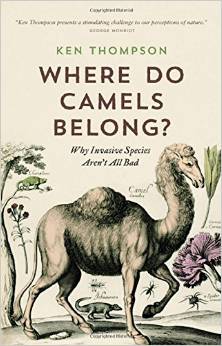
Where do camels belongMeanwhile, the angry reaction of invasion biologists to criticism of their discipline has not stopped that criticism.  Hardly a day goes by without the publication of new critiques of invasion biology by other scientists.  Where do camels belong? by Ken Thompson was published in September 2014.  It is a full frontal assault on the unfounded assumptions of invasion biology.  It is a hard-hitting, often amusing summary of the flaws in the reasoning on which invasion biology was constructed.  Although Mr. Thompson is a British academic scientist, his book is written for the general public, drawing on the scientific studies of his colleagues who share his opinion of the fallacies of invasion biology.  The book is also unique in mentioning the damage that is done by the fruitless attempts to eradicate firmly entrenched non-native species.

Mr. Thompson was recently interviewed by Canadian public radio.  Here is a choice excerpt from that interview:

“He also cautions that our efforts to control or eliminate invasive species can be tremendously expensive, are rarely successful, and often have damaging unintended consequences. For example, the herbicides used to try to eliminate invasive plants often have devastating impact on vulnerable native species. The cure, in some of these cases, is worse than the disease, he says.  Professor Thompson says the invasive species we might worry about most is actually us. Humans have spread to every corner of the globe, and altered a huge amount of the planet.  ‘We’ve chopped down forests, built dams and turned the whole world into a giant cattle pasture, and then we’re surprised that some species quite like what we’ve done. We shouldn’t be surprised.’”

The publication of Where do camels belong? is one of the few bright spots in 2014, a year full of disappointments for those who value our urban forest in the San Francisco Bay Area.  We recommend it to our readers.  It may cheer you up as it did us.

Update:  Professor Richardson recently published (February 11, 2015) an article in Ensia, an on-line science blog, which was written in response to an earlier article(January 21, 2015)  in Ensia by Daniel Simberloff.  Professor Simberloff’s article defended “invasion biology” and criticized any acceptance of “novel ecosystems.”  Professor Richardson’s response seems to defend “novel ecosystems.”   It seems that Professor Richardson has altered his views regarding novel ecosystems since writing his article two years ago about “Misleading criticism of invasion science.”  Welcome to reality, Professor Richardson.  Updated 4/8/15


  1. David Richardson and Anthony Ricciardi, “Misleading criticisms of invasion science: a field guide,” Diversity and Distribution, 19: 1461-1467, 2013

What is the goal of ecological “restorations?”

In the not-so-distant past, the goal of ecological “restoration” was usually described as the re-creation of an historical landscape that was believed to have been undamaged by humans, presumed to be “in balance” and therefore sustainable after “restoration” without further human management.  In North America, the pre-European landscape is usually selected as the ideal landscape to be replicated, based on the assumption it had not been radically altered by Native Americans.  New knowledge has overturned this model:

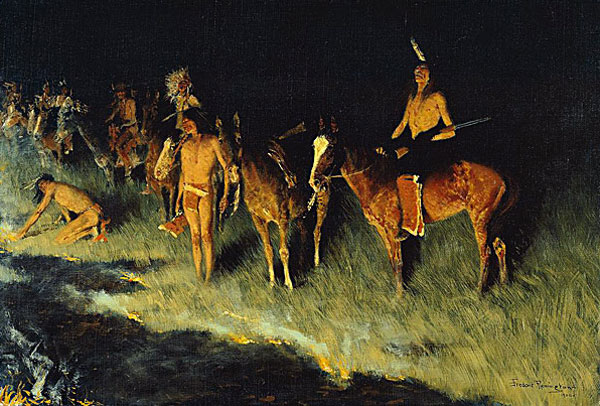
Native Americans setting grass fire, painting by Frederic Remington, 1908

Oddly, many invasion biologists accept these new understandings of ecological science without changing their deep commitment to eradicating all non-native plants and animals.  Daniel Simberloff published an article about the current status of the concept of “balance of nature” simultaneously with the publication of his defense of invasion biology.  He described the current thinking about this concept: “…a widespread rejection of the idea of balance of nature by academic ecologists, who focus rather on a dynamic, often chaotic nature buffeted by constant disturbances.”

Invasion biologists have therefore revised their goal for ecological “restorations” to accommodate their new understanding of the dynamic nature of ecosystems.

The revised goal of ecological “restorations”

If the return to an equilibrium state is no longer the goal of ecological “restorations,” what is the new goal?  This is how invasion biologists writing in defense of their discipline described their goal: “…we should seek to reestablish – or emulate, insofar as possible – the historical trajectory of ecosystems, before they were deflected by human activity, and to allow the restored system to continue responding to various environmental changes…” (1)

In this post we will deconstruct this new definition of the goal of ecological “restorations.”  Our first problem with this new definition is that we don’t know the “historical trajectory” of a landscape because it is fundamentally unknowable.  We would have to reconstruct all the events and changes in the environment in the Bay Area in the past 250 years in the imagined absence of any Europeans.  Even if we knew what would have happened without our presence, we cannot then ensure the continuation of that imagined environment because, the fact is, WE ARE HERE AND WE AREN’T GOING AWAY!

Because we cannot reconstruct an imagined environment that has not been “deflected by human activity,” restorationists—who are the practitioners of invasion biology–focus on the one element in the environment of which there is sufficient historical knowledge, i.e., plants.  Most local restoration projects eradicate all non-native plants and trees, usually using herbicides to accomplish that task.  They rarely plant anything after this eradication attempt because they don’t have the resources to do so.  Those few projects that re-plant after non-natives are eradicated usually irrigate the new landscape for several years.  Here is an incomplete list of everything these projects do not do to replicate an historical landscape:

  • Soils are not restored for many reasons:
    • We have no way of knowing the composition of soil 250 years ago.
    • Soils have been altered by the plants that have been growing in them and by the herbicides used to kill those plants.
    • Urban soils have high nitrogen levels resulting from exposure to fossil fuel exhaust.
  • The atmosphere is not restored:
    • There are much higher levels of ozone and carbon dioxide than there were 250 years ago.
  • The climate is not restored:
    • The temperature is higher than it was 250 years ago.
    • The timing of seasons has therefore changed.
    • Precipitation and fog have changed in known and unknown ways.
  • The disturbance events that sustained historical landscapes or set them on another evolutionary course are not restored:
    • We cannot set fire to urban landscapes annually without polluting our air and endangering our lives.
    • We cannot allow our creeks and rivers to overflow in urban areas without damaging our properties.
  • Most occupants of the historical landscape are not reintroduced:
    • The grazing animals that helped to sustain grassland are gone and cannot be returned to urban landscapes.
    • The top predators such as bears and wolves that kept grazing and other animals in balance with available resources cannot be returned without threatening our safety in an urban setting.
    • Many insects that lived in these historical landscapes are unknown to us and some are extinct.
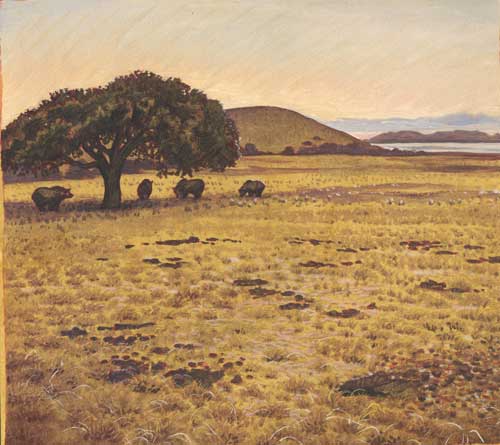
The El Cerrito Plaza with the Albany Hill in the background, centuries ago.  Oil painting by Laura Cunningham, with permission
Bears roamed the grasslands in the Bay Area, preventing over-population of grazing animals. The El Cerrito Plaza with the Albany Hill in the background, centuries ago. Oil painting by Laura Cunningham, with permission

In other words, destroying plants will not “restore” an historical landscape.  Nor will it return that landscape to its “historical trajectory” even if that trajectory were known or knowable.  Plants live in complex communities in which they are interacting with everything in the environment.  Local “restoration” projects do not “restore” an historical landscape because they do not and cannot change anything other than the plants that occupy the space.  Because most environmental variables have not been altered by these projects, the landscape will quickly return to its unrestored state unless it is intensively gardened.  In that case, the landscape will be continuously “deflected by human activity,” which violates the original goal of invasion biologists.

Misanthropic premise of invasion biology

The revised goal of invasion biology is unattainable because the absence of humans is a prerequisite for its attainment.  We cannot know and we cannot replicate a theoretical historical trajectory for ecosystems in which humans were not present.  And when we modify ecosystems in an attempt to do so, human activities will determine their future trajectory. The premise of invasion biology is that success of ecological “restorations” depends upon the absence of humans. Therefore, invasion biology has no practical application in the real world.   


  1. Carolina Murcia, James Aronson, Gustavo Kattan, David Moreno-Mateos, Kingsley Dixon, Daniel Simberloff, “A critique of the ‘novel ecosystem’ concept,”Trends in Ecology and Evolution, October 2014, Vol. 29, No. 10

Where does it belong?

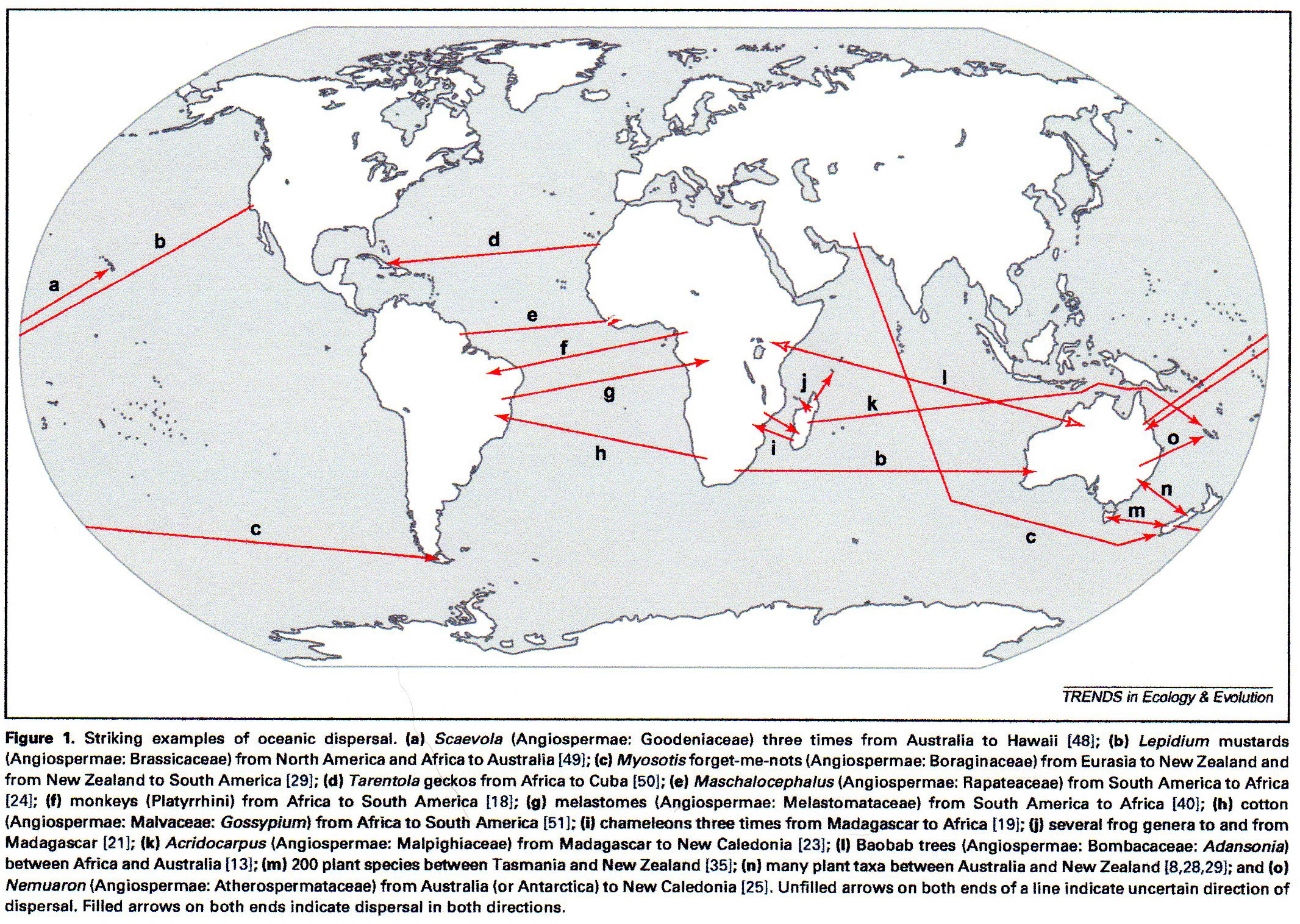
The advent of molecular genetic analysis about 50 years ago is making it possible to determine the relationships between species of plants and animals.  As this analytic method becomes more sophisticated and more accessible, we are slowly learning more about how plants and animals have been dispersed around the earth, often great distances, sometimes crossing oceans.  Here is an illustration of some of the long-distance dispersal of species across oceans which have been identified (1):

Oceanic Dispersal


Look closely at the dispersal labeled “b.”  This line describes the travels of a genus of plant (Lepidium) in the mustard family (Brassicaceae) which arrived in Australia from California and Africa in two separate dispersal incidents:  “This [molecular] pattern is likely explained by two trans-oceanic dispersals of Lepidium from California and Africa to Australia/New Zealand…” (2)

Lepidium flavum found alongside the road in Tecopa, California.  Creative Commons - Stan Shepp
Lepidium flavum found alongside the road in Tecopa, California. Creative Commons – Stan Shepp

Calibration of the molecular trees indicates the arrival of this plant in Australia/New Zealand in the Pleistocene geologic era, between .3 and 1.3 million years ago.  The authors of this study speculate that mucilaginous (sticky surface) seeds were carried by birds:  “…sea bird migration pathways between coastal California and Australia/New Zealand and South Africa and Australia/New Zealand are fully compatible with the proposed colonization scenario.”  (2)

Flowers and seed capsules of Blue Gum eucalyptus

We know that eucalyptus seeds were brought to California in the mid-19th Century by humans who came by boat.  But can we imagine a scenario in which the seeds could have been carried in their protective seed capsules on ocean currents?  And is the fact that the seeds were carried in a ship across the ocean really so very different from them being carried on the currents?

Few of these long-distance dispersals have been identified so far, but many more are likely to be identified in the future as this analytic method becomes more widely available.

Next time you hear a nativist say, “It doesn’t belong here” when explaining why a plant or animal must be killed, please think about this example of the natural dispersal of plants and animals across the oceans to new homes.  Who is to say that it doesn’t belong here?


  1. Alan de Queiroz, “The resurrection of oceanic dispersal in historical biogeography,” Trends in Ecology and Evolution, 20 No. 2, February 2005
  2. Klaus Mummenhoff, et. al., “Molecular evidence for bicontinental hybridogenous genomic constitution in Lepidium sensu strict (Brassicaceae) species from Australia and New Zealand,” American Journal of Botany, February 2004

Do insects prefer native plants?

We follow Doug Tallamy’s publications closely because he is the academic scientist most often quoted by native plant advocates to support their belief that insects require native plants and that the absence of the native plants will result in the collapse of entire ecosystems:   “…our wholesale replacement of native plant communities with disparate collections of plants from other parts of the world is pushing our local animals to the brink of extinction—and the ecosystems that sustain human societies to the edge of collapse.” (1)

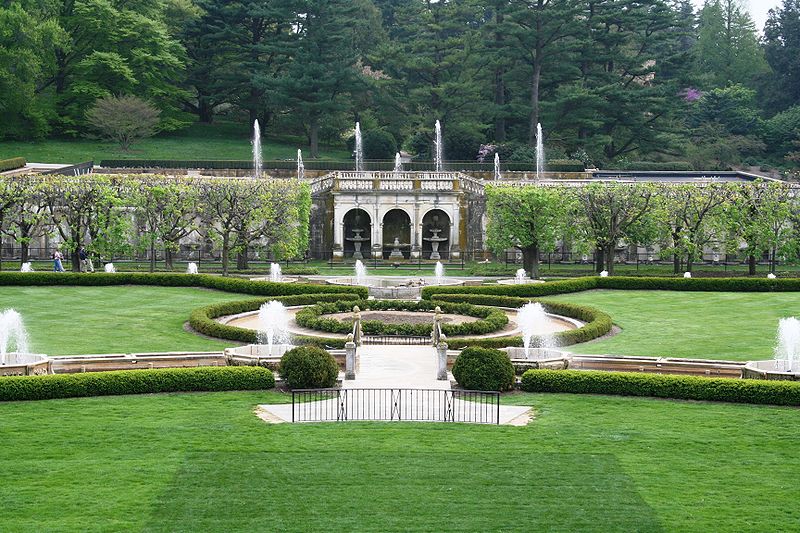
Main fountains of Longwood Gardens.  Creative Commons - Share Alike
Main fountains of Longwood Gardens. Creative Commons – Share Alike

Tallamy co-authored his most recent publication, The Living Landscape:  Designing for Beauty and Diversity in the Home Garden, with Rick Darke, curator of plants at Longwood Gardens for 20 years.  Longwood is a formal garden outside of Philadelphia, which seems at odds with the exclusively native gardens for which Tallamy advocates.  And so we were intrigued by this unlikely team.  Darke’s introduction to the book implies a departure from Tallamy’s usual mantra:

“Is this a book only about gardening with native plants?  No.  It’s a book about how native plants can play essential roles in gardens designed for multiple purposes, with a focus on proven functionality.  For better and worse, the native plant movement in North America has evolved in the last decade…One of the most important functionalities is durability:  the capacity to thrive over a long time without dependence on resource-consuming maintenance regimes.  Claims that natives are always better than exotics fail to take into account radically altered environmental conditions in many suburban landscapes…In most cases and most places, the design of broadly functional ecologically sound, resource-conserving residential gardens requires a carefully balanced mix of native and non-native plants.  It’s time to stop worrying about where plants come from and instead focus on how they function in today’s ecology.  After all, it’s the only one we have.”  (2)

Tallamy writes his own introduction to The Living Landscape, which suggests a softening of his hard-line insistence upon gardening exclusively with native plants:

“What is native in any given place today wasn’t native if we look back far enough in time, and it is certain that what will be native in that same place in the future will be different from what is native now.  Functional ecological relationships take a long time to evolve—often thousands of years—but they do evolve.  Humanity’s challenge is to reduce its introduction of rapid environmental changes that are currently causing extinctions to occur faster than the evolution of new species.”  (2)   

Has Tallamy’s viewpoint evolved?

When we reported on Tallamy’s previous publication in 2012, we quoted him as saying that a graduate student under his direction could not find any evidence that native plants were eaten by insects more frequently than non-native plants:

“Erin [Reed] compared the amount of damage sucking and chewing insects made on the ornamental plants at six suburban properties landscaped primarily with species native to the area and six properties landscapes traditionally.  After two years of measurements Erin found that only a tiny percentage of leaves were damaged on either set of properties at the end of the season…Erin’s most important result, however, was that there was no statistical difference in the amount of damage on either landscape type.”  (1)

May we conclude that Tallamy no longer believes that native plants are required by insects?  No, we may not.  In Living Landscape he takes a different approach to this question.  He collaborated in three studies which found more insects in native gardens than in non-native gardens:

  • Significantly more caterpillars of butterflies and moths were found in suburban gardens of predominantly native plants compared to gardens of predominantly non-native plants. This study also quantified the number of birds found in these gardens and concluded that “…the negative relationship between non-native plant abundance and bird community integrity is apparent in managed ecosystems as well, regardless of whether the non-native species are invasive.”  This seemed a leap of faith, given that the inventory of insects was done in a six-week period in August and September and the inventory of birds was done in a six-week period in June and July, rendering a cause-and-effect relationship dubious.
  • Two other studies were conducted in a constructed garden in which native and non-native plants were paired for comparisons. Some of the pairs were in the same genus.  Again, significantly more caterpillars and other plant-eating arthropods were found on native plants, although the differences were much smaller when the plants were in the same genus, which are often—but not always–chemically similar.

Reconciling apparent contradictions

So, how are we to reconcile these studies which find more insects on native plants with other studies which report otherwise?

  • Here in the San Francisco Bay Area, we rely on the research of Professor Arthur Shapiro to inform us of which plants are useful to our butterflies. He tells us:  “Most California natives in cultivation are of no more butterfly interest than nonnatives, and most of the best butterfly flowers in our area are exotic.” (3) The difference between Professor Shapiro’s studies and those cited by Professor Tallamy is that Professor Shapiro has been studying butterflies in “natural areas” rather than cultivated gardens.  Most of the plants that he finds butterflies using are considered weeds, such as non-native fennel and star thistle, which we wouldn’t find in suburban gardens.  We speculate that this difference accounts for some of the difference in findings. 
  • Furthermore, the studies reported by Professor Tallamy only seem contradictory. In fact, if we look at them closely we find that one reports no difference in what caterpillars eat, but considerable difference in where they are found.  And this strange difference is consistent with the scientific literature.  A meta-analysis of hundreds of studies of insect-plant interactions published by Annual Review of Entomology reports these findings:  “Herbivore densities are lower on invasive plants than on native plants, but there is no evidence that invasive plants overall suffer from less damage inflicted by native herbivores.” (4)

Go figure!  More herbivores are found on native plants, but they don’t eat more native plants than they do non-native plants.

A parting shot

Professor Tallamy urges suburban gardeners to take insects into account when making their gardening choices and, of course, we agree.  However, he closes his pitch for gardening with natives in The Living Landscape with a story which seems superficially compelling but doesn’t hold up to close scrutiny.

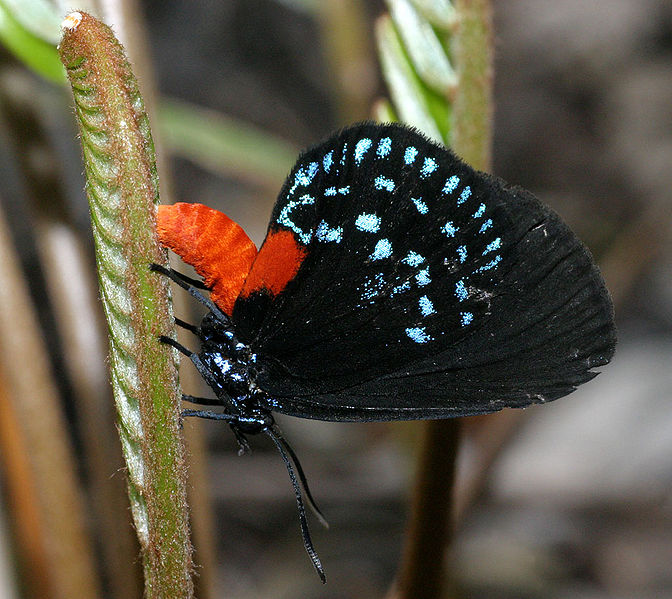
Eumaeus atala butterfly laying eggs on coontie.  Creative Commons - Share Alike
Eumaeus atala butterfly laying eggs on coontie. Creative Commons – Share Alike

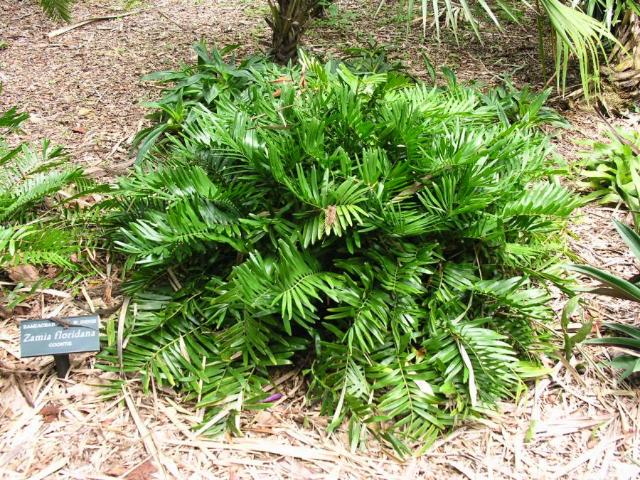
There is a beautiful butterfly (Eumaeus atala) in Florida that was historically dependent upon a particular native plant, coontie, which is a species of cycad.  Coontie was popular with early settlers as a food flavoring and was nearly wiped out early in the 20th century, along with the atala butterfly which was dependent upon it as its host plant.  Tallamy claims that the atala made a comeback when coontie became a popular plant for suburban gardens.  This makes a powerful case for how suburban gardeners can participate in efforts to conserve our native butterfly fauna.

Coontie.  Photo by Dan Culbert, University of Florida
Coontie. Photo by Dan Culbert, University of Florida

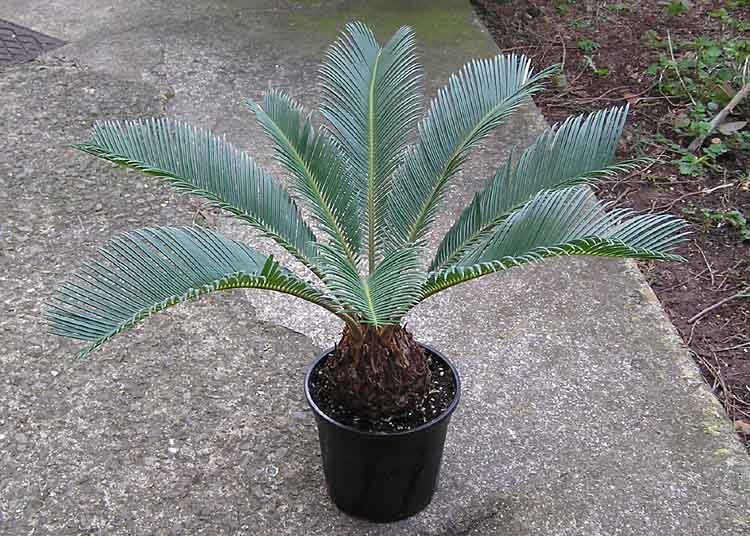
But is it true?  Wikipedia says it’s not:  “The atala is now common locally in southeast Florida rebounding to some extent as it has begun to use ornamental cycads planted in suburban areas.”    This is an example of how chemically similar plants can be useful to native insects, whether they are native plants or introduced, non-native, ornamental plants.

Sago cycad palm
Sago cycad palm is an example of an ornamental cycad

We apologize for being repetitive, but for the record we will close with the reminder that Million Trees urges everyone to plant whatever they want in their own gardens.  In public open spaces, which belong to everyone, we ask only that land managers quit destroying trees and using pesticides for the sole purpose of attempting to eradicate non-native plants.  The audience for Professor Tallamy’s publications is private gardeners, so we don’t really have a beef with him.  We critique his rationale for his preference for native plants only because it is often cited by those who demand the eradication of non-native plants and trees in our public open spaces.

The Living Landscape is a beautiful book, which we recommend to our readers for its lovely photos of naturalistic landscapes.


  1. Doug Tallamy, “Flipping the Paradigm:  Landscapes that Welcome Wildlife,” chapter in Christopher, Thomas,The New American Landscape, Timber Press, 2011
  2. Rick Darke and Doug Tallamy, The Living Landscape: Designing for Beauty and Diversity in the Home Garden, Timber Press, 2014
  3. Arthur Shapiro, Field Guide to Butterflies of the San Francisco Bay and Sacramento Valley Regions, University of California Press, 2007
  4. Martijn Bezemer, et. al., “Response to Native Insect Communities to Invasive Plants,” Annual Review of Entomology, January 2014.

A defensive tirade from invasion biologists

Pesticide use by land managers in California.  Source California Invasive Plant Council
Pesticide use by land managers in California. Source California Invasive Plant Council

An international team of invasion biologists has just published a defense of their academic turf, invasion biology.  (1) Daniel Simberloff, an American member of the team, is the most relentless defender of the crusade to eradicate all non-native species, wherever they are found, all over the world.  Their publication acknowledges the mounting criticism of this crusade and attempts to respond to that criticism, but what is most notable is what is missing from their attempt to defend their opinions.  They make no mention of the harmful methods used to eradicate non-native species:

Keep these damaging methods in mind as we visit the hypocritical and contradictory arguments used to justify the projects for which these invasion biologists advocate.  They set up “novel ecosystems” as the straw man to which they compare the goals of invasion biology.  They define novel ecosystems as “a new species combination that arises spontaneously and irreversibly in response to anthropogenic land-use changes, species introductions, and climate change, without correspondence to any historical ecosystem.”

“Lack of rigorous scrutiny”

Their primary criticism of the concept of “novel ecosystems” is that it has not been “subjected to the scrutiny and empirical validation inherent in science” and its definition is “impaired by logical contradictions and ecological imprecisions.”   These criticisms apply equally to invasion biology.

Hypothesis n % of supporting studies % of decline in support
Invasional meltdown

30

77%

41%

Novel weapons

23

74%

25%

Enemy release

106

54%

10%

Biotic resistance

129

29%

5%

Tens rule

74

28%

10%

Island Susceptibility

9

11%

25%

Although support is strongest for the invasional meltdown hypothesis, recent studies are less supportive than early studies, indicating substantial decline in supporting evidence.  Declining evidence of invasional meltdown is consistent with the fact that exotic species are eventually integrated into the food web which reduces their populations, stabilizing their spread. There is apparently little evidence that islands are more susceptible to invasion than continents and few studies have been done to test the hypothesis.

If empirical validation and semantic precision are required to establish the credibility of scientific hypotheses, invasion biology has failed that test.

“Precautionary principle of conservation and restoration”

These invasion biologists define the precautionary principle of conservation and restoration as follows:  “we should seek to reestablish –or emulate, insofar as possible—the historical trajectory of ecosystems, before they were deflected by human activity.”  This is an unusual use of the precautionary principle, which is more typically defined as avoiding damage to the environment by not using potentially harmful methods, even in the absence of solid evidence of such harm.  The precautionary principle was not used when the following “restoration” projects were defined or implemented:

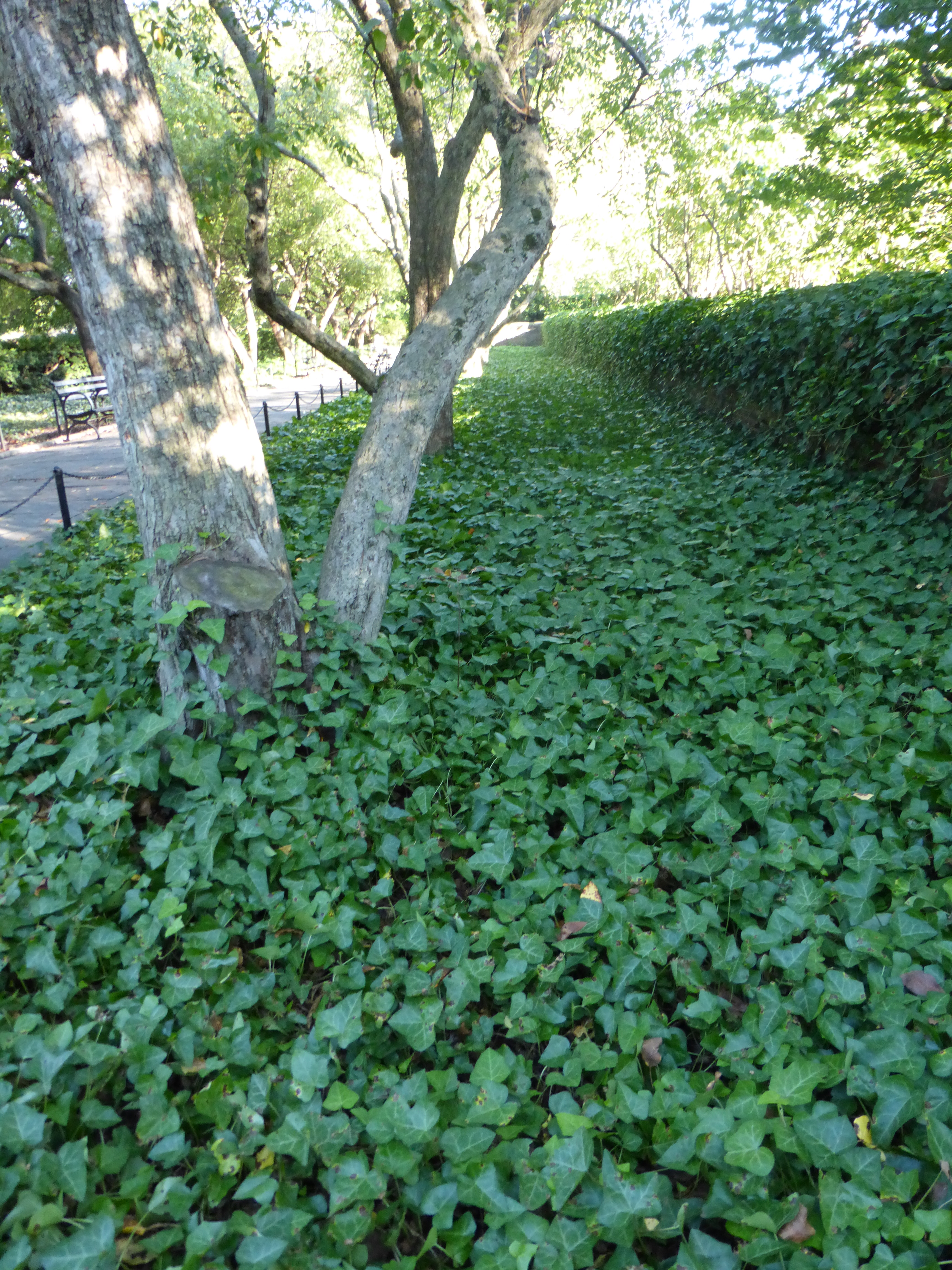
Ivy in the Conservatory in Central Park, New York City

In 1996, Daniel Simberloff made this statement in his publication about the hazards of biological controls:  “…are there any protocols for biological-control introductions that would prevent all disasters?  Probably not…” (2) Yet, in 2013, he expressed his support for the introduction of non-native insects to control cape ivy at a conference at UC Davis sponsored by the California Department of Food and Agriculture.  Although cape ivy is despised by native plant advocates, it is not an agricultural pest and therefore causes no economic damage to ecosystems, unless money is wasted on attempts to eradicate it.

“All ecosystems should be considered candidates for restoration”

In response to those who find value in novel ecosystems, these invasion biologists find none.  They reject the possibility that there is ever a point at which it may not be possible to re-create a historical landscape.  They continue to believe that ANY and ALL radically altered landscapes CAN and SHOULD be considered candidates for restoration.  Their only caveat to this universal goal is that “damaged ecosystems…should be evaluated for feasibility, desirability, and cost-effectiveness, on a case-by-case basis, so that informed and science-based policy decisions can be made, in consultations with scientists, restoration practitioners, stakeholders, and advisors.”

These criteria for potential “restoration” have nothing to do with reality:

  • Most projects in the San Francisco Bay Area have not provided cost estimates when they were planned. The public demanded cost estimates for the projects of the Natural Areas Program in San Francisco, but these demands were ignored.  Therefore, “cost-effectiveness” is not usually considered when these projects have been shoved down the public’s throat.
  • We consider the public to be “stakeholders” in decisions to radically alter our public open spaces. We are the visitors to these areas and our tax dollars pay for their acquisition, maintenance, and “restoration.”  Yet, managers of public land are consistently making those decisions without taking the public’s opinion into consideration.  Most projects are planned and executed without any public participation.  In the few cases in which there are environmental impact reviews, the projects are implemented regardless of overwhelming opposition of the public.

 “Human-damaged ecosystems can be at least partially restored”

The demonstrated futility of “restoration” projects is one of many reasons why there is waning public support for attempting them.  Yet, invasion biologists who authored this diatribe claim that “restored sites recovered on average 80-86% of biodiversity and ecosystem services…and showed improvements of 125-144% over degraded ones.”  This claim is contradicted both by other scientific studies and by experience with local projects:

  • “…this paper analyses 249 plant species reintroductions worldwide by assessing the methods used and the results obtained from these reintroduction experiments…Results indicate that survival, flowering and fruiting rates of reintroduced plants are generally quite low (on average 52%, 19%, and 16% respectively). Furthermore, our results show a success rate decline in individual experiments with time.  Survival rates reported in the literature are also much higher (78% on average) than those mentioned by survey participants (33% on average).” (3)
  • Dunnigan Test Plot, Augusst 2011.  The result of an eight-year effort to restore native grassland.  Does it look "biodiverse?"  ecoseed.com.
    Dunnigan Test Plot, August 2011. The result of an eight-year effort to restore native grassland. Does it look “biodiverse?” ecoseed.com.

    There is frequently a discrepancy between the success rates claimed in papers and those actually observed. For example, Cal-Trans gave researchers at UC Davis $450,000 to restore 2 acres of non-native annual grassland to native grassland.  UC Davis researchers spent 8 years and used multiple methods to achieve this transition.  When they ran out of money, they declared success in their published report.  They defined success as 50% native plants which they expected to last 10 years before being entirely replaced by non-native annual grasses again.  Do you consider that a success?

  • On a more anecdotal level, we watch established landscapes that have required no maintenance in the past being transformed into weedy messes by failed “restoration” projects. Then, adding insult to injury, we hear those who are responsible for these failures tell us how successful they are.

“Inadequate political will”

The authors of this publication conclude:

“No proof of ecological thresholds that would prevent restoration has ever been demonstrated.  Often the threshold that obstructs a restoration project is not its ecological feasibility, but its cost, and the political will to commit to such cost.” (1)

We are reminded of an old football adage:  “The best defense is a good offense.”  In other words, invasion biology is under fire, but the reaction of invasion biologists is to demand more….more money, more effort, and the commitment of public land managers to “restore” all ecosystems, regardless of what the public wants.  And in support of that aggressive strategy, they refuse to acknowledge the damage that is being done to the environment and the animals that live in it, by the projects they demand.

The authors of this defensive tirade have hammered another nail in the coffin of invasion biology.


  1. Carolina Murcia, James Aronson, Gustavo Kattan, David Moreno-Mateos, Kingsley Dixon, Daniel Simberloff, “A critique of the ‘novel ecosystem’ concept,” Trends in Ecology and Evolution, October 2014, Vol. 29, No. 10
  2. Daniel Simberloff and Peter Stiling, “How Risky is Biological Control?” Ecology, 77(7), 1996, pp 1965-1974
  3. Sandrine Godefroid, et. al., “How successful are plant species reintroductions?” Biological Conservation,   144, Issue 2, February 2011

Where does it end?

It is our pleasure to republish with permission a post from the website of Flood Creek Non-Nativist Landcare Group.  Flood Creek is located in Braidwood, New South Wales, Australia.  Across Australia, Landcare is a popular volunteer-based environmental movement which enjoys general support from government in the form of occasional financial grants. Over the last 25 years, many Landcare groups have undertaken projects with the stated goal of eradicating non-native plants based on a belief that native plants and animals would benefit.  That strategy will sound familiar to our readers, as will the damage to the environment which it causes.  

The Non-Nativist Landcare Group is a small team of people with a history of participation in Landcare who want to foster a discussion of current nativist approaches to environmental management, and question their outcomes.  Based on their experiences with conventional Landcare projects, the Non-Nativist Landcare Group has concluded that these often do more harm than good.  The Group describes their mission:   “Above all, this discussion is inspired by the goal of taking a more ecologically-based and functional approach to Australian socio-ecological systems and their health. We seek to highlight the inconvenient-truth that rational environmental management can never be based upon a simple mantra of “natives good, non-natives bad”. Extermination is rarely an effective way to promote landscape diversity and resilience.”

Please visit their website and wish them well in their effort to find a less destructive approach to land management.


When you look at the willful and wanton environmental destruction conveyed in these photographs you must ask yourself: ‘how could anyone do this in the name of environmentalism?’ After all the disturbance we’ve already inflicted upon this biosphere, how is this really helping?

Flood Creek 1


In this example of willow demolition, the trees were cut down and dragged away and the stumps were poisoned. Then (for some unfathomable reason) a drainage ditch was excavated into the floodplain. In the photo below, the main flow-line is 40m off to the left.

Flood Creek 2

Apart from the economic motives at play (a theme for a future post), I can think of only one reason why an ‘environmentalist’ might condone this kind of damage and disturbance. It must be to do with that old adage, ‘the end justifies the means‘.

The reasoning seems to be: ‘Sure, it makes a big mess and causes erosion, and nutrient release, and carbon emissions, and local temperature increases, and loss of habitat, but it’s necessary because we’re going to make Australia a place for natives-only again.’

So that’s the end we’re aiming for: a ‘native-only’ Australia. And these photos show the means we must accept along the way.  It seems we’re just going to remove all of the non-natives from this continent so the environment is back to ‘pristine’ again and then we can stop with the chainsaws and excavators and herbicides in the name of ‘saving’ the environment.

Flood Creek 3

We just want 1788-Australia back. Presumably without the dingoes and without the previous intrinsic Aboriginal management; plus with a few minor additions like cattle; and sheep; and horses; and apples; and asparagus; and hops; and wheat; and rice; and trout; and tomatoes; and lettuce; and cats; and dogs; and goldfish; and maybe just one or two other things, but that’s it! And we want all the ‘invasive’ natives, like Cootamundra Wattle, and Sweet Pittosporum, and Kookaburras to know their place and to go back where they were when Europeans first arrived….And stay there forever and ever….And not move just because the climate or fire regime has changed. And this won’t happen by itself so we’ll need funding and legislation and heavy machinery. And we’re going to fix it all ‘real good’ without knowing what it was actually like or exactly what species existed in many parts of the country back in 1788. And….and…..

Flood Creek 4

….And then again……When you think about it…..Are we ever actually going to achieve anything even remotely approaching a native Australia?…..really?

I doubt it.

And I’d doubt the sincerity (or sanity) of anyone who says that we could. Surely nobody actually believes this?

So, given this impossibility, it seems pretty reasonable to ask ourselves: ‘how can the end justify the means, when it’s clear there really is no conceivable end?’ If it just goes on and on forever, then how do we justify these means to no end at all? How do we live with this permanent state of expensive self-congratulatory environmental vandalism?

More importantly, given how well-supported the above activities currently are, how do objecting grassroots Landcarers begin to articulate new ways to work with the adaptive living-landscapes around us? And how do we influence the direction of our own movement so that participation in Landcare is not assumed to mean support for this destruction?


All the death and destruction in these photographs is familiar to us here in the San Francisco Bay Area.  The only difference is that the trees that were destroyed in this project were willows, which are native in California, but not native in Australia.  That difference helps us appreciate the arbitrariness of nativism, which treats eucalyptus as demons and willows as the “good” trees in California.  

We have yet to witness a “restoration” that wasn’t far more destructive than constructive.  And based on our experience in the San Francisco Bay Area, we can venture an answer to the rhetorical question, “Where does it end?”  It doesn’t end because every “restoration” is quickly occupied again by the plants that were destroyed by herbicide applications.  As long as the objective continues to be to kill everything non-native and re-populate a landscape with native plants, the project will never be complete. 

 Therefore, it only ends when the goal is revised and/or the effort is no longer funded.  And the only way to achieve that revised goal is for the public to object to the destruction of their public lands.  So, if you are tired of witnessing these destructive projects, speak up!  Tell your elected representatives that you don’t want your tax dollars spent on the pointless ruin of public open space. 

Parks of New York City

Perhaps it’s a bit of an exaggeration to say that New York City is the center of America’s cultural universe, but when it comes to park history and design, it’s an accurate accolade.  It is the home of the first major park in the country, Central Park, as well as the most modern park innovation, High Line Park, an elevated railroad re-purposed into an urban trail park.  We will visit those parks in today’s post and think about what has changed and what remains the same in the 150 years that separate the design of those quintessentially American parks.

Central Park

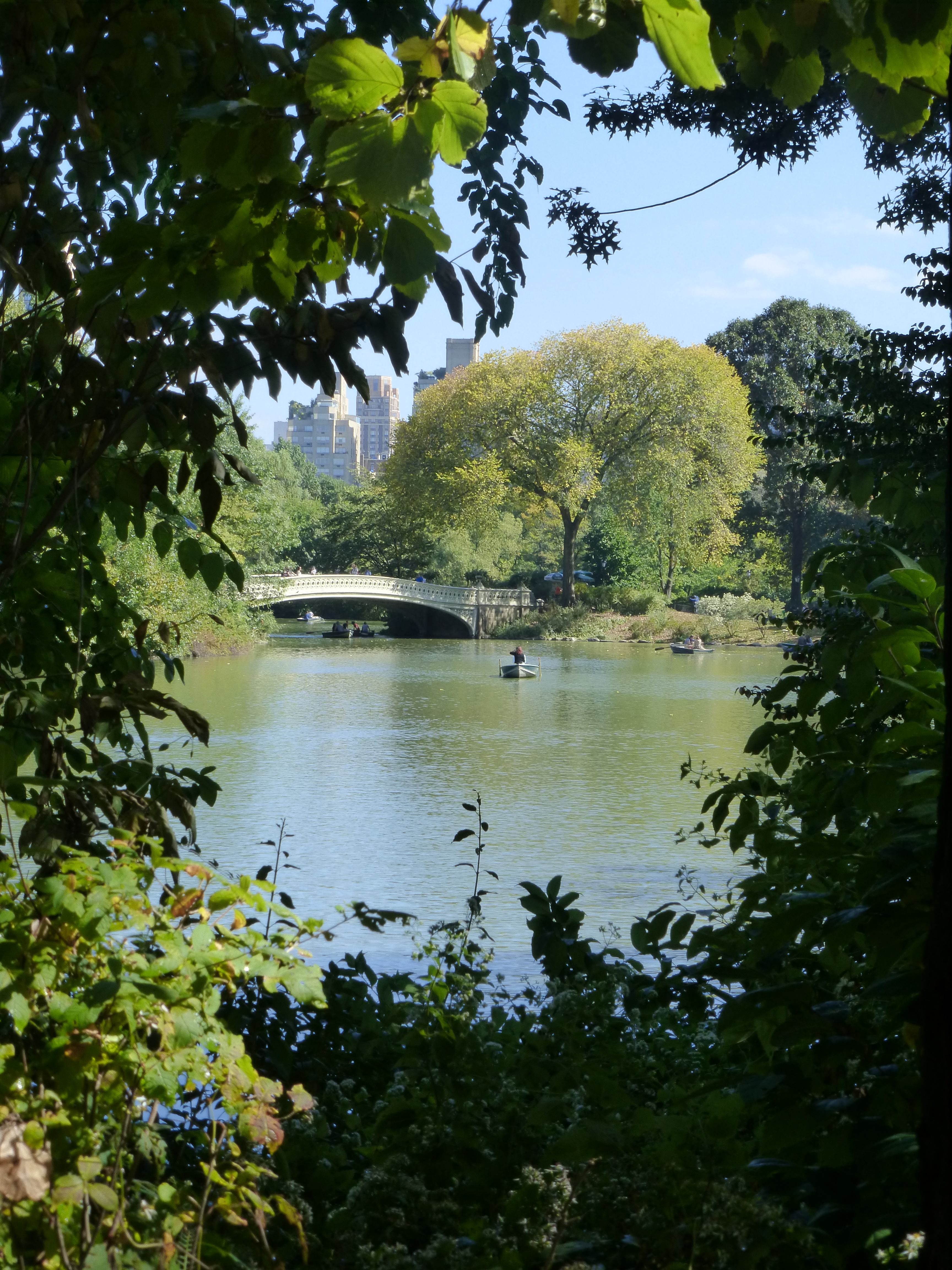
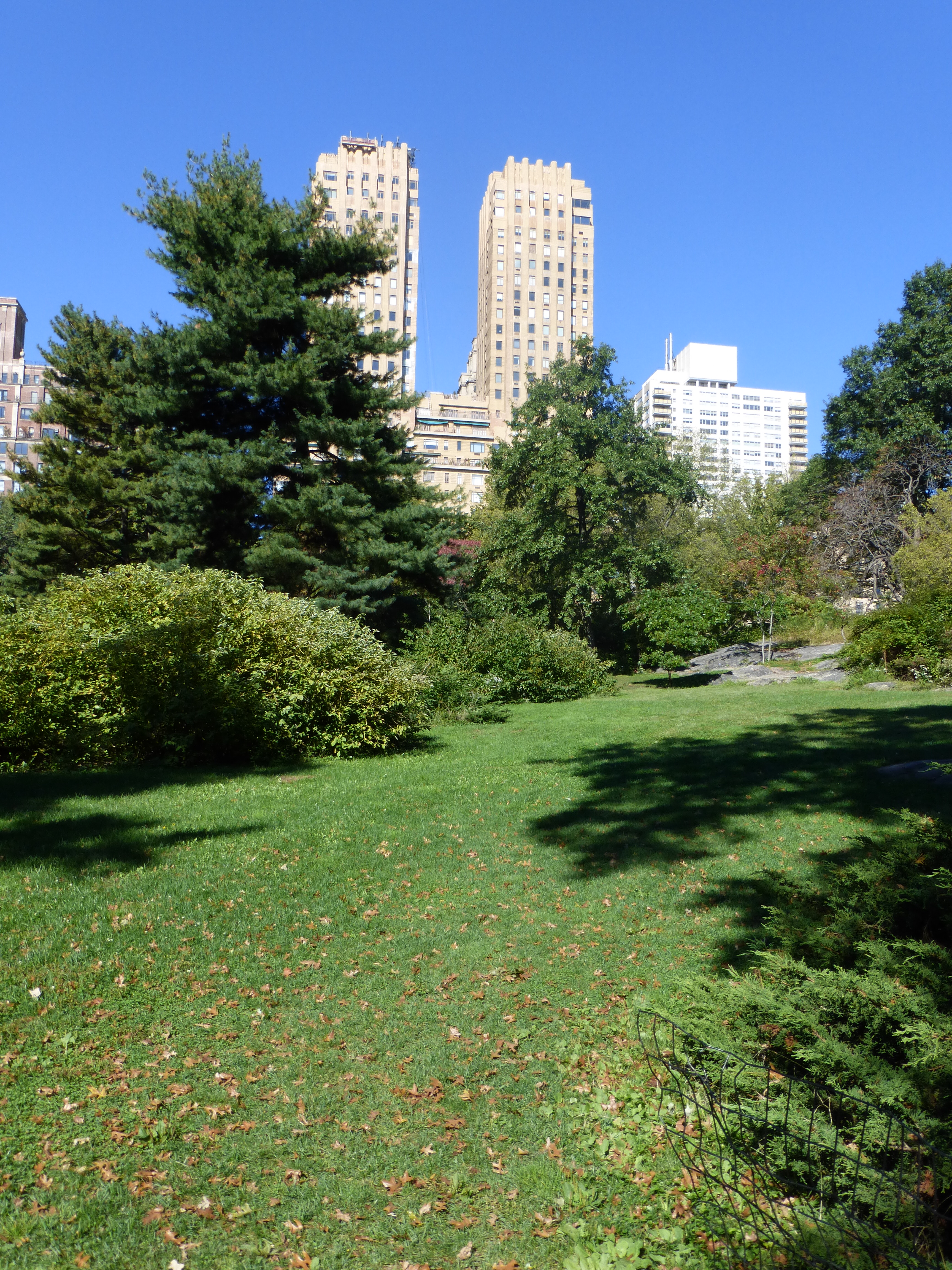
Central Park was designed and built by Frederick Law Olmstead and Albert Vaux before the Civil War.  It opened in 1857 to great fanfare and has been as central to the vitality of New York City as its name implies, since its opening.  It reflects the design sensibilities of Olmstead and the engineering genius of Vaux.  It looks completely natural, but virtually everything in it—its lakes, its streams, its hills—was constructed.

Central Park
Central Park

Olmstead was partial to a green landscape with long vistas across meadows and lakes.   He wasn’t inclined to plant colorful flowerbeds, though he could oblige when his clients demanded it.  The trees and plants he chose for Central Park were as likely to be native to New York as not.  His previous experience in agriculture informed his choices so survival of the landscape was ensured.

P1010588
Central Park

It’s not a coincidence that Olmstead’s plant list was not confined to native species because the concept of “nativeness” wasn’t defined when Central Park was designed.  “The modern division of species into native and alien first appears in the writings of Hewett Cottrell (H.C.) Watson in the mid-nineteenth century.” Watson was an amateur British botanist who was aware that some plant species had been introduced to Britain and he decided that some sort of classification system was needed to keep track of such species.  “He was the first to define ‘native’ in the modern sense:  ‘apparently an aboriginal British species, there being little or no reason for supposing it to have been introduced by human agency.’”  (1)

Watson acknowledged that distinguishing between aboriginal and introduced species wasn’t easy and he did not consider introduced species inferior to aboriginal species.  For the next one hundred years, opinions of the relative merits of aliens and natives varied.  Sometimes aliens were considered a problem and sometimes they were considered a benefit to ecosystems.  Sometimes such problems were attributed to the introduced plants and sometimes they were attributed to underlying factors.

All this changed in 1958 with the publication of Charles Elton’s book The Ecology of Invasions by Animals and Plants.  Today’s invasion biologists, if questioned, generally claim Elton’s book as their inspiration, and it has been described as signaling ‘the beginning of the field of invasion biology…’  But in many ways it is an odd book.  It isn’t a scientific book in the usually accepted sense, nor is it a textbook.  It is in fact a popular polemic, based to a large extent on a series of radio talks that Elton gave to the BBC.  But what is not in doubt is that it sits squarely in the tradition of blaming introduced species for practically any environmental ill you care to mention…” (1)

Olmstead was not burdened by the constraints of nativism in the 1850s and so he was free to plant whatever he considered beautiful and suited to the climate and conditions in New York.  We are fortunate to have this living evidence today that native and non-native plants survive  and thrive together in Central Park.  Central Park is the home of hundreds of species of birds and the temporary home of hundreds more species of migratory birds every spring and fall.

High Line Park

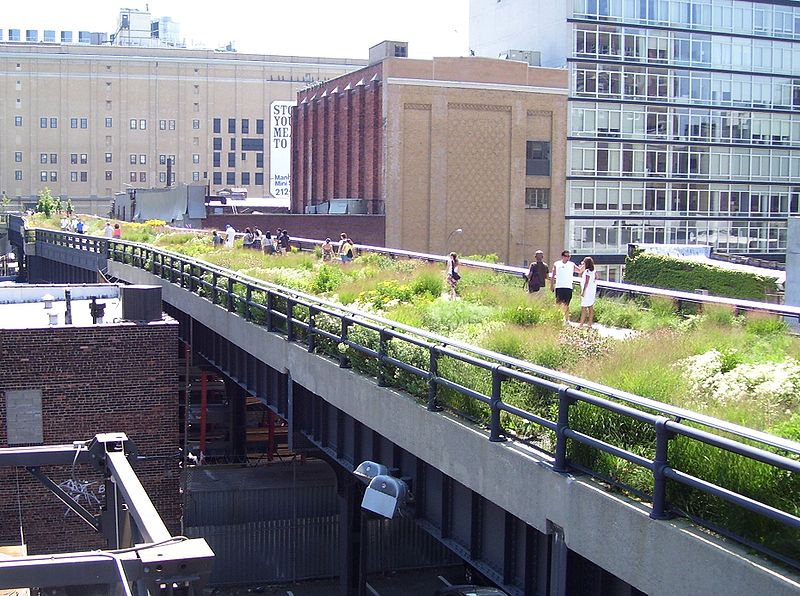
The High Line began in 1846 as a railroad line on the West Side of Manhattan, which transported unprocessed meat to the meat processing district and processed meats out of Manhattan.  In 1934, after many people were killed in collisions with the train, 13 miles of train were elevated 30 feet above the street, bypassing the cross-traffic from 34th Street to St. John’s Park Terminal at Spring Street.  In 1980, the last train on the High Line transported frozen turkeys from the meat processing district.  Soon thereafter, neighbors organized to prevent the demolition of the High Line.  The re-creation of the High Line as a park began in 2006.

High Line Park, New York City
High Line Park, New York City. Creative Commons – Share Alike
Landscape of first phase of High Line Park

The first phase of High Line Park opened in 2009, the second phase in 2011, and the third opened on September 21, 2014.   All three phases opened to rave reviews.  The park became an instant success both with New Yorkers and with tourists.  Over 5 million people visit the High Line every year.  Having seen it, we can report it is no mystery why it is so popular.  It is a safe walk above the congested streets of New York with fabulous views of the Hudson River, the surrounding neighborhood, and the dramatic skyline of the Manhattan.

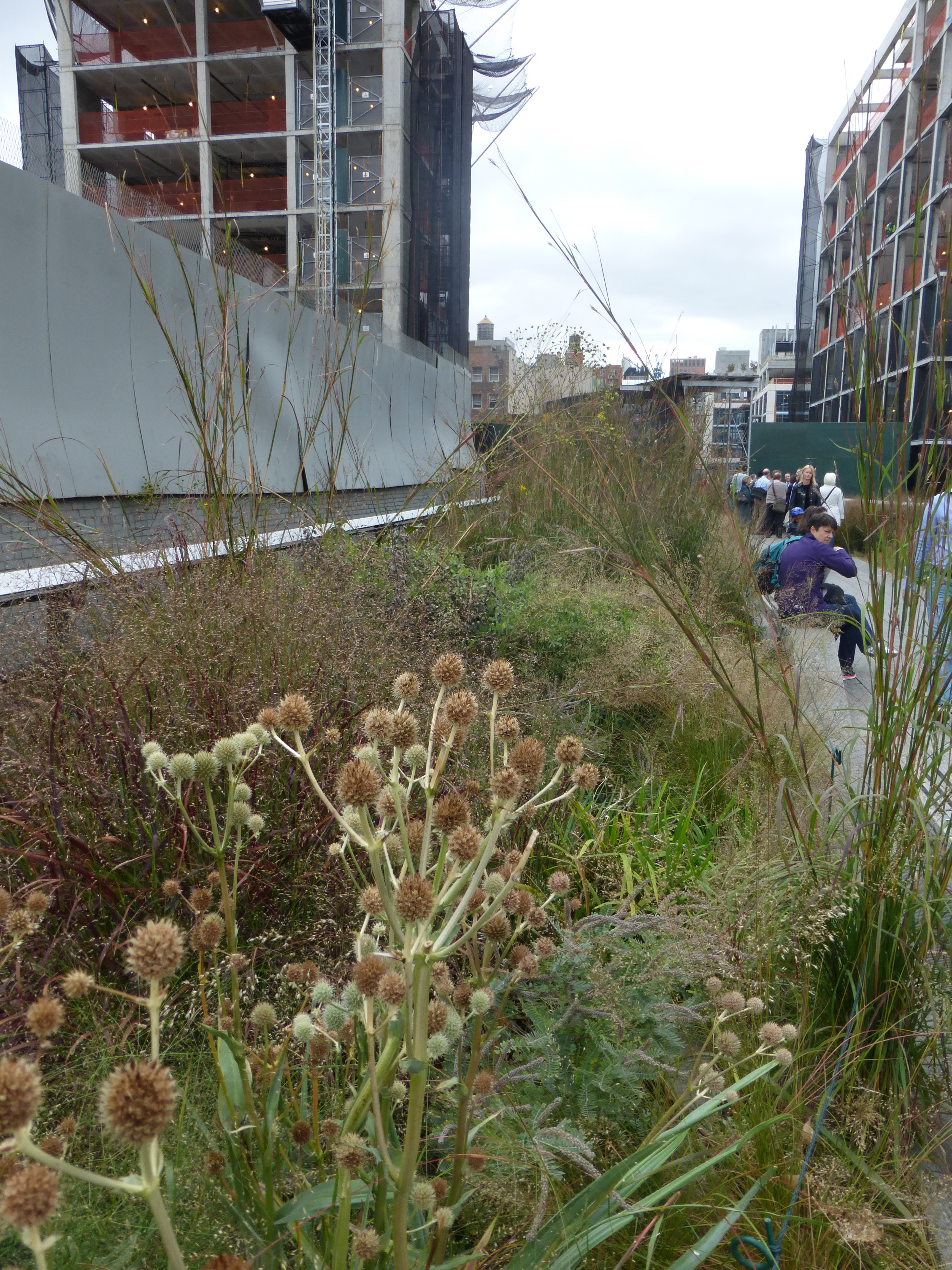
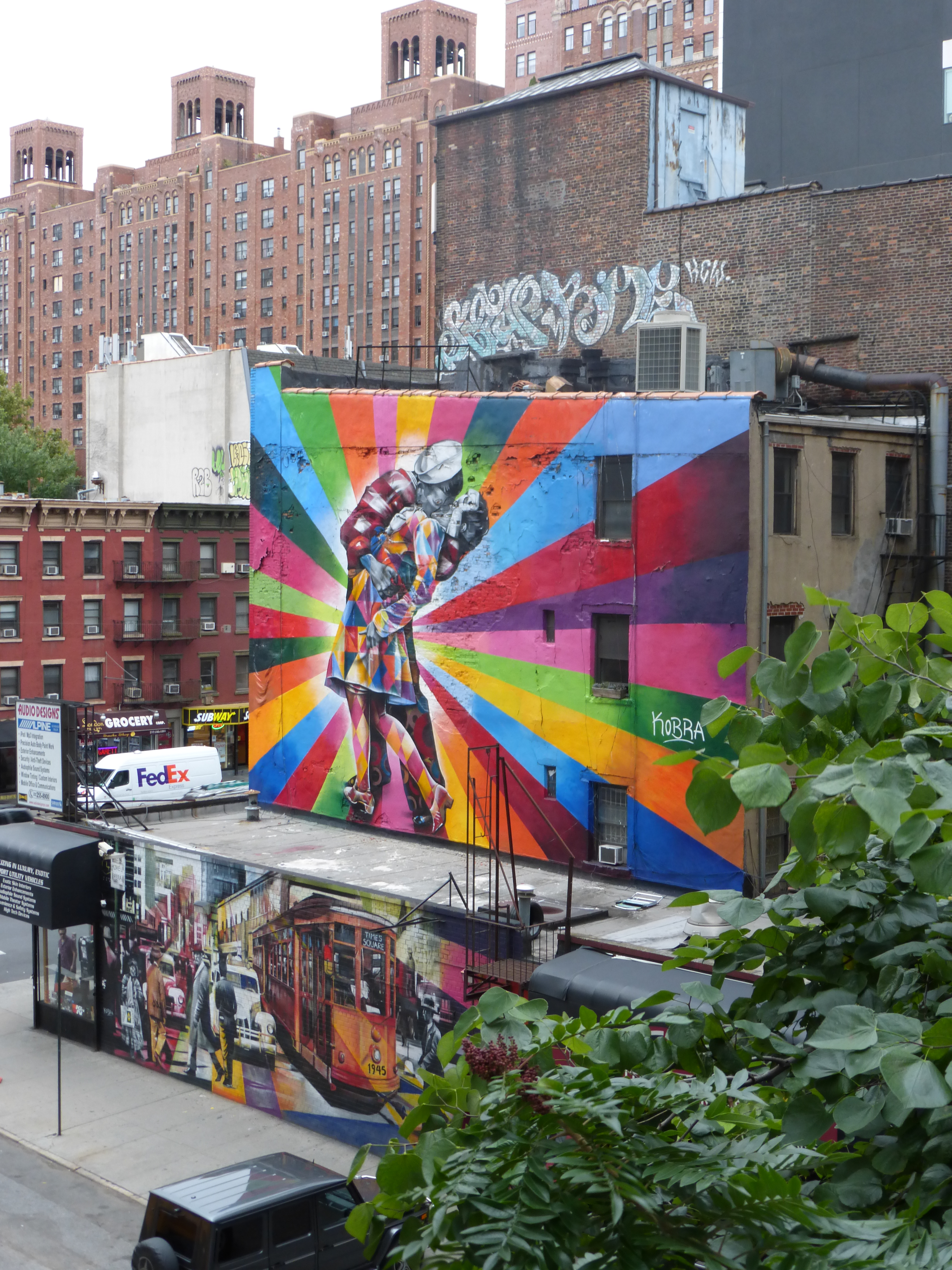
But the beauty and functionality of the park is not its only virtue.  It has transformed this formerly industrial neighborhood.  The surrounding neighborhood is dotted with cranes engaged in building valuable new residential properties.  Existing buildings are now covered with art to entertain visitors to the High Line.  The entire neighborhood has been revitalized by the development of this new, innovative re-creation of the City’s past.  It was atrociously expensive to transform the High Line into a park, but the park has already repaid the investment.

View from High Line Park
Self-Seeded landscape of Phase 3 of High Line Park

The design of the third and final portion of the High Line is different from its predecessorsPerhaps to reduce costs, the third section has retained many of the original structures of the railroad, including its weedy landscape.  The landscape is described as “self-seeded,” which is another way of saying that it is populated by the weeds that blew into the railroad ties during its 30-year fallow period.  The plant list of the High Line reflects its eclectic origins.  It is a mix of natives and non-natives, including many reviled by native plant advocates such as Tree of Heaven.  What is remarkable about the landscape in the third section is how similar it is to the earlier sections, which were planted.  In other words, achieving a “naturalistic” landscape bears some resemblance to the weeds of a vacant lot.  The final section of the High Line is no less charming and beautiful than its landscaped predecessors.

The High Line, like many parks in New York City, contains many enterprises that provide food and entertainment to its visitors.  Such enterprises are very controversial in San Francisco, where many park advocates consider them intruders.  We enjoyed a handmade cup of coffee on the High Line and wondered why San Franciscans have such a purist view of what “belongs” in their parks.

Comparing New York City with San Francisco

As we said when we began, we consider New York City the center of America’s cultural universe.  We are therefore encouraged that we found no evidence that New York City’s park system is dominated by nativism.  Their parks are both more beautiful and better maintained than those in San Francisco.  We suspect that San Francisco’s obsession with native plants has handicapped its ability to maintain beautiful parks because the plants that are native to San Francisco are brown and dormant much of the year.  New Yorkers looked back to their city’s 19th Century past to resurrect the High Line, while some San Franciscans are demanding a return to an 18th century landscape.

We also believe that San Franciscan’s objection to enterprises in their parks is one of the reasons why there isn’t enough money to maintain the parks to the same standard as the parks of New York City.

There are undoubtedly other factors at play.  The parks of New York City are heavily subsidized by wealthy foundations.  Its wealthy residents have been generous with the parks of New York City.  However, San Francisco is rapidly becoming as expensive a place to live as New York, so we wonder why our parks can’t enjoy the same level of support.  Is San Francisco’s “natives-only” approach to landscaping making our parks less attractive to potential donors?

Can you think of other reasons why San Francisco’s parks look so seedy compared to the parks of New York City?


(1) Ken Thompson, Where do camels belong?, Greystone Books, 2014

Evolutionary advantage of introduced species

We have often wondered why so many plants and animals introduced to North America become invasive, compared to species introduced to Europe.  In California, there are about 200 plants on the inventory of “invasive” plants.  In Britain, there are only about a dozen plants considered “invasive.”  In past articles, we have speculated that Americans are using different standards to determine invasiveness and that may be a factor.  But now scientists, Jason Fridley and Dov Sax have recently reported the empirical evidence that suggests some regions are more vulnerable to invasion than others because of competitive advantages of species from regions with longer evolutionary histories.  In fact, Charles Darwin is the original author of this theory:

“Darwin (1859) observed that because ‘natural selection acts by competition, it adapts the inhabitants of each country only in relation to the degree of perfection of their associates, such that, we need feel no surprise at the inhabitants of any one country…being beaten and supplanted by naturalized productions from another land.’  Darwin’s view, one of the earliest on biological invasions, presents invasion as an expectation of natural selection – a view largely absent from modern invasion biology.  Darwin further suggested that species from larger regions, represented by more individuals, has ‘consequently been advanced through natural selection and competition to a higher stage of perfection of dominating power’ and therefore be expected to beat ‘less powerful’ forms found in other regions.” (1)

Darwin2

Based on Darwin’s speculation, Fridley and Sax formulated the evolutionary imbalance hypothesis, based on three postulates:

  • Evolution is essentially an infinite series of experiments as each generation is tested by the conditions they encounter. The more tests the species passes by surviving and reproducing, the more fit the species is to face the next test.
  • The number of such experiments vary by region that differ in size and biotic history, which influences the intensity of competition each species encounters.
  • “Similar sets of ecological conditions exist around the world” thereby facilitating the movement of species from their native ranges to new ranges.

It follows from these postulates that when species from previously isolated habitats are mixed, some species will be more fit than others for any given set of conditions.  In other words, they have an evolutionary advantage by virtue of having faced more competition for a longer period of time.   These are the environmental conditions that are likely to confer such an evolutionary advantage:

  • Larger regions with large expanses of habitat usually have larger populations of species. Larger populations have more genetic variation, which provides more opportunities for natural selection to choose a “winning” genetic combination.
  • Also, more stable environments enable lineages to survive for longer periods of time. The longer the opportunity for natural selection to operate, the more fit the surviving lineage.
  • The greater the competition each species experiences, the more fit the surviving species is likely to be. Therefore, species occupying diverse habitats are likely to be more fit than species in less diverse habitats.

The authors of this new study tested these hypotheses in three geographic areas that have well-documented non-native floras, including Eastern North American, the Czech Republic, and New Zealand.  For example, the climate of the Northeast of America is similar to East Asia.  Some of the most destructive invasive species in the Northeast are from East Asia, such as the emerald ash borer.  Yet species from North America do not become invasive when introduced to East Asia.  Species from East Asia have a much longer evolutionary history than species native to the Northeast because much of the United States was buried in glaciers during the Ice Ages, while East Asia was not.  (2)  The longer evolutionary history of East Asia makes East Asian species “fitter” and more likely to be successful in North America, while North American species are less successful in East Asia.

Kudzu evolved in Japan.  USDA
Kudzu evolved in Japan. USDA

Failure of the competing theory

Invasion biology is the competing theory of why introduced species become invasive when introduced outside their native ranges.  It is a theory that turns its back on evolutionary theory by assuming that plants and animals are incapable of adapting to changed conditions.  Invasion biology assumes that introduced plants become invasive because they leave their predators behind.  This is the predator release theory which also implies that introduced plants are not useful to native animals.

The problem with the predator release theory is that there is no empirical evidence that supports it.  For example, equal numbers of insects are consistently found in native and non-native habitats.  And when empirical studies claim to have found evidence of predator release, sampling errors have discredited those studies:

“For example, one study found fewer parasitic worms in introduced starlings in North America than in the entire native range of Europe and Asia.  But once allowance was made for the actual local source of the starlings, the difference disappears:  various evidence suggests starlings arrived in North America via Liverpool, and American starlings have most of the parasites of Liverpool starlings, plus quite a few others, either American natives or European parasites introduced with other birds.  In fact, American starlings have more parasites than are found in the likely source population.”  (3)

Starling in breeding plumage.  Creative Commons - Share Alike
Starling in breeding plumage. Creative Commons – Share Alike

“Resistance is futile”

And so we add the evolutionary imbalance hypothesis to the long list of reasons why we are opposed to fruitless attempts to eradicate well established non-native species of plants and animals:

And now we know that many invasive species have evolutionary advantages over the native species they have displaced:  “The evolutionary imbalance hypothesis…could have a grim implication for conservation biologists trying to preserve native species:  They may be fighting millions of years of evolution.  If that’s true, the phrase ‘Resistance is futile’ comes to mind.” (2)


  1. Jason Fridley and Dov Sax, “The imbalance of nature: revisiting a Darwinian framework for invasion biology,” Global Ecology and Biogeography, 23, 1157-1166, 2014
  2. Carl Zimmer, “Turning to Darwin to Solve the Mystery of Invasive Species,” New York Times, October 9, 2014
  3. Ken Thompson, Where do camels belong?, Greystone Books, 2014

Mysterious semantics of the native plant movement

In 2000, we wrote a public comment about plans to close areas at Fort Funston for native plant restoration that began with this quotation from Henry David Thoreau:

It is in vain to dream of a wildness distant from ourselves.  There is none such.  It is the bog in our brain and bowels, the primitive vigor of Native in us, that inspires that dream.  Thoreau

We chose that quote to introduce our comment about Fort Funston because it is a place that was entirely altered to serve as a military fort, its sand dunes stabilized with ice plant and studded with gun bunkers; it is not a place that is easily imagined as a pristine native landscape.  As with most poetry, Thoreau’s exact meaning escaped us, but what resonated was the suggestion that “wildness” exists in our minds, not in the material world.  We found comfort in knowing that over 150 years ago, Thoreau was as mystified by the concept of wildness as we are today.

Fort Funston
Fort Funston San Francisco 2011

Today, we revisit the question of the meaning of wildness or wilderness, prompted by the publication of an op-ed by Mark Dowie in the Point Reyes Light. (1)  Dowie is a journalist who is best known as the author of Conservation Refugees, in which he informs us that hundreds of thousands of indigenous people all over the world have been evicted from their ancestral lands by public and private land owners who believe humans are antithetical to their conservation goals.  Dowie tells us that the tradition of evicting humans in the interests of preserving “wilderness” began with the eviction of Native Americans from Yosemite Valley as advocated by John Muir.  This concept of preserving land by excluding all human activities is aptly called fortress conservation. 

Dowie begins his op-ed in the Light with the observation that some words have “attained such a vague and ambiguous definition that [they have] become virtually meaningless.”  The word “sustainability” has attained such status, he says and we agree.  But his focus in his op-ed is on the word “wilderness” because it is a word that has become a tool in a dispute about land use in Point Reyes, where Dowie lives.

The National Park Service defines “wilderness”

Drakes Estero.  NPS photo
Drakes Estero. NPS photo

After a protracted battle that lasted years, the National Park Service was finally successful in shutting down the Drakes Bay Oyster Company based on its contention that the existence of the oyster farm violated a commitment to return the Point Reyes National Seashore to “wilderness.”  This was a battle that tore a small community apart and the wounds from that fight are still deep.

Mark Dowie was one of many people who opposed the closing of the oyster farm and he was often eloquent in its defense in the Light.  One of many issues in this controversy was the National Park Service’s claim that the oyster farm was harming the environment.  Highly qualified scientists debunked that claim and after a review by the National Academy of Science, the claims of the National Park Service were entirely discredited.  Unfortunately, that had no influence on the final decision to close the oyster farm.

Within days of the oyster farm closing its retail operation, those who demanded its closure were on the warpath again.  In an op-ed published by the Oakland Tribune, William Katz asked the National Park Service to evict ranchers and dairy farmers in Point Reyes:  “The European invasion of this side of the continent over just the last 200 years is obviously a done deal.  This fact makes it especially necessary to complete the original mandate of the park’s creation by removing the ranchers and their bovine accoutrements and re-establishing a natural area in which we may only be visitors.”  The connection between those two sentences eludes us.  In fact, they seem contradictory.

Dowie searches for the meaning of “wilderness”

And so, the question of what defines a “wilderness” is still very much alive in Point Reyes.  Mark Dowie tells us that he has been actively seeking a meaningful definition for some years.  He turned to several indigenous cultures based on the modern assumption that pre-European cultures occupied the elusive “wilderness:”

“Over the next four years of research, I met and conversed with many indigenous people who thrived in landscapes that looked as wild as anywhere I had ever been, whose language had no words for ‘wild,’ or ‘wildness,’ or ‘wilderness.’  Naturally, I began to wonder why societies populated by urbane people who spend most of their lives, if not all of them, on the streets of places like New York City, London, Rome, Los Angeles and Winnipeg do have a word for wilderness.  And I wondered what exactly they meant by it, if anything.”

“What I finally figured out about ‘wilderness’ was that it’s really a concept that does not translate well from language to language, especially from western to indigenous languages.  So it’s really not the word that has to be translated, but an entire ecological enthnography.”

And so, Dowie turns to those who use the word “wilderness” as their definition of the goal for what our public lands and open spaces should look like and what activities should be allowed in them:

I recently overheard a debate in which to refine and defend his own personal definition, a local wilderness romantic divided the whole concept into two separate categories—uppercase and lowercase wilderness. Uppercase, he said, was “real” wilderness: vast roadless, trail-free areas occupied by many species, including large predators that want to eat humans.  Lowercase wilderness could be found in state and national parks; as virtual or abstract wilderness, it was a cunning, managed artifice of the uppercase version designed to convince eco-tourists that they are having a true wilderness experience.  The argument descended from there into such ridiculous semantic subterfuge that I walked away mumbling to myself that wilderness may not be a word at all, or a place for that matter, but as Roderick Nash concludes at the end of his 400-page tome on the subject, merely “a state of mind.” And that if wilderness exists at all, it could be as easily found and appreciated under a bench in Central Park as on the barrens of Baffin Island.”

Some of the stumps of the trees that were destroyed in Glen Canyon Park in 2013.  Taken June 2014
Some of the stumps of the trees that were destroyed in Glen Canyon Park in 2013. Taken June 2014

Yes, Mr. Dowie, you have indeed found the mysterious meaning of the word “wilderness” as a “bog in the brain,” to quote Mr. Thoreau.  We have our own example of a similar debate with native plant advocates about the future of Glen Canyon Park in San Francisco.  Our readers will remember Glen Canyon as the scene of the devastating removal of many huge, old trees and the repeated spraying of herbicides to prevent the trees from resprouting and destroy the non-native understory.  To those who objected to this destructive project, a native plant advocate responded:

Please note the term “wilderness.” It implies natural, native flora and fauna; the wild plants and the bird and animal populations that support one another. That is what we want to have if we want a wild retreat. A morass of garden escapes and foreign invasive species is to be deplored. Let’s progress toward returning the area to a REAL wilderness. Do not let the concept that a plant’s becoming established in an area is a sign of its becoming native to the area. It remains an invasive element, a weed. It disrupts and destroys the normal habitat of native plants, animals, and insects in its surroundings.  It will be a huge and long term task, but we can restore the entire canyon to a truly wilderness state. Let’s get started!”

In this version of “wilderness,” trees and plants must be sprayed with herbicide and a new landscape planted.  The result—if it is successful—will be an entirely artificial landscape.  There will be nothing “REAL” about it.

 Language is an obstacle to agreement

 One of many obstacles to reaching agreement with native plant advocates about the future of our public lands and open spaces is that we don’t share a vocabulary.  “Wilderness” is one of many words that cannot be defined by our mutual understanding.

“Sustainability” is another word that is used by native plant advocates, which we believe is inappropriately applied to the projects they demand because it is inconsistent with the realities of climate change and evolution.   The landscapes they are creating are no longer adapted to current environmental conditions.  They are not sustainable.

 “Integrity” has recently become a favorite buzzword of nativists, used to describe their idealized landscape.  We have absolutely no idea what that word means in the context of the contrived landscapes they attempt to create.

And so the debate continues with no end in sight.  Meanwhile our public lands are being destroyed in response to the demands of native plant advocates.  For us the word “wilderness” is now synonymous with “destruction,” which creates a fortress in which humans are not welcome.


(1) Mark Dowie, “The tortured semantics of wilderness,” Point Reyes Light, September 4, 2014

Butterflies of the Bay Area Region

Our readers may remember Professor Arthur Shapiro as a critic of massive ecological “restorations” that attempt to turn back the botanical clock.   Professor Shapiro is better known in the world of academic science as an expert on the butterflies of California.  His Field Guide to Butterflies of the San Francisco Bay and Sacramento Valley Regions (University of California Press, 2007) reflects a lifetime of observation and study of butterflies.  It is as informative about butterfly behavior and physiology as it is readable and engaging.  This is no dry, academic treatise.  Rather it represents an accumulation of over thirty years of experience, walking on every sunny day amongst the butterflies of California and enjoying every minute of it.

We could choose any number of interesting topics from Professor Shapiro’s guide, but we think our readers will be most interested in learning about the natural history of California and the Bay Area region and how that history resulted in our current butterfly fauna.   It’s not a gloomy story, as you might expect in a place that has changed so radically since it was occupied by Europeans in the 19th century.  Rather it’s a story of change and adaptation to change and therefore very much in tune with the concerns of the Million Trees blog.

Butterflies in the landscape created by humans

This is the reality of which plants are useful to butterflies in the Bay Area and Delta Region of California:

Red Admiral.  public domain
Red Admiral. public domain

“California butterflies, for better or worse are heavily invested in the anthropic landscape [altered by humans].  About a third of all California butterfly species have been recorded either ovipositing [laying eggs] or feeding on nonnative plants.  Roughly half of the Central Valley and inland Bay Area fauna is now using nonnative host plants heavily or even exclusively.  Our urban and suburban multivoltine [multiple generations in one year] butterfly fauna is basically dependent on ‘weeds.’  We have one species, the Gulf Fritillary that can exist here only on introduced hosts.  Perhaps the commonest urban butterfly in San Francisco and the East Bay, the Red Admiral is overwhelmingly dependent on an exotic host, pellitory.  And that’s the way it is.”

Professor Shapiro explains that alterations in our landscape made by humans made it necessary for butterflies to make the transition from natives to non-natives in order to survive:

The explanation for this odd situation can be found in the history of California’s wetlands.  As recently as the early twentieth century, there were extensive fresh water marshes in our area, especially along the east side of the Sacramento Valley.  These wetlands stayed green in the summer and could support multivoltinism because native host plants were available…The draining, diking, and agriculturalization of the wetlands corresponded in time with the widespread naturalization of exotic weeds related to native marshland plants.”

Anise Swallowtail butterfly in non-native fennel.  Courtesy urbanwildness.org
Anise Swallowtail butterfly in non-native fennel. Courtesy urbanwildness.org

Here are a few examples of native butterfly species that made the transition from native to non-native plants when the wetlands were altered by humans:

“What did our Mylitta Crescent feed on before the various pestiferous annual Mediterranean thistles come to California?  Native, mostly wetland thistles, just as it does in mountain bogs today…The Common Checkered Skipper still uses checkerbloom in wetlands where it can find it, but thanks to a weedy species of mallow it is now found in every garden and weedy lot in the northern part of the state.  And the Anise Swallowtail still lays eggs on water hemlock…in marshes, but percentage-wise very few of them.”

San Francisco is a special case for butterflies

San Franciscans know that although their city is very small in size, it is composed of many even smaller microclimates.  Professor Shapiro explains how these microclimates impacted our butterflies:

“The main reason why we have so many federally endangered or threatened butterflies in the Bay Area is that our peculiar geography is predisposed to the fragmentation of populations—particularly in the coastal fog belt.  These local evolutionary experiments may well have been dead ends in the long run…But they were so restricted to tiny chunks of habitat that even nineteenth-century development was enough to spell their doom.”

Then he reminds us what it would take to “restore” the landscapes that supported these rare or extinct butterfly species:

“Had there been an Endangered Species Act in the 1860s, San Francisco would be a very different place.  The “Great Sand Bank” occupying the western third of the city would have been declared critical habitat for any number of plants and animals found nowhere else on Earth—including three butterflies that subsequently went extinct.  We could still have the Xerces Blue, the Pheres Blue, and the Sthenele Satyr, but there would be no Golden Gate Park and no Sunset District.  The reclamation and stabilization of what was seen as a bleak, barren, fog-and-windswept wasteland were hailed at the time as triumphs of civilization.  Now some environmentalists would like to turn the clock back and restore a little of that unique habitat.  But some of its inhabitants, including those three butterflies, are gone, never to return.”

Golden Gate Park and its neighborhood.  Would you trade this for the barren sand dunes that preceded it?  Gnu Free Documentation
Golden Gate Park and its neighborhood. Would you trade this for the barren sand dunes that preceded it? Gnu Free Documentation

 However, the story isn’t entirely of loss in San Francisco:

Gulf Fritillary.  Creative Commons
Gulf Fritillary. Creative Commons

“The Cabbage White…arrived sometime in the late nineteenth century.  The Gulf Fritillary…seems to have become established only in the 1950s.  The Fiery Skipper was unknown…in 1910…Several native species treated as scarce [in 1910] have become commoner due to introduced, weedy host plants.  The Anise Swallowtail and the Red Admiral are prime examples.  The West Coast Lady, most of whose hosts are weedy, was already very abundant in [1910].”

What do butterflies need today?

Professor Shapiro provides a detailed list of the plants used by the butterflies of California.  You will find roughly equal numbers of native and non-native plants on the list of plants they like as well as the plants they don’t like.  This is how he summarizes these lists:  “Most California natives in cultivation are of no more butterfly interest than nonnatives, and most of the best butterfly flowers in our area are exotic.”

What is done cannot be undone

While humans wring their hands about “weeds” and the loss of historical landscapes, butterflies have moved on.  And so they must to survive.  And so should we because these historical landscapes cannot be recreated without abandoning the economic enterprises which feed us or the homes that house us.  We aren’t going to bull doze Golden Gate Park or the residential neighborhoods that surround it.  The least we can do for the butterflies of California is to quit dousing the plants they need with herbicides solely because they are non-native.  We have created the landscape that we need and we should quit destroying the landscape that our butterflies now need.

Professor Shapiro’s Preface is a fitting conclusion:

The changes that humans have wrought on the lives of butterflies are merely the most recent of the many changes they have gone through in their history.  We have no hope of restoring communities to some hypothetical pristine state on any but a miniature scale.  At best we create gardens that more or less resemble what we think those communities looked like at some arbitrary time in the past.  Like all gardens, they require constant effort to keep them from becoming what today’s conditions drive them to become—conditions dominated by what we characterize as “weeds.”  We can, however, try to protect the bits of nature that have survived relatively unchanged despite us, cognizant that larger forces than we control may override our efforts.”