Spartina alterniflora: Treasured on the East Coast, reviled on the West Coast

Spartina alterniflora (Smooth Cordgrass) is a species of marsh grass native to the Atlantic and Gulf coasts of the United States, where it is considered a valuable plant making important contributions to the coastal ecology:

  •  Its dense growth provides protection against storm surge and “erosion control along shorelines, canal banks, levees, and other areas of soil-water interface.”(1)
  • It filters nutrients, sediments and toxins from the water that flows off the land before reaching the ocean, acting as a natural water treatment facility.
  • It provides cover and food for birds, mammals and marine animals that live in the coastal marsh.  Many other marsh plants occupy the same marshlands.

    Spartina alterniflora, Smooth Cordgrass. USDA photo

Where Smooth Cordgrass has died back in its native range, the dieback has been considered a serious environmental threat:

  • In 2001 the Governor of Louisiana declared a “state of emergency” when Smooth Cordgrass declined and the state obtained $3 million of federal funding to study and hopefully reverse the decline.  This study resulted in the development of a method of aerial seeding of Smooth Cordgrass to restore declining areas of marshland.(2)
  • A similar, but smaller dieback of Smooth Cordgrass in Georgia led to a collaborative research and on-going monitoring effort by 6 research institutions in Georgia.(3)
  • Similar dieback of Smooth Cordgrass has been reported as far north as the coast of Maine.  A researcher at the Connecticut Agricultural Experiment Station is quoted in that report as saying, “In New Orleans, if their marshes were intact, the storm surge of Katrina would not have reached the levees.”(4)

The war on Smooth Cordgrass in the West Coast 

Smooth Cordgrass is not native on the Pacific Coast of the United States.  Therefore it is treated as an alien invader to be eradicated with herbicides:

  • $24 million was spent to eradicate Smooth Cordgrass in San Francisco and Willapa Bay from 2000 to 2010 (5)
  • $16.3 million is projected to be spent on eradication efforts on the entire West Coast from 2011 to 2020 (6)

In 2006, 2,000 acres were treated with herbicides to eradicate Smooth Cordgrass in the San Francisco Estuary.    Most were retreated 3 to 5 times after initial treatment.  In 2010, twenty five sites were slated for retreatment, usually with herbicides.  The San Francisco Estuary Invasive Spartina Project (ISP) “defines a need for a zero tolerance threshold on invasive Spartina in the San Francisco Bay.”(7)

The ISP reports that imazapyr (Habitat) will be used in most sites, although it will sometimes be mixed with glyphosate (Roundup). (See SaveSutro for more information about imazapyr and its use in San Francisco.)  The ISP acknowledges that:

  •  “little is known about the interactive effects” of combining these herbicides or any of the surfactants used with these herbicides.
  • These herbicides will be applied using a variety of methods, including aerial spraying by helicopter.
  • Although the ISP considers imazapyr a relatively non-toxic herbicide, it also acknowledges that imazapyr has only been used since 2005.  Therefore, “Only few toxicity studies exist for birds…no data exist for the potential toxicity of imazapyr to shorebirds.”(8) Given that one of the stated purposes of eradicating Smooth Cordgrass is to benefit the endangered Clapper Rail, it seems surprising that nothing is known about the effects of imazapyr on any shorebird, including the Clapper Rail.

Why is Smooth Cordgrass treasured on the East Coast and reviled on the West Coast?  That question was asked and answered by Professor James Morris at an Environmental Law Conference in Eugene, Oregon on March 5, 2011.  Professor Morris studies Smooth Cordgrass at the Baruch Institute for Marine & Coastal Sciences at the University of South Carolina.  We urge our readers to watch a video of his presentation to the conference in Oregon.  We will draw upon that video in addressing the claims (9) made by those who are attempting to eradicate Smooth Cordgrass on the West Coast:

Indictment:  Smooth Cordgrass will invade mud flats, eliminating valuable habitat for plants and animals that inhabit that segment of marshland.

Defense:  According to Professor Morris, Smooth Cordgrass was introduced to the West Coast in shipments of Eastern oysters over 100 years ago without eliminating mudflats.  Europe has had similar experience with Smooth Cordgrass which was introduced there to reduce sediment in harbors.  Professor Morris showed pictures of Danish and Dutch estuaries in which Smooth Cordgrass has existed since the 1930s without radically altering the composition of the marshland.

Indictment:  Smooth Cordgrass will invade waterways, making them impassable.

Defense:  Again, since this has not happened in 100 years, there is no reason to assume it will happen in the future.  Furthermore, the USDA describes the narrow range of Smooth Cordgrass:  “the width and thickness of vegetative colonies are controlled by a number of site specific conditions such as elevation, shoreline slope, and frequency, depth and duration of flooding” as well as salinity and acidity.  In other words, the range of Smooth Cordgrass is limited.

Indictment:  Smooth Cordgrass does not provide habitat value equal to the native species of cordgrass with which Smooth Cordgrass competes, particularly for the endangered Clapper Rail.

Defense:  Mike Casazza at the Dixon Field Station of the USGS is presently studying the effect of eradicating Smooth Cordgrass on the reproductive success of the Clapper Rail:  “Removal of invasive Spartina accomplishes the goal of Spartina eradication, but if rails fail to survive and reproduce, then the goal of species protection is unfulfilled…the potential for impact from invasive Spartina removal and the potential for mitigation by rail ecology and behavior remain poorly understood.”(10)  Clapper Rails live in Smooth Cordgrass on the East Coast:  “numerous” Clapper Rail families were observed nesting in Smooth Cordgrass on Dewees Island, South Carolina.(11)

Indictment:  Smooth Cordgrass is outcompeting the native Pacific Cordgrass (Spartina foliosa) by displacement and hybridization.

Defense:  This is probably true because of the characteristics of the Pacific Cordgrass:  “S. foliosa occupies a very limited range in the intertidal zone, and the leaves and stems wither in fall and shed in the winter, leaving sparse standing matter that is ineffective at trapping sediment.  Seedlings of S. foliosa are seldom found in established marshes and appear only intermittently in sheltered upper mudflats.”(12)  In other words, the range of the native cordgrass is narrower, it does not grow as densely, and it is not foliated year around, thereby creating opportunities for the non-native cordgrass to occupy bare ground.  Since marsh grasses are beneficial to the environment and its inhabitants, the ability of Smooth Cordgrass to occupy this vacuum seems a benefit, particularly since native cordgrass is less capable of removing sediments from water, reducing its effectiveness as a filter of pollutants from water flowing into the bay.(13)

Smooth Cordgrass is treasured on the East and Gulf Coasts because it performs valuable ecology services.  Although it performs the same ecological functions on the West Coast, it is being eradicated.  The evidence available to us suggests that we are spending a lot of money and effort, as well as using a lot of herbicides, to eradicate Smooth Cordgrass only because it is not native to the West Coast.   

  • Smooth Cordgrass provides superior storm surge protection particularly during winter months when native cordgrass is dormant.
  • Smooth Cordgrass is more capable of filtering pollutants from water flowing into the bay.
  • Smooth Cordgrass provides at least equal habitat quality to the endangered Clapper Rail and probably other marsh plants and animals as well.
  • Smooth Cordgrass has not blocked waterways or eliminated mud flats in comparable situations over long periods of time

We invite our readers to supply us with evidence that there are legitimate reasons for the campaign against Smooth Cordgrass.


(2) Dorset Hurley, “Geogia’s Marsh Die Back and Louisiana’s Marsh Browning,” Altamaha Riverkeeper

(3) Ibid.

(4) “What’s killing off our salt marshes,” Going Coastal Magazine, September 15, 2008

(5) “West Coast Governor’s Agreement on Ocean Health,” May 2010, page 5

(6) Ibid., page 6

(7) “San Francisco Estuary Invasive Spartina Project, 2010 Pesticide Application Plan,” page 15.

(8) Ibid. page 31

(9) “West Coast Governor’s Agreement on Ocean Health,” May 2010

(10) “Ecology of California Clapper Rail in the San Francisco Bay/Delta Region,” USGS Western Ecological Research Center

(11) Judy Drew Fairchild, “Watch for Clapper Rails and chicks,” Dewees Island, SC

(12)“West Coast Governors’ Agreement on Ocean Health,” May 2010, page 12

(13) “San Francisco Estuary Invasive  Spartina Project, 2010 Pesticide Application Plan,” page 10

Basing our opinion of eucalypts on experience rather than rumors

We received a comment from a reader in Wales that prompted us to visit her website, Clegyr  Boia.  She tells a story that contains an important lesson for us:   to observe the performance of plants in our gardens and to base our evaluation of them on actual experience rather than preconceived judgments.

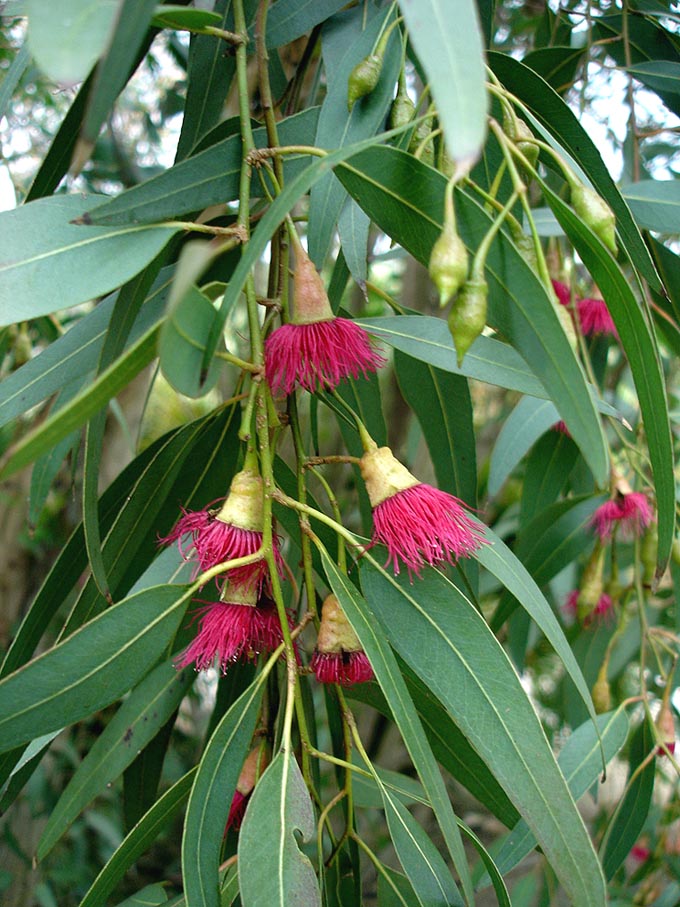
Eucalyptus leucoxylon ‘Rosea’ Wikimedia Commons Jean Tosti

In retelling this story, we shall call the owner of Clegyr Boia by the location of her property.  Clegyr Boia’s favorable opinion of eucalyptus trees is based on her visit to Australia in 1980.  As we did, she could see the beauty of the eucalyptus forest in Australia.

When she bought her property in Wales, she viewed it as an opportunity to develop an artistically beautiful landscape that she knew would include eucalyptus trees.  She planted eucalypts around one of her art installations because the blue color and graceful curves of their leaves enhanced her rock sculptures.  She planted other species of eucalypts in areas of the garden to shield them against the wind.

Soon after she began to plant eucalypts on her property, she was visited by friends and neighbors who were concerned about the introduction of eucalypts to their area.  They warned against the invasive properties of eucalyptus.  They claimed that nothing would grow under the eucalypts and that they would not provide food for wildlife.

Clegyr Boia’s initial response was to remove the eucalypts she had planted.  Then she had second thoughts.  She realized that her garden was full of non-native plants that were thriving and were providing valuable food for the denizens of her home, including her.  Since much of the food we eat is non-native, she decided that nativity is not a suitable criterion for banning a plant from her garden.  She decided to observe the eucalypts closely and decide based on their actual performance in her garden if they needed to be removed.

Some years later, she considers the eucalypts in her garden important contributors to its beauty.  They have demonstrated that other plants are welcome in the shelter of their canopy and that insects make good use of them.  They have also been remarkably resilient in salty, windy conditions.  When they have died back after heavy storms, they have soon resprouted.   Everything in her garden must make its own way, including the eucalypts, thereby proving their sustainability in this harsh setting. 

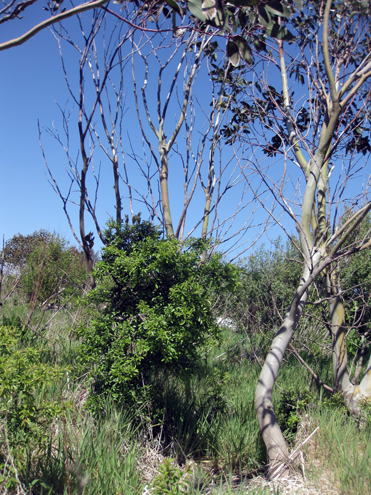
Native blackthorn grows next to eucalyptus. Photo courtesy Clergy Boia

We invite our readers to visit the Clegyr Boia website for the complete story, as well as a historical review of the migration of eucalypts all over the world and speculation about why they have acquired a negative reputation.

We tell this story because we admire Clegyr Boia’s commitment to her trees.  She listened to her neighbors, but she also made the commitment to her trees to watch their behavior in her garden.  She based her ultimate judgment of their suitability on their actual performance in her garden.  They have rewarded her patience with their success.

A dialogue about insects and non-native plants

We received a comment on our “Wildlife” page from “entomologist” that deserves a comprehensive response. 

 Conversation with “entomologist”

 “entomologist:”  “Adaptation to exotic species by specialist herbivores is unusual.  Those butterflies that switch to exotics tend to be generalists already.”  

Webmaster:  “Entomologist” is mistaken that the butterflies now using non-native plants are generalists, by which we assume he means that they use many plants, rather than a specific species.  According to Professor Art Shapiro (UC Davis), 26 of the 82 species of California butterflies now feeding on exotic plant species, are using only one plant species.  In other words, nearly one-third of California butterflies presently using exotic plant species are not generalists.(1)  When butterflies have made the transition from a native to a non-native plant, the plants are usually chemically similar. 

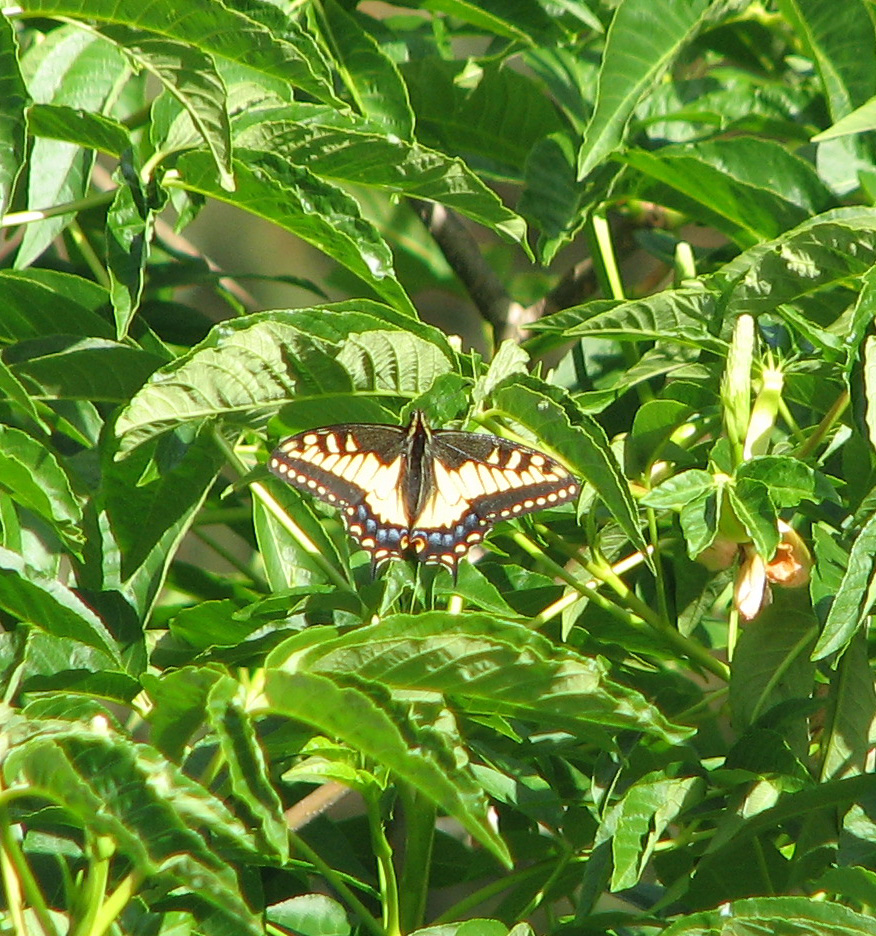
Anise Swallowtail, Sutro Forest
Anise Swallowtail, Sutro Forest, March 2010

The Anise Swallowtail is a conspicuous example of a California butterfly that is now dependent upon a particular exotic plant, fennel. This relationship between a specific native insect and a specific non-native plant is one of the reasons why the Million Trees blog was created.  Non-native fennel is being eradicated by every native plant “restoration” in the Bay Area.   

Over ten years ago, a park advocate in San Francisco became enraged by the eradication of fennel in his park because he was aware of the dependence of the Anise Swallowtail upon the fennel.  He made every effort to convince the so-called Natural Areas Program to stop destroying the fennel in his park.  He enlisted the help of Professor Art Shapiro in that effort. His efforts were ultimately unsuccessful.  The Natural Areas Program considered the non-native origins of the fennel sufficient reason to eradicate it, regardless of the needs of a native butterfly.  They continue those eradication efforts to this day. 

It is such mindless destruction of non-native plants, regardless of their benefit to fauna (or other benefits) that has made the Natural Areas Program so unpopular with people with a broader view of nature. We value the Anise Swallowtail butterfly as much as any theoretical benefit from eradicating a non-native plant.

“entomologist:”  “This idea that exotic plants are as good for wildlife as natives is just plain pathetic, especially for anyone who knows about herbivory  patterns on native and exotic plants.”

Webmaster:  By “pathetic” we assume “entomologist” means that he does not believe that insects eat non-native plants.  He is mistaken that insects do not eat non-native plants.  Returning to Professor Shapiro, he reports that 82 of 236 (35%) total species of California butterflies feed on non-native plants

Professor Dov Sax (Brown University) compared insects living in the leaf litter of the non-native eucalyptus forest with those living in the native oak-bay woodland in Berkeley, California.  He found significantly more species of insects in the leaf litter of the eucalyptus forest in the spring and equal numbers in the fall.(2)  Professor Sax also reports the results of many similar studies all over the world that reach the same conclusion.

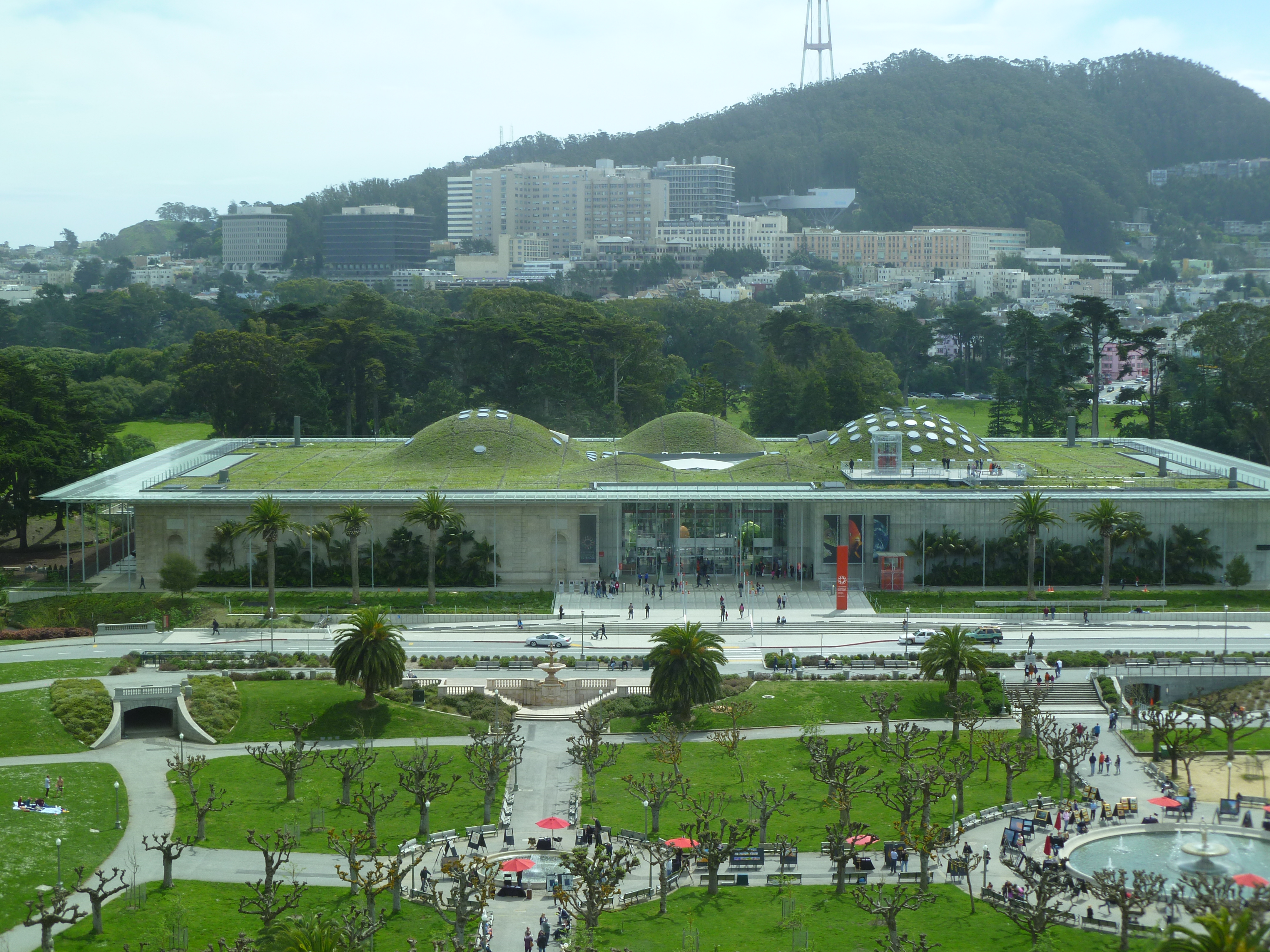
The California Academy of Sciences finds that several years after planting its roof with native plants, it is now dominated by non-native species of plants in the two quadrants that are not being weeded, replanted and reseeded with natives.  Their monitoring project recently reported that there were an equal number of insects found in the quadrants dominated by native plants and those dominated by non-native plants. 

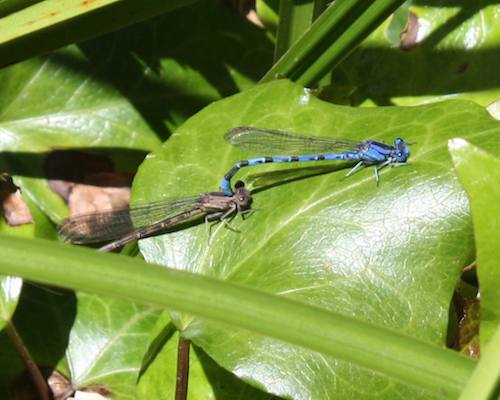
Damselflies (probably Common Blue) mating on non-native ivy in Glen Canyon Park.

We also use our eyes when we walk in our parks.  We often find insects in non-native plants.  Those non-native plants are often targets for eradication.  The damselflies in a San Francisco park are another example of the contradictory strategies of the Natural Areas Program.  They have made several attempts to reintroduce the rare Forktailed Damselfly to one of the parks in San Francisco.  Although those attempts have not been successful, we see other species of damselflies in that park, using the non-native plants that are repeatedly sprayed with herbicides by the Natural Areas Program.  We wonder if the herbicide use in that park is contributing to the failure of attempts to reintroduce the Forktailed Damselfly. Does the right hand know what the left hand is doing?

“entomologist:”  “Insects eating plants are at the base of the food chain and native plants have more insect herbivores and support more native birds.”

Webmaster:  We can agree that many birds eat insects and those that do are likely to benefit from greater populations of insects.  But, there is substantial evidence that insects are as likely to be found in non-native plants as in native plants and we trust that the birds know where to find them.  However, unlike “entomologist” we are as interested in the welfare of non-native birds as we are in native birds. 

“entomologist:”  “Doug Tallamy’s work shows this in the eastern US conclusively.”

Webmaster:  Professor Tallamy’s (University of Delaware) publications do not seem to be available on-line, which prevents us from reading his publications.  However, since he studies the insects on the east coast we don’t think whatever he reports trumps the studies that we have cited of insect populations here in the Bay Area. 

“entomologist:”     “I certainly feel for the loss of trees, but the alternative is that we accept a homogenized set of urban-tolerant plants and wildlife.  Maybe that’s ok if you don’t know the difference, but for those of us who actually pay attention it is profoundly sad.”

Webmaster:   We don’t see the logic of “entomologist’s” vision of a “homogenized” ecology.  If we destroy non-native plants and animals, our ecology will be less diverse.  And we hope that the readers of Million Trees will agree that we are, indeed, “paying attention.” 

 The Big Picture

 We suggest that “entomologist” and other native plant advocates step back from their deeply-seated prejudices against non-native plants and consider the big picture.  The fact is that insects are particularly vulnerable to climate change because they live in relatively narrow temperature ranges. (3) Although they are adjusting well to changes in vegetation, they are not likely to be able to make an equally successful adjustment to changes in temperatures.  Therefore, if our top priority is insects, we would be wise to reconsider destroying millions of non-native trees that are sequestering millions of tons of carbon, contributing to greenhouse gases and thereby to climate change.    


(1) Arthur M. Shapiro, “Exotics as host plants of the California butterfly fauna,” Biological Conservation, 110, 413-433, 2003

(2) Dov Sax. “Equal diversity in disparate species assemblages:  a comparison of native and exotic woodlands in California,” Global Ecology and Biogeography, 11, 49-52, 2002.

(3) “Mountain plant communities moving down despite climate change, study finds,” Los Angeles Times, 1/24/11

Non-native species are NOT the “second greatest threat to species in peril”

One of many doom and gloom scenarios used by native plant advocates to frighten the public into accepting their destructive “restoration” projects is the claim that “non-native species are the second greatest threat to the survival of species in peril.”(1)  Although the statement originates with a scientific study published in 1998, the context in which it was originally reported has long since been lost as it has been cited more than 700 hundred times in scientific studies according to Mark Davis.(2)

The original 1998 article in BioScience by Wilcove et.al. clearly states that the claim is not based on any actual data:

“We emphasize at the outset that there are some important limitations to the data we used.  The attributes of a specific threat to a species is usually based on the judgment of an expert source, such as a USFWS employee who prepares a listing notice or a state Fish and Game employee who monitors endangered species in a given region.  Their evaluation of the threats facing that species may not be based on experimental evidence or even on quantitative data.  Indeed, such data often do not exist.”(3)

This caveat is rarely repeated when the claim is invoked by native plant advocates to justify their crusade against non-native plants and animals.  In fact, since the statement was originally made over a decade ago, it is now repeated without reference to the original source.  It has acquired the status of a mantra amongst native plant advocates that requires no citation to substantiate its “truthiness.” 

The Wilcove et.al. article in BioScience in which this statement was made was heavily influenced by selecting a geographic area which is not representative of the United States as a whole.  Although Hawaii is a part of the United States its rates of extinction are not typical of the contiguous states of the union.  Rates of extinction are substantially higher on islands because they contain many more endemic (unique) species that do not occur elsewhere. These endemic populations are small and vulnerable to the introduction of competing species.  Native populations on islands are not supplemented by immigrations as they are elsewhere.   

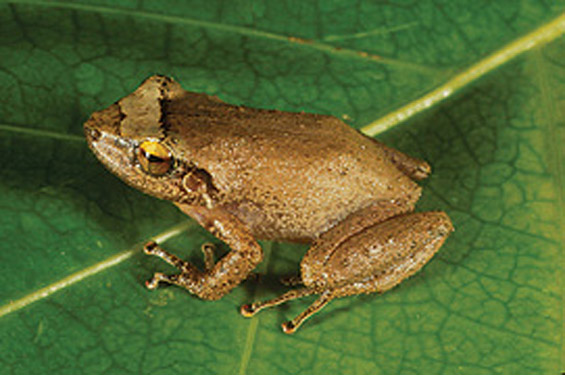
Coqui frog is being eradicated in Hawaii. USDA photo


If Hawaii is removed from the anecdotal information in the Wilcove article, the rates of extinction are comparable to those in Canada where introduced species are considered the least important of six categories of causes of extinction (habitat loss, over-exploitation, pollution, native species interactions, and natural causes such as storms) identified in a similar article in 2006(4).  This list doesn’t include climate change, which is now considered a serious threat for extinction.    Similar studies in the continental United States have reached similar conclusions.(5)

At the time the Wilcove et. al. article was published there was no evidence of a single extinction (or even local extirpation) of a native plant in the continental US resulting from competition from an introduced species of plant.  Clearly, the authors of this study were guilty of exaggeration.(6) 

Although native plant advocates have misused this publication by taking it out of context, the authors were complicit in its misuse by selecting a geographic area that is not representative of the United States.   Non-native species are NOT the second greatest threat to the survival of endangered native species.  In fact, they probably aren’t the third, fourth, or fifth greatest threat to native species. 

 We wish that native plant advocates would examine the origins of their assumptions more carefully.  We believe if they did so they would modify their destructive projects to reflect a more inclusive view of nature. 


(1) Wilcove, DS, Rothstein, D., Dubrow, J., Phillips, A., and Losos, E, “Quantifying threats to imperiled species in the United States,” BioScience, 48, 607-615, 1998. 

(2) Davis, Mark, Invasion Biology, Oxford University Press, 2009, page 181.

(3) Ibid.

(4) Venter, O, et. al., “Threats to endangered species in Canada,” BioScience, 56, 903-910, 2006.

(5) Ibid., page 182

(6) Ibid., page 183

A dialogue about the living roof on the California Academy of Sciences

We encourage native plant advocates to comment on our posts because we learn from them.  We learn more about their ideology and the assumptions that support it.

These dialogues with native plant advocates are embedded in our posts and are therefore not as accessible to our readers as they often deserve to be.  Occasionally, we will create a post from these exchanges so that all of our readers can benefit from them.  In so doing, we hope not to discourage native plant advocates from posting comments, as they are essential to improving our mutual understanding of the complex issues we are debating.

We recently received a comment from someone who seemed to believe that our post about the green roof on the California Academy of Sciences is essentially fraudulent.   His accusations deserve a response.

California Academy of Sciences, April 2011

Comment from “Name Here”

May 6, 2011 11:43 am

Name Here:  “Since you don’t have the confidence to post your identity, I thought it only fitting to return the favor. Your argument would have much more strength if you were not anonymous.

You claim on your home page to provide citations, yet in this article you fail to tell us who “We had the privilege of meeting the ecology consultant who designed the plant palette for the living roof for the academy and many other institutions around the world.” is referring to. The “ecology consultant” does not have a name? By then throwing out Peter Del Tredici’s name it would appear as though you wish your reader to assume that he was the “ecology consultant” you refer to.”

Webmaster: The ecology consultant for the living roof on the Academy was Paul Kephart of Rana Nursery. He is the person we are quoting in our post about planning for the living roof.  Our readers can confirm Mr. Kephart’s role in the design of the roof by reading this article:  “High Maintenance Superstar,” Linda McIntyre, Landscape Architecture, August 2009.  This article is not available on-line, but the edition of the magazine in which it was published can be purchased on-line.  However, Mr. Kephart’s statement quoted in our post was made in a lecture to a group and does not appear in this publication. 

Our post did not state, nor did it imply that Peter Del Tredici was the ecology consultant for this project.  He is a scientist who has published articles about native plant “restorations,” particularly in urban settings.  We quote him in our post because his observations about native plant gardens are directly relevant to the living roof.

Name Here:  “On another note, you mention this third predominant species on the roof as “a moss” and then tell us it is non-native, yet offer no proof of this. Citing another blog with no standard of journalistic integrity is not a valid source. You might want to present the scientific name of this moss to prove your point, though I do not believe, judging by your writing, that you actually know the name, or you would have presented it.”

Webmaster:  At the time that we published our posts about the living roof, we did not know the names of the mosses on the roof, which is why we quoted the “From the Thicket” blog.  The author of the “From the Thicket” blog, Heath Schenker, is Professor of Landscape Architecture at UC Davis.  Her background and credentials are described on her blog.  She wrote her post about the living roof at the California Academy of Sciences after attending a symposium at the Academy about their monitoring project.  Our readers can judge for themselves if this was a credible source of information to document our post at the time it was published.

 Name Here:  “There are many different species of mosses out there, some native, some non-native. Many moss are very cosmopolitan in their range and therefore may occur natively all over the world. The actual quote from InTheThicket is as follows: “Nobody knows where the mosses came from, but they appear to be varieties of early-succession mosses, the types that commonly show up in disturbed soil.” I challenge you to show me where this says they are non-native.”

Webmaster:  After we published our post, the Academy made their monitoring report available on-line:  http://www.calacademy.org/pdfs/living-roof-project-results.pdf.  The report contained the names of the mosses on the roof: Bryum sp., Rosulabryum sp., Ceratodon purpureus, Leptobryum pyriforme.  We took that list to the Jepson Herbarium at UC Berkeley to confirm that our description of the mosses was accurate.  The staff at the Herbarium looked up those mosses for us and described them as “cosmopolitan,” which means they are widespread and cannot be considered either native or non-native.  Since these mosses were not amongst the 9 species of native plants originally planted on the roof, we felt comfortable with our original description of them.  They are clearly “volunteers,” not part of the original roof top planting.

Name Here:  “I think it is important for anyone reading this blog to be reminded that it is just that, a blog. It is written by an anonymous source who can say whatever they like with no fear of reprisal other than these comments, and with no need to live up to journalistic standards of any kind.”

Webmaster:  Yes, the Million Trees blog is “just a blog.”  However, I invite our readers to consider the difference between this accusatory comment from “Name Here” and the information we present.  We provide citations for most statements we make.  Those citations are usually of publications by academics at major universities, published in peer-reviewed journals or journalistic articles about their publications.  We often resort to journalistic articles because they are easier for non-scientists to comprehend. 

We know that we are confronting firmly held beliefs in the community of native plant advocates.  Therefore, we cannot expect to challenge their assumptions without providing well-documented information.  And since we have often been on the receiving end of ad hominem attacks by native plant advocates, we do our best to protect ourselves from such attacks by standing on firm scientific ground and by remaining anonymous.  (One wonders what “reprisals we should fear” for providing information with which “Name Here” disagrees.)

In contrast, “Name Here” questions our credibility without providing any evidence to substantiate his claim that we are fabricating information. Therefore, his comment seems more an attempt to discredit than to illuminate. 

Celebrating the first anniversary of the Million Trees blog

We are celebrating the anniversary of our first year of the Million Trees blog by reporting our progress and what we have learned. 

Our readership has grown steadily in the past year, particularly in 2011.  Daily visits have increased 200% since December 2010.

Of our 50 pages and posts, the three most popular posts, in descending order of visits, are presently:

A more recent post “The Living Roof:  A failed experiment in native plant gardening” is in fourth place, but gaining ground quickly.  There is apparently considerable interest in the green roof on the California Academy of Sciences.

We have had over 200 comments from readers, most in support of our perspective on the native plant movement, but many critical of our approach to this issue.  We have posted most, but not all of the critical comments. 

This comment is typical of those few that we chose not to post:  “This entire website is essentially just a cesspool of misinformation.”  We responded to that reader:  “If you would be more specific, we might post your comment.  You should also cite your sources as we do on Million Trees.  At the moment, your comment contains no information.”  He did not respond, so we did not post his comment.

Most native plant advocates who post comments are more specific, but they have never provided references for the generalizations that are the underpinnings of the native plant movement, such as:

  • Native grassland stores more carbon than forests (Since carbon storage is proportional to biomass, this is a physical impossibility.)
  • Native plants produce:  “Better soil function resulting in improved air quality and hydrology and pollination”  (We have seen no scientific evidence to support any of these claims.)
  • Wildlife prefers native plants (Most wildlife has adapted to non-native plants and is sometimes dependent upon them)

We responded to these comments with scientific references that contradict these claims and we invited the authors to provide us with scientific references that support their view.  We did not receive any replies to these requests for information about the sources of their statements. 

In one case, we had a long email dialogue with a native plant advocate who filled pages with such generalizations.  We repeatedly asked him to cite his sources.  Finally he sent us a 12 page bibliography, none of which he claimed to have read.  Nor did he make any connection between this lengthy bibliography and the statements he made in support of his arguments.  That was the end of the dialogue.

We conclude that these unsupported generalizations about the superiority of native plants are symptomatic of the native plant movement, which is an ideology, not a science.  The ideology persists because it is a victim of incestuous amplification, the sharing of misinformation by a group that isolates itself from dissenting views.  They hear their assumptions repeated so often that the assumptions are eventually transformed from fiction into fact in their minds. 

Unlike native plant advocates, we read all available literature on the subject, particularly publications in support of the native plant movement, such as the newsletters of the California Native Plant Society, Nature in the City, as well as Jake Sigg’s Nature News.  When we see new claims of the benefits of native plants, we research those claims by comparing them to the scientific literature. 

It is our research of the scientific literature that gives us hope that the native plant movement is losing its credibility.  In the past few years, more and more scientists have published their research refuting many of the assumptions of the native plant movement.  We have reported on Million Trees the research of some of these scientists:  Mark Davis, Peter Del Tredici, Hugh Raffles, and Dov Sax.   The publications of these scientists have enabled us to provide our readers with the evidence that many of the assumptions of the native plant movement are unsupported by scientific research.

Thank you to the readers of the Million Trees blog for visiting and commenting.  We invite our readers to correct any misstatements of fact, as we try our best to avoid the incestuous amplification that can accompany advocacy.  We provide citations of scientific literature whenever possible to avoid that trap.  We renew our appeal to native plant advocates to supply us with the scientific literature that they believe supports their ideology and we commit ourselves to reading and reporting such evidence. 

Our inclusive view of nature: native and non-native plants at Oyster Bay

For the record, we repeat Million Trees’ primary appeal to native plant advocates:  please plant native plants if that is your preference, but quit destroying non-native plants, trees and animals. 

Destructive "restoration" at Oyster Bay
 

Hybridization: “Genetic pollution” or a natural process?

 
Presidio variety of California poppy. NPS photo

The San Francisco Chronicle’s gossip columnist, Leah Garchik, recently published a story about California poppies in the Presidio.  Apparently, someone planted the “wrong” poppy, or it migrated there.  The poppy that is native to the Presidio is small and yellow.  This “alien” poppy is the large orange poppy that most of us consider the classic California poppy.  The historical record indicates that this classic poppy grew elsewhere in San Francisco, but since it didn’t grow in the Presidio it must be removed because the Presidio’s Vegetation Management Plan “contains the requirement to remove any plants that could jeopardize the integrity of the genetics of native plants in the Presidio.” 

The “wrong” poppy

This incident reminded us of an article published in the newsletter of the local chapter of the California Native Plant Society several years ago, entitled “Contaminating the Gene Pool.”  In this article Jake Sigg instructs gardeners to beware of planting the wrong variety of a native plant because it will cause “genetic pollution.”  The California poppy is one of the examples he gives of a variety of California native being planted in San Francisco that doesn’t belong here.  It isn’t sufficient in his opinion, to plant a California native if that specific variety of the species didn’t historically occur in San Francisco.  He asks gardeners to “think in terms of preserving the genetic integrity of the local landscape.”  And he speculates many negative consequences of selecting the wrong variety, such as “genetic swamping, you’ve got all these foreign genes that are going to overwhelm the native population.”  We were reminded of Mr. Sigg’s vocal opposition to human immigration. 

For the benefit of our readers who aren’t gardeners, we should explain what Jake Sigg and the Presidio are worried about.  In a word, they are worried about hybridization, defined as “to breed or cause the production of a hybrid,” which is defined as “the offspring of two animals or plants of different breeds, varieties, or species.”  Hybridization is as likely to occur between two native plants as two non-native plants, but native plant advocates are concerned about the possibility of a native and a non-native plant producing a hybrid variety that is distinct from the native plant.  Hybridization is not inevitable, but it does occur naturally as well as through human manipulation.  The “From the Thicket” blog recently told the fascinating story of the development of a valuable garden cultivar variety of a favorite California native, ceanothus or California Lilac. 

Aside from the unpleasant association with eugenics, Mr. Sigg’s advice raises several practical questions.  How is the gardener supposed to know exactly which variety of a native plant “belongs” in San Francisco or even in a specific neighborhood within San Francisco, such as the Presidio?  And, in the unlikely event that gardeners might have such esoteric knowledge, where would they get the seeds of this specific variety?  Jake Sigg acknowledges this practical obstacle, but advises gardeners to get their seeds and plants only from the annual plant sale of the local chapter of the California Native Plant Society.  One wonders how many gardeners will follow this rather restrictive advice.

However, the more important question is the scientific question.  Is hybridization an inherently harmful process that always reduces species diversity?    We turn to Mark Davis for a less gloomy view of hybridization.  Like most scientific questions, there is evidence of both positive and negative effects of hybridization on species diversity.  Since you’ve heard the negative view from Mr. Sigg, we’ll let Mark Davis speak for the positive view.  Professor Davis reports in his book Invasion Biology* that “the fossil record generally shows that following the invasion of new species, the number of species resulting from adaptive radiations and evolutionary diversification exceeds the number of extinctions.”   And he concludes his discussion of hybridization and evolution by saying, “…a fair appraisal must also acknowledge that species introductions can enhance diversity as well, through hybridization, and the creation of new genotypes.”

The native plant movement has a narrow view of nature, which we do not share.  Their ideology is based on dire predictions of ecological disaster if we don’t follow their restrictive advice.  And when the managers of public lands choose to follow their advice, the consequences are usually the destruction of plants and animals that we value, in this case a field of California poppies. 


* Mark Davis, Invasion Biology, Oxford University Press, 2009, page 78-82.

Broom: “I’m ba-ack”

Leona Canyon, Spring 2011

One of our first posts, nearly one year ago, was about attempts to eradicate broom (see “Broom:  I’ll be back!”).  It’s that time of year again, when the broom is blooming around the Bay Area, adding a dash of bright yellow color to our public lands.

Despite continuing efforts to eradicate broom, it makes this annual comeback, regardless of the method used to kill it.  Mechanical destruction is one of the methods used.  In the photograph taken in fall 2010 of a trail in Redwood Park we see the unsightly result of such an attempt to eradicate the broom shown in our first post about broom in spring 2010.

Redwood Park, Spring 2010
Redwood Park, Fall 2010

The UC Davis Statewide Integrated Pest Management Program  predicts the results of this effort to eradicate broom:  “Brush rakes and bulldozers often leave pieces of rootstalks that readily can resprout…using large equipment to clear land creates a perfect environment for new seedling establishment, making follow-up control essential.”  So, we shouldn’t be surprised when we revisit this same site the next spring to find that although it is still unsightly, it is also covered with the resprouts of the broom.

Broom resprouts, Redwood Park, Spring 2011

Herbicides are also used to eradicate broom.  The East Bay Regional Park District uses Garlon for foliar spraying of broom, despite the public’s concern about herbicide use in our parks.  In contrast, Marin Municipal Water District (MMWD) has not used herbicides on its properties since 2005, in response to public protests.  In December 2010, the Marin Independent Journal reported that MMWD is considering using Roundup (which is considered less toxic than Garlon) for broom control, but that a proposal will not be made until 2012 at the earliest, after an environmental impact study that will consider all alternatives for “pest management.”

Even if we are willing to accept the health and environmental risks associated with herbicides, they are not a guarantee of success.  According to UC Davis, “One application of an herbicide does not always completely control brooms…Watch treated areas closely for at least a year, and retreat as necessary.”


Since the seeds of broom are known to live in the ground from 50 to 60 years, we should expect that it is very difficult to eradicate.  Unless we make a commitment to kill the plant above the ground every year for as long as the seeds live in the ground, we cannot expect to be successful in that effort.

We were therefore amused by this exchange that Jake Sigg had with one of the readers of his “nature newsletter” (December 20, 2010):

Reader:  “…We have been up there every year for about 3-1/2 years now…It has been quite instructive about how flat out difficult it is to reverse the process [of “displacement” of native plants].  Like most invaders, the non-native plants like it here and want to stay.  The broom in particular are [sic] astoundingly persistent in holding whatever territory that they have gained.  It sounds strange to say, that sometimes I think the project is an exercise in futility while at the same time is extremely satisfying work and will continue it into the indefinite future.”

Jake Sigg:  “…It is such a lop-sided struggle…And yet, we all keep going.  It is a paradox that I don’t understand.  While working I’m fully aware of the seeming futility of what we’re doing, and yet keep going—and enjoying it!!”

Jake Sigg and his readers would benefit from the advice of Mark Davis in his book, Invasion Biology.*  Professor Davis suggests that unless a non-native species causes great health or economic harm, we adopt the “LTL approach” i.e., “Learn to love ‘em” or at least “Learn to live with them.” 

If it is futile to eradicate a plant we don’t like, if that plant isn’t doing us or any other plant any harm, and if we are damaging our environment in our futile attempt, let’s change our attitude toward that plant.  If we can’t change the plant, it is still within our power to change ourselves.  Surely we can find something more fruitful to do that is equally satisfying such as planting more native plants rather than destroying non-native plants.

Broom is an especially good candidate for LTL.  It is green all year around.  It requires no care whatsoever.  And in the spring it treats us to a lovely carpet of bright yellow.   What’s not to love?


* Mark Davis, Invasion Biology, Oxford University Press, 2009, page 150

Oyster Bay: A preview of plans for the Albany Bulb

The Albany Bulb is the former dump of the city of Albany, CA.  It was built on landfill.  The East Bay Regional Park District (EBRPD) recently announced its intention to “restore” it as a native plant garden, though it admits that the word “restore” is a misnomer for a place that was never populated by native plants.  Presently, the Bulb contains an eclectic collection of art built from the junk that remains from the dump.  Non-native plants and trees thrive there with no care.  Please visit our post about the Albany Bulb for photos of this colorful and unique recreational and artistic resource. 

We recently had the opportunity to express our opinion of plans for the Albany Bulb in a conversation with the Assistant General Manager of Planning/Stewardship & Development of EBRPD.   We told the manager that it is pointless to destroy the Albany Bulb because it is an artificial place in which native plants are not more native than what grows there now without any care.  It is a heavily used place that does not require any “improvements.”  It is therefore a waste of money to destroy something that everyone loves just as it is.

The manager told us that we would also love the native plant garden once it is done.  He said that visitors often object to plans for changes in their park, but that when the project is done, they are always happy with it.  He urged us to visit Oyster Bay, a former dump for the city of San Leandro, also built on landfill.  He said it is now a beautiful native plant garden that everyone is delighted to visit.  And so, of course, we had to see this transformation because we want to know what is in store for the Albany Bulb.

This is what we found at Oyster Bay. 

Oyster Bay, April 2011

We found hundreds of stumps of trees that have been destroyed.  Many of the trees are now resprouting.  We wondered if the resprouts would be poisoned to prevent the trees from regenerating.  If not, we wondered how long it would take for the trees to return. 

Resprouts

The ground around the tree stumps was a labyrinth of the holes made by animals that had lived in them in the past.  The animals have moved on, perhaps to the cover provided by trees nearby. 

Pittosporum, Oyster Bay

We found a green sea of non-native grass.

Non-native annual grass

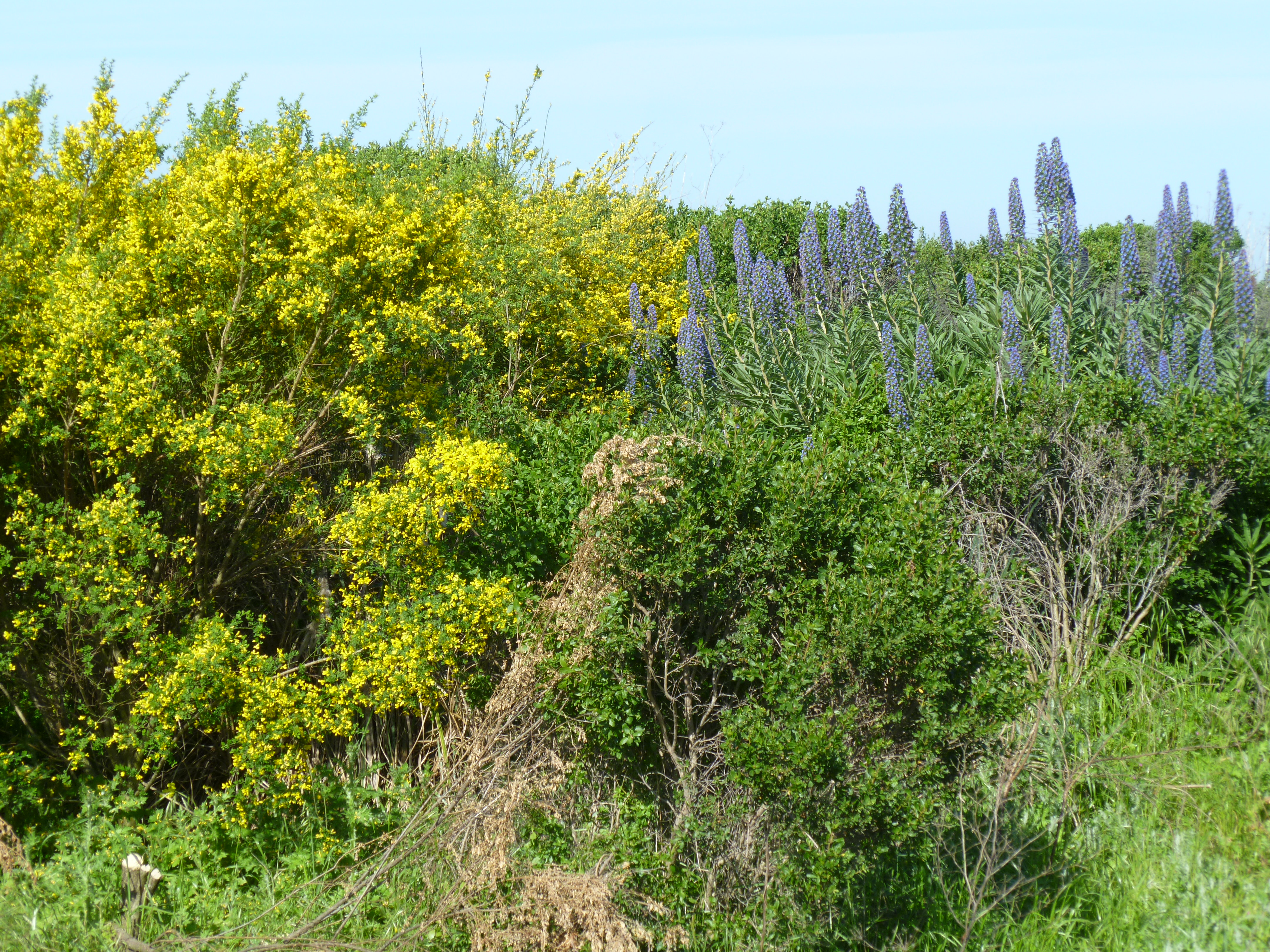
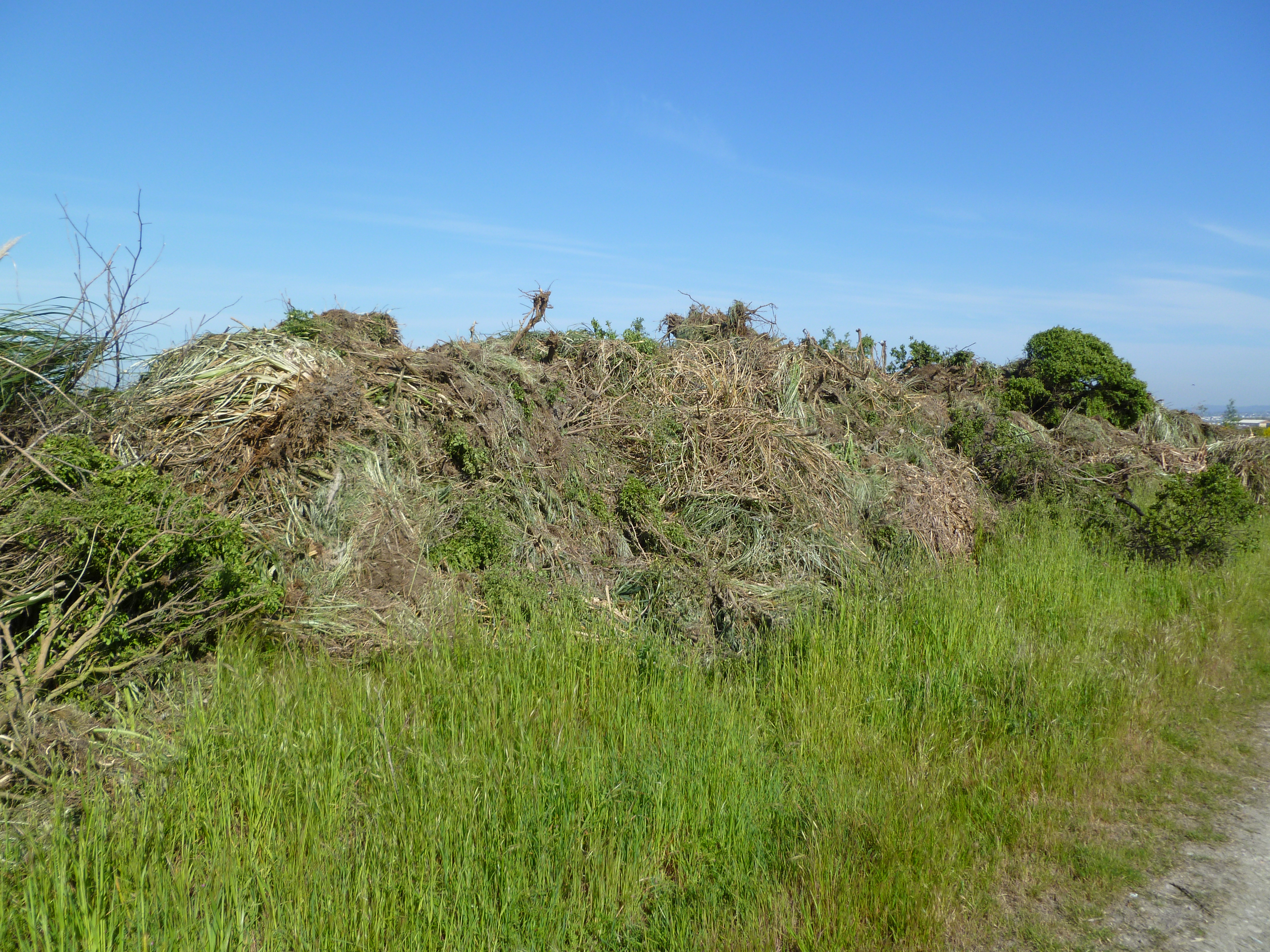
We found non-native broom and native coyote brush and close by huge piles of those same shrubs that have been mechanically cleared.  We don’t know why they have been mowed down.  We doubt that anyone would consider these debris piles a “park improvement.”

Non-native broom & Pride of Madeira, native coyote brush
One of many piles of destroyed vegetation

We found a small patch of native plants at the entrance of the park and a sign informing us that this scene of destruction is a “park improvement” project.

We also spoke to one of the few visitors we encountered on this beautiful spring Saturday.  We asked if they had been coming to the park for a long time.  They said that had.  We asked how they felt about the changes in the park, without giving them any clues as to our own assessment.  They readily volunteered that they didn’t understand why the trees were destroyed. 


A few native plants at the park entrance

Once again, we are reminded that beauty is in the eye of the beholder.  Assuming that the park manager with whom we spoke about Oyster Bay has actually seen this park, and that he sincerely believes that it is a lovely native plant garden, we must beg to differ.  Although it is a beautiful park, it has not been improved by the needless destruction of trees and vegetationThe beauty of this park derives from its diverse collection of predominantly non-native plants and trees.  We hope that it will not be further damaged by an agenda that is devoted to native plants, not to the enjoyment of park visitors. Likewise, the Albany Bulb is unlikely to be improved by destroying plants, trees, and art that is all doing just fine without any intervention by the East Bay Regional Park District.  We urge the Park District to LET IT BE! 

We don't think so!

“Mother Nature’s Melting Pot”

The Sunday New York Times of April 3rd published an op ed in defense of non-native plants.  In “Mother Nature’s Melting Pot” Professor Hugh Raffles (New School) reminds us that our country was built by immigrants.  Despite our origins, we also have a long tradition of opposition to immigration.  As each generation becomes established, it wishes to pull up the welcome carpet to new immigrants.  During times of economic crisis this anti-immigration sentiment is particularly strong.

Professor Raffles notes the extension of this anti-immigration sentiment to non-native plants and animals.  Just as immigrants have contributed to the dynamism and creativity of our society, non-native plants are contributing to our natural world as, “They arrive unannounced, encounter unfamiliar conditions and proceed to remake each other and their surroundings.” (1)

He provides many examples of non-native plants and animals that benefit both humans and native animals, including several examples that are locally relevant.  He reminds us that the eucalyptus is a rare source of winter nectar for the honeybees that were imported in the 1600s and now pollinate about one-third of our food crops.  He also reminds us that ice plant can stabilize sandy soils that might otherwise inundate our roads and neighborhoods as they shift in the wind.

Painted Lady butterfly on ice plant. Bug Squad, UC Davis

He notes that attempts to eradicate non-native plants and animals are often futile once the species become firmly established and that attempts to do so often harm the environment.   Here in the San Francisco Bay Area we are acutely aware of the harm being done by attempts to eradicate non-native plants.  We witness hundreds of thousands of healthy, mature trees being needlessly destroyed.  We see acres of park land being sprayed with toxic herbicides.  We watch precious recreational space being fenced off for “restorations” in places that are completely artificial, yet also entirely natural in the sense that they are sustained without being actively gardened.

The most recent example is the announcement that the Albany Bulb (in Albany, CA) will soon be transformed into a native plant garden.  The Albany Bulb is composed of landfill that was used for decades as a city dump and is now a heavily used park, populated by art created from the junk that remains from the dump.  Non-native plants and trees thrive there without any care.  It is pointless to destroy this valuable artistic and recreational resource, yet native plant advocates demand its “restoration.”

Sculpture of “Albany Bulb Greeter”

Professor Raffles makes the logical connection between anti-immigration sentiment and the native plant movement’s commitment to the eradication of non-native plants and animals.  This connection is relevant in the Bay Area because a prominent leader of the native plant movement here is strongly opposed to immigration.

Jake Sigg has been an officer in the local chapter of the California Native Plant Society for many years.  He was a gardener in San Francisco’s Recreation and Park Department for 31 years.  He was awarded the “Jake Sigg Award for Vision and Dedicated Service” by the California Invasive Plant Council in 2003.  This award was named for him, “For years of tireless service and leadership on invasive plant issues in California.”

For many years, Mr. Sigg has published a “Nature News” newsletter several times each week.  This newsletter is widely distributed throughout the Bay Area and is a valuable source of information about nature-related activities.  It is also Mr. Sigg’s podium from which he expresses his opinion on a range of topics.  In most issues, he expresses his deep concern about immigration, both legal and illegal.

“Virtually All Of California’s Problems Can Be Traced Back To Too Many People…Virtually All Of California’s Population Growth In The Last 10 Years Was Due To Immigration…If We Don’t Do Something About Immigration, Our Problems Will Get Much Worse.”  April 2, 2011, Nature News

He is equally concerned about related issues such as granting visas to workers with unique skills and granting citizenship to children born to undocumented immigrants.

“The Ever Expanding Pool of Cheap Labor and the Case For Fewer Visas By Joe Guzzardi”  January 25, 2011, Nature News

“Current U.S. policy results in over 300,000 additional citizens from anchor babies each year.  The demographic impact is far greater because their families stay and bring in additional relatives. Anchor babies are eligible to sponsor their illegal alien parents and other relatives when they turn 21. Moreover, taxpayers pick up the tab for the medical costs and subsequent welfare outlays because of the child’s citizenship status. ACTION NEEDED  Please ask your Congressional representative to co-sponsor HR 140.”  January 13, 2011, Nature News

And so, we conclude that Professor Raffles is not making an idle philosophical connection between the native plant movement and anti-immigration sentiment.  There IS a connection because we see it discussed repeatedly by a prominent voice in the community of native plant advocates.  Occasionally, one of Mr. Sigg’s allies challenges his opinion on this subject.  However, such a debate is apparently rare in his community of interests.

We thank Professor Raffles for making explicit what is implicit in the native plant movement.  We believe that the connection between the eradication of non-native plants and animals and opposition to immigration should be acknowledged and discussed.  The desire to be rid of immigrants—both plants and animals, including humans—is grounded in a need to find someone or something to blame for problems that we are unprepared to face or are powerless to change. 

In the case of human immigration, our living standards are declining primarily because of the globalization of the economy.  Building a wall around our country will not isolate us from the fact that developing countries with lower standards of living are presently more economically competitive.

Likewise, eradicating non-native plants and animals will not prevent the climate change and associated changes in air and water quality that make those newcomers more competitive than the natives that thrived in a different environment, one that is gone and is unlikely to return.    In fact, the destruction of healthy, mature non-native trees is exacerbating the climate change that will ultimately exterminate many species of native plants and animals.(2)


(1) Hugh Raffles, “Mother Nature’s Melting Pot,” New York Times, April 3, 2011

(2) “Multitude of Species Face Threat of Warming,” New York Times, April 4, 2011