Land Management: The Good, the Bad, and the Ugly

In January 2015, UC Berkeley destroyed about 25 eucalyptus trees at the top of Dwight Way, above the intersection of Sports Lane.  We visited the area shortly after the trees were destroyed and told our readers about the project.  We also reported that the project was an example of the huge gap between policy and practice in UC Berkeley’s tree removal projects.  The following is an excerpt from a letter that a member of the public sent to FEMA about this project, detailing the discrepancies between UC Berkeley’s theoretical commitments to “best management practices” and their actual land management practices:

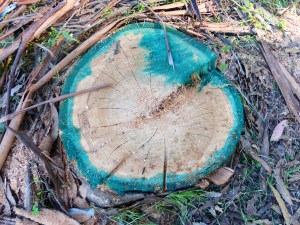
  • Green dye is added to Garlon and sprayed on the stump of the tree shortly after it is cut down. January 2015
    Green dye is added to Garlon and sprayed on the stump of the tree shortly after it is cut down. January 2015

    “The stumps of the trees that were removed have been dribbled with green dye, indicating they were sprayed with herbicide to prevent them from resprouting.  However, no herbicide application notices were posted at the site as required by law* and as described in the Final Environment Impact Statement for the FEMA grants: “In addition to the herbicide application measures, the subapplicants would follow procedures for public notification and education, including posting the timing, location, and appropriate amounts and types of pesticides or other chemicals to be applied at least 24 hours in advance.” (EIS, page 5.10-14)

  • “The Final EIS also states that “in general” most tree removals will be done “from August to November to avoid the wet season and the bird nesting and fledging season.” (EIS page 3-34) This commitment made by UC Berkeley in the EIS has been violated by this round of tree removals in January after heavy rains.
  • “In addition to the approximately 25 trees that were recently destroyed, we counted over 100 stumps that have been destroyed in this area in the past. This area is not described in the Cumulative Impact Section (EIS 6.0) of the EIS. In other words, cumulative impact of the proposed FEMA projects is underestimated by the EIS.
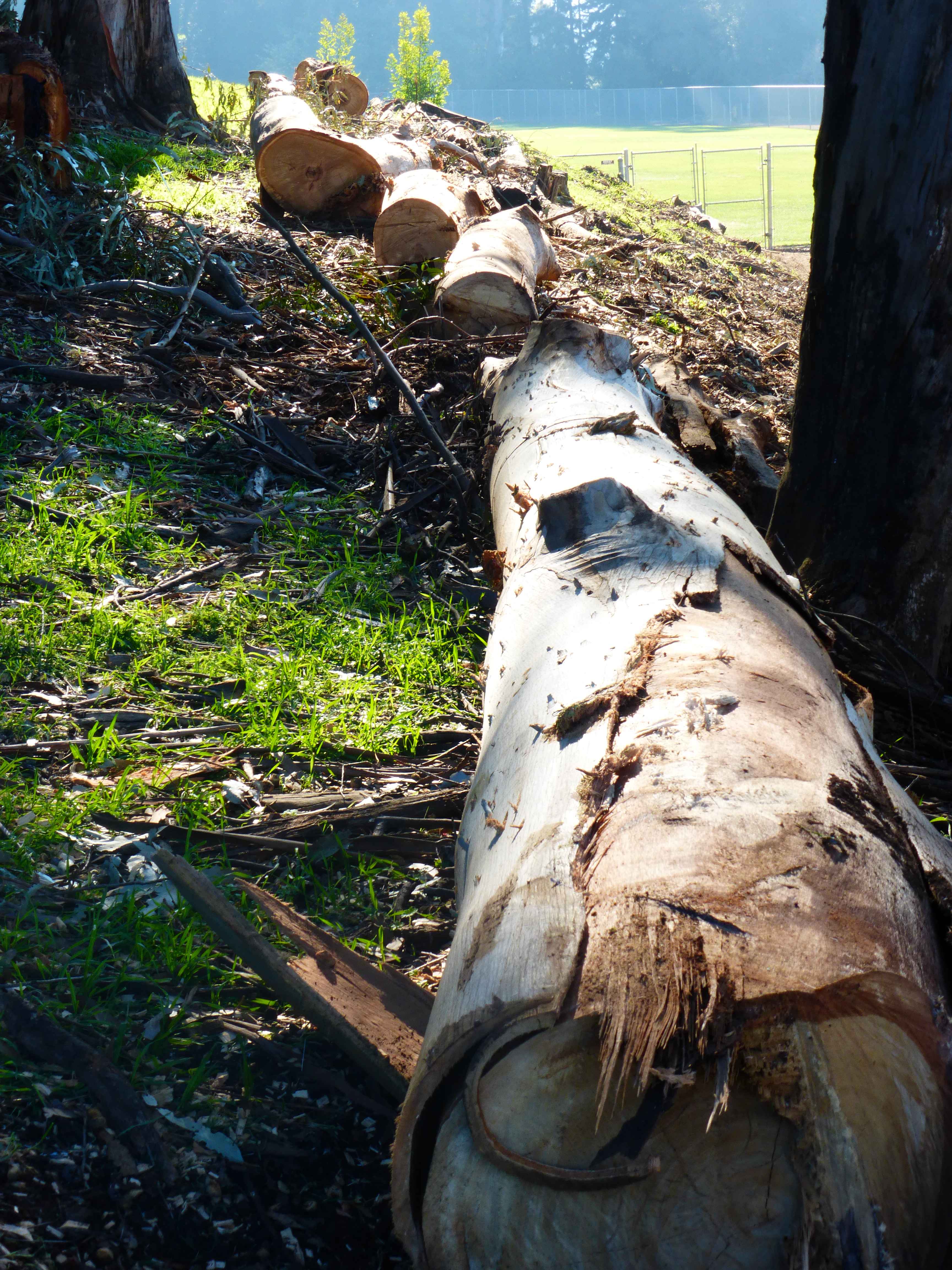
Tree removals, Dwight Way and Sports Lane. January 2015

Consequences of tree removals

One of our readers contacted us in late May 2016, suggesting that we revisit this location to see the consequences of tree removals in January 2015.  So, we went to take a look.  The scene some 18 months later is a stark reminder of why we are opposed to the destruction of all non-native trees in the East Bay Hills.
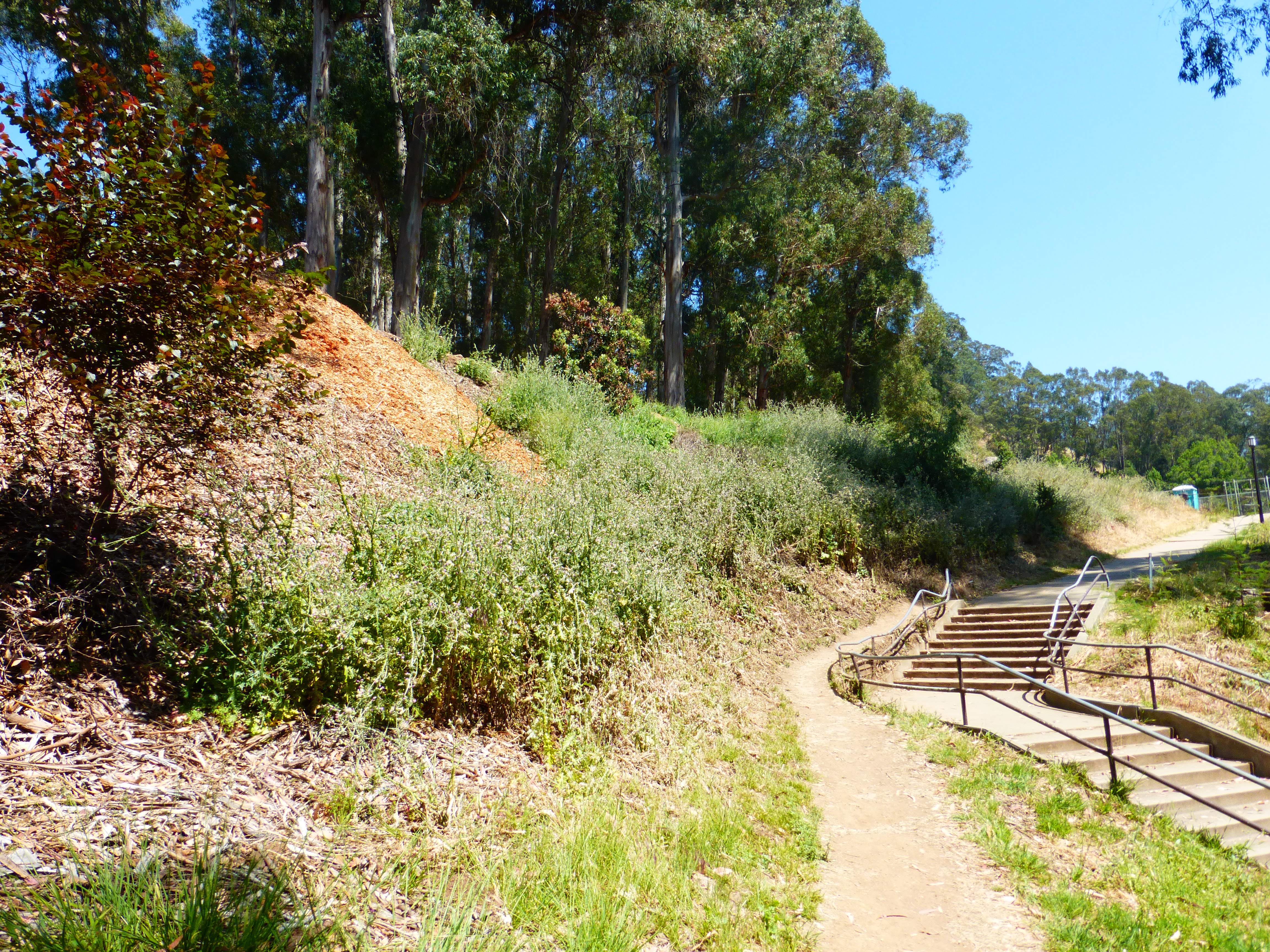
Dwight Way and Sports Lane. May 2016

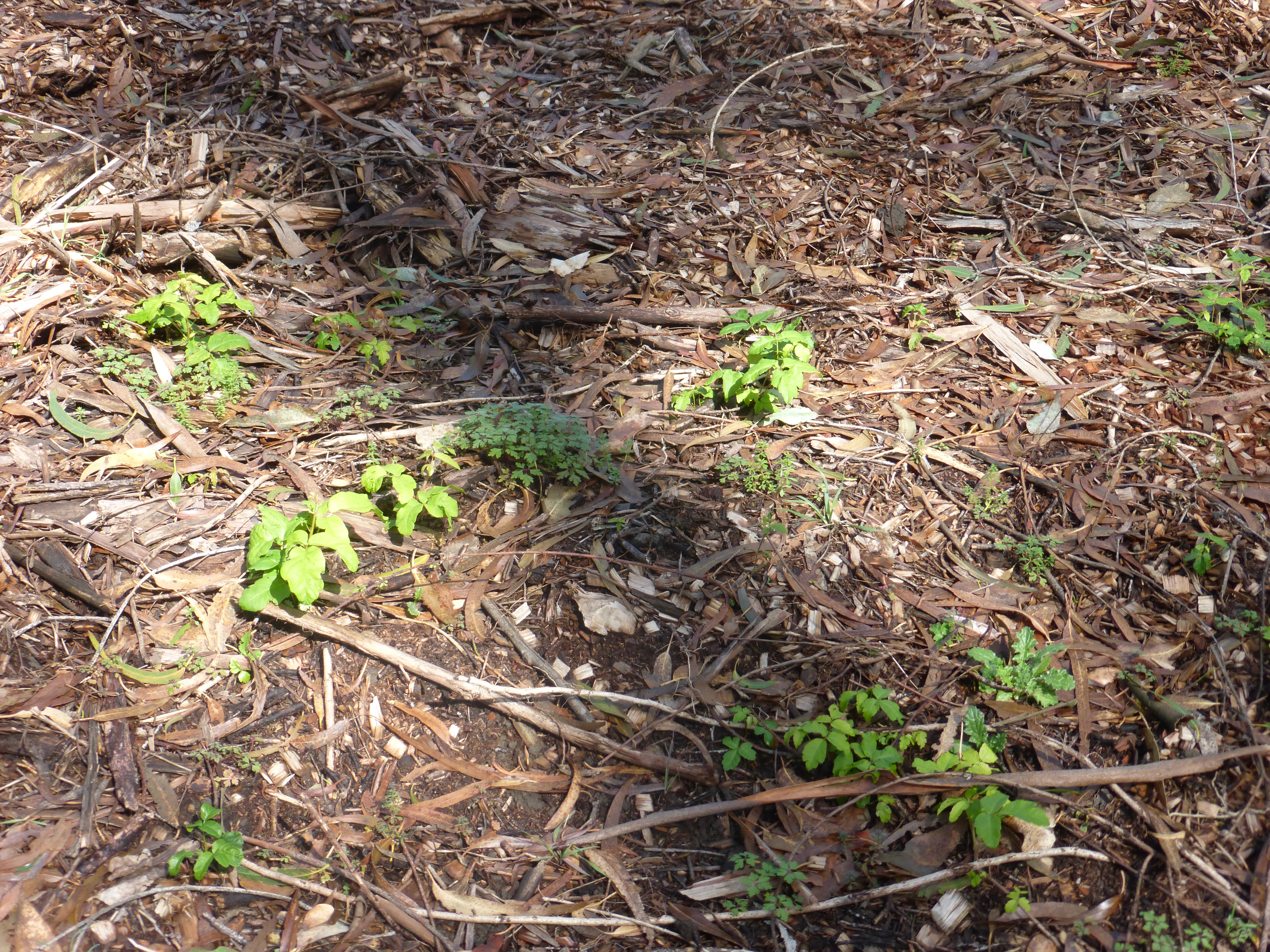
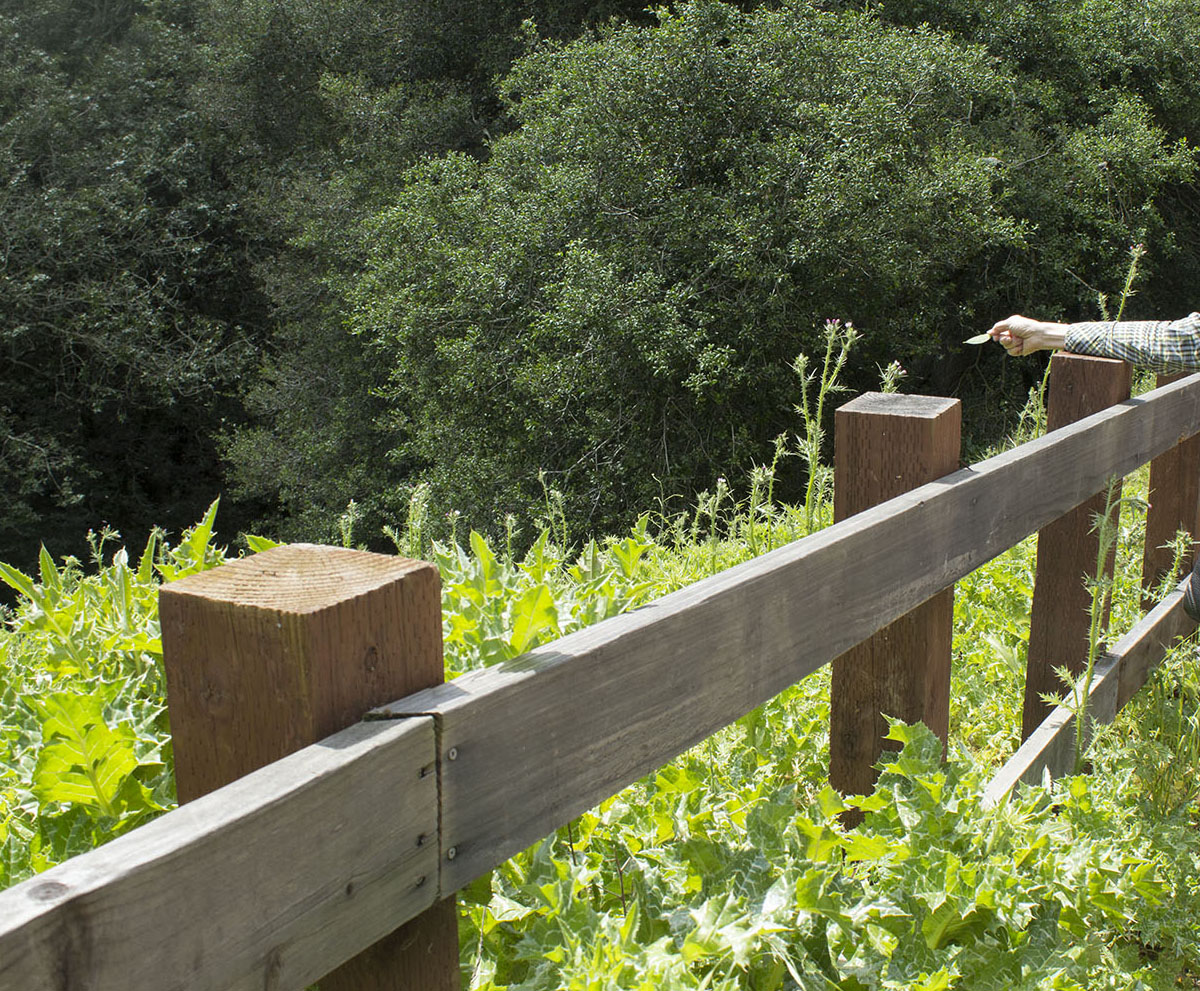
Where all of the trees were destroyed in January 2015, the ground is now completely covered in non-native weeds.  There are several species of thistle and poison hemlock that are over 6 feet tall.

Dwight Way and Sports Lane. May 2016

In some places, the trees were only thinned and the tree canopy is still intact.  The shaded forest floor is significantly less covered in tall weeds.
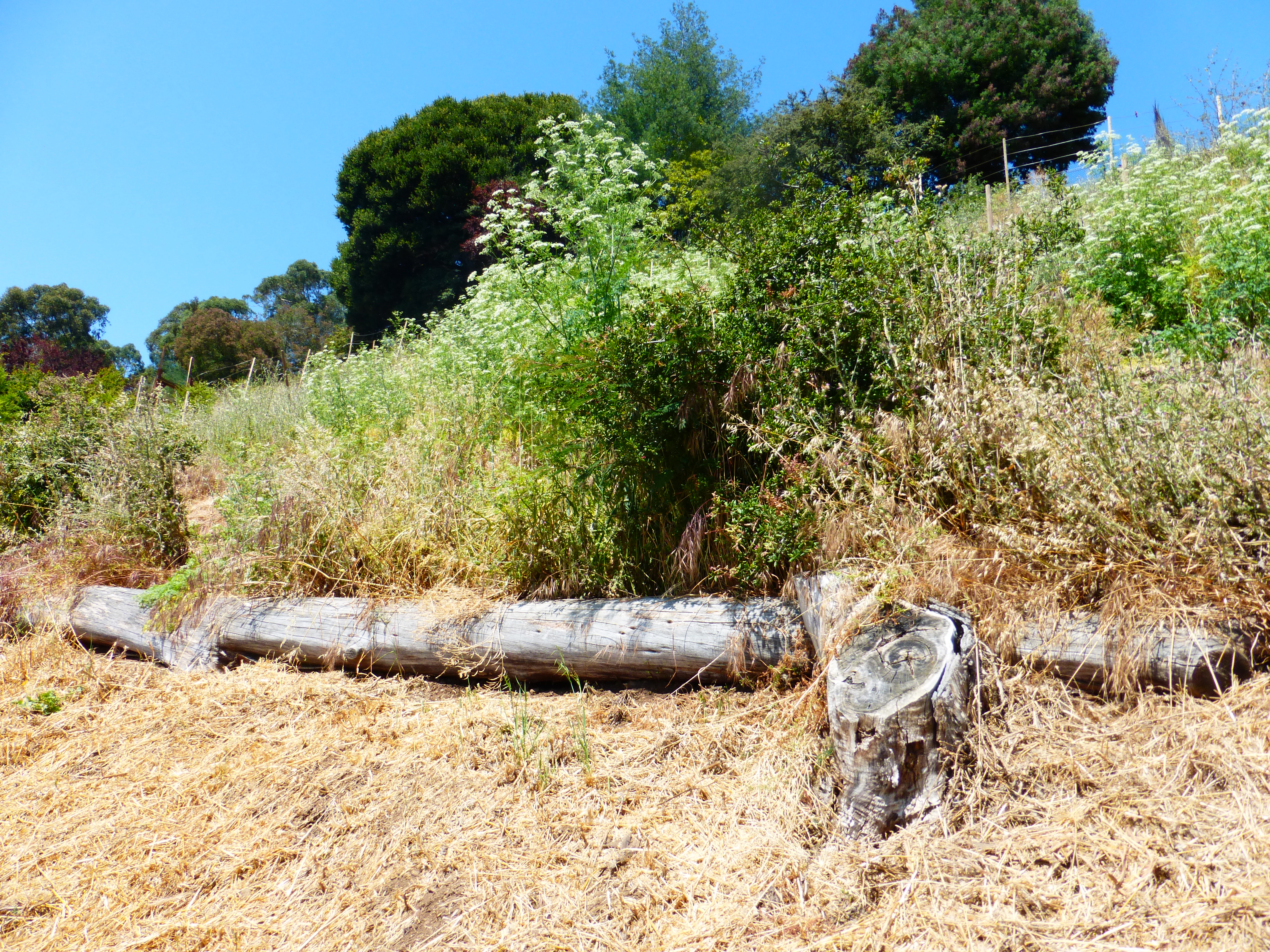
Dwight Way and Sports Lane. May 2016

We also saw the evidence of attempts at weed control.  In some places there was a sharp dividing line between dead weeds and green weeds, suggesting that the brown areas had been sprayed with herbicide.  In other places, the grassy weeds seemed to be have been cut down, perhaps with a weed whacker.  A sign indicated that goats were also being used to graze the weeds.
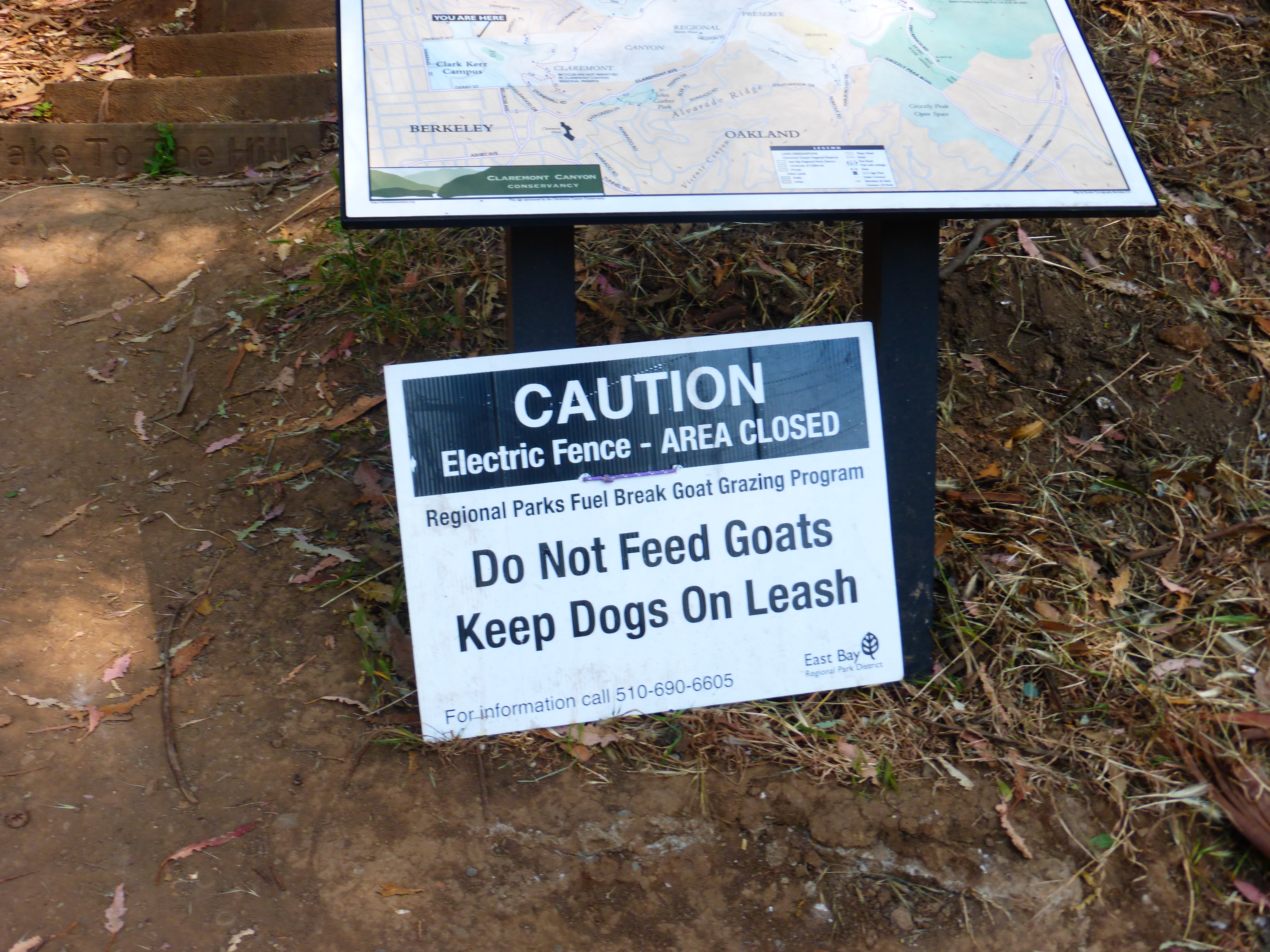
Dwight Way and Sports Lane. May 2016

Misguided choices create more maintenance issues

When the tree canopy is destroyed, increased sunlight creates opportunities for weeds to colonize the bare ground.  Once the weeds take over, land managers are forced to use herbicides to reduce the weed growth.  The only alternatives to using herbicide are more costly, such as hand-operated mechanical methods or renting goat herds.  This is a man-made problem that could have been avoided by leaving the tree canopy intact.

However, we don’t want to leave our readers with the impression that we support the radical thinning of our eucalyptus forest.  We are opposed to such thinning because the herbicide that is used to prevent the trees from resprouting is mobile in the soil.  It kills the tree by killing its roots.  In a dense eucalyptus forest, the roots of the trees are intertwined.  The herbicide used on one tree travels through the intertwined roots and damages surrounding trees that were not destroyed.

The herbicide also damages mycorrhizal fungi in the soil because they are extensions of the tree’s roots.  Mycorrhizal fungi play an important role in forest health because they transfer moisture and nutrients from the soil to the tree.  Therefore, the success of a succession landscape is handicapped by the damage done to the soil.

Also, the trees develop their defenses against the wind as they grow in a specific location with specific wind conditions.  If they are suddenly exposed to a great deal more wind because they have lost the protection provided by their neighbors, the result is often catastrophic windthrow.  That is, the chance that a tree will fall down greatly increases when it is exposed suddenly to more wind than it grew in.

The idea of “thinning” is an appealing compromise to a heated controversy.  However, the consequences of thinning must be weighed against the entirely theoretical benefit of reduced fire hazard.  The cost/benefit analysis does not make a strong argument in favor of radical thinning.

The continuum from Good to Bad land management

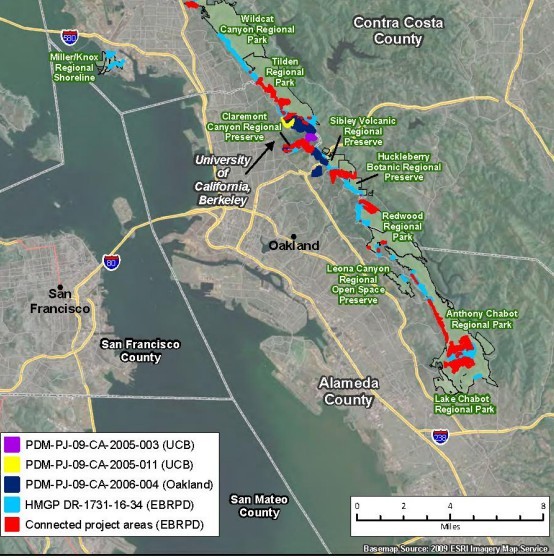
East Bay Regional Park District began to implement its “Wildfire Hazard Reduction and Resource Management Plan” in 2011, after the Environmental Impact Report for the plan was approved.  According to a presentation made by Fire Chief McCormack to the Executive Committee of the Board of Directors on June 3rd, there are 3,100 acres of park land to be treated for fuels management over the life of the plan, of which 863 acres will be done by the end of 2016 and 64 acres will be done in 2017.  The Fire Chief said, in answer to a question, that 1,360 acres (44%) of the total acres are forested with eucalyptus.
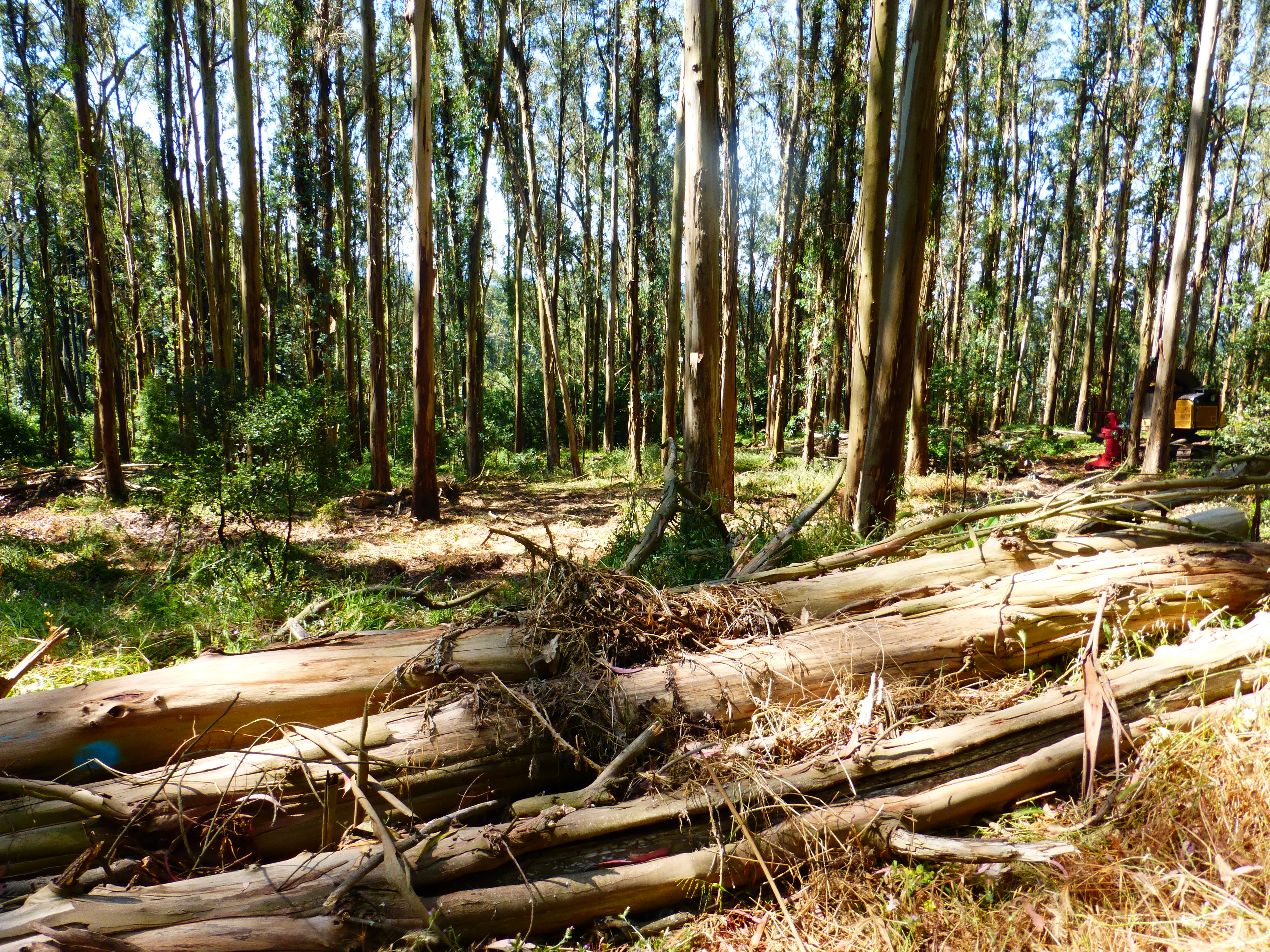
Tilden Park, Recommended Treatment Area TI001, June 5, 2016

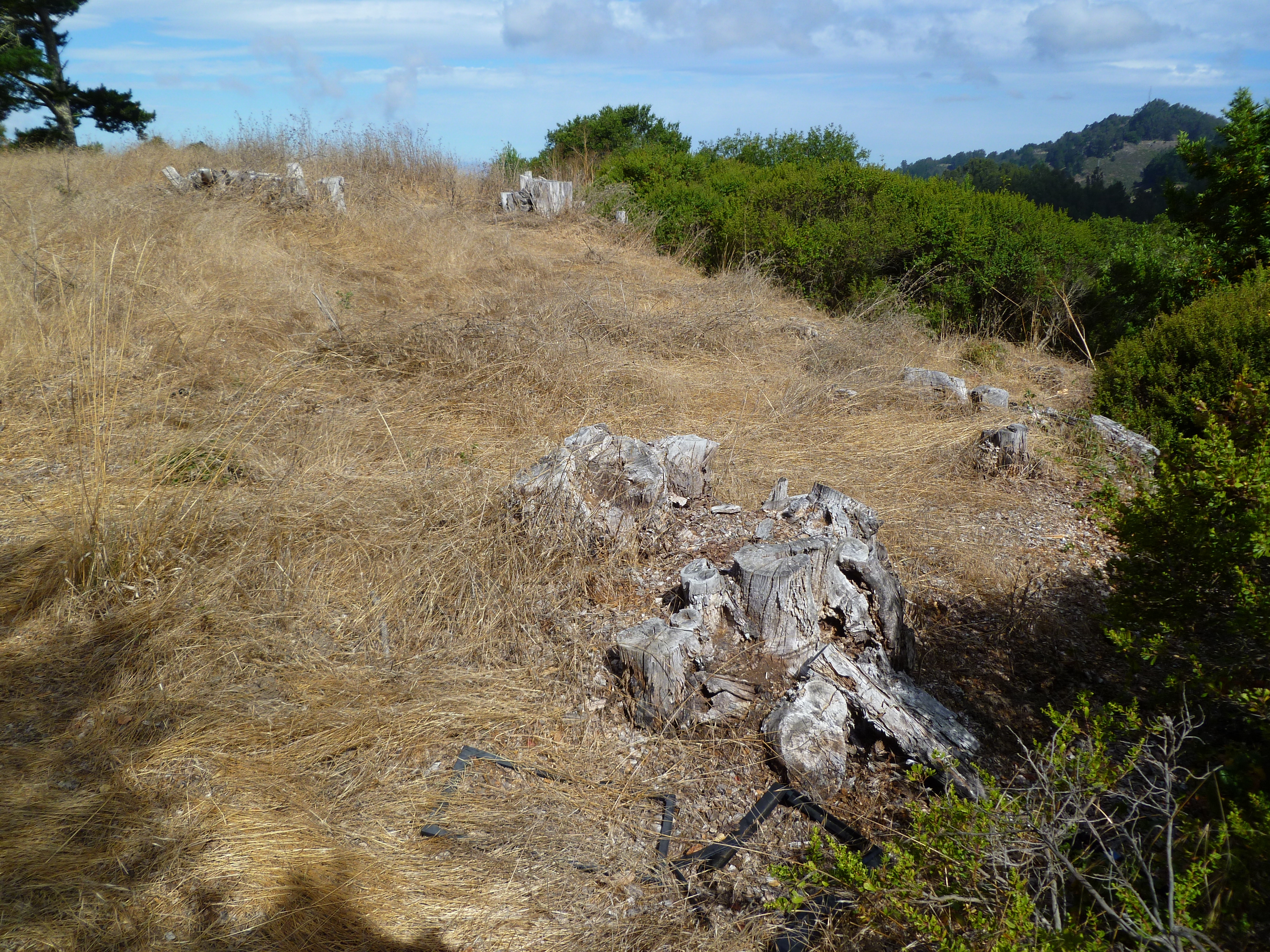
We went to see one of the “initial treatment” projects in Tilden Park on June 5th.  “Recommended Treatment Area” TI001 is along Nimitz Way, which is a paved road/path on the ridgeline.  About 17 acres of it is heavily forested in eucalyptus on both sides of the road.  The project apparently started recently and is not yet completed, judging by the presence of a lot of heavy equipment still on site.  So, these observations of this project should be considered preliminary:

  • The smallest trees are being cut down and those immediately adjacent to the road.
  • The tree canopy is intact. That is, the forest floor is still shaded.
  • The stumps were sprayed with herbicide, judging by the blue dye on the stumps.
  • There were pesticide application notices, but they had been wiped clean. Presumably there was information on those notices during the spraying and perhaps for some time after the spraying, then the information was removed.
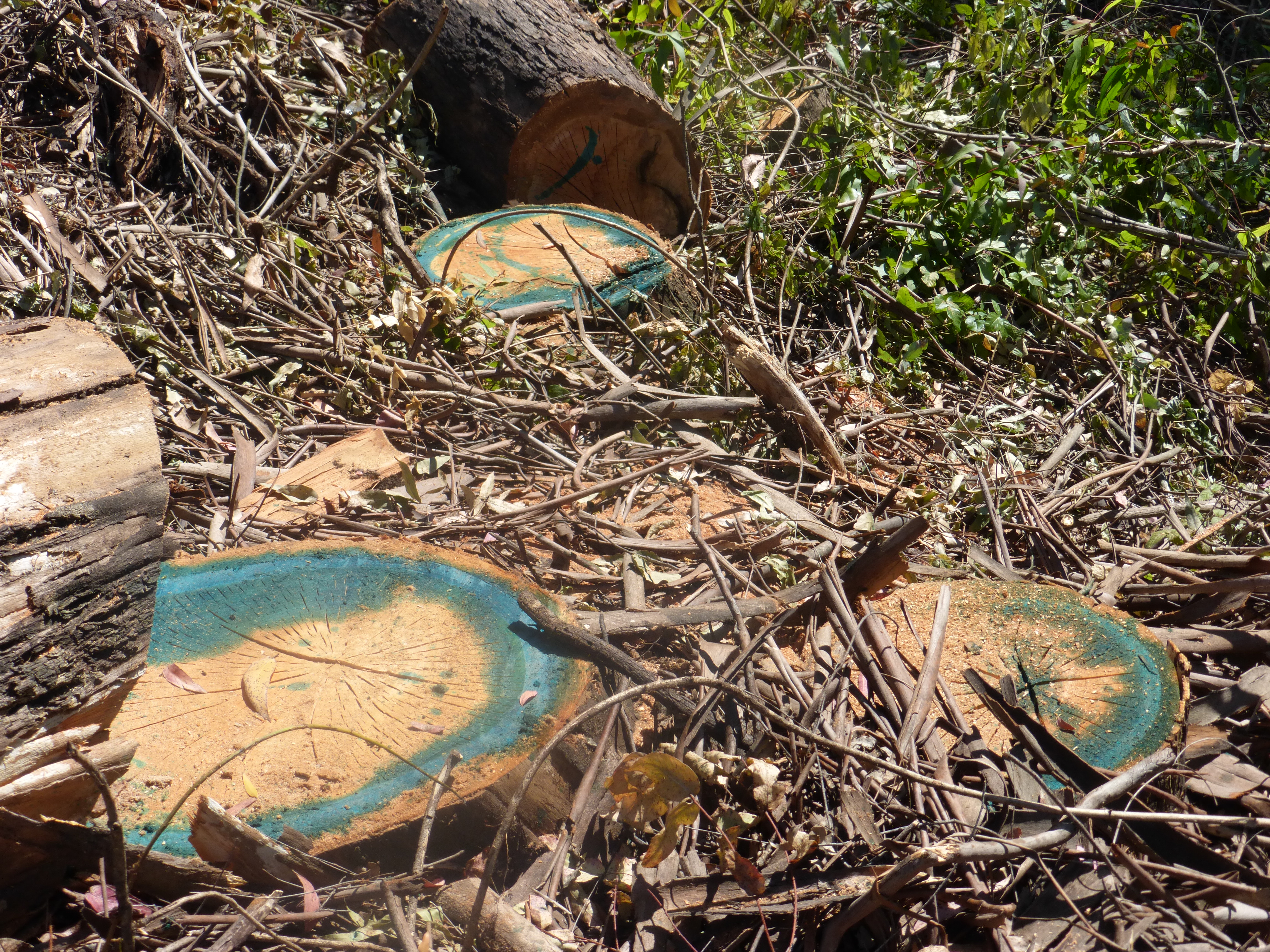
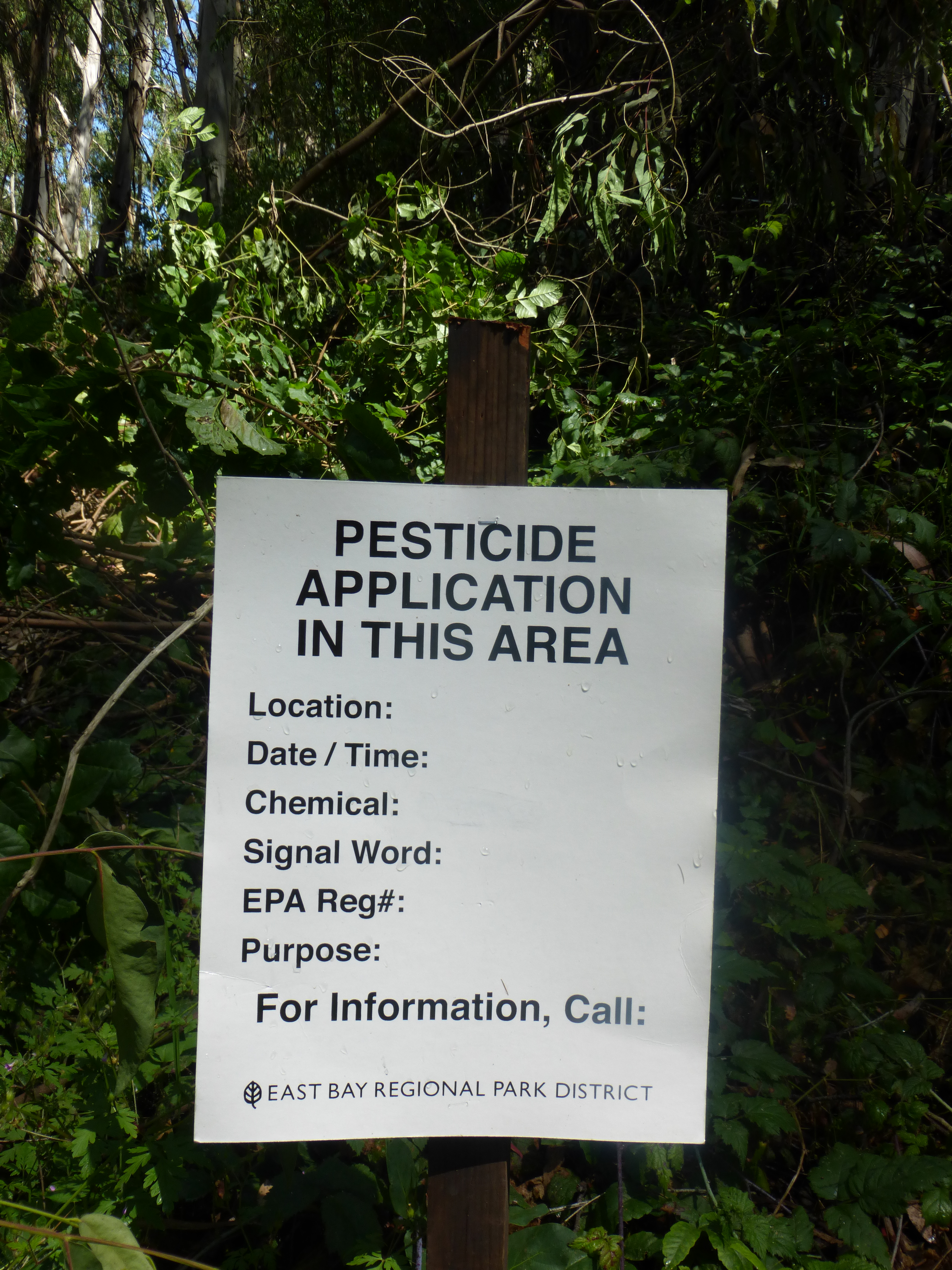
P1030688

P1030677

We must say that we were not horrified by what we saw.  There are still a lot of trees left and we are encouraged that the forest floor is still shaded.  As we have reported, when the eucalyptus forest is clear-cut the bare ground is quickly colonized by non-native weeds, which then must be sprayed with herbicide.  Since we don’t know the tree density prior to the project and what it will be when the project is complete, we can’t say what percentage of the trees were destroyed.

We plan to visit this area again after a year or so to answer these questions:

  • Is there evidence that the trees that remain were damaged or killed by the use of herbicides on the neighboring trees that were destroyed?
  • Is there evidence of fallen trees, suggesting that increased wind in the forest caused windfall?

One of our concerns about these projects was not addressed by what we saw.  The beginning of June is still in the height of bird breeding and nesting season.  We heard the calls of many nesting birds, including quail.  We are surprised and disappointed that this project began before the end of nesting season, which is the end of July.  We also wonder if some effort was made to check for nesting birds before trees were cut down.  There is no mention in the requests for proposal that the company doing the work was required to do such nest surveys before the work began.

We are describing a project that is not yet complete.  If many more trees are destroyed, it’s possible that the tree canopy will be destroyed and the forest floor will not be shaded.  If the tree canopy is intact when the project is complete, we consider this project less damaging than the clear-cuts being done by UC Berkeley and being demanded by the lawsuit of the Sierra Club.  On the continuum from Good to Bad projects, East Bay Regional Park District is closer to Good than to Bad.  EBRPD also deserves credit for supplying more information to the public about their projects than other land managers, including posting pesticide application notices.


*Last week we reported that we recently learned that pesticide application notices are not required by California law before, during, or after the spraying of Garlon or glyphosate for non-agricultural purposes.  You can read about that HERE.


Update:  On October 18, 2016, we went to see the result of “initial treatment” of Recommended Treatment Area TI001 in Tilden Park.  We confirmed with East Bay Regional Park District that initial treatment is complete, although they reserve the right to destroy more trees “if we discover something we missed this summer.” 

Our over-all impression of the project is not substantially changed from our first visit in June 2016, shortly after the project began.  These are our observations:

  • The project is accurately described by the “prescription” for the Recommended Treatment Area TI001. The prescription is available on EBRPD’s website HERE.
  • With the exception of a few small areas at the ends of the project area, trees were thinned rather than clear-cut. The trees are on average about 25 feet apart.
  • The canopy is still intact and the forest floor is shaded, though not heavily.
  • New growth of poison oak and blackberry is already emerging from the leaf litter.
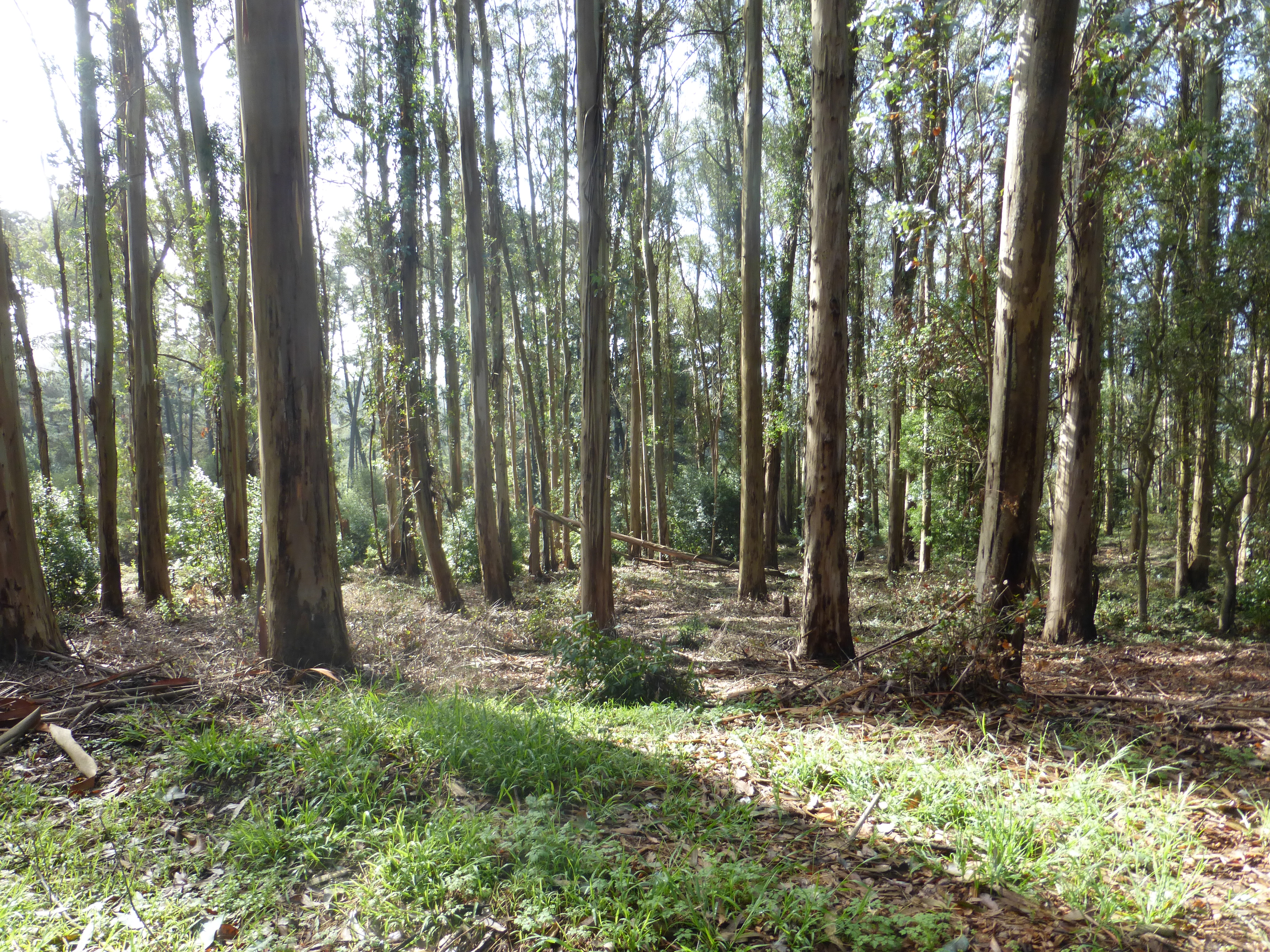
Initial treatment of Recommended Treatment Area TI001 in Tilden Park, October 2016
New sprouts of poison oak in TI 001.

As we have said before, maintaining the canopy should suppress the growth of weeds and retain moisture in the leaf litter.  If so, fire hazards are not substantially increased by this type of treatment.

However, a few of our objections to these projects remain:

  • Pesticides were used to prevent the trees from resprouting and also sprayed on the understory to destroy the fuel ladder to the trees.
  • The pesticides that are used are known to damage the soil, which could damage the trees that remain as well as whatever plants remain.
  • The trees that remain are now more vulnerable to windthrow.
  • Valuable habitat has been lost and wildlife may have been harmed by the pesticides that were used and will be used going forward.

In conclusion, even radical thinning is preferable to clear cuts.  However, the benefits of thinning are questionable, particularly because of the pesticides used by these projects.

Site 29: A preview of the implementation of FEMA grants in the East Bay Hills

Site 29, May 2016
Site 29, May 2016

Site 29 is identified by the mile marker on Claremont Ave, just west of the intersection with Grizzly Peak Blvd.  All the eucalyptus trees were destroyed there about 10 years ago.  The trees that were destroyed were chipped and piled on site as mulch intended to prevent the growth of weeds.  The trunks of the trees line the road, log reminders of the forest that was destroyed.

The site was adopted by the Claremont Canyon Conservancy (CCC).   CCC has planted many redwood trees there and they consider it their showcase for their advocacy to destroy all eucalyptus trees in Claremont Canyon and elsewhere in the East Bay Hills.  The Sierra Club and CCC have collaborated in the effort to convince the public that if the eucalyptus trees are destroyed, a lovely garden of native plants and trees will replace the eucalyptus forest.  They also want you to believe that their garden will be less flammable than the eucalyptus forest.

There are several flaws in this rosy prediction.  The first problem is that Site 29 is ecologically unique.  It is a riparian corridor with a creek running through it.  Therefore, more water is available there than on the sunny hills where eucalyptus forests grow.  It is a canyon with steeply sloping sides that provide protection from sun and wind, which helps retain moisture.  In other words, conditions at Site 29 are ideal for the landscape that CCC and its friends are trying to achieve.

Claremont Canyon Conservancy sign says, "“These coastal redwoods…have been planted by volunteers as part of a habitat restoration to create a native and fire-resistant environment in Claremont Canyon.” The sign is planted in wood chip mulch and obscured by poison hemlock and milk thistle, which are both non-native.
Claremont Canyon Conservancy sign at Site 29 says, ““These coastal redwoods…have been planted by volunteers as part of a habitat restoration to create a native and fire-resistant environment in Claremont Canyon.” The sign is planted in wood chip mulch and obscured by poison hemlock and milk thistle, which are both non-native.

Site 29 is also unique because CCC has planted many trees there and they have sponsored many work parties to maintain the site.  CCC has not made a commitment to plant all 2,000 acres of the East Bay Hills on which all non-native trees will be destroyed by the FEMA grant projects.  Nor have any of the land owners made a commitment to plant those acres after the trees are destroyed.

So, given the ideal landscape conditions, the planting, and maintenance invested by CCC, how successful is Site 29?  Is it a lovely native plant garden?  Is it less flammable than the eucalyptus forest it replaced?  This is our photo essay of Site 29 that answers those questions.  But photos can be deceiving, so we invite you to visit yourself.  Just drive east on Claremont Ave until you reach mile marker 29, park your car beside the road and take a walk.

The reality of Site 29

Milk thistle at Site 29, April 2016

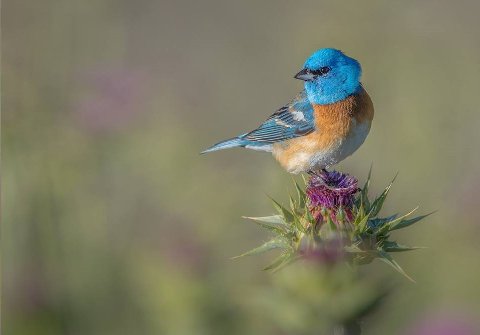
When we visited Site 29 in late April the milk thistle was thriving, but not yet in bloom.  The striking zebra pattern of the leaves makes it an attractive plant, in our opinion, and this lazuli bunting seems to agree that it is a plant worthy of admiration.  It is, however, not a native plant.

Lazuli bunting at Rancho San Antonio on milk thistle, April 2016. Courtesy Greg Barsh

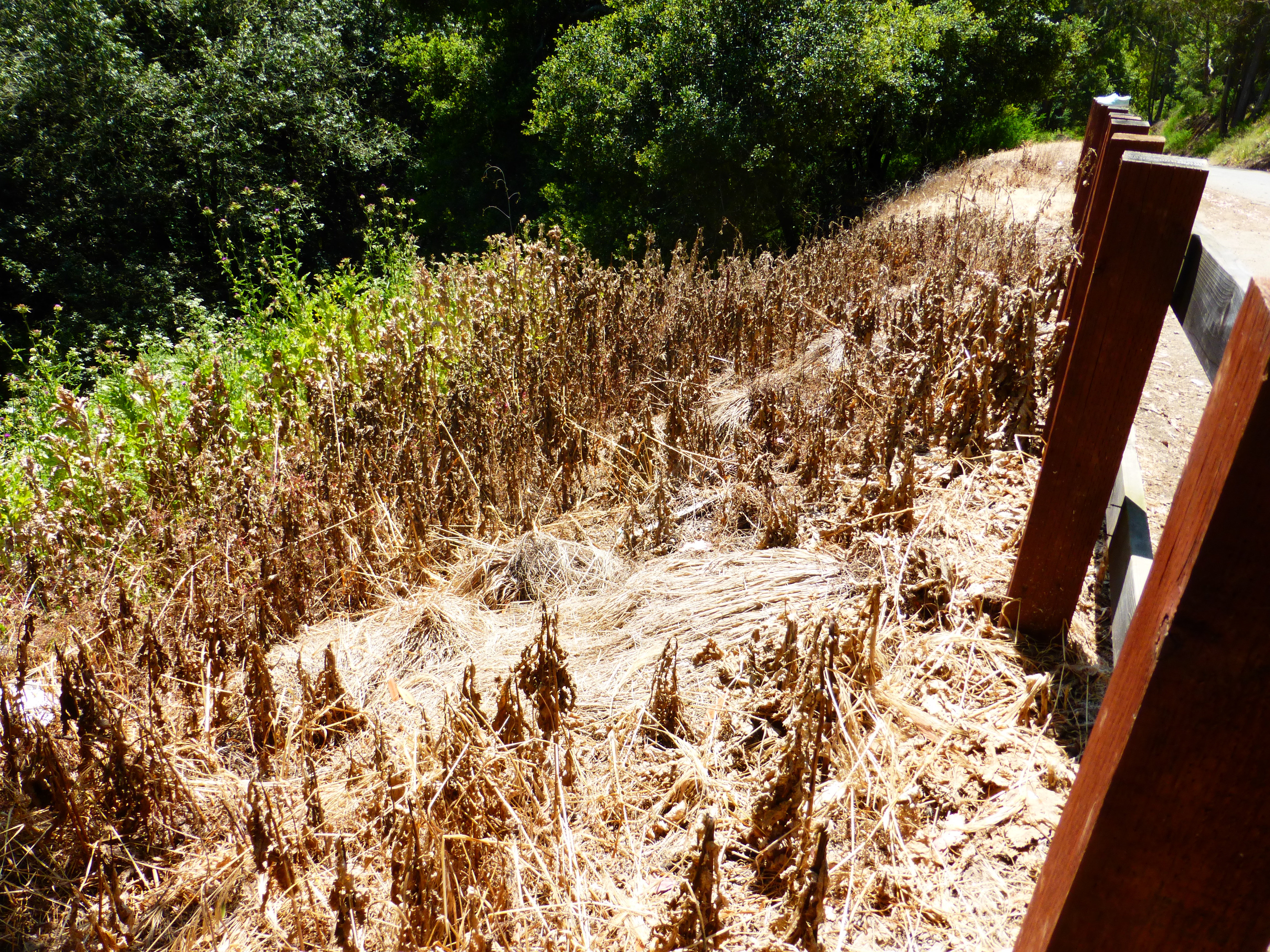
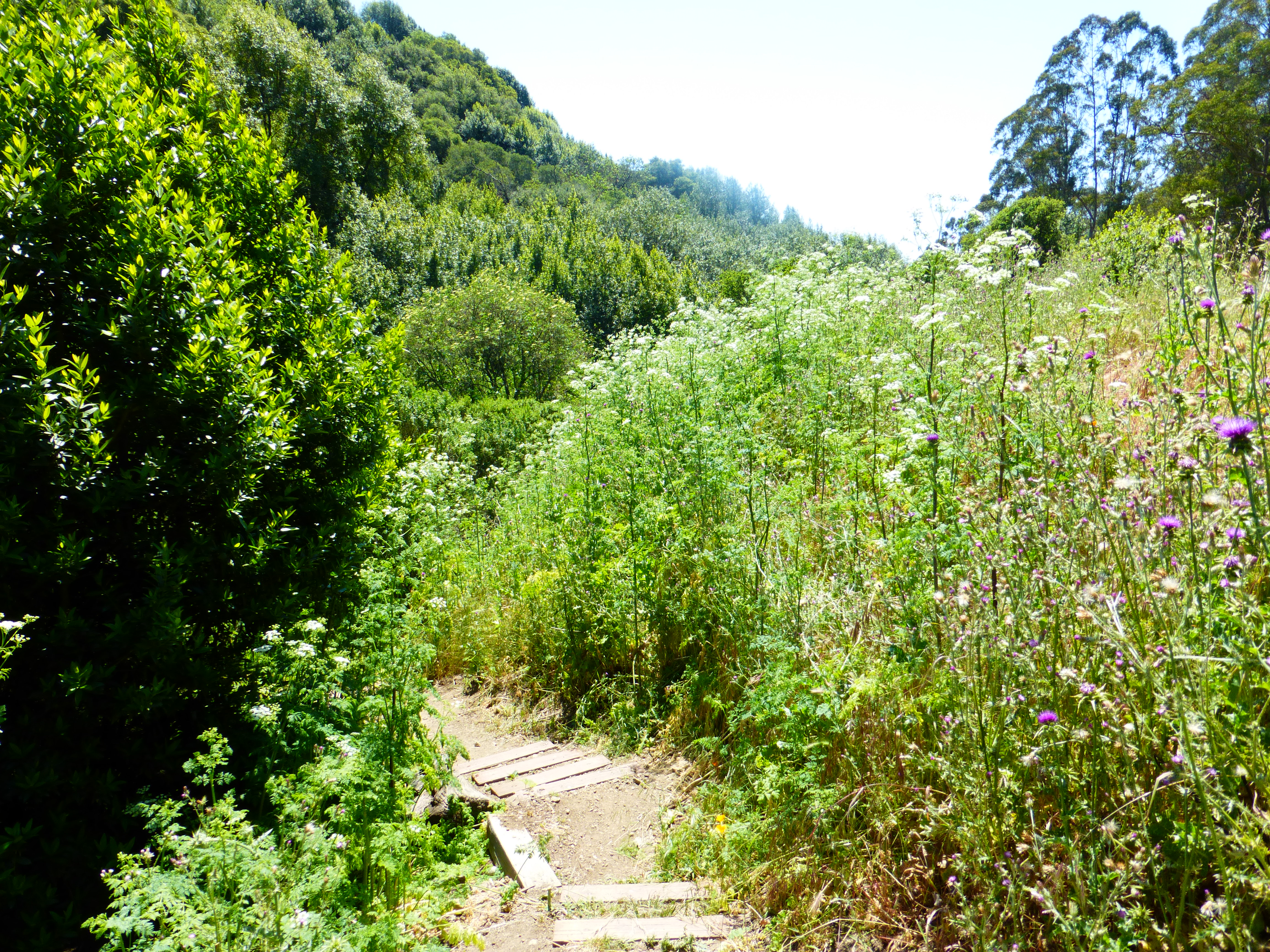
When we visited Site 29 a month later, in late May, it was a very different scene.  The milk thistle had been sprayed with herbicide along the road, to a width of about six feet, providing a stark contrast between the dead vegetation and the still green weeds.  Poison hemlock now grows along the trail into the canyon to a height of about 8 feet, joining the thistles as the landscape of Site 29.  The piles of wood chips are still visible, but are mostly covered with non-native annual grasses and other weedy shrubs.

Dead milk thistle, Site 29, May 2016
The trail down into the canyon is lined by 8-foot tall poison hemlock at Site 29.

More fantasies face harsh realities

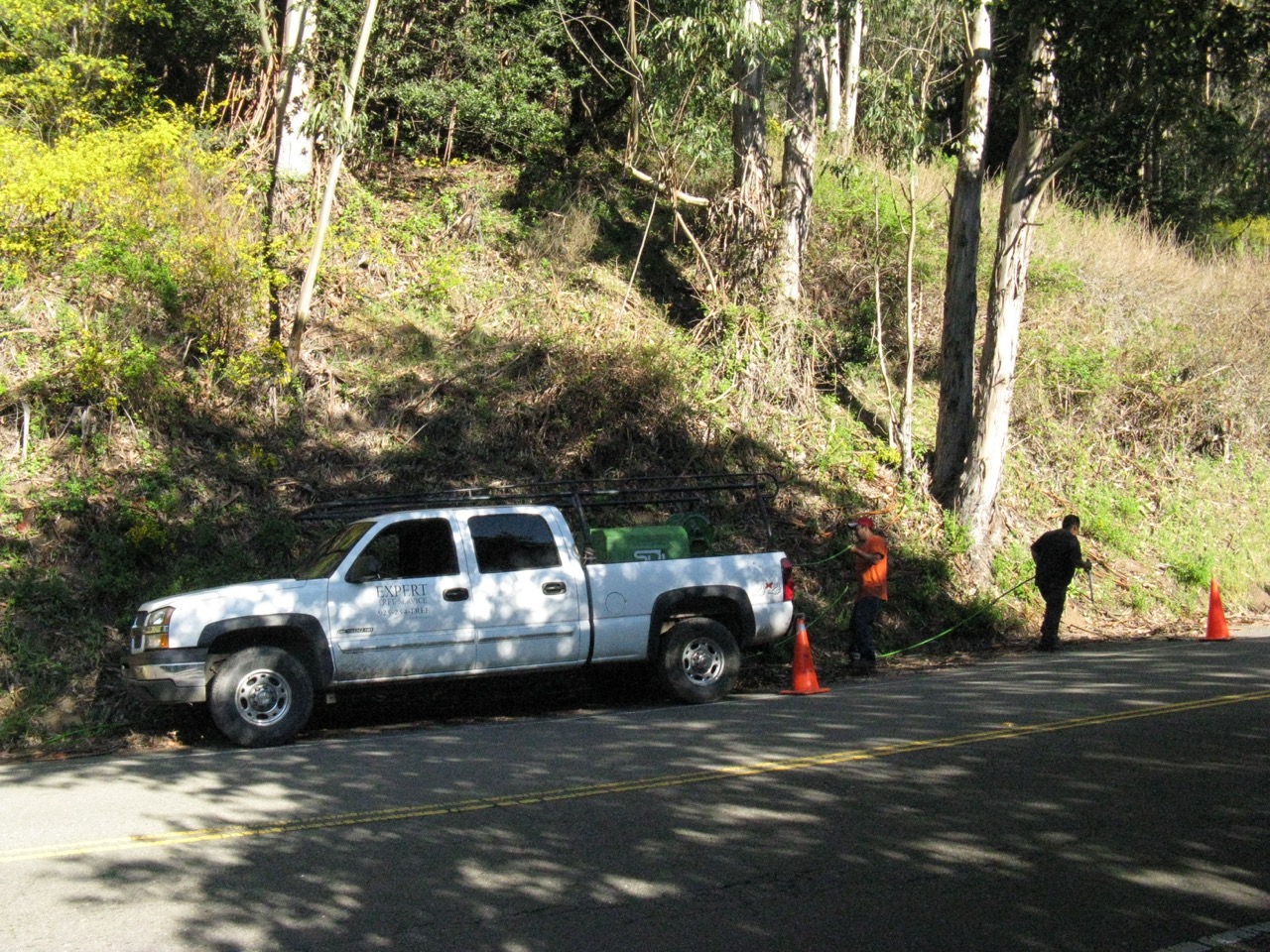
The contractors who apply herbicides on UC Berkeley properties have been photographed many times spraying herbicides at Site 29 and elsewhere.  When they are observed spraying herbicides there are not any pesticide application notices to inform the public of what is being applied and when the application is taking place.  So, unless you see them doing it, you don’t know that you are entering a place that has been sprayed with herbicide.  Several days later, you know that herbicides have been applied only because the vegetation is dying and soon looks dead.

Herbicide spraying at mile marker 29 on Claremont Ave.
Herbicide spraying on UC Berkeley property on Claremont Ave.

When the Environmental Impact Statement for the FEMA projects was published, the land managers claimed they would use “best management practices” in their pesticide applications, including posting notices in advance of spraying that would remain in place during the spraying and for some time after the spraying.  That assurance turns out to be meaningless.  Herbicides are being applied without any public notification before, during, or after application.

We were under the mistaken impression that posting application notices was required by California law.  We therefore asked those who observed herbicide applications without posted signs to report the incidents as violations of California law.

The Alameda County Agricultural Department is responsible for enforcement of California’s laws regarding pesticide use in Alameda County.  They have informed us that no notices of pesticide application are required for non-agricultural applications of glyphosate (RoundUp) or Garlon (triclopyr; the herbicide sprayed on the stumps of trees that are destroyed to prevent them from resprouting).  The manufacturers of these products say they dry within 24 hours, which is the definition of when re-entry is permitted.  Notification is not required for pesticides for which re-entry is permitted within 24 hours, even while the pesticide is being sprayed.

Would you like more Site 29s?

The eucalyptus forest at Site 29 was destroyed over 10 years ago.  Therefore, it is a preview of what we can expect when eucalyptus is destroyed on 2,000 more acres of public land in the East Bay Hills.  So, what can we learn from Site 29?

Site 29 had every advantage:  plenty of water, protection from wind and sun, planting of native trees, and maintenance by a volunteer neighborhood association.  Even with all those advantages, unshaded areas in which trees were destroyed at Site 29 are dominated by non-native weeds that are more flammable than a shady eucalyptus forest.  And because the weeds are flammable, they must be repeatedly sprayed with herbicides along the roads where ignition is most likely to occur.  Dead vegetation is more flammable than living vegetation, so the logic of the spraying seems muddled.

Most of the 2,000 acres of public land on which eucalyptus forests will be destroyed do not have a water source, or protection from wind and sun.  Nor will trees be planted or maintenance provided.  They are going to look much worse than Site 29 and they will be more flammable.

Site 29 is an opportunity for us to say,”NO, this is NOT the landscape we want.  PLEASE do not destroy our eucalyptus forests!!”

GIVE US A VOTE!! Results of letter to Sierra Club members

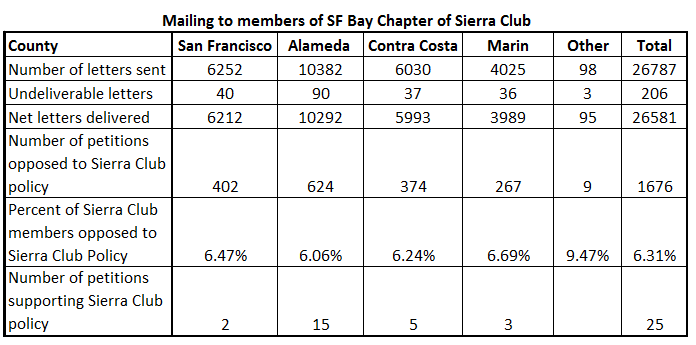
Our readers will recall that California law enabled a member of the Sierra Club to send a letter to over 26,000 members of the San Francisco Bay Chapter of the Sierra Club about the chapter’s support for deforestation and pesticide use in the East Bay Hills. Today we’re reporting the result of that letter and the next step in the long, tortuous path to changing the chapter’s policy on these issues. The letter and enclosed postcard petition are available HERE and HERE: Letter to Sierra Club members and Letter to Sierra Club members – postcard petition

To date, this is the number of postcard petitions that have been received:

sierraclub petition table

Since many couples have joint memberships, the actual number of Club members who signed the postcard petition is greater than the number of postcards.  The postcard petitions represent the opposition of 1,823 members to Sierra Club policy.  Many members also added written messages on the postcard petition, which are available HERE: Petition Comments


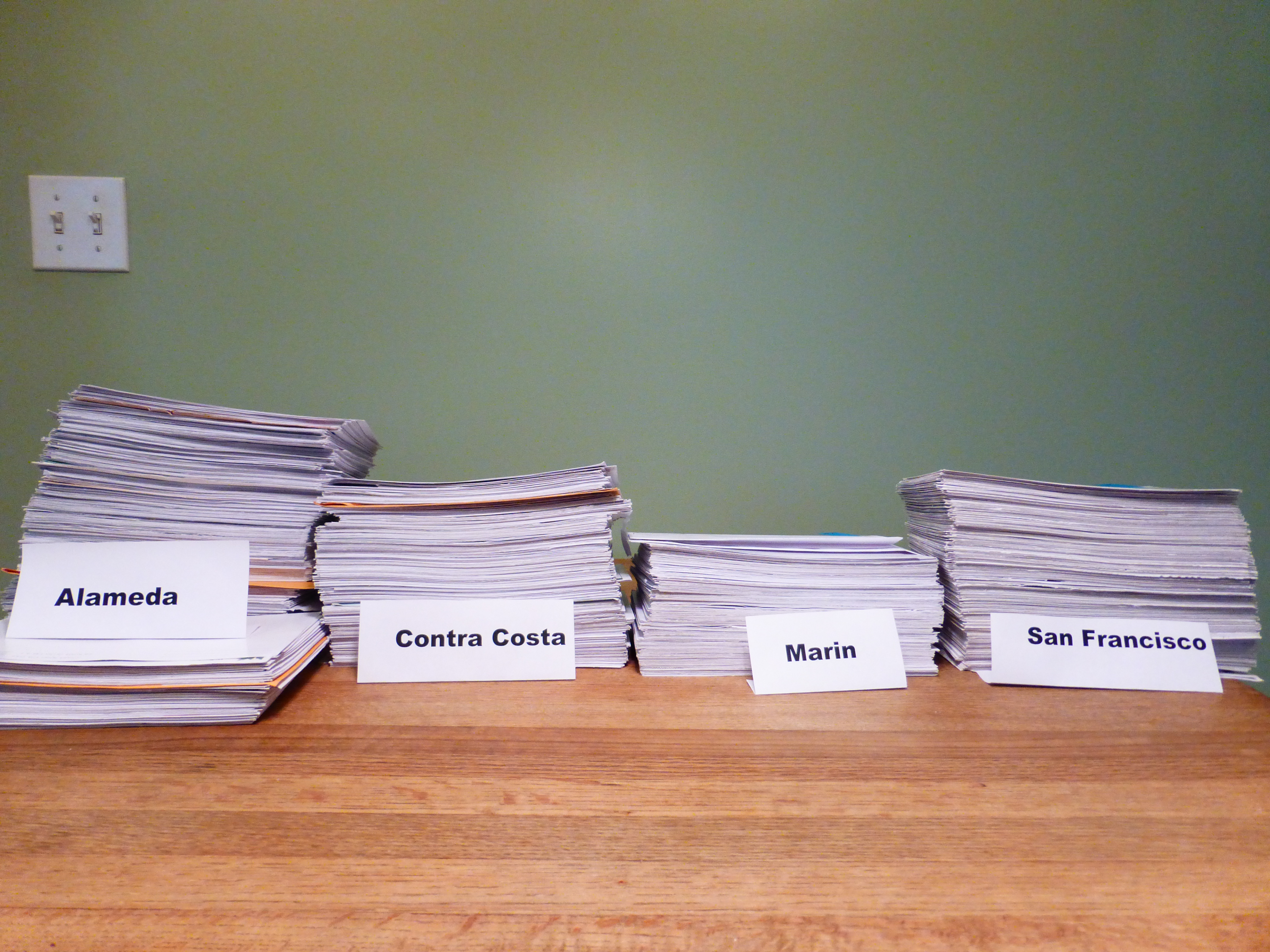
Postcard petitions to Sierra Club

The Sierra Club is now obligated to give us a VOTE on this issue!

According to the Sierra Club bylaws, critics of the Club’s policy regarding the destruction of our urban forest and pesticide use are now entitled to a formal vote on the issues.  The Sierra Club reports:  “More than 45,000 members nationwide voted” in the 2016 election for the Club’s National Board of Directors.  Let’s say 46,000 voted.  Two percent (2%) of 46,000 is 920. Nearly twice as many (1,823) Sierra Club members have indicated their opposition to the Club’s policy regarding the destruction of our urban forest and pesticide use.   Thus the results of the postcard petition now obligate the Sierra Club to conduct a formal vote on the issues:

“11.2. Except as provided in Bylaw 5.10, whenever a number of members of the Club equal at least to two percent (2%) of the number of ballots cast at the immediately preceding annual election for Directors shall request in writing that a resolution be adopted by the Club, the Board may adopt the resolution by majority vote, unless the petition specifically requests a vote of the membership or such a vote is required by law or these Bylaws; if the resolution is not so adopted, the Board shall certify it to the Secretary for a vote of the members.”

The author of the letter to Sierra Club members informed the leadership of the Sierra Club of the number of postcard petitions received and requested a formal vote on the issues, as provided by the Club’s by-laws.

How to get the attention of the Sierra Club?

We have planned a demonstration at the national headquarters of the Sierra Club on Monday, June 13, 2016, at noon.  Unless the Sierra Club agrees to conduct a formal vote on the issues before that date, we plan to tell the Sierra Club to let its members decide whether the Club should continue to support deforestation and pesticide use on public lands.

Noon 12:00 pm
Monday June 13, 2016
2100 Franklin St. (at 21st Street), Oakland
Sierra Club National Office (13th Floor)
(Close to 19th Street BART Station)

We hope that those who care about deforestation and pesticide use in the East Bay will join us for this peaceful demonstration.  A leaflet that you can print and post or distribute for this demonstration is available HERE: Flyer for demonstration  Please help us make the case that the bylaws of the Sierra Club obligate the club to give the membership a formal vote on these issues.

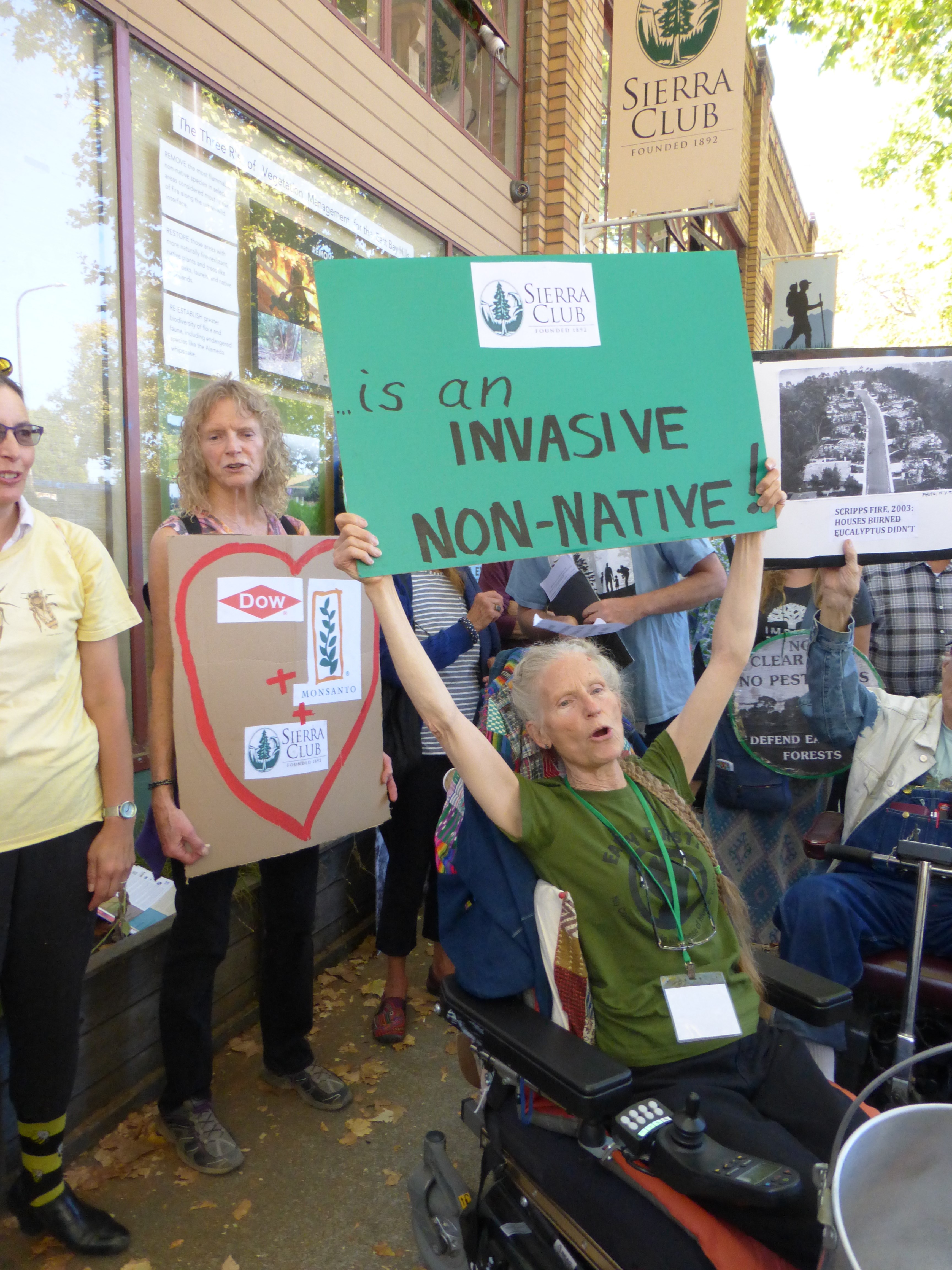
Sierra Club protest, August 25, 2015. About 80 people attended the peaceful protest.
Sierra Club protest, August 25, 2015. We delivered an on-line petition to Bay Chapter headquarters of the Sierra Club on these issues that now has over 2,800 signatures on it.

Why focus on the Sierra Club?

Opponents of the deforestation projects in the East Bay Hills may wonder why so much time and energy is spent on trying to change the policy of the Sierra Club on this matter.  Sometimes, Million Trees wonders too.

So, we will take a minute to explain that the Sierra Club has filed a lawsuit that demands immediate eradication of 100% of non-native trees on over 2,000 acres of public land.  East Bay Regional Parks District (EBRPD) is the biggest of the three land owners engaged in these projects.  EBRPD prefers to thin its eucalyptus forests from an average of 650 trees per acre to about 60-80 of the biggest trees per acre.  Although that seems to be the destruction of too many trees, it is clearly preferable to destroying EVERY non-native tree (eucalyptus, Monterey pine, and acacia) on about 1,600 acres of park land in the East Bay, which is what the Sierra Club lawsuit demands.   The other two land owners (UC Berkeley and City of Oakland) have always planned to destroy 100% of the non-native trees on about 500 acres of their land.  The Club’s lawsuit demands that they do so immediately, rather than phase some of the tree removals over a period of 10 years.

Furthermore, the Sierra Club is influential with public policy makers, including elected officials.  We believe that some decision-makers would be less likely to support these destructive projects if the Sierra Club would quit demanding the destruction of our urban forest.  In a liberal, environmentally conscious community such as ours, the Club’s promise of endorsement (or threat of non-endorsement) of a particular candidate for elected office is a powerful tool to impose the Club’s will on our decision makers.

Finally, we believe that the policy of the local chapter of the Sierra Club that demands destruction of much of our urban forest and douses our public lands with pesticides compromises the important mission of the national Sierra Club.  The national Sierra Club is appropriately focused on addressing the causes of climate change.  Climate change is the environmental issue of our time and the Sierra Club is one of the most important tools we have to address that issue.  Deforestation is a major cause of climate change.  The policy of the local chapter is therefore a contradiction of the mission of the Sierra Club.

Why poisoning the soil contributes to failed “restorations”

We are members of an international team of people who are concerned about the destructive consequences of ecological “restorations.”  Trees, Truffles, and Beasts (1) was recommended to us by one of our collaborators in Australia because the book was written by several academic scientists in Australia and the Pacific Northwest of the United States.  The book compares and contrasts the forests of these disparate locations and finds that below the ground, they have much in common.

Much more is known about the important ecological functions performed by forests above ground than below ground.  However, there are many equally important things happening below ground that are essential to the health of forests:

  • The soil is inhabited by millions of microbes that decompose organic matter, making it available to plants as nutrients. These microbes recycle dead plants and wood back into usable material for living plants.
  • Nitrogen is essential to plant growth. Microbes and fungi in the soil convert nitrogen in the atmosphere into forms needed for plant growth.  Specific plant species (e.g., legumes, such as acacia and lupine), called nitrogen “fixers,” are mediators in this process.
  • Fungi in the soil deliver water and nutrients from the soil to the roots of trees in exchange for carbohydrates provided by the trees. This symbiotic relationship is essential for the health of trees and in the absence of fungi, tree growth and development are severely retarded.
  • Most carbon is stored in the soil, and soil fungi play a role in converting atmospheric carbon dioxide into carbon that is stored in the soil. “Recent research has shown that mycorrhizal fungi hold 50 to 70 percent of the total carbon stored in leaf litter and soil on forested islands in Sweden.” (2)

Relationships between animals and forests

The animals that live in the forests contribute to forest health and forests also benefit the animals.

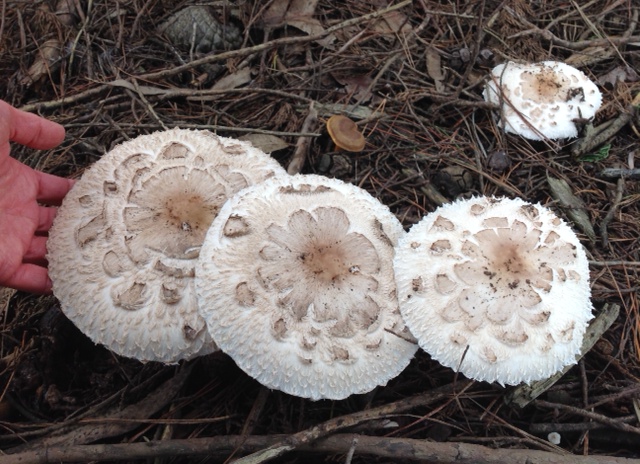
Mature Parasol mushrooms - note hand for size comparison
Mature Parasol mushrooms – note hand for size comparison

Fungi in the soil produce “fruiting bodies” that are their means of reproducing.  Fruiting bodies above ground are called mushrooms.  Fruiting bodies below ground are called truffles.  In both cases, they are important sources of food for animals.  The animals in Australia are different from those living in the Pacific Northwest, but they have in common that the fruiting bodies of fungi are equally important sources of food for them.

In the case of mushrooms above ground, dispersal of their spores is accomplished primarily by wind.  But in the case of truffles, dispersal of their spores is dependent upon the animals that eat them and “deposit” them elsewhere.  So, animals are crucial to the reproductive cycle of fungi that fruit below ground.

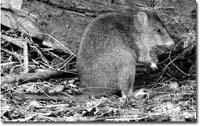
Long-footed potoroo is an Australian marsupial that eats primarily mushrooms and truffles.
Long-footed potoroo is a rare Australian marsupial that eats primarily mushrooms and truffles.

In their search for truffles, the animals also till the forest floor, which contributes to the decomposition of leaf litter and the dispersal of nutrients into the soil.  As the animals defecate in the forest, they are also making contributions to forest health and there are species of microbes and insects that specialize in the use of animal feces.

Golden mantled ground squirrel, Western North America. Prefers to eat mushrooms and truffles.
Golden mantled ground squirrel, Western North America. Prefers to eat mushrooms and truffles. Creative Commons

What happens to the forest ecosystem when it is clear cut?

The forest is a complex and delicate ecosystem.  When the forest is destroyed, we should not be surprised to learn that this ecosystem is destroyed.  Here are a few of the consequences of clear-cutting a forest:

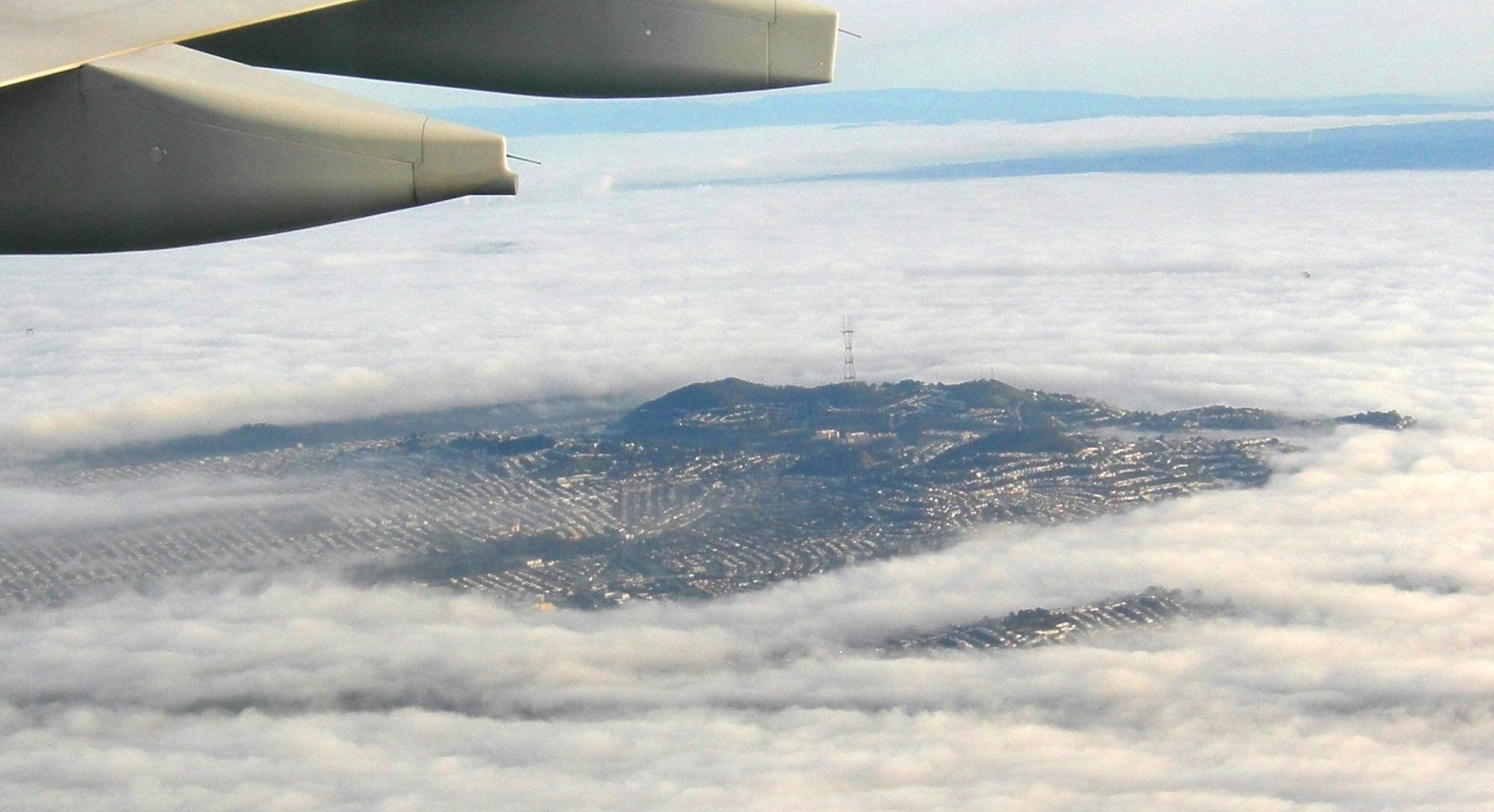
The Bay Area is often blanketed in fog. Courtesy Save Mount Sutro Forest.
  • The forest precipitates fog and the shade provided by the canopy retains that moisture on the forest floor. When we destroy the forest, we lose that source of moisture.  The ground dries out in the sunshine.  The fruiting bodies of fungi—mushrooms and truffles—require moisture to bloom and they die quickly in the absence of moisture.
  • The herbicide (Garlon) used to prevent the trees from resprouting is known to damage the mycorrhizal fungi that are essential to forest health. The herbicide that is applied to the tree stump immediately after the tree is destroyed, travels though the cambium layer of the tree down through the roots of the tree.  The tree is killed by killing its roots.  Mycorrhizal fungi are essentially extensions of the root system.  When roots are killed, so are the mycorrhizal fungi.  In the absence of mycorrhizal fungi, the survival of “replacement” plants is compromised.
  • The loss of fruiting bodies as food for animals reduces animal populations and the contributions they make to forest health.
  • Glyphosate is the herbicide most commonly used to foliar spray non-native vegetation that colonizes the unshaded ground after a clear cut. Glyphosate was originally developed as an anti-bacterial agent.  Glyphosate kills bacteria in the soil (and in the mammalian gut, 4) that are playing a role in recycling nutrients to plants (and in digesting our food). (3)

Prescribed burning is another land management method used to eradicate “invasive” plants.  In addition to polluting the air, releasing carbon into the atmosphere, and increasing the risk of wildfire, prescribed burns also damage the soil:  “Prescribed burning in California pine forest decreased the ectomycorrhizal biomass by almost 90 percent in the upper organic layers of the soil as compared to unburned sites.  A decrease of that magnitude in the mycorrhizal energy source of the fungi would affect not only fungal fruiting but also fungal populations.”  (1)

In the absence of fungi and bacteria, the soil is essentially sterile and is no longer capable of contributing to the health of a new generation of plants and animals to replace the forest.

Eucalyptus forest in California and Australia

Trees, Truffles, and Beasts was written by academic foresters who are primarily concerned about the destructive consequences of destroying native forests and replacing them with timber plantations, often of another, faster growing species.  Ironically, in the case of old growth eucalyptus forests in Australia, the choice of replacement species is often Monterey pines.  Since some of the species of mycorrhizal fungi are specific to certain species or types of trees, this change of species is not successful without the inoculation of appropriate species of fungi.  For example, some of the mycorrhizal fungi that grow on the roots of conifers are not found on eucalyptus species.

Before writing this article, we corresponded with the authors of Trees, Truffles, and Beasts to confirm that fungi are found in the eucalyptus forests of California.  Since eucalyptus was brought to California as seeds, rather than potted plants, we needed confirmation that our eucalyptus forests are also enjoying the benefits of mycorrhizal fungi.  We are grateful that the authors replied.  They report that eucalyptus forests in California are populated with fungi, including some species that are native to Australia, which implies that some eucalyptus were imported from Australia with native soil.  Therefore, we can assure our readers that our description of how the forest functions applies to the eucalyptus forest in California, as well as in Australia.

Predicting the consequences of destroying our urban forest

Plans to destroy non-native forests on 2,000 acres of public land in the East Bay will result in a dry, barren landscape populated primarily by non-native annual grasses.  Fantasies that the forest will be magically replaced by a landscape of native plants and trees are just that…fantasies.  Every reputable source of information about the planned project predicts this outcome, from the US Forest Service to the Audubon Society and the California Native Plant Society.  There are many reasons why this outcome is predictable:

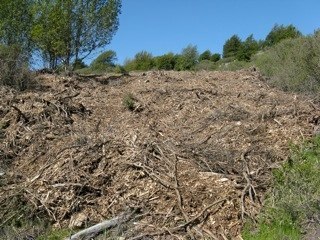
  • UC Berkeley's "Vegetation Management"
    UC Berkeley’s “Vegetation Management”

    The ground will be covered by as much as 24 inches of wood mulch, which will retard the germination of any plant. The plants most likely to penetrate this physical barrier are those that are most competitive, such as broom and other non-native weeds considered “invasive.”

  • The moisture available to plants will be reduced by the loss of fog drip and shade provided by the tree canopy. Fog drip in eucalyptus and Monterey pine forests in the East Bay has been measured at 10 inches per year. (5) Young plants and trees require more water than established plants, so the water deficit will retard the growth of a new landscape.
  • The climate of the San Francisco Bay Area has changed in the 250 years since the arrival of Europeans. Plants that were native at that time are no longer competitive in the warmer, drier climate and an atmosphere higher in nitrates and carbon dioxide.  The rapidly changing climate is making the concept of “native” increasingly irrelevant.

And now we know that the damage that will be done to the soil and the forest floor by the destruction of our urban forest will further handicap the successful establishment of a new landscape.  Aside from the physical damage done by removing hundreds of thousands of trees with heavy equipment, the herbicides used to kill trees and plants considered undesirable by the perpetrators of this devastating project will sterilize the soil.  The resulting weed-dominated moonscape will probably recover in hundreds of years, although the eventual outcome is impossible to predict in our rapidly changing environment.  Neither the supporters of this project nor its critics will live to see the recovery.


  1. Chris Maser, Andrew W. Claridge, James M. Trappe, Trees, Truffles, and Beasts, Rutgers University Press, 2008
  2. https://en.wikipedia.org/wiki/Mycorrhizal_fungi_and_soil_carbon_storage
  3. http://www.nytimes.com/2013/09/20/business/misgivings-about-how-a-weed-killer-affects-the-soil.html?ref=todayspaper&_r=1
  4. http://www.fooddemocracynow.org/blog/2015/apr/13
  5. Harold Gilliam, Weather of the San Francisco Bay Region, UC Press, 2002


Bees are harmed by nativism

As our readers know, there are many reasons why we are opposed to the projects that are billed as native plant “restorations” but, in fact, often do a great deal of damage to the environment.  Of the many bogus justifications for these harmful projects, one of the most patently false is that the projects benefit wildlife.  Today, we are publishing a letter from one of our readers about the many ways in which nativism is harmful to bees.

“I thought of you, and your ongoing fight against short-sighted nativism, yesterday as I was doing research for a project on bees. I was interviewing a second-generation beekeeper, who’s working closely with geneticists and entomologists to develop hardy strains of bees, and he mentioned two things I thought might help to highlight how the actions of groups like the NAP may actually be contributing to colony collapse:

  1. The chemicals they use. Of course, it’s been broadly publicized that glyphosate and neonicotinoids are harmful to bees, and the AG industry folks (and possibly the native plant folks?) counter that they are far less deadly to honey bees than other types of herbicides and pesticides…but the beekeeper I spoke with indicated that saying something is “less deadly” to bees misses the harm these chemicals do to colonies by weakening their ability to fight viruses, mites, etc. Bees foraging in chemical-laden fields bring residues of these compounds back to the hive, to the queen, which he likened to “placing a pregnant woman in a refinery.” The result is a dramatically shortened lifespan for the queen and a colony that’s less strong and healthy, with lower resistance to common diseases. So the chemical may not kill the bees outright, but it still contributes to their death in the end.
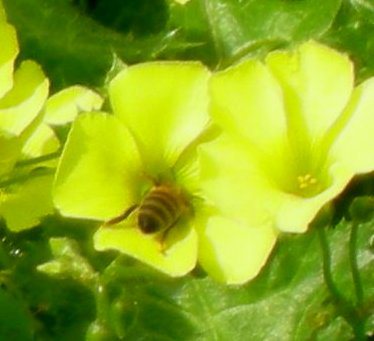
  2. Honeybee on oxalis flower, another non-native plant being eradicated with herbicide.
    Honeybee on oxalis flower, another non-native plant being eradicated with herbicide.

    Honey bees are not native to America; they’re European. And the push to eradicate non-native “weeds” has decimated their forage…essentially starving them out. He cited the case of yellow star thistle, which, he said, may have come over from Europe in the wool of sheep. Highly invasive, it used to be everywhere in CA, and it was an important source of nectar and pollen for honeybees. Then, a few decades ago, the government introduced weevils to control the plant, in the process depriving the bees of a vital food source. Beekeepers have had to range further and further afield to find areas with adequate forage for their bees.

Bumblebee on Cotoneaster, Albany Bulb. Another target for eradication.

Of course, big agriculture (subsidized by the government) has contributed to the problem as well, by plowing up land that used to grow clover and alfalfa in favor of corn (for ethanol) and soybeans. But, for me anyway, this information about non-native bees needing non-native plants was a revelation…. a real ‘a-ha’ moment that I thought could be useful in waking up well-meaning folks who may equate “native plants” with “good for bees.”

Oh, and the beekeeper also told me that one third of the food Americans eat is pollinated by honey bees….are we willing to reduce our food supply by 1/3 for the sake of “restoring” a landscape native to a time when agriculture was not prominent in California?”

The value of yellow star-thistle to bees is but one example of the value of non-native plants to insects and other animals.  In the case of bees, the eradication of hundreds of thousands of eucalyptus trees all over California has deprived bees and hummingbirds of one of the few sources of winter nectar in California.  Eucalyptus blooms from December to May, at a time when there are few other sources of nectar.  HERE is an article about the loss of this important resource to bee keepers in California.

Eucalyptus and bee. Painting by Brian Stewart.

Yellow star-thistle is one of many eradication targets of nativists in California.  East Bay Regional Park District (EBRPD) has been trying to eradicate it in their parks for decades.  We recently learned that EBRPD was planning an aerial spraying of herbicide from a helicopter on 200 acres of yellow star thistle in Briones Park.   This was a particularly controversial herbicide application for several reasons:

  • Briones Park is adjacent to the watershed surrounding Briones Reservoir, which stores the drinking water of surrounding communities.briones_450w_32c
  • The herbicide EBRPD was planning to use was Milestone, which is known to be very mobile and persistent in the soil. For that reason, the State of New York refused to approve the sale of Milestone because they were concerned about contamination of ground water.
  • Aerial spraying of pesticides by helicopter is the most dangerous application method because it greatly increases the chances of drift into non-target areas, including residential areas.

Our team of collaborators jumped into action to prevent this spraying from being done.  We organized a telephone and email campaign directed to responsible staff and Board members at both East Bay Regional Park District and East Bay Municipal Water District, which is responsible for drinking water in the East Bay.

I am pleased to report that EBRPD announced within a few days of our campaign that they were permanently cancelling this aerial application of herbicides at Briones Park.  They will continue to try to eradicate yellow star thistle using other methods.

Lessons learned

When pesticides are used in native plant “restorations,” the claim that such projects are beneficial seem utterly dishonest.  Beneficial to whom?  Certainly not the animals and humans who are exposed to these toxic chemicals.

If the public does not want public land managers to use pesticides on our public lands, we must object when they do.  If we don’t object, we get the land management we deserve.  You will be alerted to such opportunities to participate in these campaigns to influence land managers by “liking” Facebook pages:  “Death of a Million Trees” and “Save the East Bay Hills.”

It is a team effort to learn about what is happening in our public lands and to participate in the decisions that affect our communities.  We are therefore grateful to the reader who shared her conversation with a beekeeper.  We encourage others to share their knowledge so that we can be as effective as possible.  Knowledge is power!

Mopping up the last load of Sierra Club propaganda

This is the last in a series of rebuttals to the Sierra Club’s “pre-buttal” to a letter from a Sierra Club member to members of the San Francisco Bay Chapter of the Sierra Club about the Club’s support for deforestation and pesticide use on our public lands.

The truth about how much herbicide will be used

Sierra Club misrepresents volume of herbicide use:  “If used, herbicide would be applied in minute quantities under strict environmental controls.”  (1)

Courtesy Hills Conservation Network

East Bay Regional Park District (EBPRD) informs us in the Draft Environmental Impact Statement (DEIS) for the FEMA project in the East Bay Hills that it intends to use 2,250 gallons of herbicide on its project acres to destroy non-native vegetation and prevent the trees they destroy from resprouting.  You can see the detailed table of their intended herbicide use for yourself by looking at the DEIS. (2)  On what planet would 2,250 gallons be called “minute quantities?”

EBRPD intentions were to “thin” non-native trees, not destroy them all.  The Sierra Club has sued EBRPD to force them to destroy ALL non-native trees on their project acres.  If the Sierra Club lawsuit is successful, EBRPD will be forced to destroy MORE trees than it wanted to destroy.  That means it will be forced to use EVEN MORE herbicide than it intended to use, i.e., MORE than 2,250 gallons.

EBRPD is only ONE of the three public land owners that are participating in the FEMA project.  The other two public land owners (UC Berkeley and City of Oakland) intend to destroy ALL non-native trees on their project acres.  That means they will have to use EVEN MORE herbicide than EBRPD intended to use per acre of project area.

Sierra Club fabricates an argument we have not made:  “Comparing this use of herbicide to the regular broadcast spraying of farmland elsewhere is a misrepresentation of fact.” (1)

This is a red herring, intended to confuse you with an argument that no one has made in opposition to this project.  We have not likened pesticides used for these projects with agricultural use of pesticides.  We aren’t being given a choice between agricultural pesticides and pesticides in our parks.  The Sierra Club is asking us to accept additional pesticides in our parks on top of the agricultural pesticides we are already exposed to and over which we have no control.  Since many pesticides accumulate in our bodies over our lifetimes, additional pesticide exposure results in greater toxicity and potential for damage to our health.

Horticultural fiction

Sierra Club fantasizes about the post-project landscape: “Concerns about not planting trees to replace those being removed miss the mark. Replanting is not necessary. (1)

Knowledgeable organizations do not share the Sierra Club’s fantasy that native trees will magically emerge from 2 feet of eucalyptus wood chip mulch to colonize the bare ground.  Here is a partial list of the environmental consultants, governmental agencies, and environmental organizations that have refuted this fiction:

  • URS Corporation is the environmental consultant initially hired to complete the environment impact review of the FEMA projects. Their report said:  “However, we question the assumption that the types of vegetation recolonizing the area would be native.  Based on conditions observed during site visits in April 2009, current understory species such as English ivy, acacia, vinca sp., French broom, and Himalayan blackberry would likely be the first to recover and recolonize newly disturbed areas once the eucalyptus removal is complete.”
  • The US Forest Service evaluated the FEMA projects. This is their prediction of the post-project landscape: “a combination of native and non-native herbaceous and chaparral communities.”
  • The California Native Plant Society predicted the post-project landscape in its written public comment on the Draft Environmental Impact Statement (DEIS) with this rhetorical question: “What mechanism is being instituted by FEMA in this DEIS to guarantee a commitment of money and personnel for management of greatly increased acreages of newly created annual weedy grassland?”
  • The Audubon Society predicted the post-project landscape in its written public comment on the DEIS: “There is no support for the conclusion that native vegetation will return on its own.  This plan may not result in an increase in native trees and plants…Heavy mulching will delay or prevent the growth of native species.”
Trees were destroyed here by UC Berkeley over 10 years ago. The landscape is now non-native annual grasses. This is the typical outcome of tree removals on sunny hills without a water source.

Sierra Club and Claremont Canyon Conservancy (CCC) repeatedly refer to Site 29 on Claremont Blvd as a model for the FEMA projects.  They fail to acknowledge that Site 29 is not representative of most FEMA project areas because CCC planted native trees (primarily redwoods) on Site 29 and the microclimate of Site 29 is not typical of other project areas.  Site 29 is a riparian corridor—there is a creek running through it—so there is more available water than in most project areas.  It is also protected from wind and sun by hills on north and south sides of the site.  CCC has not made a commitment to plant native trees on 2,000 acres of the FEMA project areas and even if it did, it could not expect the same results in radically different microclimates such as sunny, windy ridge lines with no available water source.

Fundamentals of carbon storage

Sierra Club does not understand the fundamentals of carbon storage:  “Carbon sequestering and erosion control will not be reduced by removing eucalyptus trees… Indeed, reducing the fire danger by removing the eucalyptus will do much to prevent the release of tons of carbon that occurs during a wildfire. [x]” (1)

Sierra Club continues with the fiction that non-native trees will burn while native trees will not.  There is no evidence behind that story, and much evidence to the contrary.  The numerous wildfires throughout California each summer demonstrate that native trees and shrubs are extremely flammable—easily ignited and burning vigorously once ignited.  Native trees, shrubs, and grasses also release their stored carbon when they burn.  The NSF article cited by the Sierra Club in support of its bogus statement does not suggest that prospectively destroying forests is a means of preventing carbon loss.

Destroying eucalyptus trees will release hundreds of thousands of tons of carbon stored in those trees. That’s a simple, inarguable fact.  There are no plans to replace the eucalyptus with “native trees.”  A small portion of the carbon released by eucalyptus destruction may be recaptured by the grasses and shrubs that will grow in place of the eucalyptus, but the net loss of stored carbon to the atmosphere from the eucalyptus is huge and permanent.  Further, the eucalyptus would have continued to store even more carbon if left in place.  That future carbon sequestration is also lost.

The DEIS for the FEMA-funded projects tries to minimize the loss of stored carbon from destruction of eucalyptus by quantifying only carbon loss from the destruction of tree trunks, ignoring leaves, branches, roots, understory, forest floor litter, and soil.  But even they acknowledge, “…the planned growth of oak and bay woodlands and successional grassland containing shrub islands would not sequester as much carbon as the larger eucalyptus and pines and the denser coastal scrub that would be removed.”  (DEIS 5.6-11)

Killing habitat needed by wildlife

Sierra Club does not know who lives in our urban landscapes:  “Native landscapes provide habitat for much more diverse ecosystems.” (1)

There are many studies that find that our non-native landscape provides valuable habitat and no studies that say otherwise:

  • Most California natives in cultivation are of no more butterfly interest than nonnatives, and most of the best butterfly flowers in our area are exotic.” (3)
  • “[T]he science does not support the supposition that native plantings are required for biodiversity…it is clear that an automatic preference for native trees when planning in urban areas is not a science-based policy.” (4)
  • “Three types of trees were used most frequently by roosting monarchs [in California]: eucalyptus (75% of the habitats primarily Eucalyptus globulus), pine (20% of the habitats primarily Pinus radiata), and cypress (16% of the habitats primarily Cupressus macrocarpa)” (5)
  • “In the first half of the 20th century, the Anna’s Hummingbird bred only in northern Baja California and southern California. The planting of exotic flowering trees provided nectar and nesting sites, and allowed the hummingbird to greatly expand its breeding range…Anna’s Hummingbird populations increased by almost 2% per year between 1966 and 2010, according to the North American Breeding Bird Survey…Thanks to widespread backyard feeders and introduced trees such as eucalyptus, it now occurs in healthy numbers all the way to Vancouver, Canada.” (6)
  • Red-tailed hawk nesting in eucalyptus. Courtesy urbanwildness.org
    Red-tailed hawk nesting in eucalyptus. Courtesy urbanwildness.org

    “Fourteen of 27 nests in 1994 and 38 of 58 nests in 1995 were in exotic trees, predominantly eucalyptus. Nesting and fledging success were higher in exotic trees than in native trees in both years, owing in part to greater stability and protective cover.  Most nest trees in upland areas were exotics, and even in riparian habitats, where tall native cottonwoods and sycamores were available, Red-shouldered Hawks selected eucalyptus more often than expected based on availability.”  (7)

  • A study that compared species diversity and abundance of plants, invertebrates, amphibians, birds, and rodents in eucalyptus forest with oak-bay woodland in Berkeley, California reported this finding: “Species richness was nearly identical for understory plants, leaf-litter invertebrates, amphibians and birds; only rodents had significantly fewer species in eucalypt sites.  Species diversity patterns…were qualitatively identical to those for species richness, except for leaf-litter invertebrates, which were significantly more diverse in eucalypt sites during the spring.” (8)

We could provide many more citations from studies that consistently find that our existing non-native landscape is essential to wildlife and that destroying it will be harmful to wildlife, particularly considering the enormous amount of herbicide that will be used.  We ask this common-sense, rhetorical question, “How could destroying most of our landscape provide a more diverse ecosystem?”  It defies logic.

Environmentalism gone awry

If the Sierra Club would replace a few of its lawyers with a few scientists, perhaps we would not be having this debate.  Environmentalism has gone astray because it is not knowledgable about some basic scientific issues, such as carbon storage, the toxicity of herbicides, and the habitat needed by our wildlife.  Climate change is the environmental issue of our time.  If an environmental organization does not understand the fundamentals of carbon storage it is not capable of doing its job.  The Sierra Club must improve its knowledge of the Bay Area environment or it will fade into irrelevance in the struggle to protect that environment.


(1) http://sierraclub.org/san-francisco-bay/hillsfacts

(2) See Table 2.1 in Appendix F: http://www.fema.gov/media-library-data/1416861356241-0d76d1d9da1fa83521e82acf903ec866/Final%20EIS%20Appendices%20A-F_508.pdf

(3) Arthur Shapiro, Field Guide to Butterflies of the San Francisco Bay and Sacramento Valley Regions, University of California Press, 2007

(4) Linda Chalker-Scott, “Nonnative, Noninvasive Woody Species Can Enhance Urban Landscape Biodiversity,” Arboriculture & Urban Forestry, 2015, 41(4): 173-186

(5) Dennis Frey and Andrew Schaffner, “Spatial and Temporal Pattern of Monarch Overwintering Abundance in Western North America,” in The Monarch Butterfly Biology and Conservation, Cornell University Press, 2004.

(6) Cornell Ornithology Laboratory https://www.allaboutbirds.org/guide/annas_hummingbird/id

(7) Stephen Rottenborn, “Nest-Site selection and reproductive success of urban red-shouldered hawks in Central California,” J. Raptor Research, 34(1):18-25

(8) Dov Sax, “Equal diversity in disparate species assemblages:  a comparison of native and exotic woodlands in California,” Global Ecology and Biogeography, 11, 49-52, 2002.

Public opposition to pesticide use in our public parks

On November 19, 2015, a visitor to Mount Davidson park in San Francisco video recorded a pesticide application that is available here:

glyphosate spraying on Mt Davidson - nov 19, 2015

One of the people who saw that video reported several concerns regarding that pesticide application to the city employees who are responsible for the regulation of pesticide use in San Francisco.  Here is the email he sent to Kevin Woolen in the Recreation and Park Department and Chris Geiger in the Department of the Environment:

To:  Kevin Woolen  kevin.woolen@sfgov.org

Dear Mr. Woolen,

I understand that you are responsible for the records of pesticide applications on properties managed by San Francisco’s Recreation and Park Department.  I have heard you speak at public meetings, so I am aware that you have some expertise in that area.  Therefore, I am writing to you about a pesticide application on Mt. Davidson on November 19, 2015.  That pesticide application was recorded by this video:  https://www.facebook.com/ForestAlliance/videos/934479473312166/?fref=nf

I have several concerns about this pesticide application:

  • One of the herbicides that was sprayed was Stalker with the active ingredient imazapyr. I notice that most of the spraying was done around a tree, which was not a target of the application according to the posted Pesticide Application Notice.  As you may know, imazapyr is not supposed to be sprayed under and around non-target trees according to the manufacturer’s label:  http://www.cdms.net/ldat/ld01R013.pdf:  “Injury or loss of desirable trees or other plants may result if Stalker is applied on or near desirable trees or other plants, on areas where their roots extend, or in locations where the treated soil may be washed or moved into contact with their roots”

Here is a newspaper article about unintentional damage done to trees by spraying an imazapyr herbicide beneath them:  http://www.mlive.com/news/grand-rapids/index.ssf/2012/09/no_quick_fix_for_herbicide_dam.html

  • The Pesticide Application Notice says that the application method will be “spot treatment/daub cut stem.” This does not seem to be an accurate description of the application method on November 19th.  It seems that “backpack sprayer” would be a more accurate description of this particular pesticide application.
  • The Pesticide Application Notice says that Himalayan blackberries were one of the targets of this Pesticide Application. As you know, birds and other wildlife cannot read the signs that are posted to warn the public about these applications.  Can you assure me that the Himalayan blackberries were no longer fruiting?  Does the Recreation and Park Department have a policy against spraying vegetation when there are fruits eaten by birds and other wildlife?  If not, would the Recreation and Park Department consider adopting such a policy?
  • Although Garlon was not used in this particular pesticide application, it is often used in San Francisco’s so-called “natural areas.” Therefore, it is worth mentioning that Garlon is also known to be mobile in the soil and there are documented incidents of it damaging non-target trees when it has been sprayed on the stumps of nearby trees after they were destroyed.

Thank you for your consideration.  I hope you will share my concerns with the staff and contractors who are engaged in these pesticide applications.

Cc:  Chris Geiger  chris.geiger@sfgov.org

This is not an isolated incident.  Park visitors in San Francisco have been complaining for years about pesticide use in parks that were designated as “natural areas” over 15 years ago.  Ironically, those areas were never sprayed with pesticides before being designated as “natural areas.”  In fact, they really were natural areas prior to being officially designated as such.  Plants and animals lived in peace in those places before being “managed” by people who are committed to eradicating all non-native plants in many of San Francisco’s parks.

What can you do about it?

If you are opposed to pesticide use in San Francisco, or you object to the pointless destruction of harmless plants that are useful to wildlife, here are a few things you can do to express your opinion and influence the public policy that allows pesticide use in the public parks of San Francisco:

  • You can join over 11,000 people who have signed a petition to prohibit the use of pesticides in public parks. The petition is HERE.  The San Francisco Chronicle reported on pesticide use in San Francisco’s parks and the petition against that use.  (Available HERE)
  • You can sign up HERE to be notified of the annual meeting in which pesticide policy in San Francisco is discussed for subsequent approval by the Environment Commission. That meeting has been scheduled in December in past years.  Update:  The annual meeting has been announced.   “Annual Public Hearing on Pest Management Activities on City Properties and San Francisco’s Draft 2016 Reduced-Risk Pesticide List 4:30-7:00 pm
    Wednesday, December 16, 2015 Downstairs Conference Room, 1455 Market St. (near 11th St.; Van Ness MUNI stop)”  The meeting agenda is available HERE.
  • You can apply for one of the two vacant seats on the Environment Commission. These seats have been vacant for nearly a year.  In the past, the Environment  Commission has actively promoted pesticide use in San Francisco’s “natural areas.”  Qualifications and duties of commissioners are available HERE.
  • Appointments to the Environment Commission are made by Mayor Ed Lee. If you don’t want to serve on the Environment Commission, you can write to Mayor Lee (mayoredwinlee@sfgov.org) and ask him to appoint people to the Commission who do not support the use of pesticides in San Francisco’s public parks.

The parks of San Francisco belong to the people of San Francisco.  They have paid to acquire those properties for public use and they are paying the salaries of those who are “managing” the parks.  If you don’t like how parks are being managed, you have the right to express your opinion.  Our democracy works best when we participate in the public policy decisions that affect us.

What does this have to do with the East Bay?

Our readers in the East Bay might wonder what this incident has to do with you.  Parks in the East Bay are also being sprayed with herbicides for the same reasons.  HERE are reports of pesticide use by the East Bay Regional Park District.

Many of the pesticide applications on the properties of EBRPD are done by the same company that sprayed herbicides on Mount Davidson on November 19, 2015.  That company is Shelterbelt Builders.  You can see their trucks in the above video.  Pesticide use reports of San Francisco’s Recreation and Park Department often report that pesticide applications were done by Shelterbelt.

Shelterbelt began the eradication of non-natve vegetation in Glen Canyon in November 2011

Shelterbelt Builders is based in the East Bay.  One of its owners is Bill McClung who is a member of the Claremont Canyon Conservancy and a former officer of that organization.  The Claremont Canyon Conservancy is the organization that is demanding the eradication of all non-native trees on public land in the East Bay Hills.  Here is a description of Mr. McClung’s responsibilities on Shelterbelt’s website:

“Bill McClung joined Shelterbelt in 1997 to help refocus Shelterbelt on native plant restoration and open land management/fire safety.  After his house burnt down in the 1991 Oakland Fire, this former book publisher became interested in how wildland and fire are managed in the East Bay Hills.  He became a member of the Berkeley Fire Commission in 1994 and has a strong interest in the vegetation prescriptions of the Fire Hazard Program & Fuel Reduction Management Plan for the East Bay Hills issued in 1995 by the East Bay Hills Vegetation Management Consortium and the East Bay Regional Park District Wildfire Hazard Reduction and Resource Management Plan Environmental Impact Report of 2009/10.  He has managed many properties in the East Bay where wildfire safety and native habitat preservation are twin goals, and continues to work on interesting and biologically rich lands in the Oakland Hills.”

Claremont Canyon Conservancy

The Claremont Canyon Conservancy held their annual meeting on November 15, 2015.  Oakland’s Mayor, Libby Schaaf, was one of the speakers.  Although she took questions at the end of her presentation, one of the officers of the Conservancy called on the questioners.  There were many people in the audience who are opposed to the FEMA projects that will destroy over 400,000 trees in the East Bay Hills and many of us tried to ask questions.  With one exception, the person controlling the questions only called on known, strong supporters of the FEMA project.  Therefore, those who wished to express their opposition to the FEMA projects to the Mayor were denied that opportunity.  Fortunately, there were many demonstrators outside the meeting who could not be denied that opportunity.

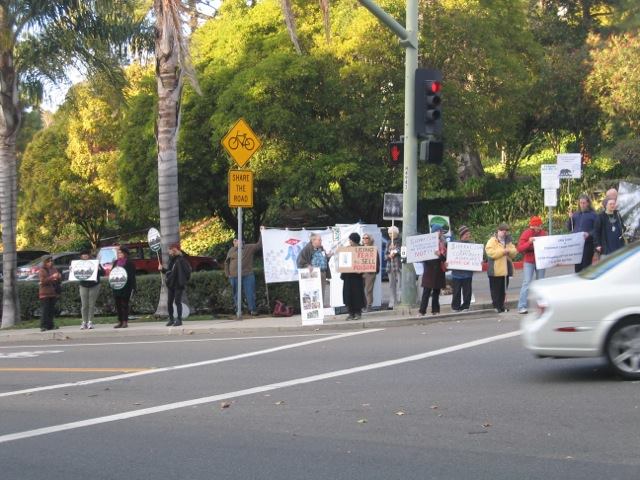
Demonstration at meeting of Claremont Canyon Conservancy, November 15, 2015

Norman LaForce was the other main speaker at the meeting.  He is an elected officer of the Sierra Club and he identified himself as one of the primary authors of the project to destroy all non-native trees in the East Bay Hills.  (An audio recording of his complete presentation is available here: https://milliontrees.me/wp-content/uploads/2015/11/norman-laforce-sierra-club-11-15-15.m4a ) This is the paraphrased portion of his presentation specifically about the herbicides that will be used by the FEMA project:

“Part of the FEMA program will be to use herbicides in a concentrated, careful program of painting or spraying herbicides to prevent the trees from resprouting. It may need to be done more than once but ultimately the suckers give up.   There is no other way to do that cost effectively.

People are saying that glyphosate causes cancer.  Radiation causes cancer but when people get cancer they are often treated with radiation.  Nobody tells them they can’t have radiation because it causes cancer.

There are a lot of people of a certain age in this room who are probably taking Coumadin as a blood thinner for a heart condition.  Coumadin is rat poison.  Nobody tells them they can’t take Coumadin.*

You must take dosage and exposure into consideration in evaluating the risks of pesticides.

Nature Conservancy used glyphosate on the Jepson Prairie.

State Parks used Garlon on Angel Island when they removed eucalyptus.

The European Union says that glyphosate does not cause cancer, so I don’t know if it does.  I’m not going to take a position on that.

Now they are saying that red meat causes cancer.

We need to put aside the question of pesticides.  They will be used properly.  We must proceed in a scientific manner.”

We leave it to our readers to interpret Mr. LaForce’s justification for pesticide use.  He seems to be suggesting that pesticides are good for our health.  There are instances in which pesticides do more good than harm, but using them to kill harmless plants in public parks isn’t one of them, in our opinion.  Since many chemicals accumulate in our bodies throughout our lives, it is in our interests to avoid exposure when we can.  If we must take Coumadin for our health, that’s all the more reason why we should avoid unnecessary exposure to rat poison when we can.

Connecting the dots

We have tried to connect the dots for our readers.  Here are the implications of what we are reporting today:

  • Pesticide applications in San Francisco are probably damaging the trees that are not the target of those applications. The food of wildlife may be poisoned by those pesticide applications.
  • You can influence the public policy that is permitting pesticide use in San Francisco.
  • The same company that is spraying pesticides in San Francisco is also doing so in the East Bay.
  • That company is also actively engaged in the attempt to transform the landscape in the San Francisco Bay Area to native plants. They have an economic interest in native plant “restorations.”
  • The Sierra Club is actively promoting the use of pesticides on our public lands.

*Coumadin is prescribed for people who are at risk of heart attack or stroke caused by blood clots.  Coumadin thins the blood and suppresses blood coagulation.  Rat poison kills animals by bleeding them to death.  There is a fine line between preventing blood clots and bleeding to death.  Therefore, people who take Coumadin have frequent blood tests to check that the dosage is at the optimal level.  Rat poisons are killing many animals that are not the target of the poison.  Animals such as owls, hawks, vultures are often killed by eating dead rodents that have been poisoned.  We should not conclude that rat poison is harmless because humans are using it in carefully controlled doses.  Herbicides being sprayed in our public lands are not being closely monitored as Coumadin use is.


Who are the climate change deniers?

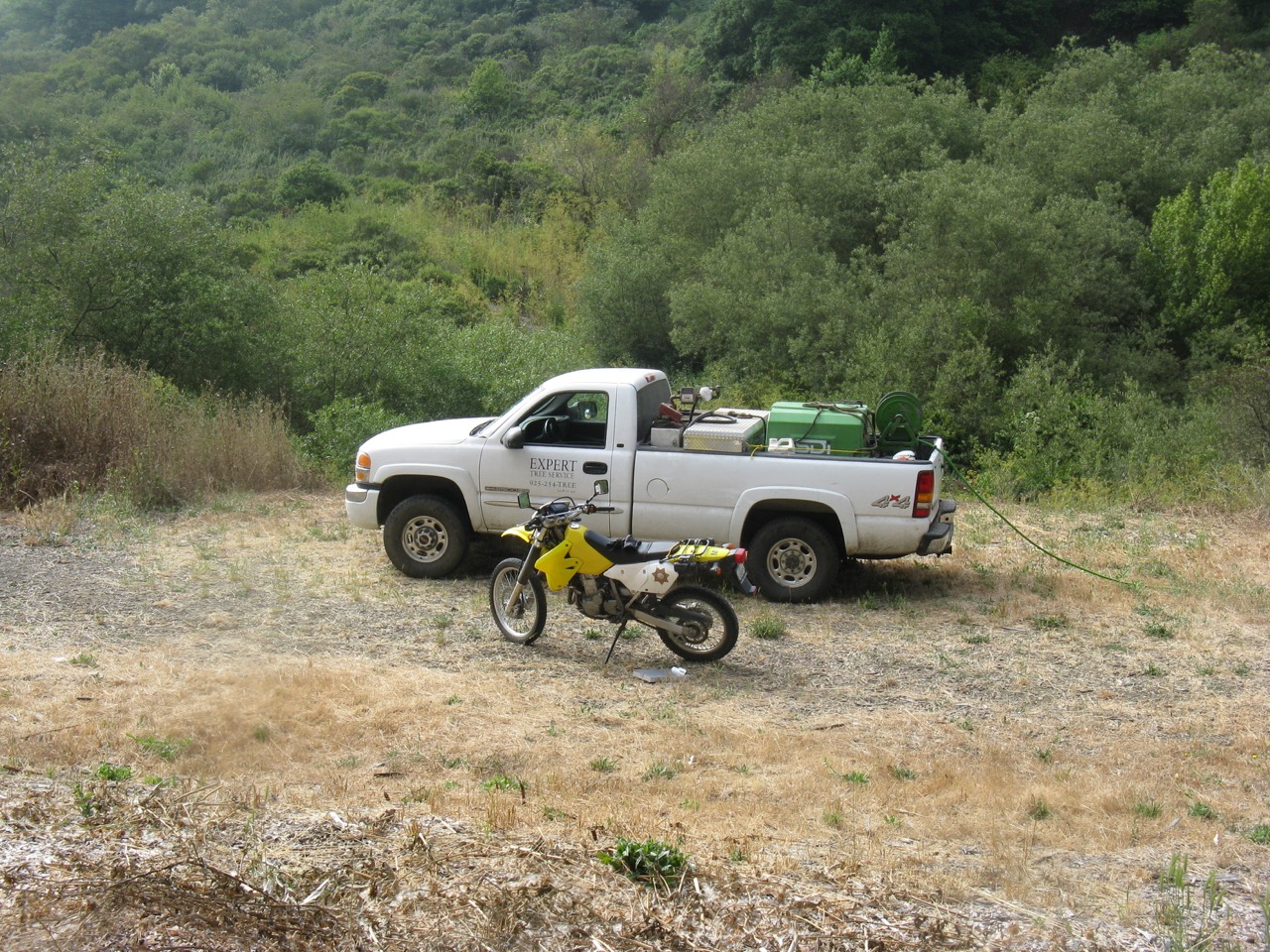
The FEMA projects in the East Bay Hills, which will destroy hundreds of thousands of trees if and when they are implemented, are not unprecedented. Many similar projects have been implemented by UC Berkeley and East Bay Regional Park District.  UC Berkeley destroyed at least 18,000 trees over 10 years ago and another 600 trees in August 2014.  Our experience with those projects is one of the reasons why we are opposed to more tree destruction on an even bigger scale.  Although land managers have attempted to reassure us about the implementation of the FEMA grant projects, we know from experience that their assurances are contradicted by the reality of their actual practices, which have been photographed by hikers in the Hills. Signpost 29 - November 2010 This photo was taken in November 2010 at signpost 29 on Claremont Blvd, which is one of the places where UC Berkeley destroyed all the non-native trees about 10 years ago and the Claremont Canyon Conservancy has been actively engaged in an effort to restore native vegetation. The truck belongs to Expert Tree Company, which is the contractor that removed the trees and sprayed herbicides.   There is a big tank of herbicide on the truck bed from which a hose extends. At the end of that hose someone is spraying herbicides on the weeds that colonize the unshaded ground when the tree canopy is destroyed.  No notice of pesticide* application is posted, as required by California law. (1) Signpost 29 - April 2012 This photo was taken in April 2012 on the opposite side of the road from signpost 29 on Claremont Blvd. This is one of the FEMA project areas where UC Berkeley intends to destroy all non-native trees.  The same truck, with the same tank of herbicide is parked beside the road and someone is spraying herbicide along the road. Again, no notice of pesticide application is posted, as required by California law. When the draft Environmental Impact Statement for the FEMA projects was published in May 2013, the public was told that all pesticide applications would be posted in advance, as required by California law.

So, the pesticide applications immortalized by these photographs are a record of violations of State law as well as broken commitments made in the Environmental Impact Statement for the FEMA projects.  But they are much more than that.  They are also a photographic record that large quantities of pesticides are being sprayed.  The truck is carrying a big tank of herbicide to which a hose is attached and from which herbicide is being sprayed.  This is obviously irrefutable evidence that claims of supporters of the FEMA projects that “minimal” amounts of herbicide are being used are untrue.  

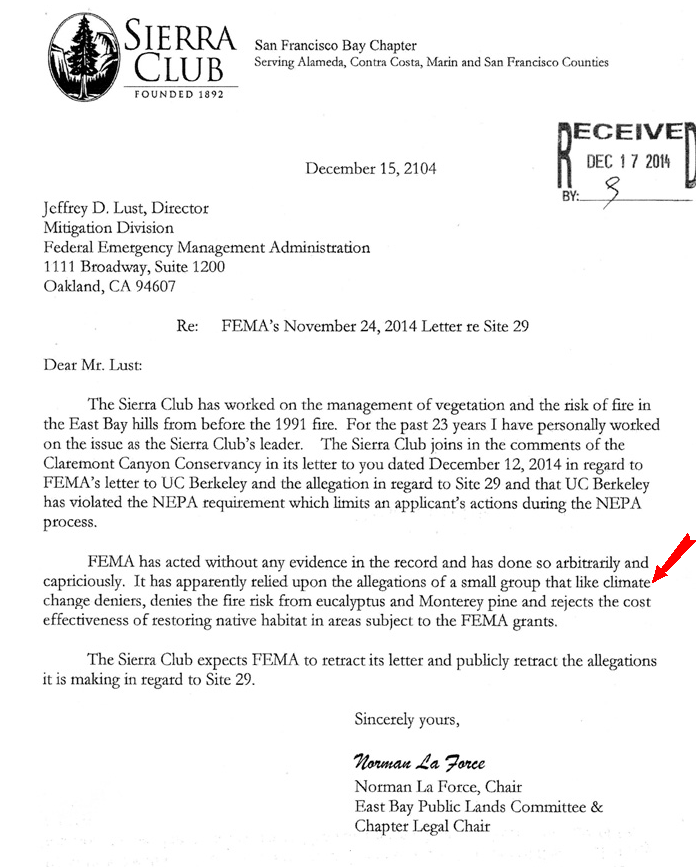
These incidents were reported to FEMA because they violated the law as well as the commitments made by the Environmental Impact Statement. FEMA followed up on that incident.  They reported the incident to the California Office of Emergency Services, which in turn notified UC Berkeley of the violation of the law.  UC Berkeley defended its actions and several supporters of the FEMA project also came to UC’s defense, including the Claremont Canyon Conservancy and the Sierra Club. Here’s the letter that the Sierra Club sent to FEMA about this incident: sierra-club-letter dec 17 2014 arrow

Sierra Club likens us to climate change deniers

We won’t waste your time justifying the complaint that UC Berkeley violated the law regarding pesticide applications. The fact that there was no pesticide application notice posted where pesticides were being sprayed is prima facie evidence that the law was violated. Our focus in this post is on the accusation of the Sierra Club (in their letter above) that those who oppose this destructive project are “like climate change deniers.”  This accusation was repeated more recently by the author of this letter, Norman LaForce, in an interview on KPFA in which he used the same phrase to describe the opposition to the destruction of our urban forest (available HERE at 33:44).  

Since the Sierra Club refuses to discuss the issues directly with those who oppose this project, perhaps they are unaware of the absurdity of this description. In fact, our opposition to this project is partially based on our concerns regarding climate change. The trees that will be destroyed by this project are storing millions of tons of carbon that will be released into the atmosphere, contributing to climate change.  Most of the trees that will be destroyed are expected to live at least another 200 years, so destroying them prematurely will needlessly exacerbate climate change.

Supporters of the FEMA projects are climate change deniers

The irony of the Sierra Club’s accusation is that the description fits them perfectly. Their support for the destruction of our urban forest is a demonstration of their denial of the realities of climate change.

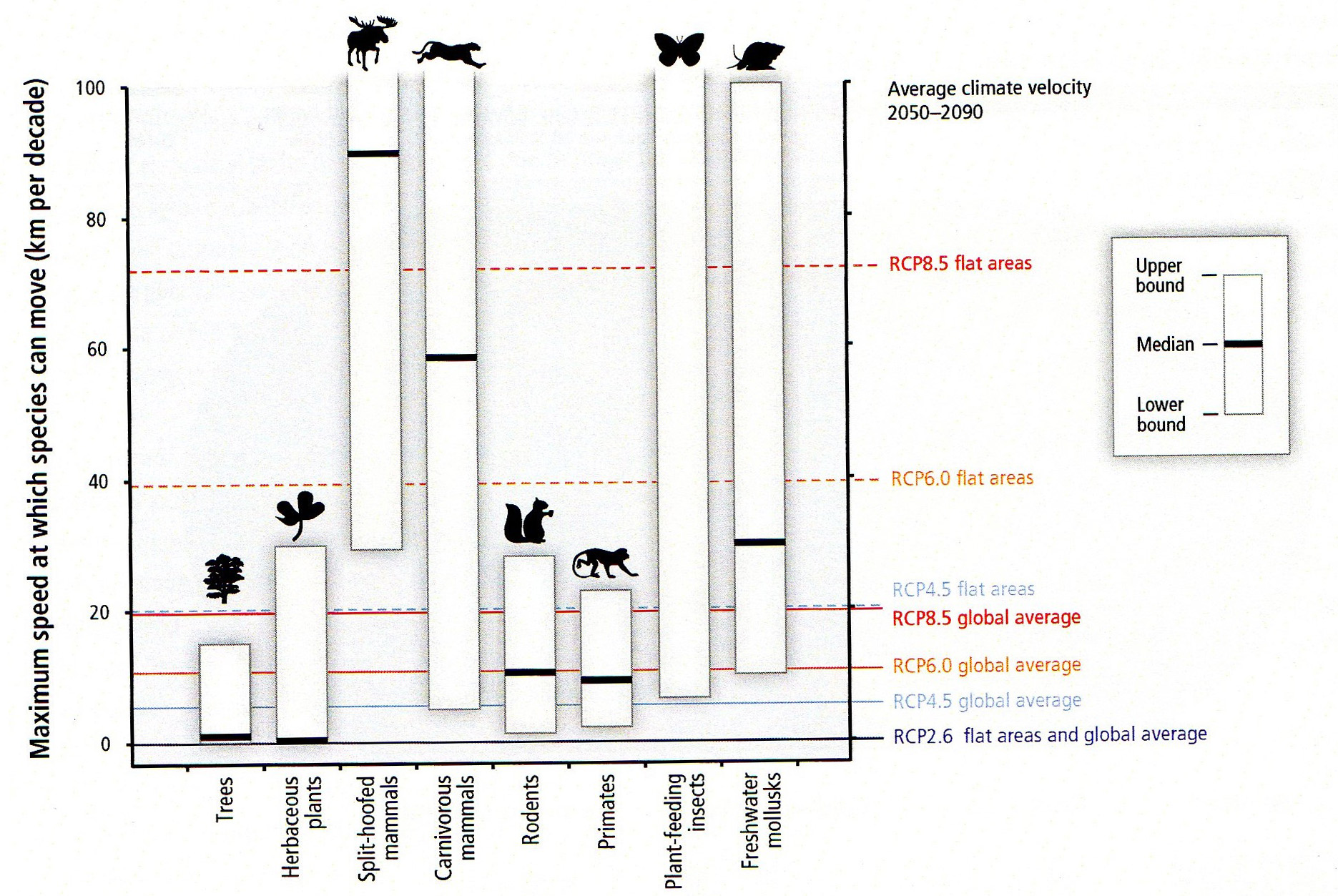
The ranges of native plants and animals have already changed in response to changes in the climate. In the Northern Hemisphere native ranges have moved north and to higher altitudes.  Scientists predict more changes in the climate in the future.  Therefore, they predict that native ranges will continue to change for the foreseeable future. The United Nations’ Intergovernmental Panel on Climate Change has published the following graphic illustration of the range changes that will be required for various types of plants and animals in the future if they are to survive:

Adaptation to Climate Change. IPCC

On the vertical axis, the graph depicts the ability of plants and animals to move, measured in kilometers per decade.  The horizontal lines depict the need of plants and animals to move in response to various scenarios of climate change, i.e., the greater the change in the climate, the further ranges must move.  The bars depict the ability of plants and animals to move and the height of each bar informs us of the variable ability of plants and animals to move.  Trees are the least able to move, unless we have the wisdom to plant them outside their native ranges—at higher latitudes or elevations–where they are more likely to survive in the future.

Supporters of the deforestation of the East Bay Hills do not acknowledge that the ranges of native plants have changed and will continue to change. They demand that we “restore” a landscape that existed in the San Francisco Bay Area 250 years ago, a landscape that is no longer adapted to the existing environment and will become progressively less well adapted in the future.

Climate change has killed millions of trees in California

The Los Angeles Times joined a scientist with the Carnegie Institution for Science, Greg Asner, in a flight over the native forests of California. The scientist is using spectrometry to measure the amount of moisture in the trees, which is a proxy for the health of trees, ranging from dead to stressed to healthy.  These measurements suggest that 120 million trees in California are dead or likely to die soon, which is about 20% of the state’s forests. Especially trees in lower elevations are in “big trouble.”  Asner predicts that oak forests in the Sierra foothills are likely to be treeless grassland in the near future.  He tells us that nearly 6 billion trees in the West died from 1997 to 2010 because of drought and bark beetle. As forests convert to grassland and scrub, the landscape releases stored carbon and its ability to store carbon in the future is greatly reduced because carbon storage is largely a function of above-ground biomass.

Dead trees in San Bernardino County, California

Contrast this actual scenario with the fantasy of native plant advocates who predict that when hundreds of thousands of trees are destroyed in the East Bay Hills, native plants and trees will magically emerge from 2 feet of wood chips to colonize the bare ground without being planted. One would be tempted to laugh at such an unlikely outcome if the reality were not so alarming.  Native plants and trees that lived in the San Francisco Bay Area 250 years ago are unlikely to survive here even if planted and irrigated.  To expect them to return without being planted is a bad joke.

Tree loss exacerbates drought

In addition to the loss of stored carbon, the loss of our tree canopy will also contribute to drought. Deforestation causes droughts because trees have an essential role in the water cycle that returns moisture to the atmosphere, then returns the moisture to the earth as precipitation. This cycle is not perfectly understood and so we are grateful to the NY Times for publishing an excellent article entitled, “Deforestation and Drought, Cutting down trees leads to climate change,” which explains “Trees take up moisture from the soil and transpire it, lifting it into the atmosphere. A fully grown tree releases 1,000 liters of water vapor a day into the atmosphere…The water vapor creates clouds, which are seeded with volatile gases…emitted by the trees to form rain.” Deforestation in the Amazon is expected to have an impact on the climate in places as far away as California. A climate scientist says, “reducing deforestation and replanting forests should be priorities not just in Brazil but in North America and beyond for many reasons, including the health of climate systems.”

When we discuss this issue with the supporters of deforestation in the Bay Area, they always pooh-pooh our concerns, saying that their projects are too small to have any effect on the climate. What they don’t seem to understand, or prefer to ignore, is that such projects are going on all over the country. Here in California, eucalyptus and Monterey pine have been destroyed in San Diego, Los Angeles, Santa Cruz, San Luis Obispo, Monterey, Sonoma, Bolinas and probably many places of which we are not aware. And we hear about new projects all the time. These intentional projects to destroy trees are in addition to the millions of native trees that have died in the past few years because of the drought and millions of native trees that were destroyed by wildfires this summer. It is unconscionable that we are voluntarily destroying hundreds of thousands of healthy trees at such a time.

And so we ask you, “Who are the climate change deniers”? We think the supporters of the FEMA projects in the East Bay Hills—including the Sierra Club—are the climate change deniers.


*Herbicides are pesticides. Pesticide is a global term which covers a multitude of specific pesticides aimed at a variety of targets.  Herbicides are the pesticides designed to kill plants.  Other pesticides include insecticides, fungicides, rodenticides, etc.  We provide this definition, because many native plant advocates do not seem to understand the definition of the word “pesticide.”  Many mistakenly believe that herbicides are not accurately called pesticides.

(1) “Pesticide Use Compliance Guide for Employers and Businesses,” Department of Pesticide Regulation, October 2010.  California Code of Regulations, Title 3, Division 6, Number 6618 (3CCR 6618)

Sierra Club cannot hide behind its smokescreen

On August 25, 2015, opponents of the projects in the East Bay Hills which will destroy hundreds of thousands of trees staged a protest at the headquarters of the Bay Area chapter of the Sierra Club and delivered a petition.  The petition (available HERE) asks the Sierra Club to quit advocating for deforestation and pesticide use in the San Francisco Bay Area and to drop its lawsuit which demands eradication of 100% of all non-native trees on 2,059 acres of public land in the East Bay.  The protest was successful as measured by the size of the crowd and the even-handed media coverage of the protest.

Sierra Club protest, August 25, 2015. About 80 people attended the peaceful protest.

Update:  HERE is a 14 minute video of the demonstration at Sierra Club headquarters on August 25, 2015.  The video includes an attempt to discuss the issue with a Sierra Club staff member.  Note the factual rebuttals to some of the claims the staff member makes in that conversation.  Also, note the final rallying cry, “Poll your membership on this issue.”  We will report soon on the follow up to that request.  Please stay tuned.  

However, although the protest has produced a flurry of defensive propaganda from the Sierra Club, it has not created new opportunities for dialogue with them.  We tried to get the issue on the agenda of the Conservation Committee following the protest and once again our request was denied. We were also denied the opportunity to publish a rebuttal to articles in their newsletter about the projects. It is still not possible to post comments on the on-line version of the Yodeler, although each article dishonestly invites readers to “leave a comment.”
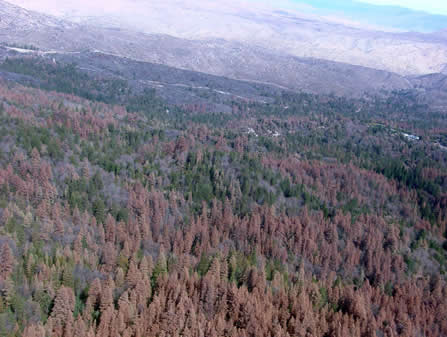
And so, open letters to the Sierra Club are the only means of communication available to us.  Here are our replies to the latest round of propaganda published in the Yodeler on September 16, 2015 (available HERE).  Excerpts from the Sierra Club article are in italics and our replies follow.


“The preferred strategy for vegetation management in the East Bay hills entails removing the most  highly flammable, ember-generating trees like eucalyptus in phases — only in select areas considered most at risk for fire along the urban-wild interface.”

Preferred by whom?  Neither fire experts nor the public think this project is a good idea, let alone the Sierra Club’s more extreme version of the project demanded by its suit.  Over 13,000 public comments on the Environmental Impact Statement were sent to FEMA, of which 90% were opposed to this project according to FEMA.  More recently, a petition in opposition to this project has over 64,000 signatures on it.  This project is NOT the “preferred strategy for vegetation management in the East Bay hills.”

Eucalyptus is not more flammable than many other trees, including native trees: 

  • A study by scientists in Tasmania found that the leaves of blue gum eucalypts were more resistant to ignition than other species of Tasmanian vegetation tested. The study credits the “hard cuticle” of the leaf for its ability to resist ignition. (1)
  • The National Park Service, which has destroyed tens of thousands of eucalypts and other non-native trees, states that eucalyptus leaves did not ignite during a major fire on Mount Tam.  (2)
  • The leaves of native bay laurel trees contain twice as much oil as eucalyptus leaves (3)  and the fuel ladder to their crowns is much lower than eucalyptus, increasing the risk of crown fires. The “Wildfire Hazard Reduction and Resource Management Plan” of the East Bay Regional Park District states explicitly that bay laurel is very flammable and recommends selective removal.
  • Eucalyptus contributed more fuel to the 1991 fire in Oakland because a deep and prolonged freeze the winter before the fire caused eucalyptus and other exotic vegetation to die back. The dead leaf litter was not cleaned up, which contributed to the fire hazard.  Such deep freezes are rare in the Bay Area.  There has not been such a freeze for 25 years and another is unlikely in the warming climate.

    Eucalyptus logs line the roads where UC Berkeley has destroyed trees. Do they look less flammable than living trees?
    Eucalyptus logs line the roads where UC Berkeley has destroyed trees. Do they look less flammable than living trees?
  • Ordinarily, eucalyptus does not contribute more fuel to the forest floor than native oak-bay woodland. This is confirmed by the National Park Service, which includes logs in the calculation of fuel loads. (2) Logs are extremely difficult to ignite.  The so-called “fire hazard mitigation projects” are leaving all the eucalyptus logs on the ground when the trees are destroyed, suggesting that they aren’t considered a fire hazard.  The National Park Service also separates the fuel loads of oaks and bays, which when combined are equal to the fuel load of eucalyptus.  Since our native woodland in the East Bay is a mixture of oaks and bays, it is appropriate to combine them when comparing their fuel loads to eucalyptus.
  • Eucalypts are sometimes blamed for casting more embers than native trees because they are taller than the oak-bay woodland. However, redwoods are as tall, if not taller, and they were also observed burning in the 1991 fire:  On Vicente Road, “Two redwoods up the street caught fire like matchsticks.” (4)  Yet, the Sierra Club is not suggesting that redwoods be destroyed to eliminate the risk of casting embers.

The Sierra Club now says the trees will be removed “in phases,” yet in its suit against the FEMA grants it objects to the phasing of tree removals.  The main focus of their suit is opposition to the “unified methodology” which proposes to remove trees over the 10 year period of the grant on only 29 acres of the total project acreage of 2,059.  To those who objected to this project, that small concession is little consolation, but for the Sierra Club it was a deal-breaker.  Their suit demands that all non-native trees be removed immediately on all project acres. 

If the Sierra Club withdraws its suit against the FEMA projects, it is free to tell another story, as it attempts to do in its Yodeler article.  As long as that suit remains in play, the Sierra Club is stuck with that version of reality.

“Once the flammable non-native trees are removed, less flammable native species can reclaim those areas and provide for a rebound of biodiversity. This model of fire prevention can summarized as the the [sic] “Three R’s”:

REMOVE the most flammable non-native trees in select areas most at risk for fire;

RESTORE those areas with more naturally fire-resistant native trees and plants; and

RE-ESTABLISH greater biodiversity of flora and fauna, including endangered species like the Alameda whipsnake.”

This is a stunning display of ignorance of the project as well as the natural history of the San Francisco Bay Area:

  • The FEMA projects do not provide for any planting or funding for planting after the trees are removed. FEMA’s mission is fire hazard mitigation, not landscape transformation.  The scientists who evaluated the FEMA projects said that a native landscape is not the likely result of the project:  “However, we question the assumption that the types of vegetation recolonizing the area would be native.  Based on conditions observed during site visits in April 2009, current understory species such as English ivy, acacia, vinca sp., French broom, and Himalayan blackberry would likely be the first to recover and recolonize newly disturbed areas once the eucalyptus removal is complete.  These understory species are aggressive exotics, and in the absence of proactive removal there is no evidence to suggest that they would cease to thrive in the area, especially the French broom which would be the only understory plant capable of surviving inundation by a 2-foot-deep layer of eucalyptus chips.” (5)
  • The US Forest Service evaluation of the FEMA projects stated that the resulting landscape would be more flammable than the existing landscape: “Removal of the eucalyptus overstory would reduce the amount of shading on surface fuels, increase the wind speeds to the forest floor, reduce the relative humidity at the forest floor, increase the fuel temperature, and reduce fuel moisture.  These factors may increase the probability of ignition over current conditions.” (6)
  • The US Forest Service evaluation predicts that the resulting landscape will be “a combination of native and non-native herbaceous and chaparral communities.” Despite the overwhelming evidence that wildfires in California start and spread rapidly in herbaceous vegetation such as dry grass, the myth persists that all non-native trees must be destroyed to reduce fire hazards.  An analyst at CAL FIRE has explained to the Center for Investigative Reporting that the reason why wildfires were so extreme this summer is because of the heavy rains in December 2014, which grew a huge crop of grass:  “The moisture did little to hydrate trees and shrubs. But it did prompt widespread growth of wild grasses, which quickly dry out without rain.  ‘They set seed, they turn yellow and they are done,’ said Tim Chavez, a battalion chief and fire behavior analyst with CAL FIRE. ‘All that does is provide kindling for the bigger fuels.’” (7) We know that more dry grass starts more wildfires, yet the Sierra Club demands that we destroy the tree canopy that shades the forest floor and produces leaf litter, which together suppress the growth of the grasses in which fires ignite. 
  • The claim that native plants are “naturally fire resistant” is ridiculous. Native vegetation in California—like all Mediterranean climates—is fire adapted and fire dependent. The wildfires all over the west this summer occurred in native vegetation.  There are over 200 species of native plants in California that will not germinate in the absence of fire and persist for only 3-5 years after a fire. (8) Although all native vegetation is not equally flammable, many species are considered very flammable, such as coyote brush, bay laurel, and chamise.  To say otherwise is to display an appalling ignorance of our natural history.

    When did "environmentalism" devolve into demonizing trees?
    When did “environmentalism” devolve into demonizing trees?
  • There is no evidence that the destruction of our urban forest will result in greater “biodiversity.” There are many empirical, scientific studies that find equal biodiversity in eucalyptus forest compared to native forests.  There are no studies that say otherwise, yet the Sierra Club and their nativist friends continue to make this claim without citing any authority other than their own opinions.  (9, 10, 11)  Bees, hummingbirds, and monarch butterflies require eucalyptus trees during the winter months when there are few other sources of nectar. Raptors nest in our tall “non-native” trees and an empirical study finds that their nesting success is greater in those trees than in native trees.

The Sierra Club’s 3Rs can best be summarized as “repeat, repeat, repeat.”  Their 3Rs are based on 3 Myths:  (1) eucalyptus trees are the most serious fire hazard; (2) “native” vegetation is categorically less flammable than “non-native” vegetation, and (3) native vegetation will magically return to the hills when trees are clearcut and the hills are poisoned with herbicide.  All available evidence informs us that these are fictions that exist only in the minds of the Sierra Club leadership and their nativist friends.

 “The Sierra Club’s approach does NOT call for clearcutting. Under “Remove, Restore, Re-establish” thousands of acres of eucalyptus and other non-natives will remain in the East Bay hills. Our proposal only covers areas near homes and businesses where a fire would be most costly to lives and property. In fact, removing monoculture eucalyptus groves and providing for the return of native ecosystems will create a much richer landscape than the alternative — thinning — which requires regularly scraping away the forest floor to remove flammable debris.”

The Sierra Club’s suit against FEMA demands that all eucalyptus and Monterey pine be removed from 2,059 acres of public property.  While it is true that the project acres are not 100% of all land in the East Bay, with respect to the project acres, it is accurate to describe the Sierra Club’s suit as a demand for an immediate clearcut of all non-native trees.

FEMA Project Areas
FEMA Project Areas

Most of the project acres are nowhere near homes and buildings.  They are in parks and open spaces with few structures of any kind.  CAL FIRE defines “defensible space” required around buildings to reduce property loss in wildfires.  CAL FIRE requires property owners to clear flammable vegetation and fuel within 100 feet of structures.  Using that legal standard, the FEMA project should not require the removal of all trees from project acres.

As we said earlier, Sierra Club’s description of the landscape that will result from the removal of the tree canopy is contradicted by scientists who evaluated the FEMA project.  And their prediction that “thinning” would “require regularly scraping away the forest floor to remove flammable debris” is not consistent with the predictions of those scientists who have advised that the loss of shade and moisture resulting from the complete loss of the tree canopy will encourage the growth of flammable vegetation and require more maintenance than the existing landscape.

“Our preferred approach does NOT focus on eucalyptus merely because they are non-natives. Rather, it is because they pose a far higher fire risk than native landscapes. Eucalyptus shed ten to fifty times more debris per acre than grasslands, native live oak groves, or bay forests — and that debris, in the form of branches, leaves, and long strips of bark, ends up draped in piles that are a near-optimal mixture of oxygen and fuel for fire. Eucalyptus trees ignite easily and have a tendency to dramatically explode when on fire. Also, eucalyptus embers stay lit longer than embers from other vegetation; coming off trees that can grow above 120 feet tall, those embers can stay lit as the wind carries them for miles.”

The Sierra Club’s suit demands the eradication of Monterey pine as well as eucalyptus.  The scientists who evaluated the FEMA projects stated that there is no evidence that Monterey pine is particularly flammable and they questioned why they were targeted for eradication:  “The UC inaccurately characterizes the fire hazard risk posed by the two species however…Monterey pine and acacia trees in the treatment area only pose a substantial fire danger when growing within an eucalyptus forest [where they provide fire ladders to the eucalyptus canopy].  In the absence of the eucalyptus overstory, they do not pose a substantial fire hazard.”  (5)  It is not credible that the Sierra Club’s demand that these tree species be entirely eradicated has nothing to do with the fact that they are not native to the Bay Area.  If flammability were truly their only criterion, they would demand the eradication of native bay laurel trees.  If fear of lofting embers from tall trees were their only concern, they would demand the eradication of redwoods.

As we said earlier, redwoods looked as though they were exploding when they ignited in the 1991 fire.  And we are seeing wildfires all over the west this fire season in which native trees look as though they are exploding when they ignite.  That’s what a crown fire looks like, regardless of the species.

It defies reason to think that an ember is capable of traveling miles and still be in flames on arrival.  In fact, Sierra Club’s suit says “non-native trees can cast off burning embers capable of being carried up to 2,000 feet in distance.”  That’s a fraction of the distance the Sierra Club now claims in its hyperbolic description of the issues in the Yodeler.  Surely we can all use a little common sense to consider how unlikely it is that a fragment of a tree small enough to be carried in the wind could travel miles while remaining on fire.  Likewise, we must ask why fragments of eucalyptus trees are likely to burn longer than any other ember of equal size.  We are not provided with any reference in support of these fanciful claims other than the opinions of the authors.

“Any herbicide use to prevent the regrowth of eucalyptus once they’ve been cut down (they quickly sprout suckers otherwise) would be hand applied in minimal amounts under strict controls. Any herbicide application must undergo a full environmental review to prevent impacts on humans, wildlife, and habitat. There are also methods other than herbicide that can be used to prevent regrowth, and the Sierra Club encourages the agencies that manage the land where fire mitigation occurs to explore these alternatives to find the most sustainable, responsible option.”

Once again, the Sierra Club is stuck with the public record which describes the FEMA projects:

  • East Bay Regional Park District has stated in the Environmental Impact Statement for the FEMA project that it intends to use 2,250 gallons of herbicide to prevent the regrowth of eucalyptus.  (12)  This estimate does not include the herbicides that will be used by UC Berkeley or the City of Oakland.  Nor does it include the herbicides that will be needed to kill flammable non-native vegetation such as fennel, hemlock, broom, radish, mustard, etc.  Surely, we can all agree that thousands of gallons of herbicide cannot be accurately described as “minimal.”
  • The Sierra Club now seems to be suggesting that further environmental review will be required for herbicide use by this project. They are mistaken in that belief.  The Environmental Impact Statement for this project is completed and it admits that the project will have “unavoidable adverse impacts” on “human health and safety” and that there will be “potential adverse health effects of herbicides on vegetation management workers, nearby residents, and users of parks and open space.”  The Sierra Club’s smoke screen cannot hide that conclusion.
  • The FEMA grants have been awarded to the three public land owners and they explicitly provide for the use of herbicides to prevent eucalyptus and acacia from re-sprouting. There is nothing in the Environmental Impact Statement that indicates that “methods other than herbicide can be used to prevent regrowth,” as the Sierra Club now belatedly opines in its latest propaganda.  If the Sierra Club wants other methods to be considered, we could reasonably expect they would make such a demand in their suit against FEMA, along with all their other demands.  They do not make such a demand in their suit.  Therefore, claims that other methods are being explored are not credible.
  • Sierra Club’s claim that herbicides will be applied “with strict controls” is not credible because there is no oversight of pesticide application or enforcement of the minimal regulations that exist in the United States. After 25 years of working for the EPA, E.G. Vallianatos wrote in 2014 of his experience with pesticide regulation in Poison Spring:  “…the EPA offered me the documentary evidence to show the dangerous disregard for human health and the environment in the United States’ government and in the industries it is sworn to oversee…powerful economic interests have worked tirelessly to handcuff government oversight.”

The Sierra Club has also explicitly endorsed the use of herbicides in the public comments they have submitted on these projects and in other articles in the Yodeler:

  • Sierra Club’s written public comment on Scoping for the FEMA EIS: “We are not currently opposed to the careful use of Garlon as a stump treatment on eucalyptus or even broom when applied by a licensed applicator that will prevent spread into adjacent soils or waters.”  Norman La Force (on Sierra Club letterhead), September 12, 2010
  • “There is no practical way to eliminate eucalyptus re-sprouting without careful use of herbicides.” Yodeler, May 25, 2013

Obfuscation and insincere backpedaling

The latest Yodeler article about the FEMA projects is a lot of hot air.  It makes claims about the issues for which it provides no evidence and for which considerable contradictory evidence exists.  It contradicts previous statements the Sierra Club has made.  Most importantly, as long as Sierra Club’s suit remains in play, the demands the Sierra Club makes in that public document cannot be denied.  If the Sierra Club wishes to back away from its previous positions, it must start by withdrawing its suit, which demands that 100% of all non-native trees in the FEMA project areas be destroyed immediately.  Withdrawal of the suit would be a most welcome start on the long healing process that is required to mend the damage the Sierra Club has done to its reputation as an environmental organization in the San Francisco Bay Area.  However, the Sierra Club will not be able to reclaim its status as an environmental organization without renouncing all pesticide use on our public lands. 

The Sierra Club has isolated itself from reality.  Its leadership refuses to speak with anyone with whom they disagree.  They have become the victims of incestuous amplification.  They apparently do not read the documents they use to support their opinions.  For example, the Sierra Club suit claims the California Invasive Plant Council (Cal-IPC) has classified blue gum eucalyptus as “moderately” invasive.  In fact, Cal-IPC’s rating of blue gum eucalyptus is “limited.”  This reflects the fact that a study of aerial photographs of Bay Area parks and open spaces, taken over a 60 year period find that eucalyptus and Monterey Pine forests were smaller in the 1990s than they were in the 1930s.  (13)

We will send our petition soon to the national leadership of the Sierra Club.  If you have not yet signed our petition, we hope you will consider doing so now. 


  1. Dickinson, K.J.M. and Kirkpatrick, J.B., “The flammability and energy content of some important plant species and fuel components in the forests of southeastern Tasmania,” Journal of Biogeography, 1985, 12: 121-134.
  2. “The live foliage proved fire resistant, so a potentially catastrophic crown fire was avoided.” http://www.nps.gov/pore/learn/management/upload/firemanagement_fireeducation_newsletter_eucalyptus.pdf
  3. Ron Buttery et. al., “California Bay Oil. I. Constituents, Odor Properties,” Journal Agriculture Food Chemistry, Vol. 22, No 5, 1974.
  4. Margaret Sullivan, Firestorm: the study of the 1991 East Bay fire in Berkeley, 1993
  5. URS evaluation of UCB and Oakland FEMA projects
  6. FEMA DEIS – evaluation of US Forest Service
  7. https://www.revealnews.org/article/rampant-california-wildfires-can-be-blamed-on-last-decembers-rain/?utm_source=Reveal%20Newsletters&utm_campaign=2d4c52ebf5-The_Weekly_Reveal_09_24_159_23_2015&utm_medium=email&utm_term=0_c38de7c444-2d4c52ebf5-229876797
  8. Jon Keeley, Fire in Mediterranean Ecosystems, Cambridge University Press, 2012
  9. https://milliontrees.me/2011/02/04/biodiversity-another-myth-busted-2/
  10. https://milliontrees.me/2013/04/09/biodiversity-of-the-eucalyptus-forest/
  11. https://milliontrees.me/2013/11/22/invertebrates-such-as-insects-are-plentiful-in-the-eucalyptus-forest/
  12. See Table 2.1 in Appendix F: http://www.fema.gov/media-library-data/1416861356241-0d76d1d9da1fa83521e82acf903ec866/Final%20EIS%20Appendices%20A-F_508.pdf
  13. William Russell and Joe McBride, “Vegetation Change and Fire Hazard in the San Francisco Bay Area Open Spaces,” Landscape and Urban Planning, 2003

Beyond the War on Invasive Species

Tao Orion is the author of Beyond the War on Invasive Species:  A Permaculture Approach to Ecosystem Restoration, the latest in the rapidly growing literature about the futile and destructive attempts to eradicate non-native species.  Ms. Orion will give a workshop at a PLACE for Sustainable Living on Thursday, September 17, 2015:

“Rethinking Invasive Species from a Permaculture Perspective”

Thursday, September 17, 2015, 6-8 pm

PLACE for Sustainable Living

1121 64th St, Oakland, CA 94608

Donations $12-$25 requested

Update:  This is the answer PLACE for Sustainable Living gave to a question about wheelchair accessibility:  “It is not wheel chair accessible yet – we have carried wheelchair persons up the steps with their wheelchairs – we can arrange for that. And the yard is filled with chipwood, wheel chairs have rolled over fine, but not sure if everyone in them can push through. Our friend, male, can push through fine.”  Please contact PLACE for Sustainable Living directly if you have specific questions about accessibility.  (addendum dated 9/10/15)

Update #2:  Ms. Orion’s presentation has been cancelled because the venue is not wheelchair accessible.  CUIDO (an organization which represents disabled people) asked that it be moved to a facility with wheelchair accessibility or cancelled.  Such a facility could not be found, so it has been cancelled.  

Update #3:  Some adjustments have been made in plans for Ms. Orion’s presentation which are apparently acceptable to at least some members of the disabled community.  Ms. Orion has therefore decided against cancelling it.  Sorry for the confusion.

Ms. Orion is visiting the Bay Area from the Willamette Valley in Oregon, where she has a small farm in the country.  She has a degree in agroecology and sustainable agriculture from UC Santa Cruz and she has studied at the Columbines School of Botanical Studies in Eugene, Oregon.  She teaches permaculture design at Oregon State University and a non-profit sustainable-living educational organization.  She has also worked as a permaculture designer for ecological restorations.

Beyond the War on Invasive Species

Beyond the War on Invasive SpeciesThe first chapter of Ms. Orion’s book is a breakthrough because it is an explicit indictment of pesticides used by so-called “restoration” projects.  Although previously published books were critical of invasion biology and the ecological industry it spawned, pesticides were barely mentioned in them.  In contrast, it is primarily the use of pesticides in ecological “restorations” that convinced Ms. Orion that the war on invasive species is doing more harm than good.
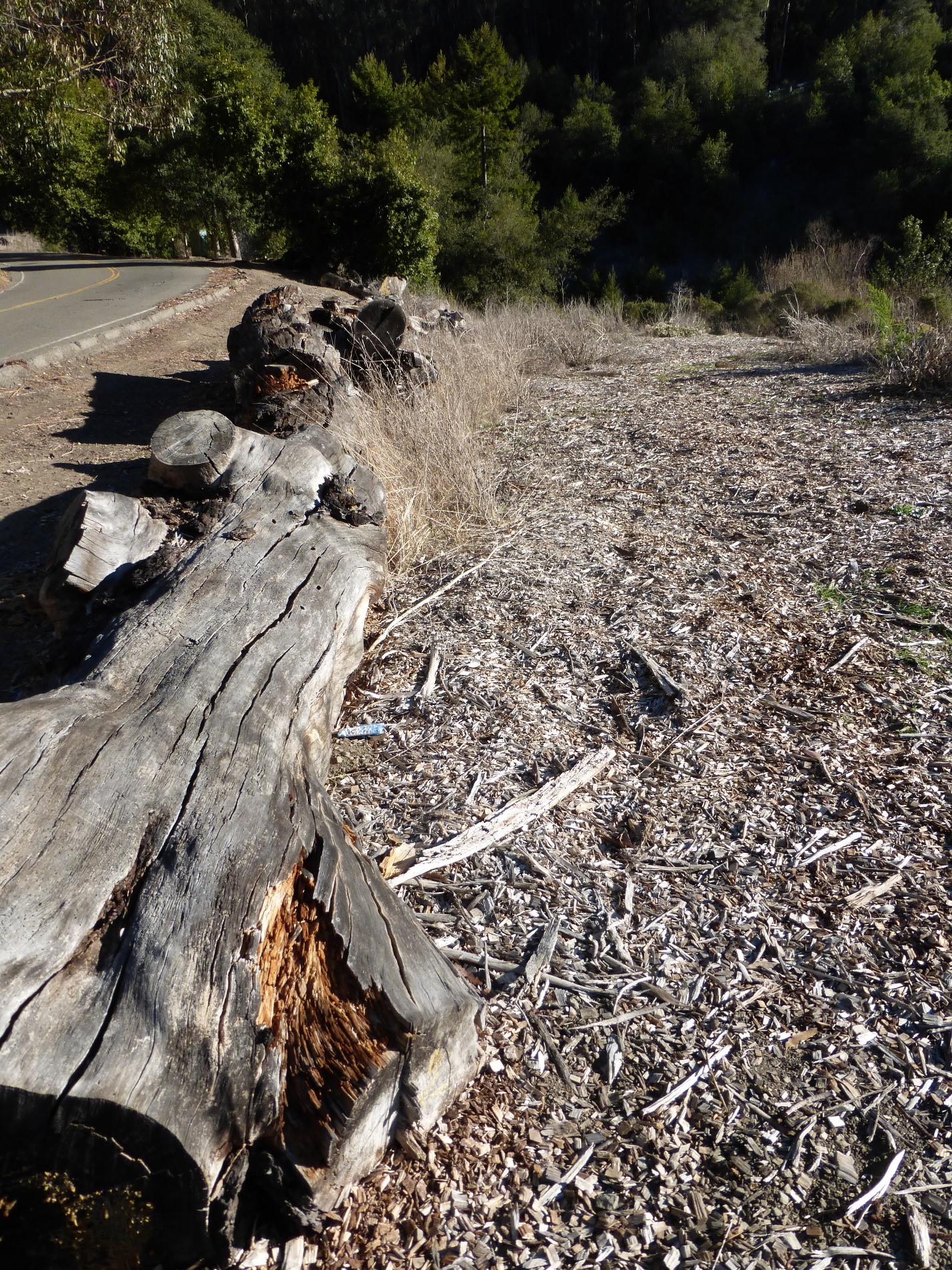
Concern about unwanted plants – AKA weeds – is as old as human engagement in agriculture, that is, thousands of years old. And most of the plant and animal species now considered “invasive” were introduced by humans to serve a variety of purposes, including aesthetics, such as mute swans and multiflora roses.  Some of these introduced plants and animals had unintended consequences such as competing with native plants and animals for available resources.  Concern – even regret – about these introductions has increased greatly in the past 25 years.  Attempts to manage these introductions has escalated from import limitations to fines and penalties and finally to attempts to eradicate plants and animals with pesticides.

The role of the pesticide industry in the escalating war on “invasive” species

Ms. Orion turns to the public record to make the case that the current focus on eradicating introduced species using pesticides was influenced by business interests.  She points out that the federal Invasive Species Advisory Committee is a consortium of academic, professional, and business interests, including at least two people who are employed by manufacturers of pesticides.  They make invasive species management policy recommendations to the National Invasive Species Council (NISC), created by Executive Order in 1999.  The federal government is spending over $1 billion annually on research and control of “invasive” species, including pesticide applications.

National Invasive Species Council

The NISC is modeled after the California Exotic Pest Plant Council, created in 1992.  That Council is now known as the California Invasive Plant Council (Cal-IPC).  Cal-IPC brought together representatives from government agencies and non-profit environmental organizations, as well as manufacturers of pesticides and spray equipment:  “Monsanto has sponsored Cal-IPC since its inception and both DuPont and Dow AgroSciences have also supported the group.”  (1)

The first annual conference of Cal-IPC in 1993 featured an employee of Monsanto, Dr. Nelroy Jackson.  Jackson’s presentation to Cal-IPC stated that “chemical weed control is the optimal method for control and removal of exotic plant species during…most native habitat restoration projects.” 

Jackson’s involvement in escalating attempts to eradicate introduced species is troubling, but is not the only example of such collaboration between the “restoration” industry and the manufacturers of pesticides.  The Weed Science Society, which advocates for “research, education, and awareness of weeds in managed and natural ecosystems,” has employees of Dow Agrosciences, Syngenta, and Dow Chemical on its board of directors.  Those manufacturers of pesticides, as well as Monsanto, Bayer Crop Science, Dupont, and BASF Corp are also donors to the weed society, at the highest levels of donations.

The manufacturers of pesticides also influence the “restoration” industry by investing and participating in the consulting firms that write environmental impact reports for ecological “restoration” projects, such as Tetra Tech (which wrote the draft Environmental Impact Report for San Francisco’s so-called Natural Areas Program).

The manufacturers of pesticides influence public policy regarding ecological “restoration” by making large tax-deductible contributions to many land-grant universities that conduct research on agriculture:  “A 2012 Report from Food and Water Watch found that nearly 25% of funding for agricultural research at public universities comes from private companies.”  (1) This is one of many reasons why there is so little research done on non-chemical approaches to ecological restoration.

As disturbing as this collaboration between the government and the pesticide industry is, the evidence of the relationships between trusted non-profit environmental organizations and corporate interests is even more so.  Nature Conservancy, National Audubon Society, and Ducks Unlimited all have close relationships with the manufacturers of pesticides and receive funding from them.

Ms. Orion then describes the use of pesticides by the “restoration” industry.  She also describes some of the damage pesticides are known to do, such as killing microbes in the soil and binding minerals in the soil.  She describes the persistence and mobility of pesticides in the environment.  She describes the inadequacy of testing and regulation of pesticides in the United States.  These issues are well known to the readers of Million Trees, so we won’t repeat them here, but new readers can click on the blue links to visit posts about those issues.

All introduced species are presumed to be harmful

Ms. Orion’s next chapters are more similar to the books that precede hers.  There are several examples of specific “invasions” that illustrate the point that “invasive” species are usually symptoms of changes in the environment, rather than causes of those changes.  Attempting to eradicate them does not reverse the changes in the environment and often causes more environmental damage.  “Invasive” species are often performing valuable ecological functions that are not understood until they are eradicated.  We have reported many examples of these issues and won’t repeat them here.  However, Ms. Orion’s telling of the history of Asian Carp in the Mississippi River and the Great Lakes was new to us and is well worth a retelling.

Song dynasty painting attributed to Liu Cai (c.1080–1120). Contains various types of fish and other marine animals, such as goldfish, perch, catfish, carp, minnows, bass, and shrimp.

Asian carp has been a mainstay in the diet of the Chinese for several thousand years, according to their historical literature.  Asian carp are well adapted to aquaculture techniques, so they have the potential to replace or supplement other sources of protein.  They were introduced to the Midwest in the early 1800s and they spread throughout the Mississippi River many decades ago.  Although they are prevalent in the Mississippi River, they have not driven any native fish to extinction.  Yet, despite their usefulness and the lack of evidence that they have caused any harm, they suddenly became the latest invasion crisis when it was feared they would soon enter the Great Lakes.  A government fisheries biologist put that fear into perspective:

“We are trying to keep invasive Chinese carps out of the Great Lakes, to protect an invasive (yet purposefully stocked) Pacific salmon fishery, which was stocked as a management tool to control hyper-abundant alewifes, another invasive fish species, because the native piscivore, the Lake Trout, was nearly wiped out by another invasive species, the sea lamprey, because people built the Welland Canal around Niagara Falls to promote intercontinental shipping deep into the Great Lakes basin.” (1)

It makes the head spin to follow the “logic” of this sequence of events, which we paraphrase, “we solved one problem by creating another, then we solved that problem by creating another…ad infinitum.“  This is an ecosystem that has been radically altered by man, including reversing the flow of the Chicago River which connects the Mississippi River to the Great Lakes to solve Chicago’s sewage problems.   The water is warmer, polluted with agricultural runoff, and there is no longer a seasonal, cleansing water surge.  These changes in the environment set the stage for the arrival of Asian Carp in the Great Lakes.  The habitat for native fish has been radically altered such that removal of Asian carp from the river is an irrelevant, inconsequential improvement of habitat needed by native fish.

Despite what would seem overwhelming evidence that Asian carp could be a valuable food source and that being rid of them is unlikely to benefit anyone, here is a brief list of what has been done so far to try to prevent them from entering the Great Lakes:

Fish kill using rotenone. http://www.encyclopedia.com/doc/1E1-X-rotenone.html
  • US Army Corps of Engineers constructed a submerged electric fence to shock and kill the fish as they enter the Great Lakes. The fence cost millions of dollars but is largely ineffective.
  • The Illinois Department of Natural Resources dumped 2,200 gallons of rotenone into sanitary and ship canals feeding into the Great Lakes. This poison kills all gilled animals. The result:  “Among the tens of thousands of dead fish, researchers found one Asian carp.” (1) This fiasco cost $3 million.
  • Other researchers have suggested a system of strobe lights and bubble and sound barriers to stop the northward migration of Asian carp.

Permaculture philosophy

Ms. Orion’s closing chapters reflect her training in permaculture design.  She considers the tending of the wild by Native Americans a model for ideal stewardship of the land.  And she advocates for land management strategies that reflect the realities of our changed environment and are sustainable into the future.  We will let her speak for herself:

“Holistic restoration planning requires an honest accounting of what has come to pass as well as a comprehensive view of what we can do about it.  The problems are complex, and the solutions are likely to be more so…Navigating from a paradigm that views invasive species as scourges to one that looks at them as opportunities for deeper ecological and economic engagement will take time and commitment, especially because the old paradigm is so entrenched politically, economically, and academically.  The tide is shifting though, as more and more of us are coming to realize that the herbicide-based eradication approach to restoration is outmoded—a futile attempt to regain an imagined past—and we need to be focusing our time, resources, and energy on adapting to the future.” (1)

Please show your support for Tao Orion and her book by attending her workshop on Thursday, September 17th.


(1) Tao Orion, Beyond the War on Invasive Species:  A Permaculture Approach to Ecosystem Restoration, Chelsea Green Publishing, 2015