Where is the invasion biology debate headed?

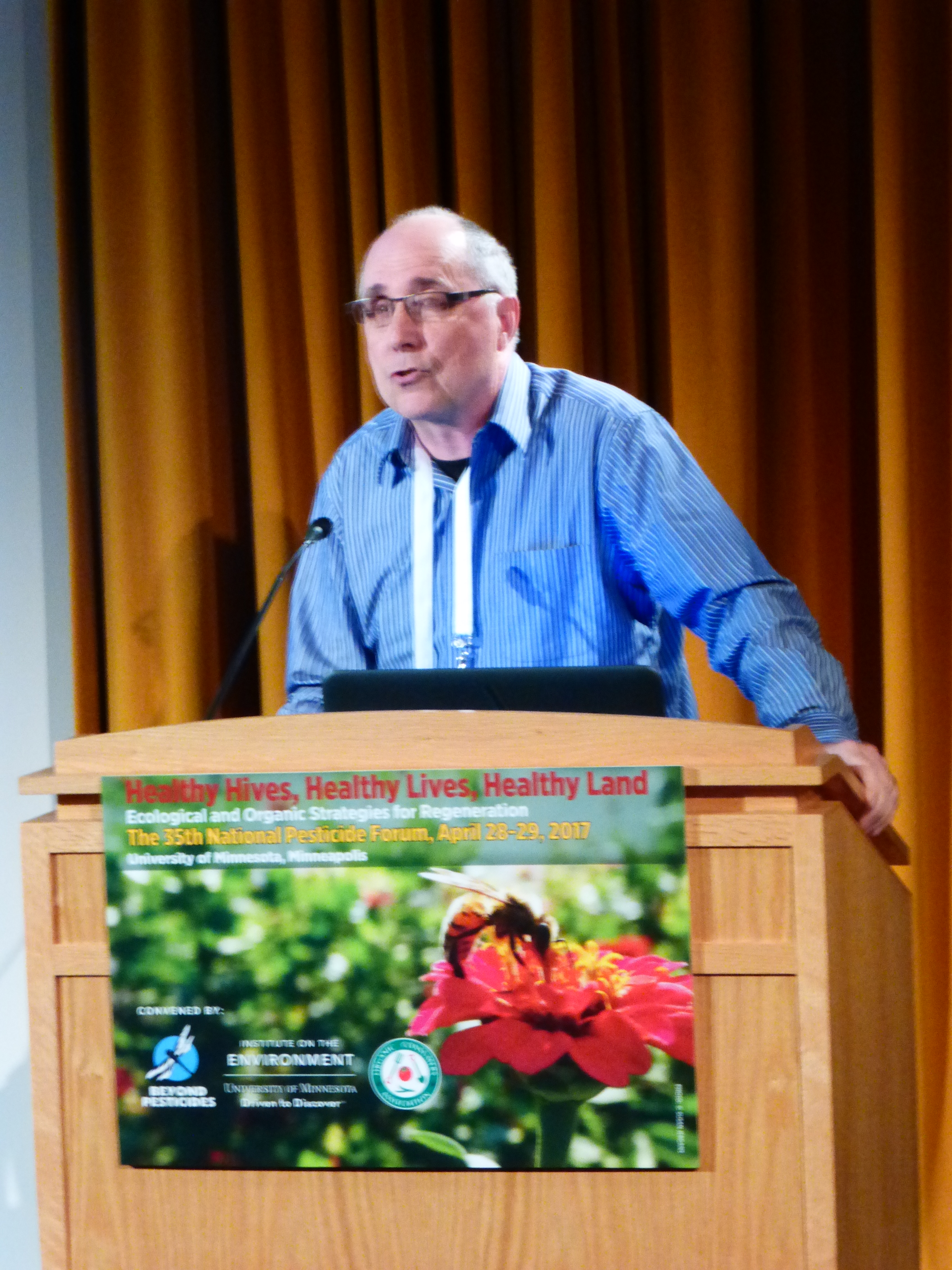
Mark Davis speaking at Beyond Pesticides conference, April 2017

Mark Davis is Professor of Biology at Macalester College in St. Paul, Minnesota.  He is one of the first academic ecologists to publicly express skepticism of invasion biology.  His book, Invasion Biology, was published by Oxford University Press in 2009.  It was the first critique of invasion biology written by an academic scientist. Professor Davis cites the many empirical studies that find little evidence supportive of the hypotheses of invasion biology. 

In 2011, Nature magazine published an essay written by Professor Davis and 18 coauthors entitled, “Don’t Judge Species on their Origins.”  This essay suggested that conservationists evaluate species based on their ecological impact, rather than whether or not they are natives.  The essay initiated an intense debate in the academic community of ecologists that continues today. 

Professor Davis spoke at the Beyond Pesticides conference in Minneapolis at the end of April 2017. (Video available HERE) He described invasion biology as an irrational ideology that is based on nostalgia for the past and a belief that wildlands are being damaged by “alien invaders.”  In fact, the perceived damage is largely in the eye of the beholder, depending largely on one’s membership in a group benefiting from the nativism paradigm, such as chemical manufacturers, conservation organizations, government agencies, and employees.  Some academic careers are also at stake.  Futile attempts to re-create historical landscapes always have the potential to make things worse.  In many instances, it is more sensible to change one’s attitude about the changing landscape than trying to change nature.

We invited Professor Davis to write a guest post for publication on Million Trees.  We asked him to express his opinion on these questions: 

  • Has the status of invasion biology changed much since Nature published your essay 2011?
  • Has increased knowledge of climate change had an impact on the status of invasion biology in academia?
  • What do you think is the future of invasion biology both as an academic discipline and as public policy?

Professor Davis’s guest post addresses these questions.  We are grateful to Professor Davis for his many contributions to our understanding of the fallacies of invasion biology and for his thoughtful guest post.

Million Trees


Competition to define nature

In the past few years, a new perspective has been taking hold in the field of ecology.  Referred to as ‘ecological novelty’ it emphasizes that many factors are producing ecologically novel environments.  Climate change (which includes changes in temperatures and patterns of precipitation), increased atmospheric carbon dioxide, which affects photosynthetic rates, increased atmospheric deposition of nitrogen (the whole earth is being fertilized due to the increased nitrogen we are pouring into the atmosphere), and the introduction of new species are all rapidly changing our environments.

A strength of the term ecological novelty is that unlike the invasion vocabulary it is simply descriptive.  It simply states that ecosystems are changing and are different than they were in the past, even the recent past.  It says nothing about whether this change is good or bad.  In this paradigm, species can be referred to as novel species, new arrivals, or long-term residents.

The less biased ecological novelty paradigm differs dramatically from the more ideological nativism paradigm.  It differs in the language it uses and it differs in the implied direction that land management should proceed.  More generally, it forsakes the normative atmosphere that permeates restoration ecology, conservation biology, and invasion biology, all of which have been substantially guided by the nativism paradigm.

The Sutro Forest in San Francisco is a good example of a novel ecosystem. It is a thriving mix of native and non-native species. Much of it will be destroyed by the irrational belief that native species are superior to non-native species.  Million Trees

Currently, invasion biologists are trying to discredit ecological novelty as a valid or valuable perspective.  This is hardly surprising since the ecological perspective would displace the nativism paradigm, and many stakeholders have much to lose if the nativism paradigm were abandoned, e.g. chemical companies, restoration and management companies, local, state, and national agencies, to name just a few.  Not surprisingly, articles trying to shore up invasion ecology and to keep it relevant have been common in recent years.

While the public may not be aware of it, there exists a heated competition to define natureWhich side wins will significantly determine how nature is managed.  Given that the redistribution of species is only going to increase in upcoming decades, it is hard to imagine that people will still be so preoccupied with origins by the middle of the century.  Like the notion of wilderness, the nativism paradigm is more of a twentieth century concept, while the construct of ecological novelty is more fitting for the twenty first century.

Undoubtedly, nativist groups will still exist and will still be preoccupied with trying to restore their vision of the past.  But, due to the number of species being moved to new regions, much more attention likely will be given to the function of species than their origins, if only for pragmatic reasons.  For people coming of age now, cosmopolitanization is the new normal, both with respect to people and other species.  We will still carry our predispositions to divide the world into us and them, but it should be clear to most that the nativism perspective will be obsolete and that beyond the creation of museums, restoring the past will not be possible, whether a city or a forest.

Currently Earth is the only planet we know of where life exists.  In this context, the desire and practice of declaring some species as aliens, exotics, or invaders seems sadly provincial and even unseemly.  Roman playwrite Publius Terentius Afer (aka Terence) wrote in his play Heauton Timorumenos, “Homo sum, humani nihil a me alienum puto”, or “I am human, and nothing of that which is human is alien to me.” To those who still see such value in distinguishing native from alien species, I say, “I am of the planet Earth and nothing of that which is earthly is alien to me.”

Mark Davis

The Ecological “Restoration” Industry: Follow the money

Matt Chew is one of many professional academics that criticize invasion biology.  Unlike most, he emphasizes explaining the weaknesses of eco-nativism using scientific, historical, and philosophical methods, depending on the issue.  This has made him a useful collaborator and resource for like-minded but primarily science-oriented colleagues. Million Trees is deeply grateful for his willingness to speak publically about the fallacies of invasion biology, including the generous gift of his time in writing this guest post for us.

Dr. Chew is a faculty member of Arizona State University’s Center for Biology and Society and an instructor in the ASU School of Life Sciences.  He teaches courses including the History of Biology, Biology and Society, and a senior conservation biology course in “novel ecosystems,” described HERE on the university’s “ASU Now” news website.

He was also a speaker at the 2013 annual conference of Beyond Pesticides.  A video of his presentation is available HERE (go to 24:40).  He says that “invasive” plants are convenient scapegoats that are presenting a marketing opportunity for the manufacturers of pesticides. Invasion biology is at the core of the greening of pesticides.

In his guest post, Matt helps us to understand how he chose to pursue a multidisciplinary critique of one topic rather than adopting a single disciplinary approach and identity. He began his professional career as a practicing conservation biologist, experiencing firsthand the sometimes startling disconnects between laws, policies, aspirations, public expectations, and realities “on the ground.” 

We celebrate April Fool’s Day with Matt Chew’s article.  When we waste our money on ecological “restorations” the joke is on us!

Million Trees

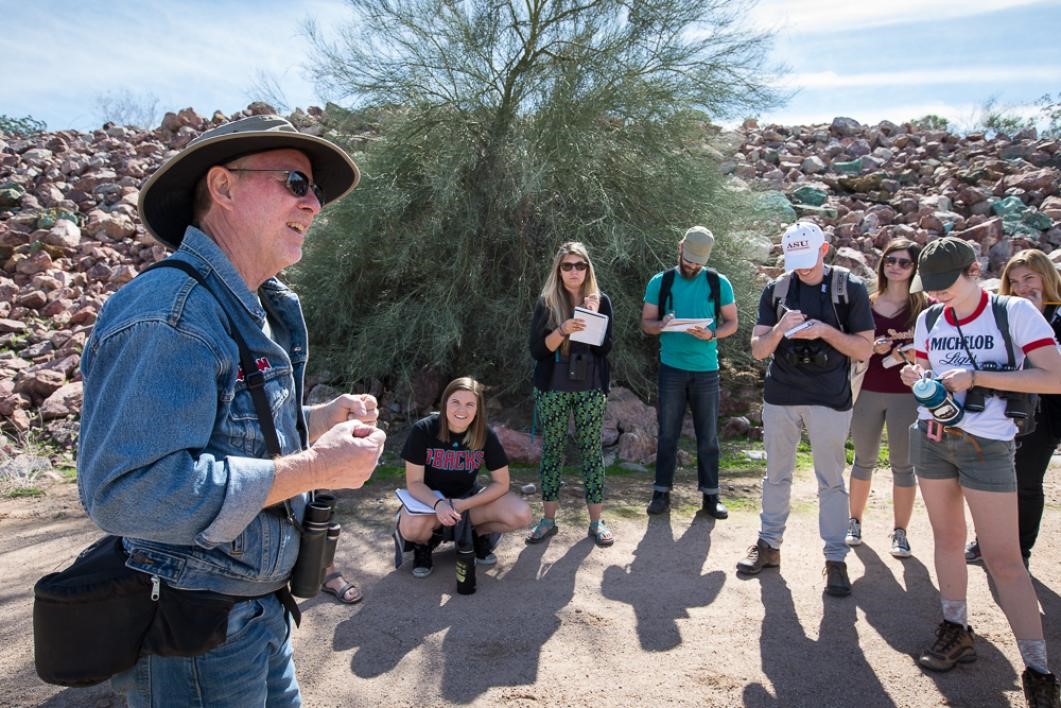
Matt Chew with his class in novel ecosystems

Those familiar with my academic work know I invest most of my efforts documenting and explaining the flaws and foibles of “invasion biology.” But I got into this messy business as a practical conservation biologist, a natural resources planner “coordinating” the Arizona State Natural Areas Program during the late 1990s. I found the toxic nativism of natural areas proponents morbidly fascinating, and the practical politics of natural areas acquisition and management morbidly galling. I chose to follow my fascination. But as “Death of a Million Trees” marks the end of its seventh year as a WordPress blog, and in light of recent decisions by Bay Area authorities, it’s time for a galling reminder:  Follow the money.

Authorities responsible for suburban fire suppression and recovery necessarily view stands of living trees as liabilities. They can’t see the forest for the fuels. The prospect of eliminating them merely drives their value further into the negative. That it must be subsidized is ironic because eucalyptus and Monterey pine are plantation grown in many countries for timber or pulp. But they aren’t traditional sources of California wood products and a glut of more familiar drought-killed trees awaits salvage far from finicky neighbors.

So condemned trees can’t just be disappeared by pointing them out to eager loggers. “Concept planning” can be fairly vague, but “action planning” must be very specific. A job this big requires both general and sub-contracting. It requires hiring and training and supervising. Capital equipment will be acquired, maintained and repaired. Affected areas must be surveyed and material volumes estimated. Before trees can be felled, access routes must be surveyed and created. After trees are felled they must be sectioned, staged, loaded and hauled away for disposal. More often they are shredded in place. At every step, someone pays and someone profits.

Where “ecological restoration” is the objective, stumps must be pulled or blasted and roots must be excavated. The eucalyptus seed bank will need to be eliminated or rendered inert. Perhaps even a century’s accumulation of organic topsoil will need amending, or removing and replacing to reconstitute prehistoric substrates. Seed suppliers and nurseries will be contracted to provide plant “native” materials. After the armies of tree-fellers and stump-blasters will come waves of laborers, tractors, diggers, spreaders, and planters in an endless relay of trucks. Ecological restoration is farming, all the more so in proximity to a cityscape arrayed in exotic plants. If all goes well and the rain falls in judicious quantities at auspicious times, planting will be followed by perpetual weeding. At every step, someone pays and someone profits.

It’s hardly surprising that FEMA has no intention of underwriting restoration on that scale. Their plans envision minimally spreading shredded wood, leaving a layer up to two feet deep to gradually decompose, and hoping whatever oaks and other present understory plants they haven’t accidentally fractured or flattened will thrive in the sudden absence of big trees. Two feet of material will gradually compact, but assurances that it will rot into organic soil within a few years are pretty optimistic. Whether and when it will support anything resembling a native plant assemblage is dubious. Meanwhile, some viable stumps will require recurring treatment with the herbicide du jour and occasional supplemental felling. It’s not a reset-and-forget strategy. It’s just the first step of a long and contentious cycle of interventions. And of course, at every step, someone pays and someone profits.

Whenever public property and expenditure is concerned there should be an open procurement process with a clear data trail. A call for proposals is written and published, bids are received, contracts awarded, and work commences. But we can be certain that by the time the prospect of deforesting the Bay Area was openly discussed by policymakers, potential bidders were positioning themselves to influence the shape of the emerging policy and take advantage of it. And various interest groups who saw deforesting the hillsides as a means to their ends became a de facto coalition of advocates. Some acted more openly than others, and some to greater effect. But prominent nonprofit organizations expect returns on their investments. Nothing happens unless someone pays and someone profits.

Some of the premises underlying the logic of the program will inevitably be faulty. Should it falter at any step due to unforeseen events (e.g., meteorological, horticultural, ecological, economic or political), contingencies will be implemented… if funds are available. There are only three certainties. Firstly, no action occurs unless someone pays and someone profits. Secondly, nature, within which I include all aspects of human society, is complex and capricious. No one can predict with much certainty how a post-deforestation landscape will look or function. Finally, a coalition of the discontented will emerge and agitate for improvements that require someone to pay, and allow someone to profit.  As Nancy Pelosi recently reminded us, “we’re capitalist and that’s just the way it is.”   

Matt Chew


Integrated Pest Management is a sham!!

Many thanks to Marg Hall for this guest post about the pesticides being used by the supplier of our drinking water in the East Bay and for the research she did to inform the public that there is a BIG gap between written policies and the reality of pesticide use on our public lands.


One day last winter, I came upon a crew cutting down about 50 eucalyptus trees on what appeared to be EBMUD lands in the East Bay hills. (East Bay Municipal Utility District, EBMUD, manages the local drinking water lands and infrastructure.) Knowing that rain was predicted, and that the standard procedure is to apply the nasty herbicide Garlon to the cut tree stumps to prevent re-sprouting, I stopped to ask the workers about the job.  The contractor (Expert Tree Service) refused to answer my questions, even the most basic one: who hired them?

Tree removals done by EBMUD on Grizzly Peak Blvd
Tree removals done by EBMUD on Grizzly Peak Blvd (prior to the incident reported by Marg Hall)

I thought it an especially bad idea to apply Garlon in the drinking water watershed during the rainy season, so I stopped them by simply refusing to leave the work area until I got some answers. It was easy. I was polite but firm. The police were called. After being threatened by the contractor with per-minute fines for delaying the work, and a trip to jail from the police, I left them to their destruction. This is how I became interested in the management of EBMUD lands.

On a personal note, I had just been diagnosed with breast cancer. Ironically, I’d been looking for hiking trails where I didn’t have to confront the risk of cancer-causing pesticide applications. The whole situation made me very grumpy.

Following up, I was assured by EBMUD staff that they do NOT allow contractors to apply herbicides to cut eucalyptus stumps, and that very few, in fact almost no, herbicides are used in the drinking watershed lands. OK, that sounded pretty good. Wanting to verify this claim, I filed a public records request to EBMUD.

Aerial spraying pesticides on public parks

Meanwhile, we (FAB, The Forest Action Brigade, a grass roots group with which I am affiliated) heard of a plan by East Bay Regional Park District (EBRPD) to aerial spray from a helicopter (yes, you read that correctly!) an herbicide named Milestone (which is prohibited for use in New York State because it is very persistent and mobile in the soil). This was to be done in Briones Park, an area that directly supplies two creeks that feed into the Briones water reservoir.

Mobilizing public support, we were able to stop that spraying, but among our growing concerns we now added the safety of our drinking water. Even though this spray was planned by the East Bay Regional Parks District (EBRPD), the staff from the Water District (EBMUD) knew about it, and didn’t try to stop it…until we raised the issue.

Management of wastershed land by supplier of our drinking water

Last summer, EBMUD invited public comment on a draft update of their Watershed Management Master Plan. In this document, an Integrated Pest Management (IPM) program was referenced (available here: ebmud-ipm-program). Curious, we obtained copies of this document.

On paper it looks pretty solid. Like most IPM programs, this one contained written assurances that only minimal pesticides will be used, and then only as a last resort. Quarterly meetings of the IPM committee would provide oversight, meet and compile reports of pesticide usage. Among committee goals are: approve pesticide use requests, ensure consistency among work groups regarding pest management, and advise on pest management strategies. The guidelines require that pesticides be used only after certain damage thresholds are reached, with follow-up evaluations of effectiveness, and documentation of adverse side effects on non-targeted organisms.

Reading this leads one to the conclusion that the land management practices are just a step below organic gardening practices. With such controls and alternatives, what could possibly go wrong?

Control of pesticide use is more theoretical than real

As I soon learned when I started asking for public records, the IPM program as outlined in the EBMUD Watershed Management draft plan is a “paper only” plan. The oversight committee has not met in 15 years, and in fact only actually met for several years (the program started in 1996). There has been no oversight, no annual report, and wildly inconsistent use has developed over the various work units at EBMUD. They do follow minimal state reporting and training requirements, but that’s it.

I found no comprehensive evaluation of pesticide use, no analysis of levels of use, or experiments with alternatives, as one would expect in an “integrated” approach. Instead I received pages and pages of daily logs by individual workers documenting pesticide use. There appear to be no restrictions on use as long as the applicators documented applications, and the pesticides used were on the approved list of pesticides. The list of approved pesticides is long and includes known carcinogens.

Since nobody at EBMUD was keeping track, several of us embarked on a labor-intensive project to sort through records ourselves and tally an annual pesticide total. We focused on EBMUD properties in Alameda and Contra Costa Counties and usage for the year 2015. We were disheartened by our findings. In these areas, EBMUD made 647 applications by truck, backpack or by hand of herbicides totaling over 700 gallons and 205 pounds.

We compared the use of pesticides by EBMUD with those used by EBRPD.  EBRPD used significantly less herbicide than EBMUD in 2015. EBRPD used 193 gallons of herbicide (glyphosate, Garlon, Oryzalin) in 2015 (and smaller quantities of specialty herbicide for specific projects).  EBRPD has 120,536 acres of property compared to only 28,000 acres of EBMUD property.

Many environmentalists concerned about pesticide use had thought EBMUD carried out a more environmentally respectful philosophy of land management. This is not true. While the Watershed and Recreation work unit reported using only 8 gallons of pesticides that year, they constitute only one of several work units. EBMUD staff in the Watershed and Recreational work unit believe that is the sum total of pesticides used in “the watershed” and that pesticide usage is low. While some of the maintenance operations are outside of the drinking water watershed lands, some are not. Nevertheless this distinction is meaningless since all land is a “watershed” whether it drains to Briones reservoir or the San Francisco Bay. Furthermore, applications of pesticide are routinely done in areas open to the public.

One such application was documented last fall by someone walking on a public road in her neighborhood who took this video (If the video won’t play for you, try clicking on this link to the video HERE:

In it you see vast quantities of Roundup (glyphosate), applied from a truck-mounted tank using a garden hose. That method of application explains why the volume of EBMUD’s pesticide use is so high.  Competent and responsible pesticide applicators use a spray nozzle to reduce the flow and spread the herbicide more evenly.

Inexplicably, the worker was soaking bare ground along the side of a road. It is pointless to apply Roundup to bare ground.  It is a foliar spray that must be applied to actively growing plants.  It has no effect on seeds, roots, or tubers in the ground.  This is explained clearly on the manufacturer’s label for the product.

This spraying was done in a residential neighborhood (Carisbrook Road, Montclair area of Oakland). No pesticide application notices were posted before, during or after the application in violation of EBMUD’s IPM guidelines, which say, “If there is likely to be public contact with the area to be sprayed with pesticide, adequate notification or posting should be conducted.”

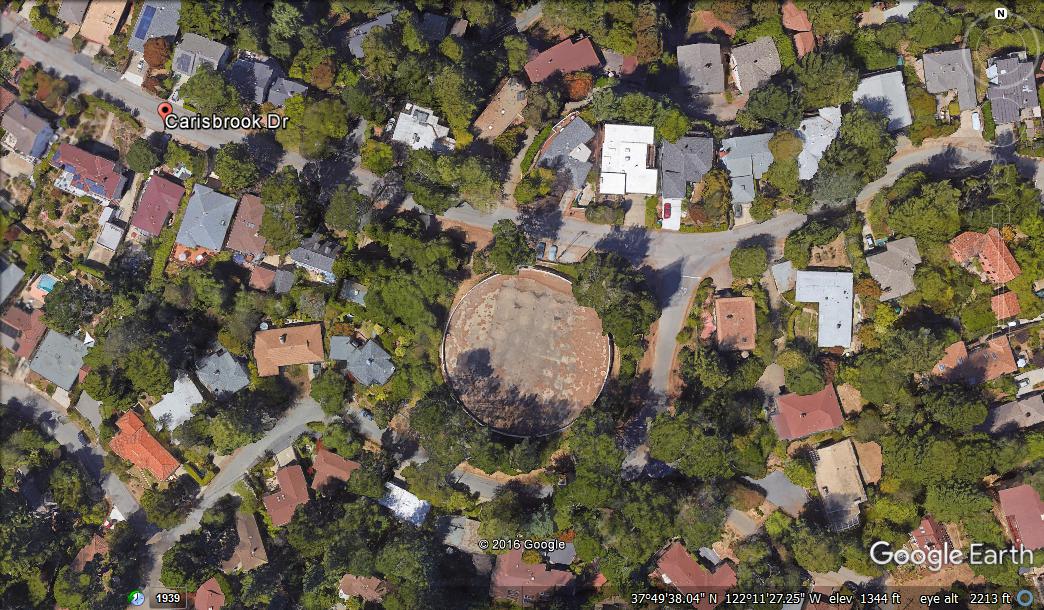
Carisbrook Reservois on Carisbrook Road in Montclair, Oakland, where pesticides were sprayed by East Bay Municipal Utilities District
Carisbrook Reservoir on Carisbrook Road in Montclair, Oakland, where pesticides were sprayed by East Bay Municipal Utilities District

The video was sent to EBMUD board members. EBMUD’s response was a defense of this application as consistent with existing policy and regulation. They also claimed that the herbicide was not sprayed on a pedestrian path.  In fact, the spraying occurred on a public road in a residential neighborhood that was used as a path by those who live in the neighborhood, such as the woman who recorded the video.

How to achieve REAL control over pesticide use on public land

That raises the obvious question: if this pesticide application is acceptable, what good is an IPM program except as a means to mislead the public into thinking we are being protected?

There’s an easier, simpler way to obtain the kind of protection we need: Forget IPM. Institute a total ban. No pesticides.  PERIOD.  It can be done.

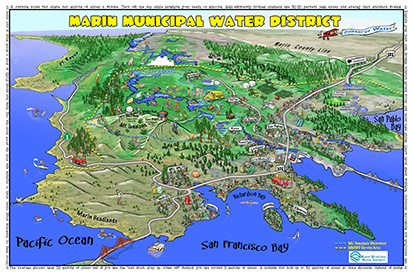
Marin Municipal Water District has banned all pesticide use on their properties.  Organic farmers do it. Why not demand this from our local land managers?

Public Policy is in OUR hands

In recent decades, public land managers have been using public tax money to apply more and more pesticides in public spaces. In the years ahead, as the Republicans dismantle the Environmental Protection Agency, destroying what little (pathetic) regulation that we now have, we local activists will need to do our own protecting.

It starts here, in our own backyards. We know there is tremendous popular support for this. People really don’t like to be exposed to pesticides when they visit public parks. Robust local activism is our only hope. Yes, we can!!

Marg Hall

An epilogue to the saga of the San Francisco Natural Areas Program

On December 15, 2016, the San Francisco Planning Commission approved the Environmental Impact Report for the Natural Areas Program and the Recreation and Parks Commission approved the management plan for the Natural Areas Program.  The public hearing was over 6 hours long and is available for viewing HERE.  Although we watched the hearing, we won’t try to summarize it here because readers can watch it if they wish.  Rather we will comment on a few conspicuous observations about the hearing.

The most noteworthy feature of the hearing was that virtually all of the supporters of the EIR and the Natural Areas Program were allowed to speak first.  Critics of the program were called on last.  If you have spoken at such a hearing, you know that speakers submit a speaker’s card on which they indicate their support or opposition for the agenda item when they arrive.  Typically, speakers are called in the order in which they arrive at the hearing.  This usual procedure was apparently not followed in this case.

The main disadvantage of not being called upon in the order in which speakers arrive is that when a hearing is 6 hours long, many people with other responsibilities—such as work or family obligations—are forced to leave before their names are called.  In the case of this hearing, I heard a number of names called of people whom I knew to be critics of NAP, who did not speak, presumably because they waited their turn but weren’t called in the order of their arrival.

Another conspicuous feature of this hearing was that the vast majority of speakers in favor of the EIR and the management plan either work directly for the program or are affiliated with it.  Many supporting speakers were representatives of non-profits that conduct similar projects or they bring children into the parks to “educate” them about native plants.  Their presence at the hearing was therefore a work responsibility which enabled them to spend an unlimited amount of time at the hearing.

This is an illustration of the biggest obstacle to the realization that nativism is a destructive agenda based on outdated scientific hypotheses for which there is no empirical evidence.  In a word, “restoration” ecology is now a multi-million dollar industry in which many people are employed.  Therefore, there is vested economic interest in continuing such efforts whether or not they are successful or beneficial.

Criticisms of the Natural Areas Program and its EIR

The speakers who opposed the approval of the management plan and its EIR were members of the general public who are neighbors of the so-called “natural areas.”  They mentioned the destruction of trees (and the subsequent loss of sequestered carbon) and the use of herbicides as their primary objection to the plans.  Another important issue was the restrictions on recreational access such as the closure of 10 miles of trails and the requirement that all access be confined to the trails that remain.  These are issues with which our readers are familiar, so we won’t elaborate.

Comments based on personal experience with specific “natural areas” seemed most effective.  One fellow said he had participated as a volunteer in several big plantings of native plants in a natural area.  The plants died each time and presently few plants have survived several attempts to “restore” this so-called natural area.  This experience had led this speaker to conclude that attempts to “restore” this park to native plants were futile.

A neighbor of Glen Canyon Park showed pictures of the impact on her neighborhood of the destruction of trees in the park several years ago.  Her neighborhood has lost its windbreak and therefore dust from the bare ground is blowing into their homes.  Their beautiful view of the trees has been replaced by bare ground.

The Natural Areas Program began 20 years ago and has been fully staffed and funded since its inception.  Therefore, it should be judged by what it has accomplished.  It has closed trails, destroyed trees, and built fences.  It has repeatedly destroyed vegetation with herbicides and planted those areas with native plants.  The native plants have died, in some cases several times in 20 years.  In other words, it has little useful to show for 20 years of investment of effort and money.  Since it has not been successful after 20 years, it seems insane to invest another 20 years of money and effort.  Remember that one definition of insanity is doing the same thing over and over and expecting a different outcome.

Support for the Natural Areas Program

We hesitate to use the word “lie” to describe the justifications for the Natural Areas Program, but after listening to hours of testimony by its supporters, we will use that word to describe a few of their claims:

  • The most effective lie is that all the trees they destroy will be replaced with native trees. In fact, no such commitment is made in the management plan, which says explicitly that the natural areas will be converted to grassland and dune scrub.  This “replacement” fiction is mentioned in the EIR.  However, the EIR makes no commitment to planting the replacement trees in the areas or even the same parks where the trees are destroyed.  This important caveat to the commitment to replace the trees was not mentioned by any of the speakers in support of the plans, including NAP’s leadership.  In the case of the 15,000 trees that will be destroyed at Sharp Park, calling those removals anything other than a clear-cut is a lie.
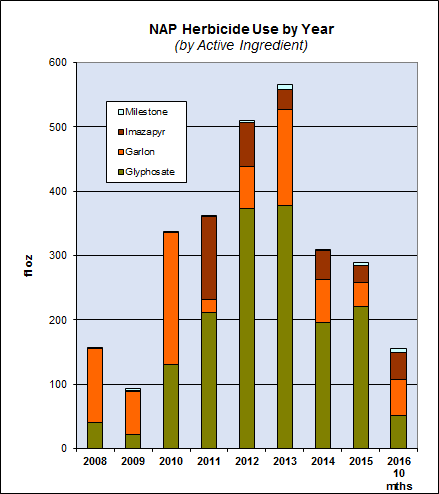
  • Inaccurate descriptions of NAP’s use of herbicides also qualify as lies. The executive director claimed during the hearing that only 2.67 quarts of “active ingredient” were used in the natural areas in 2016. In fact, public records requests inform us that NAP used 1 gallon (4 quarts) of active ingredient from January 2016 to October 2016.  The “active ingredient” is only a fraction of the amount of the formulated product.  The “inert” ingredients in the formulated product are often considered hazardous.  In other words, reporting only the volume of active ingredient underestimates the amount of herbicide being applied.  The number of pesticide applications done by NAP is another way to evaluate the magnitude of pesticides used by NAP.  From January 2016 to October 2016, pesticides were applied in the natural areas 111 times, which is 85% of all pesticide applications in park areas other than Harding Park (which is a golf course maintained to professional competition standards with contractual obligations regarding turf maintenance).  A full report of NAP’s pesticide use is available HERE.

    Courtesy San Francisco Forest Alliance
    Courtesy San Francisco Forest Alliance
  • Claims that the forest in the natural areas will be “managed” for forest health are false. The management plan says explicitly that the trees will be removed for the purpose of expanding native plant gardens that require full sun.  These areas will not be “thinned” as supporters claim.  Rather they will be removed along the leading edge of the forest in order to create more unshaded ground for planting native plants.  The health of the trees is not the criterion for their removal.  These tree removals will not benefit the forest.

However, most of the statements made by supporters are not lies.  Rather they are faithful repetitions of an ideology that most of them probably believe.  Here are a few examples:

  • Nativists believe that native animals require native plants. There is no empirical evidence to support that belief.  All empirical studies find equal numbers of insects, birds, amphibians, etc., using non-native plants.
  • Nativists claim that native pollinators require specific native plants. With few exceptions this belief is mistaken.  The monarch butterfly, for example, is as willing and able to use one of the many non-native species of milkweed as it is a native species.  Some butterflies require a specific genus of plant as its host, but a genus is typically composed of hundreds of species of which many are not native.
  • Nativists believe that the immutable relationship between specific animals and specific plants has evolved over “thousands of years.” They are mistaken.  Animals adapt much more quickly to changes in the environment.  Many changes in plants and animals have been observed over a period of years, rather than a period of centuries, let alone millennia.

Many of the supporters of the NAP plans mentioned that native plants would somehow mitigate climate change.  This is a mysterious notion that I cannot explain.  If we are destroying tens of thousands of trees that store tons of carbon, how can we claim this will reduce climate change?  The grassland that is the goal of these “restoration” projects will store a small fraction of the amount of carbon stored by the trees.  Is this absurd claim a reflection of ignorance about carbon storage?  Or is it a strategy intended to confuse the public?  Whatever the motivation, the claim that native plants mitigate climate change is NOT true.

The nativists apparently do not understand that the ranges of native plants and animals have changed in response to changes in the climate and they will continue to change.  They aren’t stopping climate change by planting native plants.  In fact, climate change requires that the concept of “native” be redefined.  That’s why their projects are unrealistic and futile because they are based on a climate that no longer exists.

The epilogue

The San Francisco Forest Alliance has announced its intention to appeal the certification of the Environmental Impact Report to the San Francisco Board of Supervisors.  This appeal will be heard sometime in 2017.  You will be notified of the hearing if you will subscribe to the Forest Alliance website:  http//sfforest.org.

Meanwhile, the Forest Alliance will ask the City of San Francisco to prohibit the use of the most toxic herbicides in the city’s parks.  There will be two public hearings regarding the city’s pesticide policies and practices:

  • Monday, December 19, 2016, 5 pm. This is a public hearing by San Francisco’s Integrated Pest Management (IPM) Program.  Details about that hearing are available HERE.
  • Tuesday, January 24, 2017. The Commission on the Environment will consider the recommendations of the IPM Program at this hearing.  The Forest Alliance will publish the details of that hearing when they are available.

Best Wishes for a BETTER 2017

The certification of the EIR and the approval of the NAP management plan is not the holiday gift that we were hoping for.  In fact, the entire year of 2016 wasn’t much of a gift to those who believe government has an important and valuable job to do.  We look forward to a better year in 2017 and we wish our readers all the best for the New Year.

christmas-holly-4

An announcement from the San Francisco Forest Alliance about their plans

We are publishing the following email message from the San Francisco Forest Alliance.  They are thanking their supporters for their help at the public hearing about the Natural Areas Program and its Environmental Impact Report.  They are announcing their intention to appeal that decision to the San Francisco Board of Supervisors.  And they inform their supporters of an opportunity to ask the Integrated Pest Management (IPM) Program to prohibit the use of the most toxic types of herbicide in the city’s so-called “natural areas.”  That hearing will take place on Monday, December 19, 2016.  Please help them if you can.


San Francisco SFFA supporters / concerned residents:

Thank you for sending in your letters and braving the rain to sit through the hours long joint meeting of the Planning Commission and SF Recreation and Parks Commission.

Yes, we lost last Thursday and now, with a heavy heart, but with a sense of pride and integrity, please rest assured that we did everything we could to convince the two commissions to see our side.

Thank you for your efforts and for working together, in solidarity and with gratitude from the SFFA leadership.  We will appeal the decision to approve the EIR and will go before the Board of Supervisors next year with an emotional plea that they do the right thing. The City cannot implement the SNRAMP while the EIR is under appeal.

In the meantime, and because the SNRAMP cannot operate without the use of herbicides in city parks, there is something we can now do:

Attend an important hearing on Monday Dec 19th in City Hall at 5 PM.

San Francisco’s Integrated Pest Management (IPM) Program is hearing public input on the guidelines for Tier 1 herbicides and on the approved pesticide list for 2017.

This hearing on the Integrated Pest Management program will be at City Hall on Monday, Dec. 19th at 5 pm, room 408.

We hope you can come because this is our main chance to influence any policy decisions about herbicides for the coming year.

If you plan to attend and make public comment please use our email box  sfforestnews@gmail.com  and leave us your name and phone number so we can coordinate our public input – it is not too late

Important Reading Materials: For those who are planning to speak – those of us who are concerned about pesticide use in our city, please read Attachments B and C(click to access the documents)

B. Draft 2017 San Francisco Reduced Risk Pesticide List, including Draft Restrictions on “most hazardous” (Tier I) herbicides

C. Summary of issues raised regarding pest management for City properties, with agency responses

Note:  It is important that you read these documents prior to making any public comments!

Public opinion does make a difference!

San Francisco Forest Alliance

BE INFORMED – GET INVOLVED – TELL YOUR NEIGHBORS

If you’re on Facebook, please “like” our page: https://www.facebook.com/ForestAlliance

Please sign our petition if you have not already done so.


The final episode in the 20-year saga of San Francisco’s “Natural Areas Program”

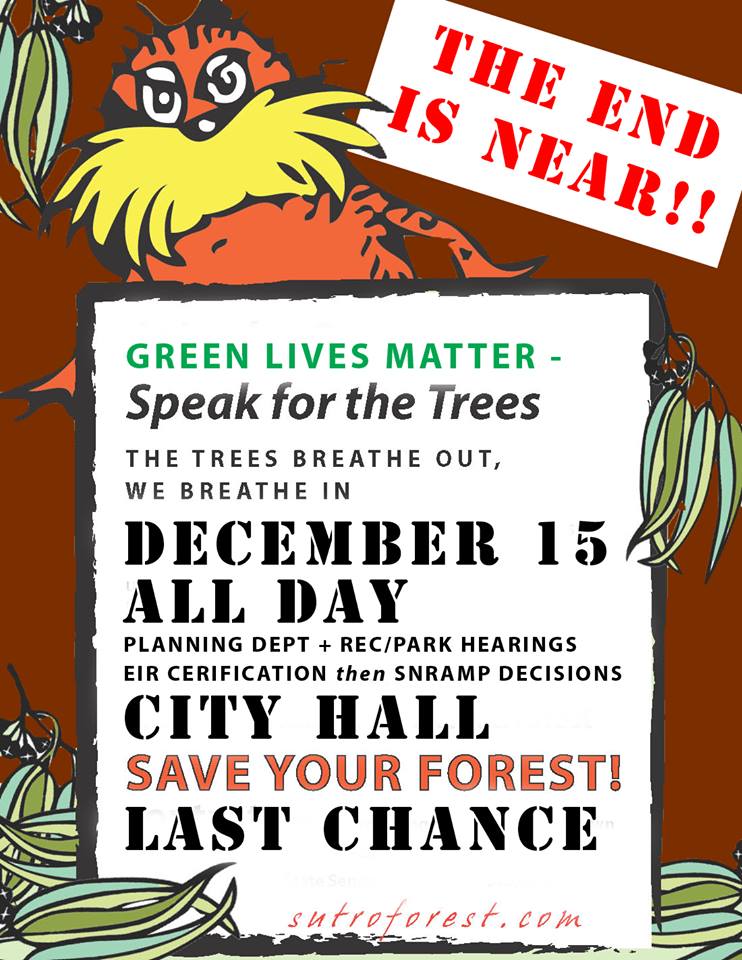
the-end-is-nearOn December 15, 2016, the San Francisco Planning commission will hold a public hearing to consider certification of the Environmental Impact Report for the Natural Areas Program. If the EIR is certified, the Recreation and Park Commission will consider formally adopting the management plan for the Natural Areas Program at the same hearing.  The Recreation and Park Commission will have the option of adopting one of the alternatives to the management plan.  The San Francisco Forest Alliance will ask that the Maintenance Alternative be adopted by the Recreation and Park Commission because it is the “environmentally superior” alternative which will destroy the least number of trees and use the least amount of pesticides. 

If you can attend this hearing and make public comment, please contact the SF Forest Alliance (sfforestnews@gmail.com) for the details about where and when the hearing will take place.  If you can’t attend the hearing, please consider sending an email to the Recreation and Park Commission (recpark.commission@sfgov.org) by Monday, December 12, 2016 (the deadline for submission of written public comments to be included in the agenda packet of the commissioners). 

We lived in San Francisco for nearly 30 years and our local park was designated a “natural area” in 1997.  Based on our experience with the Natural Areas Program, we have sent the following email to the Recreation and Park Commission.  We hope that our letter will help you write your own public comment.


Subject:  Approve the Maintenance Alternative for SNRAMP

Dear Recreation and Park Commissioners,

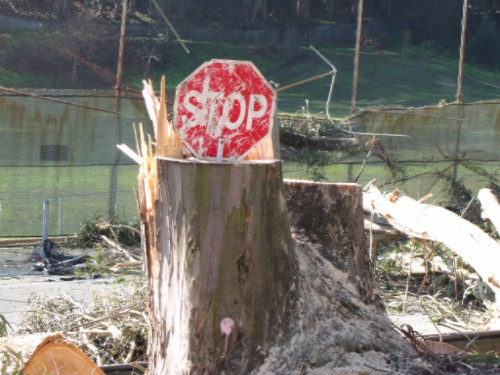
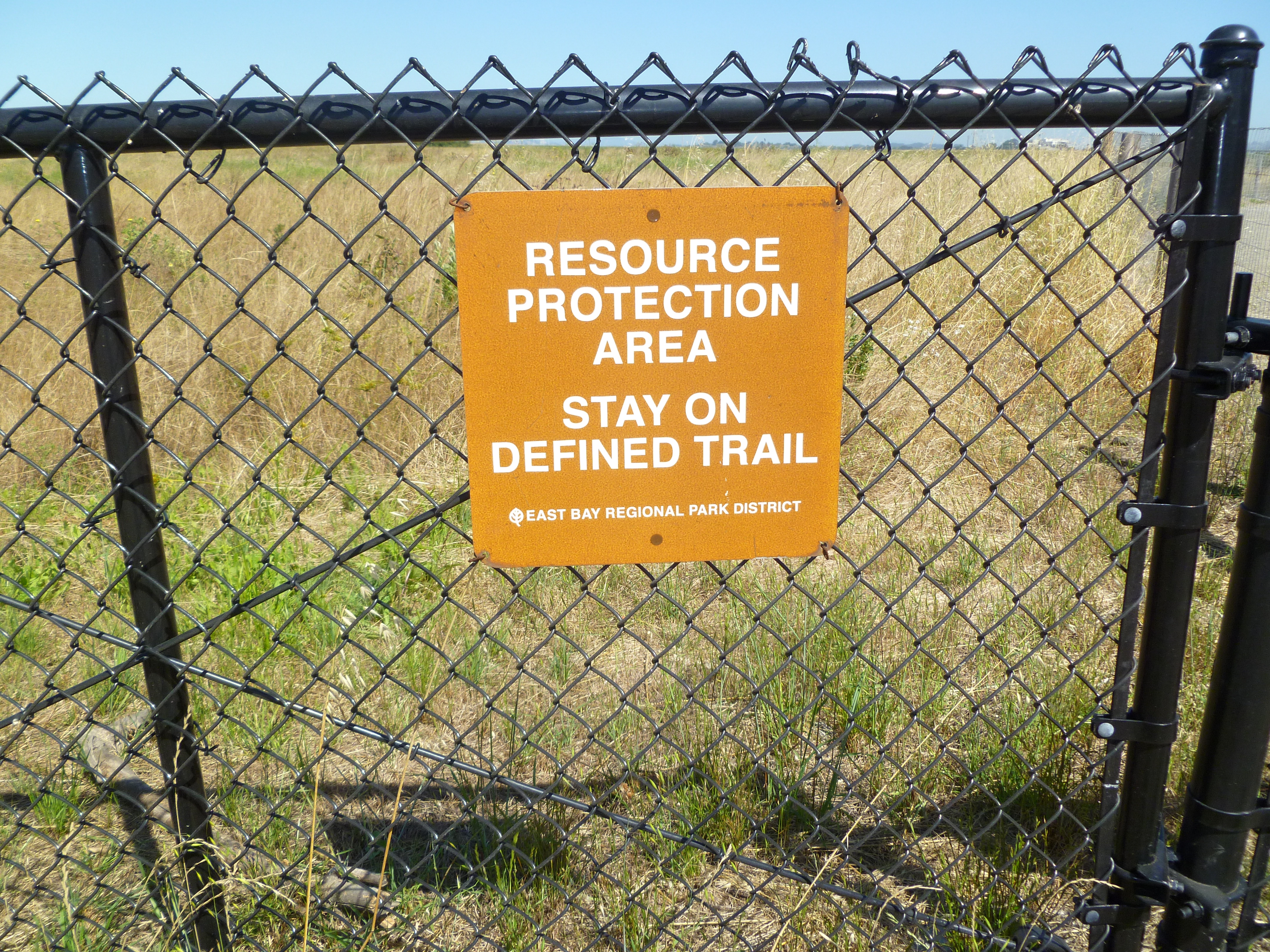
Since the Natural Areas Program was created 20 years ago, hundreds of healthy trees have been destroyed and over one thousand trees died slowly after being surreptitiously girdled by vandals calling themselves native plant advocates in the 32 so-called “natural areas.”  Hundreds of gallons of herbicide have been sprayed on harmless plants, many that provided valuable habitat and food for wildlife.  Trails have been closed and big signs installed instructing park visitors to stay on the trails that remain. Fences have been installed in some parks to enforce those restrictions.

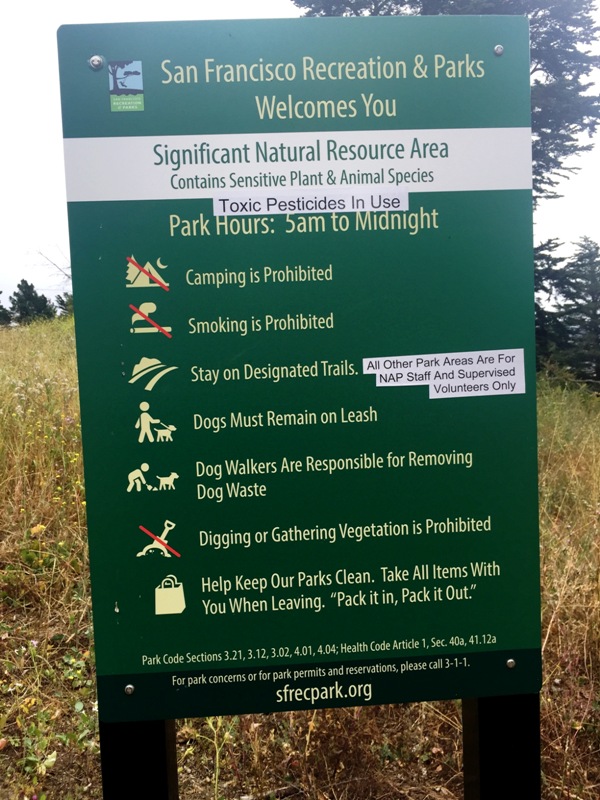
This sign in a "natural area" has been altered to express the public's opinion of the Natural Areas Program. Courtesy San Francisco Forest Alliance.
This sign in a “natural area” has been altered to express the public’s opinion of the Natural Areas Program. Courtesy San Francisco Forest Alliance.

After all that destruction and restriction, what has been accomplished?  Non-native plants have been repeatedly eradicated in the “natural areas” and native plants were planted.  These native plant gardens have repeatedly failed:  the native plants die and the non-native plants return, in some cases many times.  Native trees have been planted in a few “natural areas” but most have died, despite being irrigated during an extreme drought.  After wasting millions of dollars and the associated labor, there is little to show for that investment after 20 years.

Therefore, I am writing to ask the Recreation and Park Commission to vote to adopt the Maintenance Alternative as provided by the Environmental Impact Report that was 10 years in the making.  The Maintenance Alternative would enable the Recreation and Park Department to continue to take care of the “natural areas” they have already created, but it would prevent further tree destruction, further restrictions on recreational access, and require fewer pesticide applications.

Besides the obvious lack of success of the Natural Areas Program after 20 years of effort, there are many other reasons why it would be wise for the Recreation and Park Department to quit throwing good money after bad money.  Here are some of those reasons:

  • The Natural Areas Program was predicated on the mistaken assumption that native plants are superior to non-native plants as habitat for animals. In fact, in the past 20 years multitudes of empirical studies have been conducted that prove that wildlife has no preference for native plants.  Wildlife is just as likely to use non-native plants as they are native plants.
  • The Natural Areas Program also assumed that greater biodiversity would be achieved by eradicating non-native plants. They were mistaken in that assumption as well.  Studies have been conducted all over the world in the past 20 years that find no decrease in plant biodiversity resulting from introduced plants.
  • The climate has changed since Europeans arrived in the Bay Area in 1769 and it will continue to change. The plants that existed here in the distant past are no longer adapted to current conditions.  The ranges of native plants and animals must change if they are to survive in the long run.  Therefore, demanding that historical landscapes be re-created serves no useful purpose.
  • The native trees of California are dying by the millions. The US Forest Service informs us that 102 million native conifers have died in the Sierra Nevada in the past 6 years.  University of Cambridge recently published a study about Sudden Oak Death in which they reported that 5 million oak trees have died in California since 1995 and that the epidemic is “unstoppable.”  There are SOD infections in Golden Gate Park and the Arboretum.  The US Forest Service tells us that Coast Live Oaks will be virtually gone from California by 2060.  A study of redwoods predicts that its native range will shift north into Oregon by the end of this century.  In other words, if we want trees in California, many of them will have to be non-native trees adapted to a hotter, drier climate. 
  • Environmental conditions in a densely populated urban area such as San Francisco are also incompatible with the unrealistic goals of the Natural Areas Program. The heat island effect of urban areas exacerbates climate change.  Increased levels of soil nitrogen caused by the burning of fossil fuels promotes the growth of weeds.

The Natural Areas Program was a good idea that has outlived its usefulness.  We may try to keep it alive for sentimental reasons, but expanding it would be rewarding failure.  Please adopt the Maintenance Alternative.

Thank you for your consideration.

stop-destroying-trees

FEMA funding for East Bay tree destruction is cancelled!

We republish with permission a Huffington Post article by Jennifer and Nathan Winograd about the cancellation of FEMA funding for the destruction of hundreds of thousands of trees on the properties of UC Berkeley and the City of Oakland.  We are grateful to the Winograds and to the thousands of people who participated in the effort to prevent these projects from being implemented, including the Hills Conservation Network, which bravely filed the expensive lawsuit that resulted in this outcome.

It remains to be seen if the City of Oakland and UC Berkeley will implement their plans using other fund sources.  We therefore urge our readers to continue to follow the issue until we have some assurance that the plans have been abandoned.

The Winograds have also provided the following introduction to their Huffington Post article, which explains that this outcome could have been avoided if those who demanded the destruction of our urban forest had been willing to engage in a meaningful dialogue about the projects.

“Many of us tried to engage in meaningful dialog with Bay Area politicians and land managers about our objections to the clear cutting and poisoning of the hills. We were rebuffed. Some, like Mayor Libby Schaaf, did not even extend the courtesy of a reply. Others, like Dan Kalb, Oakland City Councilmember, calls anyone who disagrees with him “stupid.” We tried to engage the media — local newspapers, television and radio, magazines — and with few exceptions, our objections were largely ignored. When we were mentioned, we were ridiculed. Refusing to give us a fair hearing, the Contra Costa Times and San Francisco Chronicle claimed we were indifferent to public safety. Regardless of how many experts — including the U.S. Forest Service, the EPA, and former firefighters — substantiated our concerns, they remained defiant, insisting that even more forests should be clear cut and more poisons be spread. With local politicians, the media, and proponents refusing to engage in reasonable dialog, this left opponents no choice but to force the discussion in a court of law. That lawsuit, filed by Hills Conservation Network, ultimately prevailed with FEMA, which withdrew millions of dollars in funding to the City of Oakland and UC Berkeley. That’s a good thing and here’s why:”


FEMA Pulls Funding for Oakland, Berkeley Clear Cutting

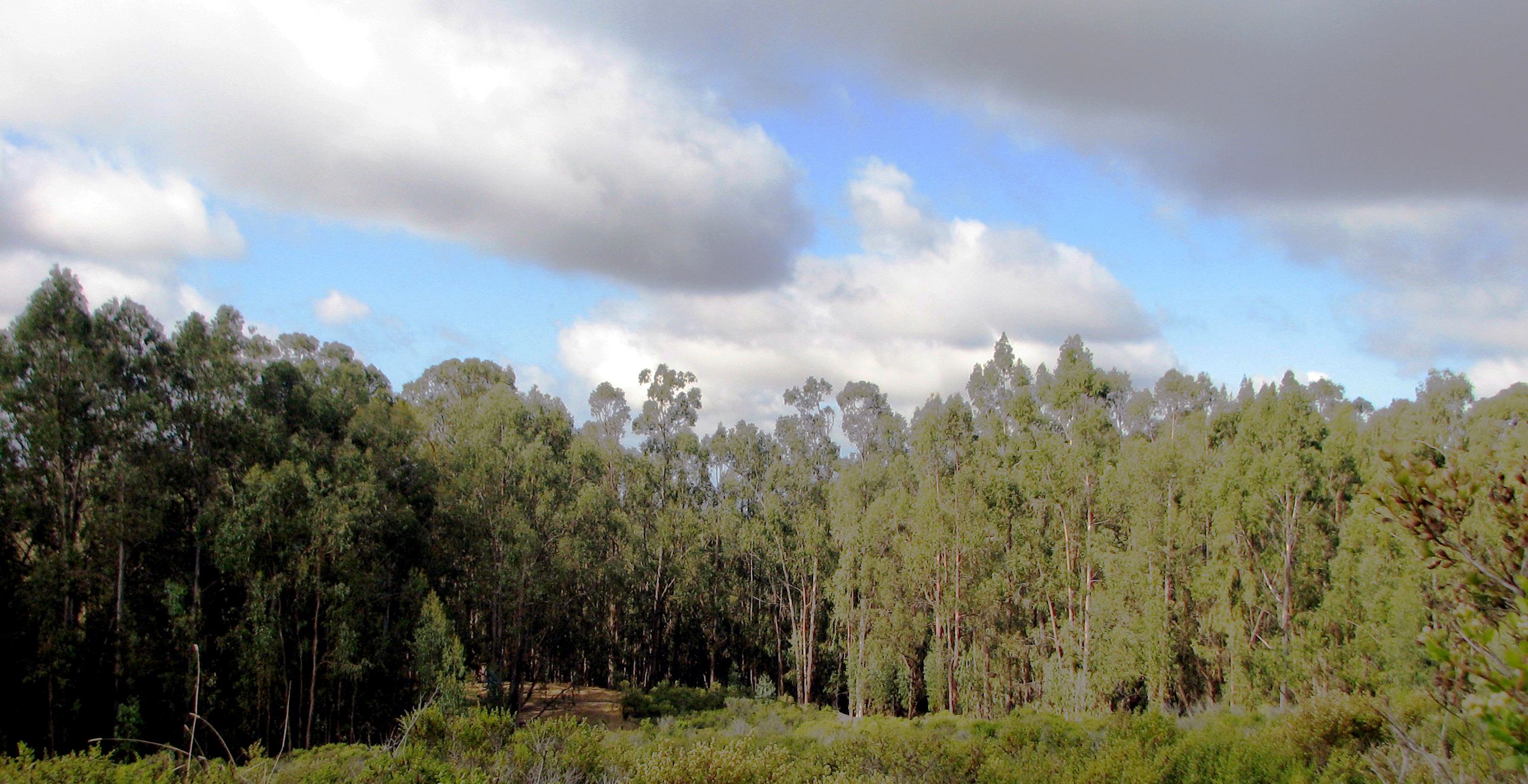
Eucalyptus forest, Lake Chabot

The City of Oakland just lost millions of dollars in federal funding. Given what the intended use of that money was for, that’s a good thing. Combined with similar funding for UC Berkeley and the East Bay Regional Parks District (EBRPD), over 400,000 trees across seven Bay Area cities were to be chopped down and thousands of gallons of cancer-causing herbicides spread on their stumps to prevent regrowth. Slated for eradication were the vast forests above the Caldecott Tunnel and Caldecott Field, North Hills Skyline, Strawberry and Claremont Canyons in Berkeley, and 11 regional parks including Sibley, Huckleberry, and Redwood in Oakland. Costing nearly $6 million, the plan would have radically transformed the character and appearance of the Oakland hills. Why?

The Scripps Ranch Fire of 2003 burned 150 homes but none of the Eucalyptus abutting those homes.

If you believe proponents, it is because the trees pose a heightened risk of fire. Since the infamous Firestorm of 1991 which burned scores of homes and killed 25 people, they have worked tirelessly to turn public opinion in the East Bay against Eucalyptus and Monterey Pine trees. Chief among their claims is that these trees were to blame for the ferocity of that fire because they are alleged to possess unusually high quantities of volatile oils that make them more flammable and prone to shooting off embers which enable the spread of fire. These claims have been repeated so many times they are often regarded as self-evident, even though the evidence does not support them, nor does the history relating to the ignition and spread of past fires. Indeed, the 1991 fire itself (and a later 2008 fire) started in grasses, the very sort of vegetation that clearcutting is intended to proliferate throughout the hills. In fact, the stated aim of the deforestation effort is to replace Oakland forests containing species of trees that are among some of the tallest in the world with shallow grasses that are highly susceptible to fire and which the EBRPD admits are “one of the most dangerous vegetation types for firefighter safety due to the rapid frontal spread of fire that can catch suppression personnel off guard.”

In a report highlighting the heightened fire risk which would have resulted from this plan, David Maloney, former Chief of Fire Prevention at the Oakland Army Base, criticized the spread of misinformation about these trees as motivated by native plant ideology, calling it “a land transformation plan disguised as a wildfire hazard mitigation plan” that will “endanger firefighters and the general public” and “be an outrageous waste of taxpayer money.” And he’s not alone in his concerns.

The U.S. Forest Service objected, saying it would “increase the probability of [fire] ignition over current conditions” because “removal of the overstory trees can introduce changes to the environment which increase fire behavior in undesirable ways.”

The U.S. Fire Administration Technical Report on the 1991 Fire led to the conclusion that removal of the trees would lead to growth of highly flammable brush species, noting that “brush fuel types played a significant role in the progression of the fire” and that brushland made up “a large portion of the available fuel.”

The Environmental Protection Agency stated that it is predicated on “extensive use of herbicides” and “risks posed to human health and the environment from that use.” It went on to express concern about the “potential impacts of climate change,” including “the length and severity of the fire season.”

FEMA itself admitted that the plan would result in “unavoidable adverse impacts … to vegetation, wildlife and habitats, protected species, soils, water quality, aesthetics, community character, human health and safety, recreation, and noise.”

During the summer, 5,200 California firefighters battled 14 fires across the state. The vast majority of the fires were in grass and brush, with a few in so-called “native” Oak woodlands.

But you would not know any of this by reading Bay Area newspapers, watching Bay Area television news programs, listening to local radio stations, reading local magazines, or hearing Bay Area politicians. These are discussions those who oppose this plan tried to engage in with the Mayor, the Oakland City Council, the media and even plan supporters in order to find a compromise, but were rebuffed. Instead, the “need” for deforestation and herbicide use was deemed “self-evident” and opponents were labeled as indifferent to public safety who debased the memory of those who died in the 1991 Firestorm.

In the absence of public discussion about the expertly substantiated criticism that the plan would have increased rather than reduced fire risk, exposed citizens to huge amounts of dangerous chemicals, released over 17,000 metric tons of greenhouse gases into our environment, poisoned and displaced wildlife, radically altered the appearance of our parks, threatened homeowners values by degrading the aesthetics upon which those values depended, eliminated erosion control for hillside homes, and caused a variety of other harms, the public was denied information that would have allowed them to make a sound and informed choice. This troubling bias does not honor the memory of those who died in that tragic fire 25 years ago; it shames it. Their loss should have served to embolden our resolve to prevent a recurrence of their tragedy through rigorous public debate, rather than hobbled us with emotionally charged rhetoric that stifled discussion before it was allowed to begin and threatened to turn the response to that fire into the root cause of yet another disaster.

For while opponents sought to elevate the discussion on this plan to prevent a future tragedy, local media, politicians, and supporters proved themselves incapable of moving beyond a narrative that was so sensationalist and even after more than two decades, so raw, that the abandonment of caution, reason, and critical analysis were paradoxically and counterproductively portrayed as the moral high ground. It left opponents no choice but to force the discussion in a court of law, a point of view that ultimately prevailed with FEMA. Whether the Mayor, City Council, deforestation advocates, and Bay Area media outlets learn from their failings going forward remains to be seen. But one thing is abundantly clear. If the result of the lawsuit proves anything, it proves opponents of deforestation and poisoning were right.

Why did Marin Municipal Water District stop using herbicides?

The Marin Municipal Water District stopped using herbicides on its properties in about 2005, in response to the public’s concerns.  MMWD then hired consultants to evaluate the risks of using herbicides.  As a result of those studies, MWWD decided in 2015 to make a permanent commitment to NOT using herbicides on its properties.

A member of the Board of Directors of MMWD has written a public comment for the East Bay Municipal Utilities District Master Plan in which he explains why MMWD made this decision.  His letter is available here:  MMWD – public comment from Board member

Here is a summary of the reasons why MMWD no longer uses herbicides on its properties:

  • The International Agency for Research on Cancer reclassified glyphosate as a “probable carcinogen.”
  • The California Office of Environmental Health Hazard Assessment has recommended that glyphosate be listed under Proposition 65.
  • A study conducted by researchers at UC Davis found that glyphosate persisted for at least 84 days when applied to foliage. “The clear inference from this study is that glyphosate could well migrate to water courses and streams which feed MMWD’s reservoirs.”
  • The toxicity of herbicides to aquatic life and habitat is well documented.
  • The persistent toxicity of many herbicides decreases soil biota which reduces CO2 absorption. “Hence, it appears that the non-pesticide approach may well assist with society’s ongoing efforts to remediate GHG through regenerative forestry practices.”

MMWD

Thank you, MMWD, for writing this letter to EBMUD about their use of pesticides on our watershed in the East Bay.  EBMUD should follow your lead!

Please write your own public comment on the East Bay Municipal Utilities District Master Plan.  Public comments are due by Friday, September 16, 2016.  Comments should be sent to watershedmasterplan@ebmud.com or by mail to Doug Wallace, EBMUD, 375 11th St, Oakland, CA 94607.

There is also a petition to EBMUD that we encourage you to sign:  

Sign the petition!
Sign the petition!

“Environmentalism” has been hijacked by nativism

Our family contributed to several mainstream environmental organizations for decades.  We were Sierra Club members because we wanted clean water and clean air.  We were Audubon Society members because we care about birds and other wildlife.

About ten years ago, we learned that these organizations were actively participating in projects demanded by native plant advocates to destroy our non-native urban forest and fence the public out of its public parks in order to turn our parks into native plant museums.  When we learned about the huge quantities of pesticides used by these projects that was the last straw.

The Berkeley Meadow is a 72-acre native plant garden on a former garbage dump on landfill.

We spent several years trying to convince these organizations that they were making a mistake by supporting projects that are doing far more damage to the environment than any theoretical benefit of native plants.  Much of our effort was directed to the Sierra Club because they claim to be a democratically run organization.  After several years of futile attempts to change the policies of these organizations, we quit because we did not want to contribute to the damage they are doing to the environment.

Logo of The Nature Conservancy.

The Nature Conservancy was the only environmental organization to which we were still contributing.  Below is our “resignation” letter to The Nature Conservancy, which explains why we finally gave up on them as well.  This was not an easy letter to write because we care deeply about the environment and the animals who live in it.  We believe that environmentalism has an extremely important role to play in society and we would like to participate in an organization that is focusing on the environmental issues of our time, particularly climate change.


September 2016

Mark Tercek, Executive Director
The Nature Conservancy

Dear Mr. Tercek,

We have been contributors to The Nature Conservancy for decades.  In the past few years we increased our donations because of the publications of TNC’s former Chief Scientist, Peter Kareiva.

While other mainstream environmental organizations were actively supporting destructive and restrictive ecological “restorations,” Mr. Kareiva was questioning that conservation strategy.  In his publication, “What is Conservation Science?” Mr. Kareiva said, “Our vision of conservation science differs from earlier framings of conservation biology in large part because we believe that nature can prosper so long as people see conservation as something that sustains and enriches their own lives.  In summary, we are advocating conservation for people rather than from people.”  Mr. Kareiva was also articulating that revised mission for conservation in presentations around the country (which we attended), in TNC’s publications, and in mainstream media.

As you know, Kareiva’s viewpoint was in conflict with the old guard of conservation biologists who subscribe to the tenets of invasion biology.  This conflict resulted in a confrontation of the old guard against TNC that was reported by the New Yorker in 2014.   TNC resolved that conflict by making a commitment to quit publishing Mr. Kareiva’s viewpoint in mainstream media and by restoring eradication of “invasive” plants to its budget.  That agreement foretold Kareiva’s departure from TNC.  Not publishing is tantamount to career suicide for scientists.  Mr. Kareiva has left TNC, as any self-respecting scientist would who has been deprived of his freedom to publish.

While this battle between competing visions of conservation played out, the country’s foremost invasion biologist, Daniel Simberloff, conducted a survey of TNC project managers to determine what, if any, impact Kareiva’s leadership was having on TNC’s conservation strategies.  Most survey respondents (95%) reported that they “manage” non-native species and nearly all reported that they would devote more effort to that task if more resources were made available.  Project managers devote a “substantial proportion” of their resources to “managing” non-native species and they expressed skepticism about “academic research and the invasion management controversy in particular.”  Simberloff did not ask project managers what methods they are using and so we have no insight into the use of pesticides by TNC.  This is probably information that Simberloff would rather we not have. Invasion biologists prefer to ignore the destructive methods that are used in the fruitless attempt to eradicate non-native plants.

Ecological “restorations” are damaging the environment by destroying useful habitat, poisoning open spaces with pesticides, and killing animals perceived to be competitors of native animals.  These projects are usually futile because the plants and animals that are being eradicated are adapted to current environmental conditions that are not reversed by their elimination.  The “native” ranges of plants and animals must change in response to changes in the environment, most notably climate change.  So-called “invasive” species are symptoms of change, not causes of change.

Here in the San Francisco Bay Area, our urban forest is being destroyed because it is predominantly non-native.  Native plant advocates have fabricated an elaborate cover story to mask nativism because widespread destruction of plants and animals does not appeal to the public.  Our public lands and open spaces are being poisoned with pesticides to kill vegetation and prevent trees from resprouting after they are destroyed.  We are unwilling to support that agenda by contributing to organizations that engage in these projects.

Therefore, we will not renew our TNC membership and we will not contribute further to TNC.  If and when TNC abandons its attempts to eradicate plants and animals that are performing valuable ecological functions, we would gladly renew our contributions.

Sincerely,

[Former Members of The Nature Conservancy]


Referenced sources:

  • D.T. Max, “Green is Good,” New Yorker, May 12, 2014
  • Sara Kuebbing and Daniel Simberloff, “Missing the bandwagon:  Nonnative species impacts still concern managers,” NeoBiota , April 14, 2015


East Bay Municipal Utilities District is using a LOT of pesticide and its new Master Plan will require that they use a LOT MORE

East Bay Municipal Utilities District (EBMUD) is the public utility that supplies our water in the East Bay.  To accomplish that task, EBMUD manages thousands of acres of watershed land.  Like most open space in the Bay Area, the vegetation on EBMUD’s land is a mix of native and non-native species.

EBMUD is revising its Master Plan.  The draft Master Plan makes a commitment to destroy all eucalyptus and Monterey pines in favor of native vegetation.  The draft Master Plan is available HEREEBMUD is accepting written public comments on the draft Master Plan until September 2, 2016 extended to Friday, September 16, 2016.  Comments should be sent to watershedmasterplan@ebmud.com or by mail to Doug Wallace, EBMUD, 375 11th St, Oakland, CA 94607.

There is also a petition to EBMUD that we encourage you to sign:

Sign the petition!
Sign the petition!

One of the reasons why we are concerned about the revised East Bay Watershed Master Plan (EBWMP) is that EBMUD is using a lot of pesticide now.  The draft Master Plan says that “pesticides have been detected in District reservoirs.”  The Master Plan renews its commitment to “replace non-native forests with native species over the long term.”  In this post, we will tell you about the pesticides that EBMUD is using now and explain how destroying trees is likely to increase their pesticide use.

How much pesticide is EBMUD using now?

We have obtained the Pesticide Use Reports (PURs) that EBMUD submitted to Alameda and Contra Costa Agriculture Departments, as required by law.  According to these Pesticide Use Reports, EBMUD applied herbicides 647 times in 2015.  It used 700.91 gallons and 205.75 lbs. of herbicide in 2015.  Of that total herbicide quantity, 255 gallons were glyphosate products. 

That is probably an underestimate of the amount of pesticide EBMUD used because:

  • Many of the PURs did not provide any information about the number of applications. Therefore, the total number of applications is higher than 647.
  • EBMUD (and all other “permittees”) is not required to report to the county pesticide applications done by contractors.  For example, EBMUD’s PURs do not include any rodenticide applications, which EBWMP says it uses.  That is an indication that the reports are not complete.

Is that a lot of pesticide?

Compared to other public land managers, EBMUD is using a LOT of pesticide.  East Bay Regional Park District (EBRPD) is an appropriate reference point.  EBRPD used 193 gallons of herbicide (glyphosate, Garlon, Oryzalin) in 2015 (and smaller quantities of specialty herbicide for specific projects).  EBRPD has 120,536 acres of propertyEBRPD’s reports include most pesticide applications done by contractors, according to EBPRD.

In contrast, EBMUD used 700.91 gallons and 205.75 lbs of herbicide on only 28,000 acres of property.  In other words, EBMUD pesticide use looks extreme when compared to EBRPD pesticide use.  The fact that EBMUD is responsible for supplying our drinking water (and the park district is not) makes the discrepancy that much more disturbing.  It seems that they should be using significantly less than they are using now.

The loss of shade will put EBMUD onto the pesticide treadmill

Destroying all non-native trees will promote the growth of weeds because shade is the most benign method of suppressing weed growth.  Most herbicide applications are for the purpose of killing weeds.  We have experience in the East Bay with the rampant growth of weeds where trees have been destroyed.  UC Berkeley destroyed all eucalyptus on the south side of Claremont Blvd at signpost 29 about 10 years ago.  They spread several feet of wood chips on the ground where they destroyed the trees, hoping to suppress the growth of weeds.  Signpost 29 is now dominated by weeds, including where wood chips were piled high.  Here are a few pictures that illustrate that weeds quickly colonize the bare ground when trees are destroyed.  Note that the weeds are dead where they have been sprayed with herbicide.  Dead weeds are more flammable than weeds that are still green, so killing them before they are dormant needlessly increases fire hazards.

Logs of trees that were destroyed line the road. Weeds are brown where they have sprayed with herbicide. Site 29, May 2016
Logs of trees that were destroyed line the road. Weeds are brown where they were sprayed with herbicide. Site 29, May 2016
Milk thistle was sprayed with herbicide., Site 29, May 2016
Poison hemlock and thistle are 8 feet tall where not sprayed with herbicide. Site 29, May2016.
Poison hemlock and thistle are 8 feet tall where not sprayed with herbicide. Site 29, May 2016.

Destroying trees will eliminate shade.  The loss of shade will increase the growth of weeds.  More weeds will require more herbicide applications to destroy the weeds.  Using more herbicide will contaminate the watershed and reduce water quality.  Shade is the most benign method of controlling weeds.

How will EBMUD prevent resprouts without using more pesticide?

One of the “Guidelines for Eucalyptus Management” in the Master Plan is:  “Prior to any harvest activities, ensure that adequate stump-sprouting control methods are available to reduce fire hazards and protect water quality.”  This is an artful and fundamentally dishonest dodge.  EBMUD must inform the public of the methods they intend to use.  If herbicides are used for this purpose, EBMUD’s use of pesticides will increase substantially.

Courtesy Hills Conservation Network

The majority of public land managers are now using Garlon to prevent eucalyptus resprouts, i.e., East Bay Regional Park District, City of Oakland, UC Berkeley, and National Park Service.  East Bay Regional Park District said in the Environmental Impact Statement for the FEMA project that it planned to use 2,250 gallons of Garlon for that purpose.

Garlon, with the active ingredient triclopyr, is one of the most toxic herbicides on the market.  The risk assessment of triclopyr that was done for Marin Municipal Water District says that Garlon is acutely toxic to aquatic life and moderately toxic to birds and bees.  It is also known to damage mycorrhizal fungi in the soil, which will retard the growth of anything planted when the trees are destroyed.  The risk assessment done for the California Invasive Plant Council says that Garlon “poses developmental and reproductive risks” to female applicators.

Garlon is sprayed on the tree stump shortly after the tree is destroyed, while the cambium layer is still alive and capable of transporting the herbicide into the roots of the trees.  It prevents resprouts by killing the roots.  This usually has to be done several times.   Garlon is known to be mobile in the soil, which is why it frequently damages non-target trees that are growing closely enough that their root structure intertwines with the roots of eucalyptus.

The only public land manager that has made a commitment to destroy approximately 15,000 eucalyptus without using herbicides is UCSF for its open space on Mount Sutro in San Francisco (to our knowledge).  They have been destroying eucalyptus on their properties for several years.  You can visit their property to see that they are not successfully controlling resprouts of the trees they have destroyed.

Marin Municipal Water District (MMWD) recently made a commitment to not using any herbicides on its properties.  It did not make that commitment willingly.  It was forced to make that commitment by its customers, who fought for years to accomplish that ban on herbicide use.  EBMUD should take heed.   The more pesticide EBMUD uses, the more likely the public will protest that use.  I don’t know if MMWD has stopped destroying eucalyptus on its property.  Given that it cannot use pesticides, it would be wise to stop destroying eucalyptus trees.

If EBMUD persists with its plans to destroy all eucalyptus trees on its properties it must inform the public of what method it intends to use to prevent resprouts.  EBMUD must choose between two bad options if it destroys the trees.  If it uses herbicides to prevent resprouts, it will contaminate our water supply.  If it controls resprouts by cutting them down once or twice a year, it will substantially increase its labor costs. The best option is to abandon the foolish plan to destroy all eucalyptus on its property.

What is EBMUD’s job?

The main mission of EBMUD is to supply clean drinking water to communities in the East Bay.  Any other objective—such as conservation of native plants—must be considered secondary to the mission of providing clean water.  If the conservation or restoration of native plants is in conflict with EBMUD’s obligation to provide clean drinking water, it must abandon or revise that commitment so that it is consistent with EBMUD’s main mission.

Please sign the petition and send a written public comment to EBMUD by September 2, 2016 extended to Friday, September 16, 2016.  Thank you for your help.

Sign the petition!
Sign the petition!