A vote against Measure FF on the ballot for the November 6, 2018 election is a vote against pesticide use in the East Bay. If Measure FF passes, it will renew a parcel tax for 20 years. For the past 15 years, the parcel tax has funded the destruction of thousands of trees on thousands of acres of public parks in the East Bay. The renewal of the parcel tax will increase the percentage of available funds for tree removals and associated pesticide use from 30% to 40% of funds raised by the parcel tax.
Post-election update: Measure FF passed easily. In Alameda County 85% of voters approved Measure FF. In Contra Costa County 80% of voters approved Measure FF. These were the vote tallies on the day after the election, on November 7th.
The public tried hard to convince the East Bay Regional Park District to stop destroying healthy trees and quit using pesticides in our parks. We attended public hearings and wrote letters to Park District leadership and its governing board. We made many suggestions for useful park improvements that would be constructive, rather than destructive. Our requests and suggestions were ignored.
After making every effort to avoid opposition to Measure FF, we reluctantly take a stand against it. The parks are important to us and we would much prefer to support park improvements. Unfortunately, Measure FF will not improve the parks. Rather, it will continue down the destructive path the Park District has been on for the past 15 years. In fact, Measure FF would escalate the destruction and poisoning of our public lands.
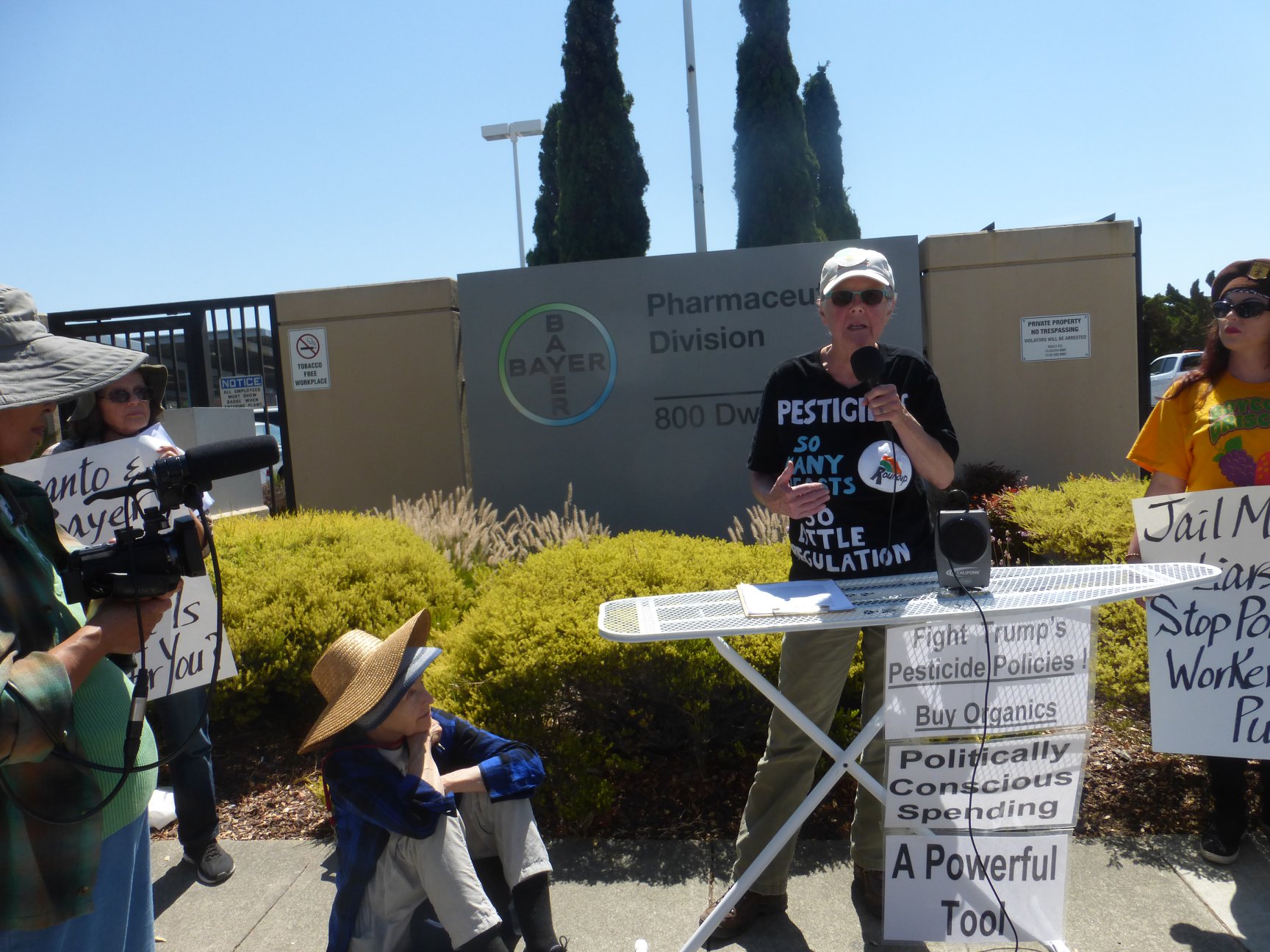
On Friday, August 31st, the Forest Action Brigade participated in a press conference rally at Bayer headquarters in Berkeley. Bayer is the new owner of Monsanto, the manufacturer of glyphosate. The rally was sponsored by a labor organization that is concerned about exposing workers to glyphosate, which is probably a carcinogen. The President of the Forest Action Brigade, Marg Hall, spoke at the rally.
The Voter Information Guides in Contra Costa and Alameda counties have published the following argument against Measure FF that was submitted by the Forest Action Brigade. We hope you will read it and take this important opportunity to protect our public parks from being needlessly damaged.
Million Trees
Argument Against Measure FF
“We love public parks, and we support taxation which benefits the common good. Nevertheless, We urge a NO vote. East Bay Regional Parks District (EBRPD) has previously used this measure to destroy, unnecessarily, thousands of healthy trees under pretexts such as “hazardous tree” designations and “protection against wildfires”. But fire experts point out that tree shade retains moisture, thereby reducing fire danger. The measure has also funded so-called “restoration”—destruction of “non-native” plants, in a futile attempt to transform the landscape back to some idealized previous “native” era.
EBRPD’s restoration and tree-cutting projects often utilize pesticides, including glyphosate (Roundup), triclopyr, and imazapyr. We agree with the groundswell of public sentiment opposing the spending of tax dollars on pesticides applied to public lands. Not only do pesticides destroy the soil microbiome; they also migrate into air, water arid soil, severely harming plants, animals, and humans. Because EPA pesticide regulation, especially under the current administration, is inadequate, it is imperative that local jurisdictions exercise greater oversight. While EBRPD utilizes “Integrated Pest Management” which limits pesticide use, we strongly advocate a no pesticide policy, with a concomitant commitment of resources.
Given the terrifying pace of climate change, it is indefensible to target certain species of trees for eradication. All trees—not just “natives” —are the planet’s “lungs,” breathing in carbon dioxide and breathing out oxygen. When a tree is destroyed, its air-cleansing function is forever eliminated, and its stored carbon is released into the atmosphere, thus worsening climate change.
Throughout history, plants, animals, and humans have migrated when their given habitats became unlivable. Adaptation to new environments is at the heart of evolutionary resilience. To claim that some species “belong here” and others do not strikes us as unscientific xenophobia.
Until EBRPD modifies its approach, we urge a NO vote.”
Forest Action Brigade
Do not be misled
The arguments in favor of Measure FF are misleading. East Bay Regional Parks District attempts to portray a destructive agenda as a constructive agenda. Please look beneath these pretty-sounding euphemisms for the destructive projects of Measure FF:
· EBRPD claims Measure FFwill “enhance public safety” and “preserve water quality.” Spraying thousands of acres of open space in our water shed with pesticides will endanger the public and contaminate our water supply.
· EBRPD claims Measure FFwill “protect redwoods and parklands in a changing climate.” Destroying hundreds of thousands of healthy trees, storing millions of tons of carbon, will exacerbate climate change. Our redwood forest in the East Bay was confined to less than 5 square miles prior to settlement because of the restrictive horticultural requirements of this treasured native tree. Because redwoods require more water than most of our urban forest, it is a fantasy that they can be expanded beyond their native footprint. Where they have been planted outside of that range, many are already dead.
· EBRPD claims Measure FFwill “restore natural areas.” Our pre-settlement landscape in the East Bay was predominantly grassland in which fire hazards are greatest. A landscape that has been sprayed with pesticide cannot be accurately described as “natural.” Previous attempts to convert non-native annual grassland to native grassland have consistently failed, partly because the soil has been poisoned with herbicide.
You can help
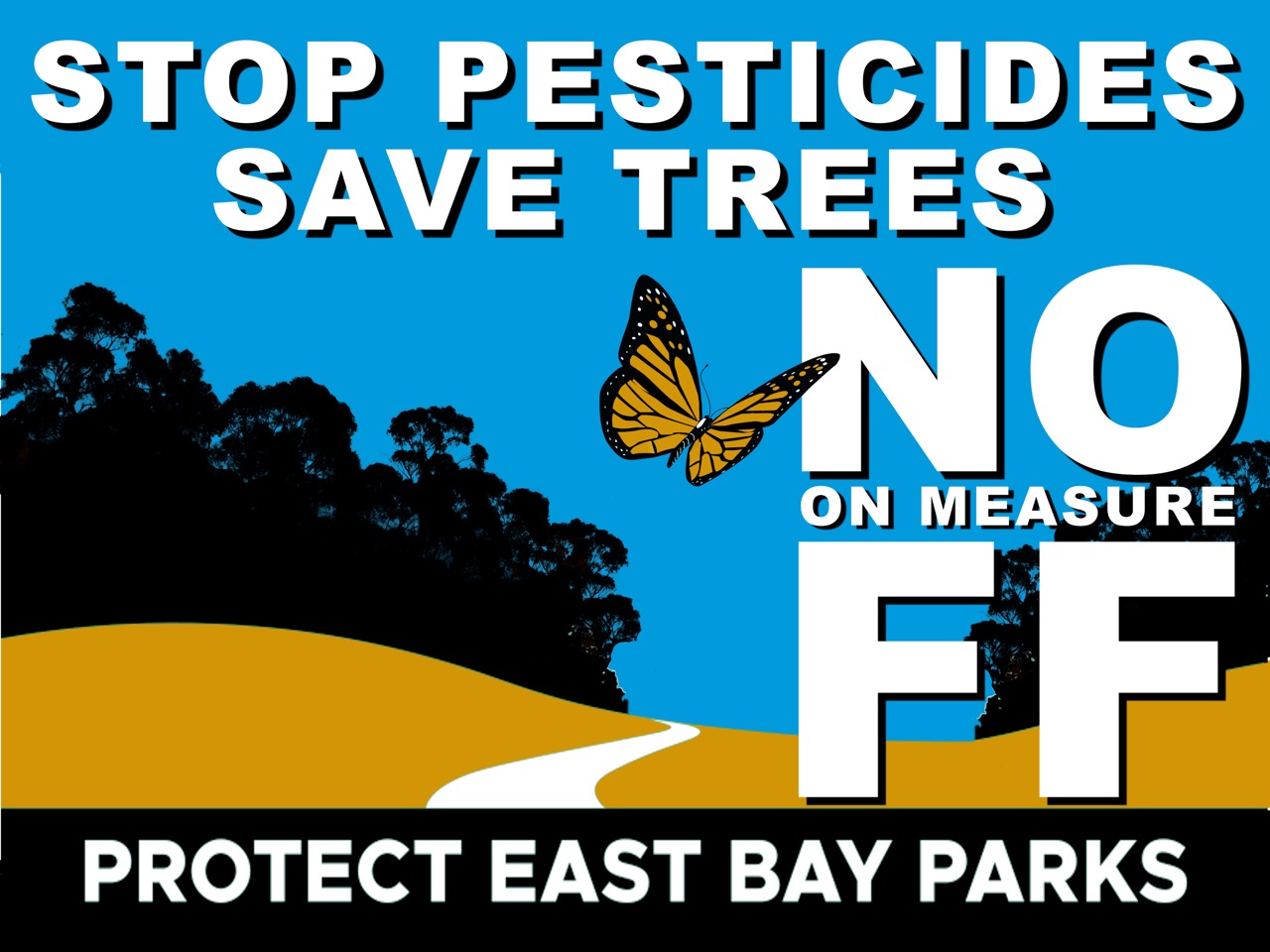
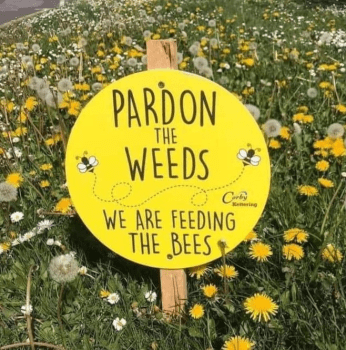
The Forest Action Brigade is offering yard signs in opposition to Measure FF (shown below). Request your yard sign by contacting the Forest Action Brigade: forestactionbrigade@gmail.com or call (510) 612-8566. Please state how many signs you would like and the neighborhood where you plan to place them. These are the East Bay cities in which Measure FF will be on the ballot: Oakland, Alameda, Piedmont, Berkeley, Emeryville, Albany, Richmond, San Pablo, El Cerrito. These cities are the top priority for yard sign placement.
The trial of DeWayne Johnson vs. Monsanto began early in July. This is the first trial of about 4,000 lawsuits against Monsanto for “product liability.” Mr. Johnson is dying of non-Hodgkin lymphoma. He believes that the glyphosate that he sprayed as an employee of the Benicia School District from 2012 to 2015 has caused his terminal cancer. His lawyer will present evidence at the trial that Monsanto knew the health risks of the glyphosate they manufactured and hid that information from the public.
This trial could be the turning point that will determine the future of glyphosate in America. Therefore, this is a suitableopportunity to explain how we got here and why the fate of glyphosate may also determine the fate of the native plant movement.
Update August 10, 2018: BREAKING NEWS!!!
”A San Francisco jury has found in favor of a school groundskeeper dying of cancer whose lawyers argued that a weed killer made by the agribusiness giant Monsanto likely caused his disease.
“Dewayne Johnson was awarded nearly $290 million in punitive damages and another $39 million in compensatory damages.
“Johnson’s lawsuit against Monsanto was the first case to go to trial in a string of legal complaints alleging the glyphosate-based Roundup herbicide caused non-Hodgkin’s lymphoma.
“He sprayed Roundup and another Monsanto product, Ranger Pro, as part of his job as a pest control manager at a San Francisco Bay Area school district, his attorneys have said.
“He was diagnosed with lymphoma in 2014, when he was 42.
“Monsanto, for its part, vehemently denies a link between Roundup and cancer.
“But jurors at San Francisco’s Superior Court of California, who deliberated for three days, found that the corporation failed to warn Johnson and other consumers about the risks posed by its weed-killing products.
This could be the beginning of the end for glyphosate. There will be many appeals of this decision, but there are also many other lawsuits in line by people who believe they were harmed by glyphosate. This is a significant step forward.
The story begins
I have followed the native plant movement in California for over 20 years. I knew that herbicides were used by land managers to eradicate plants they consider “invasive” only because I made the effort to inform myself of what they were doing. It wasn’t easy to figure out that they were using herbicides because many land managers do not post notices of their pesticide applications and even fewer report their pesticide use to the public. State law does not require posting of pesticide application notices if the manufacturer claims that the product dries within 24 hours, which exempts most of the herbicides used by land managers, including glyphosate (Roundup) and triclopyr (Garlon).
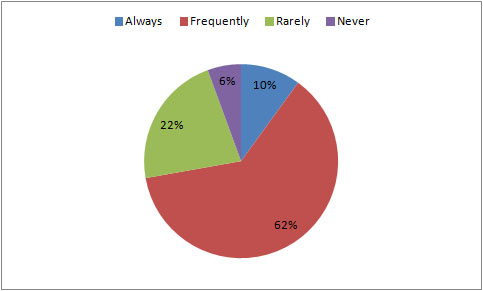
Pesticide use by land managers in California. Source California Invasive Plant Council
Ninety-four percent of land managers are using herbicides to control plants they consider “invasive.” Sixty-two percent are using herbicides frequently.
Ninety-nine percent of the land managers who use herbicides, use glyphosate products. Seventy-four percent use Garlon, which is one of the most hazardous herbicides available on the market. The Pesticide Research Institute says that Garlon “poses reproductive and developmental risks to female applicators.”
Foliar spray is the method used most frequently by land managers to apply herbicides. This method of application has the potential to drift into non-target areas and kill non-target plants.
Chapter Two: World Health Organization takes a position
In 2015, one year after the Cal-IPC survey was done, the World Health Organization’s International Agency for Research on Cancer (IARC) classified glyphosate as a “probable human carcinogen.” That decision suddenly and radically altered the playing field for the use of glyphosate, which is the most heavily used of all herbicides.
Since that decision was made, 25 countries have issued outright bans on glyphosate, imposed restrictions or have issued statements of intention to ban or restrict glyphosate-based herbicides, including Roundup. Countless US states and cities have also adopted such restrictions. Locally, the Marin Municipal Water District made a commitment to not using pesticides—including glyphosate—in 2015. MMWD had stopped using pesticides in 2005 in response to the public’s objections, but engaged in a long process of evaluating the risk of continuing use that resulted in a permanent ban in 2015.
Chapter Three: Nativists dig in
The reaction of native plant advocates to this bad news of the dangers of glyphosate has been to dig in and aggressively defend their use of herbicides.
One of the first indications of this reaction was an article about the IARC decision in the Fall 2015 newsletter of the California Invasive Plant Council (Cal-IPC) that concludes: “In the final analysis, this means that there’s no good reason to stop using glyphosate whether it’s a carcinogen or not.” If the IARC decision isn’t a good reason, what is? If the prospect of cancer isn’t a legitimate reason not to use glyphosate, what is?
In its Fall 2016 newsletter, Cal-IPC stepped up the volume. The Executive Director’s introductory letter stated the highest priorities for Cal-IPC, including, “the increased need for Cal-IPC to publicly support the appropriate use of herbicides.”
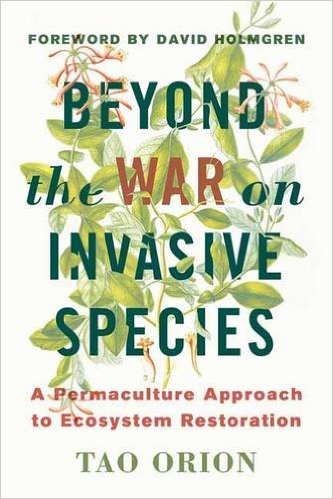
That edition of the Cal-IPC newsletter also includes a review of Tao Orion’s book, Beyond the War on Invasive Species. Tao Orion is a practicing permaculturalist who shares many of the objectives of native plant advocates. Permaculture is committed to conservation, preservation, and restoration, but practitioners achieve those objectives without using pesticides. They focus on restoring ecological functions by identifying and correcting the underlying causes of change, such as loss of water resources.
Given Cal-IPC’s commitment to herbicide use, it was unable to find value in Orion’s book. Much of their criticism seemed unfair. They said that Orion’s recommendations for using restoration methods such as burning or grazing that don’t require the use of pesticides are preaching to the choir. They claim that native plant restoration projects are, in fact, doing the same thing. Yet, the survey Cal-IPC conducted in 2014 says otherwise. Forty-seven percent of land managers said they “never” use grazing to control “invasive” plants, compared to 94% who said they use pesticides. Burning was not mentioned by any land manager as a method they use.
The survey and accompanying risk assessment of the herbicides used by those who took the survey was presented at the annual Cal-IPC conference in fall 2014. It was available on the Cal-IPC website until very recently, when it was scrubbed. The risk assessment is still available on the website of the Pesticide Research Institute, which conducted that evaluation.
In October 2017, Cal-IPC published a position statement regarding glyphosate, “The Use of Glyphosate for Invasive Plant Management.” Cal-IPC’s “position on the issue” is: “Cal-IPC supports the use of glyphosate in invasive plant management as part of an Integrated Pest Management (IPM) approach. When using glyphosate according to the label, with appropriate personal protective equipment and best practices, glyphosate is low-risk for wildlife, applicators and the public.” Their position is primarily based on their belief that doses of glyphosate used in wildland weed management are too low to be a health hazard.
Several new studies, published after the IARC decision, strengthen the case against glyphosate. New research suggests that glyphosate is a health hazard at low doses considered “safe” by the EPA. The Global Glyphosate Study is being conducted by six scientific institutions all over the world. This international consortium of scientific institutions recently published preliminary results of their study: “The results of the short-term pilot study showed that glyphosate-based herbicides (GBHs) were able to alter certain important biological parameters in rats, mainly relating to sexual development, genotoxicity and the alteration of the intestinal microbiome, at the ‘safe’ level of 1.75 mg/kg/day set by the U.S. Environmental Protection Agency (EPA).” In other words, at doses deemed safe by the US EPA, significant negative health effects were found in animals used in testing.
Another recent study of glyphosate found that the formulated product is considerably more toxic than the active ingredient alone. US National Toxicology Program recently conducted tests on formulated glyphosate products for the first time. In the past, tests were conducted only on the active ingredient…that is glyphosate alone. The formulated products that are actually applied as weed killers contain many other chemicals, some of which are not even known. The head of the National Toxicology Program Laboratory, told TheGuardian newspaper the agency’s work is ongoing but its early findings are clear on one key point. “We see the formulations are much more toxic. The formulations were killing the cells. The glyphosate really didn’t do it,” DeVito said. A summary of the NTP analysis said that “glyphosate formulations decreased human cell ‘viability’, disrupting cell membranes. Cell viability was ‘significantly altered’ by the formulations, it stated.”
Is Cal-IPC aware of these recent studies? Are the people who apply glyphosate aware of these studies? Are the employers of these applicators aware of these studies? Are these applicators the plaintiffs of future product liability lawsuits against Monsanto?
Chapter Four: California Native Plant Society defends herbicides with fantasies
If you read the publications of the California Native Plant Society (CNPS) or attend their conferences, you know that little mention is made of herbicides by their followers and those who engage in “restoration” projects. In the past, the best defense was to turn a blind eye to herbicide use.
More recently, the intense opposition to the use of herbicides on public lands seems to have forced CNPS to become actively engaged in the defense of herbicides. The most recent edition of the Journal of the California Native Plant Society, Fremontia (Vol. 46 No. 1) is a “Special Issue on Urban Wildlands.” The introductory article is illustrated with a photo of Oyster Bay. I nearly choked on this statement in that article: “In order to control invasive plants, agencies and volunteers have sometimes resorted to using herbicides as a step in integrated pest control. While use of herbicides is contentious, the use for spot treatments has enabled small groups of volunteers to successfully eliminate invasive weeds in some areas where future herbicide use will not be needed.” Oyster Bay is being doused with herbicides as we reported in a recent article that is available HERE.
Oyster Bay herbicide applications, May 2018
That same edition of Fremontia also includes several articles in which specific native plant “restorations” are described in detail. All of the projects use herbicides, often repeatedly and often without successfully establishing native plants:
“Bull Creek Ecosystem Restoration Project: Not Quite a Success Story”: This project began in 2008, after over 10 years of planning. Bull Creek was reconfigured with bull dozers, eliminating the existing landscape. Although natives were planted, weeds quickly took over the site. It was weeded by hand initially and considered a success until the creek bank eroded significantly and the artificial oxbow filled with silt. But “weeds continued to thrive” because the native plants were irrigated and they resorted to herbicide applications in 2010. Subsequent failures of native plants were blamed on unauthorized public access and the state-wide drought. Volunteer weeding has been abandoned. The future of this project is very much in doubt.
“Weed Control Efforts in the Sepulveda Basin”: “Based on more than 20 years of experience with attempting to control various weeds in the Sepulveda Basin, and given the lack of support from the city due to budgetary priorities, it is apparent that without herbicide it will be impossible to control non-native weeds that threaten regional biodiversity.”
“Nature in the City: Restored Native Habitat Along the LA River…”: “The site was sprayed with Roundup (glyphosate) several times to remove as much of the non-native seed bank as possible. Weeding continued throughout the habitat restoration and construction period.”
Did CNPS notice the contradiction between their first article and subsequent articles in the same publication? Their introductory article claims they rarely use herbicides and when they do it is only temporary. But subsequent articles about specific projects make it clear that herbicides are routinely and repeatedly used and even then, weeds persist.
Pesticides used in San Francisco’s “natural areas.” Courtesy San Francisco Forest Alliance
In the Bay Area, one of the oldest native plant “restorations” is in San Francisco, where the so-called Natural Areas Program (now called Natural Resources Division) started in 1998. They have used pesticides consistently since the program began. The San Francisco Forest Alliance began tracking their use of pesticides in 2008. In their most recent report, the Forest Alliance informs usthat pesticide use in the so-called “natural areas” has increased significantly in the first half of 2018. This increase was anticipated because the program plan and its Environmental Impact Report were finally approved in spring 2017, after 20 years of being hotly contested. The approval of the program enabled them to increase the staff of pesticide applicators from one to five. Most of the increase in pesticide use in 2018 is of Garlon, one of the most toxic pesticides available on the market. San Francisco’s native plant restorations are a specific example of the long term use of large quantities of herbicide.You can visit those areas to see for yourself that 20 years of effort and herbicides have not successfully established native plant gardens.
Good luck to DeWayne Johnson
It is difficult to understand how nativists can continue to advocate for the use of herbicides. It is even more difficult to understand how land managers can continue to use public money to spray herbicides on our public parks and open spaces. Since they are apparently impervious to scientific assessment of the health hazards of herbicides and blind to the failures of their projects, we can only hope that DeWayne Johnson will prevail in his lawsuit against Monsanto. We would like to see justice for Mr. Johnson and his family and the bonus will be the legal liabilities and associated economic costs of continuing to use a dangerous herbicide that damages the environment and everyone who lives in it.
The City of Oakland applied for a FEMA pre-disaster mitigation grant in 2005 to clear-cut all non-native trees on 122 acres of city owned property in the East Bay hills, based on the claim that it would reduce fire hazards. FEMA cancelled that grant in September 2016 in settlement of a lawsuit against the project.
The City of Oakland began the process of writing a new plan to reduce fire hazards in the hills by hiring a consultant to develop a Vegetation Management Plan in November 2016. The new plan will be much more comprehensive than the original plan, covering 1,925 acres of open space and 308 miles of roadside in Oakland. Oakland also made a commitment to an open public process to develop the plan. A survey of public opinion was conducted and two public meetings were held in 2017.
A draft of Oakland’s Vegetation Management Plan is now available HERE. There are detailed maps of the areas that will be covered by the plan. We suggest you take a look at those maps to determine what effect the plan will have on your neighborhood and the parks and open spaces you visit.
A public meeting about the draft was held on May 23, 2018 and written public comments will be accepted until June 11,2018. Comments may be submitted in the following ways:Download comment card; Email VMPcomments@oaklandvegmanagement.org; Mail:266 Grand Avenue, Suite 210, Attn: Ken Schwarz, Oakland, CA 94610. We hope you will participate in this public process that will determine the future of much of the landscape in the Oakland hills.
We are publishing an excerpt of the written public comment of one of our readers, which we hope will help you understand the issues and to write a comment of your own. Asterisks indicate where some detail has been omitted. You can see the entire public comment HERE: Oakland Draft Vegetation Management Plan – public comment
Million Trees
Ken Schwarz
Horizon Water & Environment
266 Grand Avenue, Suite 210
Oakland, CA 94610
I am broadly supportive of the Draft Vegetation Management Plan (DVMP) because:
It will create defensible space around structures in Very High Wildfire Hazard Severity Zones.
It will clear easily ignited vegetation on roadsides in places where fire hazards are greatest.
It sets priorities for implementation in places where fire hazards are greatest.
These three elements of the plan will reduce fire hazards while limiting destruction of trees and vegetation and being fiscally responsible.
My public comment will identify some weaknesses in the plan and make specific suggestions for improving the plan with the goal of minimizing fire hazards as well as collateral damage to the environment.
The 300-foot “buffer” zone is unnecessarily destructive.California law requires 100-feet of defensible space around structures. The DVMP proposes extending defensible space along roadsides and around structures to 300-feet, the length of a football field. Such a wide clearance of vegetation greatly exceeds California fire code and is therefore unnecessarily destructive. In a recently published op-ed in the Los Angeles Times, two academic scientists confirm our understanding of how to keep our communities safe: “The science is clear that the most effective way to protect homes from wildfire is to make homes themselves more fire-safe, using fire-resistant roofing and siding, installing ember-proof vents and exterior sprinklers, and maintaining “defensible space” within 60 to 100 feet of individual homes by reducing grasses, shrubs and small trees immediately adjacent to houses. Vegetation management beyond 100 feet from homes provides no additional protection.”[1]
The buffer zone should be eliminated, reduced in size, or reduced to Priority 3 so that it is less destructive and costly.
*************************
The description of herbicide use in the draft is unnecessarily vague, because it provides no information about what herbicides will be used and the health and environmental hazards of specific herbicides. Nor does it explain how, where, or why herbicides will be used.
Instead of providing that information, the plan describes the public’s opposition to herbicides as “social stigma,” which implies that our opposition is a baseless prejudice against herbicides. In fact, our opposition is based on scientific information about the dangers of herbicides and those dangers must be acknowledged by the final version of this plan.
The dangers of herbicides are well documented and well known. ****** Here is a brief list of some of the most recent studies that conclude that glyphosate products are very dangerous to the health of animals and humans:
The International Agency for Research on Cancer classified glyphosate as a “probable human carcinogen” in 2015. The IARC is composed of an international team of scientists convened by the World Health Organization of the United Nations.
The State of California responded to that news by requiring all glyphosate products sold in the State to be labeled as carcinogens. The State was sued several times by the manufacturer of Round Up—Monsanto–to prevent the labeling requirement. The State of California recently won in the state court of appeals[2]. Unless Monsanto appeals and wins in the State Supreme Court, all glyphosate products will be labeled as carcinogens in California.
US National Toxicology Program recently conducted tests on formulated glyphosate products for the first time. In the past, tests were conducted only on the active ingredient…that is glyphosate alone. The formulated products that are actually applied as weed killers contain many other chemicals, some of which are not even known. The head of the National Toxicology Program Laboratory, told TheGuardian newspaper the agency’s work is ongoing but its early findings are clear on one key point. “We see the formulations are much more toxic. The formulations were killing the cells. The glyphosate really didn’t do it,” DeVito said. A summary of the NTP analysis said that “glyphosate formulations decreased human cell ‘viability’, disrupting cell membranes. Cell viability was ‘significantly altered’ by the formulations, it stated.”[3]
The Global Glyphosate Study is being conducted by six scientific institutions all over the world. ******* This international consortium of scientific institutions recently published preliminary resultsof their study: “The results of the short-term pilot study showed that glyphosate-based herbicides (GBHs) were able to alter certain important biological parameters in rats, mainly relating to sexual development, genotoxicity and the alteration of the intestinal microbiome, at the ‘safe’ level of 1.75 mg/kg/day set by the U.S. Environmental Protection Agency (EPA).”[4] In other words, at doses deemed safe by the US EPA, significant negative health effects were found in animals used in testing.
The German Agriculture Minister announced on April 17, 2018 that she was finalizing a draft regulation to end use of the weed-killer glyphosate in household gardens, parks and sports facilities, and to set “massive” limits for its use in agriculture.[5] Germany is one of 25 countries that have issued outright bans on glyphosate, imposed restrictions or have issued statements of intention to ban or restrict glyphosate-based herbicides, including Roundup Countless US states and cities have also adopted such restrictions. [6]
Marin Municipal Water District quit using all pesticides in 2015. In a letter to East Bay Municipal Utilities District, a member of the Board of MMWD explains why that decision was made. (Attachment 2) MMWD hired scientists at UC Davis to conduct a study of the biological persistence of glyphosate. They found that glyphosate persisted for at least 84 days when applied to foliage, and perhaps longer after the study ended.
Garlon with the active ingredient triclopyr is more toxic than glyphosate. Garlon is the herbicide that is used to prevent eucalyptus and acacia from resprouting when the trees are destroyed. Its use was also specifically allowed for that purpose by Oakland City Council Resolution 79133. Although the DVMP does not mention its use, we assume—unless specifically told otherwise by the final version of the VMP—that Garlon will be used to control resprouts.
Triclopyr is an organochlorine product, in the same family of pesticides as DDT, which was banned in the US in 1972. Organochlorine products bioaccumulate and are very persistent in the environment. Nearly 50 years after it was banned, DDT is often found in the ground, in the water, and in people’s bodies.[7]
Organochlorine products are endocrine disrupters. The Pesticide Research Institute did a risk assessment of triclopyr for the California Invasive Plant Council. They reported that triclopyr “poses reproductive and developmental risks to female applicators.” [8]
The Pesticide Research Institute did a risk assessment of triclopyr for Marin Municipal Water District in which they informed MMWD that birds and bees are both harmed by triclopyr and mycorrhizal fungi in the soil are damaged by triclopyr.[9]
More research has been done on Round Up than on Garlon because it is more widely used. It is more widely used, partly because it is actually less dangerous than Garlon (it is also a non-selective plant-killer). Because of the toxicity of Garlon, several public land managers in the Bay Area have made a commitment to controlling resprouts without using herbicides: ******** Marin Municipal Water District, Marin County Parks and Open Space, UC San Francisco, and East Bay Municipal Utilities District (the supplier of our drinking water).
*************************
There is no evidence that eucalyptus is inherently more flammable than native trees. ******** Eradicating non-native trees and shrubs will not reduce fire hazards because they are not inherently more flammable than the native vegetation that will remain. Therefore, the reduction of fuel loads must be based on flammability, NOT the nativity of the flammable species. The nativity of plant species is irrelevant to reducing fire hazards and must be abandoned as criterion for destroying plants and trees.
Vegetation that burned in the North Bay fires of October 2017 was almost exclusively native. Source: Bay Area Open Space Council
I support the thinning of eucalyptus, acacia, Monterey pine and cypress to reduce fuel loads, as long as the canopy is intact.******** When the canopy is intact, the forest floor is shaded which retains moisture that retards ignition and suppresses the growth of easily ignited weeds. The DVMP proposes to thin the targeted non-native trees to distances of 35 feet, creating gaps in the canopy of 10 feet within the 300-foot “buffer zone.” The distance between the trees must be reduced to 25 feet to maintain the canopy. In addition to reducing fire hazards, maintaining the canopy will also be less destructive and will reduce the amount of stored carbon released into the atmosphere.
Tilden Park, October 2016. East Bay Regional Park District has thinned this area to distances of 25 feet between remaining trees. The forest floor is still shaded because the canopy is intact.
My greatest disappointment in the DVMP is its proposal to remove all individual non-native trees where they presently exist in native vegetation outside the “buffer zone.” ******** Removing non-native trees in riparian areas and in redwood groves as proposed by the DVMP is not fire hazard mitigation because fire hazards in those areas are minimal.
*****************************
Furthermore, destroying healthy trees damages the trees that remain because the herbicide that is used to prevent eucalyptus and acacia from resprouting is mobile in the soil and it is known to damage mycorrhizal fungi in the soil that is essential to the health of the native trees. ******* It is not possible to destroy isolated trees without damaging neighboring trees in close proximity. ****** Studies show that eucalyptus trees in native forests are not doing any damage to neighboring trees. ********
If individual non-native trees within native vegetation are not doing any environmental damage and do not increase risk of fire they should not be destroyed because destroying them WILL damage native vegetation. Please leave them alone!
Putting the DVMP into the long-term big picture
Finally, I suggest that we all take a step back from the details of the DVMP and consider the proposal in the context of the entire environment. The final VMP must minimize damage to the environment while mitigating fire hazards because:
The climate has changed and it will continue to change. When the climate changes, the vegetation changes. That is one of the axioms of ecology and it will continue to be. If non-native plants and trees are better adapted to the current and anticipated climate, we should abandon futile attempts to force plants to live where we want them to live.
If we want trees in California, we must look to the future, not the past. 130 million native conifers have died in California since 2010. 5-10 million oaks in California have been killed by Sudden Oak Death. The future of redwoods in California is in jeopardy because they require a lot of water and they don’t tolerate wind.
********************
A climate change specialist at the US Forest Service tells us in a recent study that native tree species are the most vulnerable to climate change. USFS found that native trees are more vulnerable to the changes in temperature, precipitation, growing season, and other effects of accumulating greenhouse gases. The assessment found that 88 percent of invasive tree species are expected to prove resilient in the changing climate, ranked with low vulnerability, compared to 20 percent of natives.[10]
We are contributing to climate change by destroying healthy trees that are storing tons of carbon that will be released into the atmosphere as the destroyed trees decay. The primary reason why wildfires are more frequent and more intense is because of the warmer, drier climate. Therefore destroying more trees than necessary increases fire hazards because we are exacerbating climate change by destroying more trees than necessary.
It is a fiction that destroying trees will release less carbon than the wildfires imagined by those who demand their destruction. According to a recently completed study at Oregon State University, “wildfire is not the biggest source of climate-warming carbon dioxide in Oregon forests—logging and wood products are.”[11]
*******************
The trees that will be destroyed in Oakland will not be used as lumber, which means they will contribute even more carbon to the atmosphere. Timber that is used for building retains its stored carbon until the building deteriorates or is destroyed.
The herbicides that are used to destroy vegetation and prevent trees from resprouting damage the soil and pose serious health risks to animals and humans. The more vegetation and trees the VMP destroys, the greater the damage caused by herbicides. Therefore, we must minimize the amount of vegetation that is destroyed as much as possible if herbicides are used.
We achieve nothing if the damage we do to the environment and to ourselves is greater than real or imagined reduction in fire hazards.
Oyster Bay is one of several East Bay Regional Parks along the east side of the bay that is a former garbage dump built on landfill. We visited Oyster Bay for the first time in 2011 after a former Deputy General Manager of the park district told us that it is a “beautiful native plant garden” and a model for a similar project at Albany Bulb, another former garbage dump being “restored” by the park district.
When we visited seven years ago, we found a park in the early stages of being destroyed in order to rebuild it as a native plant museum. Since there were never any native plants on this landfill, we can’t call it a “restoration.” We took many pictures of the park in 2011 that are available HERE.
We recently decided it was time to revisit the park when we noticed pictures of it in the recently published annual report of the park district’s Integrated Pest Management program, indicating recent changes in the development of the park. My article today is about what is happening now at Oyster Bay. It is still not a “beautiful native plant garden.”
“Restoring” grassland
Non-native annual grassland. Oyster Bay April 2011
Seven years ago, most of Oyster Bay was acres of non-native annual grasses. Since then, most of those acres of grassland have been plowed up and are in various stages of being planted with (one species?) native bunch grass (purple needle grass?).
Stages of grassland conversion. Oyster Bay May 2018
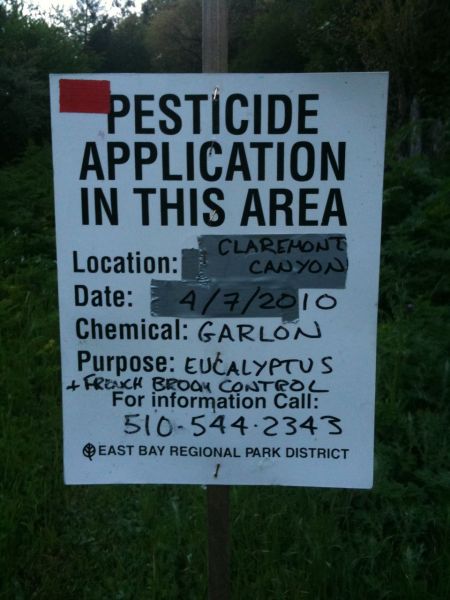
On our May 1st visit, there were at least 8 pesticide application notices posted where the native bunch grass has been planted. Several different herbicides will be used in those sprayings: glyphosate, Garlon (triclopyr), and Milestone (aminopyralid).
Herbicide Application Notices, Oyster Bay May 2018
Grassland “restoration” in California is notoriously difficult. Million Trees has published several articles about futile attempts to convert non-native annual grassland to native grassland:
We wish EBRPD good luck in this effort to convert acres of non-native annual grass into native bunch grass. Frankly, it looks like a lot of public money down the drain to us. It also looks like an excuse to use a lot of herbicide. Who benefits from this project? Not the taxpayer. Not the park visitor who is now exposed to a lot of herbicide that wasn’t required in the past. Not the wildlife, birds, and insects that lived in and ate the non-native vegetation. (We spotted a coyote running through the stumps of bunch grass. Was he/she looking for cover?)
Redwing blackbird in non-native mustard. Oyster Bay May 2018
Destroying trees and replacing them
Pittosporum forest was an excellent visual screen, sound barrier, and wind break. It was healthy and well-suited to the conditions on this site. It was probably home to many animals. Oyster Bay April 2011
When we visited Oyster Bay in 2011, many trees had already been destroyed, but there was still a dense forest of non-native pittosporum. That forest is gone and the park district has planted one small area with native trees as a “visual screen” of the Waste Management Facility next door. We identified these native trees and shrubs: ironwood (native to the Channel Islands), coast live oak, buckeye, toyon, juniper, mallow, holly leaf cherry, and redbud.
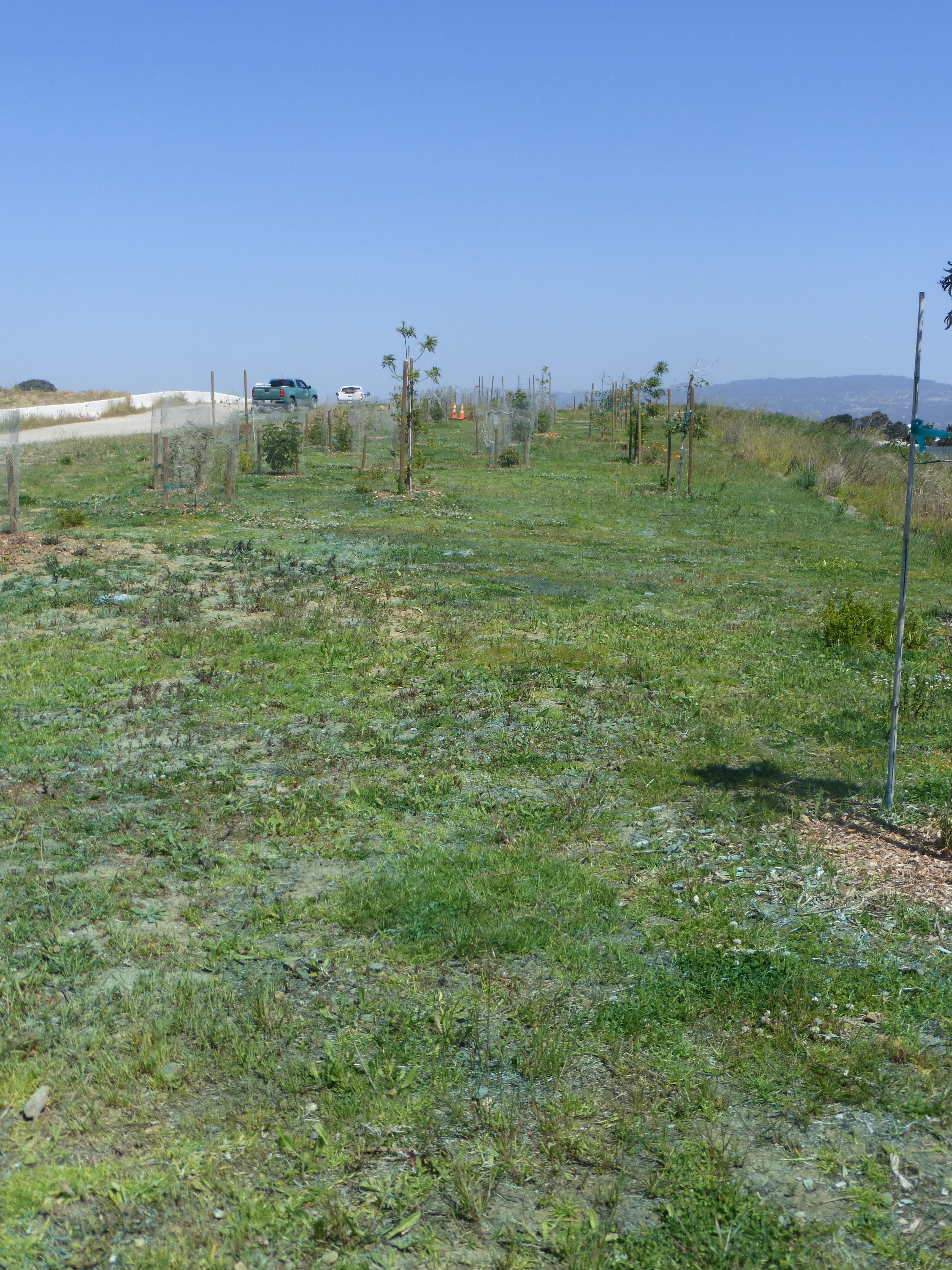
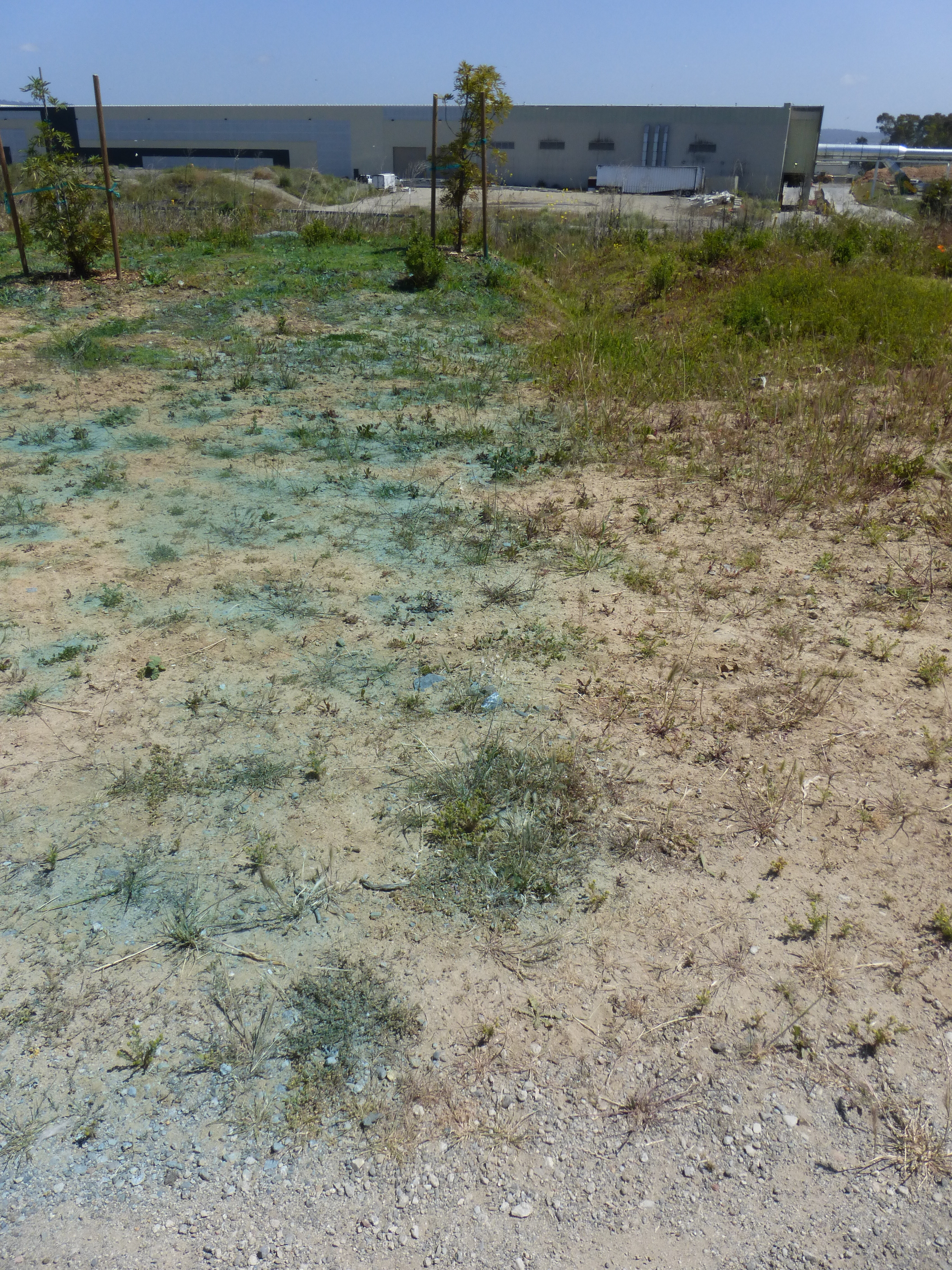
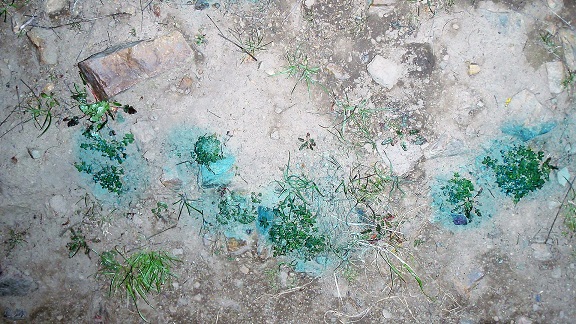
Native trees planted at Oyster Bay, May 2018Ground around trees is green with dye used when herbicide is sprayed. Oyster Bay, May 2018
We also saw a notice of herbicide application near the trees. The ground around the trees was covered in green dye, which is added to herbicide when it is sprayed so that the applicator can tell what is done. There were men dressed in white hazard suits, driving park district trucks, apparently getting ready to continue the application of herbicides.
Herbicide sprayed around newly planted trees. Oyster Bay May 2018
Not a fun day at the park
It wasn’t a fun day at the park and it isn’t fun to write about it. I decided to tell you about this visit after reading the most recent edition of the Journal of the California Native Plant Society, Fremontia (Vol. 46 No. 1). The introductory article of this “Special Issue on Urban Wildlands” is illustrated with a photo of Oyster Bay. I nearly choked on this statement in that article: “In order to control invasive plants, agencies and volunteers have sometimes resorted to using herbicides as a step in integrated pest control. While use of herbicides is contentious, the use for spot treatments has enabled small groups of volunteers to successfully eliminate invasive weeds in some areas where future herbicide use will not be needed.”
Attempting to eradicate non-native plants is NOT a short-term project. It is a forever commitment to using herbicides…LOTS of herbicide. To claim otherwise is to mislead, unless you are completely ignorant of what is actually being done.
You are paying for this
Another reason why I am publishing this article is to inform you that you are paying for these projects. The park district recently published a list of 492 active park improvement projects in 2018 (scroll down to page 71), many of which are native plant “restorations.” The majority of them are being paid for with grants of public money from federal, State, and local agencies as well as a few parcel taxes. Taxpayers had the opportunity to vote for the parcel taxes. They will have the opportunity to vote for new sources of funding for these projects:
Proposition 68 will provide $4.1 BILLION dollars for “park and water” improvements. It will be on your ballot on June 5, 2018. Roughly a third of the money will be allocated for “protection of natural habitats.” (1) Although the project at Oyster Bay does not look “natural” to us, that’s how the park district and other public agencies categorize these projects that (attempt to) convert non-native vegetation to native vegetation.
Measure CC renewal will be on the ballot in Alameda and Contra Costa counties on November 6, 2018. The park district has made a commitment to allocate 40% of the available funding to “natural resource projects.” Although the anticipated revenue (about $50 million) seems small, it is used as leverage to apply for big State grants, which require cost-sharing funding. Measure CC is essentially seed money for the much bigger federal and State funding sources.
I would like to vote for both of these measures because our parks are very important to me. If voting for these measures would actually improve the parks, I would do so. But that’s not what I see happening in our parks. What I see is a lot of damage: tree stumps, piles of wood chips, dead vegetation killed by herbicides, herbicide application notices, signs telling me not to step on fragile plants, etc.
Stay out of Oyster Bay to avoid unnecessary exposure to herbicides and keep your dogs out of Oyster Bay for the same reason. Unfortunately wildlife doesn’t have that option. They live there. Oyster Bay, May 2018
“States big bond for little projects,” SF Chronicle, May 5, 2018
I attended my first Beyond Pesticides forum in 2014 in Portland, Oregon. I have been a member of and donor to Beyond Pesticides ever since. And I have purchased only organic food since attending that forum, because of a field trip to a community of farm workers that convinced me that growing our food without using pesticides benefits both consumers and producers of America’s food.
In a recent letter to the National Invasive Species Council, Beyond Pesticides describes their organization and mission:
“Founded in 1981 as a national, grassroots, membership organization that represents community-based organizations and a range of people seeking to bridge the interests of consumers, farmers and farmworkers, Beyond Pesticides advances improved protections from pesticides and alternative pest management strategies that reduce or eliminate a reliance on pesticides.” (The letter is available HERE: Beyond Pesticides – ISAC Comment )
I receive emails from Beyond Pesticides at least once a week, alerting me to opportunities to influence the laws and policies that regulate pesticide use in America. As you might expect, the frequency of those alerts has accelerated a great deal in the past year, as the federal government is actively engaged in the process of dismantling many federal regulations, including those that regulate pesticides.
The National Invasive Species Council recently invited the public to submit public comments in answer to a few specific questions, in preparation for the next meeting of the Invasive Species Advisory Council. Today I am publishing an excerpt of the letter of Beyond Pesticides in answer to those questions (some emphasis added). I am doing so because I consider this letter a wise and informed critique of the entire concept of “invasive species” and the pesticides used to eradicate them.
“The National Invasive Species Council (NISC) posed four questions for public input to the forthcoming meeting of the Invasive Species Advisory Council (ISAC). We find it most helpful to begin with the fourth: “How can NISC foster the development and application of innovative tools and technologies to enable the prevention, eradication, and control of invasive species in a more timely and effective manner?”
In order to address this question, NISC and ISAC need to first address the question, “What is an ‘invasive species’?”
‘Invasive species’ have frequently provided a reason for dispersing toxic chemicals in the environment, often with a sense of urgency and an assumed indisputable benefit. This unsupported (and sometimes unstated) assertion of benefit is a claim to virtue that allows environmental harm instead of preventing it.
In the context of other federal, state, and local laws, the regulatory definition of ‘invasive species’ gives broad authority to agencies to use all means at their disposal to rid the jurisdiction of non-native organisms causing economic harm, as well as harm to health and the environment. Many local ordinances that ban or restrict pesticide use make an exception for ‘invasive species,’ presumably under the mistaken assumption that in doing so they are protecting the environment. Instead, they are allowing environmental harm through the spread of toxic substances.
The use of the term ‘invasive species’ as a claim to virtue that is used to promote any and every attempt to exterminate any unwanted organisms is very disturbing. It is important to understand the problems that lead to the use of toxic chemicals, beginning with the cause. In the case of situations involving so-called ‘invasive species,’ we find that few, if any, involve species that are truly ecologically invasive—that is, capable of invading and persisting in intact ecosystems. Instead, such situations usually involve species that can take advantage of disturbed habitats (‘weeds’ or ‘weedy species’). As such, the emphasis should be placed on healing the disturbance (to which end, so-called ‘invasives’ may sometimes be helpful), rather than killing the opportunist colonizer.
We do not take the position that such opportunist colonizers should never be removed or managed. We do believe that the decision concerning whether such action should be taken should be based on the situation at hand and not on a claim to virtue that makes extermination of non-natives a righteous cause.
Redefining ‘invasive species’ to be limited to those species that can invade and damage intact ecological communities will directly ‘foster the development and application of innovative tools and technologies to enable the prevention, eradication, and control of invasive species in a more timely and effective manner’ (NISC) because resources will be directed only at those species that truly present an ecological threat. It will prevent those resources from being squandered in ways that are ecologically destructive.
The sharper focus that this redefinition will bring to the NISC and ASIC will enable them to explore approaches such as those that Beyond Pesticides has used in working with National Parks, local governments, and tribes to manage ecological problems in a way that is truly protective of biodiversity.”
Terry Shistar, Ph.D.
Board of Directors
Beyond Pesticides
Beyond Pesticides will soon hold its annual forum in Irvine, California, April 13-14, 2018. As usual, the forum will include highly qualified speakers who are knowledgeable about so-called “invasive species,” and the evolutionary principles that raise questions about the necessity and futility of trying to eradicate them. Two of the speakers are important to our local effort to stop the use of pesticides to eradicate non-native plant species: Dr. Scott Carroll and Professor Tyrone Hayes.
Dr. Scott Carroll is an evolutionary biologist affiliated with UC Davis. He has published several influential studies about the speed of adaptation and evolution that enables introduced plants to join native ecosystems without long-term negative consequences of their introduction. He has coined the concept of “Conciliation Biology,” which advocates that we turn from efforts to eradicate non-native species in favor of a new approach which manages the co-existence of native and non-native species.
Professor Tyrone Hayes (UC Berkeley) is best known for his criticism of the herbicide, atrazine, which is harmful to the frogs that he studies. Unfortunately, Professor Hayes’ opposition to atrazine does not extend to the pesticides being used in the San Francisco Bay Area to eradicate non-native trees and prevent them from resprouting. Professor Hayes accepts the premise that eucalyptus trees are detrimental to native plants, which justifies the use of herbicides to destroy them, in his opinion. The herbicide that is used for that purpose (Garlon with active ingredient triclopyr) is just as toxic as atrazine. Both are organochlorine products that bioaccumulate, persist in the environment for decades, and are endocrine disruptors.
The Beyond Pesticides forum is likely to generate some lively discussion of the issues that are relevant in the San Francisco Bay Area. Details about the conference are available HERE. Beyond Pesticides makes every effort to make these forums affordable for activists. I have attended two of these conferences. They were excellent opportunities to learn more about pesticides, to meet other activists, and to get ideas about how to advocate more effectively for more responsible pesticide use in our community.
I am very grateful to Beyond Pesticides for their leadership in the effort to reduce pesticide use in the United States. They are a reliable source of information about pesticides and their activism is an inspiration to those who are engaged in this effort on a local level.
In preparation for writing the ballot measure that will renew Measure CC (the parcel tax that has funded park improvements since 2005), East Bay Regional Park District has invited the public to suggest projects for the parcel tax renewal that will be on the ballot in November 2018. The park district must receive the public’s suggestions by the end of the December to be considered when they write the ballot measure at the beginning of 2018.
Million Trees is publishing the suggestion of Marg Hall and Jean Stewart for major investments in the park district’s Integrated Pest Management Program to achieve the ultimate goal of using no pesticides in the parks.
Back in 2004, we both voted for Measure CC out of a desire to support the East Bay Regional Parks. At the time, we couldn’t have imagined that the euphemism “resource-related projects” meant funding the destruction of thousands of healthy eucalyptus trees and the subsequent application of pesticides. (1) Had this fact been clearly stated, we never would have supported CC. We’ll present herein proposals for Measure CC expenditures which are designed to shift EBRPD to a no-pesticide policy.
PESTICIDES IN THE PARKS ARE NOT POPULAR
A large segment of the local community opposes the use of public money to fund pesticide applications in our parks. Jane Goodall has observed that humans are the only animal species that insists on spoiling its own nest. It is self-destructive and unethical of us to poison our own nest, not to mention the homes of countless other species. Historically, environmentalists have opposed pesticide use; however, the local Sierra Club chapter, in a departure from this tradition, insists that poison be used in East Bay parks to remove “invasive non-native plants.” They invoke the benign-sounding term “restoration” to garner support for this ecological insanity. Note that the San Francisco Bay Chapter has never permitted a vote by members on the question of pesticide policies. In the face of their refusal to poll their own members, community activists conducted a survey of Sierra Club members. Over 1,876 local members mailed in their response, of whom 1,851 expressed disagreement with their own leadership! (25 expressed agreement.) For perspective, that’s more respondents than vote in the chapter elections! (In 2015, the candidate for Chapter Executive Committee with the greatest number of votes received only 1,139 votes.)
WHAT’S IN THAT STUFF YOU’RE SPRAYING?
Pesticide regulation in the US is weak, compromised by a cozy relationship with manufacturers. Pesticides have not been proven to be safe, despite approval of certain chemicals by the EPA. Bear in mind that in the US, the benefit of the doubt is given to the pesticide maker–no precautionary approach here–so we really don’t know the full extent of damage. Active ingredients are, of course, poisons, since they’re specifically designed to kill plants and animals. But so-called “inert” ingredients are poisonous as well.
Among the EPA’s many regulatory failures is the fact that, for the most part, “inert ingredients” get a pass. Pesticide formulations (e.g. Roundup) contain chemicals intended to increase potency. Agricultural pesticides contain more than 50% inert ingredients. Independent scientists investigating the safety of inert ingredients have uncovered evidence of harm that should be of great concern, including many hundreds of hazardous chemicals, carcinogens, and even chemicals considered to be active ingredients when used in a different product. (2)
DDT provides an illustrative cautionary tale. While it was banned in the US in 1972, DDT continued to be used in pesticides as an “inert” (!) ingredient, in a product named Kelthane. (3) This continued for TEN years! Even though DDT (and DDE, its metabolite) is a potent endocrine disruptor, the causal link to breast cancer has been hard to establish. Among the reasons for this is that breast cancer’s long latency period made such research challenging. Just two years ago the results of a large study conducted by Kaiser Oakland were released. (9,300 women with a 54-year follow-up.) Blood levels of pregnant women were tested between the years 1959 and 1962. Female offspring of those who tested with high DDT levels were 4 times likelier to develop breast cancer by age 52, compared with controls. (4) Women are still paying the price for the regulatory failures of the past. Don’t you owe it to future generations to ask yourselves what other time bombs lurk in the chemical poisons you spread?
POISON WHACK-A-MOLE
EBRPD often uses glyphosate (aka Roundup), long touted as extremely safe by manufacturers. In 2015, the World Health Organization declared glyphosate to be a “probable human carcinogen.” However, merely focusing on Roundup can lull us into believing that the solution lies in banning glyphosate. This naive thinking fails to take into account the legions of newer and less-scrutinized pesticides lining up to take Roundup’s place in a game of poison whack-a-mole.
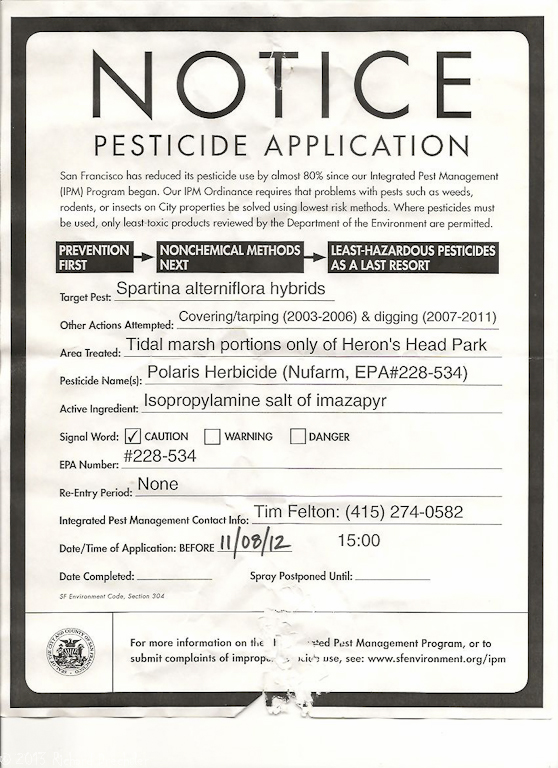
Pesticide Application Notice, Heron’s Head, 2012
Two projects which were funded by Measure CC “required” pesticides: triclopyr (Garlon) to prevent the re-sprouting of eucalyptus trees, and imazapyr (Polaris) to remove the “non-native” grass Spartina along San Francisco’s Bay shoreline. EBRPD’s own literature counts among successful CC projects: “Marsh cleanup at Martin Luther King Jr. Regional Shoreline, including Clapper Rail habitat enhancement and Spartina control” as well as “restoration of grasslands…at Pt. Pinole Regional Park”. (5) Based on your own reports, Spartina control projects have required the application of hundreds of gallons of imazapyr, some by aerial spray.
Imazapyr is toxic to fish, aquatic organisms and bees. Water soluble, it’s highly mobile and persistent; in one Swedish study, it was detectible in ground water eight years after application. (6)
As for triclopyr, much of the information has not been publicly shared. Thus scientists’ ability to conduct a well-informed evaluation of its safety is limited. We do know, however, that it significantly increases the frequency of breast cancer in both rats and mice. Despite this finding, the EPA has violated its own guidelines by refusing to classify this chemical as a carcinogen. We also know it has an adverse effect on frogs at very low exposures, and it causes documented harm to birds, fish, beneficial insects, and non-targeted plants. (7)
We can’t afford to wait 50 years to know a pesticide’s full effect. Especially now, under the current administration, corporations and politicians not only bully scientists but are systematically destroying the EPA. Now more than ever, local communities urgently need to rise to the occasion. This is where you come in.
DARE TO BE BOLD
Though she was writing about agricultural pesticides, Sandra Steingraber throws down a highly relevant challenge:
“I believe it is time for a new human experiment. The old experiment…is that we have sprayed pesticides which are inherent poisons…throughout our shared environment. They are now in amniotic fluid. They’re in our blood. They’re in our urine. They’re in our exhaled breath. They are in mothers’ milk….What is the burden of cancer that we can attribute to this use of poisons in our agricultural system?…We won’t really know the answer until we do the other experiment, which is to take the poisons out of our food chain, embrace a different kind of agriculture, and see what happens.” (8)
We propose a bold initiative. You’ve created an admirable IPM program; why not build on it by taking up Steingraber’s challenge? Use CC funding to make a commitment to a “no pesticide” policy. This would provide national leadership at a time when it is desperately needed.
Here are some practical suggestions to that end:
Expand IPM funding: Give staff the resources they need to innovate.
Go Deep: “Invasive” plants are not a problem to be eradicated but a symptom of an underlying dysfunction. Hire experts who can help you develop holistic solutions to ecosystem imbalances. Two who come to mind are Tao Orion (author of Beyond the War on Invasive Species: A Permaculture Approach to Ecosystem Restoration) and Caroline Cox (Center for Environmental Health). (9) Send your IPM staff to the yearly Beyond Pesticides conference.
Adopt the Precautionary Principle, which is based on the understanding that decision-makers have a social responsibility to protect the public from harm. The burden of proof of the harmlessness of a proposed action shifts from poison-manufacturers to…you.
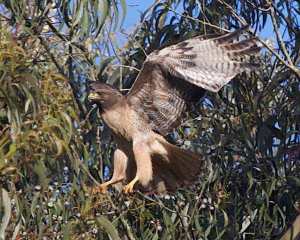
Red-tailed hawk nesting in eucalyptus. Courtesy urbanwildness.org
Plant tall trees: Having already cut thousands of living tall trees, you’re now faced with the reality of climate change. Reforestation becomes an urgent ethical imperative. Tall trees are not only carbon sinks; they also capture fog, provide raptor habitat (thus eliminating the need for rodenticides), and provide natural, nonchemical undergrowth suppression, especially in those same areas where you’ve been reapplying pesticides over and over, in a futile attempt to kill “weeds”. And of course, it goes without saying: no more cutting of healthy trees, young or old!
Experiment: Expand your existing programs of experimental plots testing various pesticide-free approaches to management of “invasive” or “opportunistic” plants.
Avoid “Restoration”: These projects almost always involve pesticides which damage the soil and many non-targeted plants and animals. If a goal can’t be achieved without them, it’s not worth doing. Restoration projects should be based in science rather than prejudice. Tao Orion’s chapter on Spartina eradication compellingly makes this case. (10)
Embrace change: Rigid nativism has no place on this planet, whether applied to humans, plants, or animals. Once you begin to appreciate those resilient plants and animals that have managed to adapt to each other in a new environment, you’ll stop fretting over their immigration status, and you won’t be so tempted to employ pesticides.
Jean Stewart, El Sobrante, CA
Marg Hall, Berkeley, CA
NOTE: Both authors have had cancer. Jean Stewart, a botanist, acquired cancer as a result of exposure to herbicides while handling them in a lab. Her tumor required several surgeries, leaving her disabled. Marg Hall reports: “I was diagnosed with invasive breast cancer in 2015. While I don’t know my mom’s blood levels of DDT when I was in her womb, there are still detectable levels of DDT in my household dust—45 years after it was banned from use!”
Orion, T., Beyond the War on Invasive Species: A Permaculture Approach to Ecosystem Restoration (Chelsea Green Publishing, 2015), p.26. Also, Cox and Surgan, “Unidentified Inert Ingredients in Pesticides: Implications for Human and Environmental Health,” Environmental Health Perspectives (2006): 1803-1806. https://www.ncbi.nlm.nih.gov/pmc/articles/PMC1764160/
Vallianatos, E.G. & Jenkins, M., Poison Spring: The Secret History of Pollution and the EPA (Bloomsbury Press, 2014), ch.4.
Cohn, B. et al, “DDT Exposure in Utero and Breast Cancer,” The Journal of Clinical Endocrinology and Metabolism, August 2015, vol. 100, Issue 8. “DDT Exposure in Utero and Breast Cancer.”
Correspondence from Beyond Pesticides (a nonprofit in Washington, DC, founded in 1981) to Massachusetts Dept. of Agricultural Resources, Feb. 18, 2014, pp. 7-8 http://www.beyondpesticides.org/assets/media/documents/NSTAR 2014 YOP Comments 2-18-2014.pdf
Steingraber, S. quoted in President’s Cancer Panel Report: Reducing Environmental Cancer Risk: What We Can Do Now; April 2010, Section 2, page 45. Read the President’s Cancer Panel’s Report. http://steingraber.com/1447/
In 2004, voters in Alameda and Contra Costa counties approved Measure CC, a parcel tax, to provide additional funding to East Bay Regional Park District for “Park Access, Infrastructure and Safety Improvements, Resource-Related Projects, and Reserve for Unknown Events.” Measure CC also stipulated that “the overall commitment to natural resources shall be no less than 30% of the revenue raised by the entire measure.” (1) Measure CC is projected to provide about $47 million in the 15 years of its life. (2)
The park district is planning to put Measure CC on the ballot for renewal next year. It’s time to look at how the park district spent our tax dollars and decide if we want to continue to give them our tax dollars for another 15 years. If you want Measure CC funding to be used differently, now is the time to tell East Bay Regional Park District what you want…BEFORE the ballot measure is written.
Fuels Management vs. Resource Management?
The park district budgeted $10.2 million of Measure CC funding for “fuels management,” about 22% of the total available funding from Measure CC. To date, the park district has appropriated $8.8 million of that budget allocation and spent $6.3 million.
The park district describes “fuels management:”“All vegetation/fuels management projects for fuels reduction are in coordination with the protection and enhancement of wildlife habitat in fuel break areas and are therefore considered to be resource related.” (2) In other words, the park district considers destroying vegetation and cutting down trees a part of its “commitment to natural resources.”
These descriptions of Measure CC projects illustrate the close relationship between fuels management and resource management:
“Assess and remove hazardous trees, promote native tree regeneration.” (2)
“Manage exotic plant species and promote fire resistant natives to reduce the risk of wildfires.” (2)
“Manage vegetation for fuels reduction in coordination with the protection and enhancement of wildlife habitat in fuel break areas to provide defensible space and meet Hills Emergency Forum flame length standard.” (2)
The park district’s policies and practices are based on mistaken assumptions:
Most monarchs in California spend the winter months roosting in eucalyptus trees. These trees are being destroyed in East Bay parks where monarchs have roosted in the past, such as Point Pinole.
There is no evidence that destroying non-native trees will “enhance wildlife habitat.” In fact, wildlife habitat is being destroyed by “fuels management” projects.
There is a wide range of opinions about the tree removals that the park district has done since their program began in 2011, after approval of the “Wildfire Hazard Reduction and Resource Management Plan” and the associated Environmental Impact Report. At one extreme, some people want the park district to destroy ALL non-native trees on its property. They consider “thinning” inadequate. The Sierra Club is in that camp and has sued to enforce their wishes. At the other extreme, some people don’t want any trees to be removed, although most would make an exception for dead and hazardous trees.
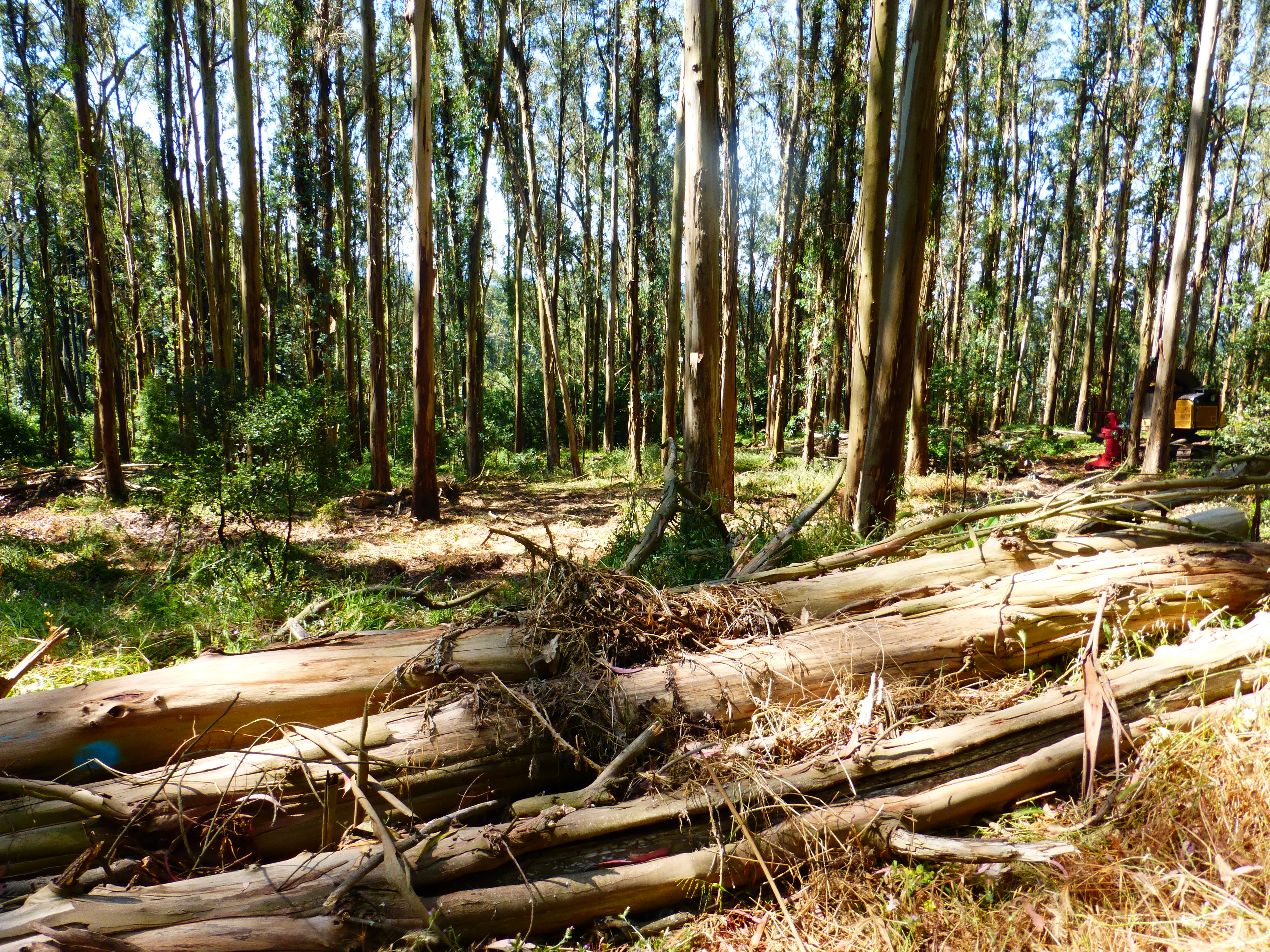
Tilden Park, Recommended Treatment Area TI001, June 5, 2016. This in one of the projects of East Bay Regional Park District, in process
After observing the park district’s tree removal projects, I have reached the conclusion that they represent a middle ground that I can accept because in many cases the canopy is intact and the forest floor is still shaded. The shade retains the moisture that retards fire ignition as well as suppresses the growth of weeds that ignite more easily during the dry season. In the 20+ years that I have defended our urban forest, I was always willing to accept a compromise and the park district’s methods look like a compromise to me. I still have concerns about tree removals and they are explained HERE. You must reach your own conclusions.
So, what’s the beef?
Unfortunately, coming to terms with the park district’s tree removals has not resolved my misgivings about how Measure CC money has been used. In a nutshell, I believe that the park district’s “resource management” projects are based on outdated conservation practices. I believe the park district is trying to re-create historic landscapes that are no longer adapted to environmental conditions. Their projects are often not successful because they do not take the reality of climate change into consideration, nor do they look to the future of our environment. They are stuck in the past.
One of the projects funded by Measure CC is typical: the effort to eradicate non-native spartina marsh grass from all park properties. The park district has been participating in the effort to eradicate all non-native spartina marsh grass from the entire West Coast for 14 years. In the first few years, EBPRD aerial sprayed from helicopters several hundred gallons of herbicide per year. Now the quantity of herbicide is about 25 gallons per year.
The reason why the rails have been harmed by the eradication of their habitat is that non-native spartina provides superior cover for the rail. The non-native species of spartina grows taller, more densely, and it doesn’t die back in the winter as the native species of spartina does. When the rail begins its nesting season, there is no cover for the birds. They are therefore being killed by their many predators.
The fact that non-native spartina provides superior cover for the birds is related to a second issue. Non-native spartina provides superior protection from winter storm surges compared to the native species which provides no protection, even when it grows and it is NOT growing.
The third issue is that eradicating non-native spartina has not resulted in the return of native spartina. Even when extensive planting has been done, native spartina does not provide habitat or storm surge protection in the San Francisco Bay Area. We should be asking if pouring hundreds of gallons of herbicide on the ground might be a factor in the unsuccessful attempt to bring native spartina back to the Bay Area.
Finally, recently published studies that compared native with non-native marsh grasses and aquatic plants with respect to the ecological functions they perform. These studies both say, “If you look at the role of exotic water plants in an ecosystem, you won’t find any significant differences compared to indigenous species.”
The spartina eradication project is an example of conservation that no longer makes sense. It damages the environment with herbicides. It destroys the habitat of rare birds. It exposes our shoreline to strong storm surges and rising sea levels. Native vegetation does not return when it is eradicated.
Looking forward, not back
The parks are very important to me. I visit them often and I treasure those visits. I would like to vote for Measure CC. I hope that the measure on the ballot will give me a reason to vote for it.
I will be looking for a revised definition of “resource management” in the ballot measure, one that acknowledges that climate change is the environmental issue of our time and that conservation must be consistent with the changes that have already occurred, as well as look forward to the changes that are anticipated in the future. Specifically, “resource management” must respect the landscape we have now, which means not trying to eradicate it, particularly by spraying it with herbicides. Resource management projects must be based on reality, rather than on fantasies about the past.
Opportunities to tell EBRPD what you want from Measure CC
East Bay Regional Park District is holding public meetings about Measure CC to give the public the opportunity to provide input regarding future park needs and priorities:
November 4, 10-12, Harrison Recreation Center, 1450 High St, Alameda
November 8, 2:30-4:30 pm, David Wendel Conference Center, 1111 Broadway, 19th Floor, Oakland
EBRPD asks that the public RSVP by sending an email to Monique Salas at msalas@ebparks.org or call 510-544-2008.
If you can’t attend, please send written feedback here: publicinformation@ebparks.org. Please tell East Bay Regional Park District what you want Measure CC funding to pay for.
The war on so-called “invasive species” continues to escalate. One of the indicators of this escalation is the recently revised California Invasive Plant Council’s (Cal-IPC) inventory of “invasive” plants. Nearly 100 plant species were added, a 50% increase in the inventory.
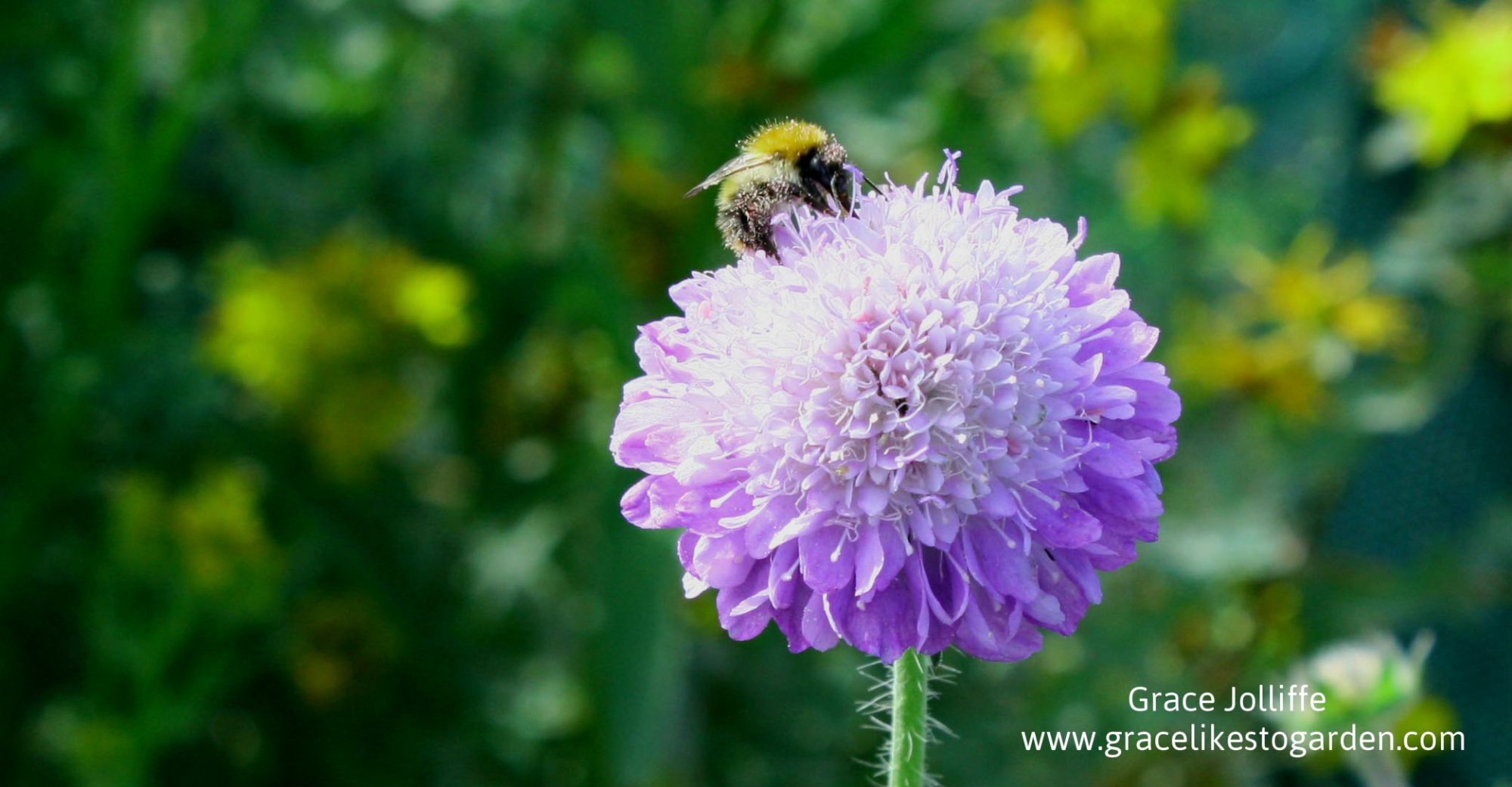
Scabiosa is one of 87 plants recently added to the inventory of “invasive” plants in California, despite the fact that is isn’t invasive in California. Scabiosa is very useful to bees because it blooms prolifically for much of the year.
More alarming is that most of the additions to the list are not considered “invasive” in California. Rather, a new category of “potentially” invasive plants was created, based on their behavior elsewhere. Many of the plants in the new category are considered invasive in Hawaii, a place with a distinctly different climate than California. Hawaii is a tropical climate, hotter than much of California and wetter and more humid than everywhere in California.
The big increase in the number of plant species now designated as “invasive” in California is a concern partly because of the herbicides that are usually used to eradicate them. Not only do we lose that plant species in our landscape when it is added to the hit list, we can also expect to see an increase in the use of the herbicides that are used to kill it.
Increased use of herbicides
Native plant advocates are aggressively defending the use of herbicides. Policies and practices are being developed to accommodate increased use of herbicides on our public lands.
East Bay Municipal Utilities District (EBMUD) is evaluating its Integrated Pest Management Program (IPM), including practices and policies regarding pesticide use. The first draft of EBMUD’s revised IPM program was made available to the public in July 2017. The draft adds several new goals to the IPM program: “habitat protection and restoration,” reducing populations of “invasive plant species,” and “use of alternative vegetation such as native plants.” EBMUD is the supplier of our drinking water in the East Bay and the quality of the water they supply should be the top—if not the only—priority. If destroying non-native plants requires greater use of herbicides, that goal contradicts EBMUD’s obligation to providing safe drinking water.
Garlon sprayed on the trail in a San Francisco park. San Francisco Forest Alliance
San Francisco’s IPM program has also changed some policies to accommodate use of herbicides in parks on plants the Natural Resource Division of the parks department considers “invasive.” The parks department restricts all park access to the established trails in the 33 “natural areas” where non-native plants are eradicated and replaced by native plants. The new IPM policy permits the spraying of herbicides without posting pesticide application notices in places that are “publicly inaccessible.” In other words, pesticide application notices are no longer required in the “natural areas” unless herbicides are sprayed on the trails. One way to reduce the public’s opposition to pesticides is to hide their use and this policy seems designed to do that.
Update: The San Francisco Forest Alliance (SFFA) has informed me that Chris Geiger, head of San Francisco’s IPM program, has given assurances that the IPM program will no longer offer City departments a blanket exemption to apply herbicides without posting in areas the department considers “publicly inaccessible”. Previous to this, each land manager was empowered to make their own decisions as to which areas they considered “publicly inaccessible”. The IPM group did not provide oversight of the decisions or keep records of which areas were exempted. Now specific exemptions will be issued and recorded on the IPM exemptions webpage. Chris Geiger reports RPD will not be requesting any posting exemptions. SFFA is still waiting for formal written documentation of this change.
This post will focus on the intersection of these symptoms of the escalating war on “invasive” plants: the expansion of California’s inventory of “invasive” plants and the closely associated claim that non-native plants must be eradicated because they compete with the native plants required by wildlife. We use buddleia, commonly known as butterfly bush, as an example.
Butterfly Bush (Buddleia): friend or enemy of butterflies?
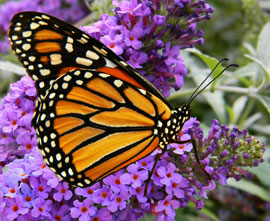
Monarch nectaring on butterfly bush. butterflybush.com
Buddleia is one of 87 plant species recently added to Cal-IPC’s inventory of “invasive” plant because it is considered invasive outside of California. Buddleia is called butterfly bush because it produces large quantities of nectar that attract swarms of butterflies. Since buddleia is very appealing to butterflies, it is popular with gardeners who like to see butterflies in their gardens.
Since buddleia is obviously useful to butterflies and Doug Tallamy claims to be concerned about the welfare of our pollinators, why is he telling gardeners to quit planting buddleia?His advice is based on the fact that buddleia is considered invasive in some places and his belief that it will eventually be invasive everywhere. In fact, that’s his belief about all non-native plants: they may not be invasive now, but he predicts that eventually they all will be invasive.
Secondly, Tallamy argues that although buddleia provides food for butterflies, it is not a host plant for butterflies. The host plant is where butterflies lay their eggs and where the caterpillar feeds when the eggs hatch. The choice of host plant species is much smaller than the number of food plant species available to butterflies, but it is not as small as Tallamy thinks it is. Tallamy does not seem to realize that many plants are chemically similar, which enables butterflies to make a transition from a native plant to a chemically similar non-native plant. Here in California, many butterfly species have made that transition and a few butterfly species are dependent upon abundant non-native plants that are available year-around because their original native host plant is dormant much of the year.
Buddleia “starves” butterflies?
This is Tallamy’s apocalyptic prediction about the fate of butterflies if gardeners continue to plant buddleia:
“It’s no exaggeration to say that when you choose which plants to include in your garden, even the beautiful, seemingly harmless butterfly bush, you’re deciding if members of your community’s local food web will be nourished or unintentionally starved. And to get to that mind frame, which is a way of thinking that truly benefits nature, including its butterflies, you’re going to have to come to a harsh realization: You need to stop planting the butterfly bush—forever.” (1)
Ironically, this harsh verdict on buddleia was published by a blog entitled, “Organic Life.” Is Organic Life unaware of the fact that the most widely used method of eradicating non-native plants is spraying herbicides? The consequence of adding more plant species to the long list of “bad plants,” is more pesticide use. That’s not very “organic.”
What amoral, selfish gardener would plant buddleia in their garden after such a severe scolding? First, let’s stop and think about the logic of the claim that buddleia will disrupt the “food web” and starve butterflies. Since buddleia is an excellent source of nectar and swarms of butterflies are observed nectaring on buddleia, how could we be “starving” them? Professor Art Shapiro (UC Davis), our local butterfly expert, said when asked about this article, “The ‘disrupting food webs’ argument is ludicrous. It’s equivalent to saying that if you eat popcorn rather than apples, you’re contributing to unemployment in the apple-picking industry.”
Is buddleia a host plant for butterflies?
Now let’s consider the argument that we should not plant buddleia in our gardens because although it feeds butterflies, it isn’t their host plant where they lay their eggs. The problem with that argument is that it isn’t true!!
Checkerspot laying eggs on buddleia, near Santa Barbara. Photo by Marc Kummel
In 1940, Charles M. Dammers reported that the Variable Checkerspot (Euphydryas chalcedona) “can use” buddleia as a substitute for its usual native host in southern California desert-mountain areas, based on a laboratory study of the larval stages of its caterpillar on buddleia. In 2001, chemical analysis of buddleia found that it is chemically similar to the native host of the checkerspot, which confirmed the potential for such a substitution.
The first actual observation of checkerspot butterflies breeding spontaneously and successfully on buddleia was in Mariposa County, California in the Sierra Nevada foothills. “Mariposa” is Spanish for butterfly. Mariposa County was named by an early Spanish explorer who saw many butterflies near Chowchilla.
Checkerspot bred successfully on buddleia in 2005 and in subsequent years. This colony of checkerspot on buddleia was reported in 2009: “We conclude that buddleia davidii [and other species of buddleia] represents yet another exotic plant adopted as a larval host by a native California butterfly and that other members of the genus may also be used as the opportunity arises.” (2)
Variable checkerspot. Photo by Roger Hall
More recently, a gardener in Mendocino County also reported the use of buddleia as the host plant of checkerspot:
“By now I am questioning how it was that butterfly larvae were using my butterfly bush as a host plant, completely against everything I’d ever heard. How was this possible? I emailed Art Shapiro, a very well-known butterfly expert and author, sending him a pic. He wrote back to confirm they were butterfly larvae, but added, ‘These are not mourning cloak butterflies. They are checkerspots. And the only time I’m aware this has happened [like, ever, except one in a lab in 1940…] is in Mariposa County.’” (3)
Bad rap for non-native plants
When the native plant movement began some 30 years ago, native plant advocates promoted their agenda with a straight-forward claim that they are superior to non-native plants. The public was initially resistant to that argument because non-native plants have been around for a long time and people have become fond of them.
Native plant advocates began to fabricate stories about the evils of non-native plants to convince the public that eradicating them was necessary because they are harmful to wildlife and they damage the environment. The Million Trees blog was created to address those claims.
But Doug Tallamy’s active participation in the crusade against non-native plants is a special case because he is an academic entomologist, credentials that make him more influential with the public. For that reason, Million Trees has critiqued several of his publications.We publish this critique of Tallamy’s opinion of buddleia for several reasons:
Buddleia is very useful to butterflies. The loss of buddleia in our gardens would be a loss to butterflies.
San Francisco’s IPM program is using Doug Tallamy’s mistaken theories to promote the use of herbicides to eradicate non-native plants in San Francisco.
Buddleia is one of 87 plants that have been classified as “invasive” by the California Invasive Plant Council despite the fact that it is NOT invasive in California. The expansion of the list of “invasive” plants in California to include plants that are NOT invasive in California, will increase the use of herbicides and will eliminate plants that are performing valuable ecological functions.
https://www.rodalesorganiclife.com/garden/never-plant-butterfly-bush (N.B. The butterfly in the photo in this article is European Small Tortoiseshell, found in Britain and in Europe. The caterpillar in the photo is the monarch caterpillar on its host plant, milkweed. Buddleia is food for both of these butterfly species.)
Arthur M. Shapiro and Katie Hertfelder, “Use of Buddleia as Host Plant by Euphydryas chalcedona in the Sierra Nevada foothills, California,” News of the Lepidopterists’ Society, Spring 2009
It is my pleasure to publish a guest post about dune “restorations” in Humboldt County that began about 30 years ago. Like most “restorations,” these projects are primarily destroying non-native plants. More often than not, they don’t plant native plants to replace the plants they destroy, although the stated goal is to “restore” native plants.
Uri Driscoll tells us why the non-native plants were planted over 100 years ago and the consequences of removing them. According to Mr. Driscoll’s Facebook page, he has lived in Arcata, Humboldt County since 1983. He has had a life-long interest in outdoor recreation, horses, organic farming, and conservation. He is a member of Arcata’s Open Space and Agriculture Committee.
If you live in the San Francisco Bay Area, you might think these projects are not relevant to us. In fact, they have everything to do with us because there are many similar projects here and the issues with those projects are similar.
Bird’s eye view of San Francisco in 1868. US Library of Congress
The San Francisco peninsula was about one-third barren sand dunes when Europeans first arrived at the end of the 18th century. About 30 years ago, native plant advocates decided they wanted whatever open space that still remains on the peninsula to be returned to pre-settlement conditions, including sand dunes where they existed in the past.
These are the sand dunes in San Francisco where Golden Gate Park was built by creating a windbreak by planting trees. The windbreak stabilized the sand dunes and made it possible to plant and sustain vegetation behind the protection of the windbreak. San Francisco Public Library, historical photo collection.Pacheco & 32nd Ave, San Francisco, 1943. San Francisco Public Library, historical photo collection
As residential neighborhoods in San Francisco were developed, iceplant and European beach grass were planted on the sand dunes to hold the sand in place. Native dune plants are not capable of stabilizing sand for long, before strong winds move the sand beneath them. In fact, the long term survival of native dune plants is dependent upon these disturbances.
Iceplant has been removed from several sand hills in residential neighborhoods, dumping sand on the properties at the base of the hills. The Great Highway, which separates Ocean Beach from the residential Sunset District is often closed because of drifting sand after removal of beach grass.
In fact, everyone living on the coast of California should have an interest in the preservation of our sand dunes because they are our first line of defense against rising sea levels and the intense storms associated with climate change. If non-native plants and trees are needed to maintain the stability of our sand dunes, so be it. Competing agendas must take a back seat to the safety of our coastal communities.
Million Trees
Stable Dunes or Native Plants?
The North and South Spits of Humboldt County are the physical barrier between Humboldt Bay and the Pacific Ocean. After the introduction of European beach grass (Ammophila arenaria) in the early 1900’s there has been a substantial stabilizing effect on the dunes as they grew wider and taller. Prior to the establishment of the grass our dunes consisted of wide expanses of unvegetated, open, moving sand. This is in sharp contrast to the variety of plant cover we have today.
Humboldt Bay
In the 1980s public land managers began removing European beach grass with the goal of restoring native vegetation. This is the story of the consequences of their projects.
Foredunes (the sand ridges parallel to and closest to the shore) with open, actively moving sands have a very high potential for accelerated erosion. The foredunes of the North Spit and South Spit are still extremely vulnerable to accelerated erosion caused by disturbances to the vegetation. A beach and dunes management plan and Environmental Impact Report (EIR) was developed in 1993 to address such issues.
Of greater concern, waves have washed over the foredunes on both spits where waves have breached the foredune where vegetative cover had been removed. Repeated overwash events would significantly and immediately impact the only access road to the South Spit and the municipal water main and water treatment facilities on the North Spit.
These dunes could again be set in motion by removal of the protective cover of native and non-native vegetation. Indeed, the intention to remobilize dunes was identified in the Conditional Use Permit application Bureau of Land Management (BLM) submitted for vegetation removal at Table Bluff County Park, a portion of the South Spit. However, those intentions are contrary to the local Humboldt Bay Beach and Dune Management Plan and accompanying EIR.
The danger is that the South Spit’s dune topography is characterized as typically low and narrow. With erosion and subsequent lowering of the foredune that occurs following vegetation removal, the right combination of concurrent high-magnitude seismic subsidence and wave attack could cause collapse of the land barrier between the Ocean and Humboldt Bay. With anticipated sea level rise we would see this risk multiply.
Source: 2008-2014 BLM monitoring report
The problem is that the previous and on-going work to remove European beach grass from the North and South Spits (in the effort to restore natural conditions and processes) has not and does not provide for the immediate re-establishment of other comparable vegetative cover to trap moving sand and prevent accelerated dune erosion. By not including this mandated mitigation measure, there is a real, legitimate potential for significant, cumulative environmental impact.
Why was European beach grass introduced?
The important thing to understand is that this specific type of beach grass (Ammophila arenaria) was introduced in Humboldt County in the early 1900’s. It was done in order to stabilize dunes to protect growing communities and infrastructure. It had the additional benefit of creating extensive coastal wetlands and wildlife habitat. By collecting sand from the beach the grass builds protective and multiple parallel ridges and accompanying deflation planes. These depressions behind the ridges act as sheltered nurseries for new plant and animal life. This process can take several decades but is reversed rapidly after the grass is removed. Such an effect has happened not only in Humboldt County but also in Point Reyes where valuable wetlands and organic pastures have been smothered by destabilized sand.
Why was European beach grass removed?
When the efforts to remove the non-native, albeit naturalized grasses began in the early 1990’s invasive biology was in its infant stages. Not much was known about the impacts from the eradication efforts of dominant species. But to some it was important to return coastal areas to the pre-beach grass era so native plants would not be out-competed.
Every movement needs a poster child. About this same time a cute little shore bird named the western snowy plover became just that. Even though it is registered as a threatened species on the west coast, other parts of the country and Mexico have significant and stable populations. We were told by local biologist Ron LaValley that the non-native grass needed to be removed to recover the local plover’s population. This claim contradicted his original report showing plover eggs nestled in the non-native grass. He was later convicted and sent to jail for falsifying data and embezzling a million dollars from similar projects involving the spotted owl.
Recognizing that manual eradication was very expensive and time consuming, California State Parks decided to bulldoze 40+ acres of Little River State Beach to provide plover breeding areas. Unfortunately, as Humboldt State Professor Mark Colwell noted in his 2008 report “importantly, eggs often fail to hatch in restored areas.” This is largely because ravens and crows find it easy to locate the nests in open sand areas.
The Lanphere-Christenson Dunes Refuge director Eric Nelson determined during a 2016 Climate Ready project that the foredunes were being excessively eroded by the 25 California Conservation Corp (CCC) workers who were digging out beach grass. His decision to spray glyphosate and imazapyr instead of hand removal was carried out despite public opposition. It remains unclear whether, despite acknowledging excessive erosion from manual eradication efforts, the refuge will return to using that method again.
Lanphere Dunes and Mad River Slough
The public takes notice of the consequences
Some of us who live near these project areas and use them for recreation started noticing native tree mortality and changes to the landforms caused by removing the stabilizing grasses. We started doing some initial research. We began looking into coastal development permits, beach and dunes management plans and monitoring reports. Our findings revealed the project areas that actually had permits also had mitigation requirements. Those included immediate replanting and strict monitoring to make sure topography and landforms were not altered. When we inquired about the monitoring and replanting programs we found those to be significantly deficient and in some cases non-existent.
Taking action
Our next step was to approach the various regulatory agencies. US Fish and Wildlife Service, California Department of Fish and Wildlife and the State Water Board should be interested in the freshwater wetland infill we were witnessing. The Harbor District and the municipal water district have a major interest in securing the two 42-inch industrial water mains protected by the same beach grass that was being removed. The Manila Community Service District maintains a waste water treatment facility on the dunes. We thought the California Coastal Commission would certainly want to know that these unauthorized alterations to coastal landforms were taking place. We felt sure the County planning department that issued some of the permits would take enforcement action.
The town of Manila’s water treatment facility
We brought photo and research documents from Oregon and Washington (2 and 3), made presentations and had meetings, site visits and sent email communications to no avail.
We stepped back and took a look at the board of directors for the non-profit called Friends of the Dunes (FOD) that has been promoting the grass removal from the very beginning. They had grown from a small, broken down 400 square foot building with a net worth of about $20,000 in 2004 to 60 + acres of ocean front property with a 3000 square foot building and a net worth of over $3.4 million in 2014. The board of directors at the time consisted of employees of most of the agencies listed above. We understood then why we were running into so many road blocks.
Our community is well known for environmental activism. So why the hesitation of local environmental organizations like the North Coast Environmental Center (NEC), Environmental Protection Information Center, and Bay Keeper to call out such impacts caused by bulldozers, herbicide spraying and wetland infilling? We can only presume that the banner of “restoration” has been used as a blindfold.
Some significant successes….more to do
We have had worthy successes. Through our efforts the California Coastal Commission has asked the Bureau of Land Management (BLM) for a new determination to address the impacts related to the Ocean Day activities involving 1000 school children digging grasses from the dunes. So far, the BLM does not think it needs to provide that. BLM puts on the event but the Coastal Commission bankrolls it. We do not know yet what the Commission’s response will be to that refusal.
The town of Manila has stopped grass removal activities in its management area and has supported the planting of native pine trees (Pinus contorta, contorta) in the dunes, which we did last February.The County planning department is engaged and acknowledges that there has been no contract with the California Conservation Corp or BLM for prior grass removal at the County Park and will not allow any more vegetation removal until a Memorandum of Understanding is developed.
The Coastal Commission has committed to reviewing the authorization allowances for BLM’s grass removal over the rest of the South Spit. The existing Plan states a two-acre area would be subjected to grass removal strictly for monitoring purposes not the mile long area subjected to eradication to date. BLM contends that authorization extends over the whole 800-acre Spit but have not been able to provide supporting documents.
The North Coast Environmental Center and even the Friends of the Dunes (FOD) took a position against spraying herbicides on the dunes.
Former board members of the FOD that are regulatory agency officials have resigned their director positions.
Communities around the country are hosting events to plant beach grasses like the ones that have been removed here. Recognition of the incredible value of stabilized dunes is becoming more wide spread. The “non-native” label is becoming more questioned.
Setting new goals and looking ahead
For us on the North Coast of California we need a much more cost effective and precautionary approach than tearing out plants that have beneficial attributes.We need to allow the beach grass to do its job of stabilizing and protecting our dunes. As we allow it to do that, the beach grass “declines in vigor” (4). When that happens, other plant and animal species utilize those protections from the harsh winds and tides of the Pacific and establish heathy vibrant wildlife habitat. Our local and migratory wildlife depend on it. And so do we.
Uri Driscoll, Arcata, California
We commend the people of Humboldt County for paying attention to the damage that is being done to their public land and we congratulate them on the progress they have made to prevent further damage. We are impressed with the methodical approach they have taken to convincing public land managers to reconsider the goals of the project and the methods being used to accomplish them.
We wish them the best of luck with their efforts. We are grateful to Uri Driscoll for taking the time and trouble to share this story with our readers.
Million Trees
(1) South Spit Interim Management Plan 2002.
(2) Evaluating Coastal Protection Services Associated with Restoration Management of an Endangered Shorebird in Oregon, U.S.A. Lindsey Carrol
The most recent newsletter (see page 8) of the California Invasive Plant Council (Cal-IPC) informed us that the beetle that was introduced in Arizona to eradicate tamarisk has spread to California, where it was not introduced. When the beetle was originally introduced, its spread beyond where it was introduced was not predicted, based on climatic restrictions on its life cycle. As usual, evolution overturns the best laid plans. According to Cal-IPC, “Rapid evolution in this developmental trait, however, allowed beetles to stay active later in the season and thus facilitated their expansion southward…”
Tamarisk defoliated by tamarisk leaf beetle along Colorado River, near Needles, California
The rapid defoliation of tamarisk throughout the southwest, including California, is an immediate threat to the endangered Southwestern willow flycatcher, which long ago adapted to tamarisk in the absence of its native host, willow. The native willow requires a great deal more water than tamarisk. Therefore, willow died off when water throughout the southwest was diverted out of riparian corridors for human consumption and agricultural production.
Dr. Chew is an expert on tamarisk and the role it plays in the ecosystems of the southwest and so we asked him to write another guest post for us on this topic. He has generously obliged with this detailed history of biocontrols and their use to eradicate non-native species.
Biocontrols are also topical because a new biocontrol was recently approved by the USDA to eradicate cape ivy. This biocontrol was eagerly anticipated by native plant advocates and is likely to be widely used by land managers in California. Therefore, this is a timely opportunity to learn about the pros and cons of biocontrols. How long will it take the introduced insect to start feeding on the many other species of ivy that are not considered “invasive?”
Evolution and natural selection are wild cards in attempts to eradicate non-native plants and animals. Although there are many dangerous consequences of using pesticides, the role that evolution plays in rendering pesticides useless is less understood and taken into consideration. Much like the hungry beetle that now is running rampant in the southwest, the weeds that are continuously sprayed with herbicide are also adapting and evolving defenses against the chemicals being used to eradicate them. There are now millions of acres of agricultural crop land infested by weeds that are immune to the pesticides that were sprayed on them for decades. Our pesticides are now useless on these “superweeds.” Instead of getting off the pesticide treadmill, we are developing stronger—and therefore more toxic—herbicides.
There are many reasons why we object to the eradication of non-native plants and animals. The tamarisk beetle is an example that illustrates a few of our objections:
Many of the plants being eradicated are providing food and habitat for animals. The animals that depend upon them are being harmed by their elimination.
The methods used to eradicate non-native species often have unintended, negative consequences, such as breeding “superweeds” that cannot be eradicated.
The puny tools of humans are often powerless against the much stronger forces of nature, such as natural selection and evolution. These forces of nature should be treated with greater respect, particularly by people who call themselves “scientists.”
Million Trees
Southwestern willow flycatcher
From California to Texas and occasionally beyond, tamarisks are among the most talked-about introduced plants in the US. Most of that discussion consists of familiar anti-alien dogma, augmented by the long-obsolete assertion that tamarisks are profligate water-guzzlers. Suffice for now to say that anti-tamarisk sentiment led to state and federal suppression policies beginning around 1940, and eventually to legislation at both levels. Little more than accumulated bad reputation of tamarisk and its presence in the region of interest led the US Fish and Wildlife Service to include tamarisks among the supposed threats to the persistence of the Southwestern Willow Flycatcher (Empidonax traillii extimus) when that subspecies was formally listed “endangered” in 1993. All of that meant both political will and appropriations were applied to the US Department of Agriculture’s search for biological control agents to deploy as “counter-pests” against tamarisks. By 1998 they had their critter, an Asian leaf-eating beetle that putatively specialized on tamarisks and would rather die than eat anything else.
By that time, though, circumspection had set in, because especially in southern Arizona the endangered birds had taken to nesting in tamarisk stands. USDA promised USFWS that their armored foreign legion would not jeopardize flycatcher populations. USDA argued that the beetles they were about to propagate and release by the multi-millions were genetically incapable of surviving below 38° North latitude. In addition to famously dividing North from South Korea, that frontier runs from near the tip of Point Reyes through Stockton and Mono Lake; just south of Tonopah, Nevada; south of Canyonlands Nation Park; through Moffat and Swink, Colorado; on through the Garden City Kansas and increasingly irrelevant points east. Southern Arizona would surely never see a tamarisk leaf beetle. “Because SCIENCE!” Hold that thought.
In 1952 the otherwise obscure and perhaps pseudonymous writer Rose Bonne copyrighted a succinct cautionary account of biological pest control. Perhaps it was read or sung or shown to you as a child: I know an Old Lady [who swallowed a fly]. Ms. Bonne denied knowing how or why the old lady swallowed the fly, but considered it portentous: “Perhaps she’ll die!” Subsequent actions had definite (if sometimes puzzling) rationales. The next four animals consumed represented a hopeful trophic cascade: the Old Lady swallowed a spider to catch the fly, then a bird to catch the spider, a cat to catch the bird and a dog to catch the cat. At that point, distended and incoherent, she panicked, swallowing a goat to catch the dog, a cow to catch the goat, then finally, fatally, a horse. (Revisionists inserted a pig between the goat and the cow. If you doubt me, Google it.)
The history of biocontrols
We can barely pause to consider the long and checkered history of biological control. Its inception required a few conditions, which may have arisen in different orders in different places. A sense of ownership, territorial claims or resource collection rights seems necessary, as does dissatisfaction with the dictates of fate. Why attempt to affect an outcome without expecting to benefit from the effort? A bit of empirical, practical natural history knowledge is also indispensable. Together they add up to the possibility of acting on the basis that “the enemy of my enemy is my friend,” to garner a greater share of whatever natural product seems desirable. Dogs to guard flocks and cats to discourage rodents are biological controls. The more organized and concentrated agriculture became, the greater the need for knowledge of “natural enemies” to enlist as economic allies. Even after revolutions in industrial chemistry offered alternatives, better living was still sometimes available through biology.
With private property rights come boundary disputes, complaints about trespass and spillover effects of management decisions. Public property, especially where subject to intensive multiple use mandates, adds complexity and diversity (if not novelty) to the mix. Rights collide with powers and authorities. Politically compromised jurisdictions—like U.S. state authority over wildlife except where superseded by federal laws and treaties or licensed to private parties—are endless fodder for litigation and finger pointing. All the while, science reconstructs what is known or considered knowable, changing expectations, affecting policies and destabilizing political balances.
Modern civilizations depend upon the plants they have introduced
Modern agricultural, horticultural and forestry practices are all legacies of the Renaissance, Reformation and Enlightenment motivations underpinning European colonialism. Empires were assembled and contested primarily for their economic advantages. During the past half-millennium they generated new wealth and new social classes that developed new governments. Among the array of actions those governments continue to undertake is facilitating the redistribution of valuable plants and animals. A visit to any retail food market reveals our near-total embrace of that redistribution. Almost every staple ingredient in every foodstuff is raised or grown far from its “wild” point of origin. Even insistent locavores prefer locally raised food, not locally evolved food. A negligible fraction of us recognize never-transported, never-domesticated edible organisms. Fewer still could survive on them as hunter-gatherers. Such are among the generally intended, hoped-for, positive outcomes of imperial colonialism. Famine is unnecessary, though it is a political tool, deployable as a weapon.
Fish, meat and leather, plant and animal fibers, timber, pulp and derived products can still be wild harvested, but are mostly and increasingly farmed. Anything worth gathering is worth cultivating, from redwood trees to bison to sugarcane to minks to soybeans to insects, yeasts, and bacteria. Even aspirational exceptions like native plant gardening are actually impossible to accomplish: seed intentionally transported from one location to another has been biogeographically rerouted; plants sold by native plant nurseries are raised in multi-source, formulated soils in plastic pots. Even simply deciding to leave a plant where it was found can render it an artifact, and there may no longer be any wilderness so remote that the configuration of its biota remains uninfluenced by human agency.
Benefits of introduced species often outweigh harm
We are told that some of the consequences of all this redistributed and reconfigured biota are marginally negligible. Others are cutting into the profits. Some organisms are moved around unintentionally and unknowingly (zebra mussels, various “blight” fungi) often because unaware transportation technology designers and operators never prevented their distribution. Many intentionally abducted and marooned populations are behaving in unexpected ways, thriving without always accomplishing their intended purposes (alligator apples and cane toads in Australia; house sparrows and wild carrots in North America) or even significantly over-achieving (“Asian” carps and kudzu in North America; rhododendrons and grey squirrels in Britain). Even where post-colonial inclinations to recover and reinstate pre-colonial values are tolerated, they hardly withstand translation into economic choices. We are adeptly, fundamentally invested in moving things around. We are likewise invested in competition, and building coalitions and alliances to help us win competitions. Especially competitions we thoughtlessly or accidentally set in motion.
Tamarisk on the Colorado River
The Old Lady who swallowed the fly would probably have been fine had she not overthought the problem. The fly was doubtless well on its way to being digested by the time she found a spider, which was likewise moribund before a bird came to hand. Maybe should could have swallowed a willow flycatcher (already protected by the Migratory Bird Treaty Act) and skipped the spider? Had the US Army Corps of Engineers, the USDA and others not overthought the problem in the late 19th and early 20th centuries, they might have come up with suitable alternatives to planting tamarisks to stabilize Texas barrier islands, deepening Four Corners arroyos and fly-away Dust Bowl topsoils. Yes, tamarisks, too, were brought to us to biologically control problems of our own making and conception. Then we needed a beetle…
As things turned out, USDA scientists were either mistaken or disingenuous regarding the latitudinal limits of their tamarisk leaf beetles. Likewise, even about the identity of the beetles, which is why I haven’t inflicted their Latin epithets on you yet. By 2010, sniping between USFWS and USDA, abetted by various conflicting conservation NGOs, led to a new “Biological Assessment” for the federally imposed tamarisk leaf beetle invasion. (I usually avoid using “invasion” in such circumstances, because invading exceeds many capacities of so-called “invasive species.” This was a real invasion, though, planned and carried out by people, not beetles. Beetles merely bred and spread.) One species of beetle became five, four which had been introduced: Diorhabda carinulata; D. elongata; D. sublineata; and D. carinata. Some were quite well-adapted to life in southern Arizona (31-32° N) and beyond. Furthermore, the endangered birds were also nesting in tamarisks in southern Utah, c. 37° N. USDA washed its hands of the federal program and revoked federal permits to release beetles; but that had no effect on the State of Colorado, which was heavily invested in producing them and continues to do so.
Distribution of tamarisk leaf beetle. Tamarisk CoalitionTamarisk leaf beetle
Fast-forward to 2017. Tamarisk leaf beetles have been spreading along Arizona waterways at rates up to ten times faster than their most ardent cheerleaders imagined they could, and from multiple directions. They will arrive in almost every known Southwestern Willow Flycatcher nesting area sometime this year. By next spring those riparian thickets will be defoliated just at the point when the nestlings most require thermal cover (i.e., shade). Thanks to Reclamation-Era water diversion projects, attempts to re-vegetate those areas with willows will require constant gardening. Reclamation replaced willow habitat with tamarisk habitat. Nevertheless, the birds persisted. Beetle releases suppressed the tamarisks, but will almost certainly fail to eliminate them entirely. Beetles are just another evolutionary pressure on a tamarisk population that is already unlike any other in the world due to unforeseen hybridizing among several species. New tamarisks and new beetles are evolving. Maybe the beetles will try a bite of something else. They’re in California now; could they find something there? Maybe the birds will evolve to eat the beetles, although that hasn’t happened yet. Perhaps the day will come when the Southwestern Willow Flycatcher gives way to the Tamarisk Beetlebird. It might not even take very long. But don’t bet on it. And don’t bet on biologists, bureaucrats or any other ambitious adults to re-learn the lesson of unintended consequences they laughed at as children, then (like so many other lessons) forgot.