As the Million Trees blog approaches the anniversary of its eighth year, we are celebrating a milestone. Yesterday, Million Trees reached a total of 250,000 individual views of posts on Million Trees. We now have over 300 subscribers and we are averaging about 150 views per day. About 25% of our readers are outside the United States. Since nativism in the natural world is an international fad, we are gratified that Million Trees is being read by people in other countries. Million Trees is also proud and grateful for the participation of several academic scientists who have written informative guest posts for Million Trees in the past year. Thank you, Dr. Matt Chew, Professors Mark Davis and Art Shapiro, and Dr. Jacques Tassin for your help!
Our most popular posts have each been visited by over 10,000 readers. They are, in the order of their popularity:
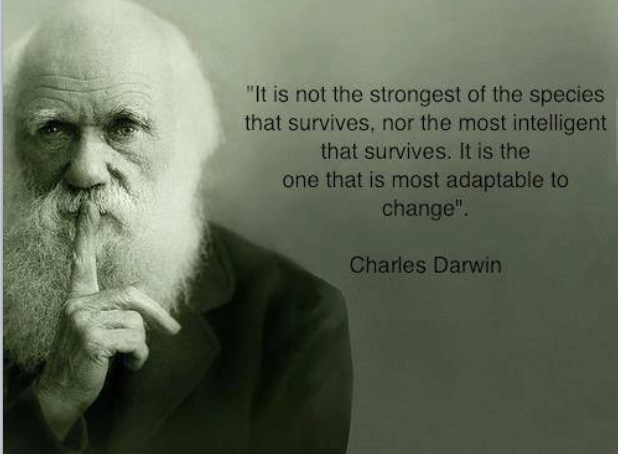
“Darwin’s Finches: An opportunity to observe evolution in action.” This article about the speed with which adaptation and evolution occur in a rapidly changing environment is the bedrock of the Million Trees blog. Nativists mistakenly believe that evolution is much slower than it is. Therefore, nativists believe plant and animal species are nearly immutable and that they are locked into mutually exclusive relationships, which are, in fact, extremely rare in nature.
“Nearly a HALF MILLION trees will be destroyed in the East Bay if these projects are approved.” The Million Trees blog was created to inform the public that nativism is destroying our urban forest in the San Francisco Bay Area. Our urban forest is composed of predominantly non-native trees. If they are destroyed, we will not have an urban forest because native trees will not survive in our changed and rapidly changing environment. Non-native trees were planted here because people wanted trees and native trees existed only in riparian corridors where they were sheltered from the wind and there was sufficient water.
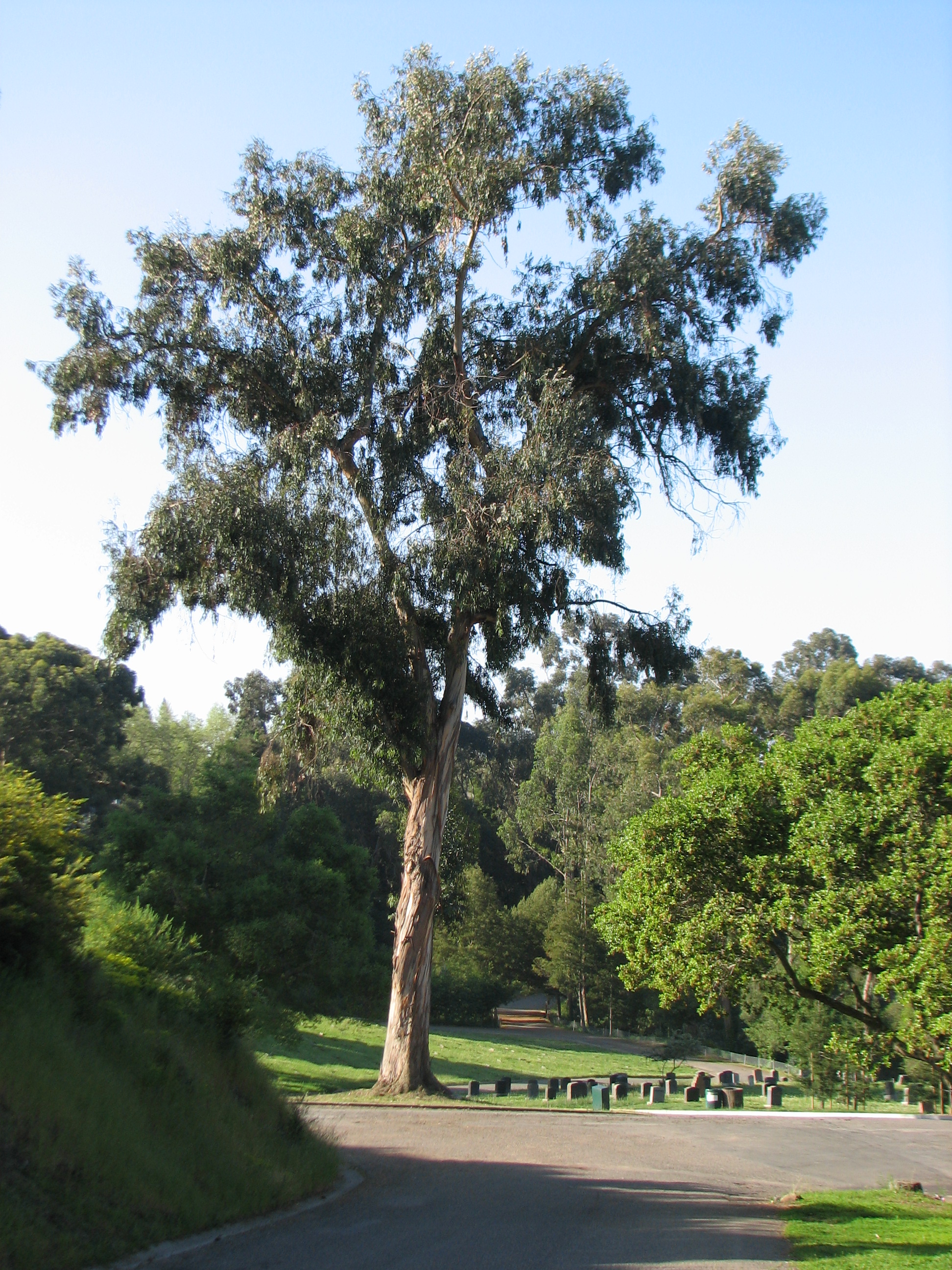
“Falling from Grace: The history of eucalyptus in California.” Because people wanted trees, they planted non-native trees that were capable of surviving in the San Francisco Bay Area. Non-native trees were valued for nearly one hundred years until nativism got a death grip on our public lands. This article on Million Trees tells the history of why eucalypts were planted and why they “fell from grace.”
In the past year, one of the most popular posts on Million Trees was “Krakatoa: A case study for species dispersal.” This post has been viewed by over 7,000 readers. Understanding how plants and animals were dispersed around the world by natural means–such as by birds, wind, and ocean currents—is another way to realize that the concept of “native vs. non-native” is an artificial construct with little practical meaning. Plants and animals have always moved and they will continue to move. In fact, as the climate changes, they MUST move if they are to find the environmental conditions in which they can survive.
Million Trees Commitment
Million Trees will continue to advocate for the preservation of our urban forest in the San Francisco Bay Area. Our strategy is to inform the public of the many projects that are destroying our forests and to describe the damage that is being done by those projects. We are particularly concerned about the use of pesticides to eradicate non-native plants and trees. We are equally committed to providing our readers the latest scientific discoveries that relegate invasion biology to a scientific back-water. We are hopeful that the gap between public policy and the scientific knowledge discrediting invasion biology will eventually be bridged and bring an end to this destructive fad.
Art Shapiro is no stranger to the long-time readers of Million Trees. Professor Shapiro is Distinguished Professor of Ecology and Evolution at UC Davis, and a renowned expert on the butterflies of California. He is the author of a seminal, frequently cited study of California butterflies that reported the results of 30 years of observing butterflies in his research transects. (1) He summarized this study in his Field Guide to the Butterflies of the San Francisco and Sacramento Valley Regions:
“California butterflies, for better or worse are heavily invested in the anthropic landscape [altered by humans]. About a third of all California butterfly species have been recorded either ovipositing [laying eggs] or feeding on nonnative plants. Roughly half of the Central Valley and inland Bay Area fauna is now using nonnative host plants heavily or even exclusively. Our urban and suburban multivoltine [multiple generations in one year] butterfly fauna is basically dependent on ‘weeds.’ We have one species, the Gulf Fritillary that can exist here only on introduced hosts. Perhaps the commonest urban butterfly in San Francisco and the East Bay, the Red Admiral is overwhelmingly dependent on an exotic host, pellitory. And that’s the way it is.”
Professor Shapiro has given us permission to reprint his Amazon review of the most recently published critique of invasion biology, Inheritors of the Earth, by Professor Chris Thomas (University of York, United Kingdom). We recommend Professor Thomas’s book to our readers. Although it is learned, it is accessible to the general public. This book is another step forward in the long march to acceptance of the reality of existing landscapes that are adapted to present climate conditions.
Million Trees
2011 Chris Thomas published a paper in the journal “Trends in Ecology and Evolution” entitled “Translocation of species, climate change, and the end of trying to recreate past ecological communities.” I immediately e-mailed him (April 11, 2011): “I have been delivering the same message in my advanced courses in Community Ecology and Biogeography for years, and have found the students by-and-large highly receptive, especially when they have internalized the overwhelming evidence for wild fluctuations in climate and vegetation since the end of the Ice Age 10-20,000 years ago. But over and over I have been told ‘but of course that is not the Party line…restoration ecology,’ blah, blah….Thank you for giving me a respectable citation, since merely citing one’s self can never do.” He e-mailed back: “…the conservation community in Britain seems mainly to be treating me with bewildered patience! I think that it will take time for everyone to become re-programmed to accept change as a reality.”
But of course change is not only a reality, it is the norm in ecology. Belief in equilibrium states and a “balance of nature” has been a dogma without a rationale beyond sentimentalism for many decades. There are coevolved segments of communities that are intimately synchronized and interdependent (say, figs and fig wasps or yuccas and their moth pollinators), but a great deal of any community is the product not of coevolution but of what Dan Janzen calls “ecological fitting,” whereby things haphazardly thrown together by the vicissitudes of geology, climate or commerce just happen to click. We are surrounded all over the globe by functioning communities and ecosystems with little to no history in geologic time. For about 40 years I have asked my students on their final exam how one might go about telling the difference between coevolved communities and “communities” assembled by chance. It is an exceedingly difficult question.
So this book is an expansion of the TREE [Trends in Ecology and Evolution] paper, and its message is vital. Resources for conservation are limited, and one must prioritize. The vast majority of naturalized alien species are harmless and many may be potentially beneficial. The ones that are genuinely harmful should be fought tooth and nail, but of course we do that anyway–we call it “pest management” and “public health.” The blanket indictment of “invasive species” makes no more sense than the blanket condemnation of human immigrants. Of course, when we say this, Thomas and I and Fred Pearce and “that Marris woman!” are immediately called out as shills for the extractive industries or the nursery industry or the Bilderbergers or the Zelosophists (conspiracy theory villains!!) or some despicable cartel of nature-haters. Pure poppycock. Truth-tellers attract trolls. That’s just the way it is.
Quite a few years ago a group of us took a prominent visiting British ecologist (not Thomas) on a field trip to the Sierra Nevada. We had half a dozen grad students and a few faculty crammed in a van. On the way up, one of the students sort-of apologized for the predominance of naturalized alien plant species in the lower foothill landscape. Our guest demurred forcefully: “Why must you consider this some kind of tragedy? Why don’t you see it as an opportunity for all kinds of evolutionary novelty to arise?” Indeed.
Thomas asks (p. 104): “How long will it be before the environmental police force of ecologists and conservationists is prepared to step back and decriminalize introduced species that have had the temerity to be successful?” An excellent question.
Stevie Nicks got over her fear of change: “Time makes you bolder…children get older…I’m getting older too.” Maybe conservationists can mature after all.
Arthur Shapiro
Professor Thomas’s book is very much in the mainstream. The Economist magazine included it in their list of important books published in 2017. It is one of only a few books in the category of “Science and technology” and it is at the top of the list. The Economist says of the book, “Humans have consigned species to extinction at an alarming rate. But hybridization and speciation is happening quickly too. An ecologist at the University of York shows how humans are bringing about a great new age of biological diversity. Extinctions ain’t what they used to be.”
The New York Times published a review of “Inheritors…” on New Year’s Eve. The reviewer summarizes Thomas’s main argument: “He argues that new species are arriving and evolving faster than old species are dying out globally…Instead of the sixth extinction, it’s a sixth genesis.” The reviewer faults Thomas for not portraying the “wonder of nature” and for giving oceans short shrift. But, the reviewer concludes with this observation about the unhelpful role that humans often play in conservation efforts: “It is human concerns that determine everything here on Earth now. An animal that arrived in a particular location hundreds or thousands of years ago is fine with us, while a more recent immigrant, like garlic mustard, is cause for alarm and extensive campaigns to extirpate the interloper. Nostalgia is deadly, as people kill to preserve or restore some ill-remembered but more natural past, and we disdain new species as weeds.” That observation about human attempts to control nature says it all. Plants and animals are not to blame for the damage we are doing to satisfy our ideological commitment to the distant past. They are symptoms of change, not the cause of change.
Happy New Year!
Million Trees
Update: Professor Thomas gave a presentation to the Long Now Foundation in San Francisco on June 19, 2018. HERE is a video of the introduction to his presentation.
And HERE is a presentation at the National Academy of Sciences, “Moving Times for the World’s Biodiversity.” If you haven’t read his book, his presentation is a good summary of the issues he covers in his book. MT
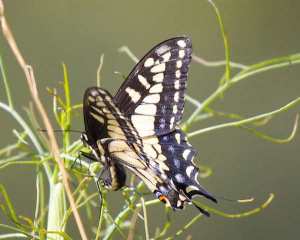
Anise Swallowtail butterfly in non-native fennel. Courtesy urbanwildness.org
Arthur M. Shapiro, “Exotics as host plants of the California butterfly fauna,” Biological Conservation,110, 413-433, 2003
In the 20-plus years we have advocated for the preservation of our urban forest, my collaborators and I have been accused of many nefarious motivations and deeds. Here is a small sample of what we have been accused of:
The Sierra Club leadership has accused us of being “climate-change deniers” in their publications, in radio interviews, and in written public comments. (We firmly believe in the reality of climate change and that is one of many reasons why we are opposed to the destruction of our urban forest.)
We have been accused of being funded by the Koch brothers by commenters on this blog and other associations with the right-wing, such as Fox News and more recently Kellyanne Conway. (I am not politically conservative.)
Discrediting one’s opponents is a standard debating tactic and we are neither surprised nor dissuaded by such name-calling. So, why are we raising the issue today? Because this name-calling has migrated into the realm of academic science. We find that shocking because academia is a place where we expect reason to prevail and debates to be based on evidence, rather than ad hominem attacks.
Academic scientists in New Zealand resort to name-calling
We have published several articles about the projects that are dumping rodenticides on islands all over the world to kill animals believed to be the predators of birds. The most aggressive projects are found in New Zealand where rodenticides have been aerial bombed on small islands for over 60 years. Recently New Zealand has made a commitment to expand that program to the mainland of New Zealand to kill all wild mammals that have been introduced by humans for over 700 years.
New Zealand intends to be “predator free” by 2050. As you might expect, many people in New Zealand object to this program because rodenticides are an indiscriminate killer of animals, such as the native species of parrot, the kea, and many domestic animals such as dogs. There are other concerns as well, such as the feasibility of such an undertaking and the toxicity of rodenticides to the environment and to humans.
Defending New Zealand’s native parrot, the kea
One of the authors of that aggressive program is an academic at University of Auckland in New Zealand, James C. Russell. His defense of his program and the academic discipline of invasion biology on which the project was based was published by an academic journal. (1) It is an unusual defense, one that we wouldn’t expect to find in an academic journal, because it does not use scientific evidence to defend the annihilation of non-native animals. Rather it accuses those who question those projects of having ulterior motives: “Where evidence is disregarded, or motivations are disingenuous, arguments against [the negative impacts of] invasive alien species take the form of science denialism,” which Russell defines as “the rejection of undisputed scientific facts” such as the causes of climate change or the risks of smoking tobacco.
Russell then tells us what he believes motivates critics of invasion biology:
“Science denialism typically originates from groups with a vested interest in opposition to the scientific consensus…” In other words, the profit motive explains the criticism of invasion biology, in Russell’s opinion.
“…there is a strong correlation with support of free-market ideologies such as laissez-faire. ” Russell paints critics of invasion biology into a right-wing corner.
Finally, Russell advises invasion biologists how to respond to “denialism” of their projects: “engage the criticisms but shift the debate from questions of scientific fact to questions of policy response.” And THAT is at the heart of the matter. Russell advises his colleagues to emphasize the policy goals, such as exterminating all wild mammals from New Zealand, rather than debate the scientific justification for that project. Since there is little scientific justification for this project, that seems like good advice. So, what is this advice doing in a scientific journal? That is the final question.
Academic scientists respond to Professor Russell
A few months after Russell’s ad hominem attack on academic critics of invasion biology, the same scientific journal published four rebuttals to Russell and Blackburn, written by 11 academic scientists.
“We disagree that there is scientific consensus around invasive species, and propose that much debate in this field stems from legitimate disagreement and not from disingenuous rhetoric.” (2)
“Constructing an ostensible category of ‘denialists’ reflects invasion biology’s traditional reliance on inflammatory exaggeration to impose and enforce a dichotomous doctrine.” (3)
“…society’s spectrum of diverse perspectives, aspirations, and personal trade-offs, which effectively constitute what Russell and Blackburn impugn as ‘vested interests,’ could and should influence society’s debates rather than be discredited.” (4)
“The organizations and individuals that continue to bemoan biodiversity loss are misleading the public and are directing conservation support away from the foremost problem, the precarious existence of species with remnant populations that are the result of habitat destruction and overexploitation.” (5)
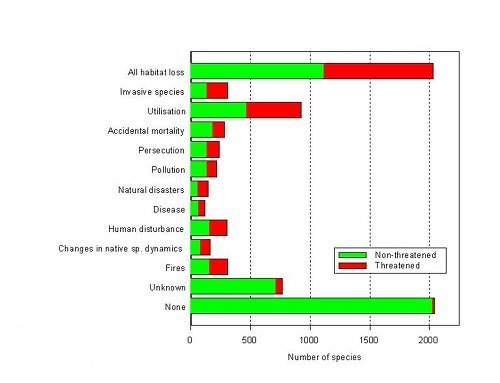
Threats to mammal species. Source: International Union for Conservation of Nature
Another academic publication also published a response to Russell and Blackburn: “Superficial understanding of the relationships between evidence and values creates exactly the dichotomization between science ‘believers’ and ‘denialists’ that Russell and Blackburn ostensibly seek to avoid. Rather than ‘standing up for science’ such dichotomization undermines it, rendering aspects of scientific enterprise ‘off limits’ to the kind of rigorous critical (self) examination fostered by science at its best.” (6)
Update:James Russell has come to the attention of the US military, according to a press report published on December 4, 2017. Russell says of his collaboration with the US military, “’And obviously we’re in the business of eradicating entire populations of animals from an island and so they have cocked their ear towards me once or twice. You don’t have to be a genius to see that there’s potential military application in that.’ In this instance, Russell’s work was being measured for suitability against a US$100 million research pot made available by the United States’ Defense Advanced Research Projects Agency (Darpa).”
As psychologists have informed us for decades, it is a short step from animal abuse to human abuse. The child who kills animals often becomes a killer of humans as an adult.
Professor Russell seems to be proud of his collaboration with the US military. In any case, he stands to profit from that collaboration. That’s ironic, given that one of his criticisms of the critics of invasion biology is that they have “vested interests” in their criticism. It seems that a grant from the US Military should be viewed as a “vested interest” in his advocacy for killing animals. And, as he says, he is “in the business of eradicating” animals.
Little scientific basis for invasion biology
Invasion biology as presently defined by academic science originated in the late 1950s. It began as a collection of hypotheses about the harm that non-native plants and animals were doing to native plants and animals. Like all hypotheses, it was based on speculation that had to be tested in the real world. In the past 25 years, many studies have been conducted that were designed to prove that non-native species are harmful to native species. With few exceptions, these studies came up empty. More often than not, studies found pros and cons to introduced species, just as we would expect of similar studies of native species. There is little evidence that invasion biology is an accurate description of how ecosystems operate.
When academic scientists are forced to resort to name-calling to defend invasion biology it no longer deserves the status of scientific hypothesis. And when it is discredited as a scientific discipline, it must be just a matter of time before the public realizes that there is no legitimate reason to kill non-native plants and animals.
We don’t see any sign of that paradigm shift, but we are hopeful that public policy will eventually be revised to reflect the reality that has been revealed by scientific studies. In the absence of scientific justification for eradication projects, they must be treated as public policy decisions. In a democracy, public policy decisions must reflect the public’s wishes. In the absence of public support, these projects will continue to cause conflict.
James C Russell and Tim Blackburn, “The Rise of Invasive Species Denialism,” Ecology & Evolution, January 2017
Sarah Crowley, Steve Hinchliffe, Steve Redpath, Robbie McDonald, “Disagreement About Invasive Species Does not Equate to Denialism: A Response to Russell and Blackburn,” Ecology & Evolution, April 2017
Mark Davis and Matthew Chew, “’The Denialists Are Coming!’ Well, Not Exactly: A Response to Russell and Blackburn,” Ecology & Evolution, April 2017
Jacques Tassin, Ken Thompson, Scott Carroll, Chris Thomas, “Determining Whether the Impacts of Introduced Species are Negative Cannot be Based Solely on Science: A Response to Russell and Blackburn,” Ecology & Evolution, April 2017
John Briggs, “Rise of Invasive Species Denialism” A Response to Russell and Blackburn,” Ecology & Evolution, April 2017
Susanna Lindstrom, “An Interdisciplinary Perspective on Invasive Alien Species,” PLoS Ecology Blog, October 2017
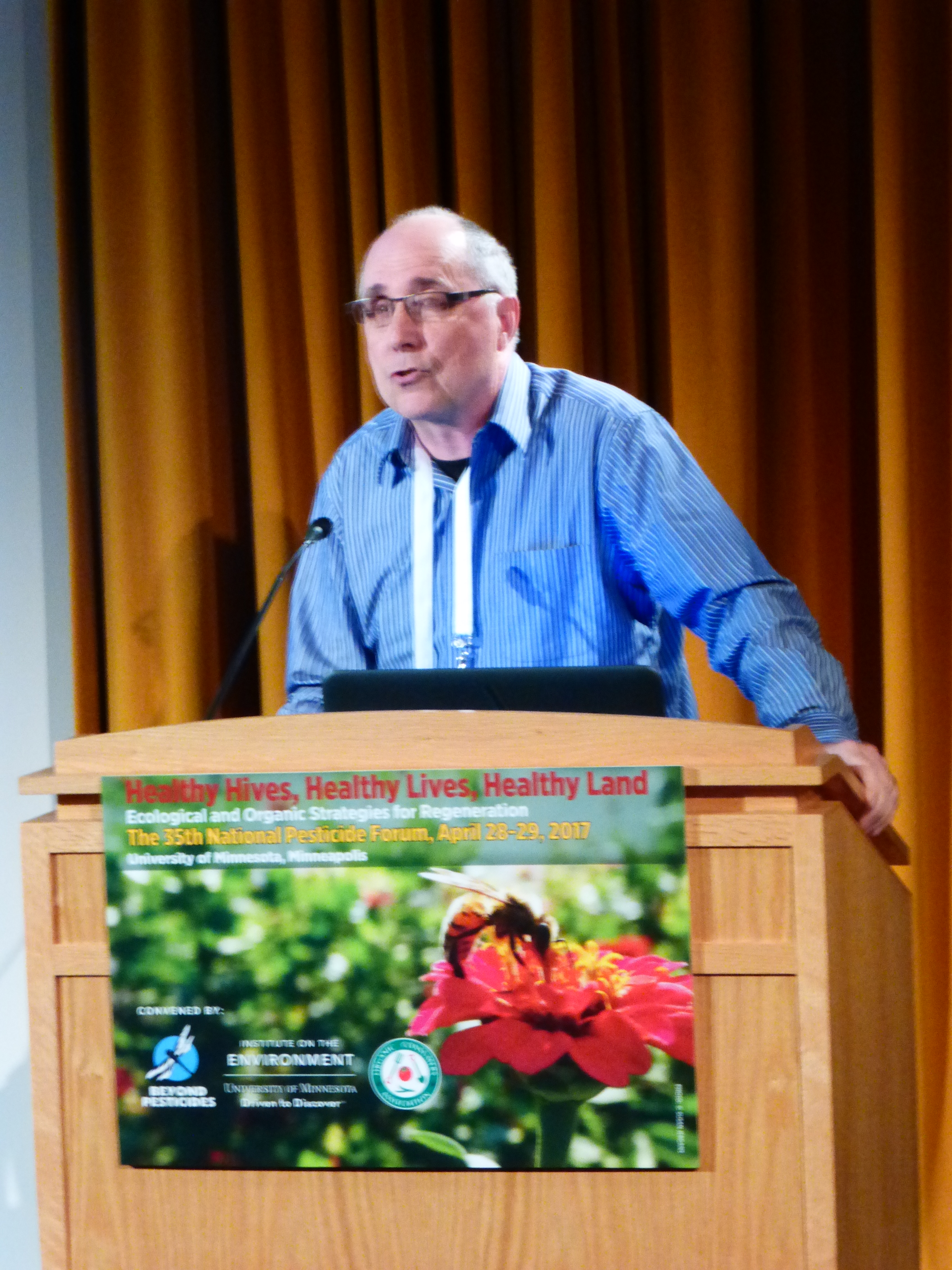
Mark Davis speaking at Beyond Pesticides conference, April 2017
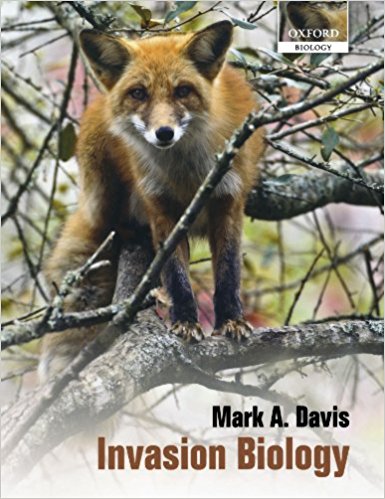
Mark Davis is Professor of Biology at Macalester College in St. Paul, Minnesota. He is one of the first academic ecologists to publicly express skepticism of invasion biology. His book, Invasion Biology, was published by Oxford University Press in 2009. It was the first critique of invasion biology written by an academic scientist. Professor Davis cites the many empirical studies that find little evidence supportive of the hypotheses of invasion biology.
In 2011, Nature magazine published an essay written by Professor Davis and 18 coauthors entitled, “Don’t Judge Species on their Origins.” This essay suggested that conservationists evaluate species based on their ecological impact, rather than whether or not they are natives. The essay initiated an intense debate in the academic community of ecologists that continues today.
Professor Davis spoke at the Beyond Pesticides conference in Minneapolis at the end of April 2017. (Video available HERE) He described invasion biology as an irrational ideology that is based on nostalgia for the past and a belief that wildlands are being damaged by “alien invaders.” In fact, the perceived damage is largely in the eye of the beholder, depending largely on one’s membership in a group benefiting from the nativism paradigm, such as chemical manufacturers, conservation organizations, government agencies, and employees. Some academic careers are also at stake. Futile attempts to re-create historical landscapes always have the potential to make things worse. In many instances, it is more sensible to change one’s attitude about the changing landscape than trying to change nature.
We invited Professor Davis to write a guest post for publication on Million Trees. We asked him to express his opinion on these questions:
Has the status of invasion biology changed much since Nature published your essay 2011?
Has increased knowledge of climate change had an impact on the status of invasion biology in academia?
What do you think is the future of invasion biology both as an academic discipline and as public policy?
Professor Davis’s guest post addresses these questions. We are grateful to Professor Davis for his many contributions to our understanding of the fallacies of invasion biology and for his thoughtful guest post.
Million Trees
Competition to define nature
In the past few years, a new perspective has been taking hold in the field of ecology. Referred to as ‘ecological novelty’ it emphasizes that many factors are producing ecologically novel environments. Climate change (which includes changes in temperatures and patterns of precipitation), increased atmospheric carbon dioxide, which affects photosynthetic rates, increased atmospheric deposition of nitrogen (the whole earth is being fertilized due to the increased nitrogen we are pouring into the atmosphere), and the introduction of new species are all rapidly changing our environments.
A strength of the term ecological novelty is that unlike the invasion vocabulary it is simply descriptive. It simply states that ecosystems are changing and are different than they were in the past, even the recent past. It says nothing about whether this change is good or bad. In this paradigm, species can be referred to as novel species, new arrivals, or long-term residents.
The less biased ecological novelty paradigm differs dramatically from the more ideological nativism paradigm. It differs in the language it uses and it differs in the implied direction that land management should proceed. More generally, it forsakes the normative atmosphere that permeates restoration ecology, conservation biology, and invasion biology, all of which have been substantially guided by the nativism paradigm.
The Sutro Forest in San Francisco is a good example of a novel ecosystem. It is a thriving mix of native and non-native species. Much of it will be destroyed by the irrational belief that native species are superior to non-native species. Million Trees
Currently, invasion biologists are trying to discredit ecological novelty as a valid or valuable perspective. This is hardly surprising since the ecological perspective would displace the nativism paradigm, and many stakeholders have much to lose if the nativism paradigm were abandoned, e.g. chemical companies, restoration and management companies, local, state, and national agencies, to name just a few. Not surprisingly, articles trying to shore up invasion ecology and to keep it relevant have been common in recent years.
While the public may not be aware of it, there exists a heated competition to define nature. Which side wins will significantly determine how nature is managed. Given that the redistribution of species is only going to increase in upcoming decades, it is hard to imagine that people will still be so preoccupied with origins by the middle of the century. Like the notion of wilderness, the nativism paradigm is more of a twentieth century concept, while the construct of ecological novelty is more fitting for the twenty first century.
Undoubtedly, nativist groups will still exist and will still be preoccupied with trying to restore their vision of the past. But, due to the number of species being moved to new regions, much more attention likely will be given to the function of species than their origins, if only for pragmatic reasons.For people coming of age now, cosmopolitanization is the new normal, both with respect to people and other species. We will still carry our predispositions to divide the world into us and them, but it should be clear to most that the nativism perspective will be obsolete and that beyond the creation of museums, restoring the past will not be possible, whether a city or a forest.
Currently Earth is the only planet we know of where life exists. In this context, the desire and practice of declaring some species as aliens, exotics, or invaders seems sadly provincial and even unseemly. Roman playwrite Publius Terentius Afer (aka Terence) wrote in his play Heauton Timorumenos, “Homo sum, humani nihil a me alienum puto”, or “I am human, and nothing of that which is human is alien to me.” To those who still see such value in distinguishing native from alien species, I say, “I am of the planet Earth and nothing of that which is earthly is alien to me.”
Mark Davis is Professor of Biology at Macalester College in St. Paul, Minnesota. He is one of the first academic ecologists to publicly express skepticism of invasion biology. His book, Invasion Biology, was published by Oxford University Press in 2009. It was the first critique of invasion biology written by an academic scientist. Professor Davis cites the many empirical studies that find little evidence supportive of the hypotheses of invasion biology.
In 2011, Nature magazine published an essay written by Professor Davis and 18 coauthors entitled, “Don’t Judge Species on their Origins.” This essay suggested that conservationists evaluate species based on their ecological impact, rather than whether or not they are natives. The essay initiated an intense debate in the academic community of ecologists that continues today.
Professor Davis spoke at the Beyond Pesticides conference in Minneapolis at the end of April 2017. (Video available HERE) He described invasion biology as an irrational ideology that is based on nostalgia for the past and a belief that wildlands are being damaged by “alien invaders.” In fact, the perceived damage is largely in the eye of the beholder, depending largely on one’s membership in a group benefiting from the nativism paradigm, such as chemical manufacturers, conservation organizations, government agencies, and employees. Some academic careers are also at stake. Futile attempts to re-create historical landscapes always have the potential to make things worse. In many instances, it is more sensible to change one’s attitude about the changing landscape than trying to change nature.
Mark Davis speaking at Beyond Pesticides conference, April 2017
We invited Professor Davis to write a guest post for publication on Million Trees. We asked him to express his opinion on these questions:
Has the status of invasion biology changed much since Nature published your essay 2011?
Has increased knowledge of climate change had an impact on the status of invasion biology in academia?
What do you think is the future of invasion biology both as an academic discipline and as public policy?
Professor Davis’s guest post addresses these questions. We are grateful to Professor Davis for his many contributions to our understanding of the fallacies of invasion biology and for his thoughtful guest post.
Million Trees
Competition to define nature
In the past few years, a new perspective has been taking hold in the field of ecology. Referred to as ‘ecological novelty’ it emphasizes that many factors are producing ecologically novel environments. Climate change (which includes changes in temperatures and patterns of precipitation), increased atmospheric carbon dioxide, which affects photosynthetic rates, increased atmospheric deposition of nitrogen (the whole earth is being fertilized due to the increased nitrogen we are pouring into the atmosphere), and the introduction of new species are all rapidly changing our environments.
A strength of the term ecological novelty is that unlike the invasion vocabulary it is simply descriptive. It simply states that ecosystems are changing and are different than they were in the past, even the recent past. It says nothing about whether this change is good or bad. In this paradigm, species can be referred to as novel species, new arrivals, or long-term residents.
The less biased ecological novelty paradigm differs dramatically from the more ideological nativism paradigm. It differs in the language it uses and it differs in the implied direction that land management should proceed. More generally, it forsakes the normative atmosphere that permeates restoration ecology, conservation biology, and invasion biology, all of which have been substantially guided by the nativism paradigm.
The Sutro Forest in San Francisco is a good example of a novel ecosystem. It is a thriving mix of native and non-native species. Much of it will be destroyed by the irrational belief that native species are superior to non-native species. Million Trees
Currently, invasion biologists are trying to discredit ecological novelty as a valid or valuable perspective. This is hardly surprising since the ecological perspective would displace the nativism paradigm, and many stakeholders have much to lose if the nativism paradigm were abandoned, e.g. chemical companies, restoration and management companies, local, state, and national agencies, to name just a few. Not surprisingly, articles trying to shore up invasion ecology and to keep it relevant have been common in recent years.
While the public may not be aware of it, there exists a heated competition to define nature. Which side wins will significantly determine how nature is managed. Given that the redistribution of species is only going to increase in upcoming decades, it is hard to imagine that people will still be so preoccupied with origins by the middle of the century. Like the notion of wilderness, the nativism paradigm is more of a twentieth century concept, while the construct of ecological novelty is more fitting for the twenty first century.
Undoubtedly, nativist groups will still exist and will still be preoccupied with trying to restore their vision of the past. But, due to the number of species being moved to new regions, much more attention likely will be given to the function of species than their origins, if only for pragmatic reasons.For people coming of age now, cosmopolitanization is the new normal, both with respect to people and other species. We will still carry our predispositions to divide the world into us and them, but it should be clear to most that the nativism perspective will be obsolete and that beyond the creation of museums, restoring the past will not be possible, whether a city or a forest.
Currently Earth is the only planet we know of where life exists. In this context, the desire and practice of declaring some species as aliens, exotics, or invaders seems sadly provincial and even unseemly. Roman playwrite Publius Terentius Afer (aka Terence) wrote in his play Heauton Timorumenos, “Homo sum, humani nihil a me alienum puto”, or “I am human, and nothing of that which is human is alien to me.” To those who still see such value in distinguishing native from alien species, I say, “I am of the planet Earth and nothing of that which is earthly is alien to me.”
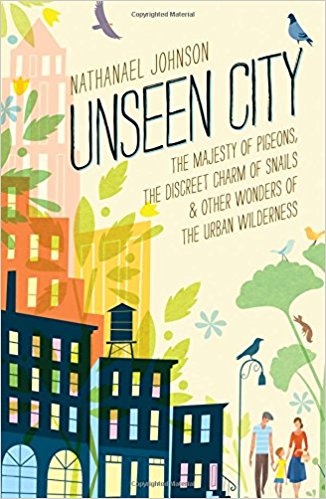
It was pure pleasure to read Unseen City (1). Unlike most nature writing, Nathanael Johnson asks readers to notice and appreciate the urban nature that we tend to take for granted. Ironically, the plants and animals that we see every day and in great numbers do not get the attention they deserve. Most nature writing tends to focus on rare and remote species to which we have little access and often laments their absence where we live. Conservationists often advocate for expensive programs to reintroduce rare species to urban centers where they haven’t lived for decades, if not centuries.
Johnson’s focus on the ordinary species around us is refreshing. We were happy to take a break from the usual hand-wringing about loss of biodiversity and instead enjoy the richness and beauty of the nature we have. It is our loss when we ignore the nature we have. Johnson’s intense focus on urban species reveals that they are every bit as interesting as the rare species we seldom see. Johnson’s approach to nature is analogous to the optimist’s “glass-half-full” approach to life.
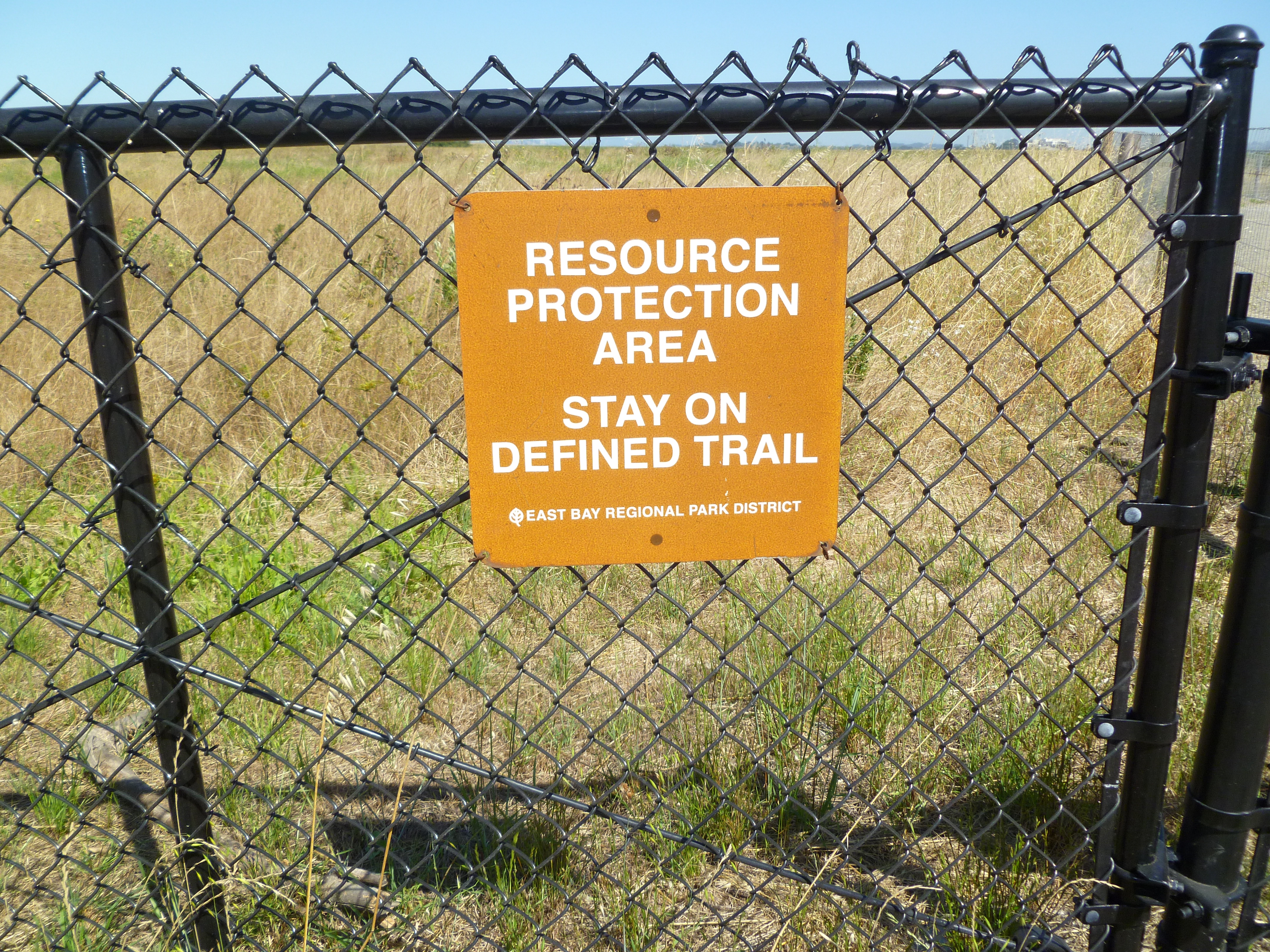
Another appealing aspect of Johnson’s approach is that his story is told from the perspective of a young father, introducing his toddler daughter to the mysteries of nature. One of our primary concerns about the museumification of our parks by native plant advocates is that children are being deprived of the opportunity to interact with nature. Being required to stay on trails or observe from behind fences is no way for children to appreciate the complexity and beauty of the natural world. Johnson takes his daughter deep into the weeds to experience nature in a physical, tactile way.
A few examples of the homely creatures in our cities
Johnson wrote his book while living in San Francisco and then in Berkeley. So, the species he encounters and studies are those with which we are all familiar. Here are some of the creatures he tells us about, with a few of the interesting things we learn about them.
Pigeons are reviled by many serious bird watchers. In fact, they are remarkable creatures in many ways. They mate for life and they are extremely devoted parents. They tend to nest in the same place and their ability to find and return to that nest from long distances is one of the reasons why humans have formed intense relationships with them. There is a long tradition of keeping homing pigeons that are raced by their keepers in competitions that occur all over the world. The pigeons are taken long distances from their nests and then timed on how long it takes them to return home. Johnson tells remarkable stories about how pigeons overcome challenging attempts to prevent them from finding their way home.
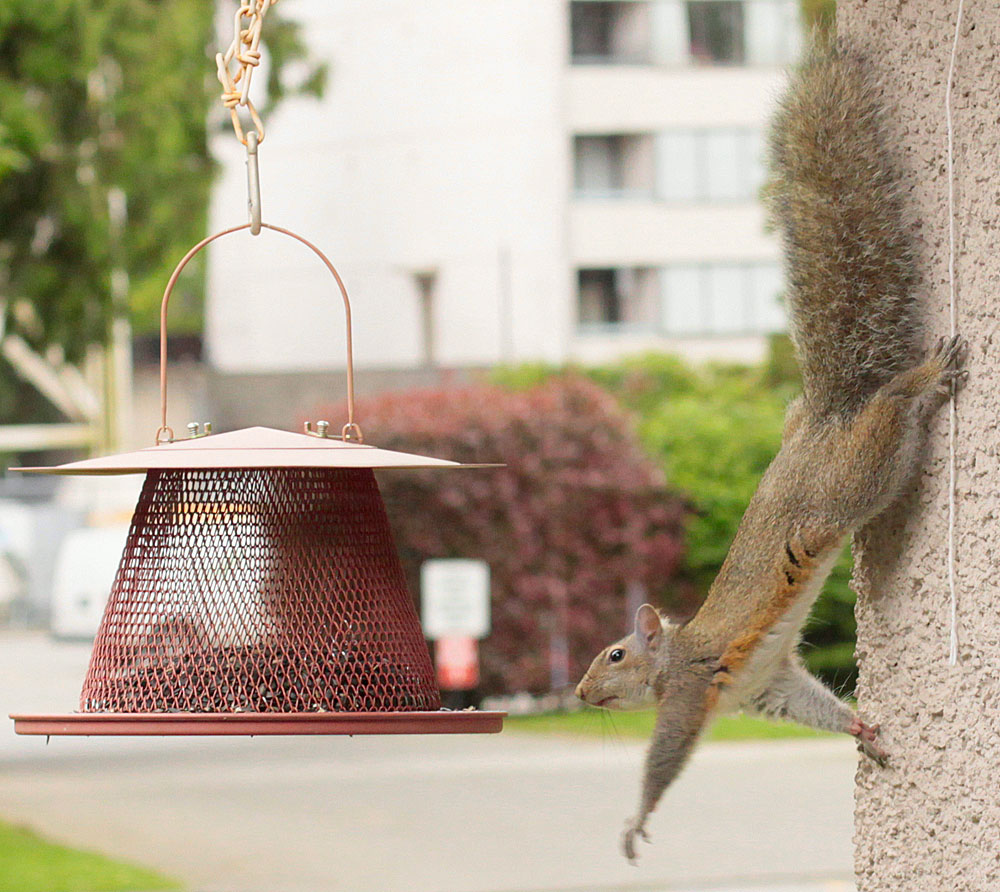
Eastern grey squirrel. Creative Commons
Squirrels are both extremely agile and very resourceful. Here is an example of how squirrels defeated an attempt to keep them out of a bird feeder: “…squirrels had to climb up through a vertical pipe, leap onto a blade of a spinning windmill, cling to it, and then sail off on the right trajectory to land on a platform. Then they had to go paw over paw upside down along a suspended chain that passed through a series of spinning disks, negotiate a revolving door, run through a slack canvas tube, and keep their balance while crossing a pole covered with slick spinning rollers. From there, it was a six-foot jump to another tunnel, through which they had to ride a sliding vehicle made to look like a rocket ship by pushing it along with their paws. Finally, there was an eight-foot jump to the food.” (1) I retell this to story to spare our readers the pointless effort of trying to prevent squirrels from raiding their bird feeders.
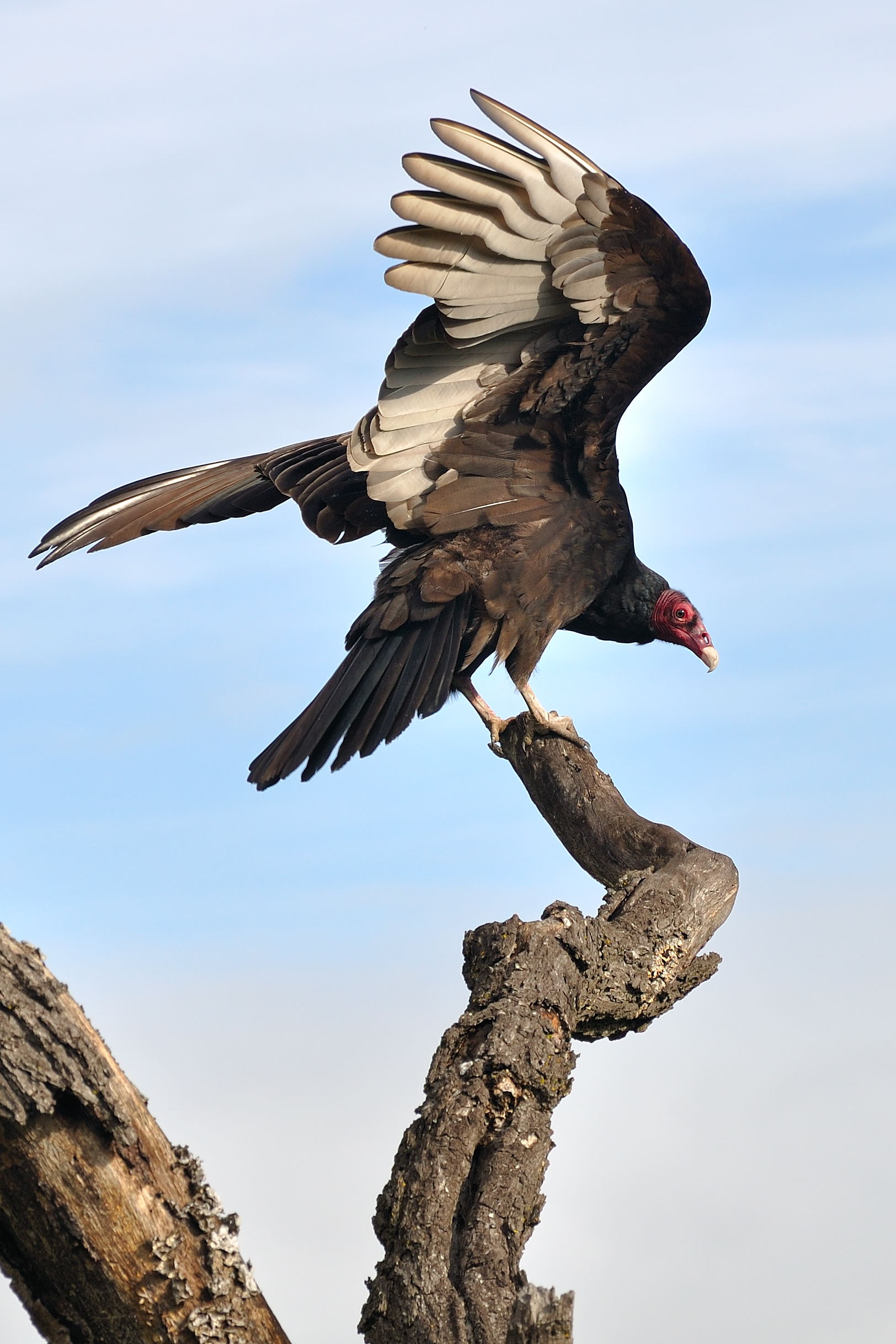
Turkey vulture in San Jose, California by Dan DeBold. Creative Commons
The turkey vulture is another underappreciated bird. They eat primarily dead animals and many of those animals died of diseases or toxic chemicals and are rotten and maggot infested when they are finally found (by smell) and eaten by the vulture. The digestive and immune system of the vulture is capable of detoxifying chemicals and killing bacteria and viruses in the dead animal. In other words, the vulture is cleaning up the remains of dead animals. India has learned the value of vultures the hard way. They killed many of their vultures with an anti-inflammatory drug they were feeding to their livestock. When their vulture population dwindled, they were buried in dead animals, many dangerously diseased and toxic. We eradicate animals at our peril because we often don’t understand the roles they are playing in the ecosystem.
Defending novel ecosystems
In addition to asking his readers to appreciate the positive qualities of the creatures in our cities, he also asks us to reconsider the deep prejudice against them that has become the conventional wisdom. Plants and animals that people believe were transplanted by humans into places where they did not exist in the distant past are considered “alien invaders” that dominate their predecessors, driving them out and reducing biodiversity.
This narrative, which originated in academic science as “invasion biology” in the 1960s, has become a popular story with the media, which is always attracted to scary stories. The media is significantly less interested in the peaceful resolution of their horror stories. With few exceptions, an introduced species that initially seems to be a problem eventually fades into the woodwork to become just another player in the ecosystem. Johnson uses the Argentine ant as one of many examples of an introduced species that spread rapidly, but 20 years later has nearly disappeared. In other cases, a species initially considered an unwelcome intruder becomes a valuable asset, such as zebra mussels which filter pollution from lakes and have become a source of food for diving birds.
Novel ecosystems are the future
Johnson concludes his book with this reminder that novel ecosystems have been created by human disturbance and that we should be grateful for the plants and animals that are capable of surviving our abusive treatment of the planet:
“The species that I’ve written about here are, at best, invisible, and at worst, reviled. We honor least the nature that is closest to us. As Courtney Humphries put it in Superdove, ‘We create and destroy habitat, we shape genomes, we aid the worldwide movement of other species. And yet we seem disappointed and horrified when those plants and animals respond by adapting to our changes and thriving in them.’
“Because they are associated with human disruption, the organisms that spring up from our footprints look like corruptions of nature. But I’ve come to see it the other way around: These species represent nature at its most vital and creative.
“Nature never misses an opportunity to exploit a catastrophe. When humans bulldoze and pave, nature sends in a vanguard of species that can tough it out in the new environment. These invasive species are not nature’s destroyers, but rather its creators. They begin setting up food webs, they evolve and diverge into new species. Because humans purposefully import exotic plants—along with the insects, seeds, and microbes we accidentally bring in from around the world—cities are remarkable centers of biodiversity. These creatures crossbreed, hybridize, eat one another, form cooperative relationships, and evolve. And so, at a time when thousands of species are at risk of extinction because of our destruction of wilderness, new species are springing up in the new habitats we have created.” (1)
Worshipping the rare at the expense of the common
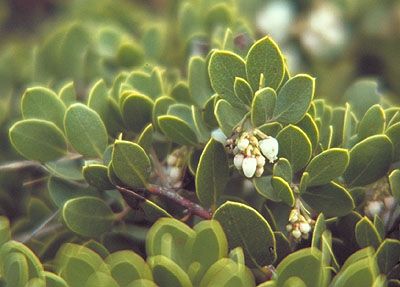
The ONLY known Raven’s manzanita plant is in the San Francisco Presidio. Its exact location is a secret to protect it.
Vast sums of money are being spent in often futile attempts to reintroduce rare plants and animals to urban environments where they have not lived for a long time. The National Park Service and San Francisco’s Natural Resources Division are having little success with their efforts to reintroduce Mission Blue butterflies. After over 30 years, the National Park Service has still not successfully germinated endangered Raven’s manzanita from seed. These fruitless efforts are not just wasteful of resources, they also inflict damage on the environment by using pesticides and setting fires to eliminate competition and destroying trees to increase sunlight on rare plants and host plants of rare insects.
The veneration of rare plants and animals is often at the expense of the plants and animals that are adapted to present environmental conditions. In Unseen City Nathanael Johnson invites us to place greater value on the ordinary creatures who are capable of living with us. We can treat them with the respect they deserve by not destroying them in pursuit of a fantasy landscape populated by fantasy creatures that are not capable of surviving the changes we have made in the environment.
Nathanael Johnson, Unseen City: The majesty of pigeons, the discreet charm of snails and other wonders of the urban wilderness, Rodale Wellness, 2016
Our family contributed to several mainstream environmental organizations for decades. We were Sierra Club members because we wanted clean water and clean air. We were Audubon Society members because we care about birds and other wildlife.
About ten years ago, we learned that these organizations were actively participating in projects demanded by native plant advocates to destroy our non-native urban forest and fence the public out of its public parks in order to turn our parks into native plant museums. When we learned about the huge quantities of pesticides used by these projects that was the last straw.
The Berkeley Meadow is a 72-acre native plant garden on a former garbage dump on landfill.
We spent several years trying to convince these organizations that they were making a mistake by supporting projects that are doing far more damage to the environment than any theoretical benefit of native plants. Much of our effort was directed to the Sierra Club because they claim to be a democratically run organization. After several years of futile attempts to change the policies of these organizations, we quit because we did not want to contribute to the damage they are doing to the environment.
Logo of The Nature Conservancy.
The Nature Conservancy was the only environmental organization to which we were still contributing. Below is our “resignation” letter to The Nature Conservancy, which explains why we finally gave up on them as well. This was not an easy letter to write because we care deeply about the environment and the animals who live in it. We believe that environmentalism has an extremely important role to play in society and we would like to participate in an organization that is focusing on the environmental issues of our time, particularly climate change.
September 2016
Mark Tercek, Executive Director
The Nature Conservancy
Dear Mr. Tercek,
We have been contributors to The Nature Conservancy for decades. In the past few years we increased our donations because of the publications of TNC’s former Chief Scientist, Peter Kareiva.
While other mainstream environmental organizations were actively supporting destructive and restrictive ecological “restorations,” Mr. Kareiva was questioning that conservation strategy. In his publication, “What is Conservation Science?” Mr. Kareiva said, “Our vision of conservation science differs from earlier framings of conservation biology in large part because we believe that nature can prosper so long as people see conservation as something that sustains and enriches their own lives. In summary, we are advocating conservation for people rather than from people.” Mr. Kareiva was also articulating that revised mission for conservation in presentations around the country (which we attended), in TNC’s publications, and in mainstream media.
As you know, Kareiva’s viewpoint was in conflict with the old guard of conservation biologists who subscribe to the tenets of invasion biology. This conflict resulted in a confrontation of the old guard against TNC that was reported by the New Yorker in 2014. TNC resolved that conflict by making a commitment to quit publishing Mr. Kareiva’s viewpoint in mainstream media and by restoring eradication of “invasive” plants to its budget. That agreement foretold Kareiva’s departure from TNC. Not publishing is tantamount to career suicide for scientists. Mr. Kareiva has left TNC, as any self-respecting scientist would who has been deprived of his freedom to publish.
While this battle between competing visions of conservation played out, the country’s foremost invasion biologist, Daniel Simberloff, conducted a survey of TNC project managers to determine what, if any, impact Kareiva’s leadership was having on TNC’s conservation strategies. Most survey respondents (95%) reported that they “manage” non-native species and nearly all reported that they would devote more effort to that task if more resources were made available. Project managers devote a “substantial proportion” of their resources to “managing” non-native species and they expressed skepticism about “academic research and the invasion management controversy in particular.” Simberloff did not ask project managers what methods they are using and so we have no insight into the use of pesticides by TNC. This is probably information that Simberloff would rather we not have. Invasion biologists prefer to ignore the destructive methods that are used in the fruitless attempt to eradicate non-native plants.
Ecological “restorations” are damaging the environment by destroying useful habitat, poisoning open spaces with pesticides, and killing animals perceived to be competitors of native animals. These projects are usually futile because the plants and animals that are being eradicated are adapted to current environmental conditions that are not reversed by their elimination. The “native” ranges of plants and animals must change in response to changes in the environment, most notably climate change. So-called “invasive” species are symptoms of change, not causes of change.
Here in the San Francisco Bay Area, our urban forest is being destroyed because it is predominantly non-native. Native plant advocates have fabricated an elaborate cover story to mask nativism because widespread destruction of plants and animals does not appeal to the public. Our public lands and open spaces are being poisoned with pesticides to kill vegetation and prevent trees from resprouting after they are destroyed. We are unwilling to support that agenda by contributing to organizations that engage in these projects.
Therefore, we will not renew our TNC membership and we will not contribute further to TNC. If and when TNC abandons its attempts to eradicate plants and animals that are performing valuable ecological functions, we would gladly renew our contributions.
Sincerely,
[Former Members of The Nature Conservancy]
Referenced sources:
D.T. Max, “Green is Good,” New Yorker, May 12, 2014
Sara Kuebbing and Daniel Simberloff, “Missing the bandwagon: Nonnative species impacts still concern managers,” NeoBiota , April 14, 2015
For those who may not be familiar with The Economist magazine, let us introduce this venerable publication to you. The Economist is a weekly news magazine published in Britain continuously since 1843. It has a readership of over 1.5 million and about half of its readers are in America. Its viewpoint is fiscally and politically moderate (it endorsed Ronald Reagan and Bill Clinton) and socially liberal (it supports same-sex marriage and immigration). It is widely read by the business community and public policy makers. In other words, it is an influential, mainstream source of information.
Therefore, The Economist’s recent articles about invasion biology represent a significant step forward in the effort to stop the pointless and damaging crusade against harmless non-native plants and animals. The following is an excerpt from the editorial version of a longer article in the December 5, 2015 edition of The Economist. We have added emphasis and a few photos.
“In Defense of Invaders”
“EVERYBODY loves to hate invasive species. Americans battle rampant plants such as kudzu, a Japanese vine; Europeans accuse the American grey squirrel of spreading disease and damaging forests. As The Economist went to press, a scientific committee was expected to sign off on Europe’s first invasive-species blacklist. Cross-border trade in 37 species will be banned (the list is bound to grow longer as conservationists add more troublemakers). Where it is not already too late to wipe out these alien invaders, EU member states will be required to do so.
“Europeans are restrained in comparison with other countries. The international list of invasive species—defined as those that were introduced by humans to new places, and then multiplied—runs to over 4,000. In Australia and New Zealand hot war is waged against introduced creatures like cane toads and rats. In 2013 New Zealand used helicopters to drop a poison known as 1080 on 448,000 hectares of land—an area about the size of Yosemite and Sequoia national parks put together. Just four public objections were recorded.
“Some things that are uncontroversial are nonetheless foolish. With a few important exceptions, campaigns to eradicate invasive species are an utter waste of money and effort—for reasons that are partly practical and partly philosophical.
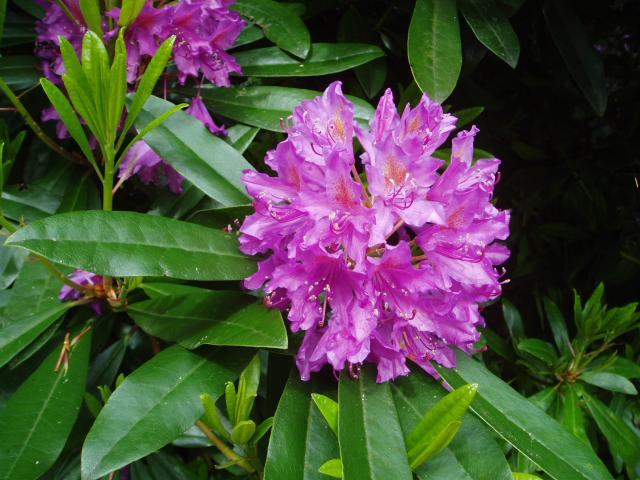
Rhodedenron ponticum, one of only a dozen plants considered invasive in Britain. Wikimedia Commons
“Start with the practical arguments. Most invasive species are neither terribly successful nor very harmful. Britons think themselves under siege by foreign plants like Japanese knotweed, Rhododendron ponticum and Himalayan balsam. In fact Britain’s invasive plants are not widespread (see article), not spreading especially quickly, and often less of a nuisance than vigorous natives such as bracken. The arrival of new species almost always increases biological diversity in a region; in many cases, a flood of newcomers drives no native species to extinction. One reason is that invaders tend to colonise disturbed habitats like polluted lakes and post-industrial wasteland, where little else lives. They are nature’s opportunists.
Honeybee in non-native wild mustard
“New arrivals often turn out to be useful, even lovely. Americans fret about the decline of a vital crop-pollinator known as the American honey bee. Apis mellifera is actually an invader from the Old World: having buzzed from Africa to Europe, it was brought to America by colonists and went wild. Invasive plants provide food and nests for vulnerable natives; invasive animals can help native species by killing their predators, as the poisonous cane toad has done in Australia.
“Another practical objection to the war on invasive species is that they are fiendishly hard to eradicate. New Zealand will not get rid of its rats any more than Britain could wipe out its grey squirrels. Culls tend to have a short-term effect at best. It is, however, sometimes possible to get rid of troublesome immigrants on tiny oceanic islands. Because the chances of success are higher, and because remote islands often contain rare species, efforts there are more worthwhile.
“The philosophical rationale for waging war on the invaders is also flawed. Eradication campaigns tend to be fuelled by the belief that it is possible to restore balance to nature—to return woods and lakes to the prelapsarian idyll that prevailed before human interference. That is misguided. Nature is a perpetual riot, with species constantly surging, retreating and hybridising. Humans have only accelerated these processes. Going back to ancient habitats is becoming impossible in any case, because of man-made climate change. Taking on the invaders is a futile gesture, not a means to an achievable end.
“No return to Eden”
“A rational attitude to invaders need not imply passivity. A few foreign species are truly damaging and should be fought… It makes sense to keep out pathogens… Fencing off wildlife sanctuaries to create open-air ecological museums is fine, too….You can garden in a garden. You cannot garden nature.”
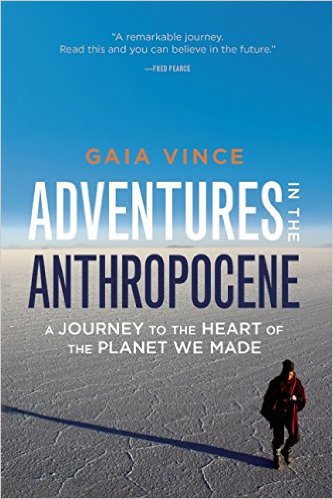
Adventures in the Anthropocene: A Journey to the Heart of the Planet We Made is, indeed, a journey. (1) Its author, Gaia Vince, traveled the globe for two years to witness first-hand the impact of human civilization on the planet. It is an even-handed account, in which grim realities are described but are balanced with optimistic predictions of the innovations that will ultimately enable us to cope with them.
Ms. Vincent takes us to remote corners of the Earth where undeveloped communities are further impoverished by climate change and related changes in the environment. Rising temperatures and reduced rainfall have forced many agricultural communities off their ancestral lands and into a more marginal existence. In Bolivia, for example, former farmers have been displaced into brutal mines where life span is typically shortened by health and safety hazards. Some Pacific and Indian Ocean islands have been drowned by rising sea levels, forcing mass evacuations onto those that remain. Their protective reefs are dissolving in the increasingly acidic ocean.
Meanwhile, enterprising people are responding to threats their communities are facing. In the Indian Himalayas, for example, artificial glaciers are being created to replace those that are melting. Glaciers were the irrigation system that enabled agriculture in marginal conditions. Torrential downpours caused by climate change are frozen on dammed, flat plains to create artificial glaciers that perform the same function. In a remote village in Nepal, a villager returns from his Western education to bring his impoverished community into the 21st century by creating a wi-fi network that provides internet access. The internet brings education to a village that could not afford teachers. It is powered by a small hydroelectric generator in a glacial stream. The stream is expected to disappear when the glacier melts in a decade or two, a problem yet to be solved.
These stories and a multitude of others are both sobering and inspiring, but we will focus on the issues relevant to Million Trees.
Harvesting fog with trees
The coast of Peru is one of the driest places on the earth. There are places in Peru where no rain has been recorded. The city of Lima is near the coast and its climate is similar to San Francisco. There is little rain, but there is a great deal of fog. Lima, like many cities in undeveloped countries, is surrounded by shanty towns in which poor people build make-shift shacks and live without modern services such as water, power, and sewage systems.
Demonstrating once again, that poverty is sometimes the mother of invention, the people of one of these shanty towns are attempting to grow a forest on their sand dune. The trees are being irrigated with water harvested by huge fog nets, which are also supplying the community with drinking and washing water. Within four years, the community expects the trees to be large enough to harvest the fog without the help of the fog nets, “producing a self-sustaining run-off that will replenish ancient wells and provide water for the community for the first time in 500 years.” (1)
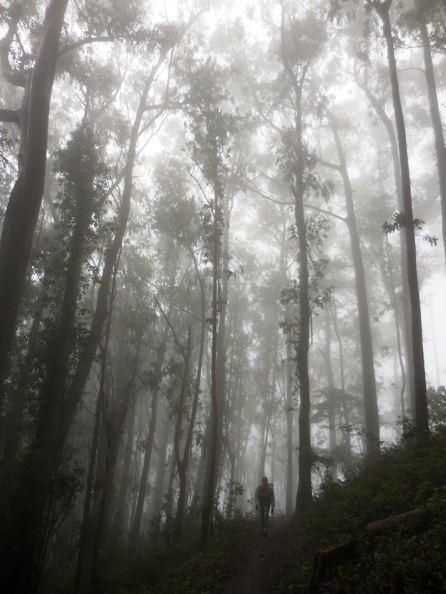
Sutro forest on a typical summer day. Courtesy Save Sutro Forest.
This is a familiar scenario to the readers of Million Trees. Fog drip in the eucalyptus forests in San Francisco has been measured at over 16 inches per year. In the driest months of the year, soil moisture in San Francisco’s eucalyptus forest has been measured at over 10%, while soil moisture in grassland was only 2% and 4% in shrubs. (2)
The value of forests and the dangers of deforestation
Each chapter of Adventures in the Anthropocene is devoted to a different ecosystem. Each ecosystem is introduced with a description of the importance of that ecosystem and the way in which is it being compromised by the activities of humans in the Anthropocene. Here are a few excerpts from the chapter about forests, which will be familiar to the readers of Million Trees.
“Forests play an important role in local and global climate. The world’s forests absorb 8.8 billion tonnes of carbon dioxide each year through photosynthesis—about one-third of humanity’s greenhouse gas emissions.”
“…their canopies provide shelter from the sun and wind, making forests much wetter, cooler environments than surrounding treeless areas. This nurtures streams and rivers, provides habitat for a range of amphibians and other life, helps cool the regional and global atmosphere, and recycles water.”
“Although forests help create the climate, they are also exquisitely sensitive to it—and the smaller a forest gets, the less resilient it is. When trees are chopped down, sunlight enters in the gap and dries the soils. Drought upsets the forests’ delicate water cycle—trees start to die and the entire ecosystem can tip from rainforest to grass-dominated savannah.”
“Deforestation emits carbon dioxide from soils and decaying plant matter, and is responsible for around 20% of all carbon dioxide emissions.”
One point bears repeating because it is relevant to our local version of deforestation. In some cases, native plant advocates have succeeded in their demand to destroy 100% of our urban forest because it is predominantly non-native. In other cases, they have only been able to convince land managers to “thin” the forests, although “thinning” does not seem an accurate description of destruction of 90% of the trees. In any case, we should all understand that the ultimate likely outcome of the “thinning” strategy is an eventual clear-cut because “when trees are chopped down, sunlight enters in the gap and dries the soils….trees start to die and entire ecosystem can tip” from forest to grassland. The drying of the soil is only one factor in this prediction. The remaining trees also will be vulnerable to wind throw. And the herbicides used to prevent the destroyed trees from resprouting are mobile in the soil and are likely to damage the trees that remain. Plans to “thin” the forest are either based on ignorance or are a strategy designed to achieve the same goals as a clear-cut with less public opposition.
Are invasive species a problem?
We were gratified that there was barely a mention of “invasive” species in the detailed accounts of the impact of human civilization on the planet. The conventional wisdom that “invasive” species are one of the primary causes of species extinction is waning and this book reflects that fact.
Galapagos Islands
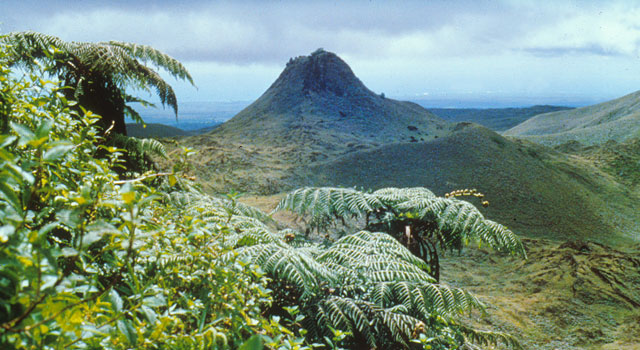
The pros and cons of introduced plant species are debated in the context of the Galapagos Islands, where biodiversity is worshipped because it was instrumental in Darwin’s theory of evolution. Ms. Vince interviewed the conservationist who has been battling invasive plant species on the Galapagos for 20 years. He recently decided that attempts to eradicate introduced plants are futile and he now calls them native plants. His surrender to this reality is controversial, but he is resolute. He is supported in this decision by scientists who have studied novel ecosystems and find ecological value in them. The rebuttal to such defense of novel ecosystems is that the globalization of ecosystems is homogenizing the world’s biota.
Ms. Vince concludes that proponents of eradicating non-native plants are losing the battle against the “McDonaldization” of nature: “From the Galapagos to Hawaii, conservationists are switching tack and starting to embrace the introduced species of Anthropocene ecosystems…” because “In some places, invasives have enhanced the landscapes, reducing erosion, providing handy cash crops or food and habitat for other wildlife.”
We can only hope that our local version of “conservation” in the San Francisco Bay Area will catch up with this new realistic perspective in time to save our urban forests from being needlessly destroyed.
Epilogue
The final chapter of Adventures in the Anthropocene is an epilogue, which takes place in 2100 in London. The author’s son muses at the age of 87 about which of his mother’s many predictions occurred in the 21st Century. As we would expect, it was a tumultuous century, one in which drastic changes were made to accommodate the changing climate.
We conclude with the final paragraph of Adventures in the Anthropocene, because it is the most optimistic prediction in this excellent book:
“…the world has become a kinder place. The terrible wars, the famines, the terrorism, extremism and hate, the drownings and deaths of hundreds of thousands of migrants the humanitarian crises…they seem to be over now…The great global mix-up of people that has occurred as a result of climate migration, urbanization, and online networks has produced a new, socially mobile, egalitarian society. The world’s giant cities force people to live together in close but diverse communities, and it has generated a spirit of cooperation.”
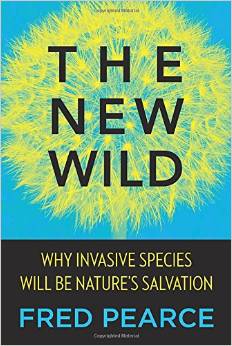
The New Wild by Fred Pearce (1) is the third book to be published in three years which challenges the conventional wisdom that native species are inherently superior to non-native species and the closely related corollary assumption that all non-native species are competitors of native species. These are the assumptions that underlie invasion biology. Each book has been progressively more pointed in its criticism of this ideology, masquerading as a scientific discipline.
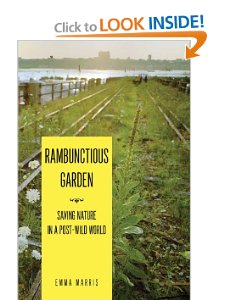
Rambunctious Garden
The first book to be published in 2011—Rambunctious Garden by Emma Marris (2)—was timid in its approach in comparison to The New Wild. Ms. Marris visited “restoration” projects all over the world. She described unsuccessful efforts to eradicate non-native plants and animals as well as extreme attempts to “rewild” that are often a mishmash of plant and animal species from different native ranges and time periods. She implied that these projects were futile as well as artificial, but she was not explicitly critical. Despite her cautious approach, she has been subjected to intense criticism from both academics and practitioners of invasion biology. The following excerpt of a reader’s review of Marris’s book found on Amazon.com is typical of the criticism:
“Earth as cookie jar”
“Emma Marris, the author of Rambunctious Garden (RG), loves the nature hiding in back street alleys and along the highway median strip. Marris believes it’s time to abandon (or de-emphasize) what she sees as outdated and naïve conservation strategies such as creation of national parks and wilderness reserves. She feels the biggest obstacles to a bold new world of “designer” and “novel” ecosystems is the “wilderness cult” that naively wants to preserve “natural” landscapes–which she says do not exist anymore.
Marris espouses the anthropocentric perspective that the Earth is more or less a resource cookie jar for humans–to be used carefully to be sure–but she doesn’t really question whether ethically or ecologically this is ultimately a good idea…
However, by moving the goalposts to vacant city lots as an acceptable desired future condition of the landscape, she implicitly, if not explicitly, provides cover for all manner of environmental degradation.”
Most of the 35 readers’ reviews about Rambunctious Garden on Amazon.com are equally critical. This particular review was rated as “helpful” by 141 other readers and 21 comments were also posted in support of the critical review. Marris and her book have been thrashed in many other venues, including conferences where she is called out by name as an enemy of nature by invasion biologists.
Where do camels belong?
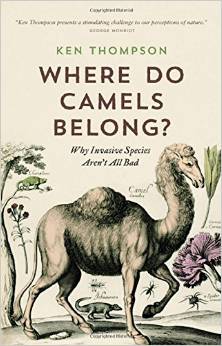
The second book, which challenges the assumptions of invasion biology, was published in September 2014. Where do camels belong? by Ken Thompson, a British academic, (3) is much more explicit in its criticism of invasion biology. One of its strong suits is the examples of the ambiguity and absurdity of the often muddy distinction between native and non-native. As we might expect, this distinction is less clear in Britain because it has a much longer history of “invasion” than North America (only because invasion biologists have chosen to define “native” in North America as any species that precedes the arrival of Europeans). Professor Thompson offers some comic examples of how status as a native has been conferred in Britain and the contortions that are required to provide preferential treatment to these “natives.”
Despite kicking up the level of criticism of invasion biology a notch, reviews of Professor Thompson’s book are far more positive than those of Ms. Marris’s book.
The New Wild
The New Wildwas published in the US in April 2015. Fred Pearce does not pull his punches in The New Wild. He methodically lays out all the reasons why invasion biology no longer deserves the status of a scientific discipline. The readers of Million Trees are familiar with all of these arguments, so we will summarize them here and provide links to articles on Million Trees that illustrate each issue:
There is very little empirical evidence that supports the assumptions of invasion biology:
There are often negative unintended consequences when attempts are made to eradicate non-native species, such as damage or deaths caused by pesticides and trophic cascades resulting from eradicating one species that has been performing a role in the ecosystem, which was not known or understood.
The “new wild,” the unmanaged novel ecosystems with a rich and diverse mix of native and non-native species working out their own arrangements, is nature at work. In novel ecosystems, vigorous evolution and adaptation to new circumstances produce self-sustaining ecosystems that are truly wild. The carefully tended restoration and re-wilding projects of “invasion biologists” will be theme parks, gardened forever; there is nothing wild about them.
Although The New Wild is a full frontal assault on invasion biology, it has been very favorably received by reviewers on Amazon.com. Here is a review by a reader for whom the book was an epiphany:
“An important—even essential—look at our global challenges”
“Let me cut to the chase: read this book. I want to follow that statement with several exclamation points, but I’m trying to control my enthusiasm. Perhaps the book seems so important to me because I was so ignorant when I first started reading it. Perhaps my level of ignorance is extraordinary, but I just checked the websites of several environmental organizations I respect and it looks to me like they too need to read the book. Certainly it is provocative, controversial, and challenging. It will anger some, but it is not an ad hominem attack against anyone. Whatever you think of Fred Pearce, Daniel Simberloff, and others on either side of this debate, it is clear that the debate is important, even urgent. It made clear to me that I have put too much faith in environmental organizations to ferret out the facts and explicate the issues for me. Clearly, I have allowed myself to be misled. Even more important, scientific standards are not being rigorously followed. Have you noticed the headlines about all the “invasive” species that “need” to be eradicated? About the billions of dollars that are required to do this purportedly important work? I have been asking why so much killing is necessary. Pearce states that it isn’t. In fact, he goes further and suggests that the species targeted for eradication may be our salvation precisely because they have the adaptability and resilience to survive in environments disturbed and dramatically changed by mankind. His arguments are articulate and persuasive.
Environmental writers and organizations sometimes make conclusory and inflammatory claims about the damage done by those species they choose to characterize as invasive. And supporters such as myself accept those claims unquestioningly. As Pearce points out in his eye-opening treatment of the subject, too often one environmentalist repeats or even amplifies the unsubstantiated claims of another, and when this happens again and again with no one questioning the science along the way, dangerous, counterfactual conclusions are spread and soon become gospel. Pearce’s probing, incisive exploration into several of those claims in his seventh chapter, “Myths of the Aliens” is alone worth the price of the book.
Pearce woke me up. I respect the scientific method and believe it must be adhered to without fail in environmental writings. I have naively accepted that other environmentalists feel the same. We cannot make intelligent decisions if we are uninformed about true facts. False allegations have no value for any of us. “Invasive” species need new, clear-eyed, unbiased consideration by environmentalists. We need to look again at our underlying assumptions. What does “native” really mean? Which species are natural to an area? Which can survive in the “wild”? Pearce asserts that there is a “New Wild” and that we will do better to respect it sooner rather than later, to work with it rather than against it. I learned so much from Pearce not only about the facts of our situation, but also about new ways of looking at our extremely challenged world. I highly recommend this book and hope you get the opportunity to read Pearce’s insightful and creative ideas.”
This reader understands for the first time that the environmental organizations he/she had previously trusted had misled him/her into believing that non-native species are the cause of environmental damage rather than symptoms of that damage. He/She was always uncomfortable about all the killing that was motivated by that viewpoint, which is perhaps what opened his/her mind to Pearce’s message. This sequence of realizations describes my own journey to the other side of invasion biology. I was initially appalled by the killing, but I did not realize that the justification for the killing was entirely bogus until I began to do my own research. I initially assumed that they knew what they were doing. After reading innumerable books and studies, I began to understand that there is little evidence supporting their claims that non-native species are damaging the environment. Quite the opposite is true. We hope that Pearce’s book will start many other readers on the same journey of discovery.
(To be fair, the first critique of invasion biology was Invasion Biology: Critique of a Pseudoscience by David Theodoropoulos, published in 2003. Although it was ahead of its time, virtually every criticism of invasion biology in that book remains true to this day. However, at that point in time there were few empirical studies testing the hypotheses of invasion biology and few “restorations” based on those hypotheses. It was therefore more difficult to make the case against invasion biology. Theodoropoulos foretold the fate of invasion biology as a discredited ideology based primarily on his personal observations in nature.)
Progress!!
In just three years, three hard-hitting books have been published which confront the unfounded assumptions of invasion biology. Although each book is progressively more aggressive and explicit in its criticism, the reaction of the public has been progressively more positive.
We admired all three of these books, so we are reluctant to conclude that the more favorable reaction to the more recent books is because of improved quality. Perhaps the more explicit criticism of the more recent books makes it easier for readers to appreciate the strength of the argument. Although we are deeply grateful to Emma Marris for leading the way, Rambunctious Garden requires the reader to reach the conclusion she only implies. The New Wild makes no such demands on the reader’s judgment.
However, we have our own optimistic theory about why readers are welcoming The New Wild. The more experience the public has with the destructive projects which attempt to eradicate non-native species, the more likely they are to understand the futility and the damage being done to the environment. We choose to interpret the positive reception for The New Wild as an indication that the public is ready to abandon the fantasy of returning our public lands to some mythical ideal landscape.
Fred Pearce, The New Wild, Beacon Press, April 2015
Emma Marris, Rambunctious Garden, Bloomsbury, 2011
Ken Thompson, Where do camels belong?, Greystone Books, 2014
 Million Trees will continue to advocate for the preservation of our urban forest in the San Francisco Bay Area. Our strategy is to inform the public of the many projects that are destroying our forests and to describe the damage that is being done by those projects. We are particularly concerned about the use of pesticides to eradicate non-native plants and trees. We are equally committed to providing our readers the latest scientific discoveries that relegate invasion biology to a scientific back-water. We are hopeful that the gap between public policy and the scientific knowledge discrediting invasion biology will eventually be bridged and bring an end to this destructive fad.





 Conservation Sense and Nonsense