
San Francisco Bay Estuary Institute is promoting a “restoration” project they call “Re-Oaking California.” The project is planning to plant oak trees in California cities, in particular. They have published an elaborate brochure describing their project and they have published a brief description in the quarterly newsletter of California Releaf, the biggest non-profit advocacy organization for California’s urban forest. Locally, they have made a presentation to Oakland’s Urban Forestry Forum and to the Bay Area Open Space Council. The Open Space Council convenes meetings of hundreds of public land managers from all over the Bay Area. In other words, the re-oaking project is being aggressively sold to those who determine the future of our public lands. Therefore, it is a project that deserves our attention.
First, I must say that I love oaks. I decided to buy the home I now live in before I stepped inside, because of the beautiful coast live oak in the front yard. The loss of that tree would be devastating both emotionally and to the value of my home.
However, my opinion of the re-oaking project is based on the reality of climate change and its implications for the future of California’s urban forest. Although the project brochure acknowledges that Sudden Oak Death has killed many oaks in California, it does not accurately reflect the scale of that epidemic.
Sudden Oak Death
Sudden Oak Death (SOD) killed 5 million oak trees in California from 1994 to 2015, when that number was reported by a study. (1) The study also said that the SOD epidemic could not be stopped and would eventually kill all oaks in California. More recent estimates are that 5 to 10 million oaks have been killed by SOD. (2)
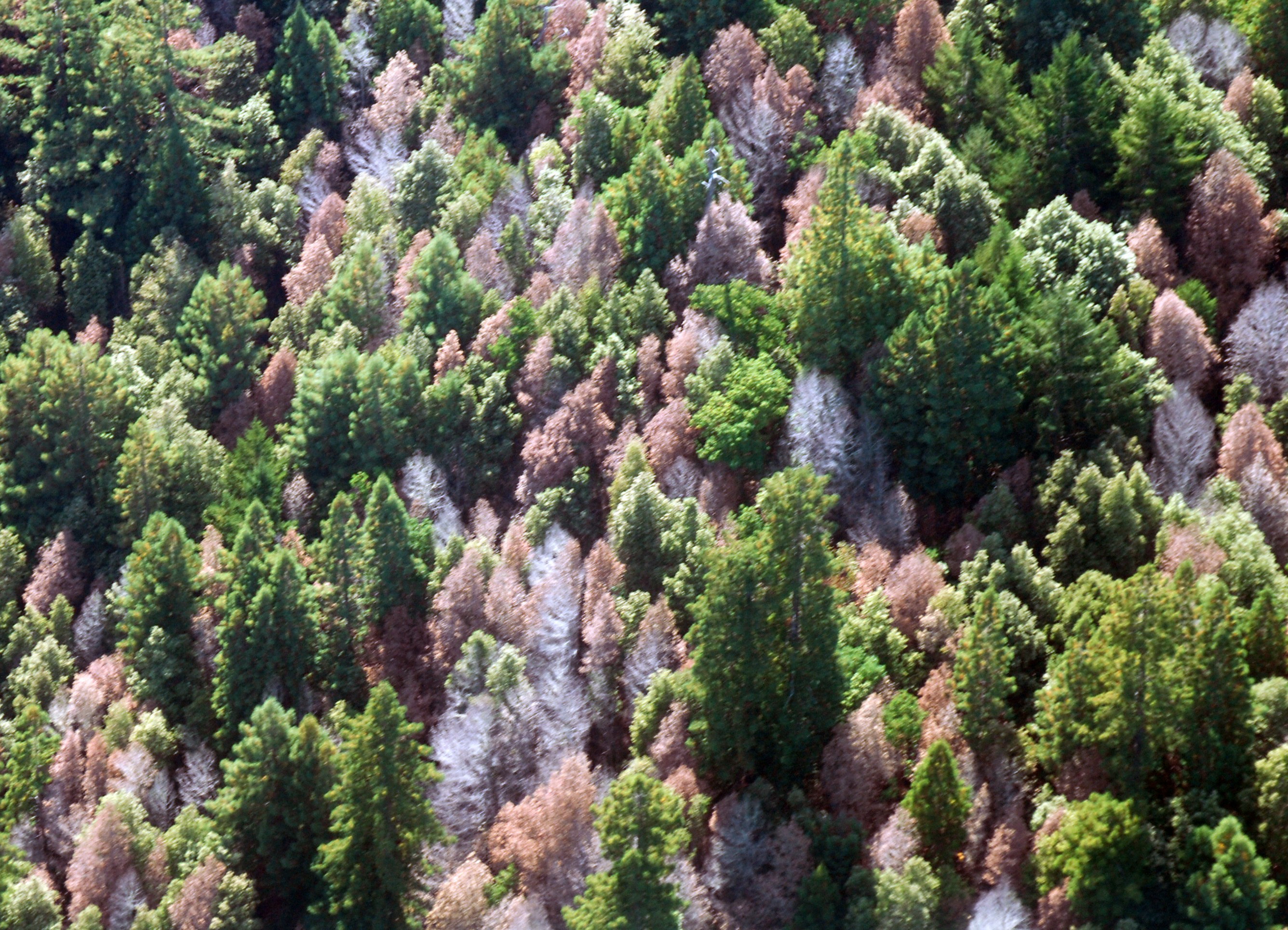
SOD is caused by a pathogen that is spread by rain and wind. We had a great deal of rain in 2016 and 2017, which greatly increased the spread of SOD infections. In the past, SOD has been mostly confined to wildlands. Now it is found in many urban areas, including San Francisco and the East Bay. In the most recent SOD survey done in spring 2017, new infections were found on the UC Berkeley campus, the UC arboretum, and the San Francisco Presidio. (2)
The scientist at UC Berkeley who conducts the annual survey of SOD infections reports that “A dramatic increase this year in the number of oaks, manzanita and native plants infected by the tree-killing disease known as sudden oak death likely helped spread the massive fires that raged through the North Bay…” (3)
Brice McPherson, Associate Specialist in Organisms and the Environment at UC Berkeley, has been studying SOD infections in Marin County and the East Bay. He made a presentation in November 2017 about the current status of SOD infections in East Bay parks. Wildcat Canyon is the park in which Mr. McPherson has most recently inventoried infected and dead trees. In 2017, Mr. McPherson found that 16.2% of coast live oaks were infected and 20.5% were dead. The number of dead and dying oaks in Wildcat Canyon is staggering: 18,750 oaks are infected and 21,360 oaks are dead. McPherson predicted that 50% of all oaks in East Bay parks would be dead within 20 years, depending upon the amount of rainfall.
Native bay trees are considered the main vectors of the pathogen that causes SOD. The re-oaking project therefore suggests that SOD infections in urban areas can be avoided if bay trees aren’t planted in proximity to the oaks. However, the source of the SOD infection recently found in the Presidio in San Francisco is said to have been rhododendrons, which should remind us that bays are not the only vectors of the SOD pathogen. In fact, the USDA reports 46 confirmed hosts for the SOD pathogen, including both native and non-native shrubs and trees. (4) Many of the hosts are commonly found in urban gardens.
Climate change kills oaks in Southern California
Sudden Oak Death infections have not been found south of San Luis Obispo. However, that does not mean that oaks in Southern California are any less threatened by changes in the environment. Several land managers in Southern California made presentations at the recent conference of the California Native Plant Society in Los Angeles about massive die-offs of oaks in Southern California. Here is an example from the Santa Monica Mountains: “Over 9,000 coast live oak and 114,000 riparian trees died from [2014 to 2017]…” (5) These deaths were caused by extremely high temperatures to which the trees are not adapted, associated drought and new insect predators, such as shot-hole borer.
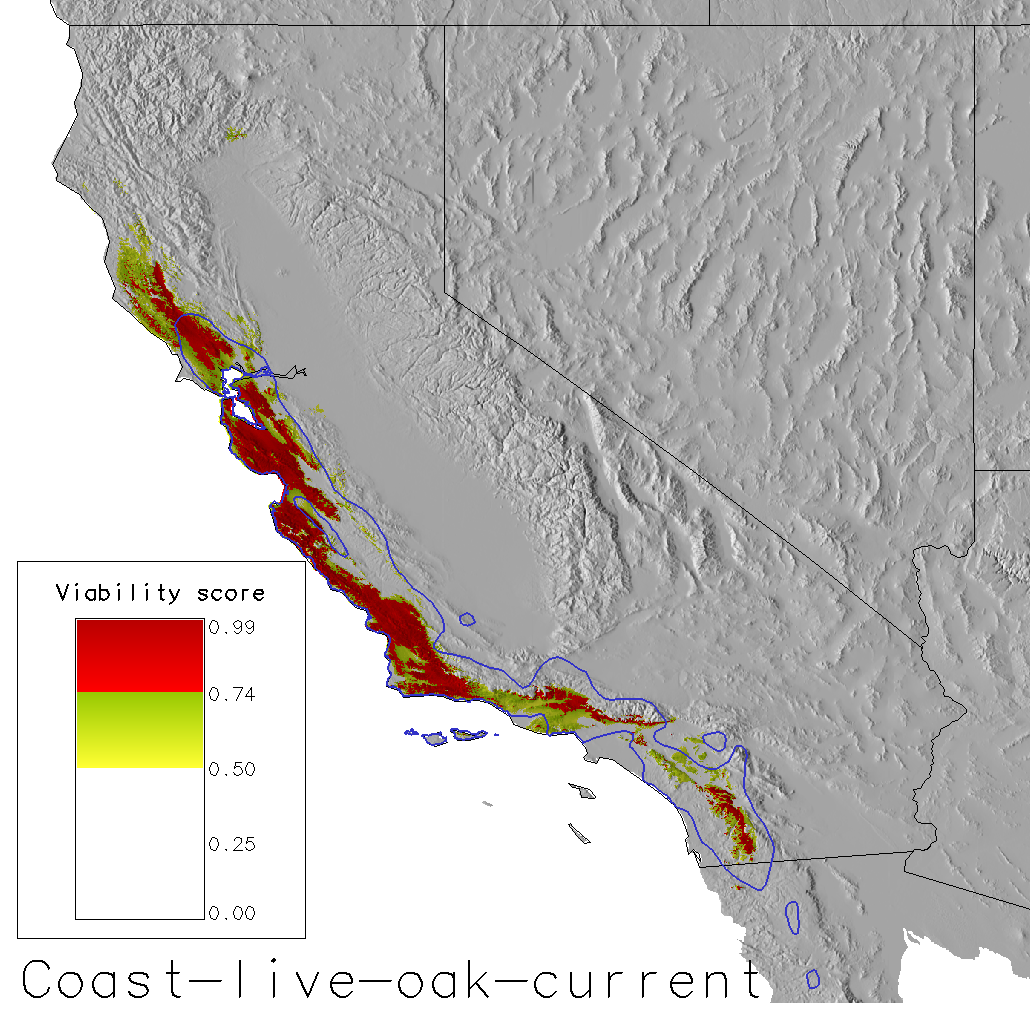
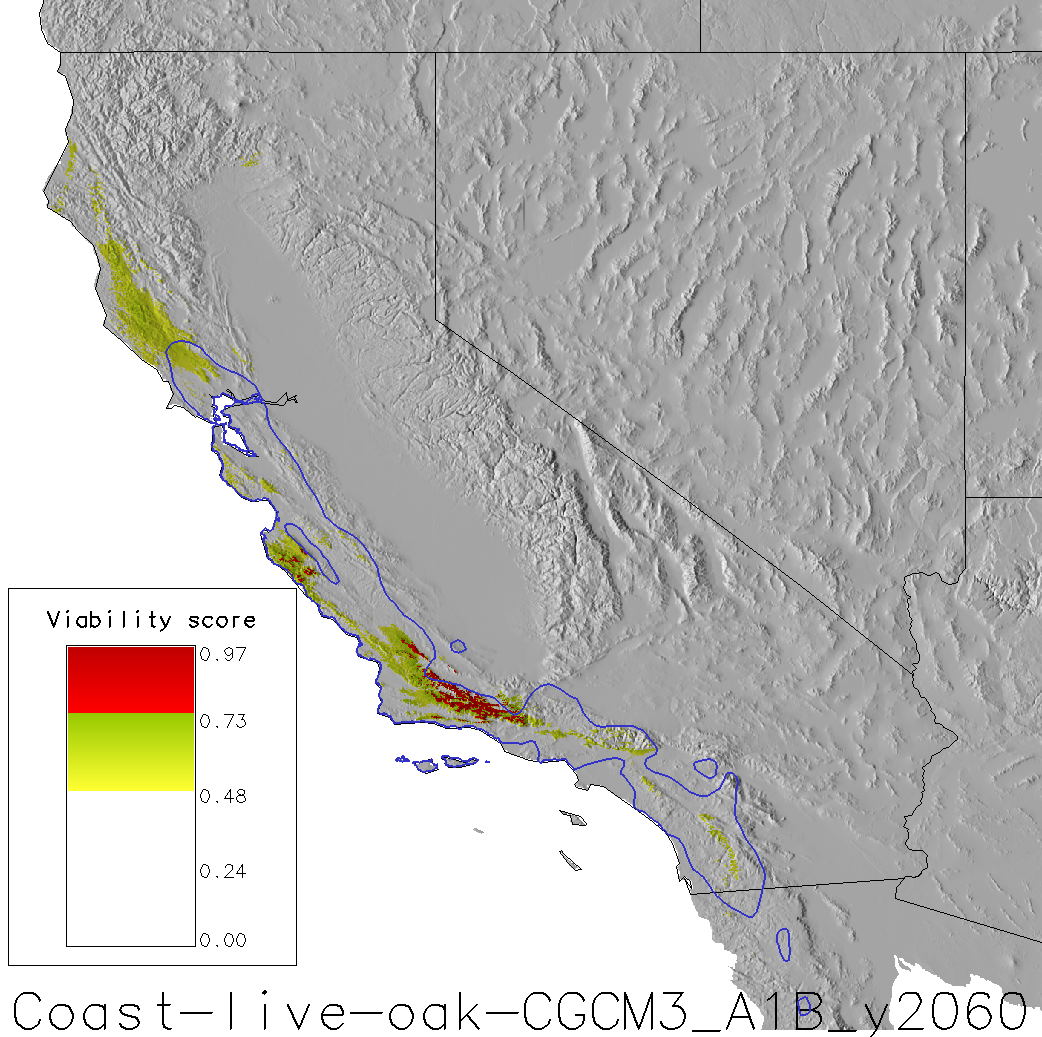
The unsuitable climate conditions in Southern California are the anticipated climate conditions of Northern California. Carbon storage in our urban forest is one of the few tools we have to combat climate change. Although coast live oaks store carbon, they are not particularly long lived. Their life expectancy is from 125 to 250 years in suitable conditions. (6) Planting trees with no long-term future is not a responsible response to climate change. The US Forest Service predicts coast live oaks will be virtually gone in California by 2060:
Wildlife in our urban forest
Although oaks are clearly useful to wildlife, they are not significantly more useful than other urban trees. Here are three studies conducted in the East Bay that compare the biodiversity of animal life in oak woodland to other tree species:
Dov Sax (Brown University) studied six forest plots of about 1 hectare each in Berkeley, CA, three of eucalypts and three of native oaks and bays. The sites were not contiguous, but were selected so they were of similar elevation, slope, slope orientation, and type of adjacent vegetation. He conducted inventories of species in spring and autumn. He counted the number of species of plants in the understory, species of invertebrates (insects) in samples of equal size and depth of the leaf litter, species of amphibians, species of birds, species of rodents. This is what he found:
“Species richness was nearly identical for understory plants, leaf-litter invertebrates, amphibians and birds; only rodents had significantly fewer species in eucalypt sites. Species diversity patterns…were qualitatively identical to those for species richness, except for leaf-litter invertebrates, which were significantly more diverse in eucalypt sites during the spring.” (7)
In 1975, Professor Robert Stebbins (UC Berkeley) was hired by East Bay Regional Park District to conduct a survey of vertebrate animals living in several parks (Sibley, Chabot, and Tilden). The forest types that Professor Stebbins studied were redwood, Monterey pine, eucalyptus, and oak-bay woodland as well as grassland and dry chaparral. Here is how he described his findings:
- “Redwood and Monterey pine habitats are notably depauperate in vertebrate species.
- “Eucalyptus habitat is far richer in vertebrates than either redwood or Monterey pine and vies with ‘dry’ chaparral and grassland in species diversity and ‘attractiveness.’
- “Oak-bay woodland is the richest in both species and ‘attractiveness.’
- “Grassland is a little less rich in species and ‘attractiveness’ than the other native habitats, but only slightly richer than eucalyptus habitat.” (8)
A wildlife study of Angel Island prior to the removal of most eucalyptus trees found:
“The total number of birds observed in native stands was similar to that observed in eucalyptus stands…Few small animals were caught in any stand; captures were in native stands five Norway Rats…in eucalyptus stands one Norway Rat…in grassland one Norway Rat and six California Voles…about three times as many salamanders were located in eucalyptus stands compared to native stands.” (9)
As David Ackerly said in response to a question at the recent conference of the California Native Plant Society, “There are few mutually exclusive relationships in nature.” It is a risky evolutionary strategy. If an animal is dependent upon a single plant species, it won’t survive in the absence of that plant species unless it is capable of adapting to available vegetation. Despite the handful of examples given in the re-oaking brochure, wildlife in California is using non-native vegetation as often as native vegetation.
California’s urban forest is not native
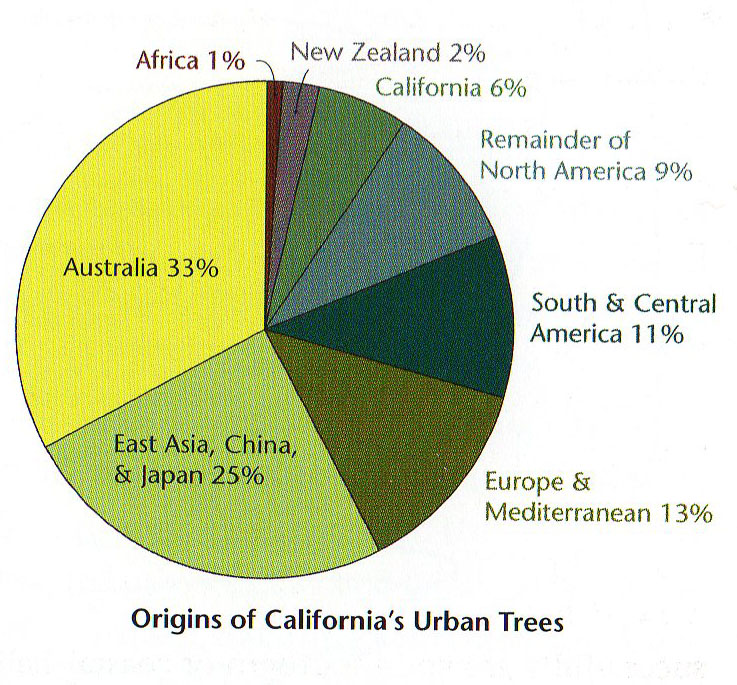
The suggestion that California’s cities could be “refugia” for our threatened oaks is wishful thinking. As Matt Ritter tells us in his book about California’s trees (A Californian’s Guide to the Trees Among Us), only 6% of California’s urban trees are native to California. Thirty-three non-profit tree advocacy organizations in California (including California Releaf) told us why in their letter to California’s Natural Resource Agency about the Urban Greening grant program: “Native trees are generally not suited to urban conditions. They have difficulty adapting to the urban environment, thereby substantially reducing survivability…As an example, the approved list of street trees for the City of San Francisco includes no trees native to San Francisco. In Oakland, two of the 48 allowed species are native.”
The future of California’s urban forest
So, what is the future of California’s urban forest? Scientists with sufficient knowledge of trees are trying to answer that question and we would be wise to pay attention to their advice. Greg McPherson gave a presentation in Davis on March 10, 2018 about “Growing Resilient Forests.” McPherson’s research at the US Forest Service about the economic value of ecosystem services provided by urban trees (carbon storage, reduction of energy use for heat/cooling, increased property values, removal of particulate pollution, etc.) has been vital to those who defend our urban forest.
McPherson lives in Davis, where he is conducting a 20-year study about the urban forests of the future, i.e., those that will survive predicted changes in the climate. Three years into the study, his research team has made some preliminary recommendations for the trees that are likely to survive anticipated changes in the climate. None is native to Northern California. Most are foreign, particularly Australian. (10)
Nativists deny reality of climate change
When the climate changes, the vegetation changes, moves, or dies. That has been one of the few axioms in nature since life has existed on Earth and we would be wise to assume that it will continue to be true. The future of California’s urban forest depends on our willingness to plant trees that are adapted to the climate and to the anticipated climate. Climate change is killing California’s trees and nativism is preventing us from replacing them with suitable trees.
- https://www.sciencedaily.com/releases/2016/05/160502161111.htm
- “Disease killing oaks spreads,” East Bay Times, October 24, 2017
- “Disease in trees pointed at in fires,” San Francisco Chronicle, October 20, 2017
- http://www.aphis.usda.gov/plant_health/plant_pest_info/pram/downloads/pdf_files/usdaprlist.pdf
- http://www.rcdsmm.org/wp-content/uploads/2016/04/Drought-and-Invasive-Beetle-impacts-RCDSMM-1.2.18.pdf
- http://ucanr.edu/sites/oak_range/Californias_Rangeland_Oak_Species/Coast_Live_Oak/
- Dov Sax, “Equal diversity in disparate species assemblages: a comparison of native and exotic woodlands in California,” Global Ecology and Biogeography, 11, 49-52, 2002. http://elkhornsloughctp.org/uploads/files/1109813068Sax2002.pdf
- Robert Stebbins, “Use of Habitats in the East Bay Regional Park by Free-living Vertebrate Animals,” August 1975. In “Vegetation Management Principles and Policies for the East Bay Regional Park District,” June 1976 (this unpublished study is available on request)
- “Focused Environmental Study, Restoration of Angel Island Natural Areas Affected by Eucalyptus,” California State Parks and Recreation, July 1988, pg 96-97.
- http://climatereadytrees.ucdavis.edu/







 Conservation Sense and Nonsense