Xenophobia is Killing Our Planet

We are publishing a guest post from South Africa with mixed feelings.  We are glad to welcome another like-minded person into our effort to prevent the pointless destruction of the plants that have been members of our communities for generations, solely because they are not considered “native.”  On the other hand, we are saddened to learn that other communities are experiencing the same destruction that we are witnessing here in the San Francisco Bay Area. This guest post is an article that was published by The Witness, which the author describes as “South Africa’s oldest daily newspaper.”


Xenophobia is Killing Our Planet

Xenophobia (both human and ecological) is raging worldwide. Yet we are all Earthlings and life on Earth has always migrated. The Khoisan are the first known inhabitants of Africa, and African elephants and lions once roamed North America; America’s bison, bear and deer immigrated from Eurasia, while horses, which evolved in the States, radiated outwards, returning home to be shot as aliens.

Historically, the mass hysteria of rhetoric-spurred xenophobia has sucked reason and compassion from sections of whole countries. Propaganda supporting Hitler’s racial-purity infected Germans to hate Jews who were vilified as pigs. In Rwanda, the genocide of the Tutsi tribe began with the Hutus defaming them as cockroaches. In South Africa, foreign nationals have been slandered as lice and ticks. While in ecological warfare, exotic plants are demonized as cancers and monsters. Those brainwashed by this illogical prejudice, tend to overlook their own ancestral origins and their personal culpability about the very things they fear and denounce in more recent arrivals in our war-torn world now over-flowing with desperate refugees.

Essentially we are all settlers at any given time. Definitions of nativeness are changed at whim by invasion biologists who measure other creatures via a creed they themselves do not exemplify. ‘Alien’ plant species are destroyed country-wide, drastically disrupting ecosystems for the slightest inconvenience to native species or commercial interests. South Africa’s multi-billion rand [1 US $ = 12.64 S. African rand] Working for Water, the world’s largest ever tree-cutting campaign, is a terrifying example. Levelling countless rain-drawing trees on a planet already suffering from tree-loss-induced global warming, is tantamount to blood-letting an already haemorrhaging patient. Far from saving water, the dire rainfall deficit has devastated South Africa with widespread drought causing a conservatively-estimated R400 million  loss to livestock and crops in KwaZulu-Natal alone.

Unprecedented ferocious winds, fires, floods, heat waves, violent storms and catastrophic disasters are battering our over-populated planet, our ice caps melting faster, its creatures dying. And it is no wonder: armed with poisons, the world’s chemical corporations have dressed themselves in Xenophobia, using it as a front to motivate and mask their hugely-profitable, unceasing nature destruction. In a study published in the journal Science this year, 18 international researchers found that human abuse has so disrupted complex interactions between oceans, land and atmosphere that the earth is becoming inhospitable to life. Johan Rockstrom, professor of environmental science at Stockholm University, gravely concluded that, for the first time in human history, we risk destabilizing the entire planet.

Only enough ecosystems, essential for regulating Earth’s climate, keep our civilization from extinction, and scientists estimate we’d have to return as much as 40% of all land to nature to regain long-term stability. Britain’s James Lovelock says we can all help by letting portions of our gardens go wild. Forest ecologist at Stellenbosch University, Dr Coert Geldenhuys, explained in an article how alien infestations repair forests when indigenous trees can’t fill the pioneering role, rehabilitating the soil before dying out, allowing natives to return. This Earth-healing is harmless, sustainable and free, yet fanatics continue mutilating and polluting, with depraved indifference leaving countless creatures, (both native and alien, seen and unseen) homeless, poisoned and dying – as recently verified by scores of dead baby weaver birds strewn amid an axed casaurina forest. Yet ever more prominent ecologists the likes of David Theodoropoulos, Mark Davis, Matthew Chew, Ken Thompson and Dov Sax, see a bigger picture with the role of invasive aliens far more complex and beneficial than generally believed. Fred Pearce (author of THE NEW WILD) puts it all in a nutshell: invasives re-boot Earth’s man-damaged ecosystems to help nature withstand global warming.

AT WAR WITH NATURE, a powerful exposé by New Zealand conservationist W F Benfield (available on AMAZON) reveals that the chemical industry in league with blindly-believing invasion followers who manufacture the crises needed to justify saturating our planet with poisons, are now offering their lethal services to the uninhabited islands of other lands. They were recently enlisted to rid our own Marion Island of mice. But this ‘extinction industry’ as Benfield succinctly describes it, uses deceit, staged photographs and chemicals to do far more harm to resident wildlife than any pest explosion ever could. (Watch POISONING PARADISE on YouTube.) The shockingly inhumane poison 1080 (banned in most countries) is regularly released over New Zealand where corporate conservation plans to render the entire country predator-free. Naturally, once predators are eradicated, their prey will multiply to plague proportions – creating unending opportunities for ever-hungry chemical corporations.

Man’s agriculture is presently eating away so much of the planet’s diminishing wilderness that the European Union and United Nations called for a global shift to a vegan diet to alleviate global warming caused by livestock farming and chemical poisoning. Recently the World Health Organization finally verified a study linking Roundup to cancer after hundreds of studies with similar findings were skewed or suppressed for 30 years. This tumour-causing herbicide was also connected to a mystery kidney disease which killed up to 20,000 farmworkers labouring in extreme heat in Central America, India and Sri Lanka. Scores of Argentinean farmers are suing Monsanto over their infant children’s birth defects, including cerebral palsy, Down’s syndrome, psychomotor retardation, missing fingers and blindness.

Roundup leaches nutrients from the soil, damages micro-organisms, kills earth worms and stimulates unstoppable super weeds. In Australasia it has killed 3 frog species, and, according to World Health statistics, the mere careless use of glyphosate-containing herbicides sickens and kills hundreds of thousands of people worldwide annually. Besides damaging the digestive tracts of animals and humans, incidences of once-rare diseases have soared since its use, linking it to Alzheimer’s, attention deficit disorder, autism, asthma and infertility. Workers spraying from backpacks are at risk simply by breathing in spray drift. Destroying harmless naturalized vegetation with chainsaws and deadly carcinogens, xenophobia, in bed with the chemical industry, is a danger to all life.

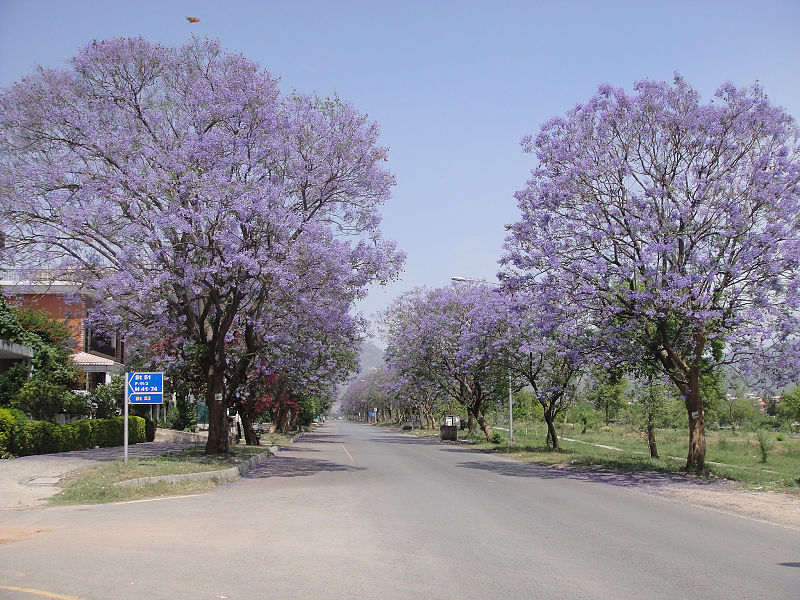
Jacaranda street trees in bloom in Pakistan.  Creative Commons - Share Alike
Jacaranda street trees in bloom in Pakistan. Creative Commons – Share Alike

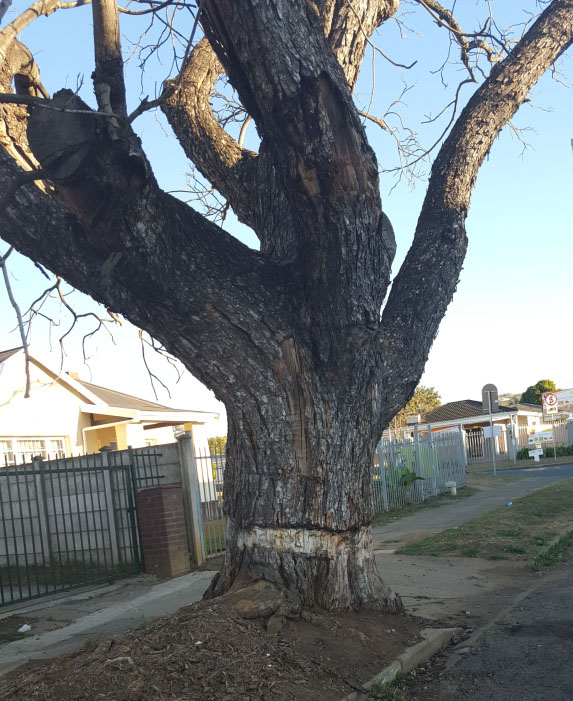
Pietermaritzburg’s beloved Art in the Park has to move next year because the original river-side site has been so degraded by felled trees, and everywhere gracious Jacaranda trees lining our streets stand tragically ring-barked and dying. In the decades since this merciless ethnic cleansing started, our bees have been poisoned to the edge of extinction, our butterflies, birds, rare frogs and chameleons as well as common-place insects and microscopic organisms essential to planet life, vanishing from our shrinking vegetation, while our polluted waterways and seas have vast chemical dead-zones, and scores of fish suffocate when poison-sprayed water-plants suck oxygen from the water whilst dying en masse.

Ring-barked (AKA girdled) jacaranda tree in South Africa.
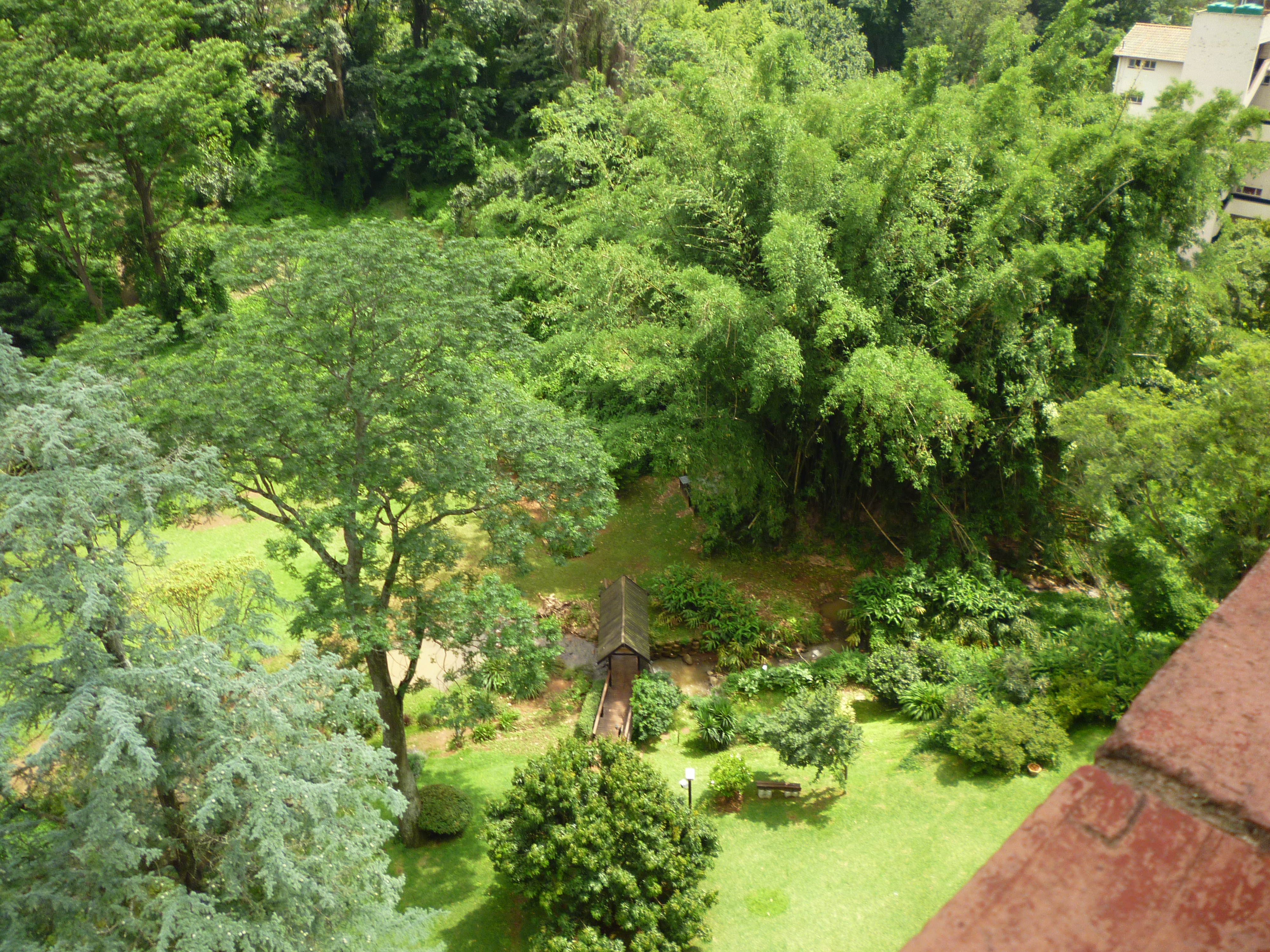
Bamboo before it was killed with herbicide.

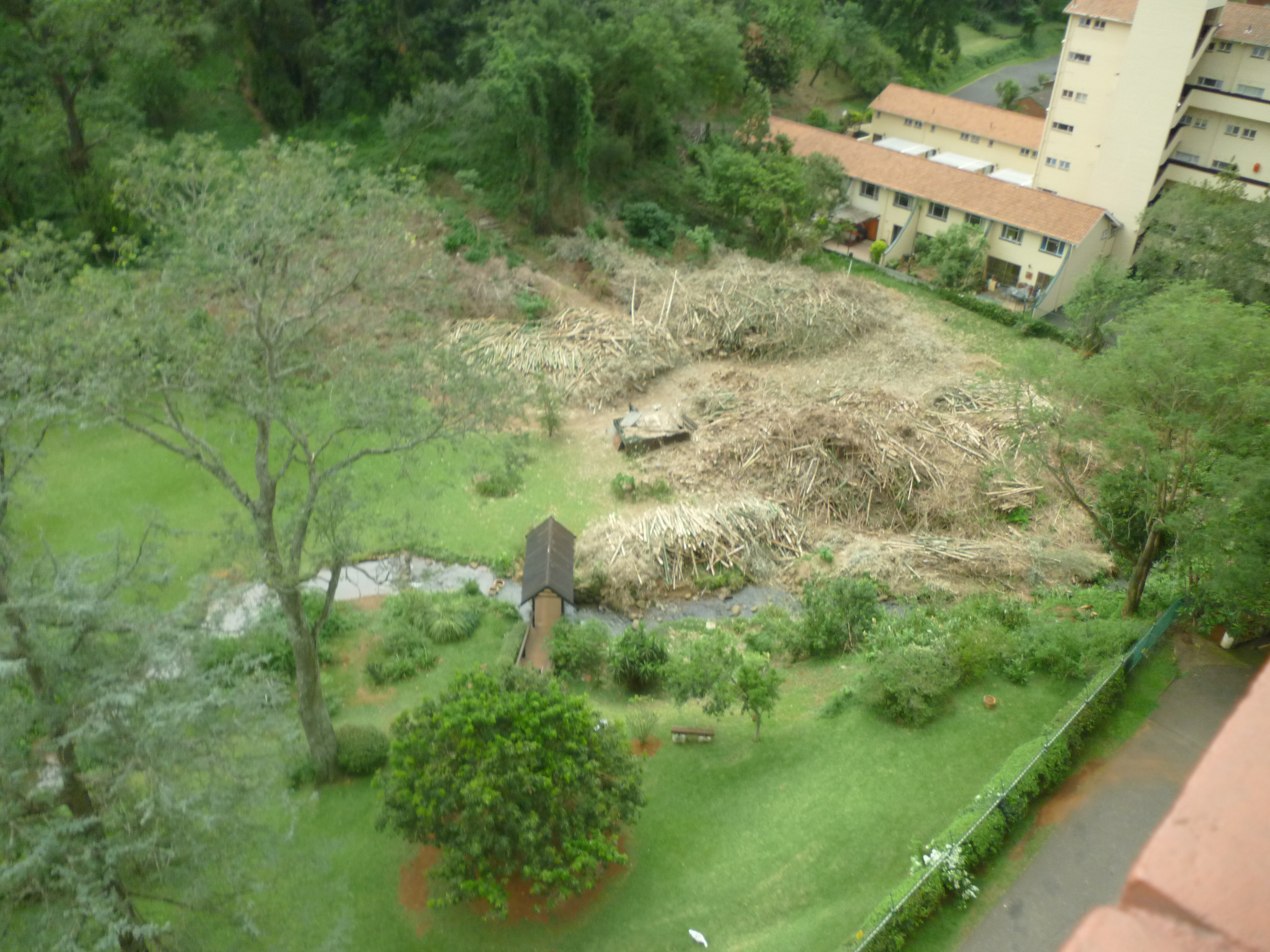
In Pietermaritzburg, magnificent five-storey tall bamboo in the once-beautiful stream-side park behind the Beacon Hill apartment block, were recently hacked and poisoned, risking the stream and its life-forms and resident geese and ducks, as well as the city’s ground water. Helicopters dropped clouds of poisonous herbicide on dagga growing amid hill-side food crops belonging to impoverished KwaZulu-Natal villagers. In the US, tons of chemicals dumped into Lake Michigan to kill one ‘alien’ fish, killed hundreds of thousands while brain-washed con-servationists and scientists cheered. American animal advocate, Nathan Winograd, reflected that in the hopeless battle to return America to a mythical ecological state, slaughter without end has been proposed. 

Bamboo after being killed with herbicide.

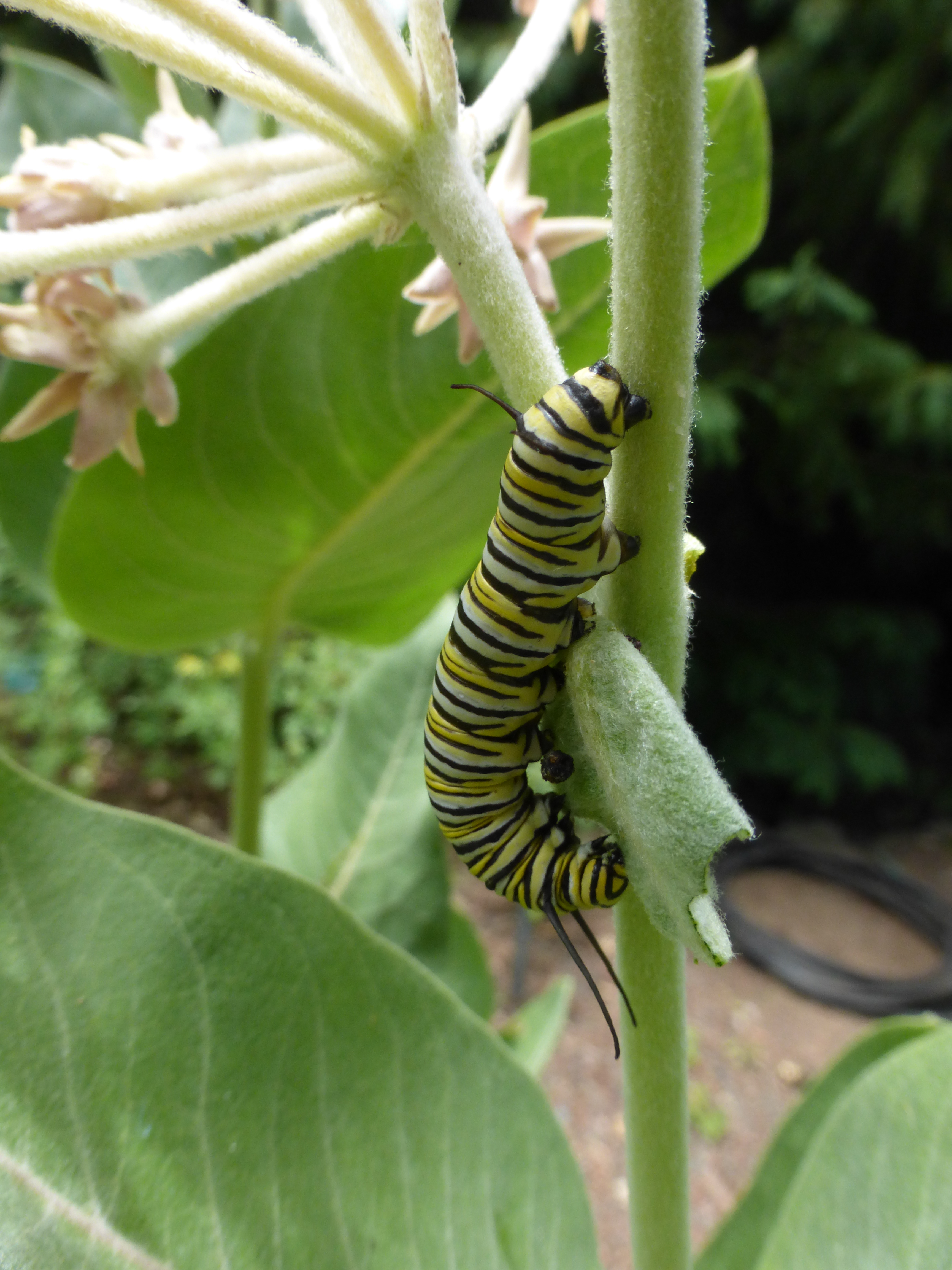
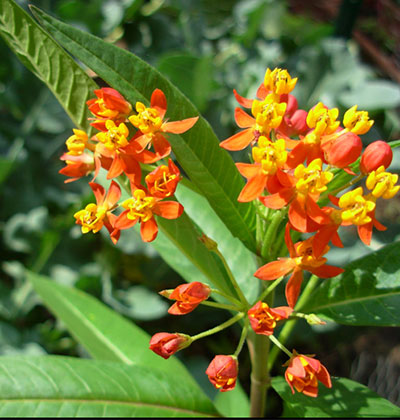
The effects of removing everything arbitrarily judged to be foreign are incalculable. Migrating thousands of miles, the incredible monarch butterfly – a precious natural wonder – has dropped an astounding 90% in numbers since milk weed was killed by herbicides. The worldwide massacre of plants and creatures sometimes just miles ‘out of place’ have evoked unlikely alliances between hunters and vegans who fear Earth’s animals are being wiped out. Andrew Tyler, Britain’s Animal Aid director, believes that the growing appetite for ‘alien’ blood is driving the slaughter of animals scapegoated for human-committed environmental abuses.

America’s Agricultural Department recently revealed that since 1997 it has destroyed a staggering 27 million animals by aerial snipers, poisons and traps, to help dessert bighorn sheep, deer and pronghorn. This alien killing mania spread quickly to unwanted natives. Elk, cougar, fox, bobcats, coyotes, badgers, prairie dogs, bears, wolves, wild longhorn, burros and horses – creatures which once filled us with wonder – among those left to rot that.  Alien disdain is worldwide: mustangs are killed lest they damage native plants, Britain’s grey squirrels destroyed to bring back the red, its deer culled to protect wildflowers, Canada Geese shot for dropping scat on pathways, while South Africa’s own shameful hit list includes the endangered black Kenya rhinoceros. Are purist’s any better than rhino poachers?

This madness, instigated and exonerated by invasion biology, is done at the unknowing tax-payer’s expense. With our living green world turning into a dead planet there have been increasing calls from the public, social sciences and ecology itself, for invasion biology to end. It is the only ‘scientific’ field ever doubted, and this, as they themselves admit, via a virtual ‘cottage industry’ of critical scientific articles, and even death-wishing obituaries in well-respected publications. Many regard this unproved discipline as money-making deceptive hype, xenophobic, immoral, cruel, nonsensical, climate changing and earth endangering. An English review of the book LA GRANDE INVASION explains the inspiring perspective of French ecologist, Jacques Tassin, who adjures conservationists to reconcile man to a new alliance with the living world, including invasives, which he believes are symptoms of pollution testifying to ‘ a richness for tomorrow’.

Invasion Biology has given chemical corporations an excuse to devastate our beautiful planet on a scale never seen before. We’ve become a world at war with itself. If this anti-life pseudo-science is not abolished, Earth’s millions of life-forms are doomed. Humanity has forgotten the spirit and intelligence innate in the wild: before it is too late we should unshackle nature to help heal itself. It’s time we all denounced what we’ve unknowingly allowed to happen. Mahatma Gandhi said: ‘Be the change you wish to see in the world.’ We should empathize with terrified foreign nationals and innocent creatures persecuted and killed through xenophobia’s ugly ethos, and remember that Christ himself identified with the alien Samaritans of this world, declaring: ‘What ye do unto the least of these my brethren, ye do also unto me.’

Gloria Keverne is a South African environmental activist and the international bestselling author of A MAN CANNOT CRY and BROKEN WINGS. In xenophobic riots in South Africa this year seven foreign-national human beings tragically lost their lives, while for decades countless trees, animals and insects have perished, poisoned and deprived of habitat by this prejudiced mind-set.  She can be emailed at glory@chrysalis-dreams.co.za.  If you agree with her viewpoint, please take a minute to thank her for defending her local landscape and wish her good luck in preventing its needless destruction.

“Drought-Adapted Eucalyptus NOT Dying by the Thousand”

Native plant advocates in the Bay Area have always had trouble convincing the public and their elected representatives that it is necessary to destroy every non-native tree in our urban forest.  They have therefore resorted to fear-mongering to convince the public that it is necessary to eradicate all non-native trees for public safety. 

Fear of fire has been effective in the East Bay where there have been fires, although claims they were caused by non-native trees are a distortion of the facts.  For the past year, native plant advocates in San Francisco have been using a variation on that theme to support their demands to destroy all non-native trees.  They now claim our eucalyptus forest is dying of drought and must be destroyed before it causes a disastrous fire.  You can read that story line in Jake Sigg’s Nature News (here) or in his recent public comments to San Francisco’s Urban Forestry Council (here), which is in the process of developing Best Management Practices for San Francisco’s urban forest.

It is our pleasure to republish this post from Save Mount Sutro Forest, responding to those claims.  As usual, it is meticulously researched and documented.  We only wish to add this small bit of common sense: The drought is hard on all plants.  If the drought were capable of singling out one species of tree to kill, it would not be the drought-tolerant eucalyptus. 


Jake Sigg, retired San Francisco Recreation and Parks Department (SFRPD) gardener who is considered the doyen of the Native Plant movement in San Francisco, has a widely circulated email newsletter. In it, he has been pushing the argument that thousands of eucalyptus trees in San Francisco are dying of drought, as evidenced by epicormic growth on these trees: “2015 is the year of decision, forced upon us by 20,000 to 30,000 dead trees.” He is suggesting they will be a fire hazard and that SFRPD must act, presumably by cutting down the trees. In a recent post, he published a picture of a tree covered in young blue-green leaves, and predicted it would be dead within a year.

But he’s mistaken.

Eucalyptus trees are drought-adapted, and the shedding of mature leaves followed by sprouting of juvenile leaves (epicormic sprouting) is one of their defense mechanisms. These trees survive in areas far drier than San Francisco, where fog-drip provides an important source of summer moisture.

2015-05-27 ab eucalyptus with epicormic growth wordEUCALYPTUS RESPONSE TO DROUGHT

Eucalyptus trees are adapted to drought. They shed mature leaves and twigs so they don’t lose water through transpiration (the tree version of breathing, which takes place mainly in the leaves.) Later, they can replace the lost branches and leaves through “epicormic sprouting.”

Blue gum eucalyptus trees have buds buried deep under their bark. When the tree is stressed, they may shed adult leaves and later sprout new leaves along their branches. When you see a eucalyptus tree that seems to have shaggy light bluish-green new leaves along its branches or trunk – that’s epicormic sprouting.

Here’s what Jake Sigg said in a recent newsletter: “According to arborists, the trees produce these abnormal shoots from epicormic buds when their lives are seriously threatened. In this case, the tree is expected to be dead by the end of 2015. On Bayview Hill, barring heavy unseasonal rain, hundreds of the trees will be dead this year. Yet the City continues to not see a problem.”

We asked UC Berkeley Professor Emeritus Joe McBride and California’s leading expert on eucalyptus for his opinion. He’s observed this condition in trees along the edge of the Presidio forest and explains, “This response is common in blue gum as a mechanism to reduce transpiration rates in order to survive drought years.”

He continues: “I am not convinced that the trees will die in large numbers.

bayview-hill-2010 smTHE GIRDLED TREES OF BAYVIEW HILL

As an aside, we find it ironic that Mr Sigg should be so concerned with dead trees on Bayview Hill, given that’s where nativists girdled hundreds of healthy eucalyptus trees to kill them. Two girdled trees

(This is done by cutting around the tree, thus starving it of nutrients that are carried only in the outer layers of the tree-trunk.) It’s clearly visible in the two photographs here, both taken on Bayview Hill.

EUCALYPTUS ADAPTS

In fact, one of the reasons eucalyptus is so widely planted – including in climates both hotter and drier than in San Francisco – is that it adapts to a wide range of conditions.

Eucalyptus globulus thrives in Southern California, Spain, Portugal, India – all places hotter and drier than San Francisco.

Here’s a quote from R.G. Florence’s textbook, Ecology and Silviculture of Eucalyptus Forests:

florence quoteFrom p.121 of the same book: “… they regulate their water usage in hot dry summers by closing their stomata [breathing pores in the leaves] during the day and lowering their rates of gaseous exchange. They adapt by their elastic cell structure to water stress.”

EPICORMIC SPROUTING IS IMPORTANT IN EUCALYPTUS

Mr Sigg describes “how to identify a dying blue gum” as follows: “Look for trees with thinning foliage and copious juvenile leaves (called coppice shoots) hugging the main stems. These coppice shoots are easy to see because of their blue color and tight clustering, as opposed to the adult leaves, which are 6-8 inches-long, dull-olive-colored and sickle-shaped and which hang from the ends of long branches. These coppice shoots are the give-away that the tree is in trouble and is destined to die soon…” (He later corrected “coppice shoots” to epicormic growth.)

But again, this is not actually true.

In fact, epicormic sprouting allows eucalyptus to survive not only drought, as described above, but even fire. The epicormic sprouting grows into new branches to replace the ones that have been damaged in the fire. This is from Wikipedia: “As one of their responses to frequent bushfires which would destroy most other plants, many Eucalypt trees found widely throughout Australia have extensive epicormic buds which sprout following a fire, allowing the vegetative regeneration of branches from their trunks.[4][5] These epicormic buds are highly protected, set deeper beneath the thick bark than in other tree species, allowing both the buds and vascular cambium to be insulated from the intense heat.[4]”

(The references are: [4] “Effects of fire on plants and animals: individual level”. Fire ecology and management in northern Australia. Tropical Savannas CRC & Bushfire CRC. 2010. Retrieved 27 December 2010. [5] “Learn about eucalypts”. EUCLID – Eucalypts of Australia. Centre for Plant Biodiversity Research. Retrieved 27 December 2010.)

And sometimes, dead branches and leaves and epicormic growth don’t even indicate stress – it’s part of the normal growth cycle. R.G. Florence’s book on eucalyptus says: the “mature crown of a eucalypt maintains itself by the continual production of new crown units, which die in turn. There will always be some dead branches in a healthy mature crown.” He goes on to say an “undue proportion of dead branches is an unhealthy sign” but a “reasonable proportion of death of crown units should be accepted as normal.” He also discusses the “epicormic shoots from dormant buds on the top and sides of the branch develop into leaf-bearing units of the mature crown.” (p.13) Eucalypts go through stages of development that include extensive self-thinning, particularly in younger trees. (p. 194)

Another reason for epicormic sprouts on eucalyptus is increased light. From Wikipedia, with references: “Epicormic buds lie beneath the bark, their growth suppressed by hormones from active shoots higher up the plant. Under certain conditions, they develop into active shoots, such as when damage occurs to higher parts of the plant or light levels are increased following removal of nearby plant. Epicormic buds and shoots occur in many woody species, but are absent from many others, such as most conifers.” [The Wikipedia article references the Encyclopedia Britannica.]

We have seen these epicormic sprouts in eucalyptus trees around the clubhouse in Glen Canyon after many trees were removed.

epicormic sprouts on eucalyptus when nearby trees removed

We also saw them on Mount Sutro near where 1,200 trees were removed for “fire safety.”

MISTAKING DEFENSES FOR DEATH THROES

In summary, then, epicormic sprouting does not indicate that the tree is near death. It may indicate that the tree is responding to drought (or even to other stresses like pesticide use or damage to its root systems) with defensive measures. It’s like declaring that everyone who has a fever is bound to die of it. The trees below are the same ones featured in the picture at the start of this article – one year later, they’re surviving, not dying.

Epicormic sprouting on eucapyptus 2014In some cases, epicormic sprouting may indicate nothing at all, except that the tree is going through a normal growth phase, or changed light conditions following removal of nearby trees.

LIVING WITH A FEW DEAD TREES

We asked Dr McBride if it made sense to cut down these trees. “I do not think the city would be justified in cutting trees down as a fire prevention action,” he says. “Cutting down drought-stressed trees at this point would be much more costly, sprouting would be difficult to control without herbicides, and the litter on the ground would have to be removed to decrease the fire hazard.”

“The problem as I see it is the accumulation of leaves, bark, and small branches on the ground. This material presents a serious fuel problem when it dries out sufficiently.” However, he points out that “In many eucalyptus stands in San Francisco the eucalyptus ground fuel (leaves, bark, and small branches) seldom dries to a point that it can be ignited because of summer fog and fog drip.” In dry areas, the best course is to “launch a program of ground fuel reduction by removing the litter from beneath eucalyptus stands.”

The eucalyptus-tree nest hole of the red-shafted flicker - San Francisco. Janet Kessler
Eucalyptus-tree nest hole of red-shafted flicker – San Francisco. Copyright Janet Kessler

A few trees may indeed die, with the drought or without it. If you think of a forest as a normal population, you expect to find some trees that are thriving and some that are hanging on, and some that are dying – just like in any population. And dead and dying trees are very valuable to wildlife: They’re more likely to have cavities that are suitable for nesting (and are easier to excavate for woodpeckers and other cavity-building species). They also have bugs that come to feast on the decaying wood, and that’s bird-food.

“Tending the Wild:” Our changing relationship with nature

We recently introduced our readers to a book about the land management practices of Native Americans in California, Tending the Wild:  Native American Knowledge and the Management of California’s Natural Resources.  (1) Drawing from this valuable resource, we will describe how the relationship of humans with nature has changed several times since the arrival of humans in California approximately 12,000 years ago.  We will conclude by raising questions about our current relationship with nature, as reflected in our land management practices.

The relationship of Native Americans with nature

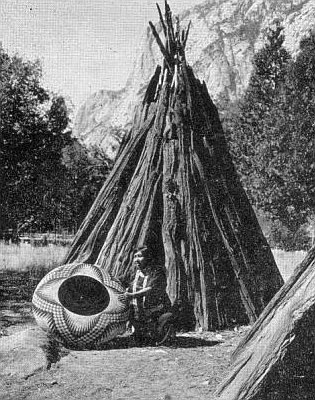
Basket CA Native AmericanWe will let the author of Tending the Wild speak for Native Americans, based on her extensive research of their culture and land-management practices:

“Although native ways of using and tending the earth were diverse, the people were nonetheless unified by a fundamental land use ethic:  one must interact respectfully with nature and coexist with all life-forms.  This ethic transcended cultural and political boundaries and enabled sustained relationships between human societies and California’s environments over millennia.  The spiritual dimension of this ethic is a cosmology that casts humans as part of the natural system, closely related to all life-forms.  In this view, all non-human creatures are ‘kin’ or ‘relatives,’ nature is the embodiment of the human community, and all of nature’s denizens and elements—the plants, the animals, the rocks, and the water—are people.  As ‘people,’ plants and animals possessed intelligence, which meant that they could serve in the role of teachers and help humans in countless ways—relaying messages, forecasting the weather, teaching what is good to eat and what will cure an ailment.” (1)

We emphasize that Native American culture considered humans a part of nature because this viewpoint provides contrast to modern interpretations of the relationship between humans and nature. 

Exploitation of nature by early settlers

When Europeans began to establish settlements in California in the late 18th century, they brought with them an entirely different viewpoint about their relationship with nature.  Natural resources were to be exploited and humans were the master of the natural world which was in their service.

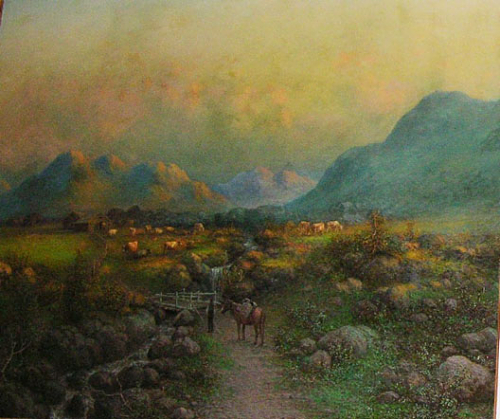
Western pioneer ranch
Western pioneer ranch. Painting by John Olson Hammerstad, 1842-1925.


The first phase of European settlement was the importation of huge herds of livestock by the Spanish coming from Mexico:

“During the Mission era…grazing was among the activities that caused the greatest damage.  Coastal prairies, oak savannas, prairie patches in coastal redwood forests, and riparian habitats, all rich in plant species diversity and kept open and fertile through centuries of Indian burning, became grazing land for vast herds of cattle, sheep, goats, hogs, and horses owned by Spanish missions and rancheros.  By 1832 the California missions had more than 420,000 head of cattle, 320,000 sheep, goats, and hogs, and 60,000 horses and mules…overgrazing eliminated native plant populations, favored alien annuals, and caused erosion…A great variety of alien [plant] species were introduced inadvertently during the Mission Period.  Research has shown that European forbs and grasses…were brought into California at this time, contained in adobe bricks, livestock feed, livestock bedding, and other materials.  Soon these alien [plants] overwhelmed the native species, markedly changing the character and diversity of grasslands and other habitats west of the inner Coast Ranges.”  (1)

Tending the Wild reports that during this early phase of European settlement, Native Americans were quick to adapt to the changing landscape.  They incorporated useful new plants into their diets.  Likewise, we see today new plants and animals quickly enter the food web.


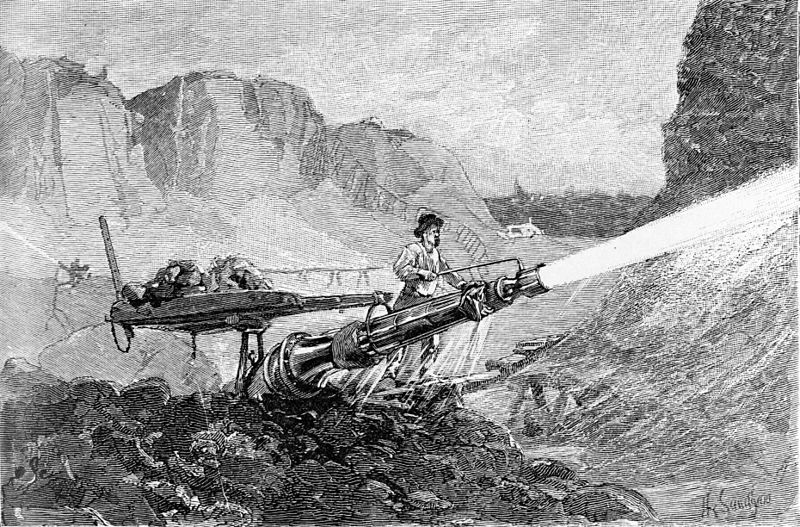
Hydraulic gold mining in California.

These changes in the landscape paled in comparison to the exploitation of the land that began in 1849 when gold was discovered in California and the huge influx of Americans of diverse European descent arrived.  Here are a few examples:

  • “…by the 1870s ‘more men made their living in the broader geography and economy of farming—48,000—than in all the mines of the Sierra footholls—36,000.’ To accommodate the acreage devoted to growing crops, marshes were drained, underground water was tapped by artesian wells, streams and rivers were dammed and diverted for irrigation, and lands were fenced.  In the process huge tracts of former native grasslands, riparian corridors, and vernal pools were converted to artificial, human-managed agricultural systems.” (1)
  • “Five million acres of wetland in California have been reduced by 91% through diking, draining, and filling for agriculture, housing, or other purposes.” (1)
  • By 1900, 40% of California’s 31 million acres of forest were logged.
  • “By the early 1900s, the numbers of marine mammals, wildfowl, elk, deer, bear, and other birds and mammals had been so drastically reduced that Joseph Grinnell would write, ‘Throughout California we had been forcibly impressed with the rapid depletion everywhere evident among the game birds and mammals.’” (1)
  • Between 1769 and 1845, the population of Native Americans in California dropped from an estimated 310,000 to 150,000. Between 1845 and 1855, the population of Native Americans dropped from 150,000 to 50,000.

Romanticizing Nature

Meanwhile, in Europe and the East Coast of the US, a new view of nature was being articulated.  The Romantic movement viewed nature as an escape from the stress of urban life, a tranquil retreat from civilization.  In California, John Muir was strongly influenced by Romanticism: 

“Muir and those with similar views responded to the destruction and exploitation of California’s natural resources with a preservationist ethic that valued nature above all else but which defined nature as that which was free of human influenceThus while he championed the setting aside of parks as public land, Muir also contributed to the modern notion that the indigenous inhabitants of the state had no role in shaping its natural attributes.” (1)

Muir was unable to fit Native Americans into his idealized view of nature.  He wrote this account of Miwok Indians in the Sierra Nevada in 1869:

“’We had another visitor from Browns’ Flat to-day, an old Indian woman with a basket on her back.  Her dress was calico rags, far from clean.  In every way she seemed sadly unlike Nature’s neat well-dressed animals, though living like them on the bounty of wilderness.  Strange that mankind alone is dirty.  Had she been clad in fur, or cloth woven of grass or shreddy bark, like the juniper or libocedrus mats, she might have seemed a rightful part of wilderness; like a good wolf at least, or bear.  But no point of view that I have found are such debased fellow beings a whit more natural than the glaring tailored tourists we saw that frightened the birds and the squirrels.’” (1)

Sharp Park, Pacifica, CA.  Photo by Erica Reder, SF Public Press
Sharp Park, Pacifica, CA. Photo by Erica Reder, SF Public Press

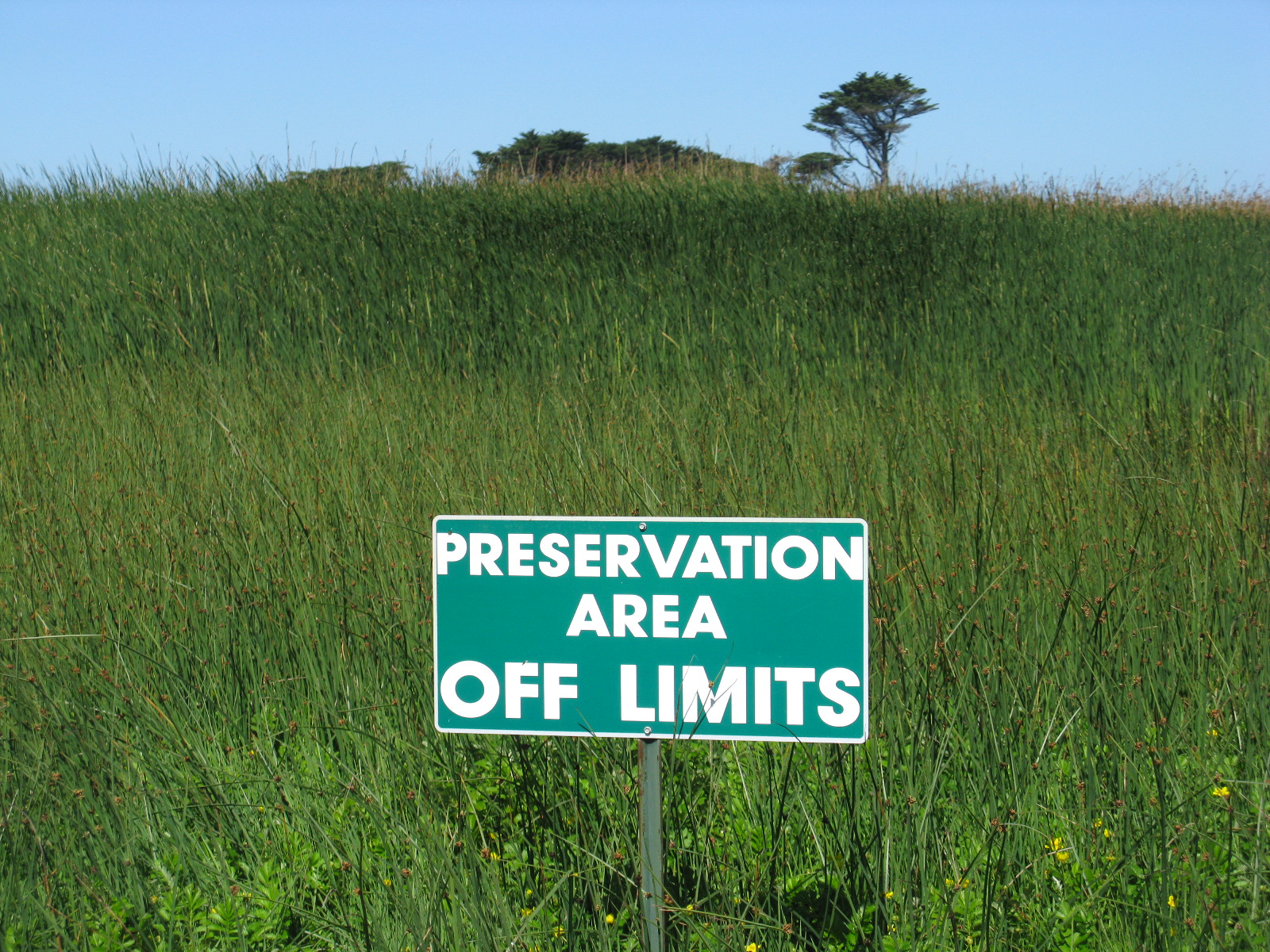
In this romanticized view of nature, humans are not welcome Humans defile the purity of nature.  This is the prevailing viewpoint today among those who consider themselves environmentalists, park advocates, and conservationists.  They advocate for “wilderness” where “humans may visit, but not remain.”  They post signs, advising visitors to look but not touch.  Their “restoration” projects put nature behind a fence.  They complain about immigration.

The condescending attitude articulated by John Muir toward Native Americans was instrumental in our ignorance of their land management practices.  Europeans considered Native Americans primitive and therefore did not expect to learn anything useful from them.  Europeans imported and grew their own food from their original homes because they were unaware of how local food sources could be grown and used.  Our knowledge of Native American culture is recent and it comes too late to ever be fully informed because those who tended the land are long since gone.  Furthermore, this new knowledge of land management practices of Native Americans is not well known, certainly not among native plant advocates who are attempting to re-create a landscape which was created by methods they do not understand.

Redefining ecological “restoration”

The author of Tending the Wild admires Native American culture as well as the landscape that was created by their land management practices.  Therefore, she concludes her book with a proposal that we adopt their land management methods:

“What then, should be the goal of ecological restoration?  Restoring landscapes and ecosystems to a ‘natural’ condition may be impossible if that natural condition never existed…Restorationists must at the very least acknowledge the indigenous influence in shaping the California landscape.  This chapter advocates an additional step—using indigenous people’s knowledge and methods to carry out the restoration process, to return landscapes to historical conditions and restore the place of humans in this continuing management.”  (1)

In our previous post, we described some of the land management practices of Native Americans, particularly the importance of setting fires.  Adopting these management practices for ecological restorations would require us to make a permanent commitment to setting fires.  Fires pollute the air, release greenhouse gases into the atmosphere, and endanger lives and property.  Therefore, this is surely not a proposition that can be reasonably applied to our densely populated urban parks.  The maximum population of Native Americans prior to the arrival of Europeans is estimated to have been 310,000.  The population of California was estimated to be over 38 million in 2013.  Land management practices that were appropriate for a human population of only 310,000 are not appropriate for a population of over 38 million.

Furthermore, the land management practices of Native Americans were useful for their culture.  They tended the landscape in order to feed, clothe, heal, and house themselves.  If that specific landscape is no longer useful for those purposes, why would we consider it an ideal landscape?  In what sense would it be superior to the landscape that occurs naturally without setting fires or intensively gardening our open spaces?

A more realistic paradigm is needed

We believe a more sustainable paradigm for managing nature is needed.  Although we won’t presume to define this new paradigm, we will suggest some parameters:

  • Humans are as much a part of nature as any other animal. Therefore, conservation goals must accommodate the presence of humans.  However, humans must respect plants and animals as equal partners in achieving conservation goals.
  • Since we live in a free society, we must assume that human populations will grow in proportion to the choices of humans. And since we are a nation of laws, we must assume that immigration will occur as allowed by our laws.  Conservation goals must be consistent with the realities of human population density.
  • Conservation goals should look forward, not back. Goals should reflect the changes in the environment that have already taken place and anticipate the changes that are expected in the future.
  • The distinction between native and non-native species should be only one of several criteria to determine whether a species “belongs here.” If plants and animals are sustaining themselves without human subsidy, we should acknowledge and appreciate the functions they perform in the ecosystem.  This approach will reduce the use of herbicides, now being used to eradicate plants perceived to be “non-native,” in our parks and open spaces.
  • Conservation goals should be realistic within the confines of available resources and in competition with other priorities.
  • There are pros and cons to every change we make in the landscape. Whenever we alter the landscape, if our land management methods damage the environment by using pesticides, killing animals or destroying their food resources and homes, contributing to greenhouse gases, restricting recreational access, etc., we must have solid evidence that the benefits to the environment will be greater than the damage we foresee.  If there is no net benefit, we should leave it be.

Can you add to or suggest revisions of this list of a new conservation ethic?  Surely there are as many opinions as there are readers of Million Trees.  We would like to hear your ideas.


  1. M. Kat Anderson, Tending the Wild: Native American Knowledge and the Management of California’s Natural Resources, University of California Press, 2005 (This is the source of most of the information in this article.)

Do insects prefer native plants?

We follow Doug Tallamy’s publications closely because he is the academic scientist most often quoted by native plant advocates to support their belief that insects require native plants and that the absence of the native plants will result in the collapse of entire ecosystems:   “…our wholesale replacement of native plant communities with disparate collections of plants from other parts of the world is pushing our local animals to the brink of extinction—and the ecosystems that sustain human societies to the edge of collapse.” (1)

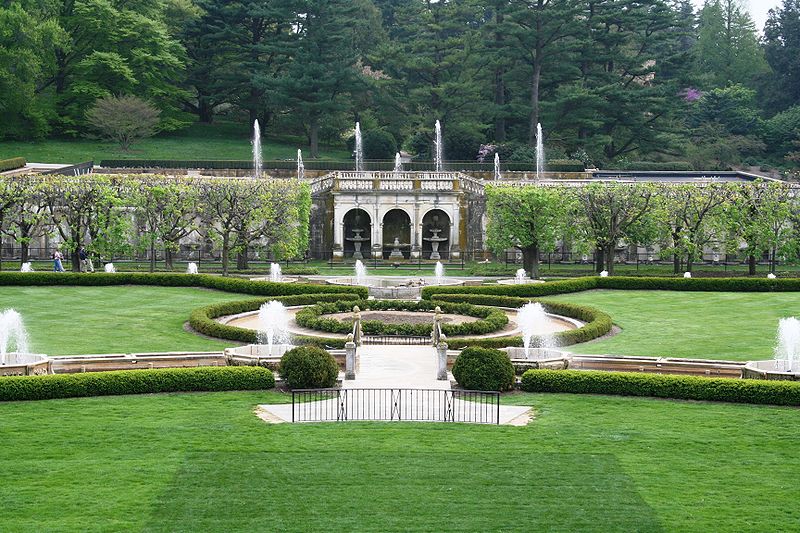
Main fountains of Longwood Gardens.  Creative Commons - Share Alike
Main fountains of Longwood Gardens. Creative Commons – Share Alike

Tallamy co-authored his most recent publication, The Living Landscape:  Designing for Beauty and Diversity in the Home Garden, with Rick Darke, curator of plants at Longwood Gardens for 20 years.  Longwood is a formal garden outside of Philadelphia, which seems at odds with the exclusively native gardens for which Tallamy advocates.  And so we were intrigued by this unlikely team.  Darke’s introduction to the book implies a departure from Tallamy’s usual mantra:

“Is this a book only about gardening with native plants?  No.  It’s a book about how native plants can play essential roles in gardens designed for multiple purposes, with a focus on proven functionality.  For better and worse, the native plant movement in North America has evolved in the last decade…One of the most important functionalities is durability:  the capacity to thrive over a long time without dependence on resource-consuming maintenance regimes.  Claims that natives are always better than exotics fail to take into account radically altered environmental conditions in many suburban landscapes…In most cases and most places, the design of broadly functional ecologically sound, resource-conserving residential gardens requires a carefully balanced mix of native and non-native plants.  It’s time to stop worrying about where plants come from and instead focus on how they function in today’s ecology.  After all, it’s the only one we have.”  (2)

Tallamy writes his own introduction to The Living Landscape, which suggests a softening of his hard-line insistence upon gardening exclusively with native plants:

“What is native in any given place today wasn’t native if we look back far enough in time, and it is certain that what will be native in that same place in the future will be different from what is native now.  Functional ecological relationships take a long time to evolve—often thousands of years—but they do evolve.  Humanity’s challenge is to reduce its introduction of rapid environmental changes that are currently causing extinctions to occur faster than the evolution of new species.”  (2)   

Has Tallamy’s viewpoint evolved?

When we reported on Tallamy’s previous publication in 2012, we quoted him as saying that a graduate student under his direction could not find any evidence that native plants were eaten by insects more frequently than non-native plants:

“Erin [Reed] compared the amount of damage sucking and chewing insects made on the ornamental plants at six suburban properties landscaped primarily with species native to the area and six properties landscapes traditionally.  After two years of measurements Erin found that only a tiny percentage of leaves were damaged on either set of properties at the end of the season…Erin’s most important result, however, was that there was no statistical difference in the amount of damage on either landscape type.”  (1)

May we conclude that Tallamy no longer believes that native plants are required by insects?  No, we may not.  In Living Landscape he takes a different approach to this question.  He collaborated in three studies which found more insects in native gardens than in non-native gardens:

  • Significantly more caterpillars of butterflies and moths were found in suburban gardens of predominantly native plants compared to gardens of predominantly non-native plants. This study also quantified the number of birds found in these gardens and concluded that “…the negative relationship between non-native plant abundance and bird community integrity is apparent in managed ecosystems as well, regardless of whether the non-native species are invasive.”  This seemed a leap of faith, given that the inventory of insects was done in a six-week period in August and September and the inventory of birds was done in a six-week period in June and July, rendering a cause-and-effect relationship dubious.
  • Two other studies were conducted in a constructed garden in which native and non-native plants were paired for comparisons. Some of the pairs were in the same genus.  Again, significantly more caterpillars and other plant-eating arthropods were found on native plants, although the differences were much smaller when the plants were in the same genus, which are often—but not always–chemically similar.

Reconciling apparent contradictions

So, how are we to reconcile these studies which find more insects on native plants with other studies which report otherwise?

  • Here in the San Francisco Bay Area, we rely on the research of Professor Arthur Shapiro to inform us of which plants are useful to our butterflies. He tells us:  “Most California natives in cultivation are of no more butterfly interest than nonnatives, and most of the best butterfly flowers in our area are exotic.” (3) The difference between Professor Shapiro’s studies and those cited by Professor Tallamy is that Professor Shapiro has been studying butterflies in “natural areas” rather than cultivated gardens.  Most of the plants that he finds butterflies using are considered weeds, such as non-native fennel and star thistle, which we wouldn’t find in suburban gardens.  We speculate that this difference accounts for some of the difference in findings. 
  • Furthermore, the studies reported by Professor Tallamy only seem contradictory. In fact, if we look at them closely we find that one reports no difference in what caterpillars eat, but considerable difference in where they are found.  And this strange difference is consistent with the scientific literature.  A meta-analysis of hundreds of studies of insect-plant interactions published by Annual Review of Entomology reports these findings:  “Herbivore densities are lower on invasive plants than on native plants, but there is no evidence that invasive plants overall suffer from less damage inflicted by native herbivores.” (4)

Go figure!  More herbivores are found on native plants, but they don’t eat more native plants than they do non-native plants.

A parting shot

Professor Tallamy urges suburban gardeners to take insects into account when making their gardening choices and, of course, we agree.  However, he closes his pitch for gardening with natives in The Living Landscape with a story which seems superficially compelling but doesn’t hold up to close scrutiny.

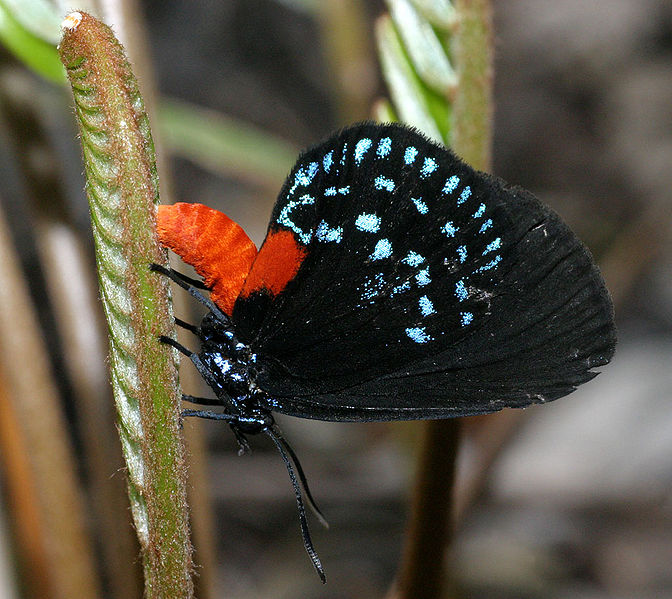
Eumaeus atala butterfly laying eggs on coontie.  Creative Commons - Share Alike
Eumaeus atala butterfly laying eggs on coontie. Creative Commons – Share Alike

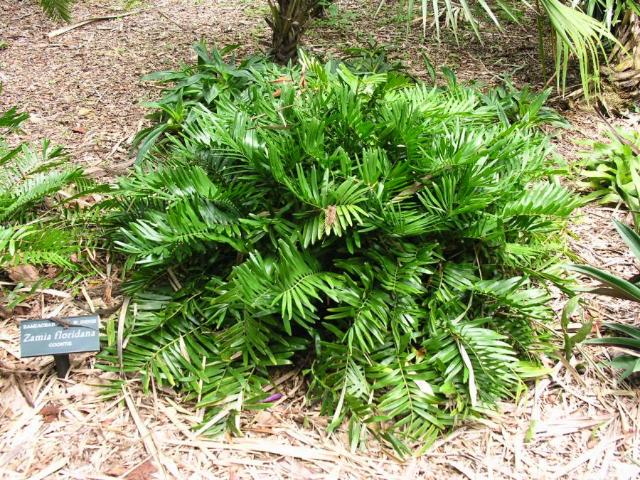
There is a beautiful butterfly (Eumaeus atala) in Florida that was historically dependent upon a particular native plant, coontie, which is a species of cycad.  Coontie was popular with early settlers as a food flavoring and was nearly wiped out early in the 20th century, along with the atala butterfly which was dependent upon it as its host plant.  Tallamy claims that the atala made a comeback when coontie became a popular plant for suburban gardens.  This makes a powerful case for how suburban gardeners can participate in efforts to conserve our native butterfly fauna.

Coontie.  Photo by Dan Culbert, University of Florida
Coontie. Photo by Dan Culbert, University of Florida

But is it true?  Wikipedia says it’s not:  “The atala is now common locally in southeast Florida rebounding to some extent as it has begun to use ornamental cycads planted in suburban areas.”    This is an example of how chemically similar plants can be useful to native insects, whether they are native plants or introduced, non-native, ornamental plants.

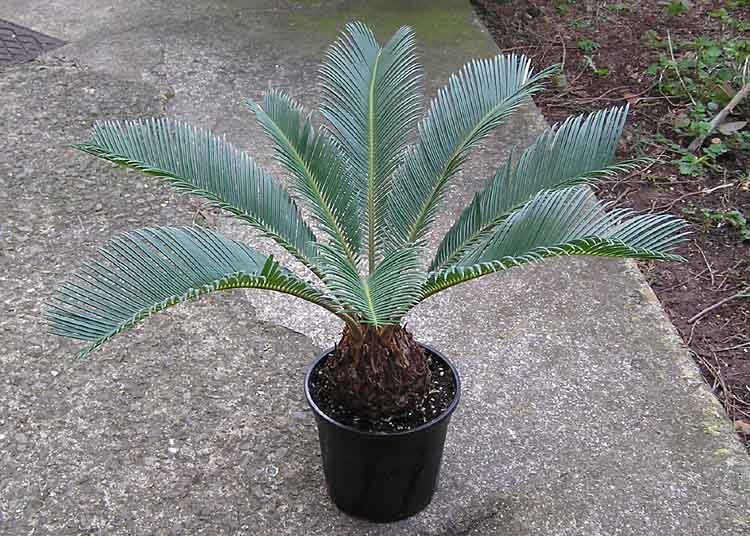
Sago cycad palm
Sago cycad palm is an example of an ornamental cycad

We apologize for being repetitive, but for the record we will close with the reminder that Million Trees urges everyone to plant whatever they want in their own gardens.  In public open spaces, which belong to everyone, we ask only that land managers quit destroying trees and using pesticides for the sole purpose of attempting to eradicate non-native plants.  The audience for Professor Tallamy’s publications is private gardeners, so we don’t really have a beef with him.  We critique his rationale for his preference for native plants only because it is often cited by those who demand the eradication of non-native plants and trees in our public open spaces.

The Living Landscape is a beautiful book, which we recommend to our readers for its lovely photos of naturalistic landscapes.


  1. Doug Tallamy, “Flipping the Paradigm:  Landscapes that Welcome Wildlife,” chapter in Christopher, Thomas,The New American Landscape, Timber Press, 2011
  2. Rick Darke and Doug Tallamy, The Living Landscape: Designing for Beauty and Diversity in the Home Garden, Timber Press, 2014
  3. Arthur Shapiro, Field Guide to Butterflies of the San Francisco Bay and Sacramento Valley Regions, University of California Press, 2007
  4. Martijn Bezemer, et. al., “Response to Native Insect Communities to Invasive Plants,” Annual Review of Entomology, January 2014.

Parks of New York City

Perhaps it’s a bit of an exaggeration to say that New York City is the center of America’s cultural universe, but when it comes to park history and design, it’s an accurate accolade.  It is the home of the first major park in the country, Central Park, as well as the most modern park innovation, High Line Park, an elevated railroad re-purposed into an urban trail park.  We will visit those parks in today’s post and think about what has changed and what remains the same in the 150 years that separate the design of those quintessentially American parks.

Central Park

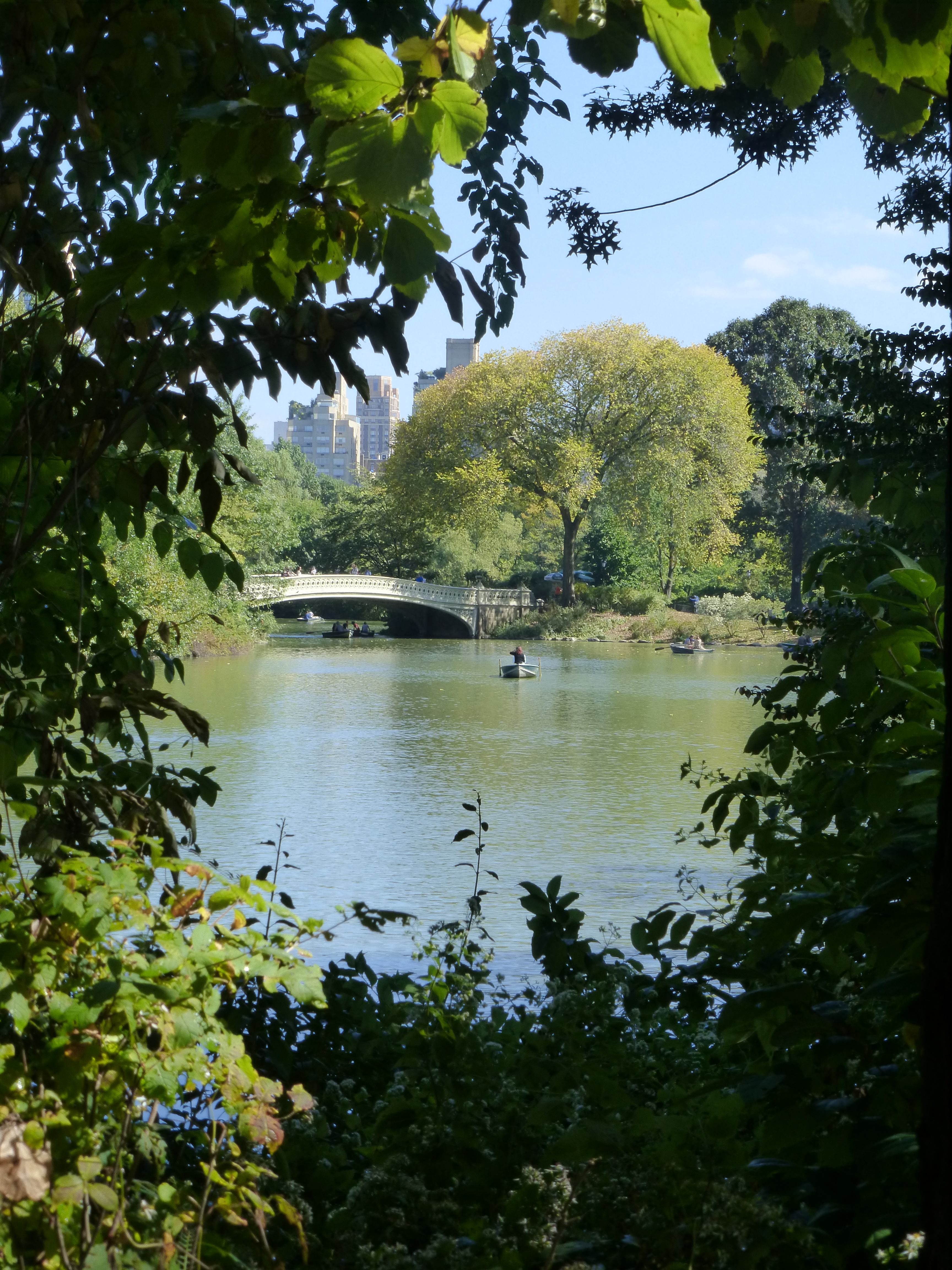
Central Park was designed and built by Frederick Law Olmstead and Albert Vaux before the Civil War.  It opened in 1857 to great fanfare and has been as central to the vitality of New York City as its name implies, since its opening.  It reflects the design sensibilities of Olmstead and the engineering genius of Vaux.  It looks completely natural, but virtually everything in it—its lakes, its streams, its hills—was constructed.

Central Park
Central Park

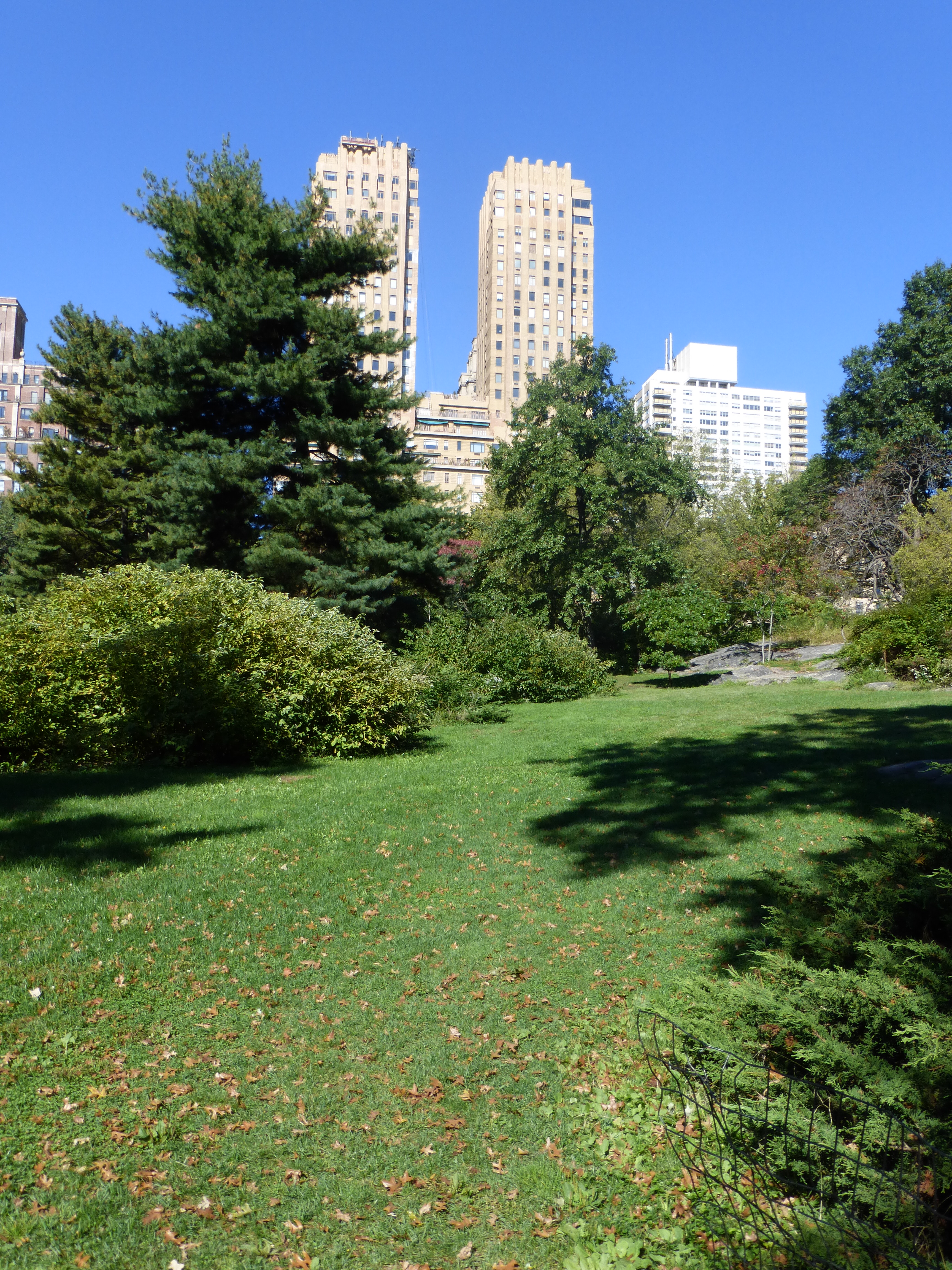
Olmstead was partial to a green landscape with long vistas across meadows and lakes.   He wasn’t inclined to plant colorful flowerbeds, though he could oblige when his clients demanded it.  The trees and plants he chose for Central Park were as likely to be native to New York as not.  His previous experience in agriculture informed his choices so survival of the landscape was ensured.

P1010588
Central Park

It’s not a coincidence that Olmstead’s plant list was not confined to native species because the concept of “nativeness” wasn’t defined when Central Park was designed.  “The modern division of species into native and alien first appears in the writings of Hewett Cottrell (H.C.) Watson in the mid-nineteenth century.” Watson was an amateur British botanist who was aware that some plant species had been introduced to Britain and he decided that some sort of classification system was needed to keep track of such species.  “He was the first to define ‘native’ in the modern sense:  ‘apparently an aboriginal British species, there being little or no reason for supposing it to have been introduced by human agency.’”  (1)

Watson acknowledged that distinguishing between aboriginal and introduced species wasn’t easy and he did not consider introduced species inferior to aboriginal species.  For the next one hundred years, opinions of the relative merits of aliens and natives varied.  Sometimes aliens were considered a problem and sometimes they were considered a benefit to ecosystems.  Sometimes such problems were attributed to the introduced plants and sometimes they were attributed to underlying factors.

All this changed in 1958 with the publication of Charles Elton’s book The Ecology of Invasions by Animals and Plants.  Today’s invasion biologists, if questioned, generally claim Elton’s book as their inspiration, and it has been described as signaling ‘the beginning of the field of invasion biology…’  But in many ways it is an odd book.  It isn’t a scientific book in the usually accepted sense, nor is it a textbook.  It is in fact a popular polemic, based to a large extent on a series of radio talks that Elton gave to the BBC.  But what is not in doubt is that it sits squarely in the tradition of blaming introduced species for practically any environmental ill you care to mention…” (1)

Olmstead was not burdened by the constraints of nativism in the 1850s and so he was free to plant whatever he considered beautiful and suited to the climate and conditions in New York.  We are fortunate to have this living evidence today that native and non-native plants survive  and thrive together in Central Park.  Central Park is the home of hundreds of species of birds and the temporary home of hundreds more species of migratory birds every spring and fall.

High Line Park

The High Line began in 1846 as a railroad line on the West Side of Manhattan, which transported unprocessed meat to the meat processing district and processed meats out of Manhattan.  In 1934, after many people were killed in collisions with the train, 13 miles of train were elevated 30 feet above the street, bypassing the cross-traffic from 34th Street to St. John’s Park Terminal at Spring Street.  In 1980, the last train on the High Line transported frozen turkeys from the meat processing district.  Soon thereafter, neighbors organized to prevent the demolition of the High Line.  The re-creation of the High Line as a park began in 2006.

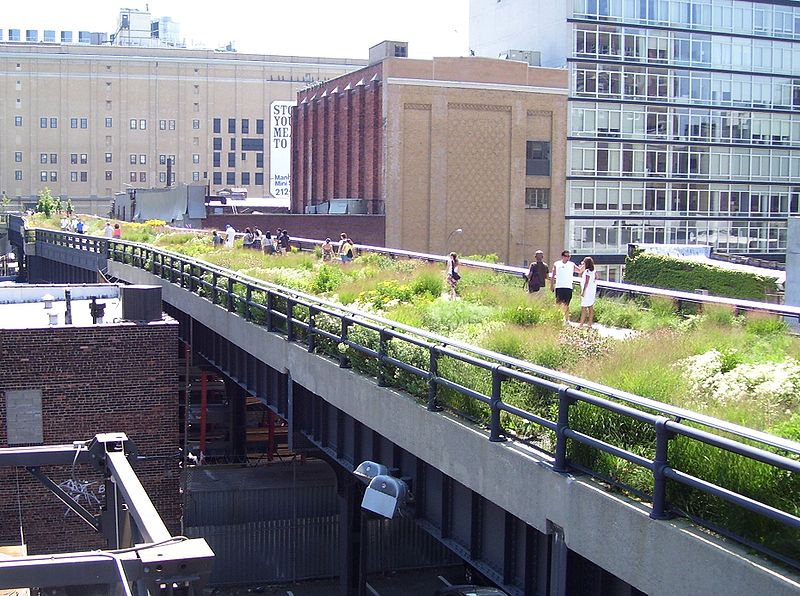
High Line Park, New York City
High Line Park, New York City. Creative Commons – Share Alike
Landscape of first phase of High Line Park

The first phase of High Line Park opened in 2009, the second phase in 2011, and the third opened on September 21, 2014.   All three phases opened to rave reviews.  The park became an instant success both with New Yorkers and with tourists.  Over 5 million people visit the High Line every year.  Having seen it, we can report it is no mystery why it is so popular.  It is a safe walk above the congested streets of New York with fabulous views of the Hudson River, the surrounding neighborhood, and the dramatic skyline of the Manhattan.

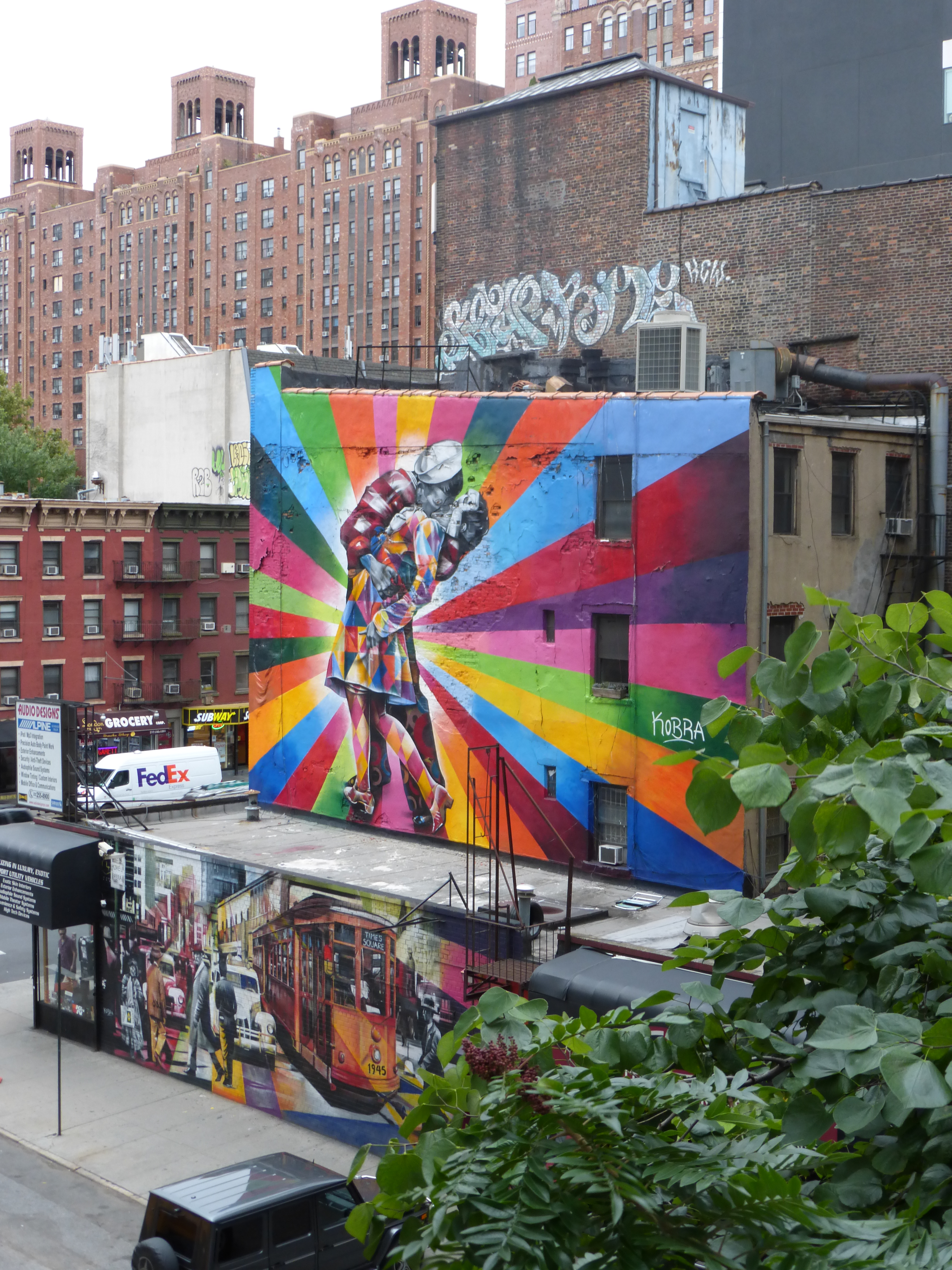
But the beauty and functionality of the park is not its only virtue.  It has transformed this formerly industrial neighborhood.  The surrounding neighborhood is dotted with cranes engaged in building valuable new residential properties.  Existing buildings are now covered with art to entertain visitors to the High Line.  The entire neighborhood has been revitalized by the development of this new, innovative re-creation of the City’s past.  It was atrociously expensive to transform the High Line into a park, but the park has already repaid the investment.

View from High Line Park
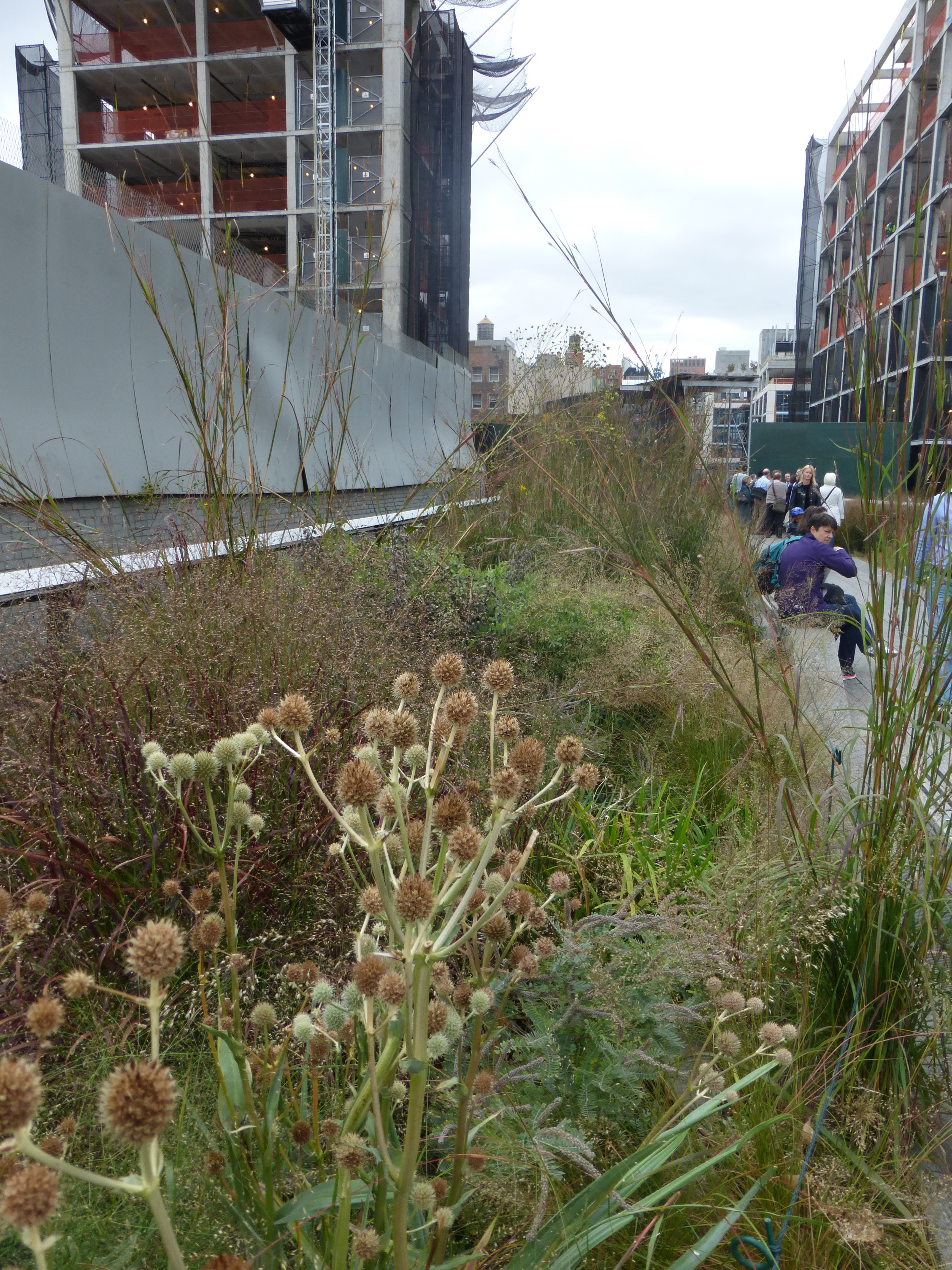
Self-Seeded landscape of Phase 3 of High Line Park

The design of the third and final portion of the High Line is different from its predecessorsPerhaps to reduce costs, the third section has retained many of the original structures of the railroad, including its weedy landscape.  The landscape is described as “self-seeded,” which is another way of saying that it is populated by the weeds that blew into the railroad ties during its 30-year fallow period.  The plant list of the High Line reflects its eclectic origins.  It is a mix of natives and non-natives, including many reviled by native plant advocates such as Tree of Heaven.  What is remarkable about the landscape in the third section is how similar it is to the earlier sections, which were planted.  In other words, achieving a “naturalistic” landscape bears some resemblance to the weeds of a vacant lot.  The final section of the High Line is no less charming and beautiful than its landscaped predecessors.

The High Line, like many parks in New York City, contains many enterprises that provide food and entertainment to its visitors.  Such enterprises are very controversial in San Francisco, where many park advocates consider them intruders.  We enjoyed a handmade cup of coffee on the High Line and wondered why San Franciscans have such a purist view of what “belongs” in their parks.

Comparing New York City with San Francisco

As we said when we began, we consider New York City the center of America’s cultural universe.  We are therefore encouraged that we found no evidence that New York City’s park system is dominated by nativism.  Their parks are both more beautiful and better maintained than those in San Francisco.  We suspect that San Francisco’s obsession with native plants has handicapped its ability to maintain beautiful parks because the plants that are native to San Francisco are brown and dormant much of the year.  New Yorkers looked back to their city’s 19th Century past to resurrect the High Line, while some San Franciscans are demanding a return to an 18th century landscape.

We also believe that San Franciscan’s objection to enterprises in their parks is one of the reasons why there isn’t enough money to maintain the parks to the same standard as the parks of New York City.

There are undoubtedly other factors at play.  The parks of New York City are heavily subsidized by wealthy foundations.  Its wealthy residents have been generous with the parks of New York City.  However, San Francisco is rapidly becoming as expensive a place to live as New York, so we wonder why our parks can’t enjoy the same level of support.  Is San Francisco’s “natives-only” approach to landscaping making our parks less attractive to potential donors?

Can you think of other reasons why San Francisco’s parks look so seedy compared to the parks of New York City?


(1) Ken Thompson, Where do camels belong?, Greystone Books, 2014

Climate change requires plants and animals move to survive

Our readers know that we consider climate change the most critical environmental issue of our time.  We also believe that the native plant ideology is antithetical to our concern about climate change for two reasons:

  • The changing climate requires that plants and animals move in order to survive. Therefore, the demand that historical ranges of native plants and animals be restored and maintained is both unrealistic and harmful.  It is unrealistic because the environment has changed in the past 250 years since the arrival of Europeans on the West Coast and it will continue to change.  Therefore, we cannot assume that the native plants that existed here in 1769 are still capable of surviving here.  It is harmful because animals can and do move as the climate changes.  Therefore, eradicating the plants they need for survival is harmful to them.
  • The eradication of non-native plants and trees is exacerbating climate change by releasing their stored carbon into the atmosphere, thereby contributing to the greenhouse gases that cause climate change. When prescribed burns are used to eradicate non-native plants or prevent natural succession the release of carbon into the atmosphere by the plants that are burned is immediate.  When large, mature trees are destroyed, the carbon they have stored as they grew is released into the atmosphere as the wood decays.  Furthermore, their ability to store carbon in the future is lost to us going forward.  Since carbon storage is directly proportional to biomass, whatever we plant in their place is incapable of storing as much carbon as the mature trees.
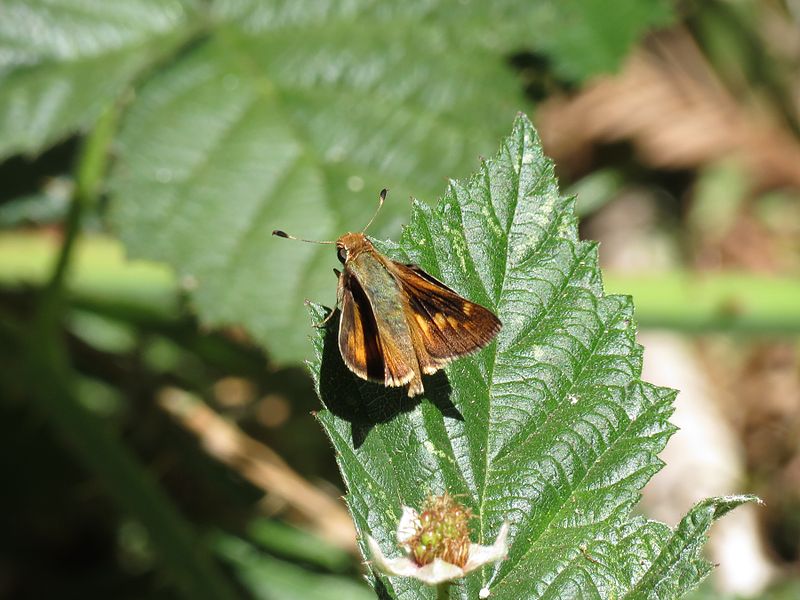
The umber skipper has adapted to Bermuda grass in lawns in the East Bay.  Creative Commons
The umber skipper has adapted to Bermuda grass in lawns in the East Bay. Creative Commons

There is an important caveat that we must add to our first bullet point.  Changing location is not the only mechanism that can ensure species survival in a changing climate.  Many species are probably “pre-adapted” to the changed climate.  That is, they may be capable of surviving changes in the climate.  Secondly, species can adapt and/or evolve in response to changes in the environment, which is another mechanism that facilitates species survival.  We invite our readers to visit our post about the rapid evolution of finches in the Galopagos Islands in response to extreme weather conditions that caused selection events.

Today we will inform our readers of the scientific record regarding the need for plants and animals to move as the climate changes.  We will use the recently released fifth report of the Intergovernmental Panel on Climate Change as our source.

Intergovernmental Panel on Climate Change

First we will establish the credibility of the Intergovernmental Panel on Climate Change (IPCC).  The IPCC was formed in 1988 by the United Nations.  It is composed of thousands of scientists from all over the world, representing the 190 member nations of the UN.  The IPCC does not conduct original research.  Rather it compiles thousands of peer-reviewed scientific studies into reports that represent a consensus viewpoint of the global scientific community.  Typically, scientists from 120 countries participate in marathon sessions in which consensus must be reached before reports can be published.  The IPCC has published 5 reports since 1988, the most recent earlier in 2014.

How the climate has changed and how it will continue to change

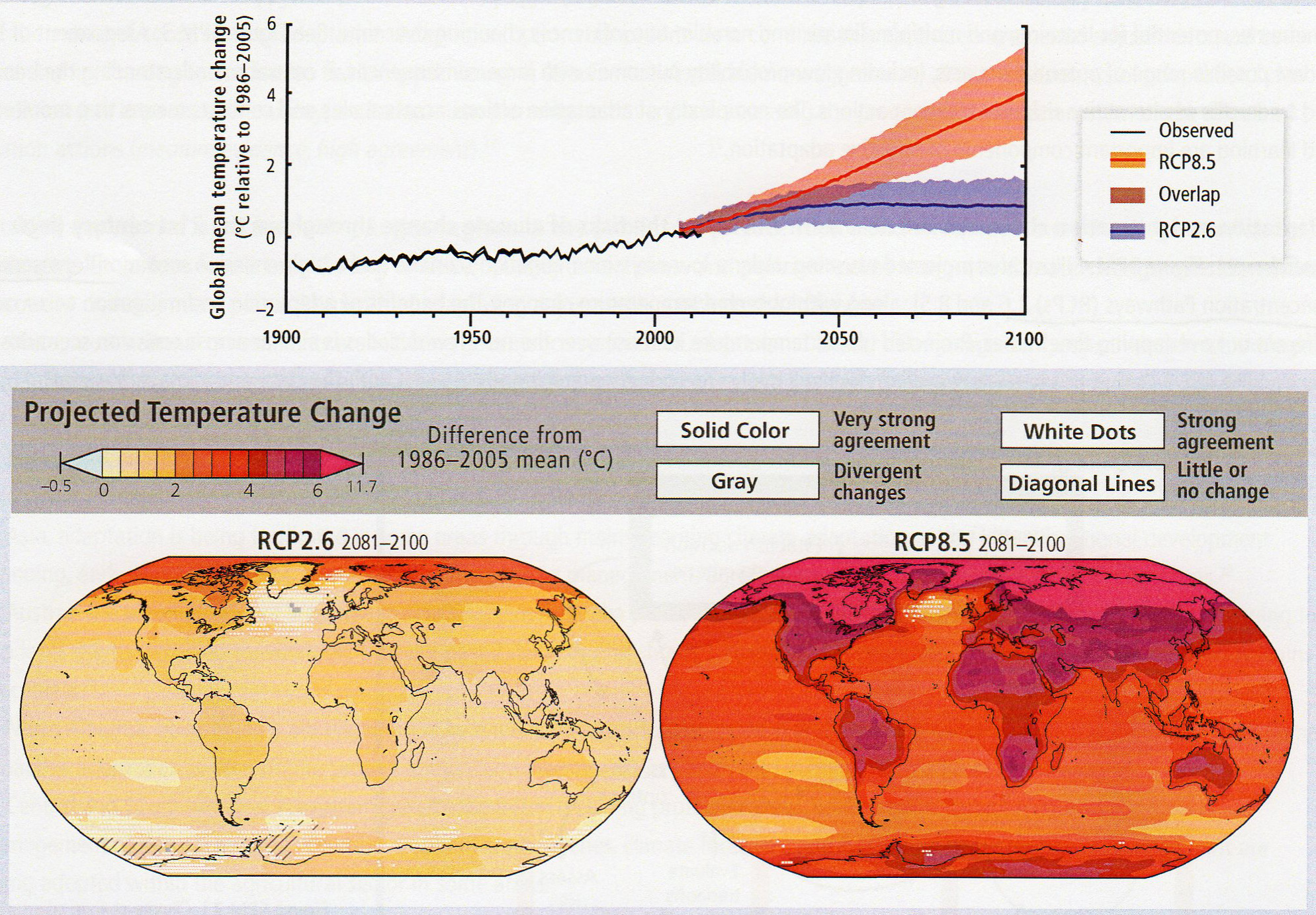
The IPCC compiled several different sources of data to report how the climate has changed from 1900 to the present.  Then they modeled the multitude of variables that influence climate to predict different trajectories for the climate going forward to 2100.  The many variables that influence climate interact in complex ways that are not entirely predictable.  There is therefore some uncertainty in those predictions, as there is in any prediction of the future.  Therefore, future temperature is depicted by the following graph as “bands” of probability.  The bands become wider as the graph depicts further into the future, as we would expect; that is, the distant future is less predictable than the near future.

Observed and projected temperature change, IPCC 2014

Here’s what we learn from this graph:

  • The graph reports that the average global temperature has increased by 1° Celsius (1.8° Fahrenheit) from 1900 to the present.  Graphs depicting the more distant past indicate that the climate began to warm around the time of the industrial revolution, about 1850.  Therefore the total increase in temperature is greater than that depicted by this graph.  However, the rate of increase has accelerated greatly in the past 50 years.
  • The upper range of projected temperature increases on the graph is labeled RCP8.5 (Representative Concentration Pathway 8.5). That pathway is based on the assumption that present levels of greenhouse gas emissions will continue to increase at the same rate as they have in the recent past.  The mean prediction of that pathway is a global temperature increase from the present to the end of the century of 3.7° Celsius (4.6° Fahrenheit).
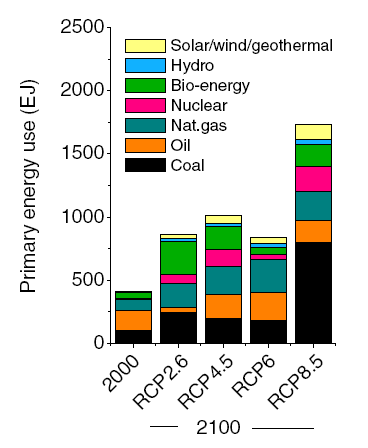
  • The lower range of the projected temperature increases on the graph is labeled RCP2.6 (Representative Concentration Pathway 2.6). The mean prediction of that pathway is a temperature increase to the end of the century of 1° Celsius (1.8° Fahrenheit).  That pathway is based on the assumption that greenhouse gas emissions are radically reduced, beginning immediately, as represented by the following graph from The Guardian.  This graph also depicts two intermediate emission scenarios between the present trajectory(RCP 8.5) and the maximum predicted reductions in emissions (RCP 2.6)
Projected energy use

Movements needed for survival in a changing climate

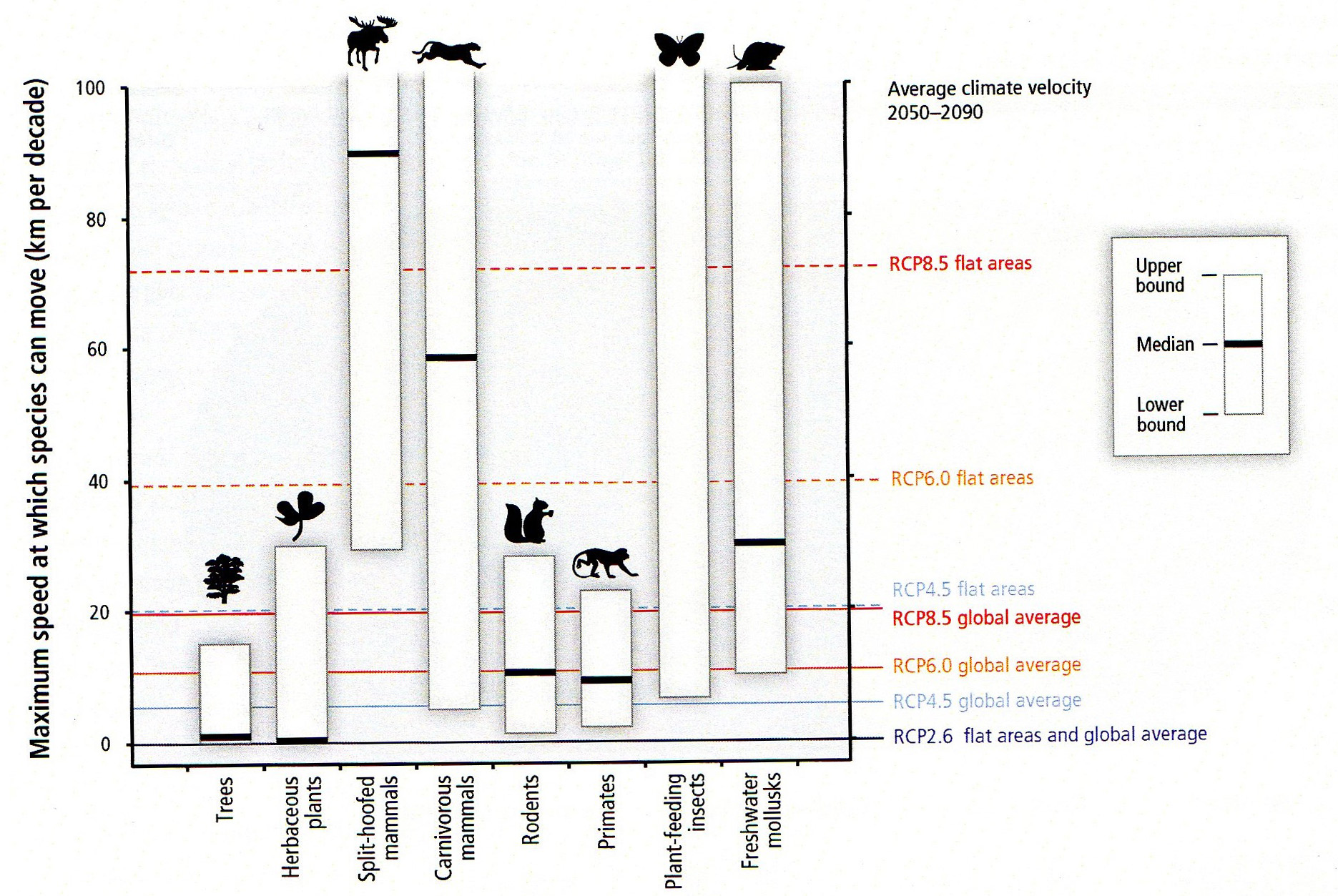
The world has done little to reduce greenhouse gas emissions and America has done even less.  According to a recent Gallup Poll, only 39% of Americans are “concerned believers” in climate change.  Another 36% of Americans believe the climate is changing, but don’t believe it will affect them.  Twenty-five percent (25%) of Americans do not believe the climate is changing.  Therefore, for the time being, it seems extremely unlikely that our polarized politics in America will be capable of responding effectively to the grim reality of climate change.  Within that context, we inform you of the final graph from the IPCC report about the need for plants and animals to move from their present ranges in response to climate change and their variable ability to do so.

Adaptation to Climate Change.  IPCC
Adaptation to Climate Change. IPCC

On the vertical axis, the graph depicts the ability of plants and animals to move, measured in kilometers per decade.  The horizontal lines depict the need of plants and animals to move in response to various scenarios of climate change as we described earlier.  The bars depict the ability of plants and animals to move and the height of each bar informs us of the variable ability of plants and animals to move.  Trees are the least able to move, unless we have the wisdom to plant them outside their native ranges—at higher latitudes or elevations–where they are more likely to survive in the future. 

For example, if we radically reduce greenhouse gas emissions immediately (RCP2.6), most species of trees and plants will be sustainable at their present latitudes and elevations.  But if greenhouse gas emissions continue on their current trajectory (RCP8.5), most species of trees and plants will not be capable of moving far enough, fast enough to survive as the climate warms.  Although trees and plants are capable of moving only very slowly, most animals are capable of moving more rapidly.  Will they have the plants they need to survive in their new ranges?

 Putting our heads in the sand

Surely there aren’t many native plant advocates in the San Francisco Bay Area who don’t believe in the reality of climate change.  The Gallup Poll reports that most people who don’t believe in climate change are Republicans and in the San Francisco Bay Area Republicans are a small minority.  And so we ask native plant advocates this question:  How do you reconcile the reality of climate change with your demand that native plants be restored and maintained where they existed 250 years ago in a very different climate?


“Restoring” vegetation does not restore an ecosystem

One of the persistent questions in our interminable debate with native plant advocates is whether or not native vegetation provides superior habitat for wildlife compared to existing non-native vegetation.  At the heart of that question is the closely related question of whether or not more insects are found in native vegetation than in non-native vegetation.  That’s because insects (and other arthropods) are near the bottom of the food web.  If there are fewer insects, there are probably fewer birds and other animals that eat insects. We have told our readers about many studies that find equal abundance and diversity of insects in native compared to non-native vegetation, so we won’t repeat them, but here’s a brief list of those studies and links to them for new readers:

Does “restoration” of native vegetation increase insect populations?

Arthropods - Creative Commons Share Alike
Arthropods – Creative Commons Share Alike

In this post we will consider this issue from a slightly different angle:  can insect population or diversity be increased by “restoration” of native vegetation?  Even if we accept the premise of native plant advocates that native vegetation supports greater abundance and diversity of insects, can that population be “restored” by eradicating non-native vegetation and replacing it with native vegetation?  That question is answered with a resounding “NO” by a study that compared arthropod abundance and diversity in undisturbed (predominantly native vegetation), disturbed (predominantly non-native vegetation), and disturbed sites 5 and 15 years after restoration. (1) Restoration methods described in the study are mowing followed by disking and seeding, disking and seeding, planting of container stock, and clearance by hand.  All sites were irrigated initially.  No mention is made of herbicide use or prescribed burns to eradicate non-native vegetation. The vegetation type in all 15 sites in Southern California was coastal sage scrub.  This is the dominant vegetation type along the coast of California and is the goal of many restoration projects in the San Francisco Bay Area.  Many species of both native and non-native vegetation in the study sites also exist in the Bay Area.

Coastal sage scrub in Southern California - Creative Commons Share Alike
Coastal sage scrub in Southern California – Creative Commons Share Alike

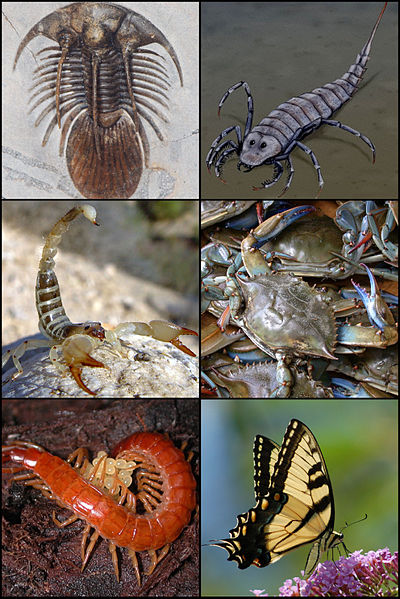
The study used pitfall traps to collect arthropods in these sites.  Arthropods are invertebrates that include insects, arachnids (spiders), and crustaceans (aquatic species not relevant to this study).  Arthropods are further divided into guilds such as herbivores, predators, scavengers, and parasites.  Because of the method of collecting in pitfall traps, few herbivores were found. Here are some of the findings of this study:

  • “Arthropod diversity at undisturbed and disturbed sites was greater than at sites that were 5 and 15 years following restoration.”
  • “Number of arthropod species was not significantly different among undisturbed, disturbed, and restored sites.”
  • “Vegetation at disturbed and undisturbed sites differed significantly; older restorations did not differ significantly from undisturbed in diversity, percent cover, or structural complexity.”
  • “Vegetation characteristics did not differ significantly between the newly restored site and disturbed sites.”
  • “…arthropod communities at all restored sites were, as a group, significantly different from both disturbed and undisturbed sites.”
  • “As found in other studies of other restoration sites, arthropod communities are less diverse and have altered guild structure.”

Here is the concluding discussion of this study:

“Of the restoration sites sampled, none had developed an arthropod community that resembled undisturbed or disturbed native coastal sage scrub. Restoration sites in general exhibited lower arthropod diversity and a preponderance of exotic arthropod species. The time elapsed since revegetation effort had no discernible effect on arthropod community structure; there was no gradual return of the community to a more natural structure over time”.

 “Restorations” do not improve arthropod abundance or diversity

This study found that arthropod population and diversity was the same in disturbed (non-native) and undisturbed (native) vegetation.  When disturbed vegetation was “restored” arthropod population was maintained but the composition of the arthropod community was significantly changed even 15 years after the restoration was completed.  There were more “exotic” species of arthropods in the restored sites even though the vegetation was similar to the undisturbed sites of native vegetation.  The restored vegetation was native, but its arthropod occupants weren’t.

However, the birds and other animals that prey on those insects don’t care if the insects are native or non-native.  Much like humans, animals are not concerned with the nativity of their food.  The non-native apple you are eating is just as tasty whether you are eating it in its native range in Central Asia or where it has been introduced.  If you have an apple tree, you know the birds and squirrels enjoy the apples too and the bees and other pollinators enjoy the apple blossoms.   Most of what we eat is not native, yet many people are obsessed with the nativity of vegetation, claiming that animals require native vegetation even though humans don’t.

An important caveat

The predominant vegetation type in the San Francisco Bay Area is coastal scrub, which is also the vegetation type in the study of arthropod populations.  This suggests that if a similar study were conducted here, the results might be similar.  However, there is one very important difference between the restorations studied in Southern California and the restorations in the Bay Area.   Land managers in the San Francisco Bay Area are using large amounts of herbicides to destroy non-native vegetation.  The study in Southern California reports no herbicide use in restoration sites. It seems likely that herbicides sprayed in restoration projects in the Bay Area would decrease the population of arthropods.  We would like to see a study that tests that hypothesis. 

There is more to an ecosystem than plants

The veneration of native plants has become a national obsession.  Demands for eradication of non-native plants are supported by many fictions to justify these destructive projects.  One of those fictions is that wildlife requires native vegetation.  We have found no empirical evidence to support that assumption.   The study we are reporting today is yet more evidence that restoring native plants does not restore an ecosystem. In this case, after 15 years of effort, land managers were eventually successful in establishing a population of native plants.  However, these “restored” native landscapes did not support a population of insects and spiders that were comparable to either the undisturbed native landscape or the unrestored non-native landscape.  We have been looking for some legitimate reason to engage in these destructive projects for over 15 years.  We have yet to find any justification for spraying our public lands with herbicides or destroying hundreds of thousands of healthy trees.  We will keep looking.


(1)    Travis Longcore, “Terrestrial Arthropods as Indicators of Ecological Restoration Success in Coastal Sage Scrub (California, USA),” Restoration Ecology, December 2003, Vol. 11 No 4, pp.397-409

Krakatoa: A case study of species dispersal

Islands are intensively studied by ecologists because they are hothouses for evolution.  Physical isolation results in the evolution of new species that are related to their mainland ancestors and the result is many endemic species of plants and animals which exist only on that island. 

Some islands originated when continents broke up into smaller pieces as a result of continental drift.  Madagascar and New Zealand are examples of islands that were originally attached to a continent.  These islands brought some of the inhabitants of the continent with them.  But many islands arose from the ocean as a result of volcanic activity and were therefore born bare as a newborn babe without vegetation or inhabitants.  All subsequent life on these volcanic islands arrived by dispersal from elsewhere via ocean currents, winds, or carried by traveling animals, most recently by humans.

Krakatoa map

Krakatoa is such a volcanic island in the Indonesian archipelago.  It has a long record of volcanic eruptions which both destroyed much of the island and created new islands.  Many of these eruptions occurred during prehistoric periods, but many have been recorded by human history.  These recent eruptions have created an evolutionary laboratory that enables us to answer the perplexing question of how quickly the dispersal of species occurs. 

The cataclysm of 1883

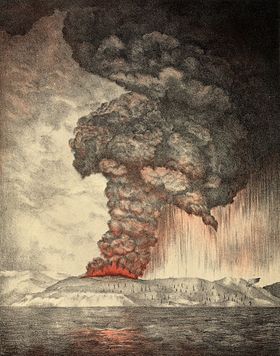
Krakatoa eruption, lithograph 1888

In August 1883 a series of volcanic eruptions on Krakatoa produced one of the most cataclysmic events of recorded human history.  The force of the blast was the equivalent of 13,000 times the nuclear bomb that devastated Hiroshima in 1945.  The blast could be heard as far as 3,000 miles away.  Shock waves from the blast reverberated around the planet 7 times.  The blast sent an ash cloud 50 miles into the atmosphere. The weather of the entire planet was altered by the ash cloud.  The temperature dropped by 1.2 Degrees Celsius in the year after the eruption and the climate did not return to normal until 1888.  The blast and subsequent tsunami killed over 36,000 people and destroyed two-thirds of the island.

 Scientists believe that nothing living survived the blast:  “no plant, no animal, no seed, no spore.” (1)  The first scientists visited Krakatoa nine months after the blast.  They reported finding nothing alive except a single spider.  Spiders are notoriously successful dispersers because the webs they weave can become sails on the wind.

Krakatoa is quickly repopulated

In 1886—three years after the eruption—the first botanical expedition arrived on Krakatoa.  They found mosses, algae, flowering plants and eleven species of fern.  They speculated that the arrival of algae enabled the spores of ferns to become established on the otherwise bare ground.  Amongst the plants there were two species of grasses.  Scientists assume that most of these plants arrived via wind, but some species could have arrived as seeds carried by the surf.

Further colonization of the barren island then began to accelerate.  By 1887, young trees were found as well as dense grassland and many ferns.  Butterflies, beetles, flies and a single monitor lizard were found in 1889.   The species of monitor lizard found in 1889 is known to be a good swimmer and is a “versatile opportunist” on land, which means it’s not a fussy eater and it can eat less often than other lizards.

By 1906, there were a hundred species of vascular plants, covering the summit in green and a grove of trees along the shore, including tamarisk and coconut palm.  The coconut is found on virtually any sunny beach in the Pacific because its seeds float in their large protective shell wherever the current carries them.

Fifty years after the eruptions of 1883, the island was home to 171 species of plants.  One botanist estimated that 40% of the plants came on the wind, 30% floated on the sea and most of the remainder were brought by animals.   The eruption of 1883 produced huge quantities of pumice–a lightweight, sponge-like volcanic glass—that floated on the ocean creating rafts that were observed for years after the eruption:  “…a ship’s captain…who encountered pumice on the Indian Ocean, lowered a boat for a closer look, ‘It was curious and interesting to note how it had been utilized by animals and low types of life as habitations and breeding places.’”  (1)

These early arrivals were effective dispersers, but they also had to be capable of surviving inhospitable conditions on arrival.  The order of arrival is therefore an important factor in determining successful establishment.  For example, animals won’t survive if they arrive before needed food resources.  The plants most likely to survive are capable of self-pollinating, that is they don’t require a partner to reproduce.

San Francisco is not an island

How does this experience on Krakatoa compare to our experience in the San Francisco Bay Area?  We’re so glad you asked!!

The many projects all over the Bay Area that destroy non-native vegetation are not isolated islands.  They are surrounded by more non-native vegetation which quickly re-populates the bare ground created by these projects.  Dispersal into small plots of land within San Francisco is much easier than onto isolated Krakatoa.  The majority of these projects do not have the resources to replant the areas in which non-native vegetation is eradicated.  The fiction is that native plants will magically reappear when non-natives are destroyed.  But we can see that the result is the return of the hardiest non-native weeds such as hemlock, star thistle, oxalis, and broom.  These hardy creatures don’t need to be planted.  Their seeds are carried by the wind or remain dormant in the ground to germinate when someone foolishly destroys the trees that provide shade and suppress germination of weeds.

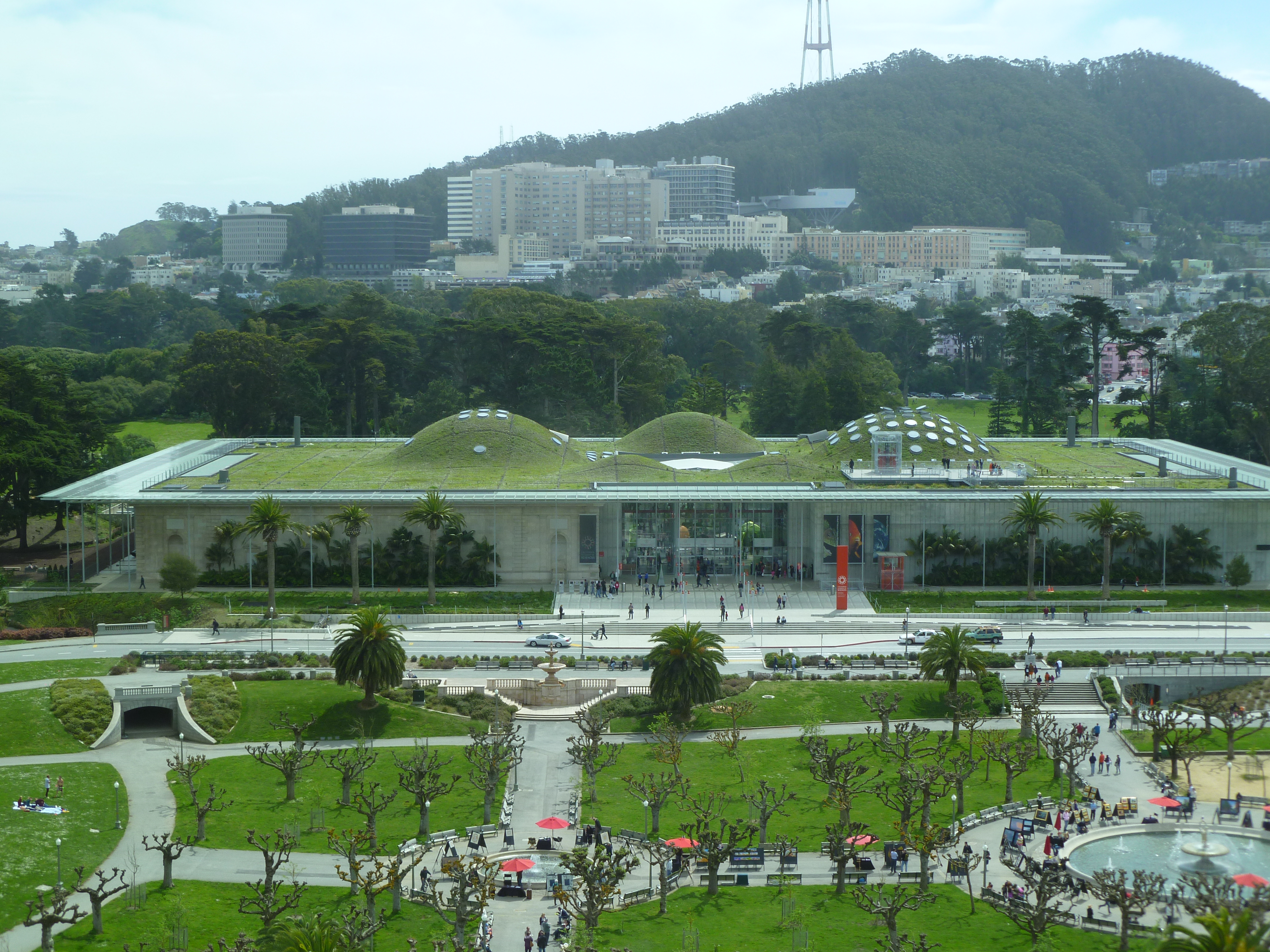
California Academy of Sciences, April 2011

Even when natives are planted, they are quickly out-competed by non-natives.  The best local example of that hard, cold fact is the living roof on the California Academic of Sciences.    When the California Academy of Sciences reopened in San Francisco in August 2008, its “living roof” was considered its most unique feature.  Thirty species of native plants were candidates for planting on the roof.  They were planted in test plots with conditions similar to the planned roof and monitored closely.  Only nine species of native plants were selected for planting on the roof because they were the only plants that were capable of self-sowing from one season to another, implying that they were “sustainable.”  A living demonstration of “sustainability” was said to be the purpose of the living roof.

Two of six of the predominant species on the roof after 2-1/2 years were native.  Four of six of the predominant species were mosses that are “cosmopolitan,” which means they are found everywhere.  They weren’t planted on the roof and were therefore “volunteers.”

The monitoring project divided the roof into four quadrants.  In February 2011, non-natives outnumbered natives in two of the quadrants.  Although natives outnumbered non-natives in the other two quadrants, non-natives were also growing in these quadrants.

The consultant who advised the Academy about what to plant on the roof would not be surprised by this monitoring report.  He advised the Academy to walk the streets of San Francisco and identify the plants growing from the cracks in the sidewalks.  These are the plants he advised the academy to plant because these are the plants that are adapted to current conditions in the city.  The Academy rejected this advice because they were committed to planting exclusively natives on the roof.

The many projects that are destroying non-native vegetation are not sustainable.  They are surrounded by non-native vegetation which is better adapted to current climate, soil, and atmospheric conditions.  Non-native vegetation will out-compete the natives that are not adapted to current conditions.  If these projects were merely futile, perhaps we could shrug and move on.  But we can’t turn a blind eye because these projects are harmful to the environment.  They use huge quantities of toxic herbicide and they are destroying healthy trees that are performing many valuable ecological functions.  These are not harmless experiments.


(1)    David Quammen, Song of the Dodo, Scribner, 1996.

(2) Some information for this post is from Wikipedia

No consensus on the definition of “native” or “invasive” species

We recently republished an article from the Garden Rant blog about the overuse and misuse of the word “invasive” to describe plants.  That article objected to the exclusive use of that pejorative word to describe non-native plants, when native plants often behave in exactly the same way.  The article also pointed out that the behavior of plants varies depending upon local conditions such that labeling any plant “invasive” beyond a specific locality is bound to be inaccurate.

A huge expanse of coyote brush at Lake Chabot, an example of a native plant that would be called "invasive" if it were not native.
A huge expanse of coyote brush at Lake Chabot, an example of a native plant that would be called “invasive” if it were not native.

Today we will tell our readers about a new study which explains why the word “invasive” is causing confusion.(1)  Four scientists in Zurich, Switzerland conducted structured interviews with 26 academic invasion biologists and landscape professionals and found no consensus about the definition of “invasive.”   Nor is there any agreement about the definition of “native,” which is surely contributing to the confusion about the appropriate use of the word “invasive.”  Finally, the authors of the study compared this lack of consensus with the scientific literature of invasion biology.  They found a conspicuous discrepancy between the uncertainty expressed in the interviews with experts and the conservation policies that are theoretically based on the scientific literature.

And the eucalyptus forest behind the coyote brush at Lake Chabot which is called "invasive" but in fact, rarely invades.
And the eucalyptus forest behind the coyote brush at Lake Chabot which is called “invasive” but in fact, rarely invades.

What is the difference between native and non-native species?

Although there was some agreement amongst invasion biologists that non-native species arrived with the help of humans, there was less agreement about the timing and location of arrival.  Some said non-natives arrived after the last glacial period (about 10,000 years ago) and others said after 1500 A.D. (post-Columbian exchange).  Landscape professionals were more likely to say that species are native which arrived prior to the life-span of humans, a significantly shorter period of time, obviously.  This is consistent with the tendency for landscape professionals to consider human perception the source of such categorization.

There was little agreement about a spatial definition of native species Some invasion biologists define native species within the context of political units (such as countries) while others use biogeographic definitions such as continents or on either side of a continental divide.

There is also disagreement about the means of movement used to define a species as non-native.  Some invasion biologists consider species non-native if their range has changed as a result of climate change because of the anthropogenic origin of contemporary climate change.  Such movement is now rapidly occurring so this particular definition is likely to result in the changed status of many species presently considered native, a change that is likely to make them targets for eradication.

When is a non-native species “invasive?”

There was little agreement about the criteria for calling a non-native species “invasive.”  Some invasion biologists did not think that an “invasive” species need behave any differently than a native species to be categorized as “invasive.”  Others believed it is appropriate to call a non-native species “invasive” if it spreads, even if that species has no negative impact on the ecosystem.  When asked to evaluate the impact of non-native species, more invasion biologists and landscape professionals considered the impact “neutral” (56%) than those who considered the impact “negative” (32%).  Invasion biologists tended to assess the affect of non-native species more negatively than landscape professionals.

The interviewees were then asked on what they based their judgment of the impact of non-native species.  This is perhaps the most telling question of all.   Both groups of experts lamented the absence of empirical evidence of the impact of non-native species:  “In almost a third (32%) of all assessments, experts could not recall any effects of non-native invasive species on ecosystem services.”  Most admitted that their judgment was based on “intuition” informed by their “general knowledge” or “extrapolating” from related knowledge:  “most experts were prepared to assume that non-native invasive species have a generally negative effect upon native biodiversity.” (emphasis added)

 Are non-native “invasive” species a serious problem? 

This is the question for which the answers of invasion biologists and landscape professionals were most divergent.  Invasion biologists consider non-native “invasive” species a serious problem which is underestimated by the public and politicians.  In contrast, landscape professionals said the problem is overestimated“…particularly due to anxiety and xenophobic feelings among the public.” 

The consequences of this lack of clarity 

The authors of this study then examined the publications of invasion biologists to see if this lack of consensus is apparent in the scientific literature of invasion biology.  They observed that invasion biologists start their publications with a definition of non-native and invasive species, but “in the rest of the text this definition was rarely strictly applied.”  They tend to use the terms “non-native” and “invasive” interchangeably.  They compare the spreading of native species to non-native species without indicating that the native species is also invasive.

The authors conclude that both the categorization of species as native or non-native and their designation as “invasive” are largely value judgments that reflect cultural values, not scientific judgments.  They suggest that invasion biologists “acknowledge the uncertainties and engage transparently with stakeholders and the public in deliberations about conflicting opinions.  Here invasion biologists should take the role of ‘honest brokers of policy alternatives,’ taking into account different prevalent values and policy preferences rather than adopting the role of ‘issue advocates.’” 

In other words, the conservation policies which are theoretically based on the scientific literature of invasion biology should acknowledge the uncertainty that pervades the discipline.  Given that uncertainty, the value judgments of the public should be on an equal footing with the value judgments of those who have a vested interest in the projects that are destroying existing landscapes.  There are alternatives to those destructive projects and the public’s opinion must be taken into account in considering those alternatives.

Of course, we agree.  As we have said many times on Million Trees, invasion biology is not a scientific discipline. Rather it is a set of value judgments based on a belief that native species (whatever they are) are superior to non-native species.  This is not just a question of semantics.  Many species are being killed because of what someone chooses to call them and irreparable damage is being done to our environment in the process of killing them.

 *********************************

(1)    Franziska Humair, et.al., “Understanding misunderstandings in invasion science:  why experts don’t agree on common concepts and risk assessments,” NeoBiota, 20, 1-30, 2014

“The trouble with the word ‘invasive'”

We are republishing an article from the Garden Rant blog with permission of the author, Susan Harris.  Susan is a professional garden writer who lives in the Washington DC area.  Garden Rant is an award-winning garden blog with a huge readership of garden writers, landscape professionals, and home gardeners.  They report over 80,000 readers per day. 

In this article, Garden Rant enters the controversial debate about the arbitrary use of the word “invasive.”  We agree that this word is both over-used and misused.  However, this is more than a semantic debate.  It’s an important debate because the word is being used to justify huge destructive projects that are damaging the environment by needlessly attempting to eradicate non-native plants, using polluting methods such as herbicides and prescribed burns.

If you have never debated with native plant advocates, you might find the comments posted to this article of interest.  They are typical of the many dialogues we have had with native plant advocates in the past.  

*********************************

This is a long-simmering rant about the many ways the term “invasive” causes confusion, and more.  DO weigh in with alternatives, pushback, and rants of your own.

“Invasive” as synonym for “nonnative”

Google “native versus invasive” and the 5.6 million hits confirms my observation that this is a common usage, and it’s led to a common misperception in the public that the opposite of native is indeed invasive.  QED: nonnatives ARE invasive.  Even regular garden writers sometimes use this juxtaposition, which should more accurately be “native versus nonnative” or I guess, “exotic.”

That great leveler, Wikipedia, confirms this problem about the term “invasive”: “The first definition, the most used, applies to introduced species (also called “non-indigenous” or “non-native”) that adversely affect the habitats and bioregions they invade economically, environmentally, and/or ecologically.”  At least their second definition is more accurate and even includes native species like deer.  No argument there.

Defining away the invasive behavior by natives

Can native plants be invasive?  Sure, as evidenced by the above-mentioned deer or in the plant world, wild grape.  But when native plants are termed invasive someone invariably pipes up to correct the writer because by definition, they’re nonnatives only.  And sure enough, legally, by the official U.S. government definition, only nonnative plants can be deemed invasive – for purposes of qualifying for money to remove them.  The 1999 Federal Executive Order on Invasive Species defines an invasive species as a “species that is not native to a particular ecosystem…”

Invasive plant lists covering large regions – even continents!

We all know that plant behavior depends on the exact conditions the plant is growing in, as well as more broadly, the region.  So some plants that behave well in the North are overly vigorous in the South.  Or some, like the infamous purple loosestrife, are vigorous in wet spots, not in dry ones.  Examples abound.

Spirea and Doublefile Viburnum (L), Lespedeza (R)

Spirea and Doublefile Viburnum (L), Lespedeza (R)

Yet this site by the U. Georgia and many other sources, including the National Park Service, don’t distinguish by region, and the resulting list of “invasives” includes these surprises to gardeners near me: several viburnums, two verbascums, several veronicas, red and white clo0ver, Japanese yew, 3 spireas (MOST on the market), various salvias, willows, nandina, grape hyacinth, Miscanthus sinensis (without specifying that it’s only the early-bloomers that spread), Lespedeza thumbergii, Pee Gee Hydrangea, cotoneaster, and strangely, littlestem bluegrass (Andropogon virginicus).  Yet native thugs like trumpet creeper are encouraged and they’re not invasive?

That designation of Spirea really bothers me because it’s such a self-sustaining, easy, low-maintenance and well behaved shrub, one I’ve grown for 30+ years with no signs of trouble.  And yet another source – the  USDA National Invasive Species Information Center – also targets Spirea Japonica and says this about it: “Spreads rapidly and forms dense stands that crowd out native species.” This and other contradictions between official reports and in-garden experiences growing targeted plants is puzzling to me.

Adding to the overly broad regionality of invasive-plant designations, there’s a new book on invasive plants, written for a national audience.

Shouldn’t invasiveness be designated locally?  And sometimes, for certain conditions?

“Invasive” used instead of “spreading”

I’ve heard garden-club members describing their passalong plants at plant swaps as “invasive” if they spread at all.  Which leads to said garden club being accused of encouraging the use of “invasives,” among other things.

Methods of “invasion” all lumped together

Mature Ivy
Mature Ivy

The  USDA lists these characteristics of invasive plants: “produce large numbers of new plants each season; tolerate many soil types and weather conditions; spread easily and efficiently, usually by wind, water, or animals; grow rapidly, allowing them to displace slower growing plants; spread rampantly when they are free of the natural checks and balances found in their native range.”

Yet some of those qualities are valued in the garden – especially tolerance of many conditions.  And for the gardener on a budget, especially one trying to replace their lawn with another groundcover, spreading is a good thing and it’s usually described more positively as “fills in quickly.”

What if the standard were: Does the plant spread in a way that causes harm to natural areas?  For example, plants that are spread by birds, like English ivy, so that the seeds can go everywhere and harm natural areas.  Unlike Spirea and Nandina that spread by rhizome and produce a couple of offspring every year, if that – just like Itea does?  Or if it’s simply spreading in the garden, is it impossible to control, like running bamboo?

daylily-550x412For example, “Invasive Species of Concern” in Maryland includes mostly plants we’d all agree are thugs and not even considered garden plants, but daylily?  As a sun-lover, it won’t spread into the woods and even out in the sun, how hard is it to dig up?

Or a plant could be harmless in a townhouse garden on Capitol Hill but potentially harmful if planted on the edge of a forest.

I wish there were several terms used to describe spreading behavior by plants, rather than the single term “invasive.”  How’s a gardener to choose between groundcovers like pachysandra, periwinkle and English ivy, when they’re lumped together as equally thuggish when only one of them will grow virtually to strangle trees, set seed and spread indiscriminately?

More science-based info, please

In researching the topic of “native versus exotic” I came across one example of the type of reporting on invasive species I’d like to see more of – based on research, not scare tactics.  Just one quote from this article by Cornell will piss off some readers, but here goes:  “A small percentage of plants exhibit invasive tendencies, while the majority of plant introductions are benign or beneficial.”

Solutions for “invasiveness” coming?

Plant breeders are hard at work breeding out invasiveness in popular garden plants, as reported on the Native Plants and Wildlife  Gardens blog.  Though controversial, especially among native-plant advocates, this type of breeding is recognized by pragmatists as a step in the right direction.

Daylily photo credit.