Endangered Species Law is under fire

Like most of our federal laws and regulations intended to protect the environment, the Endangered Species Act is under fire because the political party now in power is opposed to government regulations that impose any perceived limitations on economic activity.  There are a number of laws grinding their way through the legislative process that would revise, if not gut the ESA.*

I have mixed feelings about the threats to weaken the ESA because there is widespread agreement that the law could be improved.  When it was created, over 40 years ago, it was based on the scientific knowledge available at the time.  For example, recently available molecular analysis has greatly improved our ability to accurately identify species.

Climate change was but a glimmer on the distant horizon 40 years ago.  Now most people understand that climate change will cause many extinctions that the ESA is powerless to prevent.  Emaciated polar bears standing on small islands of ice are the poster children for the impact of climate change on rare animals.

The political threats to the ESA have focused the attention of the media on specific examples of endangered species and the efforts to prevent their extinction.  Each one illustrates a different issue with the existing law.

Attempts to solve one problem cause other problems
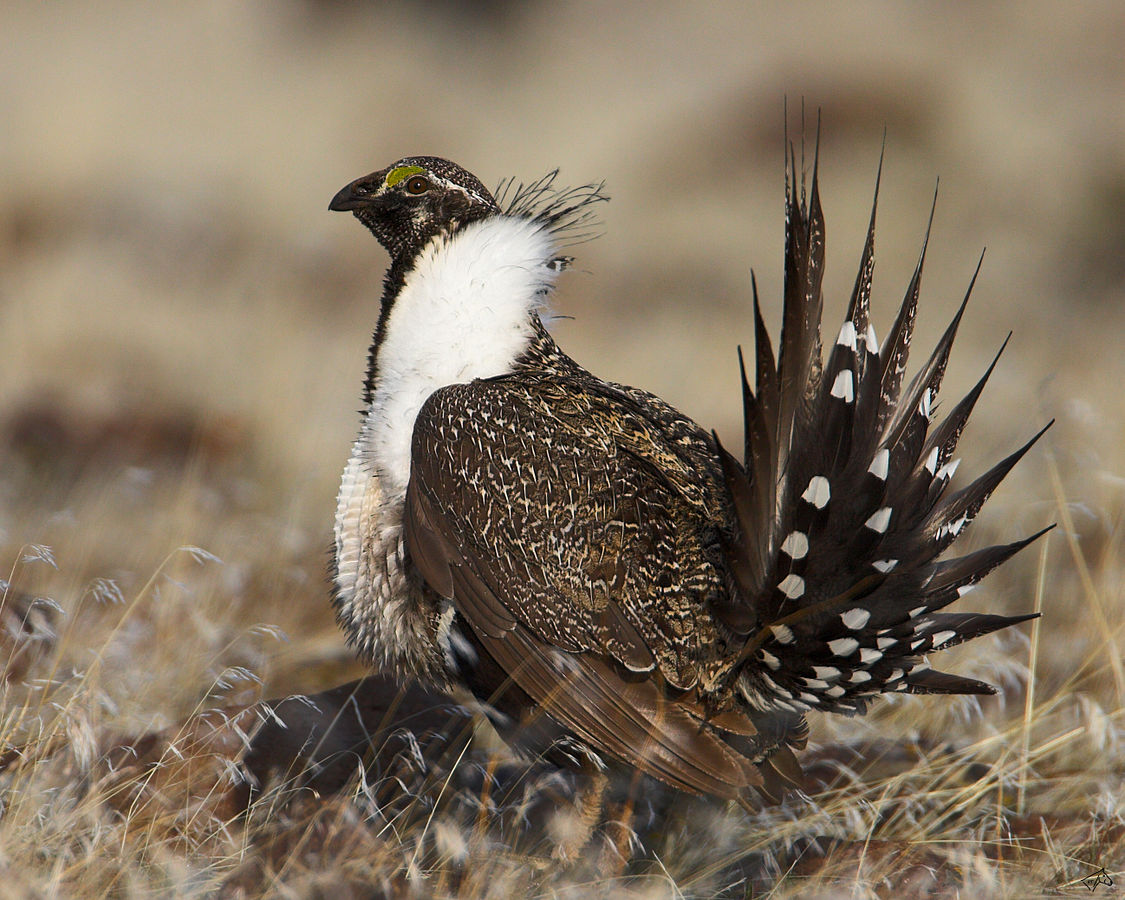
Greater sage grouse

The Greater sage grouse is a critically endangered bird (although not officially designated as such) that requires sagebrush for its home.  In an effort to expand habitat for the grouse, land managers destroyed native junipers that were spreading into grouse habitat.  A few years later they determined that destroying the trees did not produce the desired habitat.  Instead, non-native annual grasses have colonized the bare ground and many sapling junipers are growing from the seed bank left by the trees that were destroyed. (1)

Instead of calling the tree destruction a failed experiment, the scientists now propose to escalate the eradication effort.  They now plan to use herbicides and prescribed burns to eradicate the non-native annual grasses.  Given the persistence of herbicides in the soil, more sagebrush may not be the ultimate outcome.  And the sage grouse are unlikely to benefit from either poisoned vegetation or fires in their habitat.

Some extinctions are the unintended consequence of misguided “conservation” efforts

When European rabbits were intentionally imported to Australia, predictably the population quickly exploded.  A virus was then intentionally imported to kill the rabbits.  Like many biocontrols, the virus spread into the native range of the rabbits about 20 years ago, including into Spain.
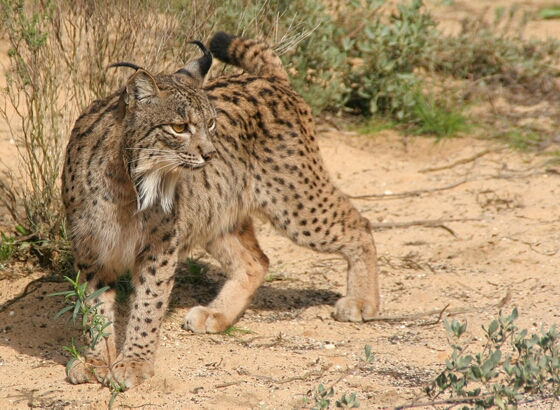
Iberian lynx. Creative Commons

The Iberian lynx is very rare partly because it is a picky eater.  Curiously, rabbits are the strongly preferred prey of the Iberian lynx.  There were enough rabbits available for the lynx until the rabbits were wiped out by the virus that was unintentionally imported to Spain.  The population of Iberian lynx plummeted to only 100 known individuals.  That’s when the EU version of the ESA kicked into action.

The Iberian lynx is now bred in captivity, a complex and challenging process likened to “having a nursery for rich kids in which you have a teacher for each kid.”  Needless to say that is an expensive proposition.  Releasing the lynx back into the wild required that 50,000 rabbits (costing $12.30 each) be simultaneously released into lynx territory.  The project cost $42 million over a period of 7 years.  (2)

The Spanish environmental official responsible for the project was visibly irritated when asked about the cost of the program.  He said “some ‘ignorant’ pundits were drawing unflattering comparisons between how much was being spent on the lynx compared to funding allocated to offset social issues such as unemployment.”  The strongest defenses of extreme efforts to save rare species are made by those who earn their living on them. (2)

Growing number of “conservation reliant” species

An article in the New York Times magazine recently asked this rhetorical question, “Should some species be allowed to die out?”  (3) The article focused on Hawaii because it is a place where heroic efforts have been made to save endangered species.  Nearly 50% of 1,280 federal endangered species are in Hawaii.  Over 80% of all endangered species are considered “conservation reliant,” a term used to describe the plants and animals that are permanently on life support.  They will not survive if not permanently tended by humans in hothouses and animal shelters.

Hawaii has the most endangered species because they evolved in isolation in a distant place with no interaction with the outside world until about 700 years ago.  That isolation cannot be recreated without stopping all trade and travel to and from Hawaii.  That is clearly not going to happen.  If the underlying conditions that cause extinctions cannot be reversed, no amount of human effort is likely to prevent the extinction.

Although I consider most of these efforts futile, that is not the conventional wisdom.  There are over 300 comments on the article in the NY Times that are overwhelmingly supportive of the ESA and the heroic efforts to save rare species.

Confiscation of private land

Dusky gopher frog

The ESA enables the government to designate both public and private land as “critical habitat” for endangered animals.  The US Supreme Court has agreed to hear a case about the application of the Endangered Species Act that enabled the federal government to designate 1,600 acres of private land as critical habitat for an endangered frog. That designation will prevent the land owner from developing the land or using it for a different purpose other than providing POTENTIAL habitat for a frog that has not been seen in that part of the country since 1965.  US Fish & Wildlife also concedes that the frog cannot live on the land in its present condition and requires modification to accommodate the needs of this frog.  (4)

Needless to say, private land owners aren’t enthusiastic about the loss of the use of their land for purposes other than supporting a specific rare animal.

Assisted migration?
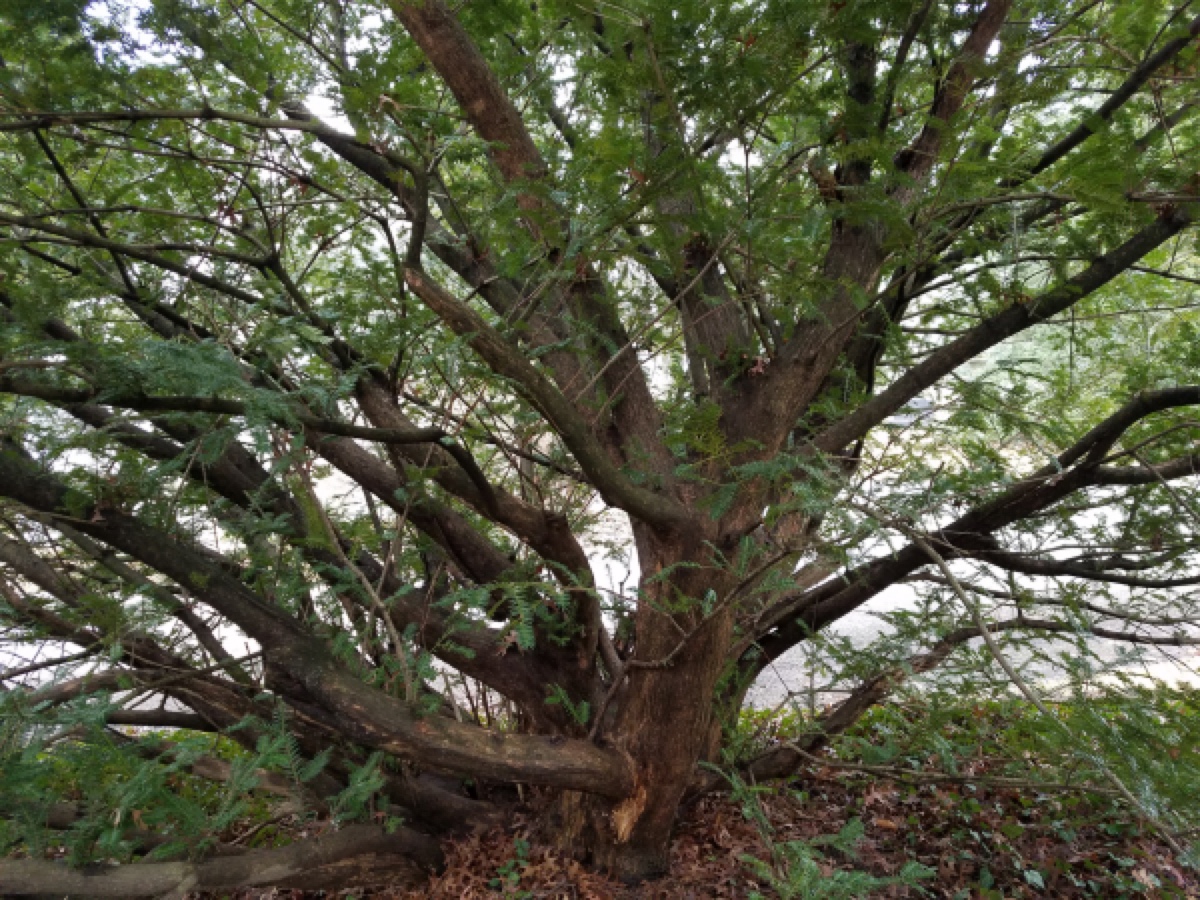
Torreya taxifolia near Cincinnati, Ohio

Torreya taxifolia, commonly known as Florida nutmeg, was classified as endangered in 1984.  It was attacked by a fungal blight about 70 years ago that has decimated its population in its small native range on the Florida panhandle.  It is an example of one of the major obstacles to keeping rare plants alive because it is very difficult to propagate:

Unlike most plants, the tree has so-called recalcitrant seeds, which cannot be preserved in conventional seed banks because they can’t survive drying. This necessitated the development of a tissue-culture system for the species called somatic embryogenesis. Embryos are surgically removed from fully developed seeds, then cultured in vitro to encourage the formation of multiple embryos. These can be safely preserved in a new cryogenic storage unit obtained by Atlanta Botanical Garden, in which the resulting plantlets are coaxed into a state of suspended animation at -321° Fahrenheit in liquid nitrogen.” (5)

This labor-intensive method of germinating the seeds of Torreya taxifolia has enabled scientists to grow Torreya in several botanical gardens in places distant from its native range.  Tree activists want to introduce the tree to wildlands in distant locations where the fungal pathogen that is killing the tree in its native range doesn’t exist.  This is called “assisted migration,” a controversial strategy that is prohibited by the ESA.  Moving endangered plants and animals requires the approval of the US Fish and Wildlife Service, permission they have so far denied for Torreya.

The ESA defines the criteria for recovery and removal of endangered status.  The plant must be living on its own “in the wild” and must successfully reproduce naturally for at least two generations.  Given the circumstances of this rare tree and many other “conservation reliant” species, it seems they are permanently doomed to be permanently legally protected endangered species.

The ESA’s reluctance to enable the movement of species from their native ranges is inconsistent with the realities of climate change.  When the climate changes, the vegetation changes.  To prevent that from happening is to doom the vegetation and the animals that require the vegetation to extinction.  The ESA has become an obstacle to survival, rather than a tool to ensure survival.

Improving the Endangered Species Act?

In summary, the Endangered Species Act can be improved to achieve its original purpose as a means of preventing extinctions of plants and animals, as illustrated by the examples listed above:

  • Actions intended to help a rare species should not inflict further damage on the environment, such as biocontrols, pesticides, and killing other animals considered competitors.
  • Plant and animal species that require permanent human intervention to survive should be removed from life support after decades of such intensive care. Humans often make that choice for themselves at the end of life and it is widely considered a humane choiceTriage is an ethical strategy in the medical profession and it should be in conservation as well.
  • Private property rights should be respected by the Endangered Species Act. The political cost of such confiscations are too high a price to pay for the meager benefits to the species in question.
  • If the underlying cause of an extinction is a fundamental change in the environment that cannot or will not be changed, it is pointless to aim conservation efforts at symptoms of the change, rather than causes of the change. For example, if melting Arctic ice opens a corridor between the Atlantic and Pacific oceans, it is pointless to try to prevent the movement of sea life between those oceans.
  • Plants and animals that can no longer survive in their native ranges because of changes in conditions, should be carefully considered for introduction to places with suitable conditions.

This wish list has nothing to do with the legislative effort to weaken the ESA.  That political effort is in the service of economic interests, such as fossil fuel exploitation and mining, and is not intended to benefit the rare plants and animals presently protected by the law. 


* “But under the Trump administration, at least 63 separate legislative efforts to weaken the [ESA] act have been undertaken since January 2017, according to the Centre for Biological Diversity.”  New York Times, April 22, 2018.

  1. http://www.argusobserver.com/news/tree-removal-could-spread-invasive-grasses/article_88eba0da-2a5b-11e8-862a-6734dbe7a90a.html
  2. https://www.nytimes.com/2018/03/31/world/europe/iberian-lynx-spain-portugal.htmlhttps://www.nytimes.com/2018/03/31/world/europe/iberian-lynx-spain-portugal.html
  3. https://www.nytimes.com/2018/03/13/magazine/should-some-species-be-allowed-to-die-out.html?hpw&rref=magazine&action=click&pgtype=Homepage&module=well-region&region=bottom-well&WT.nav=bottom-well
  4. https://www.cnn.com/2018/01/22/politics/dusky-gopher-frog/index.html
  5. https://e360.yale.edu/features/for-endangered-florida-tree-how-far-to-go-to-save-a-species-torreya
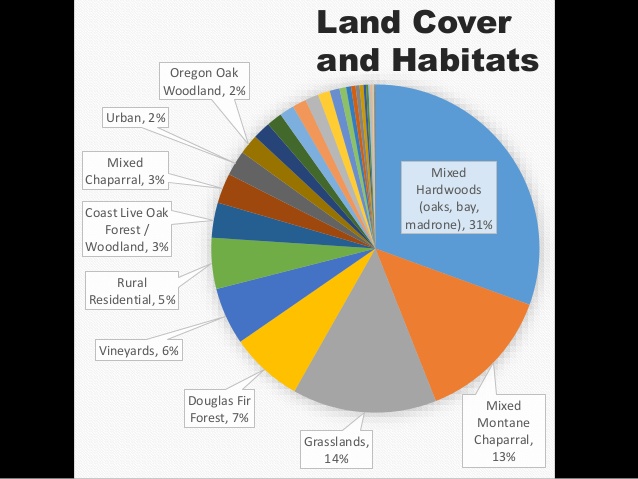
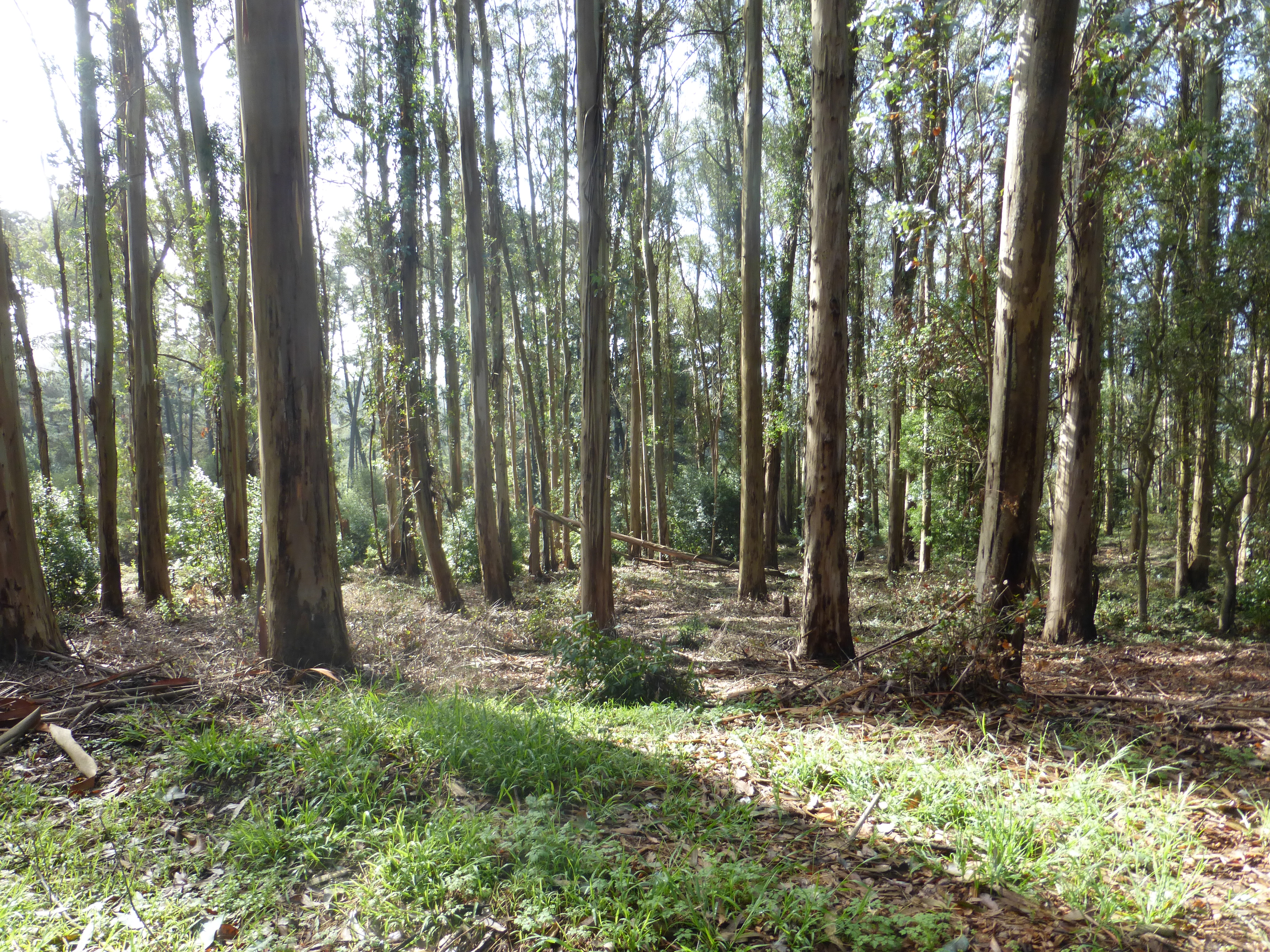
 

Action Opportunity: Draft of Oakland’s Vegetation Management Plan

The City of Oakland applied for a FEMA pre-disaster mitigation grant in 2005 to clear-cut all non-native trees on 122 acres of city owned property in the East Bay hills, based on the claim that it would reduce fire hazards.  FEMA cancelled that grant in September 2016 in settlement of a lawsuit against the project. 

The City of Oakland began the process of writing a new plan to reduce fire hazards in the hills by hiring a consultant to develop a Vegetation Management Plan in November 2016.  The new plan will be much more comprehensive than the original plan, covering 1,925 acres of open space and 308 miles of roadside in Oakland.  Oakland also made a commitment to an open public process to develop the plan.  A survey of public opinion was conducted and two public meetings were held in 2017. 

A draft of Oakland’s Vegetation Management Plan is now available HERE.  There are detailed maps of the areas that will be covered by the plan.  We suggest you take a look at those maps to determine what effect the plan will have on your neighborhood and the parks and open spaces you visit.

 A public meeting about the draft was held on May 23, 2018 and written public comments will be accepted until June 11, 2018. Comments may be submitted in the following ways: Download comment card; Email VMPcomments@oaklandvegmanagement.org; Mail:  266 Grand Avenue, Suite 210, Attn: Ken Schwarz, Oakland, CA 94610.  We hope you will participate in this public process that will determine the future of much of the landscape in the Oakland hills.

We are publishing an excerpt of the written public comment of one of our readers, which we hope will help you understand the issues and to write a comment of your own.  Asterisks indicate where some detail has been omitted.  You can see the entire public comment HERE: Oakland Draft Vegetation Management Plan – public comment

 Million Trees


Ken Schwarz
Horizon Water & Environment
266 Grand Avenue, Suite 210
Oakland, CA 94610

I am broadly supportive of the Draft Vegetation Management Plan (DVMP) because:

  • It will create defensible space around structures in Very High Wildfire Hazard Severity Zones.
  • It will clear easily ignited vegetation on roadsides in places where fire hazards are greatest.
  • It sets priorities for implementation in places where fire hazards are greatest.

These three elements of the plan will reduce fire hazards while limiting destruction of trees and vegetation and being fiscally responsible.

My public comment will identify some weaknesses in the plan and make specific suggestions for improving the plan with the goal of minimizing fire hazards as well as collateral damage to the environment.

The 300-foot “buffer” zone is unnecessarily destructive.  California law requires 100-feet of defensible space around structures.  The DVMP proposes extending defensible space along roadsides and around structures to 300-feet, the length of a football field.  Such a wide clearance of vegetation greatly exceeds California fire code and is therefore unnecessarily destructive.  In a recently published op-ed in the Los Angeles Times, two academic scientists confirm our understanding of how to keep our communities safe:  “The science is clear that the most effective way to protect homes from wildfire is to make homes themselves more fire-safe, using fire-resistant roofing and siding, installing ember-proof vents and exterior sprinklers, and maintaining “defensible space” within 60 to 100 feet of individual homes by reducing grasses, shrubs and small trees immediately adjacent to houses. Vegetation management beyond 100 feet from homes provides no additional protection.”[1]

The buffer zone should be eliminated, reduced in size, or reduced to Priority 3 so that it is less destructive and costly. 

*************************

The description of herbicide use in the draft is unnecessarily vague, because it provides no information about what herbicides will be used and the health and environmental hazards of specific herbicides.  Nor does it explain how, where, or why herbicides will be used.

Instead of providing that information, the plan describes the public’s opposition to herbicides as “social stigma,” which implies that our opposition is a baseless prejudice against herbicides.  In fact, our opposition is based on scientific information about the dangers of herbicides and those dangers must be acknowledged by the final version of this plan.

The dangers of herbicides are well documented and well known. ****** Here is a brief list of some of the most recent studies that conclude that glyphosate products are very dangerous to the health of animals and humans:

  • The International Agency for Research on Cancer classified glyphosate as a “probable human carcinogen” in 2015. The IARC is composed of an international team of scientists convened by the World Health Organization of the United Nations.
  • The State of California responded to that news by requiring all glyphosate products sold in the State to be labeled as carcinogens. The State was sued several times by the manufacturer of Round Up—Monsanto–to prevent the labeling requirement.  The State of California recently won in the state court of appeals[2].  Unless Monsanto appeals and wins in the State Supreme Court, all glyphosate products will be labeled as carcinogens in California.
  • US National Toxicology Program recently conducted tests on formulated glyphosate products for the first time. In the past, tests were conducted only on the active ingredient…that is glyphosate alone. The formulated products that are actually applied as weed killers contain many other chemicals, some of which are not even known. The head of the National Toxicology Program Laboratory, told The Guardian newspaper the agency’s work is ongoing but its early findings are clear on one key point. “We see the formulations are much more toxic. The formulations were killing the cells. The glyphosate really didn’t do it,” DeVito said. A summary of the NTP analysis said that “glyphosate formulations decreased human cell ‘viability’, disrupting cell membranes. Cell viability was ‘significantly altered’ by the formulations, it stated.”[3]
  • The Global Glyphosate Study is being conducted by six scientific institutions all over the world. ******* This international consortium of scientific institutions recently published preliminary resultsof their study: “The results of the short-term pilot study showed that glyphosate-based herbicides (GBHs) were able to alter certain important biological parameters in rats, mainly relating to sexual development, genotoxicity and the alteration of the intestinal microbiome, at the ‘safe’ level of 1.75 mg/kg/day set by the U.S. Environmental Protection Agency (EPA).”[4]  In other words, at doses deemed safe by the US EPA, significant negative health effects were found in animals used in testing.
  • The German Agriculture Minister announced on April 17, 2018 that she was finalizing a draft regulation to end use of the weed-killer glyphosate in household gardens, parks and sports facilities, and to set “massive” limits for its use in agriculture.[5] Germany is one of 25 countries that have issued outright bans on glyphosate, imposed restrictions or have issued statements of intention to ban or restrict glyphosate-based herbicides, including Roundup  Countless US states and cities have also adopted such restrictions. [6]
  • Marin Municipal Water District quit using all pesticides in 2015. In a letter to East Bay Municipal Utilities District, a member of the Board of MMWD explains why that decision was made.  (Attachment 2)  MMWD hired scientists at UC Davis to conduct a study of the biological persistence of glyphosate.  They found that glyphosate persisted for at least 84 days when applied to foliage, and perhaps longer after the study ended.

Garlon with the active ingredient triclopyr is more toxic than glyphosate.  Garlon is the herbicide that is used to prevent eucalyptus and acacia from resprouting when the trees are destroyed.  Its use was also specifically allowed for that purpose by Oakland City Council Resolution 79133.   Although the DVMP does not mention its use, we assume—unless specifically told otherwise by the final version of the VMP—that Garlon will be used to control resprouts.

  • Triclopyr is an organochlorine product, in the same family of pesticides as DDT, which was banned in the US in 1972. Organochlorine products bioaccumulate and are very persistent in the environment.  Nearly 50 years after it was banned, DDT is often found in the ground, in the water, and in people’s bodies.[7]
  • Organochlorine products are endocrine disrupters. The Pesticide Research Institute did a risk assessment of triclopyr for the California Invasive Plant Council.  They reported that triclopyr “poses reproductive and developmental risks to female applicators.” [8]
  • The Pesticide Research Institute did a risk assessment of triclopyr for Marin Municipal Water District in which they informed MMWD that birds and bees are both harmed by triclopyr and mycorrhizal fungi in the soil are damaged by triclopyr.[9]

More research has been done on Round Up than on Garlon because it is more widely used.  It is more widely used, partly because it is actually less dangerous than Garlon (it is also a non-selective plant-killer).  Because of the toxicity of Garlon, several public land managers in the Bay Area have made a commitment to controlling resprouts without using herbicides: ******** Marin Municipal Water District,  Marin County Parks and Open Space, UC San Francisco, and East Bay Municipal Utilities District (the supplier of our drinking water).

*************************

There is no evidence that eucalyptus is inherently more flammable than native trees. ******** Eradicating non-native trees and shrubs will not reduce fire hazards because they are not inherently more flammable than the native vegetation that will remain.  Therefore, the reduction of fuel loads must be based on flammability, NOT the nativity of the flammable species.  The nativity of plant species is irrelevant to reducing fire hazards and must be abandoned as criterion for destroying plants and trees.

Vegetation that burned in the North Bay fires of October 2017 was almost exclusively native. Source: Bay Area Open Space Council

I support the thinning of eucalyptus, acacia, Monterey pine and cypress to reduce fuel loads, as long as the canopy is intact.  ******** When the canopy is intact, the forest floor is shaded which retains moisture that retards ignition and suppresses the growth of easily ignited weeds. The DVMP proposes to thin the targeted non-native trees to distances of 35 feet, creating gaps in the canopy of 10 feet within the 300-foot “buffer zone.”  The distance between the trees must be reduced to 25 feet to maintain the canopy.  In addition to reducing fire hazards, maintaining the canopy will also be less destructive and will reduce the amount of stored carbon released into the atmosphere.

Tilden Park, October 2016. East Bay Regional Park District has thinned this area to distances of 25 feet between remaining trees. The forest floor is still shaded because the canopy is intact.

My greatest disappointment in the DVMP is its proposal to remove all individual non-native trees where they presently exist in native vegetation outside the “buffer zone.” ******** Removing non-native trees in riparian areas and in redwood groves as proposed by the DVMP is not fire hazard mitigation because fire hazards in those areas are minimal.

*****************************

Furthermore, destroying healthy trees damages the trees that remain because the herbicide that is used to prevent eucalyptus and acacia from resprouting is mobile in the soil and it is known to damage mycorrhizal fungi in the soil that is essential to the health of the native trees.  ******* It is not possible to destroy isolated trees without damaging neighboring trees in close proximity. ****** Studies show that eucalyptus trees in native forests are not doing any damage to neighboring trees. ********

If individual non-native trees within native vegetation are not doing any environmental damage and do not increase risk of fire they should not be destroyed because destroying them WILL damage native vegetation.  Please leave them alone!

 Putting the DVMP into the long-term big picture

Finally, I suggest that we all take a step back from the details of the DVMP and consider the proposal in the context of the entire environment.  The final VMP must minimize damage to the environment while mitigating fire hazards because:

  • The climate has changed and it will continue to change. When the climate changes, the vegetation changes.  That is one of the axioms of ecology and it will continue to be.  If non-native plants and trees are better adapted to the current and anticipated climate, we should abandon futile attempts to force plants to live where we want them to live.
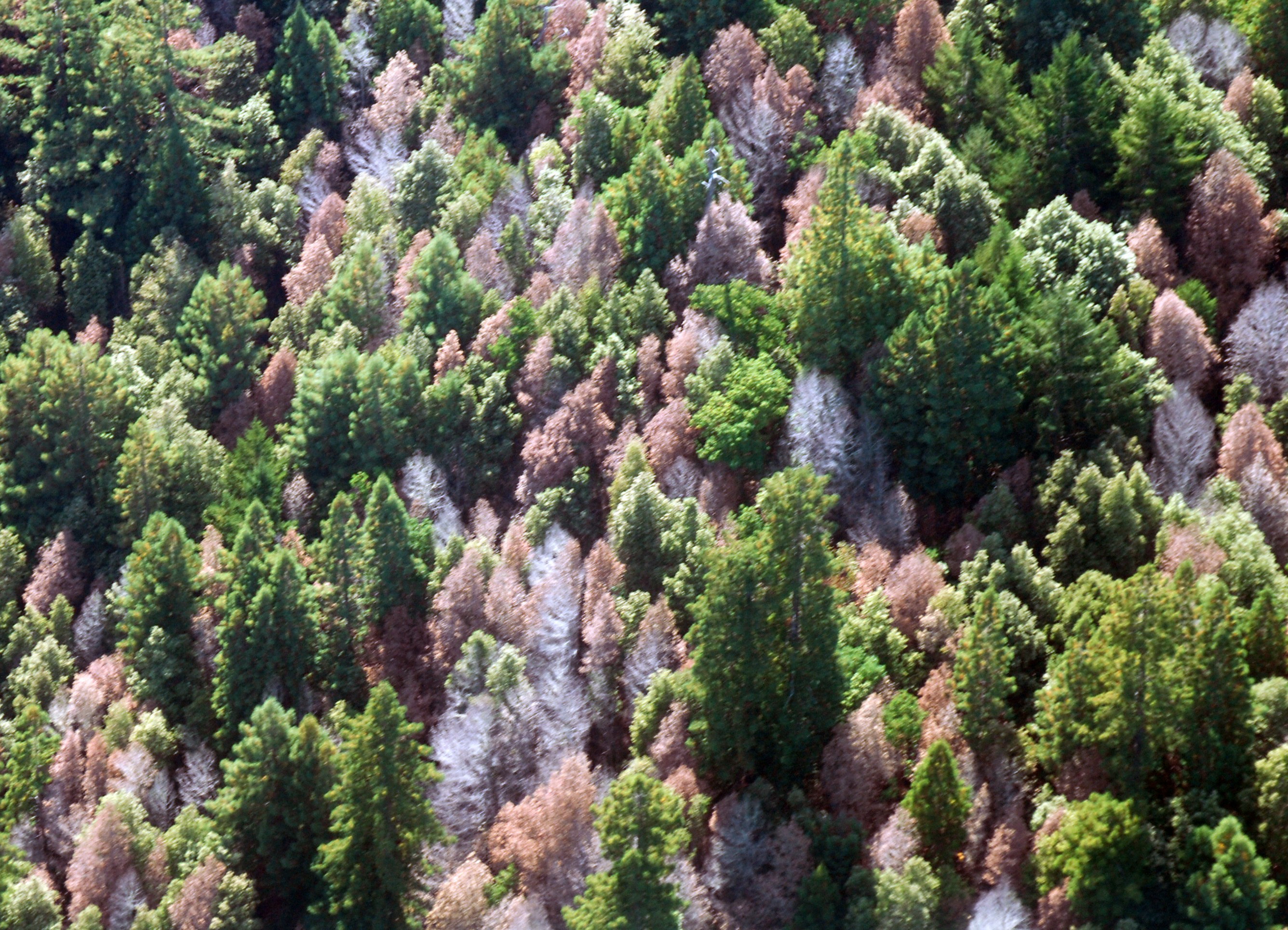
  • If we want trees in California, we must look to the future, not the past. 130 million native conifers have died in California since 2010. 5-10 million oaks in California have been killed by Sudden Oak Death. The future of redwoods in California is in jeopardy because they require a lot of water and they don’t tolerate wind.

********************

A climate change specialist at the US Forest Service tells us in a recent study that native tree species are the most vulnerable to climate change. USFS found that native trees are more vulnerable to the changes in temperature, precipitation, growing season, and other effects of accumulating greenhouse gases. The assessment found that 88 percent of invasive tree species are expected to prove resilient in the changing climate, ranked with low vulnerability, compared to 20 percent of natives.[10]

  • We are contributing to climate change by destroying healthy trees that are storing tons of carbon that will be released into the atmosphere as the destroyed trees decay. The primary reason why wildfires are more frequent and more intense is because of the warmer, drier climate.  Therefore destroying more trees than necessary increases fire hazards because we are exacerbating climate change by destroying more trees than necessary.
  • It is a fiction that destroying trees will release less carbon than the wildfires imagined by those who demand their destruction. According to a recently completed study at Oregon State University, “wildfire is not the biggest source of climate-warming carbon dioxide in Oregon forests—logging and wood products are.”[11]

*******************

The trees that will be destroyed in Oakland will not be used as lumber, which means they will contribute even more carbon to the atmosphere.  Timber that is used for building retains its stored carbon until the building deteriorates or is destroyed.

  • The herbicides that are used to destroy vegetation and prevent trees from resprouting damage the soil and pose serious health risks to animals and humans. The more vegetation and trees the VMP destroys, the greater the damage caused by herbicides.  Therefore, we must minimize the amount of vegetation that is destroyed as much as possible if herbicides are used.

We achieve nothing if the damage we do to the environment and to ourselves is greater than real or imagined reduction in fire hazards.

Thank you for your consideration.

Resident of
Oakland, California
June 2018


[1] http://www.latimes.com/opinion/op-ed/la-oe-hanson-miller-governor-fire-orders-20180525-story.html

[2] https://www.sfgate.com/news/article/State-can-label-widely-used-herbicide-as-possible-12849147.php

[3] https://www.theguardian.com/us-news/2018/may/08/weedkiller-tests-monsanto-health-dangers-active-ingredient

[4]https://sustainablepulse.com/2018/05/22/monsanto-in-epic-fail-with-attempted-attack-on-global-glyphosate-study/?utm_source=newsletter&utm_medium=email&utm_campaign=gmos_and_pesticides_global_breaking_news&utm_term=2018-05-23#.WwhUfkgvyUl

[5] https://sustainablepulse.com/2018/04/17/germany-moving-ahead-with-plans-to-restrict-weed-killer-glyphosate/?utm_source=newsletter&utm_medium=email&utm_campaign=gmos_and_pesticides_global_breaking_news&utm_term=2018-04-18#.WwhWWUgvyUl

[6] https://www.baumhedlundlaw.com/toxic-tort-law/monsanto-roundup-lawsuit/where-is-glyphosate-banned/

[7] https://www.sciencealert.com/ddt-consistently-found-in-humans-study

[8] https://www.pesticideresearch.com/site/pri-resource-centers/weed-management-resource-center/herbicide-risk-comparisons/workers/

[9]http://www.marinwater.org/DocumentCenter/View/254/HRA_Chap4_Triclopyr_1_1_2010

[10] https://www.forbes.com/sites/jeffmcmahon/2018/04/15/hug-your-native-trees-goodbye-thanks-to-climate-change/#4ad4a4176abd

[11] https://www.hcn.org/articles/climate-change-timber-is-oregons-biggest-carbon-polluter

Oyster Bay: A firehose of public funding supplies a firehose of herbicides

Oyster Bay is one of several East Bay Regional Parks along the east side of the bay that is a former garbage dump built on landfill.  We visited Oyster Bay for the first time in 2011 after a former Deputy General Manager of the park district told us that it is a “beautiful native plant garden” and a model for a similar project at Albany Bulb, another former garbage dump being “restored” by the park district.

When we visited seven years ago, we found a park in the early stages of being destroyed in order to rebuild it as a native plant museum.  Since there were never any native plants on this landfill, we can’t call it a “restoration.”  We took many pictures of the park in 2011 that are available HERE.

We recently decided it was time to revisit the park when we noticed pictures of it in the recently published annual report of the park district’s Integrated Pest Management program, indicating recent changes in the development of the park.  My article today is about what is happening now at Oyster Bay.  It is still not a “beautiful native plant garden.”

“Restoring” grassland

Non-native annual grassland. Oyster Bay April 2011

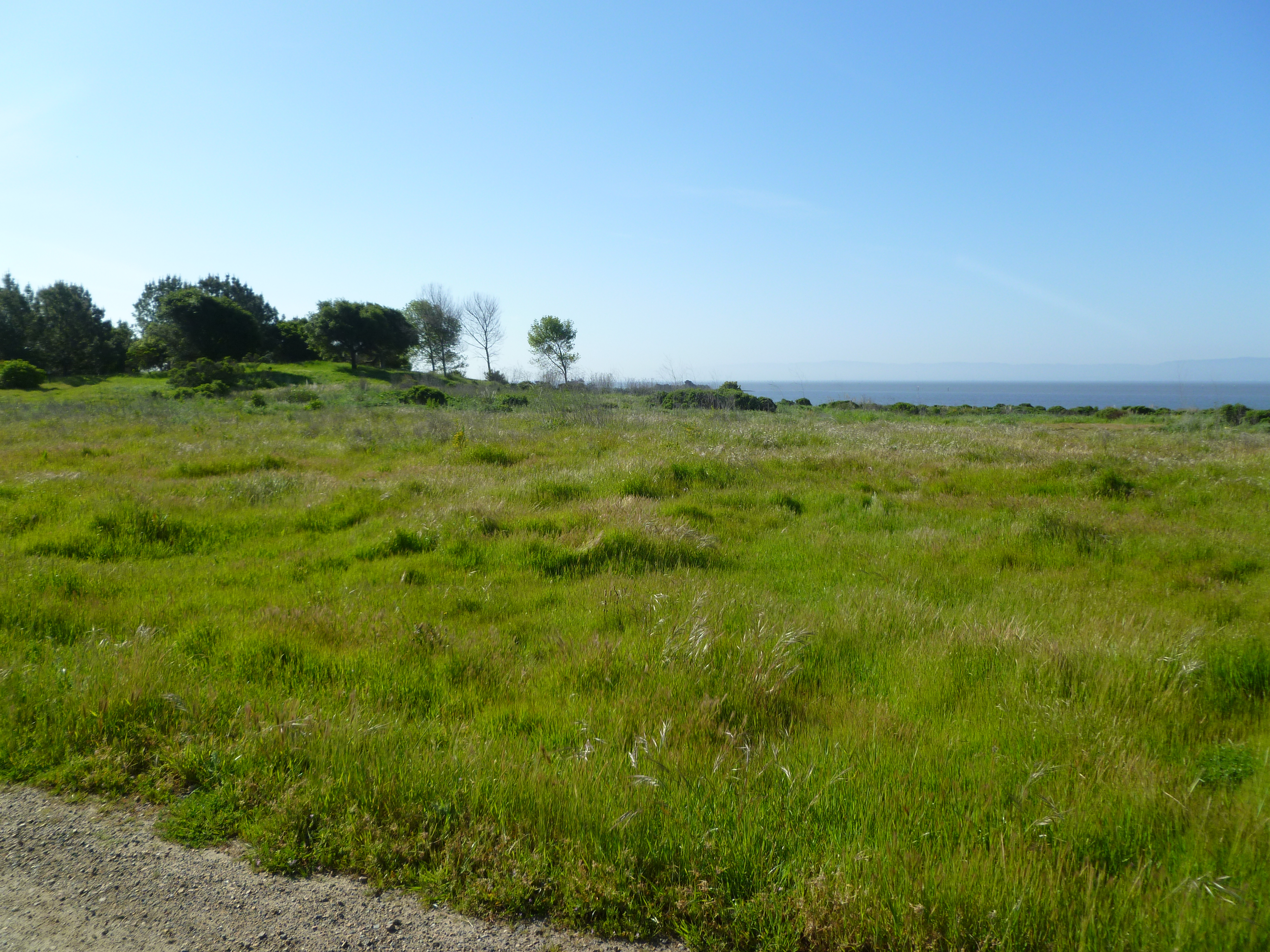
Seven years ago, most of Oyster Bay was acres of non-native annual grasses.  Since then, most of those acres of grassland have been plowed up and are in various stages of being planted with (one species?) native bunch grass (purple needle grass?).

Stages of grassland conversion. Oyster Bay May 2018

On our May 1st visit, there were at least 8 pesticide application notices posted where the native bunch grass has been planted.  Several different herbicides will be used in those sprayings:  glyphosate, Garlon (triclopyr), and Milestone (aminopyralid).

Herbicide Application Notices, Oyster Bay May 2018

Grassland “restoration” in California is notoriously difficult.  Million Trees has published several articles about futile attempts to convert non-native annual grassland to native grassland:

We wish EBRPD good luck in this effort to convert acres of non-native annual grass into native bunch grass.  Frankly, it looks like a lot of public money down the drain to us.  It also looks like an excuse to use a lot of herbicide.  Who benefits from this project?  Not the taxpayer.  Not the park visitor who is now exposed to a lot of herbicide that wasn’t required in the past.  Not the wildlife, birds, and insects that lived in and ate the non-native vegetation. (We spotted a coyote running through the stumps of bunch grass.  Was he/she looking for cover?)

Redwing blackbird in non-native mustard. Oyster Bay May 2018

Destroying trees and replacing them

P1010129
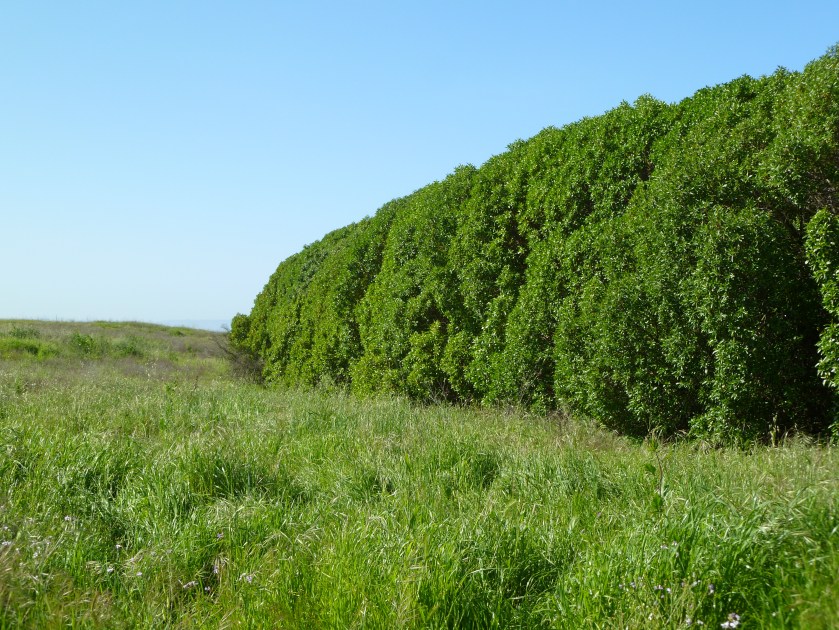
Pittosporum forest was an excellent visual screen, sound barrier, and wind break. It was healthy and well-suited to the conditions on this site. It was probably home to many animals. Oyster Bay April 2011

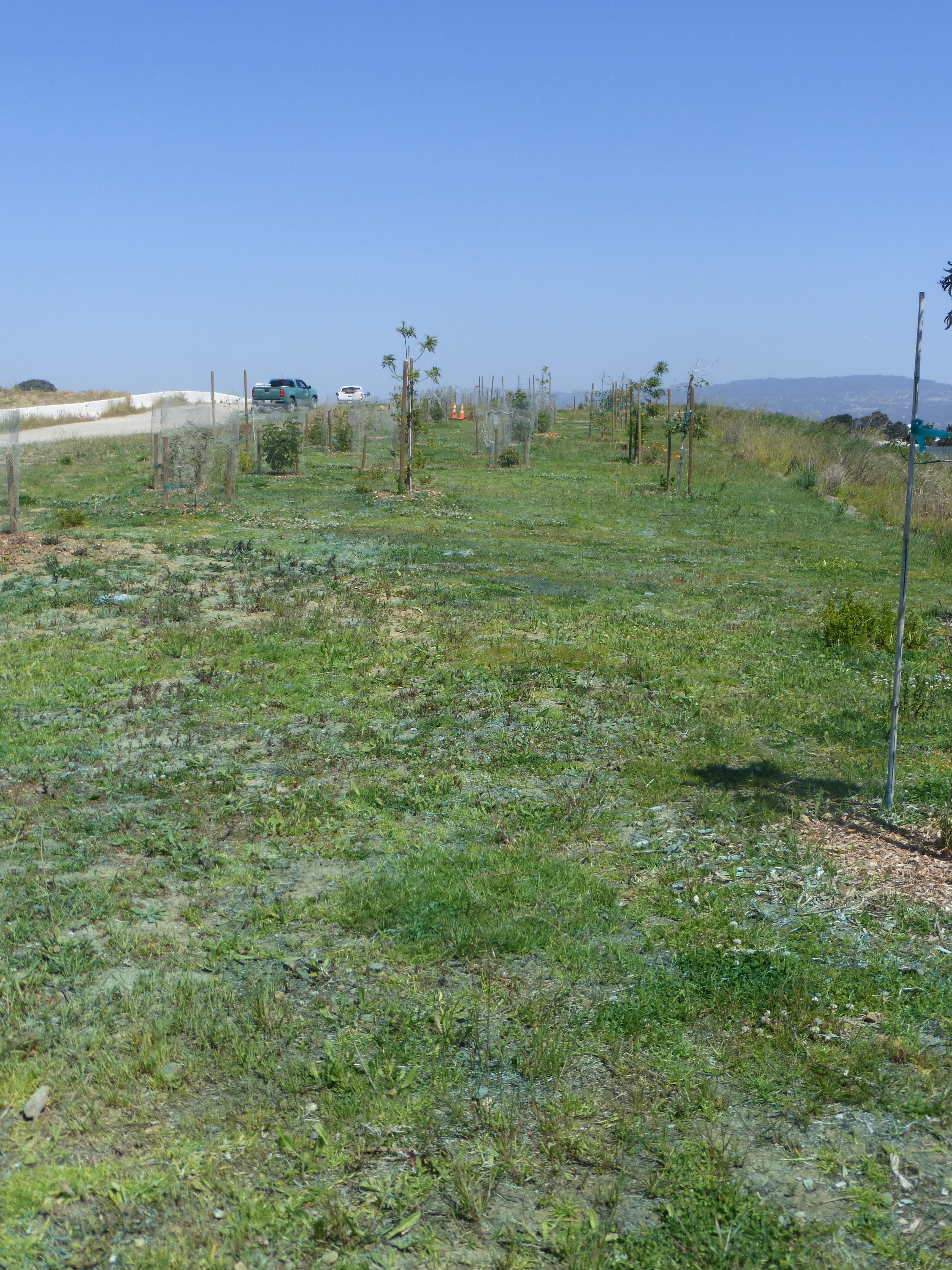
When we visited Oyster Bay in 2011, many trees had already been destroyed, but there was still a dense forest of non-native pittosporum.  That forest is gone and the park district has planted one small area with native trees as a “visual screen” of the Waste Management Facility next door.  We identified these native trees and shrubs:  ironwood (native to the Channel Islands), coast live oak, buckeye, toyon, juniper, mallow, holly leaf cherry, and redbud.

Native trees planted at Oyster Bay, May 2018
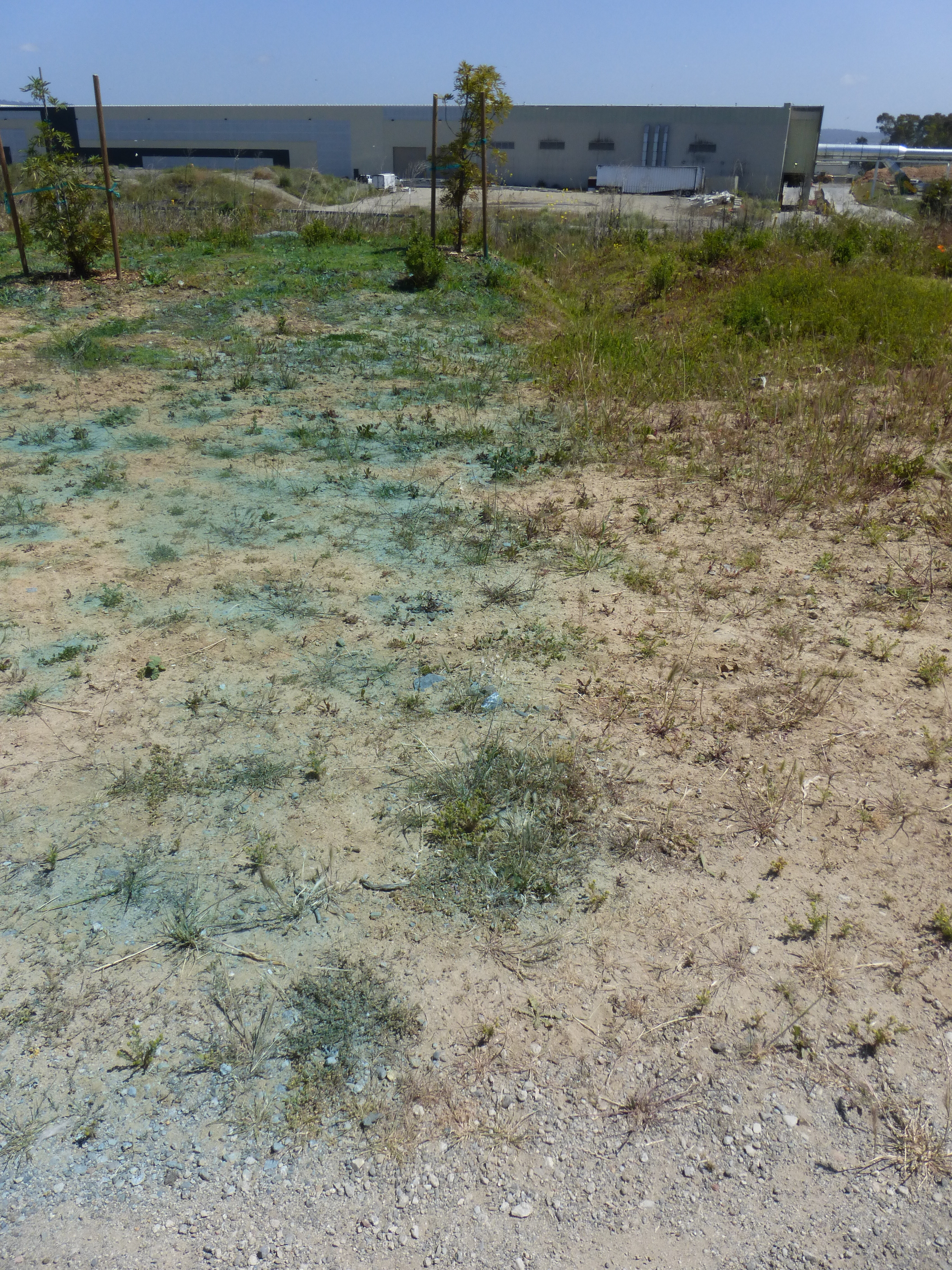
Ground around trees is green with dye used when herbicide is sprayed. Oyster Bay, May 2018

We also saw a notice of herbicide application near the trees.  The ground around the trees was covered in green dye, which is added to herbicide when it is sprayed so that the applicator can tell what is done.  There were men dressed in white hazard suits, driving park district trucks, apparently getting ready to continue the application of herbicides.

Will the trees survive this poisoning of the soil all around them?  There are many examples of trees being killed by spraying herbicides under them.  Herbicides are often mobile in the soil.  Herbicides damage the soil by killing beneficial microbes and mycorrhizal fungi that facilitate the movement of water and nutrients from the soil to the tree roots.

Herbicide sprayed around newly planted trees. Oyster Bay May 2018

Not a fun day at the park

It wasn’t a fun day at the park and it isn’t fun to write about it.  I decided to tell you about this visit after reading the most recent edition of the Journal of the California Native Plant Society, Fremontia (Vol. 46 No. 1).  The introductory article of this “Special Issue on Urban Wildlands” is illustrated with a photo of Oyster Bay.  I nearly choked on this statement in that article:  “In order to control invasive plants, agencies and volunteers have sometimes resorted to using herbicides as a step in integrated pest control.  While use of herbicides is contentious, the use for spot treatments has enabled small groups of volunteers to successfully eliminate invasive weeds in some areas where future herbicide use will not be needed.” 

That is a PATENTLY FALSE statement.  The California Invasive Plant Council conducted a survey of land managers in 2014.  Ninety-four percent of land managers reported using herbicides to control plants they consider “invasive.”  Sixty-two percent reported using herbicides frequently.  The park district’s most recent IPM report for 2017 corroborates the use of herbicides to eradicate plants they consider “invasive.”  The park district report also makes it clear that they have been spraying herbicide for a very long time.  For example, they have been spraying non-native spartina marsh grass (in the bay and along creeks) with imazapyr for 15 years!

Attempting to eradicate non-native plants is NOT a short-term project.  It is a forever commitment to using herbicides…LOTS of herbicide.  To claim otherwise is to mislead, unless you are completely ignorant of what is actually being done. 

You are paying for this

Another reason why I am publishing this article is to inform you that you are paying for these projects.  The park district recently published a list of 492 active park improvement projects in 2018 (scroll down to page 71), many of which are native plant “restorations.” The majority of them are being paid for with grants of public money from federal, State, and local agencies as well as a few parcel taxes.  Taxpayers had the opportunity to vote for the parcel taxes.  They will have the opportunity to vote for new sources of funding for these projects:

  • Proposition 68 will provide $4.1 BILLION dollars for “park and water” improvements. It will be on your ballot on June 5, 2018. Roughly a third of the money will be allocated for “protection of natural habitats.” (1) Although the project at Oyster Bay does not look “natural” to us, that’s how the park district and other public agencies categorize these projects that (attempt to) convert non-native vegetation to native vegetation.
  • Measure CC renewal will be on the ballot in Alameda and Contra Costa counties on November 6, 2018.  The park district has made a commitment to allocate 40% of the available funding to “natural resource projects.” Although the anticipated revenue (about $50 million) seems small, it is used as leverage to apply for big State grants, which require cost-sharing funding.  Measure CC is essentially seed money for the much bigger federal and State funding sources.

I would like to vote for both of these measures because our parks are very important to me.  If voting for these measures would actually improve the parks, I would do so.  But that’s not what I see happening in our parks.  What I see is a lot of damage:  tree stumps, piles of wood chips, dead vegetation killed by herbicides, herbicide application notices, signs telling me not to step on fragile plants, etc.

Stay out of Oyster Bay to avoid unnecessary exposure to herbicides and keep your dogs out of Oyster Bay for the same reason. Unfortunately wildlife doesn’t have that option. They live there. Oyster Bay, May 2018

  1. “States big bond for little projects,” SF Chronicle, May 5, 2018

Catalina Island: Island ecology and restoration

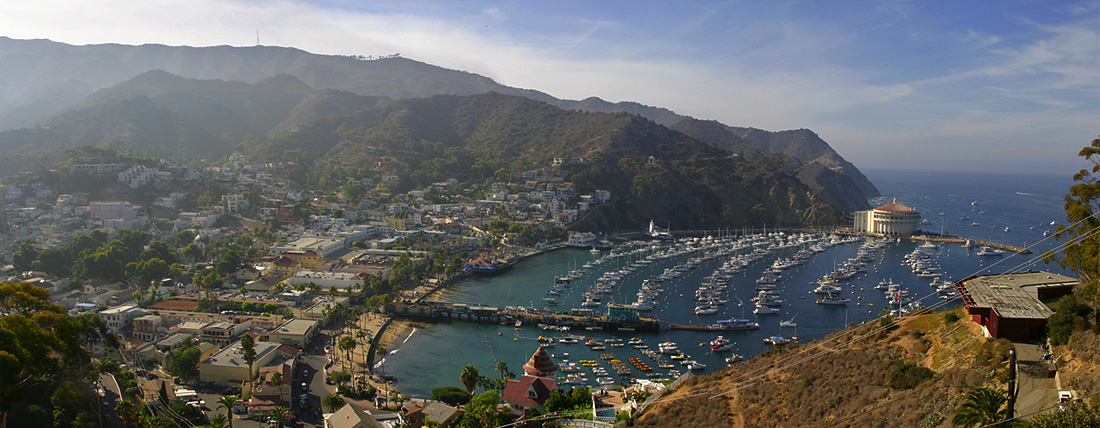
Catalina Island is dear to my heart because of several childhood vacations there.  It was thrilling to return after 60 years and find it unchanged from my memories.  Avalon, the small town of about 3,500 people, is still a quaint collection of little wooden shacks, painted bright colors.  But as an adult, my recent visit to Catalina was broader and encompassed the entire island, which was unknown to me as a child.  That broader perspective on Catalina is my focus today. (1)

Avalon Harbor, Catalina Island. Creative Commons

Catalina is one of the Channel Islands off the coast of Southern California.  It rose from the ocean about 5 million years ago as the result of geologic processes lifting the ocean floor as tectonic plates collided.  Like other oceanic islands (as opposed to those that broke off from continents), it was composed of barren rock for thousands of years.  It took thousands of years to build soil needed to support plants.  Then it took thousands of years to establish plants from the seeds blown in the wind from the mainland, brought by birds in their stomachs or adhered to their feathers and feet, or brought by waves carrying plants in storms.  When plants gained a foothold, the island was able to support insects brought by wind and waves.

The process of populating Catalina with plants and animals accelerated with the arrival of American Indians about 10,000 years ago.  Foxes were probably brought to Catalina by the Indians and oaks probably arrived as acorns brought by the Indians.  Archaeological remains of Indian settlements indicate that there were as many as 2,500 Indians living on Catalina, using only the food and materials available on the island or the surrounding ocean.

Most of the plant and animal life on Catalina came from the mainland of California, only 22 miles away from the island.  When plants and animals evolve in isolation from their ancestors, their gene pools gradually drift apart and are eventually distinct species.  That’s why there are about 60 plant and animal species on Catalina that are endemic, meaning that they exist only on Catalina.  This process of diverging evolution from mainland ancestors to unique island species is typical of all island ecosystems.

Europeans arrive on Catalina

Catalina was visited by Spanish explorers for the first time in 1542 and again in 1602.  Although their visit was brief, it was fatal because they brought diseases to which Europeans were immune and the Indians were not.  Most of the Indians on the island were killed by those diseases, a scenario that played out all over the New World in the 16th and 17th centuries.

Europeans tried to establish communities on the island in the 19th century, but their economic ventures were not successful.  They brought sheep, cattle and goats.  But there wasn’t sufficient forage for their herds and supplementing their diets by growing hay wasn’t economically viable.  They tried mining, but found little of value.  They introduced animals for hunting, such as mule deer and pigs.

Towards the end of the 19th century, Europeans made their first attempt to turn the island into a tourist destination.  The first effort ended when the entire town of Avalon burned in a fire in 1915.  That fire set the stage for the final chapter in the development of the island.  William Wrigley Jr. was able to purchase the entire island in 1919 in the “fire sale” that resulted in a bargain price.

The Wrigley Era on Catalina

William Wrigley Jr. made his fortune manufacturing and selling chewing gum.  He had the means to indulge his passion for the island, which he envisioned as a recreational paradise.  He built a magnificent Art Deco casino in Avalon that opened in 1929 and turned the town of Avalon into a famous destination that attracted celebrities as well as one million visitors each year, arriving on the huge steamers Wrigley built to bring them to Catalina.

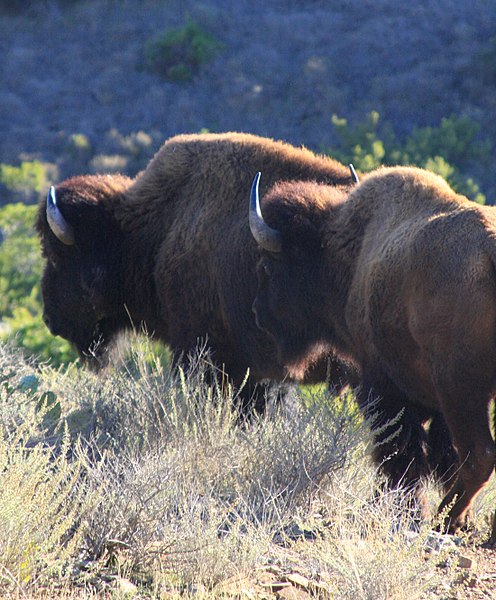
Bison on Catalina Island. Creative Commons

Many movies were made on Catalina and movie stars were frequent visitors to the island.  One of the movies brought bison to the island to feature in their western themed story.  The bison herd grew and eventually became another challenge to the survival of vegetation on the island.

The conservancy era on Catalina

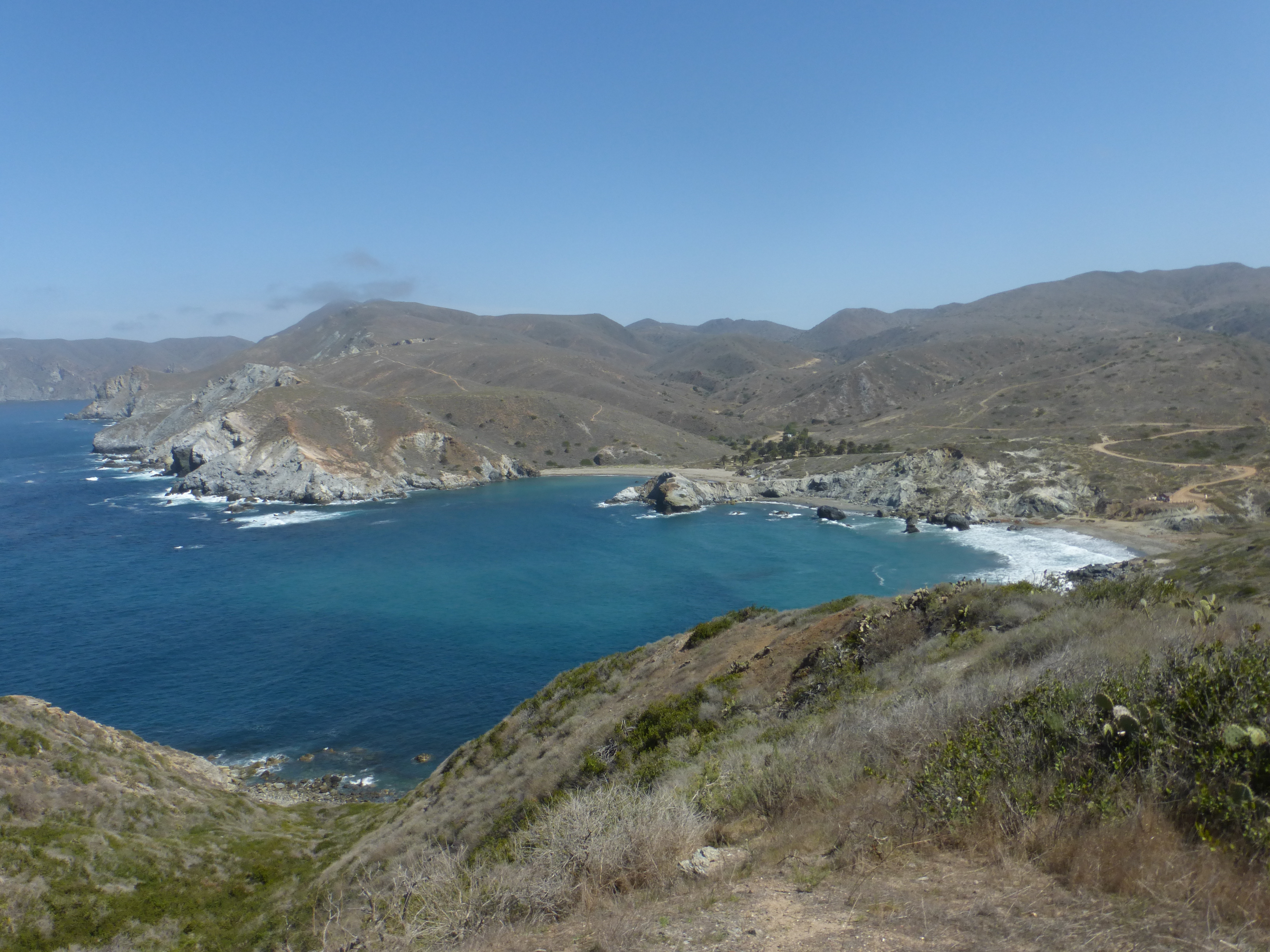
When William Wrigley died, his heirs changed the direction of the island’s development.  The island could have continued to grow into a tourist destination, but in 1972 Wrigley’s heirs decided that nearly 90% of the island would be turned into a nature reserve.  The Catalina Island Conservancy was born.  Access and development on conservancy land is restricted.

Catalina Island Conservancy land.

The conservancy has made big investments in restoring the island’s ecosystems and protecting endemic plant and animal species.  Sheep and cattle were removed, which wasn’t difficult because those enterprises had largely failed.  Feral pigs and goats were much harder to round up and were killed by hired sharp shooters.  The extermination of the pigs and goats was as controversial on Catalina as it has been on other Channel Islands.  A decade later, “with the quality of the island habitat rebounding and increased ecotourism revenue being realized by island businesses, the bitterness surrounding the pig and goat eradication is subsiding.  Conservation, contrary to popular belief, is not one long group hug.  This stuff can be hard.”  (1) Indeed, “restorations” in the San Francisco Bay Area have caused one pitched battle after another for over 20 years.  They might have been less heated battles if all opinions had been treated with equal respect, as they seem to have been on Catalina Island.

The population of mule deer is being controlled with hunting licenses.  Most of the herd of 600 bison was given to an Indian reservation in South Dakota.  The remaining herd of 150 is being controlled by a contraception program.  Maintaining the small bison herd is considered a concession to their popularity with residents and tourists on the island.

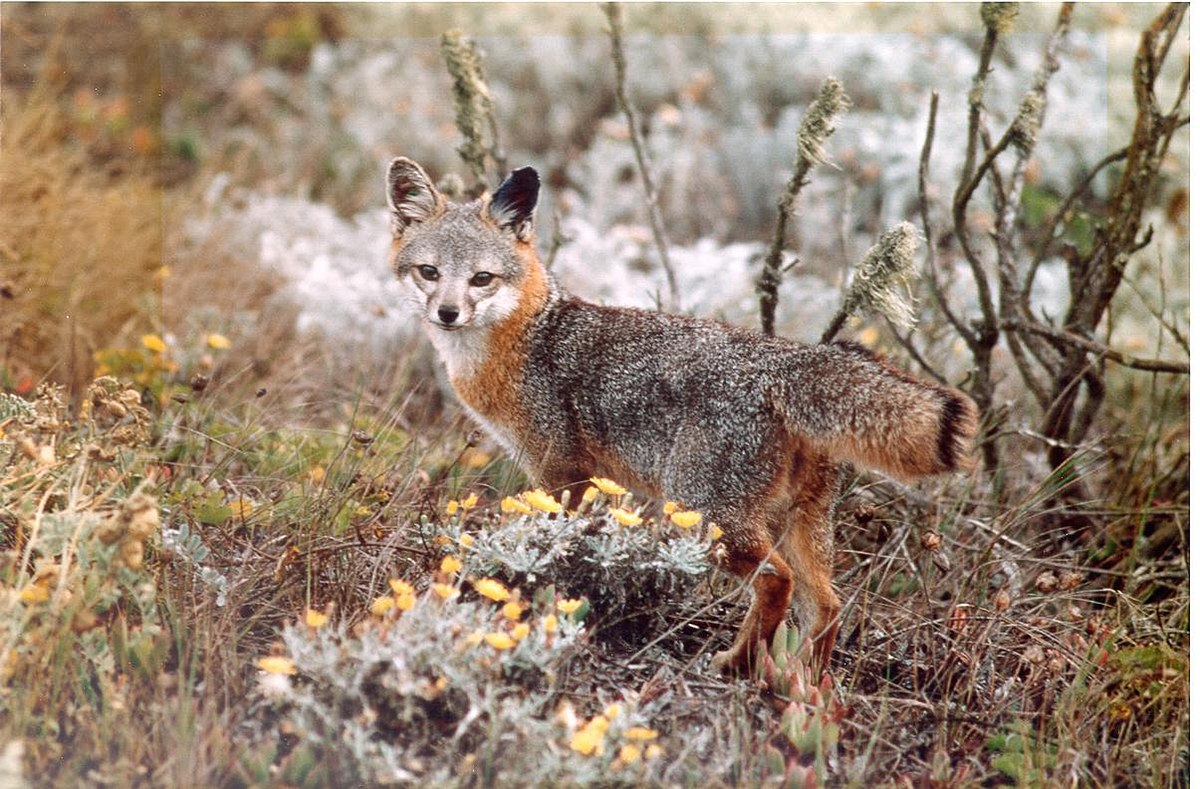
Island fox. Catalina Island fox is a sub-species of the Island fox on other Channel Islands. USFWS

The Catalina Island Fox, an endemic species, was nearly wiped out by distemper virus introduced by a castaway raccoon.  Fortunately, conservancy staff figured out why the population dwindled to only 100 foxes in time to save the foxes from extinction.  A captive breeding and vaccination program returned the fox population to over 1,500 animals in 2011.  A captive breeding program for the island’s bald eagles has also restored their population.

Invasive species

Like most restorations, the Catalina Island Conservancy is concerned about invasive species.  However, their approach to controlling non-native plants is less extreme than many similar projects.  They consider a species of broom (Genista linifolia) their highest priority for eradication.  Although they have tried and will continue trying to control it they acknowledge that it may not be possible.

Genista linifolia is native to the Canary Islands.  It was introduced to Catalina over 100 years ago when it was used to landscape the Saint Catherine Hotel when it was originally built in 1900.  The conservancy launched the Avalon Grasses Initiative in 2016 to prevent similar introductions of grasses that have a high potential to spread on the wind—such as pampas and fountain grass–from gardens in Avalon to conservancy wildlands.  Conservancy staff quietly patrol the gardens in Avalon, looking for these exotic grasses.  When they find them they approach the property owner with their proposal to remove them and replace them with native plants.  The 20 property owners who have agreed to this proposal express satisfaction with the substitution.  This strategy seems to treat the property owners with respect. (2)

Over 200 species of non-native plants live on the island, but the conservancy considers only 35 of the species a problem.  They describe their approach to non-native plants:

“The Catalina Island Conservancy has developed a thoughtful and comprehensive set of strategies for dealing with invasive plants.  First, they realized that not all introduced plants are invasive and some are less likely to outcompete native species.  Those considered invasive were ranked according to the magnitude of the problems they present, including how widespread they are, how fast they can spread and how damaging to the local native species they are.  On the basis of this information, each highly ranked invasive species is being treated with the purpose of reducing its impact on the native communities, reducing its spread or eliminating the threat.” (1)

They acknowledge that “topical chemical treatments” are one of the methods they use to control plants they consider invasive, but details of their pesticide use are not available to me.  The conservancy is a private entity that is not subject to public record laws.

My eucalyptus litmus test

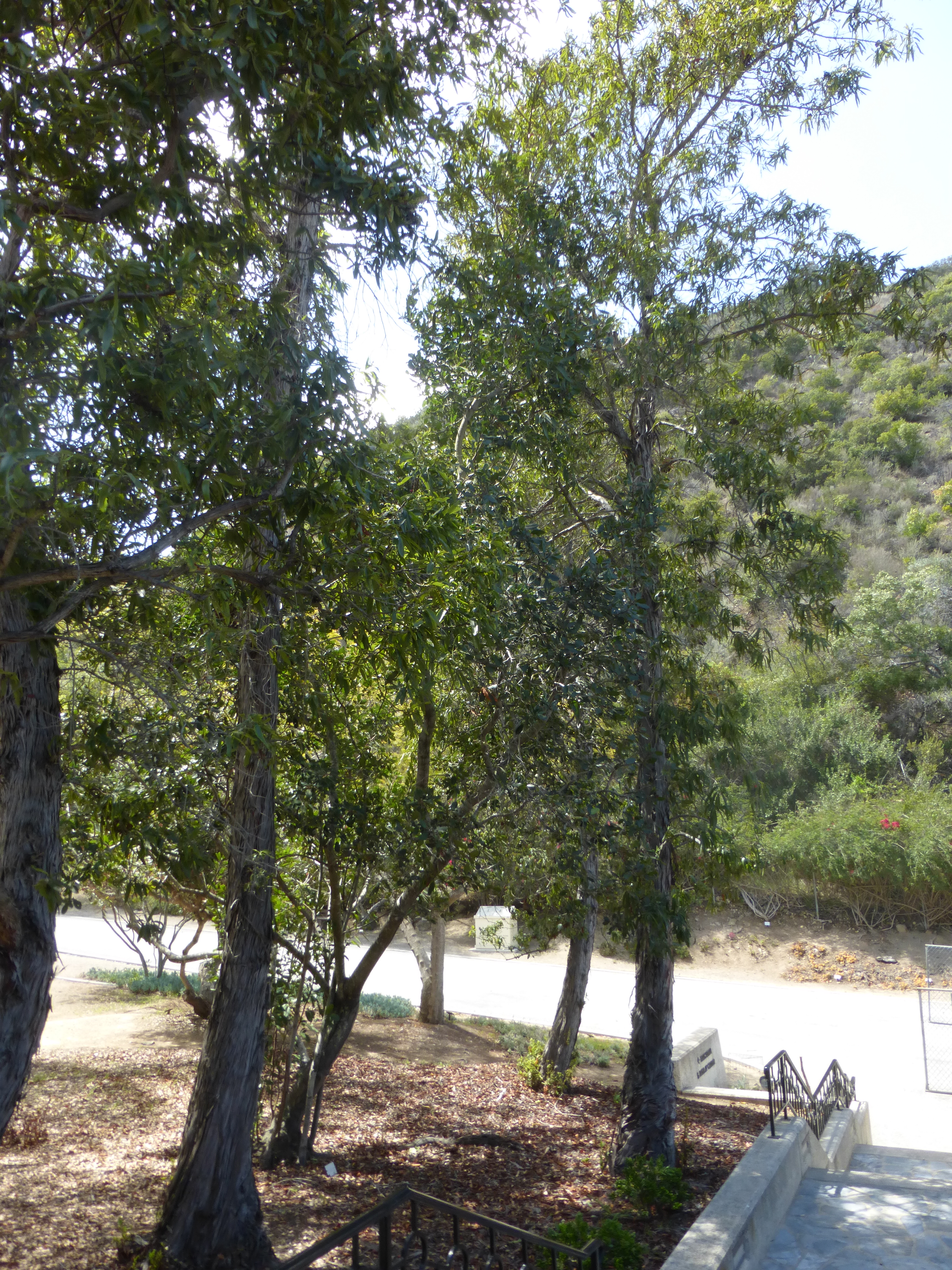
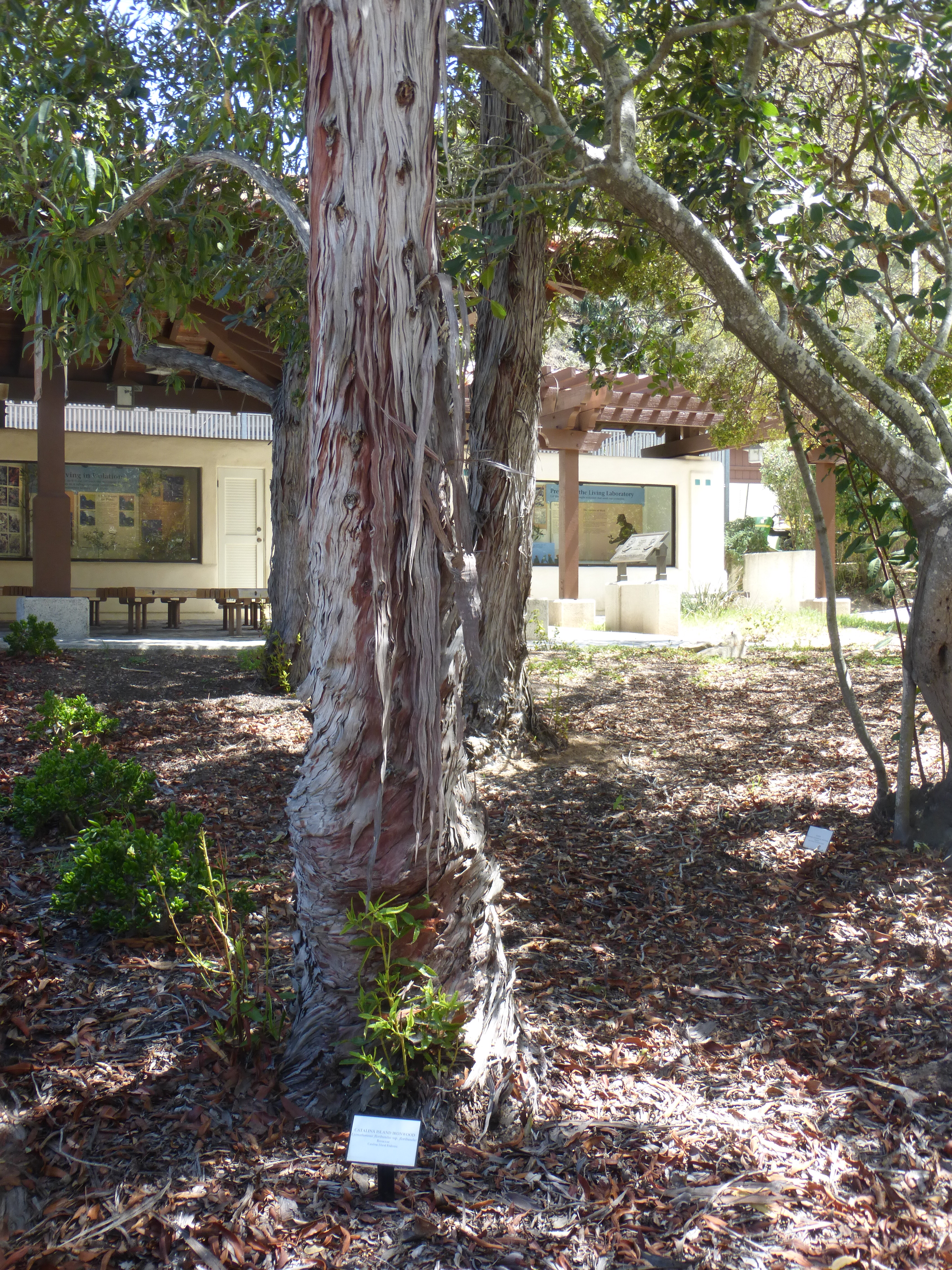
Catalina Ironwood is one of few species of native trees on the Island. It is an endemic species, like most of the native trees on the island.

There are few species of native trees on Catalina Island and their population on the island is also very small.  Therefore, most trees on the island were introduced.  Eucalyptus (mostly Red River gum and blue gum) were introduced to the island in the 1920s by the Wrigley family for a variety of reasons:  aesthetic, shade, wind break, erosion control of road cuts, etc.  Eucalypts are still there and they are the predominant tree species on the island.  Eucalyptus is found throughout the island, including the town of Avalon and several places on conservancy land, where they were planted.


The bark of Catalina ironwood is shredded, similar to the peeling bark of Blue Gum eucalyptus

The conservancy does not plan to eradicate eucalyptus on the island:  “The eucalyptus trees…are non-native, but are not highly invasive. Because of their non-invasive growth pattern and their place in the cultural heritage of the Island, they are not targeted for replacement, except when they die of natural causes.” (3)

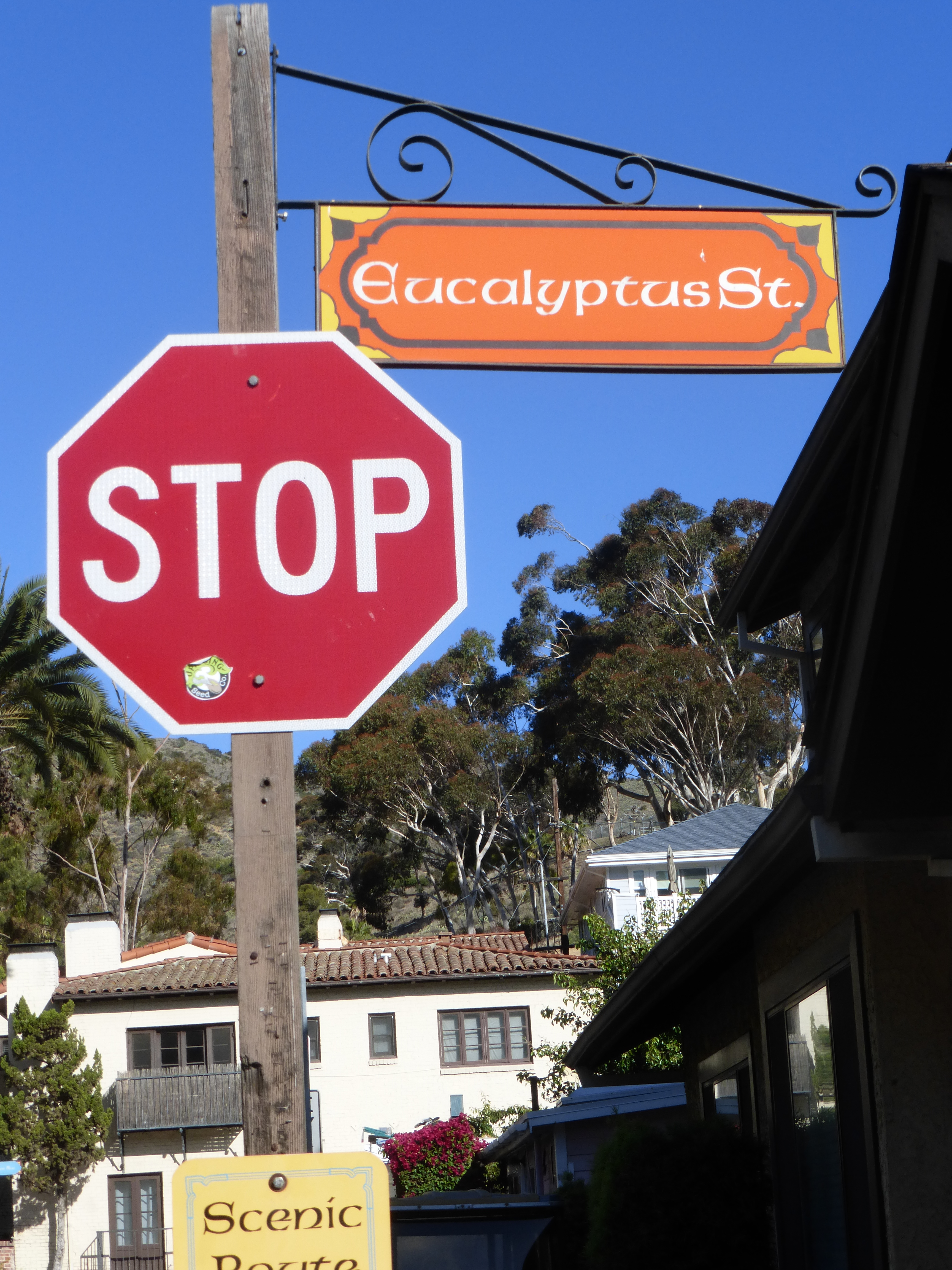
The myth that eucalypts are highly flammable that is used as an excuse to eradicate them in Northern California is not heard on Catalina Island.  An enormous wildfire torched about 10% of the island in 2007.  The fire started on conservancy land and spread to the outskirts of Avalon where it was finally extinguished after destroying several homes.  The town was evacuated and its residents stood on the beach front watching the fire approach their homes.  The eucalyptus trees that surround Avalon did not burn.  In the conservancy description of the fire, no mention is made of eucalyptus.  Although the fire was started by unsafe use of mechanized equipment, the conservancy describes fire as a natural and beneficial feature of the chaparral ecosystem of the island.

A street in Avalon is named “Eucalyptus Street.” In the background are some of the eucalypts that surround the town of Avalon.

A restoration that makes sense

I have been studying native plant restorations for over 20 years.  I have finally found on Catalina a restoration that makes some sense to me.  The restoration on Catalina Island has been more constructive than it is destructive.  It has killed less and preserved more.  It preserves eucalyptus because they aren’t doing any harm.  It does not fabricate a cover story to justify killing eucalypts just because they aren’t native. 

The conservancy also acknowledges that difficult choices must be made and that differing opinions must be respected.  Recreational interests and aesthetic preferences are not always consistent with the goals of conservation.  The conservancy preserves bison because people like to see them, despite the fact that they are not native to the island. Competing interests must be balanced if the restoration is to be supported by residents of the island:  “We have realized that people are an intrinsic part of the nature of the island—an influential and fundamental component of the conservation effort.”  (1)


Most of this article comes from this book (1) which was written by the leadership of the Catalina Island Conservancy:

  1. Frank Hein & Carlos de la Rosa, Wild Catalina Island: Natural Secrets and Ecological Triumphs, Natural History Press, 2013
  2. “Protecting Catalina’s Wildlands from Invasive Plants,” Catalina Island Conservancy Times, Fall 2017
  3. Catalina Island Conservancy website: https://www.catalinaconservancy.org/

Nativist fantasies about oaks

San Francisco Bay Estuary Institute is promoting a “restoration” project they call “Re-Oaking California.”  The project is planning to plant oak trees in California cities, in particular.  They have published an elaborate brochure describing their project and they have published a brief description in the quarterly newsletter of California Releaf, the biggest non-profit advocacy organization for California’s urban forest.  Locally, they have made a presentation to Oakland’s Urban Forestry Forum and to the Bay Area Open Space Council.  The Open Space Council convenes meetings of hundreds of public land managers from all over the Bay Area.  In other words, the re-oaking project is being aggressively sold to those who determine the future of our public lands.  Therefore, it is a project that deserves our attention.

First, I must say that I love oaks.  I decided to buy the home I now live in before I stepped inside, because of the beautiful coast live oak in the front yard.  The loss of that tree would be devastating both emotionally and to the value of my home.

However, my opinion of the re-oaking project is based on the reality of climate change and its implications for the future of California’s urban forest.  Although the project brochure acknowledges that Sudden Oak Death has killed many oaks in California, it does not accurately reflect the scale of that epidemic.

Sudden Oak Death

Sudden Oak Death (SOD) killed 5 million oak trees in California from 1994 to 2015, when that number was reported by a study. (1)  The study also said that the SOD epidemic could not be stopped and would eventually kill all oaks in California.  More recent estimates are that 5 to 10 million oaks have been killed by SOD. (2)

Tan oaks killed by SOD. US Forest Service

SOD is caused by a pathogen that is spread by rain and wind.  We had a great deal of rain in 2016 and 2017, which greatly increased the spread of SOD infections.  In the past, SOD has been mostly confined to wildlands.  Now it is found in many urban areas, including San Francisco and the East Bay.  In the most recent SOD survey done in spring 2017, new infections were found on the UC Berkeley campus, the UC arboretum, and the San Francisco Presidio. (2)

The scientist at UC Berkeley who conducts the annual survey of SOD infections reports that “A dramatic increase this year in the number of oaks, manzanita and native plants infected by the tree-killing disease known as sudden oak death likely helped spread the massive fires that raged through the North Bay…” (3)

Brice McPherson, Associate Specialist in Organisms and the Environment at UC Berkeley, has been studying SOD infections in Marin County and the East Bay.  He made a presentation in November 2017 about the current status of SOD infections in East Bay parks.  Wildcat Canyon is the park in which Mr. McPherson has most recently inventoried infected and dead trees.  In 2017, Mr. McPherson found that 16.2% of coast live oaks were infected and 20.5% were dead.  The number of dead and dying oaks in Wildcat Canyon is staggering:  18,750 oaks are infected and 21,360 oaks are dead.  McPherson predicted that 50% of all oaks in East Bay parks would be dead within 20 years, depending upon the amount of rainfall.

Native bay trees are considered the main vectors of the pathogen that causes SOD.  The re-oaking project therefore suggests that SOD infections in urban areas can be avoided if bay trees aren’t planted in proximity to the oaks.  However, the source of the SOD infection recently found in the Presidio in San Francisco is said to have been rhododendrons, which should remind us that bays are not the only vectors of the SOD pathogen.  In fact, the USDA reports 46 confirmed hosts for the SOD pathogen, including both native and non-native shrubs and trees. (4)  Many of the hosts are commonly found in urban gardens.

Climate change kills oaks in Southern California

Sudden Oak Death infections have not been found south of San Luis Obispo.  However, that does not mean that oaks in Southern California are any less threatened by changes in the environment.  Several land managers in Southern California made presentations at the recent conference of the California Native Plant Society in Los Angeles about massive die-offs of oaks in Southern California.  Here is an example from the Santa Monica Mountains:  “Over 9,000 coast live oak and 114,000 riparian trees died from [2014 to 2017]…” (5) These deaths were caused by extremely high temperatures to which the trees are not adapted, associated drought and new insect predators, such as shot-hole borer.

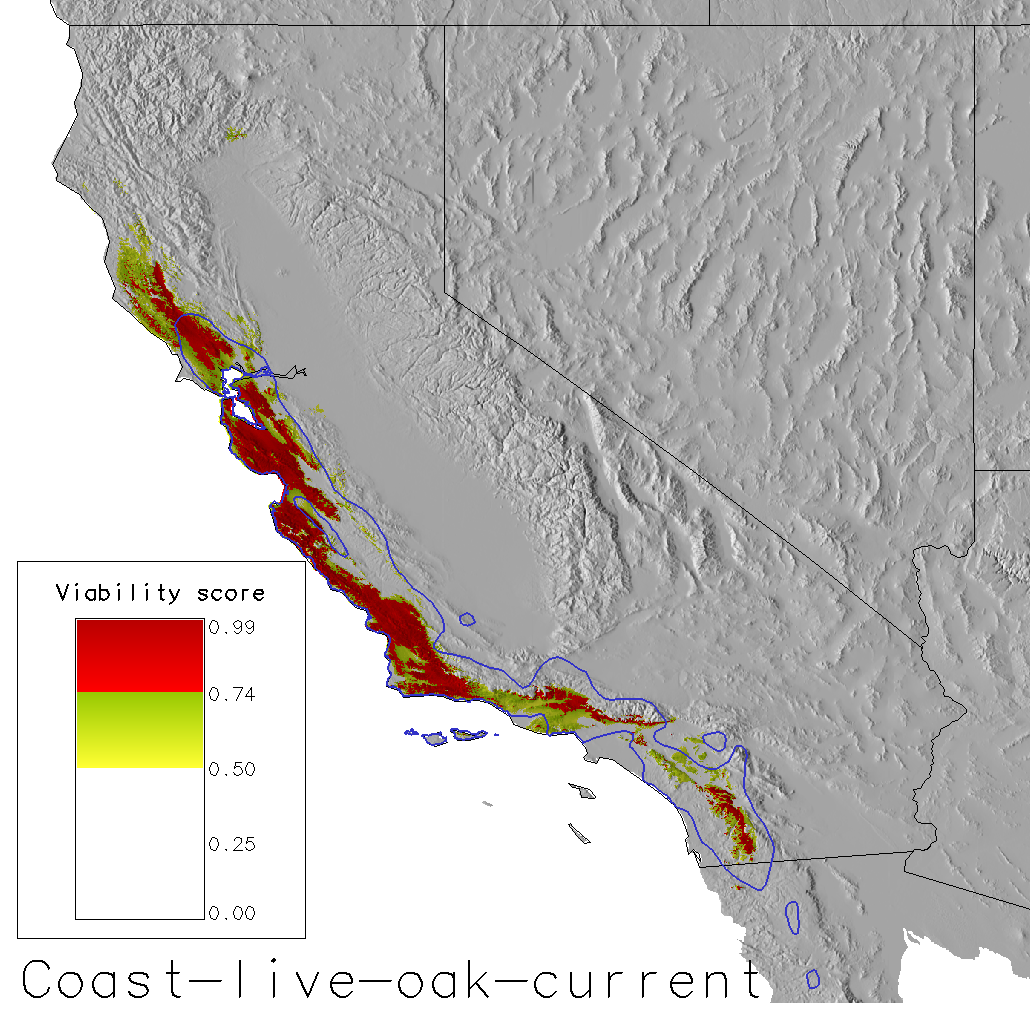
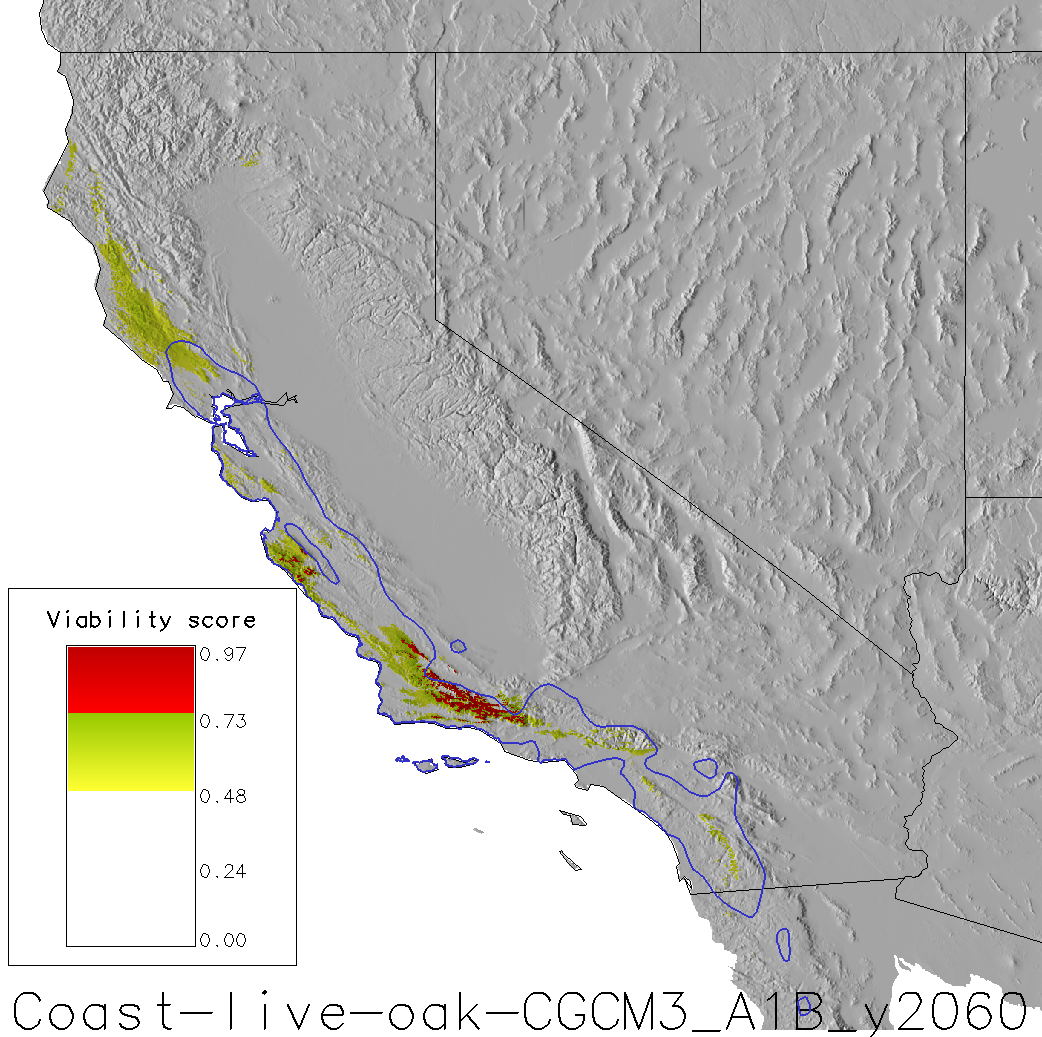
The unsuitable climate conditions in Southern California are the anticipated climate conditions of Northern California.  Carbon storage in our urban forest is one of the few tools we have to combat climate change.  Although coast live oaks store carbon, they are not particularly long lived.  Their life expectancy is from 125 to 250 years in suitable conditions. (6) Planting trees with no long-term future is not a responsible response to climate change.  The US Forest Service predicts coast live oaks will be virtually gone in California by 2060:

Wildlife in our urban forest

Although oaks are clearly useful to wildlife, they are not significantly more useful than other urban trees.  Here are three studies conducted in the East Bay that compare the biodiversity of animal life in oak woodland to other tree species:

Dov Sax (Brown University) studied six forest plots of about 1 hectare each in Berkeley, CA, three of eucalypts and three of native oaks and bays.  The sites were not contiguous, but were selected so they were of similar elevation, slope, slope orientation, and type of adjacent vegetation.  He conducted inventories of species in spring and autumn.  He counted the number of species of plants in the understory, species of invertebrates (insects) in samples of equal size and depth of the leaf litter, species of amphibians, species of birds, species of rodents.  This is what he found:

“Species richness was nearly identical for understory plants, leaf-litter invertebrates, amphibians and birds; only rodents had significantly fewer species in eucalypt sites.  Species diversity patterns…were qualitatively identical to those for species richness, except for leaf-litter invertebrates, which were significantly more diverse in eucalypt sites during the spring.”  (7)

In 1975, Professor Robert Stebbins (UC Berkeley) was hired by East Bay Regional Park District to conduct a survey of vertebrate animals living in several parks (Sibley, Chabot, and Tilden). The forest types that Professor Stebbins studied were redwood, Monterey pine, eucalyptus, and oak-bay woodland as well as grassland and dry chaparral. Here is how he described his findings:

  • “Redwood and Monterey pine habitats are notably depauperate in vertebrate species.
  • “Eucalyptus habitat is far richer in vertebrates than either redwood or Monterey pine and vies with ‘dry’ chaparral and grassland in species diversity and ‘attractiveness.’
  • “Oak-bay woodland is the richest in both species and ‘attractiveness.’
  • “Grassland is a little less rich in species and ‘attractiveness’ than the other native habitats, but only slightly richer than eucalyptus habitat.” (8)

A wildlife study of Angel  Island prior to the removal of most eucalyptus trees found:

“The total number of birds observed in native stands was similar to that observed in eucalyptus stands…Few small animals were caught in any stand; captures were in native stands five Norway Rats…in eucalyptus stands one Norway Rat…in grassland one Norway Rat and six California Voles…about three times as many salamanders were located in eucalyptus stands compared to native stands.” (9)

As David Ackerly said in response to a question at the recent conference of the California Native Plant Society, “There are few mutually exclusive relationships in nature.”  It is a risky evolutionary strategy.  If an animal is dependent upon a single plant species, it won’t survive in the absence of that plant species unless it is capable of adapting to available vegetation.  Despite the handful of examples given in the re-oaking brochure, wildlife in California is using non-native vegetation as often as native vegetation.

California’s urban forest is not native

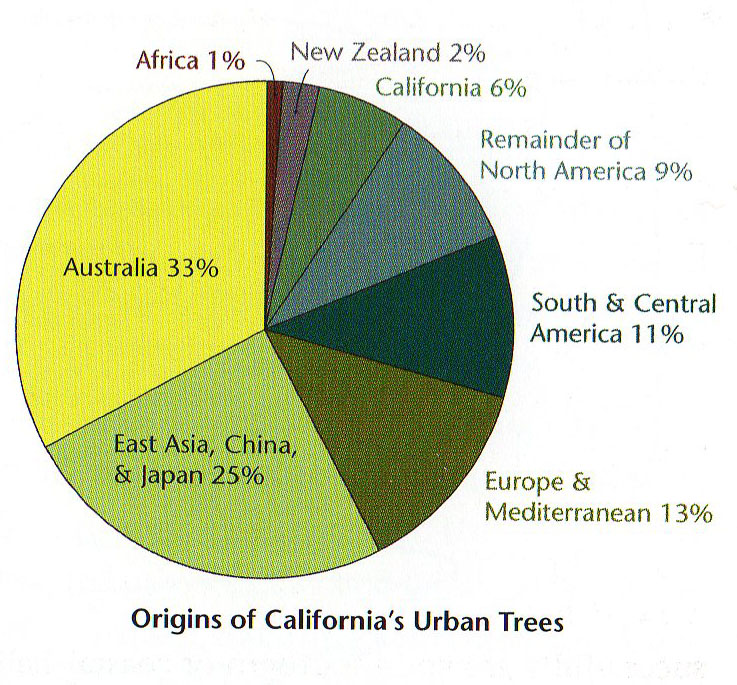
The suggestion that California’s cities could be “refugia” for our threatened oaks is wishful thinking.  As Matt Ritter tells us in his book about California’s trees (A Californian’s Guide to the Trees Among Us), only 6% of California’s urban trees are native to California.  Thirty-three non-profit tree advocacy organizations in California (including California Releaf) told us why in their letter to California’s Natural Resource Agency about the Urban Greening grant program:  “Native trees are generally not suited to urban conditions.  They have difficulty adapting to the urban environment, thereby substantially reducing survivability…As an example, the approved list of street trees for the City of San Francisco includes no trees native to San Francisco.  In Oakland, two of the 48 allowed species are native.”

The future of California’s urban forest

So, what is the future of California’s urban forest?  Scientists with sufficient knowledge of trees are trying to answer that question and we would be wise to pay attention to their advice.  Greg McPherson gave a presentation in Davis on March 10, 2018 about “Growing Resilient Forests.”  McPherson’s research at the US Forest Service about the economic value of ecosystem services provided by urban trees (carbon storage, reduction of energy use for heat/cooling, increased property values, removal of particulate pollution, etc.) has been vital to those who defend our urban forest.

McPherson lives in Davis, where he is conducting a 20-year study about the urban forests of the future, i.e., those that will survive predicted changes in the climate. Three years into the study, his research team has made some preliminary recommendations for the trees that are likely to survive anticipated changes in the climateNone is native to Northern California. Most are foreign, particularly Australian.  (10)

Nativists deny reality of climate change

When the climate changes, the vegetation changes, moves, or dies.  That has been one of the few axioms in nature since life has existed on Earth and we would be wise to assume that it will continue to be true.  The future of California’s urban forest depends on our willingness to plant trees that are adapted to the climate and to the anticipated climate.  Climate change is killing California’s trees and nativism is preventing us from replacing them with suitable trees.


  1. https://www.sciencedaily.com/releases/2016/05/160502161111.htm
  2. “Disease killing oaks spreads,” East Bay Times, October 24, 2017
  3. “Disease in trees pointed at in fires,” San Francisco Chronicle, October 20, 2017
  4. http://www.aphis.usda.gov/plant_health/plant_pest_info/pram/downloads/pdf_files/usdaprlist.pdf
  5. http://www.rcdsmm.org/wp-content/uploads/2016/04/Drought-and-Invasive-Beetle-impacts-RCDSMM-1.2.18.pdf
  6. http://ucanr.edu/sites/oak_range/Californias_Rangeland_Oak_Species/Coast_Live_Oak/
  7. Dov Sax, “Equal diversity in disparate species assemblages:  a comparison of native and exotic woodlands in California,” Global Ecology and Biogeography, 11, 49-52, 2002. http://elkhornsloughctp.org/uploads/files/1109813068Sax2002.pdf
  8. Robert Stebbins, “Use of Habitats in the East Bay Regional Park by Free-living Vertebrate Animals,” August 1975. In “Vegetation Management Principles and Policies for the East Bay Regional Park District,” June 1976 (this unpublished study is available on request)
  9. “Focused Environmental Study, Restoration of Angel Island Natural Areas Affected by Eucalyptus,” California State Parks and Recreation, July 1988, pg 96-97.
  10. http://climatereadytrees.ucdavis.edu/

Nativist fantasies about redwoods

I love redwood trees.  I doubt there is anyone who doesn’t.  So, you might wonder why I am going to tell you why planting more of them in our public parks in the San Francisco Bay Area isn’t a good idea.  Read on…

History of redwoods in California

The native range of redwoods is very small.  According to the US Forest Service, “The redwoods occupy a narrow strip of land approximately 450 miles in length and 5 to 35 miles in width.  The northern boundary of its range is…in the Siskiyou Mountains within 15 miles of the California-Oregon border.  The southern boundary of redwood’s range is…in the Santa Lucia Mountains of southern Monterey County, California.” 

Many redwoods were destroyed for timber and many to clear land for other purposes, such as roads, agriculture, and development.  However, the primary reason for its small native range is the demanding horticultural conditions required by redwoods.  They don’t tolerate wind, particularly salty wind from the ocean.  They require a lot of water.  Where there isn’t enough rain, summer fog compensates for inadequate water.  They need well drained soil and plenty of space to grow to their prodigious size of over 200 feet.

Because of these horticultural requirements, there weren’t many redwood trees in the San Francisco Bay Area prior to settlement by Europeans in the 19th century.  There were no redwoods in San Francisco where the soil was sandy and strong wind from the ocean is salty.  In the East Bay, the pre-settlement redwood forest was less than 5 square miles. (1) In fact, only 2.3% of pre-settlement Oakland was forested and redwoods were a small fraction of the tree cover. (2)

Trying to defy nature

Despite their demanding horticultural requirements and the historical evidence of these limitations, redwoods are often planted where they cannot survive because they are beautiful, popular, and “native” to California.  As the climate changes, rising temperatures and drought have killed many of the redwoods that were planted in the past.  As the climate continues to change, the future of redwoods in California becomes even more doubtful. 

San Francisco’s 2017 Annual Report of the Urban Forestry Council reports that redwoods planted on public land in San Francisco are dying:

“Agencies such as SFO [San Francisco Airport], Zuckerberg General Hospital, and SFSU [San Francisco State University] reported concerns with declining health of redwood trees under their care.  This iconic California native tree is not drought tolerant and current research shows that specimens planted in landscape settings outside their native areas are suffering from water restrictions and irrigation with non-potable water throughout the Bay Area.  Redwood trees’ water and other cultural needs should be considered when planning future plantings since periods of extreme drought are expected to continue as the climate continues to change.”  (page 11)

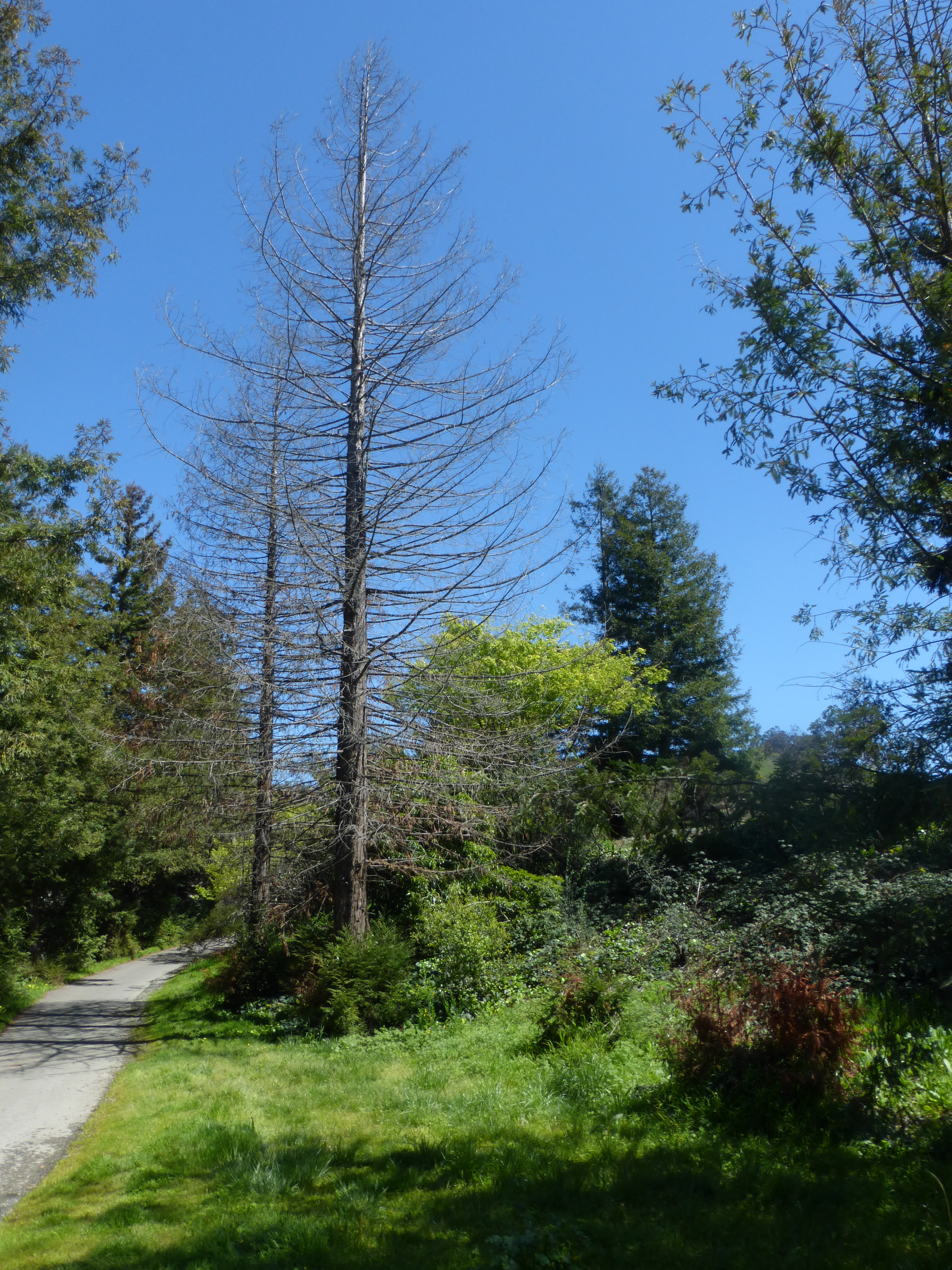
Dead redwoods, Lake Temescal, March 2018

We see similar examples of planting redwoods in East Bay Regional Parks, where they are dying.  Redwoods were planted at Lake Temescal about 5 years ago.  Despite the fact that many of them are dead, the Park District continues to plant new redwood saplings adjacent to their dead relatives.  Although it is a relatively sheltered area, the trees may have been killed by salty irrigation water.

The growing gap between science and public policy

On March 10, 2018, I attended a conference about resiliency in Davis, California: “Deepening our Roots:  Growing Resilient Forests.” I went to hear Greg McPherson speak because I have read many of his scientific publications and I admire his work.  McPherson’s research at the US Forest Service about the economic value of ecosystem services provided by urban trees (carbon storage, reduction of energy use for heat/cooling, increased property values, removal of particulate pollution, etc.) has been vital to those who defend our urban forest.

McPherson lives in Davis, where he is conducting a 20-year study about the urban forests of the future, i.e., those that will survive predicted changes in the climate. Three years into the study, his research team has made some preliminary recommendations for the trees that are likely to survive anticipated changes in the climate.  None is native to Northern California. Most are foreign, particularly Australian.

McPherson also showed photos of trees being planted now that are destined to die in the near future. One was a densely planted row of redwoods in a median strip in Davis. Professor Arthur Shapiro, who lives in Davis, made this comment when I told him about McPherson’s presentation, “Redwoods are the walking dead here. I’ve known that forever and a year.”  McPherson said redwoods have no long-term future in most of California. None of the public land managers in the Bay Area seems to know that.

East Bay Regional Park District ignores reality

East Bay Regional Park District is making a big investment in expanding redwood forests into places where redwoods did not exist in the past and where they are unlikely to survive in the future.  They are clear-cutting non-native trees and creating visual screens on the periphery of the clear-cuts by planting redwoods along the trails.  This photo was taken in Sibley Volcanic Reserve in March 2018 (the area is larger than shown in this photo):

Sibley Volcanic Reserve. Photo by Larry Danos, March 2018

These are areas that were a part of EBRPD’s “Wildfire Hazard Reduction and Resource Management Plan.”  The Fuels Management Prescription for this Recommended Treatment Area was supposed to thin the eucalyptus trees to spacing of 25 feet by removing only small trees with trunks less than 10 inches in diameter.  The original plan for this area did not include any replanting of trees.

The recent implementation of this project suggests that EBRPD’s strategy for tree removals has changed.  At least in this instance, the trees have been clear-cut, not thinned.  And redwoods were planted where none were originally planned. 

It is always risky to speculate about the motivations of other people, but I will venture a guess about this new strategy.  The Park District’s commitment to destroying non-native trees seems to have escalated from thinning to clear-cutting.  And the public’s opposition to the destruction of trees seems to have convinced the Park District that they must plant native trees to replace the trees they have destroyed.

Unfortunately, the Park District does not seem to have taken the changing climate into consideration.  The redwoods may survive long enough to placate the public, but they are unlikely to survive in the long-term.  It is a good public relations strategy, but not a good strategy for a landscape in transition in a changing climate.  It is also not a responsible strategy, given that the carbon stored by the trees being destroyed will contribute to the changing climate and won’t be replaced by dead redwood trees. 


(1) Sherwood Burgess, “The Forgotten Redwoods of the East Bay,” California Historical Society Quarterly, March 1951.

(2) Nowak, David, “Historical vegetation change in Oakland and its implications for urban forest management,” Journal of Arboriculture, 19(5): September 1993

A Milestone for Million Trees

As the Million Trees blog approaches the anniversary of its eighth year, we are celebrating a milestone. Yesterday, Million Trees reached a total of 250,000 individual views of posts on Million Trees.  We now have over 300 subscribers and we are averaging about 150 views per day.  About 25% of our readers are outside the United States.  Since nativism in the natural world is an international fad, we are gratified that Million Trees is being read by people in other countries.  Million Trees is also proud and grateful for the participation of several academic scientists who have written informative guest posts for Million Trees in the past year.  Thank you, Dr. Matt Chew, Professors Mark Davis and Art Shapiro, and Dr. Jacques Tassin for your help!

Our most popular posts have each been visited by over 10,000 readers.  They are, in the order of their popularity:

  • “Darwin’s Finches: An opportunity to observe evolution in action.”  This article about the speed with which adaptation and evolution occur in a rapidly changing environment is the bedrock of the Million Trees blog.  Nativists mistakenly believe that evolution is much slower than it is.  Therefore, nativists believe plant and animal species are nearly immutable and that they are locked into mutually exclusive relationships, which are, in fact, extremely rare in nature.
  • “Nearly a HALF MILLION trees will be destroyed in the East Bay if these projects are approved.” The Million Trees blog was created to inform the public that nativism is destroying our urban forest in the San Francisco Bay Area.  Our urban forest is composed of predominantly non-native trees.  If they are destroyed, we will not have an urban forest because native trees will not survive in our changed and rapidly changing environment.  Non-native trees were planted here because people wanted trees and native trees existed only in riparian corridors where they were sheltered from the wind and there was sufficient water.
  • “Falling from Grace: The history of eucalyptus in California.”  Because people wanted trees, they planted non-native trees that were capable of surviving in the San Francisco Bay Area.  Non-native trees were valued for nearly one hundred years until nativism got a death grip on our public lands. This article on Million Trees tells the history of why eucalypts were planted and why they “fell from grace.”

In the past year, one of the most popular posts on Million Trees was “Krakatoa:  A case study for species dispersal.”  This post has been viewed by over 7,000 readers.  Understanding how plants and animals were dispersed around the world by natural means–such as by birds, wind, and ocean currents—is another way to realize that the concept of “native vs. non-native” is an artificial construct with little practical meaning.  Plants and animals have always moved and they will continue to move.  In fact, as the climate changes, they MUST move if they are to find the environmental conditions in which they can survive.

Million Trees Commitment

Million Trees will continue to advocate for the preservation of our urban forest in the San Francisco Bay Area.  Our strategy is to inform the public of the many projects that are destroying our forests and to describe the damage that is being done by those projects.  We are particularly concerned about the use of pesticides to eradicate non-native plants and trees.  We are equally committed to providing our readers the latest scientific discoveries that relegate invasion biology to a scientific back-water.  We are hopeful that the gap between public policy and the scientific knowledge discrediting invasion biology will eventually be bridged and bring an end to this destructive fad.

Public reactions to conferences on invasive species are always illuminating

I am publishing a guest post by Jacques Tassin, who tells us of his personal experiences with presenting his findings about invasive species in public forums.  Jacques Tassin is a French ecologist. He has been working on invasive species for more than twenty years, especially on islands in the West Indian Ocean and Pacific Ocean.

Jacques Tassin

Dr.Tassin agreed to tell us about his interactions with the public because he believes the public’s views of invasive species are poorly understood and that improved understanding of the public’s views would improve communication about this controversial topic. 

I must add that my personal experiences with such interactions have revealed the same themes.  The public feels strongly that it is possible—even necessary—to control nature.  And much of that sentiment is based on guilt about the damage that humans have done to nature and a desire for redemption.  I prefer to respond to that viewpoint by informing the public of the damage being done in the name of “restoration.”  We cannot redeem ourselves by doing yet more damage.  However, I share Dr. Tassin’s frustration with scientists who are unwilling to speak to the public in ways that the public can comprehend.

Jacques Tassin is a new voice on Million Trees.  I am grateful for his participation in our discussion of invasion biology.

Million Trees


It takes much energy for a scientist to go down to the arena to meet the general public, for example in the form of a conference. But it is well worth it. On the one hand, because it allows scientists to hear a different kind of discourse than media coverage of the issue. On the other hand, because the comments and questions from the public are often very significant.

Following the publication of my book La Grande invasion: qui a peur des espèces invasives ? (The Great Invasion: Who Fears Invasive Species?) published in editions Odile Jacob in 2014, I was often invited to such meetings. I can distinguish several types of public reactions to my conferences.

The main one is the public’s seeming intolerance of the idea that we can agree to do nothing about the progression of an invasive species, even if it is proven that nothing can be done about it, or that the species in question does not have a clearly negative ecological or economic impact. Farmers and hunters are particularly opposed to this view of not intervening and therefore not controlling the environment. For these people, it is a question of putting nature in its place.

The public also strongly rejects the possibility that we cannot redeem our faults, or that we may not be able to undo what we have done, if we do not deal with invasive species. This reaction is the result of an activist stance that is particularly present in nature conservation associations. The remark that comes up most often is “we’re not going to sit back and watch.”

Finally, the third most frequent reaction is the belief that each invasive species introduced somewhere necessarily takes the place of another species. This principle of musical chairs seems deeply rooted in everyone’s mind. It is not certain that this is due to the theories of Robert MacArthur and E.O. Wilson’s about island biogeography. It seems much more likely that, deep in our imagination, the arrival of an intruder will end up with the departure of one of us.

In any case, it seems to me that the debate about invasion biology is far more concerned with social psychology than with the science of invasions. I am now certain that those who focus their discourse on the biological and ecological dimension of invasive species are headed in the wrong direction. Today, invasion biology is more in the field of psychology and beliefs than it is a question of a rational discourse. But it is clear that scientists are particularly ill-suited for this dialogue. Journalists who are used to talking to hundreds of thousands of listeners on the radio or in the press are much better equipped to do so. Scientists must learn from journalists how to communicate with the public about invasive species, whatever the public’s opinion of invasive species.

Jacques Tassin

Further Reading:

Tassin J., Thompson K., Carroll S.P., Thomas C.D. (2017). Determining whether the impacts of introduced species are negative cannot be based solely on science: a response to Russell and Blackburn. Trends in Ecology and Evolution, 32 (4) : 230-231.

Tassin, J. and C. Kull (2015). Facing the boader dimensions of biological invasions. Land Use Policy 42 : 165-169.

Tassin, J. (2014). La grande invasion. Qui a peur des espèces invasives ? Editions Odile Jacob. Paris, 216 p.

Beyond Pesticides: The voice of reason about pesticides

Beyond Pesticides logo

I attended my first Beyond Pesticides forum in 2014 in Portland, Oregon.  I have been a member of and donor to Beyond Pesticides ever since.  And I have purchased only organic food since attending that forum, because of a field trip to a community of farm workers that convinced me that growing our food without using pesticides benefits both consumers and producers of America’s food.  

In a recent letter to the National Invasive Species Council, Beyond Pesticides describes their organization and mission:

Founded in 1981 as a national, grassroots, membership organization that represents community-based organizations and a range of people seeking to bridge the interests of consumers, farmers and farmworkers, Beyond Pesticides advances improved protections from pesticides and alternative pest management strategies that reduce or eliminate a reliance on pesticides.” (The letter is available HERE: Beyond Pesticides – ISAC Comment )

 I receive emails from Beyond Pesticides at least once a week, alerting me to opportunities to influence the laws and policies that regulate pesticide use in America.  As you might expect, the frequency of those alerts has accelerated a great deal in the past year, as the federal government is actively engaged in the process of dismantling many federal regulations, including those that regulate pesticides.

 The National Invasive Species Council recently invited the public to submit public comments in answer to a few specific questions, in preparation for the next meeting of the Invasive Species Advisory Council.  Today I am publishing an excerpt of the letter of Beyond Pesticides in answer to those questions (some emphasis added).  I am doing so because I consider this letter a wise and informed critique of the entire concept of “invasive species” and the pesticides used to eradicate them.

 I am also alerting the readers of Million Trees to the opportunity to attend the annual forum of Beyond Pesticides in Irvine, California, April 13-14, 2018.  Information about that meeting is available below.

 Million Trees


“The National Invasive Species Council (NISC) posed four questions for public input to the forthcoming meeting of the Invasive Species Advisory Council (ISAC). We find it most helpful to begin with the fourth: “How can NISC foster the development and application of innovative tools and technologies to enable the prevention, eradication, and control of invasive species in a more timely and effective manner?”

In order to address this question, NISC and ISAC need to first address the question, “What is an ‘invasive species’?”

‘Invasive species’ have frequently provided a reason for dispersing toxic chemicals in the environment, often with a sense of urgency and an assumed indisputable benefit. This unsupported (and sometimes unstated) assertion of benefit is a claim to virtue that allows environmental harm instead of preventing it.

In the context of other federal, state, and local laws, the regulatory definition of ‘invasive species’ gives broad authority to agencies to use all means at their disposal to rid the jurisdiction of non-native organisms causing economic harm, as well as harm to health and the environment. Many local ordinances that ban or restrict pesticide use make an exception for ‘invasive species,’ presumably under the mistaken assumption that in doing so they are protecting the environment. Instead, they are allowing environmental harm through the spread of toxic substances.

The use of the term ‘invasive species’ as a claim to virtue that is used to promote any and every attempt to exterminate any unwanted organisms is very disturbing. It is important to understand the problems that lead to the use of toxic chemicals, beginning with the cause. In the case of situations involving so-called ‘invasive species,’ we find that few, if any, involve species that are truly ecologically invasive—that is, capable of invading and persisting in intact ecosystems. Instead, such situations usually involve species that can take advantage of disturbed habitats (‘weeds’ or ‘weedy species’). As such, the emphasis should be placed on healing the disturbance (to which end, so-called ‘invasives’ may sometimes be helpful), rather than killing the opportunist colonizer.

We do not take the position that such opportunist colonizers should never be removed or managed. We do believe that the decision concerning whether such action should be taken should be based on the situation at hand and not on a claim to virtue that makes extermination of non-natives a righteous cause.

Redefining ‘invasive species’ to be limited to those species that can invade and damage intact ecological communities will directly ‘foster the development and application of innovative tools and technologies to enable the prevention, eradication, and control of invasive species in a more timely and effective manner’ (NISC) because resources will be directed only at those species that truly present an ecological threat. It will prevent those resources from being squandered in ways that are ecologically destructive.

The sharper focus that this redefinition will bring to the NISC and ASIC will enable them to explore approaches such as those that Beyond Pesticides has used in working with National Parks, local governments, and tribes to manage ecological problems in a way that is truly protective of biodiversity.”

Terry Shistar, Ph.D.
Board of Directors
Beyond Pesticides


Beyond Pesticides will soon hold its annual forum in Irvine, California, April 13-14, 2018.  As usual, the forum will include highly qualified speakers who are knowledgeable about so-called “invasive species,” and the evolutionary principles that raise questions about the necessity and futility of trying to eradicate them.   Two of the speakers are important to our local effort to stop the use of pesticides to eradicate non-native plant species:  Dr. Scott Carroll and Professor Tyrone Hayes.

Dr. Scott Carroll is an evolutionary biologist affiliated with UC Davis.  He has published several influential studies about the speed of adaptation and evolution that enables introduced plants to join native ecosystems without long-term negative consequences of their introduction.  He has coined the concept of “Conciliation Biology,” which advocates that we turn from efforts to eradicate non-native species in favor of a new approach which manages the co-existence of native and non-native species. 

Professor Tyrone Hayes (UC Berkeley) is best known for his criticism of the herbicide, atrazine, which is harmful to the frogs that he studies.  Unfortunately, Professor Hayes’ opposition to atrazine does not extend to the pesticides being used in the San Francisco Bay Area to eradicate non-native trees and prevent them from resprouting.  Professor Hayes accepts the premise that eucalyptus trees are detrimental to native plants, which justifies the use of herbicides to destroy them, in his opinion.  The herbicide that is used for that purpose (Garlon with active ingredient triclopyr) is just as toxic as atrazine.  Both are organochlorine products that bioaccumulate, persist in the environment for decades, and are endocrine disruptors. 

The Beyond Pesticides forum is likely to generate some lively discussion of the issues that are relevant in the San Francisco Bay Area.  Details about the conference are available HERE.  Beyond Pesticides makes every effort to make these forums affordable for activists.  I have attended two of these conferences.  They were excellent opportunities to learn more about pesticides, to meet other activists, and to get ideas about how to advocate more effectively for more responsible pesticide use in our community.

I am very grateful to Beyond Pesticides for their leadership in the effort to reduce pesticide use in the United States.  They are a reliable source of information about pesticides and their activism is an inspiration to those who are engaged in this effort on a local level.

Million Trees

Were the real Nazis “native-plant” Nazis?

We recently published an article about the conference of the California Native Plant Society that featured this concluding photo of Doug Tallamy’s presentation opening the conference on February 1, 2018.

Doug Tallamy’s closing photo, CNPS Conference 2018

This photo generated some discussion among the readers of Million Trees about nativism in the natural world.  Is it related to nativism in the human realm?  This is a timely question because American politics are presently consumed by anti-immigration sentiment, AKA “nativism.”  As members of our communities are unceremoniously rounded up in immigration raids and deported from America, this is an association that is getting more attention.

We are pleased to publish a guest post by Professor Art Shapiro (UC Davis) in answer to this question.  Although Professor Shapiro is a renowned expert on the butterflies of California, he is knowledgeable on a wide range of subjects, including philosophy and history. 

Professor Shapiro offers us a nuanced answer to the question at hand.  This is an example of a general principle about such debates:  the more we know, the more complicated every issue becomes.  I have had the pleasure of a few long conversations with Professor Shapiro that were similar experiences. Professor Shapiro teaches us that we must examine issues from every angle, considering the pros and the cons.  More often than not, we can’t reach a definitive conclusion that does the issue justice.

But I will demur on the issue of nativism.  I will venture my opinion that nativism in the natural world is ultimately as pernicious as nativism in the human realm.  They both do more harm than good.  They are both fundamentally unjust.  However, I do NOT generalize about the motivation of native plant advocates. I doubt that the majority are appropriately called “native-plant Nazis.” 

I remain grateful to Professor Shapiro for sharing his knowledge and wisdom with me and with the readers of Million Trees. 

Million Trees


Various observers have noted similarities in the rhetoric used by native-plant activists and that used by xenophobes. The comparison has generated a derisive term, “native-plant Nazis,” to describe the most strident of those opposed to the use of non-native plants in gardens. But were the real Nazis “native-plant Nazis?” The answers are rather complex and in some ways surprising.

The German Romantic Movement stressed the “organic unity” of the German people and their landscapes. In 1818 the artist Friedrich Ludwig von Sckell in his book Beitraege zur bildenden Gartenkunst (“Contributions to Instructive Garden Art”) prescribed the planting of “patriotic species” to create landscapes of “patriotic character.” The great explorer-naturalist-geographer Alexander von Humboldt referred in 1806 to vaterlaendische Pflanzengestalten (plant character reflecting the Fatherland) and stressed that “the natural character of different regions of the earth is most intimately connected with the history and culture of the human race,” a notion that persists today, as witness the excellent book Landscape and Memory, by the historian Simon Schama, and is not in itself reflective of xenophobia.

During the Romantic period the intense longing for the unification of the fragmented German polity bred not only intense patriotic feeling but a concomitant disdain for the alien. Thus Fichte argued that the Germans’ “natural disposition to freedom dates back to prehistoric times, when they had been a pure and untainted race…before the influence of foreigners and the introduction of class division.” After the establishment of the First Reich in 1871, all things German were ever more aggressively touted as superior to all else, and this included landscapes. The writer Willy Pastor and the art historian Josef Strzygowski enthusiastically promoted these ideas in the early 20th Century. Pastor invoked the Ice Age as the crucible in which the German national character was forged; the glaciers “not only influenced the racial breed of humans, but also selected trees and plants….the European primeval forest, which finally evolved as the strongest out of this severe school, was no less of Germanic, Nordic race than the people…”

Nature garden designed by Willy Lange

The quintessential embodiment of such ideas was the work of the landscape architect Willy Lange. Lange and Pastor were friends and shared their nationalistic vision. Pastor published a collection of essays entitled Lichtungen (clearings) and a book The Earth in the Time of Man, in which he argued that the natural habitat of the true Teuton is a clearing in the forest. Lange translated that view into a prescription for garden design: he utterly repudiated the formalism of most European gardens and argued instead that the ideal form of garden was a well-designed, visually pleasing simulacrum of a natural forest clearing, employing whenever possible (but not exclusively) native plants characteristic of the natural landscape. His ideas were taken up by Alwin Seifert, who rose after the Nazis came to power to be the ultimate arbiter of garden design.  In 1939 Hans Hasler’s book Deutsche Gartenkunst (German Garden Art) spelled out the essential unity of the German national soul and the surrounding environment. Heinrich Friedrich Wiepking, who held the landscape design chair at the College of Agriculture in Berlin during the war, taught this doctrine as the rationale for gardening and invoked ancient Teutonic artifacts, burial mounds, and such as proof of this essential “organic unity.” Wiepking’s student Werner Lendholt “proved” that Germans already had a refined sense of landscape unity in the Bronze Age.

The idea of the “nature garden” arose repeatedly as a byproduct of romanticism, not only in Germany but throughout Europe and even in America; it can be seen as a reaction against formalism, with its rigidity and symmetry. But only in the Reich did it become so tightly fused with nationalism. There is nothing inherently political in Lange’s definition of his philosophy as “the derivation of ideas from nature and their translation in an artistic manner into garden design.”

Lange and his successors drew inspiration from the earlier work of the Irish garden writer William Robinson, who in turn was influenced by Gertrude Jekyll. And they in turn were influenced by William Thompson, who promoted the idea of the semi-natural “English flower garden” as early as 1852. The Austrian Robert Gemboeck, beginning in the 1880s, advocated “the reproduction of nature in the garden,” and was quite influential; he gave detailed prescriptions for how to create a simulacrum of wilderness—what kind of wilderness being dependent on the soil type available.

But none of this meant that the German garden had to be composed exclusively of native plants!

The era of both Robinson and Lange was the era of the “grand tour,” and both men traveled widely and assimilated their observations into their concepts of the natural garden. Lange’s disciple Hasler wrote that the master developed his art “as a result of his experiences and knowledge he gained on a north-south tour of Europe and North Africa.” After 1907 he explicitly advocated the introduction and naturalization of plants he regarded as esthetically in harmony with the true Teutonic landscape. During the 1930s the Nazi regime, primarily under the guidance of Heinrich Himmler, sponsored a series of famous expeditions to the Himalaya. There were several reasons for doing so. Himmler was entranced by the crackpot Welt-Eis Lehre (world ice theory) of Hanns Hoerbiger, which amplified the Romantic notion of the Ice Age as the crucible of German character. Himmler was interested in learning as much as possible about the Ice Age by studying what he viewed as the people living most like the ancient Teutons: the Tibetans, whom he imagined to be a pure and unadulterated race. But a subsidiary objective of the expeditions was to collect living material of Himalayan plants deemed suitable for naturalization in the Fatherland. In a sense, this represented an attempt to restore an imagined Edenic past.

Only those non-native plants judged to be inconsistent with the German landscape-character nexus, as largely defined by Alwin Seifert, were to be excluded. Seifert’s official title was Reichslandschaftsanwalt, or national landscape advocate. When he first received the title he presented two proposals to his superior, Fritz Todt: one embraced the use of non-native plants while the other did not. Seifert is a complex and problematic figure. He was anti-Semitic but never a really enthusiastic Nazi and he had a strong independent streak which often led him into trouble. He was a passionate advocate of organic gardening and sympathetic to anthroposophy, the cultish philosophy of Rudolf Steiner (today best known for the Waldorf School movement). His many contradictions led his biographer Thomas Zeller to call him “The Nazis’ environmental court jester and Cassandra, rolled into one.” His attitude on non-native plants hardened somewhat late in his tenure, when he took to calling Colorado blue spruce “public enemy #1.”

There was much in German garden philosophy and design to be admired, if one strips out the pugnacious racial and nationalistic rhetoric. There is really little difference from the natural-garden traditions developed elsewhere. Nazi Germany, early in its history, enacted what would today be characterized as the most progressive legislation in the world dealing with conservation, esthetics, and environmental health. Hence we have such books as The Green and the Brown and How Green Were the Nazis? that explore the contradiction between those facts and everything else we know about the regime. The contradiction becomes less bizarre when we remember the roots of Nazism in the Romantic movement.

At any rate, the real Nazis were never thoroughgoing “native-plant Nazis!”

Arthur M. Shapiro

Further Reading:

Bruggemeier, F.-J. and M. Cioc. 2005. How Green Were the Nazis? Nature, Environment and Nation in the Third Reich. Ohio University Press.

Uekoetter, F. 2006. The Green and the Brown: A History of Conservation in Nazi Germany. Cambridge University Press.

Wolschke-Bulmahn, J. 1992. The ‘wild garden’ and the ‘nature garden’ – aspects of the garden ideology of William Robinson and Willy Lange. Journal of Garden History 12: 183-206.

Wolschke-Bulmahn, J. 1997. Nature and Ideology: Natural Garden Design in the Twentieth Century. Dumbarton Oaks collection on the history of landscape architecture, vol. 18.