“What Agribusiness Doesn’t Want You to Know”

One of the arguments used by native plant advocates to defend the use of pesticides to eradicate non-native plants and trees is that this use is trivial in comparison to the volume of pesticides used by agriculture.  It’s not an argument that makes sense to us.  In fact, the opposite seems a stronger argument.  In other words, if it is necessary to use pesticides to produce our food, all the more reason to avoid the use of pesticides for other purposes, because the harm done by pesticides is cumulative.  Humans and other animals accumulate pesticides and other toxic substances in our bodies throughout our lifetimes so the fewer sources of toxic contamination, the better.

However, as we learn more about how pesticides are used by agriculture and how harmful pesticides are to us and other animals, the more we question the underlying premise.  That is, we wonder if it really is necessary to use pesticides to produce our food.  We have researched this question and we are reporting to our readers a brief history of pesticide use by agriculture, the consequences of this use, and finally, the growing evidence that present levels of pesticide use by agriculture isn’t necessary or justified.

The history of pesticide use by agriculture

The use of synthetic pesticides by agriculture began after World War II as a result of the development of new chemicals and the industry that produced them during the war.  Prior to WW II, farmers generally purchased raw chemicals to formulate primitive pesticides because ready-to-use pesticides were not available.  Here are some of the statistical trends that describe the use of pesticides by agriculture: (1)

  • Three-fourths of all pesticide use in the U.S. is by agriculture.
  • Pesticide use has been consistent at 2.6 to 2.7 pounds per acre of cropland per year for the past 25 years.
  • The volume of synthetic herbicide use has increased steadily since 1945, but the volume of insecticide use has declined after the 1980s as new low-dose products have been developed.
  • Fruits/nuts lead all other crops in terms of pesticide applications, with about 45 pounds of active ingredient per acre grown.  Vegetables receive about half that rate, but the rate nearly doubled from 13.4 to 23.7 pounds per acre from 1988-89 to 1996-97.

The expenditures for pesticides by agriculture are another way to understand the increased use of pesticides and their importance to both the agricultural industry and the chemical industry:  Farm expenditures on pesticides have increased from $296 million in 1929-31 to about $8.5 billion in 1995-97 in constant dollars. These are the factors that account for increased expenditures over seven decades:  (1)

  • The amount of active ingredient in pesticides usage increased during that period three fold (from 230 to 782 million pounds).
  • The replacement of low cost pesticides such as sulfur and petroleum by more expensive formulated pesticides.
  • From 1974-76 to 1995-97, the average expenditure per pound of active ingredient nearly doubled.
  • The average expenditure per capita for agricultural pesticides was reported as $32.10 in 2003.  That is, for every American, $32.10 was spent on pesticides for agriculture per year.

How does America’s pesticide usage compare to the rest of the world? (2)

  • World-wide expenditures on pesticides were $39.443 billion in 2007.  The United States bought one-third of all of the pesticides sold in the world in 2007.
  • The U.S. used 25% of all herbicides and 22% of all pesticides used in the world in 2007.

Changes in farming practices in the United States

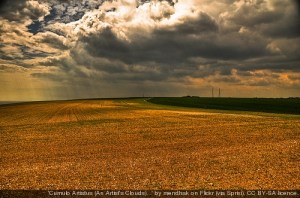
Cornfield.  Creative Commons
Cornfield. Creative Commons

Farming in the United States has changed since World War II.  There are fewer farms and they are much larger than they were in the past.  Most farming is no longer done by the owner of the land.  This separation of farming and ownership has destroyed farming communities.  We no longer find farmers congregating in local cafes swapping tips at 5 am.  It has become an impersonal industry. (3)

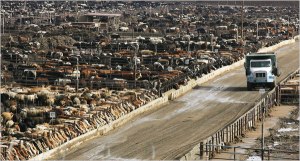
Feedlot
Feedlot

Farming practices have changed to accommodate the industrial model.  Farms now grow only one or two crops which substantially reduces the traditional practice of crop rotation.  Animals are no longer found on farms because farming and raising livestock are now done separately.  Farms now specialize.

Increased pesticide use is both cause and effect of these changes in farming practices.  The drop in crop prices which made small farms unprofitable also motivated pesticide use to reduce labor costs.  Pesticides were also a substitute for the crop rotations which reduced insect populations by disrupting the relationship between predator and host.  Pesticides also compensated for the weed-suppressing effects of alfalfa grown to feed livestock now gone from the farm.  The loss of animal manure on the farm required the substitution of chemical fertilizers. The manure which had been useful in the past is now a waste product that pollutes water from run-off from industrial-size feed lots.  Separating farming from land ownership meant those using synthetic chemicals were no longer poisoning their own land and suffering the long-term consequences of their choices.

Traditional farming methods are equally effective and do less damage to the environment

The agriculture and chemical industries have been successful in convincing the public that the use of pesticides and associated farming methods were necessary to produce the food we need at the prices we are willing to pay.  This fiction has thus far sustained an industry that is clearly damaging the environment and exposing the public to environmental pollution.  There is growing evidence that traditional farming methods are equally effective and do less damage to the environment.

The results of a large-scale, long-term study comparing traditional farming methods with industrial farming methods were recently published.  The study was conducted by the US Department of Agriculture, University of Minnesota, and University of Iowa on the research farm of the University of Iowa.  They divided the research acres into three sectors and used three different farming methods to test and compare the efficacy of these methods:  (4)

  • Conventional method:  growing only corn and soybeans in a two-year rotation cycle, using synthetic fertilizers and pesticides.
  • Three-year rotation cycle, adding a crop of grains and clover.
  • Four-year rotation cycle, adding a crop of alfalfa plus livestock which was fed the alfalfa.

They conducted this test over a nine-year period from 2003-2011.  Here are the results of their study:

  • The longer rotations of more crops produced higher yields than conventional methods:  4% more corn and 9% more soybeans.  The longer rotations were also more profitable than conventional methods.
  • The longer rotations required less synthetic fertilizer than the conventional method.  The amount of fertilizer required by the longer rotations also decreased over time as the soil improved during the study.
  • The longer rotations reduced herbicide use by a whopping 88% with little increase in weediness.”  (4)
  • Longer rotations substitute labor for other inputs, but without reducing profitability.

Why aren’t traditional farming methods adopted?

As stunning as this information is, it is actually not new:  “In 1989, the National Research Council investigated alternative agricultural operations such as these and reported that U.S. farming could be shifted to more natural forms without losses to yields or profits, without significantly higher food prices, and with significant gains in health and environmental protection.”  (3) 

The Union of Concerned Scientists explains why the public is unaware of the superiority of traditional farming methods in their article about the new study done at the University of Iowa.  They tell us that the Economic Research Service of the US Department of Agriculture reports that 53% of all food and agriculture research is conducted by the private sector.  Clearly the agriculture and chemical industries would not fund a study that might conclude that conventional farming methods are harmful and/or uneconomical.  So, the availability of funding for such studies is limited.  (4)

In the event that such a study is conducted, what are the chances that it will be published?  The study done at the University of Iowa was rejected for publication by the journals Science and the Proceedings of the National Academy of Sciences.  It was finally accepted by PLOS One which is solely an on-line publication.  (5)

Finally, in the event that a farmer learns that traditional farming methods are less harmful to the environment and equally productive, what are the chances that he will adopt those methods?  The chances are small because the farmer probably does not own the land and is therefore unconcerned about polluting it and there is no cost to the farmer associated with polluting the environment. (5)

Pesticides are a public health risk whether they are used in agriculture or in our public parks.  In both cases, the good news is that it isn’t necessary to use pesticides.  If the public wants to reduce the public health risks of pesticide use, they will have to speak up.  Those who use pesticides are not going to stop using them unless they are forced to do so. 

*************************

(1)    Center for Integrated Pest Management, North Carolina State University, “Pesticide usage in the United States:  Trends during the 20th Century,” February 2003.  Available here.

(2)    Environmental Protection Agency, “Pesticide Industry Sales and Usage. 2006 and 2007 Market Estimates.” Available here.

(3)    Sandra Steingraber, Living Downstream, Addison-Wesley, 1997

(4)    Karen Stillerman, Union of Concerned Scientists, “Crop Rotation Generates Profits without Pollution (or, What Agribusiness Doesn’t Want You to Know,” October 11, 2012.  Available here.

(5)    Mark Bittman, “A Simple Fix for Farming,” New York Times, October 19, 2012.  Available here.

Why are we poisoning ourselves?

Americans banned DDT in 1972 and PCBs a few years later. We pat ourselves on the back for banning these and other toxic chemicals, but should we? Recent research suggests that though they were banned forty years ago, they are still making us sick.

Although these chemicals were banned, the chemical industry continues to churn out new products about which we know little. Will we find out decades later that these new chemicals are just as likely to poison us as their predecessors? The history of their predecessors suggests that is a likely outcome.

Living with the consequences of our folly

The National Research Council recently published a report (1) that informed us that at least 126,000 sites throughout the country have contaminated groundwater that requires remediation. About 10% of those sites are considered “complex” which is a euphemism for the fact that the technology required to clean them up does not presently exist, meaning that restoration is unlikely to be achieved in the next 50 to 100 years. The report estimates the cost of cleaning up these sites will be from $110 billion to $127 billion. However, the report also acknowledges that both the estimate of the number of sites and the cost of the clean up are probably underestimates.

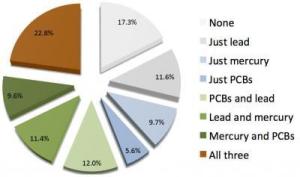
What are the consequences of living with toxic chemicals? Researchers at Brown University tested the blood of over 3,000 women between the ages of 16-49 for levels of mercury, lead, and PCBs. These three chemicals are known to harm brain development of fetuses and babies. The sample was designed to represent the national population of 134.4 million women of childbearing age. Here’s what they found:

  • “Nearly 23 percent of American women of childbearing age met or exceeded the median blood levels for all three chemical pollutants.” (2)
  • “All but 17.3 percent of the women aged 16 to 49 were at or above the median blood level for one or more of these chemicals, which are passed to fetuses through the placenta and to babies through breast milk.” (2)
  • “As women grew older, their risk of exceeding the median blood level in two or more of these pollutants grew exponentially to the point where women aged 30 to 39 had 12 times greater risk and women aged 40-49 [born before these chemicals were banned] had a risk 30 times greater than those women aged 16 to 19.” (2)
  • “Fish and alcohol consumption also raised the risk of having higher blood levels. Women who ate fish more than once a week during the prior 30 days had 4.5 times the risk of exceeding the median in two or more of these pollutants.” (2)
The body burden of multiple pollutants

While these findings are horrifying, they pale in comparison to the stunning finding that “One risk factor significantly reduced a woman’s risk of having elevated blood levels of the pollutants, but it was not good news: breastfeeding. Women who had breastfed at least one child for at least a month sometime in their lives had about half the risk of exceeding the media blood level for two or more pollutants. In other words, …women pass the pollutants that have accumulated in their bodies to their infants.” (2)

This particular study emphasizes the consequences of these pollutants for the children of the women who were tested. What about the women themselves? Surely these pollutants are also affecting their health and well-being. We turn to an outstanding book—Living Downstream– by an ecologist and cancer survivor (so far) for an answer to this question.(3)

First we must acknowledge how little we know about the connection between chemical pollution and its consequences to our health. The damage being done to our bodies by pollutants is not immediate nor is our exposure usually quantifiable which makes cause and effect very difficult to prove. Circumstantial evidence of the connection is therefore easily dismissed as anecdotal: women born in the United States between 1948 and 1958 had almost three times the rates of breast cancer in 1997 than their great-grandmothers did when they were the same age. Coincidentally, pesticide use in the United States had doubled between 1952 and 1997. (3, page 13)

Ironically, although DDT and PCBs were banned forty years ago, the connection between breast cancer and these pesticides was not discovered until after they were banned. The first study was conducted 4 years after DDT was banned on only 14 women with breast cancer. Significantly higher levels of DDT and PCBs were found in their tumors than in the surrounding healthy tissues. It took another 17 years to replicate that study on a statistically significant number of women: 14,200 women in New York City who had mammograms. The 58 women in that sample who were diagnosed with breast cancer had higher levels of DDT and PCB in their blood than women without breast cancer. (3)

It took nearly 50 years to prove that women with breast cancer have higher levels of DDT and PCB in their bodies than women without breast cancer. How long will it take us to learn what damage we are doing to ourselves with the pesticides that we are using now?

We aren’t testing for chemical pollution

Bacterial pollution at Pine Lake, San Francisco.  February 2012
Bacterial pollution at Pine Lake, San Francisco. February 2012. Courtesy Save Sutro

In San Francisco, the Department of Public Health tests the water bodies in the city for bacteria. In February 2012 they closed Pine Lake to the public because of bacterial levels. This incident prompted us to ask about San Francisco’s testing of water bodies. We learned that testing for bacteria is the ONLY test conducted in San Francisco. The watershed of Twin Peaks and Glen Canyon into Islais Creek was sprayed with pesticides over 30 times in 2011 by the Natural Areas Program, yet the water in the creek was not tested for pesticide levels. Islais Creek flows into the bay.

The need for more testing of water bodies was recently recognized by the European Science Foundation. (4) They conducted a poll of 10,000 citizens from 10 European countries which found that pollution is the top concern of the public among all concerns regarding the marine environment.

The public has good reason for their concern. There are presently about 30,000 chemicals available on the European market with production volume exceeding one ton per year. The volume of these chemicals entering rivers, streams, estuaries, and seas is increasing and potentially damaging marine organisms, ecosystems, and processes. Yet the testing of waters for these chemicals lags far behind the increasing number of chemicals being introduced to the environment.

We are on a pesticide treadmill

The tests required to put new chemicals on the market are minimal. The testing of pollution levels in the environment is also minimal. Yet, we continually introduce new pesticides about which we know little. Why? We speculate about the motivation for introducing new pesticides into the environment:

  • As the patents on pesticides expire, the manufacturers must introduce new pesticides in order to maintain their profit margins.
  • The longer a pesticide is in use, the more likely its target is to build up a resistance to it. Hundreds of weeds are resistant to available herbicides. Hundreds of insects are resistant to available insecticides.
  • The less the public knows about a pesticide, the less likely they are to be afraid of it and the less likely they are to object to its use..

Why is this issue relevant to Million Trees?

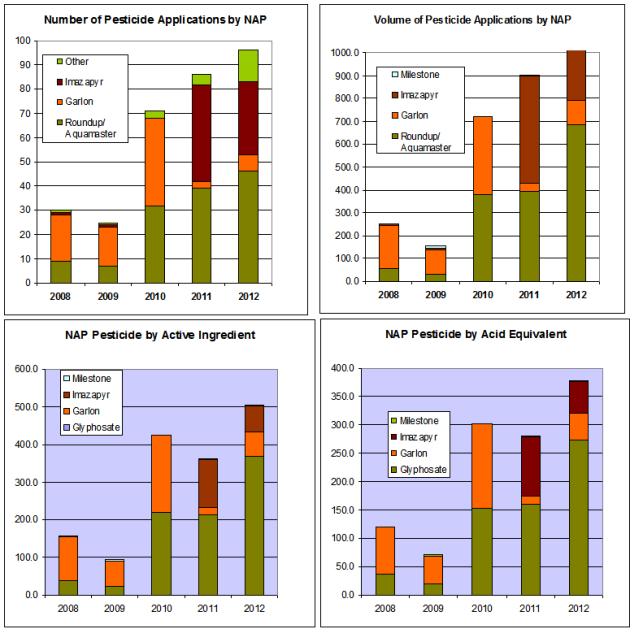
Our regular readers might wonder what this has to do with the mission of Million Trees to inform the public of the destruction of non-native trees for the purpose of creating native plant gardens. The connection is that the use of pesticides by these projects is skyrocketing as the war on non-native plants escalates.

Volume of pesticide use by San Francisco's "Natural Areas Program."  Courtesy San Francisco Forest Alliance
Volume of pesticide use by San Francisco’s “Natural Areas Program.” Courtesy San Francisco Forest Alliance

Those who work for these projects and those who support them defend their use of pesticides in our public parks by telling us they are following the rules, and the rules guarantee no harm will be done by the pesticides. What they don’t seem to understand is that many of the pesticides—and other chemicals—that we now know are harmful to us and the animals that we live with, were legal when they were used. They were legal because we did not know yet that they were harmful.

It took decades for us to understand that the pesticides we were using were harmful. We see no reason to believe that the pesticides we are using now will not also prove to be harmful. By the time we learned how harmful they are, a great deal of damage had already been done. And although many were banned decades ago, they persist in the environment and in our bodies. Therefore, we object to the frivolous use of pesticides in our public parks. Using pesticides for the purpose of killing vegetation solely because it is non-native is irresponsible, given the potential damage they can do to humans and wildlife.

*******************************

(1) National Academy of Sciences, “Clean-up of some U.S. contaminated groundwater sites unlikely for decades,” November 8, 2012

(2) Marcella Remer Thompson, Kim Boekelheide, “Multiple environmental chemical exposures to lead, mercury, and polychlorinated biphenyls among child-bearing-aged women: Body burden and risk factors,” Elsevier, November 16, 2012

(3) Sandra Steingraber, Living Downstream, Addison-Wesley, 1997

(4) European Science Foundation, “Chemical pollution in Europe’s Seas: The monitoring must catch up with the science,” March 21, 2012

Why are native plant installations often failures?

We have been watching attempts to eradicate non-native plants and replace them with native plants on public lands in the San Francisco Bay Area for over 15 years.  Few of these efforts have been successful.  Non-native plants are repeatedly eradicated, then natives are planted.  Within months the natives are dead and non-natives have returned. 

The few projects that are successful are usually fenced, irrigated, and intensively planted and weeded.  Few managers of public lands have the resources to achieve success.  We have identified here on the Million Trees blog many reasons why attempts to return native plants to places in the Bay Area where they have not existed for over 100 years are often failures.  Many of those reasons are related to the changes in the environment:

  • Higher levels of CO2 and associated climate change are promoting the growth of non-native plants.  A USDA weed ecologist (1) studied the effects of higher temperatures and CO2 on the growth of non-natives (AKA weeds) by growing identical sets of seeds in a rural setting and an urban setting with higher temperatures and CO2 levels.  Seeds grown in the urban setting produced substantially larger plants with much more pollen and therefore greater reproductive capability.
  • The growth of non-native annual grasses is encouraged by higher levels of nitrogen in the soil found in urban environments as a result of the burning of fossil fuels. (2)

 The methods used by the projects undermine success

With the exception of the project on Mount Sutro in San Francisco, all of the projects use herbicides to eradicate the non-native plants and trees.  Most of the non-native trees will resprout if their stumps are not sprayed immediately with herbicide and this must be done repeatedly to kill the roots of the trees.  Many of these herbicides persist in the ground for years and probably suppress subsequent plant growth.

This problem is illustrated by a USDA study of the effects of a one-time aerial spraying of herbicides on grassland after 16 years.  Although the herbicide is assumed to “dissipate” within a few years, the negative effect on the natives persisted 16 years later:  “…the invasive leafy spurge may have ultimately increased due to spraying.  Conversely, several desirable native herbs were still suffering the effects of the spraying,,,” 

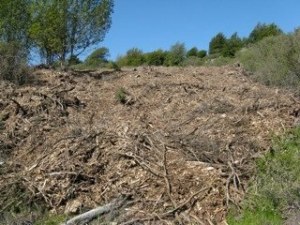
Anyone who is familiar with native plant restorations in the Bay Area knows that most are covered in a thick layer of mulch.  When tree removals are required for a project, the mulch is usually composed of the chips of the trees that have been cut down.  The projects of UC Berkeley for which UC is applying for FEMA funding (based on its claim that the clear-cutting of all non-native trees will reduce fire hazards) say specifically that the clear-cut areas will be covered with 24 inches of mulch composed of the chips of the destroyed trees. 

The UC Berkeley projects also claim that native vegetation will return to these clear-cut areas without being planted based on an assumption that the seeds of native plants are dormant in the soil.  One wonders how these seeds would be able to germinate when covered with 24 inches of mulch, or how the sprouts could penetrate it.  Their proposal contains the fanciful suggestion that squirrels will plant the acorns of oaks in the mulch, which may be true of the oaks, but is an unlikely scenario for the many other native plants and trees which UC claims will populate their “restorations” without being planted. 

Chips of destroyed trees, UC Berkeley project.  Photo courtesy Hills Conservation Network
Chips of destroyed trees, UC Berkeley project. Photo courtesy Hills Conservation Network

These heavy mulches prevent native bees from nesting in the ground, as most native bees do.  This reduces the population of pollinators which are essential to the germination of a new generation of the plants.  If long-term sustainability is the goal of these projects, an environment that is friendlier to pollinators would be helpful.

Lack of horticultural knowledge is also handicapping these projects

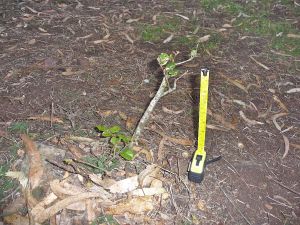
One of 5 native oaks that survive on Tank Hill 10 years after 25 oaks were planted.

The managers of these projects often display a profound ignorance of basic horticultural knowledge.  For example, we have seen them plant natives that require full sun in the deep shade of trees where they will not survive.  We have seen them plant native trees that will not tolerate wind on the slopes of windy hills, only to watch the trees wither and die.

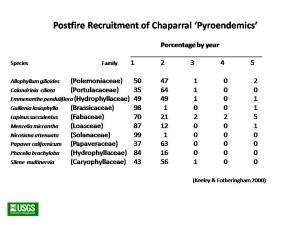
The managers of these projects are apparently unaware of the fact that hundreds of species of California native plants require fire to germinate their seeds and that most of the population will die within 5 years of the fire. (3) These are examples of such “pyroendemics” that sprout after a fire and are almost entirely gone within 5 years:

 Keeley - pyroendemics

UC Berkeley and East Bay Regional Park District do not plan to plant any natives after eradicating non-native plants and trees.  Their plans say that they expect seeds that are dormant in the ground to sprout when the ground is cleared of non-native plants.  Unless they set fire to that ground, many seeds will not germinate and most of the plants that are germinated by that fire will disappear within 5 years unless another fire germinates another generation of plants.  

UC Berkeley does not use prescribed burns on its property.  East Bay Regional Park District (EBRPD) conducts only a handful of small prescribed burns every year, which they claim are solely for the purpose of reducing fuel loads.  In an article about prescribed burns conducted by EBRPD, the District’s “Resource Analyst” is quoted as saying, “’This is not a restoration project.  Our primary goal is fuels reduction.’” (4) Ironically, both of these owners of public lands claim that their objective in the eradication of non-native plants is to reduce fire hazard, yet they are trying to reintroduce a landscape that is dependent upon fire for survival. 

The Natural Areas Program in San Francisco has never conducted a prescribed burn and the DRAFT Environmental Impact Report for their plan says they do not intend to do so in the future.

New and growing evidence that soil is altered by plants

 In addition to these issues which have contributed to the failed attempts to reintroduce an historical landscape to the San Francisco Bay Area, we are reporting today on a new issue.  Plants can change the microbial composition of the soil, including mycorrhizal fungi which have symbiotic relationships with plants. 

Researchers tested soil for changes in composition after just three growth cycles.  Several species of non-native annual grasses were grown in native soils.  They reported that the non-native species reduced the population and changed the composition of the mycorrhizal fungi, which reduced the ability of native species to establish and persist in modified soils. (5)

The Berkeley Meadow is a 72-acre native plant garden on a former garbage dump on landfill.

These changes in the soil were observed after only three growth cycles.  Our local projects are attempting to eradicate plants which occupied the soil for more than 100 years.  In some cases such as the former garbage dumps in the East Bay on landfill, the soil was never occupied by native plants.  Surely, the alteration of soil composition is a likely factor in the failure of attempts to turn these properties into native plant gardens. 

How many more decades and how much more taxpayers’ money must we spend on these projects before land managers acknowledge their failures? 

***********************

(1)    Lewis Ziska, USDA Scientist, Beltsville, MD

(2)    US Fish & Wildlife, Recovery Plan for Mission Blue butterfly

(3)    Jon Keeley, et. al., Fire in Mediterranean Ecosystems, Cambridge University Press, 2012

(4)    Wendy Tokuda, “Taming the Flames,” Bay Nature, July-September 2012

(5)    Nicholas Jordan, et. al., “Soil-Occupancy Effects of Invasive and Native Grassland Plant Species Composition and Diversity of Mycorrhizal Associations,” Invasive Plant Science and Management, October-December 2012

Bats in Glen Canyon Park are being evicted NOW!

We are reprinting with permission an article about bats in San Francisco’s parks from the San Francisco Forest Alliance.  The article reports observations of bats as well as a study of bat populations in San Francisco’s parks.  The study found that both the number of bats as well as the number of species of bats was related to the amount of forest edge in each park and the availability of water.  The study reports that the forest edge contains more insects which are the primary food of the bats. 

We are posting this story today because hundreds of trees in Glen Canyon Park in which bats and many other creatures live are being destroyed as we speak.  Here is a video of the destruction which started yesterday and continues today, along with a narrative of how and why this needless destruction is happening.  Please watch this moving video to understand why we are so committed to opposing the pointless destruction of our trees by extremist agendas that are damaging the environment and harming the animals that live in our open spaces.   (Edited to Add:  And here is a video showing the second day of the demolition project.)

The study did not find any relationship between the number of bats nor the number of species of bats with the percent of native plant coverage.  We speculate—although the study does not—that the absence of correlation between bat populations and native plant populations suggests that there are not more insects in native plants than at the forest edge.  Although native plant advocates claim that more insects are found in native plants, this is yet more evidence that this claim is not true. 

********************************

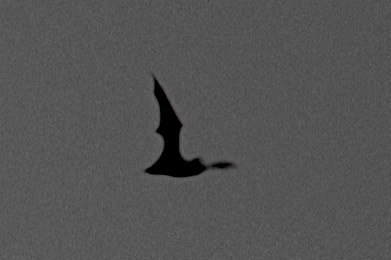
Bat in Glen Canyon Park Bats are insect-eating machines. According to the USGS, “Bats normally eat about half their weight in flying insects each night.” So even for those who don’t find these night-flying mammals charming, it’s good to know there are bats among us.

San Francisco has at least four species of bats, all of which eat insects. According to research by Jennifer Krauel, which involved recording bat sounds to determine which species they were, Mexican Free-tailed bats are the most common. Parks with water – like Glen Canyon – also have Yuma Myotis bats. The other two species she found (more rarely) were Western Red Bats, and Little Brown Bats, and she found them in just a couple of places.

2012-04-07 at 19-41-44 batHer research indicated that “amount of forest edge and distance to water were the factors best explaining species richness and foraging activity.” It also showed that bats in San Francisco remain active through the winter and don’t hibernate or move elsewhere.

If you’re interested in reading her paper, it’s here as a PDF: Jennifer Krauel thesis on bats in SF

BATS IN GLEN CANYON PARK

Glen Canyon’s bats are often visible at dusk. They’re most evident in the Fall, though they’ve been seen at other times of the year. (The pictures above are from February and April, those below from October.)

Here’s a note on bat-viewing from one visitor to Glen Canyon.

“It was late in the afternoon, and late in October. We were standing around the entrance to the park on Alms Rd. As dusk fell, bats emerged from the tall eucalyptus trees. Quite suddenly they were in the air right above us. I pulled out my camera, which is not really good in poor light but I tried to take some pictures anyway. Here’s one:

bats 1

“They’re difficult to spot in the picture, but all those black smudges are bats that were moving too fast for my pocket-camera. Here’s the same picture, cropped, with the bats circled in yellow:

bats 1a

“They dispersed over the canyon. Here’s another picture from a few minutes later (and the one below it shows where the bats are).

bats 2

bats 2a

“It was fantastic. I haven’t seen this many bats anywhere in San Francisco.”

LARGE TREES ARE IMPORTANT

We did a little research, and found a Stanford report that emphasized the importance of large trees to a particular species of bats, Yuma Myotis… bats that Krauel’s research had actually found in Glen Canyon Park.

“Yuma bats that forage in the preserve travel several miles to roost in large trees in Portola Valley and Woodside, suburban communities on the San Francisco Peninsula. The average diameter of the bats’ chosen trees is about a yard across — more than three times wider than the average tree in those areas.”

(The link to the abstract of the actual Stanford research paper is HERE.)

That’s the size of the big eucalyptus trees in Glen Canyon Park – including those that SFRPD wants to chop down.

WHY BATS MATTER

Bats are an important part of an eco-system, and fill a role few other creatures do: They hunt night-flying insects like mosquitoes that birds don’t catch because they’re sleeping. This is especially important now as West Nile virus, a mosquito-borne disease, has been spreading.

Having bats in a landscape contributes to its bio-diversity. All species of bats are protected in California.

(Some people are concerned that bats carry rabies – and it’s true no one should handle bats, especially grounded bats that may be sick, with their bare hands. But according to the California Department of Fish and Wildlife, less than 1% of bats are infected. [Click HERE to see their note.] The risk of getting rabies from a bat is less than the risk of being struck by lightning.)

HOW WILL SF RPD ENSURE THE PRESERVATION OF THE BATS?

We’re concerned about the impact of the planned tree removals on Glen Canyon’s bats.

  • All species of bats are protected, and removing the trees will impact their habitat by reducing the number of safe roosting spots, especially for Yuma Myotis bats that need both large trees and nearness to water.
  • The contractor will be chopping down the trees in the daytime. Bats roosting there are likely to be killed – if not in the process of the tree-felling, by being forced to fly blinded and confused in the daytime and fall prey to hawks, crows and ravens.

How is SF RPD going to ensure the protection of these bats?

And in what ways will felling large trees near the stream alter the ecology of the canyon?

“It’s not nice to fool Mother Nature”

Southern sea otter
Southern sea otter. Creative Commons

U.S. Fish & Wildlife Service recently announced that after a 25-year effort, they are finally giving up on the fantasy that they can relocate otters from the coast of California to one of the Channel Islands off the coast.  From 1987 to 1991, they captured and relocated 140 otters in a futile attempt to create a “no-otter zone.”  (1)

Only 40 otters remain near the Channel Islands.  Fish & Wildlife claims that most of the otters returned to the coast.  We’ll never know how many otters died in the process of relocation and subsequent repatriation.  Clearly, even if they survived the pointless ordeal, they didn’t benefit from it.   

Otters were nearly hunted to extinction because of their soft fur.  Their population plummeted from 16,000 in the late 1700s to only 50 in the 1930s.  They were listed by the Endangered Species Act as a threatened species in 1977 and their population has stabilized at about 2,800.

Because of their status as a legally protected species, U.S. Fish & Wildlife decided to move them based on their belief that they would be safer.  They claimed to be concerned that the otters might be harmed by off-shore oil drilling.  One wonders if their concern might have had more to do with the fishermen who say that otters are depriving them of their catch of abalone and sea urchins. 

Fish & Wildlife published a study of their project in 2005, which acknowledged the failure of the effort, yet it took 7 years for them to get around to officially ending it.

Killing one animal to save another

Such attempts to control nature and the animals that live in it are the stock and trade of U.S. Fish & Wildlife as well as their colleagues in state agencies with a similar mission.  Here are a couple of local examples.

Northern spotted owl

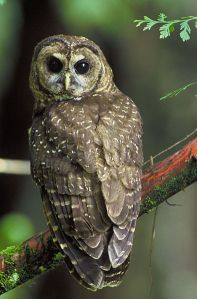
The spotted owl was given endangered species status over 25 years ago.  Logging was substantially reduced in the Pacific Northwest in an effort to save the habitat of the spotted owl, with devastating consequences for the timber-based economy.  Despite that effort, the population of spotted owls declined over 40% in the past 25 years.

So, now US Fish & Wildlife has selected a new scapegoat for the decline of the spotted owl population.  They have decided that another owl, the barred owl, is the culprit.  The barred owl is larger and its range is apparently expanding.  So, in its infinite wisdom, Fish & Wildlife recently announced that it will begin shooting barred owls where they don’t “belong” based on their assumption that the spotted owl will benefit from the removal of its competitor. (2)

Carpet bombing with rodenticides

As crazy as the plan to shoot barred owls is, here’s a plan that strikes us even worse.  In April 2011, U.S. Fish & Wildlife announced its intention to evaluate a plan to aerial bomb the Farallon Islands off the coast of San Francisco with rodenticides to kill resident mice.  (3)

Ashy storm petrel. Creative Commons

Here’s their logic for this strategy:  the mice are eaten by burrowing owls which don’t “belong” on the Farallones, in their opinion.  They claim that they don’t want to kill the burrowing owls because they acknowledge that they are just as rare in their historic range as the birds they claim will be saved by this bizarre plan.  They claim that when the burrowing owls eat all the mice, they start eating the eggs of the ashy storm petrel which is an equally rare bird, but it “belongs” on the Farallones, so its perceived needs trump those of the equally rare burrowing owl.  They believe that if the mice are killed, the burrowing owls will return to where Fish & Wildlife believes they belong. 

There is so much wrong with this plan that it’s difficult to know where to start.  The Farallones are an important bird sanctuary, home to many species of birds many of which are rare.  Can Fish & Wildlife guarantee that the burrowing owl is the only species of bird that will eat the poisoned mice?  How many burrowing owls will die from eating the poisoned mice?  If they don’t die, won’t they eat even more eggs of the storm petrel?  Will the death of the mice deprive other species of birds of their food?   As the rodenticide washes off the islands into the ocean, will it kill the marine life around the island?  Will it enter the food web of the entire island, killing unintended targets such as the birds that eat fish?

As crazy as this plan sounds, it is not a new strategy for Fish & Wildlife.   In 2008, 46 tons of rodenticides were dumped on an island in the Aleutian chain off the coast of Alaska.  That carpet bombing is known to have killed a total of 420 birds, including 40 bald eagles. (4)

The outcry about the birds being killed by rodenticides has been getting louder recently.  The San Francisco Chronicle reports that a coalition of wildlife and public health advocates has asked California’s regulator of pesticides to take rosenticides off the market.  We hope these pleas for sanity will be heeded before the Farallones are bombed with rodenticides. 

Nature is on the move

Just as humans have moved around the Earth in search of more hospitable conditions—more food, better climate, less competition—animals have done the same.  Now humans have decided that the animals must stay put.  Wherever they existed in the historic past is where they “belong.”  When animals move, man has decided they are “invasive” and they must be stopped. 

Man’s war on invasive species is accelerating because as the climate changes there is greater pressure on animals to move to find the food and habitat they need and on plants to find suitable growing conditions.  Humans are apparently unwilling or unable to do anything to stop climate change, yet they are willing and able to try to prevent plants and animals from adjusting to climate change. 

As senseless as it seems to deprive plants and animals of their survival mechanisms, this harmful approach has been immortalized in U.S. law by the Endangered Species Act.  The ESA is about 40 years old and was enacted at a time when the consequences of climate change were largely unknown.  It defines endangered species as any plant or animal that becomes rare within its historic range.  So, for example, if an animal or plant moves in response to climate change, it is often designated as an endangered species even though it may be plentiful in its new home to which it is better adapted.  And Fish & Wildlife comes to its “rescue” by trying to force it to return to its historic range to which it is no longer adapted.

As we pondered this conundrum, we were reminded of a television commercial in 1970.  Mother Nature is telling stories to her animal friends in the forest, when someone hands her a tub of margarine to taste.  She smiles sweetly and congratulates herself on how delicious butter is.  She is informed that it isn’t butter, but rather an artificial substitute.  She rises from her throne, raises her voice to scold, shoots lightning from her fingers and warns us, “It’s not nice to fool Mother Nature.”  (see this charming video here).    

Will nature punish humans for their refusal to allow it to change as needed to survive? No, not literally, of course, but perhaps we will suffer the unintended consequences of our arrogant attempts to control natural processes we do not understand.

****************************

(1)    Peter Fimrite, “Feds scrap ‘dumb idea’ of relocating otters,” San Francisco Chronicle, December 18, 2012

(2)    Associated Press, “U.S. plans to kill Barred owls to save spotted owls,” San Francisco Chronicle, February 29, 2012

(3)    Kelly Zito, “Pesticide bombing of Farallones mice stirs debate,” San Francisco Chronicle, May 12, 2011

(4)    Peter Fimrite, “Concern over fallout of bombing mice,” San Francisco Chronicle, October 17, 2011

Disbelief in climate change is dwindling

In recent weeks we have had a discouraging barrage of comments on Million Trees from someone who does not believe that the climate has changed.  We responded within the limitations of our research tools because such disbelief is an obstacle to the public policy needed to address the problem.  We are now pleased to inform our readers that such disbelief is dwindling and that only a small minority of Americans continues to disbelieve in the reality of climate change.

Associated Press and Gfk Roper Public Affairs & Corporate Communications conducted a poll of Americans about climate change in November 2012.  They found that only 18% of Americans say that the temperature has probably not gone up in the past 100 years, while 78% say it probably has gone up.   This is a 4% decline in the percentage of Americans who don’t believe the temperature has increased since the last poll was conducted in 2009.

The majority (57%) of those who think the temperature has increased are extremely or very sure about it, while only 31% of those who don’t believe the temperature has increased are extremely or very sure about their opinion.  In other words, a small minority of Americans doesn’t believe that the climate has changed and they aren’t as confident about their opinion as those who do believe that the climate has changed

Also, most (80%) Americans who think the climate has changed, consider it a serious problem and a growing majority (57%) think the U.S. government should do something about global warming. 

 Trusting our eyes and ears

The most fascinating aspect of the study was that science apparently does not deserve the credit for this growing acknowledgement of the reality of climate change.  Only 31% of those surveyed said they “trust the things scientists say about the environment” completely or a lot.  This is actually a small decrease from the percentage (32%) of Americans who said that at the time of the last survey in 2009. 

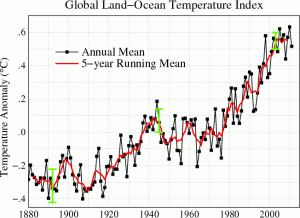
Source:  NASA
Source: NASA

Apparently, the increasing numbers of Americans who now believe in the reality of climate change are primarily using their own eyes and ears to reach this conclusion.  Jon Kronick, social psychologist and pollster at Stanford University, advised the Associated Press on the poll.  He said of those who have become believers in the past two years, “They don’t believe what the scientists say, they believe what the thermometers say…Events are helping these people see what scientists thought they had been seeing all along.”  (1)

Taking action

We are encouraged by this news.  We hope that it will give our politicians the courage to start taking action to address the causes of climate change.  An easy and painless place to start is to quit destroying the trees that are storing tons of carbon solely because they aren’t native.  When those trees are destroyed, the stored carbon is released into the atmosphere as carbon dioxide as the wood decays.  Carbon dioxide is the predominant greenhouse gas which is contributing to climate change.

Creative Commons
Creative Commons

Happy New Year!  May 2013 bring to the San Francisco Bay Area saner, less destructive management of our public lands.  Thank you for your readership in 2012.

***************************

(1)    Associated Press, “More in U.S. believe in global warming,” San Francisco Chronicle, December 15, 2012.

Mistletoe: Another “bad plant” is exonerated

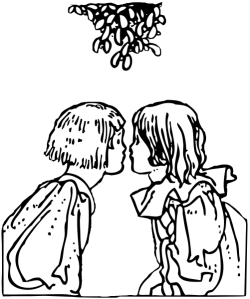
The kiss under mistletoe

Mistletoe has a mixed reputation.  On the one hand, we associate it with the Christmas folk tradition of obliging those who stand beneath it to be kissed.  But foresters have always considered it a parasite that sucks the life from the trees in which it lives.  Today we have the pleasure of reporting the result of a study in Australia which exonerates mistletoe of this crime.*  It’s our Christmas gift to our readers.

David Watson, an ecologist at Sturt University in New South Wales, Australia, had long suspected that his favorite plant, mistletoe didn’t deserve its reputation as a harmful plant.  In 2004 he set out to prove his hunch.   He removed all the mistletoe from 17 woodlands and compared them with 11 woodlands in which the mistletoe remained and 12 woodlands in which there was no naturally occurring mistletoe.

Removing the mistletoe was a huge task which took two years.  A dozen people, using cherry-pickers and clippers removed 40 tons of mistletoe.  They waited three years to study the differences in the three types of forest. 

They found that there were more birds, mammals, and reptiles in the forests where the mistletoe remained.  But the most significant difference in the three types of forest was that the number of insects on the forest floor where the mistletoe remained was much greater. 

Mistletoe in silver birch.  Creative Commons
Mistletoe in silver birch. Creative Commons

There are more insects on the forest floor where mistletoe resides because the leaves of the mistletoe contain more nutrients than the leaves of the tree that it occupies.  The tree uses the water and nutrients in its leaves before the leaves fall, whereas the fallen leaves of the mistletoe are both more abundant and contain more nutrients.   The leaves of the mistletoe also fall throughout the year when many of the trees are dormant.  Hence, there’s more food on the forest floor occupied by mistletoe for the insects that live there.

Mistletoe is found everywhere in the world except Antarctica.   There are 1,400 species of mistletoe in 5 families.  Fossil pollen grains indicate that mistletoe has existed in North America for millions of years.  Although a controlled experiment has not been done in North America, some scientists have noticed the benefits of mistletoe to forest life.  David Shaw, at Oregon State University, has noticed that the endangered northern spotted owl nests in mistletoe. 

Science tests our assumptions

This study of mistletoe is a nifty little example of the power of science to test our assumptions.  Our assumptions are often mistaken.  We should keep an open mind about any assumption that has not been tested empirically. 

Native plant advocates assume that native plants are inherently superior to non-natives and conversely, that non-native plants are not beneficial to wildlife.  Their assumptions are not supported by scientific studies.  In fact, when their assumptions are tested empirically, they are often proven to be wrong.  The native plant movement is an ideology that is not based on science.  It is a horticultural preference which should compete in the marketplace of ideas with all other horticultural preferences.    

christmas-holly-4

************************

*Alanna Mitchell, “Beyond the kiss, Mistletoe Helps Feed Forests, Study Suggests,” New York Times, December 17, 2012.  Available here.

Acacia: Another Australian tree caught in the cross hairs of nativism

Webmaster:  We are republishing, with permission, a post from the website of Christian Kull, Associate Professor of Geography and Environmental Science at Monash University in Melbourne Australia.  He is also Adjunct Professor at the University of the South Pacific.  He is presently based in Suva, Fiji, where his wife is employed by a division of the Secretariat of the Pacific Community.  (We have added a few edits for an American audience.)

We have read the debate in scientific journals between Professor Kull and his colleague, Jacques Tassin, with Tim Low, which is described in this post.  It sounded very familiar to us.  On the one hand, Kull and Tassin wish to consider the economic and environmental benefits of acacia.  Their pragmatic evaluation of acacia is attacked by Tim Low, using the same alarmist arguments that we hear in the San Francisco Bay Area about another Australian tree, the eucalyptus. 

**************************************

Are Australian acacias planted overseas miracle plants for rural development, or are they the worst kind of environmental weeds?  The battle lines appear rather stark at times.  At least when one reads environmentalist Tim Low’s rebuttal to a critique that Jacques Tassin and I wrote of his views.  We thought our statement to be tempered and tried to build a reasonable case for responsible use of exotic agroforestry trees (see also previous blog).  But Low calls us “in denial about dangerous aid,” flogs a misplaced example about mesquite in an argument about acacia, all the time preaching his argument to the converted in the journal Biological Invasions.  Low has even taken his views to an online editorial on the Australian Broadcasting Corp website and has promoted his views to the Herald Sun (link).

Meanwhile, in Vietnam, an entirely different story is developing.  On 2 November, there was a small seminar and dinner in Hanoi, Vietnam celebrating the contributions of Australian and Vietnamese scientists to the forestry sector, primarily through the promotion of Australian acacia species.  The Vietnamese Government awarded medals to Sadanandan Nambiar, Chris Harwood, Khongsak Pinyopusarerk, Rod Griffin and Stephen Midgley for “contributions to Vietnam’s forest development.”  Australian acacias are now a common part of Vietnam’s rural landscape, rehabilitating denuded landscapes, and providing wood for industry and fuel.  Australian aid (via CSIRO, AusAID, and ACIAR) played a role in supporting such initiatives since 1987, working together with Vietnamese partners like the Research Centre of Forest Tree Improvement and the Forest Science Institute of Vietnam.

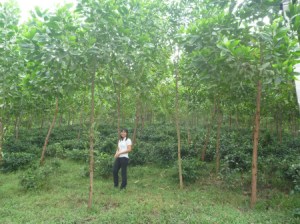
Tea grown in shade of acacia in Vietnam.  Photo by Chris Harwood
Tea grown in shade of acacia in Vietnam. Photo by Chris Harwood

According to Stephen Midgley, there are now about 900,000 hectares of Australian acacia plantations in Vietnam (about the same area as the Californian Pinus radiata [Monterey pine] in Australia).  Just last year, an estimated 120,000 hectares of acacias were planted in Vietnam – some 70% by smallholders [private property owners].  Acacias have been used as nurse crops to rehabilitate native forest areas; examples include the protection forests of Hai Van Pass and the Perfumed River catchment behind Hue.  Acacias are now a valuable commercial asset, as hardwood woodchips and as furniture wood.  Product value exceeded US$1.5 billion in 2011, with some US$400 million returning directly to the pockets of the growers, leading to improvement to livelihoods among acacia-growing communities.

An ecologist may look at this situation and worry that the acacias in Vietnam are going to ‘explode’ in the future, becoming problematic pests or replacing ‘natural’ forest.  That is, they will become too successful for their own good.  Indeed, apparently the weediness of acacias will be addressed to some extent at the upcoming IUFRO acacia sylviculture working party meeting in Vietnam.  Chris Harwood, of Australia’s research agency CSIRO, wrote to me:

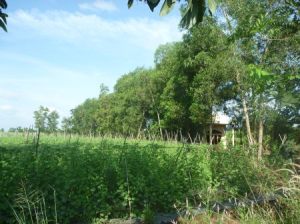
“On my just-completed trip to Vietnam I had a careful look (as I always do) in the farming landscapes of northern, central and southern Vietnam for signs of acacias spreading as weeds.  There are no such signs.  All the farming land is too intensively cultivated (Vietnam has a land area of 33m ha and a population of 87m), and  all the acacias in the landscape are planted rather than naturally regenerated, except for very occasional patches of vacant ground which may have a few ‘volunteer’ acacia seedlings but which will soon go under cultivation.  Quite large areas formerly under acacia plantations in southern Vietnam have been converted to rubber plantations during the last 5 years, with no evident difficulty.  In the north, tea is successfully grown under Acacia mangium.  The only caveat regarding weediness in Vietnam is that care must be taken when planting adjacent to native ecosystems to ensure that acacias do not spread into them.  But this is a manageable potential problem and is just not an issue for the vast majority of acacia plantations that do not abut natural ecosystems.”

Acacia and cucumber field in Vietnam.  Photo by Chris Harwood
Acacia and cucumber field in Vietnam. Photo by Chris Harwood

In addition to ecological questions about invasion potential, social scientists may ask about how access to land and other rural power relations are altered by such forestry development.  Indeed they have already (link).  But the point here might be that shouting from diametrically opposed ideological camps is probably not the best way to move forward.  In this case, there is a will to plant acacias (what combination of government diktat and social consensus I don’t know) and they are already deeply incorporated into the physical and socio-economic landscape.  In addition to shaping the already very anthropogenic landscape by farming rice, other crops, and tree crops like rubber (over 1 million hectares), the Vietnamese are farming acacias.  The question then, instead of “go acacia go” or “doom is coming,” is how farmers, foresters, villager leaders, government agents, and scientists might each in their own way address the questions of the future of Vietnam’s regional landscapes – what values are important, what are the options, what are the constraints and potential problems, what does the evidence show.  It is this kind of measured approach Jacques Tassin and I tried to make in our response to Tim Low.

**************************

Webmaster:  We believe that the debate we are engaged in with native plant advocates should be a land-use decision.  This should be a civil debate, which in a democratic society should result in a decision that reflects the wishes of an entire community.

Unfortunately, native plant advocates seem to believe that their demand that non-native trees and plants be destroyed is a moral imperative.  Although they claim environmental damage from non-native trees, they are unable to provide the scientific evidence to support that claim.  In the absence of such evidence, their demands are just an imposition of their gardening preferences on the public.  The tactics they use to impose their will are inconsistent with their claim that they are on the moral high-ground and the methods they use to eradicate non-native species are also inconsistent with their claim that they are benefiting the environment.

Response to denier of climate change

california-poppy
California poppy

Last week we published an article about how plants are responding to climate change.  We received a comment from Don E that questioned the accuracy of the climate data in the study in Ohio which found a relationship between increased temperatures and earlier blooming times.  We didn’t have access to the information needed to respond to that comment, but we were unwilling to publish it without verifying its claims because we do not want to misinform our readers. 

So, we asked the author of the study in Ohio, Kellen Calinger, if she could help us verify the accuracy of the comment.  Ms. Calinger has generously obliged us with a detailed critique of the comment.  With her permission, we are now publishing her reply in its entirety.

************************************* 

Don E:   “There are controlled laboratory experiments to show that temperature, moisture, and CO₂ effect plant growth. The Ohio study was not a controlled study and the temperature data are questionable.”

Ms. Calinger:  There are indeed controlled laboratory experiments regarding impacts of temperature, moisture, and CO2 on plant growth and my study was not controlled.  My study falls under the broad heading of observational science.  Observational and experimental studies are both extremely common and each has pros and cons.  The pros of experiments include a high degree of control over the system allowing you to focus on impacts of your variable of interest while the cons include less realistic description of a natural system.  The pros and cons of observational studies are essentially the opposite of an experiment; I didn’t control environmental variables in my study, but it likely reflects the reality of what’s happening in ecosystems far more than an experiment.  Again, these are both accepted methods of the scientific community.

Don E:  .”USHCN makes a huge TOBS adjustment in Ohio between 1979 and 1988. The justification for this is that they claim people in Ohio switched from reading temperatures in the afternoon, to reading them in the morning. That would theoretically push measured temperatures progressively down from 1979 to 1988. The Ohio raw data does not provide any support for the TOBS theory. In the middle of a long term cooling trend, measured temperatures rose very quickly from 1979 to 1988.”

Ms. Calinger:  The TOBS adjustment (time of observation adjustment) is essentially to control for the time of day that temperature measurements were taken.  A simple example would be that if I measured temperatures at noon from 1980-1990 and the next observer measured temperatures at 6AM from 1991-2000, it would probably seem like it was cooler in the ’90’s since 6AM is typically cooler than noon.  If you don’t correct for the time of observation, the actual temperature trend would be obscured by daily variation in temperatures based on time of observation. 

The U.S. Historical Climatology Network is part of the Carbon Dioxide Information Analysis center, and they lay out exactly how they treat data on their website–here’s the link: http://cdiac.ornl.gov/epubs/ndp/ushcn/monthly_doc.html

Don E:  “In addition Ohio Valley Summer Temperatures have been plummeting for 80 years. July of 2009 was the coldest on record in the Ohio Valley, and July temperatures have been plummeting in that region since 1930. July 1934 and 1936 were both much hotter – even after NCDC adds 1.5 degrees on to recent temperatures relative to the 1930s.”

Ms. Calinger:  It seems that the commenter got this information from the following blog: http://stevengoddard.wordpress.com/2012/08/03/ohio-valley-summer-temperatures-have-been-plummeting-for-80-years/

The blog presents a plot of temperature data for the Ohio Valley that starts in 1930 and runs until 2011 that indicates an overall trend of temperature decrease by 0.19 degrees Fahrenheit per decade.  While I can’t know the intentions of the author of this blog, this seems to be a case of data manipulation to mislead.  I went to the NCDC website used by the blog author and made an identical plot of Ohio Valley temperature data for July, but I didn’t restrict my plot to 1930-2011.  Instead, I used the full temperature data set from 1895-2012 and found NO indication of temperature decrease.  An extremely common tactic among climate change skeptics is to restrict a data set to a small subset of the total data that shows a cooling trend even though this is not indicative of the long term pattern.  

You can make these graphs at: http://www.ncdc.noaa.gov/oa/climate/research/cag3/ce.html

Don E:   “I would never call anyone a denier. That is an ugly term intended to denigrate skeptics by associating them with holocaust deniers. There are many highly regarded climate and physical scientists not funded by the fossil fuel industry that don’t accept the hypothesis that CO2 is the primary cause of climate change. BTW there has been no global warming in 16 years.”

Ms. Calinger:  There is simply no debate in the scientific community about climate change.  It is accepted that climate change is occurring and that warming is predominantly caused by humans.  This blog provides a really good summary of the scientific consensus: http://www.desmogblog.com/2012/11/15/why-climate-deniers-have-no-credibility-science-one-pie-chart

Of 13, 950 scientific papers, 24 reject climate change. That’s pretty clearly an overwhelming majority.  

Also, there has most definitely been warming in the past 16 years.  This past summer was the 3rd hottest on record in the U.S. and seven of the 10 hottest summers in U.S. history have occurred since 2000.  

************************** 

Webmaster:  We are grateful to Ms. Calinger for her help to respond to Don E.  We have certainly learned something from her and we hope that Don E has as well. 

We take the time and trouble to research the claims of those who choose to deny the reality of climate change because we believe that it is presently the most serious threat to our environment.  Human civilization is currently unwilling to take needed action to reverse this dangerous trend. Those who refuse to believe that it is necessary to take action are at least partly to blame for this.  We hope that if and when human civilization acknowledges climate change and its consequences, we will finally make the tough decisions that are needed.

Postscript:  The word “denier” is defined by Webster’s Unabridged Dictionary as “one who denies.”  It is not used exclusively to describe those who deny that the holocaust occurred.  In fact, it doesn’t even imply that the denier is denying something that actually exists.  It is a neutral term that applies to any person who denies anything.  For example, I deny that I am fabricating information about climate change.  Therefore I am a denier of that accusation.

Although we do not use the word “denier” in order to denigrate those who choose not to believe in climate change, we are frankly mystified by their motivation.