East Bay Regional Park District is in the process of selecting the projects that will be funded by the renewal of Measure CC, the parcel tax that has funded park improvements. Measure CC will be on the ballot for renewal in November 2018 and will provide funding for “park improvements” for the next 15 years. YOUcan have some say about those projects by making your suggestions to the park districtby the end of December. Send your suggestions to publicinformation@ebparks.com.
The original parcel tax was passed in 2004. Over 22% of the money raised by that parcel tax was used to destroy healthy non-native trees in the parks. Meanwhile, many of our native trees, most notably our Coast Live Oaks, are dying of Sudden Oak Death. Destroying our non-native trees, while our native trees are dying, predicts a treeless future for the Bay Area. Since dead trees are more flammable than living trees, destroying living trees while leaving dead trees in the parks means that fire hazards are being increased.
We published a letter from a park advocate about Sudden Oak Death to the park district recently, which is available HERE. Today we are publishing an update from the park advocate who has learned more about the dead oak trees in East Bay parks. A scientist who is studying Sudden Oak Death in East Bay parks tells us that there are tens of thousands of dead oak trees in the parks and that the park district is not removing them. The dead trees are now fuel for fires in the parks.
It’s been a rough year and we are sorry to end it with this unhappy news about trees in the East Bay. We send you our best wishes for a better year in 2018. Thank you for your readership.
Source: Brice McPherson, December 7, 2017
TO: Rick Seal, Fire Chief; Robert Doyle, General Manager; Board of Directors
CC: publicinformation@ebparks.org
FROM: Park Advocate
RE: Please hire arborist/forester with Measure CC renewal
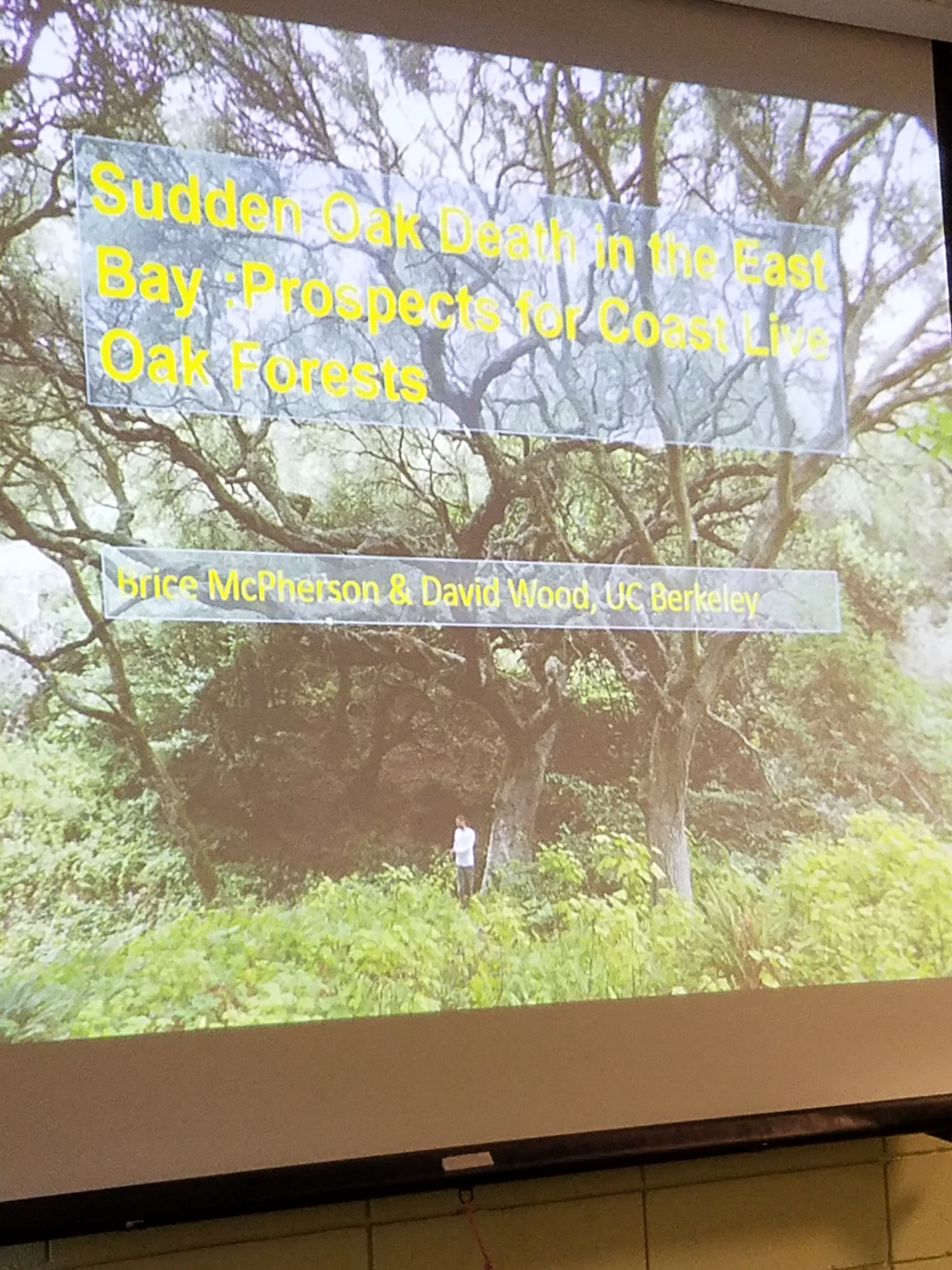
I attended the presentation of Brice McPherson to San Francisco IPM Technical Advisory Committee about Sudden Oak Death (SOD) on Thursday, December 7th. Mr. McPherson is Associate Specialist in “Organisms & the Environment” at UC Berkeley. He has been studying SOD since 2000 and more recently has inventoried the trajectory of the disease in 5 EBRPD parks and conducted experiments in those parks, with the park district’s permission.
Mr. McPherson began his study of SOD in Marin County, where SOD infections were first seen in 1994, before beginning his research in East Bay parks. Comparing the progression of the disease from Marin County to the East Bay has enabled Mr. McPherson to project the future of SOD in the East Bay.
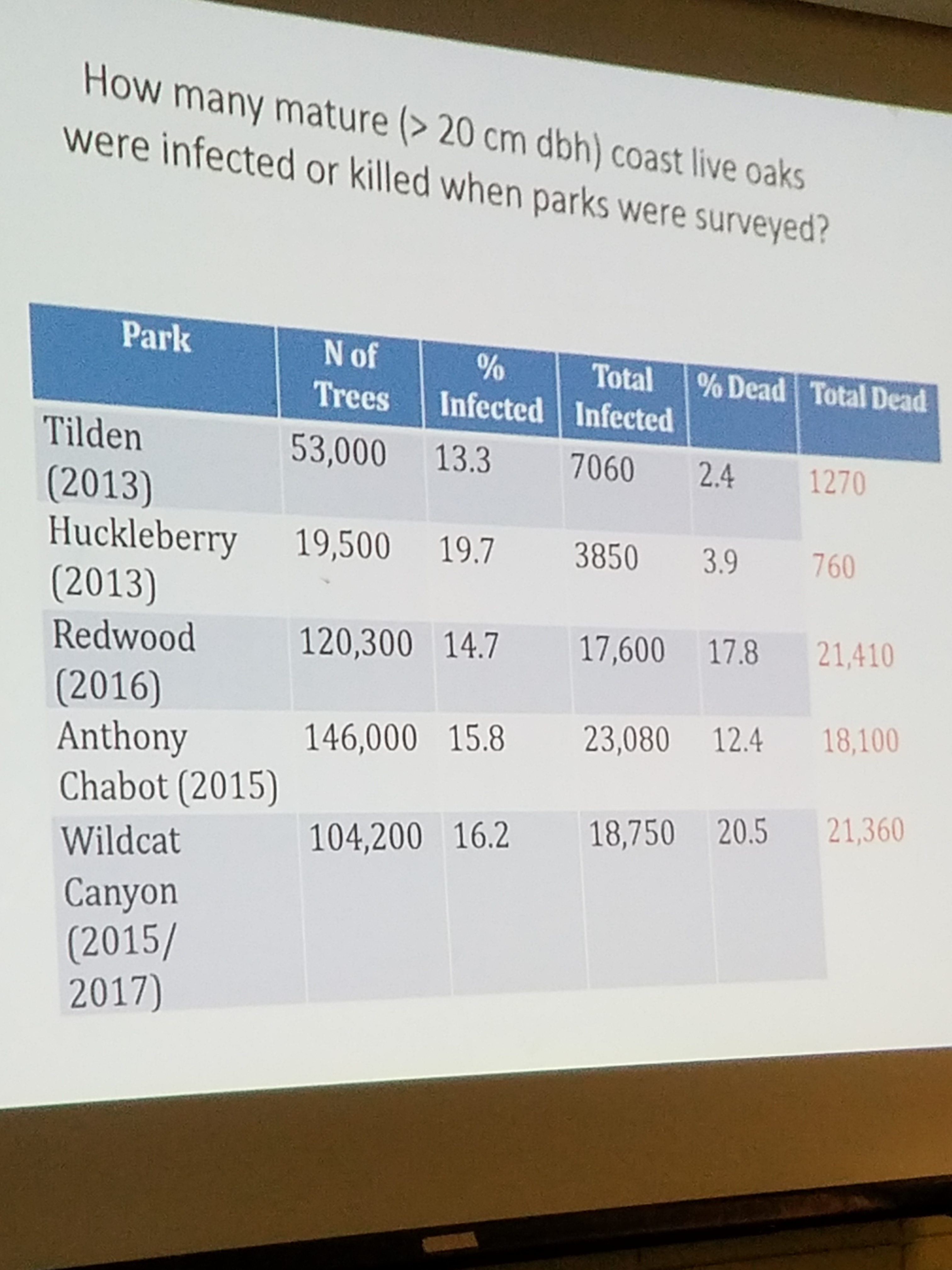
Wildcat Canyon is the park in which Mr. McPherson has inventoried infected and dead trees most recently. In 2017, Mr. McPherson found that 16.2% of coast live oaks were infected and 20.5% were dead. The number of dead and dying oaks in Wildcat Canyon is staggering: 18,750 oaks are infected and 21,360 oaks are dead.
Source: Brice McPherson, December 7, 2017
The number of dead and dying trees in the other 4 East Bay parks that Mr. McPherson is studying is smaller. However, his inventories in those parks are much older. Since SOD infections have increased exponentially in 2016 and 2017, we should assume that his data underestimate the current status of oaks in those parks. As you probably know, the pathogen that causes SOD is spread by rain and wind. For that reason, the rate of SOD infections has soared during the past two wet winters.
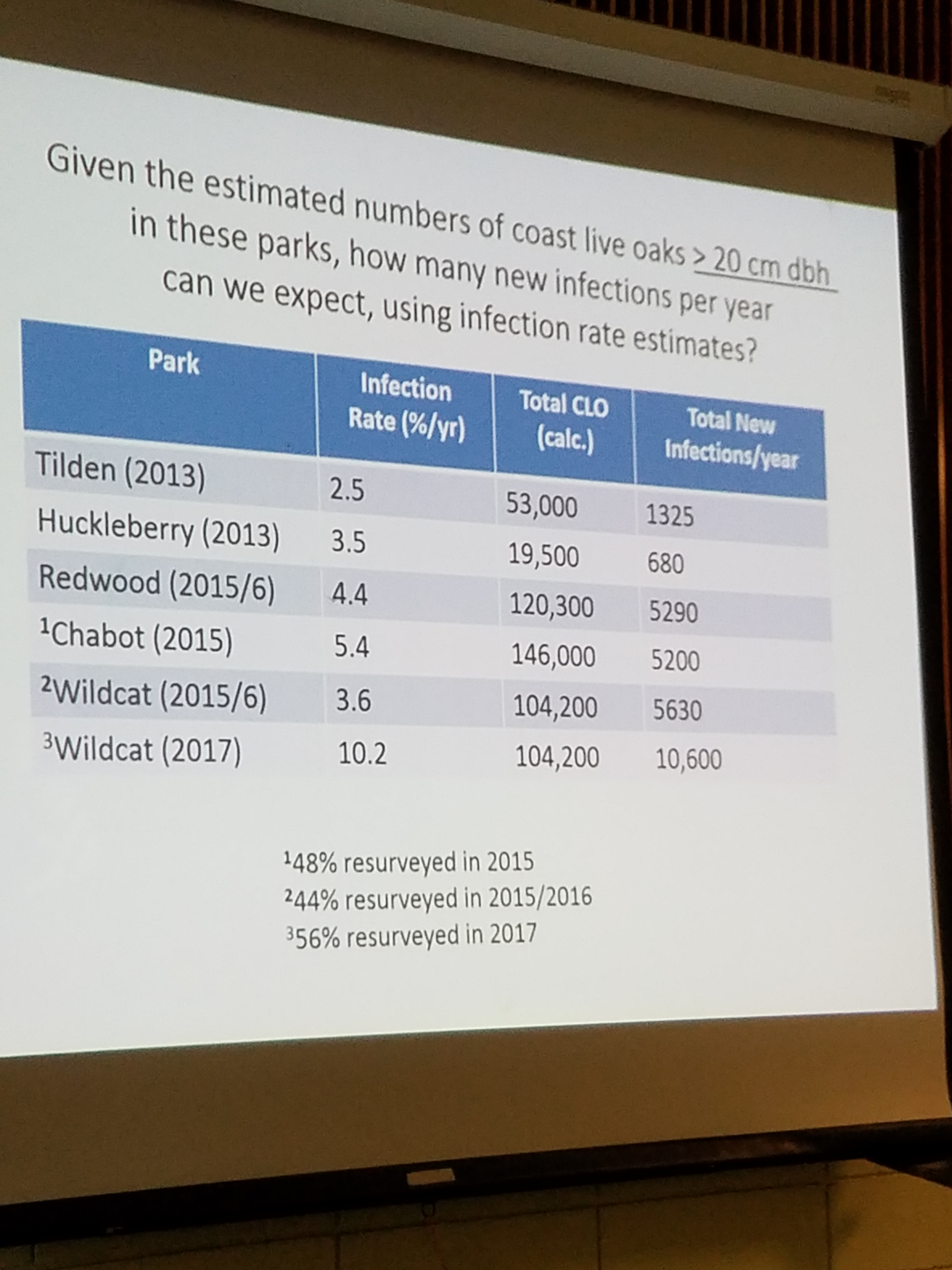
Mr. McPherson predicts that the infection rate in Wildcat Canyon will increase 10.2% per year in the future, causing 10,600 new infections per year. Mr. McPherson predicts that +/- 50% of all coast live oaks will be lost in East Bay parks in the next 20 years, resulting in “major changes in stand structure.” In other words, most oak forests will be replaced by other vegetation types.
Source: Brice McPherson, December 7, 2017
In response to a question, Mr. McPherson said that the park district is not doing anything about the dead oak trees because there are not sufficient funds available to remove the dead trees. He was also asked how the dead wood can be removed without spreading the infection and/or creating piles of dead fuel throughout the parks. He could not answer that question.
This new information requires that I repeat what I have written to you on earlier occasions: “These changes in the environment require the park district to revise its strategies for fire hazard reduction because dead trees are significantly more flammable than living trees that contain more moisture…Removing trees infected with or killed by Sudden Oak Death should now be a higher priority than continuing to destroy healthy trees, as the park district has done in the past. Protocols for removing the dead wood must be developed because the wood is fuel when left on the ground…”
As you know, the park district has spent about $22 million dollars destroying healthy, living trees in the parks with Measure CC funding. If the park district has the money to destroy living trees based on the claim that it will reduce fire hazards, it obviously has the money to remove dead fuel in the parks.
Finally, we learned from Mr. McPherson that the park district does not employ a single certified arborist or forester. Given the resources the park district devotes to native plant “restorations” and spraying pesticides, surely it can also employ someone who knows something about trees. The landscape in the East Bay is undergoing a radical change to species that are adapted to current climate conditions that, sadly, will replace our beautiful oak forests. We need the guidance of qualified arborists to identify the most hazardous trees and make the transition to a new landscape. The employment of such expertise about trees would be a worthy expenditure of new Measure CC funding.
Public land managers in the San Francisco Bay Area are destroying non-native trees and vegetation in our public parks and open spaces because of their preference for native plants. These projects are harmful to wildlife because they destroy habitat, eliminate food sources, and spray herbicides that are harmful to wildlife.
Bev Jo is a frequent visitor to all of the parks of the Bay Area. She knows our parks and the wildlife that lives in them. She cares deeply about our wildlife. We are publishing an excerpt of her comment to East Bay Regional Park District about the damage being done to wildlife, as a result of killing non-native trees and vegetation.
East Bay Regional Park District is in the process of selecting the projects that will be funded by the renewal of the parcel tax, Measure CC. Measure CC will be on the ballot for renewal in November 2018 and will provide funding for “park improvements” for the next 15 years. YOU can have some say about those projects by making your suggestions to the park district by the end of December. Send your suggestions to publicinformation@ebparks.com.
Once upon a time, people in the San Francisco Bay Area were thrilled to live in a place where so many exquisitely beautiful and edible plants from all over the world could survive. It’s not a tropical region, but sub-tropical, so there are limits to what grows here and it depends on the area. But, still there is so much magnificent variety here that cannot live in other parts of the US.
People loved to plant what they missed from their homelands. In our small yard, the previous Lebanese owner had planted a Greek Bay Laurel, Olive, Sour Orange, Apricot, Nectarine, Apple, Pear, and Plums. Our poor neighborhood that was once mostly barren dry grass and juniper hedges, now has so many beautiful herbs and plants that just taking a walk is like a trip to a botanical garden. There also has been an increase in birds and other native animals.
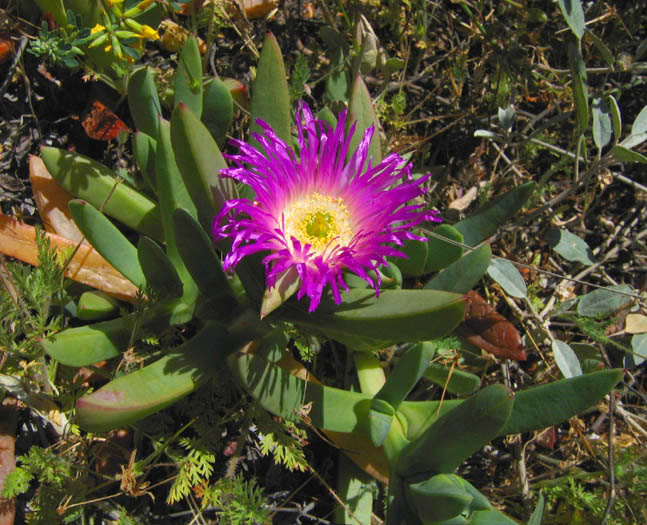
Ice Plant (Carpobrotus), NPS Photo
Visitors used to be stunned that even the California freeways could be beautiful, with South African Ice Plant in glowing bloom and large trees and shrubs that bloom throughout the year to help clean the air from the traffic and soften the noise.
And then, something very disturbing happened. A movement began to spread that many of us recognized as being frighteningly similar to the racist hatred against immigrant people, but this time it was about nature, in the guise of being for nature. Most of the luminous Ice Plant has been eradicated. Flowering plants, including edible herbs, who most rational people would revere for their beauty and ability to survive in an increasingly dry land are being called “trash” and killed.
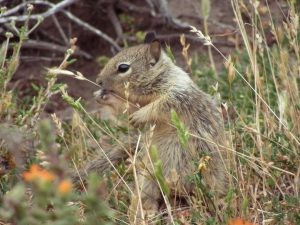
Ground squirrel
It’s not just innocent plants who are being reviled and killed, but animals are also being poisoned, trapped, and shot for no rational reason. The killing frenzy even includes important keystone native animals, like the California Ground Squirrel.
Why do we have to see parks we have loved for decades ruined, with most of the trees cut down for no reason other than that they are the “wrong” species, especially when many of the “right” (native) species are dying from global warming, disease, and insect infestation? Most parts of the US, as well as the world, treasure trees and are planting more, but not the Bay Area. Even while temperatures are increasing horrifically–and anyone can easily feel the twenty degrees difference between being in the sun versus being under trees–we are cutting down our trees.
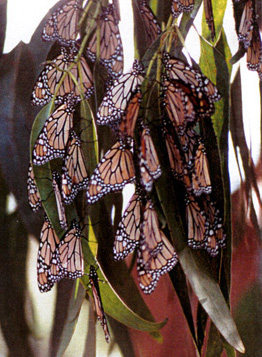
Monarch butterflies over-winter in California’s eucalyptus groves
With so much of the land in the Bay Area covered by concrete, asphalt, and buildings, shouldn’t we value and love every tree we have? Aren’t the trees who most help native animals even more important to protect? Of course I’m talking about the majestic Blue Gum Eucalyptus. In spite of myths saying no native animals use Eucalyptus, they are clearly crucial to the survival of the Monarch Butterfly. Their flowers are an important food source for hummingbirds, and they are the preferred nesting tree for large raptors, like Golden and Bald Eagles, Great Horned Owls, and Buteos. Raptors haven’t been indoctrinated in the nativist cult. They just want the safest nest for their babies. A survey in Tilden Park found 38 different plant species beneath the canopy of Eucalyptus forests, compared to only 18 in Oak woodlands.
Monterey pines are also villainized, even though they are native, with fossil records throughout the Bay Area. They give throughout their life cycle, as they irrigate other plants with their extensive fog drip. They enrich the soil more than most other trees, and feed and shelter a diverse population of animals, including woodrats. The woodrat’s intricately constructed pyramid nests provide homes for many other species like mammals, reptiles, amphibians, arthropods, etc. The pines are a self-replenishing forest, continually creating baby trees, while their dead snags are perfect granary trees for acorn and other woodpeckers, as well as being lookouts for hunting birds. Visit Monterey pines to see the rich wildlife around them, from kingfishers to tree creepers. In one small area of local pines, it’s possible to find over forty mushroom species.
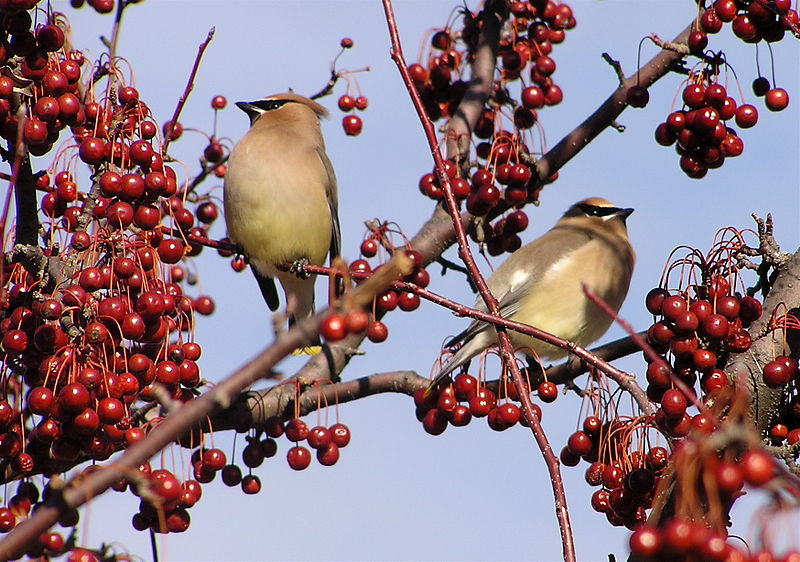
Cedar waxwings in crab apple
The advantage of having plants from all over the world is that someone is always blooming, fruiting, and setting seed. One of our most beloved, but not often seen birds, the Cedar Waxwing, travels in flocks from one berry-bearing shrub or tree to another. I have seen Waxwings eating non-native Cotoneaster, Ligustrum, and Pyracantha berries, and only once native mistletoe. Almost all our birds are benefiting from non-native species, for nesting and food.
Our most common spider species, so essential for a healthy eco-system, are non-native. Honeybees are forgotten in the vendetta against non-natives, but they are European and valuable as the chief pollinators of our agricultural crops. They are another example of a beloved species who survives because of the many non-native plants we have. Eucalyptus provide valuable food for honeybees during the winter, when little else is blooming in California. And bees help plants reproduce, which provides more food for native animals, not to mention fruit and vegetables for humans.
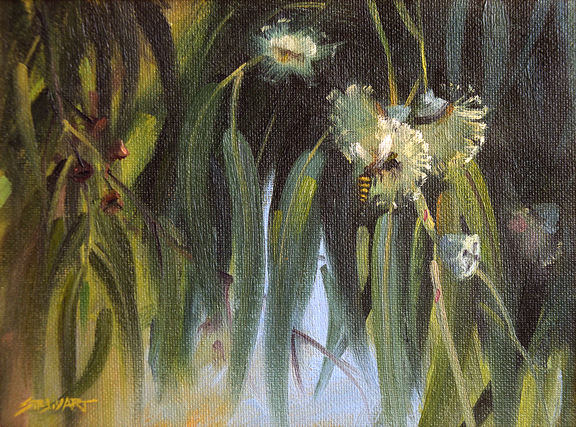
Eucalyptus and bee. Painting by Brian Stewart with permission.
As the park district plans future projects for funding by Measure CC, I ask that the projects quit destroying non-native trees and vegetation, particularly by using herbicides. Our wildlife needs these plants. The park district does not “improve” the parks by killing plants and animals.
In preparation for writing the ballot measure that will renew Measure CC (the parcel tax that has funded park improvements since 2005), East Bay Regional Park District has invited the public to suggest projects for the parcel tax renewal that will be on the ballot in November 2018. The park district must receive the public’s suggestions by the end of the December to be considered when they write the ballot measure at the beginning of 2018.
Million Trees is publishing the suggestion of Marg Hall and Jean Stewart for major investments in the park district’s Integrated Pest Management Program to achieve the ultimate goal of using no pesticides in the parks.
Back in 2004, we both voted for Measure CC out of a desire to support the East Bay Regional Parks. At the time, we couldn’t have imagined that the euphemism “resource-related projects” meant funding the destruction of thousands of healthy eucalyptus trees and the subsequent application of pesticides. (1) Had this fact been clearly stated, we never would have supported CC. We’ll present herein proposals for Measure CC expenditures which are designed to shift EBRPD to a no-pesticide policy.
PESTICIDES IN THE PARKS ARE NOT POPULAR
A large segment of the local community opposes the use of public money to fund pesticide applications in our parks. Jane Goodall has observed that humans are the only animal species that insists on spoiling its own nest. It is self-destructive and unethical of us to poison our own nest, not to mention the homes of countless other species. Historically, environmentalists have opposed pesticide use; however, the local Sierra Club chapter, in a departure from this tradition, insists that poison be used in East Bay parks to remove “invasive non-native plants.” They invoke the benign-sounding term “restoration” to garner support for this ecological insanity. Note that the San Francisco Bay Chapter has never permitted a vote by members on the question of pesticide policies. In the face of their refusal to poll their own members, community activists conducted a survey of Sierra Club members. Over 1,876 local members mailed in their response, of whom 1,851 expressed disagreement with their own leadership! (25 expressed agreement.) For perspective, that’s more respondents than vote in the chapter elections! (In 2015, the candidate for Chapter Executive Committee with the greatest number of votes received only 1,139 votes.)
WHAT’S IN THAT STUFF YOU’RE SPRAYING?
Pesticide regulation in the US is weak, compromised by a cozy relationship with manufacturers. Pesticides have not been proven to be safe, despite approval of certain chemicals by the EPA. Bear in mind that in the US, the benefit of the doubt is given to the pesticide maker–no precautionary approach here–so we really don’t know the full extent of damage. Active ingredients are, of course, poisons, since they’re specifically designed to kill plants and animals. But so-called “inert” ingredients are poisonous as well.
Among the EPA’s many regulatory failures is the fact that, for the most part, “inert ingredients” get a pass. Pesticide formulations (e.g. Roundup) contain chemicals intended to increase potency. Agricultural pesticides contain more than 50% inert ingredients. Independent scientists investigating the safety of inert ingredients have uncovered evidence of harm that should be of great concern, including many hundreds of hazardous chemicals, carcinogens, and even chemicals considered to be active ingredients when used in a different product. (2)
DDT provides an illustrative cautionary tale. While it was banned in the US in 1972, DDT continued to be used in pesticides as an “inert” (!) ingredient, in a product named Kelthane. (3) This continued for TEN years! Even though DDT (and DDE, its metabolite) is a potent endocrine disruptor, the causal link to breast cancer has been hard to establish. Among the reasons for this is that breast cancer’s long latency period made such research challenging. Just two years ago the results of a large study conducted by Kaiser Oakland were released. (9,300 women with a 54-year follow-up.) Blood levels of pregnant women were tested between the years 1959 and 1962. Female offspring of those who tested with high DDT levels were 4 times likelier to develop breast cancer by age 52, compared with controls. (4) Women are still paying the price for the regulatory failures of the past. Don’t you owe it to future generations to ask yourselves what other time bombs lurk in the chemical poisons you spread?
POISON WHACK-A-MOLE
EBRPD often uses glyphosate (aka Roundup), long touted as extremely safe by manufacturers. In 2015, the World Health Organization declared glyphosate to be a “probable human carcinogen.” However, merely focusing on Roundup can lull us into believing that the solution lies in banning glyphosate. This naive thinking fails to take into account the legions of newer and less-scrutinized pesticides lining up to take Roundup’s place in a game of poison whack-a-mole.
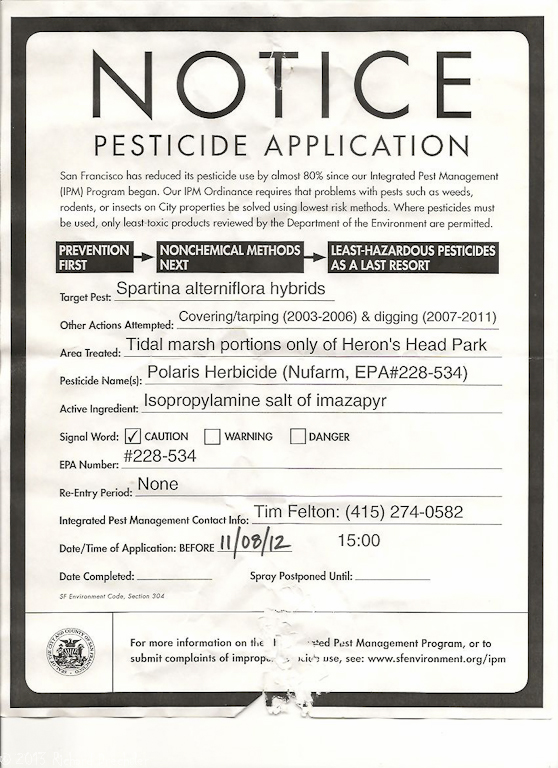
Pesticide Application Notice, Heron’s Head, 2012
Two projects which were funded by Measure CC “required” pesticides: triclopyr (Garlon) to prevent the re-sprouting of eucalyptus trees, and imazapyr (Polaris) to remove the “non-native” grass Spartina along San Francisco’s Bay shoreline. EBRPD’s own literature counts among successful CC projects: “Marsh cleanup at Martin Luther King Jr. Regional Shoreline, including Clapper Rail habitat enhancement and Spartina control” as well as “restoration of grasslands…at Pt. Pinole Regional Park”. (5) Based on your own reports, Spartina control projects have required the application of hundreds of gallons of imazapyr, some by aerial spray.
Imazapyr is toxic to fish, aquatic organisms and bees. Water soluble, it’s highly mobile and persistent; in one Swedish study, it was detectible in ground water eight years after application. (6)
As for triclopyr, much of the information has not been publicly shared. Thus scientists’ ability to conduct a well-informed evaluation of its safety is limited. We do know, however, that it significantly increases the frequency of breast cancer in both rats and mice. Despite this finding, the EPA has violated its own guidelines by refusing to classify this chemical as a carcinogen. We also know it has an adverse effect on frogs at very low exposures, and it causes documented harm to birds, fish, beneficial insects, and non-targeted plants. (7)
We can’t afford to wait 50 years to know a pesticide’s full effect. Especially now, under the current administration, corporations and politicians not only bully scientists but are systematically destroying the EPA. Now more than ever, local communities urgently need to rise to the occasion. This is where you come in.
DARE TO BE BOLD
Though she was writing about agricultural pesticides, Sandra Steingraber throws down a highly relevant challenge:
“I believe it is time for a new human experiment. The old experiment…is that we have sprayed pesticides which are inherent poisons…throughout our shared environment. They are now in amniotic fluid. They’re in our blood. They’re in our urine. They’re in our exhaled breath. They are in mothers’ milk….What is the burden of cancer that we can attribute to this use of poisons in our agricultural system?…We won’t really know the answer until we do the other experiment, which is to take the poisons out of our food chain, embrace a different kind of agriculture, and see what happens.” (8)
We propose a bold initiative. You’ve created an admirable IPM program; why not build on it by taking up Steingraber’s challenge? Use CC funding to make a commitment to a “no pesticide” policy. This would provide national leadership at a time when it is desperately needed.
Here are some practical suggestions to that end:
Expand IPM funding: Give staff the resources they need to innovate.
Go Deep: “Invasive” plants are not a problem to be eradicated but a symptom of an underlying dysfunction. Hire experts who can help you develop holistic solutions to ecosystem imbalances. Two who come to mind are Tao Orion (author of Beyond the War on Invasive Species: A Permaculture Approach to Ecosystem Restoration) and Caroline Cox (Center for Environmental Health). (9) Send your IPM staff to the yearly Beyond Pesticides conference.
Adopt the Precautionary Principle, which is based on the understanding that decision-makers have a social responsibility to protect the public from harm. The burden of proof of the harmlessness of a proposed action shifts from poison-manufacturers to…you.
Red-tailed hawk nesting in eucalyptus. Courtesy urbanwildness.org
Plant tall trees: Having already cut thousands of living tall trees, you’re now faced with the reality of climate change. Reforestation becomes an urgent ethical imperative. Tall trees are not only carbon sinks; they also capture fog, provide raptor habitat (thus eliminating the need for rodenticides), and provide natural, nonchemical undergrowth suppression, especially in those same areas where you’ve been reapplying pesticides over and over, in a futile attempt to kill “weeds”. And of course, it goes without saying: no more cutting of healthy trees, young or old!
Experiment: Expand your existing programs of experimental plots testing various pesticide-free approaches to management of “invasive” or “opportunistic” plants.
Avoid “Restoration”: These projects almost always involve pesticides which damage the soil and many non-targeted plants and animals. If a goal can’t be achieved without them, it’s not worth doing. Restoration projects should be based in science rather than prejudice. Tao Orion’s chapter on Spartina eradication compellingly makes this case. (10)
Embrace change: Rigid nativism has no place on this planet, whether applied to humans, plants, or animals. Once you begin to appreciate those resilient plants and animals that have managed to adapt to each other in a new environment, you’ll stop fretting over their immigration status, and you won’t be so tempted to employ pesticides.
Jean Stewart, El Sobrante, CA
Marg Hall, Berkeley, CA
NOTE: Both authors have had cancer. Jean Stewart, a botanist, acquired cancer as a result of exposure to herbicides while handling them in a lab. Her tumor required several surgeries, leaving her disabled. Marg Hall reports: “I was diagnosed with invasive breast cancer in 2015. While I don’t know my mom’s blood levels of DDT when I was in her womb, there are still detectable levels of DDT in my household dust—45 years after it was banned from use!”
Orion, T., Beyond the War on Invasive Species: A Permaculture Approach to Ecosystem Restoration (Chelsea Green Publishing, 2015), p.26. Also, Cox and Surgan, “Unidentified Inert Ingredients in Pesticides: Implications for Human and Environmental Health,” Environmental Health Perspectives (2006): 1803-1806. https://www.ncbi.nlm.nih.gov/pmc/articles/PMC1764160/
Vallianatos, E.G. & Jenkins, M., Poison Spring: The Secret History of Pollution and the EPA (Bloomsbury Press, 2014), ch.4.
Cohn, B. et al, “DDT Exposure in Utero and Breast Cancer,” The Journal of Clinical Endocrinology and Metabolism, August 2015, vol. 100, Issue 8. “DDT Exposure in Utero and Breast Cancer.”
Correspondence from Beyond Pesticides (a nonprofit in Washington, DC, founded in 1981) to Massachusetts Dept. of Agricultural Resources, Feb. 18, 2014, pp. 7-8 http://www.beyondpesticides.org/assets/media/documents/NSTAR 2014 YOP Comments 2-18-2014.pdf
Steingraber, S. quoted in President’s Cancer Panel Report: Reducing Environmental Cancer Risk: What We Can Do Now; April 2010, Section 2, page 45. Read the President’s Cancer Panel’s Report. http://steingraber.com/1447/
In the 20-plus years we have advocated for the preservation of our urban forest, my collaborators and I have been accused of many nefarious motivations and deeds. Here is a small sample of what we have been accused of:
The Sierra Club leadership has accused us of being “climate-change deniers” in their publications, in radio interviews, and in written public comments. (We firmly believe in the reality of climate change and that is one of many reasons why we are opposed to the destruction of our urban forest.)
We have been accused of being funded by the Koch brothers by commenters on this blog and other associations with the right-wing, such as Fox News and more recently Kellyanne Conway. (I am not politically conservative.)
Discrediting one’s opponents is a standard debating tactic and we are neither surprised nor dissuaded by such name-calling. So, why are we raising the issue today? Because this name-calling has migrated into the realm of academic science. We find that shocking because academia is a place where we expect reason to prevail and debates to be based on evidence, rather than ad hominem attacks.
Academic scientists in New Zealand resort to name-calling
We have published several articles about the projects that are dumping rodenticides on islands all over the world to kill animals believed to be the predators of birds. The most aggressive projects are found in New Zealand where rodenticides have been aerial bombed on small islands for over 60 years. Recently New Zealand has made a commitment to expand that program to the mainland of New Zealand to kill all wild mammals that have been introduced by humans for over 700 years.
New Zealand intends to be “predator free” by 2050. As you might expect, many people in New Zealand object to this program because rodenticides are an indiscriminate killer of animals, such as the native species of parrot, the kea, and many domestic animals such as dogs. There are other concerns as well, such as the feasibility of such an undertaking and the toxicity of rodenticides to the environment and to humans.
Defending New Zealand’s native parrot, the kea
One of the authors of that aggressive program is an academic at University of Auckland in New Zealand, James C. Russell. His defense of his program and the academic discipline of invasion biology on which the project was based was published by an academic journal. (1) It is an unusual defense, one that we wouldn’t expect to find in an academic journal, because it does not use scientific evidence to defend the annihilation of non-native animals. Rather it accuses those who question those projects of having ulterior motives: “Where evidence is disregarded, or motivations are disingenuous, arguments against [the negative impacts of] invasive alien species take the form of science denialism,” which Russell defines as “the rejection of undisputed scientific facts” such as the causes of climate change or the risks of smoking tobacco.
Russell then tells us what he believes motivates critics of invasion biology:
“Science denialism typically originates from groups with a vested interest in opposition to the scientific consensus…” In other words, the profit motive explains the criticism of invasion biology, in Russell’s opinion.
“…there is a strong correlation with support of free-market ideologies such as laissez-faire. ” Russell paints critics of invasion biology into a right-wing corner.
Finally, Russell advises invasion biologists how to respond to “denialism” of their projects: “engage the criticisms but shift the debate from questions of scientific fact to questions of policy response.” And THAT is at the heart of the matter. Russell advises his colleagues to emphasize the policy goals, such as exterminating all wild mammals from New Zealand, rather than debate the scientific justification for that project. Since there is little scientific justification for this project, that seems like good advice. So, what is this advice doing in a scientific journal? That is the final question.
Academic scientists respond to Professor Russell
A few months after Russell’s ad hominem attack on academic critics of invasion biology, the same scientific journal published four rebuttals to Russell and Blackburn, written by 11 academic scientists.
“We disagree that there is scientific consensus around invasive species, and propose that much debate in this field stems from legitimate disagreement and not from disingenuous rhetoric.” (2)
“Constructing an ostensible category of ‘denialists’ reflects invasion biology’s traditional reliance on inflammatory exaggeration to impose and enforce a dichotomous doctrine.” (3)
“…society’s spectrum of diverse perspectives, aspirations, and personal trade-offs, which effectively constitute what Russell and Blackburn impugn as ‘vested interests,’ could and should influence society’s debates rather than be discredited.” (4)
“The organizations and individuals that continue to bemoan biodiversity loss are misleading the public and are directing conservation support away from the foremost problem, the precarious existence of species with remnant populations that are the result of habitat destruction and overexploitation.” (5)
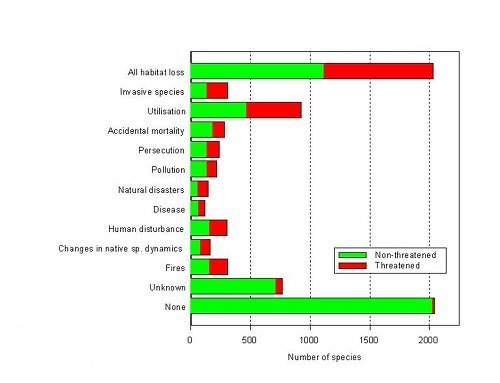
Threats to mammal species. Source: International Union for Conservation of Nature
Another academic publication also published a response to Russell and Blackburn: “Superficial understanding of the relationships between evidence and values creates exactly the dichotomization between science ‘believers’ and ‘denialists’ that Russell and Blackburn ostensibly seek to avoid. Rather than ‘standing up for science’ such dichotomization undermines it, rendering aspects of scientific enterprise ‘off limits’ to the kind of rigorous critical (self) examination fostered by science at its best.” (6)
Update:James Russell has come to the attention of the US military, according to a press report published on December 4, 2017. Russell says of his collaboration with the US military, “’And obviously we’re in the business of eradicating entire populations of animals from an island and so they have cocked their ear towards me once or twice. You don’t have to be a genius to see that there’s potential military application in that.’ In this instance, Russell’s work was being measured for suitability against a US$100 million research pot made available by the United States’ Defense Advanced Research Projects Agency (Darpa).”
As psychologists have informed us for decades, it is a short step from animal abuse to human abuse. The child who kills animals often becomes a killer of humans as an adult.
Professor Russell seems to be proud of his collaboration with the US military. In any case, he stands to profit from that collaboration. That’s ironic, given that one of his criticisms of the critics of invasion biology is that they have “vested interests” in their criticism. It seems that a grant from the US Military should be viewed as a “vested interest” in his advocacy for killing animals. And, as he says, he is “in the business of eradicating” animals.
Little scientific basis for invasion biology
Invasion biology as presently defined by academic science originated in the late 1950s. It began as a collection of hypotheses about the harm that non-native plants and animals were doing to native plants and animals. Like all hypotheses, it was based on speculation that had to be tested in the real world. In the past 25 years, many studies have been conducted that were designed to prove that non-native species are harmful to native species. With few exceptions, these studies came up empty. More often than not, studies found pros and cons to introduced species, just as we would expect of similar studies of native species. There is little evidence that invasion biology is an accurate description of how ecosystems operate.
When academic scientists are forced to resort to name-calling to defend invasion biology it no longer deserves the status of scientific hypothesis. And when it is discredited as a scientific discipline, it must be just a matter of time before the public realizes that there is no legitimate reason to kill non-native plants and animals.
We don’t see any sign of that paradigm shift, but we are hopeful that public policy will eventually be revised to reflect the reality that has been revealed by scientific studies. In the absence of scientific justification for eradication projects, they must be treated as public policy decisions. In a democracy, public policy decisions must reflect the public’s wishes. In the absence of public support, these projects will continue to cause conflict.
James C Russell and Tim Blackburn, “The Rise of Invasive Species Denialism,” Ecology & Evolution, January 2017
Sarah Crowley, Steve Hinchliffe, Steve Redpath, Robbie McDonald, “Disagreement About Invasive Species Does not Equate to Denialism: A Response to Russell and Blackburn,” Ecology & Evolution, April 2017
Mark Davis and Matthew Chew, “’The Denialists Are Coming!’ Well, Not Exactly: A Response to Russell and Blackburn,” Ecology & Evolution, April 2017
Jacques Tassin, Ken Thompson, Scott Carroll, Chris Thomas, “Determining Whether the Impacts of Introduced Species are Negative Cannot be Based Solely on Science: A Response to Russell and Blackburn,” Ecology & Evolution, April 2017
John Briggs, “Rise of Invasive Species Denialism” A Response to Russell and Blackburn,” Ecology & Evolution, April 2017
Susanna Lindstrom, “An Interdisciplinary Perspective on Invasive Alien Species,” PLoS Ecology Blog, October 2017
East Bay Regional Park District is preparing to put a parcel tax on the ballot in 2018 that will extend the funding of park improvements for another 15 years. The public has been invited to tell the park district what improvement projects should be funded by the parcel tax in the future. We are publishing a series of such public comments that we hope will inspire the public to submit their own suggestions to the park district.
TO: publicinformation@ebparks.org
CC: Board of Directors
FROM: Park Advocate
RE: Suggestion for Measure CC Projects
Climate change is the environmental issue of our time. The climate has changed and it will continue to change. If park improvement projects are going to be successful, they must have realistic goals that take into consideration the changes that have occurred and the changes anticipated in the future.
The restoration of native grassland is an example of a project that is not realistic, given current environmental conditions. Grassland in California has been 98% non-native annual grasses for over 150 years. Mediterranean annual grasses were brought from Mexico to California by the cattle of the Spaniards in the early 19th century.
David Amme is one of the co-founders of The California Native Grass Association and was one of the authors of East Bay Regional Park District’s “Wildfire Hazard Reduction and Resource Management Plan” while employed by EBRPD. In an article he wrote for Bay Nature he listed a few small remnants of native grasses in the East Bay and advised those who attempt to find them, “As you go searching for these native grasses, you’ll see firsthand that the introduction of the Mediterranean annual grasses is the juggernaut that has forever changed the balance and composition of our grasslands.” That article is available HERE.
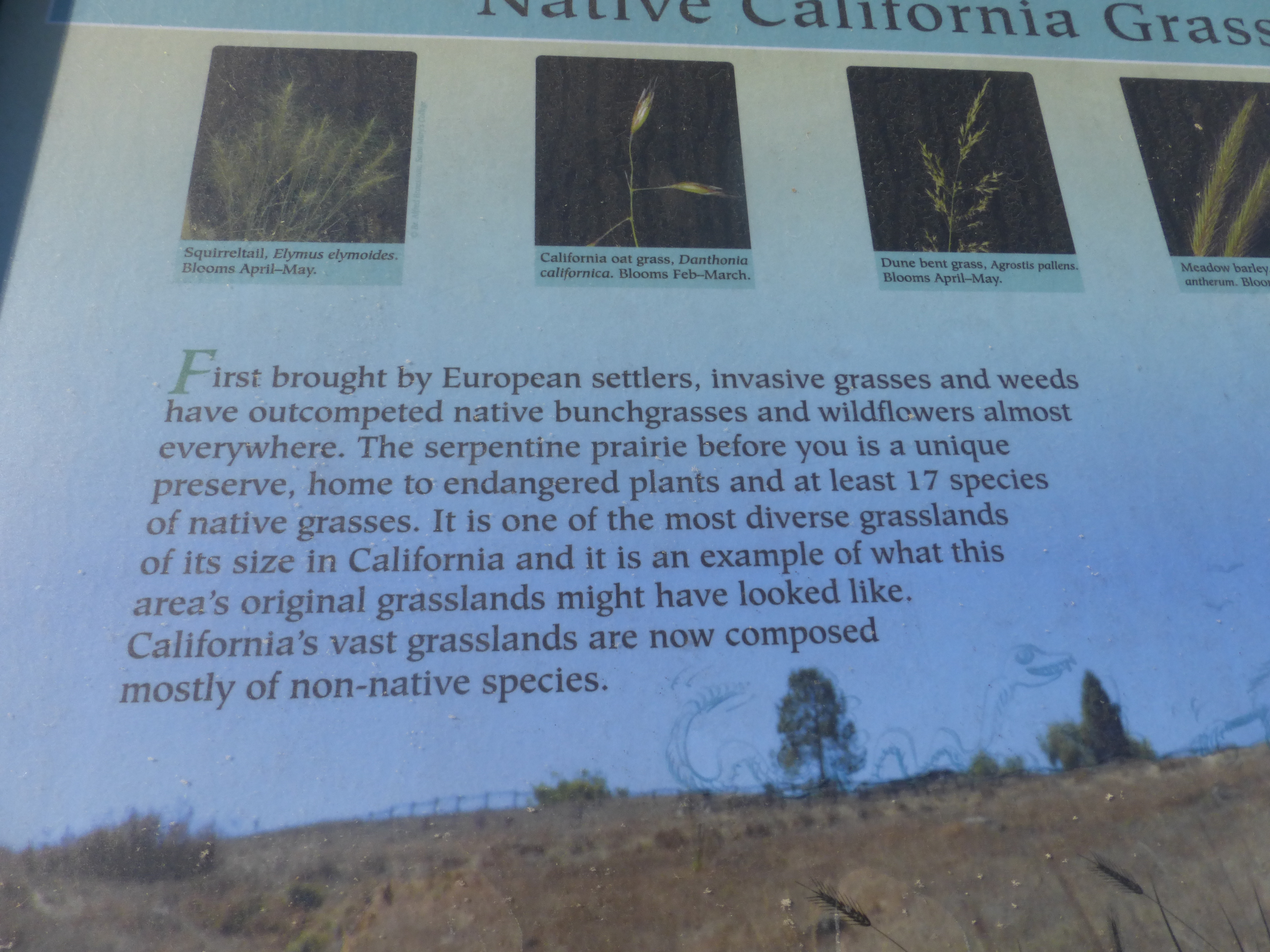
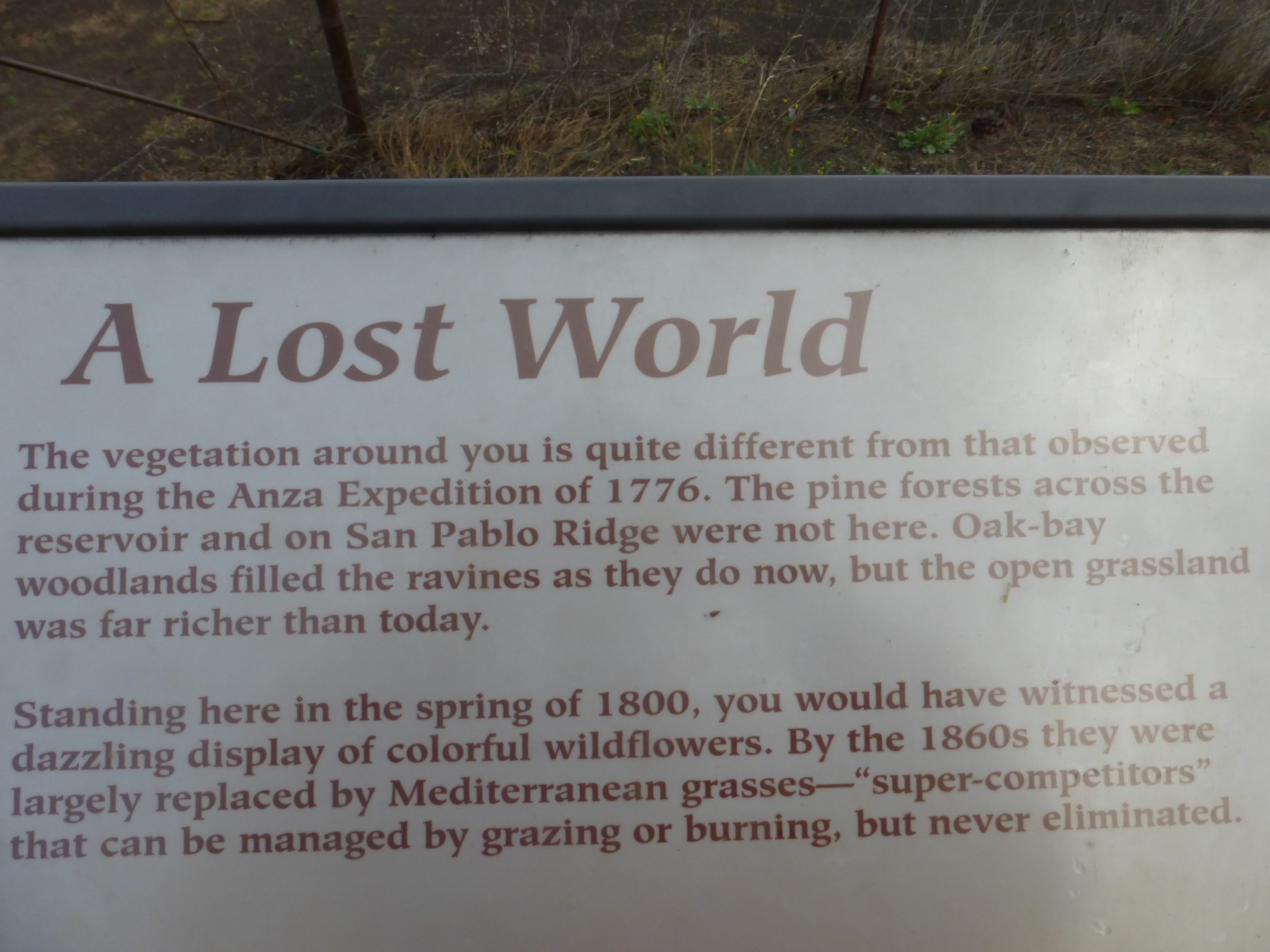
The park district seems to understand the futility of trying to transform non-native annual grassland to native bunch grasses. Here are two signs in two of the EBRPD’s parks that acknowledge the reality of California’s grassland.
Serpentine Prairie, April 2017Tilden Park, Inspiration Point, October 2016
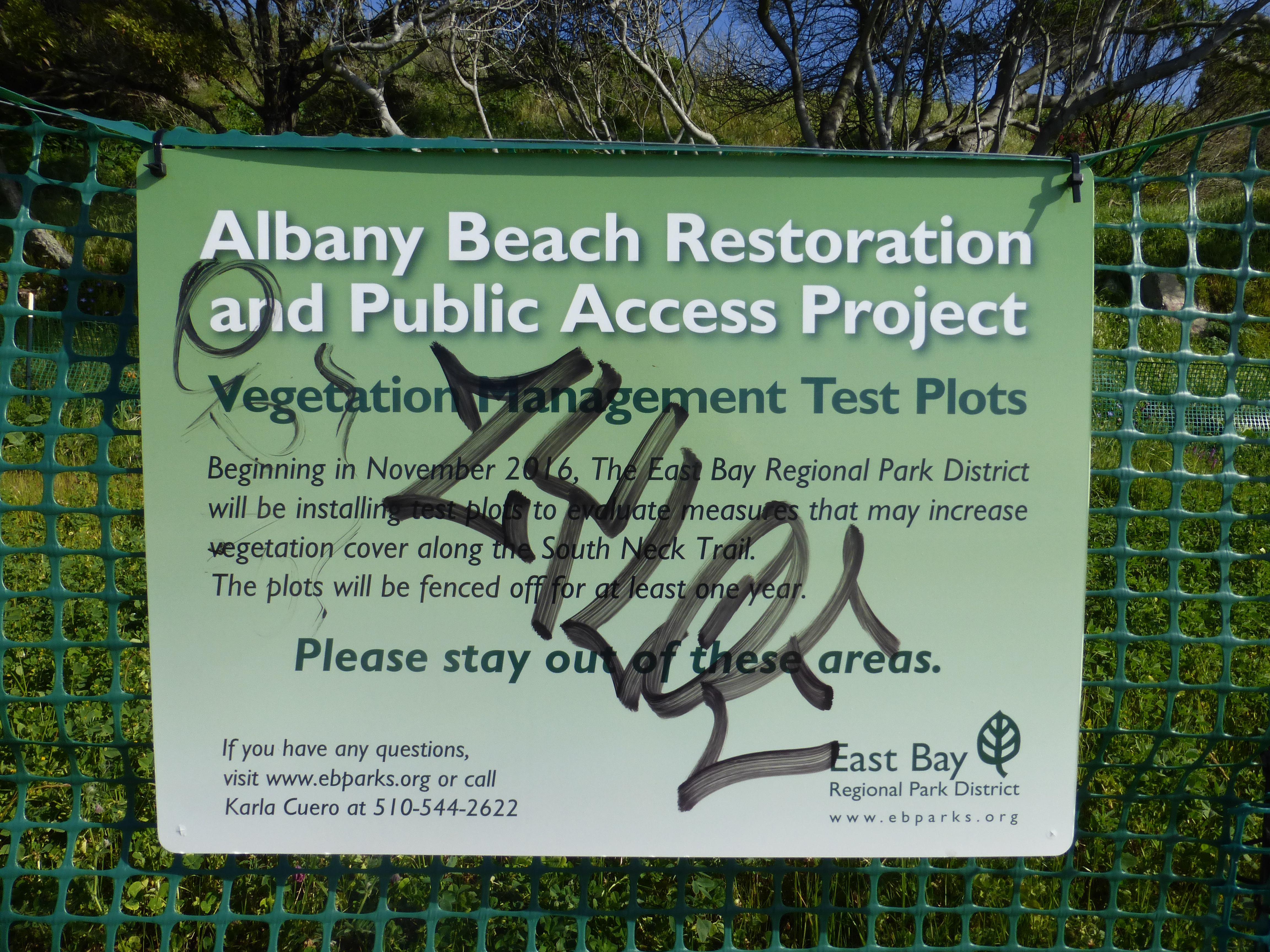
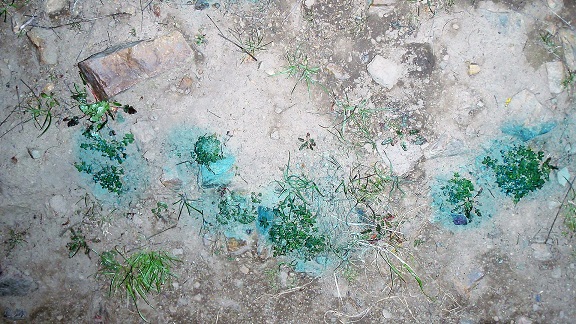
Yet, despite this acknowledgement, the park district continues to expand its efforts to transform the parks into native grassland. Park visitors recently observed a failed experiment to introduce native grasses to one of the parks. Six plots of ground were fenced. Two of the plots were control plots in which whatever non-native weeds had naturalized were allowed to grow unmolested. Two of the plots were mulch/seeded with native grasses and two of the plots were fabric/seeded with native grasses. There was no observable difference in plant composition or abundance between the seeded and unseeded plots. There was no observable difference in the outcome of the two different seeding methods that were used. In other words, native grasses were not successfully introduced to this park. My correspondence with the EBRPD employee who was responsible for this project is attached.
Albany Bulb, April 2017Albany Bulb, April 2017
The park in which this experiment was conducted is Albany Bulb. Albany Bulb is the former garbage dump of the City of Albany. It was built on landfill in the bay. The soil is not native and there were never any native plants on it. It does not seem a promising candidate for a native plant “restoration.” Unfortunately, Albany Bulb is not an atypical park along the bay. There are many other parks along the bay that were built on landfill and in which the park district is attempting to establish native plant gardens. This does not seem a realistic objective for these parks.
Albany Bulb April 2018
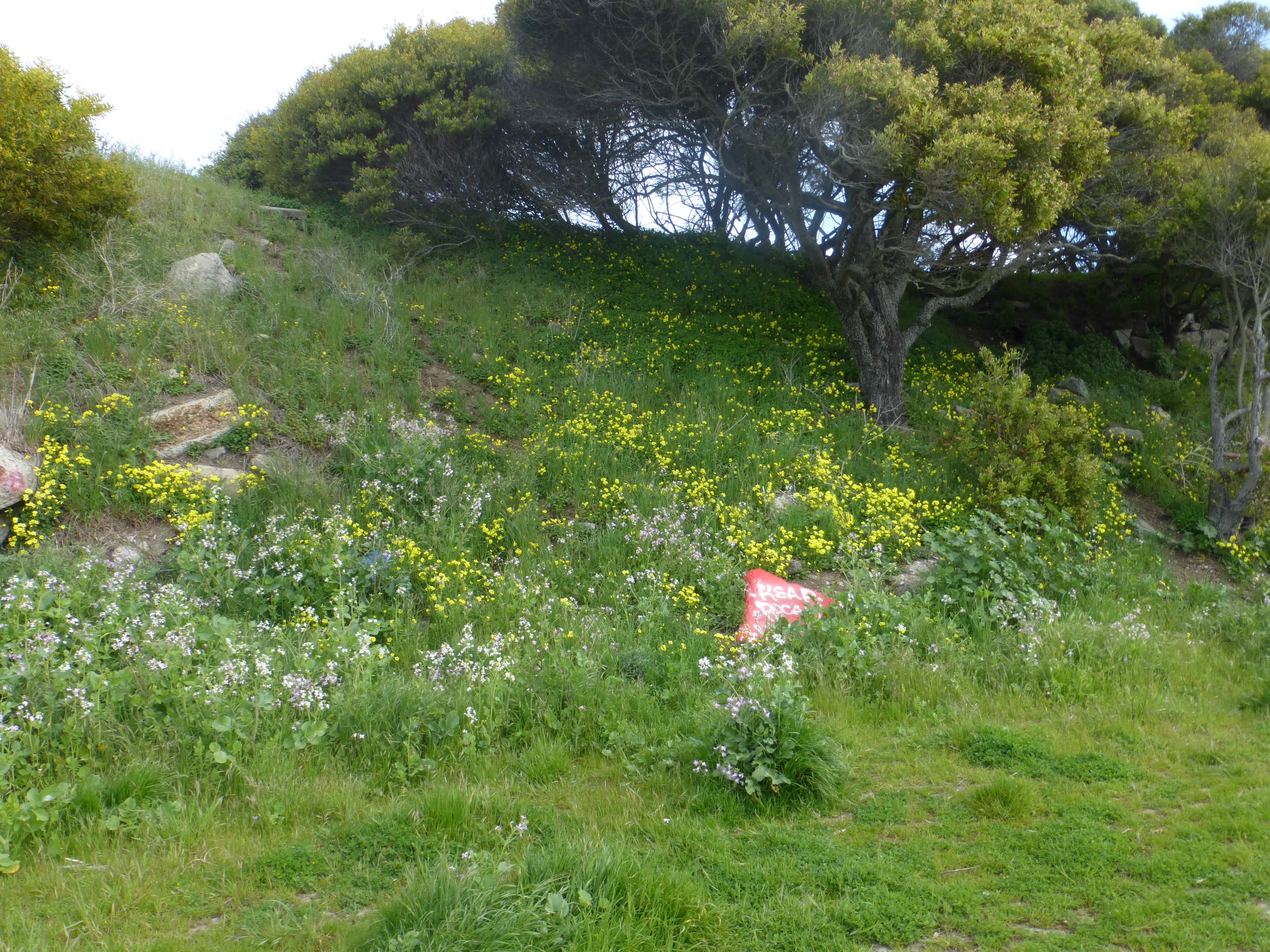
Update: One year after the experimental planting of native wildflowers at Albany Bulb, there is no evidence of that effort. The trail-sides are mowed weeds and the upslope from the trail is studded with blooming non-native oxalis and wild radish.
Albany Bulb. Non-native wildflowers. April 2018
Albany Bulb will soon be closed to the public for a major “improvement” project. Albany Landfill Dog Owners Group and Friends expects the park to be closed for about one year. They are unsure if the park will allow dogs off leash when the park re-opens. More information about the “improvement” project is available on their website: http://www.aldog.org/announcements-2. They suggest that you sign up on their website to be notified of the progress of the project and the status of the re-opening of the park.
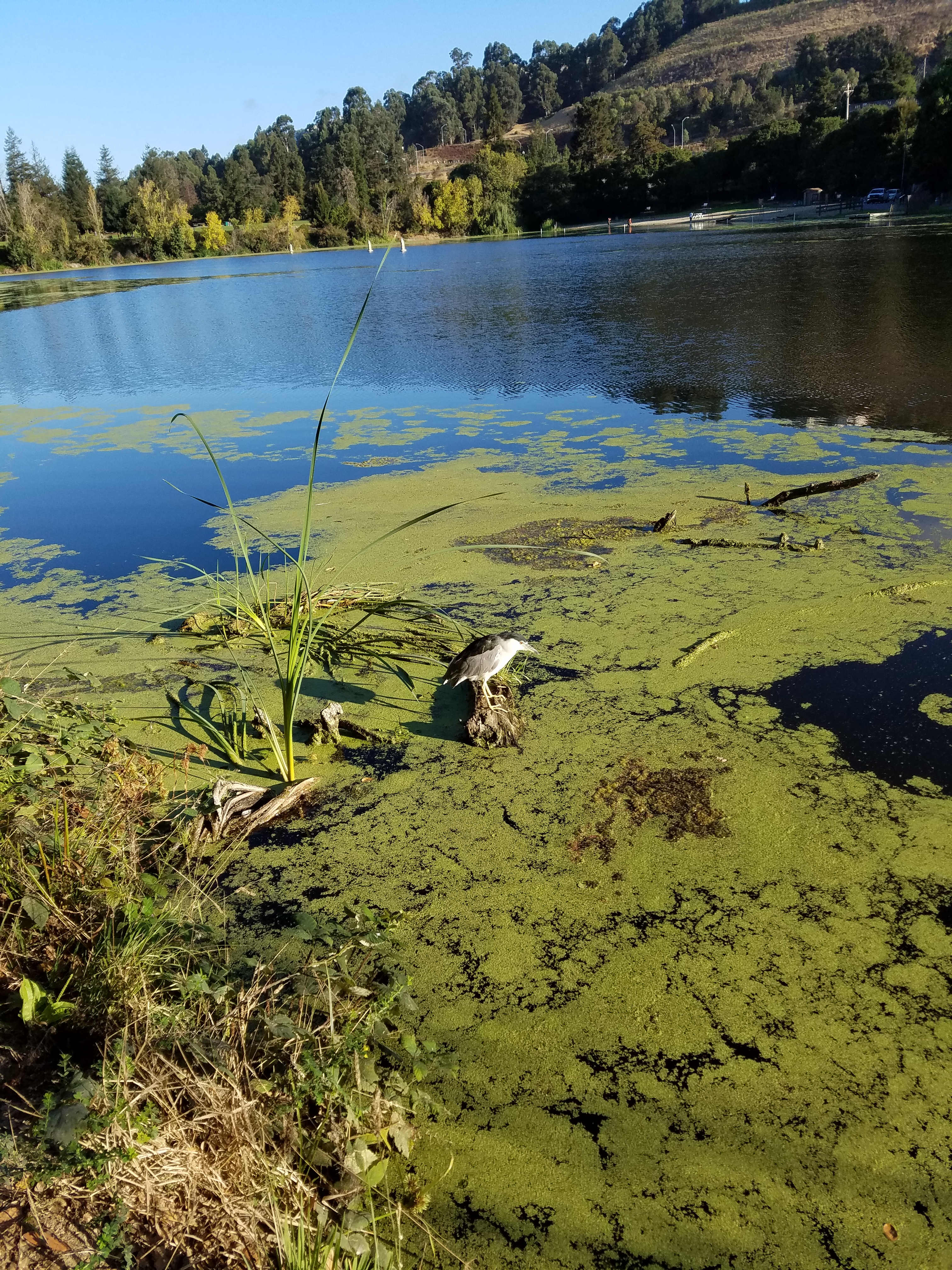
This is not to say that there aren’t many worthwhile park improvement projects that are both realistic and needed.Dredging Lake Temescal is an example of a worthy project. As you know, Lake Temescal was a popular place for people to swim until recently. In the past few years it often has been closed to the public because of toxic algal blooms. The algal blooms are caused by two closely related factors. The water is warmer than it was in the past because of climate change and the lake is shallower than it was in the past because of sediment deposited into the lake.
Black crowned night heron in algal bloom, Lake Temescal, April 2017
The park district has tried to address this issue by using various chemicals to control the growth of the algae. Although that has occasionally been successful for brief periods of time, it is not a long term solution to the problem. Furthermore, it is a good example of why the park district uses more chemicals than necessary. If the park district would address the underlying cause of the problem—that is, the depth of the lake—it would not be necessary to keep pouring chemicals into the lake. Dredging Lake Temescal should be a candidate for Measure CC funding.
And so I return to the point of this suggestion for Measure CC: Please plan projects that take into consideration the reality of climate change, that address the underlying causes of environmental issues, and that have some prospect for success.
Thank you for your consideration.
Send your comments regarding Measure CC renewal to publicinformation@ebparks.org
Send copies to staff and board members of East Bay Regional Park District
Robert Doyle, General Manager rdoyle@ebparks.org
Ana Alvarez, Deputy General Manager aalvarez@ebparks.org
Casey Brierley, Manager of Integrated Pest Management cbrierley@ebparks.org
Board of Directors:
Beverly Lane, Board President blane@ebparks.org
Whitney Dotson wdotson@ebparks.org
Dee Rosario drosario@ebparks.org
Dennis Waespi dwaespi@ebparks.org
Ellen Corbett ecorbett@ebparks.org
Ayn Wieskamp awieskamp@ebparks.org
Colin Coffey ccoffey@ebparks.org
The public meetings held by East Bay Regional Park District about the renewal of Measure CC are over. Thanks to everyone who attended. Our viewpoint was well represented. We patiently waited in line to get our wishes on their flip charts and when they were read to the crowd, our message was loud and clear: “QUIT destroying healthy trees, DON’T use pesticides.”
If you weren’t able to attend the meetings, you can still tell the park district what you are hoping for in the renewal. Voters will be given an opportunity in 2018 to vote to continue for another 15 years the parcel tax that has been used for park improvements. The park district is inviting the public to submit written public comments about the projects they want to see funded by Measure CC. We will publish a series of such comments that we hope will inspire you to write your own comments.
Send your comments to publicinformation@ebparks.org. Depending on the subject, copies to specific members of the Board or the staff are also appropriate. You will find a list of staff and board members at the bottom of this post.
I understand that you are responsible for implementing the park district’s “Wildfire Hazard Reduction and Resource Management Plan.” Much of that plan has already been implemented and most of it was funded by Measure CC. Therefore, I am writing to ask that the plans to reduce wildfire hazards be revised, as required by the plan’s commitment to “Adaptive Management.”
Adaptive Management is the sensible strategy to make needed adjustments in plans as required by changes in conditions and in response to the results of completed portions of the projects. There are two significant changes in conditions that require adjustments to the plans:
The consequences of climate change are significantly worse than were evident when the plan was written in 2009. For example, a severe drought killed 102 million native conifers in California. Higher temperatures and other changes in the environment are altering our landscape. Plants and trees that lived here prior to European settlement are no longer adapted to the changed climate and further changes are anticipated in the future.
Sudden Oak Death has killed between 5 and 10 million oak trees in California and the pathogen causing Sudden Oak Death spread exponentially in 2016 and 2017 because of heavy rain. There are significant SOD infections throughout the park district, including in urban areas. HERE is a map of those infections in Alameda and Contra Costa counties.
These changes in the environment require the park district to revise its strategies for fire hazard reduction because dead trees are significantly more flammable than living trees that contain more moisture. HERE is a San Francisco Chronicle article that explains how Sudden Oak Death contributed to recent fires in the North Bay.
Removing trees infected with or killed by Sudden Oak Death should now be a higher priority than continuing to destroy healthy trees, as the park district has done in the past. Protocols for removing the dead wood must be developed because the wood is fuel when left on the ground; presently, the official protocol for the wood of trees killed by SOD is to leave it on the ground, in place. That practice is not consistent with EBRPD’s commitment to reduce fire hazards.
Scientists tell us that wildfires are becoming more frequent and more intense all over the world because of climate change. Therefore, addressing the causes of climate change should be the top priority of a program designed to reduce fire hazards. Since deforestation is the second greatest source of the greenhouse gases causing climate change, the park district should reconsider its program of destroying healthy trees storing carbon. The park district should also plant more trees, which have a future in our changed and changing climate and that will sequester carbon and reduce air pollution.
Thank you for your consideration. I will be looking for appropriate revisions of fuels management projects when making my decision about voting for renewal of Measure CC.
Send your comments regarding Measure CC renewal to publicinformation@ebparks.org
Send copies to staff and board members of East Bay Regional Park District
Robert Doyle, General Manager rdoyle@ebparks.org
Ana Alvarez, Deputy General Manager aalvarez@ebparks.org
Casey Brierley, Manager of Integrated Pest Management cbrierley@ebparks.org
Board of Directors:
Beverly Lane, Board President blane@ebparks.org
Whitney Dotson wdotson@ebparks.org
Dee Rosario drosario@ebparks.org
Dennis Waespi dwaespi@ebparks.org
Ellen Corbett ecorbett@ebparks.org
Ayn Wieskamp awieskamp@ebparks.org
Colin Coffey ccoffey@ebparks.org
In 2004, voters in Alameda and Contra Costa counties approved Measure CC, a parcel tax, to provide additional funding to East Bay Regional Park District for “Park Access, Infrastructure and Safety Improvements, Resource-Related Projects, and Reserve for Unknown Events.” Measure CC also stipulated that “the overall commitment to natural resources shall be no less than 30% of the revenue raised by the entire measure.” (1) Measure CC is projected to provide about $47 million in the 15 years of its life. (2)
The park district is planning to put Measure CC on the ballot for renewal next year. It’s time to look at how the park district spent our tax dollars and decide if we want to continue to give them our tax dollars for another 15 years. If you want Measure CC funding to be used differently, now is the time to tell East Bay Regional Park District what you want…BEFORE the ballot measure is written.
Fuels Management vs. Resource Management?
The park district budgeted $10.2 million of Measure CC funding for “fuels management,” about 22% of the total available funding from Measure CC. To date, the park district has appropriated $8.8 million of that budget allocation and spent $6.3 million.
The park district describes “fuels management:”“All vegetation/fuels management projects for fuels reduction are in coordination with the protection and enhancement of wildlife habitat in fuel break areas and are therefore considered to be resource related.” (2) In other words, the park district considers destroying vegetation and cutting down trees a part of its “commitment to natural resources.”
These descriptions of Measure CC projects illustrate the close relationship between fuels management and resource management:
“Assess and remove hazardous trees, promote native tree regeneration.” (2)
“Manage exotic plant species and promote fire resistant natives to reduce the risk of wildfires.” (2)
“Manage vegetation for fuels reduction in coordination with the protection and enhancement of wildlife habitat in fuel break areas to provide defensible space and meet Hills Emergency Forum flame length standard.” (2)
The park district’s policies and practices are based on mistaken assumptions:
Most monarchs in California spend the winter months roosting in eucalyptus trees. These trees are being destroyed in East Bay parks where monarchs have roosted in the past, such as Point Pinole.
There is no evidence that destroying non-native trees will “enhance wildlife habitat.” In fact, wildlife habitat is being destroyed by “fuels management” projects.
There is a wide range of opinions about the tree removals that the park district has done since their program began in 2011, after approval of the “Wildfire Hazard Reduction and Resource Management Plan” and the associated Environmental Impact Report. At one extreme, some people want the park district to destroy ALL non-native trees on its property. They consider “thinning” inadequate. The Sierra Club is in that camp and has sued to enforce their wishes. At the other extreme, some people don’t want any trees to be removed, although most would make an exception for dead and hazardous trees.
Tilden Park, Recommended Treatment Area TI001, June 5, 2016. This in one of the projects of East Bay Regional Park District, in process
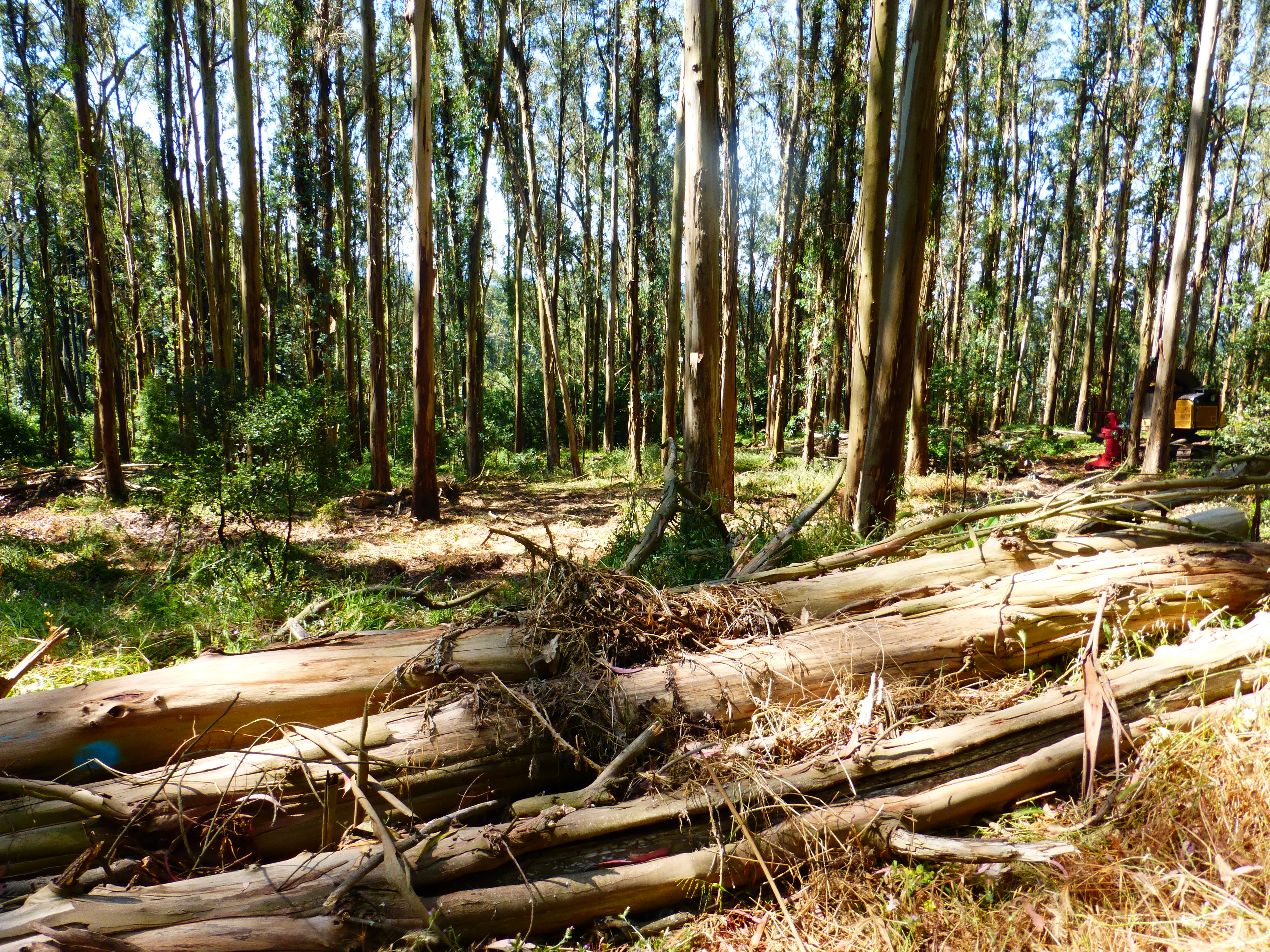
After observing the park district’s tree removal projects, I have reached the conclusion that they represent a middle ground that I can accept because in many cases the canopy is intact and the forest floor is still shaded. The shade retains the moisture that retards fire ignition as well as suppresses the growth of weeds that ignite more easily during the dry season. In the 20+ years that I have defended our urban forest, I was always willing to accept a compromise and the park district’s methods look like a compromise to me. I still have concerns about tree removals and they are explained HERE. You must reach your own conclusions.
So, what’s the beef?
Unfortunately, coming to terms with the park district’s tree removals has not resolved my misgivings about how Measure CC money has been used. In a nutshell, I believe that the park district’s “resource management” projects are based on outdated conservation practices. I believe the park district is trying to re-create historic landscapes that are no longer adapted to environmental conditions. Their projects are often not successful because they do not take the reality of climate change into consideration, nor do they look to the future of our environment. They are stuck in the past.
One of the projects funded by Measure CC is typical: the effort to eradicate non-native spartina marsh grass from all park properties. The park district has been participating in the effort to eradicate all non-native spartina marsh grass from the entire West Coast for 14 years. In the first few years, EBPRD aerial sprayed from helicopters several hundred gallons of herbicide per year. Now the quantity of herbicide is about 25 gallons per year.
The reason why the rails have been harmed by the eradication of their habitat is that non-native spartina provides superior cover for the rail. The non-native species of spartina grows taller, more densely, and it doesn’t die back in the winter as the native species of spartina does. When the rail begins its nesting season, there is no cover for the birds. They are therefore being killed by their many predators.
The fact that non-native spartina provides superior cover for the birds is related to a second issue. Non-native spartina provides superior protection from winter storm surges compared to the native species which provides no protection, even when it grows and it is NOT growing.
The third issue is that eradicating non-native spartina has not resulted in the return of native spartina. Even when extensive planting has been done, native spartina does not provide habitat or storm surge protection in the San Francisco Bay Area. We should be asking if pouring hundreds of gallons of herbicide on the ground might be a factor in the unsuccessful attempt to bring native spartina back to the Bay Area.
Finally, recently published studies that compared native with non-native marsh grasses and aquatic plants with respect to the ecological functions they perform. These studies both say, “If you look at the role of exotic water plants in an ecosystem, you won’t find any significant differences compared to indigenous species.”
The spartina eradication project is an example of conservation that no longer makes sense. It damages the environment with herbicides. It destroys the habitat of rare birds. It exposes our shoreline to strong storm surges and rising sea levels. Native vegetation does not return when it is eradicated.
Looking forward, not back
The parks are very important to me. I visit them often and I treasure those visits. I would like to vote for Measure CC. I hope that the measure on the ballot will give me a reason to vote for it.
I will be looking for a revised definition of “resource management” in the ballot measure, one that acknowledges that climate change is the environmental issue of our time and that conservation must be consistent with the changes that have already occurred, as well as look forward to the changes that are anticipated in the future. Specifically, “resource management” must respect the landscape we have now, which means not trying to eradicate it, particularly by spraying it with herbicides. Resource management projects must be based on reality, rather than on fantasies about the past.
Opportunities to tell EBRPD what you want from Measure CC
East Bay Regional Park District is holding public meetings about Measure CC to give the public the opportunity to provide input regarding future park needs and priorities:
November 4, 10-12, Harrison Recreation Center, 1450 High St, Alameda
November 8, 2:30-4:30 pm, David Wendel Conference Center, 1111 Broadway, 19th Floor, Oakland
EBRPD asks that the public RSVP by sending an email to Monique Salas at msalas@ebparks.org or call 510-544-2008.
If you can’t attend, please send written feedback here: publicinformation@ebparks.org. Please tell East Bay Regional Park District what you want Measure CC funding to pay for.
Recent wildfires in the North Bay were devastating. 44 people were killed by the fires and over 8,000 structures were destroyed, including homes and businesses. We don’t want to portray that fire as anything other than a tragedy. However, for those with a sincere interest in fire safety, there are many lessons to be learned from that fire. If people will open their eyes and their minds to the reality of those fires, there are opportunities to reduce fire hazards revealed by those fires.
What burned?
Watching videos of the fires is the best way to answer the question, “What burned?” Here are two videos of the fires that we found on the internet by doing a search for “videos of wildfires in Napa and Sonoma counties.” If you weren’t watching the news during the fires, you might start by looking at these videos. There are many more videos on the internet of those fires.
Here’s what we can see in these videos:
The fire front moved rapidly through native conifers and oaks as well as through grassland and chaparral. After watching hours of these videos, we did not see any eucalyptus trees on fire.
Many homes burned without igniting the trees and vegetation around them. If the photo was taken while the home was still burning, the vegetation is rarely engaged in the fires. If the photo was taken after the home burned, much of the vegetation is burned as well. In other words, the vegetation was ignited by the burning homes, not vice versa.
In videos of actively burning homes, the air is filled with burning embers. The source of those embers cannot be determined from the videos.
Nothing in these videos suggests that native vegetation is less flammable than non-native vegetation. Nothing in these videos suggests that the vegetation is more flammable than the structures that burned.
CalFire has identified the specific locations where four of the fires originated. Two are in groves of oak trees and two are in grassland and chaparral. Photos of those specific locations are available HERE.
UPDATE: On November 16, 2017, the Bay Area Open Space Council held a symposium about the fires in the North Bay that was billed as a “Community discussion on the impacts of the recent wildfires.” Bay Nature magazine moderated a panel of experts representing CalFire and 8 managers of public and private open space reserves.
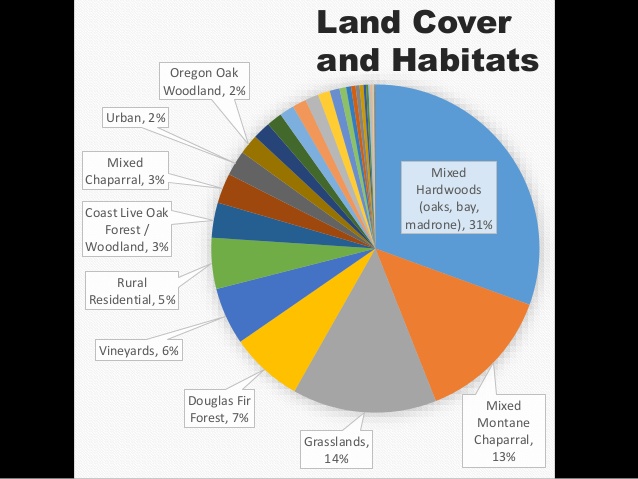
The Director of Conservation for the Bay Area Open Space Council showed a slide of the vegetation types that burned in the fires. With the exception of vineyards, only 2% of the burned vegetation was “urban.” All other vegetation was native grassland, chaparral, and native trees.
Vegetation that burned in the North Bay files of October 2017. Source: Bay Area Open Space Council
The speaker from CalFire said that we must learn to live with fire. He suggested that the way to accomplish that goal is with better land use planning, using fire and ember resistant building materials, creating defensible space, and improving the health of our forests.
The slides of the presenters and an audio recording of their presentations is available HERE.
What role did the weather play in the fire?
All sources of information about the fire reported that strong winds were the biggest factor in the rapid advance of the fire. The wind was associated with very high temperatures and it came from the east. This type of wind is called a Diablo Wind in Northern California. In Southern California it is called Santa Ana Winds. In the Mediterranean, it is called Mistral Winds.
In coastal Mediterranean climates such as California and the Mediterranean regions of France and Spain, the wind ordinarily comes off of the ocean. Because the ocean is cooler than the land, the wind is usually a source of moisture and cooler temperatures. During periods of high summer temperatures, the wind sometimes shifts direction and starts to blow off the hot interior, drying the vegetation and increasing temperatures.
Such winds were also the main cause of the wildfire in the Oakland/Berkeley hills in 1991. Jan Null was the lead forecaster for the National Weather Service in the Bay Area in 1991. He recently said of the 1991 fire: “At the time a fire starts, the really relevant conditions are the wind speeds, the temperature and the humidity. Again, the humidity goes to the dryness of the fuel. The temperatures also go to the dryness of the fuels and the wind speeds go to what the spread of the fire is. If we’d had that same Oakland Hills fire without any wind, we wouldn’t be talking about it now.”
Most wildfires in California are caused by strong, dry, hot winds. Everything burns in a wind-driven fire. Both native and non-native vegetation burns in a wind-driven fire. Homes in the path of a wind-driven fire are more likely to burn than the vegetation that surrounds the homes because the vegetation contains more moisture.
Why are wildfires becoming more frequent and more intense?
Wildfires in the west have become more severe because of increased temperatures and lower humidity at night. When it doesn’t cool off at night, the trees don’t have an opportunity to regain the moisture they have lost during the high daytime temperatures. In the past, firefighters could count on wildfires to die down at night. Now they can’t count on colder nights to make the fires less severe. (2) Since the fires in the North Bay started in the middle of the night and did the most damage that first night, this observation about warmer nights is particularly relevant to those fires.
The investigation of the recent wildfires in the North Bay is not complete, but early indications suggest that power lines probably ignited some of the fires. Some power poles fell over in the strong winds, causing the power lines to break and spark ignitions. Some trees were blown into the power lines, causing them to break or spark.
California State law requires that trees be pruned at least 4 feet from the power lines. Although PG&E says they are inspecting thousands of miles of power lines to identify potential interference with trees, these inspections are apparently not adequate. After the fires started, PG&E claimed they had removed 236,000 “dead and dying” trees and “destroyed or pruned” 1.2 million healthy trees in 2016. These destroyed trees contribute to climate change.
Apparently PG&E’s efforts to inspect and maintain power lines were inadequate and State laws intended to ensure the safety of power lines are not being enforced.
Did Sudden Oak Death contribute to the fire?
Sudden Oak Death (SOD) killed 5 million oak trees in California from 1994 to 2016, when that number was reported by a study. The study also said that the SOD epidemic could not be stopped and would eventually kill all oaks in California. More recent estimates are that 5 to 10 million oaks have been killed by SOD. (2)
SOD is caused by a pathogen that is spread by rain and wind. We had a great deal of rain in 2016 and 2017, which has greatly increased the spread of SOD. In the past, SOD has been mostly confined to wildlands. Now it is found in many urban areas, including San Francisco and the East Bay. In the most recent SOD survey done in spring 2017, new infections were found on the UC Berkeley campus, the UC arboretum, and the San Francisco Presidio. (2)
The scientist at UC Berkeley who conducts the annual survey of SOD infections reports that “A dramatic increase this year in the number of oaks, manzanita and native plants infected by the tree-killing disease known as sudden oak death likely helped spread the massive fires that raged through the North Bay…” (3)
The ranges of native plants and animals are changing because of climate change. They must move to find the climate conditions to which they are adapted. Native plant “restorations” that attempt to reintroduce plants where they existed 250 years ago, prior to the arrival of Europeans, do not take into consideration that the plants may no longer be adapted to those locations. That’s why many “restorations” are not successful.
If you haven’t seen the Sutro Forest, you should do so soon. The plans are to destroy about 50% of the trees and most of the understory.
Native plant advocates have their heads in the sand about Sudden Oak Death. The recently published Environmental Impact Report for San Francisco’s Sutro Forest announced UCSF’s intention to destroy about 50% of the non-native trees on Mount Sutro and replace some of them with native trees, including oaks and bays. Bays are the vector of the pathogen causing SOD. The EIR said NOTHING about Sudden Oak Death, nor did it acknowledge the existence of the disease in Golden Gate Park and the arboretum, less than a mile away from Mount Sutro. What’s the point of destroying healthy trees and replacing them with trees that are likely to die in the near future?
Where to go from here?
We are not powerless against bad decisions of public utilities and the forces of nature. There are things we can do to address these causes of wildfires in California:
We must address the causes of climate change. We must stop destroying healthy trees and we must plant more trees. We must choose species of trees that have a future in the changed climate. The trees must be adapted to current and anticipated climate conditions. We must quit destroying trees simply because they are not native. Non-native trees are not more flammable than native trees and many are better adapted to current climate conditions.
Improved regulation of utilities should minimize the need to destroy healthy trees, by undergrounding power lines in the most high-risk areas, improving insulation of the wires, replacing wooden power poles with metal and/or concrete poles, installing sensors that identify breaks in the power lines, etc.
Demonizing non-native trees is preventing us from addressing the causes of climate change and the closely related issue of increasing frequency and intensity of wildfires. Let’s open our eyes and our minds to the reality of wildfires in California and develop the policies that will reduce fire hazards.
The war on so-called “invasive species” continues to escalate. One of the indicators of this escalation is the recently revised California Invasive Plant Council’s (Cal-IPC) inventory of “invasive” plants. Nearly 100 plant species were added, a 50% increase in the inventory.
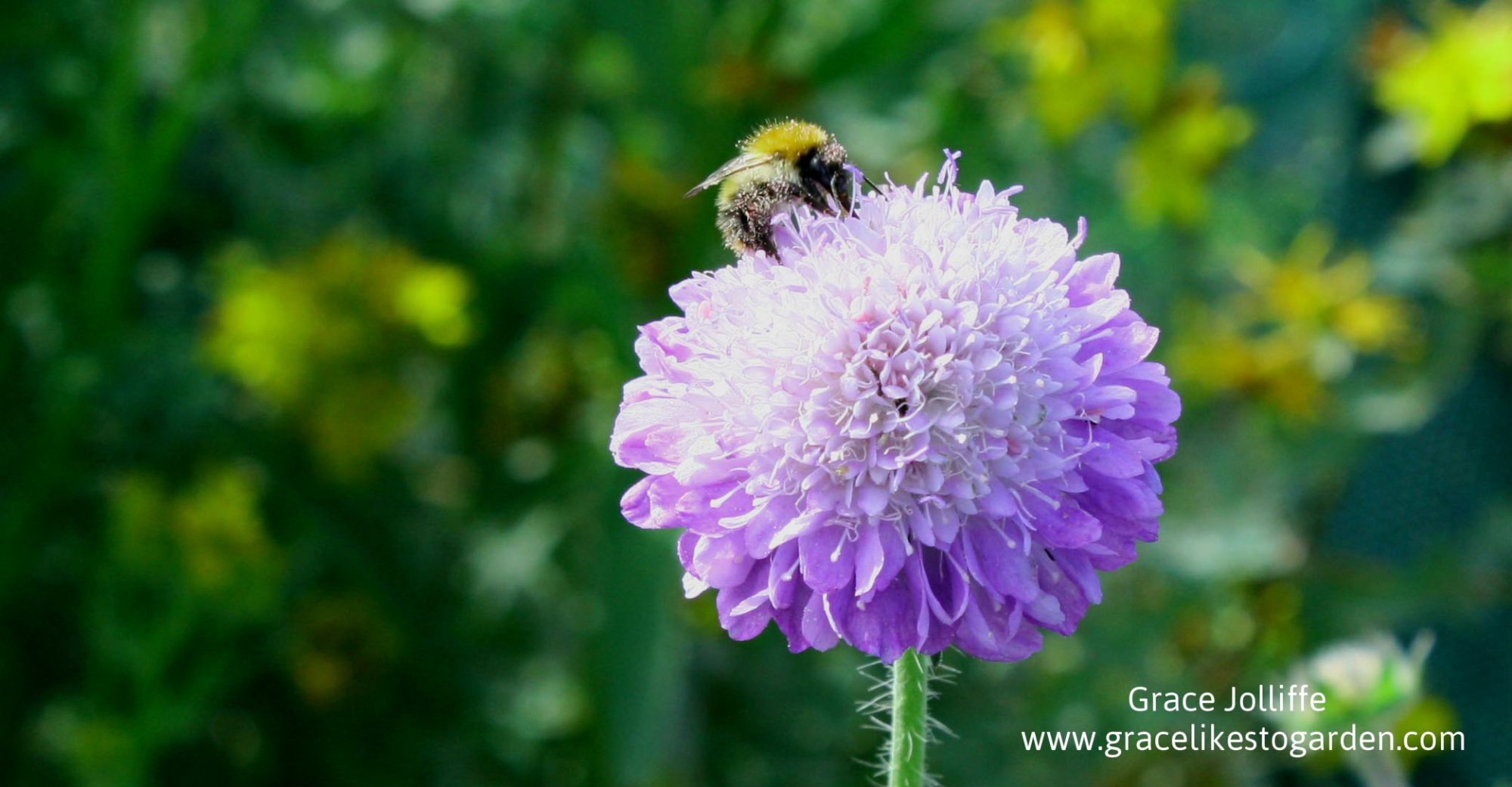
Scabiosa is one of 87 plants recently added to the inventory of “invasive” plants in California, despite the fact that is isn’t invasive in California. Scabiosa is very useful to bees because it blooms prolifically for much of the year.
More alarming is that most of the additions to the list are not considered “invasive” in California. Rather, a new category of “potentially” invasive plants was created, based on their behavior elsewhere. Many of the plants in the new category are considered invasive in Hawaii, a place with a distinctly different climate than California. Hawaii is a tropical climate, hotter than much of California and wetter and more humid than everywhere in California.
The big increase in the number of plant species now designated as “invasive” in California is a concern partly because of the herbicides that are usually used to eradicate them. Not only do we lose that plant species in our landscape when it is added to the hit list, we can also expect to see an increase in the use of the herbicides that are used to kill it.
Increased use of herbicides
Native plant advocates are aggressively defending the use of herbicides. Policies and practices are being developed to accommodate increased use of herbicides on our public lands.
East Bay Municipal Utilities District (EBMUD) is evaluating its Integrated Pest Management Program (IPM), including practices and policies regarding pesticide use. The first draft of EBMUD’s revised IPM program was made available to the public in July 2017. The draft adds several new goals to the IPM program: “habitat protection and restoration,” reducing populations of “invasive plant species,” and “use of alternative vegetation such as native plants.” EBMUD is the supplier of our drinking water in the East Bay and the quality of the water they supply should be the top—if not the only—priority. If destroying non-native plants requires greater use of herbicides, that goal contradicts EBMUD’s obligation to providing safe drinking water.
Garlon sprayed on the trail in a San Francisco park. San Francisco Forest Alliance
San Francisco’s IPM program has also changed some policies to accommodate use of herbicides in parks on plants the Natural Resource Division of the parks department considers “invasive.” The parks department restricts all park access to the established trails in the 33 “natural areas” where non-native plants are eradicated and replaced by native plants. The new IPM policy permits the spraying of herbicides without posting pesticide application notices in places that are “publicly inaccessible.” In other words, pesticide application notices are no longer required in the “natural areas” unless herbicides are sprayed on the trails. One way to reduce the public’s opposition to pesticides is to hide their use and this policy seems designed to do that.
Update: The San Francisco Forest Alliance (SFFA) has informed me that Chris Geiger, head of San Francisco’s IPM program, has given assurances that the IPM program will no longer offer City departments a blanket exemption to apply herbicides without posting in areas the department considers “publicly inaccessible”. Previous to this, each land manager was empowered to make their own decisions as to which areas they considered “publicly inaccessible”. The IPM group did not provide oversight of the decisions or keep records of which areas were exempted. Now specific exemptions will be issued and recorded on the IPM exemptions webpage. Chris Geiger reports RPD will not be requesting any posting exemptions. SFFA is still waiting for formal written documentation of this change.
This post will focus on the intersection of these symptoms of the escalating war on “invasive” plants: the expansion of California’s inventory of “invasive” plants and the closely associated claim that non-native plants must be eradicated because they compete with the native plants required by wildlife. We use buddleia, commonly known as butterfly bush, as an example.
Butterfly Bush (Buddleia): friend or enemy of butterflies?
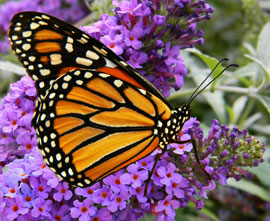
Monarch nectaring on butterfly bush. butterflybush.com
Buddleia is one of 87 plant species recently added to Cal-IPC’s inventory of “invasive” plant because it is considered invasive outside of California. Buddleia is called butterfly bush because it produces large quantities of nectar that attract swarms of butterflies. Since buddleia is very appealing to butterflies, it is popular with gardeners who like to see butterflies in their gardens.
Since buddleia is obviously useful to butterflies and Doug Tallamy claims to be concerned about the welfare of our pollinators, why is he telling gardeners to quit planting buddleia?His advice is based on the fact that buddleia is considered invasive in some places and his belief that it will eventually be invasive everywhere. In fact, that’s his belief about all non-native plants: they may not be invasive now, but he predicts that eventually they all will be invasive.
Secondly, Tallamy argues that although buddleia provides food for butterflies, it is not a host plant for butterflies. The host plant is where butterflies lay their eggs and where the caterpillar feeds when the eggs hatch. The choice of host plant species is much smaller than the number of food plant species available to butterflies, but it is not as small as Tallamy thinks it is. Tallamy does not seem to realize that many plants are chemically similar, which enables butterflies to make a transition from a native plant to a chemically similar non-native plant. Here in California, many butterfly species have made that transition and a few butterfly species are dependent upon abundant non-native plants that are available year-around because their original native host plant is dormant much of the year.
Buddleia “starves” butterflies?
This is Tallamy’s apocalyptic prediction about the fate of butterflies if gardeners continue to plant buddleia:
“It’s no exaggeration to say that when you choose which plants to include in your garden, even the beautiful, seemingly harmless butterfly bush, you’re deciding if members of your community’s local food web will be nourished or unintentionally starved. And to get to that mind frame, which is a way of thinking that truly benefits nature, including its butterflies, you’re going to have to come to a harsh realization: You need to stop planting the butterfly bush—forever.” (1)
Ironically, this harsh verdict on buddleia was published by a blog entitled, “Organic Life.” Is Organic Life unaware of the fact that the most widely used method of eradicating non-native plants is spraying herbicides? The consequence of adding more plant species to the long list of “bad plants,” is more pesticide use. That’s not very “organic.”
What amoral, selfish gardener would plant buddleia in their garden after such a severe scolding? First, let’s stop and think about the logic of the claim that buddleia will disrupt the “food web” and starve butterflies. Since buddleia is an excellent source of nectar and swarms of butterflies are observed nectaring on buddleia, how could we be “starving” them? Professor Art Shapiro (UC Davis), our local butterfly expert, said when asked about this article, “The ‘disrupting food webs’ argument is ludicrous. It’s equivalent to saying that if you eat popcorn rather than apples, you’re contributing to unemployment in the apple-picking industry.”
Is buddleia a host plant for butterflies?
Now let’s consider the argument that we should not plant buddleia in our gardens because although it feeds butterflies, it isn’t their host plant where they lay their eggs. The problem with that argument is that it isn’t true!!
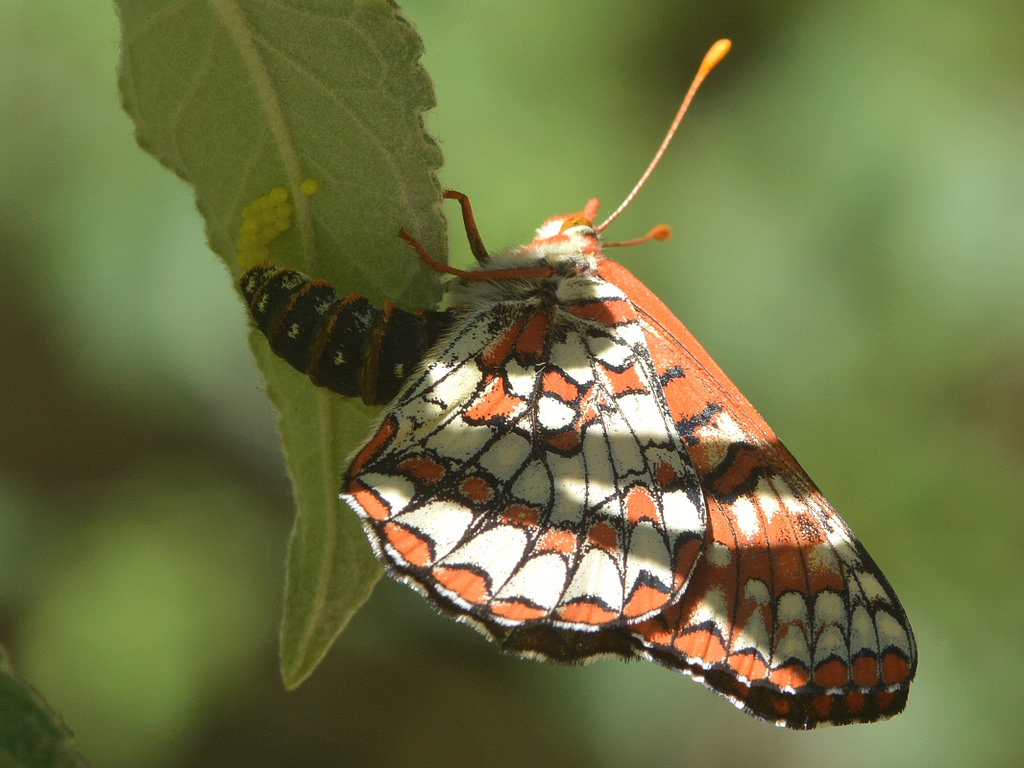
Checkerspot laying eggs on buddleia, near Santa Barbara. Photo by Marc Kummel
In 1940, Charles M. Dammers reported that the Variable Checkerspot (Euphydryas chalcedona) “can use” buddleia as a substitute for its usual native host in southern California desert-mountain areas, based on a laboratory study of the larval stages of its caterpillar on buddleia. In 2001, chemical analysis of buddleia found that it is chemically similar to the native host of the checkerspot, which confirmed the potential for such a substitution.
The first actual observation of checkerspot butterflies breeding spontaneously and successfully on buddleia was in Mariposa County, California in the Sierra Nevada foothills. “Mariposa” is Spanish for butterfly. Mariposa County was named by an early Spanish explorer who saw many butterflies near Chowchilla.
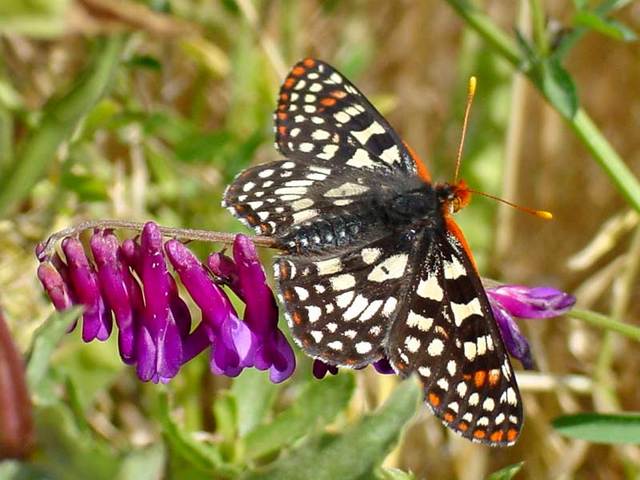
Checkerspot bred successfully on buddleia in 2005 and in subsequent years. This colony of checkerspot on buddleia was reported in 2009: “We conclude that buddleia davidii [and other species of buddleia] represents yet another exotic plant adopted as a larval host by a native California butterfly and that other members of the genus may also be used as the opportunity arises.” (2)
Variable checkerspot. Photo by Roger Hall
More recently, a gardener in Mendocino County also reported the use of buddleia as the host plant of checkerspot:
“By now I am questioning how it was that butterfly larvae were using my butterfly bush as a host plant, completely against everything I’d ever heard. How was this possible? I emailed Art Shapiro, a very well-known butterfly expert and author, sending him a pic. He wrote back to confirm they were butterfly larvae, but added, ‘These are not mourning cloak butterflies. They are checkerspots. And the only time I’m aware this has happened [like, ever, except one in a lab in 1940…] is in Mariposa County.’” (3)
Bad rap for non-native plants
When the native plant movement began some 30 years ago, native plant advocates promoted their agenda with a straight-forward claim that they are superior to non-native plants. The public was initially resistant to that argument because non-native plants have been around for a long time and people have become fond of them.
Native plant advocates began to fabricate stories about the evils of non-native plants to convince the public that eradicating them was necessary because they are harmful to wildlife and they damage the environment. The Million Trees blog was created to address those claims.
But Doug Tallamy’s active participation in the crusade against non-native plants is a special case because he is an academic entomologist, credentials that make him more influential with the public. For that reason, Million Trees has critiqued several of his publications.We publish this critique of Tallamy’s opinion of buddleia for several reasons:
Buddleia is very useful to butterflies. The loss of buddleia in our gardens would be a loss to butterflies.
San Francisco’s IPM program is using Doug Tallamy’s mistaken theories to promote the use of herbicides to eradicate non-native plants in San Francisco.
Buddleia is one of 87 plants that have been classified as “invasive” by the California Invasive Plant Council despite the fact that it is NOT invasive in California. The expansion of the list of “invasive” plants in California to include plants that are NOT invasive in California, will increase the use of herbicides and will eliminate plants that are performing valuable ecological functions.
https://www.rodalesorganiclife.com/garden/never-plant-butterfly-bush (N.B. The butterfly in the photo in this article is European Small Tortoiseshell, found in Britain and in Europe. The caterpillar in the photo is the monarch caterpillar on its host plant, milkweed. Buddleia is food for both of these butterfly species.)
Arthur M. Shapiro and Katie Hertfelder, “Use of Buddleia as Host Plant by Euphydryas chalcedona in the Sierra Nevada foothills, California,” News of the Lepidopterists’ Society, Spring 2009
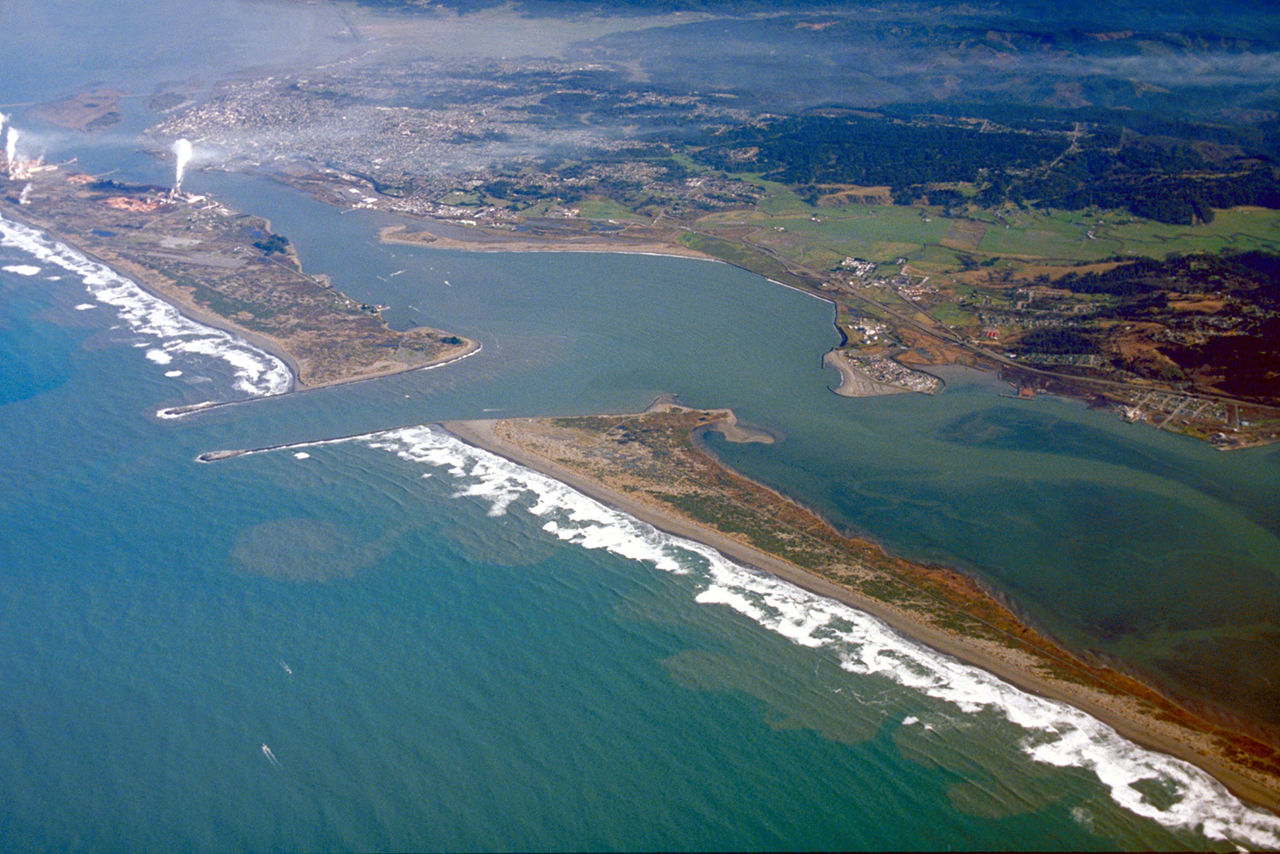
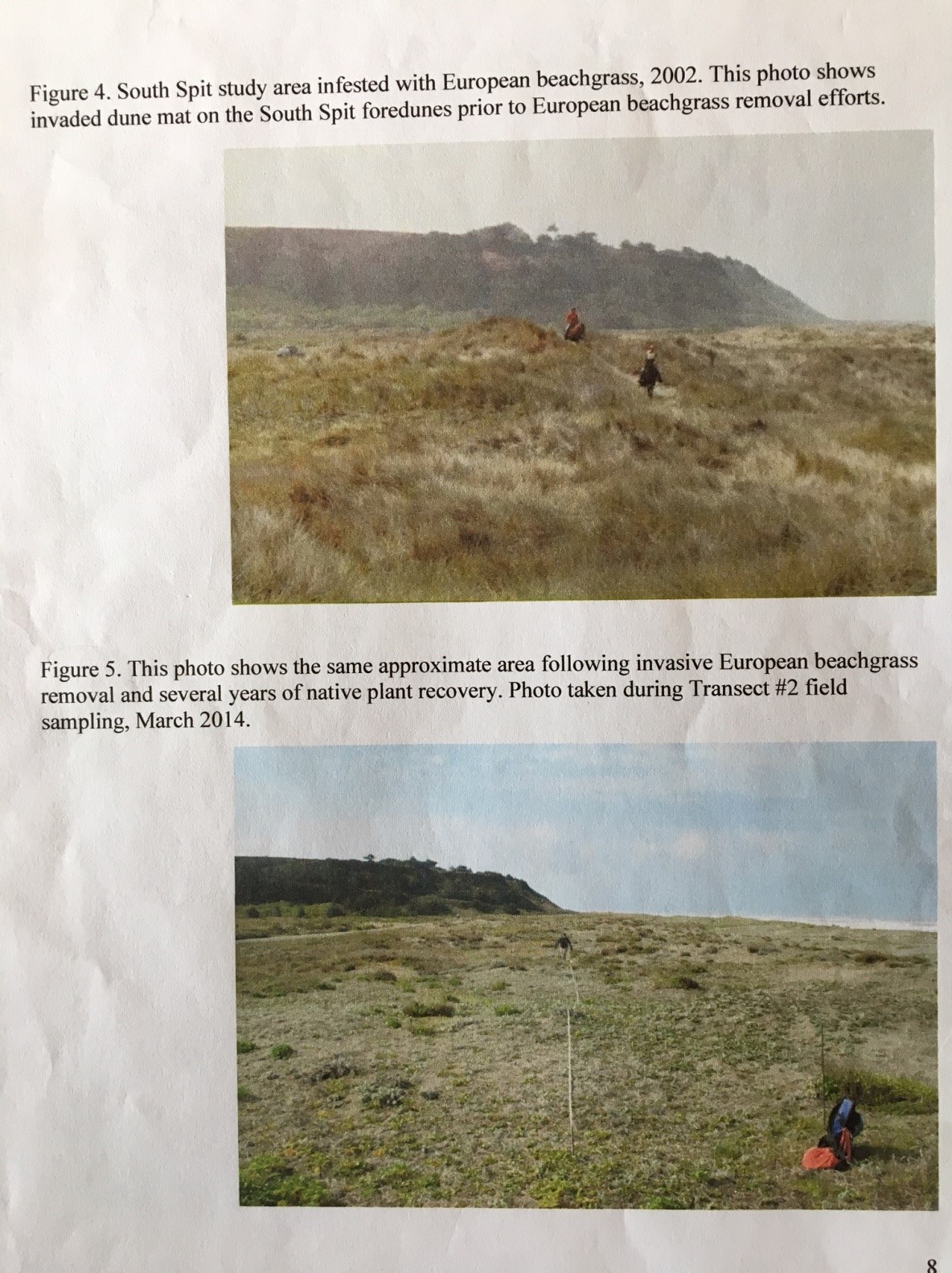
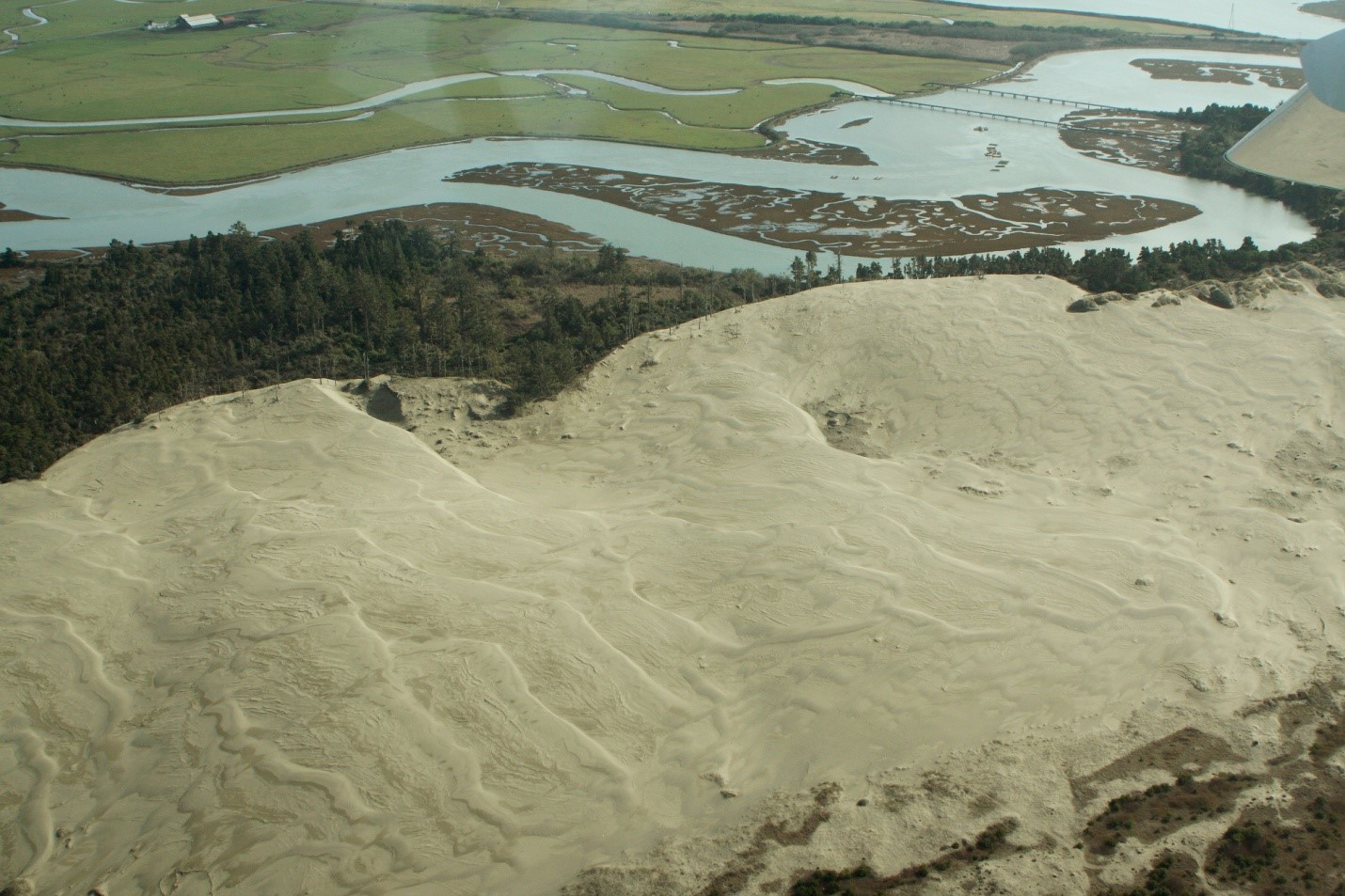
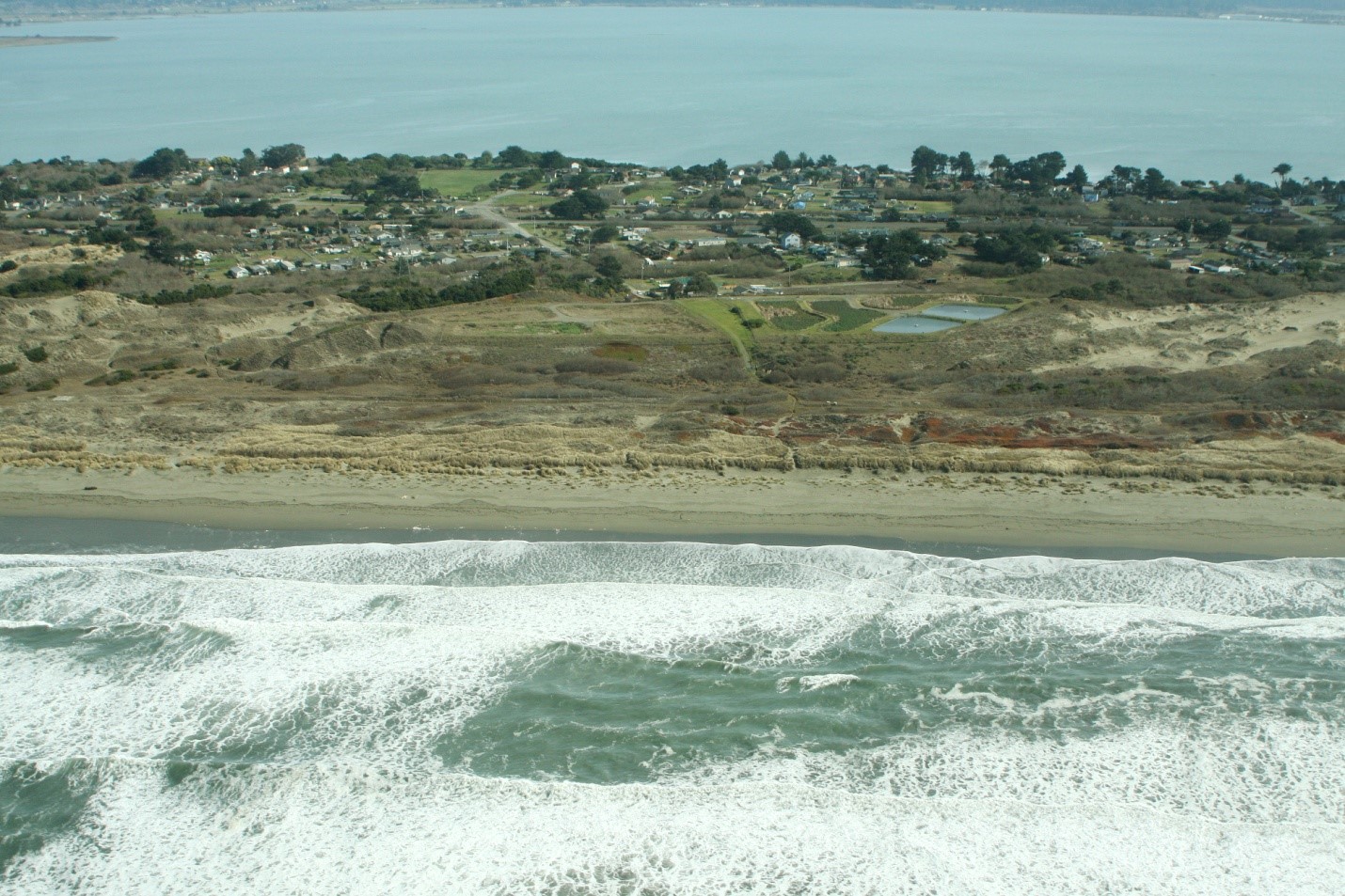
It is my pleasure to publish a guest post about dune “restorations” in Humboldt County that began about 30 years ago. Like most “restorations,” these projects are primarily destroying non-native plants. More often than not, they don’t plant native plants to replace the plants they destroy, although the stated goal is to “restore” native plants.
Uri Driscoll tells us why the non-native plants were planted over 100 years ago and the consequences of removing them. According to Mr. Driscoll’s Facebook page, he has lived in Arcata, Humboldt County since 1983. He has had a life-long interest in outdoor recreation, horses, organic farming, and conservation. He is a member of Arcata’s Open Space and Agriculture Committee.
If you live in the San Francisco Bay Area, you might think these projects are not relevant to us. In fact, they have everything to do with us because there are many similar projects here and the issues with those projects are similar.
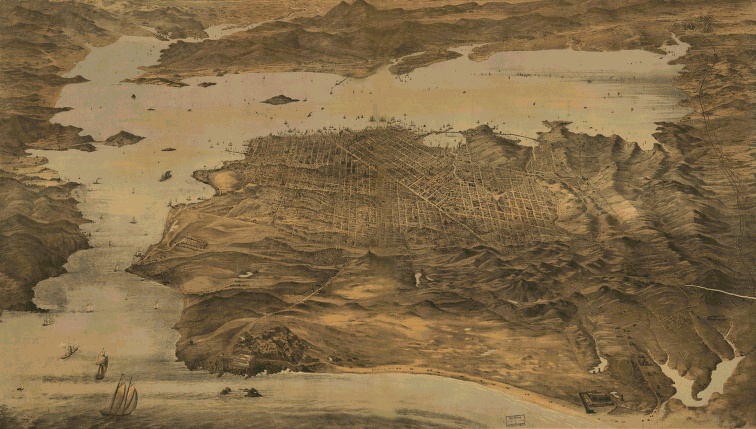
Bird’s eye view of San Francisco in 1868. US Library of Congress
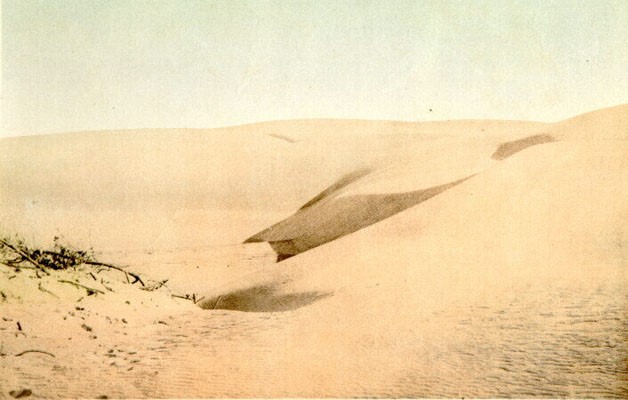
The San Francisco peninsula was about one-third barren sand dunes when Europeans first arrived at the end of the 18th century. About 30 years ago, native plant advocates decided they wanted whatever open space that still remains on the peninsula to be returned to pre-settlement conditions, including sand dunes where they existed in the past.
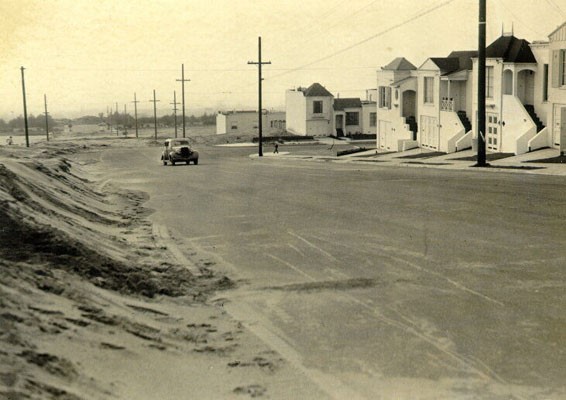
These are the sand dunes in San Francisco where Golden Gate Park was built by creating a windbreak by planting trees. The windbreak stabilized the sand dunes and made it possible to plant and sustain vegetation behind the protection of the windbreak. San Francisco Public Library, historical photo collection.Pacheco & 32nd Ave, San Francisco, 1943. San Francisco Public Library, historical photo collection
As residential neighborhoods in San Francisco were developed, iceplant and European beach grass were planted on the sand dunes to hold the sand in place. Native dune plants are not capable of stabilizing sand for long, before strong winds move the sand beneath them. In fact, the long term survival of native dune plants is dependent upon these disturbances.
Iceplant has been removed from several sand hills in residential neighborhoods, dumping sand on the properties at the base of the hills. The Great Highway, which separates Ocean Beach from the residential Sunset District is often closed because of drifting sand after removal of beach grass.
In fact, everyone living on the coast of California should have an interest in the preservation of our sand dunes because they are our first line of defense against rising sea levels and the intense storms associated with climate change. If non-native plants and trees are needed to maintain the stability of our sand dunes, so be it. Competing agendas must take a back seat to the safety of our coastal communities.
Million Trees
Stable Dunes or Native Plants?
The North and South Spits of Humboldt County are the physical barrier between Humboldt Bay and the Pacific Ocean. After the introduction of European beach grass (Ammophila arenaria) in the early 1900’s there has been a substantial stabilizing effect on the dunes as they grew wider and taller. Prior to the establishment of the grass our dunes consisted of wide expanses of unvegetated, open, moving sand. This is in sharp contrast to the variety of plant cover we have today.
Humboldt Bay
In the 1980s public land managers began removing European beach grass with the goal of restoring native vegetation. This is the story of the consequences of their projects.
Foredunes (the sand ridges parallel to and closest to the shore) with open, actively moving sands have a very high potential for accelerated erosion. The foredunes of the North Spit and South Spit are still extremely vulnerable to accelerated erosion caused by disturbances to the vegetation. A beach and dunes management plan and Environmental Impact Report (EIR) was developed in 1993 to address such issues.
Of greater concern, waves have washed over the foredunes on both spits where waves have breached the foredune where vegetative cover had been removed. Repeated overwash events would significantly and immediately impact the only access road to the South Spit and the municipal water main and water treatment facilities on the North Spit.
These dunes could again be set in motion by removal of the protective cover of native and non-native vegetation. Indeed, the intention to remobilize dunes was identified in the Conditional Use Permit application Bureau of Land Management (BLM) submitted for vegetation removal at Table Bluff County Park, a portion of the South Spit. However, those intentions are contrary to the local Humboldt Bay Beach and Dune Management Plan and accompanying EIR.
The danger is that the South Spit’s dune topography is characterized as typically low and narrow. With erosion and subsequent lowering of the foredune that occurs following vegetation removal, the right combination of concurrent high-magnitude seismic subsidence and wave attack could cause collapse of the land barrier between the Ocean and Humboldt Bay. With anticipated sea level rise we would see this risk multiply.
Source: 2008-2014 BLM monitoring report
The problem is that the previous and on-going work to remove European beach grass from the North and South Spits (in the effort to restore natural conditions and processes) has not and does not provide for the immediate re-establishment of other comparable vegetative cover to trap moving sand and prevent accelerated dune erosion. By not including this mandated mitigation measure, there is a real, legitimate potential for significant, cumulative environmental impact.
Why was European beach grass introduced?
The important thing to understand is that this specific type of beach grass (Ammophila arenaria) was introduced in Humboldt County in the early 1900’s. It was done in order to stabilize dunes to protect growing communities and infrastructure. It had the additional benefit of creating extensive coastal wetlands and wildlife habitat. By collecting sand from the beach the grass builds protective and multiple parallel ridges and accompanying deflation planes. These depressions behind the ridges act as sheltered nurseries for new plant and animal life. This process can take several decades but is reversed rapidly after the grass is removed. Such an effect has happened not only in Humboldt County but also in Point Reyes where valuable wetlands and organic pastures have been smothered by destabilized sand.
Why was European beach grass removed?
When the efforts to remove the non-native, albeit naturalized grasses began in the early 1990’s invasive biology was in its infant stages. Not much was known about the impacts from the eradication efforts of dominant species. But to some it was important to return coastal areas to the pre-beach grass era so native plants would not be out-competed.
Every movement needs a poster child. About this same time a cute little shore bird named the western snowy plover became just that. Even though it is registered as a threatened species on the west coast, other parts of the country and Mexico have significant and stable populations. We were told by local biologist Ron LaValley that the non-native grass needed to be removed to recover the local plover’s population. This claim contradicted his original report showing plover eggs nestled in the non-native grass. He was later convicted and sent to jail for falsifying data and embezzling a million dollars from similar projects involving the spotted owl.
Recognizing that manual eradication was very expensive and time consuming, California State Parks decided to bulldoze 40+ acres of Little River State Beach to provide plover breeding areas. Unfortunately, as Humboldt State Professor Mark Colwell noted in his 2008 report “importantly, eggs often fail to hatch in restored areas.” This is largely because ravens and crows find it easy to locate the nests in open sand areas.
The Lanphere-Christenson Dunes Refuge director Eric Nelson determined during a 2016 Climate Ready project that the foredunes were being excessively eroded by the 25 California Conservation Corp (CCC) workers who were digging out beach grass. His decision to spray glyphosate and imazapyr instead of hand removal was carried out despite public opposition. It remains unclear whether, despite acknowledging excessive erosion from manual eradication efforts, the refuge will return to using that method again.
Lanphere Dunes and Mad River Slough
The public takes notice of the consequences
Some of us who live near these project areas and use them for recreation started noticing native tree mortality and changes to the landforms caused by removing the stabilizing grasses. We started doing some initial research. We began looking into coastal development permits, beach and dunes management plans and monitoring reports. Our findings revealed the project areas that actually had permits also had mitigation requirements. Those included immediate replanting and strict monitoring to make sure topography and landforms were not altered. When we inquired about the monitoring and replanting programs we found those to be significantly deficient and in some cases non-existent.
Taking action
Our next step was to approach the various regulatory agencies. US Fish and Wildlife Service, California Department of Fish and Wildlife and the State Water Board should be interested in the freshwater wetland infill we were witnessing. The Harbor District and the municipal water district have a major interest in securing the two 42-inch industrial water mains protected by the same beach grass that was being removed. The Manila Community Service District maintains a waste water treatment facility on the dunes. We thought the California Coastal Commission would certainly want to know that these unauthorized alterations to coastal landforms were taking place. We felt sure the County planning department that issued some of the permits would take enforcement action.
The town of Manila’s water treatment facility
We brought photo and research documents from Oregon and Washington (2 and 3), made presentations and had meetings, site visits and sent email communications to no avail.
We stepped back and took a look at the board of directors for the non-profit called Friends of the Dunes (FOD) that has been promoting the grass removal from the very beginning. They had grown from a small, broken down 400 square foot building with a net worth of about $20,000 in 2004 to 60 + acres of ocean front property with a 3000 square foot building and a net worth of over $3.4 million in 2014. The board of directors at the time consisted of employees of most of the agencies listed above. We understood then why we were running into so many road blocks.
Our community is well known for environmental activism. So why the hesitation of local environmental organizations like the North Coast Environmental Center (NEC), Environmental Protection Information Center, and Bay Keeper to call out such impacts caused by bulldozers, herbicide spraying and wetland infilling? We can only presume that the banner of “restoration” has been used as a blindfold.
Some significant successes….more to do
We have had worthy successes. Through our efforts the California Coastal Commission has asked the Bureau of Land Management (BLM) for a new determination to address the impacts related to the Ocean Day activities involving 1000 school children digging grasses from the dunes. So far, the BLM does not think it needs to provide that. BLM puts on the event but the Coastal Commission bankrolls it. We do not know yet what the Commission’s response will be to that refusal.
The town of Manila has stopped grass removal activities in its management area and has supported the planting of native pine trees (Pinus contorta, contorta) in the dunes, which we did last February.The County planning department is engaged and acknowledges that there has been no contract with the California Conservation Corp or BLM for prior grass removal at the County Park and will not allow any more vegetation removal until a Memorandum of Understanding is developed.
The Coastal Commission has committed to reviewing the authorization allowances for BLM’s grass removal over the rest of the South Spit. The existing Plan states a two-acre area would be subjected to grass removal strictly for monitoring purposes not the mile long area subjected to eradication to date. BLM contends that authorization extends over the whole 800-acre Spit but have not been able to provide supporting documents.
The North Coast Environmental Center and even the Friends of the Dunes (FOD) took a position against spraying herbicides on the dunes.
Former board members of the FOD that are regulatory agency officials have resigned their director positions.
Communities around the country are hosting events to plant beach grasses like the ones that have been removed here. Recognition of the incredible value of stabilized dunes is becoming more wide spread. The “non-native” label is becoming more questioned.
Setting new goals and looking ahead
For us on the North Coast of California we need a much more cost effective and precautionary approach than tearing out plants that have beneficial attributes.We need to allow the beach grass to do its job of stabilizing and protecting our dunes. As we allow it to do that, the beach grass “declines in vigor” (4). When that happens, other plant and animal species utilize those protections from the harsh winds and tides of the Pacific and establish heathy vibrant wildlife habitat. Our local and migratory wildlife depend on it. And so do we.
Uri Driscoll, Arcata, California
We commend the people of Humboldt County for paying attention to the damage that is being done to their public land and we congratulate them on the progress they have made to prevent further damage. We are impressed with the methodical approach they have taken to convincing public land managers to reconsider the goals of the project and the methods being used to accomplish them.
We wish them the best of luck with their efforts. We are grateful to Uri Driscoll for taking the time and trouble to share this story with our readers.
Million Trees
(1) South Spit Interim Management Plan 2002.
(2) Evaluating Coastal Protection Services Associated with Restoration Management of an Endangered Shorebird in Oregon, U.S.A. Lindsey Carrol