A defensive tirade from invasion biologists

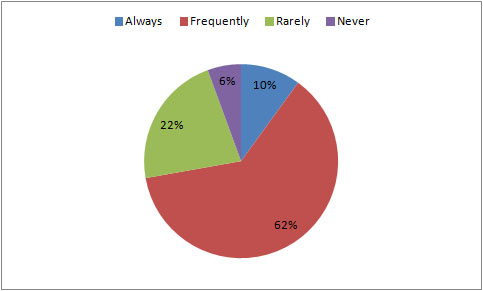
Pesticide use by land managers in California.  Source California Invasive Plant Council
Pesticide use by land managers in California. Source California Invasive Plant Council

An international team of invasion biologists has just published a defense of their academic turf, invasion biology.  (1) Daniel Simberloff, an American member of the team, is the most relentless defender of the crusade to eradicate all non-native species, wherever they are found, all over the world.  Their publication acknowledges the mounting criticism of this crusade and attempts to respond to that criticism, but what is most notable is what is missing from their attempt to defend their opinions.  They make no mention of the harmful methods used to eradicate non-native species:

Keep these damaging methods in mind as we visit the hypocritical and contradictory arguments used to justify the projects for which these invasion biologists advocate.  They set up “novel ecosystems” as the straw man to which they compare the goals of invasion biology.  They define novel ecosystems as “a new species combination that arises spontaneously and irreversibly in response to anthropogenic land-use changes, species introductions, and climate change, without correspondence to any historical ecosystem.”

“Lack of rigorous scrutiny”

Their primary criticism of the concept of “novel ecosystems” is that it has not been “subjected to the scrutiny and empirical validation inherent in science” and its definition is “impaired by logical contradictions and ecological imprecisions.”   These criticisms apply equally to invasion biology.

Hypothesis n % of supporting studies % of decline in support
Invasional meltdown

30

77%

41%

Novel weapons

23

74%

25%

Enemy release

106

54%

10%

Biotic resistance

129

29%

5%

Tens rule

74

28%

10%

Island Susceptibility

9

11%

25%

Although support is strongest for the invasional meltdown hypothesis, recent studies are less supportive than early studies, indicating substantial decline in supporting evidence.  Declining evidence of invasional meltdown is consistent with the fact that exotic species are eventually integrated into the food web which reduces their populations, stabilizing their spread. There is apparently little evidence that islands are more susceptible to invasion than continents and few studies have been done to test the hypothesis.

If empirical validation and semantic precision are required to establish the credibility of scientific hypotheses, invasion biology has failed that test.

“Precautionary principle of conservation and restoration”

These invasion biologists define the precautionary principle of conservation and restoration as follows:  “we should seek to reestablish –or emulate, insofar as possible—the historical trajectory of ecosystems, before they were deflected by human activity.”  This is an unusual use of the precautionary principle, which is more typically defined as avoiding damage to the environment by not using potentially harmful methods, even in the absence of solid evidence of such harm.  The precautionary principle was not used when the following “restoration” projects were defined or implemented:

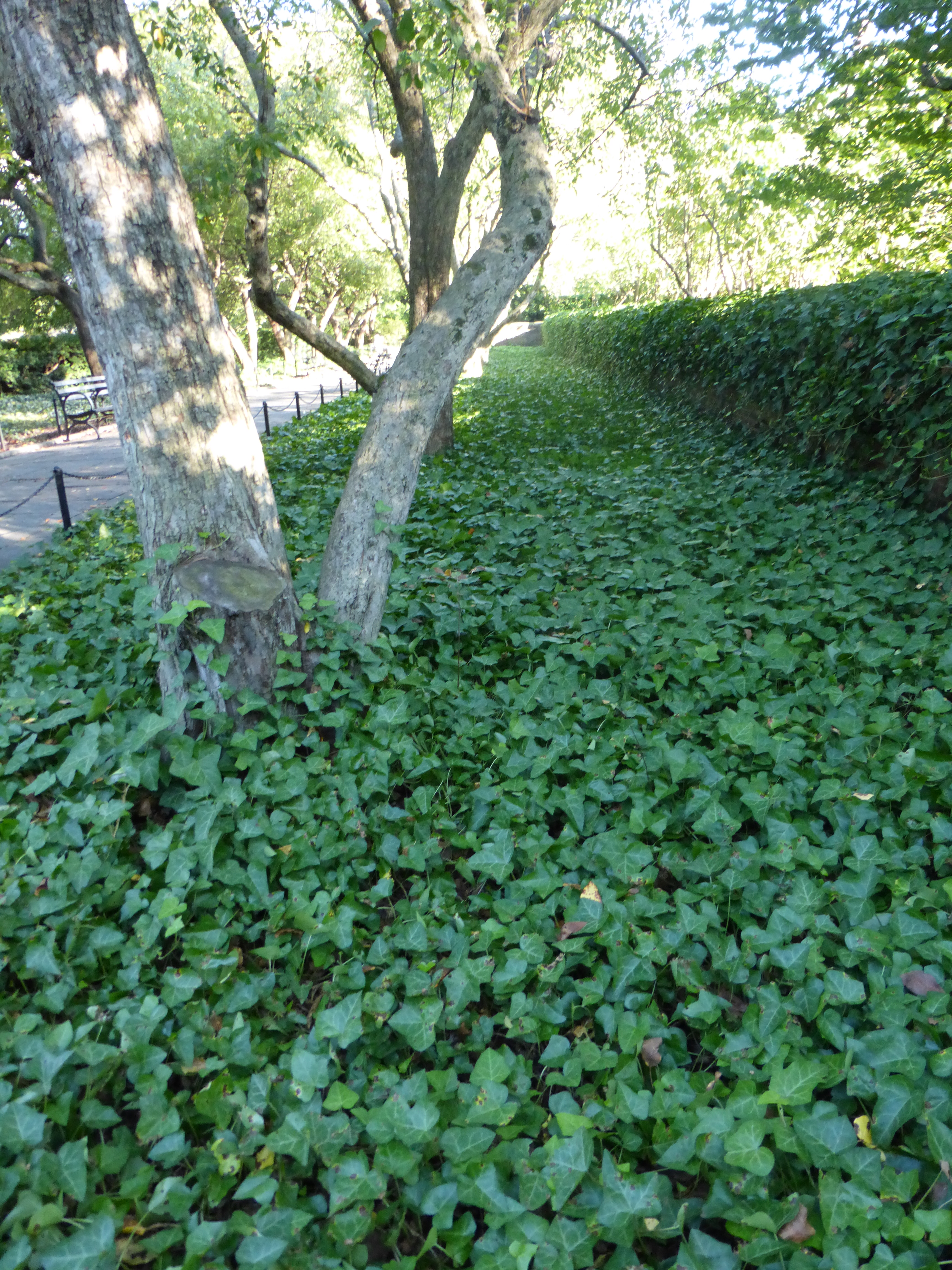
Ivy in the Conservatory in Central Park, New York City

In 1996, Daniel Simberloff made this statement in his publication about the hazards of biological controls:  “…are there any protocols for biological-control introductions that would prevent all disasters?  Probably not…” (2) Yet, in 2013, he expressed his support for the introduction of non-native insects to control cape ivy at a conference at UC Davis sponsored by the California Department of Food and Agriculture.  Although cape ivy is despised by native plant advocates, it is not an agricultural pest and therefore causes no economic damage to ecosystems, unless money is wasted on attempts to eradicate it.

“All ecosystems should be considered candidates for restoration”

In response to those who find value in novel ecosystems, these invasion biologists find none.  They reject the possibility that there is ever a point at which it may not be possible to re-create a historical landscape.  They continue to believe that ANY and ALL radically altered landscapes CAN and SHOULD be considered candidates for restoration.  Their only caveat to this universal goal is that “damaged ecosystems…should be evaluated for feasibility, desirability, and cost-effectiveness, on a case-by-case basis, so that informed and science-based policy decisions can be made, in consultations with scientists, restoration practitioners, stakeholders, and advisors.”

These criteria for potential “restoration” have nothing to do with reality:

  • Most projects in the San Francisco Bay Area have not provided cost estimates when they were planned. The public demanded cost estimates for the projects of the Natural Areas Program in San Francisco, but these demands were ignored.  Therefore, “cost-effectiveness” is not usually considered when these projects have been shoved down the public’s throat.
  • We consider the public to be “stakeholders” in decisions to radically alter our public open spaces. We are the visitors to these areas and our tax dollars pay for their acquisition, maintenance, and “restoration.”  Yet, managers of public land are consistently making those decisions without taking the public’s opinion into consideration.  Most projects are planned and executed without any public participation.  In the few cases in which there are environmental impact reviews, the projects are implemented regardless of overwhelming opposition of the public.

 “Human-damaged ecosystems can be at least partially restored”

The demonstrated futility of “restoration” projects is one of many reasons why there is waning public support for attempting them.  Yet, invasion biologists who authored this diatribe claim that “restored sites recovered on average 80-86% of biodiversity and ecosystem services…and showed improvements of 125-144% over degraded ones.”  This claim is contradicted both by other scientific studies and by experience with local projects:

  • “…this paper analyses 249 plant species reintroductions worldwide by assessing the methods used and the results obtained from these reintroduction experiments…Results indicate that survival, flowering and fruiting rates of reintroduced plants are generally quite low (on average 52%, 19%, and 16% respectively). Furthermore, our results show a success rate decline in individual experiments with time.  Survival rates reported in the literature are also much higher (78% on average) than those mentioned by survey participants (33% on average).” (3)
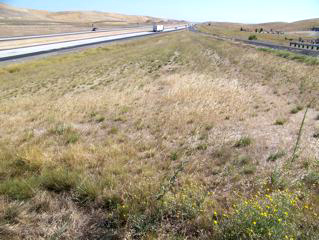
  • Dunnigan Test Plot, Augusst 2011.  The result of an eight-year effort to restore native grassland.  Does it look "biodiverse?"  ecoseed.com.
    Dunnigan Test Plot, August 2011. The result of an eight-year effort to restore native grassland. Does it look “biodiverse?” ecoseed.com.

    There is frequently a discrepancy between the success rates claimed in papers and those actually observed. For example, Cal-Trans gave researchers at UC Davis $450,000 to restore 2 acres of non-native annual grassland to native grassland.  UC Davis researchers spent 8 years and used multiple methods to achieve this transition.  When they ran out of money, they declared success in their published report.  They defined success as 50% native plants which they expected to last 10 years before being entirely replaced by non-native annual grasses again.  Do you consider that a success?

  • On a more anecdotal level, we watch established landscapes that have required no maintenance in the past being transformed into weedy messes by failed “restoration” projects. Then, adding insult to injury, we hear those who are responsible for these failures tell us how successful they are.
“Inadequate political will”

The authors of this publication conclude:

“No proof of ecological thresholds that would prevent restoration has ever been demonstrated.  Often the threshold that obstructs a restoration project is not its ecological feasibility, but its cost, and the political will to commit to such cost.” (1)

We are reminded of an old football adage:  “The best defense is a good offense.”  In other words, invasion biology is under fire, but the reaction of invasion biologists is to demand more….more money, more effort, and the commitment of public land managers to “restore” all ecosystems, regardless of what the public wants.  And in support of that aggressive strategy, they refuse to acknowledge the damage that is being done to the environment and the animals that live in it, by the projects they demand.

The authors of this defensive tirade have hammered another nail in the coffin of invasion biology.


  1. Carolina Murcia, James Aronson, Gustavo Kattan, David Moreno-Mateos, Kingsley Dixon, Daniel Simberloff, “A critique of the ‘novel ecosystem’ concept,” Trends in Ecology and Evolution, October 2014, Vol. 29, No. 10
  2. Daniel Simberloff and Peter Stiling, “How Risky is Biological Control?” Ecology, 77(7), 1996, pp 1965-1974
  3. Sandrine Godefroid, et. al., “How successful are plant species reintroductions?” Biological Conservation,   144, Issue 2, February 2011
Where does it end?

It is our pleasure to republish with permission a post from the website of Flood Creek Non-Nativist Landcare Group.  Flood Creek is located in Braidwood, New South Wales, Australia.  Across Australia, Landcare is a popular volunteer-based environmental movement which enjoys general support from government in the form of occasional financial grants. Over the last 25 years, many Landcare groups have undertaken projects with the stated goal of eradicating non-native plants based on a belief that native plants and animals would benefit.  That strategy will sound familiar to our readers, as will the damage to the environment which it causes.  

The Non-Nativist Landcare Group is a small team of people with a history of participation in Landcare who want to foster a discussion of current nativist approaches to environmental management, and question their outcomes.  Based on their experiences with conventional Landcare projects, the Non-Nativist Landcare Group has concluded that these often do more harm than good.  The Group describes their mission:   “Above all, this discussion is inspired by the goal of taking a more ecologically-based and functional approach to Australian socio-ecological systems and their health. We seek to highlight the inconvenient-truth that rational environmental management can never be based upon a simple mantra of “natives good, non-natives bad”. Extermination is rarely an effective way to promote landscape diversity and resilience.”

Please visit their website and wish them well in their effort to find a less destructive approach to land management.


When you look at the willful and wanton environmental destruction conveyed in these photographs you must ask yourself: ‘how could anyone do this in the name of environmentalism?’ After all the disturbance we’ve already inflicted upon this biosphere, how is this really helping?

Flood Creek 1


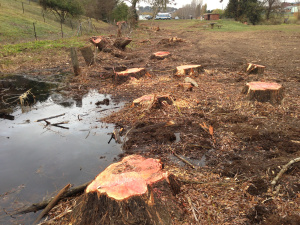
In this example of willow demolition, the trees were cut down and dragged away and the stumps were poisoned. Then (for some unfathomable reason) a drainage ditch was excavated into the floodplain. In the photo below, the main flow-line is 40m off to the left.

Flood Creek 2

Apart from the economic motives at play (a theme for a future post), I can think of only one reason why an ‘environmentalist’ might condone this kind of damage and disturbance. It must be to do with that old adage, ‘the end justifies the means‘.

The reasoning seems to be: ‘Sure, it makes a big mess and causes erosion, and nutrient release, and carbon emissions, and local temperature increases, and loss of habitat, but it’s necessary because we’re going to make Australia a place for natives-only again.’

So that’s the end we’re aiming for: a ‘native-only’ Australia. And these photos show the means we must accept along the way.  It seems we’re just going to remove all of the non-natives from this continent so the environment is back to ‘pristine’ again and then we can stop with the chainsaws and excavators and herbicides in the name of ‘saving’ the environment.

Flood Creek 3

We just want 1788-Australia back. Presumably without the dingoes and without the previous intrinsic Aboriginal management; plus with a few minor additions like cattle; and sheep; and horses; and apples; and asparagus; and hops; and wheat; and rice; and trout; and tomatoes; and lettuce; and cats; and dogs; and goldfish; and maybe just one or two other things, but that’s it! And we want all the ‘invasive’ natives, like Cootamundra Wattle, and Sweet Pittosporum, and Kookaburras to know their place and to go back where they were when Europeans first arrived….And stay there forever and ever….And not move just because the climate or fire regime has changed. And this won’t happen by itself so we’ll need funding and legislation and heavy machinery. And we’re going to fix it all ‘real good’ without knowing what it was actually like or exactly what species existed in many parts of the country back in 1788. And….and…..

Flood Creek 4

….And then again……When you think about it…..Are we ever actually going to achieve anything even remotely approaching a native Australia?…..really?

I doubt it.

And I’d doubt the sincerity (or sanity) of anyone who says that we could. Surely nobody actually believes this?

So, given this impossibility, it seems pretty reasonable to ask ourselves: ‘how can the end justify the means, when it’s clear there really is no conceivable end?’ If it just goes on and on forever, then how do we justify these means to no end at all? How do we live with this permanent state of expensive self-congratulatory environmental vandalism?

More importantly, given how well-supported the above activities currently are, how do objecting grassroots Landcarers begin to articulate new ways to work with the adaptive living-landscapes around us? And how do we influence the direction of our own movement so that participation in Landcare is not assumed to mean support for this destruction?


All the death and destruction in these photographs is familiar to us here in the San Francisco Bay Area.  The only difference is that the trees that were destroyed in this project were willows, which are native in California, but not native in Australia.  That difference helps us appreciate the arbitrariness of nativism, which treats eucalyptus as demons and willows as the “good” trees in California.  

We have yet to witness a “restoration” that wasn’t far more destructive than constructive.  And based on our experience in the San Francisco Bay Area, we can venture an answer to the rhetorical question, “Where does it end?”  It doesn’t end because every “restoration” is quickly occupied again by the plants that were destroyed by herbicide applications.  As long as the objective continues to be to kill everything non-native and re-populate a landscape with native plants, the project will never be complete. 

 Therefore, it only ends when the goal is revised and/or the effort is no longer funded.  And the only way to achieve that revised goal is for the public to object to the destruction of their public lands.  So, if you are tired of witnessing these destructive projects, speak up!  Tell your elected representatives that you don’t want your tax dollars spent on the pointless ruin of public open space. 

Parks of New York City

Perhaps it’s a bit of an exaggeration to say that New York City is the center of America’s cultural universe, but when it comes to park history and design, it’s an accurate accolade.  It is the home of the first major park in the country, Central Park, as well as the most modern park innovation, High Line Park, an elevated railroad re-purposed into an urban trail park.  We will visit those parks in today’s post and think about what has changed and what remains the same in the 150 years that separate the design of those quintessentially American parks.

Central Park

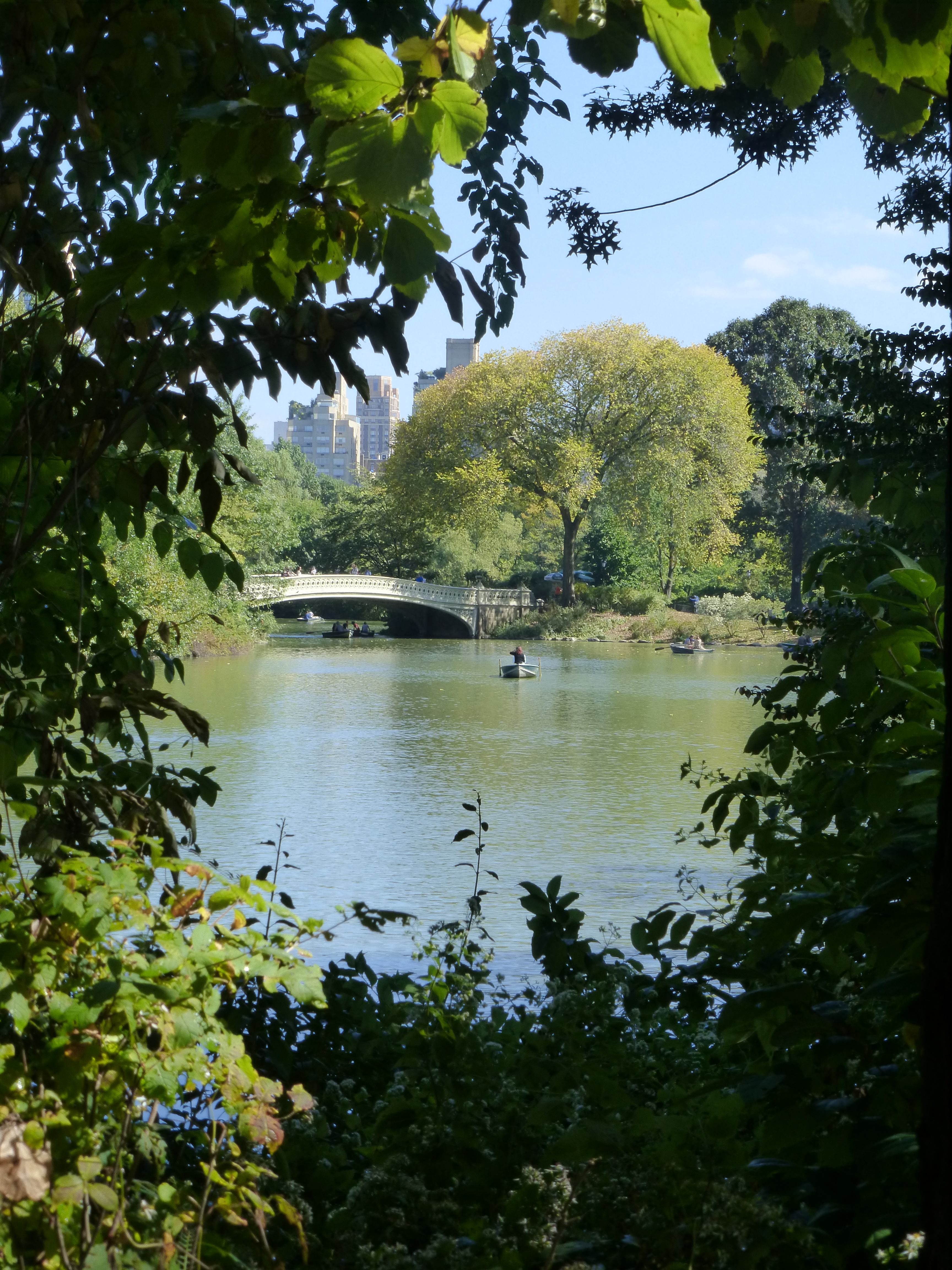
Central Park was designed and built by Frederick Law Olmstead and Albert Vaux before the Civil War.  It opened in 1857 to great fanfare and has been as central to the vitality of New York City as its name implies, since its opening.  It reflects the design sensibilities of Olmstead and the engineering genius of Vaux.  It looks completely natural, but virtually everything in it—its lakes, its streams, its hills—was constructed.

Central Park
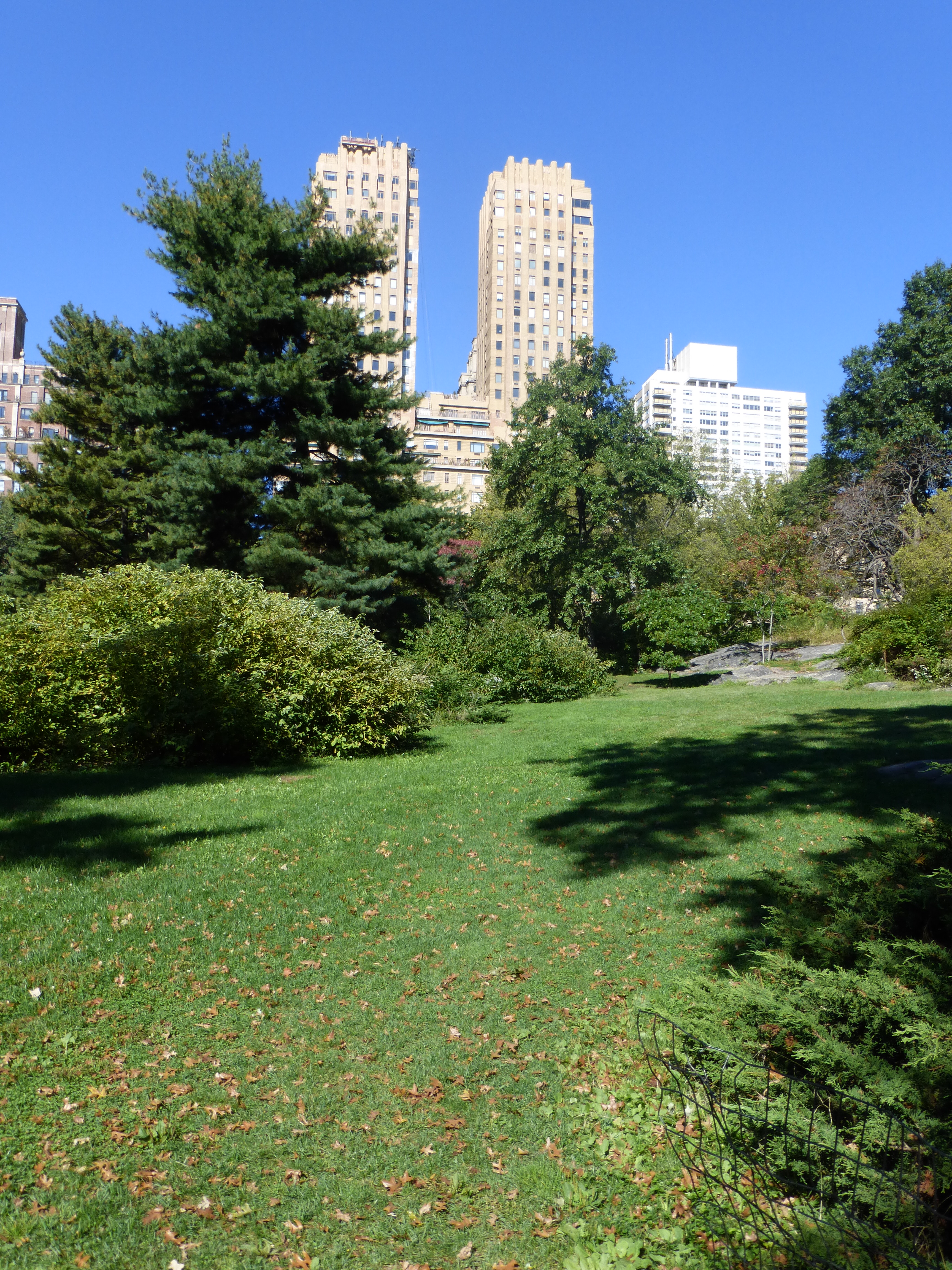
Central Park

Olmstead was partial to a green landscape with long vistas across meadows and lakes.   He wasn’t inclined to plant colorful flowerbeds, though he could oblige when his clients demanded it.  The trees and plants he chose for Central Park were as likely to be native to New York as not.  His previous experience in agriculture informed his choices so survival of the landscape was ensured.

P1010588
Central Park

It’s not a coincidence that Olmstead’s plant list was not confined to native species because the concept of “nativeness” wasn’t defined when Central Park was designed.  “The modern division of species into native and alien first appears in the writings of Hewett Cottrell (H.C.) Watson in the mid-nineteenth century.” Watson was an amateur British botanist who was aware that some plant species had been introduced to Britain and he decided that some sort of classification system was needed to keep track of such species.  “He was the first to define ‘native’ in the modern sense:  ‘apparently an aboriginal British species, there being little or no reason for supposing it to have been introduced by human agency.’”  (1)

Watson acknowledged that distinguishing between aboriginal and introduced species wasn’t easy and he did not consider introduced species inferior to aboriginal species.  For the next one hundred years, opinions of the relative merits of aliens and natives varied.  Sometimes aliens were considered a problem and sometimes they were considered a benefit to ecosystems.  Sometimes such problems were attributed to the introduced plants and sometimes they were attributed to underlying factors.

All this changed in 1958 with the publication of Charles Elton’s book The Ecology of Invasions by Animals and Plants.  Today’s invasion biologists, if questioned, generally claim Elton’s book as their inspiration, and it has been described as signaling ‘the beginning of the field of invasion biology…’  But in many ways it is an odd book.  It isn’t a scientific book in the usually accepted sense, nor is it a textbook.  It is in fact a popular polemic, based to a large extent on a series of radio talks that Elton gave to the BBC.  But what is not in doubt is that it sits squarely in the tradition of blaming introduced species for practically any environmental ill you care to mention…” (1)

Olmstead was not burdened by the constraints of nativism in the 1850s and so he was free to plant whatever he considered beautiful and suited to the climate and conditions in New York.  We are fortunate to have this living evidence today that native and non-native plants survive  and thrive together in Central Park.  Central Park is the home of hundreds of species of birds and the temporary home of hundreds more species of migratory birds every spring and fall.

High Line Park

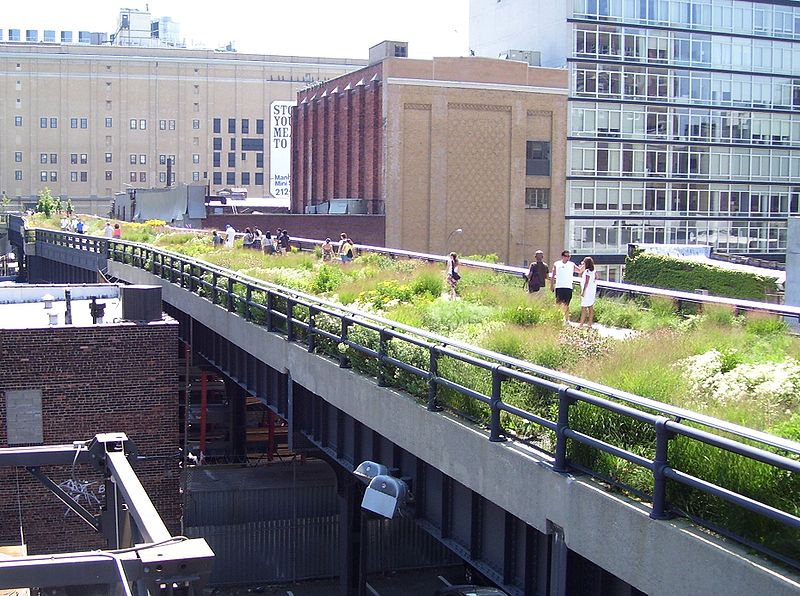
The High Line began in 1846 as a railroad line on the West Side of Manhattan, which transported unprocessed meat to the meat processing district and processed meats out of Manhattan.  In 1934, after many people were killed in collisions with the train, 13 miles of train were elevated 30 feet above the street, bypassing the cross-traffic from 34th Street to St. John’s Park Terminal at Spring Street.  In 1980, the last train on the High Line transported frozen turkeys from the meat processing district.  Soon thereafter, neighbors organized to prevent the demolition of the High Line.  The re-creation of the High Line as a park began in 2006.

High Line Park, New York City
High Line Park, New York City. Creative Commons – Share Alike
Landscape of first phase of High Line Park

The first phase of High Line Park opened in 2009, the second phase in 2011, and the third opened on September 21, 2014.   All three phases opened to rave reviews.  The park became an instant success both with New Yorkers and with tourists.  Over 5 million people visit the High Line every year.  Having seen it, we can report it is no mystery why it is so popular.  It is a safe walk above the congested streets of New York with fabulous views of the Hudson River, the surrounding neighborhood, and the dramatic skyline of the Manhattan.

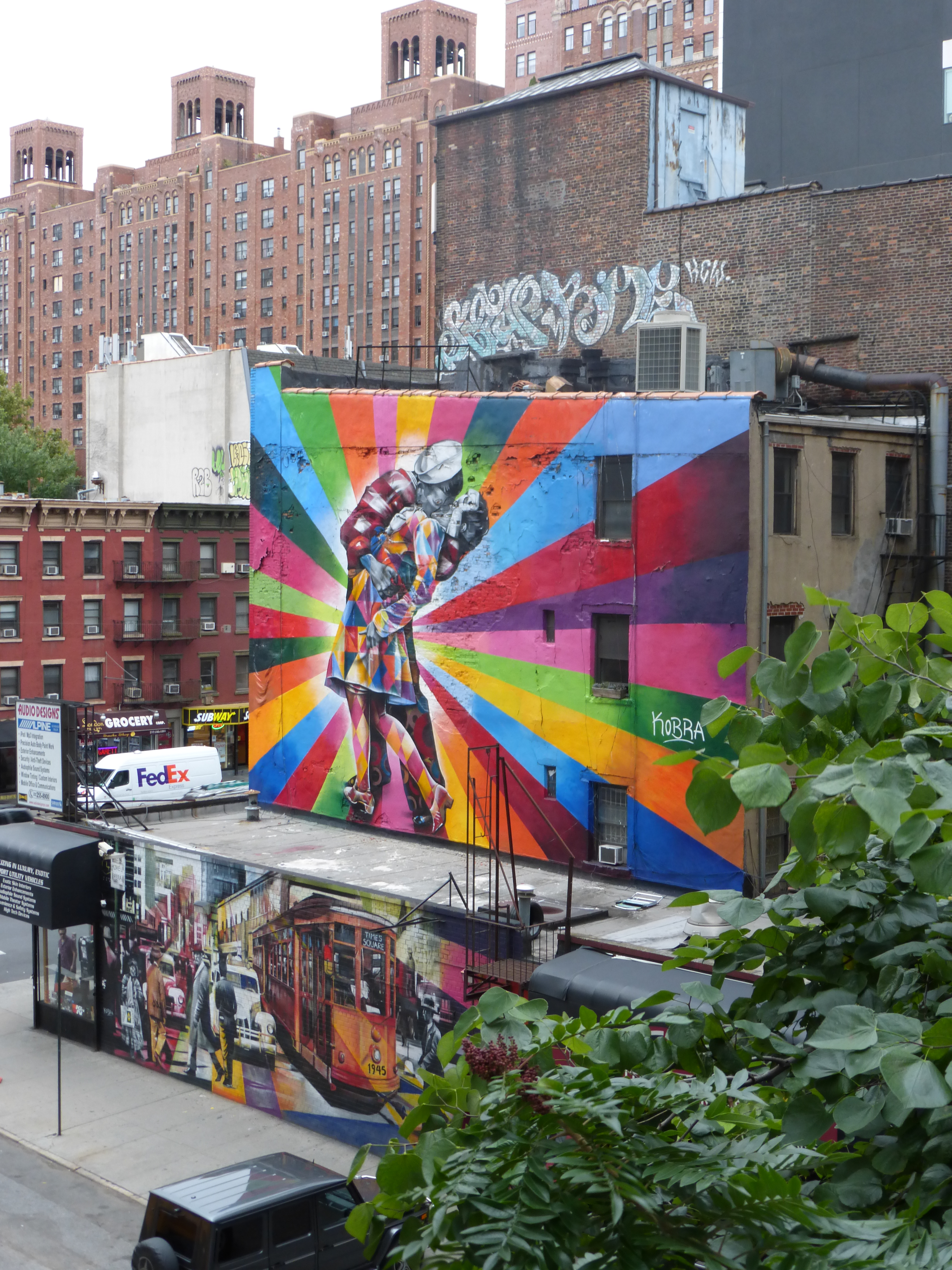
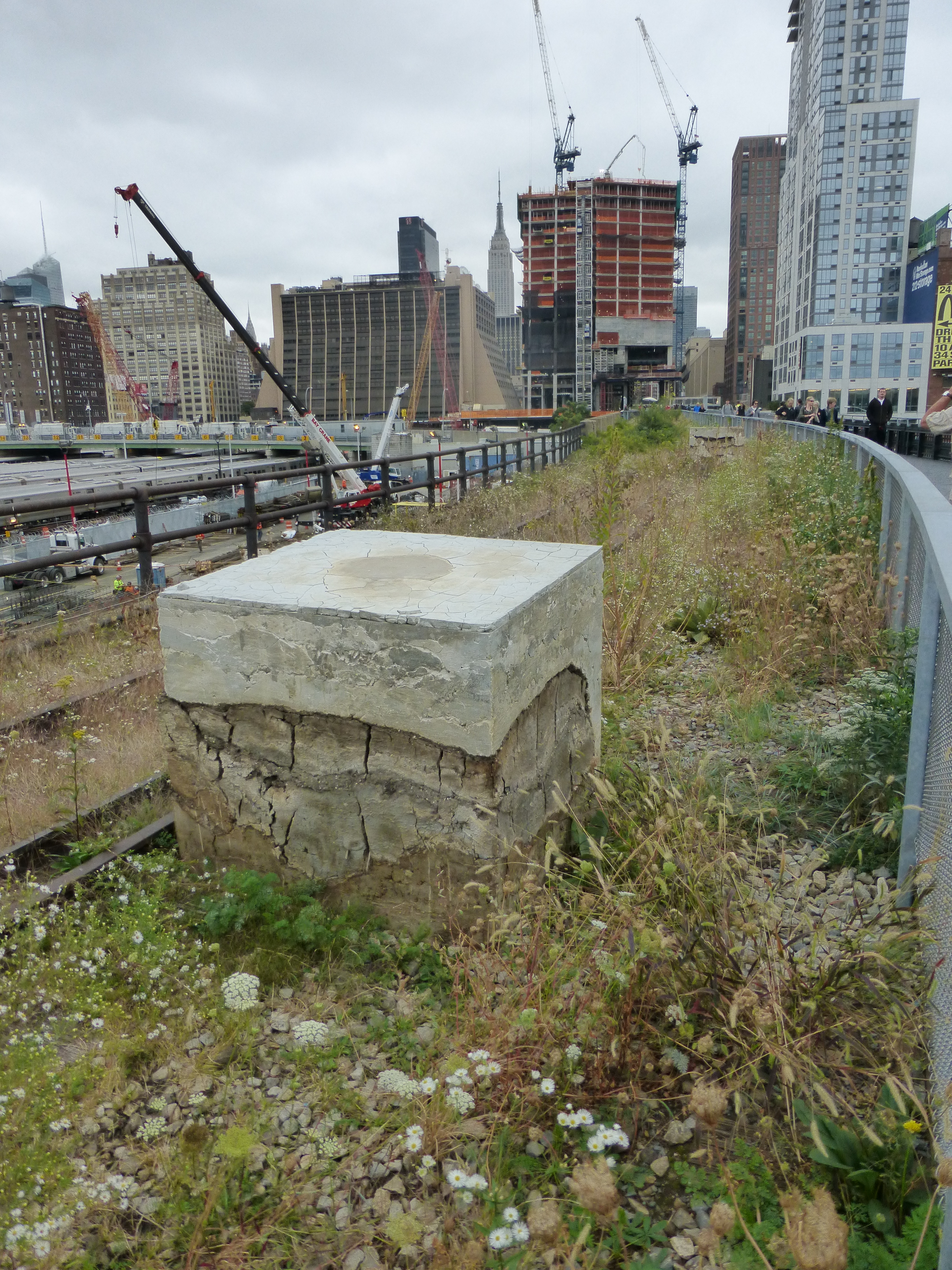
But the beauty and functionality of the park is not its only virtue.  It has transformed this formerly industrial neighborhood.  The surrounding neighborhood is dotted with cranes engaged in building valuable new residential properties.  Existing buildings are now covered with art to entertain visitors to the High Line.  The entire neighborhood has been revitalized by the development of this new, innovative re-creation of the City’s past.  It was atrociously expensive to transform the High Line into a park, but the park has already repaid the investment.

View from High Line Park
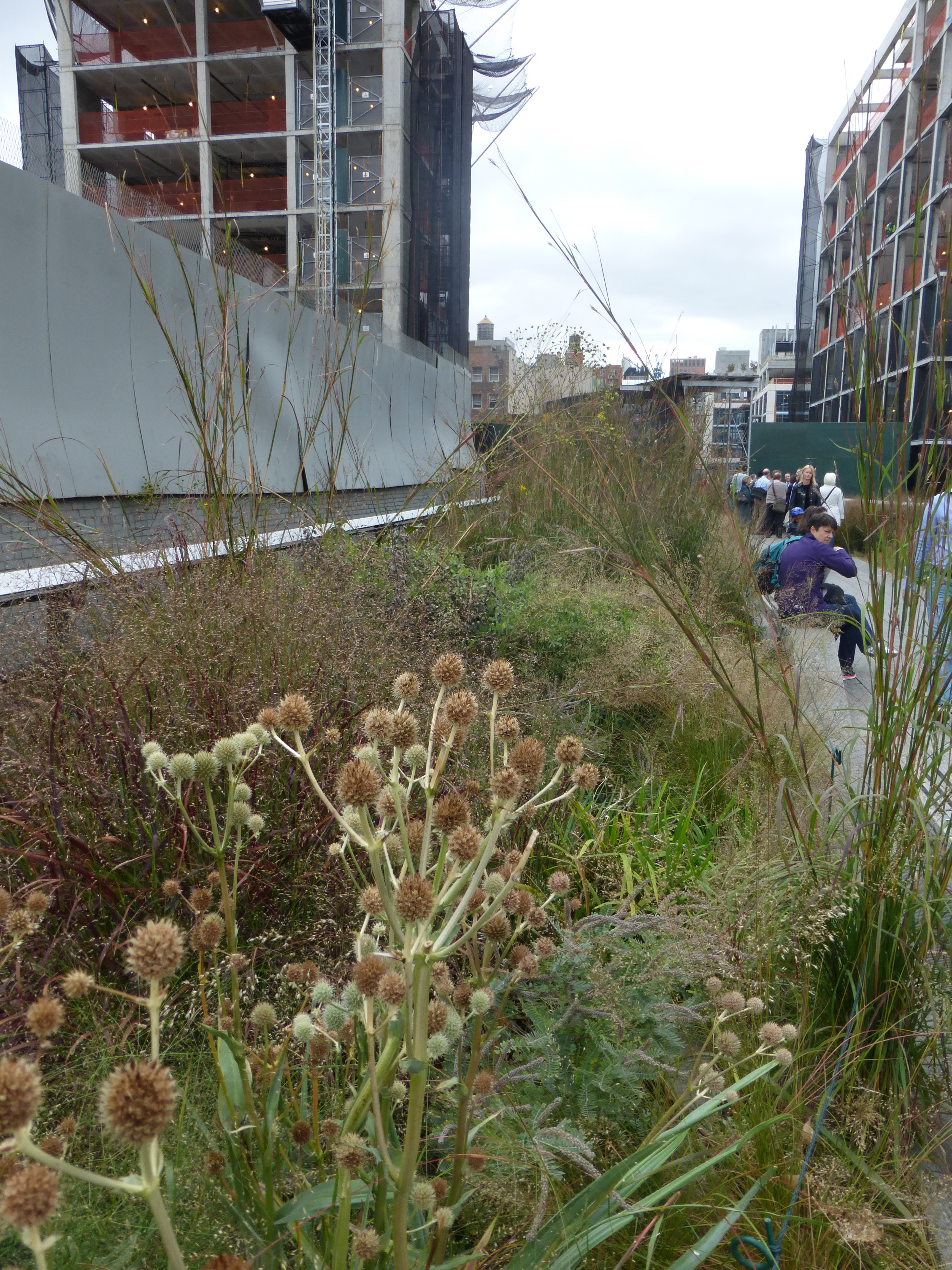
Self-Seeded landscape of Phase 3 of High Line Park

The design of the third and final portion of the High Line is different from its predecessorsPerhaps to reduce costs, the third section has retained many of the original structures of the railroad, including its weedy landscape.  The landscape is described as “self-seeded,” which is another way of saying that it is populated by the weeds that blew into the railroad ties during its 30-year fallow period.  The plant list of the High Line reflects its eclectic origins.  It is a mix of natives and non-natives, including many reviled by native plant advocates such as Tree of Heaven.  What is remarkable about the landscape in the third section is how similar it is to the earlier sections, which were planted.  In other words, achieving a “naturalistic” landscape bears some resemblance to the weeds of a vacant lot.  The final section of the High Line is no less charming and beautiful than its landscaped predecessors.

The High Line, like many parks in New York City, contains many enterprises that provide food and entertainment to its visitors.  Such enterprises are very controversial in San Francisco, where many park advocates consider them intruders.  We enjoyed a handmade cup of coffee on the High Line and wondered why San Franciscans have such a purist view of what “belongs” in their parks.

Comparing New York City with San Francisco

As we said when we began, we consider New York City the center of America’s cultural universe.  We are therefore encouraged that we found no evidence that New York City’s park system is dominated by nativism.  Their parks are both more beautiful and better maintained than those in San Francisco.  We suspect that San Francisco’s obsession with native plants has handicapped its ability to maintain beautiful parks because the plants that are native to San Francisco are brown and dormant much of the year.  New Yorkers looked back to their city’s 19th Century past to resurrect the High Line, while some San Franciscans are demanding a return to an 18th century landscape.

We also believe that San Franciscan’s objection to enterprises in their parks is one of the reasons why there isn’t enough money to maintain the parks to the same standard as the parks of New York City.

There are undoubtedly other factors at play.  The parks of New York City are heavily subsidized by wealthy foundations.  Its wealthy residents have been generous with the parks of New York City.  However, San Francisco is rapidly becoming as expensive a place to live as New York, so we wonder why our parks can’t enjoy the same level of support.  Is San Francisco’s “natives-only” approach to landscaping making our parks less attractive to potential donors?

Can you think of other reasons why San Francisco’s parks look so seedy compared to the parks of New York City?


(1) Ken Thompson, Where do camels belong?, Greystone Books, 2014

Evolutionary advantage of introduced species

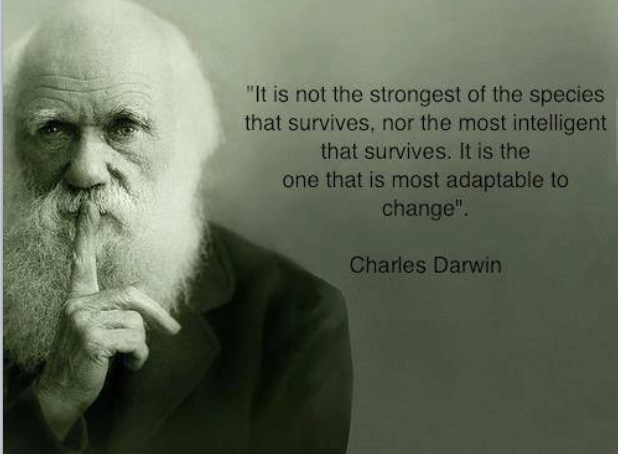
We have often wondered why so many plants and animals introduced to North America become invasive, compared to species introduced to Europe.  In California, there are about 200 plants on the inventory of “invasive” plants.  In Britain, there are only about a dozen plants considered “invasive.”  In past articles, we have speculated that Americans are using different standards to determine invasiveness and that may be a factor.  But now scientists, Jason Fridley and Dov Sax have recently reported the empirical evidence that suggests some regions are more vulnerable to invasion than others because of competitive advantages of species from regions with longer evolutionary histories.  In fact, Charles Darwin is the original author of this theory:

“Darwin (1859) observed that because ‘natural selection acts by competition, it adapts the inhabitants of each country only in relation to the degree of perfection of their associates, such that, we need feel no surprise at the inhabitants of any one country…being beaten and supplanted by naturalized productions from another land.’  Darwin’s view, one of the earliest on biological invasions, presents invasion as an expectation of natural selection – a view largely absent from modern invasion biology.  Darwin further suggested that species from larger regions, represented by more individuals, has ‘consequently been advanced through natural selection and competition to a higher stage of perfection of dominating power’ and therefore be expected to beat ‘less powerful’ forms found in other regions.” (1)

Darwin2

Based on Darwin’s speculation, Fridley and Sax formulated the evolutionary imbalance hypothesis, based on three postulates:

  • Evolution is essentially an infinite series of experiments as each generation is tested by the conditions they encounter. The more tests the species passes by surviving and reproducing, the more fit the species is to face the next test.
  • The number of such experiments vary by region that differ in size and biotic history, which influences the intensity of competition each species encounters.
  • “Similar sets of ecological conditions exist around the world” thereby facilitating the movement of species from their native ranges to new ranges.

It follows from these postulates that when species from previously isolated habitats are mixed, some species will be more fit than others for any given set of conditions.  In other words, they have an evolutionary advantage by virtue of having faced more competition for a longer period of time.   These are the environmental conditions that are likely to confer such an evolutionary advantage:

  • Larger regions with large expanses of habitat usually have larger populations of species. Larger populations have more genetic variation, which provides more opportunities for natural selection to choose a “winning” genetic combination.
  • Also, more stable environments enable lineages to survive for longer periods of time. The longer the opportunity for natural selection to operate, the more fit the surviving lineage.
  • The greater the competition each species experiences, the more fit the surviving species is likely to be. Therefore, species occupying diverse habitats are likely to be more fit than species in less diverse habitats.

The authors of this new study tested these hypotheses in three geographic areas that have well-documented non-native floras, including Eastern North American, the Czech Republic, and New Zealand.  For example, the climate of the Northeast of America is similar to East Asia.  Some of the most destructive invasive species in the Northeast are from East Asia, such as the emerald ash borer.  Yet species from North America do not become invasive when introduced to East Asia.  Species from East Asia have a much longer evolutionary history than species native to the Northeast because much of the United States was buried in glaciers during the Ice Ages, while East Asia was not.  (2)  The longer evolutionary history of East Asia makes East Asian species “fitter” and more likely to be successful in North America, while North American species are less successful in East Asia.

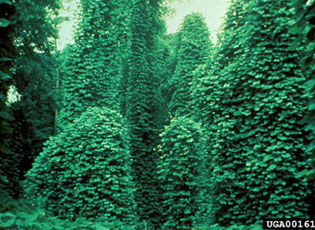
Kudzu evolved in Japan.  USDA
Kudzu evolved in Japan. USDA

Failure of the competing theory

Invasion biology is the competing theory of why introduced species become invasive when introduced outside their native ranges.  It is a theory that turns its back on evolutionary theory by assuming that plants and animals are incapable of adapting to changed conditions.  Invasion biology assumes that introduced plants become invasive because they leave their predators behind.  This is the predator release theory which also implies that introduced plants are not useful to native animals.

The problem with the predator release theory is that there is no empirical evidence that supports it.  For example, equal numbers of insects are consistently found in native and non-native habitats.  And when empirical studies claim to have found evidence of predator release, sampling errors have discredited those studies:

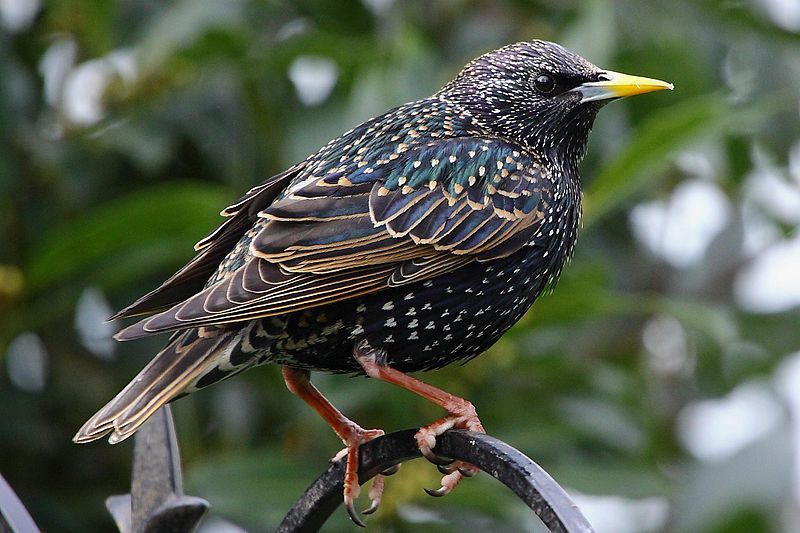
“For example, one study found fewer parasitic worms in introduced starlings in North America than in the entire native range of Europe and Asia.  But once allowance was made for the actual local source of the starlings, the difference disappears:  various evidence suggests starlings arrived in North America via Liverpool, and American starlings have most of the parasites of Liverpool starlings, plus quite a few others, either American natives or European parasites introduced with other birds.  In fact, American starlings have more parasites than are found in the likely source population.”  (3)

Starling in breeding plumage.  Creative Commons - Share Alike
Starling in breeding plumage. Creative Commons – Share Alike

“Resistance is futile”

And so we add the evolutionary imbalance hypothesis to the long list of reasons why we are opposed to fruitless attempts to eradicate well established non-native species of plants and animals:

And now we know that many invasive species have evolutionary advantages over the native species they have displaced:  “The evolutionary imbalance hypothesis…could have a grim implication for conservation biologists trying to preserve native species:  They may be fighting millions of years of evolution.  If that’s true, the phrase ‘Resistance is futile’ comes to mind.” (2)


  1. Jason Fridley and Dov Sax, “The imbalance of nature: revisiting a Darwinian framework for invasion biology,” Global Ecology and Biogeography, 23, 1157-1166, 2014
  2. Carl Zimmer, “Turning to Darwin to Solve the Mystery of Invasive Species,” New York Times, October 9, 2014
  3. Ken Thompson, Where do camels belong?, Greystone Books, 2014

Escalating war on trees in the East Bay

The Federal Emergency Management Agency (FEMA) has been considering grant applications for “fire hazard mitigation” in the East Bay since 2005, when the first of these applications was submitted. After years of debate about whether or not the projects achieve the stated purpose and at what cost to the taxpayers and the environment, FEMA finally agreed to resolve the controversial issues by mandating an environmental impact review, which began in 2010. The Draft Environmental Impact Statement (DEIS) was published in April 2013 and the public comment period on that draft closed in June 2013.

FEMA tells us they received over 3,500 public comments on the draft, so needless to say it is taking some time to analyze and respond to those comments. Based on questions raised by public comments, FEMA sent questions to the applicants in October 2013, requesting clarification of their project plans. The applicants responded in November 2013, by revising their project plans. UC Berkeley and the City of Oakland responded that they now plan to “thin” rather than to remove all non-native trees, consistent with the original intentions of East Bay Regional Park District. FEMA now predicts that the final EIS will be published around the end of 2014.

Grant applicants are champing at the bit

The applicants for these grants are getting restless for award of the grant which will fund the removal of tens of thousands of trees or more. We recently reported to our readers that UC Berkeley began to destroy trees on its property in late August 2014, before the grant has been approved. The trees that were destroyed are still lying on the ground, looking like bonfires waiting to happen.

Some of the hundreds of trees destroyed by UC Berkeley in August 2014

More recently, Claremont Canyon Conservancy has successfully recruited 12 East Bay elected officials to ask FEMA for immediate release of the grant funds, as well as “complete removal” of all eucalyptus trees, rather than thinning as originally proposed by East Bay Regional Park District and as revised by the City of Oakland and UC Berkeley in November 2013. This request was reported by the San Francisco Chronicle, Contra Costa Times, and ABC TV news. Based on these news sources, as well as the website of the Claremont Canyon Conservancy, we can report that the following East Bay elected officials have signed this request:

City of Oakland
Jean Quan, Mayor of Oakland
Dan Kalb, Oakland City Council
Rebecca Kaplan, Oakland City Council
Larry Reid, Oakland City Council
Libby Schaaf, Oakland City Council

City of Berkeley
Tom Bates, Mayor of Berkeley
Jesse Arreguin, Berkeley City Council
Laurie Capitelli, Berkeley City Council
Susan Wengraf, Berkeley City Council
Gordon Wozniak, Berkeley City Council

State of California
Nancy Skinner, State Assembly
Loni Hancock, State Senate

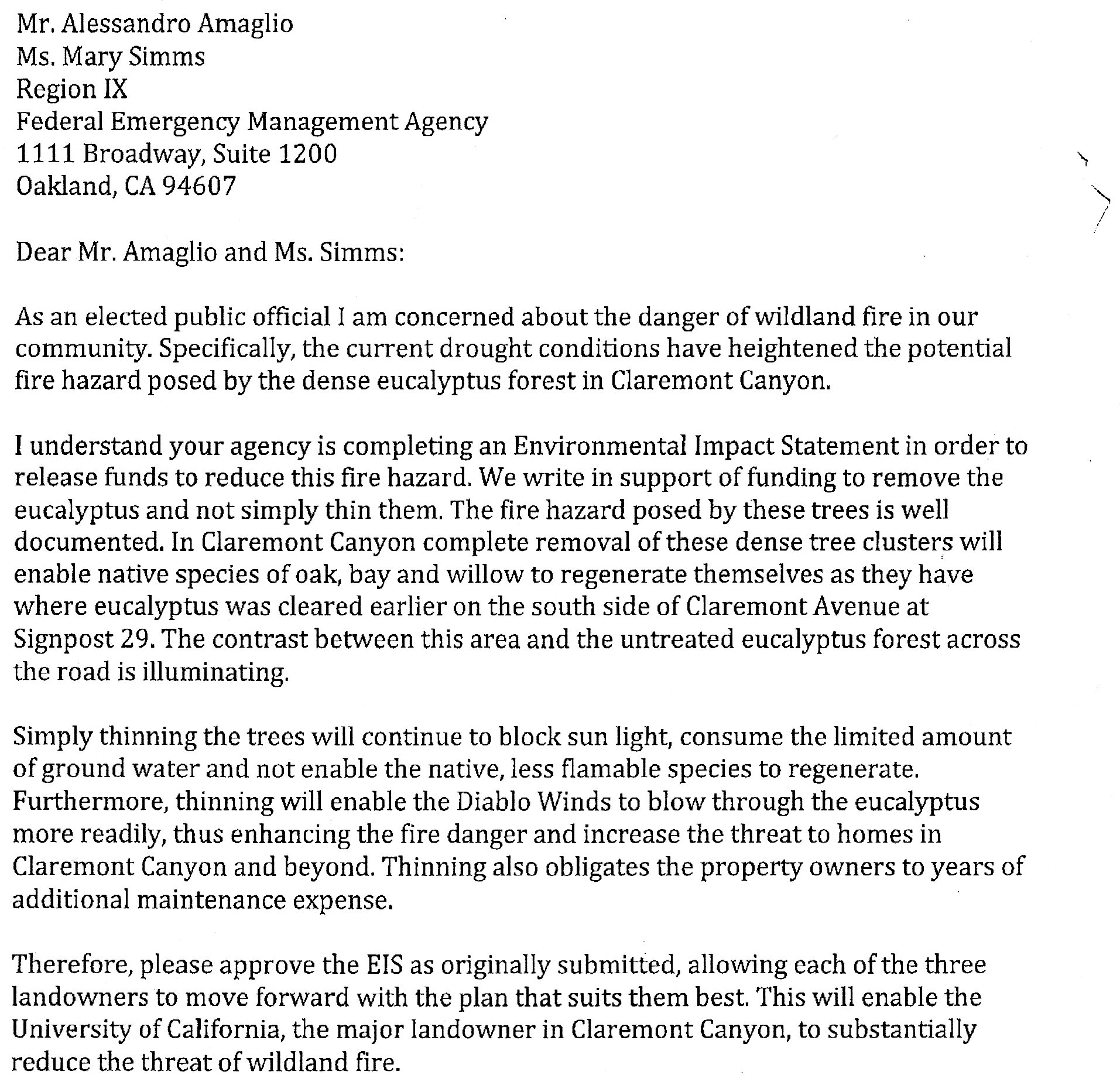
We have an unsigned copy of a letter to FEMA:

Pols letter to Amaglio

– end letter –

We cannot report with confidence that all these politicians sent the same letter because Oakland Councilman Dan Kalb is the only politician who has responded to our public records request. Mr. Kalb’s request is similar, but requests “funding to remove a substantial number of the eucalyptus trees.” Mr. Kalb’s letter seems to acknowledge that requesting removal of all eucalyptus trees would be inconsistent with the City of Oakland’s November 2013 revision of its original grant application; he says, “I know that the City of Oakland has submitted some revised language as requested by [FEMA].” The elected officials who signed the above letter do not seem to realize that their request contradicts the agreement with FEMA in November 2013 to thin rather than to remove all non-native trees on their properties. Or perhaps they have changed their minds.

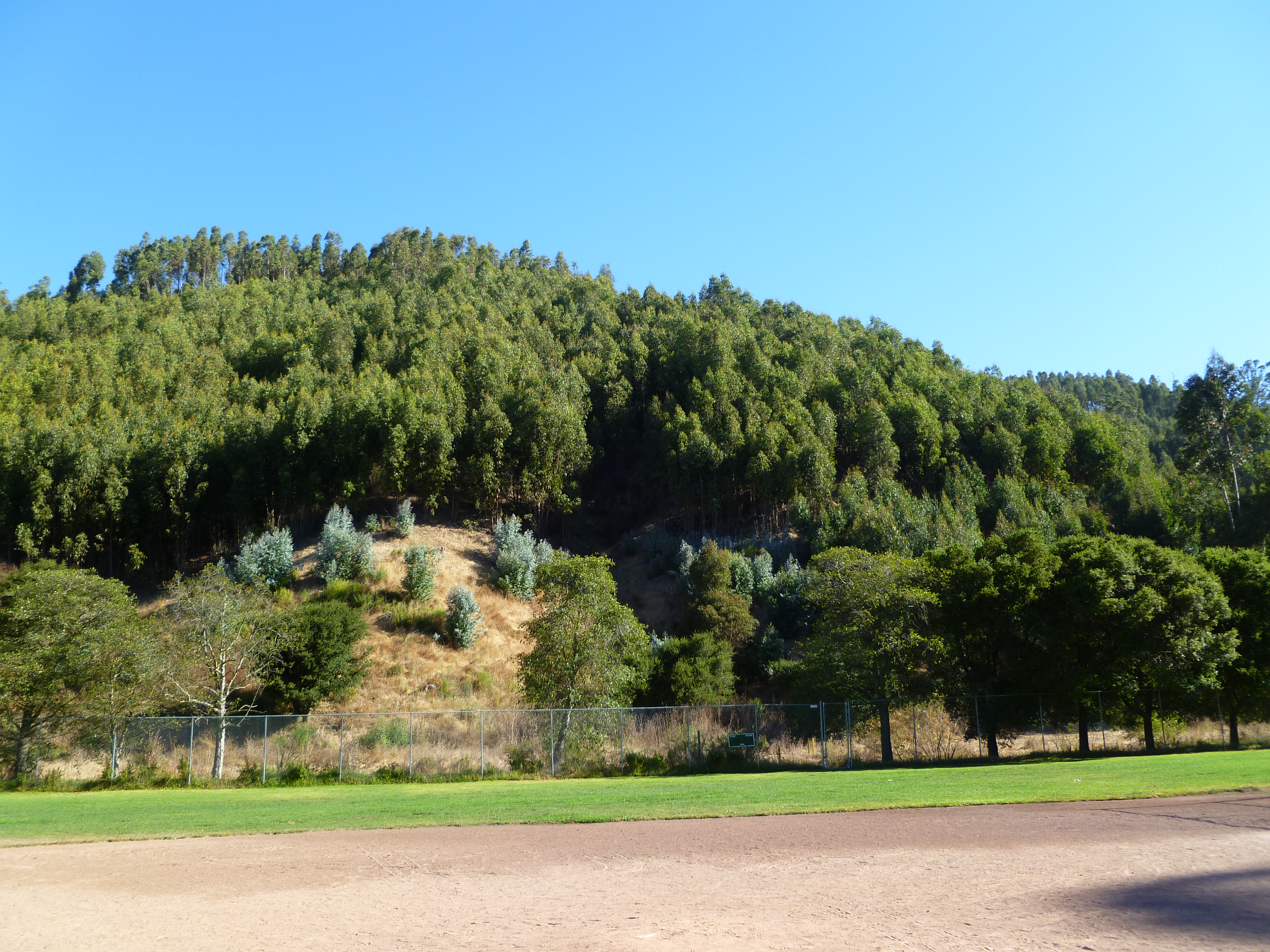
This eucalyptus forest at the North Oakland Sports Facility will be  destroyed by the City of Oakland.
The City of Oakland wants to destroy this eucalyptus forest at the North Oakland Sports Facility. Note that where they have destroyed eucalyptus in the past, they have not controlled the resprouts. The grey-green small trees near the base of the hill are eucalyptus resprouts.

Stunning display of ignorance

We are rarely surprised by the extreme views of native plant advocates, but the letter sent by East Bay elected officials is a stunning display of ignorance, mendacity, or both:

  • The claim that native plants are less flammable than non-native plants is entirely fallacious. The indigenous landscape of California is highly flammable as is demonstrated by wildfires throughout California every year. In virtually every case, those wildfires occur in native landscapes.
  • This statement is not even superficially logical: “thinning will enable the Diablo Winds to blow through the eucalyptus more readily, thus enhancing the fire danger…” Obviously, destroying ALL the trees will provide even less of a barrier to Diablo winds.
  • The public record does not support the contention that eucalyptus is more flammable than any other type of vegetation. HERE is a report of the public record of the 1991 Oakland wildfire.
  • Oaks and bays have indeed grown in Clarement Canyon since eucalypts were removed there because it is a riparian corridor where trees are sheltered from the wind and water is funneled to them. However, that is not typical of regrowth after removal of the tree canopy in most locations where eucalypts have been removed. The more likely outcome is non-native annual grasses, as explained HERE by the environmental consultant who evaluated the plans of UC Berkeley. Since fire ignites more readily in grass, fire hazards are not reduced by this transition.
Non-native annual grassland now occupies most of the area where UC Berkeley destroyed 18,000 trees about 10 years ago.

News sources also interviewed Jon Kaufman, a spokesperson for Claremont Canyon Conservancy who expressed his frustration that their desire for the destruction of non-native trees in the East Bay Hills is being delayed by FEMA: “With fire season approaching, it’s a good time to remind FEMA they need to get off their asses.” His insulting approach cannot be called a charm offensive.

Mr. Kaufman is quoted as making the following misstatement of fact: “But Kaufman said no spraying would be involved and that herbicide will be applied topically to the stumps with a brush.” We have heard native plant advocates make this claim many times. Perhaps some of them even believe it. FEMA asked for clarification from grant applicants about their plans for herbicide applications in October 2013. The applicants replied in November 2013 that they will apply Garlon according to the manufacturer’s label.

Mr. Kaufman’s claim that herbicide will not be sprayed is contradicted by the manufacturer of Garlon, DowAgra. The manufacturer describes the method of cut-stump application: “Treat the exposed cambium area and the root collar (exposed bark on the side of the stump) down to the soil line. Be sure to treat the entire circumference of the tree. To ensure effective control on large trees, also treat any exposed roots (knees) that surround the stump.” This method is illustrated on the manufacturer’s website by videos of the applicator using spraying equipment.

The herbicides needed to destroy non-native vegetation are also foliar sprayed, as described by the Draft EIS. It is a fiction that non-native trees and plants can be eradicated without spraying herbicides. The use of large quantities of herbicides is nearly as controversial as the loss of our urban forest.

Are you a voter in Oakland or Berkeley?

If you are a voter in Oakland or Berkeley and you care about the preservation of our urban forest and/or object to the hazards created by spraying our public lands with herbicides, you should know that some of the politicians who signed the letter to FEMA are on the ballot on November 4, 2014. You can take their support for clear cutting all eucalyptus in the Oakland/Berkeley hills into consideration in your vote. Better yet, you could write to them to tell them your opinion of their misguided support for removing all non-native trees on public property. We do not expect our public officials to be experts in horticulture or fire science. However, we think it is irresponsible for public officials to endorse the position of a particular interest group without making an effort to inform themselves of opposing viewpoints.

Here is a list of the candidates you will find on your ballot:

City of Oakland – Candidates for Mayor
Jean Quan http://www.oaklandnet.com/contactmayor.asp
Rebecca Kaplan atlarge@oaklandnet.com
Libby Schaaf lschaaf@oaklandnet.com

City of Berkeley – Candidates for City Council
Jesse Arreguin – District 4 – running unopposed

There is also a petition in opposition to these destructive projects available HERE.

The only logical resolution

One wonders how FEMA can now award grants to the City of Oakland or to UC Berkeley. In November 2013, these public agencies told FEMA, in writing, that they will thin rather than clear cut all non-native trees on their properties. In August 2014, UC Berkeley destroyed all eucalyptus trees on a portion of the project area, which should be a demonstration of UCB’s intentions. Actions speak louder than words, even written words.

In the case of the City of Oakland, elected officials in positions of authority, including the sitting Mayor of Oakland, have contradicted the City of Oakland’s written commitment to FEMA to thin rather than to clear-cut by asking FEMA to immediately release grant funds to clear-cut all eucalyptus from their properties.

How can FEMA trust these agencies to do what they have said in writing they intend to do? The only logical response to the request of these elected officials is to inform UC Berkeley and the City of Oakland that they have effectively rescinded their grant applications.

Mysterious semantics of the native plant movement

In 2000, we wrote a public comment about plans to close areas at Fort Funston for native plant restoration that began with this quotation from Henry David Thoreau:

It is in vain to dream of a wildness distant from ourselves.  There is none such.  It is the bog in our brain and bowels, the primitive vigor of Native in us, that inspires that dream.  Thoreau

We chose that quote to introduce our comment about Fort Funston because it is a place that was entirely altered to serve as a military fort, its sand dunes stabilized with ice plant and studded with gun bunkers; it is not a place that is easily imagined as a pristine native landscape.  As with most poetry, Thoreau’s exact meaning escaped us, but what resonated was the suggestion that “wildness” exists in our minds, not in the material world.  We found comfort in knowing that over 150 years ago, Thoreau was as mystified by the concept of wildness as we are today.

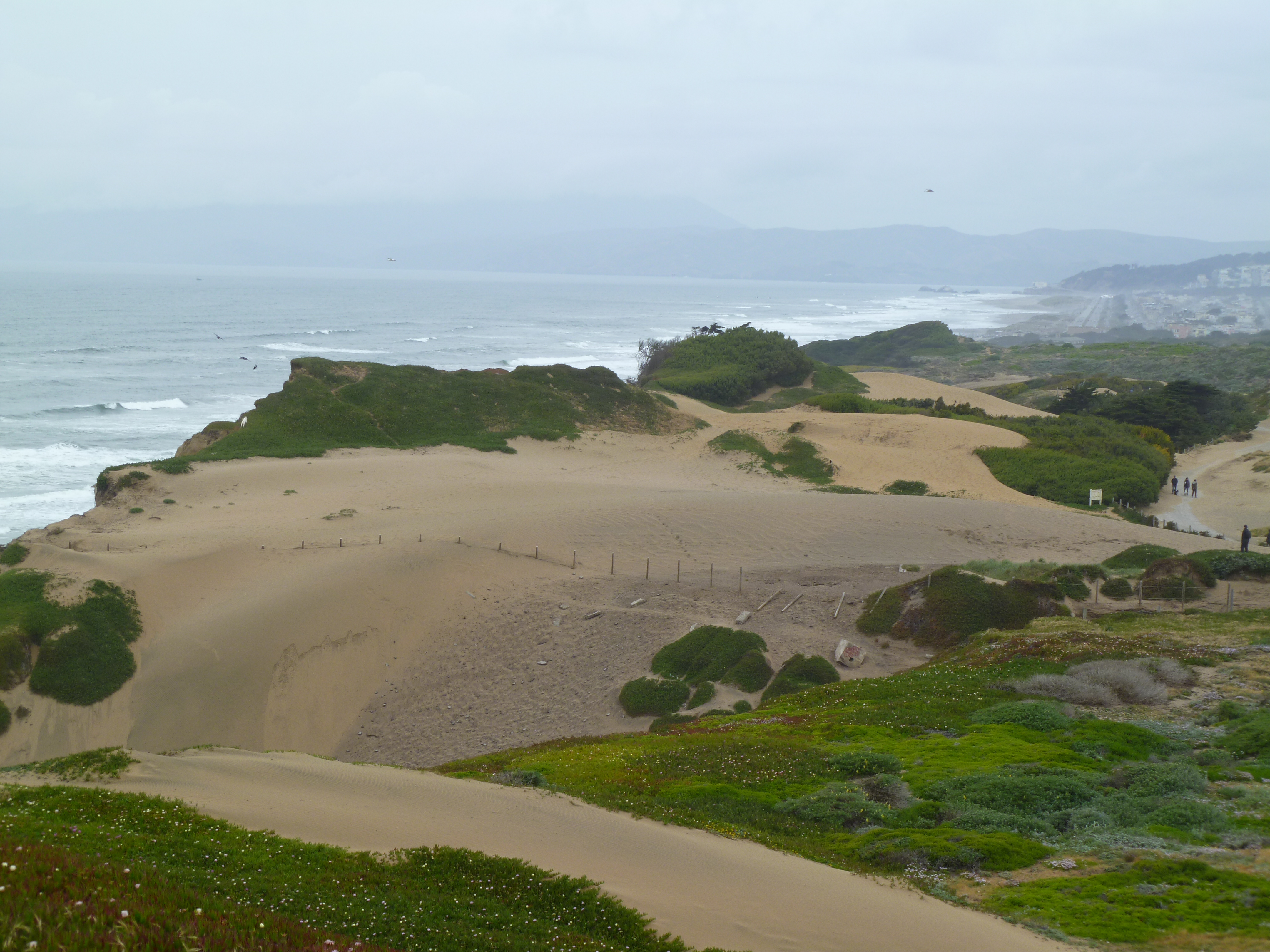
Fort Funston
Fort Funston San Francisco 2011

Today, we revisit the question of the meaning of wildness or wilderness, prompted by the publication of an op-ed by Mark Dowie in the Point Reyes Light. (1)  Dowie is a journalist who is best known as the author of Conservation Refugees, in which he informs us that hundreds of thousands of indigenous people all over the world have been evicted from their ancestral lands by public and private land owners who believe humans are antithetical to their conservation goals.  Dowie tells us that the tradition of evicting humans in the interests of preserving “wilderness” began with the eviction of Native Americans from Yosemite Valley as advocated by John Muir.  This concept of preserving land by excluding all human activities is aptly called fortress conservation. 

Dowie begins his op-ed in the Light with the observation that some words have “attained such a vague and ambiguous definition that [they have] become virtually meaningless.”  The word “sustainability” has attained such status, he says and we agree.  But his focus in his op-ed is on the word “wilderness” because it is a word that has become a tool in a dispute about land use in Point Reyes, where Dowie lives.

The National Park Service defines “wilderness”

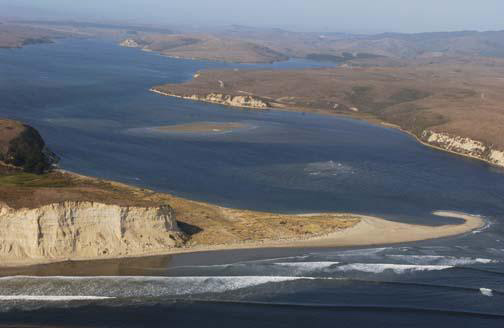
Drakes Estero.  NPS photo
Drakes Estero. NPS photo

After a protracted battle that lasted years, the National Park Service was finally successful in shutting down the Drakes Bay Oyster Company based on its contention that the existence of the oyster farm violated a commitment to return the Point Reyes National Seashore to “wilderness.”  This was a battle that tore a small community apart and the wounds from that fight are still deep.

Mark Dowie was one of many people who opposed the closing of the oyster farm and he was often eloquent in its defense in the Light.  One of many issues in this controversy was the National Park Service’s claim that the oyster farm was harming the environment.  Highly qualified scientists debunked that claim and after a review by the National Academy of Science, the claims of the National Park Service were entirely discredited.  Unfortunately, that had no influence on the final decision to close the oyster farm.

Within days of the oyster farm closing its retail operation, those who demanded its closure were on the warpath again.  In an op-ed published by the Oakland Tribune, William Katz asked the National Park Service to evict ranchers and dairy farmers in Point Reyes:  “The European invasion of this side of the continent over just the last 200 years is obviously a done deal.  This fact makes it especially necessary to complete the original mandate of the park’s creation by removing the ranchers and their bovine accoutrements and re-establishing a natural area in which we may only be visitors.”  The connection between those two sentences eludes us.  In fact, they seem contradictory.

Dowie searches for the meaning of “wilderness”

And so, the question of what defines a “wilderness” is still very much alive in Point Reyes.  Mark Dowie tells us that he has been actively seeking a meaningful definition for some years.  He turned to several indigenous cultures based on the modern assumption that pre-European cultures occupied the elusive “wilderness:”

“Over the next four years of research, I met and conversed with many indigenous people who thrived in landscapes that looked as wild as anywhere I had ever been, whose language had no words for ‘wild,’ or ‘wildness,’ or ‘wilderness.’  Naturally, I began to wonder why societies populated by urbane people who spend most of their lives, if not all of them, on the streets of places like New York City, London, Rome, Los Angeles and Winnipeg do have a word for wilderness.  And I wondered what exactly they meant by it, if anything.”

“What I finally figured out about ‘wilderness’ was that it’s really a concept that does not translate well from language to language, especially from western to indigenous languages.  So it’s really not the word that has to be translated, but an entire ecological enthnography.”

And so, Dowie turns to those who use the word “wilderness” as their definition of the goal for what our public lands and open spaces should look like and what activities should be allowed in them:

I recently overheard a debate in which to refine and defend his own personal definition, a local wilderness romantic divided the whole concept into two separate categories—uppercase and lowercase wilderness. Uppercase, he said, was “real” wilderness: vast roadless, trail-free areas occupied by many species, including large predators that want to eat humans.  Lowercase wilderness could be found in state and national parks; as virtual or abstract wilderness, it was a cunning, managed artifice of the uppercase version designed to convince eco-tourists that they are having a true wilderness experience.  The argument descended from there into such ridiculous semantic subterfuge that I walked away mumbling to myself that wilderness may not be a word at all, or a place for that matter, but as Roderick Nash concludes at the end of his 400-page tome on the subject, merely “a state of mind.” And that if wilderness exists at all, it could be as easily found and appreciated under a bench in Central Park as on the barrens of Baffin Island.”

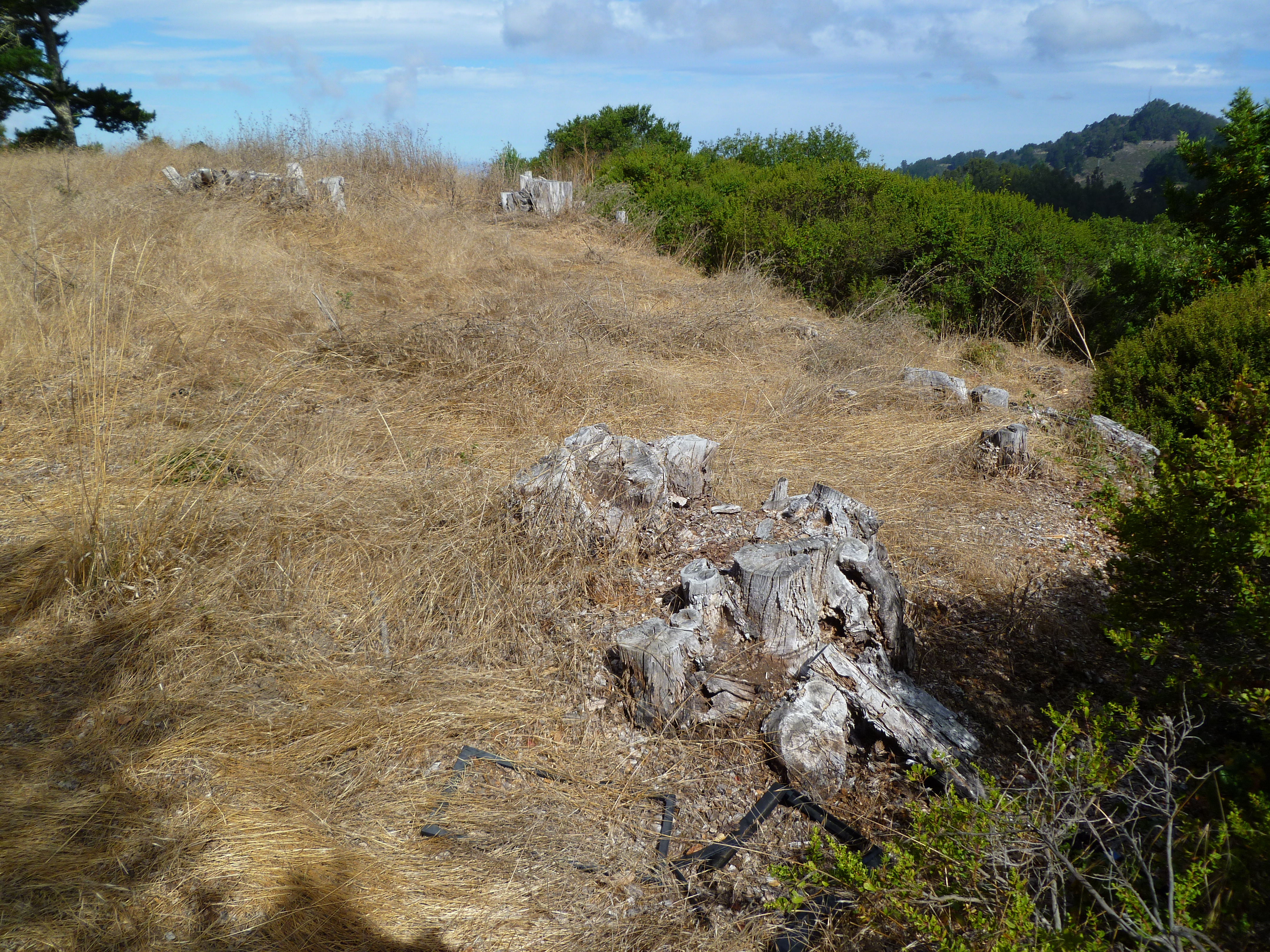
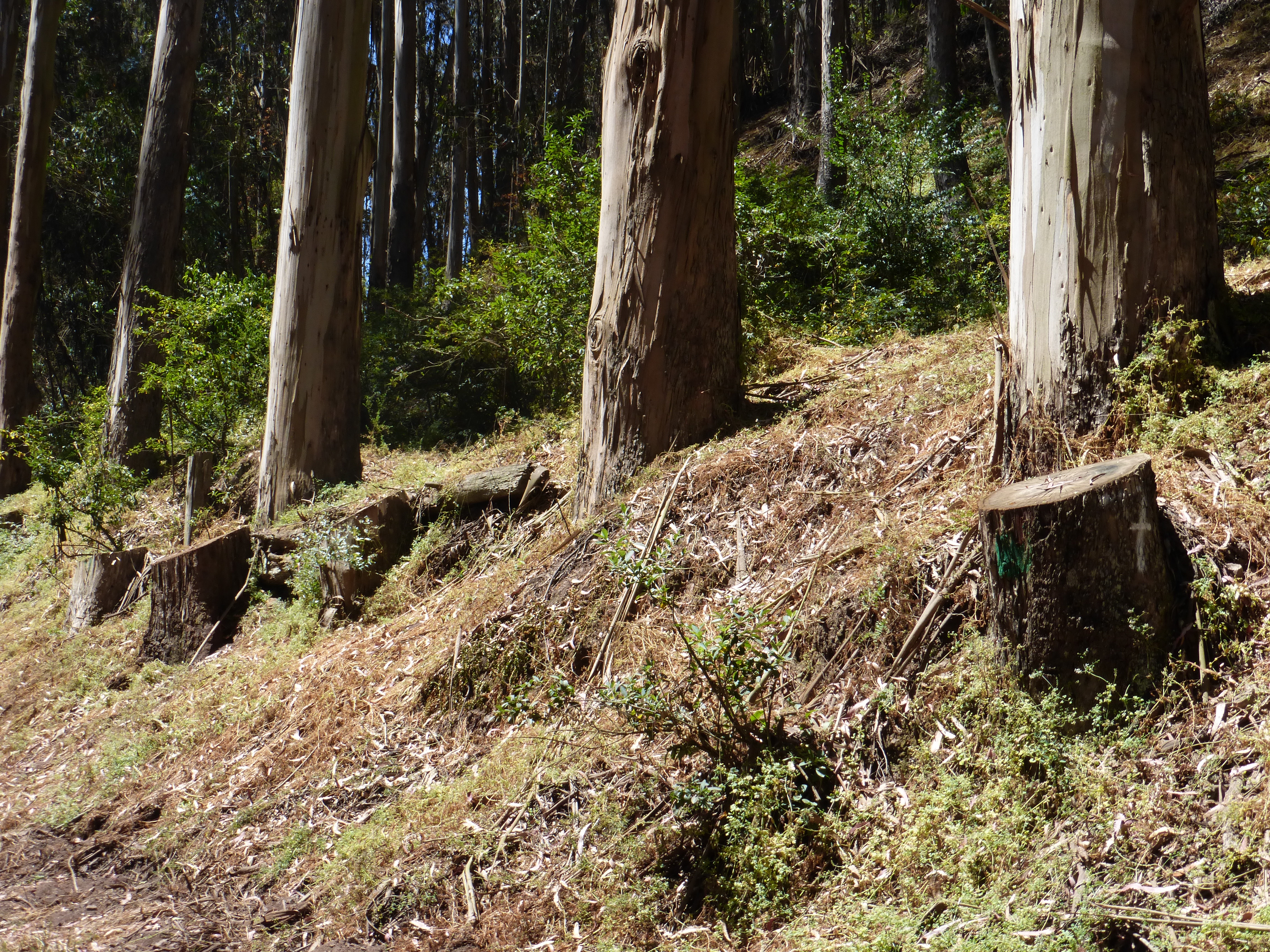
Some of the stumps of the trees that were destroyed in Glen Canyon Park in 2013.  Taken June 2014
Some of the stumps of the trees that were destroyed in Glen Canyon Park in 2013. Taken June 2014

Yes, Mr. Dowie, you have indeed found the mysterious meaning of the word “wilderness” as a “bog in the brain,” to quote Mr. Thoreau.  We have our own example of a similar debate with native plant advocates about the future of Glen Canyon Park in San Francisco.  Our readers will remember Glen Canyon as the scene of the devastating removal of many huge, old trees and the repeated spraying of herbicides to prevent the trees from resprouting and destroy the non-native understory.  To those who objected to this destructive project, a native plant advocate responded:

Please note the term “wilderness.” It implies natural, native flora and fauna; the wild plants and the bird and animal populations that support one another. That is what we want to have if we want a wild retreat. A morass of garden escapes and foreign invasive species is to be deplored. Let’s progress toward returning the area to a REAL wilderness. Do not let the concept that a plant’s becoming established in an area is a sign of its becoming native to the area. It remains an invasive element, a weed. It disrupts and destroys the normal habitat of native plants, animals, and insects in its surroundings.  It will be a huge and long term task, but we can restore the entire canyon to a truly wilderness state. Let’s get started!”

In this version of “wilderness,” trees and plants must be sprayed with herbicide and a new landscape planted.  The result—if it is successful—will be an entirely artificial landscape.  There will be nothing “REAL” about it.

 Language is an obstacle to agreement

 One of many obstacles to reaching agreement with native plant advocates about the future of our public lands and open spaces is that we don’t share a vocabulary.  “Wilderness” is one of many words that cannot be defined by our mutual understanding.

“Sustainability” is another word that is used by native plant advocates, which we believe is inappropriately applied to the projects they demand because it is inconsistent with the realities of climate change and evolution.   The landscapes they are creating are no longer adapted to current environmental conditions.  They are not sustainable.

 “Integrity” has recently become a favorite buzzword of nativists, used to describe their idealized landscape.  We have absolutely no idea what that word means in the context of the contrived landscapes they attempt to create.

And so the debate continues with no end in sight.  Meanwhile our public lands are being destroyed in response to the demands of native plant advocates.  For us the word “wilderness” is now synonymous with “destruction,” which creates a fortress in which humans are not welcome.


(1) Mark Dowie, “The tortured semantics of wilderness,” Point Reyes Light, September 4, 2014

Butterflies of the Bay Area Region

Our readers may remember Professor Arthur Shapiro as a critic of massive ecological “restorations” that attempt to turn back the botanical clock.   Professor Shapiro is better known in the world of academic science as an expert on the butterflies of California.  His Field Guide to Butterflies of the San Francisco Bay and Sacramento Valley Regions (University of California Press, 2007) reflects a lifetime of observation and study of butterflies.  It is as informative about butterfly behavior and physiology as it is readable and engaging.  This is no dry, academic treatise.  Rather it represents an accumulation of over thirty years of experience, walking on every sunny day amongst the butterflies of California and enjoying every minute of it.

We could choose any number of interesting topics from Professor Shapiro’s guide, but we think our readers will be most interested in learning about the natural history of California and the Bay Area region and how that history resulted in our current butterfly fauna.   It’s not a gloomy story, as you might expect in a place that has changed so radically since it was occupied by Europeans in the 19th century.  Rather it’s a story of change and adaptation to change and therefore very much in tune with the concerns of the Million Trees blog.

Butterflies in the landscape created by humans

This is the reality of which plants are useful to butterflies in the Bay Area and Delta Region of California:

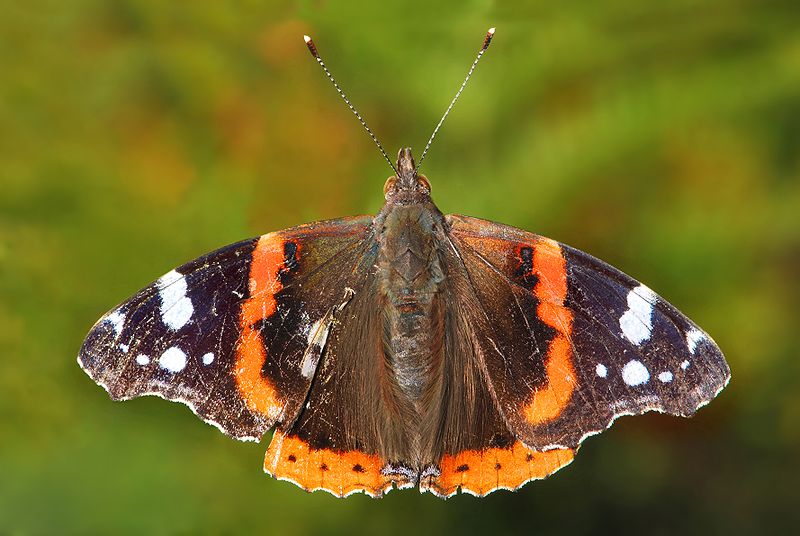
Red Admiral.  public domain
Red Admiral. public domain

“California butterflies, for better or worse are heavily invested in the anthropic landscape [altered by humans].  About a third of all California butterfly species have been recorded either ovipositing [laying eggs] or feeding on nonnative plants.  Roughly half of the Central Valley and inland Bay Area fauna is now using nonnative host plants heavily or even exclusively.  Our urban and suburban multivoltine [multiple generations in one year] butterfly fauna is basically dependent on ‘weeds.’  We have one species, the Gulf Fritillary that can exist here only on introduced hosts.  Perhaps the commonest urban butterfly in San Francisco and the East Bay, the Red Admiral is overwhelmingly dependent on an exotic host, pellitory.  And that’s the way it is.”

Professor Shapiro explains that alterations in our landscape made by humans made it necessary for butterflies to make the transition from natives to non-natives in order to survive:

The explanation for this odd situation can be found in the history of California’s wetlands.  As recently as the early twentieth century, there were extensive fresh water marshes in our area, especially along the east side of the Sacramento Valley.  These wetlands stayed green in the summer and could support multivoltinism because native host plants were available…The draining, diking, and agriculturalization of the wetlands corresponded in time with the widespread naturalization of exotic weeds related to native marshland plants.”

Anise Swallowtail butterfly in non-native fennel.  Courtesy urbanwildness.org
Anise Swallowtail butterfly in non-native fennel. Courtesy urbanwildness.org

Here are a few examples of native butterfly species that made the transition from native to non-native plants when the wetlands were altered by humans:

“What did our Mylitta Crescent feed on before the various pestiferous annual Mediterranean thistles come to California?  Native, mostly wetland thistles, just as it does in mountain bogs today…The Common Checkered Skipper still uses checkerbloom in wetlands where it can find it, but thanks to a weedy species of mallow it is now found in every garden and weedy lot in the northern part of the state.  And the Anise Swallowtail still lays eggs on water hemlock…in marshes, but percentage-wise very few of them.”

San Francisco is a special case for butterflies

San Franciscans know that although their city is very small in size, it is composed of many even smaller microclimates.  Professor Shapiro explains how these microclimates impacted our butterflies:

“The main reason why we have so many federally endangered or threatened butterflies in the Bay Area is that our peculiar geography is predisposed to the fragmentation of populations—particularly in the coastal fog belt.  These local evolutionary experiments may well have been dead ends in the long run…But they were so restricted to tiny chunks of habitat that even nineteenth-century development was enough to spell their doom.”

Then he reminds us what it would take to “restore” the landscapes that supported these rare or extinct butterfly species:

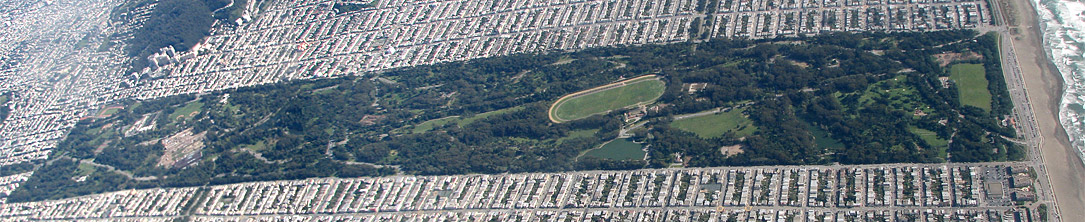
“Had there been an Endangered Species Act in the 1860s, San Francisco would be a very different place.  The “Great Sand Bank” occupying the western third of the city would have been declared critical habitat for any number of plants and animals found nowhere else on Earth—including three butterflies that subsequently went extinct.  We could still have the Xerces Blue, the Pheres Blue, and the Sthenele Satyr, but there would be no Golden Gate Park and no Sunset District.  The reclamation and stabilization of what was seen as a bleak, barren, fog-and-windswept wasteland were hailed at the time as triumphs of civilization.  Now some environmentalists would like to turn the clock back and restore a little of that unique habitat.  But some of its inhabitants, including those three butterflies, are gone, never to return.”

Golden Gate Park and its neighborhood.  Would you trade this for the barren sand dunes that preceded it?  Gnu Free Documentation
Golden Gate Park and its neighborhood. Would you trade this for the barren sand dunes that preceded it? Gnu Free Documentation

 However, the story isn’t entirely of loss in San Francisco:

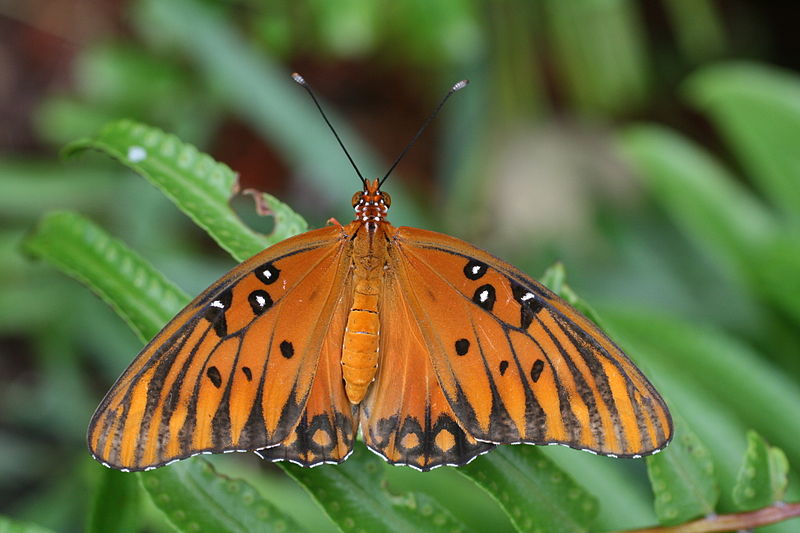
Gulf Fritillary.  Creative Commons
Gulf Fritillary. Creative Commons

“The Cabbage White…arrived sometime in the late nineteenth century.  The Gulf Fritillary…seems to have become established only in the 1950s.  The Fiery Skipper was unknown…in 1910…Several native species treated as scarce [in 1910] have become commoner due to introduced, weedy host plants.  The Anise Swallowtail and the Red Admiral are prime examples.  The West Coast Lady, most of whose hosts are weedy, was already very abundant in [1910].”

What do butterflies need today?

Professor Shapiro provides a detailed list of the plants used by the butterflies of California.  You will find roughly equal numbers of native and non-native plants on the list of plants they like as well as the plants they don’t like.  This is how he summarizes these lists:  “Most California natives in cultivation are of no more butterfly interest than nonnatives, and most of the best butterfly flowers in our area are exotic.”

What is done cannot be undone

While humans wring their hands about “weeds” and the loss of historical landscapes, butterflies have moved on.  And so they must to survive.  And so should we because these historical landscapes cannot be recreated without abandoning the economic enterprises which feed us or the homes that house us.  We aren’t going to bull doze Golden Gate Park or the residential neighborhoods that surround it.  The least we can do for the butterflies of California is to quit dousing the plants they need with herbicides solely because they are non-native.  We have created the landscape that we need and we should quit destroying the landscape that our butterflies now need.

Professor Shapiro’s Preface is a fitting conclusion:

The changes that humans have wrought on the lives of butterflies are merely the most recent of the many changes they have gone through in their history.  We have no hope of restoring communities to some hypothetical pristine state on any but a miniature scale.  At best we create gardens that more or less resemble what we think those communities looked like at some arbitrary time in the past.  Like all gardens, they require constant effort to keep them from becoming what today’s conditions drive them to become—conditions dominated by what we characterize as “weeds.”  We can, however, try to protect the bits of nature that have survived relatively unchanged despite us, cognizant that larger forces than we control may override our efforts.”

Eucalyptus: A fairy tale

We were browsing in our local used book store when a book caught my eye with the title, Eucalyptus.*  Of course, I had to buy it.  It is fiction, a welcome reprieve from the dry, often dense reading I must do to inform the readers of Million Trees.  Now I have the pleasure of sharing this diversion with you.

A fairy tale told among the trees

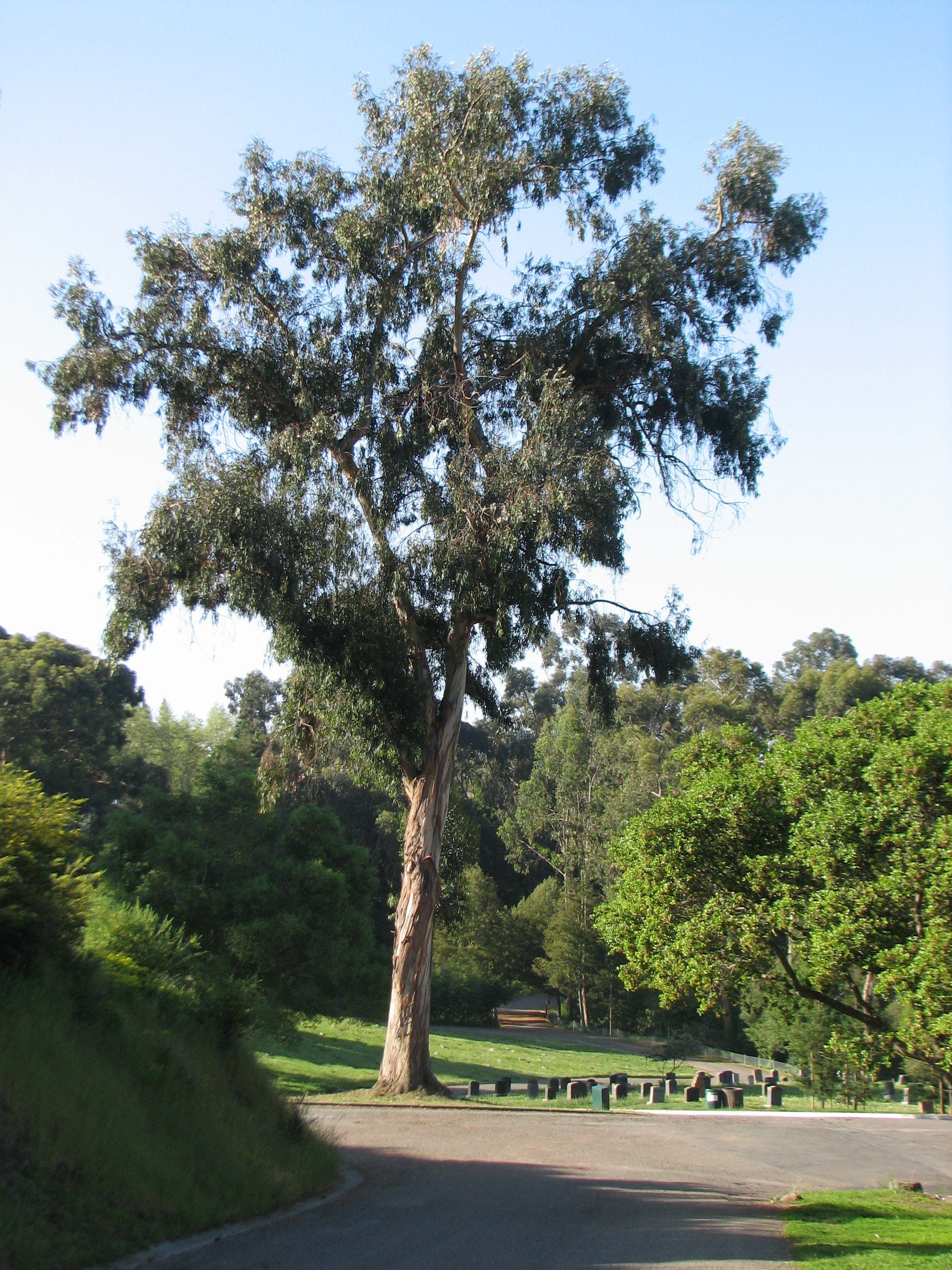
Blue gum eucalyptus tree in the Mountain View Cemetery.

We are in post-war Australia.  A young man marries a mail-order bride and soon loses her in childbirth, but not before insuring her life.  With this windfall, he buys a beautiful piece of land beside a river in southeast Australia.  His life is spent collecting and planting hundreds of different species of eucalyptus while raising his daughter.

The hundreds of species of eucalyptus provide what little structure there is to the book.  Chapters are given the botanical names of the great variety of species and their various shapes and characters are described.  Our very own blue gum is mentioned at length:  “The Blue Gum is easily recognizable.  The name E. globulus for the shape of its fruit, now describes the imperial distribution of this majestic tree:  through the Mediterranean, whole forests in California and South Africa, and all states of Australia.”

The farmer is as devoted to his trees as he is to his beautiful daughter, so when the young men start coming around to court his daughter he protects her by devising a scheme that renders her nearly unattainable.  He announces that the man who wins his daughter’s hand must first name every species of eucalyptus on his property.  This proves an insurmountable task, but his daughter is indifferent to the failures of a long line of men who come from all over Australia to see her legendary beauty, but fail over many years to pass the test.

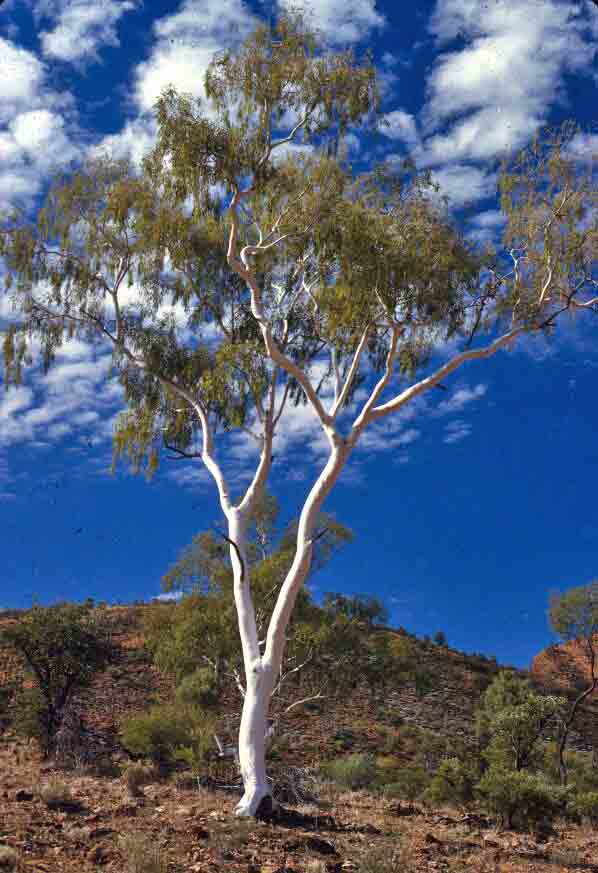
Ghost Gum.  Courtesy Cynthia Clampitt, Waltzing Australia
Ghost Gum. Courtesy Cynthia Clampitt, Waltzing Australia

Finally, a uniquely qualified botanist presents himself to the challenge.  It becomes apparent that he will pass the test.  While the father and this botanist tick off the list of hundreds of eucalypts, a mysterious stranger visits the daughter in the forest.  He tells her stories that charm her.  For the first time in her life, someone interests her.  He brings to her his knowledge of a wide world full of unusual lives and human predicaments.

When the stranger suddenly disappears without explanation, she falls into a deep stupor.  Meanwhile, the botanist passes the difficult test and comes to claim his bride.  But she languishes in despair and he is unable to revive her.

We must leave the story here, because the end is a wonderful surprise of which we do not wish to deprive you.   It was a great pleasure to read about our trees where they are respected and admired, as they deserve to be here as well.


*Murray Bail, Eucalyptus, Melbourne, Australia, 1998

Deforestation update is good news

We don’t have many opportunities to tell our readers positive stories, so we are grateful for a recent article in The Economist magazine about deforestation. (1) In many places around the world the rate of deforestation has slowed and some places are being reforested. Greenhouse gas emissions from deforestation were contributing 25% of all emissions just 15 years ago.  Now deforestation accounts for only 12% of total emissions.  The Intergovernmental Panel on Climate Change which represents international scientific consensus said in its most recent report, “deforestation has slowed over the last decade.”

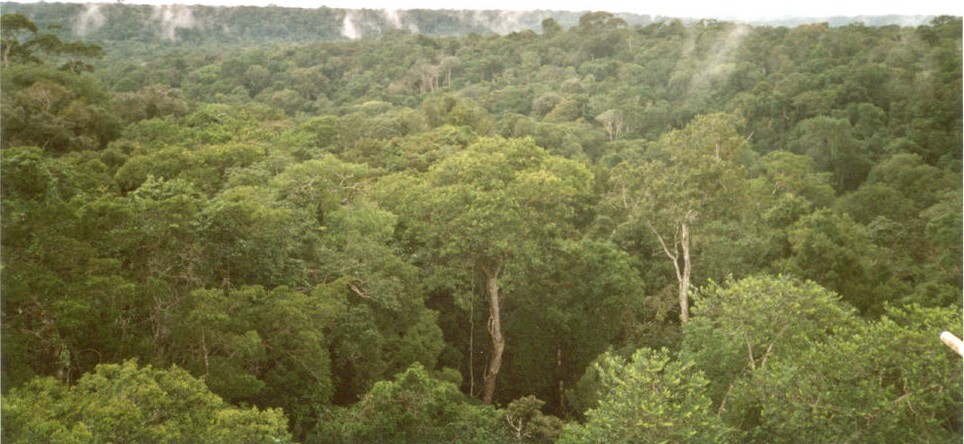
Amazon rainforest.  Creative Commons - Share Alike
Amazon rainforest. Creative Commons – Share Alike

The reasons for this improvement are important because they give us clues about how we can make further progress.  The Economist sees a pattern in the success stories:  “Typically, countries start in poverty with their land covered in trees.  As they clear it for farms or fuel, they get richer—until alarm bells ring and they attempt to recover their losses.  This happens at different stages in different places, but the trajectory is similar in most:  a reverse J. steeply down, then bottoming out, then up—but only part of the way.”  Here are a few examples that illustrate this principle:

  • Fifteen years ago, Brazil was losing 20,000 sq kilometers (7,700 sq miles) of forest per year. Since then a national policy has created national parks and protected patches of forest which has reduced deforestation to a rate of less than 6,000 sq kilometers per year.*
  • Mexico has cut its deforestation rate even more than Brazil.
  • India and Costa Rica are replanting their forests. India had 640,000 sq km of forest left in 1980.  It now has 680,000 sq km of forest.  Only 20% of Costa Rica was forested in the 1980s.  Now 50% of Costa Rica is forested.

These countries have in common some of the factors that predict success in reducing deforestation.  They are all more prosperous than they were in the past.  Their fertility rates are declining.  They are all democracies, in which public policy is largely a reflection of what the voters demand of their elected officials.  These are also countries in which the government is sufficiently functional to enforce their forest policies.  Developments in satellite imagery have helped these governments to monitor and enforce their policies.

(*Since this report was published by The Economist, the Yale Environmental Review 360e has published data on deforestation in Brazil for 2013.  After reducing the rate of deforestation since 2004, the rate of deforestation increased from 2012 to 2013 due to new roads and dams, and illegal logging.)

None of these factors would predict the relatively low deforestation rate in the Congo because its population is growing rapidly, it is still very poor, and its government is dysfunctional.  The Economist attributes the relatively low deforestation rate of the Congo to the movement of its rural population to distant urban areas.  The distance of forests in the east of the country from the cities in the west makes them less vulnerable to deforestation.

Deforestation continues to be a serious problem in Indonesia, despite the fact that the fertility rate has declined and farm output increased.  The rate of deforestation in Indonesia has exceeded that of Brazil since 2011.  The government of Indonesia is hostile to anti-deforestation policy, seeing it as foreign intervention.  Indonesia has only recently achieved democratic elections, which may enable reconsideration of forest policies.

China is also an interesting case because it has invested huge effort in reforestation without making any perceptible progress toward democratization.  However, the population is stable and increasingly urbanized and the country is significantly more prosperous than it was in the 1980s.  The effects of China’s deforestation were so dire as to motivate its autocratic rulers to take immediate action.  (2)

Only 2% of China’s original forest is still intact, according to Greenpeace.  Rampant logging and overgrazing have degraded its soil to the point that 25% of its territory is now covered in sand.  The desert is so close to Beijing that its roads are often clogged with sand, its railways inundated, and its pastures desiccated.

In 1978, China began one of the biggest reforestation projects in the world.  Since then 66 billion trees have been planted to create a shelterbelt along the edges of its northern desert that is projected to be 2,800 miles long by 2050.  Unfortunately, the Chinese selected few species of trees, which would grow quickly.  Some species were short-lived and some weren’t suited to soil conditions, so only 15% of trees planted since 1949 are still alive.  This is probably another example of a country that could make greater progress against deforestation with a more open democracy, which improves decision-making.

Global_Forest_Cover_Sub-Regional_Trends


Deforestation in the United States

Deforestation in the United States is largely a thing of the past.  About half of the United States was forested in 1600 compared to about one-third today.  Most of this deforestation occurred by 1910, when demand for lumber decreased significantly due to changes in building materials.  In the northeast of the country, much of the land has been naturally reforested as land that had been cleared for agriculture was abandoned.  It was always marginal land for agriculture, so as the population became more mobile, it moved west to find better land for farming.  This graph reflects these changes in land use and informs us that the south and the west are still supplying lumber for the world.  The US is supplying about one-fourth of the world’s timber.   Wildfires and insect infestations caused by climate change are also factors in declining forest cover in the west (although probably not reflected in this graph which ends in 1997).  (3)

Forest cover, USA. US Forest Service

Meanwhile, our local experience with deforestation is an outlier in these national trends.  Much of California was naturally treeless grassland and chaparral and it is being returned to that landscape by the native plant movement.  Most of our urban forest in the San Francisco Bay Area is not native to California.  It is being destroyed by most managers of public land because it is not native.  The public often objects to these destructive projects, but we are being ignored.

As we have seen in the examples above, deforestation and reforestation are largely political decisions.  American democracy is increasingly more responsive to economic interests than to the public.  Declining voter participation rates are undoubtedly a factor in this disturbing trend.  If you are not registered to vote, please give some thought to how our democracy has been damaged by lack of participation.  Midterm elections will take place this November.  Much is at stake.


(1) “A clearing in the trees,” The Economist, August 23-29, 2014

(2) “Great Green Wall,” The Economist, August 23-29, 2014

(3) http://en.wikipedia.org/wiki/Deforestation_in_the_United_States

Is UC Berkeley building a bonfire during fire season?

If you are watching the news, you know that wildfires are raging all over California. One of those fires destroyed most of the small town of Weed a few days ago. The San Francisco Chronicle reported that fire and made a rare acknowledgement of the flammability of native California vegetation: “…the native fuels adapted over thousands of years to the lightning-caused fires that regularly broke out in California. The most problematic in a drought situation, he said, are manzanita, younger ponderosa pine trees and incense cedars. The three are all highly flammable and close to the ground, creating a fuel ladder from the grass to the overstory trees.” The article also noted that fires usually start in grasses and are then fanned by high winds into wildfires that destroy everything in their path.

Yet, the fiction continues in the San Francisco Bay Area that only non-native trees are to blame for wildfires and that they must all be destroyed to reduce fire hazards. In fact, when the trees are destroyed, the unshaded ground is quickly populated by grasses that are the type of vegetation in which virtually all of our fires start.

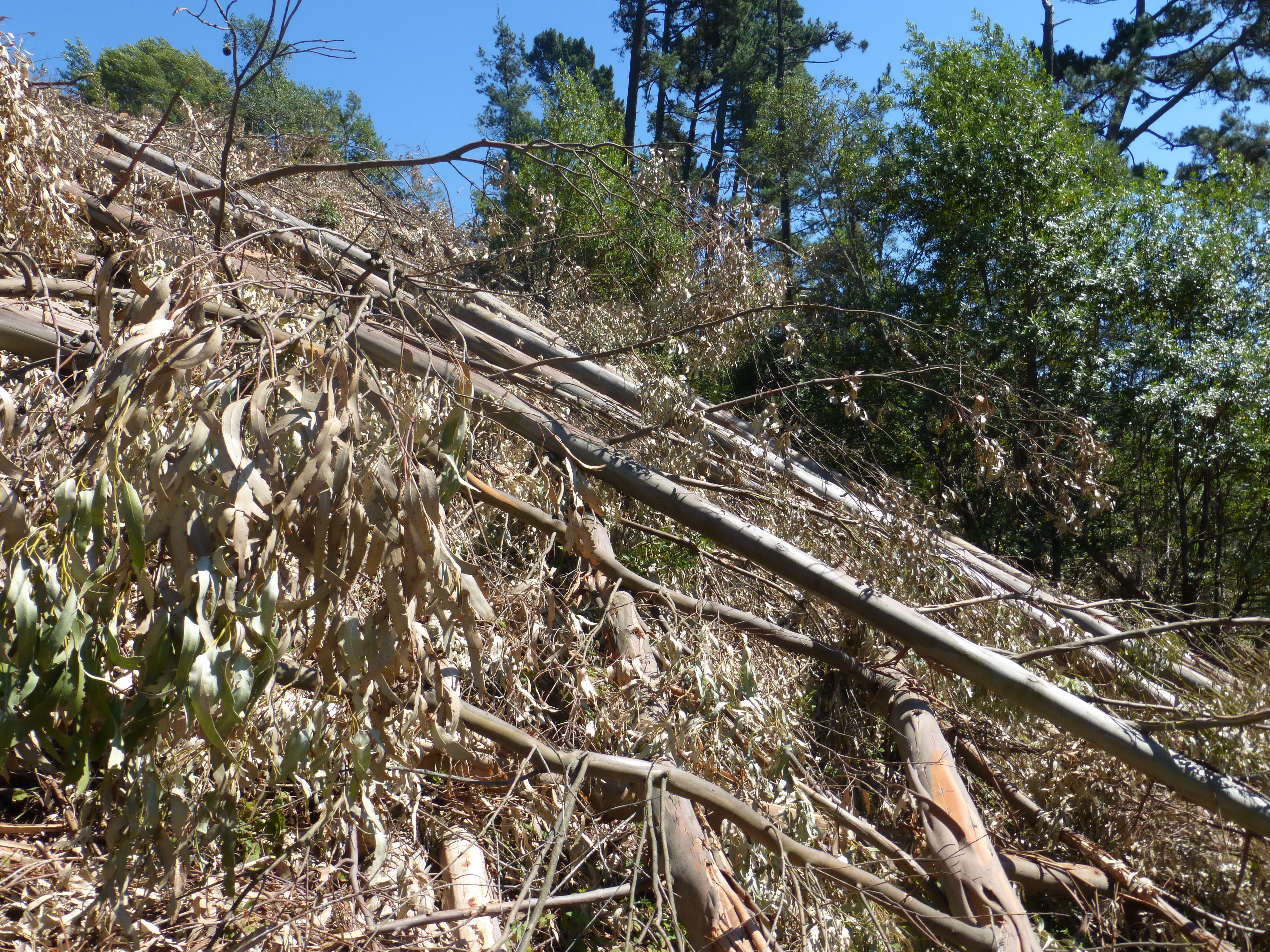
In the height of fire season, UC Berkeley has recently destroyed many trees in the East Bay Hills and left them lying on the ground to dry out. These huge piles of dead vegetation look like bonfires waiting to happen. We are grateful to our readers for alerting us to this new round of destruction. They have given us permission to publish their letter to the Federal Emergency Management Agency and UC Berkeley. We hope you will consider writing your own letter to express your concern.


Alessandro Amaglio [alessandro.amaglio@dhs.gov]
Region IX Environmental Officer
Federal Emergency Management Agency
Oakland, CA

RE: East Bay Hills – Environmental Impact Statement – FEMA – RIX

Dear Mr. Amaglio,

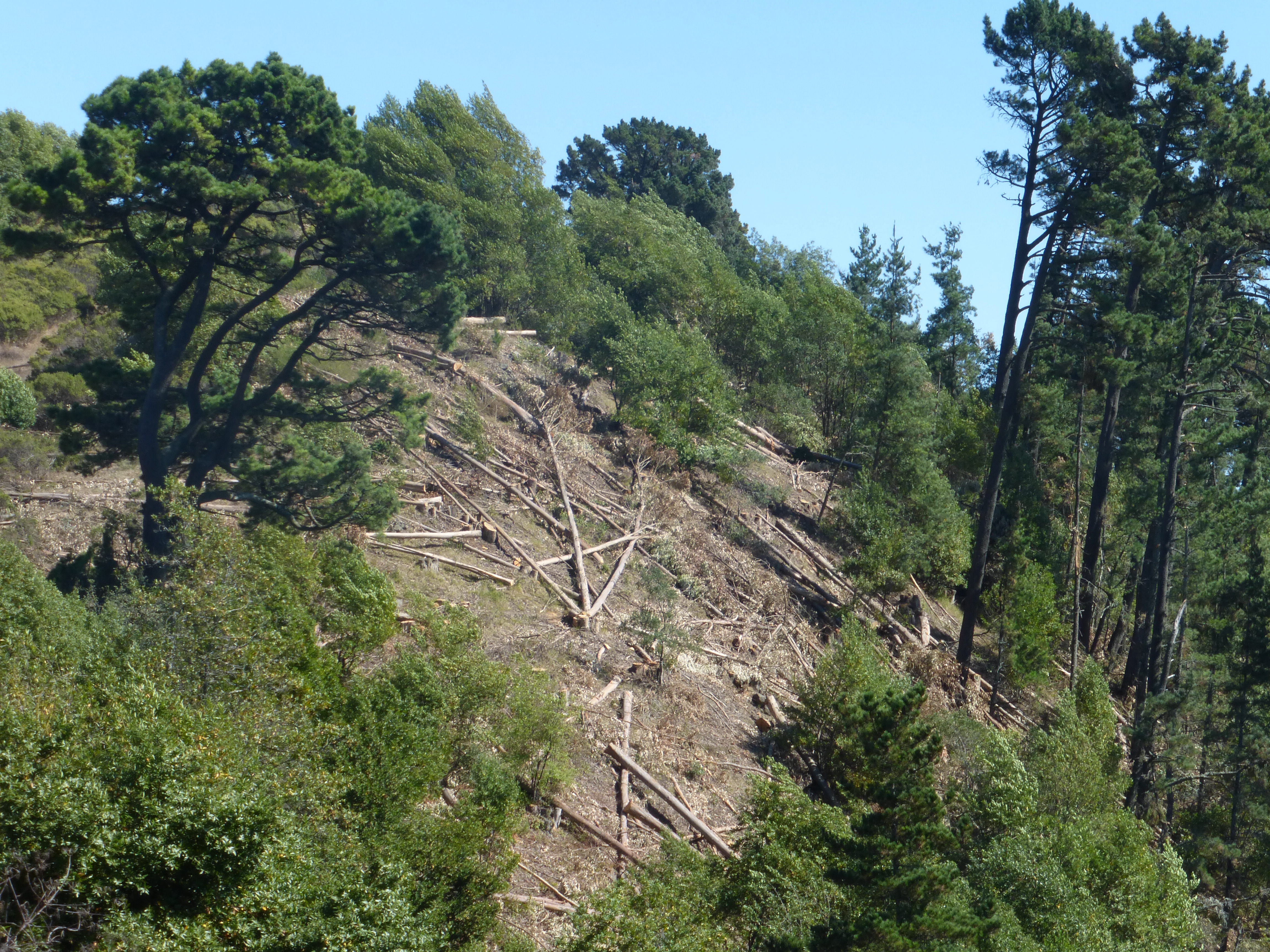
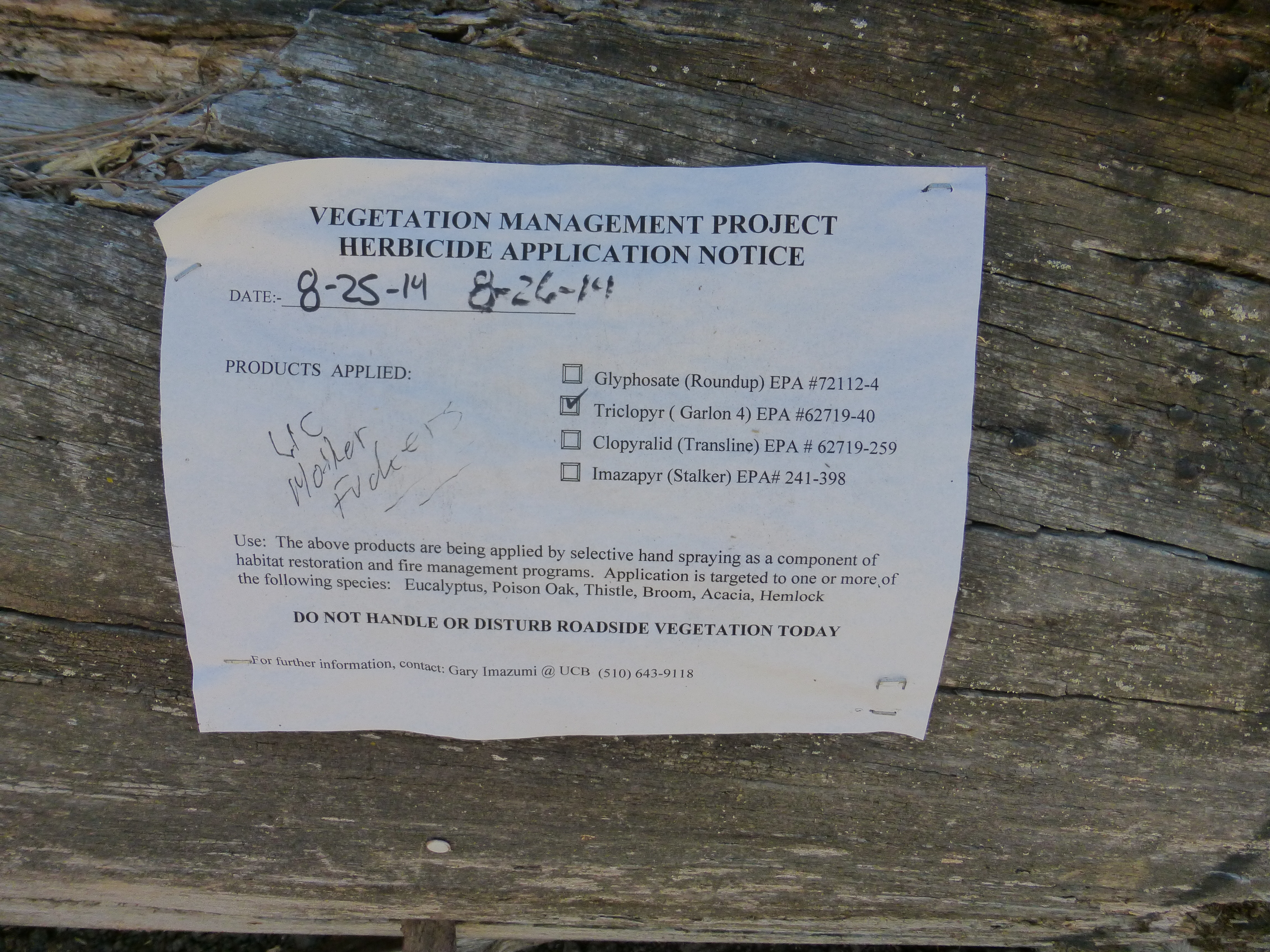
We are writing to tell you that UC Berkeley is in the process of destroying eucalyptus and some pine on its property. Judging by the Pesticide Application Notice posted on Grizzly Peak Blvd near South Park Drive, the trees were destroyed August 24-26, 2014. The scale of the removals is not entirely visible because the property goes down a steep slope that we could not cover. Based on what was visible to us, it appears that at least 100 trees were destroyed on a few acres.

P1010390

We believe the trees are being destroyed within the area for which UC Berkeley has applied for a FEMA grant to remove all non-native trees. We have used the maps in the Draft EIS to make this determination. Therefore, it seems appropriate that FEMA should be informed about this.

P1010400

While we visited the property on Monday, September 15, 2014, we could hear chainsaws in the distance but could not determine where the sound was coming from. Therefore, we suspect that more trees are being destroyed, but cannot determine exactly where.

P1010384

The Pesticide Application Notice gave the name of a person at UC Berkeley (Gary Imazumi) who is responsible for this project. (For the record, we are not responsible for the graffiti scrawled on that sign.) We have contacted him and asked for more information about the entire scale of the project and a timeline for its completion. We have also asked him what will be done with the huge piles of dead vegetation that are now lying on the ground. We have not received a response to our questions.

This incident raises the following questions and concerns:

  • Has the Draft EIS for the FEMA grants to UC Berkeley for tree removal been approved?
  • Has the FEMA grant to UC Berkeley been awarded?
  • If the EIS and/or the grant have not been approved, can UC Berkeley be reimbursed for expenses it incurs prior to the award of the grant?
  • The trees that UC Berkeley destroyed on August 24-26 are still lying on the ground several weeks after they were cut down. They have not been chipped or hauled away.  The Draft EIS made a commitment to chip the destroyed trees and distribute them on the ground.  Is there any time frame for this disposition of the destroyed trees?  Should the public expect dead trees to spend weeks or more on the ground after they are cut down?
  • As you know and the daily news confirms, we are now in the height of fire season. Does it seem consistent with fire hazard mitigation to use chainsaws at this time of year, particularly after several years of drought?
  • Does it seem consistent with fire hazard mitigation to leave dead vegetation lying on the ground during the height of the fire season? Does FEMA believe that dead vegetation is less flammable than living, standing trees?

P1010396

We understand that some of these questions are rhetorical and we don’t expect answers to any but the first three questions. The rhetorical questions are not intended to put you in an awkward position. They are intended to express our opinion of UC Berkeley’s hypocritical claim that destroying living trees will reduce fire hazards. We just want FEMA to know what is happening and to take it into consideration before finalizing the EIS and/or awarding the grant, if FEMA has not already done so.

Thank you for your consideration.

[Concerned citizens of Oakland]

Cc: Gary Imazumi, Manager, Grounds Operations, UCB [garyi@berkeley.edu]
Sal Genito, Associate Director, Grounds, Custodial, Environmental Services, UCB [salgenito@berkeley.edu]
R’obert Newell, Acting Assistant Vice Chancellor, Physical Plant, UCB [rbnewell@berkeley.edu]


Update:  On December 1, 2014, FEMA published the final Environmental Impact Statement for the “Fire Hazard Mitigation Grants” in the East Bay Hills.  As a result of UC Berkeley’s premature removal of trees in the project area prior to the publication of the EIS and prior to the award of the grants, the final EIS says that UC Berkeley will not be awarded grant funding for the Frowning Ridge portion of their grant application.  The following is an excerpt from the Executive Summary of the final EIS (page 17) which is available HERE.  However, we should not assume that this prohibition will remain when the EIS is officially approved by the “Decision of Record” on January 5, 2015, because we assume it is being challenged by those who support this project.

“In August 2014, UCB undertook environmental treatment measures on approximately 7.5 acres of the 185.2-acre project area at Frowning Ridge. According to UCB, they felled 150 eucalyptus, Monterey pine, and acacia trees, and applied an herbicide to eucalyptus and acacia stumps. In undertaking these actions prior to issuance of the final EIS, UCB failed to comply with both the specific conditions of the grant and also the NEPA requirement which limits applicant action during the NEPA process under 40 CFR 1506.1. Both required UCB to refrain from action until FEMA had completed its environmental review. As a result, the Frowning Ridge project area is no longer eligible for PDM program grant funding.

Nonetheless, the environmental analysis of the impacts of the proposed action at Frowning Ridge has not been removed from the final EIS because it is part of the review and consideration that FEMA has undertaken in concluding whether to fund the proposed actions. FEMA will continue to work with the U.S. Fish and Wildlife Service and the National Marine Fisheries Service to determine whether UCB’s unauthorized work at Frowning Ridge negatively affects UCB’s other projects at Strawberry Canyon and Claremont Canyon and will make further decisions regarding these projects in the Record of Decision.”