Deadly Dogma:  Revisiting the Farallon Islands Unnecessary Eradication Project

“The more we know about plans to eradicate harmless mice on the Farallon Islands with rodenticide, the less sense it makes.” – Conservation Sense and Nonsense

Plans to eradicate mice on the Farallon Islands with rodenticide were approved by the California Coastal Commission (CCC) two years ago, on December 16, 2021.  Although CCC approval was contingent on a few conditions intended to reduce the inevitable death of non-target birds and marine animals, it is unclear if CCC will be able to enforce the conditions. Plans seem to be moving forward behind closed doors, so Conservation Sense and Nonsense continues to be concerned about this project. 

First a brief reminder of the project and our objections to it.  House mice were introduced to the Farallon Islands over 100 years ago by ships visiting the island.  There is no evidence that mice harm birds on the Farallons.  The mice are an integral part of the food web, eating primarily vegetation and supplementing that diet with insects during summer months when vegetation is sparse.  The mice are also the prey of hundreds of thousands of birds that live on the islands as well as birds that stop over on their migratory routes.  The mouse population varies throughout the year, dwindling during winter months and increasing in the fall.  When the mouse population declines, food sources for their predators also decline.  That’s when burrowing owls are said to prey on the nestlings of ashy storm petrels.  Though the mice are blameless, the project proposes to kill them all based on the assumption that burrowing owls will not overstay their migratory stop over if food sources are significantly reduced.  The project is expected to kill hundreds—perhaps thousands—of non-target birds who will eat poisoned pellets directly and/or poisoned mice.

The project has always seemed absurd and nothing we’ve learned about it in the past 2 years has made it seem otherwise.  Our last article of 2023 will report new information learned since the project was approved.

Contamination of the food web

Robert Boesch is a retired Pesticide Regulator for the Environmental Protection Agency, region 9 and the Hawaii Department of Agriculture.  Presently, he is Visiting Colleague at University of Hawaii at Manoa.  Based on his research and experience, he has written a discussion paper about island eradications using rodenticides, which he has shared with the California Coastal Commission and many other agencies and organizations.  This entire discussion document is available below as a footnote and this is his summary of “Eradication Programs Eliminating Invasives and their Predators and Scavengers!”

  • Eradication programs for mice and Polynesian Rats are planned for the Farallon Islands, Midway and Wake Island.
  • Brodifacoum, a potent, persistent and bioaccumulative anticoagulant poison is the toxicant. [This is the rodenticide that will be used on the Farallon Islands to kill mice. There are no rats on the Farallons.]
  • Brodifacoum residues have been detected in almost all fish that were collected following treatment of Palmyra, and trace levels were found in 10 percent of the fish after treatment of Wake.
  • Brodifacoum residues in fish caught at Wake increased from trace levels to detectable residues over 3 years.
  • Diphacinone is a greater threat of secondary poisoning to mammals than brodifacoum.
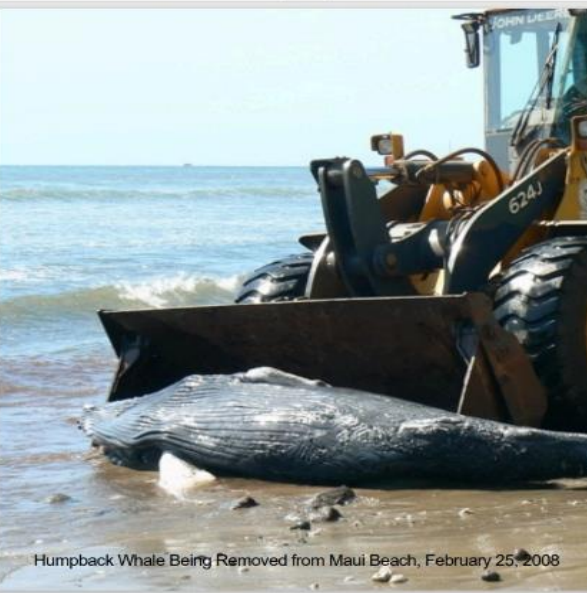
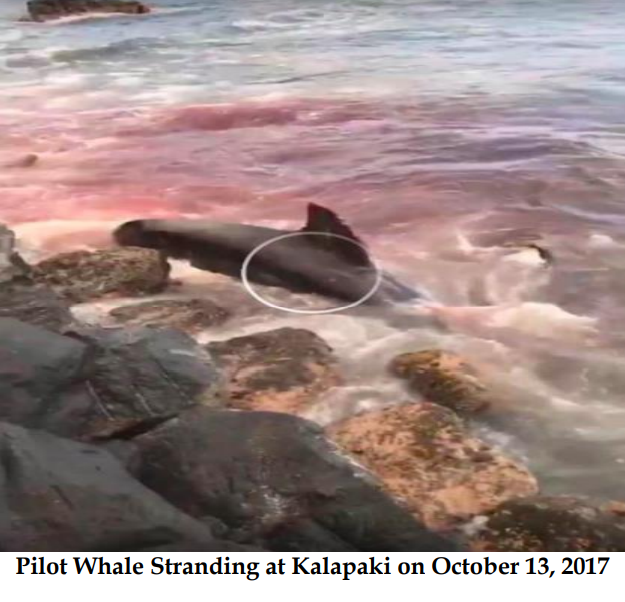
  • Strandings of whales, some hemorrhaging, occurred within 60 days following anticoagulant bombardment.
  • Unusual mass strandings of hemorrhaging dolphins occurred in San Diego and Hawaii years after anticoagulant bombardment.
  • There is very little known about the fate of anticoagulant residues in the oceans.

Our knowledge of contamination of the food web caused by rodenticide drops on islands is limited because monitoring is usually short-term and frequently done by the same contractors who implemented the project, with little motivation to report the extent or persistence of contamination.  For the same reasons, we have limited knowledge of how successful the projects are.

Track record of island eradications

About 1,200 island eradications have been done all over the world over the last 30 years.  Our evaluation of the proposed project on the Farallon Islands is based on the success or failure of those projects.

The aerial application of rodenticide to kill rats on Anacapa Island in 2001-2002 was the first of its kind in North America.  The project was also unique because it was complicated by the need to spare a population of endemic native deer mice on Anacapa.  Over 1,000 native mice were captured before the aerial application of rodenticide and released back on the island after the poison was no longer effective.  Although post-project monitoring reported successful eradication of rats, they were not confident that all of the mice that were left on the island had been killed. (1)

Attempts to eradicate mice have been consistently less successful than attempts to eradicate rats.  A study of 139 attempted eradications of animals on 107 Mediterranean islands in eight countries found that eradication projects targeted 13 mammal species. The black rat was the target of over 75% of the known attempted eradications in the Mediterranean Basin. The most widely used technique was poisoning (77% of all eradications), followed by trapping (15%) and hunting (4%).  Techniques were largely target-specific.

The average failure rate of the projects was about 11%, but success was defined only as the death of animals living on the islands at the time of the project. However, this percentage varied according to species. The failure rate of house mouse eradication was 75%. Reinvasion occurred after 15% of eradications initially considered successful. (2)

Island eradications considered initially successful, are often failures in the long run.  A recent visitor to Anacapa Island has reported seeing two dead rodents as her escorted group was leaving the island. One was identified as a deer mouse. The other rodent was not identified. Have rats returned to Anacapa?  Are native deer mice still being killed by residues of rodenticide? (3)

The eradication of rats on Anacapa Island is relevant to the planned project on the Farallon Islands because rats were killed, but mice were saved.  Although the Anacapa project considered rats a threat to birds, it did not consider mice a problem.  Rats were killed, but mice were saved by trapping and removing them from the island before the rodenticide was dropped.  Mice on the Farallon Islands are not a threat to birds.  They will be killed only because they are non-native.

Mice are members of the food web

Mice on the Farallon Islands are as much a part of the food web as they are on Anacapa Island.  They are prey of the birds and they are mainly predators of vegetation.  On the Farallon Islands, mouse predation of vegetation is considered a problem, but on Anacapa Island it is not considered a problem.  On the Farallon Islands, the study of the diet of mice reports that mice also eat insects when vegetation becomes scarce in the fall.  (4)

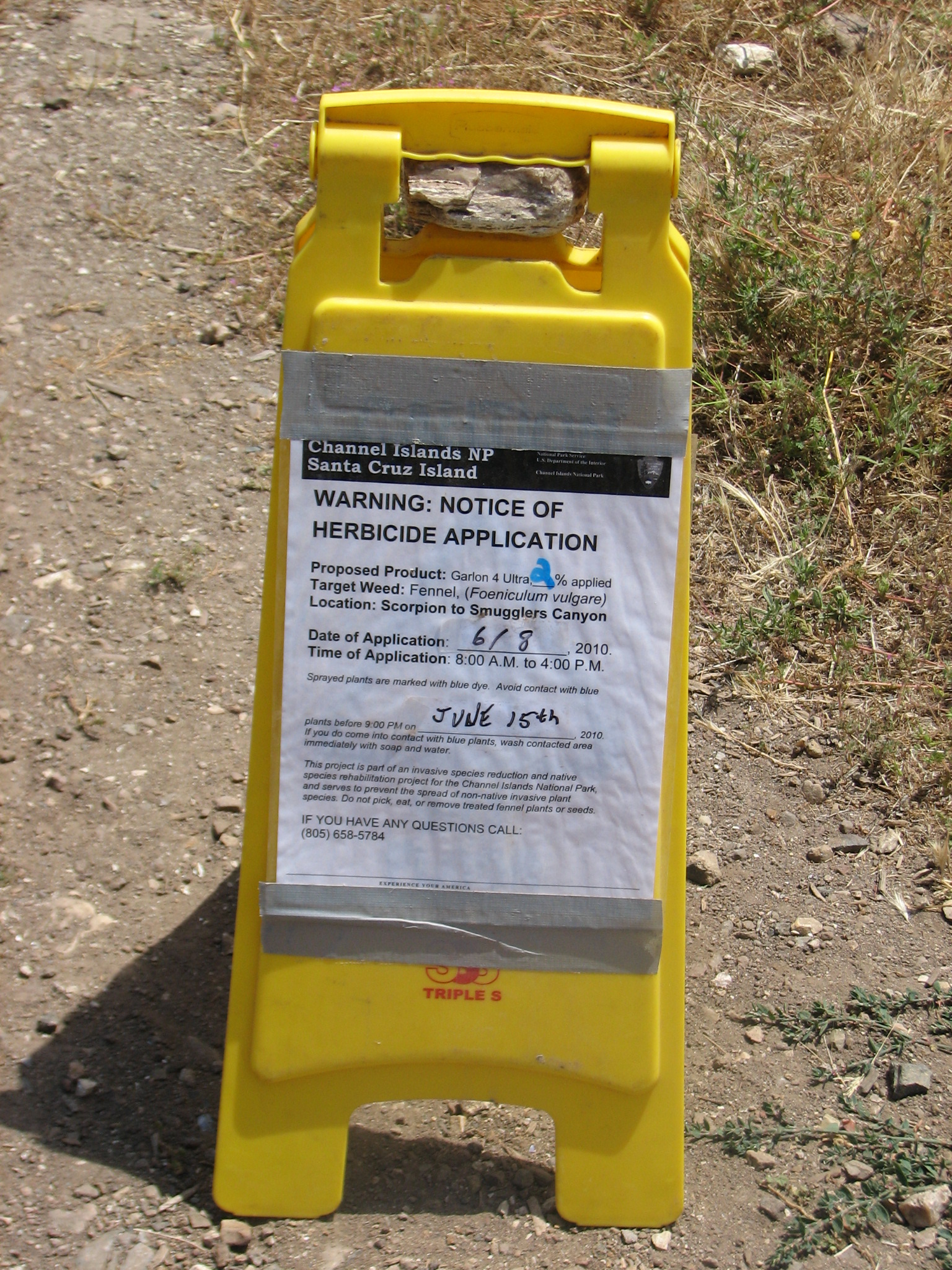
The study of the mouse diet on the Farallons also reports that 63%-80% of the vegetation on the Farallons is non-native.  That’s why Roundup (glyphosate) has been used on the Farallon Islands every year since 1988.  Between 2001-2005, an average of 226 gallons of herbicide were used annually (5.4 gallons per acre per year), according to the annual report of the Farallon National Wildlife Refuge. (5)

I took this photo on Santa Cruz Island in 2010, while visiting with an escorted group.

The Farallon Islands have never been inhabited and there has been no public access to the islands for over 100 years.  Non-native plants were not brought to the Farallons by humans.  Their seeds were brought by birds in their stomachs, in their feathers, on their feet and by wind and ocean currents.  Non-native plants dominate vegetation on the Farallons partly because non-native plants are eaten by birds.  The plants are members of the food web and their eradication is depriving birds and other animals in the ecosystem of food.  If non-native plants were not being eradicated with herbicides, it probably would not be necessary for mice to eat insects, which are not their preferred food.  We can safely assume that herbicides are harmful to the animals that consume plants that have been sprayed. (6)

Consequences of fiddling with the food web

There were also feral cats on the Farallons before they were killed.  Predictably, the population of mice increased after the cats were killed.  When 6,000 feral pigs were killed by sharp shooters on Santa Cruz Island, Golden Eagles substituted for that plentiful food source by preying on the rare, native Channel Island Fox.  Golden Eagles were captured and relocated to the mainland.  The fox population was restored to the island by a captive breeding problem.  The same could be done on the Farallons to eliminate the only known threat to ashy storm petrels.  The small population (approximately 6-10) of burrowing owls that are the only known predators of the petrels could be trapped and removed to the mainland as the Golden Eagles were on Santa Cruz Island.

Restoration plans for any ecosystem should begin with a thorough analysis of the food web.  Plucking single species of plants and animals out of complex ecosystems without understanding their role in the food web results in unintended and harmful consequences.

The Farallons project is based on mistaken assumptions

The Farallons project is based on the mistaken assumptions of invasion biology.  Most of the vegetation on the island is being killed with herbicide because it is non-native.  The vegetation is clearly essential to all the animals living on the island, but invasion biology asks us to believe that it is not, solely because it is non-native.  If the mice are killed on the island, it is only because they are non-native, not because they are harmful to birds.  They are an important source of food for the birds, but invasion biology asks us to believe they are not, solely because they are not native.  These assumptions are wrong, yet 50 years of nativist ideology still has a death grip on our public lands. 

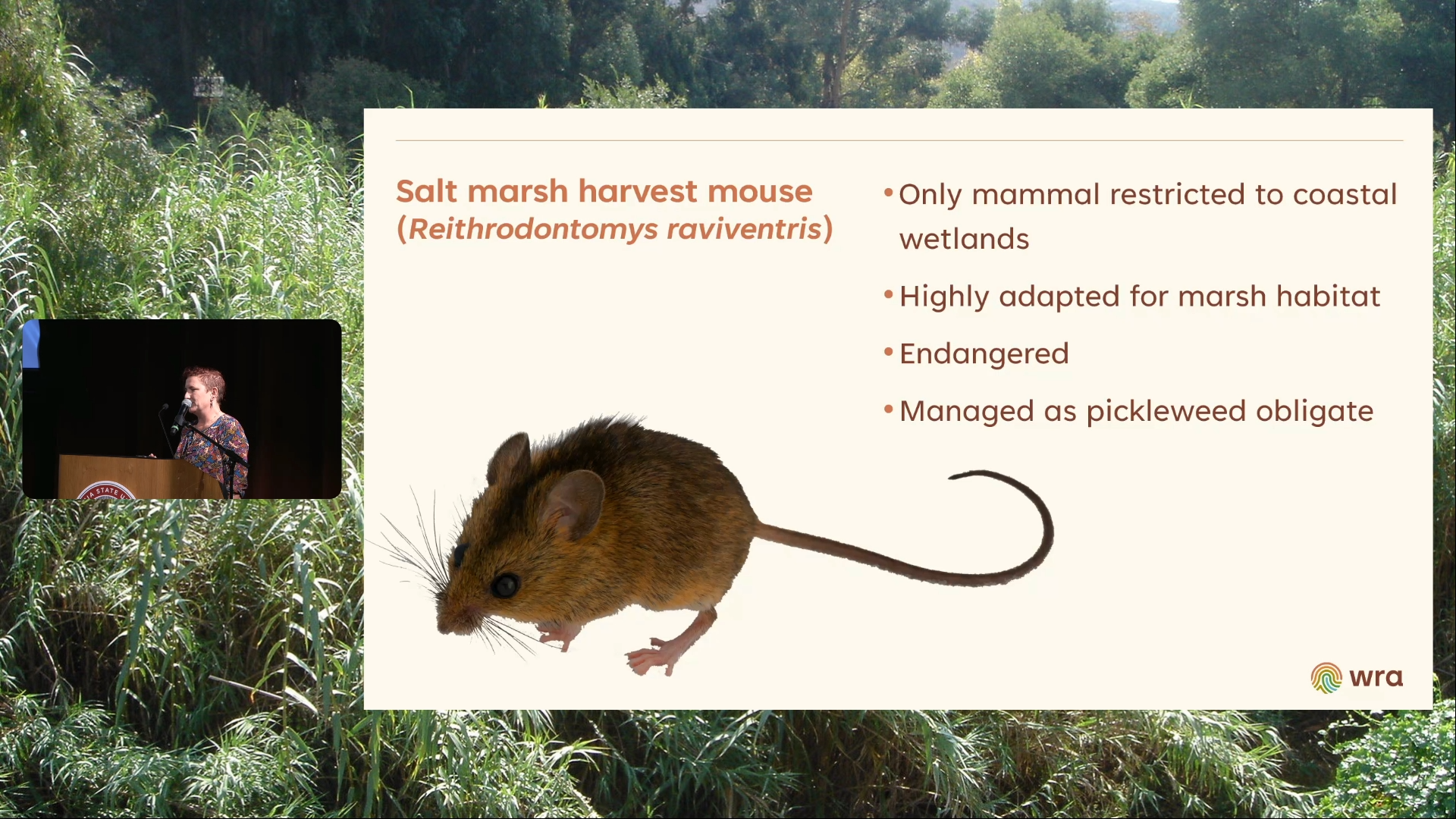
This deadly dogma is losing its grip, but apparently too slowly to prevent the destruction of the food web on the Farallon Islands.  I always attend the conferences of the California Invasive Plant Council (Cal-IPC) and the California Native Plant Society (CNPS) to give native plant advocates every opportunity to convince me of their ideology.  Consistently, I find more support for my contrarian viewpoint than I do for invasion biology.  A presentation about the salt marsh harvest mouse at the Cal-IPC conference in October 2023, is an example.

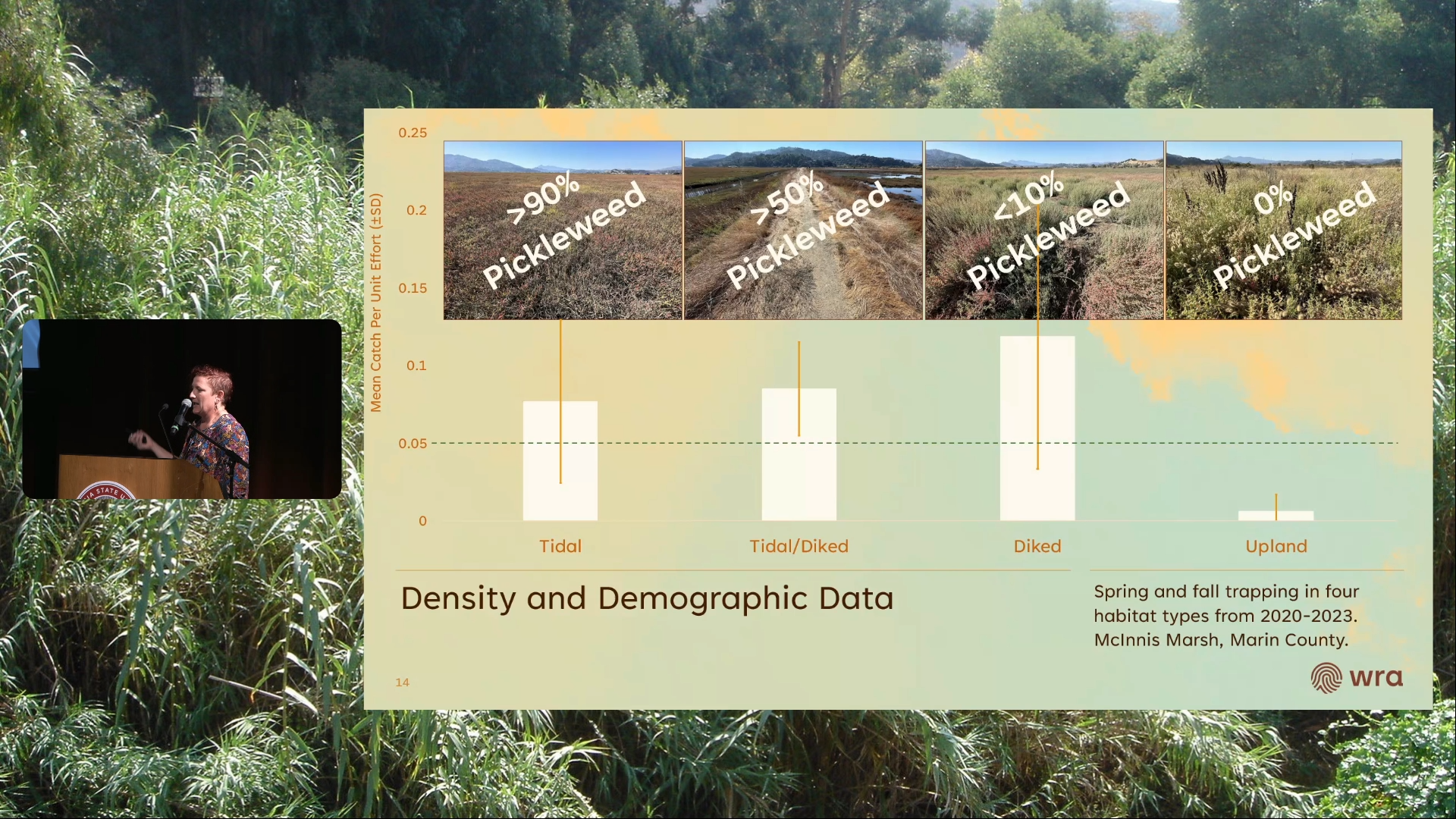
California Department of Fish and Wildlife collaborated with UC Davis to study the food preferences of salt marsh harvest mouse (SMHM), an endangered native animal that lives in the wetlands of the San Francisco Bay. It has always been presumed to be entirely dependent on native pickleweed for food and habitat. The legally mandated recovery plan is based on that mistaken assumption.

Presentation to California Invasive Plant Council conference in October 2023

The study reported to Cal-IPC shows clearly that SMHM is NOT dependent on pickleweed for either food or habitat. SMHM is an extreme omnivore. SMHM ate 39 species of native and non-native plants as well as insects in empirical trials. In fact, it ate EVERY plant it was offered. A fecal study of SMHM living in the wild confirmed that finding. Fecal analysis found SMHM had eaten 48 native and non-native plant genera as well as some insects.

Presentation to California Invasive Plant Council conference in October 2023

SMHM have no preference for native plants for either food or nesting habitat. The most SMHM’s captured in the study were found where there was less than 10% pickleweed.

This was an absurdly simple experiment in which SMHM were captured and fed a variety of plants. It could have been done by anyone with little knowledge or fancy equipment. Why does this foolish mistake, caused by nativist bias, matter? Because “restoration” projects all around the San Francisco Bay have been eradicating non-native plants, claiming it would benefit the endangered SMHM.

For example, the spartina eradication project has been hunting for and poisoning hybrid spartina marsh grass for nearly 20 years, as well as planting pickleweed for SMHM. Since herbicides are used to kill non-native plants before pickleweed is planted, there’s little doubt that SMHM populations were harmed by the eradication of their food and shelter, if not directly harmed by the pesticides that are used.

Nativism in the natural world is not benefiting wildlife. Rather it seems to benefit only the army of “restorationists” who earn their living killing harmless plants and animals.  As long as they continue to receive public funding for their projects, they have job security because they have spent over 20 years trying to do something that cannot be done. Evolution moves inexorably forward. The puny efforts of humans to regress landscapes to arbitrarily selected historical standards cannot change the forward trajectory.

There were two presentations about difficulties with native plant restorations on Anacapa and Santa Rosa Islands at the CNPS conference in October 2022.  More than 20 years after non-native iceplant, rabbits, and rats were killed on Anacapa, native flora and fauna are still described as degraded, “Due to the cumulative and severe impacts to the soil and native seedbank, native vegetation communities have not recovered on their own…”  On Santa Rosa Island the “restoration” community has installed artificial fog fences to replicate a historical cloud forest to improve survival of native chaparral plants. (7)

Alternatives to rodenticide drop on Farallon Islands

It is not necessary to kill mice on the Farallon Islands because they are not harmful to birds.  If non-native vegetation weren’t killed with herbicides, there would probably be enough vegetation for omnivorous house mice as well as birds.  Both mice and vegetation are being killed only because they are non-native.  If the nativist ideology were removed from the agenda, dumping rodenticides on mice and herbicides on non-native vegetation would not be necessary.

If the protection of ashy storm petrels really were the goal of the proposed project on the Farallon Islands, the most obvious solution would be to remove the small population of burrowing owls that are the only known predators of the petrels.  Keep in mind that ashy storm petrels are not considered threatened or endangered and that two applications for protected status have been denied. (8)

There is a non-lethal alternative to reducing populations of rodents using rodenticides that kill non-target birds and other animals.  Academic scientists at Arizona State University have developed birth control for rodents that can be used on the Farallons to reduce the population of mice.  (WISDOM Good Works)

In Summary

Killing house mice on the Farallon Islands with rodenticide is unnecessary and will be harmful to the ecosystem and its inhabitants because:

  • Aerial dropping 1.5 tons of rodenticide will poison the entire ecosystem, killing hundreds of non-target birds and marine animals.
  • House mice on the Farallon Islands do not need to be killed because they are food for birds and they are harmless.
  • If burrowing owls are killing nestlings of ashy storm petrels, they could be removed and relocated.
  • The nearly 40-year attempt to kill non-native vegetation with herbicide should be stopped because the vegetation is a vital element in the food web of the Farallon Islands.

Happy Holidays and thank you for your readership.


  1. https://www.cambridge.org/core/journals/oryx/article/eradication-of-black-rats-rattus-rattus-from-anacapa-island/F1E46767D0EEC9A6357D414DD84ABE28
  2. https://onlinelibrary.wiley.com/doi/abs/10.1111/mam.12190
  3. https://myricopia.com/2023/11/21/anacapa-island-conservation/
  4. https://www.biorxiv.org/content/10.1101/2022.02.23.481645v1.full
  5. https://drive.google.com/file/d/1XoPcS104SeOUIyfbPT_NbardctNyWAgs/view
  6. https://www.nrdc.org/sites/default/files/opinion-glyphosate-20220617.pdf “As to ecological risk, it finds potential risks to animals and plants and ‘requires’ mitigation in light of those risks, laying out specific language for glyphosate product labels.”
  7. https://www.nps.gov/chis/learn/nature/cloud-forest.htm
  8. https://www.endangeredspecieslawandpolicy.com/u-s-fish-and-wildlife-service-denies-endangered-species-act-protection-for-ashy-storm-petrel

https://wisdomgoodworks.org/2023/10/611/

Redefining Ecological Restoration

“Urban Jungle is breathtaking in its scope, both geographic and temporal… I can say I probably learned more per page in Urban Jungle than in any other book I have read at all recently.” –Professor Art Shapiro

As climate change makes many places uninhabitable, there is a new urgency to restore natural habitats damaged by human activities. 

After a lengthy and contentious battle, the European Union narrowly voted to make a commitment to restore 20% of nature areas on land and sea within their borders.  Farmers were the primary opposition to making this commitment, claiming it would severely reduce their ability to produce sufficient food.  6,000 scientists from several countries disagreed:  “They argued that in the long term, it was climate change and nature degradation that constituted the highest threat, and that the proposed policy would ensure sustainable food production.” (1)

The Biden administration has issued an executive order to conserve 30% of US lands and oceans by 2030.  This 30X30 commitment has been funded by the State of California and is in the early stages of implementation.  In the US, the commitment to “restore” land is often interpreted as a commitment to destroy non-native species with pesticides with the goal of restoring native plants and animals. 

“Restoration” could mean something entirely different and a recently published book, Urban Jungle:  The History and Future of Nature in the City, invites us to redefine restoration in a very different way.  In a nutshell, Urban Jungle proposes to let nature heal itself without a preconceived goal to replicate historical landscapes that aren’t adapted to the climate and the challenging conditions of the urban environment.  Left to its own devices, nature creates novel ecosystems, plant communities that are biodiverse and self-sustaining. 

World War II created a case study of novel ecosystems

When World War II ended in 1945, the Potsdam Agreement determined that Germany would be occupied by the allies that won the war:  United States, United Kingdom, France, and Soviet Union.  The map of post-war Germany (see below) shows the division of Germany among the allies.  The white portion of the map was administered by the Western Allies and the gray portion of the map by the Soviet Union.  Berlin (in red) was deep in Soviet controlled East Germany and was likewise divided into East and West Berlin.  The Soviet Union did whatever it could to isolate West Berlin by restricting access routes to West Berlin and ultimately building a wall around it in 1961.

Berlin was heavily bombed during the war and was largely a pile of rubble at the end of the war.  While other European cities were able to clear the rubble within a few years, West Berlin could not because the Soviets would not let them dispose of rubble outside city limits. 

The physical isolation of West Berlin and the restricted access of the population to the countryside turned West Berlin into an ecological island.  Scientists in West Berlin, with few other opportunities to pursue their interests in botany and ecology, studied and recorded the transition of many tons of building rubble into novel ecosystems populated by whatever plants could find their way there and survive the challenging conditions.  West Berlin was physically isolated from 1945 until the reunification of West and East Germany in 1990, creating a unique opportunity to study natural succession in an urban setting when nature is left alone for nearly 50 years. 

One of the first pioneer plants in West Berlin arrived with the Ukrainian army in the hay brought to feed their horses.  Salsola collina, a tumbleweed, is native to southern Russia and central Asia.  Its arrival was a preview of what was to come, a landscape that would be radically different from the pre-urban landscape.  The plants best adapted to the harsh conditions of the ruined city were hardy non-native species.

Non-native plants that thrived in West Berlin were more tolerant of higher temperatures in an urban setting, where hard surfaces absorb more solar radiation, buildings block the wind, and greater pollution traps heat.  This is known as the heat island effect.  By the 1960s, the temperature in Berlin was on average over 4⁰F higher than the surrounding countryside.

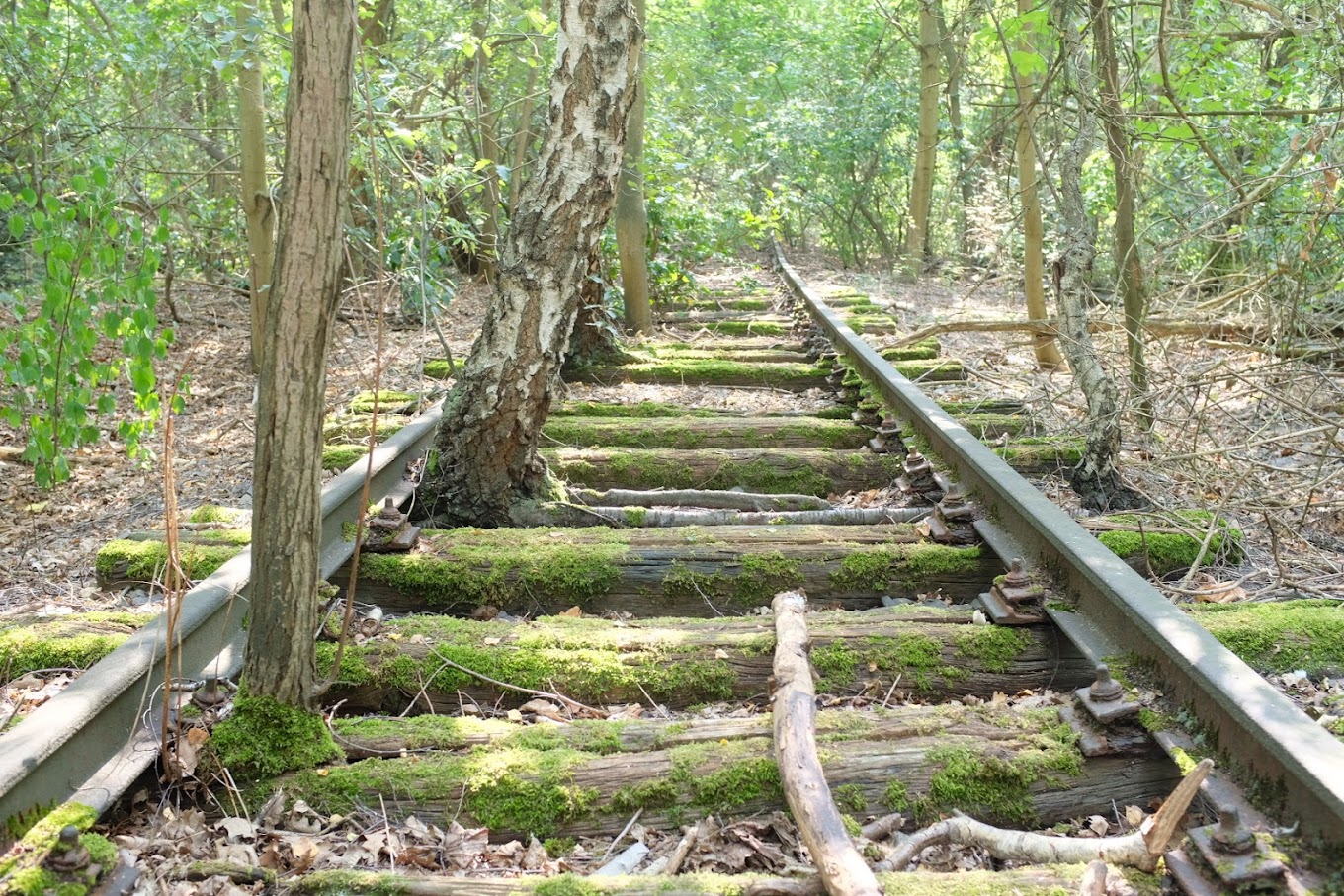
Südgelände Nature Park in Berlin was a railway yard that was abandoned in 1952 as a result of the division of East and West Berlin.  By 1984 there were 334 ferns and flowering plants and many animals, birds, and insects living in the park.  It is a novel ecosystem that was shaped by human activities then left to natural processes. It remains as a nature park today because the people of Berlin fought against developing it into a train station again. They had come to love its wild beauty during their long confinement during the Cold War and they weren’t willing to give it up. Source: Südgelände Natur Park

The naturally evolving novel ecosystems in West Berlin were also surprisingly biodiverse.  Where natural succession was allowed to occur over many years, 140 different plant species and 200 insect species were found in the 21st Century.  In nearby Tiergarten Park, which is carefully maintained as a park, only one-quarter as many insects were found in an area of comparable size.  By the end of the 20th century, 1,392 naturalized plant species were growing in Berlin, compared to 822 in the 18th century. 

21st Century equivalent to World War II

Climate change is the 21st Century equivalent of World War II in its potential to cause death and destruction.  Climate change will create similar requirements to restore environments that are destroyed.  Urban settings will be particularly vulnerable to the consequences of climate change because they are population centers and they are already compromised by urbanization. 

Tidal estuaries and wetlands are one of many ecosystems that are threatened by climate change, as sea-levels rise in a warming climate and intensity and frequency of storms increases flooding.  These threats are greater in urbanized areas because most of our largest cities were built on coastlines and rivers at a time when transportation and shipping was easier by water than by land.

Historically, cities were protected from storms by surrounding marshlands that filtered and cleansed runoff from the land, polluted by human waste. But as cities grew, marshlands were often destroyed to create more land.  In many cases, the landfill was composed of the garbage produced by city-dwellers. 

The closure of urban garbage landfills and the restoration of wetlands to buffer the city from the rising sea and extreme weather events is another opportunity to redefine restoration as a natural process that uses the healing powers of nature.  Urban Jungle uses Fresh Kills Landfill in New York City as an example of restoring nature by leaving it alone.

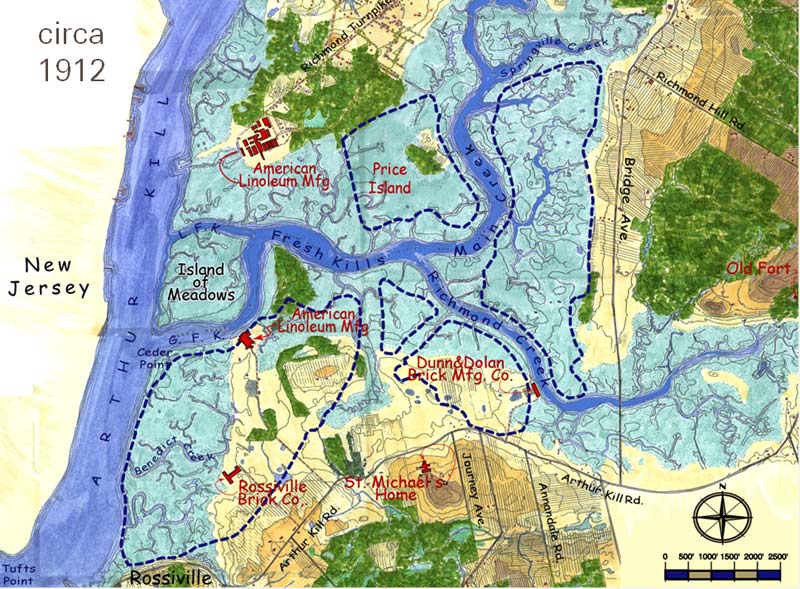
Historical map of Freshkills Park in 1912, before it was a landfill garbage dump. Source: https://www.nycgovparks.org/park-features/freshkills-park/about-the-site

Fresh Kills was a tidal estuary and marshland on the west side of Staten Island in New York City.  It was opened as a landfill to accept residential garbage in 1948.  By 1986 it had reached peak volume, receiving 26,000 tons of residential garbage per day.  When it was closed in March 2001, the garbage was from 90 to 225 feet tall, weighing 150 million short tons.  It was reopened in September 2001 to accept about one-third of the rubble from the collapse of the World Trade Center on September 11, 2001.  It was the largest garbage landfill in the world when it finally closed.

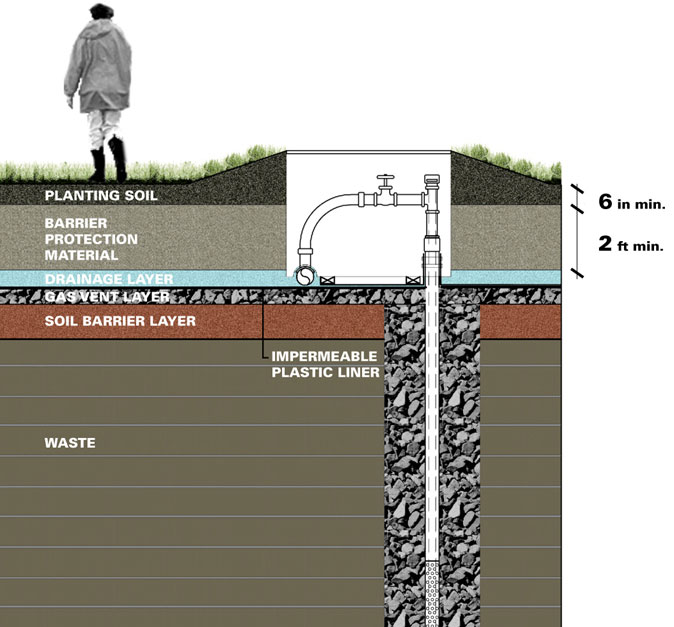
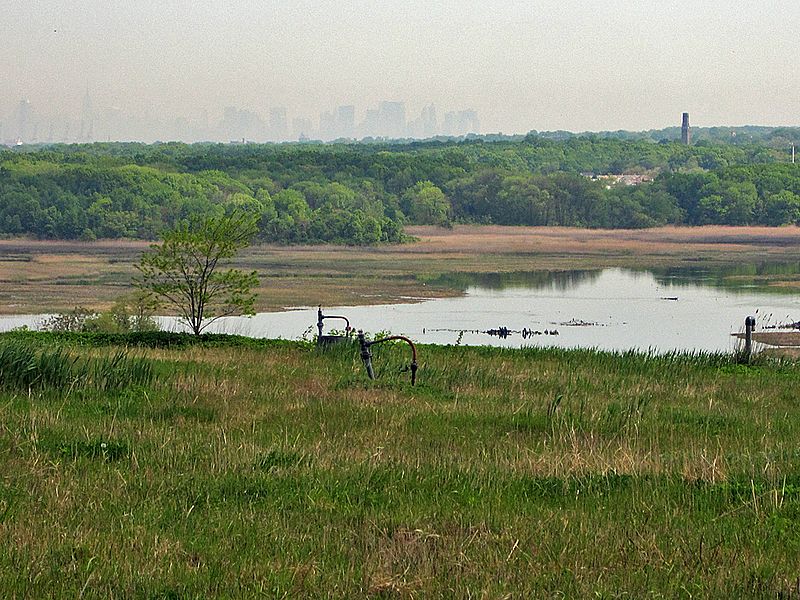
Fresh Kills Landfill is now in a 30-year process of being restored as a park, renamed Freshkills Park.  The garbage was capped (see below) and methane produced by the decomposing garbage is being captured and used to heat about 22,000 homes on Staten Island. 

The productive wetland ecosystem that was destroyed by the landfill cannot be restored.  Instead, a new ecosystem will slowly emerge on top of the toxic garbage.  The process began by seeding the slopes of garbage with fast-growing plants that were then plowed repeatedly back into the soil to add organic matter.  Then tough native grassland species were planted to provide habitat for initial colonizers, such as insects, small mammals and birds.  Now that basic conditions for life have been established, what happens next is in the hands of nature:  “Freshkills Park will be reclaimed by whatever species are attracted to the foundation of grasses.  Nature will do the bulk of the work, not human beings.  Biodiversity will steadily build as winds and birds bring seeds to the site.  This process of spontaneous successional growth is how nature rebounds from natural disasters such as forest fires, earthquakes, volcanic activity and climate upheaval.  Only in the case of Freshkills Park, the disaster was humanmade.” (2)

View of Downtown Manhattan from Freshkills Park. Licensed by Creative Commons

Getting off the pesticide treadmill

Allowing nature to heal the places humans have damaged is also an opportunity to get off the pesticide treadmill.  The natural process of succession does not require the use of herbicides to eradicate non-native plants that arrive naturally on the wind, in water currents, and in the stomachs of animals and birds.  When all plants are welcome, there is no need for herbicides and there is more biodiversity that supports more animals and is more resilient as the climate changes in unpredictable ways. 

In a place like Freshkills Park, it would defeat the purpose of turning a toxic landfill into a park public to use herbicides, insecticides, or rodenticides.  New York City banned the use of most pesticides in its public parks in 2021.   

In 2019, France banned the use of glyphosate-based herbicides for non-agricultural use.  The French city of Blois imposed the ban before the national ban was adopted:  “A study published in 2019 found more than 300 species of urban plants sprouting out of the pavements of the French city of Blois, which had recently phased out glyphosate weedkiller.”  (2)

Allowing nature to “manage” our public parks, makes them safer for us and for wildlife as well as more biodiverse than human management that wages a never-ending war on so-called “invasive” plants. There are more bees and bee species in cities than in surrounding countryside because there is more available food in its diverse vegetation:  “Analysis of honey from a bee in Boston, Massachusetts, found it had pollen taken from 411 different species of plants; nearby country honey contained traces from just eighty-two plants.  Cities are islands of biodiversity compared to rural monocultures, with a bigger and more diverse source of nectar even than nature reserves and forests…”  (2)

The takeaway message

Successful restoration of damaged land will take these facts into consideration:

  • Many hardy non-native plants are better adapted to challenging urban conditions than native plants: “If native plants can’t hack it in the metropolis, their place should be taken by specialist species drawn from around the world that find niches in the various microclimates of the concrete jungle.”  (2)
  • A diverse landscape of native and non-native plants is more resilient in a changing, variable, and unpredictable climate.
  • Novel ecosystems created by natural succession are more biodiverse than their historical predecessors.
  • When pesticides are used to kill non-native plants, disturbed land is damaged further and is even less likely to support a native landscape.  Killing non-native plants with herbicide also reduces biodiversity. 

(1) https://www.nytimes.com/2023/07/12/climate/europe-nature-restoration-law.html?searchResultPosition=1

(2) Urban Jungle:  The History and Future of Nature in the City, Ben Wilson, Doubleday, 2023

Going Toe to Toe with Doug Tallamy

In June 2023, Washington Post published an opinion piece advocating for the use of herbicides to kill non-native plants, in which Doug Tallamy was quoted as saying that spraying herbicide on non-native plants is “chemotherapy,”  equating non-native plants with cancer and pesticides with medical therapy.  Tallamy. and more broadly his viewpoint, received some blowback from Conservation Sense and Nonsense and others.

Thomas Christopher and Doug Tallamy collaborate on their shared mission of promoting the use of native plants and the closely related goal of eradicating non-native plants they consider a threat to native plants and insects. In October 2023, Tom Christopher (TC) gave Doug Tallamy (DT) an opportunity to respond to criticism of native plant dogma on his Growing Greener podcast that is available HERE.  Christopher also invited listeners to send him feedback on the podcast.  Professor Art Shapiro, whose work was central to the interview, has responded separately and his response is available as a footnote.  Conservation Sense and Nonsense (CSN) sent Christopher an email, which I hope he shared with Tallamy.  The following is an excerpt from that email. 


Hi Tom, Thanks for the air time for opposition to eradicating non-native plants in your interview with Doug Tallamy and for this opportunity to respond.  I’m flattered that criticism of native plant dogma has attracted some attention on the East Coast.  I’ve transcribed most of your interview with Doug Tallamy as best I can and provided some feedback to Tallamy’s viewpoint.  I sent Art Shapiro the podcast and he has responded separately.

TC:  Some people say that non-native plants are just as effective as natives in supporting food webs.  For example, buddleia that is spreading throughout the East and West is used by butterflies.

CSN:  Buddleia davidii is on California’s list of invasive plants, but it is not considered invasive in California.  It was put on California’s list because it is considered invasive elsewhere, making the point that invasive plant behavior varies depending on local conditions, such as climate.  Sweeping generalizations about invasiveness are rarely accurate. If gardeners are concerned about the potential for invasive behavior, they can plant a cultivar of buddleia that does not reproduce. 

DT:  We shouldn’t call all insects pollinators.  Just because an insect visits a flower for nectar doesn’t mean it’s pollinating that flower.  There are more visitors to flowers than there are pollinators.  Butterflies visiting buddleia are just there to sip nectar.

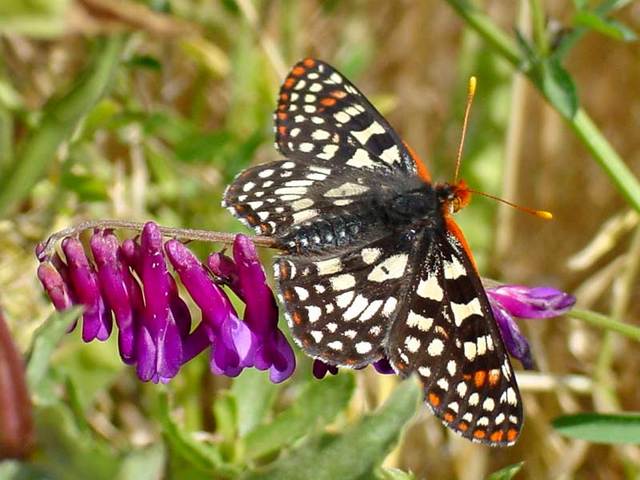
Euphydryas chalcedona
Variable checkerspot. Photo by Roger Hall

CSN:  Buddleia davidii is native to Central China.  Non-native buddleia is used by a butterfly species that is native to California and other states in the Western US.

The first actual observation of checkerspot butterflies breeding spontaneously and successfully on buddleia was in Mariposa County, California in the Sierra Nevada foothills.  Checkerspot bred there successfully on buddleia in 2005 and in subsequent years.  This colony of checkerspot on buddleia was reported in 2009:  “We conclude that buddleia davidii [and other species of buddleia] represents yet another exotic plant adopted as a larval host by a native California butterfly and that other members of the genus may also be used as the opportunity arises.” (1)

In 2017, a gardener in Mendocino County, California also reported the use of buddleia as the host plant of checkerspot:  “By now I am questioning how it was that butterfly larvae were using my butterfly bush as a host plant, completely against everything I’d ever heard. How was this possible? I emailed Art Shapiro, a very well-known butterfly expert and author, sending him a pic. He wrote back to confirm they were butterfly larvae, but added, ‘These are not mourning cloak butterflies. They are checkerspots. And the only time I’m aware this has happened [like, ever, except one in a lab in 1940…] is in Mariposa County.’” (2)

Buddleia is available as the host plant of checkerspot butterflies with a native range from Alaska south along the Pacific Coast through California and Arizona to Baja California and Mexico; east to Montana, the Dakotas, Wyoming, Colorado, New Mexico.  This is a clear case of a widespread native butterfly choosing a non-native plant as its host. 

  1.  Arthur M. Shapiro and Katie Hertfelder, “Use of Buddleia as Host Plant by Euphydryas chalcedona in the Sierra Nevada foothills, California,” News of the Lepidopterists’ Society, Spring 2009
  2. http://plantwhateverbringsyoujoy.com/never-pull-up-and-discard-what-you-cannot-identify/

DT:  Most bees that people see in their gardens are honeybees that are there to get pollen and sometimes nectar.  These are generalist bees but specialist bees that require pollen from particular plants (always native plants) can’t be supported by those at all. 

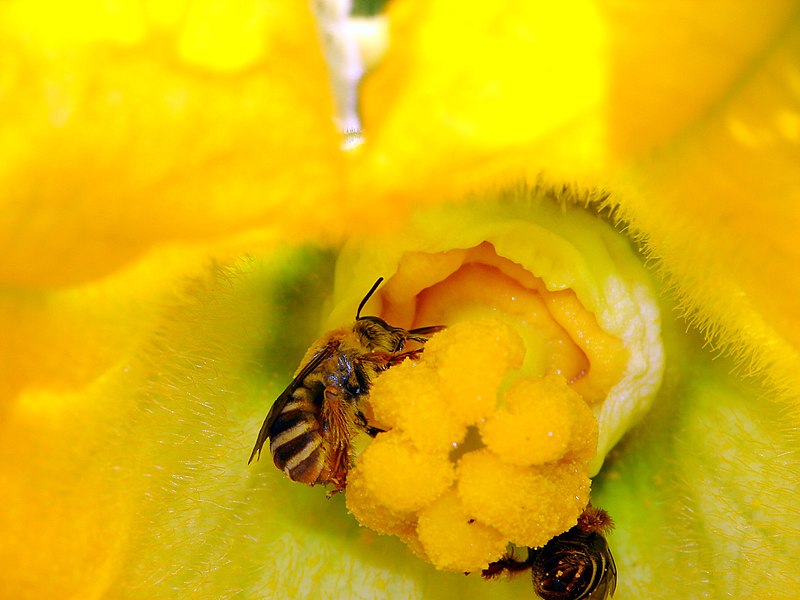
Squash bee. USDA public domain

CSN:  Specialization of insects is exaggerated by Tallamy.  For example, he would probably call a squash bee a specialist.  As its name implies, its host plant is squash plants in the squash family, with 98 genera and 975 species.  The squash bee is considered an excellent pollinator of zucchini and butternut squash, both native to Central and South America.  However, they do not usually visit melon plants, according to Wikipedia.  Again, we are reminded to avoid broad generalizations when describing the complex and diverse natural world. 

Likewise, the native alkali bee is a particularly effective pollinator of alfalfa, which is native to the Mediterranean region. Alkali bees also pollinate members of the large legume family with over 16,000 species that are native all over the world.  If you are interested in such associations, you can find an exhaustive list of native butterflies and their many non-native host plants in Art Shapiro’s butterfly guide for Central California and the Bay Area.  It is not true that bees Tallamy considers “specialists” require pollen from only native plants.

DT:  Sometimes butterflies adopt a new host plant as a caterpillar host.  For example, black swallowtail butterflies caterpillars eat carrots or parsley or dill.  What’s going on?   There are two different kind of hosts:  1) The caterpillar has not adopted a new host at all because it was already adapted to that particular host.  2) Actual host switching from one plant to another is very rare.  It happens on a time-scale of thousands of years.  It requires a mutation or an adaptation to chemical defenses of new host plants.

CSN:  Tallamy tries to make a distinction to avoid acknowledging that insects make use of introduced plants because they are chemically similar to the native plants they have used in the past, which in some cases are no longer available. The butterfly has, in fact, adopted a new host, a plant that wasn’t there before and is now hosting the caterpillar. There are many cases of rapid evolution that enable such transitions, but both cases are clearly transitions from native to non-native plants.  If the original native host is still available, it isn’t necessarily abandoned in favor of a non-native.  Such transitions are useful because they increase the population of available insect hosts and are essential if the original native host is no longer available.

TC:  Pushback from California cites research of Professor Art Shapiro reporting that spontaneous spread of non-native plants has benefited native butterflies.  He reports that 82 of 236 California native butterfly species (34%) are laying their eggs on introduced plant taxa, so caterpillars feed on them and many more butterflies use introduced plants as nectary sources.

DT:  Great!  These are host range expansions.  Agriculture in California has eliminated the host plants of a lot of butterflies and it’s a good thing we had close relatives of natives so butterflies could expand their host range and use them.  But if 34% of native butterflies are using introduced plants that means 66% are not.  If all plants were introduced, we would lose 66% of butterflies in California.  This is not the direction I want to go.  I would choose 60% rather than 34%.

CSN:  Christopher and Tallamy seem to have read one sentence in the abstract of Shapiro’s study without reading subsequent sentences: “Interactions with introduced plant taxa are not distributed evenly among butterfly species. Alpine and desert butterflies interact with relatively few introduced plants because few exotic plant species have reached and successfully colonized these habitats. Other California butterfly species are specialists on particular plant families or genera with no exotic representatives in California and have thus far failed to recognize any introduced plants as potential foodplants. Some California butterflies have expanded their geographic ranges and/or extended their flight seasons by feeding on exotic plants.”  In other words, where there are more introduced plants and some are closely related to native plant hosts, more native butterflies use introduced plants.   

TC:  What do you say to the claims that introduced plants stay greener longer than native plants adapted to wet or dry seasons so that introduced plants give rise to extra generations of caterpillars?

DT:  This is only true if caterpillars can use those plants and in host range expansions they can.  Shapiro is also right about extending availability of nectar.  For example, monarchs that migrate need forage along the way.  The minus is that we’ve been so hard on native flora.  These insects were doing just fine before we brought in non-native plants.  It’s a Band-Aid we’re putting on an environment that has been ravaged by taking out native species that were here before.  Let’s put native species back too.

CSN:  The claim that non-native plants are driving native plants to extirpation or extinction goes to the heart of the controversy.  Native plant advocates believe that accusation, although there is little evidence to support it.  The greatest threat to native plants and insects is habitat loss, particularly converting wildlands to agricultural fields.  The second greatest threat is the pesticides that are used by agriculture.  Remember that Tallamy is an enthusiastic promoter of herbicides to eradicate non-native plants.  He calls it “chemotherapy” in a recent opinion column in the Washington Post.  Pesticides kill both plants and the animals that feed on them, they are anathema to biodiversity and the food web that Tallamy believes he is supporting. 

Marcel Rejmanek (UC Davis) is the author of the most recent report on plant extinctions in California, published in 2017.  At that time there were 13 plant species and 17 sub-species native to California known to be globally extinct and another 30 species and sub-species extirpated in California but still found in other states.  Over half the globally extinct taxa were reported as extinct over 100 years ago.  Although grassland in California had been converted to Mediterranean annual grasses by grazing domesticated animals decades before then, most of the plants now designated as “invasive” in California were not widespread over 100 years ago.

Most of the globally extinct plant species had very small ranges and small populations.  The smaller the population, the greater the chances of extinction.  Most of the globally extinct plants were originally present in lowlands where most of the human population and habitat destruction are concentrated. Although there are many rare plants at higher altitudes, few are extinct.  Plants limited to special habitats, like wetlands, seem to be more vulnerable to extinction. The primary drivers of plant extinction in California are agriculture, urbanization and development in general.  Non-native plants are the innocent bystanders to disturbance.

“Invasive species” are mentioned only once in the inventory of extinct plants published by California Native Plant Society and only in combination with several other factors. However, the identity of this “invasive species” is not clear.  Rejmanek suggests that the “invasive species” rating refers to animal “invasions” by predators and grazers.  He says, “Indeed, one needs quite a bit of imagination to predict that any native plant species may be driven to extinction by invasive plants per se.” (Marcel Rejmanek, “Vascular plant extinctions in California: A critical assessment,” Diversity and Distributions, Journal of Conservation Biogeography, 2017)

TC:  90% of all insect species are specialists that have evolved in concert with only one or a few plant lineages.  How can they cope with the loss of native plants?

DT:  Native plants are adapting in evolutionary time.  Specialization is a continuum.  Few insects are confined to a single plant species, some are confined to one or two genera, and others are confined to one or two families of plants.  But if you are looking at the number of plants available to them, only about 7% of plants they are adapted to are available to them.   93% of available plants are not viable hosts for insects.  Everything is a specialist on one level of another.

CSN:  That sounds like an argument for a diverse garden, with many plant species that offer more food sources for insects.  That doesn’t seem a sound argument for eradicating non-native plants. 

TC:  I understand that some native plants are more useful to insects than others?

DT:  These are the keystone species.  Many native plants don’t support insects because plants are well-defended against them.  Keystone species are making most of the food for the food web.  Just 14% of native plants across the country are making 90% of food that drive the food web.  86% of the native plants are not driving the food web.  Insect food comes from the big producers, like oaks, black cherries, hickories, and birches.

CSN:  That is a mind-boggling admission!!  Earlier Tallamy complained that non-native plants are hosting only 34% of butterflies in California.  Now he says that only 14% of native plants are useful to insects.  He asks home gardeners to plant only native plants as well as limit our plantings to a small subset of native plants. 

Tallamy’s ideology is antithetical to the goal of biodiversity, which could be the salvation of ecosystems in a changing climate. Since we can’t predict the climate of the future, biodiversity provides more evolutionary options, which increases the chances that some species will survive. Tallamy asks us to put a few eggs in the huge basket of our ecosystems, reducing their ability to survive the challenges of our changing climate. 

For example, in Oakland, California, where I live, there were approximately 10 species of native trees prior to settlement.  In 1993, there were 350 tree species in Oakland. (David Nowak, “Historical vegetation change in Oakland and its implications for urban forest management,” Journal of Arboriculture, September 1993)  The recently published draft of Oakland’s Urban Forest Plan reports that there are now over 500 tree species in Oakland.  I can’t fathom why Oakland would want to limit the planting of trees to only 10 native species. 

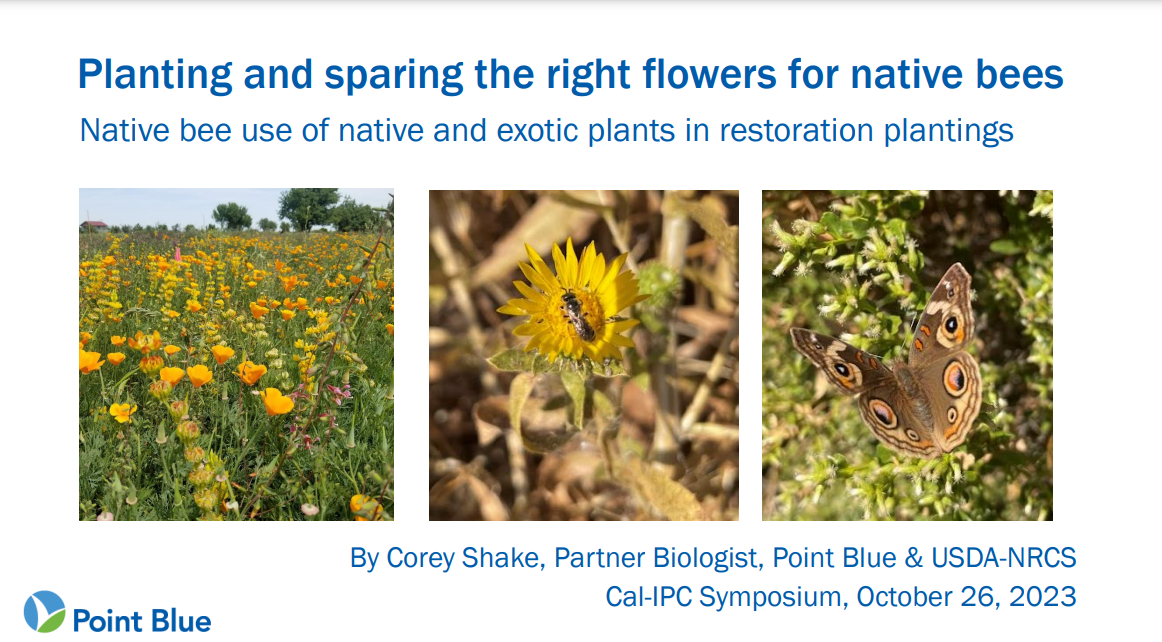
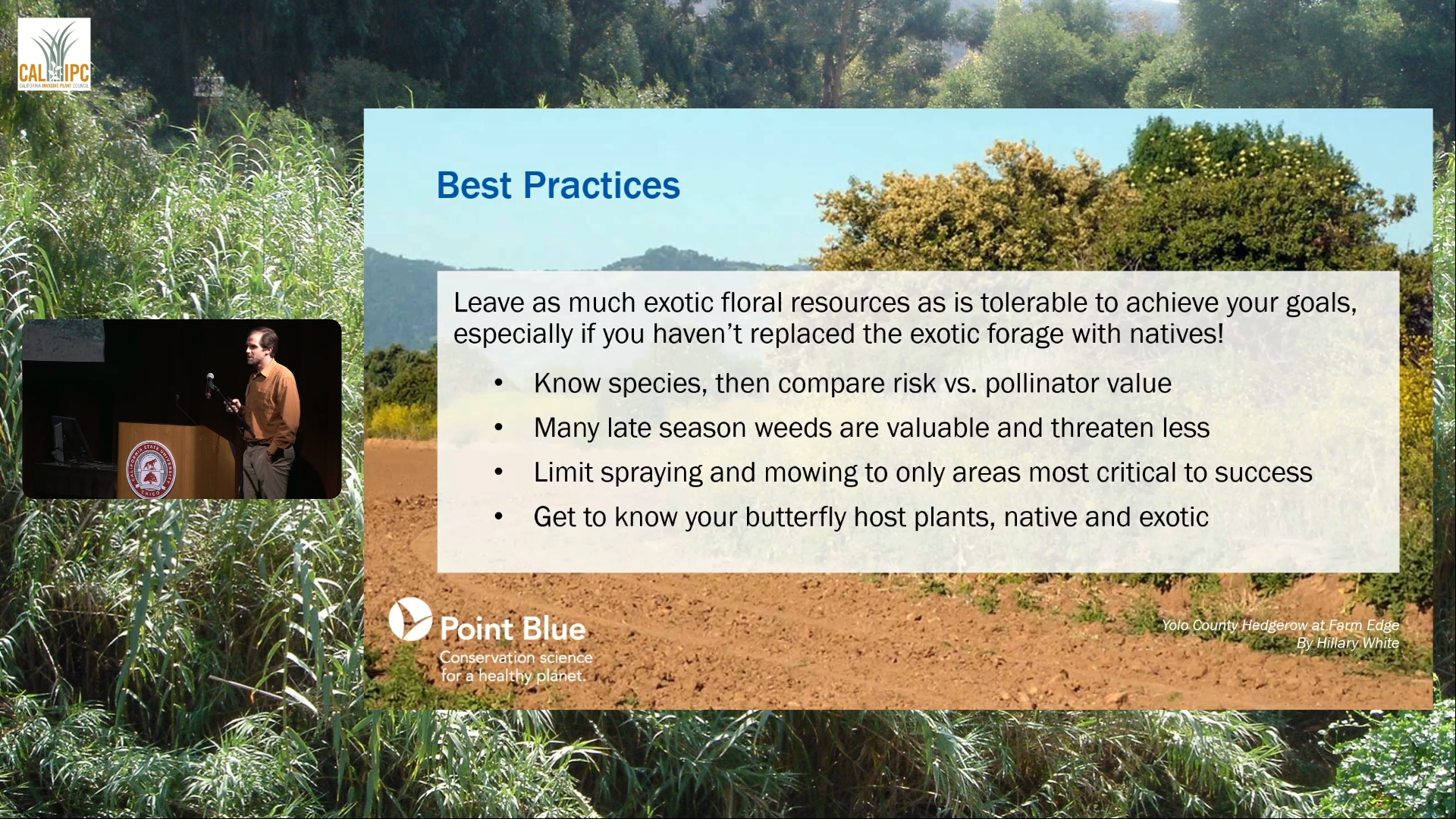
I agree with Tallamy that many native plants are not useful to insects.  I attend the annual conference of California Invasive Plant Council to give native plant advocates every opportunity to convince me of their viewpoint.  At the most recent conference at the end of October, Corey Shake of Point Blue Conservation made a presentation about his project to “Evaluate native bee preference for common native and exotic plants.” 

He designed 16 hedgerows around agricultural fields in Yolo County to determine if native bees have a preference for native plants or exotic plants, by controlling for availability of native plants compared to exotic plants.  Here is his abstract:

“Farm edge restoration monitoring in Sacramento Valley highlights native bee use of some exotic plant floral resources. Corey Shake. Point Blue Conservation Science. cshake@pointblue.org

“Research of native bee preference for native versus exotic plant floral resources in California’s Sacramento Valley has shown mixed results. No studies have demonstrated a preference for exotic plants by native bees there, but some have highlighted the importance of exotic plant floral resources in plant-pollinator networks and expressed concern that rapid removal of exotic plants without restoring native plant populations could have negative impacts on native bees. We have been collecting native bee flower visitation, plant species, and floral abundance data on 16 farm edge restoration projects in Yolo County, California since 2019, which will allow us to assess bee preferences for some key native and exotic plants relative to their floral abundance. In our preliminary analysis, we see some important trends: (1) relative to their floral abundance in our plots, some native plant species are more frequently visited by native bees than other native plants that are infrequently or rarely visited, and (2) there is significant native bee visitation to some exotic plants relative to their floral abundance. We will further evaluate these data as well as our butterfly diversity and abundance data to provide plant-species specific insights to restoration practitioners and weed management specialists to help them reduce harmful impacts to native pollinators when executing restoration projects and managing weeds.” 

In other words, not all species of native plants are useful to native bees and some species of non-native plant species are useful to native bees.  Tallamy’s sweeping generalizations about the usefulness of native plants to insects are not supported by empirical or field studies.  Although the characteristics of plants vary widely, the variation is unrelated to the national origins of plants. 

From Micro to Macro Perspective

I recognize my voice in the questions Tom Christopher asked of Doug Tallamy, as well as Art Shapiro’s.  Speaking for myself, not for Art, this interview misses the point of my criticism of native plant ideology.  I like native plants as much as I like any plant and I encourage everyone to plant whatever they prefer.  I only object to the pointless destruction of harmless non-native plants that thrive because they are best adapted to the conditions where they have naturalized.  Non-native plants do particularly well in the wake of disturbance.  Where they have replaced native plants, the natives were destroyed by disturbance, not by the hardy non-native plants that can tolerate disturbance. Non-native plants are a symptom of change, not the cause. 

I object to destructive eradication projects because they poison the soil with herbicides, making it even less likely that non-native plants will be replaced by fragile native plants.  I object to the loss of biodiversity which is a hedge against extinction in a rapidly changing climate.  We don’t know which plants will be capable of surviving in the changed climate.  We should not be taking cards out of the deck while we gamble with the future of the environment and everything that lives in it.

Unfortunately, native plant advocates take offense when anything positive is said about introduced plants.  A positive statement about a non-native is routinely interpreted as a negative statement about native plants.  It shouldn’t be.  The emphasis on the negative assessment of introduced plants results in harmful land management decisions.  The pros and cons of all plants should be considered before we condemn non-natives with a death sentence.  Like our justice system for human society, all plants should be presumed innocent until proven guilty.

Thanks again for airing this debate on your podcast. I hope you will forward my email to Doug Tallamy

Webmaster, Conservation Sense and Nonsense


Gardening with the help of nature

Juliet Stromberg is a plant ecologist who specialized in wetland and riparian ecosystems of the American Southwest.  Her friends call her Julie and I will presume to do the same.  She has retired from her position at Arizona State University, but her husband, Matt Chew, is still teaching ecology from a historical perspective at ASU.  He is very much her partner in their 20-year project to restore 4-acres of dead citrus grove and an 80-year old Spanish colonial house, long abandoned and derelict.  The property came with water rights, without which their project would not have been possible.

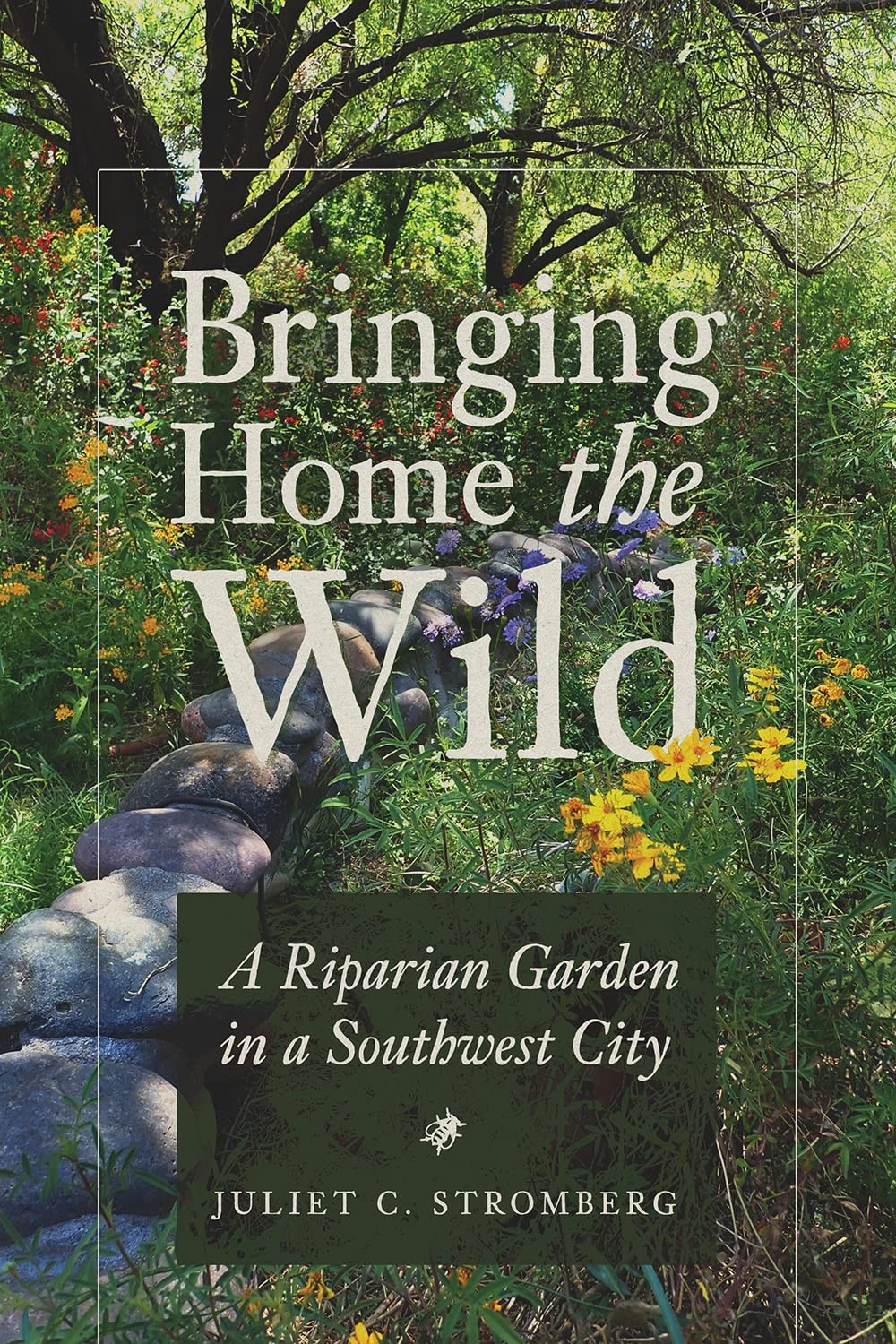
In her recently published book, Bringing Home the Wild:  A Riparian Garden in a Southwest City, Julie tells us how she and her partner transformed—with the help of natural processes–this dead patch of land in South Phoenix, Arizona into the oasis that it is today.  The first step was to restore the irrigation system, which immediately brought much of the dormant seed bank back to life. 

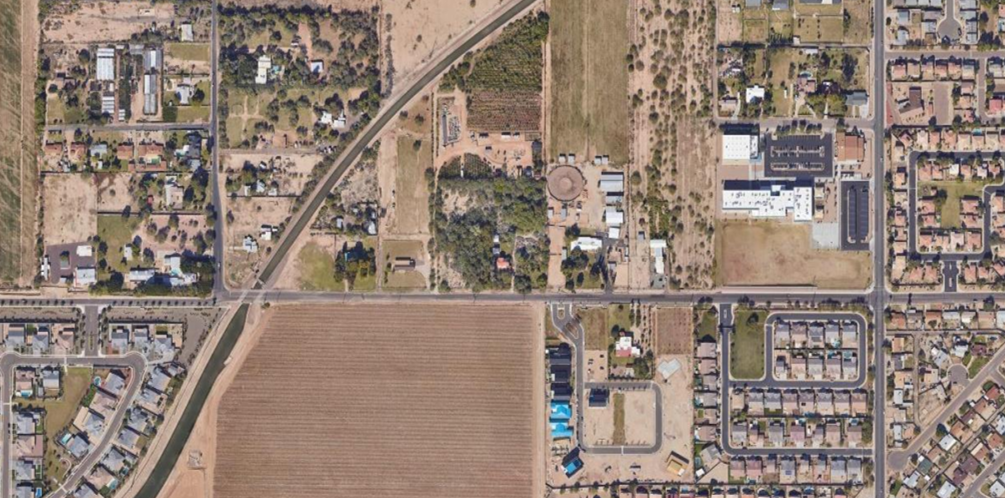
Julie & Matt’s garden is in the center of this aerial view

Using the riparian vegetation of the Salt River—the source of their water—as her reference, she chose a half-dozen tree species as the foundation of their garden, such as Fremont cottonwood, Gooding’s willow, and velvet mesquite.  Twenty years later, there are now 300 trees, sheltering a community of plants and animals.  How did they get there? 

The seeds of some trees such as blue elderberry and mulberry were brought from neighboring gardens by birds and small animals. Julie and Matt have seen 157 species of birds in their garden, so we can assume birds have done some of the planting.  The seeds of some plants are aerodynamically shaped and were blown in by the wind, adding to the diversity of the garden.

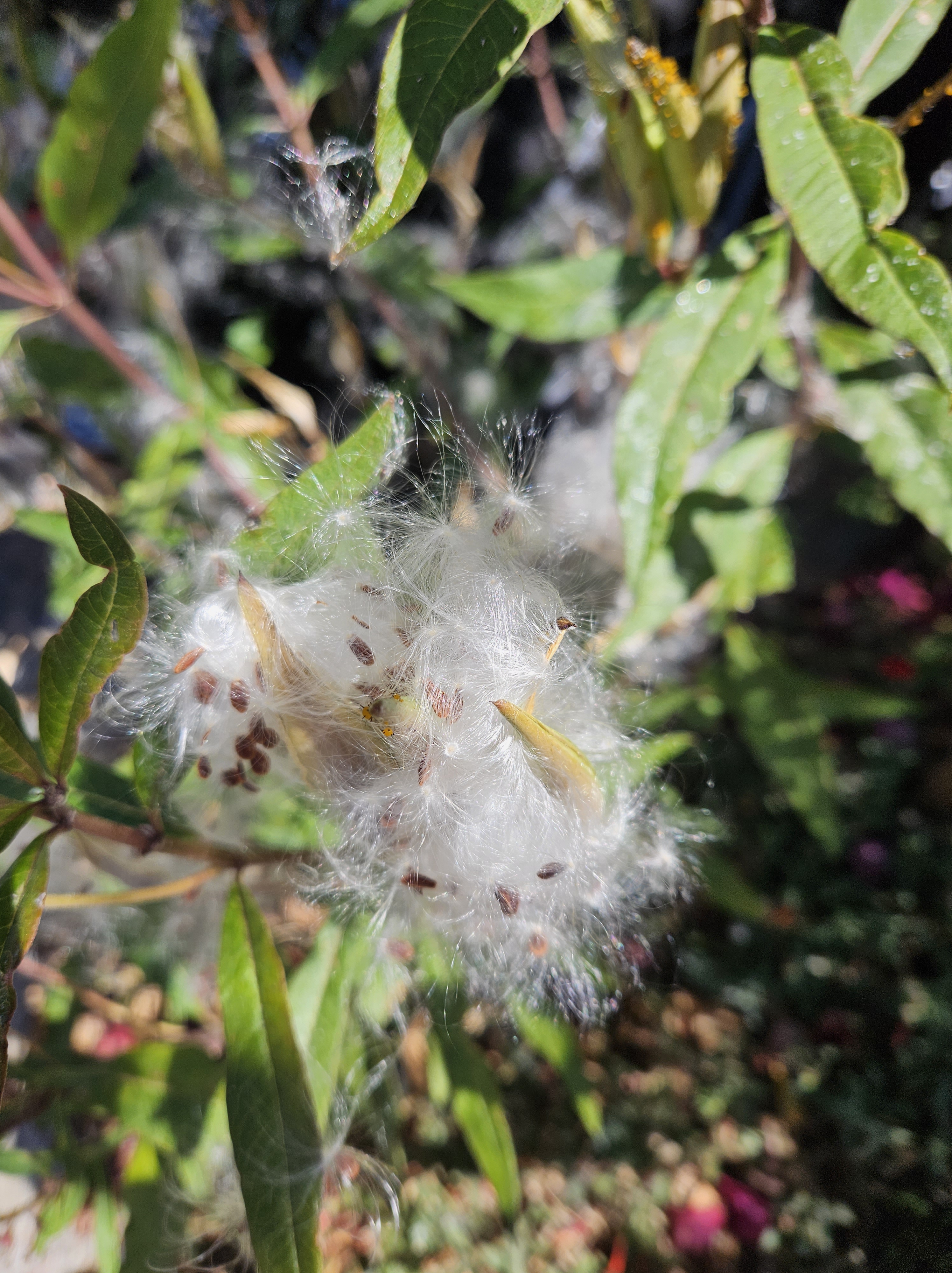
Tropical milkweed seeds ready to be launched by the wind from a neighbor’s front yard.  Conservation Sense and Nonsense, Oakland, CA, October 2023

Many of the trees are American in origin, but others are not.  Regardless of the method of dispersal, most introductions are welcome in Julie’s garden. She spares her readers the tedious recitation of which plants are considered native and which are not.  The Southwestern desert is not an ecosystem with which I am familiar.  I was glad to have a tour of Julie’s garden without irrelevant information about the nationality of every plant.  For the same reason, I like to travel in distant places where I can’t distinguish natives from non-natives.  Everything looks great to me and nothing brings me down more than a guide who wants to inform us of what “belongs” and what doesn’t. 

Julie and Matt also planted a fruit orchard and a vegetable garden that bring more birds, insects, and animals to the garden as well as providing food for their table. Eating the fruits of our labors in the garden deepens our respect for what plants do for us and establishes our working relationship with the land. 

Managing a wild garden

In keeping with Julie’s opinion that ecological restoration is a form of “glorified gardening,” she actively manages her garden.  A few plants that annoy members of her community of plants and animals—such as puncture vine and tumbleweed—are not welcome. 

When the delicate balance between predator and prey becomes unbalanced, some protective measures are necessary.  If coyotes and dogs can’t keep up with the rabbit population, it’s sometimes necessary to put vulnerable plants into cages to protect them.  The root balls of some plants are covered in wire mesh to protect them from hungry gophers. 

Plants also assist in their own defense.  Where mesquite is grazed by cattle, the tree responds by growing longer thorns to repel the cattle.  When plants are attacked by plant-eating insects, some emit a toxin to render themselves inedible.  The scent of the chemical wafts to neighboring plants, alerting them to the arrival of predators.  These natural defenses are an important line of scientific inquiry that has potential to substitute nature-based solutions for synthetic chemicals. 

The population of roof rats in Julie’s home is kept in check with liquid birth control, lest they chew on electrical wires or build nests in car engines. 

Gardening with the help of friends

Julie’s is not a manicured garden, but it requires constant pruning to keep trails clear and provide light and space for plants to thrive. The annual scouring of the flood plain by spring floods is one of the natural processes that Julie and Matt could not use to restore their land because irrigation water is channelized and confined by concrete.  Julie has come to appreciate the flies and other insects who are the decomposing crew, helping to reduce the accumulation of debris in the absence of annual scouring floods.  Sixty-six species of flies assist with decomposition as well as pollination in Julie’s garden. 

Julie is happy to have coyotes in her garden, but her dogs disagree.  Violent and fatal confrontations between these closely related species required building a wall that confines dogs close to the house at night, while coyotes safely roam most of the garden. 

Dogs are an important part of Julie and Matt’s life.  Early in the book’s introduction Julie warns readers that they should put her book down “NOW!” if they don’t want to hear dog stories.  Julie has walked thousands of dogs in a nearby animal shelter.  In addition to her own 4 dogs, there are also occasional foster dogs who need to recover from traumatic experiences to be adoptable.  In Julie’s refuge, these traumatized dogs learn to trust again. 

Peaceful co-existence

Julie is a recovering academic scientist.  Before she retired, she felt that her focus on the accumulation of data needed for scientific analysis was causing her to lose track of the big picture.  She needed to stop and smell the flowers, so to speak. 

She received her graduate education during the heyday of invasion biology. Julie slowly shifted away from native purism based on her experiences in the field.  She has rejected that doctrine, and regrets teaching her students to fear “those who came from somewhere else.” 

Julie has a vivid memory of the first step she took on that journey to her gardening ethic of peaceful coexistence.  She had been instructed to pull tree tobacco from land along the Salt River that was being restored.  The nicotine in the plant was making her feel sick, which seemed to bring her to her senses.  She began to wonder what she was doing, “following orders to kill creatures she barely knew.” 

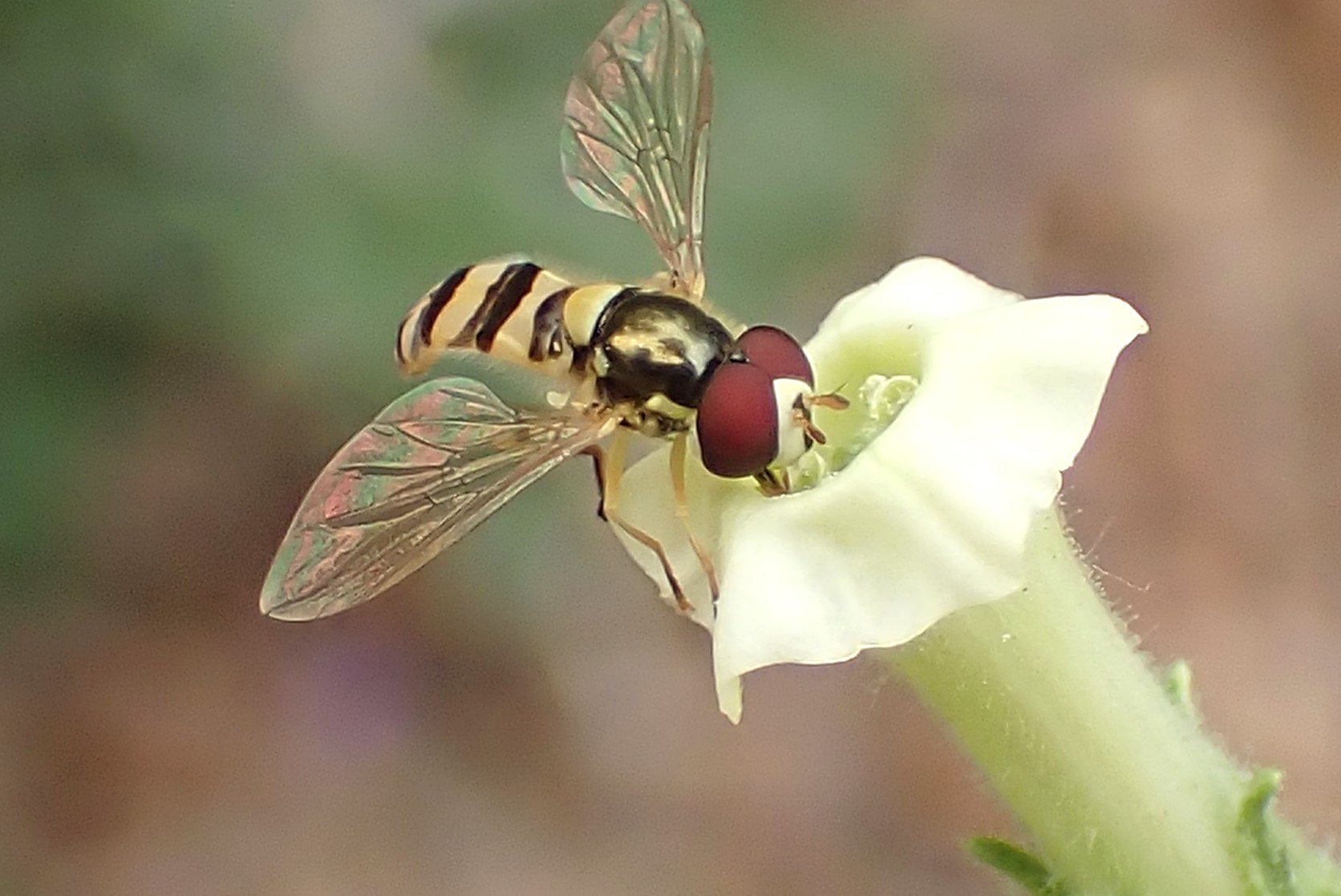
Fly on desert tobacco. Photo courtesy Juliet Stromberg

Part of Julie’s skepticism about such eradication projects is based on her understanding of how little we know.  She realizes that the harm done by non-native species is exaggerated and their benefits are underestimated.  Given the limits of our knowledge, we should be obligated to give introduced plants the benefit of the doubt before killing them.  She now appreciates the beauty of tree tobacco, which also feeds birds, fixes carbon, and stabilizes the soil.   Its seeds were naturally dispersed to Julie’s garden and tree tobacco is welcome there.

Imperatives imposed by climate change

Julie says, “The preoccupation with provenance diverts conservationists and gardeners from critical issues,” such as climate change, food security, and extinction (which, studies show, are not caused by introduced plants).  Living in the Southwest, Julie has a front row seat on climate change.  It’s always (within the context of our lifetime) been hot there, but now it is blisteringly hot during summer months.  She watches hummingbirds in her garden seek shelter in the shade, close to the irrigation drip.  She watches dogs panting, birds gasping for breath and plants wither and die in the heat.  And she knows that both native and non-native plants store carbon that would otherwise contribute to greenhouse gases causing climate change. Carbon storage varies according to certain plant characteristics, but those characteristics are unrelated to the nationality of plants. 

Those who insist on replicating the landscape that existed 200-400 years ago in America are depriving nature of the evolutionary opportunities that will enable survival.  We don’t know what life will be capable of living in the climate of the near-future.  Nature needs as many alternatives as possible to find the species that can survive.  Plants and animals are blameless in this struggle of survival of the fittest.  The least we can do is to get out of their way as natural selection finds the life that is adapted to the current and future climate.

Showing respect for nature

Julie does not use any pesticides in her garden….no herbicides, fungicide, or insecticide.  She is concerned about the pesticides used by her neighbor across the road who grows cotton.  She notices the blue cotton seeds scattered on the ground and surmises that they were coated in insecticide or herbicide that will infuse pesticide into the plant as it grows.  The poisoned seed can kill seed-eating birds and other animals and the plant itself will be poisonous as it grows.  The dust from the cotton field blows into her property when the field is plowed and after the cotton is harvested because no cover crops are grown to tamp down the dust and prevent the loss of carbon stored in the soil.  Julie can see firsthand the damage caused by industrial agriculture and is confirmed in her commitment to avoid using pesticides.

Julie shows her respect for everything living in her garden by her choice of pronouns to describe them:  “who” not “what,”  “she/her” not “it.”  She asks her readers to show the same respect for plants and animals, regardless of their nationality.  Avoiding the use of pesticides in our gardens is another way to show our respect for the plants and animals on which we depend, with the added benefit of not poisoning ourselves.

Thank you, Juliet Stromberg, for telling us about your garden and congratulations for what you have accomplished and learned from the experience of nurturing it back to life with the help of nature. 

Oakland’s revised Vegetation Management Plan is the compromise I hoped for

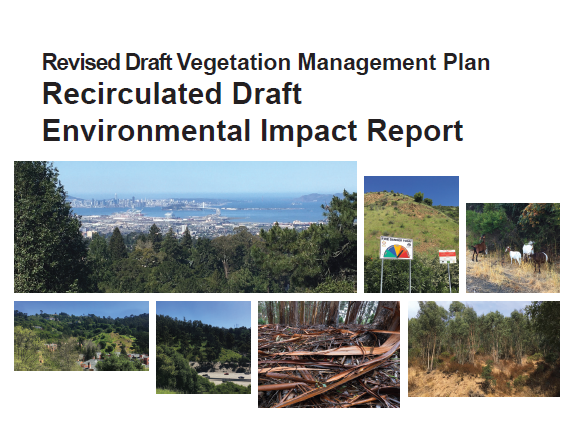
On September 1st, I told readers that Oakland would soon publish a revised Vegetation Management Plan to reduce fire hazards in Oakland by managing vegetation on 2,000 acres of city-owned property and 300 miles of roadside.  I also shared with readers my anxiety that the revised plan would be more destructive than the previous version of the plan in response to criticism of that version.    

The 4th revision of Oakland’s Vegetation Management Plan and its revised Draft Environmental Impact Report was published on September 20th.  These documents are available HERE.  There will be a public hearing about the plan by Oakland’s Planning Commission on November 1st.  The deadline for submitting written comments on the plan is November 4th.  Comments can be submitted by email DEIR-comments@oaklandvegmanagement.org or by mail to Montrose Environmental, attention Ken Schwarz, 1 Kaiser Plaza, Suite 340, Oakland CA 94612.

Update:  The deadline for commenting on the Vegetation Management Plan has been extended to Monday, November 6, 2023, at 5 PM.

The Oakland Planning Commission held a public hearing about the VMP on Wednesday, November 1, 2023.  There was no expressed opposition to the VMP at the hearing.  Representatives of Claremont Canyon Conservancy, North Hills Community Association, and Oakland Fire Safe Council spoke in support of the plan. 

One speaker said that Oakland Fire Department and the consultant who wrote the plan successfully “threaded the needle” that made agreement possible.  She also said that “of course, we wish all the eucalyptus were gone, but we understand that is expensive.”

All members of the Planning Commission expressed their admiration and support for the VMP.

Below is a map of the VMP project areas.  Figure 2.2 in the revised plan also shows detailed maps of roads in VMP project areas, with property ownership adjacent to roads indicated, which require different vegetation management standards.   

The authors of the plan have made it easy for you to read the revised version by underlining additions and striking out deletions.  If you have read earlier versions of the plan, you won’t need to read it all again, because revisions are minimal.  They are briefly summarized on page 1-2 of the plan:

Expanded the Revised Draft VMP area to encompass the area from 30 feet to 100 feet of the edge of roadsides in the City’s VHFHSZ [Very High Fire Hazard Severity Zone] where dead and dying trees (as determined by a Certified Arborist, Licensed Forester, or Fire Safety Expert) are present on City owned property and could strike the road if they fell.

“Updated the vegetation management standards as follows:

  • Expanded the zone recommended for 3-inch maximum height of grasslands after treatment from 30 feet to 75 feet from habitable structures.
  • Clarified that, where feasible, horizontal crown spacing should adhere to the California Department of Forestry and Fire Protection’s (CAL FIRE’s) most recent defensible space standards (presently codified in Pub. Res. Code Section 4291).

“Updated treatment standards for eucalyptus stands to increase the trunk diameter of single-stem eucalyptus recommended for removal from 8 inches to 10 inches, and to recommend removal of trees that pose an unreasonable fire and/or life safety risk, based on the determination of a Certified Arborist, Licensed Forester, or Fire Safety Expert.

“Updated treatment standards for closed-cone pine-cypress stands to include removal of trees that pose an unreasonable fire and/or life safety risk, based on the determination of a Certified Arborist, Licensed Forester, or Fire Safety Expert.”

If you need a reminder of vegetation management standards in the previous version, you can find them on Table 2-4.  Basically, the VMP will thin trees and vegetation and remove dead trees and fire ladders to canopies in management areas. The most significant revision of those vegetation management standards is the expansion of clearance of dead and dying trees from 30-100 feet from the edge of 300 miles of roadsides on city-owned property. The management standards defined by the previous version were acceptable to me and the proposed revision of those standards are also acceptable to me. 

However, I am sorry to see that more eucalyptus will be removed because the diameter size standard for removal has been increased from 8 to 10 inches (circumference is greater than 31 inches).  The flammability of eucalyptus has been exaggerated by native plant advocates who want all non-native trees to be destroyed.  California’s native vegetation is fire adapted and fire dependent.  Many of our most prominent native plants—such as ceanothus and manzanita–will not germinate in the absence of fire.  The planned removal of isolated non-native trees within stands of native trees is unnecessary because it will not reduce fire hazards. The VMP should be a fire hazard reduction plan, NOT a native plant restoration.

Although I recognize that dead trees are important for the long-term health of forests because they provide food and habitat for insects and birds as well as recycle nutrients into the soil, we can’t indulge that preference in very high fire hazard zones in high-density population areas that are being treated by Oakland’s Vegetation Management Plan.  As always, we must set priorities and the public’s safety must be a high priority. 

Like most public policy, the revised Vegetation Management Plan is a compromise between two extremes.  One extreme wanted all non-native trees to be destroyed in the management areas as well as within 100 feet from the edge of 300 miles of roadside.  They also wanted Oakland to make a commitment to replace those trees with native vegetation.  The opposite extreme wanted no trees to be destroyed and no herbicides to be used to control vegetation or prevent destroyed trees from resprouting. 

The revised Vegetation Management Plan is the compromise I had hoped for.  Specifically, I had hoped that fire hazards could be reduced in Oakland without destroying more trees than necessary to mitigate fire hazards. The thinning strategy that the VMP proposes has been used successfully by the East Bay Regional Park District for over 10 years.  It leaves the canopy intact so the forest floor is shaded, which suppresses the growth of weeds and keeps the forest floor moist, which retards ignition.

I had hoped that herbicides would not be used in public parks, but did not achieve that goal. However, I am grateful that the revised plan makes many efforts to protect the public, their pets, wildlife and goats grazing in project areas from exposure to the herbicides that will be used.  (Improvements in these protections are described on pages 2-81, 3.3-29, 3.3-32)  There are also extensive new protections for monarch butterflies and a rare species of bee (see page 3.4-86). 

If your interests in the Vegetation Management Plan are different from mine, I urge you to read the plan and form your own opinion.  I hope you will be able to support the revision because it is going to be attacked by the same extreme interests that have prevented Oakland from adopting and implementing a fire hazard mitigation plan for over 7 years. Expressing our support might help to get the VMP over the finish line after years of delay caused by gridlock. I would welcome you to the middle ground that I occupy.  It’s lonely here in the middle.  We don’t have much of an audience above the noise made by the extremes, but we have the capacity to enable public policy to be made if we speak up in defense of compromise. If we want to reduce wildfire hazards in Oakland, we must compromise.

An Attempt to Legally Mandate Native Plants Throughout California Has Failed

This is a story of the influence of interest groups on the process of making new laws.  When Assembly Bill 1573 was introduced in February 2023, it seemed to be primarily a water-saving measure that would “eliminate the use of irrigation of nonfunctional turf” (turf that is not a recreational area or community space with foot traffic).  AB1573 also mandated that all new or renovated nonresidential areas install not less than 25% local native plants by 2026, 50% local native plants by 2030, and 75% local native plants by 2035.  It defined local native plants as “California indigenous plants to an area that have evolved and occur naturally in the Jepson Region associated with a specific California location.”

As AB1573 passed through legislative committees in the Assembly and the Senate it was amended six times (legislative history of AB1573 is available HERE.).  California Native Plant Society and its many allies pulled out all the stops to influence the legislation and ensure its passage.  Members of these advocacy organizations were asked at each juncture to contact their elected representative to urge them to pass this legal mandate requiring public and commercial properties to plant native plants.

The final revision of AB1573 occurred on September 1st, after consideration by the Senate Appropriations Committee.  The final revision made two significant changes:

  • The requirement for native plants in new and renovated landscapes on non-residential properties was lowered to 10%.
  • However, the definition of native plant was revised to include:  “a plant that is nonnative and noninvasive that provides pollinator benefits, and that is a low-water use plant, as determined by the Department of Water Resources and the Natural Resources Agency”  In other words, the final revision considers many non-native plants the functional equivalent of native plants.

On September 7, 2023, the authors of AB1573 asked that the bill be moved to the “inactive file.” They have given up.  Their bill has been so emasculated that they don’t see the point of continuing to try to pass it.  

Why did this attempt to legally mandate native plants fail?

There are probably many aspects of this story that I don’t know.  There were probably many private meetings and written communications that I’m not aware of.  I could probably learn about some of them by making a public records request, but I think I know enough of the story to relate it to my readers.  If you know more about the process than I do, please share it with us.

The first visible sign that AB1573 was in trouble was in June 2023, when the Associate Director of Plant California Alliance published an editorial about AB1573 in an agricultural newsletter, available HERE.  Plant California Alliance represents “California’s nursery industry. Our membership includes farmers, growers, urban agriculturists, wholesalers, retail garden centers, landscapers, garden suppliers, horticulturalists, as well as educators and researchers.”  This is an organization with horticultural knowledge and practical experience growing plants in California. The editorial explained why the goals of AB1573 are unrealistic and based on mistaken assumptions about California native plants:

  • There aren’t enough native plants available for sale to meet such a requirement. California Native Plant Society claims nursery sales are about 6% native, but two large wholesale nurseries estimate their stock is not more than 1% native. 
  • “…there is also the fundamental question of why a native plant mandate is included in a water conservation bill at all. Not all native plants are low water plants…Sometimes a non-native plant is a better choice when designing a drought resilient, low water garden.” California Water Service recommends:  “Plants that are adapted to long, dry summers and short, rainy winters are called “Mediterranean-zone” plants. These include plants that are native to California, as well as those that originated in southern Europe, South America, and other “Mediterranean” climates. These plants don’t need much water in the summer and have thrived in water-scarce conditions for thousands of years.”
  • “And, what about native plants’ impacts on fire? Unfortunately, some California native plants are not considered fire-resistant, and some are even considered fire prone. For example, FireSafe Marin has several California native plants on their list of fire-prone plants, including manzanita (Arctostaphylos), coyote brush (Baccharis spp.), California buckwheat (Erigonum fasciculatum), and California bay (Umbellularia californica).” Most wildfires in California occur in native chaparral and native conifer forests. When wildfires occur in residential neighborhoods, the homes themselves are the primary fuel for the fire. Everything burns in wind-driven fires, regardless of the native origins of plants.
NY Times reported that 150 homes burned in this wind-driven fire in San Diego in 2003, but the eucalyptus surrounding the neighborhood did not burn. NY Times photo

In August, tree advocacy organizations finally woke up to the implications of AB1573 for California’s urban forests when they realized that the definition of “native plant” also included native trees.  California Releaf and California Urban Forests Council asked their members to contact the Senate Appropriations Committee to ask that trees be explicitly exempted from the requirement for native plants on non-residential properties in California. 

Composition of California’s Urban Forest. Source: Californian’s Guide to the Trees Among Us

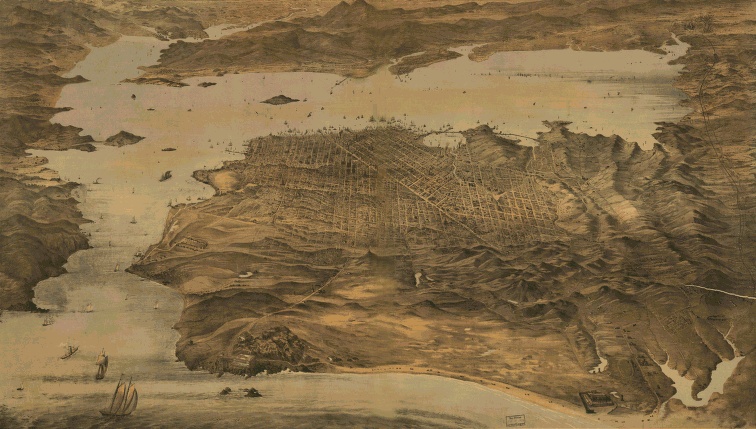
Only 9% of California’s urban forests are native to California. (1)  Pre-settlement San Francisco was virtually treeless.  One-third of San Francisco was barren sand dunes on its western edge.  San Francisco’s urban forest is now predominantly non-native and much of it is being destroyed to accommodate native plant restorations that require full sun. 

Birds-eye view of San Francisco in 1868

Non-native trees were planted in Oakland in the 19th century because there were few native trees: “Vegetation before urbanization in Oakland was dominated by grass, shrub, and marshlands that occupied approximately 98% of the area.” (2)  Non-native tree species in the East Bay are adapted to soil and microclimate conditions that are not suitable for native species.  Non-native annual grasses will replace Oakland’s urban forest in the hills, not native trees, if native plant advocates get the Vegetation Management Plan they have been fighting for for nearly 8 years.

A Learning Experience?

I would like to think that California’s policy makers learned something from the process of considering AB1573.  Do they have a better understanding of what grew in California in the past and therefore what is capable of growing in the future?

Probably not

Ironically, on the same day that AB1573 was withdrawn by its authors, the San Francisco Examiner published this article about a new initiative to plant more greenery in San Francisco, led by the California Academy of Sciences.  It’s an excellent idea, except that the leaders of this initiative equate greenery with native plants:  “He’s looking to introduce more native plants in The City, which will in turn attract more native insects and more native birds throughout San Francisco.”  Nature is not synonymous with native plants.  The scientific definition of biodiversity includes both native and non-native plants.  In fact, San Francisco’s Open Space Element of the General Plan also defines biodiversity as including both native and non-native plants. 

As much as I would like to hope that Californians have a more realistic goal for the future of California’s landscapes after watching the failure of AB1573, I don’t think I can. 


  1. Matt Ritter, A Californian’s Guide to the Trees Among Us, Heydey Books, 2016.
  2. David Nowak, “Historical vegetation change in Oakland and its implications for urban forest management,” Journal of Arboriculture, September 1993

Oakland’s Vegetation Management Plan Is Headed in a Destructive Direction

Oakland has been trying to adopt a vegetation management plan (VMP) to mitigate fire hazards since November 2016.  The plan has been drafted three times in 2018, 2019, and 2020 and a draft Environmental Impact Report was also published in 2020.  All three versions of the plan were acceptable to me and many others.  Every version would have removed dead trees and thinned non-native trees on 2,000 acres of public land and 300 miles of roadsides in Oakland, leaving the tree canopy intact so that the forest floor would be shaded, suppressing the growth of weedy vegetation that ignites easily and keeping the forest floor moist, which retards fire ignition. 

Unfortunately, none of the proposed vegetation management plans were acceptable to native plant advocates who want all non-native trees in project areas in Oakland to be destroyed and the land replanted with native plants and trees.  The plan they are demanding is a native plant restoration, not a wildfire hazard mitigation plan.  Since they have successfully prevented Oakland from addressing wildfire hazards for eight years, we might assume they aren’t concerned about wildfire. 

A fourth version of the plan and a new Environmental Impact Report are expected to be published in September 2023 and there will be a new public comment period in October.  Based on written and oral public comments at public hearings, we predict that the revised plan is likely to be far more destructive than previous drafts of the plan.  Based on that prediction, I am alerting you to the need to read the revision and write a public comment.  Please ask to be notified of the publication of the plan by sending an email to info@oaklandvegmanagement.org .


Update:  The revised Oakland Vegetation Management Plan and revised Draft Environmental Impact Report were published on September 20, 2023.  These documents are available HERE.  There will be a public hearing by the Oakland Planning Commission on November 1, 2023.  The deadline for public comment will be November 4, 2023.  Comments can be submitted by email DEIR-comments@oaklandvegmanagement.org or by mail to Montrose Environmental, attention Ken Schwarz, 1 Kaiser Plaza, Suite 340, Oakland CA 94612.

When I have read the revised plan and its revised EIR, I will post a draft of my public comment on the draft by October 1st

– Webmaster, Conservation Sense and Nonsense, September 20, 2023


What do opponents of previous plans want?

There is a wide range of opinions about a vegetation management plan for Oakland.  I will use the public comment of the California Society of American Foresters (SAF) on the third version of the VMP as a representative opinion and the best available predictor of where the fourth revision is likely headed.  The entire comment of the Society of American Foresters (SAF) is available HERE and here are some of the revisions SAF is asking for

  • “Ecological restoration should be a goal of the VMP, including the establishment of native plant species where nonnative species dominate…Thinning of dense stands of nonnative tree species should only be done as part of an overall strategy of restoration, i.e., the goal of any tree removals should always be to eventually convert these stands to native tree or vegetation cover in order to build greater ecological resiliency.
  • “In concert with the goal of ecological restoration, adaptive management in light of climate change should guide management practices and restoration plans. Adaptive management strategies that incorporate new information and changing conditions will be critical to ecosystem restoration. Annual grasslands may become more dominant, oak woodlands less so in the planning area in the future as climate changes. Management targets in many cases will have to be based on anticipated future conditions.”
  • “However, if thinning is kept as the desired practice, we ask that you design each entry to be sufficiently intensive to assure that tree crowns will not close before the next thinning entry (10 years from now?) and indeed is sufficiently thinned to allow work towards establishing native vegetation in these stands.”
  • “The use of prescribed fire as a vegetation maintenance tool should have been considered and included in the VMP especially on ridges where fire moving from adjacent jurisdictions might occur, or along power-line transmission corridors.”
  • “The vegetation management zones along roadsides, especially along routes of egress, should be modified to extend 100 feet from roadside edges and should include any trees with underlying structural or health conditions that are tall enough to fall onto streets and roads. This may in some cases require looking outside of the 100-foot roadside clearance.”
  • “It is important that the use of triclopyr herbicides is included to treat cut stumps in eucalyptus to prevent sprouting. Glyphosate herbicides will not be effective in treating eucalyptus stumps and will result in resprouts.”
  • “There should be an Ecological Restoration Guide added to the appendices…This new appendix would outline the City of Oakland’s current ecological restoration efforts, identify stakeholders (e.g., city departments, Oakland Wildlands Stewards, etc.) and their roles…”

Native plant restoration, NOT wildfire hazard mitigation

The Society of American Foresters (SAF) is asking the City of Oakland to make a commitment to eradicating all non-native trees in project areas and replacing them with native plants.  Such a plan would not reduce wildfire hazards in Oakland because native vegetation is not inherently less flammable than non-native vegetation.  Most wildfires in California occur in native chaparral and native conifer forests.

The plan proposed by the Society of American Foresters (SAF) is a native plant restoration plan, NOT a wildfire hazard mitigation plan.  Their proposal would destroy much of Oakland’s urban forest, which would not be replaced by native trees:

  • Non-native trees were planted in Oakland in the 19th century because there were few native trees: “Vegetation before urbanization in Oakland was dominated by grass, shrub, and marshlands that occupied approximately 98% of the area.” (1)  Non-native tree species in the East Bay are adapted to soil and microclimate conditions that are not suitable for native species.
  • Grassland was the dominant vegetation type of pre-settlement Oakland partly because of the land management practices of Native Americans and the stock grazing of early settlers:  “Native Americans played a major role in creation of grasslands through repeated burning and these disturbance-dependent grasslands were maintained by early European settlers through overstocking of these range lands with cattle and sheep. Twentieth century reduction in grazing, coupled with a lack of natural fires and effective suppression of anthropogenic fires, have acted in concert to favor shrubland expansion.” (2)
  • Grassland in California is not native to California.  Mediterranean annual grasses were brought to California in the early 19th century by the grazing herds of Spanish-Mexicans.  California’s native bunch grasses are not adapted to heavy grazing by herds of domesticated animals.  The grassland of California is about 99% non-native (Allan Schoenherr, A Natural History of California, UC Press, 1992).  Attempts to convert annual grasslands to native bunch grass have not been successful.  A team of scientists at UC Davis spent $450,000 and 8 years trying to convert 2 acres of grassland to native bunch grasses without success.  Grassland that will replace our urban forest will not be native. 
  • Grass is easily ignited and fires move quickly through grassland, particularly in a wind-driven fire.  The deadly, destructive fires in Maui, Hawaii are a case in point.  When agricultural fields of sugar cane, pineapple and other tropical fruit left Maui they were quickly succeeded by non-native grass that was considered a factor in the spread of fire. (3)  Dormant, dry annual grassland in the East Bay Hills will be more flammable than the living vegetation that native plant advocates want to destroy.
  • A small redwood grove was the only pre-settlement exception to the otherwise treeless Oakland hills:  “…for thousands of years [the Oakland hills] were treeless meadows, visited seasonally under Indigenous management…The one exception was the redwood groves of the southern Oakland Hills, a restricted forest that extended a few miles eastward from upper Dimond Canyon over the ridgetop to the outskirts of Moraga.” (4) Much of this grove still exists today because coastal redwoods are vigorous resprouters when they are burned or cut down.
  • SAF also predicts a vegetation type-conversion from forest to grassland:   “Annual grasslands may become more dominant, oak woodlands less so in the planning area in the future as climate changes.” Grassland will naturally succeed to shrubland without regular burning, which SAF recommends to reduce fuel loads.
  • Prescribed burns in densely populated urban areas are rarely approved by Bay Area Air Quality Management District because they pollute the air and often cause uncontrolled wildfires. California law regarding liability for damage caused by prescribed burns was revised in 2022 to provide legal protections for those who manage prescribed burns.  The revised law lowers the standard for liability to gross negligence from a previous standard of simple negligence. (5)

Consequences of landscape conversion to grass and shrubs

Destroying thousands of trees will increase air pollution and reduce air quality.  Destroying thousands of trees will increase greenhouse gas emissions causing climate change by releasing the carbon stored by the trees that are destroyed and reducing carbon sequestration going forward because the destroyed forest will not be replaced by a forest of native trees.

There was little biodiversity in Oakland’s pre-settlement forest“Oakland’s original species composition has increased from approximately 10 tree species to more than 350…Today [1993], only 31% of existing trees are native to Oakland, the plurality of trees (38%) are native to Australia/New Zealand.”  (1)  Destroying thousands of non-native trees in Oakland will reduce the biodiversity of our forest.  A more diverse forest is more resilient, particularly in a changing climate, with extreme and variable weather conditions.

Increasing 300 miles of roadside clearance from 30 feet (as proposed by the 3rd version of the VMP) to 100 feet (as proposed for the 4th version of the VMP) will produce wood debris on a scale that cannot be disposed of.  We know what the outcome will be because of a similar project on Claremont Ave, where eucalyptus was clear cut 100 feet from the north side of 1.1 miles of the road in fall 2020.  Below are pictures of the piles of wood chips and logs that remained along that stretch of road for about 9 months while project managers tried to figure out what to do with the wood debris, which was eventually dispersed throughout the hills.  UC Berkeley implemented the project with funding from Cal-Fire. 

The north side of Claremont Ave. was clear cut 100 feet from the road. The south side of the road was not cut because the trees are native.   There is a creek flowing at the bottom of the canyon that creates the moist conditions needed for native trees, which will not grow where non-native trees now grow. Photo by Doug Prose, courtesy Hills Conservation Network.
One of many piles of logs, Claremont Ave, November 2020. It took about 9 months for the logs to be dispersed along roads in the hills. Photo by Doug Prose, courtesy Hills Conservation Network.
One of many piles of wood chips, Claremont Ave, November 2020

The roads in the East Bay hills are now lined with logs, preventing people from pulling off the road. No native plants or trees were planted after the trees were destroyed. Three years later, the clear cut roadside is vegetated with non-native annual grasses and coyote brush, a pioneer native shrub.

The project on the property of UC Berkeley was very small in comparison to the Oakland vegetation management plan that will clear cut 300 miles of roads, producing at least 300 times the amount of wood debris.  What will Oakland do with the wood debris that is produced from the destructive VMP that native plant advocates demand?  Tons of wood debris lying on the ground is far more flammable than living trees, which is another indication that the VMP that native plant advocates demand is not about mitigating fire hazards. It’s about their preference for a native landscape that is not less flammable than the landscape they demand be destroyed.  Like all Mediterranean climates, our native vegetation is fire adapted and fire dependent.  A significant number of our native species will not regenerate in the absence of fire.  Most wildfires in California in the past 5-10 years have occurred in native chaparral and native conifer forests. 

NY Times reported that 150 homes burned in this wind-driven fire in San Diego in 2003, but the eucalyptus surrounding the neighborhood did not burn. The flammability of eucalyptus trees is exaggerated to justify their destruction. NY Times photo

The more trees that are destroyed, the more herbicide will be required to prevent the trees from resprouting.  SAF is correct in saying that tricopyr will be needed to kill the roots of the trees to prevent them from repsouting.  Glyphosate will not accomplish that task.  Triclopyr is more toxic than glyphosate. Triclopyr has a signal word of “warning” and glyphosate has a less toxic signal word of “caution.”  Triclopyr kills the roots of woody plants by traveling from the cut stump to the roots of the plant in the soil.  Triclopyr is known to kill mycorrhizal fungi in the soil, which are essential to the health of plants growing in the soil.  The more herbicide that is used to kill the roots of destroyed trees, the less likely a newly planted native landscape is to survive.  All the more reason to assume that the destroyed forest will not be replaced by a native landscape.

In Summary

  • The landscape that native plant advocates demand for Oakland will be predominantly non-native annual grasses.
  • Native trees will not replace the trees that are destroyed because they are not adapted to most places where non-native trees now live and because there is no available funding to purchase native plants, plant them on thousands of acres of public land, and irrigate them until they are established.  Similar fuels management projects done by East Bay Regional Parks District, East Bay Municipal Utilities District, and UC Berkeley have not planted a native landscape to replace trees that have been destroyed.
  • Non-native annual grasses will naturally succeed to shrubs in the absence of frequent fire.  Shrublands are more flammable than the existing urban forest because fire travels on the ground, unless wind-driven fire ignites tree canopies.  In that case everything burns, both native and non-native trees.  The wind-driven fire in Oakland in 1991 spared no trees in burned areas, whether native or non-native.  
  • The project would produce many tons of flammable wood debris that has no commercial value and no place to be safely disposed of.
  • The loss of our urban forest will increase air pollution in Oakland, contribute to greenhouse gas emissions causing climate change, and raise temperatures in a city that is already a heat-island. 
  • Herbicides needed to prevent the urban forest from resprouting will poison the soil and suppress the growth of a new landscape.

If you live in Oakland City Council District 4 or 6, you are likely to be directly affected by Oakland’s vegetation management plan.  The most effective way to influence the VMP is to express your opinion to your representative on the City Council, as well as our at-large representative on the Council.  Contact information for members of the Oakland City Council is available HERE.


(1) David Nowak, “Historical vegetation change in Oakland and its implications for urban forest management,” Journal of Arboriculture, September 1993
(2) Jon E. Keeley, “Fire history of San Francisco East Bay Region and implications for landscape patterns,” International Journal of Wildland Fire, September 2005.
(3) https://www.nytimes.com/2023/08/13/us/hawaii-wildfire-factors.html
(4) Andrew Alden, Deep Oakland: How geology shaped a city, Heyday, 2023.
(5) https://kion546.com/news/2022/01/04/new-california-law-changes-liability-for-out-of-control-prescribed-burns/

The Great Lakes: A story of man-made invasions

I’m reading about the Great Lakes in preparation for a cruise on the Great Lakes from Chicago to Toronto. (1,2)  It’s a story of continuous invasions of aquatic creatures, one after the other, with many more expected in the future.  Every one of those invasions was caused by the removal of natural barriers from isolated bodies of water to accommodate human activities such as shipping of goods.

Connecting the Great Lakes to the Atlantic Ocean

The St. Lawrence River is the natural gateway into the Great Lakes from the Atlantic Ocean.  The salty water of the ocean and the fresh water of the lakes was part of the natural barrier that protected the lakes from invasive species because, for the most part, the marine creatures that live in salty water are different from those that live in fresh water. 

The St. Lawrence River was steep and narrow, creating white-water rapids that limited travel from the ocean to the lakes (or vice versa) in anything but a birch bark canoe that could be carried around the rapids.  The natural barrier was penetrated by building the St. Lawrence Seaway in 1959 that widened the river and used locks to climb the steep incline of the river into Lake Ontario. 

The St. Lawrence Seaway was instantly obsolete because of the unforeseen container revolution that transformed global shipping.  The transition from traditional to container shipping was instantaneous because the advantages are so great. Container ships are huge in comparison to the small ships that had been loaded by hand for centuries. The St. Lawrence Seaway is too narrow to accommodate container ships.  The loans given to the builders of the seaway by Canada and the US were eventually forgiven because the tolls on the seaway will never pay for the expense.

But the damage was done, although much of it could have been avoided.  The ships that start their voyage in fresh water ports on rivers take on their ballast water when they start their voyage and with it freshwater aquatic creatures that don’t live in the Great Lakes.  When they arrive in the Great Lakes they dump their ballast water to take on their cargo.  The dumping of ballast water in the Great Lakes could have been regulated in 1959, but it wasn’t.  Only very recently have ships from fresh water ports been asked to exchange their ballast water in the ocean, before entering the Great Lakes and those regulations weren’t mandatory until 2021.  Such is the power of commercial interests that the consequences of introducing new species into the Great Lakes were not considered.

Niagara Falls, Canadian side Source

The second natural barrier that protected the Great Lakes was Niagara Falls in New York with a vertical drop of 160 feet.  That steep cliff across the Niagara River prevented the movement of marine animals from the Atlantic Ocean, through Lake Ontario and into the other four lakes.  It was one of the first barriers to be penetrated by the Erie Canal in 1825 and the Welland Canal in 1829.  The Erie Canal connects the Hudson River that flows into the Atlantic Ocean to Lake Erie, bypassing Niagara Falls and creating a gateway from the Atlantic Ocean into the Great Lakes.  The Welland Canal connects Lake Ontario to Lake Erie, which also bypassed Niagara Falls and created another gateway from the Atlantic Ocean to all of the Great Lakes.

Connecting the Great Lakes to the Mississippi River Basin

The St. Lawrence Seaway, Erie, and Welland canals opened the front door of the Great Lakes to salt water creatures in the Atlantic Ocean and the ships that brought foreign aquatic animals into the Great Lakes. The reversal of the Chicago River that connected Lake Michigan to the entire Mississippi River basin, opened the back door to the Great Lakes to all of the freshwater aquatic animals that live in the vast Mississippi River basin, east of the Continental Divide. 

When Chicago was built, it dumped its sewage into Lake Michigan and it also took its drinking water from Lake Michigan.  As the population of Chicago grew it became more vulnerable to typhoid epidemics caused by the polluted water Chicago was drinking.  The Chicago River had sent a dribble of water into Lake Michigan from its headwaters not far west of Chicago before it was reengineered.   

In 1900, Chicago built a huge sanitary canal that connected Lake Michigan to the Mississippi River.  The sanitary canal carried Chicago’s sewage into the Mississippi River and created a shipping lane to the Mississippi River while giving Chicago a clean source of water from Lake Michigan.  The sanitary canal reversed the flow of the Chicago River, which now flows out of Lake Michigan.  

The Consequences

The first invasive predator of native fish arrived in the Great Lakes via the canals built early in the 19th century.  The sea lamprey is a parasite that attaches itself to the bellies of fish and slowly sucks the blood out of it.  Its suction-cup mouth is the stuff of nightmares. 

Source: Great Lakes Fishery Commission

Lampreys, like salmon and sturgeon, are born in freshwater rivers and streams before living in the ocean and finally returning to their freshwater birth place to spawn and die.  They are capable of living in both fresh and salty water.  In the Great Lakes lampreys did not need to migrate to the ocean as their ancestors had because there was sufficient food in the lakes. 

As late as the 1940s commercial fishermen in the Great Lakes were harvesting 100 million pounds of native fish, such as lake trout and whitefish, annually.  Lampreys were first reported in Lake Michigan in 1936.  By 1950, the commercial fishery had all but collapsed as the lamprey population reached its peak. 

Lampreys met their match when a graduate student at University of Michigan wrote his Ph.D. thesis about the life cycle of lampreys.  He spent several years stalking lampreys in Lake Michigan and its tributaries, finding out where and when they spawn and at what point in their life cycle they become parasites of fish. 

The lamprey population had been so vast that it was impossible to target an attack on them.  An understanding of their life cycle enabled the development of a strategy to eradicate them.  More than 5 of their 7-year lifespan is spent burrowed in the gravel of small streams that feed into the lakes.  At that stage they are not yet fish predators. 

Armed with the knowledge of when and where lampreys were most vulnerable, the strategy was to build mesh barriers that prevented the lampreys from returning to the streams to spawn.  There was some success with the barriers, but not sufficient to reduce the huge population. 

The final solution to lamprey control was the use of a chemical that would poison lampreys without killing native fish. Finding the chemical that would do the job was a classic case of trial-and-error without regard for the consequences of using poisons in the environment.  Chemicals were solicited from all over the country and the world for study as candidates.  The tests, done in uncontrolled environments with no safety precautions for low-level workers, consisted of dumping hundreds of different chemicals into three jars, one containing a lamprey, another native lake trout, and a third native blue gill.  After hundreds of trials, a chemical that killed only the lampreys was selected for the job of eradicating the lamprey population.  No thought was given to the possible effect on all the other native fish in the lakes—such as whitefish and sturgeon—or humans, or plants. (3) The same chemical is still used today to control the lamprey population, which remains but is no longer considered a problem. 

There are many invasions into the Great Lakes.  The lampreys were followed by alewives, a species of small fish.  The population of alewives boomed at first, then busted, resulting in massive rafts of millions of dead alewives.  Finally, the population of alewives stabilized and now are considered the primary prey of salmon that were introduced in the 1960s to serve the sport fishermen who are the backbone of Michigan’s tourist industry. 

Zebra and quagga mussels proved to be one of most damaging of the invaders in the Great Lakes, partly because of how widely they spread. They were brought to the lakes in the ballast water of ocean-going ships.  The open back door of the Great Lakes into the vast Mississippi River basin enabled the inevitable spread of quagga mussels throughout the country, eventually crossing the Continental Divide into western states.  Those who tried to prevent that spread, spent many years imposing strict regulations about decontaminating and moving boats into places where mussels weren’t yet found.  Today, places like Lake Powell have given up enforcing the regulations. 

The mussels are filter feeders of phytoplankton that is food for creatures at the bottom of the food chain, depriving them of food, as well as their predators higher in the food chain. The mussels have turned sandy beaches into foot-slicing no-go zones.  They improve the water clarity of the lakes, but that’s a mixed blessing for other inhabitants of the lakes. 

Quagga and zebra mussels are now part of the food web.  Populations of diving ducks have increased where mussels are found.  A species of non-native fish—the goby—thrives on quaggas.  And native whitefish, yellow perch, and chub have slowly developed the ability to digest quaggas, a story not fit for the squeamish.  Whitefish don’t have the jaws needed to crack the mussel open, so they swallow them whole and leave it to their digestive system to deal with it:  “the typical whitefish has an anus about the size of a ‘swizzle stick.’  But the fish excrement, a paste of crushed mussel shell thick as unset concrete, stretched the whitefish’s underside orifice to the diameter of his pinky.” (1)

The latest arrival is Asian carp via the Chicago River and sanitary canal from the Mississippi River into Lake Michigan. Asian carp were introduced to the Mississippi River to eat sewage pollution drained into the river by many rural communities.  The prediction is that Asian carp will decimate the commercial fishery of the Great Lakes, though it is still early in that story.

More man-made problems

Not all problems in the Great Lakes are caused by the arrival of foreign aquatic species, but other problems are also man-made.  Lake Erie is the most polluted of the Great Lakes.  In summer months, when temperatures are high, there are toxic algal blooms that kill fish and pollute drinking water.  Although the sources of pollution are man-made, the shallow lake bottom contributes to the problem.  Lake Erie is the shallowest of the Great Lakes. 

The Great Black Swamp at the western edge of Lake Eric slowly drained the watershed into Lake Erie, filtering and cleansing the water as it flowed through the swamp.  The swamp was drained and filled to create more land for agriculture and remove an obstacle to westward travel and migration.  Now the rich agricultural land that surrounds Lake Erie drains run-off of chemical fertilizers into the lake, providing the nutrients that produce algal blooms.

Climate change has already created chaos in the Great Lakes and the damage is expected to accelerate in the future.  While the climate has warmed on land, the temperature of the water in the Great Lakes has climbed even higher, promoting growth of toxic algae. Winter temperatures are no longer low enough to freeze the lakes during the winter because the dark water of the lakes in the winter absorbs more heat than reflective white snow and ice.  The higher temperature of the water in the lakes also increases evaporation of the water, lowering water levels, causing erosion of the exposed shore, and destroying infrastructure on the shore.

Moral of the Story

Problems in the Great Lakes were caused by humans who were accommodating their own needs.  The aquatic animals blamed for the problems were only symptoms of the changes made by humans.  They were not the cause.  Eradicating them will not prevent new invasions in the future, so long as the gateways to other bodies of water remain open.  And over time, many of the species that cause problems at first will enter the food web and become contributing members of the ecosystem.  We fear change, but in many cases that is because our time frame for evaluating change is too short.

We should assume that similar problems have occurred wherever isolated bodies of water have been connected to serve human activities. The Suez Canal connected the Mediterranean Sea to the Red Sea in 1869.  The Panama Canal connected the Atlantic Ocean to the Pacific Ocean in 1914.  I can only imagine the consequences of removing the impassable barriers between those vast bodies of water. 

To be clear, I don’t regret the building of most of the canal passages, with the possible exception of the St. Lawrence Seaway. However, it is not realistic to expect that the environment will not be altered by removing impassable barriers on water or land and it is pointless to blame the plant and animal species that are merely responding to the changes we have made.   


(1) Dan Egan, Death and Life of the Great Lakes, W.W. Norton & Co., 2017

(2) Jerry Dennis, The Living Great Lakes, St. Martin’s Press, 2003

(3) The pesticide 3-trifluoromethyl-4-nitrophenol (TFM) is used to control sea lamprey (Petromyzon marinus) populations in the Great Lakes through its application to nursery streams containing larval sea lampreys. TFM uncouples oxidative phosphorylation, impairing mitochondrial ATP production in sea lampreys and rainbow trout (Oncorhynchus mykiss). However, little else is known about its sub-lethal effects on non-target aquatic species. The present study tested the hypotheses that TFM exposure in hard water leads to (i) marked depletion of energy stores in metabolically active tissues (brain, muscle, kidney, liver) and (ii) disruption of active ion transport across the gill, adversely affecting electrolyte homeostasis in trout. Exposure of trout to 11.0 mg l− 1 TFM (12-h LC50) led to increases in muscle TFM and TFM-glucuronide concentrations, peaking at 9 h and 12 h, respectively. Muscle and brain glycogen was reduced by 50%, while kidney and muscle lactate increased with TFM exposure. Kidney ATP and phosphocreatine decreased by 50% and 70%, respectively. TFM exposure caused no changes in whole body ion (N a+, Cl, Ca2 +, K+) concentrations, gill Na+/K+ ATPase activity, or unidirectional Na+ movements across the gills. We conclude that TFM causes a mismatch between ATP supply and demand in trout, leading to increased reliance on glycolysis, but it does not have physiologically relevant effects on ion balance in hard water.” (Oana Birceanu, et.al., “The effects of the lampricide 3-trifluoromethyl-4-nitrophenol (TFM) on fuel stores and ion balance in a non-target fish, the rainbow trout,” Comparative Biochemistry and Physiology, March 2014)

Dana Milbank: “How I learned to love toxic chemicals”

Dana Milbank is a political commentator for the Washington Post.  Like many city dwellers, Milbank moved his family from Washington DC to the Virginia countryside during the Covid pandemic. 

His new home inspired him to become a native plant advocate with the usual corresponding hatred of non-native plants.  He announced his new hobby of killing non-native plants in April 2023, as described in this response to his article by several defenders of the natural world as it exists, rather than as some might wish it to be.

In a more recent article, Milbank expressed his frustration at the failure of his early efforts to destroy non-native plants on his property without using herbicides: “When last I wrote about my battle of the brush, I was losing, badly, to the invasive vines and noxious weeds that had turned forest and field at my Virginia home into an impassable jungle. I’d cut them back, but they would return in even greater numbers.”

And he explained how he “learned to stop worrying and love chemicals.”  He is now both a native plant advocate and a promoter of herbicides (specifically glyphosate) which is typical of most native plant advocates. 

He justifies poisoning both his property and the Shenandoah National Park near his home by turning to advisors who tell him what he wants to hear, people who make their living using herbicides to eradicate non-native plants. 

Of course, renowned native plant guru, Doug Tallamy, is one of his advisors.  Although Tallamy advised residential gardeners against using herbicides in his book, Nature’s Best Hope, published in 2020, he has now changed his mind about herbicides.  In Milbank’s article, Tallamy says that herbicides are an “essential tool:”  “‘I think of it as chemotherapy,’ said Doug Tallamy, a University of Delaware entomologist and guru of the native-plant movement. ‘We have ecological tumors out there. If we don’t control them, we have ecological collapse. We have the collapse of the food web.’”

Poisoning the soil

Milbank admits that glyphosate (Roundup) is toxic and he wears protective gear when applying it, including a respirator (which is not required for glyphosate applications by California’s pesticides regulations).  He describes his application technique:  My preferred technique is ‘hack and squirt.’ With my hatchet, I cut gouges around the circumference of the invading tree, then spray the poison inside. For smaller invaders, I can chop the whole thing down and apply the chemical as a ‘cut stump’ treatment.

I read most of the over one thousand comments on Milbank’s article to determine the public’s reaction.  Although many commenters express reservations about the use of herbicides, the majority of commenters are supportive of the use of herbicides.  The manufacturers of pesticides are definitely winning the public relations battle regarding chemical safety.  When supporters reply to doubters of herbicide use, they defend Milbank’s application technique as “surgical.” 

Cut stump and hack and squirt application methods are less likely to disperse chemicals in the air, but they increase soil contamination.  These application methods work by applying herbicide shortly after the woody plant is cut, while the cambium layer (between the bark and the heart wood) is still functional. The cambium layer delivers the herbicide to the roots of the plant to kill the roots. The application may appear to be “surgical” from the standpoint of above-ground contamination, but the damage is being done in the soil, the plants growing in the soil, and the animals that eat those plants. 

Source: https://www.acompletetreecare.com/blog/what-are-the-layers-of-a-tree-trunk/

There are many consequences of poisoning the soil:

  • Because the roots of plants are intertwined as well as connected to one another by fungal networks in the soil, non-target plants are harmed and often killed.  It is not possible to poison one plant without poisoning others. HERE is an example of a forest of native trees that was damaged by spraying herbicide under the trees.
  • Herbicides kill beneficial microbes and fungi in the soil that contribute to plant health. (1) For example, fungal networks that are killed by herbicides transport moisture and nutrients from the soil to the plants.  Whatever vegetation remains or is planted in the future is handicapped by the loss of this living support system.
  • Glyphosate binds minerals in the soil, preventing essential nutritional minerals such as iron and manganese in the soil from being taken up by plants. (2)  Glyphosate is so widely used that it is found in the blood and urine of most of the population, including children.  Could glyphosate be a factor in widespread iron-deficiency anemia in adolescent girls and young women? (3)
  • Glyphosate is a well-known anti-microbial agent.  These effects raise concerns regarding glyphosate’s influence on human health and behavior through secondary means, such as our gastrointestinal microbiome, given what is now known regarding the gut microbiome and its influence on human health and disease. (4,5)
Source: https://symsoil.com/soil-food-web-soil-cities/

Who are the climate change deniers?

Milbank repeats his accusation that those who believe the threat of non-native plants is exaggerated, are climate change deniers.  He turns to the Executive Director of the federal Invasive Species Council for confirmation, who calls the threats of non-native plants “settled science.”  Science is, by definition, never settled.  Science is a process, not a conclusion.  Every scientific hypothesis is constantly tested and usually refined or overturned as new knowledge and methods are available.   Many scientists are testing the hypotheses of invasion biology and questioning their validity in a changing climate. 

The only issue about invasion biology that is “settled” is that it has created a multi-billion dollar “restoration” industry that relies on and benefits the manufacturers of pesticides, as well as creating vested interests that perpetuate the industry.

Milbank also quotes one of his advisors who claims that native plants are better adapted to the changed climate than non-native plants:  “The natives have the best ability to adapt — they’ve been adapting for tens of thousands of years in these areas — so they’ve got the ability to change as the climates and the landscapes have been changing.”  This statement seems comical, given that the topic is the extreme difficulty of eradicating non-native plants and the fact that they are out-competing native plants.  There is zero evidence that native plants are better adapted to the changed climate than the non-native plants that have replaced them.  500 million years of geologic history on Earth has informed us that when the climate changes—as it has many times–the vegetation changes. 

All plants, whether native or non-native, convert carbon dioxide to oxygen and store carbon. Destroying them contributes to greenhouse gases causing climate change by releasing their stored carbon into the atmosphere and reducing the capacity of the landscape to absorb more carbon in the future.  To deny that fact, is to be a climate change denier.

Reality trumps unrealistic hopes

Milbank describes the landscape he hopes to achieve with the help of herbicides.  It is the landscape that existed in the distant past, in a different climate, before the environment was altered by the activities of humans.  I am reminded of one of the presentations at the most recent conference of the California Native Plant Society, an event where the audience hopes and the speakers douse the audience’s hope with the reality of their unsuccessful efforts.  The presenter described a 20-year effort at the Santa Rosa Plateau Ecological Reserve to convert non-native annual grassland to native grassland, using annual (sometimes bi-annual) prescribed burns.  Many different methods were used, varying timing, intensity, etc.  The abstract for this presentation reports failure of the 20-year effort:  “Non-native grass cover significantly decreased after prescribed fire but recovered to pre-fire cover or higher one year after fire.  Native grass cover decreased after prescribed fire then recovered to pre-burn levels within five years, but never increased over time.  The response of native grass to fire (wild and prescribed) was different across time and within management units, but overall native grass declined.” The audience was audibly unhappy with this presentation.  One person asked if the speaker was aware of other places where non-native grass was successfully converted to native grass.  The speaker chuckled and emphatically said, “NO.  I am not aware of any place where native grasses were successfully reintroduced.” 


(1) “Glyphosate kills microorganisms beneficial to plants, animals, and humans,” Beyond Pesticides, October 2021.
(2) “Glyphosate, a chelating agent—relevant for ecological risk assessment?” Environmental Science and Pollution Research International, 2018
(3) “Prevalence of Iron Deficiency and Iron-Deficiency Anemia in US Females Aged 12-21 Years, 2003-2020,” Journal of American Medical Association, 2023
(4) “Is the Use of Glyphosate in Modern Agriculture Resulting in Increased Neuropsychiatric Conditions Through Modulation of the Gut-brain-microbiome Axis?” Frontiers in Nutrition, 2022
(5) “Toxic Effects of Glyphosate on the Nervous System: A Systematic Review” International Journal Molecular Science, 2022

Calaveras Big Trees State Park: To burn or not to burn?

Coast redwoods (Sequoia sempervirens) and sierra redwoods, often called giant sequoias (Sequoiadendron giganteum), are members of the Sequoioideae family, a sub-family of the Cypress family.  Both are native to California.  Dawn redwood (Metasequoia) is the third genus in the small Sequoioideae family.  Although there is fossil evidence that dawn redwoods lived in California some 40 million years ago they are now native only to a small region in China. 

Coast and sierra redwoods have a common ancestor that is now extinct.  They evolved into different genera in response to the creation of microclimates by geologic changes that isolated their gene pools and gradually drifted apart in directions adapted to their respective regions. (1)

Coast redwoods live in wetter climates than sierra redwoods and they are heavily dependent on coastal fog that maintains a moist environment when interior regions of California are hot and dry.  As our climate continues to change, the future of coast redwoods will depend on whether or not our coastal fog persists.  In turn, the fog depends on the coolness of the ocean relative to the warmth of the land.  The greater that difference in temperature, the more fog is created as water in warm air condenses when it meets cold ocean air.

Sierra redwoods tolerate a much drier climate than coast redwoods, but they have been tested by our prolonged drought.  They are also threatened by wildfires that have ravaged California during our long drought.  Only about 70 small, isolated groves of sierra redwoods still exist on the western slope of the Sierra Nevada.  In 2020 and 2021, wildfires killed 13 percent to 19 percent of the world’s giant sequoias, according to the U.S. Forest Service. (2) The Mariposa Grove of giant sequoias in Yosemite National Park burned in 2022, but none of the sequoias were killed. 

Public land managers are under intense pressure to do whatever is necessary to save our sierra redwoods.  Extreme measures have been taken, such as wrapping their huge trunks in fire resistant foil, spraying trunks with water and canopies with gel when fires approach.  (3)

The prevailing opinion about conserving sierra redwoods is that prescribed burns will reduce fuel loads and therefore fire hazards as well as kill shrubby understory that can carry fire from the ground into tree canopies. The understory is also considered competition for moisture in the soil. Kevin McCarthy, the speaker of the US House of Representatives, has introduced a bill titled Save our Sequoias Act (SOSA) that would enable logging to reduce fuel loads in giant sequoia groves without requiring environmental impact reviews. Many experts disagree about that strategy.  We visited the sierra redwood grove in Calaveras Big Trees State Park at the end of May to see for ourselves and consider the pros and cons of the strategy that is being used there to save the big trees.

Calaveras Big Trees State Park

Calaveras Big Trees State Park is located near the town of Arnold at an elevation of about 4,700 feet.  It is near the northern end of the narrow range of giant sequoias.  The southern end of the range is near the city of Visalia in Sequoia National Park at about 6,000 feet elevation.  Most of the big trees that were destroyed by recent wildfires are at the southern edge of the native range.  Recent wildfires have not reached Calaveras Big Trees, but several giant sequoias in the park were badly damaged by prescribed burns and may not survive.  These damaged trees are a testament to the risks of prescribed burns.
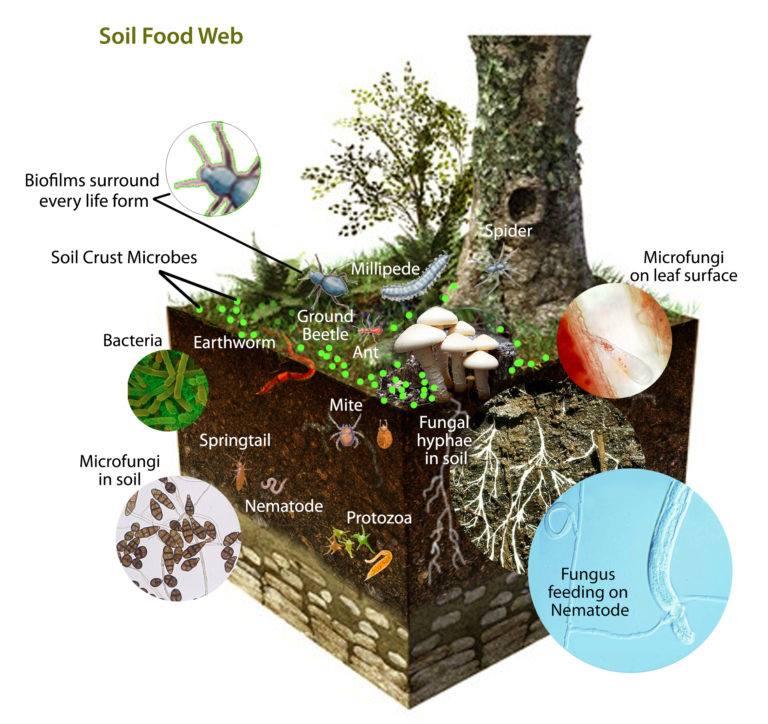
Below is a picture of one of the areas that was intentionally burned in 2022 to reduce fuel loads:

Calaveras Big Trees State Park, May 25, 2023

Below is a picture of a giant sequoia that was scorched by that fire. The right-hand side of the tree looks seriously damaged, suggesting that the tree may not survive:

Calaveras Big Trees State Park, May 25, 2023

Larger prescribed burns were also conducted on the northern edge of the park, where there are few sequoias.  Below is a picture of one of several large areas of the park that were intentionally burned:

Calaveras Big Trees State Park, May 25, 2023

There are only two sequoias in this part of the park, named the Orphans because of their isolation from other sequoias in the park.  The Orphans were severely burned by this fire. (see below) It isn’t clear if the Orphans will survive.

The Orphans, Calaveras Big Trees State Park. Photo by Alan Beymer with permission.

Land management or mismanagement?

The potential loss of a few giant sequoias at Calaveras Big Trees may seem trivial, but their loss must be put in the context of the small and shrinking population of giant sequoias as well as their very long lifespan of roughly 3,000 years.  The survival of the species is threatened by these unintentional deaths that could have been avoided. 

Many major wildfires have been started when burn crews lost control of prescribed burns. In April 2022, the US Forest Service conducted two prescribed burns in the Santa Fe National Forest in New Mexico that merged and became a major wildfire that burned for months, ultimately destroying over 341,000 acres of forest.  Although it was one of the most destructive of wildfires started by a prescribed burn, it is only one of many. 

Logging to thin the forest is another strategy used by public land managers to reduce fuel loads, but we did not see any evidence of logging at Calaveras Big Trees. The giant sequoias in Calaveras County reside in a mixed conifer forest of ponderosa pine, incense cedar, white fir, and sugar pine.  These tree species are valuable timber and therefore vulnerable to pressure from the logging industry.  It seems likely that the Save our Sequoias Act sponsored by Republicans is a gift to the logging industry, rather than to the sequoias.

In 2017, the National Academy of Sciences published an evaluation of fuels management projects in the US.  The authors of this publication reported that managing forest fuels has been ineffective:  “Mechanical fuels treatments on the US federal lands over the last 15 years totaled almost 7 million hectares, but the annual area burned has continued to set records.  Regionally, the area treated has little relationship to trends in the area burned, which is influenced primarily by patterns of drought and warming.”  Where fuels treatment was done, wildfires subsequently occurred:“10% of the total number of US Forest Service forest fuels treatments completed in the 2004-2013 period in the western United States subsequently burned in the 2005-2014 period.”  This suggests that “most treatments have little influence on wildfire.” In any case, only 40% of wildfires occurred in forests since 1984, with most fires burning grasslands and shrublands. 

The authors of the study published by the National Academy of Sciences, recommend a new approach to forest management.  Whereas past policies were designed to maintain forest conditions to historical conditions, this is no longer considered a realistic goal.  The recommended goal is now “supporting species compositions and fuel structure that are better adapted to a warming, drying climate with more wildfire.” 

The other, equally important new goal is to reduce the vulnerability of communities to wildfire by “changing building codes to make structures more fire-resistant…and providing incentives, education, and resources to reduce vulnerability to future wildfire.”  The only tree removals that make sense to the authors are those immediately around residential communities, “strategically located to protect homes and the surrounding vegetation.”  That is the principle of creating “defensible space” immediately around structures:  “fuels management for home and community protection will be most effective closest to homes…where ignition probabilities are likely to be high.”  The strategies used in Calaveras Big Trees to protect giant sequoias may not be the best strategies for surrounding residential communities. 

Land managers who conduct prescribed burns in sequoia groves also believe they are assisting forest regeneration because the heat of fires is said to release the seed-carrying female cones from the tree canopy and open the cones to release their seeds.  The track record on forest regeneration after wildfires depends partly on the severity of fire, but the results of studies are mixed. (4)

The purpose of prescribed burns is to reduce fuel loads with low-severity fire in order to prevent more destructive high-severity fires.  However, in the case of giant sequoias, high-severity fires may be necessary for long-term survival of the species:  “High-severity fires create robust seedling establishment and survival. For example, in a report on sequoia ecology, NPS researcher Nate Stephenson concluded: ‘Before the arrival of European settlers, successful recruitment of mature sequoias depended on fires intense enough to kill the forest canopy in small areas. Thus, sequoia is a pioneer species, and this conclusion has specific management implications.’” (5)

We saw an example of forest regeneration after a severe wildfire in the sequoia grove in Calaveras Big Trees.  Below is a photo of the Mother of the Forest that was burned by a wildfire in 1908.  That tree was particularly vulnerable to wildfire because the thick, spongy bark layer that protects sequoias from fire (as well as insects and disease) had been removed by entrepreneurs (more accurately called vandals) who reassembled the bark as a tree replica for display and profit.

Calaveras Big Trees State Park, May 25, 2023

The Mother of the Forest is surrounded by a young forest of trees, including many giant sequoias.  (See below. Trees with reddish bark are young giant sequoias.)  “The [1908] fire created ideal growing conditions for giant sequoia seedlings and today there is a healthy stand of young sequoias there.  Many of these trees are the result of natural regeneration that happens after a fire, while others were planted during the 1930s by members of the Civilian Conservation Corps.” (6)

Calaveras Big Trees State Park, May 25, 2023

Mountain dogwood (Cornus nuttalli) and hazelnut (Corylus cornuta) are the predominant understory shrubs in the forest of Calaveras Big Trees.  After an unusually long, cold winter most weren’t blooming yet at the end of May.  A few dogwoods were blooming where sunshine penetrated the tree canopy.  (see below)

Calaveras Big Trees State Park, May 25, 2023

Unfortunately, these lovely small trees are seen as competitors of the giant sequoias for available water and nutrients in the soil.  Therefore, destroying the understory in Calaveras Big Trees is one of the management goals.  According to the Calaveras Big Trees Association, most of the dogwoods were chopped down by park staff about 9 years ago.  Dogwoods are vigorous resprouters, so they quickly grew back more densely than their taller predecessors.  Pesticides (including herbicides) aren’t used in Calaveras Big Trees, so resprouting was inevitable.  I wonder if those who destroyed the dogwoods understood that would be the outcome of their effort. 

Management strategies of the timber industry are based on an assumption of competition.  When clear-cut harvests are done by the timber industry they are typically sprayed with herbicides from helicopters to destroy the understory that they assume competes with the tree seedlings they plant for the next timber crop.  Public land managers often use the same strategy.

The research of Suzanne Simard has informed us that there is more cooperation in the forest than there is competition.  A lifetime of observing healthy forests taught her that the soil is occupied by vast networks of fungi that connect the plants and trees.  These mycorrhizal fungi transfer moisture and nutrients from the soil to the trees and plants, to their benefit.  She speculated that the destruction of all vegetation in clear cuts was eliminating that support structure and she designed experiments to test her hypothesis. 

The specifics of fungal associations between tree species varies, which requires that we describe a specific relationship.  Simard’s original studies focused on the fungal associations between Douglas fir and birch trees in the understory.  Birch trees were destroyed in the clear cuts that were then planted with Douglas fir seedlings that were not doing well.  Simard’s experiments eventually revealed that birch trees and firs mutually benefit one another through their fungal networks.  Carbon stored and the sugar produced by photosynthesis by firs are shared with deciduous birch during winter months while they are leafless.  In summer months when birch are foliated, they store more carbon that is shared with firs.  Birch is resistant to a root pathogen to which firs are susceptible.  In a sharing fungal relationship between birch and firs, birch confers some of that resistance to the root pathogen onto their fir neighbors.  Is there a similar relationship between dogwoods and sequoias and other conifers in the forest at Big Trees? 

The understory also shades the forest floor, which retains moisture in the soil that would otherwise evaporate in the absence of shade. The canopy of giant sequoias is near the top of mature trees and doesn’t cast much shade.  In other words, the shaded forest floor provides more moisture for all members of the plant community in sequoia groves.  Furthermore, a shaded forest floor is less likely to ignite a fire because of the moisture it retains. 

More questions than answers

I don’t know the answers to the questions I have raised about management strategies in Calaveras Big Trees:

  • Is there a mutually beneficial relationship between dogwood and hazelnut and giant sequoia?  Is it necessary or beneficial to destroy the understory in the sequoia groves of Calaveras Big Trees?
  • Are there more risks than rewards in conducting prescribed burns in Calaveras Big Trees?
  • Would thinning the trees in sequoia groves benefit the timber industry more than the sequoias?
  • Are severe fires more effective than low-severity fires to germinate the seeds of giant sequoias and regenerate the forest after fires?

However, I am sure that when there is uncertainty and great risk, there must be caution.  I also know that Calaveras Big Trees State Park is a treasure.  If you haven’t visited, I suggest you put it on your bucket-list.


  1. Gary D. Lowe, “Geologic History of Giant Sequoia and the Coast Redwood,” North America Research Group, Beaverton, Oregon, 2013-2014.
  2. Twilight Greenaway, “In California, a race to save the world’s largest trees from megafires,” Inside Climate News, September 23, 2022.
  3. “‘It could be a big tree in 1,000 years’:  tiny seedlings of giant sequoias rise from ashes of wildfire,” The Guardian, November 1, 2021
  4. Kristen Shive, et.al., “2021 Fire Season Impact in Giant Sequoias, National Park Service.
  5. George Wuerthner, “Save Our Sequoias Act:  A Stealth Attack on NEPA-EAS and Our Sequoia Groves,”  Wildlife News, May 21, 2023.
  6. “A Guide to the Calaveras North Grove Trail,” Calaveras Big Trees State Park.  Much of the information in this article comes from this trail guide.