Happy New Year and Farewell

The Million Trees blog is folding its tent and moving on because most of the projects in the San Francisco Bay Area that I have followed for 20 years have been approved, funded, and are being implemented.  Every public land manager in the Bay Area has made a commitment to destroying most non-native trees and using pesticides for that purpose.

If you wish to continue following the development of these projects, I recommend these websites:  San Francisco Forest Alliance Defend East Bay Forests, Save the East Bay Hills, and Hills Conservation Network.

For the record, this is a brief summary of my beliefs about the environment:

If I return to the blogosphere in the future, the title and mission of a new blog would change.  The focus would be the science that informs my commitment to the cosmopolitan landscape that exists, rather than the fantasized landscape of the past.  I will also continue to inform readers of new studies that find evidence of the damage that pesticides do to the environment and its inhabitants.  If you are a subscriber to the Million Trees blog, you will be informed if I publish a new blog.

Thank you for your readership.

Million Trees

Conference of the California Invasive Plant Council: Fallacies and Failures

The California Invasive Plant Council held their 27th annual conference in Monterey in November.  It was their biggest conference, with about 400 attendees and more sponsors than ever before.  Clearly the industry that promotes the eradication of non-native plants is alive and well.  However, a closer look at the conference presentations suggests otherwise.  Eradication efforts are growing, but eradication success is not and establishing a native landscape after eradication is proving elusive.

A few common themes emerged from the presentations:

  • Eradication cannot be accomplished without using pesticides.
  • When eradication is achieved with pesticides, non-natives are rarely replaced by native plants.
  • Planting natives after non-natives are eradicated reduces re-invasion, but secondary invasions of different non-native plants are common.
  • “Managing” forests with prescribed burns did not result in more biodiversity than leaving the forest alone.

Goals of these eradication projects have shifted in response to these failures to achieve original goals:

  • Replacement plantings after eradication are sometimes a mix of natives and non-natives.
  • Inability to establish native grassland has given way to different goals.
  • Language used to describe the projects are evolving to be more appealing to potential volunteers.

Here are a few examples of presentations that illustrate these themes:

Eradicating beach grass in Point Reyes National Seashore

About 60% of sand dunes in the Point Reyes National Seashore were covered in European beach grass when the eradication effort began in 2000.  The goal of the project was to restore native dune plants and increase the population of endangered snowy plovers that nest on bare sand.

The project began by manually pulling beach grass from 30 acres of dunes at Abbott’s Lagoon.  The grass grew back within one year, presumably because the roots of the beach grass are about 10 feet long.  Manually pulling the grass from the surface does not destroy the roots.

A new method was devised that was more successful with respect to eradicating the beach grass.  The grass and its roots were plowed up by bulldozers and buried deep in the sand.  The cost of that method was prohibitively expensive at $25,000 to $30,000 per acre and the barren sand caused other problems.

The barren dunes were mobile in the wind.  Sand blew into adjacent ranches and residential areas, causing neighbors of the park to object to the project.  The sand also encroached into areas where there were native plants, burying them.  The bare sand was eventually colonized by “secondary invaders.”  Different non-native plants replaced the beach grass because they were more competitive than the desired native plants.

In 2011, the National Park Services adopted a third strategy for converting beach grass to native dune plants.  They sprayed the beach grass with a mixture of glyphosate and imazapyr.  At $2,500 to $3,000 per acre, this eradication method was significantly cheaper than the mechanical method.

However, it resulted in different problems that prevented the establishment of native dune plants.  The poisoned thatch of dead beach grass was a physical barrier to successful seed germination and establishment of a new landscape.  Where secondary invaders were capable of penetrating the dead thatch, the resulting vegetation does not resemble native dunes.

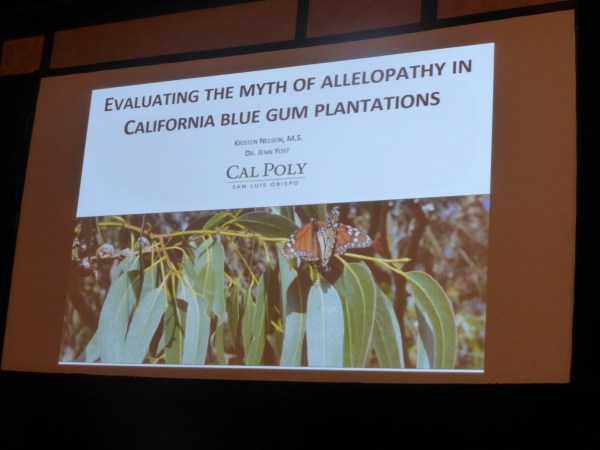
Presentation at California Invasive Plant Council conference regarding attempt to eradicate European beach grass at Point Reyes National Seashore

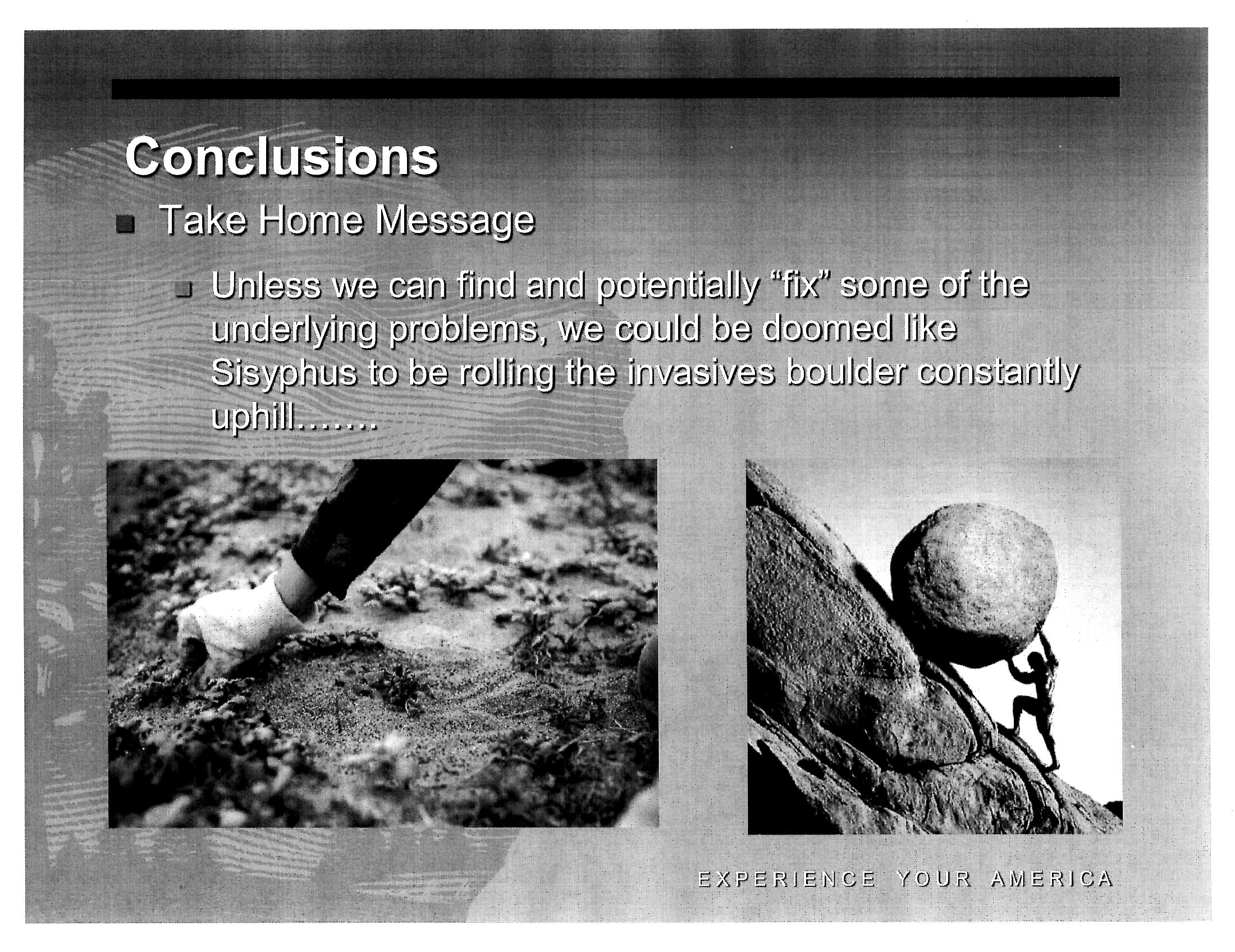
The concluding slides of this presentation were stunning.  They said it is a “Restoration fallacy that killing an invader will result in native vegetation.”  My 20 years of watching these futile efforts confirm this reality.  However, I never expected to hear that said by someone actually engaged in this effort.  The presenter mused that such projects are like Sisyphus trying to roll a boulder up hill. 

Presentation at California Invasive Plant Council conference regarding attempt to eradicate European beach grass at Point Reyes National Seashore

Attempting to plant Douglas fir after eradication of broom

Over a period of 5.5 years, broom was eradicated in plots in Oregon by spraying glyphosate.  The plots were then planted with Douglas fir seedlings that soon died.  They were replanted the following year and died in the second year.

There were two theories about why the plantings failed, both broadly described as “legacy” effects in the soil left by the broom.  One theory is that nitrogen levels were too high for successful growth of Douglas fir.  That theory is consistent with the fact that broom is a nitrogen fixer.  That is, broom—like all legumes—have the ability to transfer nitrogen in the atmosphere to nitrogen in the soil with the help of bacteria that facilitate that transfer.  Nitrogen generally benefits plant growth, but there can also be too much nitrogen.

The second theory is that Douglas fir requires a specific suite of mycorrhizal fungi for successful growth.  Mycorrhizal fungi live in roots of plants and trees.  They transfer moisture and nutrients from the soil to the plants.  Plants with a healthy suite of mycorrhizal fungi are more drought tolerant because they extract more moisture from the soil.

Neither of these theories has been successfully proven by this project.  They remain unanswered questions.  We were struck that the researchers had not considered the possibility that the repeated use of glyphosate could have been a factor in the failure of the Douglas fir.  Glyphosate is known to kill bacteria in the soil.  Could it also kill mycorrhizal fungi?  (We know that triclopyr kills mycorrhizal fungi.) That possibility was not considered by this project. Did the project consider that glyphosate also changes the consistency of the soil by binding certain minerals together?  It is more difficult for roots and water to penetrate the hard soil.  Were soil samples taken before and after repeated applications of glyphosate to determine how the soil had been changed by pesticide applications?

The published abstract for this project made this observation:  “It is typically assumed that once an invasive species is successfully removed, the impact of that species on the community is also eliminated.  However, invasive species may change the environment in ways that persist, as legacy effects, long after the species itself is gone.”  In fact, it seems likely that the pesticides used to eradicate the “invasive” species could also be the source of the “legacy effects.”

Does “managing” a forest result in greater biodiversity in the understory?

California State Parks tested that hypothesis by conducting prescribed burns in some of their forests in the Sierra Nevada 20 years ago, while leaving other portions of the forest “unmanaged.”

The abstract for this presentation describes the goals and expectations for the prescribed burns:  “Prescribed fire is a tool used to reduce fuels in the forests in the Sierra Nevada and mimic the low and moderate severity wildfires that burned before the onset of fire suppression.  A manager’s hope is that prescribed fire will create the disturbance necessary to stimulate the development of species rich understory communities and increase species richness, compared to unburned forests, which are often viewed as species depauperate.”

Twenty years after the burns, abundance and species composition of the understory in the burned areas were compared to the unburned areas.  They found little difference in the biodiversity of the understory of burned areas compared to unmanaged forests:

  • “Species richness was highly variable within burned and passively managed areas but was not statistically different.”
  • “Passively managed areas did not appear to be depauperate in understory species diversity compared to areas managed with prescribed fire.”
  • “Fire did not appear to reduce or enhance species richness numbers in burned areas, as compared to passively managed areas.”

No fires occurred in either the burned areas or the unmanaged areas during the 20-year period.  Therefore, this study did not test the theory that prescribed burning reduces fire hazards in forests.  This study found no significant differences in diversity of forest understory resulting from prescribed burns.

There are significant risks associated with prescribed burns.  They cause air pollution and they frequently escape the controlled perimeter of the fire, becoming wildfires that destroy far more than intended.  This study does not provide evidence that would justify taking those risks.  In fact, available evidence supports the “leave-it-alone” approach to land management.

Moving the goal posts

If at first you don’t succeed, you have the option of redefining success.  Here are a few of the projects presented at the conference that seemed to take that approach.

Make projects so small that success can be achieved

Eric Wrubel introduced himself as the National Park Service staff who is responsible for prioritizing invasive plants for removal in the National Parks in the Bay Area (GGNRA, PRNS, Muir Woods, and Pinnacles).  His work is based on the premise that the most successful eradications are those that are small.  The bigger the infestation, the greater the investment of time and resources it takes to eradicate it and the smaller the likelihood of success.  This is illustrated by a graph showing this inverse relationship between the size of the invasive population and the success of eradication.

Source: Rejmanek and Pitcairn, “When is eradication of an exotic pest plant a realistic goal?,” 2002

The process of prioritizing eradication projects began over 10 years ago with a survey of over 100 species of plants considered invasive.  Cal-IPC’s “watch list” was used to identify the plants that are not yet widely spread in California, but considered a potential problem in the future.  Cal-IPC’s risk assessment was the third element in the analysis.  Plants with “High” risk ratings by Cal-IPC were put higher on the priority list than those with “Moderate” or “Limited” ratings.  Plants that did not exist elsewhere in the region or watershed were also given higher priority, based on the assumption that re-invasion was less likely.

This is the list of eradication projects in the National Parks in the Bay Area that was presented at the conference of the California Invasive Plant Council. The projects marked with the red symbol for crossing out are completed projects. Nearly half of the plants on this hit list are not considered invasive in California.

The priority list showed that the highest priority eradication projects were quite small.  Some were just a few acres.  Buddleia jumped out as the 7th highest priority on only 13 acres.  Buddleia was recently added to a new category of plants on Cal-IPC’s “invasive” inventory.  It is not considered invasive in California, although it is considered invasive elsewhere.

In placing buddleia on its “hit list,” Cal-IPC illustrates one of the fundamental weaknesses of its evaluation method.  Cal-IPC does not evaluate pros and cons of non-native plants.  Only traits considered negative are taken into consideration.

Monarch sanctuary in Monterey, California. November 2018

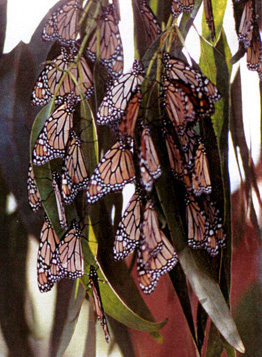
Buddleia is one of the most useful nectar plants for pollinators in California.  We took the time to visit the monarch butterfly sanctuary in Monterey while attending the conference.  The monarchs are arriving now to begin their winter roost in the eucalyptus, Monterey pine and cypress in this small grove.  At the entrance to the sanctuary a sign instructs visitors to plant only native milkweed as the monarch’s host plant and only native flowers for nectar.  Fortunately whoever planted the flowering shrubs in the sanctuary didn’t follow the advice of the sign-makers.  They planted buddleia and other flowering non-natives such as bottle-brush.  Several species of butterflies and hummingbirds were enjoying those plants in the Sanctuary. Strict adherence to the native plant agenda is not beneficial to wildlife because animals do not share our prejudices.

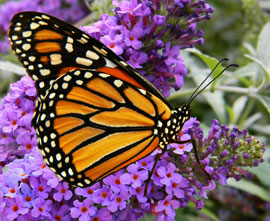
Monarch nectaring on butterfly bush. butterflybush.com

Acknowledging the difficulties of converting non-native annual grass to native perennial grass

Pinnacles National Park acquired 2000 acres of former ranchland in 2006.  The park wanted to convert the non-native annual grasses and yellow-star thistle on the former ranch to perennial bunch grasses and oak woodland.  They were able to reduce the amount of yellow-star thistle by burning and spraying with herbicide, but cover of native species remained low.  Conversion of grasses from non-native annuals to native perennial grass has been tried many times, in many places, and for long periods of time.  These projects were notoriously unsuccessful.

The project at Pinnacles has changed its goal to plant forbs (herbaceous flower plants) instead of grasses and they report that they are having some success.   They justify that shift in goal on soil analysis that suggests forbs were more prevalent than perennial grasses in inland valleys in California than previously thought.

This change in goal could be described as “adaptive management,” which adjusts methods and goals in response to observable outcomes of existing methods.  You could also call it “trial and error.”  We would like to see more land managers make such adjustments to their strategies, rather than doing the same thing over and over again and expecting a different outcome.

Recruiting volunteers with appealing messages

There were several presentations about effective methods of recruiting volunteers to participate in restoration projects.  Some of their messages seem to acknowledge that the language used in the past may have alienated some potential volunteers.  Speaking from personal experience, I can confirm that observation.  Here are just a few of the cringe-worthy native plant mottos that I hope have been abandoned in favor of a more positive message:

  • “That plant doesn’t belong here.”
  • “That is a good plant and the other is a bad plant.”
  • “The invasive landscape is sick and requires chemotherapy.” (to justify the use of pesticides)
  • “That’s a trash bird.” (said of common, introduced birds, such as starlings and house sparrows)

The speaker advised those who work with volunteers to focus on why an unwanted plant is a problem rather than where it comes from.  Unfortunately, the list of problems is heavily influenced by the preferences of native plant advocates.  If their criticisms are not accurate, or they don’t acknowledge the advantages of the plant, little has been achieved by using euphemisms.  Here are a few of the inaccurate criticisms made of eucalyptus:

What was missing?

Ecological restoration is a major industry. Thousands of people are employed by the industry, which is funded by many different sources of public money.  Whether individual projects are successful or not, the industry will survive and thrive as long as it is funded.  Greater care should be taken to design and implement projects that will be successful.

Stepping back from the conference presentations of specific restoration projects, here are a few issues that were conspicuously absent from the conference. 

  • Pesticides are being widely used by the restoration industry. When projects don’t achieve desired outcomes, pesticides should be considered as a factor.  Did pesticides alter the soil?  Were beneficial microbes and fungi killed? How persistent was the pesticide in the soil?  How mobile was the pesticide in the soil?  Was pesticide applied in the right manner?  Could aerial drift account for death of non-target plants?  There are many other useful questions that could be asked.

Update:  The California Invasive Plant Council has published “Land Manager’s Guide to Developing an Invasive Plant Management Plan.”  It says very little about the disadvantages of using herbicides to eradicate plants they consider “invasive” other than a vague reference to “unintended consequences,” without discussion of what they are or how to avoid them. 

However, it does give us another clue about why eradication efforts are often unsuccessful. When herbicides are used repeatedly, as they have been in the past 20 years, weeds develop resistance to them:   “The International Survey of Herbicide Resistant Weeds (2018) reports there are currently 496 unique cases (species x site of action) of herbicide-resistant weeds globally, with 255 species…Further, weeds have evolved resistance to 23 of the 26 known herbicide sites of action and to 163 different herbicides.”  The Guide therefore recommends that land managers rotate herbicides so that the “invasive” plants do not develop resistance to any particular herbicide.  The Guide gives only generic advice to use “herbicide X” initially and “herbicide Y or Z” for subsequent applications.

In other words, the California Invasive Plant Council continues to promote the use of herbicides to kill plants they consider “invasive.”  They give advice about ensuring the effectiveness of herbicides, but they do not give advice about how to avoid damaging the soil, killing insects, and harming the health of the public and the workers who apply the herbicides.  May 20, 2019

  • Are workers who apply pesticides being adequately trained and supervised by certified applicators? The safety of workers should be one of many goals of restoration projects.
  • When non-native plants are eradicated, serious thought should be given in advance to the probable outcome. Will native plants return?  Will wildlife be harmed?  Will the risks of failure outweigh the potential benefits of success?
  • Is climate change taken into consideration when planning the replacement landscape? Are the plants that grew in the project location 200 years ago still adapted to that location?  Is there enough available water?
  • If new plantings require irrigation to be established, what is the water source? Is it recycled water with high salt content that will kill many plants, including redwoods?
  • Are the new plantings vulnerable to new infectious diseases, such as phytopthera or infestations of new insects such as shot-hole borer?
  • Does the project team have sufficient horticultural knowledge to choose plants that can survive in current conditions? Does the project team know the horticultural needs of the plants they are planting?  Is there enough sunlight, water and wind protection for the trees they are planting?

The public is investing heavily in the “restoration” of ecosystems.  We can only hope that our investment is being used wisely and that projects will not do more harm than good.  Cal-IPC can play a role in raising the questions that have the potential to improve projects and enable them to succeed.  The long-term survival of the “restoration” industry depends on it.


Most quotes are from abstracts of presentations published in the conference program.

Trophic cascades are initiated by pesticide use

Although the Environmental Protection Agency requires that pesticides be tested before they can be sold in the US, we know that the required tests are inadequate to determine if the pesticide is dangerous to human health and the environment.  The tests are only as accurate as the test protocols and procedures.  There are many flaws in the testing methods required by federal law.  Here are a few of them:

  • Tests are conducted on laboratory animals in which the dose is limited to a single chemical. In the real world, humans and other animals are subjected to many chemicals simultaneously in doses that are unknown and unknowable, because little testing is done of contamination in the environment. Only the active ingredient in pesticide is tested, not the formulated product that is a cocktail of many chemicals.
  • Tests are done for relatively short periods of time, compared to the long lives of humans during which chemicals accumulate in our bodies.
  • The chemical threshold deemed “safe” is not the dose at which no adverse effect occurred. It is only the dose at which no adverse effect was observed:  “Subclinical affects—reduced fertility, compromised immune systems, and reduced intelligence, for example—are not observed not because they have not occurred but because they are seldom sought.” (1) In other words, the testing regimen does not test for many potential health problems.
  • The testing regimen is also limited to a few animal species at certain stages of development. For example, bees are the only species of insect on which pesticide tests are required and they are only tested at the adult stage.  Bee keepers will tell you that larvae stages of bee development are far more vulnerable to pesticides than adult bees, yet no tests are required on that stage of development.  Bees are probably less vulnerable to pesticides than caterpillars which eat vegetation, but caterpillars are not tested.  If caterpillars are killed, there are no moths and butterflies.

A proposal for a new testing standard of the impact on the entire ecosystem

Beyond Pesticides has published a review of many scientific studies about the impact of pesticides on the entire ecosystem in which they are applied.  The article reports substantial empirical evidence that pesticides are initiating trophic cascades in the entire ecosystem in which pesticides are used.  The article concludes that such studies of the entire food web are needed to identify and prevent such damage. (2)

What is a trophic cascade?

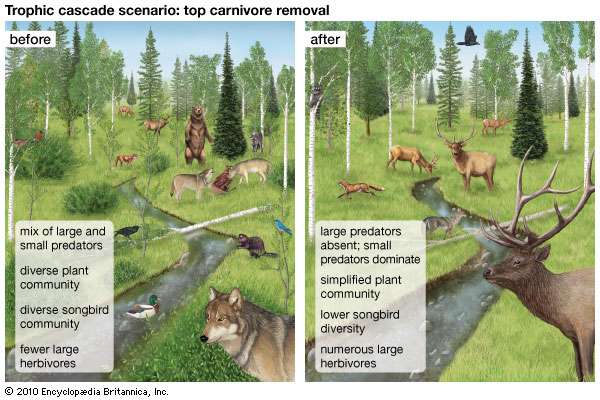
A change in the population of one member of an ecosystem can trigger a trophic cascade by altering the balance of the entire food web. 

The classic example of a “top-down” trophic cascade is the sequence of events in Yellowstone National Park when wolves were exterminated in the park.  In the absence of the top predator in the ecosystem, the population of elk that were their prey exploded.  The grazing animals ate trees and shrubs that were the food of the beavers.  The beaver population declined, which altered the hydrology of the ecosystem.  Wetlands maintained by beaver dams dried up and the community of plants and animals in the wetlands died off.  Although there were other predators of the grazing animals, such as bears and mountain lions, the packs of wolves subjected the herds of grazing animals to harassment that kept them moving, reducing damage to the vegetation.

Wolves have returned to Yellowstone National Park because of the Endangered Species Act that protected them and the ecosystem has been restored by the natural forces of predator and prey relationships.  The endangered status that protected wolves was recently rescinded in response to the demands of ranchers with domesticated animals.  Although wolves may not be killed inside Yellowstone, they may be killed when they leave the park.  We may eventually see a reversal of the improvements in an ecosystem ruled by wolves.


Update:  Emma Marris has critiqued the theory that the absence of wolves in Yellowstone National Park caused a trophic cascade that damaged the entire ecosystem in Yellowstone National Park and the reintroduction of wolves restored the ecosystem.  Her article, entitled “A good story:  Media bias in trophic cascade research in Yellowstone National Park,” was published in Peter Kareiva’s et al. new book, Effective Conservation Science, Data not Dogma.

Marris details the lack of data supporting the existence of a trophic cascade or its reversal when wolves were reintroduced.  She calls those claims speculative, an unproven hypothesis.  More importantly, Marris believes that proof of that hypothesis is unattainable:  “…even ecosystems as well studied as Yellowstone remain beyond our ken…lifetimes will be required to understand them and even then they may always remain, by virtue of changing faster than we are able to follow, essentially unknowable.”

More humility is needed to guide conservation.  If we are to avoid damaging the environment further, we need to keep in mind how little we know.  Nature may be far wiser in managing itself than humans presume to be. 


There are also examples of “bottom-up” trophic cascades when increases or decreases in the abundance of microscopic plants and animals disrupt the entire food web, ultimately impacting the top of the food chain.

Insects are also near the bottom of the food chain.  They are essential food for birds, particularly to young nestlings.  Scientists began noticing that insect populations were disappearing some time ago, but their anecdotal observations were not empirically tested until 2016 when an entomological society in Germany published a study about the decline:  “The German study found that, measured simply by weight, the overall abundance of flying insects in German nature reserves had decreased by 75 percent over just 27 years.” (3)  Although there are undoubtedly many reasons for this rapid disappearance of insects, including pesticides, there is almost no research being done to determine the causes:  “Rob Dunn, an entomologist at North Carolina State University…recently searched for studies showing the effect of pesticide spraying on the quantity of insects living in nearby forests.  He was surprised to find that no such studies existed.  ‘We ignored really basic questions,’ he said.  ‘It feels like we’ve dropped the ball in some giant collective way.’” (3)  Professor Dunn should not feel badly.  Almost no research is being done on the effects of pesticides on anyone, any animal or anything in the environment  Turning a blind eye to the possibility of such harm done by pesticides is one of the ways in which the industry is shielded from regulation.

Trophic cascades caused by pesticides

The review article published by Beyond Pesticides reports that many empirical studies have discovered trophic cascades initiated by pesticide applications.  Here is one example from agriculture:

“Mesleard et al. (2005) found that the insecticide fipronil, used to control midge pests in conventional rice fields, causes a trophic cascade that reduces the nutritional value of the area for waterfowl. Comparing a chemical intensive rice field to one managed organically, the trophic cascade ultimately neutralized the efficacy of synthetic pesticide use in the first place.

“Direct toxicity from fipronil reduced the number of invertebrate predators in chemical-intensive rice fields. This led to a trophic cascade that allowed herbivorous animals to flourish. On the surface, organic and chemically-managed rice fields both contained the same amount of invertebrate biomass. However, in chemical-intensive fields, this biomass was primarily in the form of gastropods (snails and slugs). When researchers surveyed the fields in late summer, only 12% of the invertebrate community were predators, while in organic fields that proportion was 70%. Slugs and snails are not a major food source for the most common waterfowl in the region studied, the heron, making organic plots a more valuable source of sustenance.” (2)

The review article also provides examples of trophic cascades initiated by pesticides in aquatic environments and in “invasive species” control projects.  Both herbicides and insecticides have initiated trophic cascades.  The effect on the food web of one pesticide is sometimes different from another.  The timing of a pesticide application sometimes has different impacts on the food web.  The effects of pesticides vary widely and are very complex.

A local example of a trophic cascade

There are many aquatic weeds in the Delta where the Sacramento and San Joaquin rivers slowly meander into the San Francisco Bay.  The weeds come from warmer climates and they are thriving here because of climate change.  Lower water levels are also a factor because shallower water is warmer.  The water level is lower because of drought and the diversion of water from the rivers and the Delta to irrigate agricultural crops.  Annual spring floods that cleansed the Delta system in the distant past have been stopped by upstream dams that keep water levels constant.

Instead of addressing the underlying reasons why the aquatic weeds have become a problem, the powers that be (State Parks Division of Boating and Waterways and approved by US Fish & Wildlife Service) have been spraying the aquatic weeds with pesticide and dumping pesticide pellets into the water.  These pesticide applications have been steadily increasing:  “Charts provided by the state show a 50 percent hike in the amount of pellets used from 2014 to 2017 and a 66 percent increase in the amount of spray that was administered during the same time period.” 

Fortunately, there are thousands of fishermen in the Delta who have noticed massive die-offs of fish, turtles, goats, ducks, muskrats, and otters since the spring. They have reported these deaths to California State Parks, who deny knowledge of such die-offs.

The fishermen have formed an organization, Norcal Delta Anglers Coalition.  They have organized to document this trophic cascade that was probably initiated by unnecessary pesticide applications.  We wish them luck.  We hope they have more success than we have had convincing public land managers that they are damaging the environment and its inhabitants with pesticides.

Testing and evaluation of pesticides must be improved

This important review article (1) concludes that pesticides can upset and imbalance ecosystem health and stability.  Studies find “increased risk of disease transmission, dangers to declining species, algae blooms, the loss of ecosystem services like nutrient cycling, and importantly, ineffective pest management.”  Therefore, there is a “critical need for EPA to consistently assess ecosystem level trophic effects as part of the pesticide registration process.” In the absence of a truly precautionary system where independent science is adequately considered by regulators, pesticides are likely to cause trophic cascades or other ecosystem disruption.

Such ecosystem evaluations of pesticides are not going to happen in the foreseeable future.  The 180-degree turn in American politics that would be required to improve pesticide regulation is unlikely.  Although most of the meager federal regulation we had in place prior to 2017 has been dismantled, regulation in the prior administration was also inadequate.

Courtesy Beyond Pesticides

Therefore, our fallback position should be DON’T USE ANY MORE PESTICIDE THAN ABSOLUTELY NECESSARY.  Buy organic food to protect your family and to put industrial agriculture using pesticides out of business.  Fight for rigorous pesticide regulation locally, in your city, your county and your state.

The end of another nativist myth

Native plant advocates promote the use of pesticides to eradicate non-native plants.  The myth they use to justify their use of pesticides is that damage is confined to the target plant or animal.  Clearly that is not true. Pesticides can be aimed at a specific plant, but non-target plants are often killed unintentionally because pesticides are mobile in the soil, they drift in the air and they are carried by the roots of the target plant to the intertwined roots of non-target plants.

Furthermore, killing one plant or animal in an ecosystem ultimately effects the entire community of plants and animals.  The collateral damage to the entire ecosystem caused by pesticides can be devastating to the entire food web.  Clearly the word “restoration” is a misnomer when used to describe eradication projects using pesticides.

Given the inevitable damage to entire ecosystems, the claim that native plant “restorations” benefit wildlife is clearly unlikely, if not patently false. 


  1. Joe Thornton, Pandora’s Poison, MIT Press, 2000
  2. Drew Toher, “Pesticide Use Harming Key Species Ripples through the Ecosystem,” Pesticides and You, Summer 2018.
  3. Brooks Jarvis, “The Insect Apocalypse Is Here,” New York Times, November 27, 2018

All life on Earth is related

Today we will take a deep dive into evolutionary history to talk about the origins of life on Earth.  Drawing from David Quammen’s new book, The Tangled Tree, we will tell you about “a radical new history of life,” as promised by the subtitle of his book. (1)

Categorizing Nature

Throughout written history, humans have demonstrated a compelling need to name and categorize everything in our world, including nature.  Naming and categorizing passes for understanding and enables us to talk about issues using commonly understood definitions.

Linnaean taxonomy was one of the first and most influential attempts to classify the natural world into three kingdoms:  plants, animals, and minerals.  Since Systema naturae was published by Carl Linnaeus in the 18th century, many other classification systems have been proposed by subsequent generations of scientists.

The conventional wisdom about classifying nature changed radically after the discovery of the molecular structure of DNA in the 1950s and the molecular analysis that it enabled in the 1960s.  Genetic analysis revealed the evolutionary relationships between organisms, enabling the development of phylogenetic “trees” depicting those relationships.

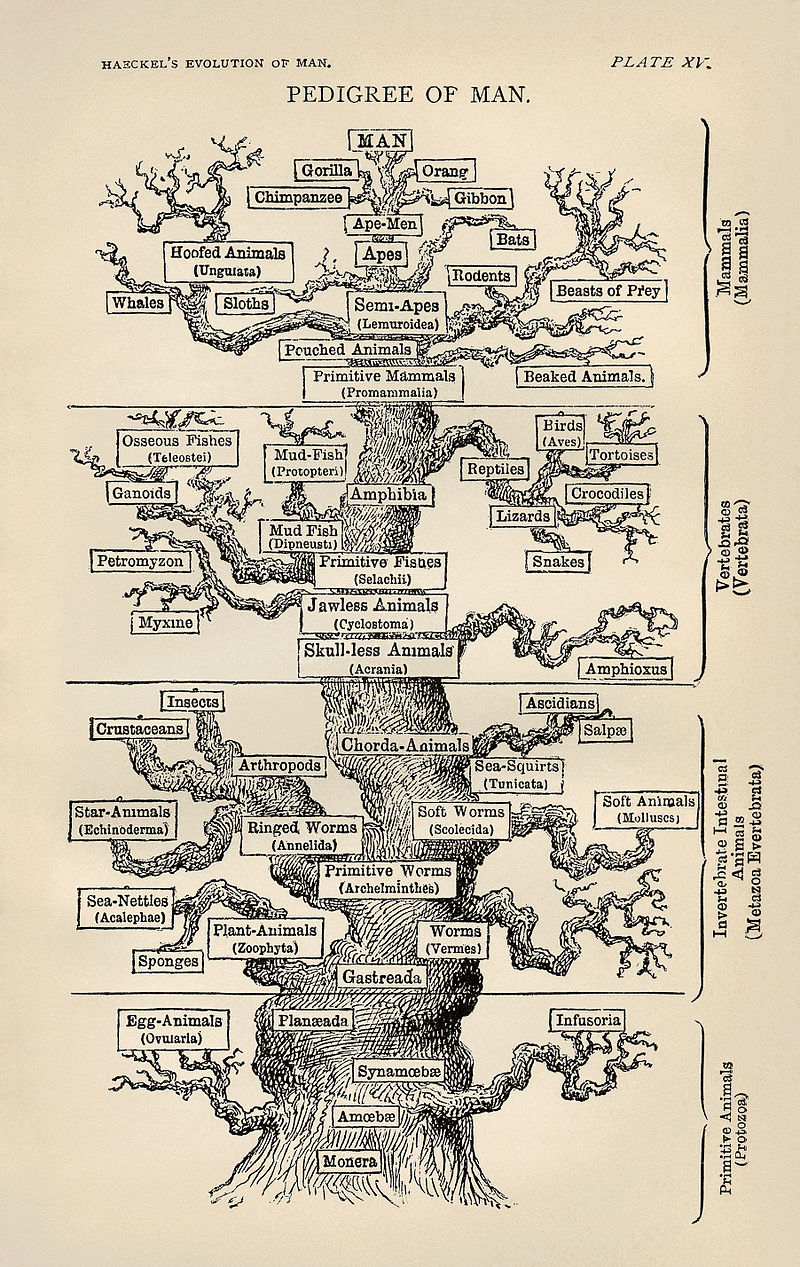
Haeckel’s Tree of Life, 1879

The revolutionary work of Charles Darwin was instrumental in initiating such speculation about evolutionary history.  Such theories about the history of life on Earth were often depicted as “trees of life,” showing the progression of evolution.  One of the earliest of such “trees” was published in the 1870s, shortly after the publication of Darwin’s Origin of Species in 1859.

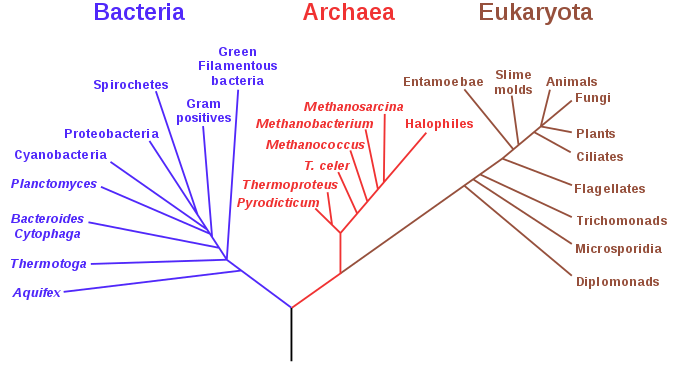
In 1977, using molecular analysis, Carl Woese published his hypothesis of a new kingdom of life, Archaea.  He proposed a new categorization of all life on Earth, which he called domains:  Bacteria, Archaea, Eucarya.  Bacteria and Archaea are one-celled organisms without a nucleus.  Eucarya are every other living organism, including plants, animals, and fungi. Kingdoms of life were relegated to the second level of taxonomy (the classification of organisms).

The hypothesis of Woese was challenged, often contentiously, for decades, but is now conventional wisdom among scientists of phylogenetics, as the genetics of evolution is called.  However, as tidy as these new categories might appear, they aren’t.  As human intellectual constructs often are, many species of life defy neat categorization.  Around the edges of every domain there are many species of life that don’t entirely fit the criteria.  Likewise, around the edges of every genus and species, there are many gray areas.  Just as the distinction between “native” and “non-native” is often ambiguous, so is the categorization of many organisms.  This is a reminder that we must use such definitions with humility, always being prepared to consider a new hypothesis that improves our understanding.

Domains of life

Revising the mechanisms of evolution

Molecular analysis has also radically altered our understanding of how evolution proceeds.  Charles Darwin’s hypothesis about evolution was that change in organisms occurs through genetic variation from one generation to the next.  Occasional genetic mutations from one generation to the next was later added to what is called “vertical evolution.”  Each subsequent generation of a species is tested by the environment and that test is called natural selection.  The individual member of a species that is best adapted to the environment survives to reproduce, while less well-adapted individuals do not survive to reproduce.

Scientists have more recently observed that species in one domain of life also exchange genetic material with another domain of life, as well as exchanges between different species within domains.  This is called “horizontal gene transfer.”  The discovery of horizontal gene transfer (HGT) has revolutionized how we think about evolution.  Natural selection remains as the mechanism that confers success or failure on such changes in genes from one generation to another.

Significance of horizontal gene transfer

Horizontal gene transfers occurred in deep time, but are known to be a significant issue at the present time.  Horizontal gene transfer is the primary mechanism for the spread of antibiotic resistance in bacteria and plays an important role in the evolution of bacteria that can degrade synthetic compounds such as pesticides. Antibiotic resistance in one species of bacteria can be transferred to another species of bacteria, multiplying the incidence of antibiotic resistance. (2)

The introduction of chloroplasts into plant cells roughly 3.5 billion years ago was one of the most significant events in the evolution of life on Earth.  The introduction of chloroplasts into plant cells was an example of a horizontal gene transfer from a bacteria cell into eucarya cells.  Chloroplasts are the organelles (specialized structures inside eucarya cells that perform specific functions) that perform photosynthesis in plant cells.  Photosynthesis enables plants to convert the energy of the sun into carbohydrates that feed the plant and emit oxygen as its waste product.  Photosynthesis converts carbon dioxide into oxygen.  This neat trick of photosynthesis radically altered the atmosphere by reducing carbon dioxide and increasing oxygen.  Just as increased carbon dioxide in the atmosphere is now increasing temperatures on Earth, lower carbon dioxide levels in the atmosphere reduced temperatures.  This so-called “Great Oxidization Event” was the probable cause of one of the five great extinctions hundreds of millions of years ago. (3)

The horizontal gene transfer of mitochondria from bacteria cells to eucarya cells was equally significant to the evolution of life on Earth.  Mitochondria are organelles in eucarya cells that perform respiration and energy production functions in most eucarya species of both plants and animals. (2)

The list of such horizontal gene transfers is long.  Here are some examples to help you understand that HGT is an extremely important evolutionary mechanism, perhaps even more important than vertical evolution (2):

• From bacteria to fungi
• From bacteria to plants
• From organelle to organelle
• From plant to plant
• Fungi to insects
• From bacteria to insects
• From viruses to plants
• From bacteria to animals
• From plants to animals
• From plant to fungus

Implications of horizontal gene transfer

Our bodies contain more microbes, such as bacteria, than they do human cells.  Those microbes are interacting with our own cells.  Sometimes the microbes cause problems and sometimes they solve problems.  The microbes in our bodies cannot be called enemies or friends.  Sometimes their interactions with our cells permanently alter our genes and are inherited by our offspring.  Such permanent alterations of our genes are called horizontal gene transfer.  Such interactions between microbes and cells occurs in all life forms, altering plants, animals, etc. 

What are the implications of these interactions?

  • All life forms on Earth are related. No life form on Earth can be considered “alien.”  Every organism on Earth is constantly undergoing change, as it interacts with other organisms.  No “species” is immutable in the long term.
  • Critics of genetic engineering say it is “unnatural” and risky because it introduces genes into organisms in which they did not evolve naturally. But horizontal gene transfer does exactly the same thing and it is a “natural” process.  Genetic engineering is risky, just as HGT is, but it is mimicking a natural process.
  • Many pesticides are known to kill bacteria. Since bacteria are resident in our bodies in huge numbers and are known to sometimes be beneficial, it seems unnecessarily risky to kill them with pesticides.   As with genetic engineering, the risk should be weighed against potential benefits.  Are the risks worth taking?
  • Epidemiological studies report correlation between increased pesticide applications and increased birth defects in humans. Laboratory studies on rats report birth defects in rats exposed to low doses of glyphosate as well as birth defects in subsequent generations of the exposed rats: “A 2018 study of pregnant rats exposed to low doses of glyphosate-based herbicides revealed that the rats had difficulties in getting pregnant and surviving the pregnancy. The second generation offspring suffered from being smaller than normal. They were also afflicted with abnormalities developed before birth. This means the glyphosate-based weed killers inoculate their victims with monstrosities.” (4) These studies suggest that genes may have been altered by pesticide exposure.

  1. David Quammen, The Tangled Tree: A radical new history of life, Simon & Schuster, 2018
  2. Specific examples of these HGTs are available HERE.
  3. http://www.growingpassion.org/2010/04/evolution-of-chloroplasts-endosymbiosis.html
  4. https://sustainablepulse.com/2018/10/24/the-specter-of-genetic-catastrophe/?utm_source=newsletter&utm_medium=email&utm_campaign=gmos_and_pesticides_global_breaking_news&utm_term=2018-10-24#.W9B55ktKg2x

More opposition to Measure FF

As you make the important decision about voting on Measure FF, please take into consideration that Million Trees and the Forest Action Brigade are not the only East Bay residents who plan to vote against Measure FF.  Today we tell you more about why many East Bay voters have made that decision.

Post-election update:  Measure FF passed easily.  In Alameda County 85% of voters approved Measure FF.  In Contra Costa County 80% of voters approved Measure FF.  These were the vote tallies on the day after the election, on November 7th.  

A ’91 fire victim and survivor tells us why he will vote against Measure FF

The East Bay Times published the following op-ed about Measure FF on October 4th. It was written by Peter Scott. He states his opposition to Measure FF clearly and emphatically.  Emphasis and photo have been added.

“Save trees, ‘no’ on Alameda County’s Measure FF”

“Alameda County’s proposed Measure FF, East Bay Regional Park District Parcel Tax Renewal, appears innocent enough: improvements in area parks, safety, a 20-year continuation of a 2004 plan to enhance the public’s enjoyment of East Bay Regional Park District (EBRPD) properties.

And the tax — a dollar a month per single-family residence and $69 a month for multifamily units in Alameda County — seems affordable. But wait: Half of the money raised by this measure would fund destruction of thousands of healthy, mature trees in the East Bay hills.

This isn’t the first time this deforestation has been proposed. In 2013, FEMA offered a similar plan, to be implemented by UC Berkeley, the city of Oakland and the EBRPD. After the plan’s environmental impact was discussed in three public hearings, citizens responded with 13,000 written comments, which, by FEMA’s count, were 90 percent against the plan.

The reason, subsequently confirmed in litigation, was that the plan would involve significant, permanent negative impacts to the environment but would still fail to achieve its stated goal — to reduce risk of fire in the hills. The U.S. Forest Service commented that in terms of mitigating risk, it would be better to do nothing than to proceed with FEMA’s plan. The reason this type of proposal keeps popping up is because it is the object of long-term lobbying by a clique of nativists who want to rid the hills of species they don’t like. Their reasoning depends on myths such as these:

  • Once upon a time, before white people came and changed things, the hills were a stable environment of so-called native vegetation that was healthy and inherently fire-resistant;
  • “native” species tend to be less likely to ignite, and they have manageable flame lengths (the distance at the ground from the flame’s leading edge to its tip);
  • and trees are the culprit and were the primary reason that the 1991 fire burned out of control.

These statements are not only incorrect, they are the opposite of the truth. The old landscape burned regularly; the flame lengths of “native” brush and grasses are multiples of mature trees’ flame lengths and create conflagrations that fire personnel won’t fight because they spread and change direction so fast; the 1991 fire was a STRUCTURE fire, not a vegetation fire: houses set fire to trees, not the other way around.

Factually, the ’91 fire was human-caused. First, it was a contractor’s construction debris fire that escaped into the brush; secondly, it was a reignition from embers that the Oakland Fire Department had failed to extinguish. The official report examining the causes doesn’t mention trees but does criticize the OFD’s failures in its incident command’s preparation, training and management during the fire. Of the 16 major fires in the hills since 1905, there are basically two categories: human-caused (10 fires) and “unknown cause” — it’s a safe bet most of those “unknowns” were also human-caused.

If Measure FF is truly focused on fire risk mitigation, it would fund regular removal of fine fuels around the base of the trees — as EBMUD does so successfully — because it is the brush, grasses and debris on or near the ground that are most likely to ignite and are key to the fire’s spread and ferocity. Leave the tall trees alone, because they reduce wind, shade the ground, catch fog drip and discourage growth of flammable, weedy plants. If trees are not cut down, then repeated applications of herbicides to kill re-sprouts are unnecessary.

Measure FF proposes to fund some good things — maintenance and improvements in the parks — but they make FF a Trojan horse. They are sugar-coating on a foul and foolish enterprise: deforestation to create so-called “oak-bay savannahs,” which are actually grass- and brush-covered hills, dotted with occasional low trees — the type of landscape that has been burning so fast and ferociously in Lake and Sonoma counties and throughout the state. We must send the FF authors back to the drawing board, telling them to come back to us when they have plan that will actually reduce, not increase, the fire hazard.”

Peter Scott, Oakland, California

No one is more knowledgeable about East Bay fire history and fire hazard mitigation than Peter Scott.  He is a founding member of the Claremont Canyon Conservancy and the Hills Conservation Network.  He is passionate about fire safety in the East Bay partly because of his personal loss.  His home burned down in 1970 and 1991 and his mother was killed in the 1991 fire.  Since 1991, he has made fire hazard mitigation one of his personal priorities.  Peter Scott and his wife, Teresa Ferguson, instigated the Civil Grand Jury report about the ’91 fire.

Alameda County Green Party says “NO on Measure FF”

The Alameda County Green Party has recommended that “green” voters vote NO on Measure FF, with reservations. This was a difficult decision for the Green Party, as it was for us. We all love the parks and we know that some of the money raised by Measure FF will be used to make needed and appropriate park improvements. They explain their reservations and the reluctant conclusion they reached in their Green Voter Guide that is available on line. Here’s what they say about their decision (emphasis added):

“The Green Party of Alameda County recommends a NO vote, with reservations, on Measure FF (Alameda/Contra Costa Counties):

If approved by voters, Measure FF would simply continue existing Measure CC funding. Voters passed Measure CC in 2004 to provide local funding for park infrastructure, maintenance, safety, and services. Measure CC is a $12/year parcel tax that is set to expire in 2020. Measure FF is expected to raise approximately $3.3 million annually until it expires in 20 years.

Measure CC boasts a long list of successful improvement to East Bay Regional Parks in areas of public safety, wildfire mitigation, healthy forest management, shoreline protection, environmental stewardship, habitat preservation, park infrastructure and maintenance, recreational and educational programming, and visitor services.

While impacts of the Measure have been wide-ranging and largely celebrated, record California wildfires in 2018 have caused both opponents and proponents of the Measure to highlight the wildfire mitigation aspect of the program. Neither Measure CC nor Measure FF contains language that details how to approach reducing wildfires, however, Measure CC’s funds helped in developing the Wildfire Hazard Reduction and Resource Management Plan (“Plan”) that was approved in 2010 by the East Bay Regional Parks District (EBRPD) Board of Directors.

Proponents state that passing Measure FF is critical to continue to reduce risk of wildfires along the wildland-urban interface. They accept that thinning of certain tree species and controlled use of herbicides are tools outlined in the Plan to accomplish the task.

Opponents are against unnecessary removal of non-native species and use of herbicides (EBRPD has expanded use of herbicides and clear-cutting), arguing that extreme fires are driven by effects of climate change, not a particular tree species. Opponents agree with many fire experts that the key defense of homes against wildfire is defensible space, and argue that clear-cutting removes trees that sequester carbon (mitigating climate change) and removes the canopy that provides habitat for species and helps cool the environment. On pesticide use, they simply say: “If organic farmers can do it, so can EBRPD!”

We agree with the opponents: There are environmentally-sensitive alternate approaches to reducing wildfire risk that do not involve removing so many trees and applying poisons in East Bay parks, but the EBRPD Board must be willing to implement them. Vote “No” to send a message to the Board that we can do better. Our reservations are that we like the parks and want to protect them, and we appreciate most of the improvements that Measure FF funds.”

Alameda County Green Party

We are deeply grateful to the Green Party for their decision and we commend them for considering all sides of this complex issue, which is seldom done by political organizations.

Deliver the message to the Park District

Whatever the outcome of this election, votes against Measure FF will deliver a clear message to the Park District:  STOP destroying healthy trees and killing harmless plants and trees with dangerous pesticides!! 

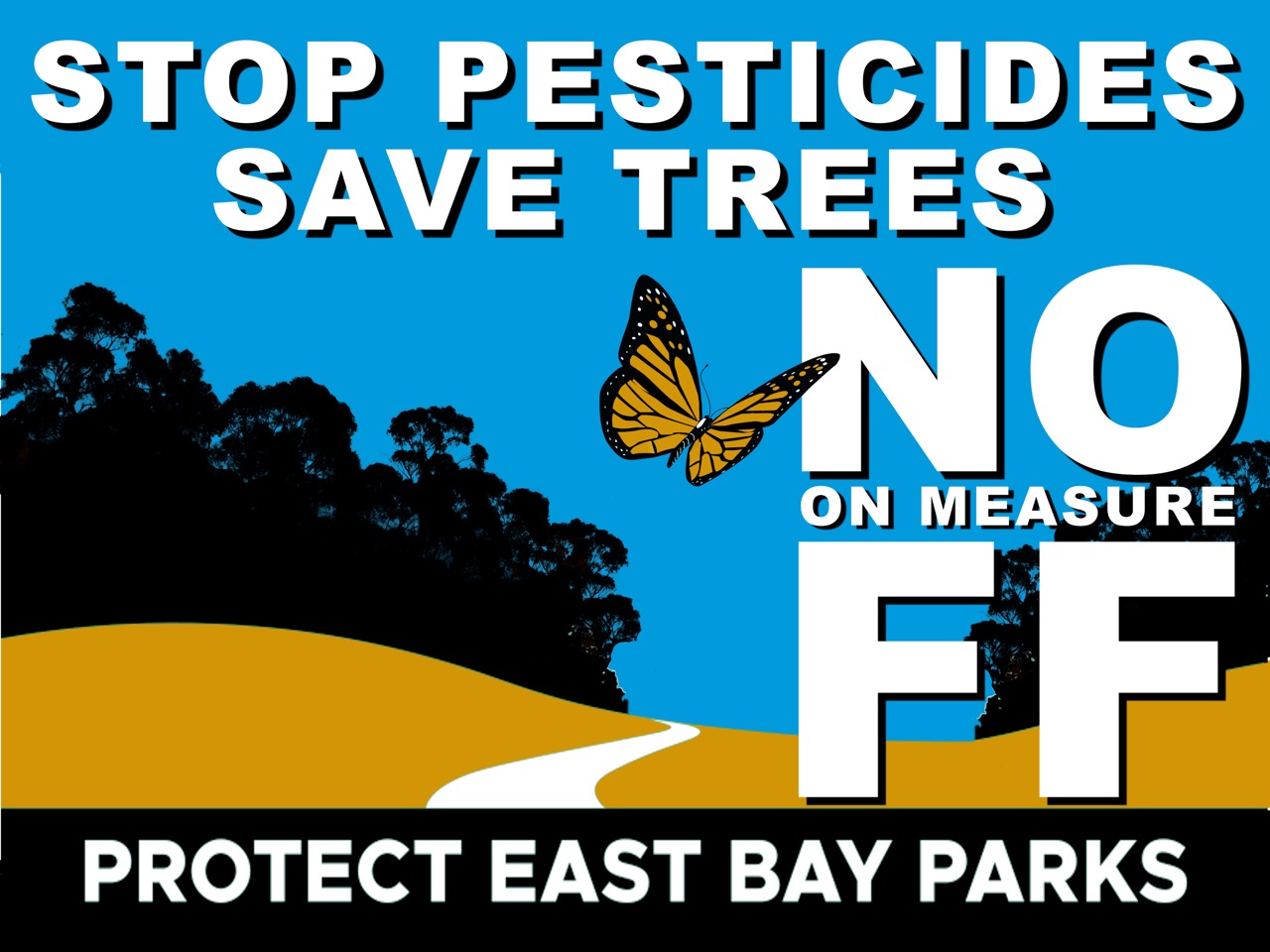
This is the big, beautiful yard sign that you can put in your yard and neighborhood road medians in the East Bay.

Peter Scott and the Green Party have delivered this message and you have the opportunity to add your voice by placing a yard sign in your own yard and in the road medians in your neighborhood in the East Bay.  The Forest Action Brigade is offering yard signs at no cost to you.  Request your yard sign by contacting the Forest Action Brigade:  forestactionbrigade@gmail.com or call (510) 612-8566.

Vote NO on Measure FF!!

A vote against Measure FF on the ballot for the November 6, 2018 election is a vote against pesticide use in the East Bay.  If Measure FF passes, it will renew a parcel tax for 20 years.  For the past 15 years, the parcel tax has funded the destruction of thousands of trees on thousands of acres of public parks in the East Bay.  The renewal of the parcel tax will increase the percentage of available funds for tree removals and associated pesticide use from 30% to 40% of funds raised by the parcel tax.

Post-election update:  Measure FF passed easily.  In Alameda County 85% of voters approved Measure FF.  In Contra Costa County 80% of voters approved Measure FF.  These were the vote tallies on the day after the election, on November 7th.  

Tree removals increase pesticide use because herbicides are required to prevent the trees from resprouting.  Also, when the shade of trees is eliminated, the unshaded ground is soon colonized by weeds that are then sprayed with herbicide.  The destruction of trees has put public land managers on the pesticide treadmill.

The public tried hard to convince the East Bay Regional Park District to stop destroying healthy trees and quit using pesticides in our parks.  We attended public hearings and wrote letters to Park District leadership and its governing board.  We made many suggestions for useful park improvements that would be constructive, rather than destructive.  Our requests and suggestions were ignored.

After making every effort to avoid opposition to Measure FF, we reluctantly take a stand against it.  The parks are important to us and we would much prefer to support park improvements.  Unfortunately, Measure FF will not improve the parks.  Rather, it will continue down the destructive path the Park District has been on for the past 15 years. In fact, Measure FF would escalate the destruction and poisoning of our public lands.

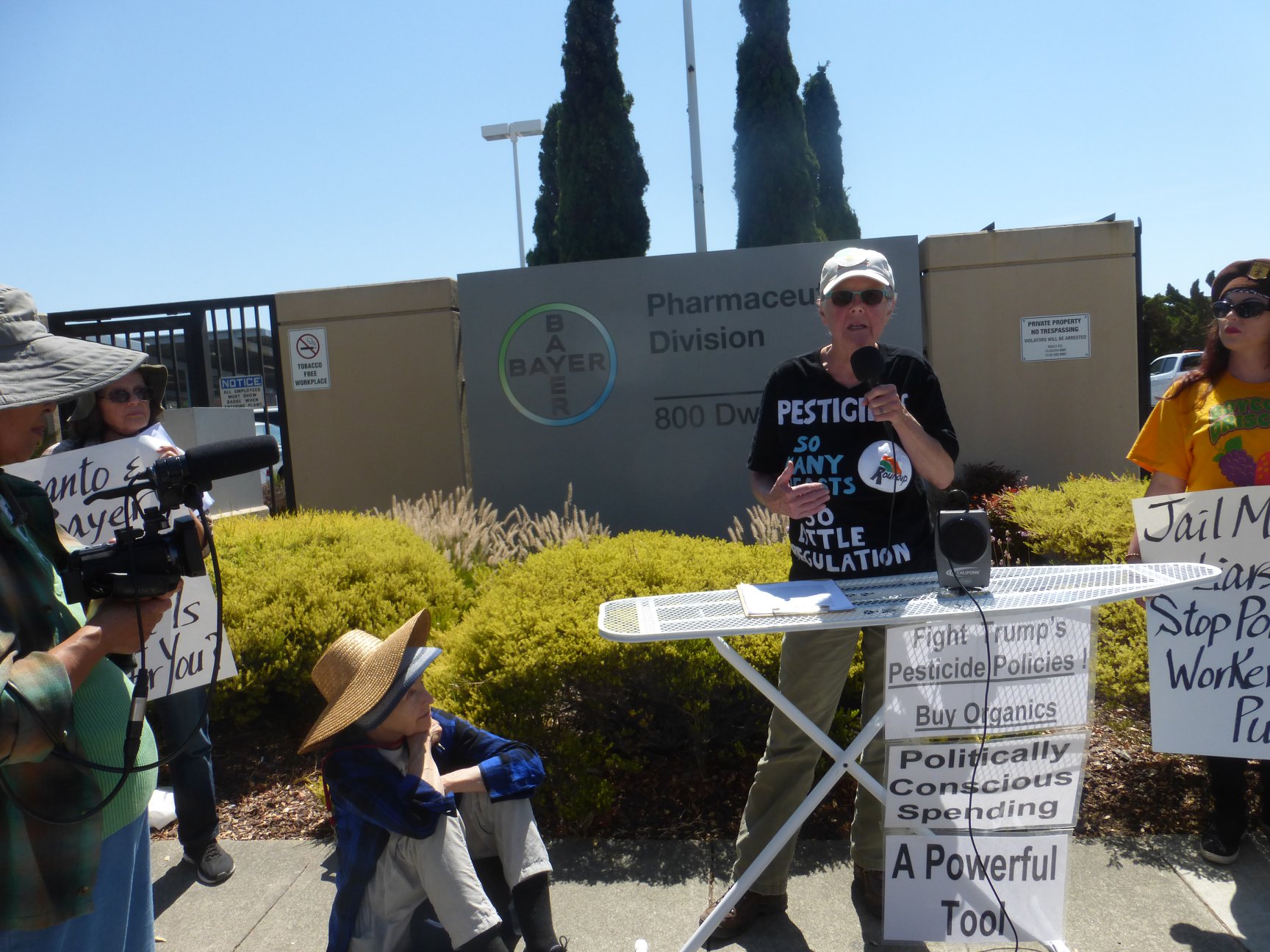
On Friday, August 31st, the Forest Action Brigade participated in a press conference rally at Bayer headquarters in Berkeley. Bayer is the new owner of Monsanto, the manufacturer of glyphosate. The rally was sponsored by a labor organization that is concerned about exposing workers to glyphosate, which is probably a carcinogen.  The President of the Forest Action Brigade, Marg Hall, spoke at the rally.

The Voter Information Guides in Contra Costa and Alameda counties have published the following argument against Measure FF that was submitted by the Forest Action Brigade.  We hope you will read it and take this important opportunity to protect our public parks from being needlessly damaged.

Million Trees

Argument Against Measure FF

“We love public parks, and we support taxation which benefits the common good. Nevertheless, We urge a NO vote. East Bay Regional Parks District (EBRPD) has previously used this measure to destroy, unnecessarily, thousands of healthy trees under pretexts such as “hazardous tree” designations and “protection against wildfires”. But fire experts point out that tree shade retains moisture, thereby reducing fire danger. The measure has also funded so-called “restoration”—destruction of “non-native” plants, in a futile attempt to transform the landscape back to some idealized previous “native” era.

EBRPD’s restoration and tree-cutting projects often utilize pesticides, including glyphosate (Roundup), triclopyr, and imazapyr. We agree with the groundswell of public sentiment opposing the spending of tax dollars on pesticides applied to public lands. Not only do pesticides destroy the soil microbiome; they also migrate into air, water arid soil, severely harming plants, animals, and humans. Because EPA pesticide regulation, especially under the current administration, is inadequate, it is imperative that local jurisdictions exercise greater oversight. While EBRPD utilizes “Integrated Pest Management” which limits pesticide use, we strongly advocate a no pesticide policy, with a concomitant commitment of resources.

Given the terrifying pace of climate change, it is indefensible to target certain species of trees for eradication. All trees—not just “natives” —are the planet’s “lungs,” breathing in carbon dioxide and breathing out oxygen. When a tree is destroyed, its air-cleansing function is forever eliminated, and its stored carbon is released into the atmosphere, thus worsening climate change.

Throughout history, plants, animals, and humans have migrated when their given habitats became unlivable. Adaptation to new environments is at the heart of evolutionary resilience. To claim that some species “belong here” and others do not strikes us as unscientific xenophobia.

Until EBRPD modifies its approach, we urge a NO vote.”

Forest Action Brigade

Do not be misled

The arguments in favor of Measure FF are misleading.  East Bay Regional Parks District attempts to portray a destructive agenda as a constructive agenda.  Please look beneath these pretty-sounding euphemisms for the destructive projects of Measure FF:

·       EBRPD claims Measure FF will “protect against wildfires.”  Destroying harmless trees miles away from any residential structures and replacing the shaded, moist forest with dry grassland that easily ignites will NOT “protect against wildfires.”

·       EBRPD claims Measure FF will “enhance public safety” and “preserve water quality.”  Spraying thousands of acres of open space in our water shed with pesticides will endanger the public and contaminate our water supply.

·       EBRPD claims Measure FF will “protect redwoods and parklands in a changing climate.”  Destroying hundreds of thousands of healthy trees, storing millions of tons of carbon, will exacerbate climate change.  Our redwood forest in the East Bay was confined to less than 5 square miles prior to settlement because of the restrictive horticultural requirements of this treasured native tree.  Because redwoods require more water than most of our urban forest, it is a fantasy that they can be expanded beyond their native footprint.  Where they have been planted outside of that range, many are already dead.

·       EBRPD claims Measure FF will “restore natural areas.”  Our pre-settlement landscape in the East Bay was predominantly grassland in which fire hazards are greatest.  A landscape that has been sprayed with pesticide cannot be accurately described as “natural.”  Previous attempts to convert non-native annual grassland to native grassland have consistently failed, partly because the soil has been poisoned with herbicide.

You can help

The Forest Action Brigade is offering yard signs in opposition to Measure FF (shown below).  Request your yard sign by contacting the Forest Action Brigade: forestactionbrigade@gmail.com or call (510) 612-8566.  Please state how many signs you would like and the neighborhood where you plan to place them.  These are the East Bay cities in which Measure FF will be on the ballot:  Oakland, Alameda, Piedmont, Berkeley, Emeryville, Albany, Richmond, San Pablo, El Cerrito.  These cities are the top priority for yard sign placement.

Million Trees

The Truth About Animals…or not?

In The Truth About Animals, Lucy Cooke chose thirteen animal species to explore our changing relationship with animals by telling the story of how our perception of animals has changed in over two thousand years of written history.  Misconceptions about animals have always been a reflection of human culture.  Although scientific methods of studying animals have improved our understanding, we should assume that the “truth” continues to elude us because we cannot altogether escape our tendency to anthropomorphize animals.  We project our own motivations onto animals which often prevents us from accurately observing their behavior outside our own judgmental framework.  We have selected a few examples from Lucy Cooke’s book to illustrate these issues.

Sloth is one of the seven deadly sins

Three-toed sloth in Panama

Human society values hard work, which has prevented us from seeing the sloth as a respectable citizen of the animal world.  In fact, we named the sloth with the intention of insulting it for its lazy life style.  Although the sloth sprawls helplessly on the ground, in the trees, where it lives, it can move from branch to branch with surprising grace and agility, although slowly.  They have fewer muscles than would be needed to move upright on the ground which enables them to hang in the trees while using little energy.  Early explorers to the New World judged the sloth from their perspective as ground dwellers rather than from the sloth’s perspective in the trees.  The sloth’s reputation is not enhanced by being dirty and smelly.

The sloth eats leaves but lacks teeth to chew them.  The leaves are slowly broken down by bacteria in the sloth’s gut and the slowness of digestion is in sync with its slow metabolism and low body temperature.  Sloths have survived for about 64 million years, far longer than the mere 300,000 years of the ancestors of Homo sapiens, proving that they are well adapted to where they live.  The sloth is a survivor, the ultimate test of the success of a species.

Penguins:  Paragons of family values or not?

Emperor penguin family. Creative Commons

People love penguins, primarily because they are cute.  We like their torpedo shaped pint size and the dapper tuxedo they wear.  Neither their shape nor their outerwear were designed to appeal to us.  They are flightless birds that are extremely efficient catchers of fish.  Their wings propel them through the water at speeds of over 30 miles per hour.  Their feet are propellers, steering their quick maneuvers in pursuit of fish.  On land, they are awkward waddlers, which we find endearing.

Their white fronts are less visible to predators in the water when viewed from below with the glare of the light above them.  Their black backs also hide them from being seen in the water from above.

The movie March of the Penguins greatly increased the popularity of penguins partly because it featured a particular species of penguin, the emperor penguin, that is a dedicated father.  The emperor colony trudges deep into the frozen wastes of Antarctica to lay their eggs and hatch their chicks.  When the egg is laid, father penguin puts the egg on top of his feet to keep it off the frozen ice and sits gingerly on it to keep it warm.  Mother penguin promptly leaves because her energy is depleted by producing the egg.  She goes to sea to fish and restore her energy to return 2 months later.  Then they take turns raising the chick and feeding it.

March of the Penguins tried to sweeten the idealized penguin family by claiming that they are monogamous.  In fact, 85% of penguins choose different mates every year.  The time frame for raising the penguin chick is perilously short, allowing no time to hunt for last year’s mate among thousands of lookalikes.

But not all penguin species are scrupulous family members.  Adélie penguins exchange rocks for sex with unattached males.  The rocks are needed to elevate nests above frigid water that can drown eggs and chicks.  And the rocks are at a premium where the penguins nest, so mother penguin makes a deal for the safety of her nest.

Adélie penguins engage in other scandalous sexual behavior that was observed by a scientific expedition in 1911-12:  “They were ‘gangs of hooligan cocks’ whose ‘passions seem to have passed beyond their control’ and whose ‘constant acts of depravity’ run the gamut of masturbation, recreational sex and homosexual behavior to gang rape, necrophilia, and pedophilia.  Chicks were ‘sexually misused by these hooligans,’ including one who ‘misused it before the very eyes of its parent.’  Stray chicks were crushed and ‘very often suffer indignity and death at the hands of these hooligan cocks.’” (1) When the scientific expedition published its report of their findings, these dirty bits were deleted from the publication and kept under lock and key in the museum until being discovered in 2009.

If animal behavior was unseemly in the eyes of early scientists, the public didn’t need to know about it.  I think we can safely assume that there is less such censorship by scientists today, partly because there is greater tolerance for the vast range of sexual behavior among humans.

The mystery of migration


Nesting stork in Morocco, 2013

Ms. Cooke chooses the stork to tell the long story of unraveling the mysteries of migration.  The stork arrives in Europe in early spring which historically coincided with the annual baby boom.  Nine months earlier, on June 21st summer solstice was celebrated with great festivals during which many children were conceived.  This coincidental arrival of storks and babies resulted in the stork becoming a symbol of fertility and childbirth.  A young couple consulting a doctor about their disappointment in not having a child were surprised when told that the stork nesting on their chimney was not a substitute for the sexual encounter they had thought was unnecessary.

Theories about where the storks went when they left their huge nests of sticks were no less imaginative.  In the 17th century an Oxford-educated physics scholar proposed the theory that the storks migrated to the moon:  “’The stork, when it hath bred, and the young fully fledged…all rise together, and fly in one great flock…first near the earth, but after higher…till at last this great cloud…appears less and less by distance, till it utterly disappears.  Now, Whither should be creatures go unless it were to the moon?’”  (1)

This theory was considered an advance over earlier theories.  In the 3rd Century BC, Aristotle had several theories about bird migrations.  His “transmutation” theory suggested that winter robins become redstarts in summer and summer warblers become blackcaps in winter.  His alternative theory was that some birds hibernate in winter.  Actually, the poorwill is the only known hibernating bird. In western North American deserts the poorwill hides in a torpor, avoiding winter food shortages.

Aristotle is the originator of another, particularly persistent hibernation theory.  His belief that swallows spent the winter months at the bottom of lakes and rivers, like fish, is found in “scientific” publications into the 19th century:  “’It appears certain that swallows become torpid during the winter, and even that they pass the season at the bottom of the water in the marshes.’”  (1)

That theory was tested in the 18th century in a series of grisly experiments that cost the lives of many hapless swallows, reminding us that animal rights are a very recent development in science.  On the other hand, we should empathize with early scientists who had little knowledge of the world outside their narrow range of mobility, given limited transportation.  As our world expands so does our knowledge of it.

Pfeilstorch (Arrow Stork)

Ms. Cooke believes the breakthrough in solving the migration mystery occurred in the 19th century when a stork arrived for nesting season with a huge wooden spear lodged in its neck, providing “irrefutable evidence that birds migrate over Africa.”  Ironically, as our knowledge of migration improves, the migration itself is rapidly failing because of anthropogenic (caused by humans) change.

  • Hunting of birds increases as the human population increases and episodically during famines caused by war and crop failures.
  • When farmers in Africa started using pesticides, many storks were killed when they ate poisoned grasshoppers and other large insects.
  • Pollution and drainage of wetlands for farmland caused a sharp decline in Europe’s stork population in the 20th Century:  “The last breeding pair was seen in Belgium in 1895, in Switzerland in 1950 and in Sweden in 1955.” (1)
  • Some migrating birds have quit migrating because the gardened landscapes of humans are more hospitable year around than their winter homes. Flocks of Canada geese are seen year around in the parks and open spaces in the Bay Area.
Canada geese, Lake Merritt, Oakland, California. Oakland Wiki

Ms. Cooke laments:  “[Swallow] numbers along with those of dozens of long-haul bird migrants across Europe, Asia and America, are in perilous decline, thanks to the combined effect of global warming, habitat destruction, hunting and pesticides.  Some scientists have suggested that long-haul migration could soon become a thing of the past.  These amazing avian vanishing acts, which puzzled us for so many generations, could themselves magically disappear, just as they’ve finally been demystified.  (1)

Progress, but humility is still needed

Ms. Cooke concludes that although we know more about animals than we did two thousand years ago, we are undoubtedly still making mistakes and must continually refine our understanding“The quest for truth is a long and winding road, littered with deep potholes.  Thankfully our methods are less brutal than those of our eye-popping past, but we are still stumbling along in the dark and making mistakes.  With the rise of efforts to discredit science, there has never been a greater need for truth.  Yet, wrong turns are an essential part of all scientific progress, which demands blue-sky thinking as it seeks out each new horizon in understanding.  As long as our egos or dogmatic beliefs are not to blame, we should not be afraid to continue to make wondrous mistakes…” (1)

Science is a process that is never done.  We celebrate new discoveries, but we must never think of them as the end of the story.  Our minds must always be open to new information if we are to continue to make progress as humans.


  1. Lucy Cooke, The Truth About Animals: Stoned sloths, lovelorn hippos, and other tales from the wild side of wildlife, Basic Books, 2018

Adapting to more wildfire in western North American forests as the climate changes

The National Academy of Sciences (NAS) has published its recommendations for a new approach to managing forests in the American West to adapt to the increasing frequency and intensity of wildfires in the changing climate.  The authors of the NAS publication regarding adaptive forest management in the changing climate are 12 academic scientists from major public universities in 8 western states. (1)

Although the National Academy of Sciences was created by an Act of Congress in 1863, during the Lincoln administration, it is a non-governmental non-profit that receives no direct government funding.  Its charge is “providing independent, objective advice to the nation on matters related to science and technology. … to provide scientific advice to the government ‘whenever called upon’ by any government department.” Members of the Academy serve without salary as “advisers to the nation.” Election to the National Academies is one of the highest honors in the scientific field. The independence of NAS is ensured by lack of governmental funding and salaries to its members.  However, 85% of NAS funding is government grants and contracts. (2)

In other words, this publication is an important policy document, prepared by distinguished scientists and published by America’s most prestigious scientific institution.  It deserves our attention and respect.

Why is a new forest management approach needed?

In the past, forest management policies have focused primarily on preventing fire, reducing fuel loads, and restoring burned areas.  Given the increasing intensity and frequency of wildfires, there is a new understanding that these approaches are no longer adequate to address new conditions created by the changed and changing climate.  The new approach recognizes that fuels reduction cannot alter regional wildfire trends and therefore must adapt ecosystems and residential communities to more frequent fires, including “planning residential development to withstand inevitable wildfire.”  This represents a shift from restoring historical conditions, now considered unsustainable, to developing fire-adapted communities.

The authors of this publication tell us that managing forest fuels has been ineffective:  “Mechanical fuels treatments on the US federal lands over the last 15 years totaled almost 7 million hectares, but the annual area burned has continued to set records.  Regionally, the area treated has little relationship to trends in the area burned, which is influenced primarily by patterns of drought and warming.”  Where fuels treatment was done, wildfires subsequently occurred:  “10% of the total number of US Forest Service forest fuels treatments completed in the 2004-2013 period in the western United States subsequently burned in the 2005-2014 period.”  This suggests that “most treatments have little influence on wildfire.” In any case, only 40% of wildfires occurred in forests since 1984, with most fires burning grasslands and shrublands.  Clearly, these projects have been a waste of time, trees, and taxpayer money.

This area on the west side of Grizzly Peak Blvd is known as Frowning Ridge. It is one of the first areas that was clear-cut by UC Berkeley over 10 years ago. Destroying the trees did not prevent the grass and shrubs from igniting in the August 2017 fire. Pictures of that area before and after the trees were destroyed are available here: https://milliontrees.me/2013/06/08/guest-article-about-fema-projects-by-a-student-of-the-forest/  The fire in August 2017 was stopped when it reached the forest on the opposite side of the road.

Nor do the authors consider “thinning” of forests a viable method of reducing fire hazards because “when thinning is combined with the expected warming, unintended consequences may ensue, whereby regeneration is compromised and forested areas convert to non-forest.”  When trees are thinned, the trees that remain are more vulnerable to wind and they lose the ability to share resources with the neighboring trees that have been removed.

Tilden Park, October 2016. East Bay Regional Park District has radically thinned this area to distances of 25 feet between remaining trees. This area is about 2 miles away from any residential structures. Cal Fire defines “defensible space” as 100 feet around structures.

There are two major reasons for increased wildfire hazards.  More than 50% of the increase in areas burned by wildfire in the American West is attributed to climate change.  The expansion of residential development into forested areas—called the Wildland-Urban-Interface (WUI)—is the second factor:  “Between 1990 and 2010, almost 2 million homes were added in the 11 states of the western United States, increasing the WUI by 24%.”  35% of wildfires in the WUI since 2000 were in California, more than any other state.

What is the new management goal?

Whereas past policies were designed to maintain forest conditions to historical conditions, this is no longer considered a realistic goal.  The recommended goal is now “supporting species compositions and fuel structure that are better adapted to a warming, drying climate with more wildfire.”  Sounds like planting tree species that are adapted to new climate conditions, doesn’t it?

The other, equally important new goal is to reduce the vulnerability of communities to wildfire by “changing building codes to make structures more fire-resistant…and providing incentives, education, and resources to reduce vulnerability to future wildfire.”  The only tree removals that make sense to the authors are those immediately around residential communities, “strategically located to protect homes and the surrounding vegetation.”  That is the principle of creating “defensible space” immediately around structures:  “fuels management for home and community protection will be most effective closest to homes…where ignition probabilities are likely to be high.”

Source: Cal Fire

These strategies are called “transformative resilience,” which “refers to planned fundamental change in response to drastically altered disturbances that have the potential to create broad-scale, systemic shifts in ecological states or radical shifts in values, beliefs, social behavior, and multilevel governance.”  The authors of these policy recommendations acknowledge that such rapid and radical shifts in social and ecological transformation are rare and difficult to achieve.  We certainly agree with that observation.

The urgently needed paradigm shift

Public policy and conventional wisdom is wedded to the past.  The public is unable or unwilling to acknowledge the realities of climate change.  They remain committed to “restoring” the landscape to an imagined pre-settlement ideal in the distant past.  And public land managers remain committed to creating that fantasy landscape, by destroying existing landscapes and using herbicides to do so.  They destroy the trees of the future and plant the trees of the past.  And they destroy trees miles from any residential properties while property owners resist the creation of defensible space needed to protect their homes.

The authors of the NAS publication clearly state the risks of continuing down that path:  “[Such policies] may be the easiest, most familiar path with the least uncertainty, but this approach is short-sighted and could come at the cost of adaptation to future wildfire as climate change continues.”

They also urge the public to wake up to this new reality:  “Some ecosystems will survive and thrive as they adapt to novel future conditions, but not all.  Embracing rather than resisting ecological change will require a significant paradigm shift by individuals, communities, and institutions and will challenge our conservation philosophies.”

Our safety and the future of our land are at stake.  We must take our heads out of the sand and look forward instead of back to a past that is long gone and will not return.  Since climate change is causing more wildfires, destroying more trees than necessary to achieve fire safety is counterproductive because deforestation is the source of about 10% of carbon emissions contributing to climate change.


(1) Tania Schoennagel, et. al., “Adapt to more wildfire in western North American forests as climate changes,” Proceedings of National Academy of Sciences, May 2017

(2) Wikipedia https://en.wikipedia.org/wiki/National_Academy_of_Sciences

Another innocent introduced plant with a bad rap

Professor Mark Davis, known as “a friend to aliens,” is one of a growing number of academic scientists who are critical of invasion biology.  His research has exonerated some of the introduced plants that are accused of harming native plants. Garlic mustard is an example.  Professor Davis has briefly summarized his research of garlic mustard for publication on Million Trees.

The Nature Conservancy says, “…garlic mustard [is] one of the ten most destructive invasive species in Indiana today… It…displaces native or other desired plants in a relatively short period of time.” Although the Nature Conservancy description of the lifecycle of garlic mustard is identical to Professor Davis’s description, it reaches the opposite conclusion about its effect on native plants.  The Nature Conservancy describes laborious methods of eradication and concludes that herbicides and prescribed burns may be necessary. 

It is precisely that accusation that non-native plants “displace” native plants that is at the heart of the debate about so-called “invasive species.”  Nativists do not believe that native and non-native plants can co-exist.  In fact, when empirical studies test that hypothesis, they rarely find evidence of such displacement.  The fact is, the environmental conditions that support native plants also support non-native plants and the result is usually more biodiversity, rather than less. 

The first sighting of the garlic mustard herb in the U.S.A. was in 1868 in Long Island, New York. Garlic mustard was intentionally introduced into the northeastern United States for food, erosion control, and medicine. Pretty isn’t it? It’s tasty as well.

If native plants are not doing well, compared to non-natives, it is usually for other reasons, such as changes in the climate or available water or the arrival of a new insect or pathogen.  It is rarely because of the arrival of new plants.  Killing non-native plants with herbicide is simultaneously killing native plants and damaging the soil they live in.

There is room for everyone in the human world and in the natural world.  Nativism in the human realm is as unnecessary as it is in the natural world.  Fear and anger about human immigrants to America is strongest in places with few immigrants.  I am fortunate to live in a place with many immigrants.  I can see first-hand how they enrich my community.  I also see first-hand how introduced plants are not doing any harm, but the futile efforts to kill them with herbicides IS doing a great deal of harm to every living thing in the environment.

Million Trees


Garlic mustard, Alliaria petiolata (Brassicaceae), is a European biennial plant (completing its life cycle over 2 years) now common in many Midwestern and eastern North American forests. It is self-pollinating, has abundant seeds that are viable in the soil for long periods of time, and can grow in a variety of forest environments.  These characteristics allow garlic mustard to spread easily. Many consider it to be an invasive species that displaces native herbs and inhibits tree seedling growth and survival.

For the past six years I have worked with colleagues and students to determine to what extent garlic mustard is negatively affecting native herbs and tree seedlings in an oak forest in east-central Minnesota.  Based on our monitoring of garlic mustard and the other plant species, garlic mustard appears to be acting similarly to other species.

Specifically, garlic mustard and the other common native herbs seem to be changing in abundance largely independent of one another. In other words, changes in abundance of one species is unrelated to changes in other.  In six years of study, we have not been able to document any substantial effects by garlic mustard on other plant species, positive or negative.

In fact, the best predictor of garlic mustard presence is high diversity of native plants.  The most likely explanation for this fact is that all the species, garlic mustard included, are simply establishing in microsites favorable to plants in general.  The same conditions that benefit native plant species also probably benefit non-native plant species.

Overall, our findings are not consistent with the common claim that garlic mustard is a noxious invasive species responsible for the decline of many North American native forest herbs. Rather, our findings are more consistent with other recent studies and reviews that have concluded that garlic mustard is primarily responding to ecological changes in North American forests.

In other words, at many sites garlic mustard is not a significant driver of change but rather is a passenger of change.  What might be the drivers of change, the real causes of declines of many native wildflowers?  Evidence points to both earthworms and white-tailed deer.

Earthworms, which have been introduced from Europe and Asia, have drastically reduced the abundance of litter in these forests.  The near absence of litter has been shown to negatively impact many of the native species.  However, eradicating earthworms would be impossible and attempting to do so would cause more damage to the environment.

Due to the abundance of habitat, secondary forests, and lack of predators, white-tailed deer populations have exploded throughout many of the Midwestern and eastern forests.  And, native plants are a common food of the deer.  The deer tend to avoid garlic mustard due to its garlicy oils.

Mark Davis, Macalester College


Professor Davis’s studies of garlic mustard:

Davis MA, Anderson MD, Bock-Brownstein L, Staudenmaier A, Suliteanu M, Wareham A, and Dosch JJ.  2015.  Little evidence of native and non-native species influencing one another’s abundance and distribution in the herb layer of an oak woodland.  Journal of Vegetation Science 26:105-112.  PDF

Davis MA, MacMillen C, LeFevre-Lefy M, Dallavalle C, Kriegel N, Tyndel S, Martinez Y, Anderson MD, and Dosch JJ.  2014. Population and plant community dynamics involving garlic
mustard (Alliaria petiolata) in a Minnesota Oak Woodland: a four year study. Journal of the Torrey Botanical Society 141: 205–216.  PDF

Davis MA, Colehour A, Daney J, Foster E, MacMillen C, Merrill E, O’Neil J, Pearson M, Whitney M, Anderson MD, and Dosch JJ. 2012.  The population dynamics and ecological effects of garlic mustard, Alliaria petiolata, in a Minnesota oak woodland. American Midland Naturalist 168: 364-374.  PDF

TAKING ACTION: The Forest Action Brigade requests correction of the public record regarding lifespan of eucalyptus

The Forest Action Brigade (FAB) has given Million Trees permission to publish their letter to the Park Advisory Committee of the East Bay Regional Park District.  FAB asks that the public record be corrected regarding the lifespan of eucalyptus and related issues.  The Park Advisory Committee was given misinformation regarding the status of eucalyptus trees in the parks by the Acting Fire Chief.  

The Park District does not have a single certified arborist or forester on staff.  The Park District needs such expertise to inform the park staff and to avoid making mistakes, such as destroying healthy trees and planting trees where they will not survive because the horticultural conditions for the trees are not suitable.

When the public was given the opportunity to make suggestions for projects to be included in the renewal of Measure CC parcel tax, hiring a qualified arborist was one of the suggestions that park advocates made.  That suggestion was ignored, as were most of our suggestions.  The Park District is responsive to a narrow constituency, such as the Sierra Club, Audubon Society, and California Native Plant Society.  

Please join us in objecting to the unnecessary destruction of healthy trees in our parks:  Park Advisory Committee c/o sclay@ebparks.org; Board of Directors c/o ybarial@ebparks.org.


June 20, 2018

Park Advisory Committee
East Bay Regional Park District

Dear Members of PAC,

On May 21, 2018, Acting Fire Chief Aileen Theile explained the park district’s strategy regarding eucalyptus removal and its justification for that strategy to the Parks Advisory Committee:

“Tsutsui asked about the life cycle of the eucalyptus plantation. Theile replied they have a lifespan of 50-60 years, and most of the trees were planted about 50-60 years ago. Those planted 50 years ago are failing on a regular basis. Theile continued eucalyptus trees actually do not do well in plantations. They need to compete for sunlight and the trees within the grove are weak. If the outer trees begin to fail, the inner trees are unable to withstand the wind because they have historically been protected by the outer trees. The Park District is trying to remove the fuel ladder, by creating a break between surface fuels and fires that get up into the tree canopy. Tsutsui asked how long is mitigation needed. Theile explained there will probably not be many eucalyptus plantation trees left in the next 50 years.” (Minutes of PAC meeting, 5/21/18)

We are writing to correct several misstatements of fact in Chief Theile’s testimony to the Park Advisory Committee:

Theile:  “[eucalyptus] have a lifespan of 50-60 years…”

That statement is not accurate.  It is an extreme underestimate of the lifespan of eucalyptus.

Blue gum eucalyptus and all other species of eucalyptus are native to Australia.  They were brought to California shortly after the Gold Rush of 1849.  Since they haven’t been in California 200 years, we don’t know how long they will live here.  But how long they live in Australia is obviously relevant to answer that question because longevity is specific to tree species.  We can expect some variation by climate, but not much, and the climate of Australia is similar to the climate in California with wet, mild winters and hot, dry summers.

We know that blue gums live in Australia about 200-400 years because Australian scientists tell us that:

Growth Habits of the Eucalypts by M.R. Jacobs, (Institute of Foresters of Australia, 1955, 1986): Blue Gum eucalyptus lives in Australia from 200-400 years, depending upon the climate.” In milder climates, such as San Francisco, the Blue Gum lives toward the longer end of this range.

That reference was corroborated by John Helms, Professor Emeritus of Forestry at UC Berkeley and an Australian who said in response to our question about blue gums in California, “Blue gums would commonly live for 200 – 400 years, although I presume that some might live longer.”

We also asked the Australian National Botanic Gardens.  They said, “It’s possible that the average lifespan of a native species growing in the wild in Australia would differ to the average lifespan of the same species introduced in northern California, since introduced plants can often “escape” their natural predators when such introductions occur.”

In other words, since eucalyptus trees have more predators in Australia than they do in California, we should expect them to live longer here.  This is called the “predator release” hypothesis.  Ironically, that hypothesis is used by nativists to support their claim that eucalyptus is invasive in California. It’s only logical to apply that hypothesis to the question of how long blue gums will live in California.

However, using actual experience in Australia to predict the future of blue gums in California requires some speculation.  Therefore, we turn to the question of how long they have lived in California for guidance.  There are countless examples of eucalyptus in California over 150 years old that are still very much alive and well.  Here are a few local examples:

  • Eucalyptus, Mills College, Oakland 2015

    The Grinnell Eucalyptus Grove on the UC Berkeley campus was planted in 1877. Most of that grove is still alive and well.  https://www.berkeley.edu/news/multimedia/2004/01/trees.html

  • Eucalyptus was planted as a windbreak at Mills College shortly after it relocated to Oakland in 1871.  Those trees are very much alive.
  • Mountain View Cemetery in Oakland, California was designed by Frederick Law Olmsted in the 1860s.  Like most of the East Bay, the site was treeless. Olmsted’s design was an eclectic collection of mostly non-native trees, including blue gums.  The cemetery is on steep, windward facing hills, where the windbreak provided by blue gums is particularly valued.
  • There are equally old blue gum eucalyptus on the Stanford Campus and many other places on the San Francisco peninsula. 2.2 miles of El Camino Real planted with blue gum eucalyptus in the 1870s were put on the National Register of Historic Places in 2012.

Cal Poly maintains a website that evaluates trees in California, called SelecTree.  SelecTree states that the lifespan of blue gum eucalyptus is “greater than 150 years.”  That estimate is the longest category for longevity on the SelecTree website. (https://selectree.calpoly.edu/)  It is the same estimated lifespan for Coast Live Oak and many other trees, according to SelecTree.

Theile:  “…most of the [eucalyptus] trees were planted about 50-60 years ago.”

That is also an inaccurate statement.  The Park District’s “Wildfire Hazard Reduction and Resource Management Plan” (2009) states, “In the early 1900s, plantations of eucalyptus and pine were planted for hardwood production and to forest the primarily grass-covered hills in preparation for coming real estate development.”  (page 5)

The first master plan for the Park District was published in 1930:  “Proposed Park Reservation for East Bay Cities.”  That publication contains photos of eucalyptus at Lake Chabot, Skyline Ridge and Wildcat Canyon.  https://www.ebparks.org/civicax/filebank/blobdload.aspx?BlobID=23514

Theile:  “Those planted 50 years ago are failing on a regular basis.”

Sibley Volcanic Reserve. Photo by Larry Danos, March 2018

If that statement is accurate, we have no evidence of its accuracy.  In the past 9 months, eucalyptus trees have been destroyed throughout the Park District.  When visitors inquire, they are told the trees were hazardous.  In some cases, the areas were supposed to be thinned in accordance with the Park District’s “Wildfire…Plan.”  At Sibley Volcanic Reserve, for example, large areas of over an acre were clear cut in March 2018 where the plan was to thin.  We know the trees weren’t dead because the stumps of the trees were sprayed with herbicide, as indicated by blue dye.  If the trees were in fact dead, it would not have been necessary to spray the stumps with herbicide to prevent their resprouting.  We asked for an arborist’s evaluation of the condition of the trees before they were destroyed.  We received no response to our request for this information.  In other words, claims that eucalyptus trees are dead or dying are unsubstantiated.  Available evidence suggests that healthy trees are being needlessly destroyed.

Tree failures are most likely to occur where the Park District has thinned the trees.  The trees that remain are subjected to more wind.  The herbicide that is used to prevent the destroyed trees from resprouting is mobile in the soil and it damages the soil by killing beneficial microbes and the mycorrhizal fungi that are essential to tree health.  The roots of the trees are intertwined, enabling the herbicide to damage the roots of the trees that remain.  If, indeed, there are tree failures, they are undoubtedly being caused by the Park District’s tree removals and associated herbicide use.

Theile:  “…eucalyptus trees actually do not do well in plantations.”

This is an inaccurate statement.  In fact, densely planted trees protect one another from the wind and they share available resources.  Peter Wohlleben in The Hidden Life of Trees explains:

“…in nature, trees operate less like individuals and more as communal beings. Working together in networks and sharing resources, they increase their resistance…This is because a tree can be only as strong as the forest that surrounds it…Their well-being depends on their community, and when the supposedly feeble trees disappear, the others lose as well.  When that happens, the forest is no longer a single closed unit.  Hot sun and swirling winds can now penetrate to the forest floor and disrupts the moist, cool climate.”

“Theile explained there will probably not be many eucalyptus plantation trees left in the next 50 years.”

That is apparently an expression of the Park District’s willful intentions.  The eucalyptus trees will be gone in 50 years because the Park District apparently intends to destroy them all, not because they are dead or dying.  Rather because that’s what the Park District wants to do.

For the record, we state our purpose:

Monachs in eucalyptus, Pacific Grove Museum

We are opposed to the unnecessary destruction of healthy trees, because it serves no useful purpose.  Trees deep inside our parks pose no fire hazard to residential areas.  They are storing thousands of tons of carbon that will contribute to climate change when released into the atmosphere.  Wildfires are becoming more intense and frequent because of climate change.  Therefore destroying hundreds of thousands of trees causes wildfires rather than mitigating them.  The trees perform many other useful functions.  They provide food and habitat for birds, bees, and butterflies.  They reduce air pollution.  They provide shade and protection from wind, making visitors to the parks more comfortable.  The herbicide use associated with tree destruction damages the environment and is an unnecessary health hazard to wildlife and the public.

[redacted]

Please add this letter to the record of the Park Advisory Committee meeting of May 21, 2018.

Thank you.

Forest Action Brigade

CC: EBRPD Board of Directors; Aileen Theile