Are non-native plants “ecological traps” for birds? — Part II

We previewed this post last week in our response to Doug Tallamy’s belief that some bird species require caterpillars for their survival.  We are continuing our critique of a claim that non-native plants are “ecological traps” for birds.

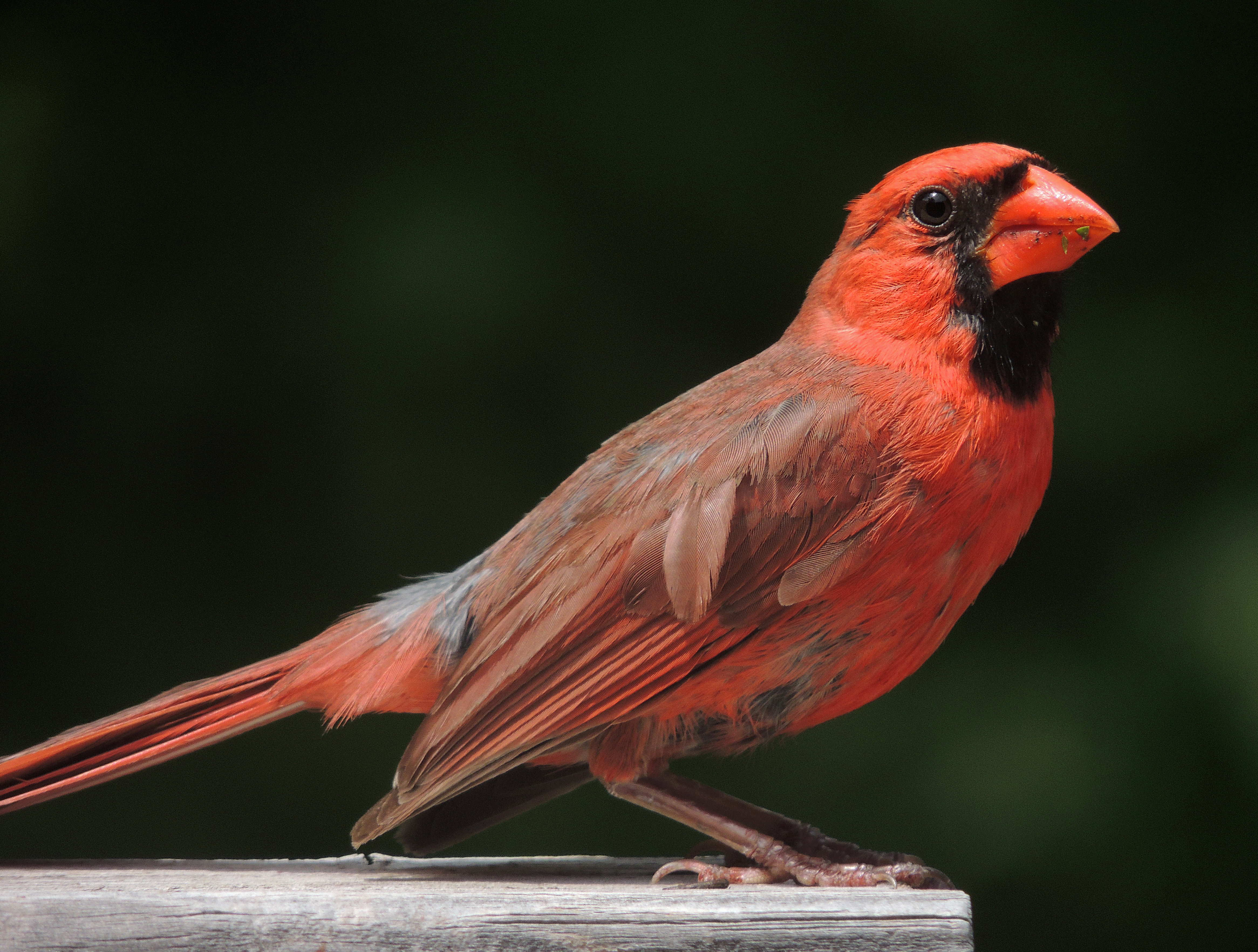
Northern Cardinal, Male.  Creative Commons - Share Alike
Northern Cardinal, Male. Creative Commons – Share Alike

In “Nonnative plants:   Ecological Traps,” Amanda Rodewald is quoted as saying that non-native honeysuckle significantly reduces the nesting success of cardinals by increasing nest predation:

Typically in the wild, male cardinals that are in the best condition grab the best territories and nesting spots and breed earliest in the year. They also successfully rear more young than their less-fit competitors—an example of natural selection at work. But this pattern changes when honeysuckle invades a forest. Because honeysuckle leafs out sooner in spring than most plants, the fittest cardinals rush to mate and nest in the shrubs’ dense foliage. But instead of a gain in reproductive success, these birds pay a price. The early nesters in honeysuckle rear 20 percent fewer young than those that nest in native plants.”  (1) (emphasis added)

She speculates that the probable reason for this reduced success is nest predation which she believes is greater earlier in nesting season because there are fewer nests.

We don’t know if Ms. Rodewald was accurately quoted in her interview or if she has changed her mind.  However, Ms. Rodewald has published a study which says exactly the opposite:

“…these results provide no evidence that urban forests were acting like ecological traps for cardinals.  Instead, cardinals in urban and rural forests had similar numbers of nesting attempts, young fledged over the breeding season, and apparent annual survival rates.  Thus, these findings do not support the idea that urban forests in Central Ohio represent ecological traps for synanthropic understory birds” [birds that live in artificial habitats created by humans].  (2)

Urban forest sites in her study contained far more exotic vegetation than rural forest study sites:  “Understory woody vegetation was over 50% more dense, with nearly 3 times greater numbers of exotic shrub stems than rural forests.”  Exotic vegetation in this study was described as predominantly honeysuckle and multiflora rose.  There was no statistical relationship between the number of nesting attempts and the composition of the landscape:  “There were no significant differences in either the number of nesting attempts among years or between [urban and rural] landscapes.” (2)

This study offers several possible explanations for the reproductive success of cardinals in urban forests dominated by exotic shrubs:

  • “…urban forests in this study contained denser understory vegetation than rural forests.” 
  • Therefore, there is “…increased cover provided by exotic shrubs in the urban forest.”
  • “…winter microclimates may be particularly important for resident birds…cities may be favorable thermal climates for birds because cities may act as ‘heat islands.’”
  • Urban sites…probably provided more food sources for wintering birds.  Urban forests had nearly 3 times more fruit and nearby birdfeeders than rural forests.  Cardinals… were regularly seen feeding on fruits of exotic shrubs (e.g., honeysuckle, multiflora rose).  Previous studies have indicated that supplemental food sources…can improve overwinter survival rates, body mass, and nutritional condition…Such changes in winter food and microclimate may explain increases in species richness and abundance of birds wintering in urbanizing landscapes around Columbus. Ohio.”

In her published study, Ms. Rodewald also contradicts her statement that greater nest predation in honeysuckle is the cause of reduced reproductive success of cardinals.  In her published study, she says, “…high rates of nest predation frequently documented in urban landscapes do not necessarily translate to reduced productivity or survival.”

Ms. Rodewald’s statement that early nesting in honeysuckle is more likely to result in predation is also contradicted by another study.  (3) Although this study was conducted in Ithaca, New York, the study site was also dominated by honeysuckle.  This study found that the most fit cardinal males bred earliest in the nesting season and their nesting success for the entire nesting season was therefore greater than pairs starting later in the season:  “These results confirm that an earlier breeding date is associated with producing more offspring in a season regardless of any possible effect vegetation density may have on nest initiation date.” (3)

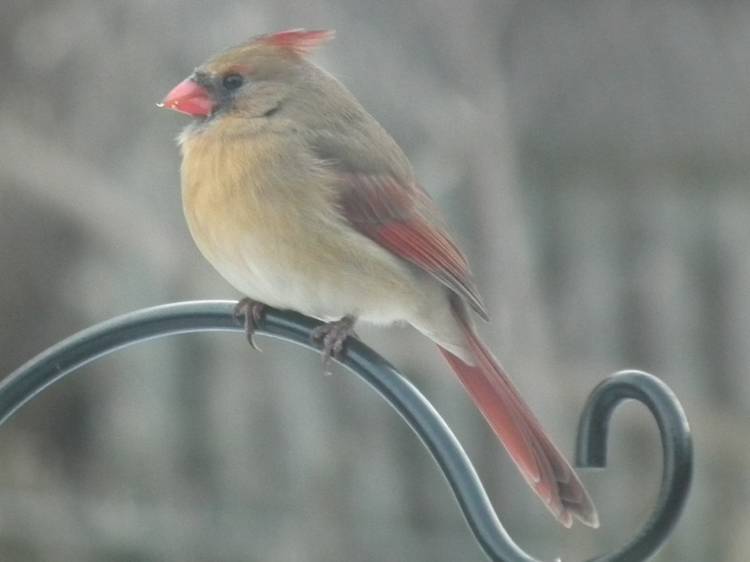
Northern Cardinal, Female.  Creative Commons - Share Alike
Northern Cardinal, Female. Creative Commons – Share Alike

Ms. Rodewald’s published study is consistent with a similar study:  “Predation on Northern Cardinal nests:  Does choice of nest site matter?”  This study was also conducted in Ohio in a mixed landscape of both native and non-native shrubs.  Non-native shrubs were predominantly honeysuckle and multiflora rose, as they were in Ms. Rodewald’s study.  This study was trying to find a relationship between predation and the location of nests.  Many hypotheses were tested relative to these variables:  height of nest, concealment of nest, accessibility of nest, common vs. rare shrub location, proximity to habitat edge, distance to human activity.  It found no such relationship:  “Several hypotheses to explain differences between the location of the successful and failed nests were tested.  None of these explained why the contents of particular nests were taken.”  (4)

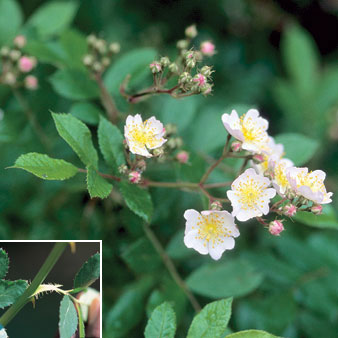
Multiflora rose.  NPS
Multiflora rose. NPS
Although cardinals had the choice of nesting in native or non-native shrubs in this 80 hectare bird sanctuary (Aullwood  Audubon Center and Farm), 65% of the 121 nests in this study were in non-native honeysuckle or multiflora rose.  The study tested for an association between plant species and probability of nest success by dividing all nests into two categories, one for the two dominant species of non-native plants and the other for all other plant species:  “The probability of success was not associated with [plant] species category.”  (4)

Only 25% of the 121 nests were successful.  Although that sounds like a low success rate, it is consistent with other sources of information about reproductive success of cardinals:  “Northern Cardinals have a very low nesting success rate with only 15–37% of their nests succeeding in fledging young.” (5)

This publication (4) had a very interesting theory about why nest location is unrelated to nesting success.  The cardinal is unusual in having a very long nesting season from April to late-September.  They have as many as 6 broods.  When a nest fails, they start building a new nest in another location within 5-7 days.  The female chooses the nest.  Essentially, she is rolling the dice.  She makes a nearly random choice of nest site and her long-term odds of nest success is primarily because she rolls the dice many more times than other species of birds:  “We propose that a high incidence of predation by a rich guild of nest predators precludes the existence of predictably safe nests for cardinals.  Instead, the cardinals appear simply to be well-adapted to renest rapidly in response to the near randomness of nest predation.”  There are trade-offs for every potential nest location.  For example, a low nest is more accessible to ground-dwelling predators such as snakes or rodents while a nest high in a tree is more accessible to nest parasites such as cowbirds.  So, the cardinal mom takes her chances by making different choices and her eventual success is largely a question of luck.

Looking for “ecological traps”

We have been unable to find evidence that non-native plants are “ecological traps” for birds.  When we find such claims, we turn to scientific literature for evidence.  We find many studies begin with hypotheses which predict ecological harm done by non-native plants.  But we have yet to find empirical studies that reach that conclusion.   

The article we have critiqued in this post is a case-in-point.  It starts with the report that the population of cardinals has exploded where honeysuckle has invaded.  Despite that fact, the article concludes that the cardinal population is somehow harmed by honeysuckle.  One wonders how the authors of that article reconcile this contradiction.  Doesn’t the increased population speak for itself?

In any case, in the absence of evidence of harm, we do not believe that the destruction of existing landscapes can be justified, particularly since doing so requires large amounts of herbicide.  Given the probability that the herbicides are harmful to animals, particularly soil microbes and insects, how can such destruction be justified?

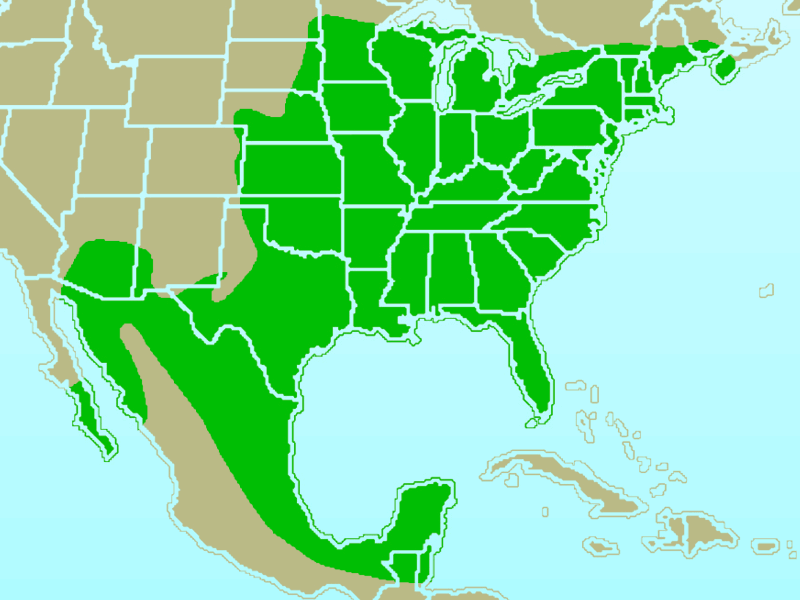
Range map of Northern Cardinal.  public domain
Range map of Northern Cardinal. public domain
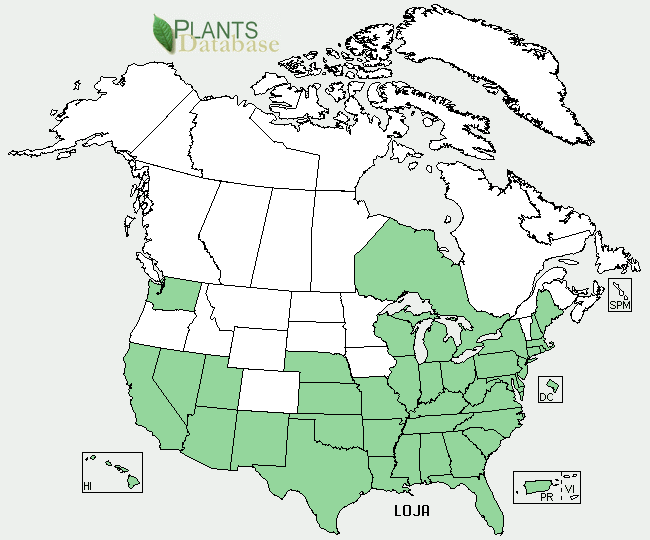
Range map of Japanese honeysuckle.  USDA
Range map of Japanese honeysuckle. USDA

************************

(1)    John Carey, “Nonnative Plants: Ecological Traps Offering alluring habitat for songbirds, exotic plants may actually decrease the animals’ long-term survival and fitness,” National Wildlife Federation, January 14, 2013

(2)    Lionel Leston, Amanda Rodewald, “Are urban forests ecological traps for understory birds?  An examination using northern cardinals,  Biological Conservation, 131 (2006), 566-574

(3)    L. LaReesa Wolfenbarger, “Red coloration of male northern cardinas correlates with mate quality and territory quality,” Behavioral Ecology, Vol. 10 No. 1 (1999), 80-90

(4)    Tamatha Filliator, Randall Breitwisch, Paul Nealon, “Predation northern cardinal nests:  Does choice of nest site matter?,” The Condor, 96, 761-768, 1994

(5)    Wild Birds Unlimited

Are non-native plants “ecological traps” for birds?

One of the reasons why native plant advocates want the managers of our public lands to destroy non-native plants and replace them with native plants is that they believe native plants provide superior habitat for birds.  However, empirical studies do not support this belief, as we have explained in earlier posts.  Today we will examine an article recently published in an advocacy magazine, making the claim that non-native plants are “ecological traps” for birds:  “Nonnative Plants: Ecological Traps Offering alluring habitat for songbirds, exotic plants may actually decrease the animals’ long-term survival and fitness” (1)

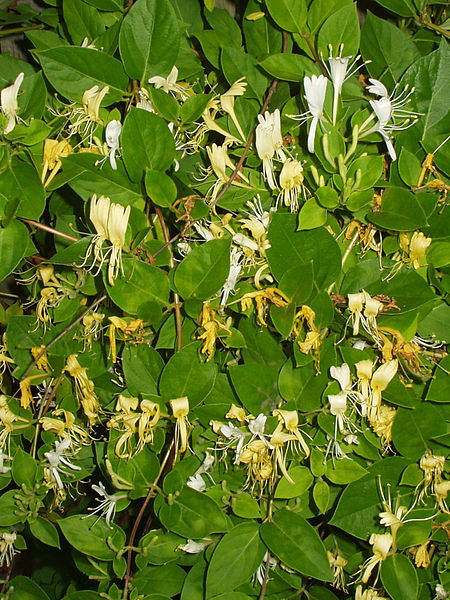
Japanese honeysuckle.  Attribution William Rafti
Japanese honeysuckle. Attribution William Rafti

The article begins auspiciously with the good news that populations of some bird species have increased significantly in recent decades because of the spread of non-native plant species which are valuable sources of food:  “…a 2011 paper, published in the journal Diversity and Distributions, concluding that the number of fruit-eating birds such as cardinals, robins and catbirds tripled during the past three decades in parts of central Pennsylvania due to the spread of nonnative honeysuckles.”  (1)  And then the article attempts to contradict this good news by turning to the usual nativist caveats.

Generalists vs. Specialists

Nativists claim that the animal kingdom is divided into generalists and specialists.  The generalists are theoretically omnivores—they have a varied diet—and so depriving them of native plants will not prevent their survival.  Specialists, on the other hand, are dependent upon a narrow range of plant or animal species for survival.  We are expected to believe that specialists far outnumber generalists and that we doom them to extinction when one particular species of native plant or animal is unavailable to them.

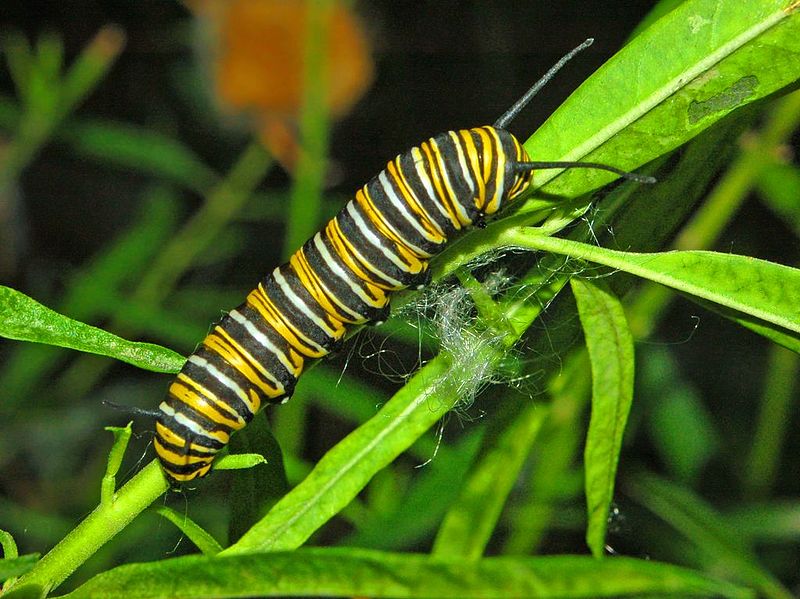
Monarch butterfly caterpillar - Creative Commons - Share Alike
Monarch butterfly caterpillar – Creative Commons – Share Alike

Doug Tallamy is the purveyor of the generalist vs. specialist overstatement.  We have critiqued his assumptions in an earlier post.  In a nutshell, there are few mutually exclusive relationships in nature because they are a risky evolutionary strategy.  The plant or animal that is dependent upon one other species is significantly less likely to survive in the long term than an animal with more dietary options.  The perception that there are immutable relationships between insects and plants also underestimates the speed of adaptation and evolution, particularly of insects with large populations and short lifespans.

For example, a bird that eats insects usually eats all manner of insects as well as spiders.  They are not dependent solely upon caterpillars as Mr. Tallamy seems to believe:  “…warblers and chickadees rely on caterpillars for 90 percent of their diet during the breeding season, eating hundreds per day. ‘That’s a lot of insects,’ Tallamy says. ‘If you don’t have those insects, you don’t have the birds.’” (1)

According to Cornell Ornithology Lab–America’s most prestigious research institution for birds–warblers and chickadees have a much more varied diet than Mr. Tallamy believes.  (We chose specific species with ranges and abundant populations in Delaware where Mr. Tallamy lives.  However, the diet of all species of chickadees and warblers are similar.)

  • Black-capped Chickadee:  “In winter Black-capped Chickadees eat about half seeds, berries, and other plant matter, and half animal food (insects, spiders, suet, and sometimes fat and bits of meat from frozen carcasses). In spring, summer, and fall, insects, spiders, and other animal food make up 80-90 percent of their diet. At feeders they take mostly sunflower seeds, peanuts, suet, peanut butter, and mealworms.” (2)
  • Orange-crowned Warbler:  “insects and spiders.” (2) Most insects are not caterpillars and many are not herbivores.
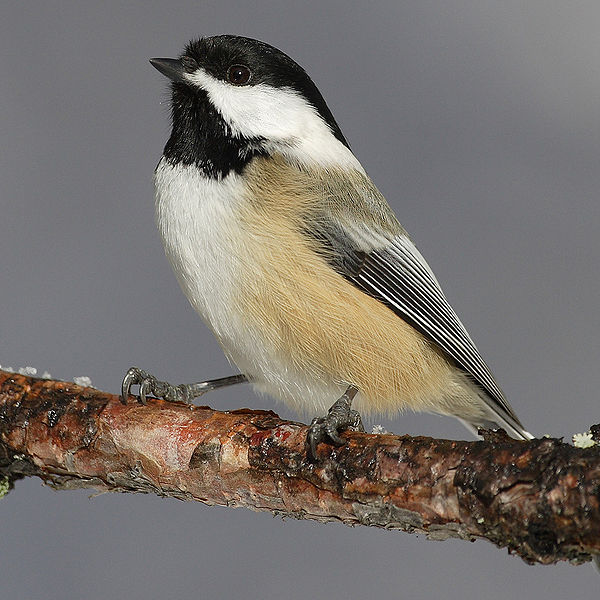
Black-capped Chickadee - Creative Commons - Share Alike
Black-capped Chickadee – Creative Commons – Share Alike

No evidence that insects require native plants

Mr. Tallamy is focused on caterpillars because they are herbivores, that is, they eat plants.  Just as he believes that the birds need native plants, he also believes that plant-eating insects need native plants.  However, Mr. Tallamy disproved his own theory about an immutable relationship between native plants and insects when he supervised a graduate student whose thesis concluded: 

Erin [Reed] compared the amount of damage sucking and chewing insects made on the ornamental plants at six suburban properties landscaped primarily with species native to the area and six properties landscaped traditionally.  After two years of measurements Erin found that only a tiny percentage of leaves were damaged on either set of properties at the end of the season….Erin’s most important result, however, was that there was no statistical difference in the amount of damage on either landscape type.” (3)

This empirical study, supervised by Mr. Tallamy, was unable to find evidence that there are more plant-eating insects in a native garden than in a landscaped garden of non-native cultivars.  Yet, Mr. Tallamy continues to claim that insects require native plants and birds require those insects for their survival:  “Tallamy’s research shows that birds also may be harmed indirectly because nonnative plants affect insects. He has found that the number and diversity of plant-eating insects, especially caterpillars, drops dramatically when exotic plants invade…[Tallamy said,] ‘My prediction is that birds that specialize on insect herbivores will take a bigger hit than those that eat other insects,’” (1)

The study by Mr. Tallamy’s student about the relationship between native plants and insects is not the only empirical evidence that his assumption is incorrect.  We have published several articles about local studies that have found no such relationship:

Native plant advocates have also offered “evidence” of insect populations in the local eucalyptus forest.  UCSF produced a video to promote their original plan to destroy most of the eucalypts on Mount Sutro (now on hold indefinitely).  An arborist shows us eucalyptus leaves that have been chewed by insects.  He claims that a drastically thinned forest will be healthier because it will have fewer insect predators.  So, there are insects in the eucalyptus forest when it suits native plant advocates’ purposes and there are no insects in the eucalyptus forest when it does not.  They want more insects when they are advocating on behalf of birds and they want fewer insects when they are demanding that trees be destroyed.  It’s rather confusing.

Insects ARE important to birds

We agree with Mr. Tallamy that insects are very important to birds because they are a major source of food, especially during the nesting season when their high-protein content is vital to nestlings.  Therefore, we believe that Mr. Tallamy should join us in making climate change our highest environmental priority.  Because insects are cold-blooded, they are particularly vulnerable to the extreme weather conditions associated with climate change.  They cannot adjust their body temperature as warm-blooded animals can in response to such fluctuations in temperature.  A recent study predicts devastating consequences for insect populations in coming decades:  “Our predictions are that some species [of insects] would disappear entirely in the next few decades, even when they have a fairly wide distribution that currently covers hundreds of kilometers.” (4)

We believe that a single-minded focus on native plants is misguided because in a rapidly changing climate the entire concept of “native” becomes meaningless.  Just as insects are unlikely to survive radical changes in temperature, the ranges of native plants must change if species are to survive.

Stay tuned for Part II

In our next post, we will continue our critique of the article that theorizes that non-native plants are “ecological traps.”  We will tell our readers about the published research that contradicts statements in the article about predation of cardinal nests in non-native honeysuckle.  The author of one of the studies is quoted in this article, saying something completely different than her own published study.  It’s an intriguing contradiction.

**********************************

(1)    John Carey, “Nonnative Plants: Ecological Traps Offering alluring habitat for songbirds, exotic plants may actually decrease the animals’ long-term survival and fitness,” National Wildlife Federation, January 14, 2013

(2)    Cornell Ornithology Laboratory, Guide to Birds

(3)     Tallamy, Doug, “Flipping the Paradigm:  Landscapes that Welcome Wildlife,” chapter in Christopher, Thomas, The New American Landscape, Timber Press, 2011

(4)    “Extreme weather caused by climate change decides distribution of insects, study shows,”  Science Digest, February 20, 2014

“Feds Target Egrets and Owls for Eradication”

We are publishing a guest article by Sydney Ross Singer, Director, Good Shepherd Foundation.  Dr. Singer has been a tireless defender of non-native species in Hawaii, where he lives.  Nativism in Hawaii is even more destructive than similar projects in the San Francisco Bay Area.

***********************

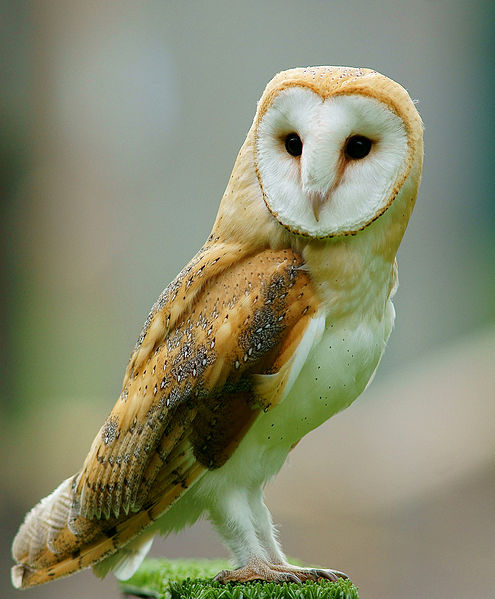
Barn Owl.  Creative Commons 2.0 Generic.
Barn Owl. Creative Commons 2.0 Generic.

Tens of thousands of innocent Owls and Egrets will be executed in Hawaii by the US Fish and Wildlife Service unless President Obama issues a pardon.

Cattle egrets and barn owls are an important part of Hawaii’s environment, consuming large amounts of rodent and insect pests as they were meant to do when first introduced by the government to these islands back in the 1950′s. They are protected by international migratory bird treaties, and are admired and prized by people wherever they are found.

Unfortunately, they are now being targeted for destruction statewide by the same invasive species eradicators who are killing our other introduced wildlife.

Egret.  Creative Commons Share Alike.
Egret. Creative Commons Share Alike.

Currently, whenever there is a conflict between egrets or owls and endangered species or airports, there have been permits required for their control in the local area where they are a problem. The US Fish and Wildlife Service has proposed lifting this permit requirement to allow the egrets and barn owls to be killed anywhere they are found, even if they are not causing any problems. It is killing the innocent today to prevent a potential problem in the future.

This is a reminder of ethnic cleansing and genocide. It is not what our great nation is about.

This slaughter of innocent egrets and owls is a crime against nature and against the people who live with and admire these magnificent birds. Making matters even worse, one of the methods that will be used to kill the birds is to attract them to slaughter areas by broadcasting their bird calls. Owls will be attracted from miles away to be shot. Egret colonies will be massacred for no reason other than their existence in Hawaii.

This “final solution” for the egrets and owls, not only controlling them where they are a problem but everywhere they live throughout the Hawaiian Islands, can only be stopped by President Obama issuing a stay on their execution. It is the Federal Government’s Fish and Wildlife Service that wants to allow unlimited open season on these birds. It is up to the President of our country to intervene on the behalf of these innocent, magnificent creatures.

Please help spread the word. Sign our Change.org petition. And visit our website http://www.DontKilltheBirds.org. Together we can help save these wonderful birds from needless slaughter.

************************

Photos and bold emphasis added.

Needlessly exterminating animals

As much as we dislike the destruction of plants and trees simply because they are not native, the extermination of animals is far more disturbing.  There are presently two such proposed projects in the news to which the public has reacted angrily.  We will start with the project in the San Francisco Bay Area which plans to kill ground squirrels and gophers in a public park in Berkeley.  In this case, the animals are native.  They will be killed because public land managers have decided they MIGHT be a problem in the future. 

The squirrels and gophers of Cesar Chavez Park in Berkeley

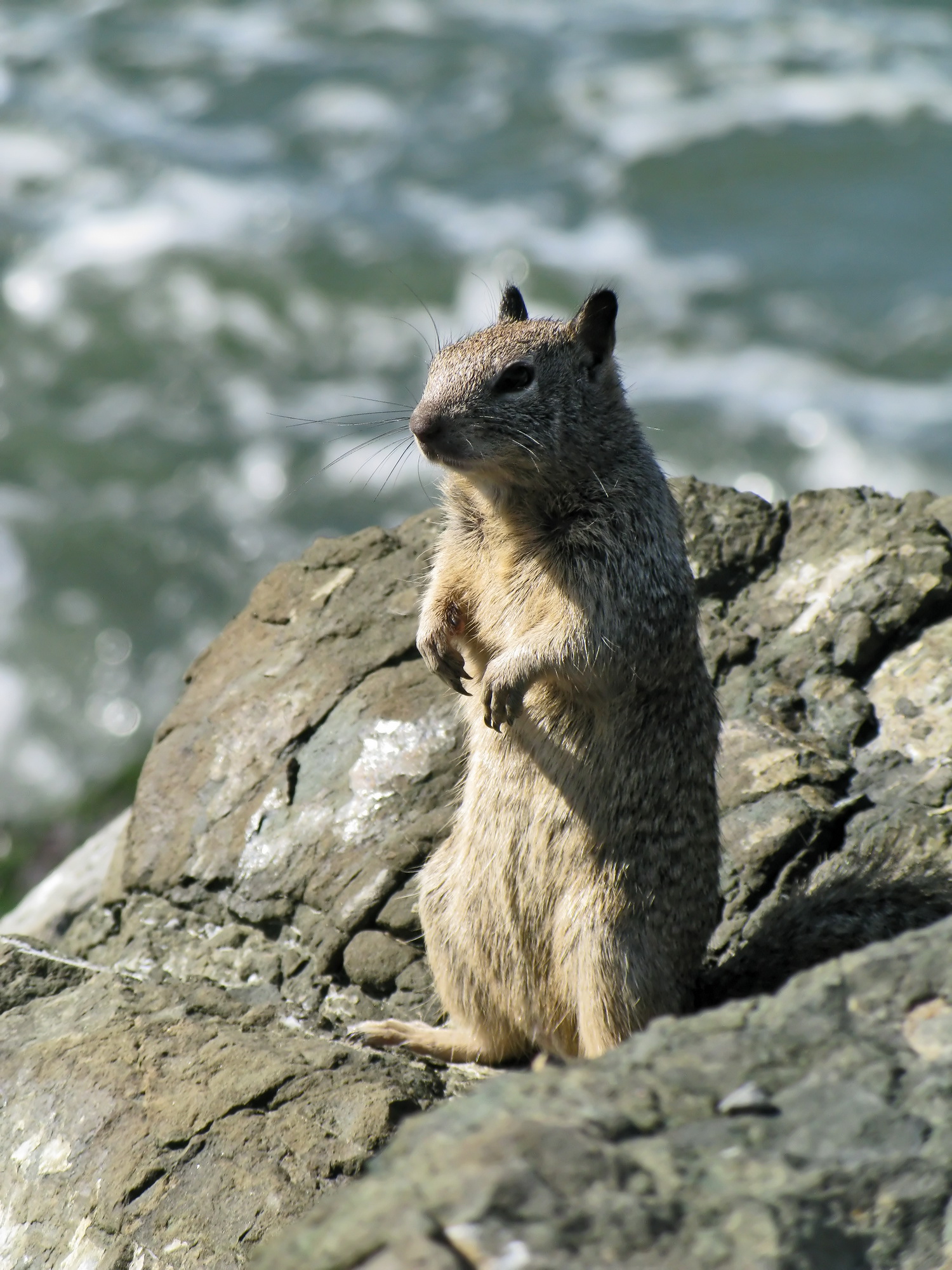
California Ground Squirrel at the Berkeley Marina.  Creative Commons - Benefactor 123
California Ground Squirrel at the Berkeley Marina. Creative Commons – Benefactor 123

Cesar Chavez Park is the former garbage dump of the city of Berkeley, built on landfill.  When the dump was closed in the 1990s, the garbage was not removed.  It was capped with clay which was intended to contain whatever toxins were in the garbage.  Then two feet of soil was put on top of the clay so that vegetation could be planted in the park.  Small animals moved into the park, as we should expect.

The population of squirrels and gophers is now considered too big by land managers.  Although there is no evidence that the burrows of the animals have penetrated the clay cap, the officials who are responsible for the water quality of the bay are apparently concerned that they MIGHT burrow through the clay cap:   “…they are getting perilously close to the clay cap that covers the landfill. If the rodents penetrate that barrier, dangerous toxins like gasoline, lead, iron, herbicides and pesticides, could leach into the bay. So the city needs to reduce the animal population to lessen the risk, according to city spokesman Matthai Chakko. ‘We haven’t had any of the materials inside the landfill escape into the bay and we don’t want that to happen,” said Chakko. “We are trying to solve a problem before it happens.’” (1)

The population explosion is being blamed on park visitors feeding the squirrels.  Squirrel-feeders have been interviewed by the media.  They defend their right to feed the squirrels, which is a source of pleasure for them.  It should not be too difficult to understand that many people prefer feeding squirrels to killing them.  (However, we do not encourage people to feed wildlife in public parks and open space because the animals usually pay the price.)

Some media sources also blame off-leash dogs for exacerbating the problem.  The San Francisco Chronicle claims that off-leash dogs dig into the animals’ burrows, making them larger.  There is a small, legal off-leash area in the center of the park.  We have walked around the perimeter of this park many times.  Although we have seen dogs being walked on-leash on the trail around the park, we have never seen an off-leash dog outside the legal off-leash area.  Another media source reports that most of the burrowing animals live on the outer edge of the park which is consistent with our observation.  Furthermore, making the burrows larger at the surface, doesn’t get them any closer to the clay cap two feet below the surface.  Therefore, the scenario imagined by the Chronicle is not consistent with the facts.  (1)

Action alert (update):  The Berkeley City Council will reconsider the extermination of squirrels and gophers at Cesar Chavez Park at their meeting on March 25, 2014.  Please come to speak for these animals.  Here is a link to an article in the Oakland Tribune with more information (scroll down to the second item in the article):    http://www.insidebayarea.com/news/ci_25298598/citywise-santanas-oakland-payout-tops-200k?IADID=Search-www.insidebayarea.com-www.insidebayarea.com

Scapegoating animals for problems we cause

This project is similar to many others to which we object:

  • There is no evidence that there actually IS a problem.  These animals should not be killed without such evidence.
  • IF there is a problem, it is one created by humans:  We should have predicted the presence of burrowing animals when we closed this dump.  An impenetrable cap on the garbage should have been installed.  If an impenetrable cap was not physically possible, the garbage should have been removed.  IF feeding the animals is contributing to the population surge, humans are the problem, not the animals.  We do not assume that feeding the animals is, in fact, contributing to the problem.  It sounds like more finger-pointing to us.  (However, we agree that people should not feed wildlife in public parks because the wildlife usually pays the price for the pleasure of humans.  We suggest that people channel that impulse into a sanctioned form of animal welfare such as volunteering in your local animal shelter or wildlife rescue organization.)
  • There is no evidence that dogs are contributing to the problem either.  They are yet another scapegoat for a problem created by humans….IF, in fact, there IS a problem.  
  • Humans have a very short-term perspective on nature.  We often perceive problems in nature that are short-term and we over-react to them because we have a desire to control nature.  In fact, surges in animal populations usually resolve themselves without our interference when the animals exhaust available resources.  Humans often do more harm than good when we attempt to control nature and these attempts are usually futile because nature is far more powerful than we are.
  • We should set priorities when we address environmental issues.  Untold thousands of chemicals are being drained into the bay every day according to the San Francisco Regional Water Quality Control Board:  “’However, there are a number of chemicals that are showing up not too far from levels of concern, and that’s the bad news,’ said Tom Mumley. assistant executive officer of the San Francisco Regional Water Qaulity Control Board,  ‘There’s a really big, long list of chemicals that we haven’t measured yet, or we don’t have good thresholds to interpret whether the concentrations out there are something to be alarmed about or not,’ said Jay Davis, a senior scientist at the San Francisco Estuary Institute. More than 100,000 chemicals are registered or approved for commercial use in the United States.” (2)  While we merrily pour toxic chemicals down our drains and spray our public lands with pesticides, does it make any sense to worry about the POSSIBILITY that a few squirrels could be burrowing into a former garbage dump?

Update March 27, 2014:  Berkeleyside (an excellent on-line news source for Berkeley) reports that the Berkeley City Council put the plan to kill ground squirrels and gophers at Cesar Chavez Park on hold indefinitely, pending further study.  Berkeleyside reports that the Water Quality Board notified the City Council in writing that they did NOT order Berkeley to kill the animals, contrary to the claims of the Berkeley officials proposing the plan.  There is absolutely NO doubt that this decision is a direct result of thousands of people contacting Berkeley to protest the plans.  It pays to speak up, folks!

The swans of New York

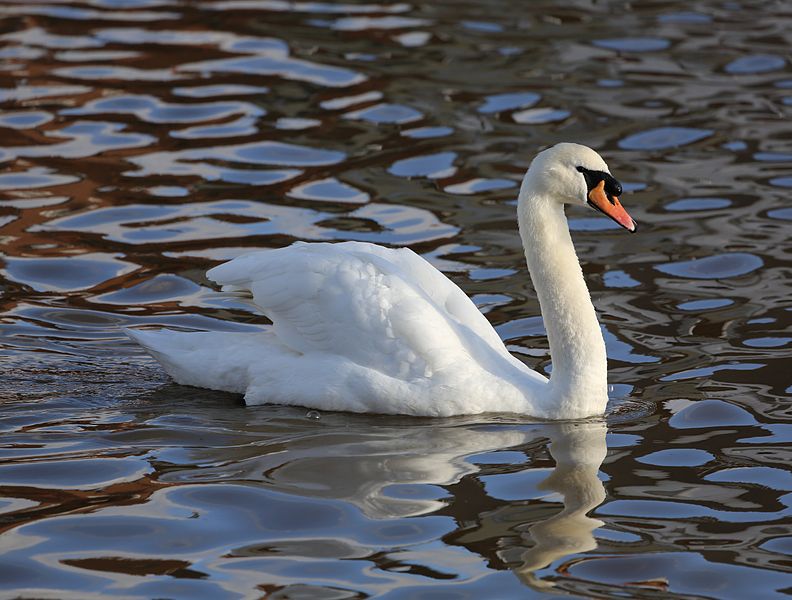
Mute Swan.  Creative Commons - Share Alike
Mute Swan. Creative Commons – Share Alike

The State of New York has announced its intention to exterminate all mute swans in the state.  The mute swans were introduced in the 1880s because at that time people thought them beautiful.  Now some people have apparently changed their minds.  People calling themselves bird-advocates have decided that because mute swans aren’t native to the United States, they must be killed.

According to an op-ed in the New York Times, this bizarre plan to kill this and other non-native species of birds originates with the Audubon Society and other organizations advocating on behalf of birds (apologies for the contradiction). They succeeded in revising the Migratory Bird Act in 2004, to remove protections from all non-native birds in the United States.  This policy was based on an ASSUMPTION that the mere existence of non-native birds is a threat to native birds.  Like all similar projects to exterminate a non-native species, the State of New York provided no evidence that the mute swans are a threat to native birds.  The proposal merely stated that the swans are “aggressive” and that they eat aquatic vegetation.

Since there are only about 2,200 mute swans in the State of New York, one wonders how much of a problem they could be.  They are called “invasive,” as are most non-native species, but their small population suggests this is an exaggeration.

The op-ed in the New York Times was written by Professor Hugh Raffles (New School).  Readers of Million Trees may remember him as the author of another eloquent op-ed about the fallacies of invasion biology using the American “melting pot” as a metaphor.

The comments on his op-ed about the swans are revealing.  There is almost no support for killing the swans.  Here is one of the few supporting comments from a typical nativist, using the usual arguments about how there MIGHT be a problem in the distant future:  “Not-so-weird” says A century is not nearly enough time for wetlands to adapt to the presence of a new species. Thousands or millions of years would be more appropriate. As we wait to see what happens, we could lose any number of native species whose ecosystem services we have yet to fully understand or appreciate. The science does not need to be complete for the safest, most responsible course of action to be removing mute swans from our wetlands in the most humane way possible.”    It’s difficult to imagine our environment thousands or millions years from now, but we doubt that mute swans will be a concern in the unlikely event that there will be humans around to worry about them.

Don’t we have enough problems?

There is no shortage of real, serious problems in our environment.  One wonders where our public servants find the time to dream up problems that don’t exist.  We suggest that they put their over-active imaginations to rest and focus on solving existing problems rather than fabricating them.  And while they’re at it, we would appreciate it if they would quit pointing fingers at animals when diagnosing problems most of which are caused by the actions of humans.

***************************

(1)    Frances Dinkelspiel, “Berkeley to kill squirrels, gophers to protect bay,” Berkeleyside, February 19, 2014

(2)     Stephanie Lee, “Report:  Some levels of chemicals in SF Bay near levels of concern,” San Francisco Chronicle, October 28, 2013

No consensus on the definition of “native” or “invasive” species

We recently republished an article from the Garden Rant blog about the overuse and misuse of the word “invasive” to describe plants.  That article objected to the exclusive use of that pejorative word to describe non-native plants, when native plants often behave in exactly the same way.  The article also pointed out that the behavior of plants varies depending upon local conditions such that labeling any plant “invasive” beyond a specific locality is bound to be inaccurate.

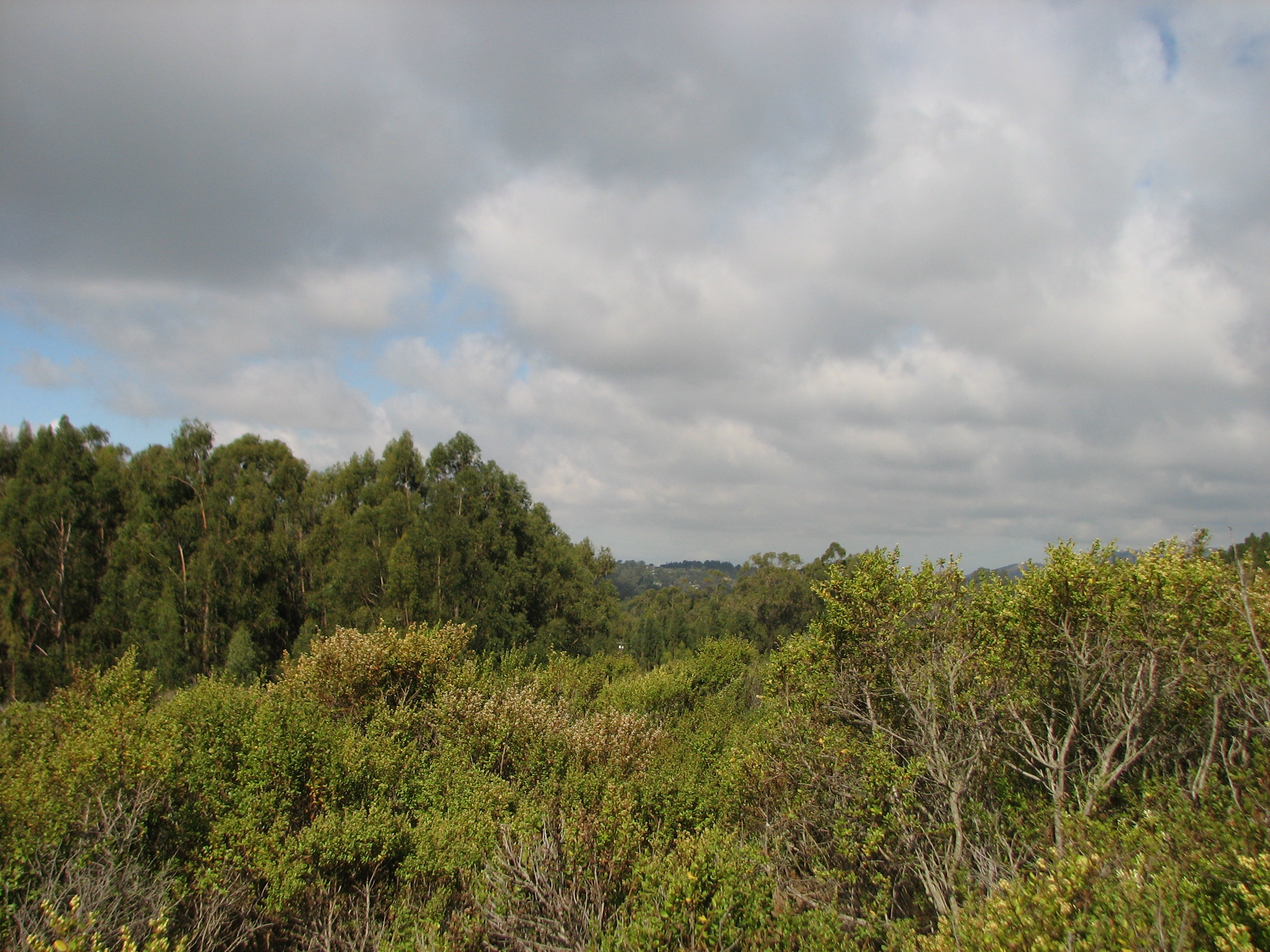
A huge expanse of coyote brush at Lake Chabot, an example of a native plant that would be called "invasive" if it were not native.
A huge expanse of coyote brush at Lake Chabot, an example of a native plant that would be called “invasive” if it were not native.

Today we will tell our readers about a new study which explains why the word “invasive” is causing confusion.(1)  Four scientists in Zurich, Switzerland conducted structured interviews with 26 academic invasion biologists and landscape professionals and found no consensus about the definition of “invasive.”   Nor is there any agreement about the definition of “native,” which is surely contributing to the confusion about the appropriate use of the word “invasive.”  Finally, the authors of the study compared this lack of consensus with the scientific literature of invasion biology.  They found a conspicuous discrepancy between the uncertainty expressed in the interviews with experts and the conservation policies that are theoretically based on the scientific literature.

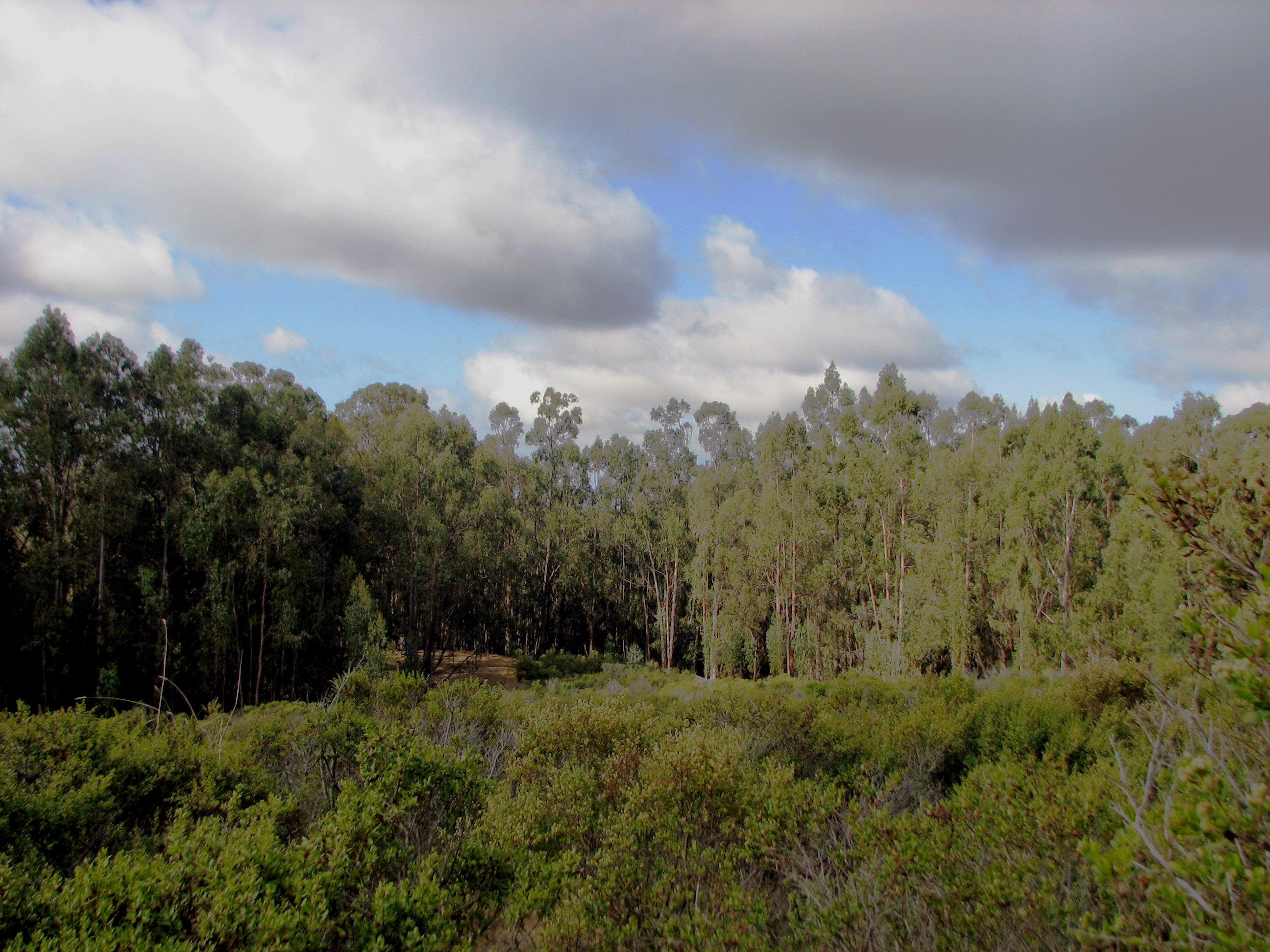
And the eucalyptus forest behind the coyote brush at Lake Chabot which is called "invasive" but in fact, rarely invades.
And the eucalyptus forest behind the coyote brush at Lake Chabot which is called “invasive” but in fact, rarely invades.

What is the difference between native and non-native species?

Although there was some agreement amongst invasion biologists that non-native species arrived with the help of humans, there was less agreement about the timing and location of arrival.  Some said non-natives arrived after the last glacial period (about 10,000 years ago) and others said after 1500 A.D. (post-Columbian exchange).  Landscape professionals were more likely to say that species are native which arrived prior to the life-span of humans, a significantly shorter period of time, obviously.  This is consistent with the tendency for landscape professionals to consider human perception the source of such categorization.

There was little agreement about a spatial definition of native species Some invasion biologists define native species within the context of political units (such as countries) while others use biogeographic definitions such as continents or on either side of a continental divide.

There is also disagreement about the means of movement used to define a species as non-native.  Some invasion biologists consider species non-native if their range has changed as a result of climate change because of the anthropogenic origin of contemporary climate change.  Such movement is now rapidly occurring so this particular definition is likely to result in the changed status of many species presently considered native, a change that is likely to make them targets for eradication.

When is a non-native species “invasive?”

There was little agreement about the criteria for calling a non-native species “invasive.”  Some invasion biologists did not think that an “invasive” species need behave any differently than a native species to be categorized as “invasive.”  Others believed it is appropriate to call a non-native species “invasive” if it spreads, even if that species has no negative impact on the ecosystem.  When asked to evaluate the impact of non-native species, more invasion biologists and landscape professionals considered the impact “neutral” (56%) than those who considered the impact “negative” (32%).  Invasion biologists tended to assess the affect of non-native species more negatively than landscape professionals.

The interviewees were then asked on what they based their judgment of the impact of non-native species.  This is perhaps the most telling question of all.   Both groups of experts lamented the absence of empirical evidence of the impact of non-native species:  “In almost a third (32%) of all assessments, experts could not recall any effects of non-native invasive species on ecosystem services.”  Most admitted that their judgment was based on “intuition” informed by their “general knowledge” or “extrapolating” from related knowledge:  “most experts were prepared to assume that non-native invasive species have a generally negative effect upon native biodiversity.” (emphasis added)

 Are non-native “invasive” species a serious problem? 

This is the question for which the answers of invasion biologists and landscape professionals were most divergent.  Invasion biologists consider non-native “invasive” species a serious problem which is underestimated by the public and politicians.  In contrast, landscape professionals said the problem is overestimated“…particularly due to anxiety and xenophobic feelings among the public.” 

The consequences of this lack of clarity 

The authors of this study then examined the publications of invasion biologists to see if this lack of consensus is apparent in the scientific literature of invasion biology.  They observed that invasion biologists start their publications with a definition of non-native and invasive species, but “in the rest of the text this definition was rarely strictly applied.”  They tend to use the terms “non-native” and “invasive” interchangeably.  They compare the spreading of native species to non-native species without indicating that the native species is also invasive.

The authors conclude that both the categorization of species as native or non-native and their designation as “invasive” are largely value judgments that reflect cultural values, not scientific judgments.  They suggest that invasion biologists “acknowledge the uncertainties and engage transparently with stakeholders and the public in deliberations about conflicting opinions.  Here invasion biologists should take the role of ‘honest brokers of policy alternatives,’ taking into account different prevalent values and policy preferences rather than adopting the role of ‘issue advocates.’” 

In other words, the conservation policies which are theoretically based on the scientific literature of invasion biology should acknowledge the uncertainty that pervades the discipline.  Given that uncertainty, the value judgments of the public should be on an equal footing with the value judgments of those who have a vested interest in the projects that are destroying existing landscapes.  There are alternatives to those destructive projects and the public’s opinion must be taken into account in considering those alternatives.

Of course, we agree.  As we have said many times on Million Trees, invasion biology is not a scientific discipline. Rather it is a set of value judgments based on a belief that native species (whatever they are) are superior to non-native species.  This is not just a question of semantics.  Many species are being killed because of what someone chooses to call them and irreparable damage is being done to our environment in the process of killing them.

 *********************************

(1)    Franziska Humair, et.al., “Understanding misunderstandings in invasion science:  why experts don’t agree on common concepts and risk assessments,” NeoBiota, 20, 1-30, 2014

The impact of climate change on birds

As our readers know, we consider climate change the most important environmental problem of the 21st century.  All other environmental issues pale in comparison to climate change because most other problems are exacerbated, if not caused by climate change.  For example, when native plant advocates demand that we destroy healthy trees storing tons of carbon dioxide, we know that they are not benefiting native plants which will be less well adapted to a changed climate.  The many projects that are destroying healthy trees chip the wood, which releases the stored carbon into the atmosphere as carbon dioxide as the wood decays over time.

The environmental reviews of these destructive projects try to respond to this criticism of their projects by making a number of bogus claims.  For example, they claim that they intend to replace all the trees with native trees, although the horticultural requirements of native trees will prevent their survival where most non-native trees now thrive.  They also claim that the mythical new native trees will compensate for the loss of the carbon stored in the existing urban forest, based on their belief that young trees store carbon at a faster rate than old trees.

Now we have a new study which has overturned this assumption.  Thirty-eight scientists from all over the world participated in a study of 670,000 trees from 403 tropical and temperate species of trees.  They have reported their findings in Nature magazine:

“Here we present a global analysis of 403 tropical and temperate tree species, showing that for most species mass growth rate increases continuously with tree size. Thus, large, old trees do not act simply as senescent carbon reservoirs but actively fix large amounts of carbon compared to smaller trees; at the extreme, a single big tree can add the same amount of carbon to the forest within a year as is contained in an entire mid-sized tree. The apparent paradoxes of individual tree growth increasing with tree size despite declining leaf-level and stand-level productivity can be explained, respectively, by increases in a tree’s total leaf area that outpace declines in productivity per unit of leaf area and, among other factors, age-related reductions in population density.” (1)

In other words, we now have empirical evidence that large, old trees store far more carbon than young trees.

The impact of climate change on birds

Since native plant advocates often claim that their destructive projects benefit birds, let’s examine that claim in the context of climate change.  How is climate change making life difficult for birds?  That’s our topic today.

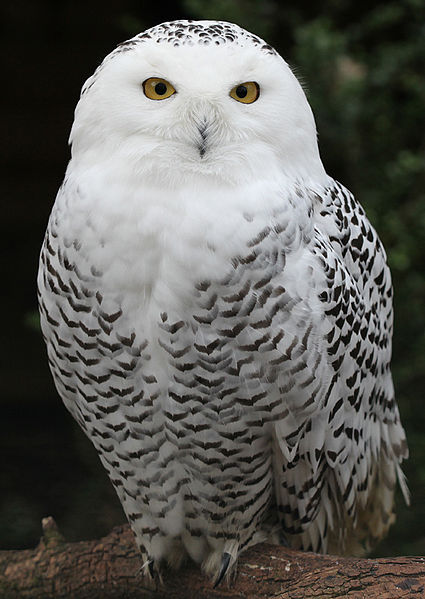
Female Snowy Owl.  Creative Commons
Female Snowy Owl. Creative Commons

We start with a report that snowy owls are being seen in the continental United States, in places far outside their normal range, such as Little Rock, Arkansas and northern Florida.  At Logan Airport in Boston, more than 75 snowies have been captured and relocated during last fall’s migration season, an unprecedented number.  Airports are attractive to grass-eating birds such as geese as well as raptors hunting for small mammals, such as owls and hawks because they are surrounded by vast, open fields.  Airports are dangerous places for both birds and airplane passengers, so this isn’t good news for anyone.

Snowy owls are enormous birds (20-27 inches tall and 54-66 inches wingspan) with white feathers that blend with their usual home in the Arctic.  So what are they doing so far south?  Nobody really knows, but there are theories.  One of those theories is that there was a sudden surge in the population of lemmings in the Arctic which is the preferred prey of the snowies.  That sudden increase in their food source may have caused a surge in the population of snowies and now they must disperse to parts unknown to find what they need to eat.  We will revisit that theory latter in the context of climate change; the article about the impact of climate change on bird populations (see below) reports that the population of lemmings has declined, suggesting that the snowies are moving south in search of food.

What happens when snow turns to rain?

As the climate warms, places where winters brought snow in the past are now rainy.  Think of what that means to birds sitting on nests in the open.  Snow doesn’t penetrate the down of chicks as much as rain does.  A nestling that was kept dry in the snow is now soaked to the skin.  Brrrrrrr…can you feel for that bird?

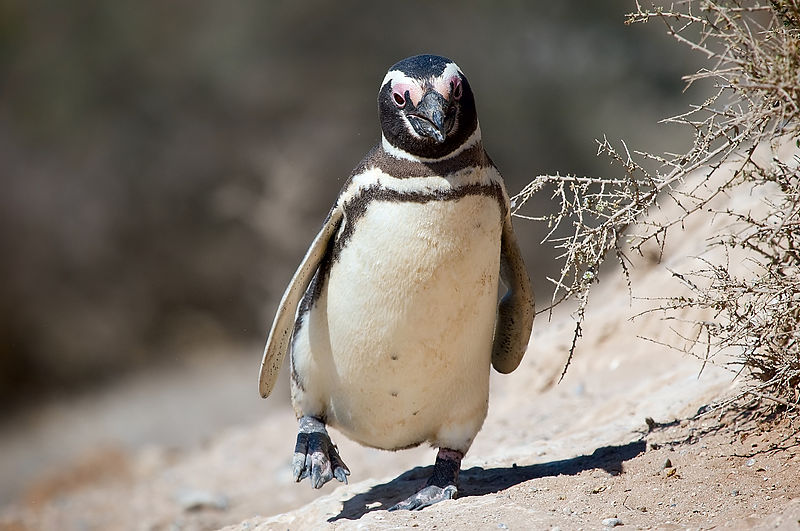
Magellanic Penguin.  Creative Commons
Magellanic Penguin. Creative Commons

A colony of Magellanic penguins in Argentina has been studied for decades by a researcher who now reports that climate change is taking its toll on that colony:

“’Rainfall is killing a lot of penguins, and so is heat,’ said P. Dee Boersma, a University of Washington scientist and lead author of the study, ’And those are two new causes.’” (2)

The penguin chicks are most vulnerable about a week after hatching, when their parents have quit protecting them round-the-clock.  After about 6 weeks, they develop more waterproof plumage.  In the past, only about one-third of chicks survived to leave the nest, most often as a result of predation and starvation.  Heavy storms killed penguins in 13 of the 28 years of the study.  Extreme heat events have recently taken a toll.  The population of breeding pairs in the colony has declined by 24 percent since 1987.

Rain where snow was the more usual winter weather-pattern is also known to have taken a toll on the peregrine falcon population in the Canadian Arctic.

Disrupting the food chain in the Arctic

Yale Environment 360 recently published a report about the impact of climate change on birds in the Arctic. (3) Here is a long, depressing list of specific impacts on many species of birds as a result of climate change in the Arctic:

  • As we have reported, polar bears around Hudson Bay are starving because the bay is no longer freezing long enough for them to hunt for seals on the ice.  They have turned to eating birds’ eggs.  Can you blame them?
  • The rising temperature in the Arctic has increased the population of mosquitoes.  Some birds are dying from blood loss.  This may be hard to imagine if you haven’t visited the Arctic. We can tell you from experience, that the air is black with mosquitoes on a typical summer day in Alaska.
  • Contrary to the opinion of the researchers studying snowy owls, the researchers interviewed by Yale Environment 360 say that the population of lemmings and other prey has declined which has reduced populations of peregrine falcon, ptarmigan, jaeger, skua, etc.  A researcher explains that early, deep snow provides the insulation needed for successful breeding of lemmings.  Without this insulation, the population has decreased significantly. 
  • As spring arrives earlier, snowshoe hares may not be changing their white fur fast enough to escape predation, which will reduce that population over time as fewer hares survive to breed in the future.  The hare is an important source of prey for the raptors.
  • Gulls scavenged the seal hunts of polar bears in the past.  With receding ice and reduced hunting opportunities, this food source has decreased and what remains is often contaminated with mercury.  These factors have combined to result in an 80% decline in the gull population since the 1980s.
  • When weather conditions are unseasonal and extreme at the start of the nesting season, birds often skip the nesting season altogether.  Such a sensible choice has been observed by scientists in several locations.

The article ends on a modest note, by reminding us how little we know about birds and the limitations of the research that is done on their populations.  Some of the population changes that have been observed could be short-term.  There is much variation in nature from which we cannot accurately extrapolate.

How could local native plant “restorations” benefit birds? 

The projects demanded by native plant advocates will destroy tens of thousands of healthy, old, large trees that are expected to live at least 200 more years and store much additional carbon during that period.  These trees will release tons of the greenhouse gases causing climate change when they are destroyed.  Climate change is clearly not benefiting birds.  How can native plant advocates continue to claim that the projects they demand will benefit birds?  It is a cruel fiction that these projects will benefit birds.

We are reporting about studies of birds in polar regions today.  Climate change at the poles is presently more visible and extreme than it is locally.  Assuming that we continue to do nothing, we can expect similar changes in our neighborhood in the near future with similar impacts on the birds.

*********************

(1) N.L. Stephenson, et. al., “Rate of tree carbon accumulation increases continuously with tree size,” Nature, January 15, 2014.
(2) Henry Fountain, “For Already Vulnerable Penguins, Study Finds Climate Change Is Another Danger,” New York Times, January 29, 2014.
(3) Ed Struzik, “Northern Mystery: Why Are Birds of the Arctic in Decline?” Yale Environment 360, January 22, 2014

“The trouble with the word ‘invasive'”

We are republishing an article from the Garden Rant blog with permission of the author, Susan Harris.  Susan is a professional garden writer who lives in the Washington DC area.  Garden Rant is an award-winning garden blog with a huge readership of garden writers, landscape professionals, and home gardeners.  They report over 80,000 readers per day. 

In this article, Garden Rant enters the controversial debate about the arbitrary use of the word “invasive.”  We agree that this word is both over-used and misused.  However, this is more than a semantic debate.  It’s an important debate because the word is being used to justify huge destructive projects that are damaging the environment by needlessly attempting to eradicate non-native plants, using polluting methods such as herbicides and prescribed burns.

If you have never debated with native plant advocates, you might find the comments posted to this article of interest.  They are typical of the many dialogues we have had with native plant advocates in the past.  

*********************************

This is a long-simmering rant about the many ways the term “invasive” causes confusion, and more.  DO weigh in with alternatives, pushback, and rants of your own.

“Invasive” as synonym for “nonnative”

Google “native versus invasive” and the 5.6 million hits confirms my observation that this is a common usage, and it’s led to a common misperception in the public that the opposite of native is indeed invasive.  QED: nonnatives ARE invasive.  Even regular garden writers sometimes use this juxtaposition, which should more accurately be “native versus nonnative” or I guess, “exotic.”

That great leveler, Wikipedia, confirms this problem about the term “invasive”: “The first definition, the most used, applies to introduced species (also called “non-indigenous” or “non-native”) that adversely affect the habitats and bioregions they invade economically, environmentally, and/or ecologically.”  At least their second definition is more accurate and even includes native species like deer.  No argument there.

Defining away the invasive behavior by natives

Can native plants be invasive?  Sure, as evidenced by the above-mentioned deer or in the plant world, wild grape.  But when native plants are termed invasive someone invariably pipes up to correct the writer because by definition, they’re nonnatives only.  And sure enough, legally, by the official U.S. government definition, only nonnative plants can be deemed invasive – for purposes of qualifying for money to remove them.  The 1999 Federal Executive Order on Invasive Species defines an invasive species as a “species that is not native to a particular ecosystem…”

Invasive plant lists covering large regions – even continents!

We all know that plant behavior depends on the exact conditions the plant is growing in, as well as more broadly, the region.  So some plants that behave well in the North are overly vigorous in the South.  Or some, like the infamous purple loosestrife, are vigorous in wet spots, not in dry ones.  Examples abound.

Spirea and Doublefile Viburnum (L), Lespedeza (R)

Spirea and Doublefile Viburnum (L), Lespedeza (R)

Yet this site by the U. Georgia and many other sources, including the National Park Service, don’t distinguish by region, and the resulting list of “invasives” includes these surprises to gardeners near me: several viburnums, two verbascums, several veronicas, red and white clo0ver, Japanese yew, 3 spireas (MOST on the market), various salvias, willows, nandina, grape hyacinth, Miscanthus sinensis (without specifying that it’s only the early-bloomers that spread), Lespedeza thumbergii, Pee Gee Hydrangea, cotoneaster, and strangely, littlestem bluegrass (Andropogon virginicus).  Yet native thugs like trumpet creeper are encouraged and they’re not invasive?

That designation of Spirea really bothers me because it’s such a self-sustaining, easy, low-maintenance and well behaved shrub, one I’ve grown for 30+ years with no signs of trouble.  And yet another source – the  USDA National Invasive Species Information Center – also targets Spirea Japonica and says this about it: “Spreads rapidly and forms dense stands that crowd out native species.” This and other contradictions between official reports and in-garden experiences growing targeted plants is puzzling to me.

Adding to the overly broad regionality of invasive-plant designations, there’s a new book on invasive plants, written for a national audience.

Shouldn’t invasiveness be designated locally?  And sometimes, for certain conditions?

“Invasive” used instead of “spreading”

I’ve heard garden-club members describing their passalong plants at plant swaps as “invasive” if they spread at all.  Which leads to said garden club being accused of encouraging the use of “invasives,” among other things.

Methods of “invasion” all lumped together

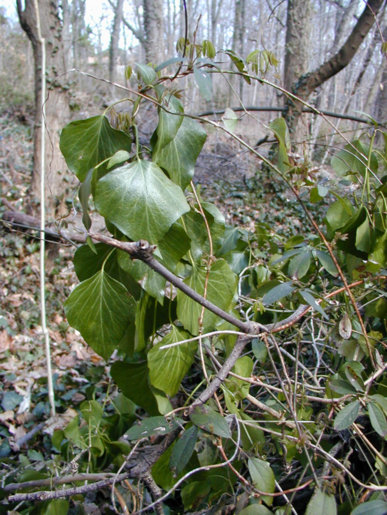
Mature Ivy
Mature Ivy

The  USDA lists these characteristics of invasive plants: “produce large numbers of new plants each season; tolerate many soil types and weather conditions; spread easily and efficiently, usually by wind, water, or animals; grow rapidly, allowing them to displace slower growing plants; spread rampantly when they are free of the natural checks and balances found in their native range.”

Yet some of those qualities are valued in the garden – especially tolerance of many conditions.  And for the gardener on a budget, especially one trying to replace their lawn with another groundcover, spreading is a good thing and it’s usually described more positively as “fills in quickly.”

What if the standard were: Does the plant spread in a way that causes harm to natural areas?  For example, plants that are spread by birds, like English ivy, so that the seeds can go everywhere and harm natural areas.  Unlike Spirea and Nandina that spread by rhizome and produce a couple of offspring every year, if that – just like Itea does?  Or if it’s simply spreading in the garden, is it impossible to control, like running bamboo?

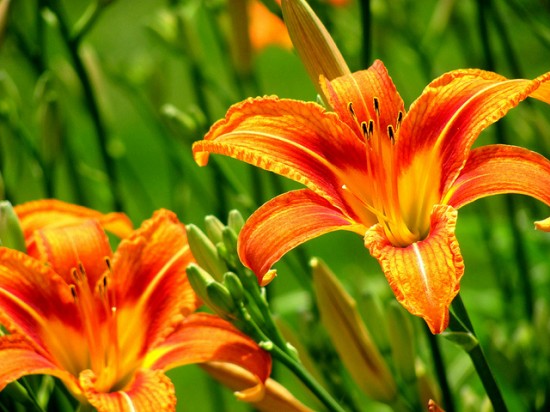
daylily-550x412For example, “Invasive Species of Concern” in Maryland includes mostly plants we’d all agree are thugs and not even considered garden plants, but daylily?  As a sun-lover, it won’t spread into the woods and even out in the sun, how hard is it to dig up?

Or a plant could be harmless in a townhouse garden on Capitol Hill but potentially harmful if planted on the edge of a forest.

I wish there were several terms used to describe spreading behavior by plants, rather than the single term “invasive.”  How’s a gardener to choose between groundcovers like pachysandra, periwinkle and English ivy, when they’re lumped together as equally thuggish when only one of them will grow virtually to strangle trees, set seed and spread indiscriminately?

More science-based info, please

In researching the topic of “native versus exotic” I came across one example of the type of reporting on invasive species I’d like to see more of – based on research, not scare tactics.  Just one quote from this article by Cornell will piss off some readers, but here goes:  “A small percentage of plants exhibit invasive tendencies, while the majority of plant introductions are benign or beneficial.”

Solutions for “invasiveness” coming?

Plant breeders are hard at work breeding out invasiveness in popular garden plants, as reported on the Native Plants and Wildlife  Gardens blog.  Though controversial, especially among native-plant advocates, this type of breeding is recognized by pragmatists as a step in the right direction.

Daylily photo credit.

Eucalyptus in the news

Because our mission is to inform our readers of the many projects all over California that are destroying non-native trees and vegetation in order to “restore” the native landscape of grassland and dune scrub, we are obligated to tell many sad stories.  So, we are always pleased when we have the opportunity to relay some good news for a change.  In this post we will tell you about several articles in the media that have treated our non-native landscape, as well as those who defend it, with more respect.

High Country News

Taking these articles in chronological order, we’ll start with an article in the High Country News which was published December 23, 2013. (1)  We considered it our Christmas present!

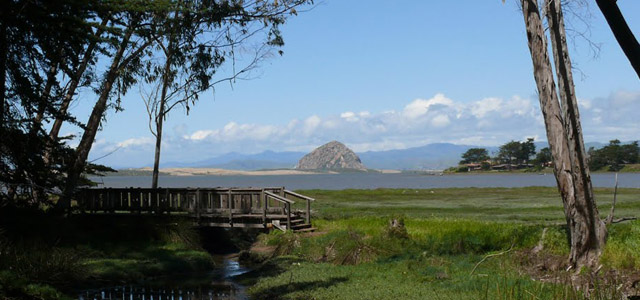
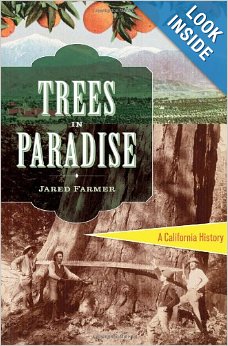
The article was informed by Jared Farmer’s Trees in ParadiseWe have reported extensively about this book, so we’ll leave that information aside to focus on what is new in this article.  It is written in the context of a specific project which had originally planned to destroy about 120 of 450 eucalypts on a 32-acre preserve managed by the Morro Coast Audubon Society.  The Sweet Springs Nature Preserve is in Los Osos, California, near San Luis Obispo.

Sweet Springs Nature Preserve, Los Osos, California

When the project was announced, defenders of eucalyptus objected:  “the Morro Coast Audubon Society was so stunned by the outcry when it filed for a county permit to remove some of the…blue gums that they put the project on hold,”  The defenders of the eucalypts are treated with respect by the author of the High Country News article.  She portrays the controversy as a question of different conservation priorities.  The eucalypts are serving a population of monarch butterflies and raptors.  Those who want to destroy the eucalypts believe they are shading out rare native plants that would theoretically serve a different species of native butterfly.  The author implies that these are all worthy goals.

She seeks the advice of a local scientist, Matt Ritter of Cal Poly State University in San Luis Obispo.  He tells us that  of the 38 species of eucalyptus that are widespread in California, only 18 have naturalized and only two—blue gums and red gums—are considered “moderately invasive, and then only in places refreshed by perennial moisture in the form of streams, springs or summer fog. “  He shows the author photographs of a place where eucalypts spread at a rate of 2 feet per year during the period 1931 to 2001.  Mr. Ritter concedes that that isn’t a particularly fast rate of spread compared to other plants.  For example, we wonder how it would compare to the spread of coyote brush into grassland that isn’t burned periodically to prevent natural succession to shrubs.

The article isn’t specific about the location of the photographs except to say it is “150 miles north” of San Luis Obispo.  That would put the location south of Santa Cruz.  That technique was also used In “Vegetation Change and Fire Hazard in the San Francisco Bay Area Open Spaces” by William Russell (USGS) and Joe McBride (UC Berkeley). (2) They used aerial photos of Bay Area parks taken over a 60 year period from 1939 to 1997, to study changes in vegetation types.  They studied photos of 3 parks in the East Bay (Chabot, Tilden, Redwood), 2 parks in the North Bay (Pt Reyes, Bolinas Ridge), and one on the Peninsula (Skyline).  These photos revealed that grasslands are succeeding to shrubland, dominated by native coyote brush and manzanita.  Eucalyptus and Monterey pine forests actually decreased during the period of study.  In those cases in which forests increased in size, they were native forests of oaks or Douglas fir.  In other words, they found no evidence that non-native trees are invading native trees or shrubs. 

The High Country News article ends with this happy ending:  “…the Morro Coast Audubon Society board backpedaled on its plan to remove blue gums.  While approving the removal of small trees—those with trunk diameters of eight inches or less—it took the larger trees off the table.  Flagged as exceptions to be considered on a case-by-case basis were trees that pose risks to life or property.”  This is the kind of compromise that we hope will ultimately resolve this conflict.  This particular compromise is especially welcome because a chapter of the Audubon Society made this decision.  We hope that the Bay Area chapter of the Audubon Society—Golden Gate Audubon—will note this compromise and learn from it.  To date, they have reflexively supported every destructive project in the Bay Area. 

High Country News is often quoted in Jake Sigg’s Nature News, which suggests it is influential with native plant advocates.  We hope this even-handed treatment of those who object to the destruction of eucalyptus will come to their attention.

San Francisco Chronicle

Trees in Paradise, by Jared Farmer

On Sunday, January 12, 2014, the San Francisco Chronicle published an op-ed by Jared Farmer, the author of Trees in Paradise. (3) It was also a balanced article that treated both sides of the debate about eucalyptus with respect.  We won’t describe the op-ed in this post because we have covered the book extensively in earlier posts.

To date, the article has drawn 115 on-line comments and three letters to the editor.  They are typical of the highly polarized debate about eucalyptus.  Here is the letter to the editor from the “other side:”

“I have never read such unsubstantiated, unscientific, navel-gazing in 50 years of reading The Chronicle. The logic of celebrating this invasive human-introduced species is the same as celebrating the hydraulic mining of the Sierra foothills or the decimation of the native Californians by disease and organized murder. We may never be able to restore our oaks and redwoods to their previous place, but a euke is as natural as a strip mine – and even more dangerous to life through falling limbs and fire.”

The commenter equates “human-introduced” trees to genocide and “organized murder” of Native Americans.  My, my…such hyperbole.  “Euke” rhymes with “nuke”…how clever.  He also reveals his ignorance of our natural history in the Bay Area where eucalyptus did not displace oaks and redwoods because there were virtually no trees here.  We won’t be looking to this person for the compromise that we seek.  This is the religious fervor which is standing in the way of compromise.

Bay Nature

The following day, January 13, 2014, Bay Nature published an excellent article about eucalyptus, featuring the reforestation effort at the Presidio in San Francisco. (4)  The article informs readers of Bay Nature of these facts which we know to be true:

  • Pre-settlement San Francisco was virtually treeless:  “Looking out along the high western ridge of the vista would have unfolded in rolling waves of sand and grass, dotted with scrubby plants that unfurled all the way to sea.  A few oaks lined the creek beds, and everything was bent to the wind and salt air.”
  • Non-native trees were planted to provide protection from the wind which enabled establishment of the entire landscape:  “The native oaks that grew in the area were too short to serve as protection from the wind and sand, and the dune habitat looked nothing like the forests that Easterners knew and loved.  And after the dunes of Golden Gate Park were forested in the 1880s, confidence mounted that the same transformation could take place at the Presidio.”
  • Non-native trees and native plants can and do thrive together:  “Like sentinels [cypresses planted just a few years ago] preside over the Presidio, but they also co-exist with the original settlers of the area:  native plants.”
  • Non-native trees provide valuable habitat for native birds:  “…the forest has also increased habitat for native species of birds that wouldn’t normally be able to nest here…”
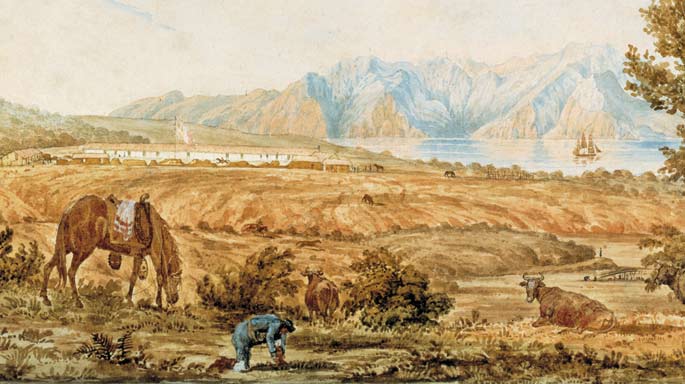
The San Francisco Presidio, painting by Richard Beechey, 1826

Bay Nature is also widely read by native plant advocates and it often defends their destructive projects.  This article represents a significant change of tune, one that is very welcome.   We hope it predicts the compromise we are seeking.

San Francisco Examiner

On Sunday, January 19, 2014, the San Francisco Examiner published an op-ed by Joel Engardio about San Francisco’s Natural Areas Program. (5)  In a perfectly balanced article, he accurately describes the two sides of the conflict about the destruction of trees by the Natural Areas Program.  Frankly, Mr. Engardio implies that he thinks the passion of the conflict is a bit silly, but he also makes it perfectly clear that he considers it a waste of taxpayers’ money to engage in needless tree destruction on the scale proposed by the plans of the Natural Areas Program.

A particularly nasty on-line comment on the article ends with this sentence:  “Not only does it display an impossible amount of ignorance, but a complete lack of ethics or morality.”  Having lost the debate on scientific grounds, native plant advocates now resort to self-righteous moral arguments.  Surely that is weaker ground.  Managers of our public lands are not obligated to deliver the moral imperatives of a particular interest group.

What does all this add up to?

Together, these articles represent a sea change of attitude on the part of publications that in the past were consistently supportive of the ecological “restorations” that are destroying much of our urban forest.  Critics of these projects have not been treated with such respect in the past.  Supporters of the projects were called “environmentalists” in the past.  Now the conflict is portrayed as a conflict amongst environmentalists.  That is a big step forward.

We hope that this significant improvement in media coverage of this controversy will create the atmosphere needed to find a compromise with which we can all live in peace.  We won’t predict the exact nature of that compromise because we know there is a range of opinions.  Speaking for the Million Trees blog—and no one else—we will say that the word “eradication” must be expunged from the debate and whatever the compromise is, it must include a commitment to quit using pesticides in our public parks for the sole purpose of killing non-native vegetation.

We are grateful to all of these publications for their participation in this debate.  That is the balanced reporting we are looking for from a socially responsible media.

*******************************

(1)    Madeleine Nash, “Eucalyptus:  Beauty or Beast?,” High Country News, December 23, 2013. 

2)    Russell, W. H., and J. R. McBride. 2002.  “Vegetation change and fire hazard in the San Francisco bay area open spaces.”  Pages 27-38 in:  Blonski, K.S., M.E., and T.J. Morales.  Proceedings of the California’s 2001 Wildfire Conference:  Ten Years After the East Bay Hills Fire; October 10-12, Oakland California.  Technical Report 35.01.462.  Richmond CA:  University of California Forest Products Laboratory.

(3)    Jared Farmer, “Going out on a limb to defend eucalyptus,” SF Chronicle, January 12, 2014

(4)    Rachel Diaz-Bastin, “New Life for Presidio’s Historic Forest,” Bay Nature, January 13, 2014

(5)    Joel Engardio, “Tree war is Campos vs.Chiu wild card,” San Francisco Examiner, January 19, 2014

Quibbling with Jared Farmer’s “Trees in Paradise”

As we said in our most recent post, we respect Jared Farmer’s comprehensive history of eucalyptus in California as told in his book, Trees in Paradise.  However, we take issue with several of  his assessments of projects that are still on the drawing board.  Since these projects have not yet been implemented and final approval of them is still pending, for the record we will detail our quibbles in this post.

San Francisco’s Natural Areas Program

Farmer trivializes the plans of San Francisco’s Natural Areas Program to remove 18,500 trees over 15 feet tall and countless smaller trees on 1,100 acres of park property managed by San Francisco’s Recreation and Park Department.  This is his description of their plans:

“Unfortunately, poor PR and misinformed criticism initially created the impression that the greenery of Golden Gate Park would be clear-cut.  In truth, less than 5 percent of the city’s crown jewel had been rezoned.  Even so, some neighborhood groups opposed any cuts anywhere; they wanted to ‘integrate’ the blue gums instead of “exterminating” them.  (And they didn’t want to give up any place where they could take their dogs off-leash.)

Most of these trees on Mount Davidson will be destroyed if the plans of the Natural Areas Program are implemented.

Mr. Farmer has not done his homework about San Francisco’s Natural Areas Program.  The disputed tree removals are not in Golden Gate Park.  He’s right that few acres of Golden Gate Park have been designated as “natural areas.”  Most of those acres are oak woodland, which no one would dispute are appropriately designated for preservation of native species.  There aren’t many tree removals planned in Golden Gate Park.  It therefore has not been one of the areas that are disputed by critics of the Natural Areas Program. The most controversial “natural areas” are places like Mount Davidson where the plans propose to destroy 1,600 trees, including many Monterey cypresses, of which even eucalyptus-haters are fond.  Mr. Farmer chooses to defend a “natural area” that isn’t being disputed.

Mr. Farmer repeats one of the accusations of native plant advocates that critics of the Natural Areas Program “oppose any cuts anywhere.”  This is an exaggerated description of most critics of the Natural Areas Program.  Those who have been engaged in the 15-year effort to negotiate for a less destructive program have offered many compromises over the years.  The number of planned tree removals have not been reduced during that long debate.  It would be more accurate to say that supporters of the Natural Areas Program do not want any trees in the “natural areas.”

He also repeats one of the most popular “cover stories” of native plant advocates in San Francisco that all criticism of their plans originates with dog owners.  In fact, NAP is controversial among dog owners and for good reason.  There are only 118 acres of legal off-leash areas in the 3,500 acres of San Francisco’s park land.  The Natural Areas Program claimed 80% of those acres as “natural areas:”  “Approximately 80 percent of the SFRPD off-leash acreage is located within Natural Areas.”  (SNRAMP, page 5-8).  The Draft Environmental Impact Report (DEIR) for the Natural Areas Program proposes to close or reduce the size of several off-leash areas.  The DEIR provides no evidence that these areas have been negatively impacted by dogs.  It also states that all off-leash areas in the natural areas are subject to closure in the future if it is considered necessary to protect native plants.  Since NAP has offered no evidence that the proposed immediate closures are necessary, it is reasonable to assume it will offer no evidence if it chooses to close the remainder of the 80% of all off-leash areas in San Francisco located in “natural areas.”  We know from the DEIR public comments that NAP supporters demand their closure.

There are many reasons why people are opposed to the Natural Areas Program (NAP) and similar native plant “restoration” projects.  The loss of access to parks for walking one’s dog is only one of them.  It is the reason most often cited by defenders of NAP because there is little sympathy for that particular use of parks; it is a way of belittling our concerns.  In fact, this isn’t an issue in some of the most controversial “restoration” projects, such as Mount Sutro where no effort is being made to restrict access to hikers accompanied by dogs.  Yet, opposition to that project is even greater than opposition to NAP because more trees are in jeopardy.

About 50 trees were destroyed in the Interior Greenbelt, the "natural area" on Mount Sutro, in 2010
About 50 trees were destroyed in the Interior Greenbelt, the “natural area” on Mount Sutro, in 2010

The most common reason for opposition to NAP is the removal of healthy trees.  A closely related reason which motivates many others is that large quantities of herbicides are being sprayed in our parks for the purpose of killing non-native vegetation. Herbicides are also needed to prevent eucalypts from resprouting after they are cut down.  Mr. Farmer makes no mention of the huge quantities of herbicides that are required by the “restoration” projects that destroy eucalyptus.  Some critics of these projects are primarily concerned about the loss of habitat for the animals that live in and/or use the existing vegetation.

According to the US Forest Service, San Francisco has one of the smallest tree canopies in the country.  Only 12% of San Francisco is covered by a tree canopy.  Only Newark, New Jersey has a smaller tree canopy.  San Francisco is an extremely cold and windy place.  As Mark Twain famously said, he had never been colder in his life than he had been in San Francisco on a summer day.  Our trees are our protection against that wind.  Destroying them will make San Francisco an even more uncomfortable place.  Trees are an asset everywhere, but in San Francisco they are more than that.  They make an inhospitable climate livable.  The completely artificial landscape of Golden Gate Park would not exist without the windbreak of non-native trees at its Western, windward edge that enabled the transformation of barren sand dunes into a verdant park.

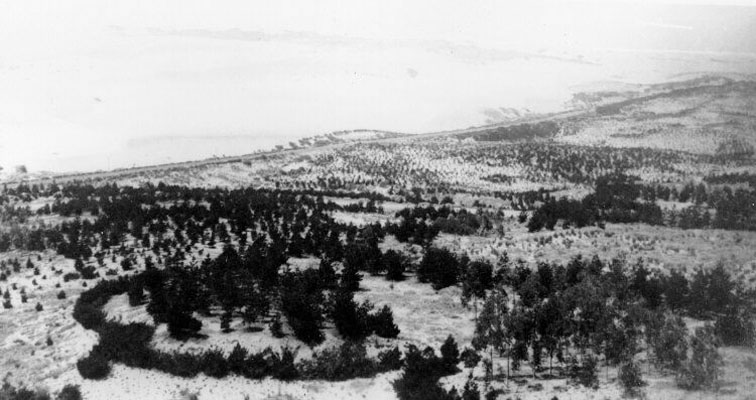
Golden Gate Park in 1880.  The trees are about 10 years old.  In the distance, looking south, we see the sand dunes of the Sunset District.  That's what most of Golden Gate Park looked like before the trees were planted.
Golden Gate Park in 1880. The trees are about 10 years old. In the distance, looking south, we see the sand dunes of the Sunset District. That’s what most of Golden Gate Park looked like before the trees were planted.

Despite Mr. Farmer’s inaccurate assessment of San Francisco’s Natural Areas Program, we consider his chapters about eucalyptus in California very informative and we recommend Trees in Paradise to our readers.  The controversy regarding eucalyptus in California is complex and we cannot expect to agree with everyone about every facet of the issue.  Critics of ecological “restorations” in the San Francisco Bay Area are a broad coalition with a range of opinions.  We welcome Mr. Farmer into our big tent.

Falling from grace: The history of eucalyptus in California

Eucalypti, painting by Guiseppe Cadenasso (1858-1918)

There is much to like in Jared Farmer’s chapters in Trees in Paradise about eucalyptus in California.  He begins with a comprehensive history of when, where, why, and by whom eucalypts were planted in California.  The history begins in the 1870s:  “Planters believed variously that the exotic trees would provide fuel, improve the weather, boost farm productivity, defeat malaria, preserve watersheds, and thwart a looming timber famine.  First and foremost, settlers propagated them to domesticate and beautify the land, to give it more greenery. (1)

Although eucalyptus proved to be a disappointment as a source of timber, it continued to be widely planted in California until about 1913 because it was so well adapted to California’s climate, readily available, and grew quickly:  “In 1924 a botanical investigator estimated that the state contained 40,000 to 50,000 acres of solid eucalyptus, broken down as 80 percent blue gum, 15 percent “red gums,” 4 percent sugar gum, and 1 percent others.”  In 1927, the Los Angeles Times said of eucalyptus, “[it] seems more essentially California than many a native plant; so completely has it adopted California, and so entirely has California adopted it, that without its sheltering beneficence our groves and vineyards would be like Home without a Mother.’” (1)

Well into the 1960s eucalypts were still considered a valuable asset in California.  Harold Gilliam, the nature writer for the San Francisco Chronicle, said, “The Eucalyptus seems an indispensable element of this State’s landscapes, as indigenously Californian as the redwoods, the poppy fields, the long white coastal beaches, the gleaming granite of the High Sierra,’” (1)

Exhibit at Oakland Museum of California

The tide turns against eucalyptus in California

Jared Farmer dates the reversal of the reputation of eucalyptus in Northern California to 1972, when an unusually deep and prolonged freeze caused eucalyptus to die back.  Because this was a unique event in California, with which there was little experience, the initial assumption was that the eucalypts were dead.  Thus began a concerted effort to remove the dead trees that were presumed to be a fire hazard.  Before the question of who would pay for this massive clean-up could be resolved, it became clear that the trees weren’t actually dead and would resprout. The removal effort was abandoned for the time being. This was an early lesson in the indestructibility of eucalyptus that would prove central to the debate in the future.  Eucalypts resprout regardless of how they are destroyed; whether they are burned by fire or frost or cut down, they will resprout unless their roots are repeatedly poisoned with herbicide (usually Garlon).  

Shortly after this episode, the managers of our public lands began to adopt policies requiring the removal of non-native species based on an assumption that native species would benefit from their removal.  In 1982, the Golden Gate National Recreation Area (GGNRA), properties managed by the National Park Service, adopted a policy of destroying all blue gum eucalyptus on 600 acres of park property in Marin County.  Ironically, they chose to announce their intention to destroy the trees on Arbor Day in 1986.  They were flabbergasted by the public’s response to their announcement.  They received letters from 350 members of the public and petitions from hundreds more, virtually all adamantly opposed to the proposed plan.  Marin County supervisors were also opposed to the plans.  Farmer says the GGNRA was forced to scale-back their plans to a single demonstration area. (Farmer doesn’t mention that subsequently GGNRA has destroyed tens of thousands of eucalypts using a variety of justifications including fire hazard. (See “Our Mission.”)

The State Parks Department adopted the same policy to remove all blue gum eucalyptus from State parks around the same time.  They started with Angel Island in the San Francisco Bay and the reaction of the public was much the same as it had been to the plans of the GGNRA.  This time the State Parks Department didn’t back down.  They did a complete Environmental Impact Report in response to public demands and then they removed virtually all the eucalyptus on the island in 1990, with the exception of 6 acres deemed to have historic value.  Eucalyptus has been removed from two other State Parks:  Annadel in Sonoma County and Montana de Oro in San Luis Obispo County.  (If the State of California hadn’t experienced severe budgetary difficulties, this list of parks in which eucalyptus was eradicated would undoubtedly be longer.)

Public opinion about eucalyptus changed radically after the fire in the Berkeley-Oakland hills in 1991.  It is important to note that the managers of public land had adopted the native plant ideology that requires the removal of non-natives such as eucalyptus prior to that fire.  The fire was an opportunity for the managers of public lands to justify their projects based on a claim that the trees are a fire hazard. 

Is it accurate to blame eucalyptus for the 1991 fire?  Although Farmer says the eucalypts were not the cause of the fire, he claims there were eucalypts on only 20% of the burned area but that eucalyptus was 70% of the fuel in the fire.  These statistics are new to us and are not consistent with FEMA’s technical report which says that the homes destroyed by the fire were the biggest fuel source. The primary reason there was so much eucalyptus leaf and bark litter was that there had been another deep, prolonged freeze the winter before the fire that caused the eucalyptus to die back as it had in 1972. As in 1972, no coordinated civic effort was made to clean up the dead tree litter.

Such deep freezes are rare in the San Francisco Bay Area.  The freeze in 1990 was the first and only freeze since 1972 and there has not been another since 1990. The current balmy and dry winter is a harbinger of the warming climate.  Such freezes in the future are unlikely.  If there were another freeze, would we have the sense to clean up the dead litter next time?  We would like to think so.

NY Times reported that 150 homes were burned in the Scripps Ranch fire in 2003, but none of the eucalyptus surrounding the homes caught fire.

Farmer identifies other factors in the reversal of the reputation of eucalyptus in California.  There have been a few fatalities caused by falling limbs and trees, although Farmer rejects the suggestion that eucalypts are inherently more dangerous than other trees.  Available databases and media reports of tree failures and fatalities don’t support the claim that eucalypts are more hazardous than other trees.

Farmer also reports insect infestations in eucalyptus, particularly in Southern California.  He dances around the question of whether or not these insect predators of eucalyptus were imported from Australia by native plant advocates for the purpose of killing the trees.  We have reported on a study by an entomologist at UC Riverside that supports that theory and we have witnessed native plant advocates bragging about having a hand in that scheme.

However, Farmer rejects the claim that eucalyptus is very invasive.  He also reports the studies that find equal diversity and abundance of wildlife in eucalyptus forest and native woodlands.  Claims to the contrary are often used by native plant advocates to justify the eradication of the eucalyptus forest.

Farmer ultimately concludes that eucalypts in California are dying of old age, implying that this will be the graceful resolution of the conflict about their existence in California.  We believe he is mistaken in that judgment.  Blue gum eucalyptus lives in Australia from 200-500 years, towards the longer end of that range in milder climates such as the San Francisco Bay Area.  Our blue gums haven’t been here that long, so we don’t yet know how long they will live here.  However, many professional arborists with no vested economic interest in their destruction have judged our eucalyptus forest in the Bay Area to be healthy.

We don’t advocate for planting blue gum eucalyptus.  In any case, they aren’t available in nurseries in California any more.  We ask only that existing trees be allowed to die of natural causes because of the environmental damage that would be done by destroying them prematurely:  the release of millions of tons of carbon dioxide into the atmosphere, the spraying of herbicides to prevent them from resprouting, the loss of the habitat they provide.

We are grateful to Jared Farmer for his book about the trees of California.  Mr. Farmer is a professor of history at State University of New York, Stony Brook.  He is the author of a favorably-reviewed book about Utah where he grew up and received his graduate education.  He has done a prodigious amount of research of both scientific and historical documents about the trees of California.  His writing style is engaging and he steps back from his subject to muse about the philosophical issues raised by his findings.  His book deserves the respect of both tree and native plant advocates.

*******************************

(1)    Jared Farmer, Trees in Paradise:  A California History. W.W. Norton & Company, 2013