California’s Department of Pesticide Regulation (DPR) has published a draft of a policy that would replace its Integrated Pest Management policy with a Sustainable Pest Management (SPM) policy that is different in name only. SPM makes a commitment to continue using pesticides in California until 2050, and by implication, beyond. It makes NO commitment to reduce pesticide use or reconsider the current targets of pesticide applications. It claims that the health hazards and damage to the environment will be reduced by identifying “Priority Pesticides” for possible substitution or “eventual elimination.” It doesn’t commit to identifying any specific number of dangerous pesticides nor does it provide specific criteria for selecting these dangerous products. It claims that increased testing and development of new products will result in safer products and puts these judgments into the hands of “stakeholders” with “experiential and observational knowledge” rather than scientists with expertise in soil science, endocrinology, toxicology, epidemiology, biology, botany, horticulture, etc. The “stakeholder” committee that wrote the SPM proposal for urban areas included the manufacturer of pesticides and other users and promoters of pesticides.
That’s not an exhaustive list of the many faults of SPM and the dangers that lurk in it. I hope you will read it yourself and consider writing your own public comment by thedeadline on Monday, March 13, 2023, at 5 pm. The document is available HERE. It’s less than 100 pages long and it is a quick read because it is basically a collection of bullet-points.
This is how to comment: “DPR is accepting public comments to inform the prioritization and implementation of the Roadmap’s recommendations through March 13, 2023 at 5 p.m. Comments can be shared in writing to alternatives@cdpr.ca.gov or by mail to the department at 1001 I Street, P.O. Box 4015, Sacramento, CA 95812-4015.” Please note that Department of Pesticide Regulations is not offering revisions, only “prioritization and implementation.”
My public comment on California’s “Sustainable Pest Management Roadmap”
A summary of my public comment is below. A link to the entire comment is provided at the end of the summary:
Public Comment on “Sustainable Pest Management Roadmap” (AKA “Pathway to poisoning the environment for another 25 years”)
My public comment is focused on pesticide use in urban areas because of my personal experience and knowledge of pesticide use where I live. These are the broad topics I will cover in detail with specific examples later in my comment:
Since glyphosate was classified as a probable carcinogen by the World Health Organization in 2015 and the manufacturer of glyphosate settled 100,000 product liability lawsuits by awarding $11 billion to those who were harmed by glyphosate, public land managers have been engaged in the process of substituting other, usually equally or more dangerous herbicides for glyphosate to deflect the public’s concerns. The Sustainable Pest Management Roadmap (SPM) formalizes this process of substitution without addressing the fundamental problems caused by pesticides.
SPM endorses the status quo that exists now. Affixing the word “Accelerating” to SPM is an extreme case of double-speak that deliberately obscures, disguises, distorts, or reverses the meaning of words. SPM ensures that toxic pesticides will be used in California for more than 25 years, to 2050, and likely beyond. SPM therefore accelerates the damage to the environment that is occurring now. Given that climate change will enable the movement of more pests into areas where they are now suppressed by weather, greater use of pesticides should be anticipated so long as the underlying issue is not addressed.
The underlying issue is that pests have been identified for eradication that in some cases cannot be eradicated and in other cases should not have been identified as pests either because they are innocuous or because of the valuable ecological functions they perform. The key question that SPM does not address is whether pesticide use is truly necessary in the first place. Unless we focus on whether a pesticide is actually necessary, all other issues are merely window dressing for perpetual pesticide use.
SPM proposes to identify “Priority Pesticides” for possible substitution without any clear definition of “Priority Pesticides,” a process that is ripe for manipulation. Given the substitutions that are occurring now, we cannot assume that further substitutions would be less toxic. SPM puts the classification of “Priority Pesticides” into the hands of “stakeholders” without clearly identifying who stakeholders are. SPM says “stakeholders” were involved in the development of the proposed policy. Those stakeholders included only users and promoters of pesticide use. There was no representation on the Urban Sub-Group of organizations such as Californians for Pesticide Reform, California Environmental Health Initiative, Beyond Pesticides, Center for Environmental Health, Environmental Working Group, etc. Nor was there any visible expertise in the fields of science that are capable of analyzing and evaluating the impact of pesticides, such as soil science, endocrinology, toxicology, entomology, botany, biology, or horticulture. SPM ensures that this exclusion will continue during the implementation phase by suggesting that “experiential and observational” knowledge should be represented on an equal footing with undefined “science.” The word “science” is being used and abused by advocates for pesticide use who dangle it as a magic talisman, conferring fraudulent credibility.
As a long-time reader of Jake Sigg’s Nature News, I am very familiar with his passionate crusade against Oxalis pes-caprae. When oxalis appears in the landscape in January, Jake gears up his campaign again. This year the WestsideObserver published an article by Jake about oxalis that reaches a new level of urgency and asks land managers to increase their use of herbicides to kill the plant.
In the past, Jake has advised careful and relentless hand-pulling of oxalis with its bulb intact. Now he acknowledges that hand-pulling is useless to eradicate oxalis. Although herbicides have been used on oxalis in San Francisco’s parks for 25 years, Jake now wants MORE herbicides to be used. Over 20% of all herbicide spraying by the Natural Resources Division (NRD) of the Recreation and Park Department was applied to kill oxalis in “natural areas” in 2022. NRD sprayed oxalis 35 times in 2021 and 38 times in 2022.
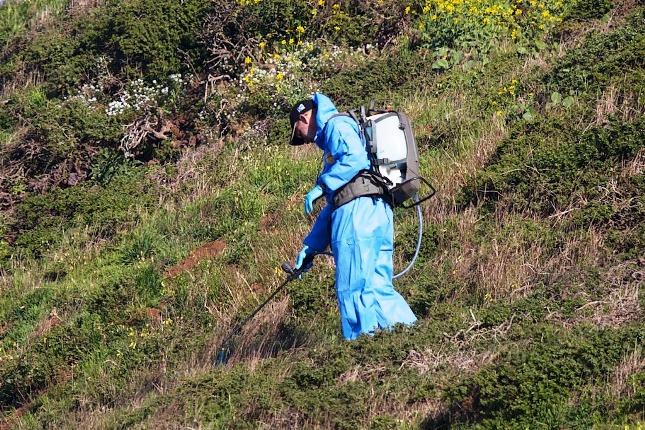
Spraying Garlon on Twin Peaks in San Francisco, February 2011
From January to March, virtually all the herbicides sprayed by NRD in the so-called “natural areas” were sprayed on oxalis. If it were possible to eradicate oxalis with herbicide, why is there more oxalis now than there was 25 years ago, when NRD (then known as the Natural Areas Program) started spraying herbicides in the “natural areas?” A lot of herbicide has flowed under the bridge in the past 25 years, but oxalis thrives. What is the point of pouring more herbicide under the bridge of sighs? We’re pouring more fuel on the fire with nothing to show for it.
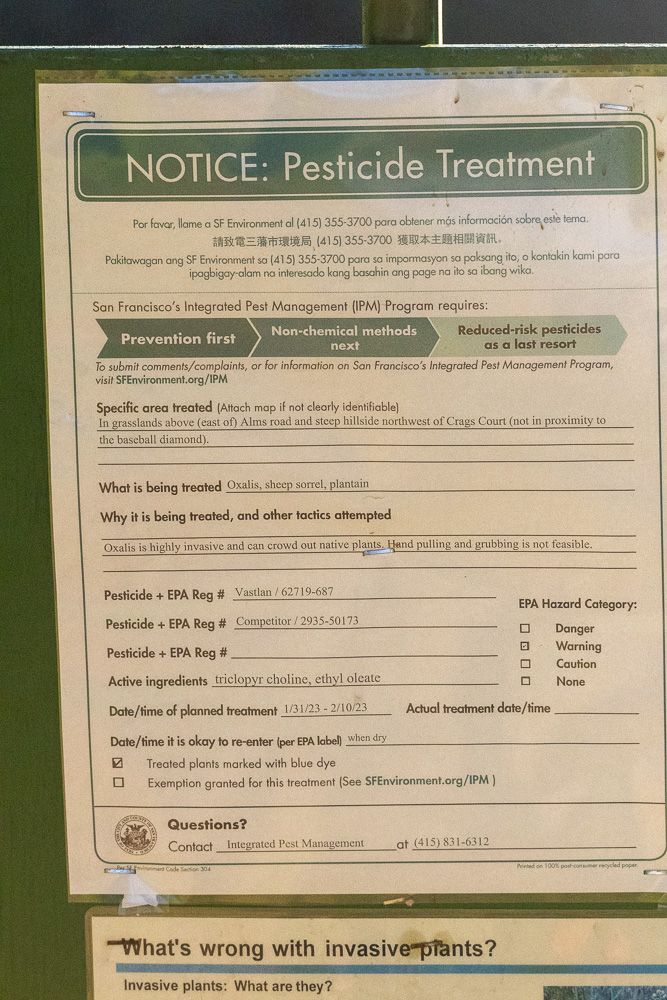
One of many pesticide application notices on oxalis in Glen Canyon Park in February 2023.
The University of California Integrated Pest Management Program explains why it’s not possible to eradicate Oxalis pes-caprae with herbicides: “Several postemergent herbicides including triclopyr and fluroxypyr (selective for broadleaf plants) and glyphosate and glufosinate (nonselective) effectively kill the top growth of this weed but are harmful to most ornamentals, so be careful these herbicides don’t drift onto desirable plants. These herbicides don’t kill the bulbs, and regrowth from bulbs should be expected.” In other words, you can kill the above-ground top growth and other non-target plants in the vicinity, but you won’t kill the oxalis.
Chemical Warfare?
On one hand, Jake urges public land managers to escalate chemical warfare against oxalis. On the other hand, he accuses oxalis of “chemical warfare” (AKA allelopathy), secreting chemicals that kill other plants. This accusation is pure speculation on Jake’s part. He offers as “evidence” of his speculation that after oxalis dies back in April “we’re left with bare ground for the rest of summer and autumn.” He ignores the obvious fact that annual spraying of gallons of herbicide on oxalis in the “natural areas” could be causing the bare ground. It has apparently not occurred to him that many herbicides are non-selective, killing everything they touch, not just targeted plants. And those herbicides that claim to be selective are very mobile in the soil, capable of killing adjacent plants through their roots. If you don’t want to see bare ground, don’t spray herbicides!
Jake asks for more research on how oxalis interacts with other plants in his article published by Westside Observer. He is apparently unaware of the research that has been done by scientists at University of Montana to address the question of how competitive oxalis is in plant communities that include native plants: “Oxalis is a poor competitor. This is consistent with the preferential distribution of Oxalis in disturbed areas such as ruderal habitats, and might explain its low influence on the cover of native species in invaded sites.”
The study explains why oxalis does not suppress the growth of other plants, including natives. Oxalis makes more phosphorous available in the soil, which essentially acts as a fertilizer for other plants: “These results are consistent with our field data and suggest that Oxalis may improve P availability in the field.”
This study was published in 2007. It found that Oxalis pes-caprae does not suppress the growth of other plants and, in fact, increases nutrients in the soil. Jake apparently doesn’t know about this study and related studies that found that pollinators are as interested in O. pes-caprae as they are in native plants.
Jake’s accusation that oxalis is waging “chemical warfare” against native plants does not come out of nowhere. The same accusation was used against eucalyptus trees for decades until a definitive empirical study proved that eucalyptus is not allelopathic. The California Invasive Plant Council removed that accusation from its evaluation of Blue Gum eucalyptus in 2015 (along with the accusation that eucalyptus kills birds). As the readers of Jake’s Nature News know, his hatred of eucalyptus is second only to his hatred of oxalis. There was never evidence that eucalyptus is allelopathic and there is no evidence that oxalis is allelopathic.
Does biodiversity justify poisoning nature?
Jake justifies his crusade against oxalis based on his belief that its existence threatens biodiversity. Since there is no evidence that oxalis kills other plants, there is no reason to believe its existence threatens biodiversity.
Jake also asks us to include only native plants in the measure of biodiversity, but he is alone in that belief. Scientific measurements of biodiversity include all species of plants and animals, whether considered native or non-native. The Recreation and Open Space Element of San Francisco’s General Plan explicitly acknowledges that both native and non-native plants contribute to biodiversity:“Parks and open spaces in San Francisco include both native and non-native species, both of which can contribute to local biodiversity.” (Policy 4.1, Recreation and Open Space of San Francisco General Plan)
Jake ups the ante against oxalis by claiming that wildlife requires solely native plants, a fundamental tenet in native plant ideology. Again, this claim is unsupported by evidence. As Professor Art Shapiro (UC Davis) says in his Field Guide to Butterflies of the San Francisco Bay and Sacramento Valley Regions,“Most California natives in cultivation are of no more butterfly interest than nonnatives, and most of the best butterfly flowers in our area are exotic.”
coyote hunting in oxalis field. Copyright Janet Kessler
On one hand, Jake claims that oxalis deprives birds and other foragers of food. On the other hand, Jake acknowledges that oxalis is foraged by gophers and scrub jays (based on one observation). Jake wants it both ways because that serves his purpose.
If native plants were any benefit to wildlife, that benefit is quashed by the widespread use of herbicides being used in the “natural areas.” For example, Himalayan blackberries are an important source of food for birds and other wildlife in San Francisco’s parks and are also eaten by children visiting the parks. The blackberries are routinely sprayed with herbicides in the so-called “natural areas.” Wildlife is exposed to the herbicides and they are also deprived of important sources of food.
A recent survey of 24,000 gardens in the UK found that pesticide use had a significant effect on bird life. The study found that gardens that used pesticides had fewer species of birds than similar gardens that did not use pesticides:
“Pesticide spraying impacted the positive effect [surrounding habitat quality] had on bird richness. Specifically, ‘species richness [number of species] increases with the surrounding quality, both for gardens that do not use pesticides and for gardens that applied pesticides, but this effect is significantly less strong when pesticides are applied’ the study indicates. Scientists zeroed in on three active ingredients: the weed killer glyphosate, the neonicotinoid insecticide acetamiprid, and the synthetic pyrethroid deltamethrin as resulting in the most damaging pesticide impacts to bird species’ richness.” Note that the study’s definition of “surrounding habitat quality” made no distinction between native and non-native plants. The British are not strong supporters of native plant ideology.
Nativists keep using huge quantities of herbicide to kill vegetation they don’t like, while also claiming that their eradication projects benefit birds. This is a fundamental contradiction. Their eradication projects are harmful to birds and other creatures that live in our parks and open spaces.
Jake’s Lament
In his article, Jake laments that people are accepting changes in the landscape because they don’t remember what the landscape looked like 100 years ago. His “baseline view” of what landscapes should look like is much further in the past than most people’s memories of the landscape.
The climate has changed significantly in the past 100 years. When the climate changes vegetation changes. We should welcome the changes because they are required for the survival of any landscape. When the climate changes, plants and animals must move, adapt, or die. The changing landscape is an indication that plants are adapting to changing conditions.
We cannot stop evolution, nor should we try. Herbicides are a futile attempt to stop evolution. Herbicides cannot stop evolution, because plants evolve a resistance to them. After 25 years of constant herbicide use in San Francisco’s parks and open spaces, we should assume that they are less effective every year.
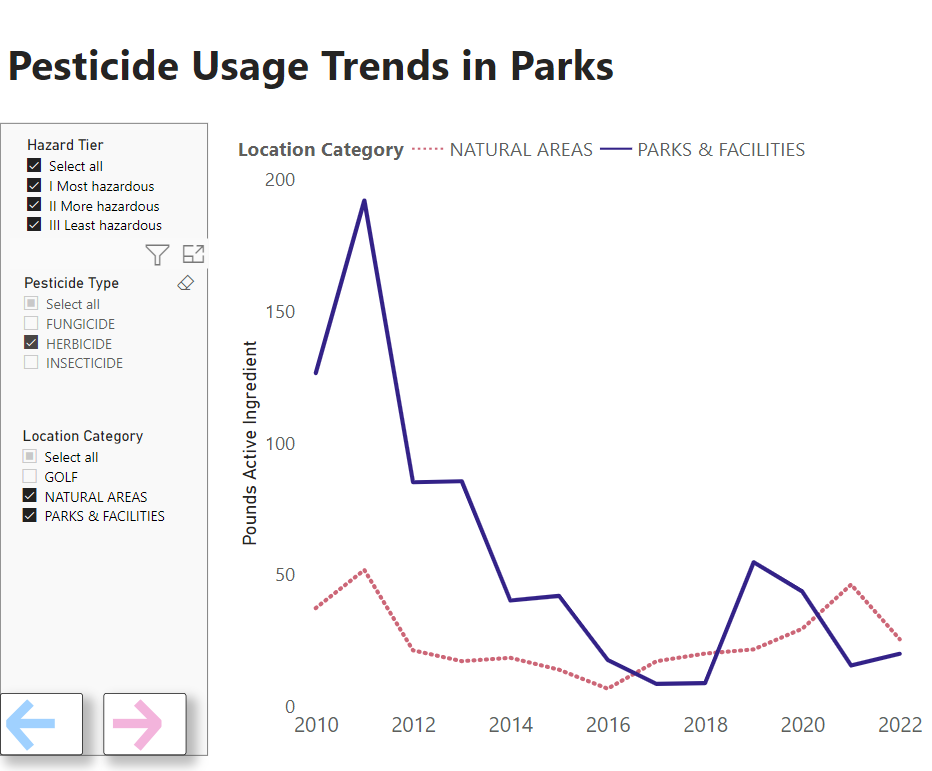
While San Francisco’s Recreation and Park Department has significantly reduced its use of herbicides since 2010, the Natural Resources Division that is responsible for the “natural areas” has not. Natural Resources Division is now using more herbicides than the rest of the parks. Source: San Francisco IPM Program, Department of Environment
“This is a superb book. Laura Martin’s research takes us where no restoration literature has gone before, asking, ‘Who gets to decide where and how wildlife management occurs?’ Martin tackles this question with unmatched clarity and insight, illuminating the crucial discussions we must have to secure a future with thriving natural species and spaces.”—Peter Kareiva, President and CEO, Aquarium of the Pacific
The author of Wild by Design, Laura J. Martin, is a professor of environmental history at Williams College.(1) She has written a comprehensive history of ecological restoration in the US that is consistent with my own observations of the restoration industry in the past 25 years. It’s a story of the gradual transition from a conservation ethic to a preservation ethic and finally to the restoration ethic that we see today. The story is punctuated by milestone federal laws and actions that facilitated the transition. Environmental non-profits and academic ecologists used those laws to professionalize and monetize the restoration industry that exists today.
By the end of the 19th Century, the public began to react to the environmental degradation caused by unregulated resource extraction. In 1902, a survey of naturalists around the country determined there were 1,143 bison left in the country; virtually all were in captivity. The American Bison Society was founded in 1905 in reaction to the disappearance of bison in America. Their activism led to the creation of federal game reserves on former Indian reservations where captive bison were introduced. The game reserves were the model for the National Wildlife Refuge system that was greatly expanded by President Teddy Roosevelt.
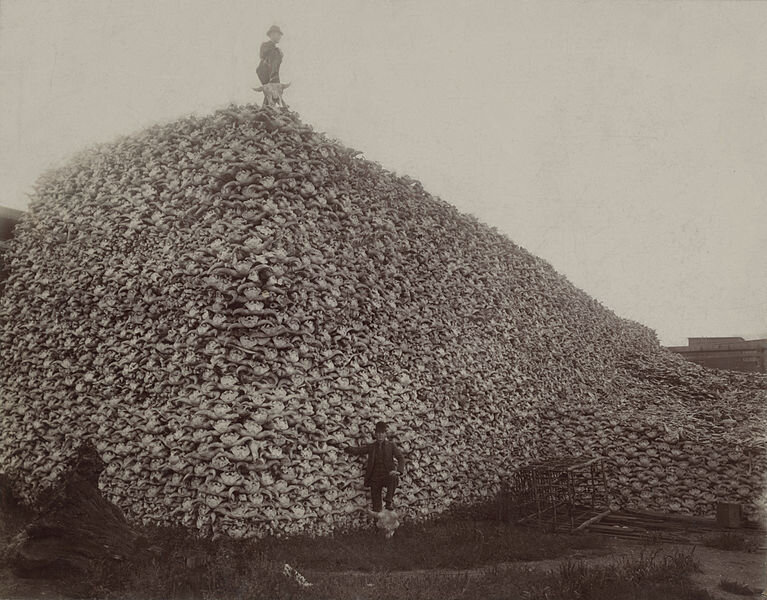
A photograph from 1892 of a pile of American bison skulls in Detroit, Michigan waiting to be ground for fertilizer or charcoal. (Photo Wikimedia Commons)
The creation of the Wild Flower Preservation Society (WFPS) in 1901 was modeled on the successful campaign of the Audubon Society to save birds killed to serve as ornaments on fancy hats. It was as much a campaign to shame women into abandoning the fashion fad as it was an effort to legally ban the practice. Likewise, the Wildflower Preservation Society applied social pressure. They were critical of organized excursions to visit wildflowers because they picked and trampled the wildflowers. WFPS said that “Weddings are a new menace to our native plants” because of their use of wild flowers. Their criticism was initially aimed at their own community, but “it moved toward policing the behavior of so-called new immigrants to the United States—especially children.” The moralistic scolding by these early native plant advocates was a preview of the finger-wagging now aimed at those who choose to plant a diverse garden.
These advocacy organizations are precursors to the many environmental non-governmental organizations that are influential in pressuring government to invest in ecological restorations today.
Conservation and Preservation
The goals of conservation and preservation are similar, but some differences were observable in the past 200 years. Both ethics are committed to protecting the environment, but conservation allows the sustainable use of natural resources while preservation protects nature from use. The presidencies of both Teddy and Franklin Roosevelt were committed to conservation.
Teddy Roosevelt created the US Forest Service based on the premise that government can and should regulate public lands to manage natural resources. Franklin Roosevelt’s conservation programs were based on the same principle, but were motivated by the economic emergency of the depression as well as the environmental disaster of the Dust Bowl in the Midwest. The Civilian Conservation Corp (CCC) was created to provide jobs as well as to plant a “shelter belt” of trees across the Midwest of the country as a windbreak to stop dust storms (and many other projects). Ecologists were critical of CCC projects because they expanded recreational opportunities and put “a stamp of man’s interference on every natural area they invade.” They preferred to exclude humans and their activities from nature. This is another early indicator of the conflicts between preservation and conservation that persist to the present day.
Sharp Park, Pacifica, CA. Photo by Erica Reder, SF Public Press
Government investment in ecological research
Ecological research in the United States was fundamentally altered after World War II, which ended with the beginning of the atomic era. Atomic bombs were dropped on Japan to end the war without much thought given to the consequences. After WWII, the federal government made big investments in science, creating the Atomic Energy Commission and the National Science Foundation, which funded ecological research to study the impact of radiation on the environment and those who live in it. Conservation Sense and Nonsense published an article about those studies and the impact they had on ecological research.
These studies legitimatized destruction of ecosystems to study effects of the destruction and the concept was expanded from radiation to pesticides in the 1960s. They also provided funding to the academic profession of ecology that was small and is now enormous. The dependence of ecological studies on government funding remains to this day and government funding of ecological projects has created the restoration industry that now extends far beyond academia. Destruction of existing habitat is still considered the prerequisite to restoring a historical landscape. Often, destruction is the first and only stage of the project because of the persistent fantasy that the native landscape will regenerate without further help.
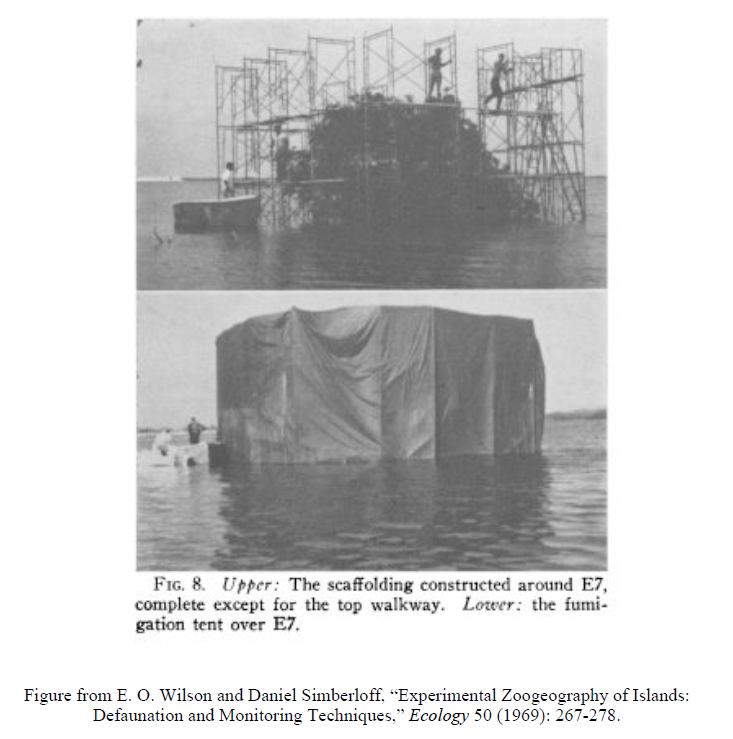
In the late 1960s Daniel Simberloff tented and fumigated 6 mangrove islands off the eastern short of Florida with methyl bromide to kill all life on the islands. The objective of the project was to study how long it would take to repopulate the islands with insects.
From Conservation to Restoration
The post-war economic boom of the 50s and 60s greatly increased the impact of human activities on the environment. The federal government built a vast highway system that fragmented and disrupted ecosystems. We built huge dams, and channeled riparian ecosystems. Open space was rapidly covered by housing and industrial development. Wetlands were drained and filled with rubble to create more land.
People who cared about the environment began to react to the loss of nature and wildlife that lives in nature. Although Aldo Leopold is idolized by the native plant movement, his concern about the degradation of nature was primarily for wildlife. His interest in vegetation was as habitat for wildlife. He was opposed to government programs devoted to killing animals perceived as predators of game animals because he believed that wildlife is best served by expanding their habitat. In fact, he was opposed to the expansion of government’s role in conservation because “he believed restoration would be most efficient and effective if pursued by private citizens.” He did not prefer native plants because “Farmers had the opportunity to conserve plants such as ragweed and foxtail (an introduced grass), ones ‘on which game, fur, and feather depend for food.’” In other words, in the 1940s one of the icons of the native plant movement knew that wildlife is not dependent upon native plants for food. One wonders if native plant advocates have actually read Leopold’s treatise, A Sand County Almanac.
Aldo Leopold’s son, Starker Leopold, had as much impact on conservation in the United States as his father. In 1963, he published the Leopold Report that changed the direction of conservation in the National Park Service. The Leopold Report recommended a goal for national parks of maintaining historical conditions as closely as possible to those of “primitive America.”When the Leopold Report was adopted as official policy by the National Park Service in 1967, it committed NPS to restoring park lands to pre-settlement conditions.NPS officially changed this policy in 2021, but we don’t see any change locally in their projects because NPS is decentralized and local parks are autonomous.
Restoration Goals
Professor Martin says that “historical fidelity did not become a widespread restoration goal among ecologists and environmental organizations until the 1980s.” The arrival of Columbus in the new World in 1492 was arbitrarily selected as the date after which all new plant species were “deemed nonnative, unwanted reminders of human (colonist) presence and activity.” On the West Coast, 1769 is the equally arbitrary date to confer non-native status because it is the date of the first Spanish expedition to California.
Many now question the goal of replicating historical landscapes. After 40 years of effort, there is a growing recognition that it is not a realistic goal, especially in a rapidly changing climate. The Society for Ecological Restoration has changed its definition of ecological restoration from “the goal of intentionally altering a site to establish a defined, indigenous, historic ecosystem” in 1990 to “the process of assisting the recovery of an ecosystem that has been degraded, damaged, or destroyed” in 2002. Try telling that to the restorationists on the ground who are still trying to eradicate naturalized non-native plants that have been here for nearly 200 years. Non-native annual grassland in California is a case in point. It has been repeatedly burned, mowed, plowed, and poisoned for 25 years without any visible progress toward native perennial grassland.
Blaming non-native species
Around the same time that historical fidelity was identified as the goal of “restorations,” land managers and ecologists decided that the existence of non-native species is the main threat to native species. I suppose the “logic” was that the main difference between historical landscapes and present landscapes is the existence of non-native species. Concern about non-native species spread among federal agencies such as the National Park Service and The Nature Conservancy (TNC) began aggressive campaigns to kill non-natives, “which were newly framed as the main threat to wild species…nativity would become a precondition to wildness—of plants and animals both.” TNC’s methods have become increasingly deadly and destructive: using fire and herbicides to kill plants, poisoning honeybees, aerial hunting of sheep, pigs, and goats. As a former donor to TNC, their methods finally became intolerable to me.
Professor Martin believes that the identification of non-native species as the scapegoat was not based on experimental evidence, but merely a description of the strategies used by public land managers, as well as The Nature Conservancy. Non-native species were a convenient scapegoat because they were easily identified and were an easy substitute for identifying and remediating the underlying conditions causing so-called “invasions.” “Although the role of invasive species in native species extinction has since been challenged by some ecologists, the influence of this fear on species management has been enormous…The US federal budget for invasive species management increased by $400 million between 2002 and 2005, for example.”
Endangered Species Act
The Endangered Species Act (ESA) was passed in 1973, along with companion laws such as the National Environmental Protection Act and others. These federal laws created more funding opportunities for ecological projects as well as the legal justification for ecological restoration projects.
Federal laws permit the reintroduction of legally protected plant and animal species to places where they no longer exist. The ESA confers the same protections for reintroduced species as it does for naturally occurring species. Such reintroductions have become a tool for the restoration industry. I have seen that strategy used in the San Francisco Bay Area. If we had not been successful in preventing the reintroduction of a legally protected turtle, it would have justified the destruction of the non-native forest in my neighborhood park because the turtle requires unshaded nesting habitat within 500 feet of the water source in the park. The park remains largely forested because that is one of the few battles we have won in 25 years. Reintroduced, legally protected species are the Trojan horses of ecological restorations.
Compensatory mitigationis an equally powerful tool for the restoration industry. Federal law requires an Environmental Impact Statement (EIS) for projects that will have a significant impact on the environment, such as big developments like building Disney World in Florida. Disney World was built on an enormous wetland that was lost by the development of the park. The EIS for the project agreed that the impact would be great, but it “mitigated” the impact by requiring Disney to fund the creation of a new wetland in a distant location.
The funding generated to create fake wetlands built a new industry of commercial companies to design and build them. Academic restoration ecologists questioned the functional equivalency between created and natural wetlands: “’however accurate [the Comprehensive Everglades Restoration Plan] is the restored community can never be authentic.’” The tension between commercial and academic restorationists continues today.
The Society for Ecological Restoration published findings that mitigation wetlands were not functionally equivalent to the wetlands they were meant to replace. In Florida only half of the promised mitigation projects were actually built. Those that were built were colonized by “undesirable plant species” such as cattail and melaleuca in 32 of 40 projects.
Projects that earn carbon credits are creating the same opportunities to generate funding for restoration projects in distant locations. The Nature Conservancy was successful in defining carbon offsets as an international market when the Kyoto Protocols were signed in 1997. They understood that a reforestation project would be cheaper in Costa Rica (for example) than a comparable energy efficiency project in the US. Such distant projects don’t benefit those in the US who now have a power plant in their backyard that is being offset by a forest in Costa Rica.
It’s a game for those who know how to play. I have witnessed local examples in the Bay Area. An oil spill in the bay generated millions of dollars of compensatory damages to fund unrelated “restoration” projects. How does planting eel grass compensate for hundreds of birds killed by the oil spill? When the San Francisco airport expanded runways, the airport had to pay compensatory mitigation that funded the restoration of native plants at India Basin in San Francisco that hardly compensates for the increased air traffic enabled by the new runway.
Conclusion
Professor Martin is surprisingly frank about the future of ecological restoration in America:
“Whatever paths restorationists choose, restorations must happen in tandem with other changes in human behavior. If we don’t reduce the ongoing harms of racism, fossil fuel burning, overconsumption by the wealthy, and toxic industrial chemicals, restoration will offer no more than a temporary repair, a way to move a problem to some other place or time.”
I would go one step further in my assessment of the restoration industry. I would say that the methods used by restorationists are directly contributing to environmental degradation.
Professor Martin asks the right questions in her concluding chapter: “Who benefits from restoration? Who is harmed?” Those who earn their living in the restoration industry are the primary beneficiaries. According to a 2015 study entitled “Estimating the Size and Impact of the Ecological Restoration Economy,” environmental regulation has created a $25 billion-per-year restoration industry that directly employs more people than coal mining, logging or steel production. Given recent investments in restoration projects of billions of dollars by California and federal infrastructure funding, this figure is undoubtedly an underestimate.
Who is harmed?Wildlife and humans are harmed by the destruction of useful habitat with herbicides. Harmless animals and plants are killed because they have been arbitrarily classified as “invasive.” And all Americans are harmed by the waste of public funds that could be used to benefit society and/or the environment.
(1) Laura J. Martin, Wild by Design: The rise of ecological restoration, Harvard University Press, 2022. All quotes are from this book.
Laura J. Martin is an environmental historian at Harvard University. She wrote two articles (1,2) about the origins of ecological field studies that might help explain the destructive methods still used today by some ecologists. Professor Martin “contendsthat the history of ecosystem science cannot be separated from the history of nuclear colonialism and environmental devastation in the Pacific [Nuclear Testing] Grounds” (2)
When the US dropped two atomic bombs on Japan in 1945, little thought was given to the consequences of atomic bombs because ending the war in the Pacific was the only consideration. Japan surrendered to the US less than one month after the bombs were dropped, effectively ending World War II.
Few doubt that the use of atomic weapons was instrumental in ending World War II. After the war, there was a more sober effort to determine the consequences of using atomic weapons. Some believed that nuclear weapons might replace conventional warfare. Others wanted to understand the impact on life on the planet before making such a momentous decision. This effort was focused on practical considerations such as the impact on the world’s fisheries and food supply. The objective of their initial studies was less concerned about long-term consequences for the environment such as the duration of impacts on living creatures and the environment in which they live.
The US federal government invested heavily in the sciences after World War II. The Atomic Energy Commission (AEC) was established in 1946 and the National Science Foundation (NSF) in 1950. The availability of federal grant funding for academic institutions “dramatically reconfigured the relationships among federal, academic, and corporate spheres.” (2) Increased federal funding greatly increased the number of academic research projects.
Between 1945 and 1970, the US detonated 105 nuclear weapons. The Atomic Energy Commission and later the National Science Foundation paid academic ecologists to conduct field studies at the test sites to determine the impact on animals.
In 1963 the US, Soviet Union, and Great Britain signed a Partial Test Ban Treaty that prohibited all non-wartime detonations except for those done below ground. Testing of the effects of radiation by academic scientists continued because the AEC mass produced radioisotopes and distributed them to American institutions. Scientists were no longer constrained to field sites where atomic bombs had been detonated.
“Thus began a period in which ecologists purposefully destroyed ‘ecosystems’ to study how they recovered.”
Laura Martin, “The World in Miniature”
The availability of radioisotopes made laboratory testing possible, but it also enabled large-scale atomic irradiation experiments such as a forest irradiation project in Georgia that exposed 300 acres of forest to an air-shielded reaction (?) that produced radiation levels comparable to expected fallout following a nuclear catastrophe. The purpose of that experiment was to determine the impact of radiation on forests. The findings were that some tree species were more vulnerable to radiation than others. This finding contributed to the hypothesis “that the greater number of species in an ecosystem, the better that system will be ‘adjusting to stress.’” (1) This is the familiar theory that greater biodiversity enhances resiliency of ecosystems against stressors such as climate change. It remains a cornerstone of conservation science.
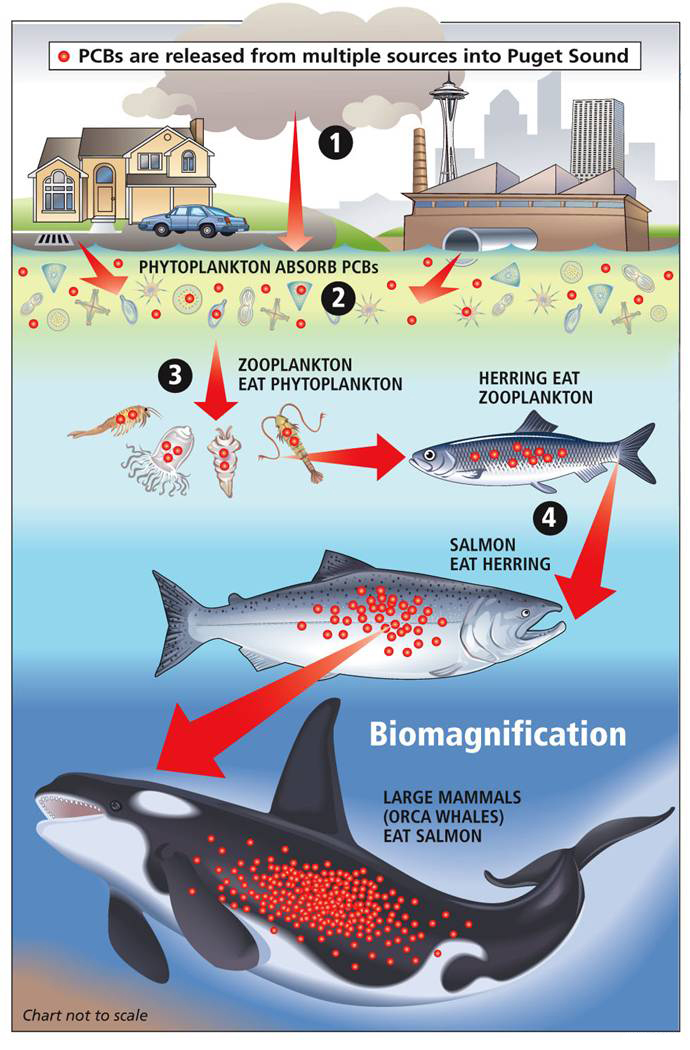
These studies are also responsible for the knowledge that radiation—and many other toxic substances such as chemicals—bioaccumulate, first described publicly in 1955, according to Martin. Many toxic substances persist in our bodies throughout our lifetime. The longer we are exposed to them, the more dangerous they are to our health. Women who were exposed to DDT before it was banned in 1972 still have higher levels of DDT in their bodies than women born after 1972. Many toxic chemicals also bioaccumulate in food webs. Top predators in the food web are more heavily burdened with poison than animals at the bottom of the food web because of biomagnification.
Using pesticides to study impacts and recovery
The concept of destroying an ecosystem for the purpose of studying impacts and recovery from impacts was soon extended to using pesticides. In a study funded by NSF in the 1960, herbicides were repeatedly applied to clear-cut plots in the White Mountain National Forest to compare the runoff from “disturbed” watershed with “undisturbed” control watersheds. “They concluded that forest clear-cutting led to the leaching of nutrients from the soil, and ultimately, algal blooms in downstream waters.” (1) (Yet, 60 years later, spraying clear-cuts with herbicides is still the norm in the timber industry.)
Destructive methods used by Daniel Simberloff
The first publication (3) in 1969 of Daniel Simberloff’s academic career was a report of his Ph.D. dissertation project under the direction of EO Wilson at Harvard University. He tented and fumigated with methyl bromide 6 mangrove islands off the Eastern shore of Florida to kill all the insects. His objective was to study how long it would take for insects to recolonize the islands.
Although Simberloff monitored the islands for only one year, he concluded, “The colonization curves plus static observations on untreated islands indicate strongly that a dynamic equilibrium number of species exists for any island.” (3) This is an example of the generalized conclusions of ecological studies noted by Professor Martin: “With ecosystem studies, ecologists claimed that fieldwork conducted in one place could be used to understand other distant and different places. The Pacific Proving Grounds became a model for lakes in Wisconsin, rain forests in Panama, deserts in China…” (2)
Laura Martin says of Simberloff’s study, “Destruction thus became a method of studying ecosystems. As Eugene Odum put it: ‘ecologists need not feel bashful about attacking ecosystems so long as they observe the rules of good science.’” (1)
Methyl bromide used by Simberloff in his thesis project is known to deplete the ozone layer of the atmosphere that shields the Earth from harmful Ultraviolet light that causes skin cancer. Its use was severely restricted by an international treaty in 1989. However, it is still used in the US for agricultural crops as a soil sterilant that kills all living organisms in the soil.
Nearly 60 years after the publication of his Ph.D. study, Daniel Simberloff remains one of the most vocal advocates for the eradication of non-native plants and animals. With few exceptions, those eradications require the use of pesticides. Simberloff may not have known the damage that methyl bromide does in the environment at the time of his study, but surely he knows or should know now. Yet, he is still committed to the eradication of non-native plants, projects that require the use of pesticides.
Many ecological studies and associated “restoration” projects adopt the same viewpoint that destruction is a justifiable method of studying and “restoring” ecosystems. “Restoration” projects often begin by killing all non-native plants with herbicides before attempting to create a native landscape. Rodenticides and insecticides are used to kill non-native animals with the understanding that many native animals will inevitably and unintentionally be killed. The Endangered Species Act accommodates the by-kills of these projects by issuing permits for “incidental takes.” The law and the scientific community make a distinction between killing individual animals and killing animals on a scale that threatens the survival of the species.
Killing and destruction were established as legitimate scientific tools over 70 years ago. Given what we know now about pesticides and radiation and at a time when habitats are being destroyed by human activities and climate change, is it time to question the legitimacy of habitat destruction as a scientific tool?
A Preview
Professor Martin is also the author of her recently published book, Wild by Design: The Rise of Ecological Restoration. I look forward to reading it. Meanwhile, I hope Professor Martin’s papers about the destructive origins of ecological field studies are a preview of her book.
Update: I have read and summarized Wild by Design in this article, published January 7, 2023.
Happy New Year! We hope 2023 will be a more peaceful year.
I have attended the annual symposiums of the California Invasive Plant Council (Cal-IPC) for 5 years. I have always learned something new and the most recent symposium in November 2022 was no exception. This year there was a lot of important information about herbicides that are widely used to eradicate non-native plants.
Several presentations reviewed the California laws that regulate pesticide use in California. (Slides for one of those presentations are available HERE.) The laws are designed to reduce risks of exposure to both applicators and the public.
The presentations emphasized the importance of legally mandated personal protective equipment (PPE) for applicators. The minimum PPE required by California law is protective eyewear and chemically resistant gloves:
Source: 2022 Cal-IPC Symposium
The toxicity of pesticides is rated by federal law as “Caution,” “Warning,” or “Danger,” with “Danger” indicating the most toxic and “Caution” the least toxic. These ratings are defined as signal words. Signal words of “Warning” or “Danger” require the applicator to also wear protective coveralls, in addition to protective eyewear and gloves.
Other types of PPE may be required by the product label, shown in this picture:
Source: 2022 Cal-IPC Symposium
Comparing the toxicity of organic and synthetic herbicides
Signal words can be used to compare the acute toxicity of different products. For example, the signal word on glyphosate products is “Caution,” indicating that it is considered less acutely toxic than other herbicides with higher toxicity ratings of “Warning” or “Danger.” Signal words are not a measure of long-term health damage of pesticides, such as cancer or kidney damage. Epidemiological studies of long-term health effects of pesticides are hotly disputed and are usually dismissed by the manufacturers of pesticides.
When glyphosate products were rated as a “probable human carcinogen” by the World Health Organization and tens of thousands of product liability lawsuits were filed by users of glyphosate products with cancer, there was a public backlash against the use of glyphosate partly because it is the most widely used herbicide on the market. Glyphosate is found in most of our food and in the urine of most people. The health damage done by glyphosate is the result of 40 years of widespread use by agriculture. Glyphosate’s “Caution” signal word does not reflect the long-term effects of its use.
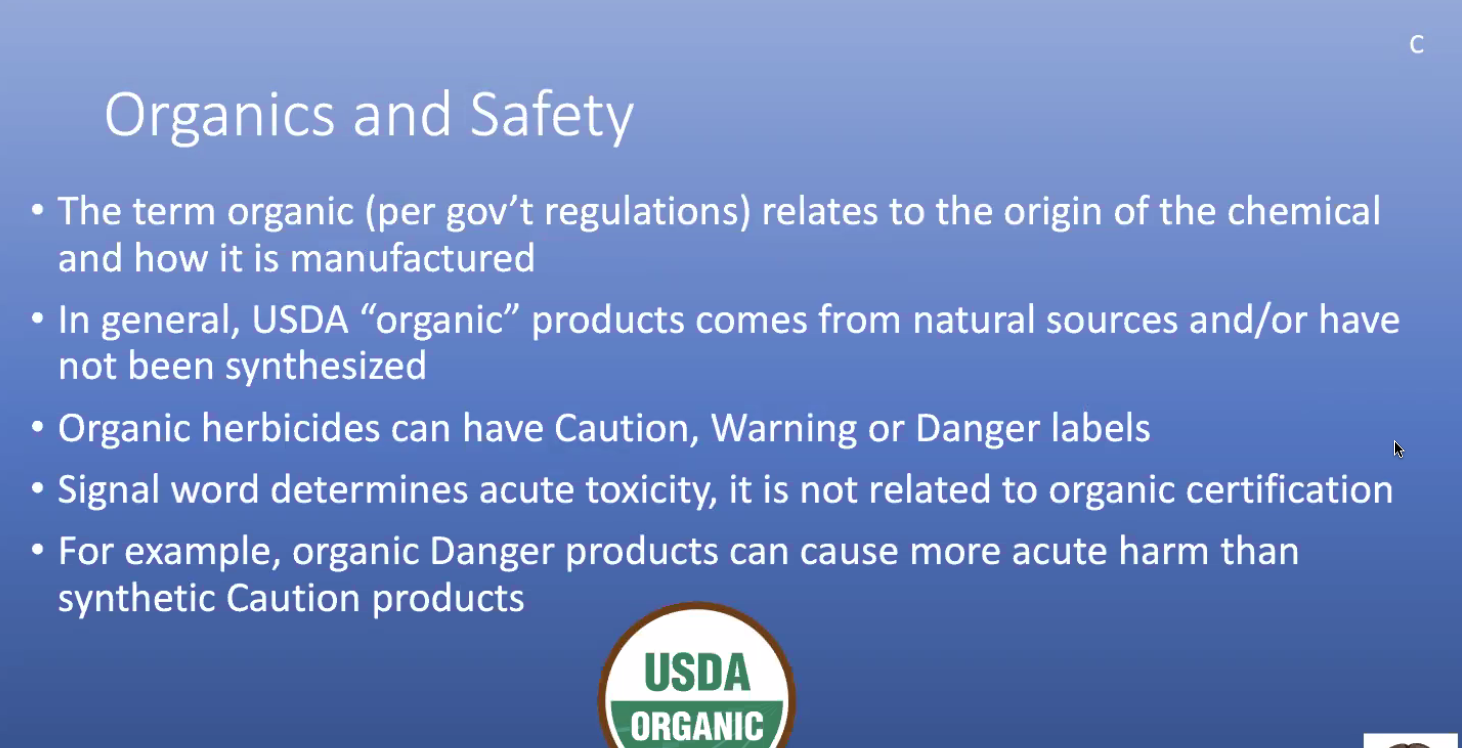
What is the difference between synthetic and organic pesticides? In general, organic products are derived strictly from sources in nature with little or no chemical alteration. Synthetic pesticides are products that are produced from chemical alteration.
Are organic pesticides less toxic than synthetic pesticides? The general public tends to assume that organic pesticides are less toxic than synthetic pesticides, such as glyphosate. Based on the signal words the EPA assigns to pesticides to evaluate toxicity, organic pesticides are not necessarily less toxic than some synthetic pesticides. Remember the signal words are “Danger” (the most toxic), “Warning,” and “Caution” (the least toxic.)
Several presentations at the Cal-IPC conference compared the toxicity of organic and synthetic pesticides, using signal words as a proxy for toxicity. This is a slide from one of the presentations:
I also compared the signal words of the organic products used by Marin County and East Bay Regional Park District. Although they are using some organic products not evaluated by the presentation at the Cal-IPC Symposium, many of the organic products they are using have a “Warning” signal word, which means the EPA considers them more toxic than glyphosate.
Clearly organic herbicides are not necessarily less toxic than synthetic herbicides and many organic herbicides are more toxic than glyphosate.
Comparing the efficacy of organic and synthetic herbicides
Here are the results of the field trial (one organic herbicide was removed from the field trial when glyphosate was reported as an undisclosed ingredient in the product):
WeedZap and Fireworxx are the organic herbicides used in the field trial. The organic herbicides used in the field trial were found to be less effective than synthetic herbicides considered equally toxic.
“Organic herbicides kill weeds that have emerged but have no residual activity on those emerging subsequently. Further, while these herbicides can burn back the tops of perennial weeds, perennial weeds recover quickly.”
“These organic products are effective in controlling weeds when the weeds are small but are less effective on older plants.” The organic herbicides were significantly less effective when weeds were more than 12 days old.
“…broadleaf weeds were easier to control [with organic herbicides] than grassy weeds.”
Comparing the cost of organic and synthetic herbicides
The field study comparing organic and synthetic herbicides also compared the costs of these different product types:
In other words, organic herbicides are considerably more expensive than synthetic herbicides.
The publication of the UC Nursery and Floriculture Alliance agrees: organic herbicides “are expensive and may not be affordable…Moreover, because these materials lack residual activity, repeat applications will be needed to control perennial weeds or new flushes of weed seedlings.”
Clearly, organic herbicides are not a substitute for synthetic herbicides because they are not less toxic, not as effective, and are very expensive. Cal-IPC considers that assessment of organic herbicides a justification for continued use of synthetic herbicides. I consider it an argument for declaring a truce in the war on “invasive” species. We have waged that war for over 30 years. We have not won that war. In fact, we lose ground every year. We have done more damage to the environment with our chemicals than the “invasive” species did. We have reached a dead end.
Herbicides and Climate Change
The most valuable lesson I learned at the Cal-IPC Symposium was that climate change is making herbicides less effective. Higher temperatures and higher levels of CO₂ are reducing the effectiveness of herbicides. This revelation was mentioned only briefly in a presentation by Regional Invasive Species and Climate Change (RISCC) Management Networks. A search of the scientific literature substantiated that revelation:
”Herbicide effectiveness in controlling invasive plants under elevated CO2: Sufficient evidence to rethink weeds management:” “We found that responses of the weed species to herbicide under elevated CO2 were species-specific… However, the C3 [cool season] grasses tended to be the most sensitive to herbicide application followed by the herbs and C4 [warm/hot season] grasses while shrubs and vines demonstrated the highest resistance. Our results highlight the need for broader testing to determine the species most likely to exhibit increased tolerance to herbicide in the future in order to improve management options beforehand and thus offset a future liability.”
These studies are just a small selection of the studies that respond to a search for “impact of heat and CO₂ levels on herbicide efficacy.” They all point to yet another reason why the chemical crusade on introduced plants is a dead end.
Climate change is a reality and it is here to stay. Climate change has changed the ranges of where native plants can survive and it has made it impossible to destroy the non-native plants that are capable of surviving in the changed climate. Switching from one poison to another will not overcome the forces of evolution, which dictate that vegetation changes when the climate changes.
Tree Thieves (1) is a non-fiction version of Damnation Spring, a novel that tells the story of the Timber Wars that ended with the death of the logging industry in the Pacific Northwest in the 1970s, 80s, and 90s. Although the industry collapsed throughout the Pacific Northwest, both books focus on the redwood forests of coastal Northern California.
Sequence of Events
When the timber industry began in earnest after the Gold Rush of the 1850s, there were said to be 2 million acres of redwood forest on the coast of California. The demand for timber during the Gold Rush fueled the unrestricted clear-cut methods that decimated the forest, provoking a backlash.
The city-slickers who established the Save the Redwoods League in 1918
The National Park Service invited three well known conservationists to visit the redwood forests of Northern California, which led to the creation of the Save the Redwoods League in 1918. Two members of that team–Madison Grant and Henry Osborn—were also advocates for eugenics, the control of human reproduction for the purpose of increasing characteristics considered desirable. The author of Tree Thieves, Lyndsie Bourgon, describes their purpose for creating the Save the Redwoods League: “They considered protecting the redwoods as part of a mission to enshrine White, masculine dominance over the wilderness.” (1) Save the Redwoods League purchased several parcels of redwood forest for preservation, setting the stage for the continuing perception of environmentalism as the hobby of wealthy city dwellers, with little understanding of the lives of those who live and work in resource extraction industries such as forestry. The League has acquired a total of 66 redwood forests as of 2018, according to Wikipedia.
In the 1930s the government imposed restrictions on the timber industry that limited clear-cutting methods because of concern about dwindling timber stocks. The industry returned to clear-cutting methods after World War II in response to the demand for new housing. By 1968 90% of redwood forests had been logged, according to Tree Thieves.
Consequences of clear-cut logging
The author of Tree Thieves believes that the turning point leading to the Timber Wars was a flood in 1955 that triggered a landslide that “toppled 1,000 year old redwoods and covered the region in silt and mud.” The landslide was the result of decades of clear-cutting the forest: “During clear-cut logging, topsoil is lost and streams are bulldozed for roads…In Humboldt [County’s] forests, the root system could no longer contain the immense annual rainfall and waterways began to flood. Mangled roots, lack of second growth, and flattened shrubs made the earth unstable and the construction of roads deep in the woods to transport logged wood had hastened erosion and habitat destruction.”
This is what remains of Orick, Ca. Google Earth
Clear-cut logging didn’t stop after the first flood and landslide and in 1964 another flood and landslide swept through the town of Orick. The town of Orick is at the center of Tree Thieves’ telling of events. Orick is said to be a Yurok word for “mouth of the river,” perhaps referring to Redwood Creek that bisects Orick. Yuroks were one of several tribes of Native Americans who were the first human inhabitants of the region. At the height of the post-war timber boom, there were about 2,000 inhabitants of Orick. The 2010 census downgraded Orick from a town to a “census designated place” with fewer than 400 inhabitants.
These catastrophic floods alerted the Sierra Club to the issue of clear-cut logging and the government was becoming concerned about the environmental devastation it caused. In 1968, the government established the Redwood National Forest, which ended logging in the park. The government believed—or said they believed–the park would create a tourist trade, replacing the logging economy. Timber corporations were compensated by the government for the loss of their properties, but there wasn’t government relief for the loggers.
The Timber Wars
The promise of a tourist industry proved to be a fantasy, which forewarned the loggers of the consequences of expanding the national park that occurred in 1978. This time the loggers fought back and environmentalists organized to engage in that war. In the 1970s, Humboldt County became a rural refuge for hippies fleeing the druggy disorder of cities as described by Joan Didion in Slouching towards Bethlehem. They were the foot-soldiers opposing the loggers in the Timber Wars.
Both sides of the Timber Wars engaged in violence and vandalism, as well as degrading rhetoric. “ARE YOU AN ENVIRONMENTALIST, OR DO YOU WORK FOR A LIVING?” was a typical protest sticker worn by loggers. One of the leaders of the environmentalists, Judi Bari, described the loggers as “the equivalent of the white racists in Mississippi…They’re being used by the system. But they are people who are not real bright who have bought into it.”
The battle lines need not have been drawn between loggers and environmentalists. If they had worked together to find a solution to environmental issues, the battle lines could have been the timber corporations vs. the government. The decision to clear-cut and spray with herbicides was made by the corporations, not by the loggers. Many of the loggers had learned their profession by taking individual trees in the forest, which quickly recovered from single tree removals. They knew that clear-cutting was destructive and they probably would have been glad to return to less destructive methods of logging. Many of them also knew that herbicides used for road clearance and destroying competing vegetation after clear-cuts were poisoning the watershed and sickening their community. That aspect of the story is best told by Damnation Spring.
If loggers and environmentalists had worked together to pressure the government to regulate the destructive aspects of the timber industry, the environmental issue could have been resolved without a war that permanently alienated both loggers and environmentalists. Government has the right to regulate pesticide use and it could restrict clear-cutting, but it didn’t and it won’t. The Timber Wars also alienated some people from environmentalism and others from the logging industry. There is a lesson here for those who wish to learn it.
The loggers were also disrespected by the government. While the plan to expand the national park was being debated, the loggers organized a convoy of logging trucks across the country to Washington DC in 1977. They carved a redwood log into the shape of a peanut, intended as a gift to President Carter, a former peanut farmer, hoping to engage him in a dialogue. President Carter refused the gift and the request for a meeting. He said the peanut-log was a waste of a valuable resource. The logging convoy not only failed, but it subjected the loggers to abuse across the entire country and back.
The decision to expand Redwood National Park in 1978 incorporated the forests protected by the Save the Redwoods League and California state parks into a total of 139,000 acres, protecting approximately 45% of remaining redwood forests. Once again, the timber corporations were compensated for the loss of their properties. This time, the federal government tried to compensate loggers for the loss of their employment by funding a job training program, community development projects, watershed restoration, and direct compensation to unemployed loggers.
The failure of the job retraining effort was very disappointing: “By 1988, $104 million had been spent on about 3,500 people, of whom fewer than 13% had received retraining….’Never have so many given so much for so few,’ one critic noted of the funding.”
The fate of the loggers and their community
When spotted owls and several other forest species were designated as threatened species by the Endangered Species Act in the 1990s, much of the timber industry was also shuttered in Washington and Oregon. Between 1980 and 1998, 23% of logging jobs were lost.
Using the community of Orick in California as an example, Tree Thieves describes the consequences of the loss of the timber industry. Many people moved away. Those who remained pieced together a meager living of odd jobs. Many of those odd jobs were criminal. Poaching of whole trees in the national park is still common, but poaching the valuable redwood burls is more lucrative.
Redwood burl. California State Parks
Redwood burls are the tree’s means of recovering from wounds. The burls have artistic patterns in their wood grain that make them valuable to make furniture, art objects, and veneers for the dashboards of luxury cars. The tree is damaged by the removal of its burls and is sometimes killed by the damage.
Tree Thieves interviews many of the former loggers, now poachers. They are an angry bunch who feel justified in their thievery. Their livelihoods and self-respect have been taken from them and they have been subjected to decades of abuse by self-righteous environmentalists and government enforcement. They now feel owed.
Having won the Timber Wars, environmentalists are rarely directly engaged in confrontational encounters. Now the anger of dispossessed loggers is directed at government employees who are trying—with little success—to stop poaching and punish poachers. Government employees are also imposing new restrictions on the communities surrounding the national park, opening new wounds. For example, these poor communities are now prohibited from collecting drift wood on the beach, which was used to fuel wood-burning stoves in the past.
Timber corporations were not blamed for the Timber Wars. They were compensated by the government for the loss of their land. They had already logged much of the land and didn’t see much future in the few forests that remained. They were responsible for much of the loss of employment because they had mechanized much of the work and reduced availability of unlogged forests after clear-cutting for decades. They walked away unharmed.
Making, selling, and using methamphetamines is also a common way to survive in Humboldt County. Those who choose that mode of survival frequently engage in other criminal behavior and their lives are often ruined in the process.
The marijuana trade in Humboldt County is also a popular career choice. Ironically, the damage to the environment caused by large marijuana farms hidden in the forests is one of the consequences of the transition from a logging economy to an odd-job economy.
This scenario is probably similar to many other small towns and rural communities in America. There are devastated communities in former coal country and in the rust-belt where manufacturing industries have been closed as the result of global trade agreements that enabled industries to move to countries with lower labor costs. Those are the places where angry people no longer trust the government, where environmentalists and other “experts” are hated. And those are the places where desperate, resentful people have turned to an angry, resentful politician to lead our country. We reap what we have sown.
Lyndsie Bourgon, Tree Thieves: Crime and survival in North America’s woods, Little, Brown Stark, The Hatchett Group, 2022. All quotes are from this book. Some factual information is from Wikipedia.
The California Native Plant Society (CNPS) held a conference in October for the first time since 2018. There were two main themes of the conference:
Money: The State of California is making a huge investment in the environment with many interrelated goals:
“30 X 30” is shorthand for the goal of protecting 30% of California’s land and coastal waters by 2030.
Developing “nature-based solutions” to address the threats of climate change.
Vegetation and forest management to reduce wildfire hazards.
Protecting and enhancing California’s biodiversity.
Fire: The frequency and intensity of wildfire is of concern to all Californians, but the California Native Society has a particular interest in fire because it is viewed as a tool to enhance native plant abundance and control the spread of non-native plants that outcompete native plants.
Money
If attendance were the sole measure of success, the conference was a resounding success. The conference was sold out with record-breaking attendance of 1,200 people. That’s a 50% increase in attendance since 2018, when 800 people attended. People came to learn about the many opportunities for public funding of their “restoration” projects and they were not disappointed.
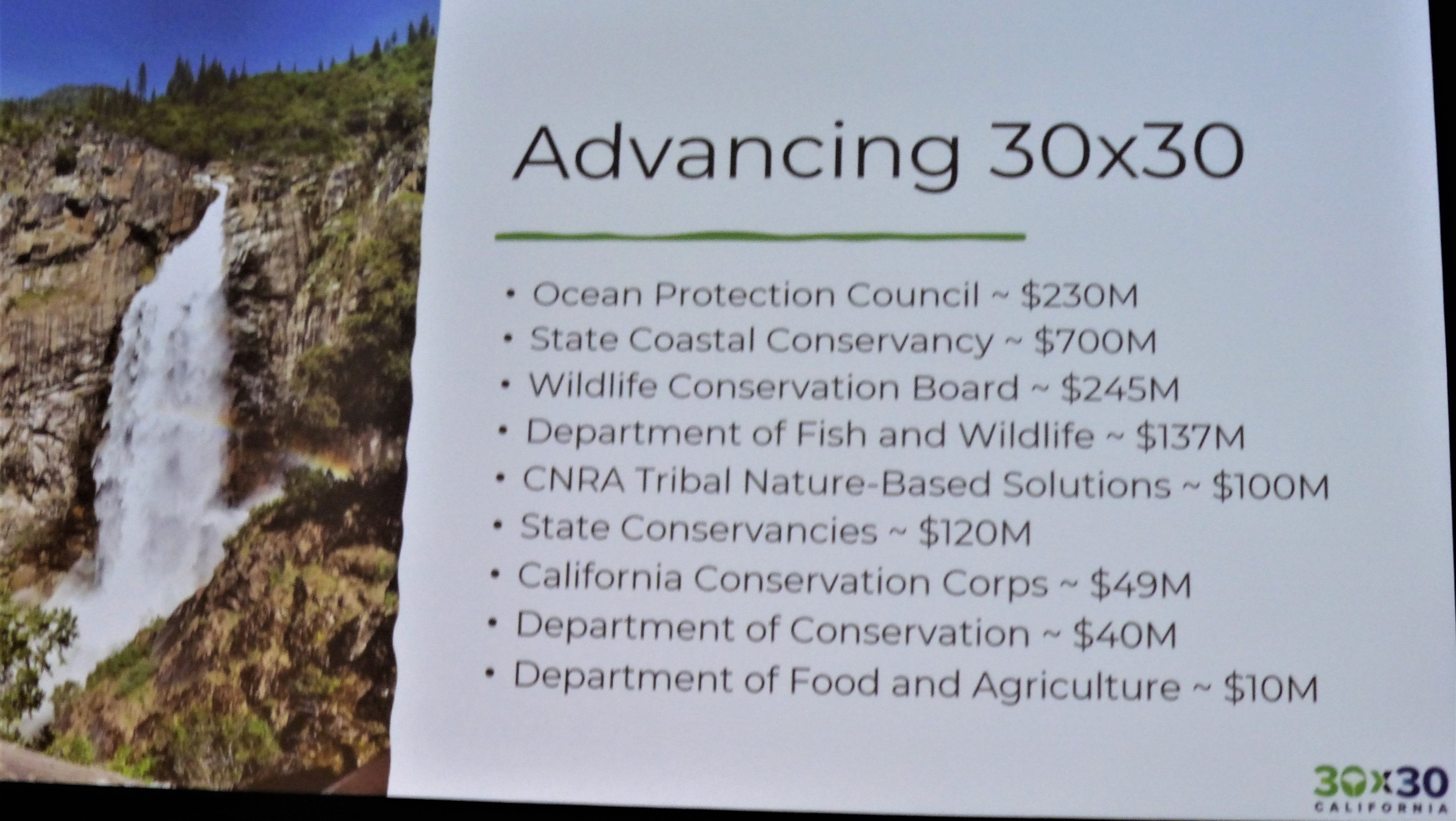
Jennifer Norris, Deputy Secretary for Biodiversity and Habitat for the California Natural Resources Agency (CNRA) was one of the keynote speakers. She and many other staff of CNRA made presentations at the conference to inform the community of native plant advocates about the many new opportunities to obtain grants for their projects. This slide (below) shown at the conference, itemized by state agencies the $1.631 Billion budget for just the 30 X 30 portion of the CNRA’s environmental grant programs. It does not include Cal-Fire funding for forestry projects to reduce wildfire hazards and address climate change. Nor does it include $10 million of new funding for Weed Management Areas, which funds projects that attempt to eradicate non-native plants and $10 million of new funding for the state council for invasive species. State funding is also supplemented by new federal funding in support of a national goal of achieving 30 X 30.
But money isn’t the only element of this state program that native plant advocates are excited about. They have also been gifted a three-year moratorium on requirements for Environmental Impact Reports for their projects. There will therefore be no requirements for a public process to review plans and comment on them.
An anxious applicant for state grant funding asked a speaker representing the Wildlife Conservation Board about a rumor that projects using herbicides would not be funded. The speaker’s reassuring answer was, “We are not rejecting projects using herbicides.” Applicants are being asked to complete a questionnaire about herbicides they plan to use, but the speaker was quick to add, “We have not rejected any [such applications] so far.” She assured the audience that “You are all careful” in your use of herbicides.
Huge buckets of money are being distributed with no restrictions on the use of herbicides and no vetting process such as an environmental impact review with opportunities for the public to comment. It seems inevitable that some of the projects will unintentionally do more harm than good, and the public will have nothing to say about which projects are funded.
Fire
Alexii Sigona was the first keynote speaker for the conference. He is a member of the Amah Mutsun-Ohlone Tribal Band (not a federally recognized tribe) and a Ph.D. candidate at UC Berkeley in the Department of Environmental Science. He explained that there are 600 recognized members of the Amah Mutsun Band in a wide region around Pescadero, Hollister, and San Juan Bautista. They collaborate with organizations such as CNPS because they don’t have the resources to manage their ancestral tribal lands. He described some of the projects they engage in:
Landscape scale removal of “invasive” plants.
Plug planting of 120,000 native grass plants.
Creating “native hedgerows” for food sources.
Removal of native Douglas Firs “encroaching” on grassland. They have removed 5,000 native Douglas fir trees. He acknowledged that this project caused some concern about erosion and aesthetics. Removal of native Douglas fir was mentioned by several other speakers during the conference. It is an example of the preference of native plant advocates for grassland because it is the pre-settlement vegetation. Native coyote brush is another target of eradication projects that attempt to prevent natural succession of grassland to other vegetation types.
There is great interest among native plant advocates in the land management practices of Native Americans because controlled burns were Native Americans’ most important tool to maintain grassland species needed for food and for their prey. Controlled burns are important to native plant advocates because they believe they are beneficial to native plants and help to control non-native plants. Prescribed burns are also currently popular with many public land managers and they are the current fad among many fire scientists.
Two presentations at the conference suggest that prescribed burns are not compatible with the preservation of native chaparral, nor are they capable of converting non-native grassland to native grassland.
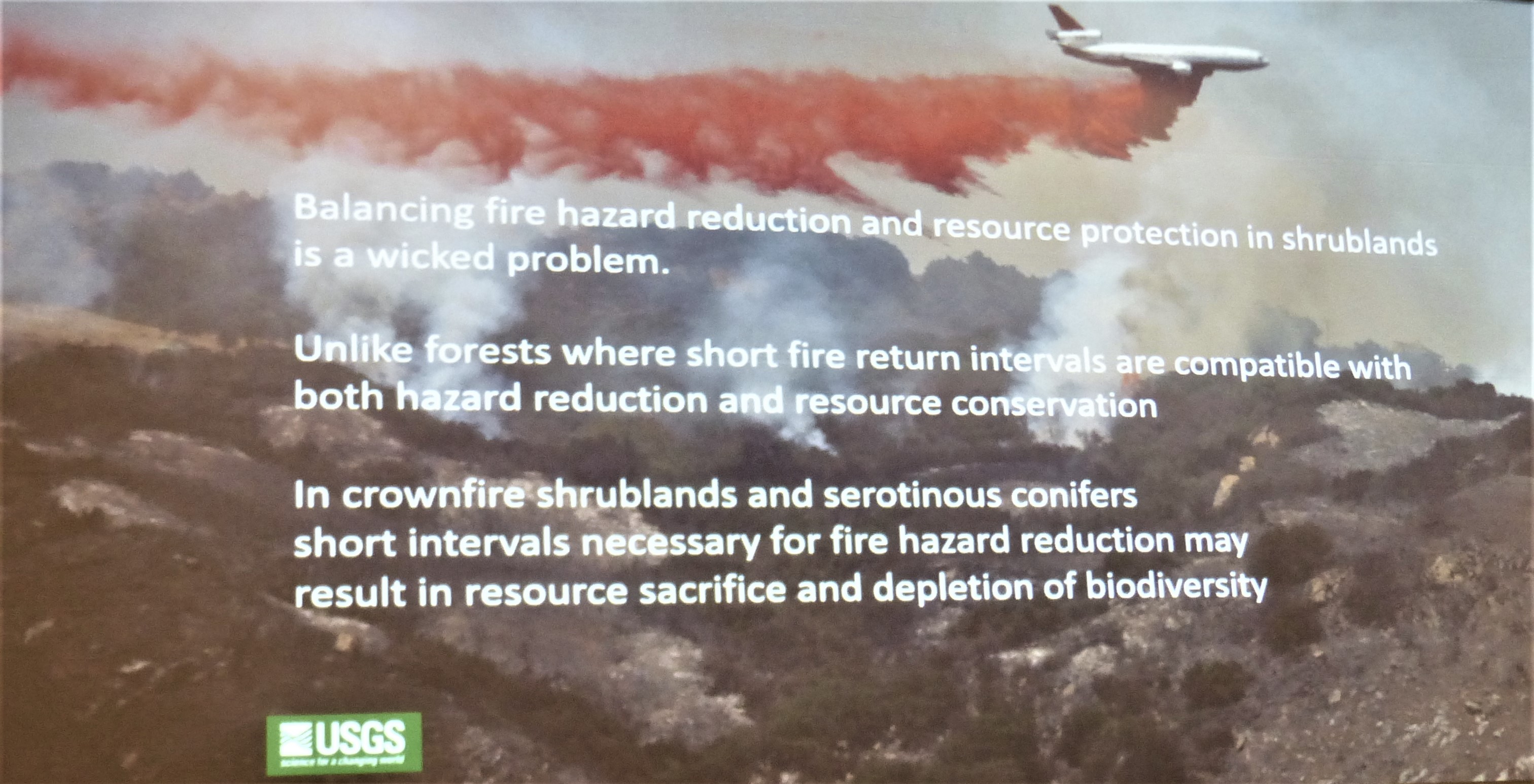
This (above) is the concluding slide of Jon E. Keeley’s presentation. Dr. Keeley is a respected fire scientist with US Geological Service with expertise in chaparral species. He explained that 60% of native chaparral species (notably manzanita and ceanothus) are obligate seeders that do not resprout after fire and therefore depend on the existence of their dormant seed bank for regeneration. In recent decades the fire interval in chaparral has decreased due to climate change and associated drought. In many places, the fire interval has become too short to establish the seed bank needed for regeneration. In those places Dr. Keeley has observed vegetation type conversion to non-native annual grasses.
Dr. Keeley Is concerned that vegetation type conversion from forests in some cases and shrublands in others to non-native annual grassland may be the result of shortening fire intervals further “because of the upsurge in state and federal programs to utilize prescription burning to reduce fire hazard.” (1) This concern extends to some conifer species that do not resprout. Some are serotinous conifers whose cones are sealed shut and do not release their seeds in the absence of fire.
This is a familiar theme for much of Dr. Keeley’s research. He asks that land managers balance the conflicting goals of resource management and fire hazard reduction.
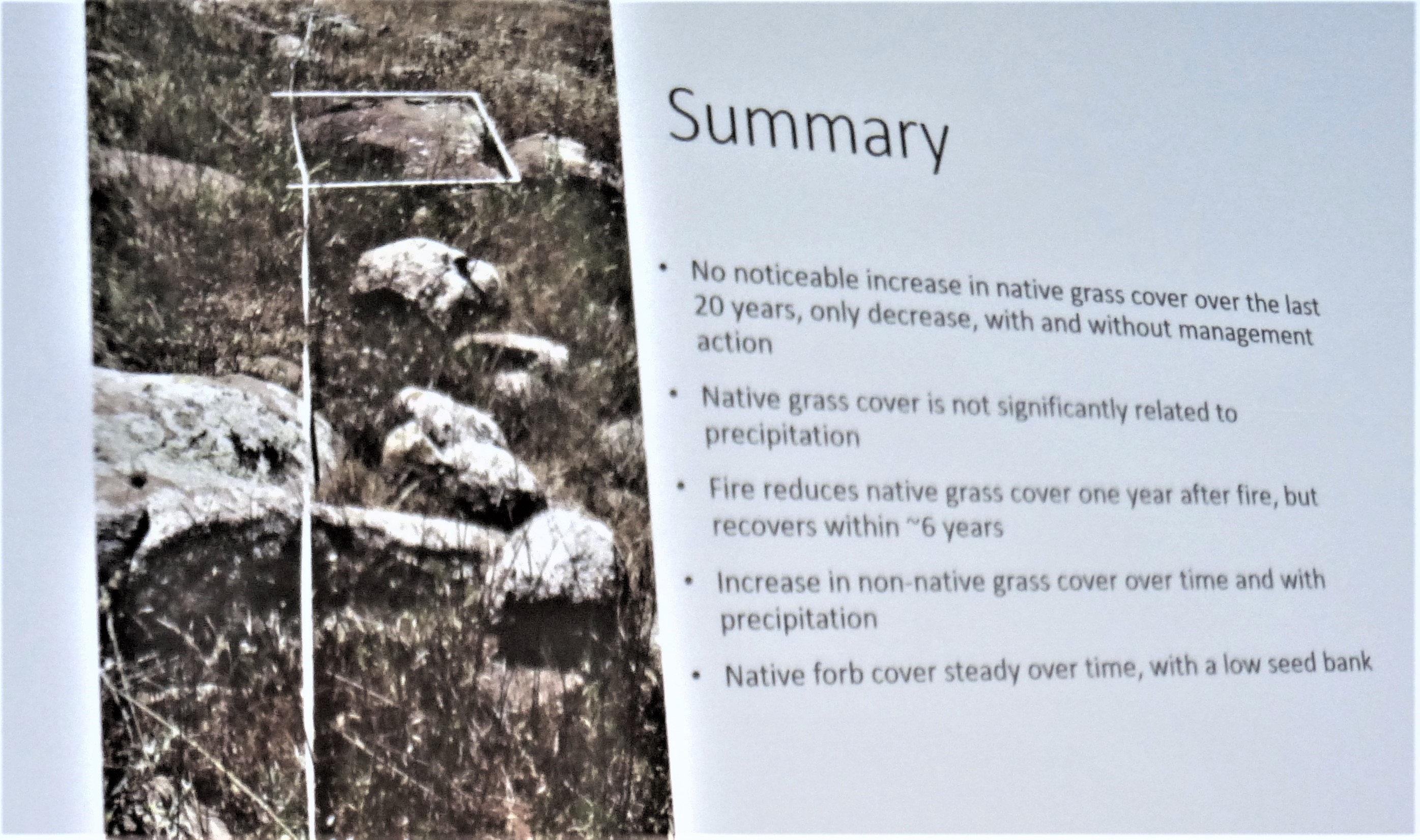
This (above) is the concluding slide (sorry for the poor quality of my photo) of a presentation about a 20-year effort at the Santa Rosa Plateau Ecological Reserve to convert non-native annual grassland to native grassland, using annual (sometimes bi-annual) prescribed burns. Many different methods were used, varying timing, intensity, etc. The abstract for this presentation reports failure of the 20-year effort: “Non-native grass cover significantly decreased after prescribed fire but recovered to pre-fire cover or higher one year after fire. Native grass cover decreased after prescribed fire then recovered to pre-burn levels within five years, but never increased over time. The response of native grass to fire (wild and prescribed) was different across time and within management units, but overall native grass declined.” (1)
The audience was audibly unhappy with this presentation. One person asked if the speaker was aware of other places where non-native grass was successfully converted to native grass. The speaker chuckled and emphatically said, “NO. I am not aware of any place where native grasses were successfully reintroduced.”
Another questioner prefaced her question with the admission that “I’m new here and all this is new to me.” Then she suggested that Native Americans are having some success using prescribed fire and that they should be consulted. The speaker graciously replied that she planned to do so.
Keep in mind that Native Americans weren’t historically using prescribed fire to convert annual grasses to native grasses. Their burns were intended to maintain native grassland in the absence of competing non-native annual grassland. Their objectives were different and they were operating in a very different climate and environment.
Estimates of the pre-settlement population of Native Americans in Californiarange from 138,000 to 750,000. The population of Native Americans is estimated to have been reduced to as few as 25,000 after the arrival of Europeans due to disease and violence. There are now over 39 million Californians and only 630,000 of them were Native Americans in the 2020 census. Land management practices that are suitable for a population of less than 1 million seasonally migrating Californians are not necessarily suitable for a population of over 39 million sedentary Californians.
The futility of trying to eradicate non-native plants
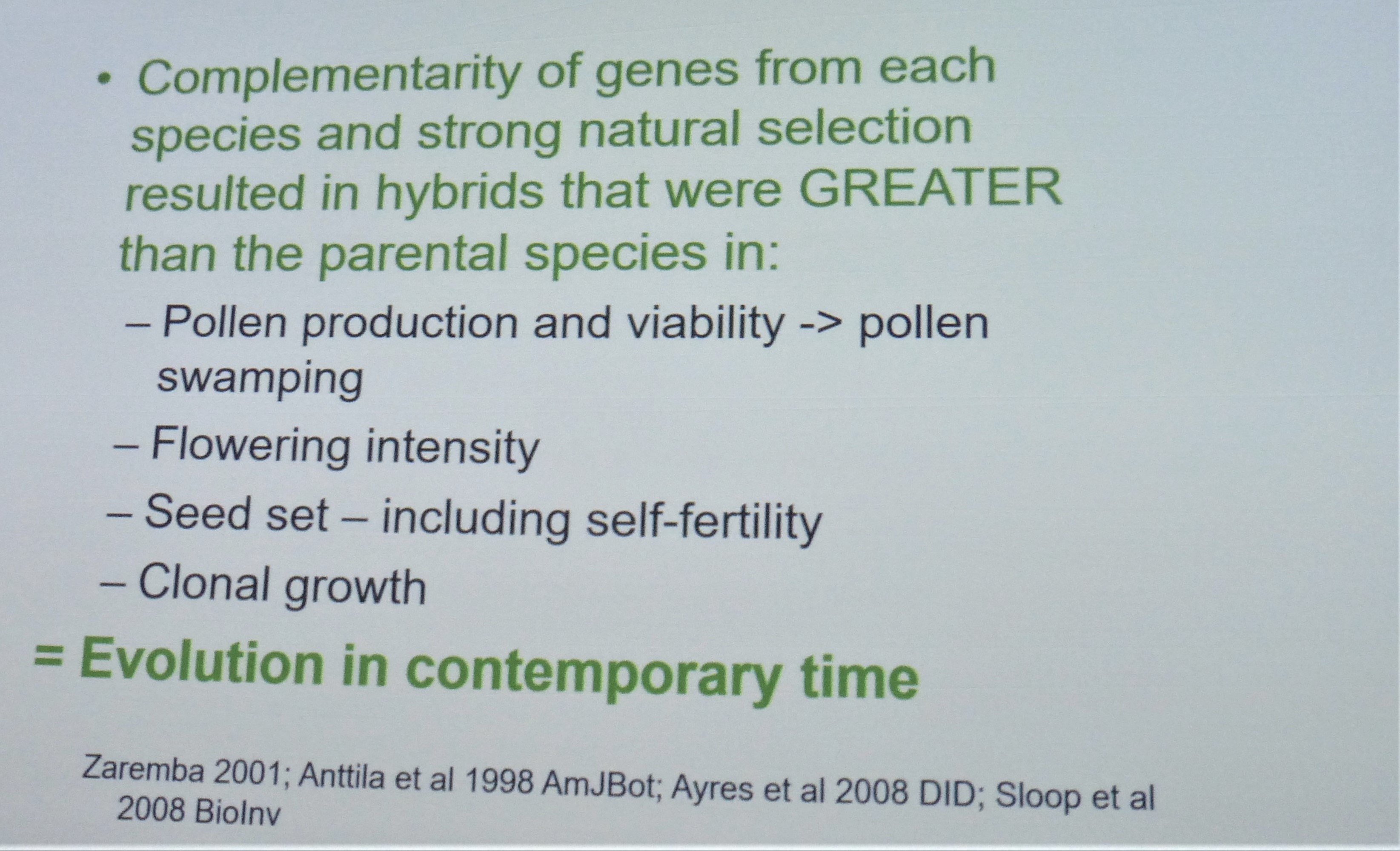
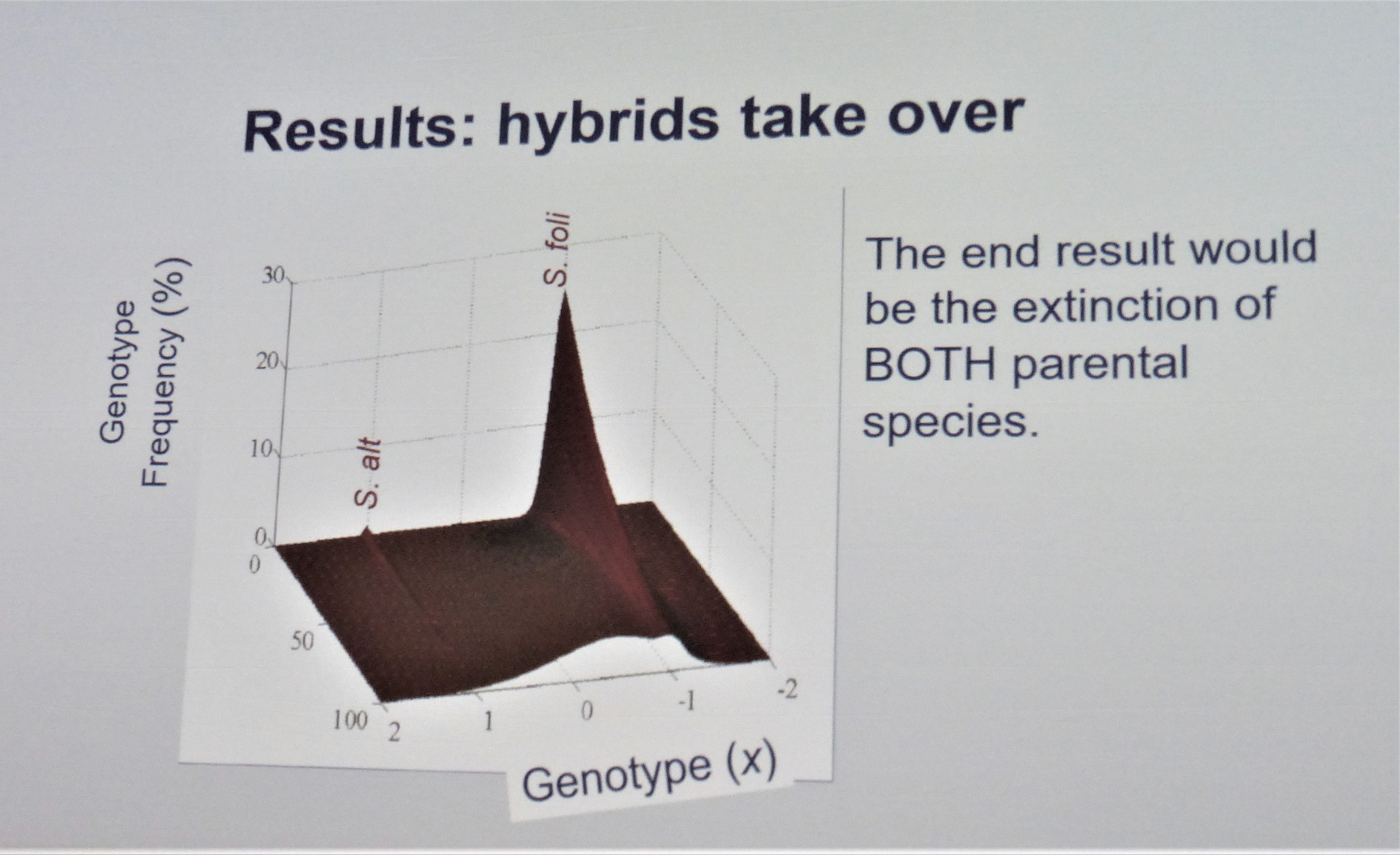
The Invasive Spartina Project (ISP) is another 20-year eradication project that is doomed to failure. The presentation about the ISP was bravely made by Dr. Debra Ayres, one of the creators of the ISP in 1998. With intensive effort and hundreds of gallons of herbicide (imazapyr), non-native spartina marsh grass has been greatly reduced in the San Francisco Bay, but the hybrid of non-native S. alterniflora and native S. foliosa persists. Dr. Ayres explained why:
The spartina hybrid is reproductively stronger in every way than either of its parent species. Dr. Ayres predicts that the hybrid will eventually replace both of its parent species:
If the goal of this project was to eradicate non-native spartina, hybrid spartina will accomplish that goal. You might think that this prediction would end the futile attempt to eradicate the hybrid, but you would be wrong. There is no intention of abandoning this 20-year project. More funding is assured by the California Coastal Conservancy and the project continues to provide well-paid jobs.
Dr. Ayres ended her presentation with this enigmatic statement: “Evolution doesn’t stop just because we think it has to.”She seems to acknowledge that humans cannot stop evolution, yet she seems to recommend that we continue to try doing so. If those positions seem contradictory, that’s because they are. The bottom line is that as long as public funding continues to be available, this project will continue.
A central theme of the nativist agenda is the futile desire to prevent hybridization because it has the potential to replace a species considered “native.” They fail to understand that hybridization is an important evolutionary tool that helps plant and animal species adapt to changes in environmental conditions by favoring traits that are better adapted to new conditions. Humans cannot stop evolution, nor should we try.
San Francisco
I have a special interest in San Francisco because I lived there for nearly 30 years. The native plant movement is very strong in San Francisco and there were several presentations about the success of the movement at the conference.
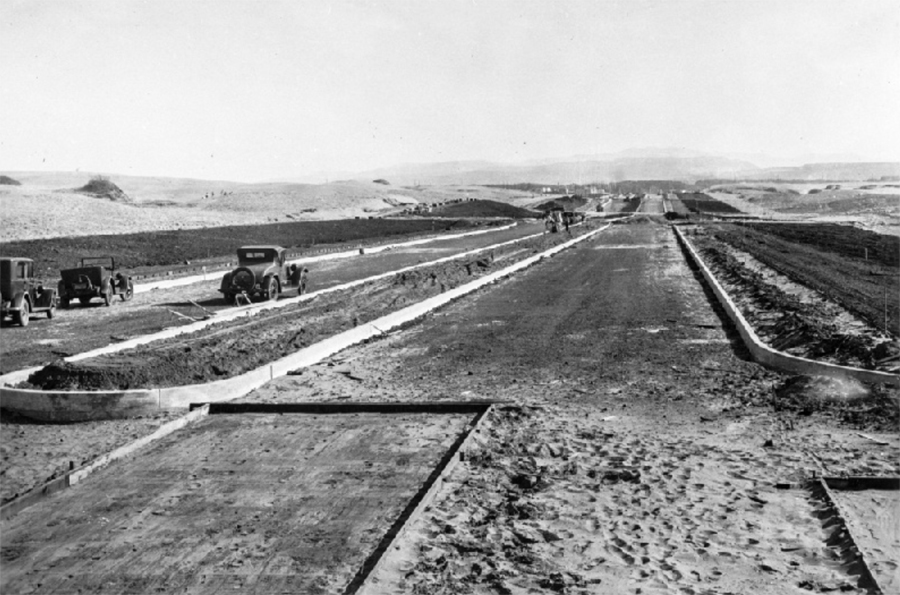
Sunset Blvd being built on barren sand in 1931
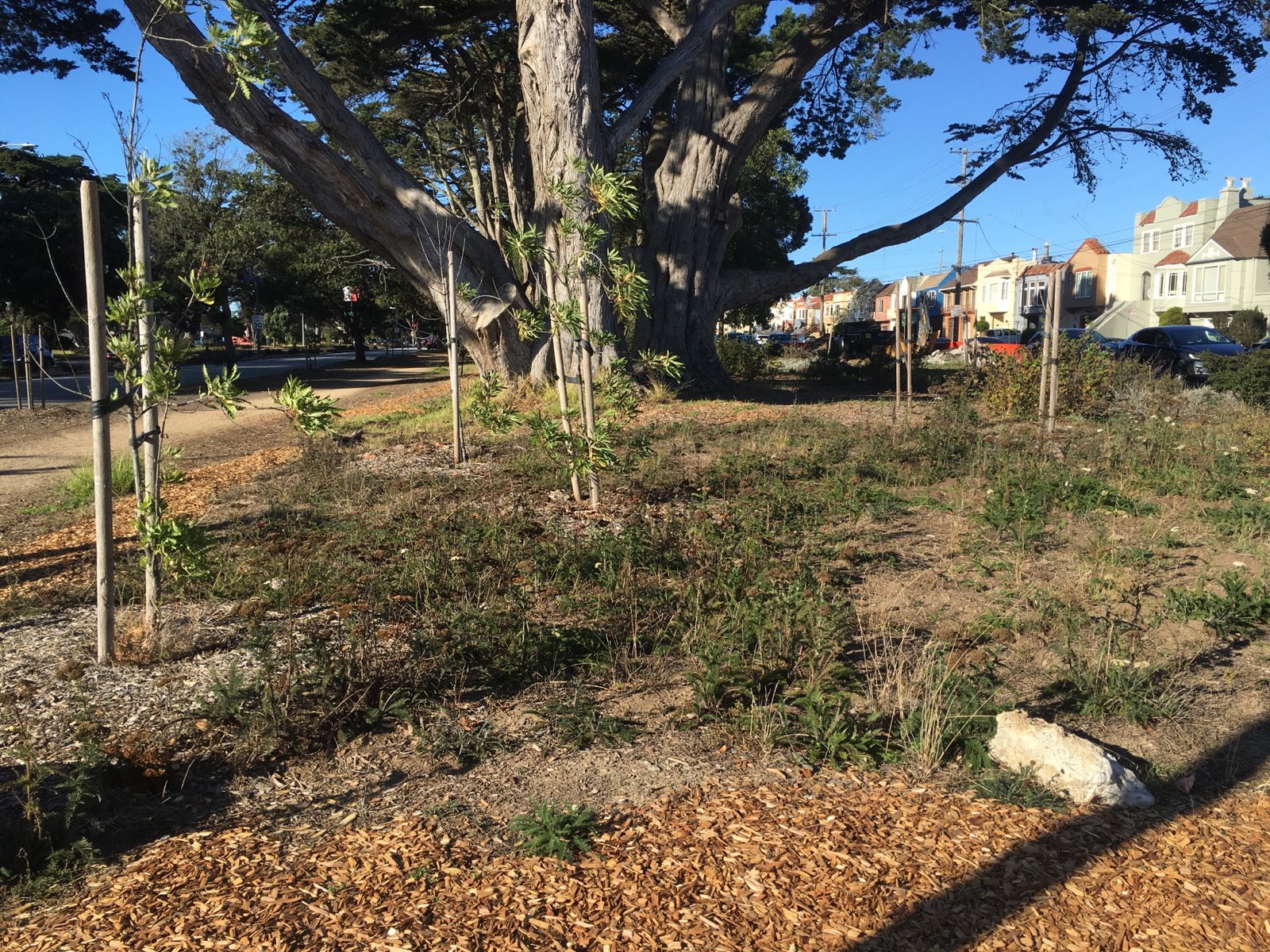
One of the projects is trying to turn Sunset Blvd on the western side of San Francisco into a native plant garden. I lived in that district and am therefore familiar with Sunset Blvd as the major north-south traffic artery through the district. It is important as the only wind break in the windiest district of the city, which is only 13 short blocks from the ocean. The district is virtually treeless because of wind conditions and the pre-settlement landscape of barren sand. Sunset Blvd is therefore the oasis of the Sunset District. In the past, it was the only place to take a long walk in the shelter of the tall Monterey pines and cypress and tall-shrub understory. The lawn beneath the trees was the only place for children to play close to their homes.
San Francisco’s Department of Public Works (DPW) is responsible for maintaining the medians in San Francisco. It was therefore DPW’s responsibility to replace the wind break on Sunset Blvd that is dying of old age. That’s not what they chose to do. They are replacing the lawn with native shrubs and the tall trees with small native trees that won’t provide shelter from the wind.
The spokesperson for DPW acknowledged that the project is controversial. Neighbors of Sunset Blvd valued the sheltered recreational space provided by the 2.5 mile-long and wide median. Native plant advocates and their allies want to create a wildlife corridor through the western edge of the city. The spokesperson for DPW said that their plans are a compromise between these different viewpoints. I don’t know if the neighbors agree, but I can say that native plant advocates are thrilled with the new native plant gardens on Sunset Blvd based on their presentation at the CNPS conference.
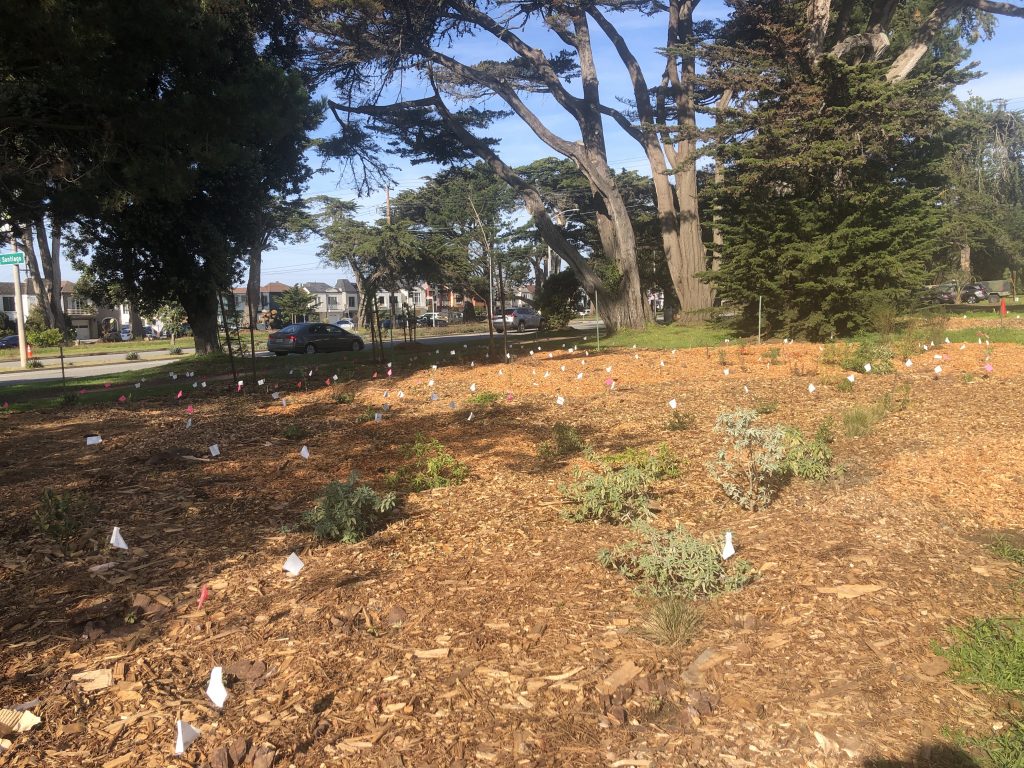
Planting Sunset Blvd. with native plants, December 2020
Native plant advocates prevailed on Sunset Blvd because CNPS bought or raised all the native plants and provided volunteers to plant them and maintain them for 3 years. DPW couldn’t look their gift horse in the mouth. DPW hired 6 new gardeners to support maintenance of Sunset Blvd. This is an example of how the money that is flowing into such projects will transform many places into native plant gardens.
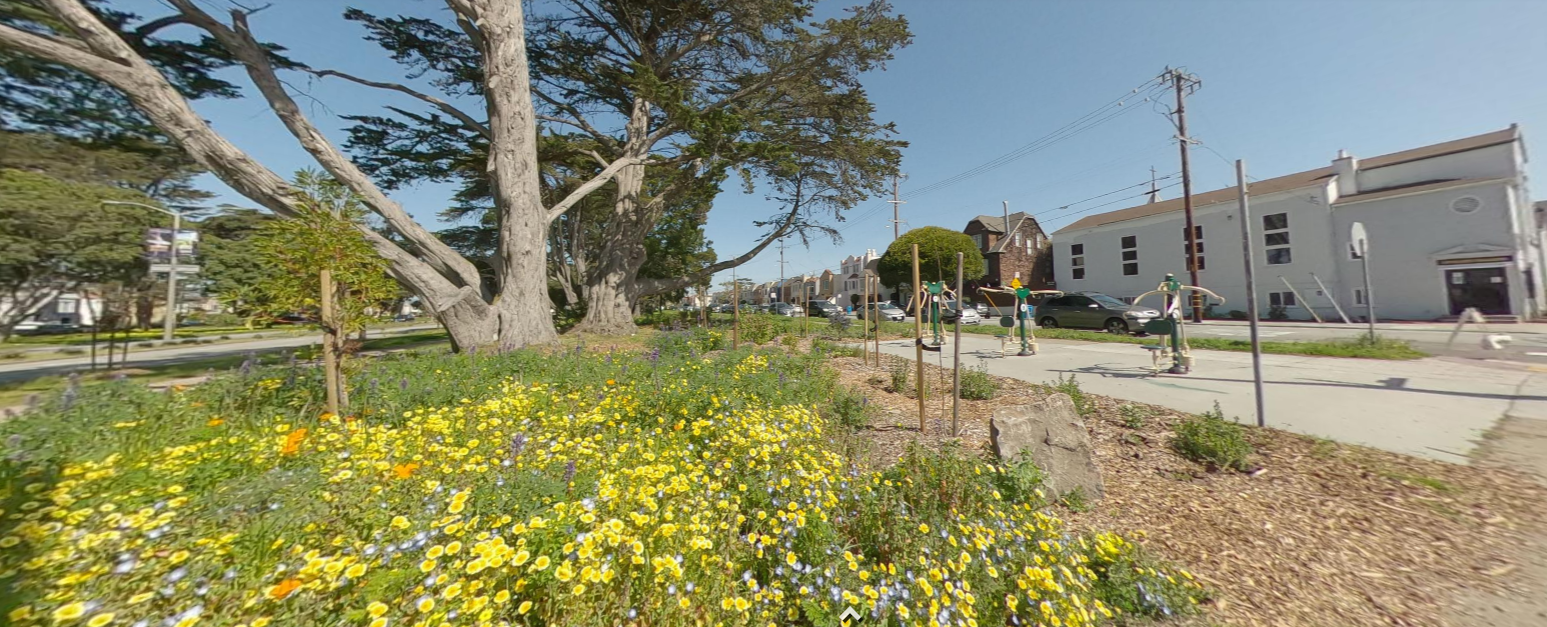
Sunset Blvd and Taraval, spring 2022
So, let’s look at the result of these projects. Presenters of these projects showed many beautiful pictures of newly planted native gardens on Sunset Blvd (above). The pictures were taken in spring, when native plants briefly flower. But that’s not what these places look like most of the year. They will look better if they are irrigated year-round, but that would defeat the purpose of replacing the lawn to reduce water usage. Unlike native plants, lawn turns brown during the dry season if it isn’t watered, but it is still functional as walkable ground.
Here’s what that garden at Sunset Blvd and Taraval looks like most of the year:
Sunset Blvd & Taraval, October 23, 2022
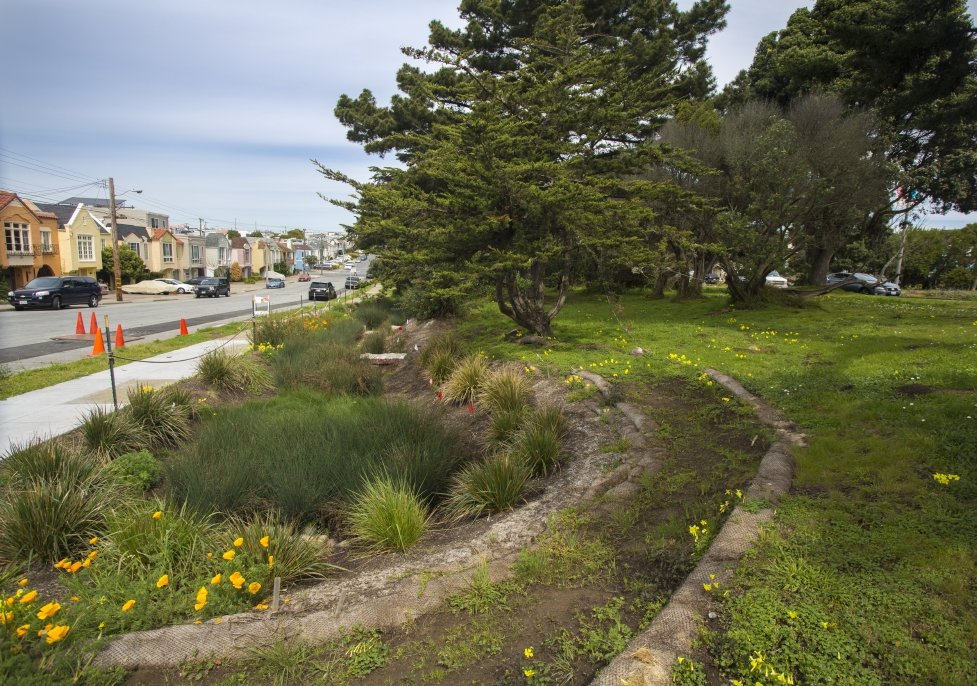
There was also a presentation by a spokesperson from San Francisco’s Public Utilities Commission (PUC) about the creation of rain gardens in San Francisco. San Francisco’s sewer system was built long ago when regulations did not require the separation of street run off from residential sewage. When it rains, the sewage treatment plant is overwhelmed by street run off. The sewage treatment plant releases untreated sewage and run off into the ocean, in violation of federal standards for water treatment.
Rain garden on Sunset Blvd as shown at the CNPS Conference
Rain Garden on Sunset Blvd in August 2022. They aren’t pretty year around.
The PUC is developing rain gardens to redirect street run off away from sewage treatment plants into the ground so that treatment plants are not overwhelmed during heavy rain. The San Francisco Chronicle recently reported that 151 rain gardens have been installed so far. It seems a very good idea, but native plant advocates are not happy with the rain gardens because the PUC has not made a commitment to plant exclusively native plants in the rain gardens. The audience pressured the speaker about this issue. He advised them to lobby the PUC to make a commitment to plant only native plants in the rain gardens. I have no doubt that they will take his advice. Given their influence and their access to public funding, I would be surprised if the PUC continues to resist their demands.
Conclusion
I have undoubtedly exhausted your patience, although there is much more I could tell you about, including several projects that look promising because they are exploring the importance of soil health to achieve successful results.
The conference themes in 2022 were consistent with the previous two conferences I have attended since 2015. This is my summary of the fundamental errors of the nativist agenda in the natural world. They are as apparent in 2022 as they were in 2015:
The futility of trying to eradicate non-native plants that are better adapted to current environmental conditions.
The futile and harmful attempts to prevent natural succession and hybridization.
The contradictory goals of fuels management and resource management.
The lack of understanding that vegetation changes when the climate changes. The ranges of native plants have changed and will continue to change. The pre-settlement landscape of the 18th century cannot be recreated.
The lack of understanding of the importance of soil health to ecological restoration and associated ignorance (or denial) of the damage that pesticides do to the soil.
(1) Abstracts for all presentations are available on the CNPS website.
San Francisco Forest Alliance (SFFA) is a 501(c)4 not-for-profit organization with a mission of inclusive environmentalism. SFFA fights to protect our environment through outreach and providing information. SFFA opposes the unnecessary destruction of trees, opposes the use of toxic herbicides in parks and public lands, and supports public access to our parks and conservation of our tree canopy.
With permission, Conservation Sense and Nonsense is republishing SFFAs annual report on pesticide use by San Francisco’s Recreation and Park Department. The report separates pesticide use in so-called “natural areas” from other park areas and finds that most pesticides are used in “natural areas.” Conservation Sense and Nonsense is grateful to SFFA for compiling and reporting this important information.
Conservation Sense and Nonsense follows pesticide use by the East Bay Regional Park District (EBRPD), where the pattern of pesticide use is similar to San Francisco’s Recreation and Park Department. EBRPD has restricted spraying of glyphosate pesticides in developed areas of the park while continuing to use pesticides in naturalized areas to eradicate non-native plants. In other words, most pesticide use in the public parks of the San Francisco Bay Area is devoted to eradicating non-native plants.
Conservation Sense and Nonsense
As we usually do, we compiled the pesticide usage data for San Francisco Recreation and Parks Department for 2021. (We exclude Harding Park – but not the other golf courses – from this analysis because it’s externally-managed under a PGA contract to be kept tournament-ready at all times.) We’re pleased to note that SFRPD has reduced its pesticide usage in comparison to 2020 and 2019.
NATIVE PLANT AREAS USE MORE OF THESE TOXIC HERBICIDES
But this is not true of the Natural Resources Division (this includes PUC areas managed in the same way – i.e. use of toxic herbicides against plants they dislike). Their usage has risen and is the highest it’s ever been from 2016.
The Natural Resources Department (NRD, formerly the Natural Areas Program or NAP) is the entity that is trying to bring “native” plants to more than a thousand acres of our parks, cuts down trees and restricts access to people and their pets. NRD, which accounts for perhaps a fourth of the land area, used over 70% of the pesticides measured as active ingredients in fluid ounces.
NRD – and PUC lands that they are managing the same way – continued to increase their use of triclopyr since the new pesticide Vastlan has been designated Tier II (More Hazardous) instead of Garlon, which was Tier I (Most Hazardous). In both herbicides, the active ingredient is triclopyr. They also increased their usage of imazapyr, and continued to use Roundup, though in smaller quantities than before.
Here are the two earlier graphs lined up to show the comparison. The Native Plant areas used more herbicides in 2021 than they had ever used in the last six years – or that the other SFRPD departments together used in the same time. Their failure to reduce usage in 2021 is in stark contrast to the more than 50% drop in the other SFRPD.
SFRPD Other (i.e. other than the Native plant areas) uses mainly Polaris (imazapyr) and Clearcast ( ammonium salt of imazamox). The native plant areas, NRD / SFPUC, use large amounts of triclopyr, (Garlon and Vastlan), as well as some glyphosate (Roundup).
A FAILING STRATEGY
The NRD’s continually growing usage of the herbicides is a sign that this strategy is failing. They have been using hazardous chemicals on some 50 target species of plants year after year. Theoretically, the point of using toxic herbicides on unwanted species is to allow the desired species to replace them. Instead, the growing usage of these chemicals shows that if anything, the situation is only made worse.
This stands to reason; “invasive” plants are successful because they are better adapted to current conditions. If they are destroyed with herbicides, the replacement is likely to be the next best adapted (thus, invasive) species. Given 50 target species, the bench is deep. This leads to a vicious cycle of hazardous herbicide use, clearly visible in the graph above.
PESTICIDES COME TO SHARP PARK
For many years since we started compiling these data, Sharp Park has been off-limits for pesticides. We’ve seen very minimal usage – maybe 3 or 4 times over all the years. It’s home to the red-legged frog, and the San Francisco garter snake.
In 2021, that changed. In the space of one year, pesticides were applied 9 times. We did anticipate this would happen as NRD extended its grip on this park.
TIER HAZARD RATINGS
San Francisco’s Department of the Environment (SFEnvironment) assigns Tier hazard ratings to the various pesticides it uses. Tier III is Least Hazardous, Tier II is More Hazardous, and Tier I is Most Hazardous. Over the years we have been following this usage, we have seen various chemicals being moved from one Tier to another. Milestone was moved from Tier I to Tier II; Glyphosate (Roundup, Aquamaster) from Tier II to Tier I; and triclopyr (Garlon, Garlon 4 Ultra, Turflon, Vastlan) from Tier I to Tier II (for Vastlan and Turflon). Avenger was moved from Tier II to Tier III, which we think makes sense and makes analysis easier. We analyze the usage of Tier I and Tier II herbicides.
REDUCE OR ELIMINATE HERBICIDE USE
SF Forest Alliance has been trying to encourage SFRPD to reduce or eliminate Tier I and Tier II herbicide use. Some years ago, it appeared that pesticide usage was declining, especially after the Roundup revelations. When we wrote our Pesticides report for 2016, the other areas of SFRPD had slashed their herbicide use; the NRD accounted for 74% of pesticide usage. The 2021 data have renewed our hope that SFRPD’s other departments will adopt a cautious approach to the use of toxic herbicides. Unfortunately, this does not appear true of the nativist departments, NRD / PUC.
Every year, the San Francisco Forest Alliance also makes public comment at the annual review of San Francisco’s Integrated Pest Management program. Conservation Sense and Nonsense is grateful for SFFA’s vigilance of pesticide use in San Francisco’s public parks. Below is an excerpt from SFFA’s public comment to the Commission on the Environment regarding San Francisco’s IPM program.
Conservation Sense and Nonsense
Once again we are sending our comments emphasizing the self-evident truth that high toxicity herbicides are dangerous, unnecessary, and should never be used…
Below are the points we have repeated year after year for many years:
Herbicidal chemicals are more toxic, more persistent, more mobile and more dangerous than their manufacturers disclose;
The aesthetic or ideological “danger” from “weeds” is not a risk to health and welfare;
Scientific studies associate exposure to herbicides with cancer, developmental and learning disabilities, nerve and immune system damage, liver or kidney damage, reproductive impairment, birth defects, and disruption of the endocrine system;
There is no safe dose of exposure to those chemicals because they persist in soil, water, and animal tissue, so even low levels of exposure could still accumulate and harm humans, animals, and the environment;
Especially vulnerable individuals include infants, children, pregnant women, the elderly, people with compromised immune systems and chemical sensitivities;
Toxic runoff from herbicides pollute streams and groundwater, and therefore the drinking water sources;
Herbicides are harmful to pets and wildlife – including threatened and endangered species, plants, and natural ecosystems;
Herbicides are harmful to soil microbiology and contaminate soil into the future, reducing biodiversity in sensitive areas…
I recently received a message, asking for help to save a grove of eucalyptus trees on the Napa River from destruction: “I live in Napa on the river where eucalyptus trees are going to be cut down that are home to owls, ravens, herons, egrets and more for over 50 years. Could you please help save these beautiful trees and wildlife? Any suggestions or ideas would be greatly appreciated.”
Eucalyptus trees on Milton Road on the Napa River
Owls nest in the trees on Milton Road
I learned a few more details by speaking with the neighbor of the trees. The trees are on State property and the project was going to be funded by California Department of Fish & Wildlife (CDFW). There are few trees in this neighborhood and therefore few alternatives for the birds that roost and nest in the eucalyptus trees
Eucalyptus grove on the Napa River in which many birds nest and roost
The neighbors asked if herbicides would be used to prevent the trees from resprouting. That was a concern partly because the well that supplies their drinking water is within 60 feet of the trees. Before they received an answer to that question, they were informed that “CDFW has decided to halt their project of cutting down the eucalyptus trees on Milton Road!”We don’t know why CDFW changed its mind, but we would like to believe the questions raised by the neighbors may have helped. Thanks and congratulations to the neighbors of the eucalyptus grove on the Napa River.
Eucalyptus trees threatened in El Granada
Shortly before I heard from folks in Napa, I learned about a project to destroy eucalyptus in a small community on the coast of San Mateo County. It’s a foggy coastal location, much like Mount Sutro in San Francisco, where fog drip from the trees during summer months keeps the ground moist and reduces fire hazards.
The community has made a video (available HERE) about the project and the issues it raises. It is an even-handed presentation that acknowledges the fire hazards of dense forests in the hills surrounding their community and contrasts that risk with the lower risk of the widely spaced trees in the medians of their village on flat land. The video explains the many important functions that trees perform to store carbon, improve air quality, provide wind protection and habitat for birds. The people of El Granada would like the project to reduce fire hazards in the hills, but retain the trees in their street medians because of their ecological value. It’s a reasoned and reasonable approach.
The people of El Granada ask for your help to save some of their trees. Their website (available HERE) invites you to sign their petition.
Predictable…and probably only the beginning
The State of California has committed billions of dollars in fire hazard mitigation, climate change, and biodiversity. We watched the budgetary plans for these projects being developed in the past year and the plans were recently approved. Now communities all over California are applying for State grants to implement projects like the two I have described today. Now it’s up to communities to watch as plans are developed and participate in the process to ensure that the plans reflect their wishes. It’s your money and your community. Pay attention and engage in the process.
Postscript…different, but the same
Days before publishing this article, I received an email from Santa Barbara: “Well it is with great sadness we have to report that The University of California at Santa Barbara (UCSB) is again trying to destroy hundreds of Eucalyptus trees here at the University. They want to destroy what is known as “The Eucalyptus Curtain” the boundary between the University and Isla Vista the college town here.”
“Eucalyptus Curtain,” UC Santa Barbara. Source: localwiki.org
Some people who are trying to save this grove of eucalyptus are appealing to the California Coastal Commission. They suggest those who share their opinion contact the CCC HERE.
In this case, the motivation for destroying these trees is not the usual allegation that they are a fire hazard. According to this article in localwiki, the trees will be destroyed to build more student and faculty housing. There is no question in my mind that we need more housing and I am rarely opposed to any housing project, including this one. However, the consequences of destroying these trees are the same regardless of the motivation:
The loss of the windbreak in a windy coastal location.
The loss of stored carbon and the loss of more carbon storage some 200 years into the future, based on the expected lifespan of eucalyptus.
While the native plant movement remains strong in California and locally in the San Francisco Bay Area, some communities are waking up to the fact that weeds make valuable contributions to our gardens and the wildlife that lives in them. The British have always been ahead of us in welcoming plants from all over the world in their gardens. The British have been enthusiastic importers of plants from all over the world for hundreds of years. They had one of the biggest empires in the world, spanning the globe from India to Africa, Australia, New Zealand, and America, which put them in a unique position to sample the botanical riches of the world.
The English garden, where plants from all over the world are welcome
In a recent article in The Guardian, an English gardener describes her journey from fighting the weeds in her garden to her new relationship with them: “I remember writing, many years ago, about my fight to get rid of these dandelions. Clearly, I didn’t win. Now, when I am greeted by them, I am glad I lost the battle. These days, I truly consider them friends…they are welcome in my garden, because I know they do more good than harm.”
The English gardener reminds us that the war on weeds began only recently. Going deep into agricultural history, weeds were natural forage that were a part of our diet. Weeds fed our domesticated animals, stuffed our mattresses and made twine and rope. Many have medicinal properties, but most have marketable substitutes now. They were tolerated on the edges of agricultural fields and in our gardens.
The typical American lawn, maintained with pesticides and fertilizer is not habitat for pollinators or other insects. Source: Pristine Lawn Care Plus
The war on weeds began after World War II, when chemicals were introduced to agriculture. Pesticides were considered benign for decades. We have learned only recently of the dangers of some pesticides. The promotion of pesticides changed the aesthetics of gardening, initiating an era in which weeds were banished from our agricultural fields and our gardens.
Note the drone hovering over the children in a strawberry field. Drones are the latest development in chemical warfare. They are used to spot non-native plants in open space as well as to aerial spray pesticides. They are cheaper than other methods of application and for that reason are likely to increase the use of pesticides.
Do not underestimate the power of propaganda to promote the use of pesticides: “A publishing company linked to the most powerful agricultural lobby group in the U.S. is releasing children’s books extolling the benefits of pesticides and nitrogen fertilizers.” Industrial agriculture begins the indoctrination of the public at childhood.
Bumblebee in clover. Source: buzzaboutbees.net
Weeds made their way back into our gardens partly by evolving resistance to the pesticides we used for decades to kill them. There is growing awareness of the impact of pesticides on insects and wildlife. As populations of pollinators decline, we are more willing to indulge their preference for weeds such as dandelions and clover. Weeds are often the first to arrive in the spring garden, as native bees are emerging from their winter hibernation in ground nests. Weeds prolong the blooming season in our gardens, providing nectar and pollen before cultivated plants are blooming.
“No Mow May” comes to America!
“No Mow May” originated in Britain out of concern for declining populations of bees. Communities make a commitment to stop mowing their lawns in May to let the weeds dominate their lawns. Weeds such as dandelions and clover give the bees an early boost in the spring that studies show increases bee populations. Lawns maintained with pesticides and fertilizers provide poor habitat for bees.
Two professors in the Midwest of the US introduced “No Mow May” to their community in Wisconsin in 2020. They signed up 435 residences to participate in “No Mow May” and studied the impact: “They found that No Mow May lawns had five times the number of bees and three times the bee species than did mown parks. Armed with this information, they asked other communities to participate.” According to the New York Times, “By 2021, a dozen communities across Wisconsin had adopted No Mow May. It also spread to communities in Iowa, Minnesota, Illinois and Montana.”
Farmers climb on board
Hedgerows are the backbone of the English countryside. They are a complex bramble of woody and herbaceous plants that traditionally served as fences, separating roads from agricultural fields and confining domesticated animals. They nearly disappeared when industrial agriculture dictated that fields be cultivated from edge to edge. They are making a comeback in the English countryside as farmers realize that their loss contributed to the loss of wildlife. The concept of hedgerows as vital habitat is slowly making its way to America.
US Department of Agriculture reports improvements in agricultural practices in the past 10 years: more no-till farming that reduces fossil fuel use and carbon loss from the soil; more efficient irrigation methods; broader field borders for pollinators and wildlife; more crop rotations that reduce disease and insect pests; reduction of nitrogen and phosphorous run-off; reduction in diesel fuel use, etc. These are all well-known methods of reducing environmental damage from industrial agriculture, but there is now evidence that farmers are actually adopting them.
Nativists are late to the game
We see progress being made to reduce pesticide use and provide more diverse habitat for wildlife, but nativists drag their feet. They continue to use pesticide to eradicate non-native plants and they deny the value of non-native plants to insects and wildlife, despite overwhelming evidence to the contrary.
In a recent comment posted on Conservation Sense and Nonsense, a nativist explains the justification for using herbicides to eradicate non-native plants: “No one likes herbicides, but in the absence of a labor force willing to abandon its modern conveniences to do very hard work, they are important tools in restoration ecology, and methods are improving as a result of careful science to determine how the least amount of them could be used to gain the greatest amount of benefits to the maximum amount of species. Throwing those tools away is about like tossing chemotherapy or vaccinations because of that “all-or-nothing” black or white point of view that native plant supporters are being (unjustly) accused of.”
For nativists, the harm done by non-native plants is greater than the harm done by pesticides. This equation does not take into consideration the benefits of many non-native plants to wildlife and it underestimates the damage caused by pesticides to the environment and its inhabitants.