Nature’s Best Hope? Nope!

On November 16, 2024 I attended a conference at the Oakland Museum of California, where I live, sponsored by Bringing Back the Natives Garden Tour and featuring Doug Tallamy as the key note speaker.  The conference was sold out.  Two hundred enthusiastic native plant gardeners attended the conference.  Although a native Coast Live Oak is the crown jewel in my garden, I don’t consider myself a native plant advocate.  I listened quietly.

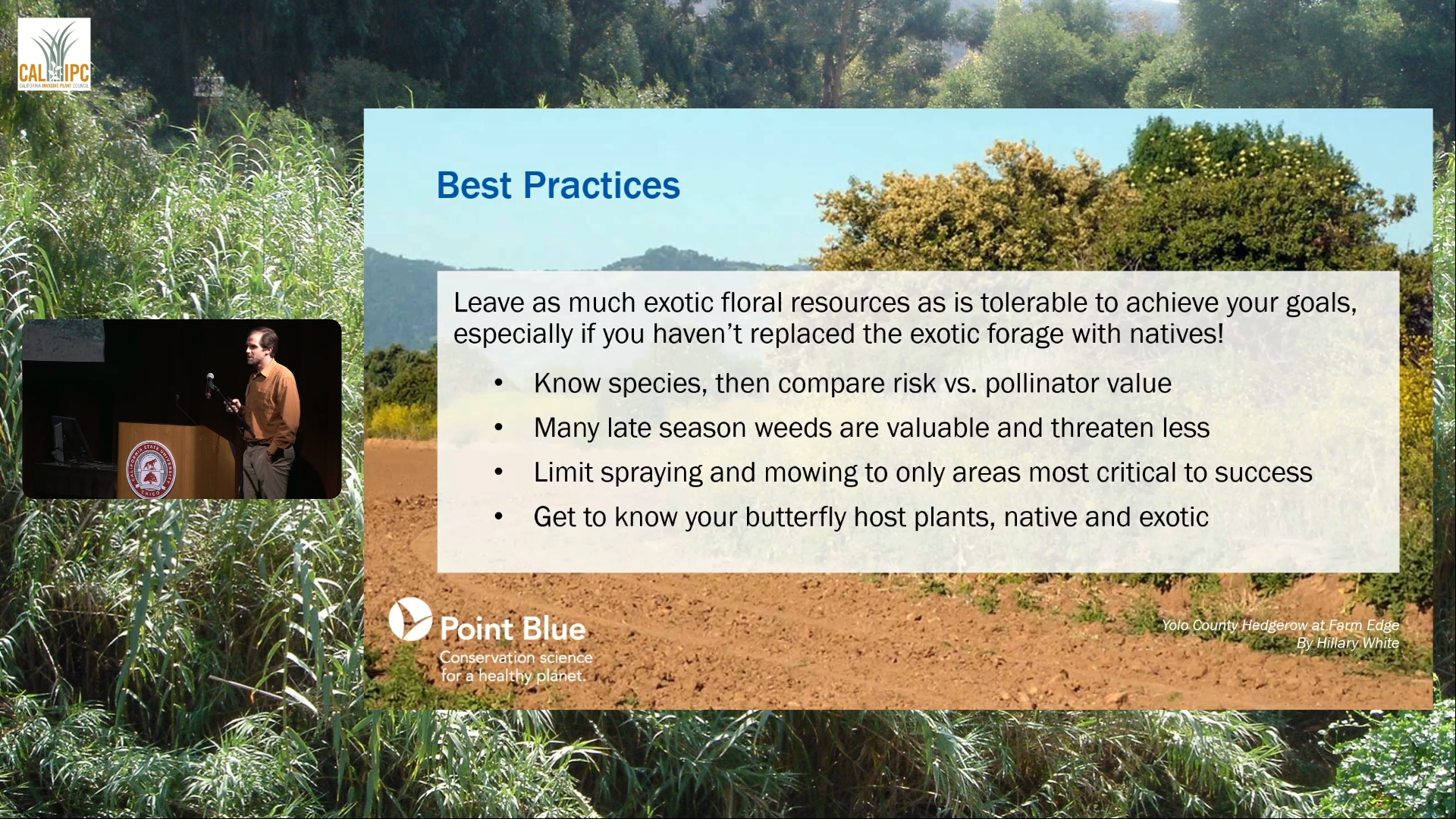
I have heard Doug Tallamy speak several times and I have read his books, so there were few surprises in his talk, except for this slide:
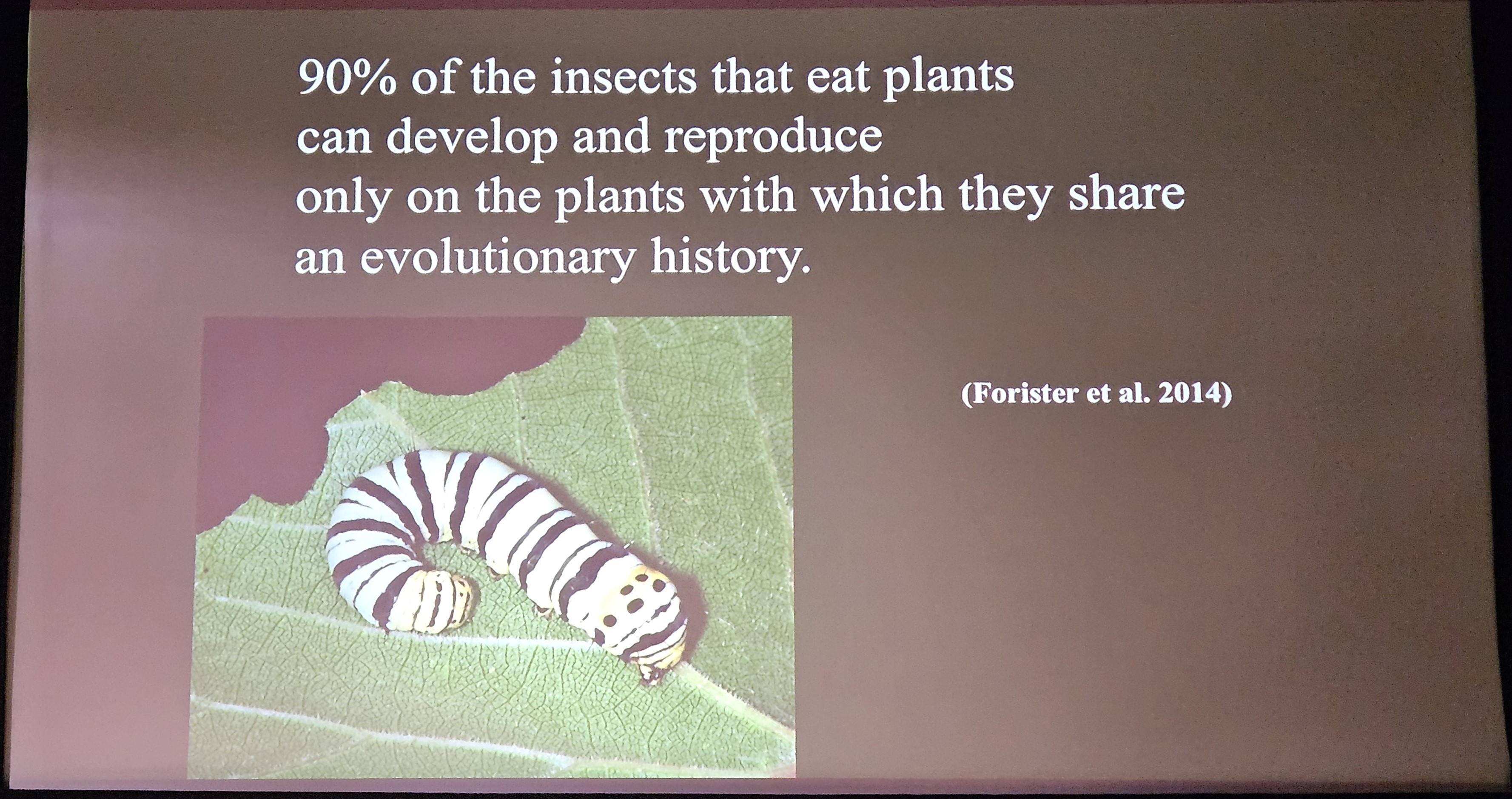
The cited study for this slide was published by Matthew Forister (and others).  Professor Forister is an academic entomologist who is a specialist in lepidoptera (moths and butterflies).  I have read several of Forister’s studies and I respect his research, so I was surprised that he would reach the conclusion claimed on Tallamy’s slide. 

I read the study (available HERE) and I was unable to find a conclusion in the study that was consistent with Tallamy’s interpretation of it.  Hmmmm, I said to myself, does Tallamy’s slide accurately represent Forister’s study? 

I asked Claude.ai to compare the study with Tallamy’s brief summary of the study.  Claude’s response was: 

“After carefully reviewing both the original study and Professor Tallamy’s summary slide, I find that his statement represents a somewhat oversimplified interpretation of the study’s findings…While Professor Tallamy’s statement captures the general spirit of the research – that most insect herbivores are specialists – it appears to be a simplified interpretation that makes stronger and more specific claims than what’s directly supported by the study’s data. The “90%” figure and the explicit connection to evolutionary history, while perhaps derived from other research, aren’t directly demonstrated in this particular study.”

Forister’s study found a continuous distribution between specialists and generalists, not a strict dichotomy, as Tallamy’s slide claims.  For example, an insect that is confined to plants in a genus is more specialized than an insect that is confined to a plant family.  Insects that are confined to a single plant species are extremely rare because they are often an evolutionary dead end. 

Professor Forister’s study is interesting.  It found that dietary specialization of insects varies by latitude and that specialization is greatest near the equator, where diversity of plant species is greatest, creating more opportunities for ecological niches in which specialized insects can find what they need with less competition.   

The same principle applies in the temperate zone, where we live.  That is, greater diversity creates more opportunities for insects to find what they need.  The scientific definition of biodiversity includes both native and non-native species.

The relationship between plant species in the Apiaceae family and the anise swallowtail butterfly evolved in the distant past, eons before individual members of the family evolved into different genera and species.  The association between an insect and its host plant is chemical rather than being a connection to a specific plant species.  In other words, anise swallowtail butterflies co-evolved with fennel. 

Likewise, monarch butterflies co-evolved with tropical milkweed, which is native to Mexico and Central America.  Both tropical milkweed and local native plants in the same genus contain the chemical that monarchs seek, a chemical that renders it unappealing to its predators because it makes them sick.  Again, this similarity is fortunate because tropical milkweed is evergreen and local natives are deciduous, making it available for monarchs to breed in winter months in a warming climate. Winter breeding of monarchs is recent and may not benefit the monarch population because fewer food sources are available in winter months. (2)

With the help of genetics, we can understand why individual members of a family of plants are closely related.  Plants and animals with a common ancestor are dispersed around the globe in a variety of ways, of which many are natural and long precede the advent of humans around 300,000 years ago.  Plants are carried by ocean currents, rivers, wind, storms, birds, animals, etc. 

When plants arrive in a new home, they quickly begin to change, partly because of random genetic drift and partly because they respond and adapt to the specific environment in which they have landed.  Over time, the change in the plant becomes great enough to be considered a new species, but its chemical properties remain similar to its ancestors in most cases.  Exceptions abound because nature is complex and our understanding is limited.

Why does it matter?

I attended this conference because native plant advocates are unhappy about Oakland’s Urban Forest Plan.  I support the plan because it will improve Oakland’s urban forest by addressing hazardous tree conditions, expanding the forest with diverse tree species, and more equitably distributing Oakland’s forest resources to neighborhoods that have been short-changed in the past.  I expected the plan to be discussed at the conference.  It was.

Native plant advocates want Oakland to plant more native trees and fewer non-native trees.  Opinions vary, of course, but some want a forest of exclusively native trees because of their belief that native trees support wildlife and non-native trees are not useful to wildlife.  There are many reasons why a diverse urban forest best serves Oakland and every animal that lives here:

  • The pre-settlement vegetation of Oakland was 98% grass, shrub, and marshland.(1) There were only 10 species of trees that are native to Oakland:  coast live oak, bay laurel, coast redwood, madrone, big leaf maple, holly leaf cherry, toyon, willow, buckeye, redbud.  There are now over 500 tree species in Oakland.
  • The goal of the Urban Forest Plan is to increase the population of street trees.  Most of the trees that are native to Oakland are not suitable as street trees.  Some are too big.  Some are shrubs rather than trees.  The branching habit of some native trees are too low to be street trees, which must not obstruct sidewalks or streets. 
  • Some shrubs can be pruned into trees, but that would be very costly and Oakland is broke!  A shrub that has been severely pruned into a tree is not stable.
  • Growing conditions where trees are needed in Oakland are often not suitable for native trees. That’s why they didn’t grow there prior to settlement.  Oakland’s urban forest is predominantly non-native because they are adapted to our growing conditions.
  • Climate change requires a diverse urban forest because a more diverse forest is more resilient.  Sudden Oak Death has killed millions of oaks throughout California for the past 25 years. We can’t predict which tree species will survive the warming climate.  Therefore, we must hedge our bets by planting a diverse forest.

As expected, the first question the audience asked of Doug Tallamy was why Oakland Tree Services is telling native plant advocates that Oakland can’t plant exclusively native trees because they aren’t adapted to the challenging conditions that street trees face.  Doug Tallamy replied that Oakland’s Tree Services is mistaken.  He showed this slide of the many native alternatives that he believed would be suitable street trees:
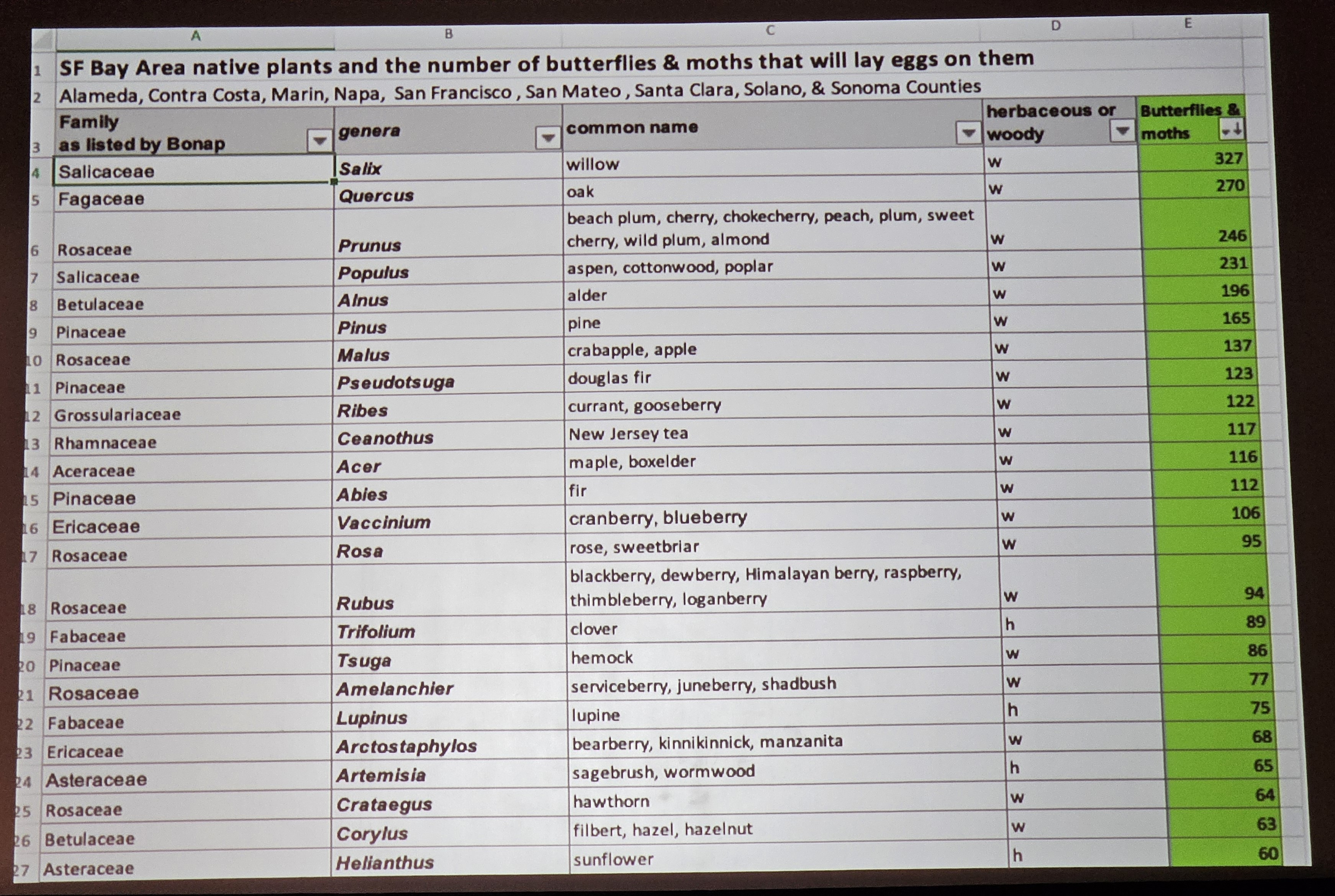
This list is predominantly shrubs.  Some are not native to Oakland.  Some plants native to Oakland are missing from the list. At least one—Himalayan blackberry—is a notorious invasive non-native that most public land managers have been trying to eradicate for decades.  Himalayan blackberry is, however, an extremely useful plant for wildlife.  The list is a mixed bag, but it won’t create an urban forest.  

Update:  The Public Works & Transportation Committee of the City of Oakland approved the Urban Forest Plan for Oakland today, December 10, 2024.  Eleven people spoke in support of the plan.  No one spoke against the plan.  

Dan Kalb, City Council representative for District 1, asked why Oakland is planting non-native trees, which he claimed are breaking sidewalks and destroying the foundations of people’s homes by sending their roots into their yards.  David Moore, the head of Tree Services, handled these questions well and Kalb did not pursue the issue further. No speaker objected to non-native trees in Oakland.  

I have a native Coast Live Oak in my front yard, which damaged the foundation of my home, destabilizing the house and doing extensive damage inside the house.  To save the tree, we had to repair the foundation by suspending the new foundation over the roots from two steel-reinforced piers that are 10 feet deep at each end of the foundation.  In other words, although there is some variation in the configuration of tree roots, the variation is unrelated to the national origin of the tree species. 

Given the budget deficit in Oakland, it was necessary to reduce the goal of the plan to maintain the tree canopy rather than increase it.  No one objected to that change in the goal.  We all understood that the change was necessary.

On the bright side

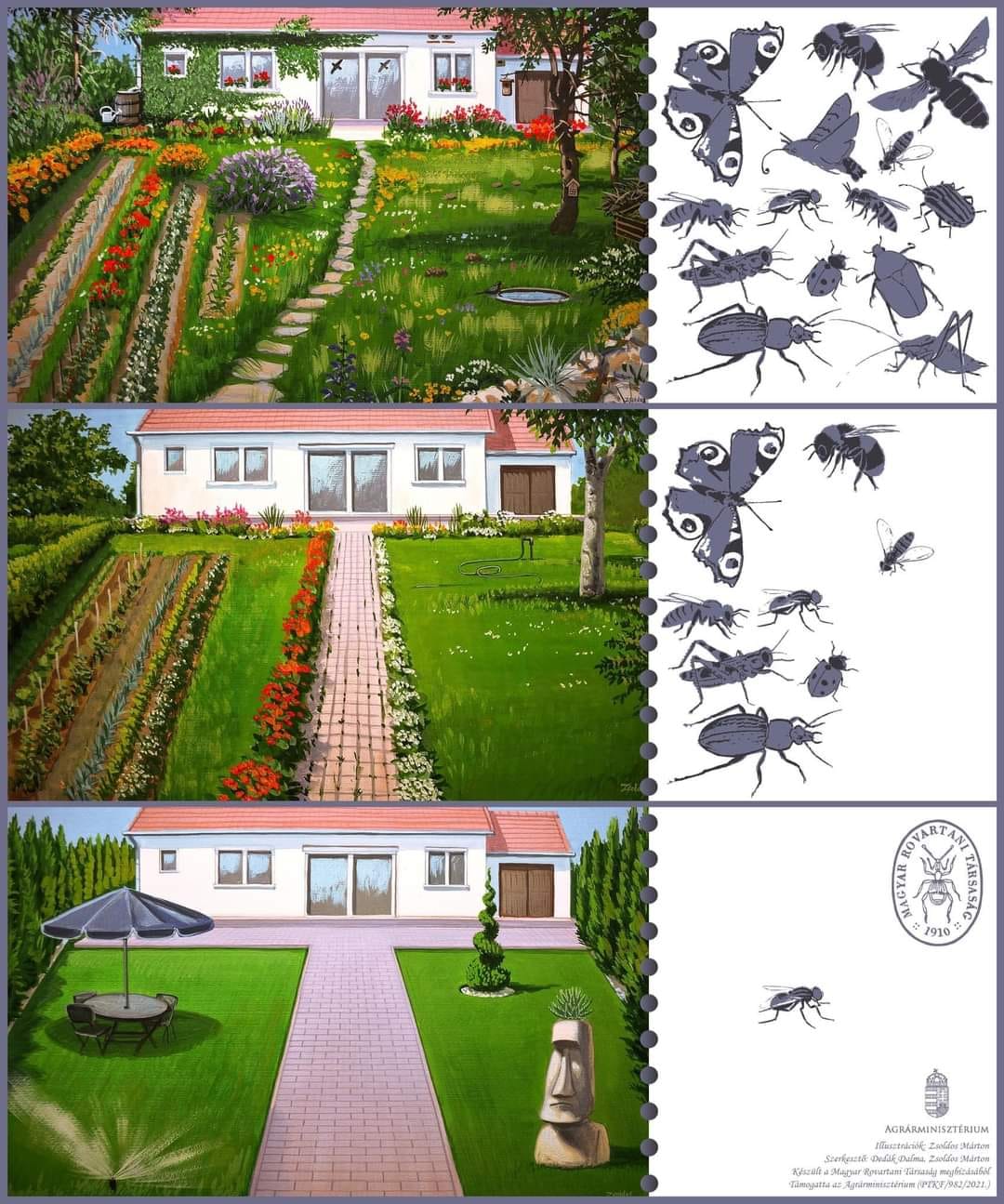
I enjoyed two presentations by native plant gardeners who transformed their yards from barren places into lovely native plant gardens.  One started her project by digging up concrete covering her back yard.  The other began by digging up a front lawn.  Of course, their new gardens are an improvement over their predecessors.  They are more beautiful and they serve more wildlife. 

However, would these new gardens be even more beautiful and useful to wildlife if they were more diverse?  Would they be more resilient as the climate continues to change in unpredictable ways?  Maybe.
Thankfully, there was little talk of destruction in either of these inspiring presentations.  One exception was an anecdote about the visit of a native plant advocate to the garden of a fellow gardener.  The gardener asked his visitor where agapanthus in his garden is from.  When told it was from South Africa, he promptly pulled it out of the ground. The audience was very amused by the story.

When traveling in distant places, I don’t want to know which plants are native.  Don’t ask, don’t tell.  It’s a pleasant break from the “good” plant, “bad” plant dichotomy. 

Tallamy advised against using insecticide, but he made no mention of using herbicides. 

I have no quarrel with these gardeners.  I firmly believe that everyone should be free to plant whatever they wish in their gardens.  I respect everyone’s plant preferences and I ask that they respect mine. 

However, our public parks and open spaces belong to everyone and our tax dollars are used to maintain them.  I ask only that public land managers quit destroying healthy trees and landscapes, especially with herbicides. 


(1) David Nowak, “Historical vegetation change in Oakland and its implications for urban forest management,”  Journal of Arboriculture, September 1993

(2) Professor Emeritus Arthur Shapiro sent the following “qualifiers” in an email.  The article has been revised accordingly.  “…a couple of qualifiers. First, zelicaon cannot breed all year because it has a seasonal pupal diapause (dormancy) in winter which is photoperiod—T mediated. Its native wetland hosts (Cicuta and Oenanthe) support breeding March-October. It is unclear that it had any native hosts at all in upland, dry habitats. It was probably a tule marsh species in pre-European CA (below about 4000′), just as its close relative machaon is a fenland species in the U.K. Second, monarchs didn’t breed in winter until recently, again because of photoperiod-T induced reproductive (adult) diapause. Tropical milkweed has been cultivated in CA for well over a century but was not bred on in winter, even in SoCal. I hypothesize that warming T is responsible for the change. It is NOT advantageous to breed in winter. Because curassavica is the only plant available, it gets reused over and over again and becomes contaminated with high levels of an infectious protozoan parasite that causes significant morbidity and mortality. The butterfly might be better off if it didn’t try to breed in winter.” November 21, 2024.

Defining “Success” so “Success” can be achieved

I always attend the conferences of the California Invasive Plant Council (Cal-IPC) and the California Native Plant Society because I feel obligated to understand their viewpoint so I can accurately report on the controversies of invasion biology.  Ironically, the more I learn about the native plant movement and the “restoration” industry it spawned, the less sense it makes.  The October 2024 Symposium of the California Invasive Plant Council has provided more evidence that attempts to eradicate well-established non-native landscapes and replace them with native plants are futile.

Tricks of the “restoration” trade

Every Cal-IPC Symposium has wrestled with the question of whether or not it’s possible to convert non-native grassland to native grassland. A study of 37 grassland “restorations” in coastal California addresses that question. (1)  It’s really quite simple.  All you need to do is define success as 25% native plants after “restoration” and limit post-project monitoring to 5 years or less:  “Monitoring is done ≤5 years after project-implementation, if at all, and rarely assesses the effects of management practice on project success.” 

It also helps if public land managers in charge of the projects won’t allow the academic researcher to enter the land to conduct a survey of the results.  43% of the projects that were studied were “statutory,” i.e., they were mandated by laws such as county general plans or legally required mitigation for projects elsewhere that Environmental Impact Reports determined were harmful to the environment.  30% of the managers of the statutory projects would not allow the academic researcher to survey their projects. 

It is also easier to achieve success if the project goal is downgraded mid-project as were many of the statutory projects because they weren’t able to meet the original goal.

Project managers can also reduce their risks of failure by planting a small number of native species that are particularly easy to grow:  “Ninety-two percent of restoration managers preferentially use one or more of the same seven [native] species.”  Seven projects planted only one native species. 

According to the study, the result of planting only a few hardy native plants is “biotic homogenization.”  Call it what you will, but this risk-averse strategy is inconsistent with claims that the goal of native plant restorations is to increase biodiversity. 

The study did not ask project managers about the methods they used to eradicate non-native plants or plant native plants.  The study tells us nothing about the methods that were used or whether or not some methods were more effective than others.  Since results of the projects were all very similar, should we assume that the methods that were used didn’t matter? 

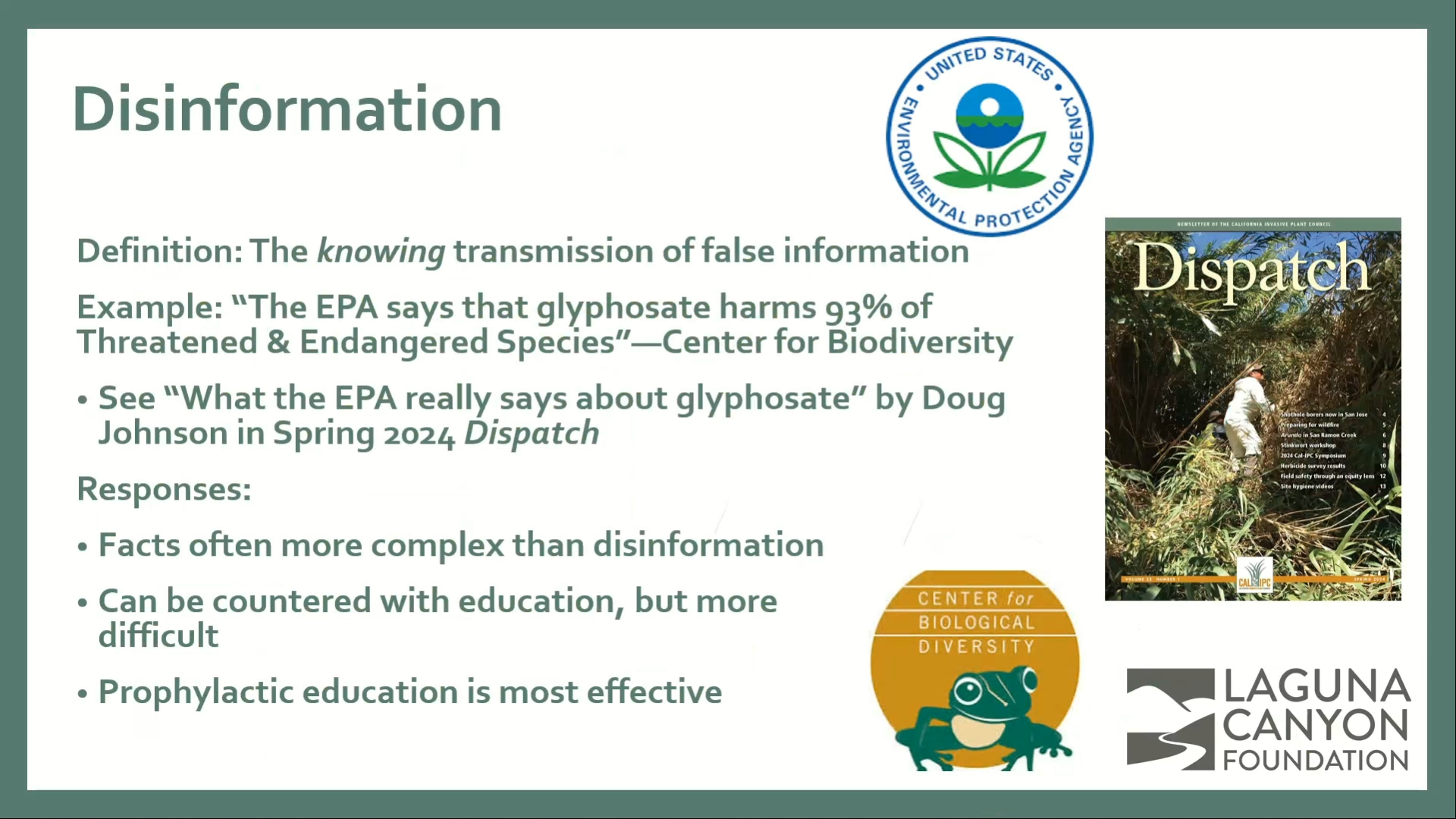
The presentation of this study concluded with this happy-face slide. (see below) It looks like a cartoonish marketing ad to me:

Harmless aquatic plants being pointlessly eradicated

A USDA research ecologist stationed at UC Davis made a presentation about the most effective way to kill an aquatic plant with herbicides, but that wasn’t the message I came away with. 

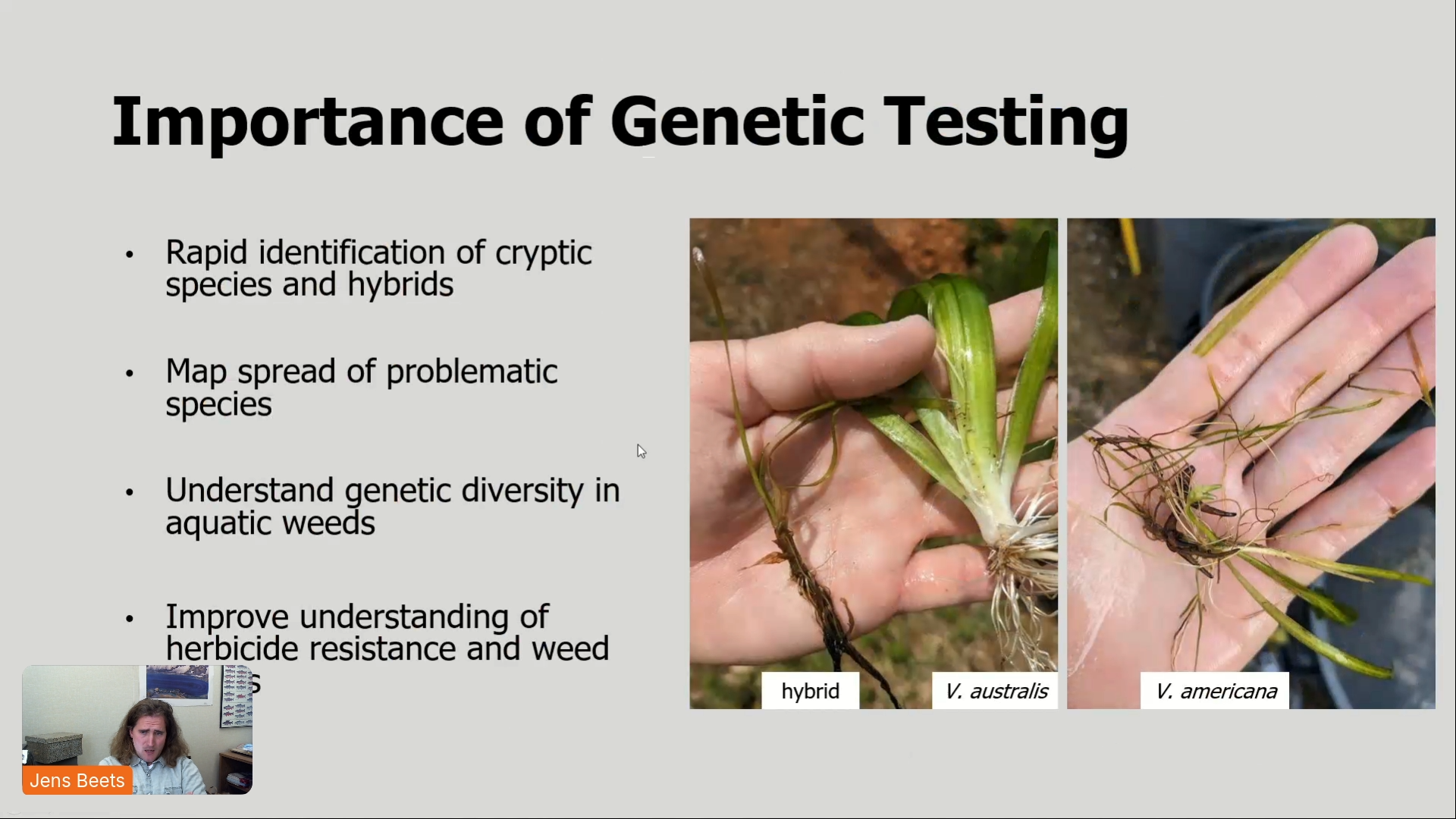
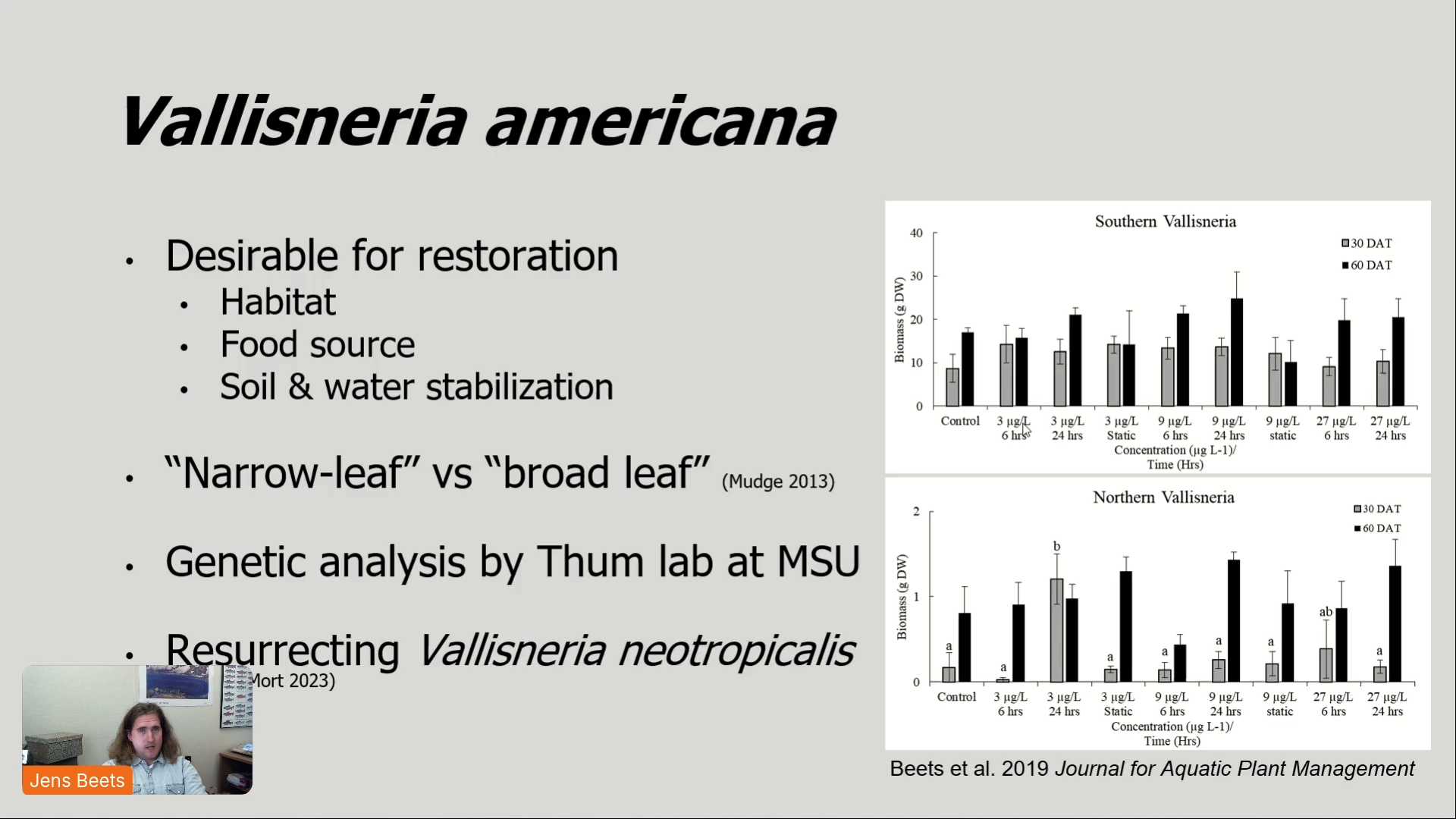
Jens Beets told us about a species of aquatic plant that is native to the East and Gulf coasts of the US, but is considered a “noxious weed” in California, solely because it isn’t native.  He said the plant is considered very useful where it is native.  (see below)

Where Vallisneria americana is native, it is considered a valuable plant for habitat restoration because it is habitat for vertebrates and invertebrates and it stabilizes soil and water levels.  The canvasback duck is named for this plant species because it is preferred habitat for the native duck that is found in California during the winter.

 Vallisneria americana looks very similar to other species in the genus considered native in California.  For that reason, native species of Vallisneria have been mistakenly killed with herbicide because applicators didn’t accurately identify the target plant as native.  Jens Beets recommended that genetic tests be performed before plants in this genus are sprayed with herbicide.

This story probably sounds familiar to regular readers of Conservation Sense and Nonsense.  The story is identical to the pointless and futile effort to eradicate non-native species of Spartina marsh grass in the San Francisco Bay.  The species being eradicated in California is native to the East and Gulf coasts, where it protects the coasts from extreme storm surges and provides valuable habitat for a genus of bird that is plentiful on the East Coast, but endangered in California.  The 20-year effort to eradicate non-native Spartina has killed over 50% of the endangered bird species in the San Francisco Bay. 

Throwing good money after bad

Because the hybrid is indistinguishable from the native species of Spartina on the West Coast, 7,200 genetic tests have been performed in the past 12 years before hybrid Spartina was sprayed with herbicide. Taxpayers have spent $50 million to eradicate Spartina over 20 years.  Recently, California state grants of $6.7 million were awarded to continue the project for another 10 years.  A portion of these grants is given to the California Invasive Plant Council to administer the grants.

Plants are sprayed with herbicide because they aren’t native, not because they are harmful.  Even if the target species is needed by birds and other animals, it is still killed and animals along with it.  The target species looks the same as the native species and only genetic testing can identify it is as a non-native.  The non-native is the functional equivalent of the native.  It is only genetically different because natural selection has adapted it to the conditions of a specific location. 

Pesticide regulation in the US is a hit or miss proposition

The final session of the symposium was a carefully orchestrated apologia for herbicides, a defensive tirade that suggested Cal-IPC believes its primary tool is in jeopardy.  Two presentations were made by employees of regulatory agencies.  Their assignment was to reassure the public that pesticides are safe because they are regulated by government agencies. 

The fact that many countries have banned pesticides that are routinely used in the US does not speak well for our regulatory system.  America’s pesticide regulators rarely deny market access to new pesticides.  A recent change in policies of California’s Department of Pesticide Regulation made a commitment to the continued use of pesticides for another 25 years. 

In 1996, Congress ordered the U.S. Environmental Protection Agency (EPA) to test all pesticides, used on food, for endocrine disruption by 1999. The EPA still doesn’t do this today. Twenty-five years later, the EPA has not implemented the program, nor has it begun testing on 96% of registered pesticides.  In 2022, an organization that represents farm workers sued the EPA to conduct the legally mandated evaluation of chemicals for endocrine disruption.   The lawsuit has forced the EPA to make a commitment to conduct these evaluations of chemicals for hormone disruption.   

The Cal-IPC presenters got some badly needed push back from attendees.   One attendee informed the audience that all the testing of herbicides is bought by the manufacturers, not the regulators who don’t do any testing.  Another attendee pointed out that herbicides have not been evaluated for the damage they are doing to the soil, damage that makes it difficult to grow native plants in the dead soil.  The “pesticide regulator” agreed with those observations.

Fire safety or native plant restoration?

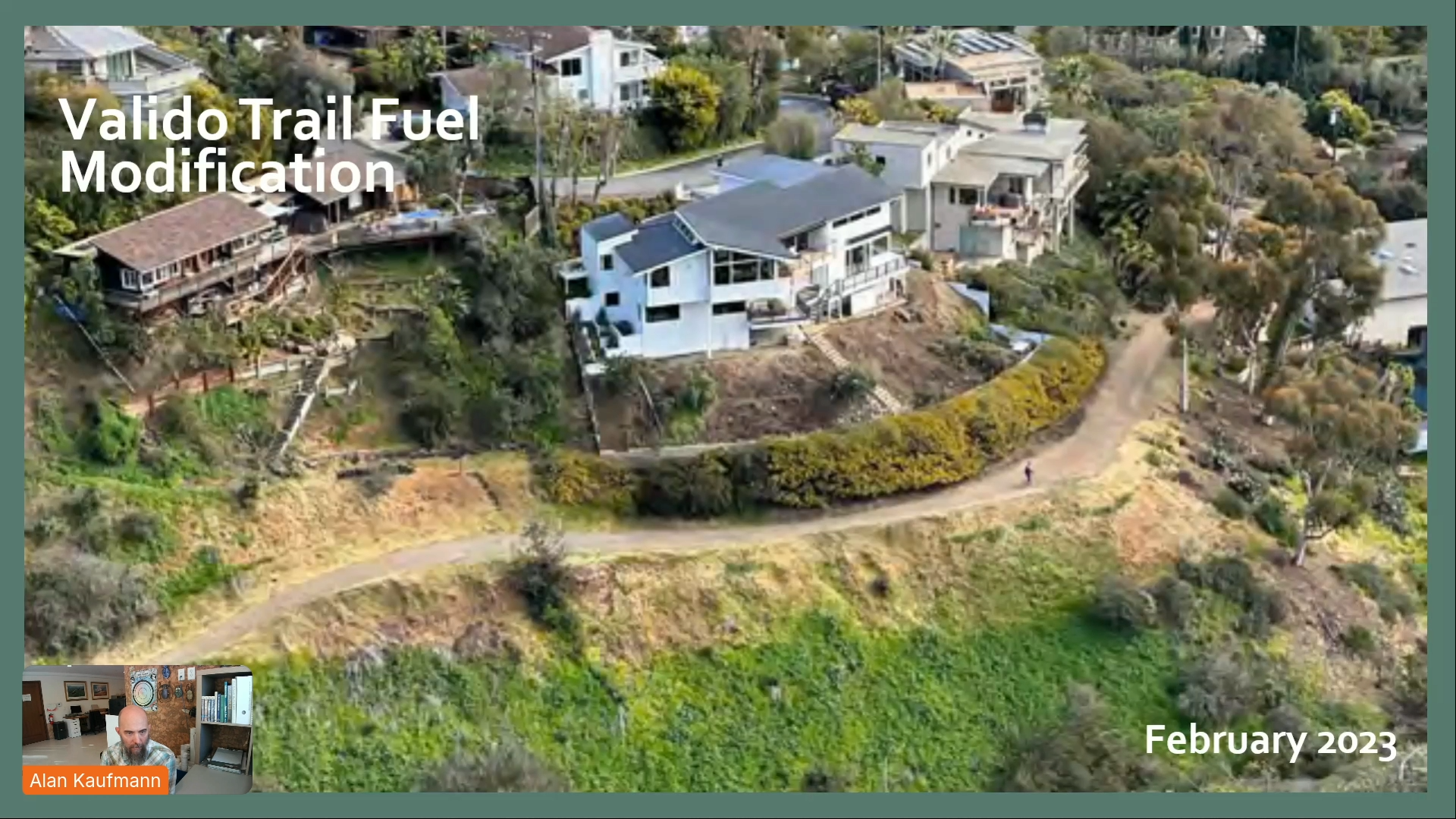
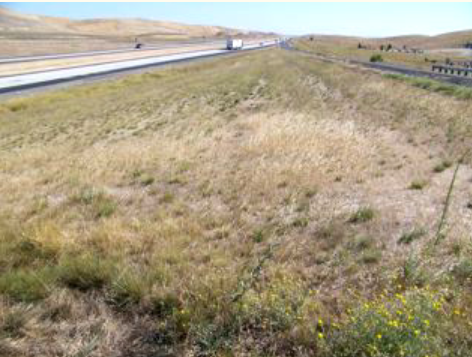
The Interim Deputy Director of the Laguna Canyon Foundation was the final presenter for the Symposium, speaking on a Friday afternoon at 4:30 pm, when there were less than 100 attendees left of the 690 registrants.  His presentation was about the blow back that his organization gets from the public about herbicide applications.  Criticism of herbicides escalated after a wet year that increased vegetation considered a fire hazard.  This photo (below) is an example of the visible effects of fuels management by Laguna Canyon Foundation using herbicides.

It seems likely that a fuels management project was selected for this presentation because it’s easier to justify herbicide use for fuels management than for eradicating harmless plants solely because they aren’t native. 

I recently supported Oakland’s Vegetation Management Plan that will use herbicides for the first time on 300 miles of roadsides and 2,000 acres of public parks and open space in Oakland.  Previously, herbicide applications were only allowed on medians in Oakland.  I tracked the development of the Vegetation Management Plan for 7 years through 4 revisions to avoid nativist versions of fuels management such as leaving dead thatch after herbicide applications on grassland or destroying non-native trees, while leaving highly flammable bay laurel trees behind or destroying broom, while leaving more flammable coyote brush behind.

However, using herbicides for the sole purpose of killing non-native plants is much harder to justify.  The irrational preference for native species has put us on the pesticide treadmill. Every plant species now targeted for eradication with herbicides should be re-evaluated, taking into consideration the following criteria:

  • Is it futile to attempt to eradicate a plant species that has naturalized in an ecosystem?
  • Will the attempt to eradicate the plant species do more harm than good?
  • Is the targeted plant species better adapted to current environmental and climate conditions?
  • Is the targeted non-native plant making valuable contributions to the ecosystem and its animal inhabitants?

If these questions cannot be satisfactorily answered, the bulls-eye on the targeted plant should be removed. Limiting the number of plants now being sprayed with herbicide is the only way to reduce pesticide use. If the plant isn’t a problem, there is no legitimate reason to spray it with herbicide.

Pot calls kettle black

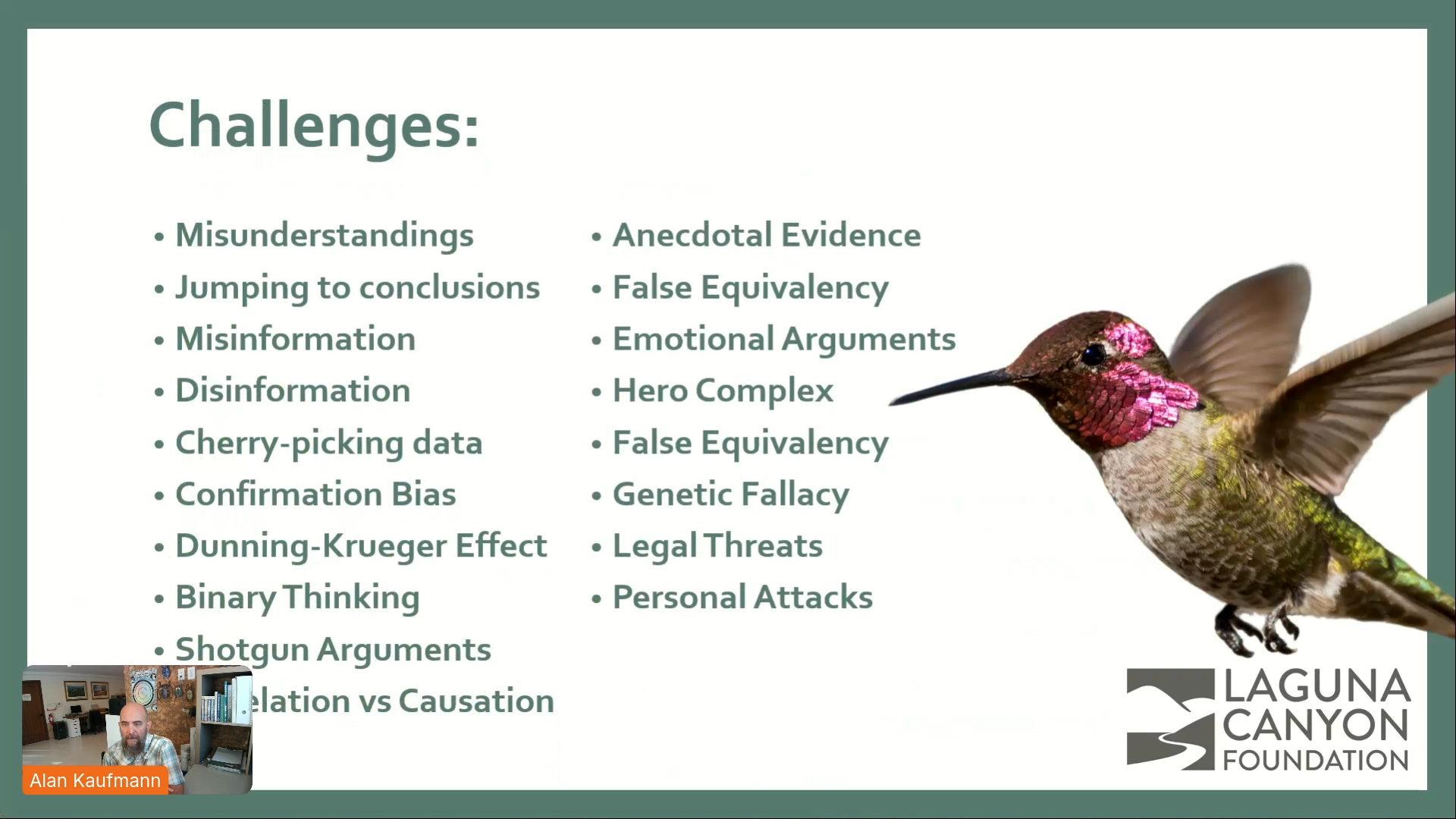
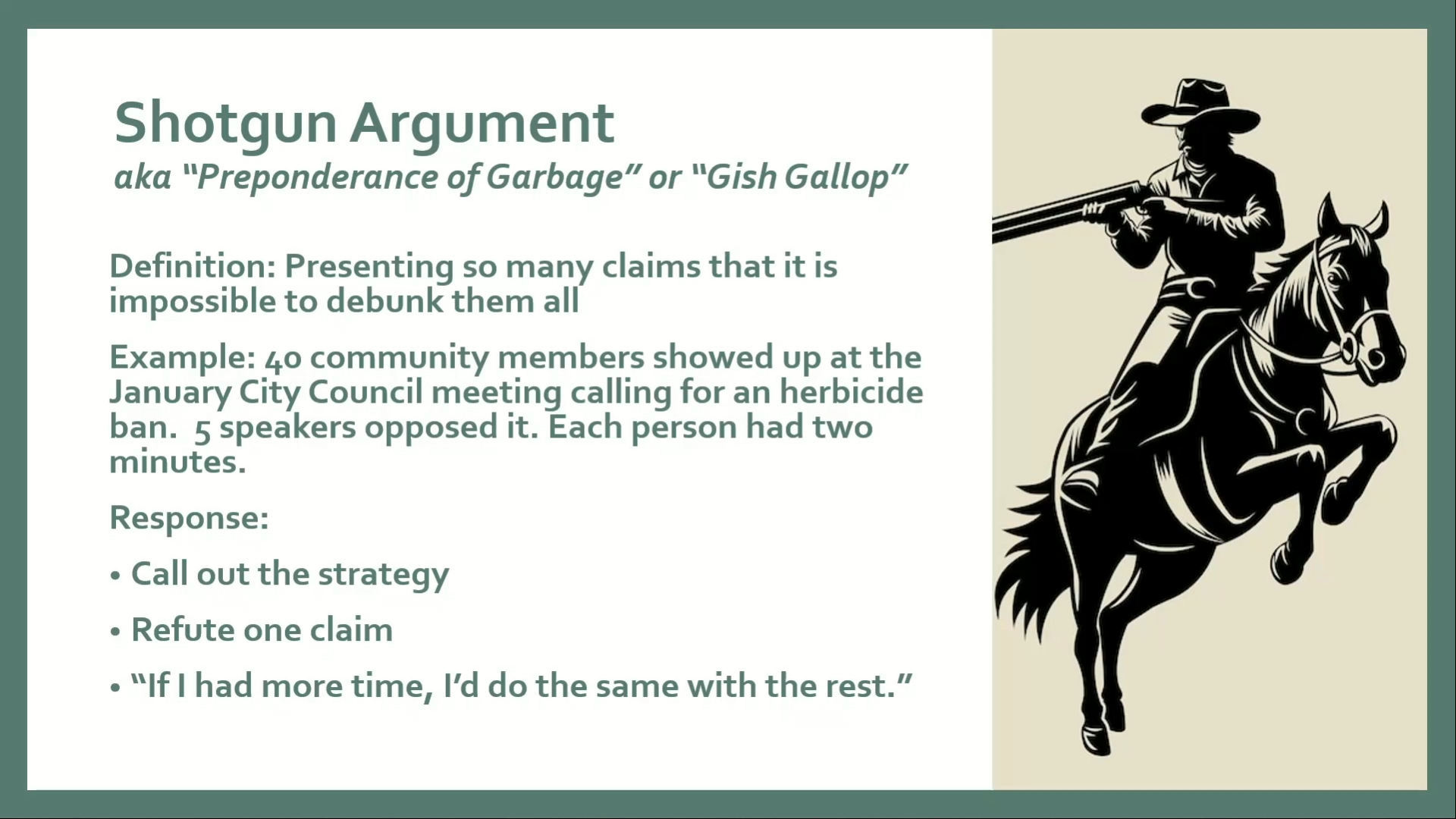
The Cal-IPC presentation was a detailed criticism of the public’s complaints about herbicides used in their community.  The intention of the presentation was to arm herbicide applicators with defenses against the public’s complaints.  Herbicide applicators were encouraged to recognize these arguments (below) and participate in the “education” of the public about the righteousness of their task.

The presenter then showed a series of slides making specific accusations, such as these:  (see below)

Those who object to the pointless destruction of nature can also cite distortions and misrepresentations of facts (AKA lies) by those who engage in these destructive projects;

  • Nativists fabricated a myth that eucalyptus kills birds to support their demand that eucalyptus in California be destroyed.  There is no evidence that myth is true. 
  • Nativists also fabricated a myth that burning eucalyptus in the 1991 firestorm in the East Bay cast embers that started spot fires 12 miles away from the fire front.  There is no evidence that myth is true.
  • Nativists exaggerate the success of their projects by setting a low bar for success, conducting no post-project monitoring, and restricting access to their completed projects.  
  • The EPA justified the dumping of rodenticides on off-shore islands by inaccurately claiming that the rodenticides do not end up in the water, killing marine animals.  There is ample evidence that island eradications have killed many marine animals because rodenticide lands in the water when applied by helicopters. 
  • USFWS justified the killing of 500,000 barred owls in western forests by claiming they are an “invasive species.”  In fact, barred owls migrated from the East to the West Coasts via the boreal forests of Canada.  These forests were not planted by humans and have existed since the end of the last Ice Age, some 10,000 years ago.  The arrival of barred owls on the West Coast was a natural phenomenon.  Barred owls are therefore not “invasive species.” In a rapidly changing climate, many animals must move to survive.
  • Nativists claim that most insects are “specialists” that require native plants.  That claim is a gross exaggeration of the dependence of insects on native plants, which are sometimes confined to a family of plants containing thousands of both native and non-native species. 
  • Pesticide applicators also complain about “personal attacks.”  They are not alone.  I (and others) have been called “nature haters,” “chemophobes,” and “climate change deniers.”  Pesticide applicators feel abused.  So do I. 

I could go on.  The list of bogus claims of the superiority of native plants and animals is long and getting longer as more and more public money is available to conduct misnamed “restorations.”  Suffice to say, there is plenty of misinformation floating around invasion biology and most of it is used to defend destructive “restoration” projects.  The war on nature is also a war of words. 


(1) ­Justin Luong, et.al., “Lessons learned from an interdisciplinary evaluation of long-term restoration outcomes on 37 coastal grasslands in California.” Biological Conservation, February 2022.

The program for the Cal-IPC 2024 Symposium is available HERE.  Abstracts and presentation slides have not yet been posted to the website, but they will eventually be available to the general public. 

Dana Milbank: The evolution of a native plant advocate

Dana Milbank is a political columnist for the Washington Post.  Like many Americans, Milbank moved his family from urban Washington D.C. to a derelict farm in the foothills of the Blue Ridge Mountains in Virginia, seeking refuge in nature from urban confinement imposed by the Covid pandemic.  So began his war on nature, dictated by native plant ideology.

In a series of columns, WaPo readers observed how his battle against non-native plants developed:

  • The first installment of his “restoration” saga described the over-grown property that he believed he was obligated to tame:  “an entire civilization of invasive vines and weeds had cruelly exploited the inattention [of previous elderly owners].”  The vines were “murdering defenseless native trees.”   He hired a crew to clear brush, until the cost challenged his budget.  Then he bought equipment and tried to do it himself.  He concluded that he could not “restore order” to his land without using herbicides.  Even then, he was doubtful of ultimate success:  “Clearly, I won’t be defeating these invaders.  At best, I’ll battle them to a temporary truce, holding them at bay until I lose the will to fight them.”  Like many city-slickers, Milbank has an unrealistic vision of what nature looks like when allowed to take its course.
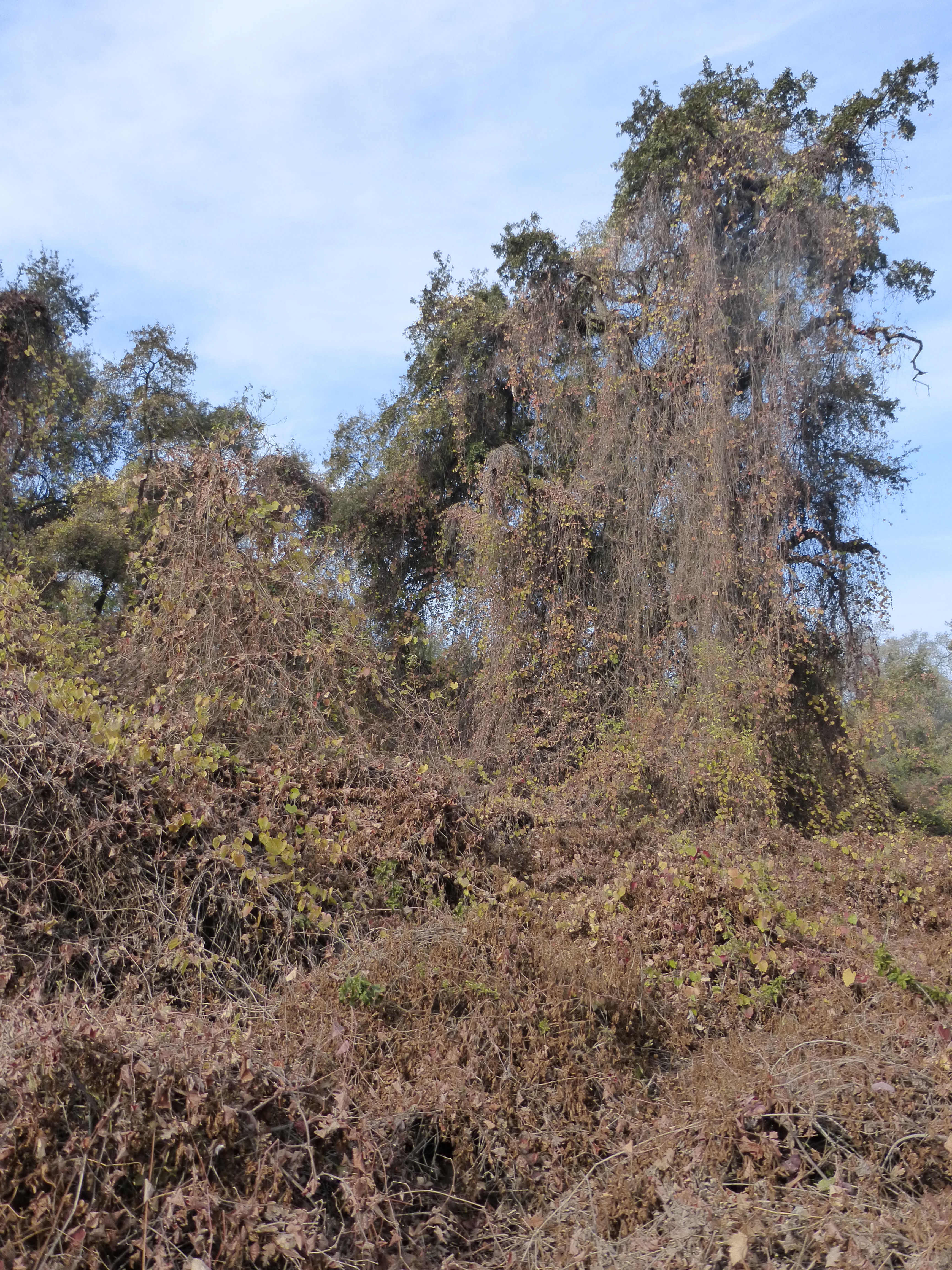
Kaweah Oaks Preserve, Visalia, CA.  November 2013.  California Wild Cucumber, also called manroot (Marah fabacea), climbing over a native valley oak.  Both native and non-native plants can be “invasive.” 
  • In the second episode of Milbank’s battle plan, deer were his target:  “I will be wielding my gun against a brutal foe—one that destroys our forests, kills our wildflowers, sickens humans and threatens the very survival of birds, mammals, insects and amphibians.  I am becoming a deer hunter.”   Where top predators, such as wolves and bears, have been eliminated by humans, there is an over-population of deer who browse vegetation, depriving other animals of the food and cover they need.  Again, Milbank has his doubts about the effectiveness of hunting deer on his property:  “I can’t pretend that my hunting will make a dent in the deer population.” 
  • After taking Virginia’s Master Naturalist Program, Milbank’s third episode expresses his regrets as a gardener:  “I’ve been filling my yard with a mix of ecological junk food and horticultural terrorists” and he warns urban and suburban gardeners that their gardens are “dooming the Earth.”  He takes aim at cultivars in general and many specific species of introduced plants.  Conservation Sense and Nonsense explains why most of these accusations are exaggerated, if not, patently false. 
  • In Milbank’s column, “How I learned to love toxic chemicals,” he expresses frustration about how hard it is to eradicate non-native plants:  “I was losing, badly, to the invasive vines and noxious weeds…I’d cut them back, but they would return in even greater numbers.”  He fully embraces the use of herbicides to escalate his war on nature:  “I have become a reluctant convert to chemicals.”  He acknowledges that glyphosate is toxic, but he claims that the cut-stump application method he uses is “surgical.” He wears protective clothing, including a respirator, which is not required by the product label or California law for glyphosate applications.  He is encouraged by Doug Tallamy, who calls herbicides “chemotherapy.”  Conservation Sense and Nonsense explains why herbicides are doing more harm than good to the environment and everything that lives in it.  

Throwing caution to the winds

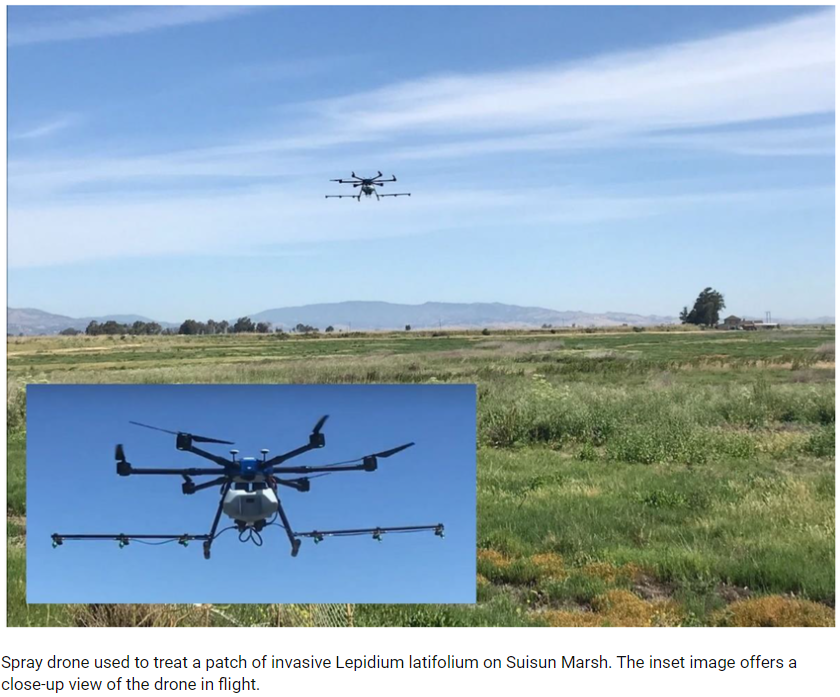
In the latest installment of Milbank’s crusade against non-native plants, he tosses caution about herbicides aside. He hires a drone to spray a hayfield with glyphosate in preparation for creating a meadow of native grasses and forbs:

“To save the birds, I brought in this big bird: a 10-foot-square, Chinese-made drone with 8 propellers, capable of carrying 10 gallons of fluid, in this case glyphosate, to kill the grass in my hayfield. (It might seem counterintuitive to douse a field in herbicide to help nature, but conservationists broadly endorse the practice.)”

Herbicides are often sprayed from drones to eradicate non-native plants considered “invasive.” Source: https://www.researchgate.net/figure/Spray-drone-used-to-treat-a-patch-of-invasive-Lepidium-latifolium-on-Suisun-Marsh-The_fig3_372867398https://www.researchgate.net/figure/Spray-drone-used-to-treat-a-patch-of-invasive-Lepidium-latifolium-on-Suisun-Marsh-The_fig3_372867398

Milbank has abandoned his cautious use of herbicide and is now aerial spraying from a drone 30 feet over his head, while he watches, without wearing any protective gear:

“Shanley, in shorts, sneakers and fishing shirt, plopped in a lawn chair in the shade of my barn and, using a control pad with two joysticks, sent the drone into the sky… In a moment, the beast was airborne and, from a height of about 30 feet, spraying death on my hayfield. It sprayed the fescue. It sprayed the Johnson grass. It sprayed the foxtail. It returned, flew over the barn — and sprayed me with glyphosate. Programming error. “Sorry about that,” Shanley said. My eyes burned for two days.”

If he had been wearing safety goggles, as required for glyphosate applicators in California, he would have been spared. Milbank has the right to poison himself, his land, and the animals that live on his land.  Although the applicator may be breaking laws (he would be in California) by not wearing any protective equipment, Milbank isn’t doing anything illegal. 

If I weren’t reading his story in the mainstream media with a national following, I wouldn’t be writing about what he’s doing. I’m writing about Milbank’s dangerous use of herbicides because he has a big audience and his audience displays their ignorance of the dangers in over 1,400 comments.

The reader comments on Milbank’s latest article are uniformly positive, as were comments on his earlier installments about his war on nature.  Most comments are short expressions of unqualified praise, such as “You are doing holy work,” or “God bless you.”

A handful of comments (including mine) express concern about the indiscriminate use of glyphosate.  The few dissenting readers are blasted by Milbank’s supporters.  Some of their responses betray ignorance of herbicides: 

  • It’s not Round Up; it’s a safe herbicide.”  In fact, Milbank says he’s using glyphosate, which is the active ingredient in Round Up.
  • “He said nothing about dousing. It looks like a selective approach. In some cases, there is no practical alternative.”  In fact, Milbank says explicitly that he’s spraying 10 gallons of herbicide 30 feet over the ground from an aerial drone.  Does that sound selective?

The reader comments claiming that glyphosate is harmless brought to mind a recent article about the army of paid apologists for pesticides.  The pesticide industry, in collaboration with the US government, has “established a ‘private social network’ to counter resistance to pesticides and genetically modified (GM) crops in Africa, Europe and other parts of the world, while also denigrating organic and other alternative farming methods. More than 30 current government officials are on the membership list, most of whom are from the US Department of Agriculture (USDA).”

The most common defense of Milbank’s herbicide spraying was that it only needs to be done once, with an occasional follow up prescribed burn.  Milbank doesn’t actually claim that herbicide only needs to be sprayed once, but his supporters wish to believe that.  Here are a few actual attempts to convert non-native grass to native grass that illustrate that such a conversion is unlikely to be possible, even after a persistent, long-term attempt.

Dunnigan plot in August 2011, after 9 years of effort, described below. Source: https://www.ecoseeds.com/road.test.html
  • A team of academic scientists at UC Davis attempted to convert non-native grasses to native grasses on 2 acres of roadside.  At a cost of $450,000, they tried every available method (herbicides, plowing, plug planting, mowing, burning) for 9 years.  When they ran out of money, they declared success, which they defined as 35% native grasses that they expected to last for no more than 10 years. (See above)
  • The Invasive Spartina Project in the San Francisco Bay has been trying to eradicate non-native spartina marsh grass with herbicide for 20 years at a cost of $50 million.  The project was recently granted another $6.7 million to continue the project for another 10 years.  The project has killed over 600 endangered birds (Ridgway rails) in the San Francisco Bay because of the loss of habitat. 
  • One of the presentations at the 2022 conference of the California Native Plant Society was about a 20-year effort at the Santa Rosa Plateau Ecological Reserve to convert non-native annual grassland to native grassland, using annual prescribed burns.  Many different methods were used, varying timing, intensity, etc.  The abstract for this presentation reports failure of the 20-year effort:  “Non-native grass cover significantly decreased after prescribed fire but recovered to pre-fire cover or higher one year after fire.  Native grass cover decreased after prescribed fire then recovered to pre-burn levels within five years, but never increased over time.  The response of native grass to fire (wild and prescribed) was different across time and within management units, but overall native grass declined.”  The audience was audibly unhappy with this presentation.  One person asked if the speaker was aware of other places where non-native grass was successfully converted to native grass.  The speaker chuckled and emphatically said, “NO.  I am not aware of any place where native grasses were successfully reintroduced.”
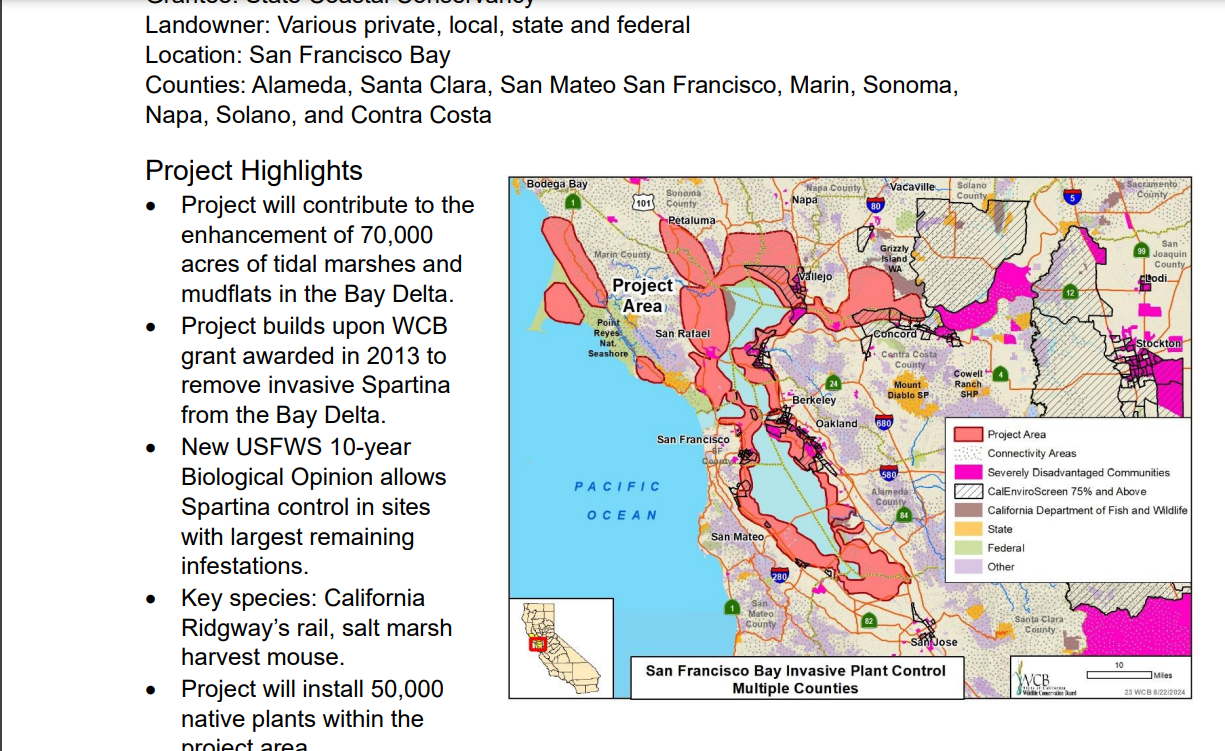
This map of the San Francisco Bay shows where herbicides have been sprayed on non-native marsh grass for 20 years. It is a BIG project!

Anyone with a little knowledge of how herbicides work, would know that glyphosate kills only the top-growth of an actively growing plant.  Glyphosate won’t kill the seed bank of Milbank’s hayfield, which he says has been growing there for decades, perhaps as long as 100 years.  That’s why glyphosate must be applied annually as the seed bank continues to produce new top-growth annually.  If Milbank plants native plants after the initial spraying, they will be killed by subsequent spraying because glyphosate is a non-selective herbicide, which kills whatever it touches, both native and non-native plants. Perhaps Milbank knows this, but his readers don’t.  It might explain why Milbank is not particularly optimistic about the prospects of achieving his goal of a native meadow:  “Will it work? I have no idea. It could become the field of my dreams…Or it could be a costly and time-consuming failure.”

Only two of Milbank’s readers mention the damage that herbicide does to the soil, making future plantings even less likely to survive.  One of those comments is from a farmer who has reason to know this important information: 

The number of things you screwed up, from possibly destroying that old man’s life, family, and farm, to messing up the winter food supply with a cascading effect for farms in your region, to obliterating a small farm, were appalling until you got to the part where you killed your soil microbes with poison. You actually killed topsoil with the idea you were going to grow healthy plants! If I were to write a caricature of a [sub]urbanite transplanted to a farming community and with the best intentions absolutely destroying everything, couldn’t have done any better than you have with your self-congratulatory actions. Farms are complex systems embedded in even more complex natural systems. Farms interact with and depend on each other. It’s where food comes from. When you kill one, you hurt all the others. You also hurt animals and plants that depend on the farm. Creating a farm, and a farming community, is hard. Destroying one is easy, and you just did it.”

This comment brought to mind a recent study about the damage that pesticides do to the soil.  A meta-analysis of 600 studies “…published in the journal iScience found that soil pollution was the leading cause of declines among organisms living underground. The finding has surprised scientists, who expected farming intensification and climate change to have much greater impacts.”  The co-author of the study said, “Above ground, land use, climate change and invasive species have the greatest impact on biodiversity, so we assumed that this would be similar below ground,” Victoria says. “Our results show, however, that this isn’t the case. Instead, we found that pesticide and heavy metal pollution caused the most damage to soil biodiversity. This is worrying, as there hasn’t been a lot of research into the impacts of soil pollution, so its effects might be more widespread than we know.”

A familiar story

Dana Milbank’s plans to transform a derelict farm into a native plant garden are the mirror image of the native plant movement in the San Francisco Bay, the region where I live and have observed failed native plant “restorations” for over 25 years:

  • Native plant “restoration” projects in the Bay Area began over 25 years ago based on the mistaken assumption that if non-native plants were destroyed, native plants would magically emerge without being planted.  In other words, nativists originally believed that the only obstacle to native plants was the mere existence of non-native plants.
  • After 25 years of applying herbicides repeatedly, there are no more native plants in the San Francisco Bay Area than there were 25 years ago.  The soil has been poisoned by herbicides and climate change and associated drought makes native plants progressively less well adapted to current environment conditions.
  • Despite the obvious failure of these “restoration” attempts, they continue unabated because vast sums of public money are available to keep them going.  Dana Milbank will run out of money eventually, but the public coffers are never empty.  Milbank is 56 years old.  When he gets too old to do the work or when he dies, whatever he has accomplished will quickly revert to its previous unmanaged state.  Nature will prevail and his brief conceit that humans can control nature will be history. 
  • The public is unaware of how much herbicide is used by public land managers because application notices are not required for most pesticides.  In California, for example, if the manufacturer of the pesticide claims that the pesticide will dry within 24 hours, application notices are not required by law.  Glyphosate is one of many herbicides for which application notices are not required.  Some land managers post application notices anyway, but many do not.  The public is also ignorant of the damage that pesticides do to the environment and everything that lives in it. 

Defining “Success” So That “Success” Can Be Achieved

I always attend the conferences of the California Invasive Plant Council (Cal-IPC) and the California Native Plant Society because I feel obligated to understand their viewpoint so I can accurately report on the controversies of invasion biology.  Ironically, the more I learn about the native plant movement and the “restoration” industry it spawned, the less … Continue reading “Defining “Success” So That “Success” Can Be Achieved”

I always attend the conferences of the California Invasive Plant Council (Cal-IPC) and the California Native Plant Society because I feel obligated to understand their viewpoint so I can accurately report on the controversies of invasion biology.  Ironically, the more I learn about the native plant movement and the “restoration” industry it spawned, the less sense it makes.  The October 2024 Symposium of the California Invasive Plant Council has provided yet more evidence that attempts to eradicate well-established non-native landscapes and replace them with native plants are futile.

Tricks of the “Restoration” Trade

Every Cal-IPC Symposium has wrestled with the question of how to convert non-native grassland to native grassland. A study of 37 grassland “restorations” in coastal California answers that question. (1)  It’s really quite simple.  All you need to do is define success as 25% native plants after “restoration” and limit post-project monitoring to 5 years or less:  “Monitoring is done ≤5 years after project-implementation, if at all, and rarely assesses the effects of management practice on project success.” 

It also helps if public land managers in charge of the projects won’t allow the academic researcher to enter the land to conduct a survey of the results.  43% of the projects that were studied were “statutory,” i.e., they were mandated by laws such as county general plans or legally required mitigation for projects elsewhere that Environment Impact Reports determined were harmful to the environment.  30% of the managers of the statutory projects would not allow the academic researcher to survey their projects. 

It is also easier to achieve success if the project goal is downgraded mid-project as were many of the statutory projects because they weren’t able to meet the original goal.

Project managers can also reduce their risks of failure by planting a small number of native species that are particularly easy to grow:  “Ninety-two percent of restoration managers preferentially use one or more of the same seven [native] species.”  Seven projects planted only one native species. 

According to the study, the result of planting only a few hardy native plants is “biotic homogenization.”  Call it what you will, but this risk-averse strategy is inconsistent with claims that the goal of native plant restorations is to increase biodiversity. 

The study did not ask project managers about the methods they used to eradicate non-native plants or plant native plants.  The study tells us nothing about the methods that were used or whether or not some methods were more effective than others.  Since results of the projects were all very similar, should we assume that the methods that were used didn’t matter? 

The presentation of this study concluded with this happy-face slide. (see below) It looks like a cartoonish marketing ad to me:

Harmless aquatic plants being pointlessly eradicated

A USDA research ecologist stationed at UC Davis made a presentation about the most effective way to kill an aquatic plant with herbicides, but that wasn’t the message I came away with. 

Jens Beets told us about a species of aquatic plant that is native to the East and Gulf coasts of the US, but is considered a “noxious weed” in California, solely because it isn’t native.  He said the plant is considered very useful where it is native.  (see below)

Where Vallisneria americana is native, it is considered a valuable plant for habitat restoration because it is habitat for vertebrates and invertebrates and it stabilizes soil and water levels.  The canvasback duck is named for this plant species because it is preferred habitat for the native duck that is found in California during the winter.

 Vallisneria americana looks very similar to other species in the genus considered native in California.  For that reason, native species of Vallisneria have been mistakenly killed with herbicide because applicators didn’t accurately identify the target plant as native.  Jens Beets recommended that genetic tests be performed before plants in this genus are sprayed with herbicide.

This story probably sounds familiar to regular readers of Conservation Sense and Nonsense.  The story is identical to the pointless and futile effort to eradicate non-native species of Spartina marsh grass in the San Francisco Bay.  The species being eradicated in California is native to the East and Gulf coasts, where it protects the coasts from extreme storm surges and provides valuable habitat for a genus of bird that is plentiful on the East Coast, but endangered in California.  The 20-year effort to eradicate non-native Spartina has killed over 50% of the endangered bird species in the San Francisco Bay. 

Throwing good money after bad

Because the hybrid is indistinguishable from the native species of Spartina on the West Coast. 7,200 genetic tests have been performed in the past 12 years before hybrid Spartina was sprayed with herbicide. Taxpayers have spent $50 million to eradicate Spartina over 20 years.  Recently, California state grants of $6.7 million were awarded to continue the project for another 10 years.  A portion of these grants are given to the California Invasive Plant Council to administer the grants.

Plants are sprayed with herbicide because they aren’t native, not because they are harmful.  Even if the target species is needed by birds and other animals, it is still killed and animals along with it.  The target species looks the same as the native species and only genetic testing can identify it is as a non-native.  The non-native is the functional equivalent of the native.  It is only genetically different because natural selection has adapted it to the conditions of a specific location. 

Pesticide regulation in the US is a hit or miss proposition

The final session of the symposium was a carefully orchestrated apologia for herbicides, a defensive tirade that suggested Cal-IPC believes its primary tool is in jeopardy.  Two presentations were made by employees of regulatory agencies.  Their assignment was to reassure the public that pesticides are safe because they are regulated by government agencies. 

The fact that many countries have banned pesticides that are routinely used in the US does not speak well for our regulatory system.  America’s pesticide regulators rarely deny market access to new pesticides.  A recent change in policies of California’s Department of Pesticide Regulation made a commitment to the continued use of pesticides for another 25 years. 

In 1996, Congress ordered the U.S. Environmental Protection Agency (EPA) to test all pesticides used on food for endocrine disruption by 1999. The EPA still doesn’t do this today. Twenty-five years later, the EPA has not implemented the program, nor has it begun testing on 96% of registered pesticides.  In 2022, an organization that represents farm workers sued the EPA to conduct the legally mandated evaluation of chemicals.   The lawsuit has forced the EPA to make a commitment to conduct these evaluations of chemicals for hormone disruption.   

The Cal-IPC presenters got some badly needed push back from attendees.   One attendee informed the audience that all the testing of herbicides is bought by the manufacturers, not the regulators who don’t do any testing.  Another attendee pointed out that herbicides have not been evaluated for the damage they are doing to the soil, damage that makes it difficult to grow native plants in the dead soil.  The “pesticide regulator” agreed with those observations.

Fire safety or native plant restoration?

The Interim Deputy Director of the Laguna Canyon Foundation was the final presenter for the Symposium, speaking on a Friday afternoon at 4:30 pm, when there were less than 100 attendees left of the 690 registrants.  His presentation was about the blow back that his organization gets from the public about herbicide applications.  Criticism of herbicides escalated after a wet year that increased vegetation considered a fire hazard.  This photo (below) is an example of the visible effects of fuels management by Laguna Canyon Foundation using herbicides.

It seems likely that a fuels management project was selected for this presentation because it’s easier to justify herbicide use for fuels management than for eradicating harmless plants solely because they aren’t native. 

I recently supported Oakland’s Vegetation Management Plan that will use herbicides for the first time on 300 miles of roadsides and 2,000 acres of public parks and open space in Oakland.  Previously, herbicide applications were only allowed on medians in Oakland.  I tracked the development of the Vegetation Management Plan for 7 years through 4 revisions to avoid nativist versions of fuels management such as leaving dead thatch after herbicide applications on grassland or destroying non-native trees, while leaving highly flammable bay laurel trees behind or destroying broom, while leaving more flammable coyote brush behind.

However, using herbicides for the sole purpose of killing non-native plants is much harder to justify.  The irrational preference for native species has put us on the pesticide treadmill. Every plant species now targeted for eradication with herbicides should be re-evaluated, taking into consideration the following criteria:

  • Is it futile to attempt to eradicate a plant species that is deeply entrenched in plant communities?
  • Will the attempt to eradicate the plant species do more harm than good?
  • Is the targeted plant species better adapted to current environmental and climate conditions?
  • Is the targeted non-native plant making valuable contributions to the ecosystem and its animal inhabitants?

If these questions cannot be satisfactorily answered, the bulls-eye on the targeted plant should be removed. Limiting the number of plants now being sprayed with herbicide is the only way to reduce pesticide use. If the plant isn’t a problem, there is no legitimate reason to spray it with herbicide.

Pot calls kettle black

The Cal-IPC presentation was a detailed criticism of the public’s complaints about herbicides used in their community.  The intention of the presentation was to arm herbicide applicators with defenses against the public’s complaints.  Herbicide applicators were encouraged to recognize these arguments (below) and participate in the “education” of the public about the righteousness of their task.

The presenter then showed a series of slides making specific accusations, such as these:  (see below)

Those who object to the pointless destruction of nature can also cite similar distortions and misrepresentations of facts (AKA lies) by those who engage in these destructive projects;

  • Nativists fabricated a myth that eucalyptus kills birds to support their demand that eucalyptus in California be destroyed.  There is no evidence that myth is true
  • Nativists also fabricated a myth that burning eucalyptus in the 1991 firestorm in the East Bay cast embers that started spot fires 12 miles away from the fire front.  There is no evidence that myth is true.
  • Nativists exaggerate the success of their projects by setting a low bar for success, conducting no post-project monitoring, and restricting access to their completed projects.  
  • The EPA justified the dumping of rodenticides on off-shore islands by inaccurately claiming that the rodenticides do not end up in the water, killing marine animals.  There is ample evidence that island eradications have killed many marine animals because rodenticide lands in the water when applied by helicopters. 
  • USFWS justified the killing of 500,000 barred owls in western forests by claiming they are an “invasive species.”  In fact, barred owls migrated from the East to the West Coasts via the boreal forests of Canada.  These forests were not planted by humans and have existed since the end of the last Ice Age, some 10,000 years ago.  The arrival of barred owls on the West Coast was a natural phenomenon.  Barred owls are therefore not “invasive species.” In a rapidly changing climate, many animals must move to survive.
  • Nativists claim that most insects are “specialists” that require native plants.  That claim is a gross exaggeration of the dependence of insects on native plants, which are sometimes confined to a family of plants containing thousands of both native and non-native species. 
  • Pesticide applicators also complain about “personal attacks.”  They are not alone.  I (and others) have been called “nature haters,” “chemophobes,” and “climate change deniers.”  Pesticide applicators feel abused.  So do I. 

I could go on.  The list of bogus claims of the superiority of native plants and animals is long and getting longer as more and more public money is available to conduct misnamed “restorations.”  Suffice to say, there is plenty of misinformation floating around invasion biology and most of it is used to defend destructive “restoration” projects.  The war on nature is also a war of words. 


(1) ­Justin Luong, et.al., “Lessons learned from an interdisciplinary evaluation of long-term restoration outcomes on 37 coastal grasslands in California.” Biological Conservation, February 2022.

The Forever War on Non-Native Plants

I spoke to California’s Wildlife Conservation Board at their August 2024 meeting about the Invasive Spartina Project. I asked the Board not to fund the eradication of non-native spartina and its hybrid, using herbicide. This project, which began 20 years ago, had cost over $50 million by 2023. (1)  Non-native spartina, native to the East and Gulf coasts (2), provides crucial habitat for Clapper rails (3), closely related to our endangered Ridgway rails.

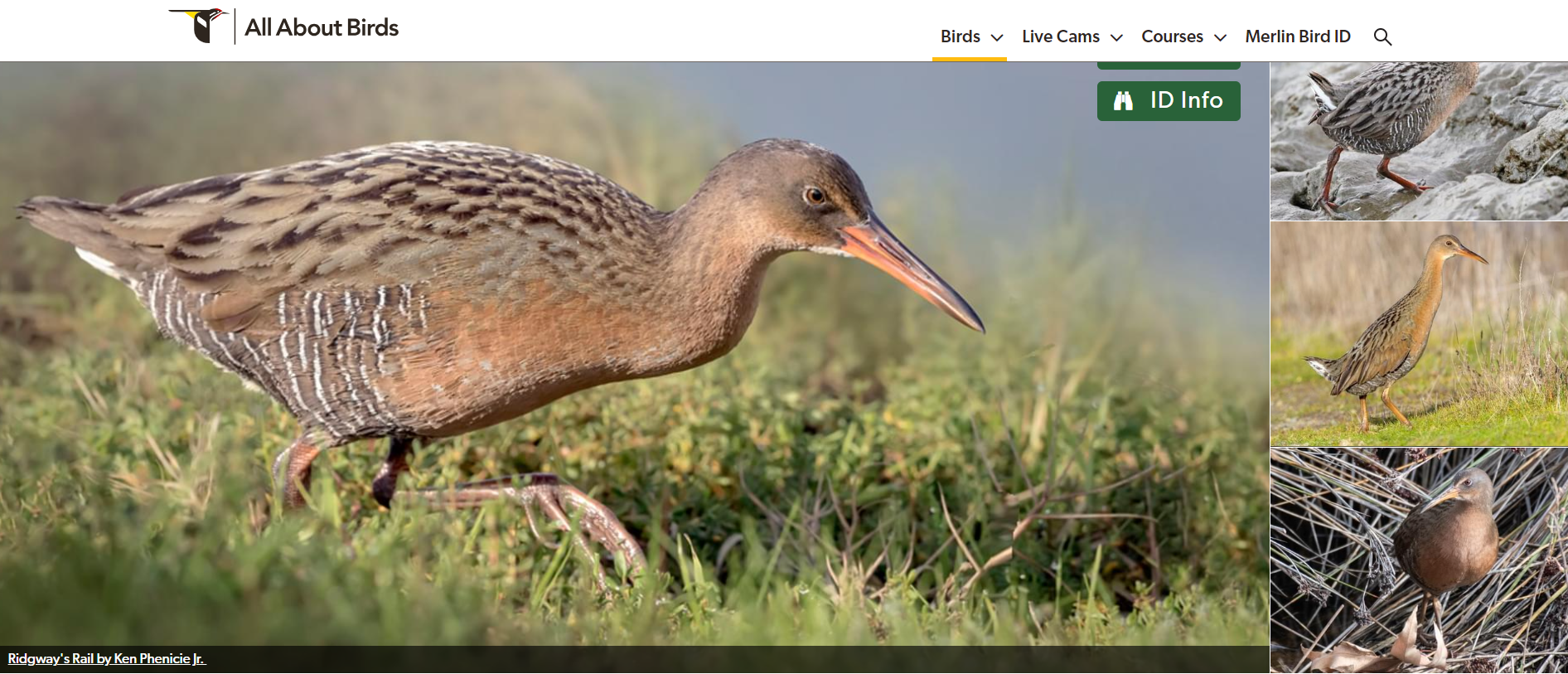
Source: Cornell Laboratory of Ornithology

Non-native spartina grows taller, denser, and doesn’t die back in winter as native spartina does. Because early aerial spraying of herbicide eradicated most non-native spartina by 2010, Ridgway rail populations declined by 50% due to habitat loss. (4)

The project was temporarily paused in 2014 to plant native marsh plants and stabilize rail populations. When the project was resumed in most places the rail population continued to decline from 2018-2023. There were approximately 1,200 Ridgway rails in the Bay estuary before the project began. (5)  The most recent survey in 2022 found about 500. (6)

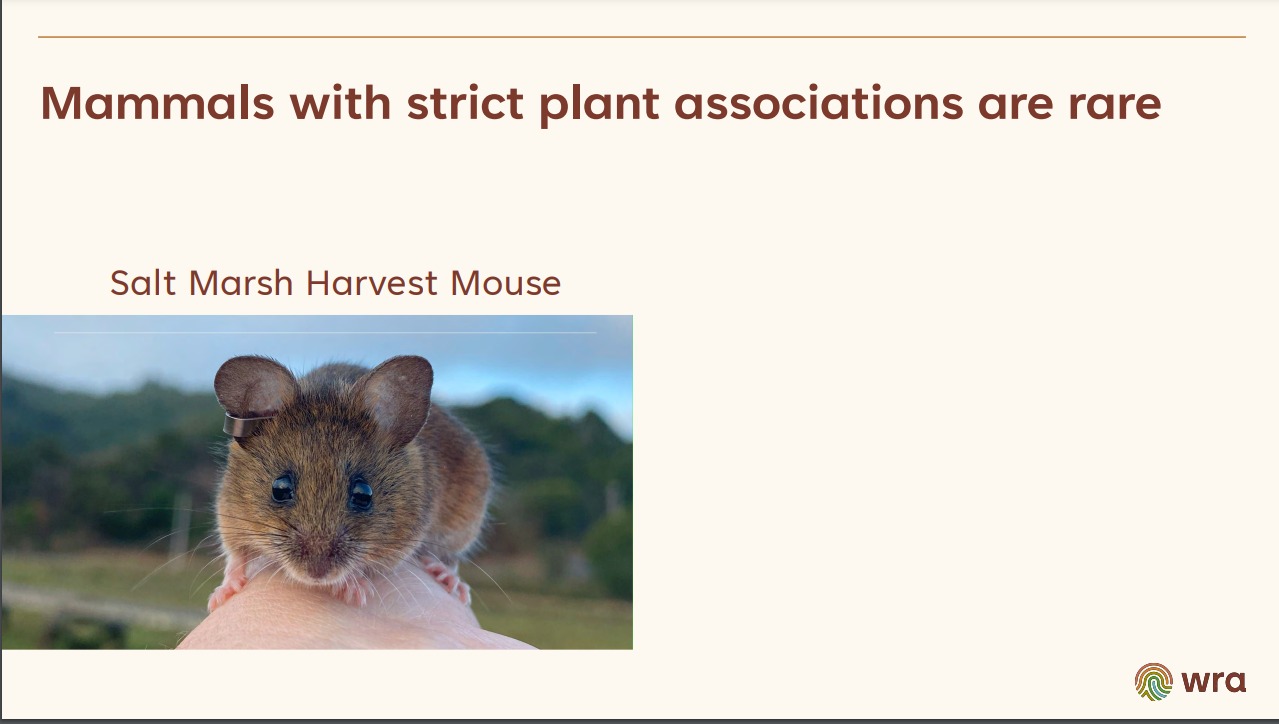
Native pickleweed was planted based on the mistaken assumption it would benefit endangered salt marsh harvest mice.  Recent studies show there are more mice in areas with less pickleweed and they eat both native and non-native plants. (7)

For the past 10 years, the focus has been on eradicating a hybrid of spartina, though it is indistinguishable from native spartina and 7,200 genetic tests were required from 2010 to 2022 to identify it. Hybridization is a natural evolutionary process that supports natural selection. (8)

Hybrid spartina could help to protect the Bay’s shoreline as sea level rises and extreme storm events cause erosion.  Where it is eradicated, gaps in vegetation are difficult to revegetate because the herbicide (imazapyr) that is used is very mobile and persistent in the soil. Imazapyr is also a non-selective herbicide that kills both native and non-native plants growing closely together, as they do in the San Francisco Bay Estuary. (9)

Although others spoke with me, there were an equal number of people who spoke in favor of granting nearly $7 million to continue the project for another 10 years. Some of the funding is granted to California Invasive Plant Council to administer the grants. Several of those speakers (including Marin Audubon) actually claimed that the project is benefiting endangered Ridgway rails, despite the fact that the project has killed at least 600 of them by destroying their nesting habitat and probably contaminating the food they eat, such as crustaceans and mollusks.

You might wonder why an organization such as Marin Audubon, which is committed to protecting birds, would advocate to continue a project that has killed at least 600 endangered birds, until you remember that Marin Audubon is also supportive of the project that plans to kill 500,000 barred owls. Marin Audubon also wants the Barred Owl Management Strategy to be mandatory instead of voluntary as proposed by USFWS.

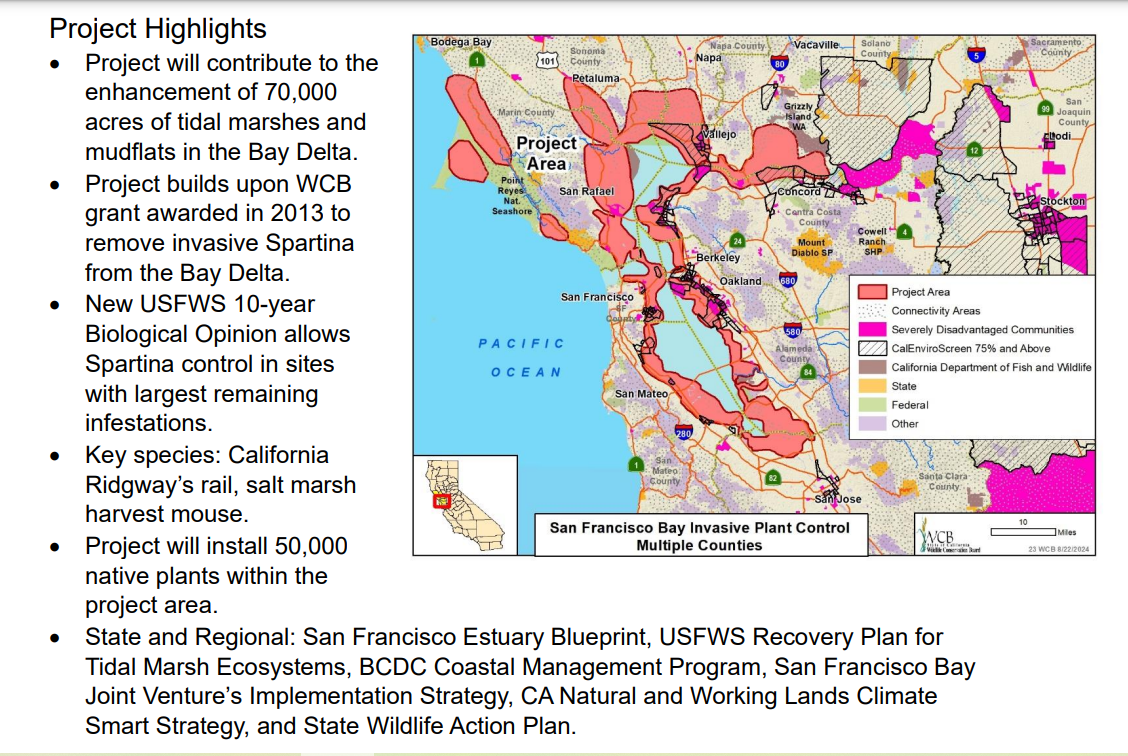
Source: Staff Report for Invasive Spartina Project, WCB Board Meeting, August 22, 2024

The Wildlife Conservation Board approved grants to the Invasive Spartina Project with one dissenting vote. The dissenting Board member voted, “Hell, NO!” Her term on the Board will end after the May 2025 meeting.  She does not expect to be reappointed.  Her departure will be the end of the effort to prevent the Wildlife Conservation Board from granting funds to projects that use pesticides.  It’s another dead end for those who advocate on behalf of wildlife and against the use of pesticides on public lands.

Funding sources to continue the Invasive Spartina Project are the Greenhouse Gas Reduction Act and Climate Change Resilience fund. These funding sources are as inappropriate as the project itself.  Destroying vegetation does not reduce greenhouse gas emissions.  Destroying non-native vegetation that grows taller, denser, and doesn’t die back in winter does not make our shoreline more resilient as sea-levels rise and winter storms become more intense.

Invasive Spartina Project is typical, not unique

The Invasive Spartina Project is typical of other “restoration” projects in California that have been trying, unsuccessfully, to eradicate non-native plants for 20 years and more.  Thanks to the California Invasive Plant Council (Cal-IPC), we now have survey data that tells us where these projects have been done and for how long. (10)

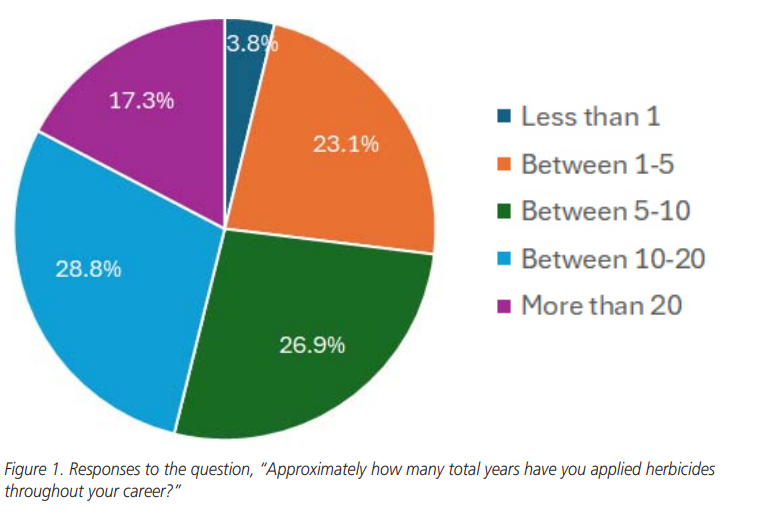
Cal-IPC sent more than 300 survey questionnaires to “practitioners” who had registered for Continuing Education credits for Cal-IPC classes and “land manager staff of organization throughout California.”  Over 100 practitioners replied to the survey.  This graph depicts their replies to the question, “Approximately how many total years have you applied herbicides throughout your career?”

Source: California Invasive Plant Council

Clearly, the Invasive Spartina Project is one of many “restoration” projects that have been applying herbicides for 20 years or more.  And the Invasive Spartina Project has secured State funding to continue spraying herbicides for another 10 years.  Spraying herbicides on public lands has created stable, life-long employment for an army of weed warriors. 

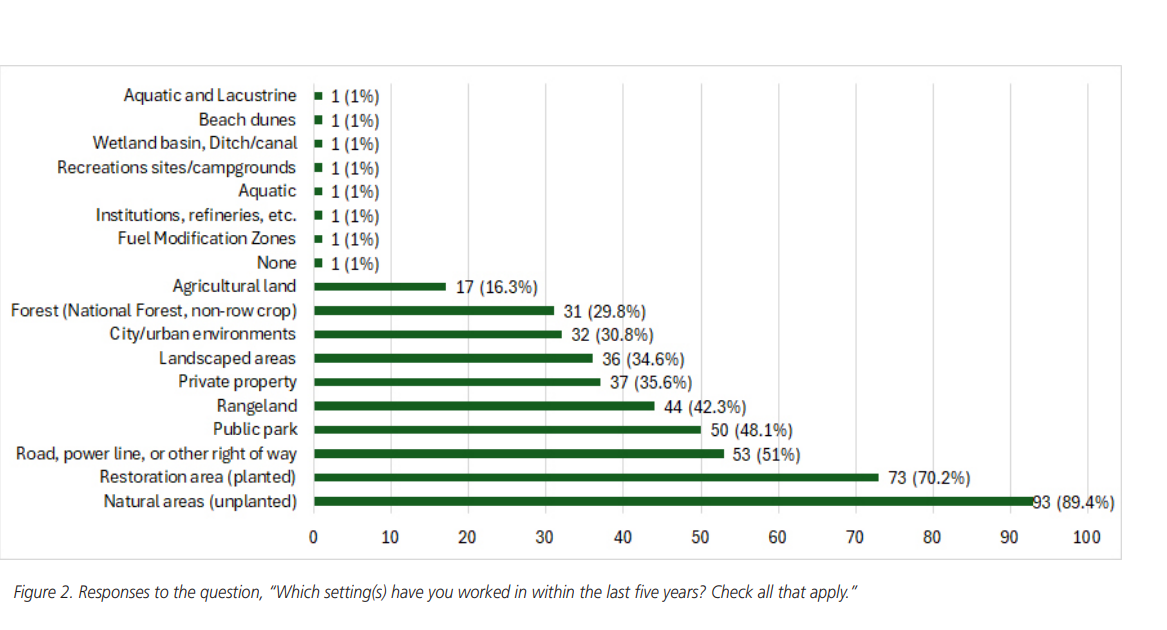
The survey also tells us where herbicides are being sprayed:

Source: California Invasive Plant Council

Virtually all (89%) herbicide applicators are spraying herbicides in “natural areas”—which we assume are wildlands—where no attempt has been made to plant native plants.  Most projects are more destructive than they are constructive. Nearly 50% of herbicide applicators are spraying in public parks.  70% of herbicide applicators spray in “restoration areas,” presumably to sustain the native plants that were planted.  If they are using non-selective herbicides, such as glyphosate and imazapyr, they are probably killing native plants too.

There are many other revelations in this survey and the details are available in the Cal-IPC publication (10):

  • Only 1.9% of respondents had not used herbicides or been part of a project that used herbicides.
  • The top three application methods were spot spraying (100%), cut stump (87%), and broadcast spray (70%).
  • 40% of respondents were not calibrating their herbicide use.  “Calibration is the process of adjusting and measuring the amount of pesticide that a piece of equipment will apply to a target area. It’s an important step in the pesticide application process to ensure that the equipment is applying the correct amount of pesticide at the right rate and in a uniform manner.” (Google search)
  • 28% of respondents had never received calibration training.  20% of respondents said they did not calibrate their herbicide application because “they did not know how.” Cal-IPC often claims that herbicides are being applied “judiciously.” If you don’t know how to apply herbicides, you are unlikely to apply them “judiciously.”

The Forever War on Non-Native Plants

Cal-IPC’s survey of “restoration” practitioners confirms our observations of their efforts in the past 25 years in the San Francisco Bay Area:

  • Attempts to eradicate non-native plants are a Forever War that has poisoned our public lands without eradicating non-native plants or restoring native vegetation, in most cases.
  • The war is futile because it is attempting to stop evolution, which is trying to help flora and fauna adapt to the changing climate and environment.  Humans cannot stop evolution, nor should we try.  The Forever War is a losing battle against evolution, which has sustained life on Earth for 3.7 billion years, without human “assistance.” 
  • The plants that we are trying to kill are also adapting to the poisonous war we pointlessly wage against them.  They have evolved and will continue to evolve resistance to the poisons we spray on them. Herbicides are less effective than they were 40 years ago and they will be continuously less effective. 
  • We are poisoning ourselves and other animals in our futile attempt to kill the plants that feed them.  Claims that wildlife eat only native plants is a fiction and a lie that sustains an industry with vested economic interests in that myth.
  • Many pesticide applicators are not properly trained or they are not following legally mandated instructions for pesticide applications on product labels. They are hurting themselves when they don’t wear legally required personal protection equipment. They are hurting the environment and everyone who lives in it when they use too much pesticide because they have not calibrated their applications as required by the product label. When they don’t post pesticide application notices in advance of their applications, they deprive the public of the opportunity to protect themselves by avoiding the area.  Even when they do, such signs would not be helpful to wildlife.
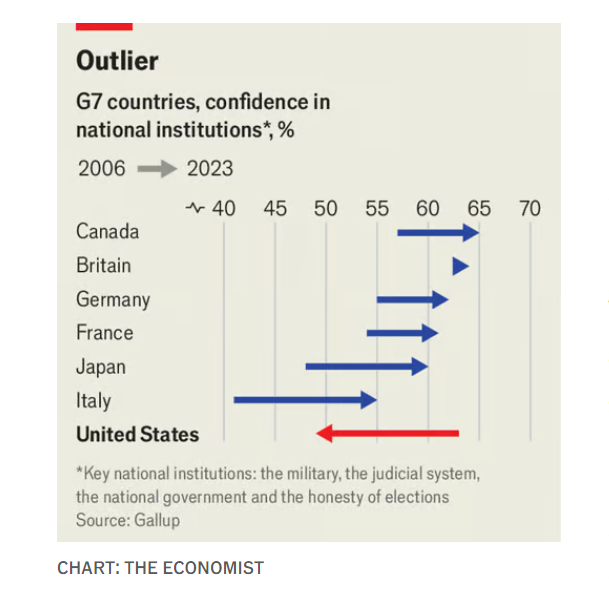
  • The money that is wasted on this Forever War could be used to address a multitude of other pressing needs.  For example, the lead pipes in Oakland that are delivering drinking water contaminated with lead to children in our public schools could be replaced with a fraction of what has been spent to eradicate non-native spartina marsh grass in the past 20 years. (11)  It’s no wonder that the public does not trust the American government:
Source: Economist Magazine

References:

  1. San Francisco Estuary News, “The Battle for Native Cordgrass,” Jacoba Charles, March 2023
  2. USDA Plant Database:  Spartina alterniflora  When the Invasive Spartina Project began, the USDA Plant Database  map of this species indicated that the species was introduced on the West Coast.  The current version of the map shows that this species is now native to the West Coast.
  3. Clapper rail, Cornell Laboratory of Ornithology  Status of Clapper rail is “Low Concern”
  4. Adam Lambert et.al., “Optimal approaches for balancing invasive species eradication and endangered species management,” Science, May 30, 2014, vol. 344 Issue 6187
  5. “Effects of Predation, Flooding, and Contamination on Reproductive Success of California Clapper Rails (Rallus Longirostris Obsoletus) in San Francisco Bay,” Steven E. Schwarzbach, Joy D. Albertson, Carmen M. Thomas, The Auk, 1 January 2006
  6. 2023 California Ridgway’s Rail Surveys for the San Francisco Estuary Invasive Spartina Project  (page 9)
  7. “Evaluating the plasticity of a ‘specialized’ rodent in a highly-invaded estuary,” Katie R. Smith, et.al.,  Presentation to California Invasive Plant Council Symposium, October 2023
  8. San Francisco Estuary Invasive Spartina Project   2021‐2022 Monitoring and Treatment Report (Appendix II, page 3)
  9. Journal of Pesticide Reform: https://assets.nationbuilder.com/ncap/pages/26/attachments/original/1428423389/imazapyr.pdf?1428423389#:~:text=Imazapyr%20can%20persist%20in%20soil,aerial%20and%20ground%20forestry%20applications
  10. Dispatch, Newsletter of California Invasive Plant Council, Spring 2024  (page 10-11)
  11. “In 2018, Oakland Unified School District (OUSD) estimated that it would cost $38 million to fix lead contamination in its schools. This included $22 million to replace water lines and $16 million to replace drinking water and sink fixtures. The OUSD blamed the aging infrastructure for the high lead levels and sought help from the state and federal government.” (Google Search)

Going Toe to Toe with Doug Tallamy

In June 2023, Washington Post published an opinion piece advocating for the use of herbicides to kill non-native plants, in which Doug Tallamy was quoted as saying that spraying herbicide on non-native plants is “chemotherapy,”  equating non-native plants with cancer and pesticides with medical therapy.  Tallamy. and more broadly his viewpoint, received some blowback from Conservation Sense and Nonsense and others.

Thomas Christopher and Doug Tallamy collaborate on their shared mission of promoting the use of native plants and the closely related goal of eradicating non-native plants they consider a threat to native plants and insects. In October 2023, Tom Christopher (TC) gave Doug Tallamy (DT) an opportunity to respond to criticism of native plant dogma on his Growing Greener podcast that is available HERE.  Christopher also invited listeners to send him feedback on the podcast.  Professor Art Shapiro, whose work was central to the interview, has responded separately and his response is available as a footnote.  Conservation Sense and Nonsense (CSN) sent Christopher an email, which I hope he shared with Tallamy.  The following is an excerpt from that email. 


Hi Tom, Thanks for the air time for opposition to eradicating non-native plants in your interview with Doug Tallamy and for this opportunity to respond.  I’m flattered that criticism of native plant dogma has attracted some attention on the East Coast.  I’ve transcribed most of your interview with Doug Tallamy as best I can and provided some feedback to Tallamy’s viewpoint.  I sent Art Shapiro the podcast and he has responded separately.

TC:  Some people say that non-native plants are just as effective as natives in supporting food webs.  For example, buddleia that is spreading throughout the East and West is used by butterflies.

CSN:  Buddleia davidii is on California’s list of invasive plants, but it is not considered invasive in California.  It was put on California’s list because it is considered invasive elsewhere, making the point that invasive plant behavior varies depending on local conditions, such as climate.  Sweeping generalizations about invasiveness are rarely accurate. If gardeners are concerned about the potential for invasive behavior, they can plant a cultivar of buddleia that does not reproduce. 

DT:  We shouldn’t call all insects pollinators.  Just because an insect visits a flower for nectar doesn’t mean it’s pollinating that flower.  There are more visitors to flowers than there are pollinators.  Butterflies visiting buddleia are just there to sip nectar.

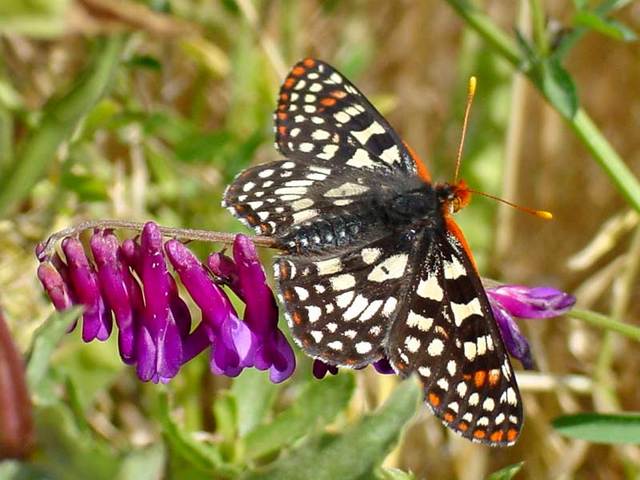
Euphydryas chalcedona
Variable checkerspot. Photo by Roger Hall

CSN:  Buddleia davidii is native to Central China.  Non-native buddleia is used by a butterfly species that is native to California and other states in the Western US.

The first actual observation of checkerspot butterflies breeding spontaneously and successfully on buddleia was in Mariposa County, California in the Sierra Nevada foothills.  Checkerspot bred there successfully on buddleia in 2005 and in subsequent years.  This colony of checkerspot on buddleia was reported in 2009:  “We conclude that buddleia davidii [and other species of buddleia] represents yet another exotic plant adopted as a larval host by a native California butterfly and that other members of the genus may also be used as the opportunity arises.” (1)

In 2017, a gardener in Mendocino County, California also reported the use of buddleia as the host plant of checkerspot:  “By now I am questioning how it was that butterfly larvae were using my butterfly bush as a host plant, completely against everything I’d ever heard. How was this possible? I emailed Art Shapiro, a very well-known butterfly expert and author, sending him a pic. He wrote back to confirm they were butterfly larvae, but added, ‘These are not mourning cloak butterflies. They are checkerspots. And the only time I’m aware this has happened [like, ever, except one in a lab in 1940…] is in Mariposa County.’” (2)

Buddleia is available as the host plant of checkerspot butterflies with a native range from Alaska south along the Pacific Coast through California and Arizona to Baja California and Mexico; east to Montana, the Dakotas, Wyoming, Colorado, New Mexico.  This is a clear case of a widespread native butterfly choosing a non-native plant as its host. 

  1.  Arthur M. Shapiro and Katie Hertfelder, “Use of Buddleia as Host Plant by Euphydryas chalcedona in the Sierra Nevada foothills, California,” News of the Lepidopterists’ Society, Spring 2009
  2. http://plantwhateverbringsyoujoy.com/never-pull-up-and-discard-what-you-cannot-identify/

DT:  Most bees that people see in their gardens are honeybees that are there to get pollen and sometimes nectar.  These are generalist bees but specialist bees that require pollen from particular plants (always native plants) can’t be supported by those at all. 

Squash bee. USDA public domain

CSN:  Specialization of insects is exaggerated by Tallamy.  For example, he would probably call a squash bee a specialist.  As its name implies, its host plant is squash plants in the squash family, with 98 genera and 975 species.  The squash bee is considered an excellent pollinator of zucchini and butternut squash, both native to Central and South America.  However, they do not usually visit melon plants, according to Wikipedia.  Again, we are reminded to avoid broad generalizations when describing the complex and diverse natural world. 

Likewise, the native alkali bee is a particularly effective pollinator of alfalfa, which is native to the Mediterranean region. Alkali bees also pollinate members of the large legume family with over 16,000 species that are native all over the world.  If you are interested in such associations, you can find an exhaustive list of native butterflies and their many non-native host plants in Art Shapiro’s butterfly guide for Central California and the Bay Area.  It is not true that bees Tallamy considers “specialists” require pollen from only native plants.

DT:  Sometimes butterflies adopt a new host plant as a caterpillar host.  For example, black swallowtail butterflies caterpillars eat carrots or parsley or dill.  What’s going on?   There are two different kind of hosts:  1) The caterpillar has not adopted a new host at all because it was already adapted to that particular host.  2) Actual host switching from one plant to another is very rare.  It happens on a time-scale of thousands of years.  It requires a mutation or an adaptation to chemical defenses of new host plants.

CSN:  Tallamy tries to make a distinction to avoid acknowledging that insects make use of introduced plants because they are chemically similar to the native plants they have used in the past, which in some cases are no longer available. The butterfly has, in fact, adopted a new host, a plant that wasn’t there before and is now hosting the caterpillar. There are many cases of rapid evolution that enable such transitions, but both cases are clearly transitions from native to non-native plants.  If the original native host is still available, it isn’t necessarily abandoned in favor of a non-native.  Such transitions are useful because they increase the population of available insect hosts and are essential if the original native host is no longer available.

TC:  Pushback from California cites research of Professor Art Shapiro reporting that spontaneous spread of non-native plants has benefited native butterflies.  He reports that 82 of 236 California native butterfly species (34%) are laying their eggs on introduced plant taxa, so caterpillars feed on them and many more butterflies use introduced plants as nectary sources.

DT:  Great!  These are host range expansions.  Agriculture in California has eliminated the host plants of a lot of butterflies and it’s a good thing we had close relatives of natives so butterflies could expand their host range and use them.  But if 34% of native butterflies are using introduced plants that means 66% are not.  If all plants were introduced, we would lose 66% of butterflies in California.  This is not the direction I want to go.  I would choose 60% rather than 34%.

CSN:  Christopher and Tallamy seem to have read one sentence in the abstract of Shapiro’s study without reading subsequent sentences: “Interactions with introduced plant taxa are not distributed evenly among butterfly species. Alpine and desert butterflies interact with relatively few introduced plants because few exotic plant species have reached and successfully colonized these habitats. Other California butterfly species are specialists on particular plant families or genera with no exotic representatives in California and have thus far failed to recognize any introduced plants as potential foodplants. Some California butterflies have expanded their geographic ranges and/or extended their flight seasons by feeding on exotic plants.”  In other words, where there are more introduced plants and some are closely related to native plant hosts, more native butterflies use introduced plants.   

TC:  What do you say to the claims that introduced plants stay greener longer than native plants adapted to wet or dry seasons so that introduced plants give rise to extra generations of caterpillars?

DT:  This is only true if caterpillars can use those plants and in host range expansions they can.  Shapiro is also right about extending availability of nectar.  For example, monarchs that migrate need forage along the way.  The minus is that we’ve been so hard on native flora.  These insects were doing just fine before we brought in non-native plants.  It’s a Band-Aid we’re putting on an environment that has been ravaged by taking out native species that were here before.  Let’s put native species back too.

CSN:  The claim that non-native plants are driving native plants to extirpation or extinction goes to the heart of the controversy.  Native plant advocates believe that accusation, although there is little evidence to support it.  The greatest threat to native plants and insects is habitat loss, particularly converting wildlands to agricultural fields.  The second greatest threat is the pesticides that are used by agriculture.  Remember that Tallamy is an enthusiastic promoter of herbicides to eradicate non-native plants.  He calls it “chemotherapy” in a recent opinion column in the Washington Post.  Pesticides kill both plants and the animals that feed on them, they are anathema to biodiversity and the food web that Tallamy believes he is supporting. 

Marcel Rejmanek (UC Davis) is the author of the most recent report on plant extinctions in California, published in 2017.  At that time there were 13 plant species and 17 sub-species native to California known to be globally extinct and another 30 species and sub-species extirpated in California but still found in other states.  Over half the globally extinct taxa were reported as extinct over 100 years ago.  Although grassland in California had been converted to Mediterranean annual grasses by grazing domesticated animals decades before then, most of the plants now designated as “invasive” in California were not widespread over 100 years ago.

Most of the globally extinct plant species had very small ranges and small populations.  The smaller the population, the greater the chances of extinction.  Most of the globally extinct plants were originally present in lowlands where most of the human population and habitat destruction are concentrated. Although there are many rare plants at higher altitudes, few are extinct.  Plants limited to special habitats, like wetlands, seem to be more vulnerable to extinction. The primary drivers of plant extinction in California are agriculture, urbanization and development in general.  Non-native plants are the innocent bystanders to disturbance.

“Invasive species” are mentioned only once in the inventory of extinct plants published by California Native Plant Society and only in combination with several other factors. However, the identity of this “invasive species” is not clear.  Rejmanek suggests that the “invasive species” rating refers to animal “invasions” by predators and grazers.  He says, “Indeed, one needs quite a bit of imagination to predict that any native plant species may be driven to extinction by invasive plants per se.” (Marcel Rejmanek, “Vascular plant extinctions in California: A critical assessment,” Diversity and Distributions, Journal of Conservation Biogeography, 2017)

TC:  90% of all insect species are specialists that have evolved in concert with only one or a few plant lineages.  How can they cope with the loss of native plants?

DT:  Native plants are adapting in evolutionary time.  Specialization is a continuum.  Few insects are confined to a single plant species, some are confined to one or two genera, and others are confined to one or two families of plants.  But if you are looking at the number of plants available to them, only about 7% of plants they are adapted to are available to them.   93% of available plants are not viable hosts for insects.  Everything is a specialist on one level of another.

CSN:  That sounds like an argument for a diverse garden, with many plant species that offer more food sources for insects.  That doesn’t seem a sound argument for eradicating non-native plants. 

TC:  I understand that some native plants are more useful to insects than others?

DT:  These are the keystone species.  Many native plants don’t support insects because plants are well-defended against them.  Keystone species are making most of the food for the food web.  Just 14% of native plants across the country are making 90% of food that drive the food web.  86% of the native plants are not driving the food web.  Insect food comes from the big producers, like oaks, black cherries, hickories, and birches.

CSN:  That is a mind-boggling admission!!  Earlier Tallamy complained that non-native plants are hosting only 34% of butterflies in California.  Now he says that only 14% of native plants are useful to insects.  He asks home gardeners to plant only native plants as well as limit our plantings to a small subset of native plants. 

Tallamy’s ideology is antithetical to the goal of biodiversity, which could be the salvation of ecosystems in a changing climate. Since we can’t predict the climate of the future, biodiversity provides more evolutionary options, which increases the chances that some species will survive. Tallamy asks us to put a few eggs in the huge basket of our ecosystems, reducing their ability to survive the challenges of our changing climate. 

For example, in Oakland, California, where I live, there were approximately 10 species of native trees prior to settlement.  In 1993, there were 350 tree species in Oakland. (David Nowak, “Historical vegetation change in Oakland and its implications for urban forest management,” Journal of Arboriculture, September 1993)  The recently published draft of Oakland’s Urban Forest Plan reports that there are now over 500 tree species in Oakland.  I can’t fathom why Oakland would want to limit the planting of trees to only 10 native species. 

I agree with Tallamy that many native plants are not useful to insects.  I attend the annual conference of California Invasive Plant Council to give native plant advocates every opportunity to convince me of their viewpoint.  At the most recent conference at the end of October, Corey Shake of Point Blue Conservation made a presentation about his project to “Evaluate native bee preference for common native and exotic plants.” 

He designed 16 hedgerows around agricultural fields in Yolo County to determine if native bees have a preference for native plants or exotic plants, by controlling for availability of native plants compared to exotic plants.  Here is his abstract:

“Farm edge restoration monitoring in Sacramento Valley highlights native bee use of some exotic plant floral resources. Corey Shake. Point Blue Conservation Science. cshake@pointblue.org

“Research of native bee preference for native versus exotic plant floral resources in California’s Sacramento Valley has shown mixed results. No studies have demonstrated a preference for exotic plants by native bees there, but some have highlighted the importance of exotic plant floral resources in plant-pollinator networks and expressed concern that rapid removal of exotic plants without restoring native plant populations could have negative impacts on native bees. We have been collecting native bee flower visitation, plant species, and floral abundance data on 16 farm edge restoration projects in Yolo County, California since 2019, which will allow us to assess bee preferences for some key native and exotic plants relative to their floral abundance. In our preliminary analysis, we see some important trends: (1) relative to their floral abundance in our plots, some native plant species are more frequently visited by native bees than other native plants that are infrequently or rarely visited, and (2) there is significant native bee visitation to some exotic plants relative to their floral abundance. We will further evaluate these data as well as our butterfly diversity and abundance data to provide plant-species specific insights to restoration practitioners and weed management specialists to help them reduce harmful impacts to native pollinators when executing restoration projects and managing weeds.” 

In other words, not all species of native plants are useful to native bees and some species of non-native plant species are useful to native bees.  Tallamy’s sweeping generalizations about the usefulness of native plants to insects are not supported by empirical or field studies.  Although the characteristics of plants vary widely, the variation is unrelated to the national origins of plants. 

From Micro to Macro Perspective

I recognize my voice in the questions Tom Christopher asked of Doug Tallamy, as well as Art Shapiro’s.  Speaking for myself, not for Art, this interview misses the point of my criticism of native plant ideology.  I like native plants as much as I like any plant and I encourage everyone to plant whatever they prefer.  I only object to the pointless destruction of harmless non-native plants that thrive because they are best adapted to the conditions where they have naturalized.  Non-native plants do particularly well in the wake of disturbance.  Where they have replaced native plants, the natives were destroyed by disturbance, not by the hardy non-native plants that can tolerate disturbance. Non-native plants are a symptom of change, not the cause. 

I object to destructive eradication projects because they poison the soil with herbicides, making it even less likely that non-native plants will be replaced by fragile native plants.  I object to the loss of biodiversity which is a hedge against extinction in a rapidly changing climate.  We don’t know which plants will be capable of surviving in the changed climate.  We should not be taking cards out of the deck while we gamble with the future of the environment and everything that lives in it.

Unfortunately, native plant advocates take offense when anything positive is said about introduced plants.  A positive statement about a non-native is routinely interpreted as a negative statement about native plants.  It shouldn’t be.  The emphasis on the negative assessment of introduced plants results in harmful land management decisions.  The pros and cons of all plants should be considered before we condemn non-natives with a death sentence.  Like our justice system for human society, all plants should be presumed innocent until proven guilty.

Thanks again for airing this debate on your podcast. I hope you will forward my email to Doug Tallamy

Webmaster, Conservation Sense and Nonsense


Oakland’s revised Vegetation Management Plan is the compromise I hoped for

On September 1st, I told readers that Oakland would soon publish a revised Vegetation Management Plan to reduce fire hazards in Oakland by managing vegetation on 2,000 acres of city-owned property and 300 miles of roadside.  I also shared with readers my anxiety that the revised plan would be more destructive than the previous version of the plan in response to criticism of that version.    

The 4th revision of Oakland’s Vegetation Management Plan and its revised Draft Environmental Impact Report was published on September 20th.  These documents are available HERE.  There will be a public hearing about the plan by Oakland’s Planning Commission on November 1st.  The deadline for submitting written comments on the plan is November 4th.  Comments can be submitted by email DEIR-comments@oaklandvegmanagement.org or by mail to Montrose Environmental, attention Ken Schwarz, 1 Kaiser Plaza, Suite 340, Oakland CA 94612.

Update:  The deadline for commenting on the Vegetation Management Plan has been extended to Monday, November 6, 2023, at 5 PM.

The Oakland Planning Commission held a public hearing about the VMP on Wednesday, November 1, 2023.  There was no expressed opposition to the VMP at the hearing.  Representatives of Claremont Canyon Conservancy, North Hills Community Association, and Oakland Fire Safe Council spoke in support of the plan. 

One speaker said that Oakland Fire Department and the consultant who wrote the plan successfully “threaded the needle” that made agreement possible.  She also said that “of course, we wish all the eucalyptus were gone, but we understand that is expensive.”

All members of the Planning Commission expressed their admiration and support for the VMP.

Below is a map of the VMP project areas.  Figure 2.2 in the revised plan also shows detailed maps of roads in VMP project areas, with property ownership adjacent to roads indicated, which require different vegetation management standards.   

The authors of the plan have made it easy for you to read the revised version by underlining additions and striking out deletions.  If you have read earlier versions of the plan, you won’t need to read it all again, because revisions are minimal.  They are briefly summarized on page 1-2 of the plan:

Expanded the Revised Draft VMP area to encompass the area from 30 feet to 100 feet of the edge of roadsides in the City’s VHFHSZ [Very High Fire Hazard Severity Zone] where dead and dying trees (as determined by a Certified Arborist, Licensed Forester, or Fire Safety Expert) are present on City owned property and could strike the road if they fell.

“Updated the vegetation management standards as follows:

  • Expanded the zone recommended for 3-inch maximum height of grasslands after treatment from 30 feet to 75 feet from habitable structures.
  • Clarified that, where feasible, horizontal crown spacing should adhere to the California Department of Forestry and Fire Protection’s (CAL FIRE’s) most recent defensible space standards (presently codified in Pub. Res. Code Section 4291).

“Updated treatment standards for eucalyptus stands to increase the trunk diameter of single-stem eucalyptus recommended for removal from 8 inches to 10 inches, and to recommend removal of trees that pose an unreasonable fire and/or life safety risk, based on the determination of a Certified Arborist, Licensed Forester, or Fire Safety Expert.

“Updated treatment standards for closed-cone pine-cypress stands to include removal of trees that pose an unreasonable fire and/or life safety risk, based on the determination of a Certified Arborist, Licensed Forester, or Fire Safety Expert.”

If you need a reminder of vegetation management standards in the previous version, you can find them on Table 2-4.  Basically, the VMP will thin trees and vegetation and remove dead trees and fire ladders to canopies in management areas. The most significant revision of those vegetation management standards is the expansion of clearance of dead and dying trees from 30-100 feet from the edge of 300 miles of roadsides on city-owned property. The management standards defined by the previous version were acceptable to me and the proposed revision of those standards are also acceptable to me. 

However, I am sorry to see that more eucalyptus will be removed because the diameter size standard for removal has been increased from 8 to 10 inches (circumference is greater than 31 inches).  The flammability of eucalyptus has been exaggerated by native plant advocates who want all non-native trees to be destroyed.  California’s native vegetation is fire adapted and fire dependent.  Many of our most prominent native plants—such as ceanothus and manzanita–will not germinate in the absence of fire.  The planned removal of isolated non-native trees within stands of native trees is unnecessary because it will not reduce fire hazards. The VMP should be a fire hazard reduction plan, NOT a native plant restoration.

Although I recognize that dead trees are important for the long-term health of forests because they provide food and habitat for insects and birds as well as recycle nutrients into the soil, we can’t indulge that preference in very high fire hazard zones in high-density population areas that are being treated by Oakland’s Vegetation Management Plan.  As always, we must set priorities and the public’s safety must be a high priority. 

Like most public policy, the revised Vegetation Management Plan is a compromise between two extremes.  One extreme wanted all non-native trees to be destroyed in the management areas as well as within 100 feet from the edge of 300 miles of roadside.  They also wanted Oakland to make a commitment to replace those trees with native vegetation.  The opposite extreme wanted no trees to be destroyed and no herbicides to be used to control vegetation or prevent destroyed trees from resprouting. 

The revised Vegetation Management Plan is the compromise I had hoped for.  Specifically, I had hoped that fire hazards could be reduced in Oakland without destroying more trees than necessary to mitigate fire hazards. The thinning strategy that the VMP proposes has been used successfully by the East Bay Regional Park District for over 10 years.  It leaves the canopy intact so the forest floor is shaded, which suppresses the growth of weeds and keeps the forest floor moist, which retards ignition.

I had hoped that herbicides would not be used in public parks, but did not achieve that goal. However, I am grateful that the revised plan makes many efforts to protect the public, their pets, wildlife and goats grazing in project areas from exposure to the herbicides that will be used.  (Improvements in these protections are described on pages 2-81, 3.3-29, 3.3-32)  There are also extensive new protections for monarch butterflies and a rare species of bee (see page 3.4-86). 

If your interests in the Vegetation Management Plan are different from mine, I urge you to read the plan and form your own opinion.  I hope you will be able to support the revision because it is going to be attacked by the same extreme interests that have prevented Oakland from adopting and implementing a fire hazard mitigation plan for over 7 years. Expressing our support might help to get the VMP over the finish line after years of delay caused by gridlock. I would welcome you to the middle ground that I occupy.  It’s lonely here in the middle.  We don’t have much of an audience above the noise made by the extremes, but we have the capacity to enable public policy to be made if we speak up in defense of compromise. If we want to reduce wildfire hazards in Oakland, we must compromise.

An Attempt to Legally Mandate Native Plants Throughout California Has Failed

This is a story of the influence of interest groups on the process of making new laws.  When Assembly Bill 1573 was introduced in February 2023, it seemed to be primarily a water-saving measure that would “eliminate the use of irrigation of nonfunctional turf” (turf that is not a recreational area or community space with foot traffic).  AB1573 also mandated that all new or renovated nonresidential areas install not less than 25% local native plants by 2026, 50% local native plants by 2030, and 75% local native plants by 2035.  It defined local native plants as “California indigenous plants to an area that have evolved and occur naturally in the Jepson Region associated with a specific California location.”

As AB1573 passed through legislative committees in the Assembly and the Senate it was amended six times (legislative history of AB1573 is available HERE.).  California Native Plant Society and its many allies pulled out all the stops to influence the legislation and ensure its passage.  Members of these advocacy organizations were asked at each juncture to contact their elected representative to urge them to pass this legal mandate requiring public and commercial properties to plant native plants.

The final revision of AB1573 occurred on September 1st, after consideration by the Senate Appropriations Committee.  The final revision made two significant changes:

  • The requirement for native plants in new and renovated landscapes on non-residential properties was lowered to 10%.
  • However, the definition of native plant was revised to include:  “a plant that is nonnative and noninvasive that provides pollinator benefits, and that is a low-water use plant, as determined by the Department of Water Resources and the Natural Resources Agency”  In other words, the final revision considers many non-native plants the functional equivalent of native plants.

On September 7, 2023, the authors of AB1573 asked that the bill be moved to the “inactive file.” They have given up.  Their bill has been so emasculated that they don’t see the point of continuing to try to pass it.  

Why did this attempt to legally mandate native plants fail?

There are probably many aspects of this story that I don’t know.  There were probably many private meetings and written communications that I’m not aware of.  I could probably learn about some of them by making a public records request, but I think I know enough of the story to relate it to my readers.  If you know more about the process than I do, please share it with us.

The first visible sign that AB1573 was in trouble was in June 2023, when the Associate Director of Plant California Alliance published an editorial about AB1573 in an agricultural newsletter, available HERE.  Plant California Alliance represents “California’s nursery industry. Our membership includes farmers, growers, urban agriculturists, wholesalers, retail garden centers, landscapers, garden suppliers, horticulturalists, as well as educators and researchers.”  This is an organization with horticultural knowledge and practical experience growing plants in California. The editorial explained why the goals of AB1573 are unrealistic and based on mistaken assumptions about California native plants:

  • There aren’t enough native plants available for sale to meet such a requirement. California Native Plant Society claims nursery sales are about 6% native, but two large wholesale nurseries estimate their stock is not more than 1% native. 
  • “…there is also the fundamental question of why a native plant mandate is included in a water conservation bill at all. Not all native plants are low water plants…Sometimes a non-native plant is a better choice when designing a drought resilient, low water garden.” California Water Service recommends:  “Plants that are adapted to long, dry summers and short, rainy winters are called “Mediterranean-zone” plants. These include plants that are native to California, as well as those that originated in southern Europe, South America, and other “Mediterranean” climates. These plants don’t need much water in the summer and have thrived in water-scarce conditions for thousands of years.”
  • “And, what about native plants’ impacts on fire? Unfortunately, some California native plants are not considered fire-resistant, and some are even considered fire prone. For example, FireSafe Marin has several California native plants on their list of fire-prone plants, including manzanita (Arctostaphylos), coyote brush (Baccharis spp.), California buckwheat (Erigonum fasciculatum), and California bay (Umbellularia californica).” Most wildfires in California occur in native chaparral and native conifer forests. When wildfires occur in residential neighborhoods, the homes themselves are the primary fuel for the fire. Everything burns in wind-driven fires, regardless of the native origins of plants.
NY Times reported that 150 homes burned in this wind-driven fire in San Diego in 2003, but the eucalyptus surrounding the neighborhood did not burn. NY Times photo

In August, tree advocacy organizations finally woke up to the implications of AB1573 for California’s urban forests when they realized that the definition of “native plant” also included native trees.  California Releaf and California Urban Forests Council asked their members to contact the Senate Appropriations Committee to ask that trees be explicitly exempted from the requirement for native plants on non-residential properties in California. 

Composition of California’s Urban Forest. Source: Californian’s Guide to the Trees Among Us

Only 9% of California’s urban forests are native to California. (1)  Pre-settlement San Francisco was virtually treeless.  One-third of San Francisco was barren sand dunes on its western edge.  San Francisco’s urban forest is now predominantly non-native and much of it is being destroyed to accommodate native plant restorations that require full sun. 

Birds-eye view of San Francisco in 1868

Non-native trees were planted in Oakland in the 19th century because there were few native trees: “Vegetation before urbanization in Oakland was dominated by grass, shrub, and marshlands that occupied approximately 98% of the area.” (2)  Non-native tree species in the East Bay are adapted to soil and microclimate conditions that are not suitable for native species.  Non-native annual grasses will replace Oakland’s urban forest in the hills, not native trees, if native plant advocates get the Vegetation Management Plan they have been fighting for for nearly 8 years.

A Learning Experience?

I would like to think that California’s policy makers learned something from the process of considering AB1573.  Do they have a better understanding of what grew in California in the past and therefore what is capable of growing in the future?

Probably not

Ironically, on the same day that AB1573 was withdrawn by its authors, the San Francisco Examiner published this article about a new initiative to plant more greenery in San Francisco, led by the California Academy of Sciences.  It’s an excellent idea, except that the leaders of this initiative equate greenery with native plants:  “He’s looking to introduce more native plants in The City, which will in turn attract more native insects and more native birds throughout San Francisco.”  Nature is not synonymous with native plants.  The scientific definition of biodiversity includes both native and non-native plants.  In fact, San Francisco’s Open Space Element of the General Plan also defines biodiversity as including both native and non-native plants. 

As much as I would like to hope that Californians have a more realistic goal for the future of California’s landscapes after watching the failure of AB1573, I don’t think I can. 


  1. Matt Ritter, A Californian’s Guide to the Trees Among Us, Heydey Books, 2016.
  2. David Nowak, “Historical vegetation change in Oakland and its implications for urban forest management,” Journal of Arboriculture, September 1993

Oakland’s Vegetation Management Plan Is Headed in a Destructive Direction

Oakland has been trying to adopt a vegetation management plan (VMP) to mitigate fire hazards since November 2016.  The plan has been drafted three times in 2018, 2019, and 2020 and a draft Environmental Impact Report was also published in 2020.  All three versions of the plan were acceptable to me and many others.  Every version would have removed dead trees and thinned non-native trees on 2,000 acres of public land and 300 miles of roadsides in Oakland, leaving the tree canopy intact so that the forest floor would be shaded, suppressing the growth of weedy vegetation that ignites easily and keeping the forest floor moist, which retards fire ignition. 

Unfortunately, none of the proposed vegetation management plans were acceptable to native plant advocates who want all non-native trees in project areas in Oakland to be destroyed and the land replanted with native plants and trees.  The plan they are demanding is a native plant restoration, not a wildfire hazard mitigation plan.  Since they have successfully prevented Oakland from addressing wildfire hazards for eight years, we might assume they aren’t concerned about wildfire. 

A fourth version of the plan and a new Environmental Impact Report are expected to be published in September 2023 and there will be a new public comment period in October.  Based on written and oral public comments at public hearings, we predict that the revised plan is likely to be far more destructive than previous drafts of the plan.  Based on that prediction, I am alerting you to the need to read the revision and write a public comment.  Please ask to be notified of the publication of the plan by sending an email to info@oaklandvegmanagement.org .


Update:  The revised Oakland Vegetation Management Plan and revised Draft Environmental Impact Report were published on September 20, 2023.  These documents are available HERE.  There will be a public hearing by the Oakland Planning Commission on November 1, 2023.  The deadline for public comment will be November 4, 2023.  Comments can be submitted by email DEIR-comments@oaklandvegmanagement.org or by mail to Montrose Environmental, attention Ken Schwarz, 1 Kaiser Plaza, Suite 340, Oakland CA 94612.

When I have read the revised plan and its revised EIR, I will post a draft of my public comment on the draft by October 1st

– Webmaster, Conservation Sense and Nonsense, September 20, 2023


What do opponents of previous plans want?

There is a wide range of opinions about a vegetation management plan for Oakland.  I will use the public comment of the California Society of American Foresters (SAF) on the third version of the VMP as a representative opinion and the best available predictor of where the fourth revision is likely headed.  The entire comment of the Society of American Foresters (SAF) is available HERE and here are some of the revisions SAF is asking for

  • “Ecological restoration should be a goal of the VMP, including the establishment of native plant species where nonnative species dominate…Thinning of dense stands of nonnative tree species should only be done as part of an overall strategy of restoration, i.e., the goal of any tree removals should always be to eventually convert these stands to native tree or vegetation cover in order to build greater ecological resiliency.
  • “In concert with the goal of ecological restoration, adaptive management in light of climate change should guide management practices and restoration plans. Adaptive management strategies that incorporate new information and changing conditions will be critical to ecosystem restoration. Annual grasslands may become more dominant, oak woodlands less so in the planning area in the future as climate changes. Management targets in many cases will have to be based on anticipated future conditions.”
  • “However, if thinning is kept as the desired practice, we ask that you design each entry to be sufficiently intensive to assure that tree crowns will not close before the next thinning entry (10 years from now?) and indeed is sufficiently thinned to allow work towards establishing native vegetation in these stands.”
  • “The use of prescribed fire as a vegetation maintenance tool should have been considered and included in the VMP especially on ridges where fire moving from adjacent jurisdictions might occur, or along power-line transmission corridors.”
  • “The vegetation management zones along roadsides, especially along routes of egress, should be modified to extend 100 feet from roadside edges and should include any trees with underlying structural or health conditions that are tall enough to fall onto streets and roads. This may in some cases require looking outside of the 100-foot roadside clearance.”
  • “It is important that the use of triclopyr herbicides is included to treat cut stumps in eucalyptus to prevent sprouting. Glyphosate herbicides will not be effective in treating eucalyptus stumps and will result in resprouts.”
  • “There should be an Ecological Restoration Guide added to the appendices…This new appendix would outline the City of Oakland’s current ecological restoration efforts, identify stakeholders (e.g., city departments, Oakland Wildlands Stewards, etc.) and their roles…”

Native plant restoration, NOT wildfire hazard mitigation

The Society of American Foresters (SAF) is asking the City of Oakland to make a commitment to eradicating all non-native trees in project areas and replacing them with native plants.  Such a plan would not reduce wildfire hazards in Oakland because native vegetation is not inherently less flammable than non-native vegetation.  Most wildfires in California occur in native chaparral and native conifer forests.

The plan proposed by the Society of American Foresters (SAF) is a native plant restoration plan, NOT a wildfire hazard mitigation plan.  Their proposal would destroy much of Oakland’s urban forest, which would not be replaced by native trees:

  • Non-native trees were planted in Oakland in the 19th century because there were few native trees: “Vegetation before urbanization in Oakland was dominated by grass, shrub, and marshlands that occupied approximately 98% of the area.” (1)  Non-native tree species in the East Bay are adapted to soil and microclimate conditions that are not suitable for native species.
  • Grassland was the dominant vegetation type of pre-settlement Oakland partly because of the land management practices of Native Americans and the stock grazing of early settlers:  “Native Americans played a major role in creation of grasslands through repeated burning and these disturbance-dependent grasslands were maintained by early European settlers through overstocking of these range lands with cattle and sheep. Twentieth century reduction in grazing, coupled with a lack of natural fires and effective suppression of anthropogenic fires, have acted in concert to favor shrubland expansion.” (2)
  • Grassland in California is not native to California.  Mediterranean annual grasses were brought to California in the early 19th century by the grazing herds of Spanish-Mexicans.  California’s native bunch grasses are not adapted to heavy grazing by herds of domesticated animals.  The grassland of California is about 99% non-native (Allan Schoenherr, A Natural History of California, UC Press, 1992).  Attempts to convert annual grasslands to native bunch grass have not been successful.  A team of scientists at UC Davis spent $450,000 and 8 years trying to convert 2 acres of grassland to native bunch grasses without success.  Grassland that will replace our urban forest will not be native. 
  • Grass is easily ignited and fires move quickly through grassland, particularly in a wind-driven fire.  The deadly, destructive fires in Maui, Hawaii are a case in point.  When agricultural fields of sugar cane, pineapple and other tropical fruit left Maui they were quickly succeeded by non-native grass that was considered a factor in the spread of fire. (3)  Dormant, dry annual grassland in the East Bay Hills will be more flammable than the living vegetation that native plant advocates want to destroy.
  • A small redwood grove was the only pre-settlement exception to the otherwise treeless Oakland hills:  “…for thousands of years [the Oakland hills] were treeless meadows, visited seasonally under Indigenous management…The one exception was the redwood groves of the southern Oakland Hills, a restricted forest that extended a few miles eastward from upper Dimond Canyon over the ridgetop to the outskirts of Moraga.” (4) Much of this grove still exists today because coastal redwoods are vigorous resprouters when they are burned or cut down.
  • SAF also predicts a vegetation type-conversion from forest to grassland:   “Annual grasslands may become more dominant, oak woodlands less so in the planning area in the future as climate changes.” Grassland will naturally succeed to shrubland without regular burning, which SAF recommends to reduce fuel loads.
  • Prescribed burns in densely populated urban areas are rarely approved by Bay Area Air Quality Management District because they pollute the air and often cause uncontrolled wildfires. California law regarding liability for damage caused by prescribed burns was revised in 2022 to provide legal protections for those who manage prescribed burns.  The revised law lowers the standard for liability to gross negligence from a previous standard of simple negligence. (5)

Consequences of landscape conversion to grass and shrubs

Destroying thousands of trees will increase air pollution and reduce air quality.  Destroying thousands of trees will increase greenhouse gas emissions causing climate change by releasing the carbon stored by the trees that are destroyed and reducing carbon sequestration going forward because the destroyed forest will not be replaced by a forest of native trees.

There was little biodiversity in Oakland’s pre-settlement forest“Oakland’s original species composition has increased from approximately 10 tree species to more than 350…Today [1993], only 31% of existing trees are native to Oakland, the plurality of trees (38%) are native to Australia/New Zealand.”  (1)  Destroying thousands of non-native trees in Oakland will reduce the biodiversity of our forest.  A more diverse forest is more resilient, particularly in a changing climate, with extreme and variable weather conditions.

Increasing 300 miles of roadside clearance from 30 feet (as proposed by the 3rd version of the VMP) to 100 feet (as proposed for the 4th version of the VMP) will produce wood debris on a scale that cannot be disposed of.  We know what the outcome will be because of a similar project on Claremont Ave, where eucalyptus was clear cut 100 feet from the north side of 1.1 miles of the road in fall 2020.  Below are pictures of the piles of wood chips and logs that remained along that stretch of road for about 9 months while project managers tried to figure out what to do with the wood debris, which was eventually dispersed throughout the hills.  UC Berkeley implemented the project with funding from Cal-Fire. 

The north side of Claremont Ave. was clear cut 100 feet from the road. The south side of the road was not cut because the trees are native.   There is a creek flowing at the bottom of the canyon that creates the moist conditions needed for native trees, which will not grow where non-native trees now grow. Photo by Doug Prose, courtesy Hills Conservation Network.
One of many piles of logs, Claremont Ave, November 2020. It took about 9 months for the logs to be dispersed along roads in the hills. Photo by Doug Prose, courtesy Hills Conservation Network.
One of many piles of wood chips, Claremont Ave, November 2020

The roads in the East Bay hills are now lined with logs, preventing people from pulling off the road. No native plants or trees were planted after the trees were destroyed. Three years later, the clear cut roadside is vegetated with non-native annual grasses and coyote brush, a pioneer native shrub.

The project on the property of UC Berkeley was very small in comparison to the Oakland vegetation management plan that will clear cut 300 miles of roads, producing at least 300 times the amount of wood debris.  What will Oakland do with the wood debris that is produced from the destructive VMP that native plant advocates demand?  Tons of wood debris lying on the ground is far more flammable than living trees, which is another indication that the VMP that native plant advocates demand is not about mitigating fire hazards. It’s about their preference for a native landscape that is not less flammable than the landscape they demand be destroyed.  Like all Mediterranean climates, our native vegetation is fire adapted and fire dependent.  A significant number of our native species will not regenerate in the absence of fire.  Most wildfires in California in the past 5-10 years have occurred in native chaparral and native conifer forests. 

NY Times reported that 150 homes burned in this wind-driven fire in San Diego in 2003, but the eucalyptus surrounding the neighborhood did not burn. The flammability of eucalyptus trees is exaggerated to justify their destruction. NY Times photo

The more trees that are destroyed, the more herbicide will be required to prevent the trees from resprouting.  SAF is correct in saying that tricopyr will be needed to kill the roots of the trees to prevent them from repsouting.  Glyphosate will not accomplish that task.  Triclopyr is more toxic than glyphosate. Triclopyr has a signal word of “warning” and glyphosate has a less toxic signal word of “caution.”  Triclopyr kills the roots of woody plants by traveling from the cut stump to the roots of the plant in the soil.  Triclopyr is known to kill mycorrhizal fungi in the soil, which are essential to the health of plants growing in the soil.  The more herbicide that is used to kill the roots of destroyed trees, the less likely a newly planted native landscape is to survive.  All the more reason to assume that the destroyed forest will not be replaced by a native landscape.

In Summary

  • The landscape that native plant advocates demand for Oakland will be predominantly non-native annual grasses.
  • Native trees will not replace the trees that are destroyed because they are not adapted to most places where non-native trees now live and because there is no available funding to purchase native plants, plant them on thousands of acres of public land, and irrigate them until they are established.  Similar fuels management projects done by East Bay Regional Parks District, East Bay Municipal Utilities District, and UC Berkeley have not planted a native landscape to replace trees that have been destroyed.
  • Non-native annual grasses will naturally succeed to shrubs in the absence of frequent fire.  Shrublands are more flammable than the existing urban forest because fire travels on the ground, unless wind-driven fire ignites tree canopies.  In that case everything burns, both native and non-native trees.  The wind-driven fire in Oakland in 1991 spared no trees in burned areas, whether native or non-native.  
  • The project would produce many tons of flammable wood debris that has no commercial value and no place to be safely disposed of.
  • The loss of our urban forest will increase air pollution in Oakland, contribute to greenhouse gas emissions causing climate change, and raise temperatures in a city that is already a heat-island. 
  • Herbicides needed to prevent the urban forest from resprouting will poison the soil and suppress the growth of a new landscape.

If you live in Oakland City Council District 4 or 6, you are likely to be directly affected by Oakland’s vegetation management plan.  The most effective way to influence the VMP is to express your opinion to your representative on the City Council, as well as our at-large representative on the Council.  Contact information for members of the Oakland City Council is available HERE.


(1) David Nowak, “Historical vegetation change in Oakland and its implications for urban forest management,” Journal of Arboriculture, September 1993
(2) Jon E. Keeley, “Fire history of San Francisco East Bay Region and implications for landscape patterns,” International Journal of Wildland Fire, September 2005.
(3) https://www.nytimes.com/2023/08/13/us/hawaii-wildfire-factors.html
(4) Andrew Alden, Deep Oakland: How geology shaped a city, Heyday, 2023.
(5) https://kion546.com/news/2022/01/04/new-california-law-changes-liability-for-out-of-control-prescribed-burns/

Dana Milbank: “How I learned to love toxic chemicals”

Dana Milbank is a political commentator for the Washington Post.  Like many city dwellers, Milbank moved his family from Washington DC to the Virginia countryside during the Covid pandemic. 

His new home inspired him to become a native plant advocate with the usual corresponding hatred of non-native plants.  He announced his new hobby of killing non-native plants in April 2023, as described in this response to his article by several defenders of the natural world as it exists, rather than as some might wish it to be.

In a more recent article, Milbank expressed his frustration at the failure of his early efforts to destroy non-native plants on his property without using herbicides: “When last I wrote about my battle of the brush, I was losing, badly, to the invasive vines and noxious weeds that had turned forest and field at my Virginia home into an impassable jungle. I’d cut them back, but they would return in even greater numbers.”

And he explained how he “learned to stop worrying and love chemicals.”  He is now both a native plant advocate and a promoter of herbicides (specifically glyphosate) which is typical of most native plant advocates. 

He justifies poisoning both his property and the Shenandoah National Park near his home by turning to advisors who tell him what he wants to hear, people who make their living using herbicides to eradicate non-native plants. 

Of course, renowned native plant guru, Doug Tallamy, is one of his advisors.  Although Tallamy advised residential gardeners against using herbicides in his book, Nature’s Best Hope, published in 2020, he has now changed his mind about herbicides.  In Milbank’s article, Tallamy says that herbicides are an “essential tool:”  “‘I think of it as chemotherapy,’ said Doug Tallamy, a University of Delaware entomologist and guru of the native-plant movement. ‘We have ecological tumors out there. If we don’t control them, we have ecological collapse. We have the collapse of the food web.’”

Poisoning the soil

Milbank admits that glyphosate (Roundup) is toxic and he wears protective gear when applying it, including a respirator (which is not required for glyphosate applications by California’s pesticides regulations).  He describes his application technique:  My preferred technique is ‘hack and squirt.’ With my hatchet, I cut gouges around the circumference of the invading tree, then spray the poison inside. For smaller invaders, I can chop the whole thing down and apply the chemical as a ‘cut stump’ treatment.

I read most of the over one thousand comments on Milbank’s article to determine the public’s reaction.  Although many commenters express reservations about the use of herbicides, the majority of commenters are supportive of the use of herbicides.  The manufacturers of pesticides are definitely winning the public relations battle regarding chemical safety.  When supporters reply to doubters of herbicide use, they defend Milbank’s application technique as “surgical.” 

Cut stump and hack and squirt application methods are less likely to disperse chemicals in the air, but they increase soil contamination.  These application methods work by applying herbicide shortly after the woody plant is cut, while the cambium layer (between the bark and the heart wood) is still functional. The cambium layer delivers the herbicide to the roots of the plant to kill the roots. The application may appear to be “surgical” from the standpoint of above-ground contamination, but the damage is being done in the soil, the plants growing in the soil, and the animals that eat those plants. 

Source: https://www.acompletetreecare.com/blog/what-are-the-layers-of-a-tree-trunk/

There are many consequences of poisoning the soil:

  • Because the roots of plants are intertwined as well as connected to one another by fungal networks in the soil, non-target plants are harmed and often killed.  It is not possible to poison one plant without poisoning others. HERE is an example of a forest of native trees that was damaged by spraying herbicide under the trees.
  • Herbicides kill beneficial microbes and fungi in the soil that contribute to plant health. (1) For example, fungal networks that are killed by herbicides transport moisture and nutrients from the soil to the plants.  Whatever vegetation remains or is planted in the future is handicapped by the loss of this living support system.
  • Glyphosate binds minerals in the soil, preventing essential nutritional minerals such as iron and manganese in the soil from being taken up by plants. (2)  Glyphosate is so widely used that it is found in the blood and urine of most of the population, including children.  Could glyphosate be a factor in widespread iron-deficiency anemia in adolescent girls and young women? (3)
  • Glyphosate is a well-known anti-microbial agent.  These effects raise concerns regarding glyphosate’s influence on human health and behavior through secondary means, such as our gastrointestinal microbiome, given what is now known regarding the gut microbiome and its influence on human health and disease. (4,5)
Source: https://symsoil.com/soil-food-web-soil-cities/

Who are the climate change deniers?

Milbank repeats his accusation that those who believe the threat of non-native plants is exaggerated, are climate change deniers.  He turns to the Executive Director of the federal Invasive Species Council for confirmation, who calls the threats of non-native plants “settled science.”  Science is, by definition, never settled.  Science is a process, not a conclusion.  Every scientific hypothesis is constantly tested and usually refined or overturned as new knowledge and methods are available.   Many scientists are testing the hypotheses of invasion biology and questioning their validity in a changing climate. 

The only issue about invasion biology that is “settled” is that it has created a multi-billion dollar “restoration” industry that relies on and benefits the manufacturers of pesticides, as well as creating vested interests that perpetuate the industry.

Milbank also quotes one of his advisors who claims that native plants are better adapted to the changed climate than non-native plants:  “The natives have the best ability to adapt — they’ve been adapting for tens of thousands of years in these areas — so they’ve got the ability to change as the climates and the landscapes have been changing.”  This statement seems comical, given that the topic is the extreme difficulty of eradicating non-native plants and the fact that they are out-competing native plants.  There is zero evidence that native plants are better adapted to the changed climate than the non-native plants that have replaced them.  500 million years of geologic history on Earth has informed us that when the climate changes—as it has many times–the vegetation changes. 

All plants, whether native or non-native, convert carbon dioxide to oxygen and store carbon. Destroying them contributes to greenhouse gases causing climate change by releasing their stored carbon into the atmosphere and reducing the capacity of the landscape to absorb more carbon in the future.  To deny that fact, is to be a climate change denier.

Reality trumps unrealistic hopes

Milbank describes the landscape he hopes to achieve with the help of herbicides.  It is the landscape that existed in the distant past, in a different climate, before the environment was altered by the activities of humans.  I am reminded of one of the presentations at the most recent conference of the California Native Plant Society, an event where the audience hopes and the speakers douse the audience’s hope with the reality of their unsuccessful efforts.  The presenter described a 20-year effort at the Santa Rosa Plateau Ecological Reserve to convert non-native annual grassland to native grassland, using annual (sometimes bi-annual) prescribed burns.  Many different methods were used, varying timing, intensity, etc.  The abstract for this presentation reports failure of the 20-year effort:  “Non-native grass cover significantly decreased after prescribed fire but recovered to pre-fire cover or higher one year after fire.  Native grass cover decreased after prescribed fire then recovered to pre-burn levels within five years, but never increased over time.  The response of native grass to fire (wild and prescribed) was different across time and within management units, but overall native grass declined.” The audience was audibly unhappy with this presentation.  One person asked if the speaker was aware of other places where non-native grass was successfully converted to native grass.  The speaker chuckled and emphatically said, “NO.  I am not aware of any place where native grasses were successfully reintroduced.” 


(1) “Glyphosate kills microorganisms beneficial to plants, animals, and humans,” Beyond Pesticides, October 2021.
(2) “Glyphosate, a chelating agent—relevant for ecological risk assessment?” Environmental Science and Pollution Research International, 2018
(3) “Prevalence of Iron Deficiency and Iron-Deficiency Anemia in US Females Aged 12-21 Years, 2003-2020,” Journal of American Medical Association, 2023
(4) “Is the Use of Glyphosate in Modern Agriculture Resulting in Increased Neuropsychiatric Conditions Through Modulation of the Gut-brain-microbiome Axis?” Frontiers in Nutrition, 2022
(5) “Toxic Effects of Glyphosate on the Nervous System: A Systematic Review” International Journal Molecular Science, 2022