Adventures in the Anthropocene

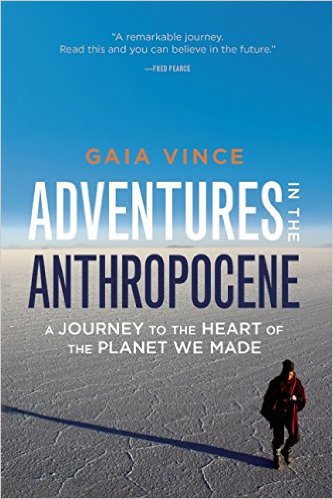
Adventures in the AnthropoceneAdventures in the Anthropocene:  A Journey to the Heart of the Planet We Made is, indeed, a journey. (1) Its author, Gaia Vince, traveled the globe for two years to witness first-hand the impact of human civilization on the planet.  It is an even-handed account, in which grim realities are described but are balanced with optimistic predictions of the innovations that will ultimately enable us to cope with them.

Ms. Vincent takes us to remote corners of the Earth where undeveloped communities are further impoverished by climate change and related changes in the environment.  Rising temperatures and reduced rainfall have forced many agricultural communities off their ancestral lands and into a more marginal existence.  In Bolivia, for example, former farmers have been displaced into brutal mines where life span is typically shortened by health and safety hazards.  Some Pacific and Indian Ocean islands have been drowned by rising sea levels, forcing mass evacuations onto those that remain.  Their protective reefs are dissolving in the increasingly acidic ocean.

Meanwhile, enterprising people are responding to threats their communities are facing.  In the Indian Himalayas, for example, artificial glaciers are being created to replace those that are melting.  Glaciers were the irrigation system that enabled agriculture in marginal conditions.  Torrential downpours caused by climate change are frozen on dammed, flat plains to create artificial glaciers that perform the same function.  In a remote village in Nepal, a villager returns from his Western education to bring his impoverished community into the 21st century by creating a wi-fi network that provides internet access.  The internet brings education to a village that could not afford teachers.  It is powered by a small hydroelectric generator in a glacial stream.  The stream is expected to disappear when the glacier melts in a decade or two, a problem yet to be solved.

These stories and a multitude of others are both sobering and inspiring, but we will focus on the issues relevant to Million Trees.

Harvesting fog with trees

The coast of Peru is one of the driest places on the earth.  There are places in Peru where no rain has been recorded.  The city of Lima is near the coast and its climate is similar to San Francisco.  There is little rain, but there is a great deal of fog.  Lima, like many cities in undeveloped countries, is surrounded by shanty towns in which poor people build make-shift shacks and live without modern services such as water, power, and sewage systems.

Demonstrating once again, that poverty is sometimes the mother of invention, the people of one of these shanty towns are attempting to grow a forest on their sand dune.  The trees are being irrigated with water harvested by huge fog nets, which are also supplying the community with drinking and washing water.  Within four years, the community expects the trees to be large enough to harvest the fog without the help of the fog nets, “producing a self-sustaining run-off that will replenish ancient wells and provide water for the community for the first time in 500 years.” (1)

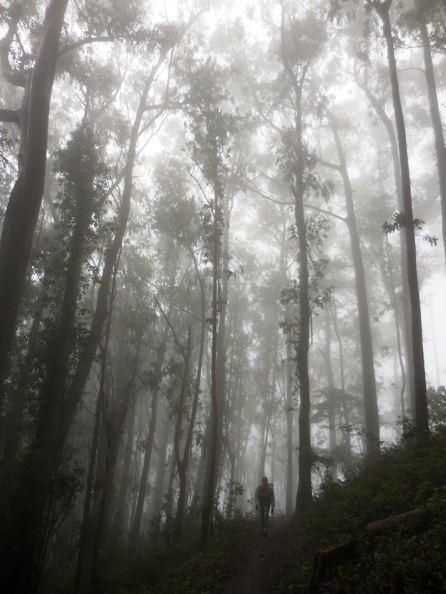
Sutro forest on a typical summer day. Courtesy Save Sutro Forest.

This is a familiar scenario to the readers of Million Trees.  Fog drip in the eucalyptus forests in San Francisco has been measured at over 16 inches per year.  In the driest months of the year, soil moisture in San Francisco’s eucalyptus forest has been measured at over 10%, while soil moisture in grassland was only 2% and 4% in shrubs.  (2)

The value of forests and the dangers of deforestation

Each chapter of Adventures in the Anthropocene is devoted to a different ecosystem.  Each ecosystem is introduced with a description of the importance of that ecosystem and the way in which is it being compromised by the activities of humans in the Anthropocene.  Here are a few excerpts from the chapter about forests, which will be familiar to the readers of Million Trees.

  • “Forests play an important role in local and global climate. The world’s forests absorb 8.8 billion tonnes of carbon dioxide each year through photosynthesis—about one-third of humanity’s greenhouse gas emissions.”
  • “…their canopies provide shelter from the sun and wind, making forests much wetter, cooler environments than surrounding treeless areas. This nurtures streams and rivers, provides habitat for a range of amphibians and other life, helps cool the regional and global atmosphere, and recycles water.”
  • “Although forests help create the climate, they are also exquisitely sensitive to it—and the smaller a forest gets, the less resilient it is. When trees are chopped down, sunlight enters in the gap and dries the soils. Drought upsets the forests’ delicate water cycle—trees start to die and the entire ecosystem can tip from rainforest to grass-dominated savannah.”
  • “Deforestation emits carbon dioxide from soils and decaying plant matter, and is responsible for around 20% of all carbon dioxide emissions.”

One point bears repeating because it is relevant to our local version of deforestation.  In some cases, native plant advocates have succeeded in their demand to destroy 100% of our urban forest because it is predominantly non-native.  In other cases, they have only been able to convince land managers to “thin” the forests, although “thinning” does not seem an accurate description of destruction of 90% of the trees.  In any case, we should all understand that the ultimate likely outcome of the “thinning” strategy is an eventual clear-cut because “when trees are chopped down, sunlight enters in the gap and dries the soils….trees start to die and entire ecosystem can tip” from forest to grassland.  The drying of the soil is only one factor in this prediction.  The remaining trees also will be vulnerable to wind throw.  And the herbicides used to prevent the destroyed trees from resprouting are mobile in the soil and are likely to damage the trees that remain.  Plans to “thin” the forest are either based on ignorance or are a strategy designed to achieve the same goals as a clear-cut with less public opposition.

Are invasive species a problem?

We were gratified that there was barely a mention of “invasive” species in the detailed accounts of the impact of human civilization on the planet.  The conventional wisdom that “invasive” species are one of the primary causes of species extinction is waning and this book reflects that fact. 

Galapagos Islands
Galapagos Islands

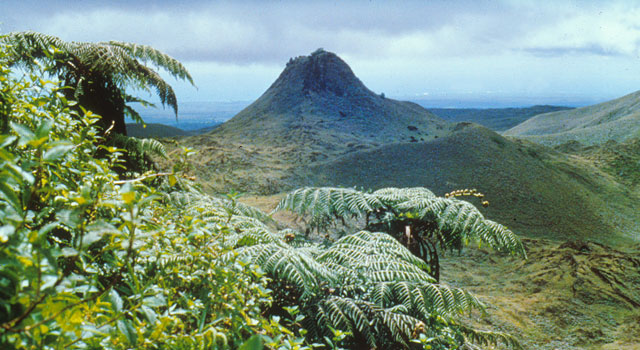
The pros and cons of introduced plant species are debated in the context of the Galapagos Islands, where biodiversity is worshipped because it was instrumental in Darwin’s theory of evolution.  Ms. Vince interviewed the conservationist who has been battling invasive plant species on the Galapagos for 20 years.  He recently decided that attempts to eradicate introduced plants are futile and he now calls them native plants.  His surrender to this reality is controversial, but he is resolute.  He is supported in this decision by scientists who have studied novel ecosystems and find ecological value in them.  The rebuttal to such defense of novel ecosystems is that the globalization of ecosystems is homogenizing the world’s biota.

Ms. Vince concludes that proponents of eradicating non-native plants are losing the battle against the “McDonaldization” of nature:  “From the Galapagos to Hawaii, conservationists are switching tack and starting to embrace the introduced species of Anthropocene ecosystems…” because “In some places, invasives have enhanced the landscapes, reducing erosion, providing handy cash crops or food and habitat for other wildlife.”

We can only hope that our local version of “conservation” in the San Francisco Bay Area will catch up with this new realistic perspective in time to save our urban forests from being needlessly destroyed.

Epilogue

The final chapter of Adventures in the Anthropocene is an epilogue, which takes place in 2100 in London.  The author’s son muses at the age of 87 about which of his mother’s many predictions occurred in the 21st Century.  As we would expect, it was a tumultuous century, one in which drastic changes were made to accommodate the changing climate.

We notice that 22nd Century vegetation of London is tropical:  “Now, carpets of sedges and mosses fill the spaces, interspersed by grasses grazed by capybara, and the planted fig and mango trees, noisy with wild birds.”     We marvel that people claiming to be environmentalists are blissfully unaware of the fact that the native plants they are demanding we restore are not adapted to current climate conditions, let alone the climate foreseen in the near future.

We conclude with the final paragraph of Adventures in the Anthropocene, because it is the most optimistic prediction in this excellent book:

…the world has become a kinder place.  The terrible wars, the famines, the terrorism, extremism and hate, the drownings and deaths of hundreds of thousands of migrants the humanitarian crises…they seem to be over now…The great global mix-up of people that has occurred as a result of climate migration, urbanization, and online networks has produced a new, socially mobile, egalitarian society.  The world’s giant cities force people to live together in close but diverse communities, and it has generated a spirit of cooperation.”

We look forward to a time of greater equality for humanity as well as for the natural world, when the meaningless and unnecessary distinction between native and non-native will be retired from our vocabulary.


(1) Gaia Vince, Adventures in the Anthropocene:  A Journey to the Heart of the Planet We Made, Milkweed Editions, 2014

(2) Kevin M. Clarke, et. al., “The influence of urban park characteristics on ant communities,” Urban Ecosyst, 11:317-334, 2008

The Sierra Club must STOP advocating for deforestation and pesticide use in San Francisco Bay Area

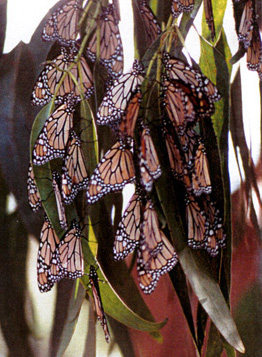
Monarch butterflies over-winter in California's eucalyptus groves
Monarch butterflies over-winter in California’s eucalyptus groves

Million Trees is sponsoring a petition to the national leadership of the Sierra Club in collaboration with San Francisco Forest Alliance.  The petition asks the Sierra Club to quit advocating for the destruction of the urban forest and the use of pesticides in the San Francisco Bay Area.  It also asks the Sierra Club to withdraw its suit against FEMA, which demands the destruction of 100% of all “non-native” trees (eucalyptus, Monterey pine, acacia).  This is an on-line petition which can be signed HERE.  If you are signing this petition and you are a present or former member of the Sierra Club, please mention it in your comments.

sign petition to sierra club

There will be a demonstration by supporters of this petition at the headquarters of the San Francisco Bay Area Chapter of the Sierra Club on Tuesday, August 25, 2015, at 4 pm, 2530 San Pablo Ave, Suite I, Berkeley, CA.  Please join us if you can.

If you are a regular reader of Million Trees, you probably understand why we are making this request of the Sierra Club.  For the benefit of newer readers, we recap the long history of trying to convince the San Francisco Bay Area Chapter of the Sierra Club that its support for the destruction of our urban forest, as well as the pesticides used to prevent its return, contradicts the mission of the Sierra Club as a protector of the environment.

  • This “open letter” was sent to the leadership of the local chapter of the Sierra Club. It informs the Sierra Club of many misstatements of fact in the chapter’s newsletter about the “Wildfire Hazard Reduction and Resource Management Plan” of the East Bay Regional Park District.
  • This article is about the Sierra Club’s public comment on the “Wildfire Hazard Reduction and Resource Management Plan” of the East Bay Regional Park District. The Sierra Club instructs EBRPD to put the “restoration of native plant communities” on an equal footing with fire hazard reduction.  It also specifically endorses the use of pesticides for this project.  In other words, native plants are more important than public safety in the opinion of the Sierra Club. 
  • This “open letter” is about misstatements of fact in the chapter newsletter about San Francisco’s Natural Areas Program. We wrote that “open letter” because the newsletter refused to publish our letter to the editor.
  • This article is about misstatements of fact in the chapter newsletter about the FEMA projects in the East Bay Hills. This incident occurred during the brief period of time when the on-line version of the newsletter was accepting on-line comments.  That opportunity to communicate with the chapter enabled a correction of inaccurate statements in the newsletter.

Sierra Club’s suit against FEMA, which demands the destruction of 100% of all “non-native” trees in the East Bay Hills was the proverbial straw that broke the camel’s back.  Chronic annoyance at the club’s endorsement of destructive and poisonous projects was suddenly elevated to outrage.  HERE is the Club’s description of its suit, which is available in its on-line newsletter.  Attempts to communicate our outrage to the Club by posting comments on that article failed.  That is, the Club is no longer publishing comments it doesn’t like, thereby cutting off any means of communicating with them.  Our petition is the only means of communication left to us.  The text of the petition follows and it can be signed HERE.  Please distribute this petition to your friends and neighbors who share our concern about the destruction and poisoning of our public lands in the San Francisco Bay Area.


Title:     Sierra Club must STOP advocating for deforestation and pesticide use in San Francisco Bay Area

Petition by:        Million Trees and San Francisco Forest Alliance

To be delivered to:
Michael Brune, Executive Director, Sierra Club, michaelbrune@sierraclub.org
Aaron Mair, President, Board of Directors, Sierra Club, aaronmair@gmail.com

We are environmentalists who ask the Sierra Club to quit advocating for the destruction of the urban forest and the use of pesticides in the San Francisco Bay Area.  We also ask that the Sierra Club withdraw its suit against FEMA, which demands the destruction of 100% of all “non-native” trees (eucalyptus, Monterey pine, acacia).  If you are signing this petition and you are a present or former member of the Sierra Club, please mention it in your comments.

Over the past 15 years, tens of thousands of trees have been destroyed on public lands in the San Francisco Bay Area.  Now hundreds of thousands of trees in the East Bay are in jeopardy of being destroyed by a FEMA grant to three public land managers.  The Bay Area Chapter of the Sierra Club has actively supported all of these projects and now it has sued FEMA to demand the destruction of 100% of all “non-native” trees.

These projects have already used hundreds of gallons of herbicide to prevent the trees from resprouting and to kill the weeds that grow when the shade of the canopy is destroyed.  Now, the FEMA project intends to use thousands of gallons of herbicide for the same purpose.  These herbicides (glyphosate, triclopyr, imazapyr) are known to be harmful to wildlife, pets, and humans.

This environmental disaster will release tons of carbon into the atmosphere, thereby contributing to climate change.  It will destroy valuable habitat for wildlife, introduce poisons into our watershed, cause erosion, and eliminate our windbreak.  We call on the national leadership of the Sierra Club to prevent the active participation of the Bay Area Chapter of the Sierra Club in this environmental disaster.

Petition background:

The San Francisco Bay Area was virtually treeless prior to the arrival of Europeans.  The landscape was predominantly grassland, scrub, and chaparral.  Trees grew only in ravines where they were sheltered from the wind and water was funneled to them.  The trees that were brought from other areas of California and from other countries were chosen because they are the species that are best adapted to our local conditions.  John Muir, the Founder of the Sierra Club, also planted these tree species around his home in Martinez and was as fond of those trees as many of us are still today.

The Sierra Club has now turned its back on this cosmopolitan view of nature in favor of returning our landscape to the pre-settlement landscape of grassland, scrub, and chaparral.  This approach has led to the destruction of tens of thousands of trees and the use of herbicides to prevent them from resprouting.

In the East Bay, native plant advocates have also falsely claimed that “non-native” trees are more flammable than native plants.  Although fire hazard reduction was the stated purpose of the FEMA grants, fire hazards will be increased by the clear-cuts of our urban forest for the following reasons:

  • Tons of dead, dry wood chips will be scattered on the ground to a depth of 24 inches.
  • The fog drip which is condensed by the tall trees moistens the ground and will be lost when the canopy is destroyed. The ground vegetation will therefore be drier and more likely to ignite.
  • The tall trees provide a windbreak which has been demonstrated repeatedly to be capable of stopping a wind-driven fire, which is typical of California wildfires.
  • The project does not intend to plant any replacement plants or trees. Therefore, the most likely colonizers of the bare ground are annual grasses which ignite easily during the dry season and in which most fires in California start and spread.
Hummingbird in eucalyptus flower.  Courtesy Melanie Hoffman
Hummingbird in eucalyptus flower. Courtesy Melanie Hoffman

Many empirical studies document the rich biodiversity of our urban forest today.  Bees, hummingbirds, and monarch butterflies require eucalyptus trees during the winter months when there are few other sources of nectar.  Raptors nest in our tall “non-native” trees and an empirical study finds that their nesting success is greater in those trees than in native trees.

In short, the Bay Area Chapter of the Sierra Club is promoting an environmental disaster that is adamantly opposed by tens of thousands of people.  FEMA received over 13,000 public comments on its draft Environmental Impact Statement, over 90% in opposition to this project, according to FEMA’s own estimate.  The signers of this petition are also opposed to this project as presently described by FEMA grant applications and its Environmental Impact Statement.

Environmentalists in the San Francisco Bay Area have been denied due process by the local chapter of the Sierra Club.  The Bay Area Chapter has blocked every effort to communicate with them:  they ignore our emails, block our comments on their blog, refuse our letters to the editor of their newsletter, and do not answer our phone calls.  We believe that the national leadership has an obligation to consider our complaint because the actions of the local chapter are inconsistent with the mission of the Sierra Club.  The local chapter is actively contributing to climate change and endorsing the use of toxic pesticides in our environment.

A retired university planner critiques the FEMA projects in the East Bay Hills

We recently finished reading all of the 13,000 public comments on the FEMA draft EIS.  FEMA says that about 90% of the comments are opposed to the project and having read the comments that seems about right. 

It was a very rewarding experience to read the comments and we recommend it to anyone who is discouraged or doubtful that we can prevent the destruction of our urban forest in the East Bay (available HERE).

There were many excellent comments, many from people with specific expertise and knowledge of the issues that inform our opposition to these projects.  We plan to publish a few of them, as we obtain permission from their authors.  Today, we publish the public comment of Christopher Adams, with his permission.  We hope you are as impressed with his astute analysis as we are.


 Comments on Hazardous Fire Risk Reduction, East Bay Hills, CA,

Draft EIS

Prepared by Christopher Adams

Introduction:

My comments here are made solely in my capacity as a private citizen, but I think it is germane to state my background. I am a retired university planner, and for several years I directed the office which was responsible for review of every environmental document prepared by all the campuses and other facilities of the University of California. In addition, I was directly involved with the drafting, the public hearings, and the response to comments and preparation of two major Environmental Impact Reports, prepared under the California Environmental Quality Act for a UC campus. I also live near the EB Hills in an area subject to wild fires and share the concerns of others about the risk of fire.

Summary:

The Hazardous Fire Risk Reduction, East Bay Hills, CA, Draft EIS is a deficient document, beginning with its basic premise. While purportedly for the purposes of fire management, the proposed actions appear to be mostly motivated by a dream of a restoring the EB Hills to some imagined Eden prior to the European and American colonization of California. Instead of applying scientific and policy analysis to the impacts of the proposed actions the DEIS authors appear to have decided that the proposed clear cutting and herbicide measures are the right ones for fire protection and then cherry‐picked evidence, whether in the description of existing conditions or the possible alternatives solutions, which supports this conclusion. The DEIS rejects out of hand fire management alternatives that do not involve clear cutting and massive application of herbicides. In so doing the DEIS is a classic example of post hoc rationalization. Unless the DEIS is re‐issued with corrections and additions responding to the comments below, I believe that FEMA is seriously exposed to potential litigation. More significantly, if FEMA does not consider other less draconian and less expensive fire management measures, it will not be serving the interests of the citizens most impacted by fire danger, not to mention the taxpayers who will ultimately foot the bill.

Specific Comments:

The DEIS fails to note the existence of native trees which are specifically susceptible to the effects of one of the herbicides proposed for use. Section 4.2.2.2.1 notes that the native trees in the woodlands include madrone (Arbutus menziesii). However, in Section 3.4.2.1.1 Strawberry Canyon‐PDM there is no mention of madrones in the list of trees in the “native forest” (first paragraph of section). This is a significant omission, because there are madrones in Strawberry  Canyon, yet in the third paragraph of this same section one of the two herbicides proposed for use to stifle stump regeneration is Stalker (imazapyr) which has been identified elsewhere as being used specifically to eliminate madrones. According to the EPA Reregistration Eligibility Decision for Imazapyr: “Imazapyr use at the labeled rates on non‐crop areas when applied as a spray or as a granular to forestry areas present risks to non‐target plants located adjacent to treated areas.” (1)

The DEIS fails to acknowledge the growing threat of French broom in the UCB area.

While the presence of eucalyptus, Monterey pine, and acacia is repeatedly discussed, there is almost no mention of the rapid invasion of French broom. It is mentioned only in passing and without its scientific name in the discussion in Section 4.2.2.2.3 under “Northern Coastal Scrub.” While French broom has been rapidly increasing in the upper slopes of the Strawberry Canyon PDM and Claremont PDM areas, there is no mention of it at these locations in the DEIS. This plant is an active pyrophyte which chokes out native vegetation, can be poisonous to livestock, and is of limited benefit to native animals. The increase in sunlight from the proposed removal of large amounts of eucalyptus will encourage its spread. There is no mention of the fire risk from French broom in the discussion of fire risk in Northern Coastal Scrub, Section 4.3.3.2.5, and I could find no mention of its removal anywhere in the document.

The UCB project description does not explain if a fuel break is planned in the UCB areas and if so to describe it.

Section 1.1.1 UCB states that it will follow the “same general approach…which is included in Oakland’s grant application (see Section 1.1.2 below).” In Section 1.1.2 it is stated there the Oakland PDM would “create a fuel break on the west side of Grizzly Peak Boulevard north and east of the Caldecott Tunnel [presumably this means the west entrance to the tunnel].” UCB Strawberry Canyon properties also abut Grizzly Peak Boulevard, so the statement of “the same general approach” implies that UCB also proposes a “fuel break,” but none is described. Since the term “fuel break” implies clearing to the bare soil, with potential significant environmental impacts, this is a serious omission.

The DEIS fails to consider the impact on global climate change by the wholesale destruction of trees. The DEIS states that for UCB Strawberry Canyon alone 12,000 trees will be destroyed. Because trees absorb CO2 at an average rate of 13 pounds per year, this represents a potential loss in CO2 absorption of 78 tons per year. Given the growth patterns of native trees in Berkeley, which tend to be riparian or to grow on north facing slopes in a widely scattered pattern, the number of replacement trees will not come close to compensating for those destroyed. The difference should be estimated and calculated.

The DEIS fails to consider an actual and accomplished fuel management program when dismissing the alternative described in Section 3.3.1.1.

The Lawrence Berkeley National Laboratory (LBNL) is located on 175 acres on the north side of Strawberry Canyon immediately adjacent to the UCB and EBRPD areas described in the DEIS. LBNL, which is managed by the University of California, employs more than 4,000 persons on this site in laboratory buildings and with equipment that is worth several billion dollars. LBNL has recently completed a fire management program which is essentially what is described in Section 3.3.1.1 of the DEIS, Removal of Brush, Surface Fuels, Lower Limbs and Small Trees. The entire project was completed within the LBNL maintenance budget without special grants and has given the laboratory a great deal of fire security, according to its professional fire personnel. Yet there is no reference to this in the DEIS. The LBNL program is further described in the following links. This first links to a powerpoint slides; the second to a video discussion of the slides. http://www.lbnl‐cag.org/docManager/1000000159/Berkeley%20Lab%20Fire%20Safe%20Vegetati on%2C%20Lab%20Fire%20Marshal.pdf

http://www.lbnl‐cag.org/Content/10024/preview.html

The links convey much more effectively than my comments how an alternative to massive clear cutting and massive application of herbicides will effectively accomplish the goal of managing fire in the East Bay Hills.

The DEIS is incomplete and verging on the dishonest about the use of herbicides.

“Management of resprouts without herbicides is expensive….and thus was removed from further study.” This ignores the management of resprouts used successfully by LBNL as described in the above referenced powerpoint and video. There is no study about the use of herbicides at the scale proposed, e.g. 12,000 trees in Strawberry Canyon alone, on human populations, let alone native plants and animals.

The DEIS fails completely to discuss the realities of encouraging native plants after the clear cutting and heavy and repeated application of herbicides.

1) Restoration ecology is barely in its infancy, yet this DEIS expects us to accept on faith alone that when the clear cutting is done and the slopes sprayed with herbicides the native vegetation will miraculously reappear.

2) At the present time live oaks and bays are common on the north side (south facing side) of Strawberry Canyon under eucalyptus. This is probably because the fog drip from the eucalyptus and the shade encourage their growth in what would otherwise be a very dry area. Compare, for example, on slopes of similar aspect in portions of the EB Hills behind El Cerrito or Fremont. There is nothing in the DEIS to explain how native trees will increase or survive after the clear cutting has destroyed their source of water and shade.

3) Because of the abundance of deer in Strawberry Canyon and adjacent areas, small trees need to be protected against browsing. (See the LBNL powerpoint for an illustration of wire protective cages. http://www.lbnl‐ cag.org/docManager/1000000159/Berkeley%20Lab%20Fire%20Safe%20Vegetati on%2C%20Lab%20Fire%20Marshal.pdf) The DEIS says nothing about preventing deer browsing.

4) California native oaks of several species, including Quercus agrifolia are subject to the fungal disease Sudden Oak Death Syndrome (SODS), which has been found in the East Bay Hills. The DEIS fails to discuss the existence of SODS or its impact on replacement vegetation after the clear cutting and application of herbicides.

5) The DEIS states that “alleopathic oils” in the leaves and bark of eucalyptus suppress the growth of other vegetation. Yet the DEIS fails to state how covering slopes two feet deep with eucalyptus slash will not inhibit growth of new “native” plants.

6) Native California bunch grasses have largely been supplanted by European annual grasses, many of which form mats which choke out other plants. Similarly native shrubs such as coyote bush (Baccharis species) are being supplanted by invasive plants such as broom. The DEIS fails to explain how native plants will succeed in competition for sun and water with these plants.

The DEIS fails to consider the aesthetic impact to views from the trails and roads within the canyon and from houses near it after the clear cutting.

Section 4.12.2 of the DEIS states that a goal of the UCB LRDP (2005) is to “Maintain the visual primacy of the natural landscape in the hill campus” but there is no mention of the impact of clear cutting on this natural landscape. The north side of the lower portion of Strawberry Canyon forms the main campus of Lawrence Berkeley National Laboratory (LBNL). While individual buildings at LBNL are attractive in design, the overall effect of the site is essentially industrial, similar to an office park one might see along a freeway. The views of LBNL from the fire road that winds through the canyon are now largely screened by the large trees which will be destroyed by clear cutting. The trees also offer cooling shade to those using the area for recreation. The fire road is a major recreation amenity for UCB students, employees, and neighbors, used daily by hundreds of hikers, joggers, dog walkers, and mountain bikers. Removal of most of the trees as proposed will completely change the views enjoyed from the fire road. The DEIR provides absolutely no analysis of this impact either verbally or by providing illustrations of any viewing point in Strawberry Canyon. Most of the discussion of Section 5.8 is oriented to views over the hills from high points to the bay, which indeed may be improved by clear cutting. There is no discussion of views from within the areas to be clear cut and no reference to Strawberry Canyon.

The DEIS bases its list of plant species slated for destruction on incomplete and inaccurate botanical and fire danger information.

The authors of the DEIS seem not to understand the difference between “native” and “endemic” and they seem to have arbitrarily selected some “native” plants to extirpate while keeping others based on criteria having little or no relationship to fire hazards. Section 3.4.2.1.1 states that “Non native trees, including all eucalyptus, Monterey pine, and acacia would be cut down.” The Jepson Manual  (2), which is the definitive source for California plants divides the state into geographic areas. According to Jepson Monterey pines (Pinus radiata) are native to California, and while not endemic to the EB Hills, they are native in the geographic area CCo, which includes both portions of Monterey County and the EB Hills with similar climatic conditions. Coast redwoods (Sequoia sempervirens) are also found in Strawberry Canyon but not as an endemic. They are also native to the geographic area (CCo). In contrast to Monterey pines, however, Coast Redwoods appear to escape destruction by clear cutting; at least there is no mention of such action in the DEIS. Another native and Strawberry Canyon endemic, California Bay (Umbellularia californica), is specifically listed in the DEIS to be retained. But in a publication of the University of California Cooperative Extension (3) it is listed as a “High Fire Hazard Native Tree.” Note that these comments are not meant to imply favoring destruction of redwoods or bay trees but to further illustrate the inaccurate information and the arbitrary nature of the DEIS conclusions. Similarly cypress species which grow in parts of Strawberry Canyon are also listed as pyrophites in this UC document, but the DEIS does not propose their extirpation.

The DEIS fails to consider the impact on Strawberry Creek of run‐off from the predicted massive amounts of slash, from the standpoint of hydrology and flood control or the impact on the biota of the creek.

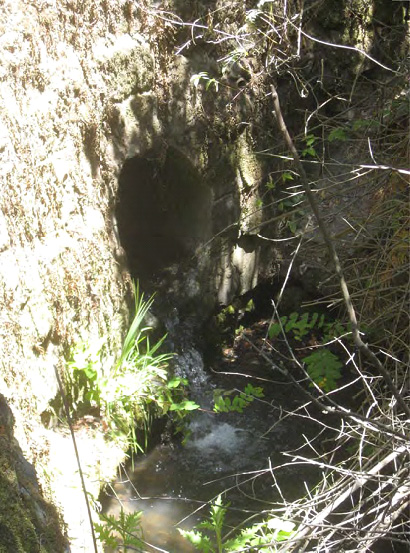
Section 3.4.2.1 of the DEIS states within Strawberry Canyon there will be clear cutting on 56 acres and that the downed trees will be chipped and left on 20% of the site at a depth of 2 feet. Based on these numbers the cumulative amount of material on the ground will be 975,744 cubic feet (.2 x 56 x 43,560 x 2). If merely 1% of this material is washed away in a storm, which seems a very conservative estimate considering the slopes where the material would be placed, there could be more than 1,000 cubic yards of slash material washed into Strawberry Creek. The DEIS does not discuss the impact on the biota of the creek of this potential massive amount of new material. Nor does the DEIS discuss the impact of this material on stream flow in storm conditions. Given that the culverts in the lower levels of the creek, near the Haas Clubhouse and the University Botanic Garden, are only about 9.5 square feet in cross section (See Figure 1.), there is a strong likelihood that the slash material would block the culverts and cause flooding. Section 3.4.2.1 states that “if the site yields a large number of large tree trunks,” some “may” be removed or used for other purposes than left on the site; however, the DEIS fails to state the criteria for determining what the “large number” is that would trigger such action. The hydrologic and ecological impacts are presumably left to the loggers to evaluate.

FEMA comment - Adams 1 copy

Figure 1, Culvert on lower fire trail, near Botanic Garden


The DEIS implies that trees other than eucalyptus, Monterey pines, and acacias will not be cut, but current actions in Strawberry Canyon suggest that UCB will cut anything at any time regardless of environmental regulations. The DEIS must be amended and re‐issued to include other UCB actions as part of cumulative impacts.

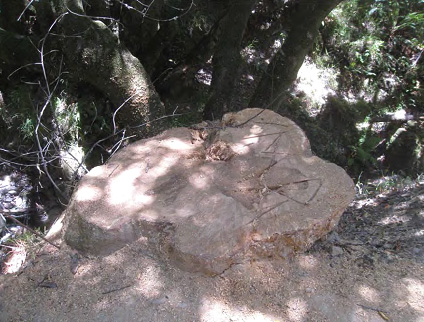
During the past week (June 6‐13, 2013) I have personally observed the cutting of at least six healthy, mature California live oaks, bays, and cypresses in Strawberry Canyon. (See Figures 2 and 3.) The oaks were particularly magnificent, and their destruction is tragic. I am familiar with the needs for passage of fire trucks as I own woodland property on a narrow privately maintained road. None of the trees just cut would have prevented passage of trucks, but I was told by one of the tree cutters that the excuse was “Fireman.” To my knowledge this cutting was done without any compliance with the California Environmental Quality Act (CEQA), which is the state equivalent of NEPA and applies to all UCB actions. This cutting constitutes a violation of the CEQA Guidelines Section 15304, which states that exemptions from CEQA apply only to actions “which do not involve the removal of healthy, mature, scenic trees.” If UCB is flagrantly cutting trees now, while the DEIS is out for public comment, what can we expect once the NEPA process is completed?

FEMA comment - Adams 2 copy

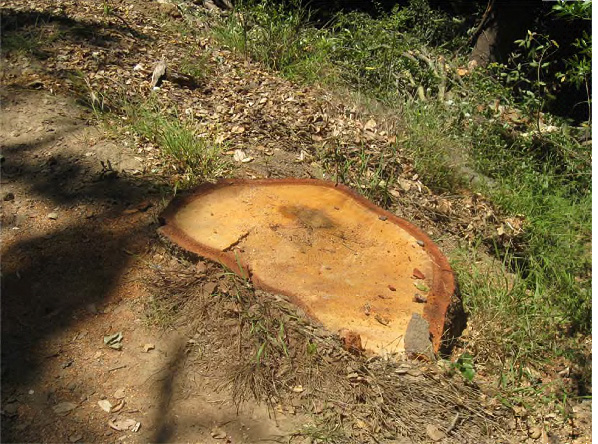
Figure 2. Bay stump on lower fire trail, cut on or about June 11 2013, diameter +/‐42”

FEMA comment - Adams 3 copy

Figure 3. Live oak stump on lower fire trail, cut on June 10, 2013, diameter +/‐ 38”

(1) EPA 738‐R‐06‐007, 2006

(2) The Jepson Manual of Vascular Plants of California, 2nd Edition, UC Press, 2012

(3) Pyrophytic vs. Fire Resistant Plants, FireSafe Marin in Cooperation with University of California Cooperative Extension, October 1998


Thank you, Mr. Adams, for taking the time and trouble to write this excellent public comment on the FEMA draft EIS.


Science in the National Parks

We were so encouraged by our reader’s report about the conference of the California Native Plant Society (CNPS) that we decided to attend the conference of the National Park Service (NPS), “Science for Parks, Parks for Science” at UC Berkeley, March 26-27, 2015.  As we have reported many times, the National Park Service is heavily engaged in native plant “restorations.”  Their projects are some of the most aggressive in the Bay Area and some of the most successful, because they seem to have greater resources than other local managers of public land.  Therefore, we were curious about their assessment of those efforts.  Are they starting to have doubts, as expressed by some of the presentations at the CNPS conference?  This is a brief summary of what we learned.

The angry old guard

The keynote speaker was E.O. Wilson, the granddaddy of “biodiversity.”  He spoke of his desire to safeguard biodiversity by preserving one-half of the Earth as “protected areas” and the closely related goal to connect all protected areas. This lofty goal should be compared to the current figure of 13% of the earth which is presently protected and the internationally agreed-upon goal of 17%, according to the second speaker, Ernesto Enkerlin, Chair of the IUCN World Commission on Protected Areas.

The moderator, Steven Beissinger, Professor of Conservation Biology at UC Berkeley, asked Professor Wilson a few pointed questions:

  • “Can working landscapes play a role in conservation?” Professor Wilson said. “That is a stupid, dangerous way of looking at conservation.  Parks cannot be evaluated in terms of their value to humanity.  The natural world is valuable in its own right.  Emma Marris and Peter Kareiva of the Nature Conservancy are pushing this; they have the least experience with studying the natural world.  This dangerous thinking must be countered immediately.”  Granted, Emma Marris is a science journalist, but Peter Kareiva was an academic scientist at University of Washington for decades before becoming Chief Scientist at the Nature Conservancy.
  • “Must protected areas be devoid of people?” Professor Wilson said “Of course not.  Indigenous people might be included.”  In fact, indigenous people have been evicted from many protected areas around the globe.  Furthermore, virtually the entire population of the US is not indigenous.  Where does that leave us?
  • “Given the challenges faced by conservation, is triage necessary to prioritize projects to focus on the most important and threatened species?” Professor Wilson said with some feeling, “That’s ridiculous!  We CAN bring them all back, we must SAVE THEM ALL!”

Professor Daniel Simberloff, the well-known invasion biologist, was another speaker who believes it is necessary and possible to eradicate all non-native plants and animals in our public lands.  He also called out by name Marris, Kareiva and others for their criticism of invasion biology.  Frankly, we think these personal attacks are unseemly in the context of what should be considered a scientific debate about the most effective methods of conservation.  The moderator, Professor Holly Doremus (UC Berkeley, Boalt Hall), asked Professor Simberloff a few tough questions as well:

Most other speakers at the conference had a less sanguine view of our ability to “save every species” and “eradicate every non-native species.”  The need for “triage” was repeated in many presentations and descriptions of past and present projects were often pessimistic about the prospects of success.  Climate change and its impact on the environment was the dominant theme of the conference.

All loss, no gain

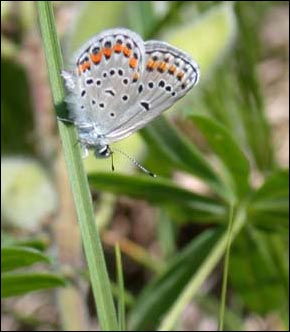
Mission Blue butterfly.  Wikimedia Commons
Mission Blue butterfly. Wikimedia Commons

The endangered Mission Blue butterfly exists only in a few locations in the San Francisco Bay Area:  Twin Peaks, San Bruno Mountain, Milagro Ridge in San Mateo County, and the headlands of Marin County.  We recently reported that the 32-year effort to restore butterfly habitat on San Bruno Mountain has been plagued by natural succession to native coyote brush that competes with the butterfly’s host plant, 3 species of lupine.  The status of the butterfly population on San Bruno Mountain is unknown because of inadequate monitoring.  Save Mount Sutro Forest has reported that the butterfly population on Twin Peaks remains very small despite repeated attempts to move butterflies from San Bruno Mountain.  We learned at the NPS science conference that the effort to restore butterfly habitat in the Marin Headlands in order to increase the butterfly population there has experienced its own difficulties.

The restoration of butterfly habitat to the Marin Headlands was controversial because about 500 Monterey pines were destroyed to make way for the lupine scrub required by the butterflies.  The pines had been planted by the military over 100 years ago.  They were heavily used by raptors during their annual fall migration through the Bay Area.  The Marin chapter of the Audubon Society was therefore opposed to their destruction.  As usual, this opposition was ignored by the National Park Service, which manages that property, and the trees were destroyed in about 2009.

NPS has been engaged in the effort to restore the habitat needed by the Mission Blue since the trees were removed.  Those engaged in that effort presented a poster at the NPS science conference which reported:

  • In 2010, NPS and its collaborators attempted to promote the growth of the 3 species of lupine required by the Mission Blue by removing all vegetation mechanically and with prescribed burns, then seeding with lupine.
  • Neither burn nor mechanical treatments resulted in increased lupine species cover after one or three years. In fact, both mechanical and burn treatment resulted in increased cover of non-native forbs and grasses after three years.

In other words, 500 trees were destroyed, which were heavily used by migrating raptors, but Mission Blue butterflies did not benefit from the destruction of these trees because efforts to restore the habitat they require have been completely unsuccessful.  This is a familiar scenario:  all loss and no gain.

Karner blue butterfly - USFWS
Karner blue butterfly – USFWS

We also heard a presentation about a 20-year effort to “restore” the habitat required by an endangered butterfly (Karner blue) at Indiana Dunes National Lakeshore.  The complete failure of that effort is attributed to changes in the climate, considered “abnormal:”

Despite advances in our understanding of habitat needs of the Karner blue, and extensive management to meet those needs, Karner numbers at Indiana Dunes have fallen more than 99% over the past fifteen years, with precipitous declines associated with historically abnormal weather in 2012. We have documented a role phenological [seasonal] mismatching between the butterfly and its host plant plays in this population decline and the sensitivity of this species to habitat fragmentation.”

One wonders what “abnormal” weather means during a time of extreme changes in the climate, which are not expected to return to “normal.”  The speaker predicted that the likely outcome for the Karner blue at Indiana Dunes is its complete disappearance and probable replacement with a different butterfly species which is better adapted to the new climate.

Reality Check

Doug Johnson, Executive Director of the California Invasive Plant Council, made a presentation about new digital tools to identify populations of plants considered “invasive:”  CalWeedMapper and WHIPPET.  These tools will enable land managers to set priorities for attempts to eradicate these plants.  Using  a thistle species as an example, he showed a map that indicated this “invasive” plant is present everywhere in northern California, but there are isolated pockets of it south of there.  These small, isolated populations represent potential opportunities to prevent its spread before it is so widespread that eradication is impossible.  This is an example of triage, which was the dominant theme of the conference. 

Oxalis in Glen Canyon Park, San Francisco

Mr. Johnson was recently interviewed by Bay Nature about a non-native species of oxalis, which San Francisco’s so-called Natural Areas Program has been attempting to eradicate for many years by spraying it with Garlon.  Garlon is the most hazardous pesticide used by the Natural Areas Program.  Mr. Johnson expressed his opinion to Bay Nature that it is futile to attempt to eradicate oxalis: “‘It’s not a target for landscape-level eradication because it’s way too widespread.’”

On March 13, 2015, the California Invasive Plant Council published its final reassessment of Blue Gum Eucalyptus (available HERE).  Cal-IPC has downgraded its rating of invasiveness and ecological impact from “moderate” to “limited.”  Although the detailed assessment is less than perfect, the overall rating itself is an improvement.  We are grateful to our readers who sent comments to Cal-IPC on its deeply flawed first draft of the reassessment.

In other words, the California Invasive Plant Council seems to have entered a new era of realistic expectations.  This looks like a BIG step forward to us, because if that viewpoint is adopted by land managers it should mean less destruction and less use of pesticides.

The Take Away

The old guard is unprepared to compromise their firm belief that it is possible to save every species of native plant and animal and that every non-native plant and animal must be killed to achieve that lofty goal. They defend their indefensible opinion by attacking those who are looking for a more realistic approach to conservation. However, climate change is bringing more and more converts to this viewpoint, which was best expressed by one of the plenary speakers, Hugh Possingham, Professor of Mathematics and Ecology, University of Queensland in Australia.  He was asked how his model of “ecological parks” fits with the mission of the National Park Service to preserve the parks “unimpaired.”  We paraphrase Professor Possingham’s answer:

“The Australian conservation ethic is similar to the United States’.  We yearn for pre-invasion days.  When I grew up in Adelaide we had 7.5 hectares of pristine vegetation for the entire city, which had 750 species at one time and now there are 500 species left.  It’s a museum.  It isn’t a functioning ecosystem.  So, we have got to embrace the creation of ecosystems that are not particularly natural.  However, I’ve learned that the birds don’t care where the plants come from.  Where weeds have been ripped out, bird diversity has plummeted.  I have been converted to the European viewpoint of disturbed landscapes: that is, these new plants have value.  Australia is completely over-run with non-native plants and animals.  Australians would be willing to shoot all the feral cats, but the fact is it’s not possible because we don’t have the resources to attempt it, let alone succeed at it.”

Thank you, Professor Possingham, for your frank acknowledgement of the value of new species to wildlife and your acceptance of more realistic goals for conservation in the 21st Century.


Videos of the plenary speakers are available on the conference website, as well as abstracts of posters and presentations.

Conference of the California Native Plant Society

In January 2015, the California Native Plant Society (CNPS) celebrated its 50th anniversary by holding a gigantic conference.  About 700-1,000 people attended.  There were several hundred short presentations and many posters describing research and “restoration” projects.  The abstracts of these presentations are available on the CNPS website.  We are publishing a brief description of a few of the presentations sent to us by one of our readers who attended the conference.  We publish with permission but without attribution, on request.  We have added a few edits in brackets and italics as well as a few links to relevant articles on Million Trees.


I was very impressed with the quality of the presentations at the CNPS conference.  Some were given by academic scientists or their graduate students. Many were given by land managers and managers of “restoration” projects.  There were about 225 presentations in 5 simultaneous sessions, so it was possible to hear only about 45 of them. There were also many short “lightning” presentations and nearly 50 posters.  Please consider this an impression of the conference, rather than a comprehensive report.

Michael Soulé was the opening speaker.  You might recognize his name as one of the proponents of invasion biology who is angry about growing acceptance of “novel ecosystems” and the ecological functions they perform.  [Million Trees has posted articles about this debate among academic scientists.  Soulé is one of the invasion biologists who demanded that the Nature Conservancy abandon their support for novel ecosystems.]   His objection to any acceptance of non-native plants was the main focus of his presentation.  He closed by saying that he “cannot live” without wild nature.  Since his definition of “nature” seems to exclude non-native plants, one wonders how he will manage to survive.   Perhaps he lives in an alternate universe populated solely by native plants.

Trees in Paradise, by Jared Farmer

Jared Farmer was the speaker at the conference dinner.  His subject was the history of eucalyptus in California.  His presentation was similar to his treatment of the subject in his book, Trees in Paradise.  [Million Trees has posted articles about Farmer’s book.]  Like his book, his presentation was even-handed in its treatment of eucalyptus.  That enraged the audience, which booed every time he said something positive about eucalyptus.  One wonders why he was invited to speak to this audience.  Were the organizers of the conference interested in promoting a more balanced view of eucalyptus?  Or did they just want a provocative speaker to wake up a sleepy audience after hours of a fund-raising auction?

Many of the presentations were surprisingly frank about the difficulties experienced by “restoration” projects.  CNPS deserves credit for inviting speakers who described some stunning failures of their effort to “restore” native landscapes.  I’ll describe just a few of the themes of speakers I heard.

San Francisco’s Public Utilities Commission

I was surprised to learn that San Francisco’s Public Utilities Commission (PUC) is heavily engaged in native plant “restorations.”  The PUC is responsible for managing thousands of acres of open space in the watershed that supplies San Francisco’s drinking water.  Common sense suggests that the PUC’s top priority would be the purity and safety of the water supply.  The PUC presentations at the conference suggest otherwise.  The PUC’s commitment to native plant “restorations” seems to trump the goal of clean water.

The PUC attempted to “restore” 100 acres of wetland and riparian habitat in San Mateo, Alameda, and Santa Clara counties by planting over 500,000 native plants, obtained from several different nurseries.  They claim to have followed a strict protocol which theoretically should have prevented the introduction of diseased plants.  Their protocol obviously failed.  The fact that many of the plants were infected with Phytophthora was not discovered until they were planted in the ground.  Phytophthora is the pathogen that is causing Sudden Oak Death.  The PUC is now faced with the difficult—if not impossible—task of trying to contain the spread of a fatal pathogen for which there is no known cure.

This project was funded by a “mitigation” grant for capital projects elsewhere in San Francisco.  Environmental laws require the builders of new development to “mitigate” for the impact they have on the environment by funding projects elsewhere, which are considered beneficial to the environment.  This often looks like legalized extortion to me.  It also increases the cost of infrastructure improvements, which limits the number of improvements we can make.  In this case, there clearly was no benefit to the environment.  It was both money down the drain and a poke in the environment’s eye.

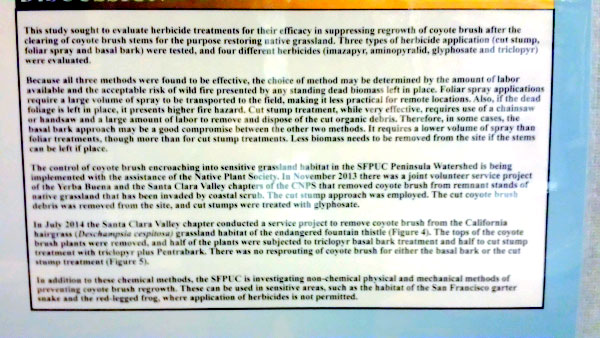
As pointless as that project seemed, the other project presented by the PUC seemed even more pointless.  They presented a poster describing an experiment intended to determine the most effective application method and type of herbicide to eradicate coyote brush.  They used several different methods and types of herbicide, including Garlon (triclopyr) [which is known to be very toxic to aquatic life] and Milestone (aminopyralid) [which is banned in the State of New York because it is persistent and very mobile in the soil].

Detail of poster about PUC project, CNPS Conference

As you know, coyote brush is a native plant, so one wonders why it was necessary to eradicate it.  According to PUC’s poster, it’s another example of trying to prevent natural succession from grassland to scrub.  You might ask why the PUC is obligated to maintain grassland?  You might also ask how the PUC can justify using toxic herbicides in our watershed?  I can’t answer those questions.  It doesn’t make sense to me.

San Bruno Mountain

Mission Blue butterfly. Wikimedia Commons

There was also a discouraging presentation by the folks who have been engaged in the effort to “restore” San Bruno Mountain in order to preserve and maintain a population of several species of rare butterflies, including the endangered Mission Blue butterfly.  This project officially began 32 years ago when the Habitat Conservation Plan was created by federal environmental protection laws.  The goal was to restore native grassland required by the rare butterflies.  The speaker said this goal remains largely unfulfilled.  As for the butterflies, their current status is largely unknown because monitoring efforts are not sufficient to determine the size of the population.

While non-native plants considered “invasive” are a part of the problem in achieving the goal of this project, the biggest problem is, in fact, a native plant.  Once again, natural succession from grassland to native scrub, dominated by coyote brush, is the main reason why grassland continues to shrink on San Bruno Mountain:

“Although the last mapping effort in 2004 reported 1296 acres of grassland, we believe that many of these areas are in imminent threat of scrub encroachment and could be converted to scrub after a good coyote brush recruitment year. Large patches of contiguous grassland with less than 2% scrub cover are quickly vanishing…Baccharis pilularis (coyote brush) accounts for the majority of the scrub encroachment observed on San Bruno. It seems to follow the well documented pattern of episodic establishment in wet seasons when roots can more quickly tap into needed soil water. Once seedlings have survived the first critical year, mortality drops quickly and full establishment plays out over the next 5-7 years (Williams et al. 1987). During this process of establishment, grassland resources decline and eventually disappear. Soil changes such as increased nitrogen and allelopathic compounds often follow scrub encroachment (Zavaleta and Kettley 2006, Weidenhamer and Callaway 2010) reducing the ability of grasslands to successfully re-establish without an intermediate disturbance such as a fire or intensive browsing (Hobbs and Mooney 1986).” (1)

San Bruno Mountain from Daly City. Wikimedia Commons

It’s seems almost comic that when all is said and done, the main threat to native grassland “restoration” is apparently a native plant that is just doing what comes naturally…”invading” grassland in the absence of fire or grazing.

Hybridization:  Friend or foe?

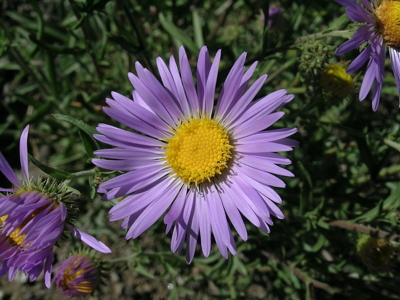
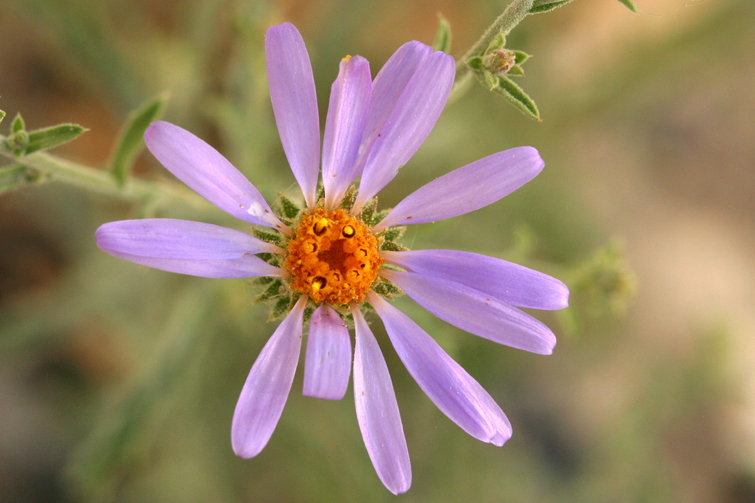
Dieteria canescens variety canescens, native to Wyoming and other western states. Photo by Stephen Perry.
Dieteria canescens variety canescens, native to Wyoming. Photo by Stephen Perry.

I also attended the presentation of a native plant advocate from Mammoth Lake, on the eastern side of the Sierras.  She is engaged in a futile crusade to prevent the hybridization of a new plant, which she considers non-native, with a closely related native plant.  When this new plant arrived in her neighborhood, she recognized that it was different, but she was unable to identify it.  It wasn’t easy to find someone who could identify it.  Eventually, she found a botanist in Wyoming (where it is native) who was able to tell her that the new plant is a variety of a plant that is native at Mammoth Lake.  These plants are in the aster family.  The native is Dieteria canescens.  The new plant considered a non-native invader is Dieteria canescens var. canescens.  In other words, they are the same species!

From a horticultural standpoint, the new plant is superior to the native in every way: it is a bigger plant with more flowers; the flowers are bigger with more rays; the flowers are a deeper color.  So, why must it be eradicated?  Because native plant advocates fear that it will hybridize with the native aster and “swamp” it genetically, i.e., wipe it out.  Would that be such a terrible thing?  That is a matter of opinion.

Dieteria canescens, native to Mammoth Lake. Photo by Steve Mason

One person in the audience asked why the new plant was not being accepted as an adaptation to climate change that would probably increase the likelihood of the survival of the species.  The speaker’s answer was that she could not accept the loss of the variety she considers native.  Another person in the audience asked this rhetorical question:  “What is our narrative here?  How can we expect the public to understand that it is necessary to eradicate a plant that is the same species?” The speaker agreed that it is not an easy sell.  I was encouraged by these questions.  They seem to be a glimmer of common sense.  I hope they are prophetic of the future of the native plant movement.

On that happy note, I close with an invitation to visit the CNPS website to read the abstracts of the hundreds of posters and presentations at this excellent conference.


  1. “Assessment of the past 30 years of habitat management and covered species monitoring efforts associated with the San Bruno Mountain Habitat Conservation Plan (Draft),” Creekside Science, October 21, 2014.

Deforestation update is good news

We don’t have many opportunities to tell our readers positive stories, so we are grateful for a recent article in The Economist magazine about deforestation. (1) In many places around the world the rate of deforestation has slowed and some places are being reforested. Greenhouse gas emissions from deforestation were contributing 25% of all emissions just 15 years ago.  Now deforestation accounts for only 12% of total emissions.  The Intergovernmental Panel on Climate Change which represents international scientific consensus said in its most recent report, “deforestation has slowed over the last decade.”

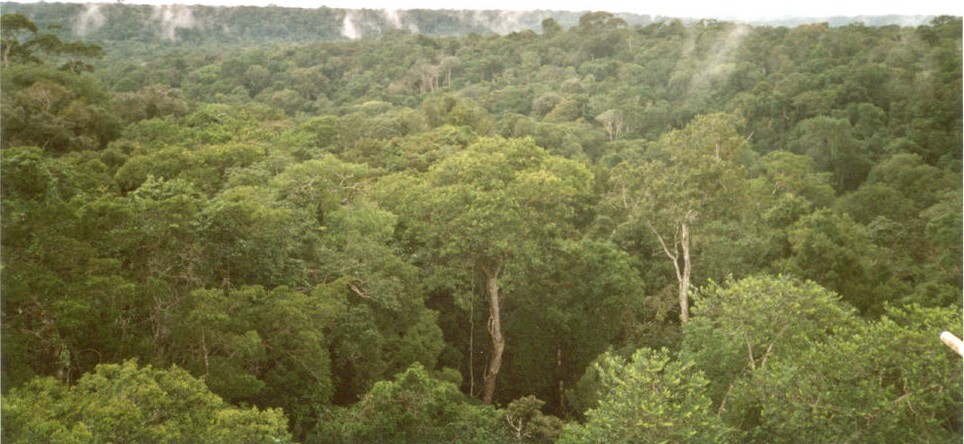
Amazon rainforest.  Creative Commons - Share Alike
Amazon rainforest. Creative Commons – Share Alike

The reasons for this improvement are important because they give us clues about how we can make further progress.  The Economist sees a pattern in the success stories:  “Typically, countries start in poverty with their land covered in trees.  As they clear it for farms or fuel, they get richer—until alarm bells ring and they attempt to recover their losses.  This happens at different stages in different places, but the trajectory is similar in most:  a reverse J. steeply down, then bottoming out, then up—but only part of the way.”  Here are a few examples that illustrate this principle:

  • Fifteen years ago, Brazil was losing 20,000 sq kilometers (7,700 sq miles) of forest per year. Since then a national policy has created national parks and protected patches of forest which has reduced deforestation to a rate of less than 6,000 sq kilometers per year.*
  • Mexico has cut its deforestation rate even more than Brazil.
  • India and Costa Rica are replanting their forests. India had 640,000 sq km of forest left in 1980.  It now has 680,000 sq km of forest.  Only 20% of Costa Rica was forested in the 1980s.  Now 50% of Costa Rica is forested.

These countries have in common some of the factors that predict success in reducing deforestation.  They are all more prosperous than they were in the past.  Their fertility rates are declining.  They are all democracies, in which public policy is largely a reflection of what the voters demand of their elected officials.  These are also countries in which the government is sufficiently functional to enforce their forest policies.  Developments in satellite imagery have helped these governments to monitor and enforce their policies.

(*Since this report was published by The Economist, the Yale Environmental Review 360e has published data on deforestation in Brazil for 2013.  After reducing the rate of deforestation since 2004, the rate of deforestation increased from 2012 to 2013 due to new roads and dams, and illegal logging.)

None of these factors would predict the relatively low deforestation rate in the Congo because its population is growing rapidly, it is still very poor, and its government is dysfunctional.  The Economist attributes the relatively low deforestation rate of the Congo to the movement of its rural population to distant urban areas.  The distance of forests in the east of the country from the cities in the west makes them less vulnerable to deforestation.

Deforestation continues to be a serious problem in Indonesia, despite the fact that the fertility rate has declined and farm output increased.  The rate of deforestation in Indonesia has exceeded that of Brazil since 2011.  The government of Indonesia is hostile to anti-deforestation policy, seeing it as foreign intervention.  Indonesia has only recently achieved democratic elections, which may enable reconsideration of forest policies.

China is also an interesting case because it has invested huge effort in reforestation without making any perceptible progress toward democratization.  However, the population is stable and increasingly urbanized and the country is significantly more prosperous than it was in the 1980s.  The effects of China’s deforestation were so dire as to motivate its autocratic rulers to take immediate action.  (2)

Only 2% of China’s original forest is still intact, according to Greenpeace.  Rampant logging and overgrazing have degraded its soil to the point that 25% of its territory is now covered in sand.  The desert is so close to Beijing that its roads are often clogged with sand, its railways inundated, and its pastures desiccated.

In 1978, China began one of the biggest reforestation projects in the world.  Since then 66 billion trees have been planted to create a shelterbelt along the edges of its northern desert that is projected to be 2,800 miles long by 2050.  Unfortunately, the Chinese selected few species of trees, which would grow quickly.  Some species were short-lived and some weren’t suited to soil conditions, so only 15% of trees planted since 1949 are still alive.  This is probably another example of a country that could make greater progress against deforestation with a more open democracy, which improves decision-making.

Global_Forest_Cover_Sub-Regional_Trends


Deforestation in the United States

Deforestation in the United States is largely a thing of the past.  About half of the United States was forested in 1600 compared to about one-third today.  Most of this deforestation occurred by 1910, when demand for lumber decreased significantly due to changes in building materials.  In the northeast of the country, much of the land has been naturally reforested as land that had been cleared for agriculture was abandoned.  It was always marginal land for agriculture, so as the population became more mobile, it moved west to find better land for farming.  This graph reflects these changes in land use and informs us that the south and the west are still supplying lumber for the world.  The US is supplying about one-fourth of the world’s timber.   Wildfires and insect infestations caused by climate change are also factors in declining forest cover in the west (although probably not reflected in this graph which ends in 1997).  (3)

Forest cover, USA. US Forest Service

Meanwhile, our local experience with deforestation is an outlier in these national trends.  Much of California was naturally treeless grassland and chaparral and it is being returned to that landscape by the native plant movement.  Most of our urban forest in the San Francisco Bay Area is not native to California.  It is being destroyed by most managers of public land because it is not native.  The public often objects to these destructive projects, but we are being ignored.

As we have seen in the examples above, deforestation and reforestation are largely political decisions.  American democracy is increasingly more responsive to economic interests than to the public.  Declining voter participation rates are undoubtedly a factor in this disturbing trend.  If you are not registered to vote, please give some thought to how our democracy has been damaged by lack of participation.  Midterm elections will take place this November.  Much is at stake.


(1) “A clearing in the trees,” The Economist, August 23-29, 2014

(2) “Great Green Wall,” The Economist, August 23-29, 2014

(3) http://en.wikipedia.org/wiki/Deforestation_in_the_United_States

Climate change requires plants and animals move to survive

Our readers know that we consider climate change the most critical environmental issue of our time.  We also believe that the native plant ideology is antithetical to our concern about climate change for two reasons:

  • The changing climate requires that plants and animals move in order to survive. Therefore, the demand that historical ranges of native plants and animals be restored and maintained is both unrealistic and harmful.  It is unrealistic because the environment has changed in the past 250 years since the arrival of Europeans on the West Coast and it will continue to change.  Therefore, we cannot assume that the native plants that existed here in 1769 are still capable of surviving here.  It is harmful because animals can and do move as the climate changes.  Therefore, eradicating the plants they need for survival is harmful to them.
  • The eradication of non-native plants and trees is exacerbating climate change by releasing their stored carbon into the atmosphere, thereby contributing to the greenhouse gases that cause climate change. When prescribed burns are used to eradicate non-native plants or prevent natural succession the release of carbon into the atmosphere by the plants that are burned is immediate.  When large, mature trees are destroyed, the carbon they have stored as they grew is released into the atmosphere as the wood decays.  Furthermore, their ability to store carbon in the future is lost to us going forward.  Since carbon storage is directly proportional to biomass, whatever we plant in their place is incapable of storing as much carbon as the mature trees.
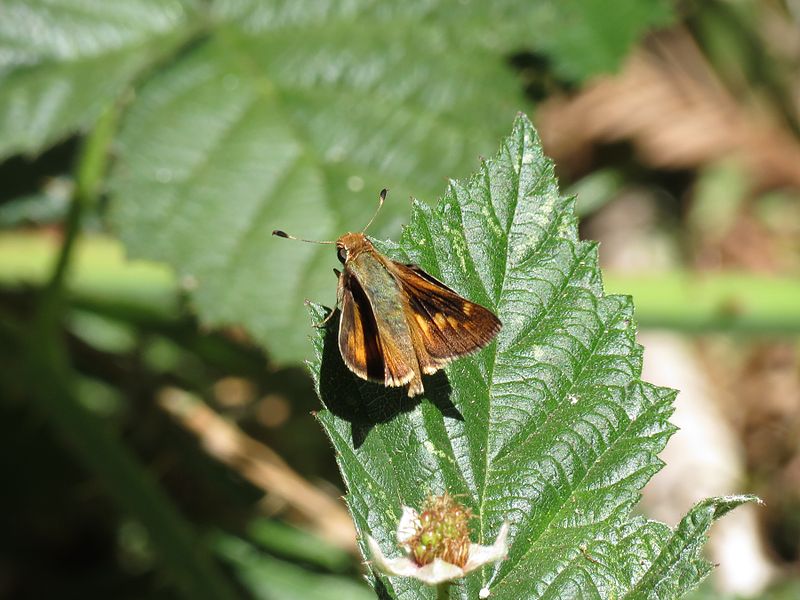
The umber skipper has adapted to Bermuda grass in lawns in the East Bay.  Creative Commons
The umber skipper has adapted to Bermuda grass in lawns in the East Bay. Creative Commons

There is an important caveat that we must add to our first bullet point.  Changing location is not the only mechanism that can ensure species survival in a changing climate.  Many species are probably “pre-adapted” to the changed climate.  That is, they may be capable of surviving changes in the climate.  Secondly, species can adapt and/or evolve in response to changes in the environment, which is another mechanism that facilitates species survival.  We invite our readers to visit our post about the rapid evolution of finches in the Galopagos Islands in response to extreme weather conditions that caused selection events.

Today we will inform our readers of the scientific record regarding the need for plants and animals to move as the climate changes.  We will use the recently released fifth report of the Intergovernmental Panel on Climate Change as our source.

Intergovernmental Panel on Climate Change

First we will establish the credibility of the Intergovernmental Panel on Climate Change (IPCC).  The IPCC was formed in 1988 by the United Nations.  It is composed of thousands of scientists from all over the world, representing the 190 member nations of the UN.  The IPCC does not conduct original research.  Rather it compiles thousands of peer-reviewed scientific studies into reports that represent a consensus viewpoint of the global scientific community.  Typically, scientists from 120 countries participate in marathon sessions in which consensus must be reached before reports can be published.  The IPCC has published 5 reports since 1988, the most recent earlier in 2014.

How the climate has changed and how it will continue to change

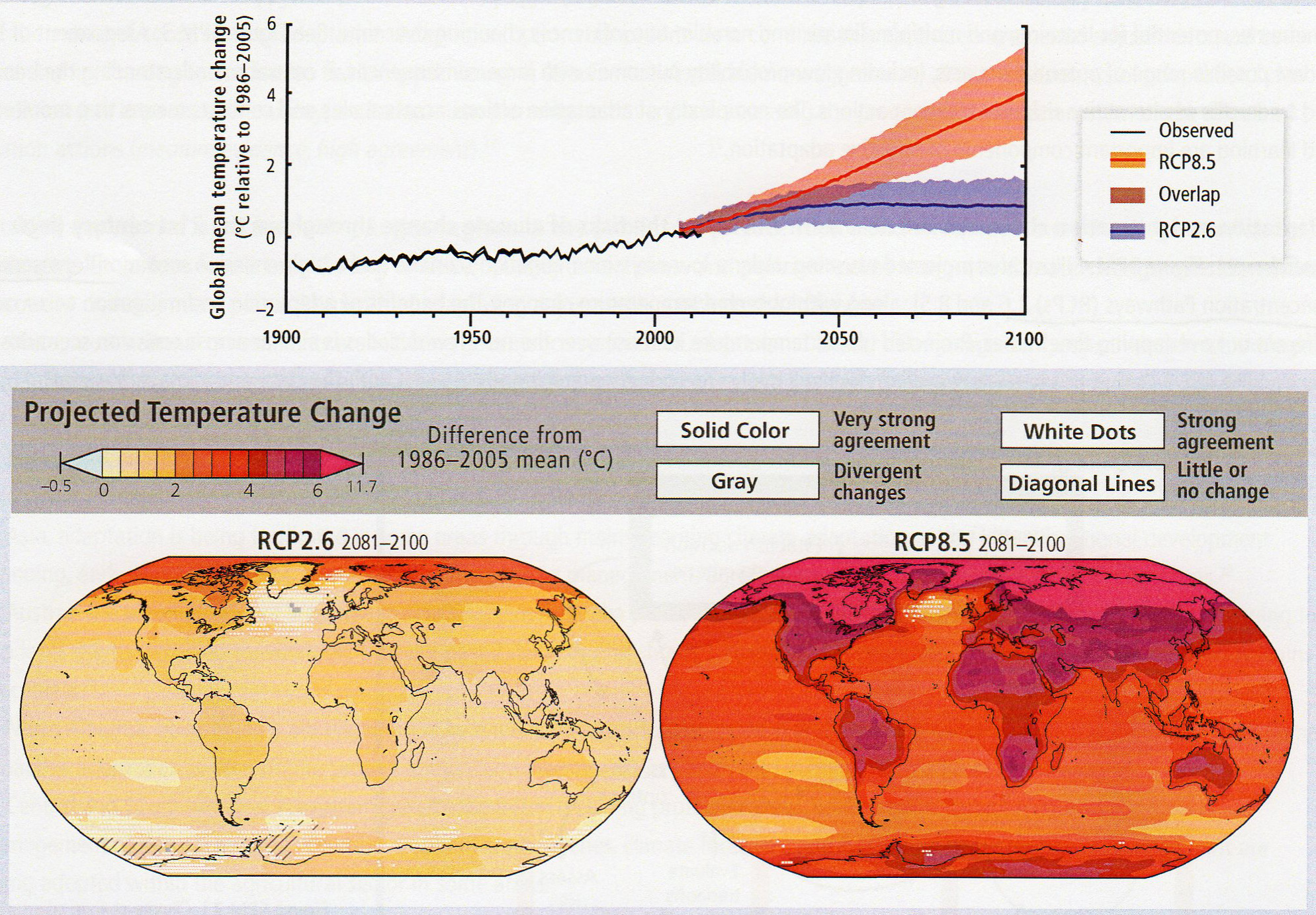
The IPCC compiled several different sources of data to report how the climate has changed from 1900 to the present.  Then they modeled the multitude of variables that influence climate to predict different trajectories for the climate going forward to 2100.  The many variables that influence climate interact in complex ways that are not entirely predictable.  There is therefore some uncertainty in those predictions, as there is in any prediction of the future.  Therefore, future temperature is depicted by the following graph as “bands” of probability.  The bands become wider as the graph depicts further into the future, as we would expect; that is, the distant future is less predictable than the near future.

Observed and projected temperature change, IPCC 2014

Here’s what we learn from this graph:

  • The graph reports that the average global temperature has increased by 1° Celsius (1.8° Fahrenheit) from 1900 to the present.  Graphs depicting the more distant past indicate that the climate began to warm around the time of the industrial revolution, about 1850.  Therefore the total increase in temperature is greater than that depicted by this graph.  However, the rate of increase has accelerated greatly in the past 50 years.
  • The upper range of projected temperature increases on the graph is labeled RCP8.5 (Representative Concentration Pathway 8.5). That pathway is based on the assumption that present levels of greenhouse gas emissions will continue to increase at the same rate as they have in the recent past.  The mean prediction of that pathway is a global temperature increase from the present to the end of the century of 3.7° Celsius (4.6° Fahrenheit).
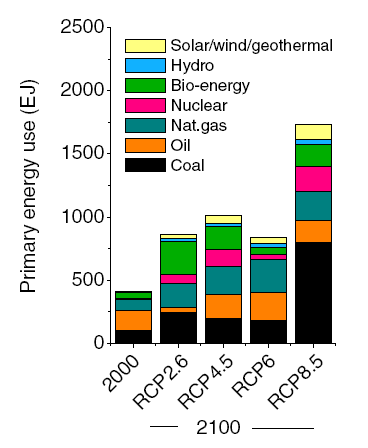
  • The lower range of the projected temperature increases on the graph is labeled RCP2.6 (Representative Concentration Pathway 2.6). The mean prediction of that pathway is a temperature increase to the end of the century of 1° Celsius (1.8° Fahrenheit).  That pathway is based on the assumption that greenhouse gas emissions are radically reduced, beginning immediately, as represented by the following graph from The Guardian.  This graph also depicts two intermediate emission scenarios between the present trajectory(RCP 8.5) and the maximum predicted reductions in emissions (RCP 2.6)
Projected energy use

Movements needed for survival in a changing climate

The world has done little to reduce greenhouse gas emissions and America has done even less.  According to a recent Gallup Poll, only 39% of Americans are “concerned believers” in climate change.  Another 36% of Americans believe the climate is changing, but don’t believe it will affect them.  Twenty-five percent (25%) of Americans do not believe the climate is changing.  Therefore, for the time being, it seems extremely unlikely that our polarized politics in America will be capable of responding effectively to the grim reality of climate change.  Within that context, we inform you of the final graph from the IPCC report about the need for plants and animals to move from their present ranges in response to climate change and their variable ability to do so.

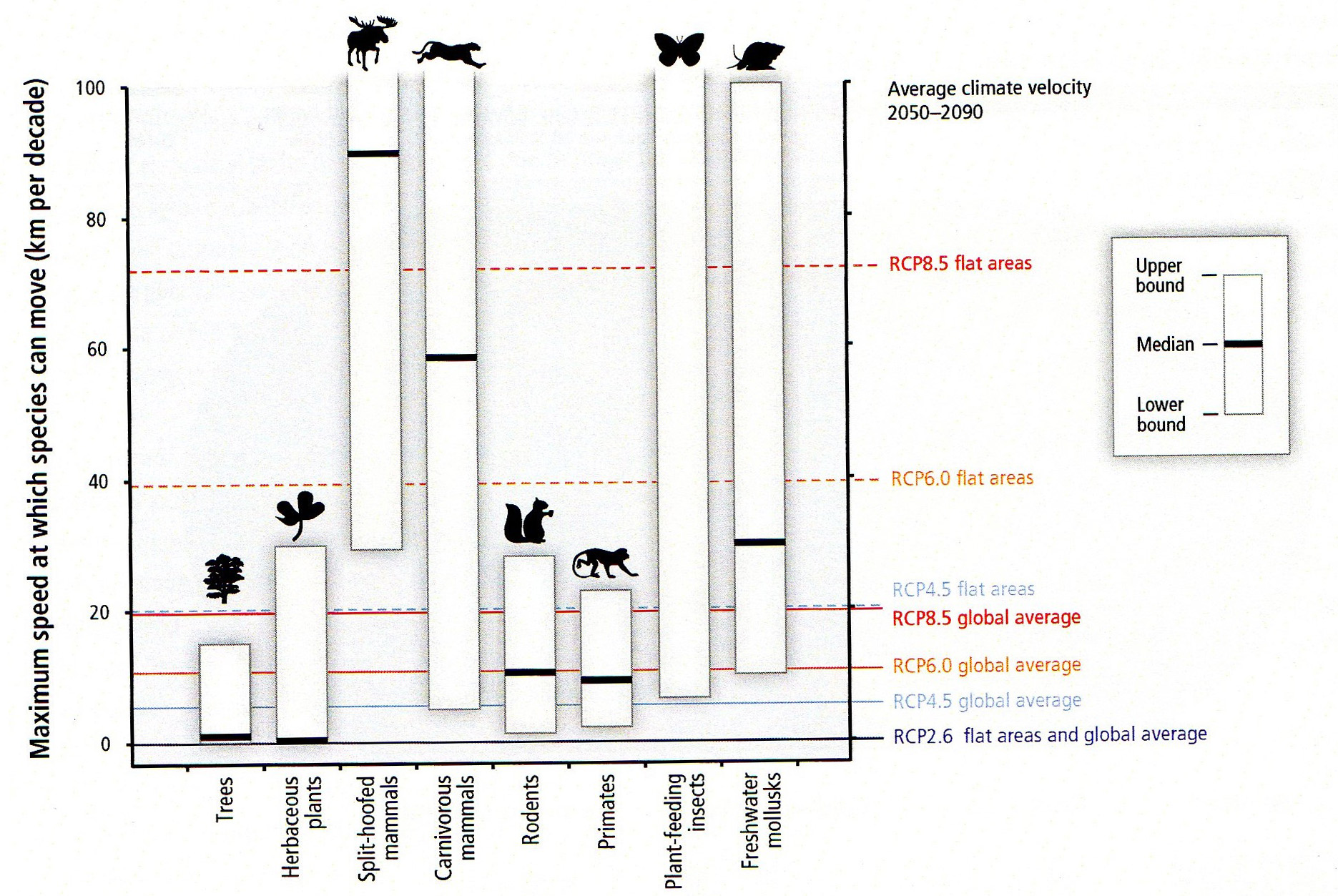
Adaptation to Climate Change.  IPCC
Adaptation to Climate Change. IPCC

On the vertical axis, the graph depicts the ability of plants and animals to move, measured in kilometers per decade.  The horizontal lines depict the need of plants and animals to move in response to various scenarios of climate change as we described earlier.  The bars depict the ability of plants and animals to move and the height of each bar informs us of the variable ability of plants and animals to move.  Trees are the least able to move, unless we have the wisdom to plant them outside their native ranges—at higher latitudes or elevations–where they are more likely to survive in the future. 

For example, if we radically reduce greenhouse gas emissions immediately (RCP2.6), most species of trees and plants will be sustainable at their present latitudes and elevations.  But if greenhouse gas emissions continue on their current trajectory (RCP8.5), most species of trees and plants will not be capable of moving far enough, fast enough to survive as the climate warms.  Although trees and plants are capable of moving only very slowly, most animals are capable of moving more rapidly.  Will they have the plants they need to survive in their new ranges?

 Putting our heads in the sand

Surely there aren’t many native plant advocates in the San Francisco Bay Area who don’t believe in the reality of climate change.  The Gallup Poll reports that most people who don’t believe in climate change are Republicans and in the San Francisco Bay Area Republicans are a small minority.  And so we ask native plant advocates this question:  How do you reconcile the reality of climate change with your demand that native plants be restored and maintained where they existed 250 years ago in a very different climate?


California Invasive Plant Council sticks to its guns aimed at eucalyptus

Monarch butterflies roosting in eucalyptus tree.

In December 2013, one of our collaborators in the effort to save our urban forest from pointless destruction submitted a request to the California Invasive Plant Council to reconsider its evaluation of blue gum eucalyptus (Eucalyptus globulus) as “moderately invasive.” 

The California Invasive Plant Council (Cal-IPC) has responded to that request with a draft reassessment which is available here:  http://www.cal-ipc.org/ip/inventory/eucalyptus.phpCal-IPC’s draft maintains the same over-all rating of blue gum as “moderately invasive.”   Cal-IPC is inviting “substantive comments and questions” by July 31st to info@cal-ipc.org.

Today we are publishing with permission the cover letter of a public comment that will be submitted by one of our collaborators.  We hope it will inspire you to write your own public comment by the deadline of July 31, 2014. 


From the perspective of humans, there are pros and cons to most species of plant and animal.  E. globulus is no exception to this general rule.  Cal-IPC reaches a negative conclusion regarding blue gum by exaggerating negative issues and de-emphasizing or omitting positive issues.  Cal-IPC now acknowledges that blue gum has “low invasive potential” only in specific conditions and that its population in California is stable, but it has introduced new issues and intensified others so that it can maintain its overall rating of “moderately invasive.”  I remind Cal-IPC that its name is Invasive Plant Council, not fire council or hydrology council.

Cal-IPC also fails to take into consideration the negative side-effects of attempting to eradicate eucalyptus.  There are environmental benefits associated with leaving blue gums alone.  These damaging consequences of eucalyptus removal should appear on the “asset” side of the ledger:

It is also not in Cal-IPC’s strategic best interests to continue to advocate for the eradication of eucalyptus in California:

  • As the eradication projects get progressively more destructive, the public’s negative reaction to the destruction becomes progressively more aggressive.  There are now thousands of us all over the State and all over the country, working to stop this destruction and we are often effective in preventing these projects from being approved or funded.  An op-ed in the New York Times in September 2013, expressed support for our opinion that the word “invasive” has become a destructive tool and is inappropriately applied to eucalyptus in California.
  • The scientific community has also become progressively more critical of the attempts to eradicate eucalyptus.  Last fall, Nature  magazine quoted several well-known academic scientists in an article that criticized plans to destroy 30,000 eucalypts on Mount Sutro in San Francisco.  In May 2014, the CEO and Chief Scientist of the Nature Conservancy expressed their opinion on TNC’s website that destroying eucalypts in California is unnecessary.
  • Since blue gum eucalyptus is no longer available in nurseries in California and has not been planted for many decades, it has no long-term future in California.  To the extent that eucalyptus is a problem, it is a problem that will resolve itself in time.

Cal-IPC’s continued support for these projects is no longer in the mainstream of scientific or public opinion.  Removing eucalyptus from Cal-IPC’s “hit list” would significantly improve Cal-IPCs chances of success with the plants that remain on its inventory of invasive plants.  The public is unlikely to expend the same amount of energy opposing the eradication of broom, for example.

Cal-IPC has an opportunity to defuse a controversy that is handicapping the success of its venture.  Cal-IPC would be wise to abandon its crusade aganst blue gum eucalyptus.

Update:  On March 13, 2015, the California Invasive Plant Council published its final reassessment of Blue Gum Eucalyptus (available HERE).  Cal-IPC has downgraded its rating of invasiveness and ecological impact from “moderate” to “limited.”  Although the detailed assessment is less than perfect, the over all rating itself is an improvement.  Thanks to those who sent comments to Cal-IPC.

Climate Change vs. Biodiversity: NOT!!

A new study reported changing public and scientific interest in biodiversity compared to climate change.  Using reports in the media and scientific journals in the United Kingdom and the US, as well as funding of scientific studies by the World Bank and the National Science Foundation, the study reports that the interest in climate change has increased and the interest in biodiversity has decreased in the past 25 years.

This analytical approach seems to suggest that these two environmental issues are mutually exclusive, that the interest in one is at the expense of the other.  We find this both unfortunate and unnecessary because we consider these two issues intimately related.  Climate change is increasingly the biggest threat to biodiversityIf plants and animals are unable to adapt to climate change, they are doomed to extinction. 

Therefore, we believe that science should study these topics together.  In fact, the study on which we are reporting acknowledges the relationship between these topics:  “Dual-focus projects are being funded more often, but… ‘this is relatively small and does not mitigate the plateauing expenditure on biodiversity research.’” (1)

Conservation in a changed climate

As long as conservation and “restoration” projects are devoted to replicating historic landscapes, they are likely to be unsuccessful.  The climate, atmosphere, and soil conditions are no longer suited to a landscape that existed hundreds of years ago, particularly in urban environments.  Therefore, if biodiversity is to be preserved by conservation and restoration, such projects must look forward, not backwards. 

We have been watching the Nature Conservancy closely for signs that it is adapting to climate change.  We look to the Nature Conservancy to lead the way because they employ hundreds of scientists.  In contrast, many mainstream environmental organizations employ more lawyers than scientists.

We have reported that the Conservancy’s Chief Scientist, Peter Kareiva, is at least paying lip service to an approach to conservation that takes into consideration the profound changes in the environment caused by the activities of man.  This acknowledgement of the irreparably altered environment is encapsulated by the proposal to name a new geologic era, the Anthropocene.

Unfortunately, the old guard of conservation biology has engaged in a vigorous campaign to silence the Conservancy’s new approach.  This conflict between the old guard and scientists who have proposed a more realistic approach to conservation was recently reported by the New Yorker. (2)  According to that article, Peter Kareiva has made a commitment to the old guard to quit publishing anything regarding the Anthropocene and its implications for conservation practices.

The Nature Conservancy has responded to the article in the New Yorker in its on-line blog.  It doesn’t explicitly address the question of whether or not a commitment has been made to quit advocating for a more realistic approach to conservation.  However, it implies that the Conservancy plans to continue on a course of scientific innovation and experimentation, which it describes as “practical.”  Here is a specific choice made by the Conservancy that typifies this approach:

Monarch butterflies roosting in eucalyptus tree.

“We know it was worth spending millions of dollars to rid Santa Cruz Island of non-native pigs.  But we are pretty sure it would not be worth spending what could be hundreds of millions of dollars to rid California of non-native Eucalyptus trees (which also happen to harbor wildlife and monarch butterflies.)” (3)

Although the Nature Conservancy’s Chief Scientist may have agreed to “shut up,” we see signs of the Conservancy’s new approach in its latest magazine.  In a brief article entitled “Forests of the Future,” the magazine reports that they are no longer planting the species of trees that existed in the past in one of their properties in Minnesota, because they don’t believe that species is adapted to current or predicted future conditions.  Instead they are actively engaged in reforestation of the land with new species:

Over the past two springs, the team planted 88,000 tree seedlings across 2,000 acres in the northeastern corner of the state.  The seedlings consisted of species that should survive better in a warmer and drier climate—trees, such as red oak, found in higher numbers just south of the area. For a team accustomed to restoring forests to match historical landscapes, helping the North Woods [of Minnesota] adapt to a predicted future climate is a new but necessary idea.  [The Conservancy’s science director in Minnesota] says, ‘All of our modeling is saying the same thing,’ she adds, ‘We needed someone to actually go out and start trying some of this stuff.’” (4)

Looking forward not back

We are very encouraged by the Conservancy’s new approach and we hope that other land managers will be inspired by it.  We are also reminded of a recent visit to a nature reserve near San Luis Obispo managed by the local chapter of the Audubon Society.  We reported about this reserve in a recent article because the land managers had planned to destroy all eucalyptus trees on that property but were forced to scale back their plans in response to a noisy negative reaction from the public.

Dying oak tree, Sweet Springs Nature Reserve

On our recent visit, we learned that this was a wise choice because many of the oak trees that were planted on this reserve by those who wish to “restore” it are quite dead despite the fact that the reserve has an extensive irrigation system.  These land managers looked back and the result of that retrospective thinking is a landscape of dead native trees.

Irrigated native plant garden, Sweet Springs Nature Reserve

Climate change requires land managers to wake up to the realities of what will grow where.  Land managers in the San Francisco Bay Area appear to be blind to that reality.  They repeatedly plant species where they grew hundreds of years ago and we are forced to watch the plants die repeatedly. 


(1)    “Climate change beats biodiversity as a press, scientific, and funding priority,” Science Daily, June 11, 2014

(2)    D.T. Max, “Green is Good,” New Yorker, May 12, 2014

(3) Mark Tercek and Peter Kareiva, “Green is Good:  Science-Based Conservation in the 21st Century,” May 5, 2014

(4)    “Forests of the Future,” Nature Conservancy, June/July 2014

“Gardening for Climate Change”

The White House recently released the National Climate Assessment which was prepared by a panel of scientists convened by the federal government.  This report informed us that average temperature increase of only 2° Fahrenheit over the entire country in the past century has produced these changes in the environment:

  • “Summers are longer and hotter, and extended periods of unusual heat last longer than any living American has ever experienced.”
  • “Winters are generally shorter and warmer.”
  • “Rain comes in heavier downpours.”

If greenhouse gas emissions continue to increase at the same pace, the report predicts an increase in average temperature of as much as 10 degrees by the end of the century.  If an increase of only 2 degrees is capable of producing the extreme weather we are experiencing, it is difficult to imagine what we can expect if the temperature increases 10 degrees.

Climate Change Map
Climate Change Map

President Obama announced the report“This is not some distant problem of the future.  This is a problem that is affecting Americans right now.  Whether it means increased flooding, greater vulnerability to drought, more severe wildfires—all these things are having an impact on Americans as we speak.”

The impact of climate change on plant life (1)

Henry David Thoreau recorded the arrival of spring at Walden Pond in Concord, Massachusetts in the 1850s.  His data has been incorporated into the records of his successors, creating a continuous record across 160 years.  Spring arrives in Concord, Massachusetts about three weeks earlier than it did in the 1850s.  This pattern mirrors the changes occurring around the planet according to field studies and satellite images taken from space. 

The response of plants to this change in seasons has varied, according to a study published recently by the Proceedings of the National Academy of Sciences.  Some species of plants reach their flowering peak earlier in the year, while other species are extending their flowering into later in the fall.

Another study speculates that increased temperature isn’t the only factor influencing these changes in flowering patterns.  Increased levels of carbon dioxide also may be affecting plants.  Earlier snow melt may be another trigger for changes in timing of flowering.  The availability of pollinators at the time of flowering is assumed to influence the long term survival of flowering plants.  In other words, the affects of climate change on plants are complex and imperfectly understood.

The implications for gardeners who care about wildlife

The New York Times recently published an op-ed which offered an answer to this question:  “How do we garden in a time of climate change?”  There are probably many answers to that question, so we should understand the perspective of the author of the op-ed, James Barilla.  He describes his background on his website“… James Barilla held a variety of posts in wildlife research and management, crossing paths with wolves and mountain lions in remote wilderness and promoting “mini-beast” habitat in urban schoolyards. He first became intrigued by backyard wildlife while working in England for a land trust, where his job was to create wildlife habitat on the outskirts of a city.”  He has a Master’s Degree in Environmental Science from University of Montana and a Ph.D. in English from UC Davis.  He now teaches creative and environmental writing at University of South Carolina.  He has written a book about gardening to support urban wildlife and articles published by Atlantic and National Geographic Magazine. 

One of Mr. Barilla’s goals as a gardener is to provide habitat for wildlife.  Million Trees is therefore very interested in his answer to the question, “How do we garden in a time of climate change?”  because we are always responding to the perception of native plant advocates that the eradication of non-native plants will benefit wildlife.  Mr. Barilla shares our view that, particularly at a time of a rapidly changing climate, it no longer makes sense to limit ourselves to native plants if we are to provide useful habitat to wildlife:

“In [the] microclimate [of our backyards], extreme gardening means making the yard hospitable for as many species as possible, without worrying so much about whether they originally belonged here or not.  I used to think that tearing out turf and making room for native species like purple coneflower and switchgrass was the best thing I could do.  But things aren’t that simple anymore.  It doesn’t make sense to think in terms of native and nonnative when the local weather vacillates so abruptly.  A resilient garden is a diverse garden.”  (emphasis added)

Mr. Barilla also acknowledges the changing ranges of plants and animals in response to climate change and the need to accommodate those changes if species are to survive:  “…species are disappearing across their native range but flourishing outside it…This phenomenon of species movement and adaptation is likely to become commonplace as the climate changes.”

Monarch butterflies roosting in eucalyptus tree.

Finally, Mr. Barilla appeals to us on moral grounds:  “we humans are responsible for the current changes.  So we must also be responsible for helping other species survive them.”  He uses the needs of the monarch butterfly as an example of a species that has been particularly hard hit by both climate change and the agricultural practices of humans.  He urges gardeners to plant milkweed—the host plant of monarchs—in their yards.

Scientists in Ohio have concluded that episodes of extreme heat have reduced the population of native butterflies.   Here in California, we can help monarchs by stopping the many projects that are destroying eucalyptus because monarchs use eucalyptus in several hundred locations along the coast of California as their overwintering roost.   

Native plant advocates are putting their heads in the sand

We (and thousands of people with whom we have collaborated in the past 15 years) have made every effort to inform native plant advocates that they are mistaken in their assumption that native plants provide habitat superior to non-native plants.  We have provided them with the many empirical studies that prove otherwise, including one cited by Mr. Barilla in his op-ed:  “One study in Davis, California, found that 29 of 32 native butterflies in that city breed on nonnative plants.  Thirteen of these butterfly species have no native host plants in the city; they persist there because nonnative plants support them.”  This study by Professor Arthur Shapiro and his graduate student was published over 10 years ago.  (1)  It is only one of 5 local studies that report similar findings for every taxon of wildlife:  benthic microorganisms, insects, amphibians, reptiles, birds, mammals.

Anise Swallowtail butterfly in non-native fennel

There are similar studies elsewhere in the country and around the world that also find equal numbers of insects in native and non-native vegetation.  The British Royal Horticultural Society is conducting a 4-year study of insect use of plants.  Their preliminary findings are that insects are equally likely to use native and non-native plants.  Even Doug Tallamy was unable to find evidence to support his mistaken assumption that more insects use native plants than non-native plants.

Yet, native plant advocates refuse to consider the damage they are doing to both the environment and wildlife that is struggling to survive the destruction of their habitat.  They demand the destruction of thousands of healthy trees, storing millions of tons of carbon dioxide that is released into the atmosphere when the trees are destroyed, thereby contributing to climate change.  They demand that herbicides be used to eradicate non-native vegetation and kill the roots of the trees that are destroyed to prevent them from resprouting.

Here are a few specific examples of native plant advocates– and the environmental organizations that support them– refusing to consider the damage being done to the environment and wildlife:

  • Neighbors of Mount Davidson in San Francisco have been trying for several years to discuss plans of the Natural Areas Program to destroy 1,600 trees on Mount Davidson with the Bay Area Chapter of the Sierra Club, which supports those plans.  The Chapter Sierra Club leadership has repeatedly refused to even discuss the issue with the neighbors who are members of the Sierra Club.  The final response came from the Sierra Club Executive Director, Michael Brune who supports the refusal of Chapter leadership to discuss the issue with Club members.
  • The Sierra Club recently announced in its newsletter, The Yodeler, that it has asked the East Bay Regional Park District to destroy 100% of all eucalyptus trees on over 1,200 acres of park land.  East Bay Regional Park District has estimated the average density of the eucalyptus forest on their properties at 650 trees per acre, which means that the Sierra Club is demanding that over 780,000 trees be destroyed in the East Bay.
  • The Sierra Club recently announced that it has asked UC San Francisco to implement its original plan to destroy over 30,000 trees on Mount Sutro in San Francisco.  In making this request, they claim that such destruction will benefit native plants, although the original plan did not propose to plant any native plants.  (These plans are presently on hold, although UCSF is now in the process of destroying about 180 trees they consider hazardous, in the height of nesting season.)
  • San Francisco’s Department of the Environment has submitted an application for funding to create a Biodiversity and Ecology Master Plan which proposes to treat all open space in San Francisco as “natural areas” using the Natural Areas Program as its model.  The Natural Areas Program is presently restricted to 1,100 acres of city-managed park land.  If implemented, this plan could eradicate non-native plants on all city-owned open space as well as private backyards.

The changing climate requires that we reconsider the commitment to native plants in historic ranges because they are probably no longer adapted to those ranges.  They must move if they are to survive and we must accommodate that movement if we want them to survive.  Likewise, we must reconsider everything we are doing to contribute to climate change, including our use of fossil fuels and deforestation.

Taking action

If you are a member of the Sierra Club, please tell them your opinion of their recent demands to destroy more trees in San Francisco and the East Bay than is presently planned by the owners of those properties.  Also, urge them to listen to the concerns of their members regarding the plans for tree removals by San Francisco’s Natural Areas Program.  Their address is:  San Francisco Bay Chapter Sierra Club, 2530 San Pablo Ave. Suite I, Berkeley, CA 94702-2000

If you live in San Francisco and don’t want all open space in the city to be treated as native plant museums, please write to Polly Escovedo (who is considering the grant application to create a Biodiversity and Ecology Master Plan) by May 14, 2014:  polly.escovedo@resources.ca.gov


(1)    This section is from:  Carl Zimmer, “Springing Forward, and Its Consequences,” New York Times, April 23, 2014

(2)    SD Graves and AM Shapiro, “Exotics as host plants of the California butterfly fauna,” Biological Conservation, 110 (2003) 413-433