Lesson Learned: Don’t prune trees during breeding/nesting season

This article is reposted with permission from CoyoteYipps, a blog about San Francisco’s urban coyotes. It is a timely reminder that spring is breeding/nesting season for birds. 

There isn’t a hard-and-fast rule about when birds breed, build their nests, and raise their nestlings.  The general “rule” in the Bay Area is that most birds are nesting between February and August.  However, as the climate changes, we should expect outliers and we should be watchful for them. 

This story illustrates that pruning trees during nesting season is risky business.  We commend the author of this story for correcting a serious mistake and bringing this story to a happy ending.

We attended the Western Conference of the International Society of Arborists in Anaheim, California last week.  One of many excellent presentations we heard was about what arborists need to know about taking care of trees without harming wildlife. 

The presentation was made by an employee of HortScience in the San Francisco Bay Area.  HortScience is the arboriculture company that does most of the evaluations of trees for San Francisco’s Recreation and Park Department.  They are therefore influential in determining the future of the Bay Area’s urban forest.

HortScience has developed a protocol for arborists to avoid harming wildlife when they are working on trees.  The draft protocol is available HERE.  The author of the protocol is taking public comments on the draft until the end of May:  ryan@hortscience.com.  When the protocol is completed, HortScience plans to offer training to arborists to help them protect the birds in our urban forest.

We hope that people who are knowledgeable about birds will look at the draft and make suggestions for improving it to be most effective.  Thanks for your help to protect the birds in our urban forest.


MY HUMMINGBIRD ADVENTURE by LAUREL ROSE

I learned a valuable lesson this weekend: Do Not Prune or Remove Trees in Spring!  

Over the past couple years, I’ve been removing a row of unattractive honeysuckle trees along the fence line to let more light into our shady yard and plant some ferns & other foliage. The trees all had long skinny bare trunks with foliage starting at about 15- 20 feet up so all I could see was fallen leaves on top of compacted dirt and 8 pencil-thin tree trunks.

skinny trees (copyright Laurel Rose)

This weekend 7 and 8 were scheduled for removal. After getting 7 out of the ground, root and all, my friend and & I were getting ready to start breaking the trunk & branches down to 4 foot size segments required by the city for the green waste bins. I had a hand saw and my friend was using my mini electric chain saw for the job. I kept a safe distance in a far corner of the yard and we got to work. 2 branches into it, the chainsaw turns off and I hear “Oh Noooo! Oh my god! Nooo!” then, “chirp, chirp chirp”!

Tiny hummingbird nest on a twig
This is how I found the nest (copyright Laurel Rose)

The tree had a hummingbird nest camouflaged and expertly woven very securely onto a few twig size branches. Both my friend and I love & respect nature so we were a little frantic and horrified at the thought of nearly chainsawing through this little womb-like nest cradling 2 chicks. I found a little box and cushioned it with soft material scraps and toilet paper and placed the nest inside very carefully. It took a good hour for us to calm down and stop focusing on how thoughtless we had been to choose April to remove a tree. Even ugly trees with sparse foliage provide habitat and serve a s food source. My friend, a somewhat burly guy named Terry but whose friends call him “Bubba” was on the verge of tears telling me, “I searched for a nest before sawing off each branch. . .” . Even if one of us has noticed it, it did not resemble a typical storybook nest.
I called every organization and person I could think of for help on that Saturday evening: Golden Gate Audubon Society, Wild Care, and Janet. I was able to listen to a recorded instructions for caring for a injured chick. I kept them inside for the night in a warm dark spot away from my curious little dog who likes to be a part of everything I do whenever possible. As soon as it was light outside, I placed the box up high in the area where the tree had been. Within 20 minutes, mom showed up and fed her hungry babies and I watched as she gathered nectar from the flowers overhead on tree number 8 (which will stay in my yard).

Baby hummingbird (copyright Laurel Rose)
DAY 1: a few hours after discovery

We estimated the age to be between 2 & 3 weeks and were told that hummingbird chicks leave the nest at 23 days old. A couple days before this happens, a stronger chick pushes the weaker out of the nest and it dies because mom will not feed it on the ground. The reason this happens is because the nest is very small and is needed as a “launching pad”. Once the other chick takes flight, mom will continue to feed her baby for several days, teaching how and where to find all the best nectar & bugs before she chases it away to find its own territory. Since they are in a box, neither one will be pushed out of the nest and mom will continue to feed them both. I’m not sure if this may have any negative or unforeseen consequences but I like that idea!

Two hummingbird chicks in the nest
Two hummingbird chicks on the first day
Two Hummingbird chicks
Second Day – Hummingbird chicks
Box put up to rescue hummingbird nest
A safe space for a hummingbird nest

Day 2: I secured a new box in the other Honeysuckle tree because we were having some very windy days.


Box fastened into tree to rescue a hummingbird nest
Box fastened well against the wind

Day 3: I wasn’t sure if Mama was feeding her chicks with the new placement of the box with a different type of access, but I caught her in the act (see video below)


Mama hummingbird entering box to feed chicks in rescued nest
Mama hummingbird entering to feed the chicks – click for video (copyright Laurel Rose)
Hummingbird chick near fledging

Day 4: They changed so much from one day to the next

Two hummingbird fledglings

Day 5: Just before I left late Thursday morning, I went to check on the chicks and snapped this photo. They looked like they were ready to spread their wings. I might have made them a little nervous putting the camera up so close but wondered if they were contemplating their first flight.

Hummingbird chicks just before departing nest

When I came home in the early evening, the first thing I did was check the box and it was empty. I stood there for several minutes wondering how such a tiny creature with only 23 days of life can survive on their own. That’s when I heard chirping above and looked up- there was mama with 1 chick shoulder to shoulder on a branch.

hummingbird sitting in chain link fence
Hummingbird sitting in chain link fence

hummingbird-in-wire-2I looked around for the other chick and had noticed what I thought was a leaf caught in one of the links on the fence, but a closer look told me otherwise.

Maybe the little guy didn’t feel quite ready, or maybe he wanted to say goodbye. He let me get real close and looked at me with that one little eye as I said some encouraging words and slowly reached in my back pocket for my camera. I snapped one photo and he flew to the branch up above where his family was.

Today would be Day 8. I’ve been seeing what I believe to be this same little chick hanging out in the honeysuckle tree where the box was. A few hours ago, I observed the mama arrive and feed the chick patiently waiting on a little branch.

If you would like to invite hummingbirds to your yard I would not recommend those feeders with sugar water because they must be cleaned every 3- 4 days or they can make the hummingbirds very sick. It’s much better and healthier to provide their natural food sources and plant things like honeysuckle, sage, fuchsia, Aloe vera and other long tubular flowers that provide both nectar as well as habitat for insects that serve as protein. Hummingbirds also need a place to perch during the day & sleep at night that offers some protection from wind & rain- usually trees. You can also hang a perch up high in a tree near the flowers and you can encourage nesting by providing materials by hanging a “Hummer Helper” you can purchase and fill with store bought material or even dog and cat hair — the “Hummer Helper” is actually just a “suet feeder” which you can buy for a lot less. The best time to start is May. The Hummingbird Society has a lot more tips and information on their website.

*One last note about trimming trees- the safest time is in the Fall during the months of September- December

Why poisoning the soil contributes to failed “restorations”

We are members of an international team of people who are concerned about the destructive consequences of ecological “restorations.”  Trees, Truffles, and Beasts (1) was recommended to us by one of our collaborators in Australia because the book was written by several academic scientists in Australia and the Pacific Northwest of the United States.  The book compares and contrasts the forests of these disparate locations and finds that below the ground, they have much in common.

Much more is known about the important ecological functions performed by forests above ground than below ground.  However, there are many equally important things happening below ground that are essential to the health of forests:

  • The soil is inhabited by millions of microbes that decompose organic matter, making it available to plants as nutrients. These microbes recycle dead plants and wood back into usable material for living plants.
  • Nitrogen is essential to plant growth. Microbes and fungi in the soil convert nitrogen in the atmosphere into forms needed for plant growth.  Specific plant species (e.g., legumes, such as acacia and lupine), called nitrogen “fixers,” are mediators in this process.
  • Fungi in the soil deliver water and nutrients from the soil to the roots of trees in exchange for carbohydrates provided by the trees. This symbiotic relationship is essential for the health of trees and in the absence of fungi, tree growth and development are severely retarded.
  • Most carbon is stored in the soil, and soil fungi play a role in converting atmospheric carbon dioxide into carbon that is stored in the soil. “Recent research has shown that mycorrhizal fungi hold 50 to 70 percent of the total carbon stored in leaf litter and soil on forested islands in Sweden.” (2)

Relationships between animals and forests

The animals that live in the forests contribute to forest health and forests also benefit the animals.

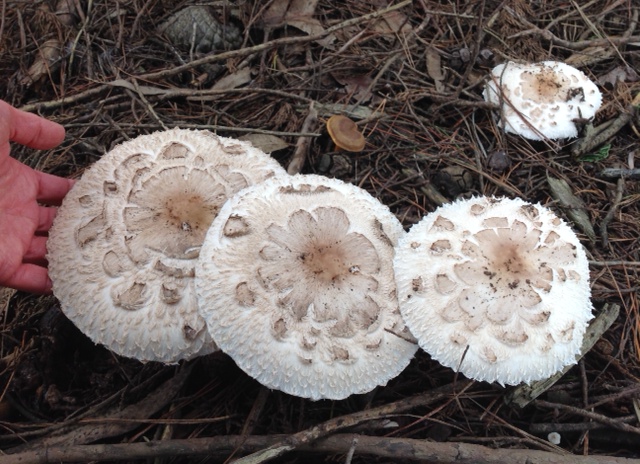
Mature Parasol mushrooms - note hand for size comparison
Mature Parasol mushrooms – note hand for size comparison

Fungi in the soil produce “fruiting bodies” that are their means of reproducing.  Fruiting bodies above ground are called mushrooms.  Fruiting bodies below ground are called truffles.  In both cases, they are important sources of food for animals.  The animals in Australia are different from those living in the Pacific Northwest, but they have in common that the fruiting bodies of fungi are equally important sources of food for them.

In the case of mushrooms above ground, dispersal of their spores is accomplished primarily by wind.  But in the case of truffles, dispersal of their spores is dependent upon the animals that eat them and “deposit” them elsewhere.  So, animals are crucial to the reproductive cycle of fungi that fruit below ground.

Long-footed potoroo is an Australian marsupial that eats primarily mushrooms and truffles.
Long-footed potoroo is a rare Australian marsupial that eats primarily mushrooms and truffles.

In their search for truffles, the animals also till the forest floor, which contributes to the decomposition of leaf litter and the dispersal of nutrients into the soil.  As the animals defecate in the forest, they are also making contributions to forest health and there are species of microbes and insects that specialize in the use of animal feces.

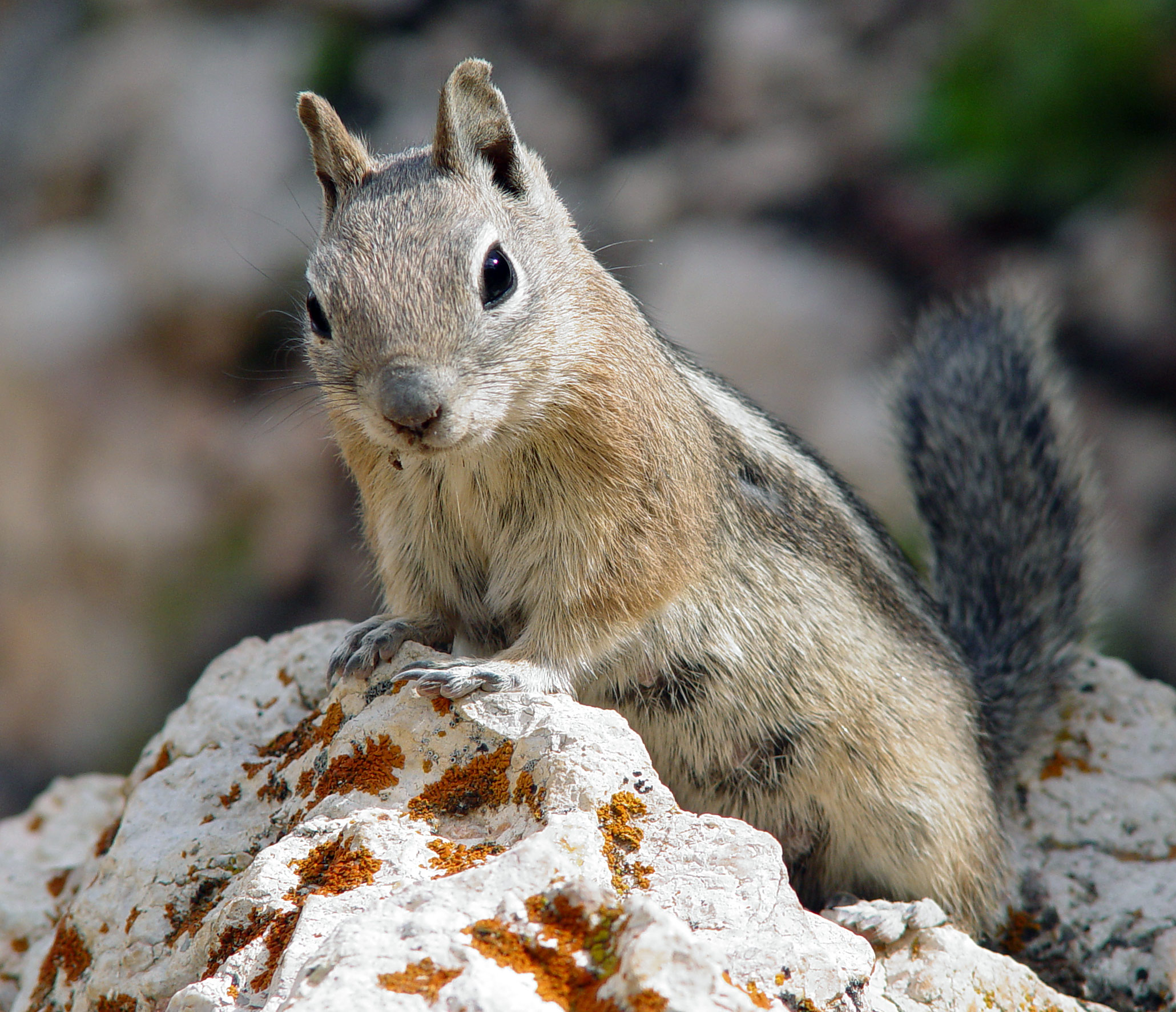
Golden mantled ground squirrel, Western North America. Prefers to eat mushrooms and truffles.
Golden mantled ground squirrel, Western North America. Prefers to eat mushrooms and truffles. Creative Commons

What happens to the forest ecosystem when it is clear cut?

The forest is a complex and delicate ecosystem.  When the forest is destroyed, we should not be surprised to learn that this ecosystem is destroyed.  Here are a few of the consequences of clear-cutting a forest:

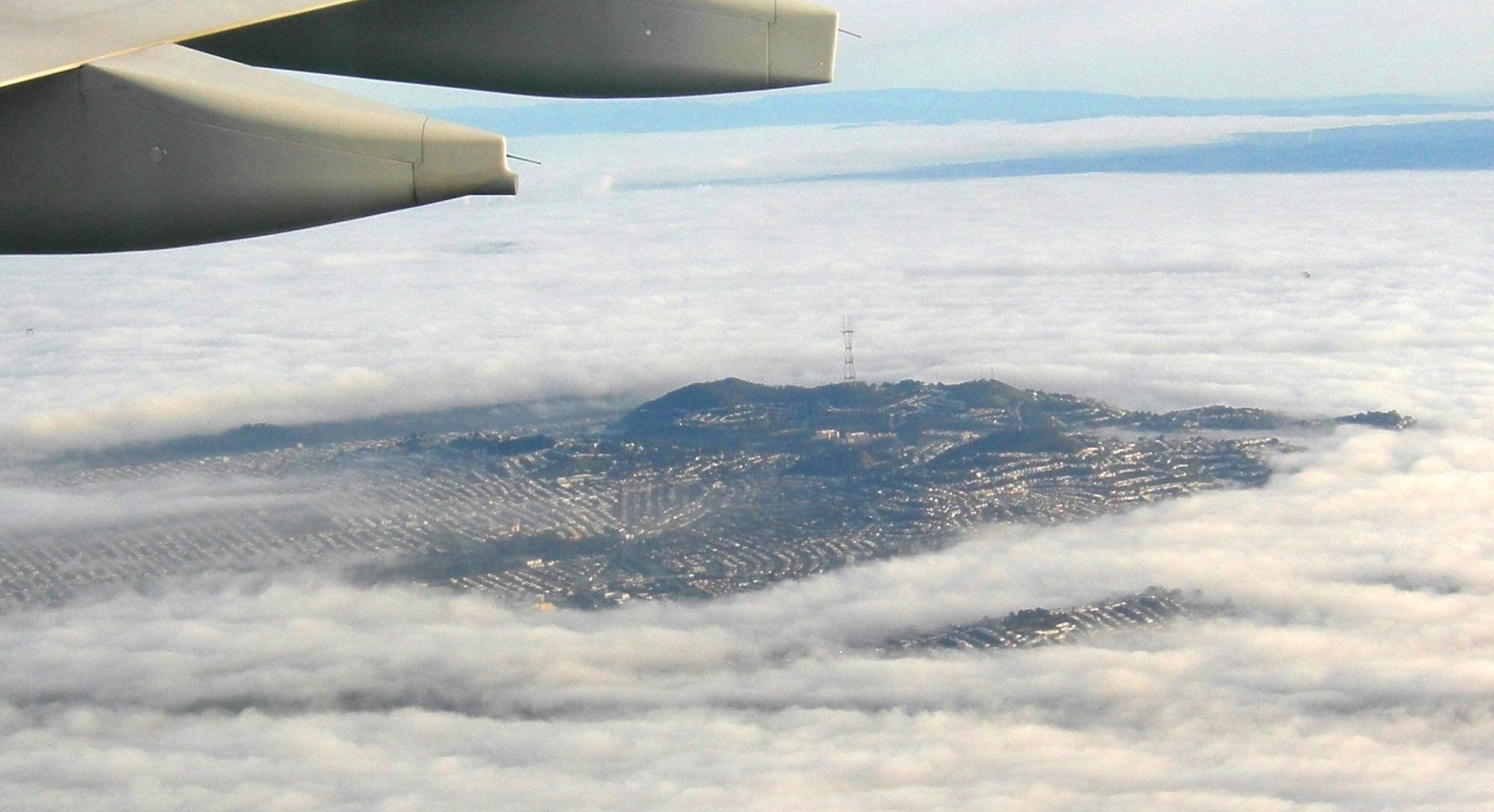
The Bay Area is often blanketed in fog. Courtesy Save Mount Sutro Forest.
  • The forest precipitates fog and the shade provided by the canopy retains that moisture on the forest floor. When we destroy the forest, we lose that source of moisture.  The ground dries out in the sunshine.  The fruiting bodies of fungi—mushrooms and truffles—require moisture to bloom and they die quickly in the absence of moisture.
  • The herbicide (Garlon) used to prevent the trees from resprouting is known to damage the mycorrhizal fungi that are essential to forest health. The herbicide that is applied to the tree stump immediately after the tree is destroyed, travels though the cambium layer of the tree down through the roots of the tree.  The tree is killed by killing its roots.  Mycorrhizal fungi are essentially extensions of the root system.  When roots are killed, so are the mycorrhizal fungi.  In the absence of mycorrhizal fungi, the survival of “replacement” plants is compromised.
  • The loss of fruiting bodies as food for animals reduces animal populations and the contributions they make to forest health.
  • Glyphosate is the herbicide most commonly used to foliar spray non-native vegetation that colonizes the unshaded ground after a clear cut. Glyphosate was originally developed as an anti-bacterial agent.  Glyphosate kills bacteria in the soil (and in the mammalian gut, 4) that are playing a role in recycling nutrients to plants (and in digesting our food). (3)

Prescribed burning is another land management method used to eradicate “invasive” plants.  In addition to polluting the air, releasing carbon into the atmosphere, and increasing the risk of wildfire, prescribed burns also damage the soil:  “Prescribed burning in California pine forest decreased the ectomycorrhizal biomass by almost 90 percent in the upper organic layers of the soil as compared to unburned sites.  A decrease of that magnitude in the mycorrhizal energy source of the fungi would affect not only fungal fruiting but also fungal populations.”  (1)

In the absence of fungi and bacteria, the soil is essentially sterile and is no longer capable of contributing to the health of a new generation of plants and animals to replace the forest.

Eucalyptus forest in California and Australia

Trees, Truffles, and Beasts was written by academic foresters who are primarily concerned about the destructive consequences of destroying native forests and replacing them with timber plantations, often of another, faster growing species.  Ironically, in the case of old growth eucalyptus forests in Australia, the choice of replacement species is often Monterey pines.  Since some of the species of mycorrhizal fungi are specific to certain species or types of trees, this change of species is not successful without the inoculation of appropriate species of fungi.  For example, some of the mycorrhizal fungi that grow on the roots of conifers are not found on eucalyptus species.

Before writing this article, we corresponded with the authors of Trees, Truffles, and Beasts to confirm that fungi are found in the eucalyptus forests of California.  Since eucalyptus was brought to California as seeds, rather than potted plants, we needed confirmation that our eucalyptus forests are also enjoying the benefits of mycorrhizal fungi.  We are grateful that the authors replied.  They report that eucalyptus forests in California are populated with fungi, including some species that are native to Australia, which implies that some eucalyptus were imported from Australia with native soil.  Therefore, we can assure our readers that our description of how the forest functions applies to the eucalyptus forest in California, as well as in Australia.

Predicting the consequences of destroying our urban forest

Plans to destroy non-native forests on 2,000 acres of public land in the East Bay will result in a dry, barren landscape populated primarily by non-native annual grasses.  Fantasies that the forest will be magically replaced by a landscape of native plants and trees are just that…fantasies.  Every reputable source of information about the planned project predicts this outcome, from the US Forest Service to the Audubon Society and the California Native Plant Society.  There are many reasons why this outcome is predictable:

  • UC Berkeley's "Vegetation Management"
    UC Berkeley’s “Vegetation Management”

    The ground will be covered by as much as 24 inches of wood mulch, which will retard the germination of any plant. The plants most likely to penetrate this physical barrier are those that are most competitive, such as broom and other non-native weeds considered “invasive.”

  • The moisture available to plants will be reduced by the loss of fog drip and shade provided by the tree canopy. Fog drip in eucalyptus and Monterey pine forests in the East Bay has been measured at 10 inches per year. (5) Young plants and trees require more water than established plants, so the water deficit will retard the growth of a new landscape.
  • The climate of the San Francisco Bay Area has changed in the 250 years since the arrival of Europeans. Plants that were native at that time are no longer competitive in the warmer, drier climate and an atmosphere higher in nitrates and carbon dioxide.  The rapidly changing climate is making the concept of “native” increasingly irrelevant.

And now we know that the damage that will be done to the soil and the forest floor by the destruction of our urban forest will further handicap the successful establishment of a new landscape.  Aside from the physical damage done by removing hundreds of thousands of trees with heavy equipment, the herbicides used to kill trees and plants considered undesirable by the perpetrators of this devastating project will sterilize the soil.  The resulting weed-dominated moonscape will probably recover in hundreds of years, although the eventual outcome is impossible to predict in our rapidly changing environment.  Neither the supporters of this project nor its critics will live to see the recovery.


  1. Chris Maser, Andrew W. Claridge, James M. Trappe, Trees, Truffles, and Beasts, Rutgers University Press, 2008
  2. https://en.wikipedia.org/wiki/Mycorrhizal_fungi_and_soil_carbon_storage
  3. http://www.nytimes.com/2013/09/20/business/misgivings-about-how-a-weed-killer-affects-the-soil.html?ref=todayspaper&_r=1
  4. http://www.fooddemocracynow.org/blog/2015/apr/13
  5. Harold Gilliam, Weather of the San Francisco Bay Region, UC Press, 2002


“Beyond Words: What animals think and feel”

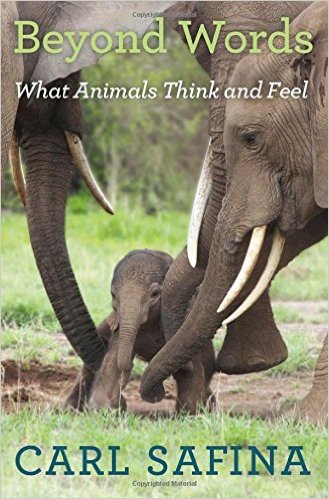
Beyond WordsBeyond Words, by Carl Safina, was written by an animal lover for other animal lovers.  His mission is to convince his readers that animals are capable of the full range of emotions experienced by humans and that their communities are often as complex and varied as human communities.  His hope is that humans who understand the feelings and capabilities of animals, will therefore treat them with the respect they deserve.  It is a worthy cause and not hard to sell to this animal lover.

Inadequate scientific inquiry

Safina begins by lamenting the sorry state of scientific inquiry into animal behavior.  He speculates that the dominance of humans in the environment fostered a condescending attitude toward animals that prevented scientific inquiry of the animal kingdom until very recently.  Animals were perceived by humans as utilitarian objects to be exploited for food and transport or destroyed if perceived as a threat or a competitor.  This attitude is still prevalent in human societies.

One of the first studies of animal behavior was Jane Goodall’s long association with a community of chimpanzees.  When she wrote papers about her observations, she faced extreme resistance to their publication.  One of the most common reactions of the academic scientists to studies of animal behavior has been to dismiss them as anthropomorphic projections of human feelings and motivation.

Observing animals

The lack of respect for animal studies among academic scientists has created opportunities for many volunteer and non-scientist observers to break new ground as reporters of animal behavior.  Safina visited several communities of animal observers and shares their experiences with us:

  • He watches elephants in Africa as they go about their business under the watchful eyes of park rangers trying to protect them from poachers.
  • He joins teams of volunteer observers of wolves in Yellowstone National Park.
  • He follows orcas (AKA killer whales) with researchers in Puget Sound in Washington State.

Emotional lives of elephants

Unfortunately, elephant populations in Africa are being decimated by poachers because of the value of ivory.  Observers of elephant communities therefore have many opportunities to witness the grief that accompanies every loss of a beloved member of the community.  Here are a few observations of the behavior of elephants in response to the loss of a comrade:

  • “The elephants cautiously extend their trunks, touching the body gently, as if obtaining information. They run their trunk tips along the lower jaw and the tusks and the teeth:  the parts that would have been most familiar in life and most touched during greetings…” (1)
  • “Elephants sometimes cover dead elephants with soil and vegetation, making them, I think, the only other animals who perform simple burials…When sport hunters shot a large male elephant, his companions surrounded his carcass. The hunters returned hours later to find that the others had not only covered their dead comrade with soil and leaves but had plastered his large head wound with mud.” (1)
  • “…a matriarch named Eleanor, ailing, collapsed. Another matriarch, Grace, rapidly approached her with facial glands streaming from emotion.  Grace lifted Eleanor back fully onto her feet.  But Eleanor soon collapsed again.  Grace appeared very stressed, and continued trying to lift Eleanor.  No success.  Grace stayed with Eleanor as night fell.  During the night, Eleanor died.  The next day an elephant named Maui started rocking Eleanor’s body with her foot.  During the third day, Eleanor’s body was attended by her own family, by another family, and by Eleanor’s closest friend…A week after her death, Eleanor’s family returned and spent half an hour with her.” (1)
  • “When a female named Tonie gave birth to a stillborn baby, she stayed with her dead child for four days, alone in the heat, guarding it from the lions who wanted it.” (1)

A full range of human emotions are implicit in these incidents, such as loyalty to one’s friends and family and maternal love.

Social structure of animal communities

There is as much variety in the structure of animal communities as there is in human communities.  Elephant communities are matriarchal.  The oldest female is the leader of the group and the group is composed only of females and their offspring.  When male elephants reach maturity they wander on their own, interacting with matriarchal families only when the females are in heat.  Leadership is conferred on the oldest female because she is the most experienced member of the group.  She is therefore in the best position to make important decisions about where the group will go for food and how they will respond to threats from their predators.  The quality of that leadership can vary based on the personal attributes of the oldest female, but seniority is the only apparent criterion for that role.

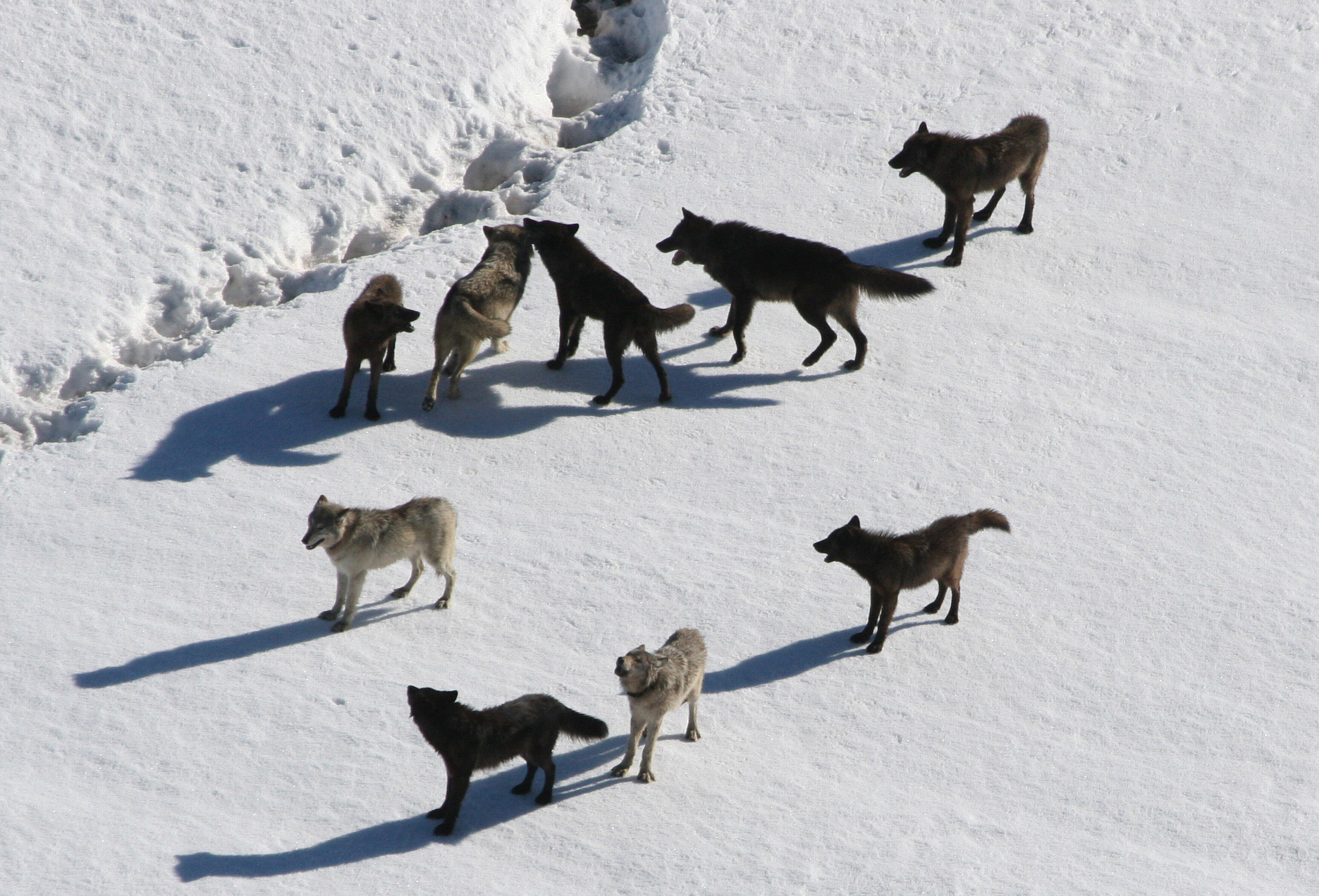
Pack of Gray Wolves, Yellowstone National Park

In contrast, the leadership of the wolf pack is the male and female alpha pair.  That status is achieved by virtue of physical strength and dominance; in some cases leadership is more magnanimous than it is dominant.  The male and female young of the alpha pair are also members of the pack, but personalities or loss of key members can splinter the pack.  There is intense competition for hunting territory and mates between packs and sometimes within packs.  This competition is often physical, and results in the death of members of the pack.  Safina tells us that as many wolves are killed by other wolves, as are killed by humans with guns.

The wolf pack resembles human families and communities.  Sibling rivalry is common.  Tribal competition between packs resembles human secular and sectarian wars.  The volunteer observers of wolves in Yellowstone Park are extremely dedicated to their task.  They explain their obsession by pointing out that the lives of wolves are much like watching a soap opera.

Individuality

While it is possible to generalize about the behavior and social structure of animal communities, we must also keep in mind that there is much individual variation.  Just as humans have distinctly different personalities, so too do animals.  Safina often turns to his dogs to illustrate this variability within species and we can do the same.  Our family has lived with nine dogs, usually in pairs.  No two dogs were exactly alike.  One was as shy as another was gregarious even though they were the same breed.  Some were obsessed with catching balls; others were completely uninterested in them.  Some were very attached and responsive to their human guardians, while others were independent.

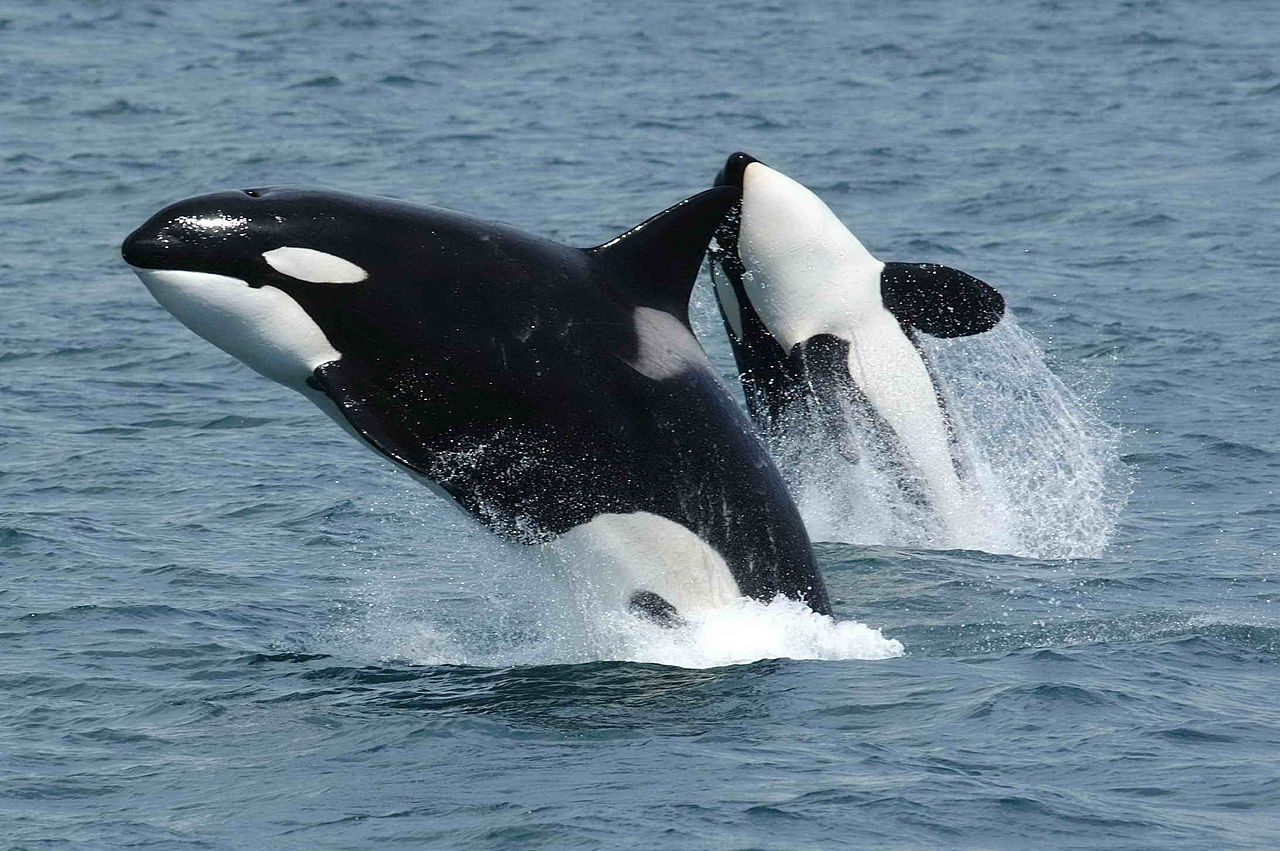
In addition to the variability of personalities in animal communities, their social structures may vary just as human societies vary.  Some orca pods stay close within a home range in Puget Sound and eat an exclusively fish diet.  Other orca pods travel long distances and eat exclusively other marine mammals such as seals.  Human societies vary widely in many ways, such as the range from extreme individualism of American society to a more communal society in places like Iceland.                                                                                                                                                                                                                                                                                                               Domestication

Safina tells us that our dog companions evolved from wolves.  Less shy members of wolf communities were willing to approach human settlements where they could often find discarded food.  In exchange, dogs alerted humans to the presence of predators.  This partnership developed over thousands of years.  While the dogs were domesticated by that relationship, they changed physically to conform to the requirements of their new, less active life, becoming cuddlier to accommodate the preferences of humans.

Likewise, humans have been domesticated by changes in their lifestyles.  Hunters and gatherers had to be much more observant about their surroundings than humans in agricultural communities.  Hunters were always wary that they could easily be the hunted.  Gatherers were always looking for edible plants; knowing the difference between edible and inedible plants was a matter of life and death.  The territorial range of agricultural communities is small compared to that of foraging communities.

Bad news for animals

Animals are often the losers when human populations grow and their communities expand into animal habitats.  In the case of elephants, the value of ivory is threatening their future in Africa.  In the case of wolves, their appetite for domesticated animals makes them targets of ranchers.  When endangered status of wolves is removed, wolves are quickly killed when they stray out of national park boundaries.  Wolf packs must travel great distances to find the prey they need and the park boundary is only an abstraction that does not restrain their movements.

Orcas in Puget Sound

The threats to orcas in Puget Sound are many and are associated with many anthropogenic changes in the environment.  Agricultural runoff from industrial sized feed lots and pesticide applications pollute the water.  Pesticides are also used to kill marsh grasses so that huge clam beds can be installed on the shores of Puget Sound.  Human sewage is sometimes inadequately treated before it reaches the sound.  All of these sources of pollution are a factor in declining populations of salmon.

Salmon populations have also declined because dams have blocked access to their spawning streams and the streams they used to reach them have been channeled and diverted into culverts.  Overfishing is another factor in declining salmon populations.  Global warming has increased water temperatures in oceans, which has disrupted the entire ocean food web.

All this results in less food for orcas.  Consequently, orca reproduction has declined significantly and infant mortality of orcas has soared.  The future of orcas in Puget Sound is very much in doubt.

Food for thought

Carl Safina has written an excellent book that we recommend to our readers without reservation.  We guarantee that it will warm your heart to read about animal communities that share both the positive and the negative aspects of human societies.  We hope it will make you reflect, as it did us, about the ways in which the activities of humans intrude on the lives of animals.  Thank you, Mr. Safina, for giving us this opportunity to learn more about our animal friends.


(1) Carl Safina, Beyond Words: What animals think and feel, Henry Holt & Co., 2015

Bees are harmed by nativism

As our readers know, there are many reasons why we are opposed to the projects that are billed as native plant “restorations” but, in fact, often do a great deal of damage to the environment.  Of the many bogus justifications for these harmful projects, one of the most patently false is that the projects benefit wildlife.  Today, we are publishing a letter from one of our readers about the many ways in which nativism is harmful to bees.

“I thought of you, and your ongoing fight against short-sighted nativism, yesterday as I was doing research for a project on bees. I was interviewing a second-generation beekeeper, who’s working closely with geneticists and entomologists to develop hardy strains of bees, and he mentioned two things I thought might help to highlight how the actions of groups like the NAP may actually be contributing to colony collapse:

  1. The chemicals they use. Of course, it’s been broadly publicized that glyphosate and neonicotinoids are harmful to bees, and the AG industry folks (and possibly the native plant folks?) counter that they are far less deadly to honey bees than other types of herbicides and pesticides…but the beekeeper I spoke with indicated that saying something is “less deadly” to bees misses the harm these chemicals do to colonies by weakening their ability to fight viruses, mites, etc. Bees foraging in chemical-laden fields bring residues of these compounds back to the hive, to the queen, which he likened to “placing a pregnant woman in a refinery.” The result is a dramatically shortened lifespan for the queen and a colony that’s less strong and healthy, with lower resistance to common diseases. So the chemical may not kill the bees outright, but it still contributes to their death in the end.
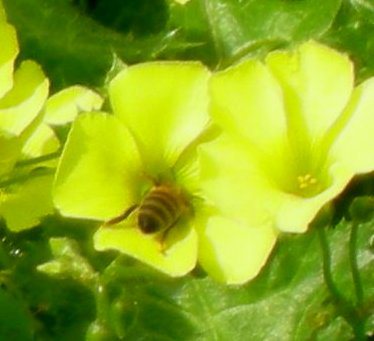
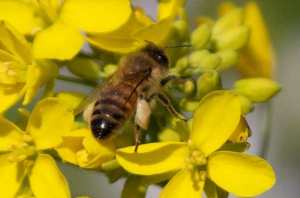
  2. Honeybee on oxalis flower, another non-native plant being eradicated with herbicide.
    Honeybee on oxalis flower, another non-native plant being eradicated with herbicide.

    Honey bees are not native to America; they’re European. And the push to eradicate non-native “weeds” has decimated their forage…essentially starving them out. He cited the case of yellow star thistle, which, he said, may have come over from Europe in the wool of sheep. Highly invasive, it used to be everywhere in CA, and it was an important source of nectar and pollen for honeybees. Then, a few decades ago, the government introduced weevils to control the plant, in the process depriving the bees of a vital food source. Beekeepers have had to range further and further afield to find areas with adequate forage for their bees.

Bumblebee on Cotoneaster, Albany Bulb. Another target for eradication.

Of course, big agriculture (subsidized by the government) has contributed to the problem as well, by plowing up land that used to grow clover and alfalfa in favor of corn (for ethanol) and soybeans. But, for me anyway, this information about non-native bees needing non-native plants was a revelation…. a real ‘a-ha’ moment that I thought could be useful in waking up well-meaning folks who may equate “native plants” with “good for bees.”

Oh, and the beekeeper also told me that one third of the food Americans eat is pollinated by honey bees….are we willing to reduce our food supply by 1/3 for the sake of “restoring” a landscape native to a time when agriculture was not prominent in California?”

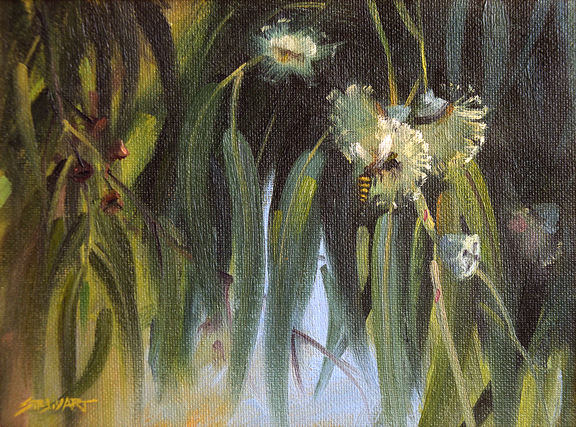
The value of yellow star-thistle to bees is but one example of the value of non-native plants to insects and other animals.  In the case of bees, the eradication of hundreds of thousands of eucalyptus trees all over California has deprived bees and hummingbirds of one of the few sources of winter nectar in California.  Eucalyptus blooms from December to May, at a time when there are few other sources of nectar.  HERE is an article about the loss of this important resource to bee keepers in California.

Eucalyptus and bee. Painting by Brian Stewart.

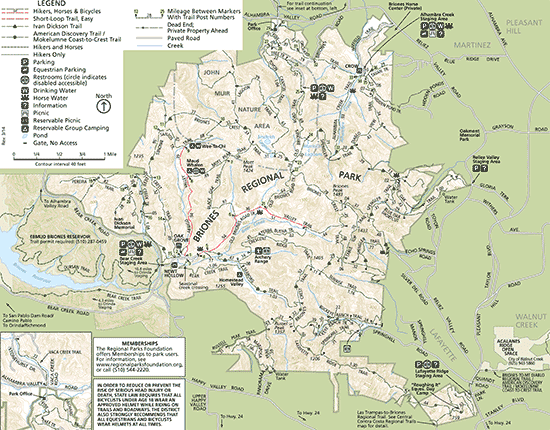
Yellow star-thistle is one of many eradication targets of nativists in California.  East Bay Regional Park District (EBRPD) has been trying to eradicate it in their parks for decades.  We recently learned that EBRPD was planning an aerial spraying of herbicide from a helicopter on 200 acres of yellow star thistle in Briones Park.   This was a particularly controversial herbicide application for several reasons:

  • Briones Park is adjacent to the watershed surrounding Briones Reservoir, which stores the drinking water of surrounding communities.briones_450w_32c
  • The herbicide EBRPD was planning to use was Milestone, which is known to be very mobile and persistent in the soil. For that reason, the State of New York refused to approve the sale of Milestone because they were concerned about contamination of ground water.
  • Aerial spraying of pesticides by helicopter is the most dangerous application method because it greatly increases the chances of drift into non-target areas, including residential areas.

Our team of collaborators jumped into action to prevent this spraying from being done.  We organized a telephone and email campaign directed to responsible staff and Board members at both East Bay Regional Park District and East Bay Municipal Water District, which is responsible for drinking water in the East Bay.

I am pleased to report that EBRPD announced within a few days of our campaign that they were permanently cancelling this aerial application of herbicides at Briones Park.  They will continue to try to eradicate yellow star thistle using other methods.

Lessons learned

When pesticides are used in native plant “restorations,” the claim that such projects are beneficial seem utterly dishonest.  Beneficial to whom?  Certainly not the animals and humans who are exposed to these toxic chemicals.

If the public does not want public land managers to use pesticides on our public lands, we must object when they do.  If we don’t object, we get the land management we deserve.  You will be alerted to such opportunities to participate in these campaigns to influence land managers by “liking” Facebook pages:  “Death of a Million Trees” and “Save the East Bay Hills.”

It is a team effort to learn about what is happening in our public lands and to participate in the decisions that affect our communities.  We are therefore grateful to the reader who shared her conversation with a beekeeper.  We encourage others to share their knowledge so that we can be as effective as possible.  Knowledge is power!

Mopping up the last load of Sierra Club propaganda

This is the last in a series of rebuttals to the Sierra Club’s “pre-buttal” to a letter from a Sierra Club member to members of the San Francisco Bay Chapter of the Sierra Club about the Club’s support for deforestation and pesticide use on our public lands.

The truth about how much herbicide will be used

Sierra Club misrepresents volume of herbicide use:  “If used, herbicide would be applied in minute quantities under strict environmental controls.”  (1)

Courtesy Hills Conservation Network

East Bay Regional Park District (EBPRD) informs us in the Draft Environmental Impact Statement (DEIS) for the FEMA project in the East Bay Hills that it intends to use 2,250 gallons of herbicide on its project acres to destroy non-native vegetation and prevent the trees they destroy from resprouting.  You can see the detailed table of their intended herbicide use for yourself by looking at the DEIS. (2)  On what planet would 2,250 gallons be called “minute quantities?”

EBRPD intentions were to “thin” non-native trees, not destroy them all.  The Sierra Club has sued EBRPD to force them to destroy ALL non-native trees on their project acres.  If the Sierra Club lawsuit is successful, EBRPD will be forced to destroy MORE trees than it wanted to destroy.  That means it will be forced to use EVEN MORE herbicide than it intended to use, i.e., MORE than 2,250 gallons.

EBRPD is only ONE of the three public land owners that are participating in the FEMA project.  The other two public land owners (UC Berkeley and City of Oakland) intend to destroy ALL non-native trees on their project acres.  That means they will have to use EVEN MORE herbicide than EBRPD intended to use per acre of project area.

Sierra Club fabricates an argument we have not made:  “Comparing this use of herbicide to the regular broadcast spraying of farmland elsewhere is a misrepresentation of fact.” (1)

This is a red herring, intended to confuse you with an argument that no one has made in opposition to this project.  We have not likened pesticides used for these projects with agricultural use of pesticides.  We aren’t being given a choice between agricultural pesticides and pesticides in our parks.  The Sierra Club is asking us to accept additional pesticides in our parks on top of the agricultural pesticides we are already exposed to and over which we have no control.  Since many pesticides accumulate in our bodies over our lifetimes, additional pesticide exposure results in greater toxicity and potential for damage to our health.

Horticultural fiction

Sierra Club fantasizes about the post-project landscape: “Concerns about not planting trees to replace those being removed miss the mark. Replanting is not necessary. (1)

Knowledgeable organizations do not share the Sierra Club’s fantasy that native trees will magically emerge from 2 feet of eucalyptus wood chip mulch to colonize the bare ground.  Here is a partial list of the environmental consultants, governmental agencies, and environmental organizations that have refuted this fiction:

  • URS Corporation is the environmental consultant initially hired to complete the environment impact review of the FEMA projects. Their report said:  “However, we question the assumption that the types of vegetation recolonizing the area would be native.  Based on conditions observed during site visits in April 2009, current understory species such as English ivy, acacia, vinca sp., French broom, and Himalayan blackberry would likely be the first to recover and recolonize newly disturbed areas once the eucalyptus removal is complete.”
  • The US Forest Service evaluated the FEMA projects. This is their prediction of the post-project landscape: “a combination of native and non-native herbaceous and chaparral communities.”
  • The California Native Plant Society predicted the post-project landscape in its written public comment on the Draft Environmental Impact Statement (DEIS) with this rhetorical question: “What mechanism is being instituted by FEMA in this DEIS to guarantee a commitment of money and personnel for management of greatly increased acreages of newly created annual weedy grassland?”
  • The Audubon Society predicted the post-project landscape in its written public comment on the DEIS: “There is no support for the conclusion that native vegetation will return on its own.  This plan may not result in an increase in native trees and plants…Heavy mulching will delay or prevent the growth of native species.”
Trees were destroyed here by UC Berkeley over 10 years ago. The landscape is now non-native annual grasses. This is the typical outcome of tree removals on sunny hills without a water source.

Sierra Club and Claremont Canyon Conservancy (CCC) repeatedly refer to Site 29 on Claremont Blvd as a model for the FEMA projects.  They fail to acknowledge that Site 29 is not representative of most FEMA project areas because CCC planted native trees (primarily redwoods) on Site 29 and the microclimate of Site 29 is not typical of other project areas.  Site 29 is a riparian corridor—there is a creek running through it—so there is more available water than in most project areas.  It is also protected from wind and sun by hills on north and south sides of the site.  CCC has not made a commitment to plant native trees on 2,000 acres of the FEMA project areas and even if it did, it could not expect the same results in radically different microclimates such as sunny, windy ridge lines with no available water source.

Fundamentals of carbon storage

Sierra Club does not understand the fundamentals of carbon storage:  “Carbon sequestering and erosion control will not be reduced by removing eucalyptus trees… Indeed, reducing the fire danger by removing the eucalyptus will do much to prevent the release of tons of carbon that occurs during a wildfire. [x]” (1)

Sierra Club continues with the fiction that non-native trees will burn while native trees will not.  There is no evidence behind that story, and much evidence to the contrary.  The numerous wildfires throughout California each summer demonstrate that native trees and shrubs are extremely flammable—easily ignited and burning vigorously once ignited.  Native trees, shrubs, and grasses also release their stored carbon when they burn.  The NSF article cited by the Sierra Club in support of its bogus statement does not suggest that prospectively destroying forests is a means of preventing carbon loss.

Destroying eucalyptus trees will release hundreds of thousands of tons of carbon stored in those trees. That’s a simple, inarguable fact.  There are no plans to replace the eucalyptus with “native trees.”  A small portion of the carbon released by eucalyptus destruction may be recaptured by the grasses and shrubs that will grow in place of the eucalyptus, but the net loss of stored carbon to the atmosphere from the eucalyptus is huge and permanent.  Further, the eucalyptus would have continued to store even more carbon if left in place.  That future carbon sequestration is also lost.

The DEIS for the FEMA-funded projects tries to minimize the loss of stored carbon from destruction of eucalyptus by quantifying only carbon loss from the destruction of tree trunks, ignoring leaves, branches, roots, understory, forest floor litter, and soil.  But even they acknowledge, “…the planned growth of oak and bay woodlands and successional grassland containing shrub islands would not sequester as much carbon as the larger eucalyptus and pines and the denser coastal scrub that would be removed.”  (DEIS 5.6-11)

Killing habitat needed by wildlife

Sierra Club does not know who lives in our urban landscapes:  “Native landscapes provide habitat for much more diverse ecosystems.” (1)

There are many studies that find that our non-native landscape provides valuable habitat and no studies that say otherwise:

  • Most California natives in cultivation are of no more butterfly interest than nonnatives, and most of the best butterfly flowers in our area are exotic.” (3)
  • “[T]he science does not support the supposition that native plantings are required for biodiversity…it is clear that an automatic preference for native trees when planning in urban areas is not a science-based policy.” (4)
  • “Three types of trees were used most frequently by roosting monarchs [in California]: eucalyptus (75% of the habitats primarily Eucalyptus globulus), pine (20% of the habitats primarily Pinus radiata), and cypress (16% of the habitats primarily Cupressus macrocarpa)” (5)
  • “In the first half of the 20th century, the Anna’s Hummingbird bred only in northern Baja California and southern California. The planting of exotic flowering trees provided nectar and nesting sites, and allowed the hummingbird to greatly expand its breeding range…Anna’s Hummingbird populations increased by almost 2% per year between 1966 and 2010, according to the North American Breeding Bird Survey…Thanks to widespread backyard feeders and introduced trees such as eucalyptus, it now occurs in healthy numbers all the way to Vancouver, Canada.” (6)
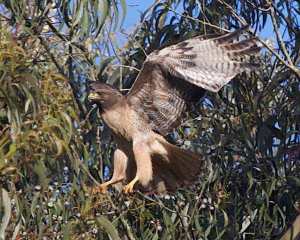
  • Red-tailed hawk nesting in eucalyptus. Courtesy urbanwildness.org
    Red-tailed hawk nesting in eucalyptus. Courtesy urbanwildness.org

    “Fourteen of 27 nests in 1994 and 38 of 58 nests in 1995 were in exotic trees, predominantly eucalyptus. Nesting and fledging success were higher in exotic trees than in native trees in both years, owing in part to greater stability and protective cover.  Most nest trees in upland areas were exotics, and even in riparian habitats, where tall native cottonwoods and sycamores were available, Red-shouldered Hawks selected eucalyptus more often than expected based on availability.”  (7)

  • A study that compared species diversity and abundance of plants, invertebrates, amphibians, birds, and rodents in eucalyptus forest with oak-bay woodland in Berkeley, California reported this finding: “Species richness was nearly identical for understory plants, leaf-litter invertebrates, amphibians and birds; only rodents had significantly fewer species in eucalypt sites.  Species diversity patterns…were qualitatively identical to those for species richness, except for leaf-litter invertebrates, which were significantly more diverse in eucalypt sites during the spring.” (8)

We could provide many more citations from studies that consistently find that our existing non-native landscape is essential to wildlife and that destroying it will be harmful to wildlife, particularly considering the enormous amount of herbicide that will be used.  We ask this common-sense, rhetorical question, “How could destroying most of our landscape provide a more diverse ecosystem?”  It defies logic.

Environmentalism gone awry

If the Sierra Club would replace a few of its lawyers with a few scientists, perhaps we would not be having this debate.  Environmentalism has gone astray because it is not knowledgable about some basic scientific issues, such as carbon storage, the toxicity of herbicides, and the habitat needed by our wildlife.  Climate change is the environmental issue of our time.  If an environmental organization does not understand the fundamentals of carbon storage it is not capable of doing its job.  The Sierra Club must improve its knowledge of the Bay Area environment or it will fade into irrelevance in the struggle to protect that environment.


(1) http://sierraclub.org/san-francisco-bay/hillsfacts

(2) See Table 2.1 in Appendix F: http://www.fema.gov/media-library-data/1416861356241-0d76d1d9da1fa83521e82acf903ec866/Final%20EIS%20Appendices%20A-F_508.pdf

(3) Arthur Shapiro, Field Guide to Butterflies of the San Francisco Bay and Sacramento Valley Regions, University of California Press, 2007

(4) Linda Chalker-Scott, “Nonnative, Noninvasive Woody Species Can Enhance Urban Landscape Biodiversity,” Arboriculture & Urban Forestry, 2015, 41(4): 173-186

(5) Dennis Frey and Andrew Schaffner, “Spatial and Temporal Pattern of Monarch Overwintering Abundance in Western North America,” in The Monarch Butterfly Biology and Conservation, Cornell University Press, 2004.

(6) Cornell Ornithology Laboratory https://www.allaboutbirds.org/guide/annas_hummingbird/id

(7) Stephen Rottenborn, “Nest-Site selection and reproductive success of urban red-shouldered hawks in Central California,” J. Raptor Research, 34(1):18-25

(8) Dov Sax, “Equal diversity in disparate species assemblages:  a comparison of native and exotic woodlands in California,” Global Ecology and Biogeography, 11, 49-52, 2002.

Irrational fears threaten bats and trees

The Secret Lives of Bats is appropriately named because our knowledge of bats is limited by the fact that they are active at night while we sleep and their activities are shrouded by darkness.  The author of this engaging little book, Merlin Tuttle, devoted his life, from the time he was a teenager, to the study and conservation of bats.  Although he learned a great deal about bats in the 60 years he has studied them, it is his accomplishments in bat conservation that are most inspiring and impressive.

A few bat facts

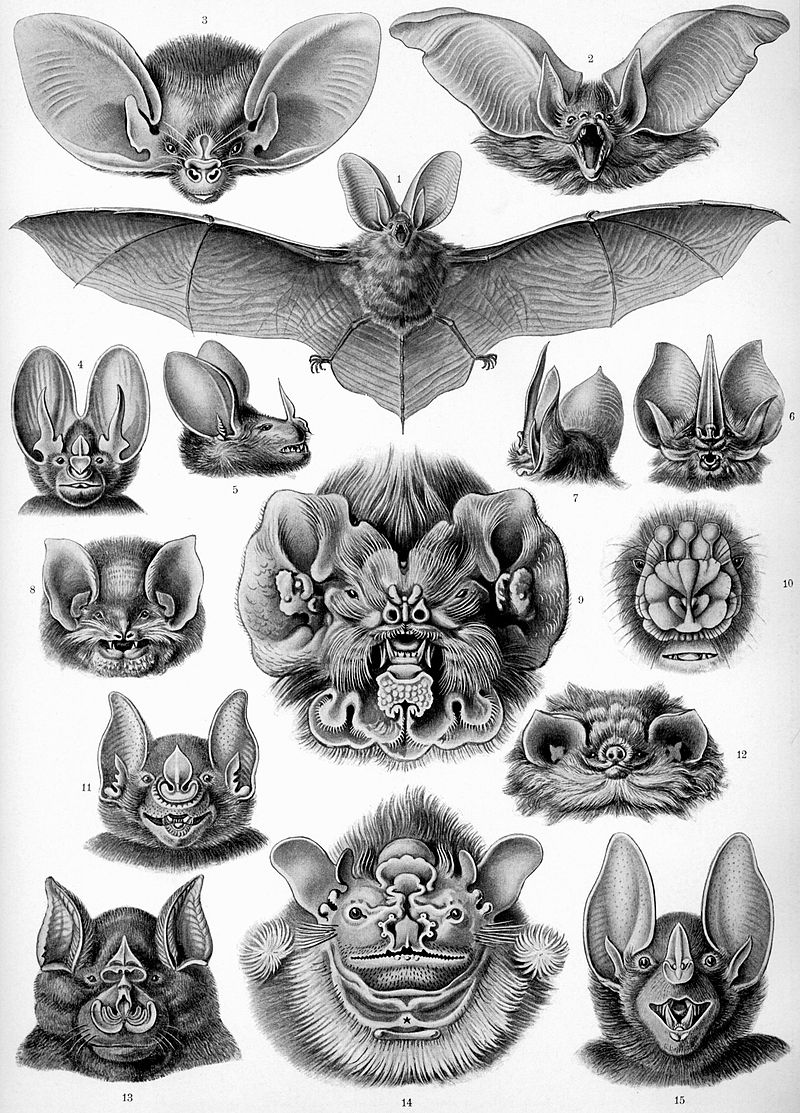
"Chiroptera" from Ernst Haeckel's Kunstformen der Natur, 1904
“Chiroptera” from Ernst Haeckel’s Kunstformen der Natur, 1904

There are nearly 1,300 species of bats and they are distributed all over the world, with the exception of Polar Regions.  We can’t describe the entire range of variation in the characteristics of such a diverse order (Chiroptera), so we will describe them only in general terms:

  • Bats are the only flying mammal. Their pups are born live and are generally fed breast milk by their mothers.
  • Many bat species live in caves and migrate from cold caves where they hibernate in winter to warmer caves where their pups are born.
  • Seventy percent of bat species eat insects. Bats in the US are insectivores.  Most remaining bat species eat fruit and live in tropical regions.  There are three bat species, called vampire bats that eat exclusively blood.   There are also a few species of carnivorous bats such as those that eat fish or frogs.
  • Many bat species live 20 to 30 years.
  • Most bat species use echolocation to find their prey in the darkness. See a video of a bat finding a moth, using echolocation HERE.

Local bat facts

There are 17 bat species in coastal California.  A study of foraging bats in 22 of San Francisco’s municipal parks found 4 species of insectivore bats.  The amount of forest edge and distance to water were the factors best explaining species richness and foraging activity.  The study found no correlation between bat foraging and the percent of native of plants, implying that there is no correlation between insect populations and native plants.

Why are bats important?

Insect-eating bats reduce insect populations, which reduces agricultural pests and disease-carrying mosquito populations.  A study in Arizona and New Mexico found that crop pests made up to two-thirds of free-tailed bats’ diets.  Another study found free-tailed bats feasting on migrating moths in Texas thousands of feet aboveground.  Tuttle estimates that “a single bat easily can consume more than 20 moths in a night, each carrying 500 to 1,000 eggs that otherwise would be laid on crops.  A density of 5,000 to 10,000 caterpillars per acre of cotton exceeds the threshold for pesticides.  Yet 20 moths can lay from 10,000 to 20,000 eggs.  If even half hatched to become caterpillars, they still could force a farmer to spray an acre of crop.”  (1)  Reduced populations of crop pests means fewer pesticides, which reduces farmers’ costs and toxicity exposure to consumers.

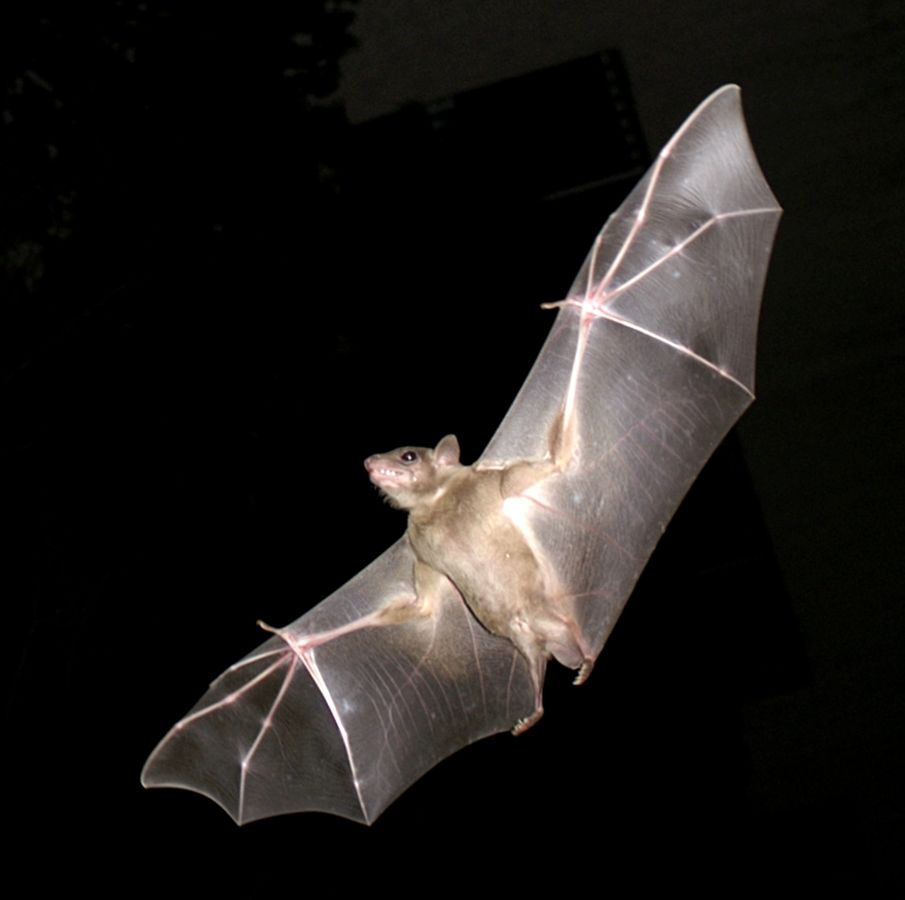
Common fruit bat. This photo makes it clear that the wings of a bat are also its hands. Creative Commons

Fruit-eating bats are important pollinators and dispersers of seeds.  There are some species of plants that can only be pollinated by bats because of the shape of the flower and the fact that it blooms only at night.

Although birds are also dispersers of seeds, the germination success of the seeds they disperse is probably less than those dispersed by bats because most bird species poop while perched, unlike bats that usually poop while flying.  Seeds deposited on open ground are more likely to germinate than seeds deposited in the shade of tree canopy.  Therefore, bats probably play a vital role in the reforestation of fallow agricultural land.

Bad raps about bats

So, as useful as bats are, why are their colonies often threatened with destruction?

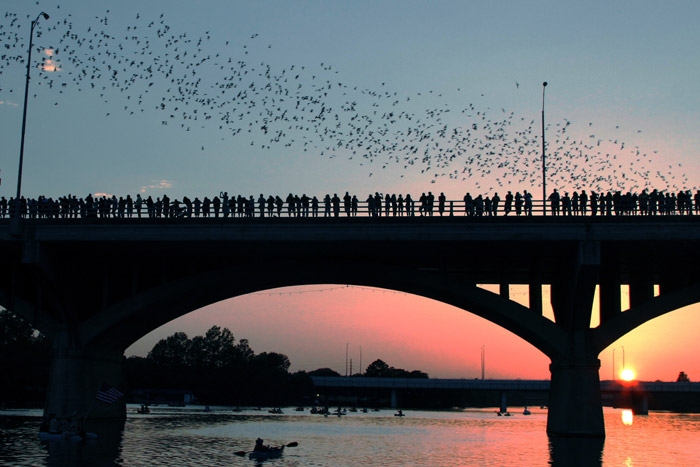
Bats departing from Congress Ave Bridge, Austin Texac
Bats departing from Congress Ave Bridge, Austin Texas

In the past, ignorance of the valuable functions performed by bats was the usual reason why their colonies are destroyed. The fact that the lives of bats are largely unseen contributes to that ignorance.  The colony of Brazilian free-tailed bats in Austin, Texas is a case in point.  In 1984, 1.5 million Brazilian free-tailed bats took up residence under a bridge in Austin, Texas.  “Newspaper headlines screamed, ‘Bat colonies sink teeth into city.’  They claimed that hundreds of thousands of rabid bats were invading and attacking the citizens of Austin.”  (1)

Tuttle was the curator of mammals at the Milwaukee Public Museum in Wisconsin at the time.  He had recently founded Bat Conservation International.  He quit his job and moved his fledging enterprise to Austin, where he was not warmly received.  But Tuttle is an engaging fellow and his knowledge of and fondness for bats is contagious.  Tuttle is equally modest, so he gives the bats full credit for convincing the public that bats need not be feared.  Within two months of his arrival, he turned the media coverage around.

The colony of Brazilian free-tailed bats in Austin is now internationally famous and a major tourist attraction.  Every evening at dusk, crowds form to witness the departure of the bats to forage for the evening.  My family has witnessed this moving event.  It is, indeed, a spectacle, on par with watching and listening to the raucous honking of huge flocks of Aleutian geese departing at dawn from their roosts for agricultural fields in Humboldt County.  Nature makes the best performance art.

Our federal Centers for Disease Control and Prevention informs us that we have little to fear from rabid bats:  “Most bats don’t have rabies. For example, even among bats submitted for rabies testing because they could be captured, were obviously weak or sick, or had been captured by a cat, only about 6% had rabies.”

Anthropogenic problems and bad solutions

There are only three species of vampire bats in tropical regions, but only one is considered a problem because it has a preference for mammals.  The population of this species of bat has grown because of the introduction of large herds of domesticated cattle.  The bats deplete the blood of the cattle and can spread diseases.  Reluctantly, Tuttle admits that these bat populations must be controlled.

So, his mission where vampire bats are causing problems for ranchers was to educate the ranchers about how to identify and find the bats.  There are other species of bats living in these areas that are performing valuable functions and unfortunately they roost in big colonies that are easy for the ranchers to find.  The ranchers were dynamiting or destroying these colonies because they were unable to distinguish them from the bats that were causing their problems.  Unfortunately, the vampire bats roost independently, hiding in trees.  So, they are more difficult for the ranchers to find.  With Tuttle’s help, tactics were devised to find the individually roosting vampire bats in order to reduce their populations.

New challenges for bats

Tuttle and his compatriots have accomplished a great deal in the past 60 years to increase our knowledge of bats and the important roles they play in nature.  He has convinced many people that it is not in their interests to destroy bat colonies on their properties.  However, he closes his book with two new challenges to bats:

  • Wind turbines are killing as many bats as they are birds. We must carefully study the design and placement of wind turbines to reduce this threat to our winged neighbors.
  • White-nosed syndrome is a fungus that has killed tens of thousands of bats in caves, particularly in the North East of the US. The fungus seems to live in a fairly narrow temperature range, so we are hopeful that it will not continue to spread rampantly.

The danger of misinformation

Millions of bats needlessly lost their lives because people were afraid of them.  Much progress has been made to inform the public of the value of bats.  Is this starting to sound familiar?  It should.  Millions of eucalyptus trees have been destroyed because people were needlessly afraid of them.  Please help us spread the word about the value of our trees.


(1) Merlin Tuttle, The Secret Lives of Bats, Houghton Mifflin Harcourt, 2015.  A favorable review of this book is also available in the New Yorker.

Alexander von Humboldt: “The Invention of Nature”

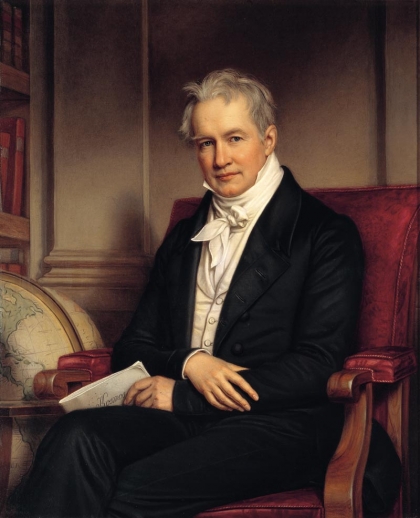
Portrait of Alexander von Humboldt by Joseph Stieler, 1843

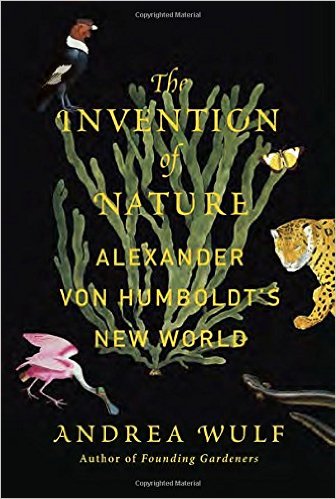
Alexander von Humboldt made so many contributions to science that we cannot do him justice here.  We will therefore focus on his study of nature and put his accomplishments in that area into the context of historical events and his personal views of those events.  We draw from Andrea Wulf’s The Invention of Nature in this article. (2)

Humboldt is considered the originator of the scientific concept of biogeography, “the study of the distribution of species and ecosystems in geographic space and through (geological) time.” (1)  In other words, biogeography attempts to explain why species are where they are.  It is therefore relevant to the mission of Million Trees, which is to make the case that species belong wherever they persist without human management and without regard to how they got there.

The journey begins

Alexander von Humboldt was born in 1769 in what was then Prussia and is now Germany.  Under the thumb of a domineering mother, he was required to spend most of his twenties as a mining inspector.  In that capacity, he mastered the science of geology that he put to good use throughout his long life.

At the age of 27, he was freed from his obligations to his mother by her death.  With the help of his inheritance he began his travels to satisfy his intense curiosity about the world.  He brought along on his journeys the tools of measurement that existed at that time.  He made detailed recordings of his measurements wherever he went and they were the basis of comparing the many places he visited.

His journey began in the mountains of Europe and they became the baseline of his comparisons throughout his journeys.  But his movements in Europe were hampered by the political situation.  Revolutionary France was expanding its empire with a series of wars in Europe that prevented him from visiting many places of interest to him.  After several failed attempts to join voyages to other places, the King of Spain granted Humboldt a passport to the Spanish colonies in South America to collect the flora and fauna of the New World.

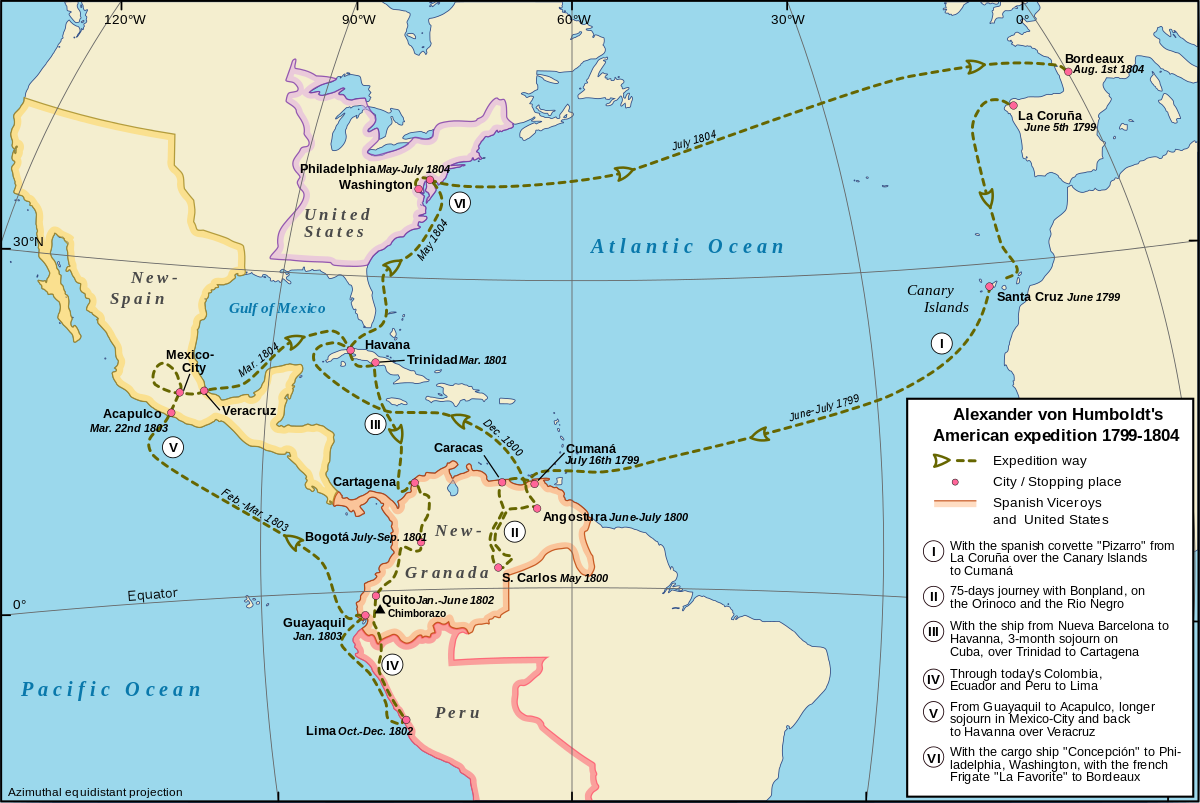
Humboldt set sail from Spain in June 1799, along with “a great collection of the latest instruments, ranging from telescopes and microscopes to a large pendulum clock and compasses—forty-two instruments in all, individually packed with protective velvet-lined boxes—along with vials for storing seeds and soil samples, reams of paper, scales and countless tools.” (2)

Journey of Alexander von Humboldt in the New World, 1799-1804. Creative Commons - Share Alike
Journey of Alexander von Humboldt in the New World, 1799-1804. Creative Commons – Share Alike

Finding unity in nature

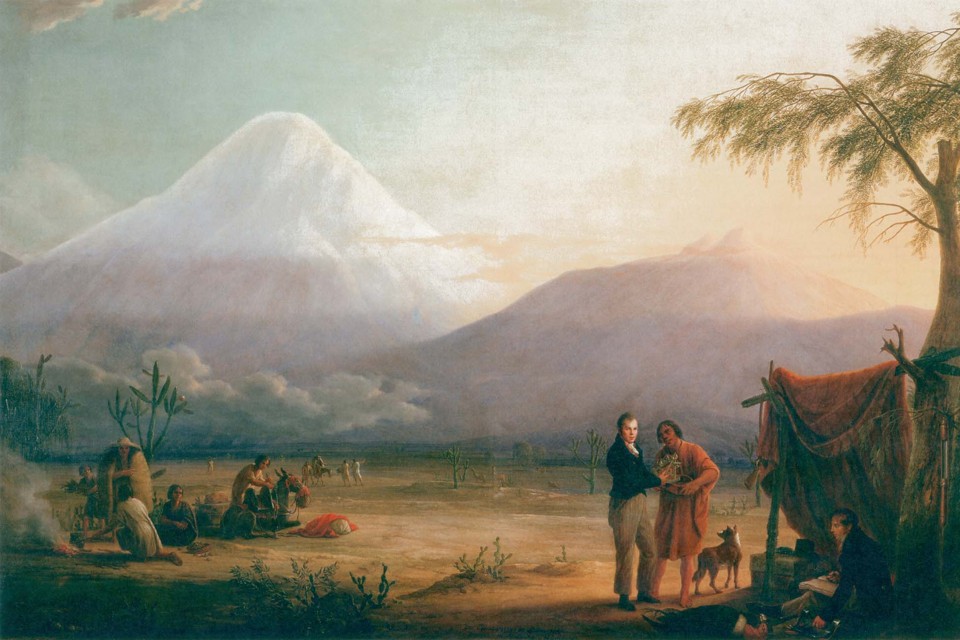
Alexander von Humboldt collecting plants at the foot of Chimborazo. Painting by Friedrich George Weitsch

Humboldt and his companions climbed every mountain they encountered, taking precise measurements of altitude, temperature, and samples of soil and plants as they gained altitude.  As he accumulated data from each climb he began to see a pattern in what he encountered.  Humboldt’s new, revolutionary idea of nature fell into place for him as he climbed Chimborazo in Ecuador to an unprecedented height of 19,413 feet, about 1,000 feet shy of the summit:  “Nature, Humboldt realized, was a web of life and a global force…Humboldt was struck by this ‘resemblance which we trace in climates the most distant from each other.’ (2)

Humboldt's Naturegemälde
Humboldt’s Naturegemälde

Humboldt called the graphic depiction of his theory Naturegemälde which means roughly “painting of nature.”  His drawing shows that plants are distributed according to their altitudes and latitudes, from subterranean mushroom species to the lichens that grow below the snow line.  In similar latitudes, palms grow in the tropical zone at the foot of the mountain.  Oaks and shrubs prefer the temperate climate above the tropical zone.  Naturegemälde illustrated for the first time that “nature is a global force with corresponding climate zones across continents.” (2)

Addendum:  In 2012 – 210 years after Humboldt climbed Chimborazo – a scientific expedition surveyed the vegetation on Chimborazo and compared that survey to Humboldt’s survey in 1802.  They found that the vegetation has moved to higher altitudes on average 500 meters.   This movement of plants to higher elevations (and latitudes in other examples) is a response to climate change, which requires plant and animal species to move in order to survive.  It is one of many examples of why the concept of “native plants” is meaningless at a time of rapid climate change. (3)

Humboldt’s theory of the unity of nature, connected in a global web of life, required an interdisciplinary approach of which few of his contemporaries were capable.  He drew equally from his fund of knowledge about astronomy, botany, geology, and meteorology.  Sadly, as human knowledge has expanded exponentially in over 300 years, an interdisciplinary approach to science has become unattainable.  Scientific inquiry has become increasingly narrowly specialized, preventing the global view that informed Humboldt’s studies.  The “big picture” is lost in the compartmentalization of science into isolated, specialized scientific disciplines.

Socio-political context of Humboldt’s travels

We cannot fully appreciate Humboldt’s scientific accomplishments without mentioning his interest in and concern for the human realm.  Humboldt was 20 years old when the French Revolution occurred in 1789.  He was thrilled and delighted by the prospect of liberty and equality for the French people.  His admiration for the French made Paris his home for much of his life.  He believed that science would thrive in such an atmosphere of freedom of thought and action.

As Humboldt travelled in the New World, he brought this standard of freedom and liberty along with him.  New Spain was lacking in that regard.  He believed that the cultural accomplishments of the indigenous people were sadly devalued.  He was disgusted by the oppression of the indigenous people and the lack of basic human rights of the colonists.  He observed the consequences of this oppression in the colonial landscape.  Mineral riches were ravaged and forests were razed for the cash crops that impoverished the settlers.  The colonial government required them to grow monocultures such as indigo (blue dye), in lieu of the crops needed to feed the population.

Humboldt was one of the first scientists to observe the destructive consequences of deforestation.  Forests were cleared for agricultural fields.  Wood was the fuel of the time, providing heat and light.  Later forests would fuel ships, trains and industrial steam engines.  Where forests were cleared, the land quickly dried out because trees recycle water into the atmosphere.  Erosion and desertification are the eventual consequences of deforestation.

For the same reason that Humboldt admired the French Revolution, he also admired the new American republic that had only recently gained its independence from Britain and was founded on democratic principles.  He went far out of his way to visit the United States to consult with the young democracy.

Thomas Jefferson was the President at the time and they spent much valuable time together.  The Spanish jealously guarded all useful information about New Spain because the United States was clearly a rival in the New World.  Humboldt brought the Americans much useful information about their competitor because he not only wished to be helpful to their young enterprise, he firmly believed in universal access to information.

However, there was one horrible blot on the reputation of the United States that made Humboldt queasy.  He abhorred slavery in his own country as well as in the United States.  As much as he enjoyed the company of Thomas Jefferson and respected his intelligence, he was scandalized by the scale of enslavement on Jefferson’s Virginia plantation.

Humboldt’s concern for the welfare of humans extended to all races, ethnicities, and classes.  Just as he embraced all nature as worthy of his attention, his view of humanity was equally generous and inclusive.  We venture to guess that he would be as mystified by the pointless distinction between “native” and “non-native” plants and animals as we are.

Humboldt’s legacy

When Humboldt returned to Europe in 1804 at the age of 35, his reputation as an important scientist was already established by the correspondence in which he had engaged during the 5-year voyage.  He returned with the detailed record of his travels, including specimens:

“[He] returned with trunks filled with dozens of notebooks, hundreds of sketches and tens of thousands of astronomical, geological and meteorological observations.  He brought back some 60,000 plant specimens, 6,000 species of which almost 2,000 were new to European botanists—a staggering figure, considering that there were only 6,000 known species by the end of the eighteenth century.” (2)

He spent 21 years publishing over 30 volumes about his 5-year journey in the New World.  Not only were these books widely read, they influenced many of the greatest scientists and thinkers who succeeded him:

  • Charles Darwin’s correspondence with Humboldt and many references to Humboldt’s publications in his own work are evidence of Humboldt’s influence on Darwin’s work. Just as Humboldt’s journey inspired his theory of the unity of nature, Darwin’s journey around the globe was the inspiration for his theory of evolution.  Readers of Darwin’s early work observed the similarity of his writing style with that of Humboldt.
  • Humboldt was equally influential in the writings of Henry David Thoreau. Thoreau published an unsuccessful book shortly after his two-year reclusive experience on Walden Pond.  Then he learned from Humboldt’s books to observe and record the workings of nature, which eventually transformed his writings into the nature writing that made him famous.  The records he kept of the climate on Walden Pond are still used as a reference point for the climate change that has occurred in the past 150 years.
  • George Perkins Marsh is considered the first American environmentalist. His book Man and Nature was the first to express alarm in 1864 about American deforestation.  The writings of Humboldt were the first to alert Marsh to this issue and as they did for Humboldt this issue was brought into focus by extensive travels.  Marsh could see America’s future in Egypt where thousands of years of intensive agriculture left the land bare and unproductive.

Invention of NatureThis is but a short list of important scientists all over the world who were influenced and inspired by the writings of Alexander von Humboldt long after his death in 1859 at the age of 89.  We encourage our readers to read Andrea Wulf’s The Invention of Nature:  Alexander von Humboldt’s New World for the full story.  We have reported on other books by Andrea Wulf—The Brother Gardeners and The Founding GardenersMs. Wulf turns botanical history into a gripping story.

What is Humboldt’s message to Million Trees?

Alexander von Humboldt delivers a powerful message that fits well with our mission.  He saw the world and its inhabitants as fitting together in a harmonious and comprehensible manner.  He was always looking for the connections between seemingly disparate elements in nature and finding them wherever he looked.  His egalitarian hopes for humanity fit perfectly with his perception of nature as working together to make a web of life with humans as a part of that web.

We would like to think that Million Trees shares the Humboldtian viewpoint and we hope that our readers agree.  We hope that the New Year will bring more harmony to nature and those who live within it.


(1) Wikipedia https://en.wikipedia.org/wiki/Biogeography

(2) Andrea Wulf, The Invention of Nature:  Alexander von Humboldt’s New World, Alfred A. Knopf, New York, 2015

(3) Morueta-Holme N, Engemann K, Sandoval-Acuña P, Jonas JD, Segnitz RM, Svenning JC, “Strong upslope shifts in Chimborazo’s vegetation over two centuries since Humboldt,”  Proc Natl Acad Sci U S A. 2015 Oct 13;112(41):12741-5.  Available HERE.


Subirdia: Birds adapt to the Anthropocene

christmas-holly-4This article is our Christmas present to our readers.  We celebrate the holidays with good news about the birds living in cities all over the world.

Subirdia was written by John Marzluff, an academic ornithologist at University of Washington. (1)  He reports many years of his research and that of his graduate students about the birds that live in urban and suburban Seattle as well as surrounding forest reserves.  He also reports on countless studies of bird populations in similar settings all over the world.  All of those studies reach remarkably similar conclusions.

It took me a long time to read this book because its introduction was off-putting.  Virtually every plant and animal was preceded by the qualifier of “native” or “non-native.”  The implication of the introduction was that the most important feature of every plant and animal is whether or not it is native.  As our readers know, we consider the nativity of plant and animal species largely irrelevant.  All plants and animals are at home in our ideal nature.

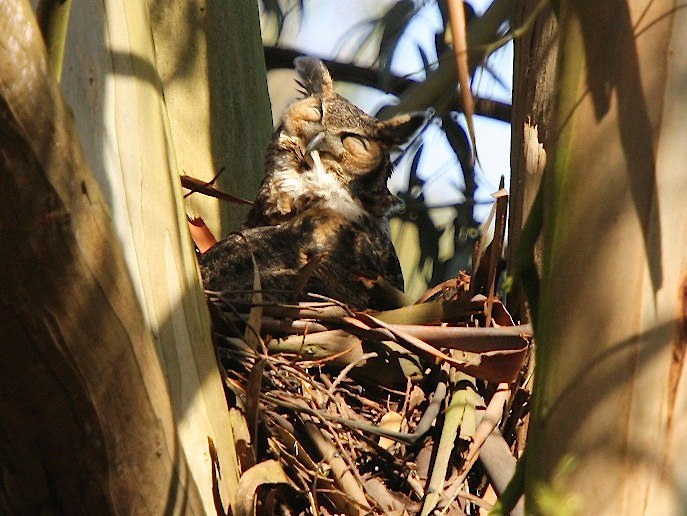
Owl nesting in eucalyptus, courtesy urbanwildness.com

When I finally got around to reading Subirdia I was pleasantly surprised.  Although the author has a preference for native plants and animals, in fact, his research and that of others does not justify his obsession.  Where birds are actually found in the greatest numbers is where the habitat is most diverse, not necessarily exclusively native.

Suburbia is very birdy

The conventional wisdom is that cities are inhospitable places for birds and other wildlife.  After all, haven’t we paved over much of their habitat, interrupted their movements by fragmenting their habitat, and drained or covered water resources? In fact, bird populations in urban areas all over the world are both plentiful and diverse.

After years of counting numerous bird species in his hometown of Seattle, the author of Subirdia wondered if Seattle might be unique because it is heavily forested.  After conducting similar surveys in 10 cities around the world, Marzluff is convinced that birds are successfully adapting to rapid urbanization of human society.  The urban centers of cities in North and Central America, New Zealand and Europe support an average of 23 bird species.  He found the least number of bird species (11) in Auckland, New Zealand and the greatest number (31) in St. Andrews, Scotland.

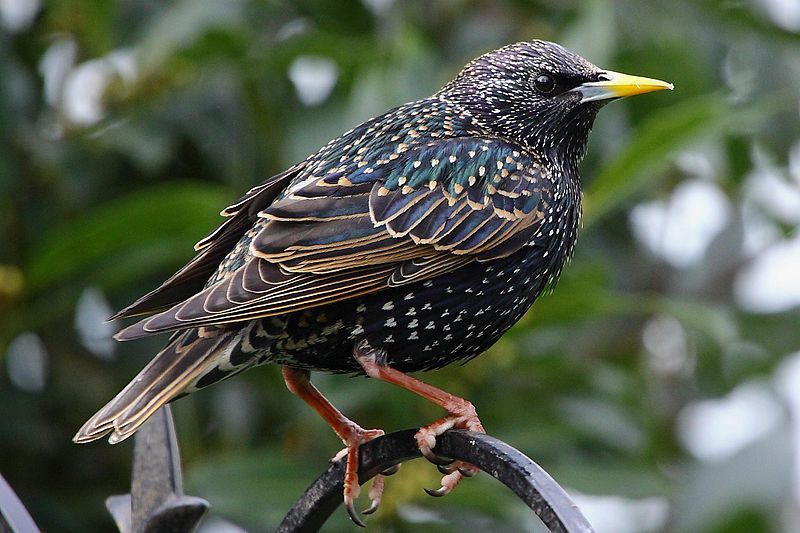
Starling in breeding plumage. Creative Commons - Share Alike
Starling in breeding plumage. Creative Commons – Share Alike

Another popular myth about the loss of bird diversity in the Anthropocene is that the globalization of human civilization produces “homogenized” nature.  That is, many people believe that bird populations may not be in decline, but there are a few hardy species that dominate everywhere.  Again, Marzluff’s studies do not corroborate that belief.  Five bird species are found in cities all over the world (house sparrows, starlings, Canadian geese, mallard ducks, and rock pigeons).  However, these ubiquitous species are not the predominant bird species he found in cities.  Of the 151 different bird species he found in the 10 cities he visited, 75% of them were unique to each of the cities.   “Homogenization is barely perceptible.” (1)

Comparing bird populations in cities with nature reserves

Marzluff also compared bird populations in cities with undeveloped nature preserves.  Once again, cities still look like good homes for birds.  He finds twice as many bird species in Ketchikan, Alaska as in the nearby wildlands along the Naha River, “a remote wilderness fifty miles away…that required powerboat, kayak, and hiking to attain.” (1)

He also visited Yellowstone National Park, a 2.2 million acre protected area within an undeveloped ecosystem of nearly 20 million acres, where he counted 26 bird species in four days.  From there, he flew to New York City where he counted 31 bird species in Central Park in only three days.  Historical records of bird surveys in Central Park and Yellowstone National Park indicate that about 200 bird species have been found in both parks since the late 19th century.  “From a bird’s perspective, a large park created by human hands or by nature is not all that different.”  (1)
Accommodating birds in cities

Marzluff’s concluding chapters advise city dwellers how to encourage and support birds.  His “ten commandments” for accommodating birds make no mention of planting native plants or eradicating non-native plants:

  • “Do not covet your neighbor’s lawn.”
  • “Keep your cat indoors.”*
  • “Make your windows more visible to birds that fly near them.”
  • “Do not light the night sky.”
  • “Provide food and nest boxes.”
  • “Do not kill native predators.”
  • “Foster a diversity of habitats and natural variability within landscapes.”
  • “Create safe passage across roads and highways.”
  • “Ensure that there are functional connections between land and water.”
  • Enjoy and bond with nature where you live, work, and play!”

Marzluff expresses a strong preference for native plants throughout his book, but his research in Seattle is inconsistent with that preference:  “The forests of Seattle and its suburbs now embrace 141 species of trees, including 30 native species and ornamentals from North and South America, Europe, Asia, and Africa.  Some are problematic invaders, but in total they provide a diverse menu of foods and nesting and roosting sites for birds.”  (1)

Why a preference for natives?

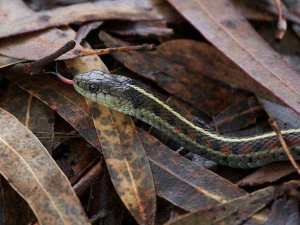
Garter snake in eucalyptus leaf litter. Courtesy Urban Wildness

Another academic scientist in Washington State, Linda Chalker-Scott, directly addresses the vexing question of why public policies which mandate the use of native plants have proliferated despite the lack of evidence that they are superior in any way.  She focuses on this question:  “Do native and nonnative woody species differ in how they affect species diversity?”  Her literature search found 120 studies from 30 countries that quantified the biodiversity of birds, insects, mammals, reptiles, and other plants in woody plants and trees in urban landscapes.

The analysis of these studies reveals that “the science does not support the supposition that native plantings are required for biodiversity…it is clear that an automatic preference for native trees when planning in urban areas is not a science-based policy.” (2) The assumption that native plants are superior to non-native plants is based on these misconceptions:

  • The definitions of native and alien species are value judgments, not science-based concepts.
  • Native plants are often poorly suited to environmental conditions in urban areas, such as compacted soil and changes in the climate. Conversely, introduced plants are often well suited to these urban conditions.
  • Many introduced plants provide valuable ecological benefits. For example, they often provide food, pollen, and nectar resources during winter months when native plants are dormant.
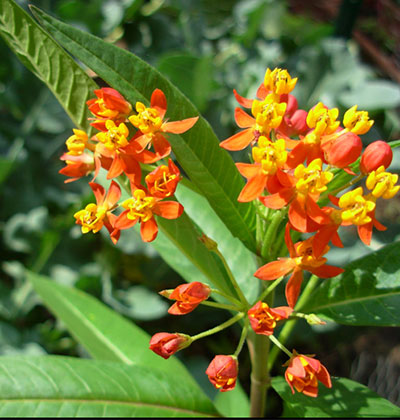
  • Tropical milkweed is not native to California. (Asclepias curassavica) Creative Commons
    Tropical milkweed is not native to California. (Asclepias curassavica) Creative Commons

    Doug Tallamy is the academic scientist most closely associated with the native plant ideology. His claim that insects require native plants is based on his mistaken assignment of nativity to an entire genus, when only a few species within that genus are actually native.  For example, there are over 35 species of milkweed in the genus Asclepias, but only two species are native to California.  Most members of the milkweed family are useful to monarch butterflies.  It is therefore not accurate to claim that monarchs require native plants.  They have lived all over the world for over 200 years in some places where there are no native species of milkweed.

Chalker-Scott’s meta-analysis of 120 studies concurs with Mr. Marzluff:  “The published research overwhelmingly identifies diversity, structure, and function as the most important vegetation characteristics for enhancing community biodiversity…In fact, sometimes landscapes require the inclusion of exotic trees and control of natives to maintain diversity.” (2)

Doing more harm than good

Our readers know that we do not begrudge the preference of native plant advocates for native plants.  We encourage them to plant whatever they want.  We only ask that they stop destroying the plants they don’t like.  That request is based on our belief that they are doing far more harm to our public lands than any perceived benefit of native plants.  Much of that harm is caused by the widespread use of herbicides to destroy non-native vegetation.  These herbicides are known to damage the soil and they migrate in the soil, damaging neighboring plants that are not targeted.  These issues are surely a factor in the conspicuous lack of success of their “restorations.”  There is also mounting evidence of the toxicity of herbicides to bees, birds, and other animals including humans.

But there is another, equally important reason why we object to the futile attempts to eradicate non-native plants.  They are providing valuable habitat for wildlife.  Even when they are replaced by native plants after being destroyed, the animals that depended upon them are not necessarily restored to the landscape.  In fact, few projects plant natives after the eradication of non-natives.

Japanese honeysuckle. Attribution William Rafti

A recently published study (3) of the removal of Amur honeysuckle (Lonicera maackii) is an example of the loss of valuable habitat.  The hypothesis of this study was that “invasion of urban habitats by exotic plants was the underlying mechanism driving changes in bird-plant networks.”  The study tested this hypothesis by comparing forest plots dominated by honeysuckle with those in which honeysuckle had been removed and the surrounding forest habitat replicated.  They measured nesting birds, nest predators, and nest survival.

They found that the lowest overall nest survival rates were found in the plots in which honeysuckle had been removed.  In other words, “…removal of invasive honeysuckle from urban forests did not restore network structure to that of rural landscapes.”  The authors concede, “This finding was not consistent with our original hypothesis that invasion of forests by the exotic Amur honeysuckle was responsible for the urban-associated changes in bird-plant networks.”  They conclude, “The degree to which native communities can be restored following removal of exotic plants remains unclear.” 

Actually, we think it is quite clear that eradicating non-native plants does not benefit man or beast. We marvel that the fantasy persists that there is some theoretical benefit to killing harmless plants, despite the consistent lack of evidence of any benefit and the considerable evidence of the harm of such attempts. 


*Like most ornithologists, Marzluff comes down hard on cats as killers of birds in his book.  However, he cites just one study about predation of fledglings.  The study used radio transmitters to determine the fate of 122 newly fledged birds over a period of two years.

The results do not justify the demonization of cats:  “Only 20 percent of radio-tagged birds died during our study.  Birds such as Cooper’s hawks and mammals such as Townsends’ chipmunks, ermine, and Douglas squirrels were the most likely predators.  The most notorious of all bird predators, the out-of-the-house cat, was implicated in only one death, though we could never be entirely sure which mammal or which bird had killed the fledging.”  (1) Marzluff credits a neighborhood coyote for controlling the cat population.  Frankly, that doesn’t make sense.  Chipmunks and squirrels are just as likely to be prey for the coyotes.

We have reported on similar studies which reach the same conclusions.  A meta-analysis of 8 studies of nest predators of song birds in North America used video cameras to identify the predators of 242 depredation events.  Only one of those nest predators was a cat.

We have no objection to the general advice to keep your cat indoors. (We have never had a cat and don’t plan to.)  However, we think that estimates of birds killed by cats are greatly exaggerated.  Humans seem to have an unfortunate desire to look for scapegoats and cats seem to fit the bill for bird lovers.

  1. John M. Marzluff, Welcome to Subirdia, Yale University Press, 2014
  2. Linda Chalker-Scott, “Nonnative, Noninvasive Woody Species Can Enhance Urban Landscape Biodiversity,” Arboriculture & Urban Forestry, 2015, 41(4): 173-186
  3. Amanda D. Rodewald, et. al., “Does removal of invasives restore ecological networks? An experimental approach,” Biological Invasions, March 2015

The Economist: “You can garden in a garden. You cannot garden nature.”

For those who may not be familiar with The Economist magazine, let us introduce this venerable publication to you.  The Economist is a weekly news magazine published in Britain continuously since 1843.  It has a readership of over 1.5 million and about half of its readers are in America.  Its viewpoint is fiscally and politically moderate (it endorsed Ronald Reagan and Bill Clinton) and socially liberal (it supports same-sex marriage and immigration).  It is widely read by the business community and public policy makers.  In other words, it is an influential, mainstream source of information.

Therefore, The Economist’s recent articles about invasion biology represent a significant step forward in the effort to stop the pointless and damaging crusade against harmless non-native plants and animals.  The following is an excerpt from the editorial version of a longer article in the December 5, 2015 edition of The Economist.  We have added emphasis and a few photos.


“In Defense of Invaders”

“EVERYBODY loves to hate invasive species. Americans battle rampant plants such as kudzu, a Japanese vine; Europeans accuse the American grey squirrel of spreading disease and damaging forests. As The Economist went to press, a scientific committee was expected to sign off on Europe’s first invasive-species blacklist. Cross-border trade in 37 species will be banned (the list is bound to grow longer as conservationists add more troublemakers). Where it is not already too late to wipe out these alien invaders, EU member states will be required to do so.

“Europeans are restrained in comparison with other countries. The international list of invasive species—defined as those that were introduced by humans to new places, and then multiplied—runs to over 4,000. In Australia and New Zealand hot war is waged against introduced creatures like cane toads and rats. In 2013 New Zealand used helicopters to drop a poison known as 1080 on 448,000 hectares of land—an area about the size of Yosemite and Sequoia national parks put together. Just four public objections were recorded.

“Some things that are uncontroversial are nonetheless foolish. With a few important exceptions, campaigns to eradicate invasive species are an utter waste of money and effort—for reasons that are partly practical and partly philosophical.

Rhodedenron ponticum, one of only a dozen plants considered invasive in Britain. Wikimedia Commons

“Start with the practical arguments. Most invasive species are neither terribly successful nor very harmful. Britons think themselves under siege by foreign plants like Japanese knotweed, Rhododendron ponticum and Himalayan balsam. In fact Britain’s invasive plants are not widespread (see article), not spreading especially quickly, and often less of a nuisance than vigorous natives such as bracken. The arrival of new species almost always increases biological diversity in a region; in many cases, a flood of newcomers drives no native species to extinction. One reason is that invaders tend to colonise disturbed habitats like polluted lakes and post-industrial wasteland, where little else lives. They are nature’s opportunists.

Honeybee in non-native wild mustard

New arrivals often turn out to be useful, even lovely. Americans fret about the decline of a vital crop-pollinator known as the American honey bee. Apis mellifera is actually an invader from the Old World: having buzzed from Africa to Europe, it was brought to America by colonists and went wild. Invasive plants provide food and nests for vulnerable natives; invasive animals can help native species by killing their predators, as the poisonous cane toad has done in Australia.

Another practical objection to the war on invasive species is that they are fiendishly hard to eradicate. New Zealand will not get rid of its rats any more than Britain could wipe out its grey squirrels. Culls tend to have a short-term effect at best. It is, however, sometimes possible to get rid of troublesome immigrants on tiny oceanic islands. Because the chances of success are higher, and because remote islands often contain rare species, efforts there are more worthwhile.

“The philosophical rationale for waging war on the invaders is also flawed. Eradication campaigns tend to be fuelled by the belief that it is possible to restore balance to nature—to return woods and lakes to the prelapsarian idyll that prevailed before human interference. That is misguided. Nature is a perpetual riot, with species constantly surging, retreating and hybridising. Humans have only accelerated these processes. Going back to ancient habitats is becoming impossible in any case, because of man-made climate change. Taking on the invaders is a futile gesture, not a means to an achievable end.

“No return to Eden”

“A rational attitude to invaders need not imply passivity. A few foreign species are truly damaging and should be fought… It makes sense to keep out pathogens… Fencing off wildlife sanctuaries to create open-air ecological museums is fine, too….You can garden in a garden. You cannot garden nature.”

Monarch myths revisited

Debunking the myths of nativism—especially those that justify the eradication of non-native trees—is the task we have assigned ourselves, which requires us to revisit a few of the misconceptions about monarch butterflies in California.

Monarch Butterfly. Creative Commons

When application for endangered status for monarchs was filed in August 2014, a few new monarch myths emerged and have since been faithfully repeated by native plant advocates who are demanding the eradication of our urban forests.  The monarch migration in California is using predominantly non-native trees, which should afford those trees some protection.  Unfortunately, it has only produced more convoluted theories that deny the value of non-native plants and trees to monarchs.

Myth #1:  The California migration of monarch butterflies prefers native trees for their winter roost. 

Monarch butterflies roosting in eucalyptus tree.

A study of the trees used by monarch butterflies for their winter roost in over 300 different sites in California reported that the vast majority of monarchs are using eucalyptus:

“Three types of trees were used most frequently by roosting monarchs:  eucalyptus (75% of the habitats primarily Eucalyptus globulus), pine (20% of the habitats; primarily Pinus radiata), and cypress (16% of the Cupressus macrocarpa).  Twelve other tree species were identified…with a combined prevalence of only 10%.” (Three different studies by different authors are the source of these data, therefore they don’t add up to 100%.) (1)

Unfortunately, this fact has been obscured by a small study of a few selected sites used by monarchs during their migration.  Griffiths and Villanova (2) observed the monarch migration in a few sites in Monterey and San Luis Obispo counties.  They report that the monarchs moved around among three tree species including eucalyptus, suggesting to them that Monterey pine and cypress are equally important to the monarchs.  While we don’t doubt that this may be true, we don’t think we can generalize from this study because it was conducted in the small native range of Monterey pine and cypress.

The California migration of monarchs spends the winter months roosting in tall trees in 17 counties along the coast of California, from Mendocino County in the north to San Diego County in the south. (1) Most of that expanse is outside the native range of Monterey pine and cypress.  Griffiths and Villanova do not acknowledge that both Monterey pine and cypress are being eradicated outside their native range for the same reason that eucalyptus is being eradicated, i.e., they are considered “alien invaders” where they have been planted outside their native range.  Here in the San Francisco Bay area, for example, 500 Monterey pines were destroyed on the Marin headlands a few years ago and an untold number of Monterey pines will be destroyed by the FEMA projects in addition to those that have already been destroyed here.

If, in fact, monarchs do have a preference for Monterey pines and cypress for their winter roost, they do not have that option outside of the small native range of those trees in Monterey County. 

For the record, we should tell you that we are just as opposed to the pointless destruction of Monterey pine and cypress outside their small native range as we are opposed to the destruction of eucalyptus.

There is paleontological evidence (fossil cones) that Monterey pines lived in the San Francisco Bay Area several times in the distant past.  That finding was reported (4) in Fremontia, the journal of the California Native Plant Society.  The author asked that Monterey pines be allowed to remain where they lived in the past because the species is threatened in its small native range.  Unfortunately, her advice has been ignored by native plant advocates, who continue to demand that all Monterey pines be destroyed where they have been planted outside their present native range.  This extreme viewpoint is one of the reasons why native plant advocates have earned their reputation as fanatics.

Myth #2:  The California migration of monarch butterflies used exclusively native trees before eucalyptus was planted in California.

Those who wish to discount the value of eucalyptus to overwintering monarchs often assume the California monarch migration predates the planting of eucalyptus in California in mid-19th century.  That assumption supports their claim that all of our eucalyptus can be destroyed without having a negative impact on monarch butterflies.   In fact, there is no historical record of the monarch migration until the mid-19th century.  The historical record of the monarch migration was reported by Vane-Wright (3), who tells us the California monarch migration is probably a 19th century expansion of the range of the eastern monarch migration, from east of the Rocky Mountains to Mexico.  Recent molecular analysis of the monarch migration confirms that the eastern and western migration of monarchs in North America are genetically identical, suggesting that the populations might be dispersing east and west from their Mexican winter roost. (5)

Monarch caterpillar on milkweed. Tilden Botanical Garden

Monarch butterflies are not usually eaten by birds because their host plant contains a toxin that makes birds sick and the monarch’s warning colors broadcast that fact.  The warning colors of butterflies that are toxic to birds are often mimicked by other species of butterflies to confer that protection.  There is a monarch mimic, the Viceroy, in the eastern US, which occurs in California only in a tiny bit of riparian habitat in southeast California.  “The lack of mimics suggests the [monarch] may not have been here long enough for any to evolve.” (6)

Myth #3: Non-native species of milkweed is harmful to monarch butterflies.

Monarch butterflies lay their eggs on milkweed and their larvae, the caterpillar, feeds exclusively on milkweed.  Many native plant advocates believe that the monarch requires a native species of milkweed.  They are mistaken in that assumption.  Wikipedia lists over 35 species of milkweed (genus Asclepias) all over the world and many are known to be used by the widely dispersed populations of monarchs.

The dispersal of monarchs from their original range in North America is approximately 200 years old, according to molecular analysis of populations across the Pacific Ocean (Hawaii, Samoa, Fiji, New Caledonia, New Zealand, Australia) and across the Atlantic (Spain, Portugal, Morocco).  These dispersals are assumed to have been aided by human transportation of both milkweeds and monarchs and extreme weather events.  “For example, monarchs were recorded in Australia in 1870 and were most probably carried there on cyclonic winds from a source population in New Caledonia.” (7)  These populations do not migrate and are therefore genetically distinct from the ancestral population of North American monarchs as a result of genetic drift.

In many of the homes of new populations of monarch butterflies there was no native species of milkweed before being introduced simultaneously with the monarch populations.  Although there are numerous members of the milkweed family native to Australia, monarchs do not appear to utilize the native species, preferring the introduced species of milkweed.

Tropical milkweed (Asclepias curassavica) Creative Commons

In California, a tropical species of milkweed is popular with gardeners (Asclepias curassavica).  Unlike the native species of milkweed, tropical milkweed does not die back in winter.  Gardeners therefore tend to prefer the tropical milkweed because it makes a colorful contribution to their gardens year around.

Of course, native plant advocates prefer native species of milkweed and they justify their preference by claiming that tropical milkweed is harmful to monarchs.  They claim that the monarch parasite (Ophryocystis elektroscirrha) can accumulate on tropical milkweed because it doesn’t die back during the winter.  Tropical milkweed is the only milkweed available in winter.  The parasite disrupts some winter breeding of monarchs, but that breeding would not occur in the absence of tropical milkweed.  If more monarchs are the goal, tropical milkweed is making a contribution to the monarch population.

New scientific research debunks the myth that tropical milkweed is harmful to monarchs.  Leiling Tao et.al. (8) studied monarch lifespans when they fed on a variety of milkweed species.  They looked at both resistance to monarch parasite (O. elktroscirrha) infection and tolerance once infected.  They found a complex interaction between species of milkweed the monarchs fed on and the amount of mycorrhizal fungi on the roots of the milkweed.  But one result was clear:  monarchs raised on tropical milkweed (A. curassavica) lived as long, or longer than, monarchs raised on other species of milkweed.  They were less likely to be infected, and once infected, tolerated the infection well.  In short, there is nothing about tropical milkweed as a host that is detrimental to monarch survival in the presence of parasites.

Native plant advocates also speculate that tropical milkweed can disrupt the migratory patterns of monarchs because it is available when native milkweed is not available.  Given that monarchs have persisted for 200 years all over the world, using exclusively non-native milkweed and without migrating, this seems an unnecessarily pessimistic concern.  Neither native milkweed species, nor migration are essential to the survival of monarchs as a species.

Peek under the cover story

As we often do on Million Trees, we have taken a peek under the cover story being used by native plant advocates to justify the eradication of non-native plants and trees.  Once again, we find a lot of pessimistic speculation, but little evidence that eradicating non-native plants will benefit wildlife, or conversely that wildlife can only survive in native habitat.  Yes, it was a tedious journey to that conclusion and we thank you for your patience if you have persevered to our optimistic conclusion that wildlife is far more resourceful and resilient than nativism wishes to believe.


(1) Dennis Frey and Andrew Schaffner, “Spatial and Temporal Pattern of Monarch Overwintering Abundance in Western North America,” in The Monarch Butterfly Biology and Conservation, Cornell University Press, 2004.

(2) Jessica Griffiths and Francis Villablanca, “Managing monarch butterfly overwintering groves:  Making room among the eucalyptus,” California Fish and Game 101(1): 40-50; 2015. Summary also available HERE.

(3) Richard Vane-Wright, “The Columbus Hypothesis:  An Explanation for the Dramatic 19th Century Range Expansion of the Monarch Butterfly,” in Biology and Conservation of the Monarch Butterfly,Natural History Museum of Los Angeles County, 1993.

(4) Constance Millar, “Reconsidering the Conservation of Monterey Pine,” Fremontia, Vol. 26, No. 3, July 1998

(5) Justine I. Lyons, et. al., “Lack of genetic differentiation between monarch butterflies with divergent migration destinations,” Molecular Ecology, (2012) 21, 3433-3444

(6) Art Shapiro, Field Guide to Butterflies of the San Francisco Bay and Sacramento Valley Regions, California Natural History Guides, UC Press, 2007.

(7) Amanda Pierce, et. al., “Serial founder effects and genetic differentiation during worldwide range expansion of monarch butterflies,” Proceedings of the Royal Society of Britain, 281: 2014.2230.

(8) LeilingTao, et. al., “Disease ecology across soil boundaries:  effects of below-ground fungi on above-ground host—parasite interactions,” Proceedings of Royal Society of Britain, 282: 2015.1993.