Yale Environment 360, the on-line science blog, published an interesting article last week about new discoveries in forest ecology regarding the importance of microbes in the soil for forest health. These root fungi—called mycorrhizal fungi— form a symbiotic relationship with many plants and trees, both native and non-native. They provide water and mineral nutrients in exchange for plant carbohydrates. Scientists have known of the existence of these microorganisms for some time, but recent advances in DNA analysis has enabled scientists to identify thousands of different species of mycorrhizae and their association with certain tree species.
Scientists at Yunnan University in China had been trying for some time to save a critically endangered tree that had dwindled to only 200 individuals. They had been transplanting seedlings into protected areas, with little success. Finally, they discovered that inoculating the seedlings with mycorrhizae increased survival rates from 46% to 80%
Root fungi and our urban forest in the Bay Area
We learned of the importance of these root fungi to our urban forest from Colin Tudge’s book, The Tree, nearly ten years ago: “Most forest trees and many other plants too, make use of mycorrhizae; some, like oaks and pines, seem particularly reliant on them.” And eucalypts are also dependent upon mycorrhizae: “Many trees have mycorrhizae, but pines and eucalypts seem particularly adept.” (1)
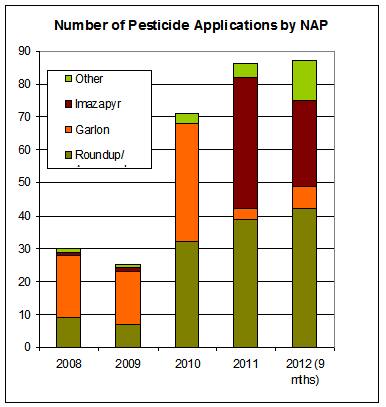
And in 2010, we learned from the Marin Municipal Water District’s “Herbicide Risk Assessment,” that one of the most frequently used herbicides sprayed on the stumps of eucalypts when they are cut down is known to be harmful to mycorrhizal fungi in the soil. This herbicide is also foliar sprayed on non-native vegetation such as broom, Himalayan blackberry, ivy, etc. The active ingredient in Garlon 3A and Garlon 4 Ultra—triclopyr–is known to be toxic to microrganisms such as mycorrhizae:
“Mycorrhizal fungi are symbionts with plants that provide water and mineral nutrients in exchange for plant carbohydrates. Cenococcum geophilum, the slowest growing fungus, was least sensitive to the effects of triclopyr, exhibiting decreased growth at 742 ppm a.e. A similar study found that triclopyr (formulation not reported) could inhibit growth in five mycorrhizal species: Hebeloma crustuliniforme, Laccaria laccata, Thelophora americana, Thelophora terrestris, and Suillus tomentosus.94Fungi were kept in liquid culture for 30 days and the reduction of biomass with increasing triclopyr concentrations was measured. A 90% reduction in biomass was observed for all species at concentrations of 720 ppm; greater than 50% reduction biomass was observed in four of the five species at 36 ppm. The most sensitive species, Thelophora americana, exhibited a 6% decrease in growth rates relative to controls at triclopyr concentrations of 0.072 ppm (this result was statistically significant). In other species, statistically significant decreases in growth were reported between 0.72 ppm and 7.2 ppm.” (2)
These studies tested this herbicide on only six species of mycorrhizal fungi. We should probably assume that other species would also be harmed and it is likely that other herbicides would also be harmful, though no tests have apparently been conducted. Testing of pesticides is woefully inadequate because legal requirements for testing are minimal and most testing is funded by manufacturers with little motivation for learning more bad news.
Here is one of the comments posted on the Yale Environment 360 article by an academic at University of Philippines, about presumed damage to agricultural soils by pesticide and fertilizer use:
“The article on microbes by Conniff follows what I pointed out earlier to Yale e360, that there is a group in the Philippines, of which one is a geneticist trained in the U.S. and two are foresters trained in the Philippines, who believe in fertilizer- and pesticide-free agriculture methods that do not kill off microorganisms in the soil that are much needed by the plants. They (the three happen to be brothers) applied this principle to rice and other crops and are harvesting more with less input. They have a growing following among farmers as well as a flourishing broadcasting business. They fight an uphill battle against fertilizer and pesticide multinationals and their local partners. They are slowly winning their battles and will later win the war for food security. Advances in tropical forestry will broaden horizons. Thank you Yale e360!”
Posted by Bienvenido R. Rola, PhD on 10 Oct 2013
Implications for ecological “restorations” in the Bay Area
It seems likely that the huge amounts of herbicide that are used by local projects to eradicate non-native vegetation are damaging the microbes in the soil that are essential to forest health. This is probably one of many explanations for the lack of success of these projects. Here is a recap of the many reasons why these projects are rarely successful unless they are intensively planted and gardened:
- Higher levels of CO₂ and associated climate change are promoting the growth of non-native plants.
- The growth of non-native annual grasses is encouraged by higher levels of nitrogen in the soil found in urban environments as a result of the burning of fossil fuels.
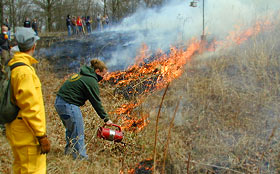
- Hundreds of species of California native plants require fire to germinate their seeds and most of the population will die within 5 years of the fire. Prescribed burns are prohibited in San Francisco and are severely limited in most urban areas because of air quality standards and safety concerns.
- Herbicides are damaging the soil.
***************************************
(1) Colin Tudge, The Tree, Three Rivers Press, 2005
(2) Chapter 4, Marin Municipal Water District, “Herbicide Risk Assessment,” 2010