Dana Milbank: The evolution of a native plant advocate

Dana Milbank is a political columnist for the Washington Post.  Like many Americans, Milbank moved his family from urban Washington D.C. to a derelict farm in the foothills of the Blue Ridge Mountains in Virginia, seeking refuge in nature from urban confinement imposed by the Covid pandemic.  So began his war on nature, dictated by native plant ideology.

In a series of columns, WaPo readers observed how his battle against non-native plants developed:

  • The first installment of his “restoration” saga described the over-grown property that he believed he was obligated to tame:  “an entire civilization of invasive vines and weeds had cruelly exploited the inattention [of previous elderly owners].”  The vines were “murdering defenseless native trees.”   He hired a crew to clear brush, until the cost challenged his budget.  Then he bought equipment and tried to do it himself.  He concluded that he could not “restore order” to his land without using herbicides.  Even then, he was doubtful of ultimate success:  “Clearly, I won’t be defeating these invaders.  At best, I’ll battle them to a temporary truce, holding them at bay until I lose the will to fight them.”  Like many city-slickers, Milbank has an unrealistic vision of what nature looks like when allowed to take its course.
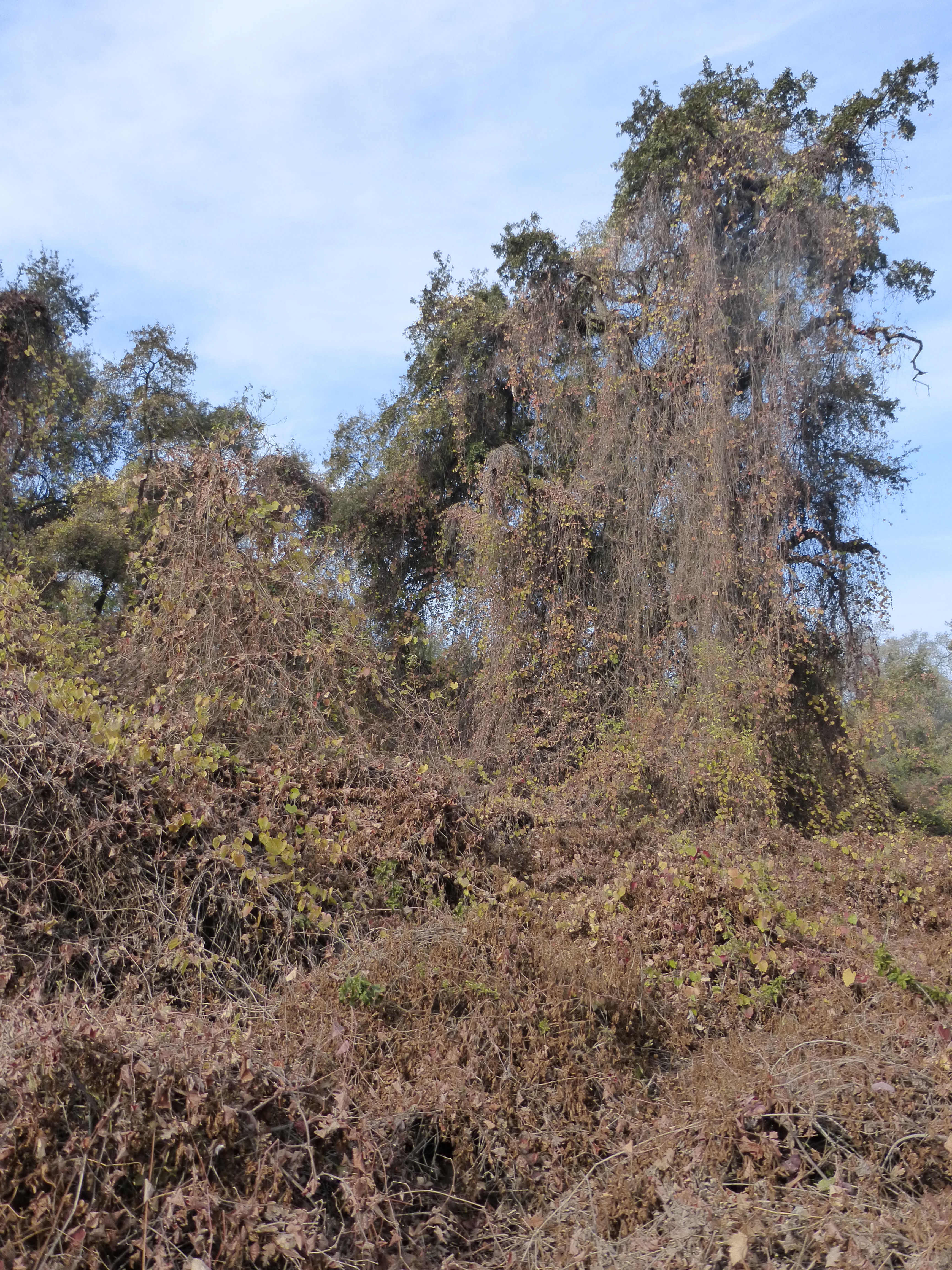
Kaweah Oaks Preserve, Visalia, CA.  November 2013.  California Wild Cucumber, also called manroot (Marah fabacea), climbing over a native valley oak.  Both native and non-native plants can be “invasive.” 
  • In the second episode of Milbank’s battle plan, deer were his target:  “I will be wielding my gun against a brutal foe—one that destroys our forests, kills our wildflowers, sickens humans and threatens the very survival of birds, mammals, insects and amphibians.  I am becoming a deer hunter.”   Where top predators, such as wolves and bears, have been eliminated by humans, there is an over-population of deer who browse vegetation, depriving other animals of the food and cover they need.  Again, Milbank has his doubts about the effectiveness of hunting deer on his property:  “I can’t pretend that my hunting will make a dent in the deer population.” 
  • After taking Virginia’s Master Naturalist Program, Milbank’s third episode expresses his regrets as a gardener:  “I’ve been filling my yard with a mix of ecological junk food and horticultural terrorists” and he warns urban and suburban gardeners that their gardens are “dooming the Earth.”  He takes aim at cultivars in general and many specific species of introduced plants.  Conservation Sense and Nonsense explains why most of these accusations are exaggerated, if not, patently false. 
  • In Milbank’s column, “How I learned to love toxic chemicals,” he expresses frustration about how hard it is to eradicate non-native plants:  “I was losing, badly, to the invasive vines and noxious weeds…I’d cut them back, but they would return in even greater numbers.”  He fully embraces the use of herbicides to escalate his war on nature:  “I have become a reluctant convert to chemicals.”  He acknowledges that glyphosate is toxic, but he claims that the cut-stump application method he uses is “surgical.” He wears protective clothing, including a respirator, which is not required by the product label or California law for glyphosate applications.  He is encouraged by Doug Tallamy, who calls herbicides “chemotherapy.”  Conservation Sense and Nonsense explains why herbicides are doing more harm than good to the environment and everything that lives in it.  

Throwing caution to the winds

In the latest installment of Milbank’s crusade against non-native plants, he tosses caution about herbicides aside. He hires a drone to spray a hayfield with glyphosate in preparation for creating a meadow of native grasses and forbs:

“To save the birds, I brought in this big bird: a 10-foot-square, Chinese-made drone with 8 propellers, capable of carrying 10 gallons of fluid, in this case glyphosate, to kill the grass in my hayfield. (It might seem counterintuitive to douse a field in herbicide to help nature, but conservationists broadly endorse the practice.)”

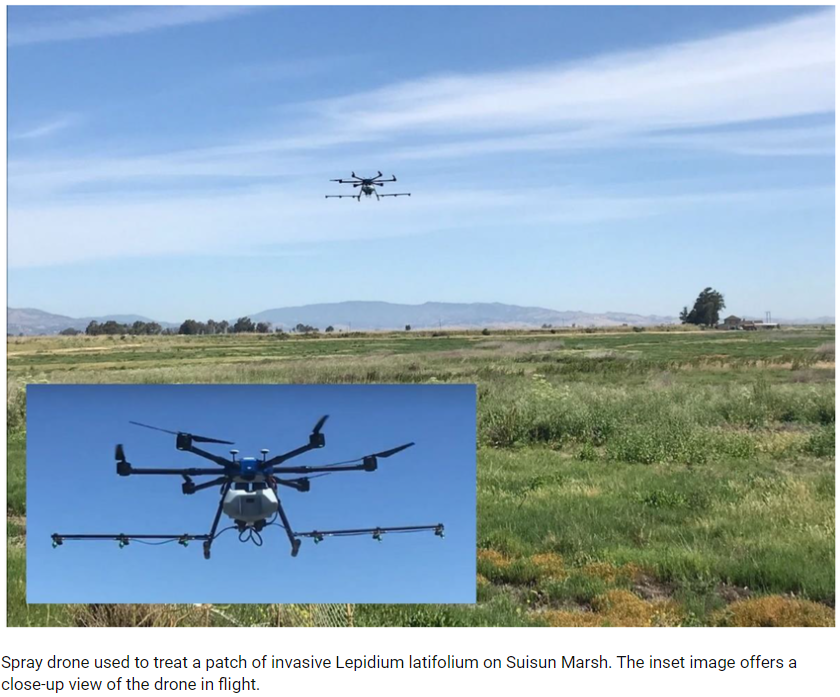
Herbicides are often sprayed from drones to eradicate non-native plants considered “invasive.” Source: https://www.researchgate.net/figure/Spray-drone-used-to-treat-a-patch-of-invasive-Lepidium-latifolium-on-Suisun-Marsh-The_fig3_372867398https://www.researchgate.net/figure/Spray-drone-used-to-treat-a-patch-of-invasive-Lepidium-latifolium-on-Suisun-Marsh-The_fig3_372867398

Milbank has abandoned his cautious use of herbicide and is now aerial spraying from a drone 30 feet over his head, while he watches, without wearing any protective gear:

“Shanley, in shorts, sneakers and fishing shirt, plopped in a lawn chair in the shade of my barn and, using a control pad with two joysticks, sent the drone into the sky… In a moment, the beast was airborne and, from a height of about 30 feet, spraying death on my hayfield. It sprayed the fescue. It sprayed the Johnson grass. It sprayed the foxtail. It returned, flew over the barn — and sprayed me with glyphosate. Programming error. “Sorry about that,” Shanley said. My eyes burned for two days.”

If he had been wearing safety goggles, as required for glyphosate applicators in California, he would have been spared. Milbank has the right to poison himself, his land, and the animals that live on his land.  Although the applicator may be breaking laws (he would be in California) by not wearing any protective equipment, Milbank isn’t doing anything illegal. 

If I weren’t reading his story in the mainstream media with a national following, I wouldn’t be writing about what he’s doing. I’m writing about Milbank’s dangerous use of herbicides because he has a big audience and his audience displays their ignorance of the dangers in over 1,400 comments.

The reader comments on Milbank’s latest article are uniformly positive, as were comments on his earlier installments about his war on nature.  Most comments are short expressions of unqualified praise, such as “You are doing holy work,” or “God bless you.”

A handful of comments (including mine) express concern about the indiscriminate use of glyphosate.  The few dissenting readers are blasted by Milbank’s supporters.  Some of their responses betray ignorance of herbicides: 

  • It’s not Round Up; it’s a safe herbicide.”  In fact, Milbank says he’s using glyphosate, which is the active ingredient in Round Up.
  • “He said nothing about dousing. It looks like a selective approach. In some cases, there is no practical alternative.”  In fact, Milbank says explicitly that he’s spraying 10 gallons of herbicide 30 feet over the ground from an aerial drone.  Does that sound selective?

The reader comments claiming that glyphosate is harmless brought to mind a recent article about the army of paid apologists for pesticides.  The pesticide industry, in collaboration with the US government, has “established a ‘private social network’ to counter resistance to pesticides and genetically modified (GM) crops in Africa, Europe and other parts of the world, while also denigrating organic and other alternative farming methods. More than 30 current government officials are on the membership list, most of whom are from the US Department of Agriculture (USDA).”

The most common defense of Milbank’s herbicide spraying was that it only needs to be done once, with an occasional follow up prescribed burn.  Milbank doesn’t actually claim that herbicide only needs to be sprayed once, but his supporters wish to believe that.  Here are a few actual attempts to convert non-native grass to native grass that illustrate that such a conversion is unlikely to be possible, even after a persistent, long-term attempt.

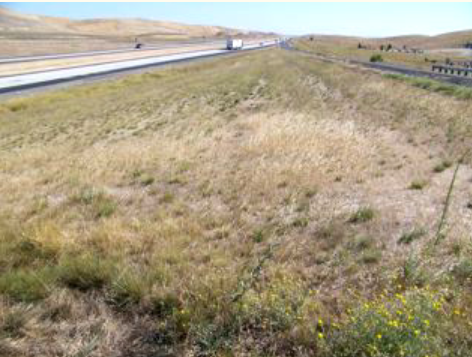
Dunnigan plot in August 2011, after 9 years of effort, described below. Source: https://www.ecoseeds.com/road.test.html
  • A team of academic scientists at UC Davis attempted to convert non-native grasses to native grasses on 2 acres of roadside.  At a cost of $450,000, they tried every available method (herbicides, plowing, plug planting, mowing, burning) for 9 years.  When they ran out of money, they declared success, which they defined as 35% native grasses that they expected to last for no more than 10 years. (See above)
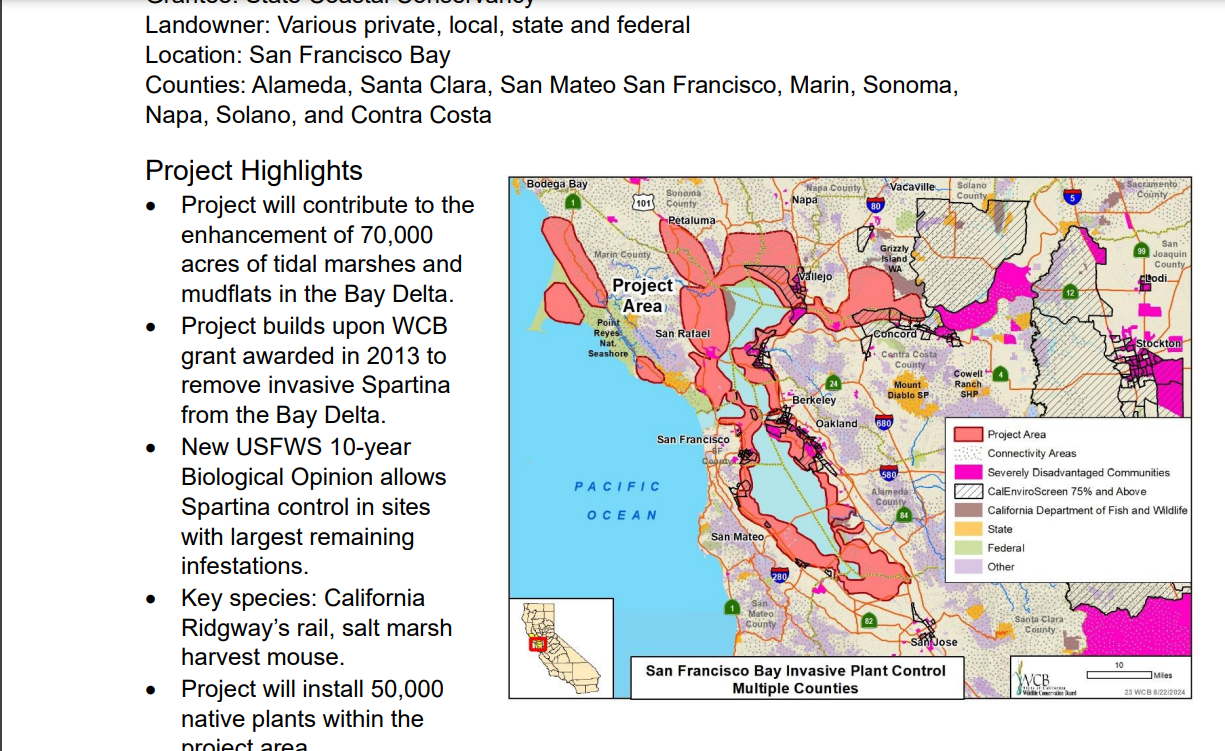
  • The Invasive Spartina Project in the San Francisco Bay has been trying to eradicate non-native spartina marsh grass with herbicide for 20 years at a cost of $50 million.  The project was recently granted another $6.7 million to continue the project for another 10 years.  The project has killed over 600 endangered birds (Ridgway rails) in the San Francisco Bay because of the loss of habitat. 
  • One of the presentations at the 2022 conference of the California Native Plant Society was about a 20-year effort at the Santa Rosa Plateau Ecological Reserve to convert non-native annual grassland to native grassland, using annual prescribed burns.  Many different methods were used, varying timing, intensity, etc.  The abstract for this presentation reports failure of the 20-year effort:  “Non-native grass cover significantly decreased after prescribed fire but recovered to pre-fire cover or higher one year after fire.  Native grass cover decreased after prescribed fire then recovered to pre-burn levels within five years, but never increased over time.  The response of native grass to fire (wild and prescribed) was different across time and within management units, but overall native grass declined.”  The audience was audibly unhappy with this presentation.  One person asked if the speaker was aware of other places where non-native grass was successfully converted to native grass.  The speaker chuckled and emphatically said, “NO.  I am not aware of any place where native grasses were successfully reintroduced.”
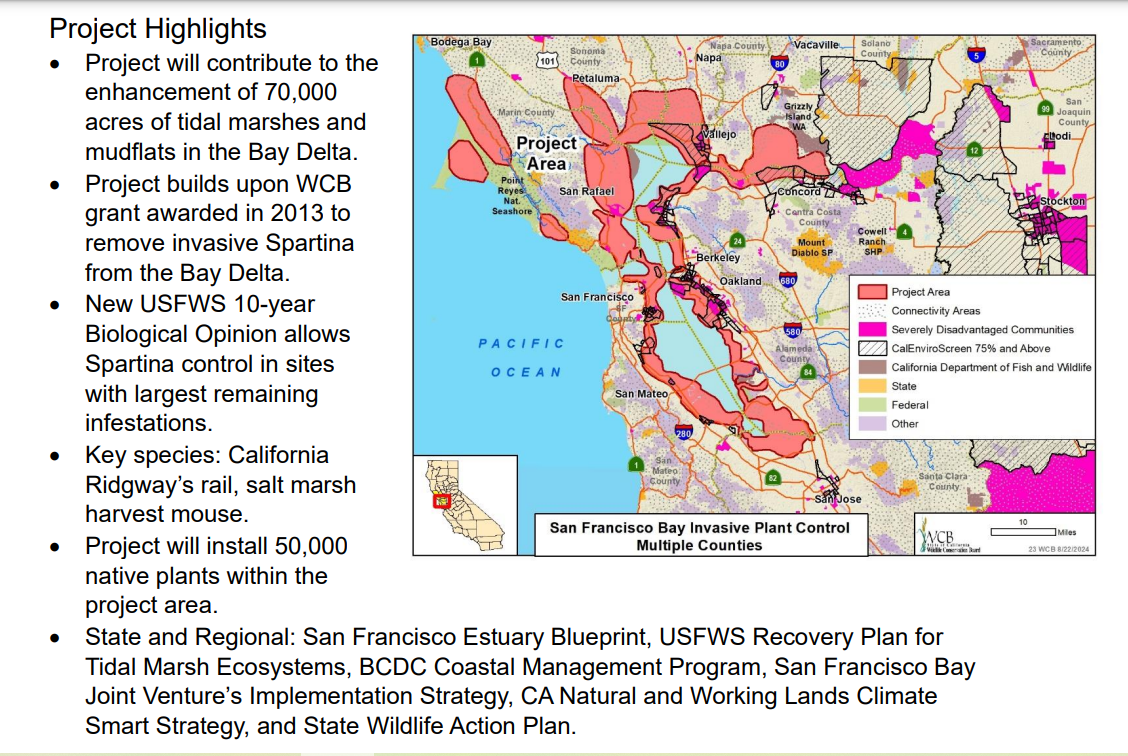
This map of the San Francisco Bay shows where herbicides have been sprayed on non-native marsh grass for 20 years. It is a BIG project!

Anyone with a little knowledge of how herbicides work, would know that glyphosate kills only the top-growth of an actively growing plant.  Glyphosate won’t kill the seed bank of Milbank’s hayfield, which he says has been growing there for decades, perhaps as long as 100 years.  That’s why glyphosate must be applied annually as the seed bank continues to produce new top-growth annually.  If Milbank plants native plants after the initial spraying, they will be killed by subsequent spraying because glyphosate is a non-selective herbicide, which kills whatever it touches, both native and non-native plants. Perhaps Milbank knows this, but his readers don’t.  It might explain why Milbank is not particularly optimistic about the prospects of achieving his goal of a native meadow:  “Will it work? I have no idea. It could become the field of my dreams…Or it could be a costly and time-consuming failure.”

Only two of Milbank’s readers mention the damage that herbicide does to the soil, making future plantings even less likely to survive.  One of those comments is from a farmer who has reason to know this important information: 

The number of things you screwed up, from possibly destroying that old man’s life, family, and farm, to messing up the winter food supply with a cascading effect for farms in your region, to obliterating a small farm, were appalling until you got to the part where you killed your soil microbes with poison. You actually killed topsoil with the idea you were going to grow healthy plants! If I were to write a caricature of a [sub]urbanite transplanted to a farming community and with the best intentions absolutely destroying everything, couldn’t have done any better than you have with your self-congratulatory actions. Farms are complex systems embedded in even more complex natural systems. Farms interact with and depend on each other. It’s where food comes from. When you kill one, you hurt all the others. You also hurt animals and plants that depend on the farm. Creating a farm, and a farming community, is hard. Destroying one is easy, and you just did it.”

This comment brought to mind a recent study about the damage that pesticides do to the soil.  A meta-analysis of 600 studies “…published in the journal iScience found that soil pollution was the leading cause of declines among organisms living underground. The finding has surprised scientists, who expected farming intensification and climate change to have much greater impacts.”  The co-author of the study said, “Above ground, land use, climate change and invasive species have the greatest impact on biodiversity, so we assumed that this would be similar below ground,” Victoria says. “Our results show, however, that this isn’t the case. Instead, we found that pesticide and heavy metal pollution caused the most damage to soil biodiversity. This is worrying, as there hasn’t been a lot of research into the impacts of soil pollution, so its effects might be more widespread than we know.”

A familiar story

Dana Milbank’s plans to transform a derelict farm into a native plant garden are the mirror image of the native plant movement in the San Francisco Bay, the region where I live and have observed failed native plant “restorations” for over 25 years:

  • Native plant “restoration” projects in the Bay Area began over 25 years ago based on the mistaken assumption that if non-native plants were destroyed, native plants would magically emerge without being planted.  In other words, nativists originally believed that the only obstacle to native plants was the mere existence of non-native plants.
  • After 25 years of applying herbicides repeatedly, there are no more native plants in the San Francisco Bay Area than there were 25 years ago.  The soil has been poisoned by herbicides and climate change and associated drought makes native plants progressively less well adapted to current environment conditions.
  • Despite the obvious failure of these “restoration” attempts, they continue unabated because vast sums of public money are available to keep them going.  Dana Milbank will run out of money eventually, but the public coffers are never empty.  Milbank is 56 years old.  When he gets too old to do the work or when he dies, whatever he has accomplished will quickly revert to its previous unmanaged state.  Nature will prevail and his brief conceit that humans can control nature will be history. 
  • The public is unaware of how much herbicide is used by public land managers because application notices are not required for most pesticides.  In California, for example, if the manufacturer of the pesticide claims that the pesticide will dry within 24 hours, application notices are not required by law.  Glyphosate is one of many herbicides for which application notices are not required.  Some land managers post application notices anyway, but many do not.  The public is also ignorant of the damage that pesticides do to the environment and everything that lives in it. 

Defining “Success” So That “Success” Can Be Achieved

I always attend the conferences of the California Invasive Plant Council (Cal-IPC) and the California Native Plant Society because I feel obligated to understand their viewpoint so I can accurately report on the controversies of invasion biology.  Ironically, the more I learn about the native plant movement and the “restoration” industry it spawned, the less … Continue reading “Defining “Success” So That “Success” Can Be Achieved”

I always attend the conferences of the California Invasive Plant Council (Cal-IPC) and the California Native Plant Society because I feel obligated to understand their viewpoint so I can accurately report on the controversies of invasion biology.  Ironically, the more I learn about the native plant movement and the “restoration” industry it spawned, the less sense it makes.  The October 2024 Symposium of the California Invasive Plant Council has provided yet more evidence that attempts to eradicate well-established non-native landscapes and replace them with native plants are futile.

Tricks of the “Restoration” Trade

Every Cal-IPC Symposium has wrestled with the question of how to convert non-native grassland to native grassland. A study of 37 grassland “restorations” in coastal California answers that question. (1)  It’s really quite simple.  All you need to do is define success as 25% native plants after “restoration” and limit post-project monitoring to 5 years or less:  “Monitoring is done ≤5 years after project-implementation, if at all, and rarely assesses the effects of management practice on project success.” 

It also helps if public land managers in charge of the projects won’t allow the academic researcher to enter the land to conduct a survey of the results.  43% of the projects that were studied were “statutory,” i.e., they were mandated by laws such as county general plans or legally required mitigation for projects elsewhere that Environment Impact Reports determined were harmful to the environment.  30% of the managers of the statutory projects would not allow the academic researcher to survey their projects. 

It is also easier to achieve success if the project goal is downgraded mid-project as were many of the statutory projects because they weren’t able to meet the original goal.

Project managers can also reduce their risks of failure by planting a small number of native species that are particularly easy to grow:  “Ninety-two percent of restoration managers preferentially use one or more of the same seven [native] species.”  Seven projects planted only one native species. 

According to the study, the result of planting only a few hardy native plants is “biotic homogenization.”  Call it what you will, but this risk-averse strategy is inconsistent with claims that the goal of native plant restorations is to increase biodiversity. 

The study did not ask project managers about the methods they used to eradicate non-native plants or plant native plants.  The study tells us nothing about the methods that were used or whether or not some methods were more effective than others.  Since results of the projects were all very similar, should we assume that the methods that were used didn’t matter? 

The presentation of this study concluded with this happy-face slide. (see below) It looks like a cartoonish marketing ad to me:

Harmless aquatic plants being pointlessly eradicated

A USDA research ecologist stationed at UC Davis made a presentation about the most effective way to kill an aquatic plant with herbicides, but that wasn’t the message I came away with. 

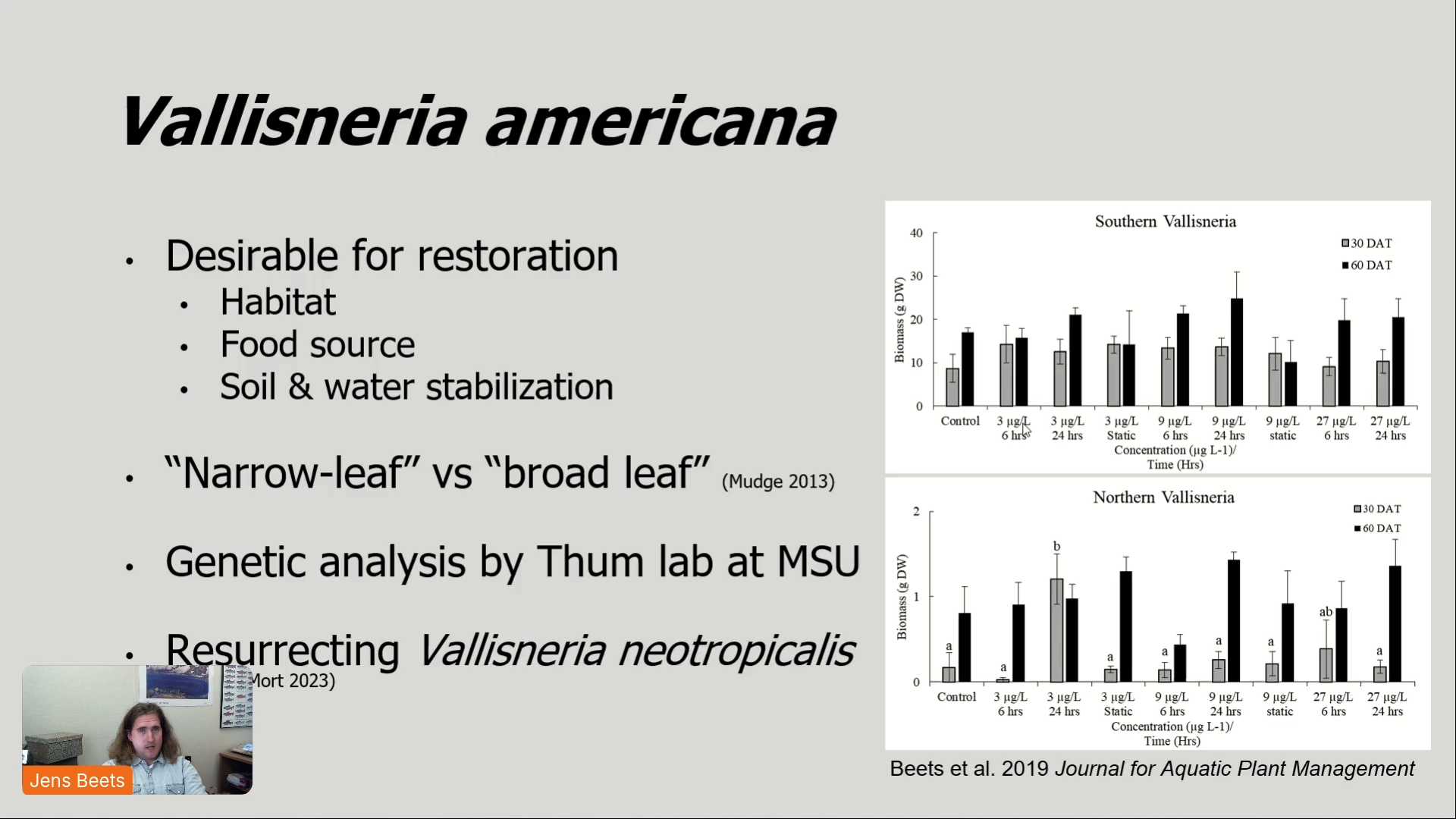
Jens Beets told us about a species of aquatic plant that is native to the East and Gulf coasts of the US, but is considered a “noxious weed” in California, solely because it isn’t native.  He said the plant is considered very useful where it is native.  (see below)

Where Vallisneria americana is native, it is considered a valuable plant for habitat restoration because it is habitat for vertebrates and invertebrates and it stabilizes soil and water levels.  The canvasback duck is named for this plant species because it is preferred habitat for the native duck that is found in California during the winter.

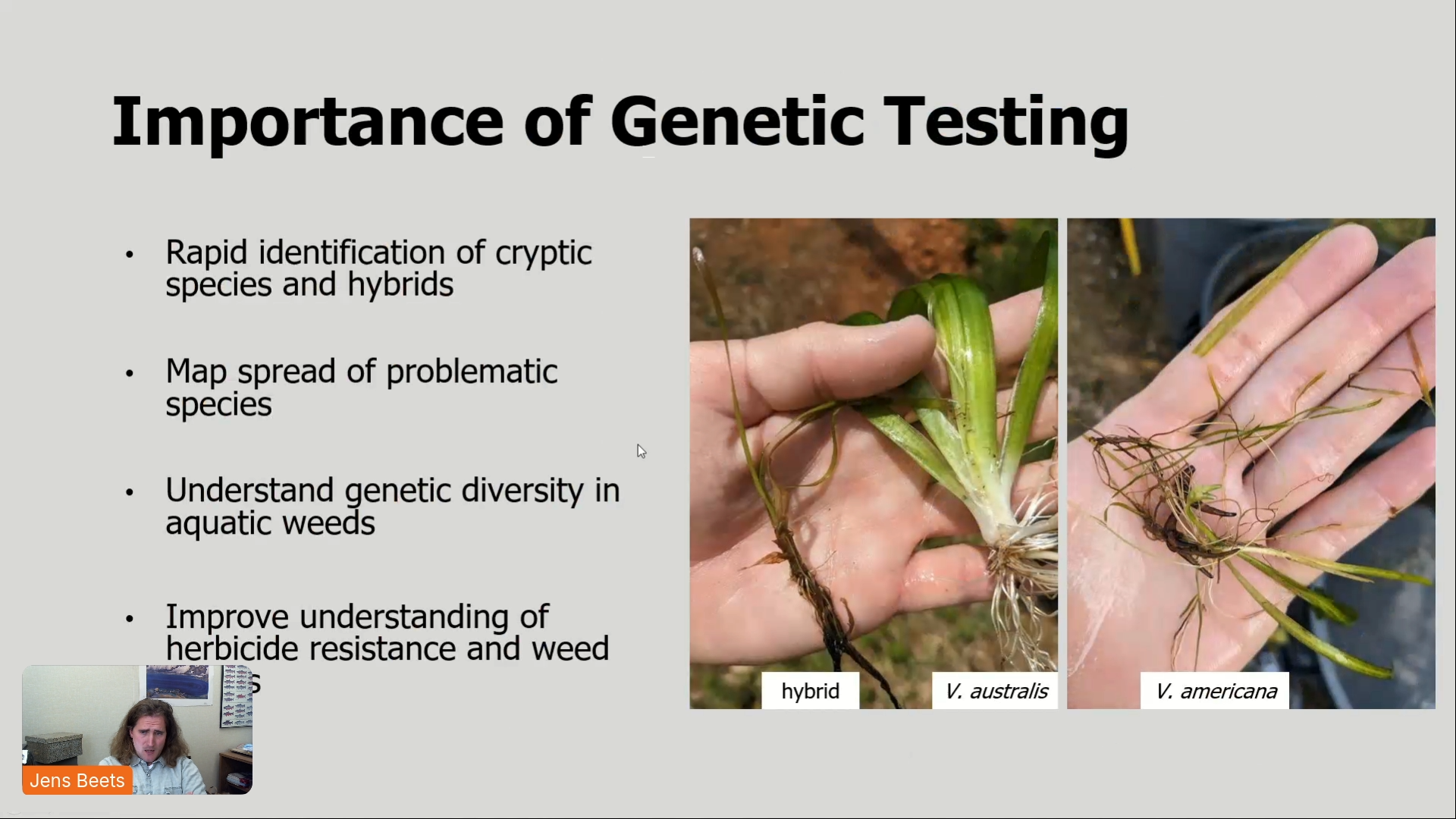
 Vallisneria americana looks very similar to other species in the genus considered native in California.  For that reason, native species of Vallisneria have been mistakenly killed with herbicide because applicators didn’t accurately identify the target plant as native.  Jens Beets recommended that genetic tests be performed before plants in this genus are sprayed with herbicide.

This story probably sounds familiar to regular readers of Conservation Sense and Nonsense.  The story is identical to the pointless and futile effort to eradicate non-native species of Spartina marsh grass in the San Francisco Bay.  The species being eradicated in California is native to the East and Gulf coasts, where it protects the coasts from extreme storm surges and provides valuable habitat for a genus of bird that is plentiful on the East Coast, but endangered in California.  The 20-year effort to eradicate non-native Spartina has killed over 50% of the endangered bird species in the San Francisco Bay. 

Throwing good money after bad

Because the hybrid is indistinguishable from the native species of Spartina on the West Coast. 7,200 genetic tests have been performed in the past 12 years before hybrid Spartina was sprayed with herbicide. Taxpayers have spent $50 million to eradicate Spartina over 20 years.  Recently, California state grants of $6.7 million were awarded to continue the project for another 10 years.  A portion of these grants are given to the California Invasive Plant Council to administer the grants.

Plants are sprayed with herbicide because they aren’t native, not because they are harmful.  Even if the target species is needed by birds and other animals, it is still killed and animals along with it.  The target species looks the same as the native species and only genetic testing can identify it is as a non-native.  The non-native is the functional equivalent of the native.  It is only genetically different because natural selection has adapted it to the conditions of a specific location. 

Pesticide regulation in the US is a hit or miss proposition

The final session of the symposium was a carefully orchestrated apologia for herbicides, a defensive tirade that suggested Cal-IPC believes its primary tool is in jeopardy.  Two presentations were made by employees of regulatory agencies.  Their assignment was to reassure the public that pesticides are safe because they are regulated by government agencies. 

The fact that many countries have banned pesticides that are routinely used in the US does not speak well for our regulatory system.  America’s pesticide regulators rarely deny market access to new pesticides.  A recent change in policies of California’s Department of Pesticide Regulation made a commitment to the continued use of pesticides for another 25 years. 

In 1996, Congress ordered the U.S. Environmental Protection Agency (EPA) to test all pesticides used on food for endocrine disruption by 1999. The EPA still doesn’t do this today. Twenty-five years later, the EPA has not implemented the program, nor has it begun testing on 96% of registered pesticides.  In 2022, an organization that represents farm workers sued the EPA to conduct the legally mandated evaluation of chemicals.   The lawsuit has forced the EPA to make a commitment to conduct these evaluations of chemicals for hormone disruption.   

The Cal-IPC presenters got some badly needed push back from attendees.   One attendee informed the audience that all the testing of herbicides is bought by the manufacturers, not the regulators who don’t do any testing.  Another attendee pointed out that herbicides have not been evaluated for the damage they are doing to the soil, damage that makes it difficult to grow native plants in the dead soil.  The “pesticide regulator” agreed with those observations.

Fire safety or native plant restoration?

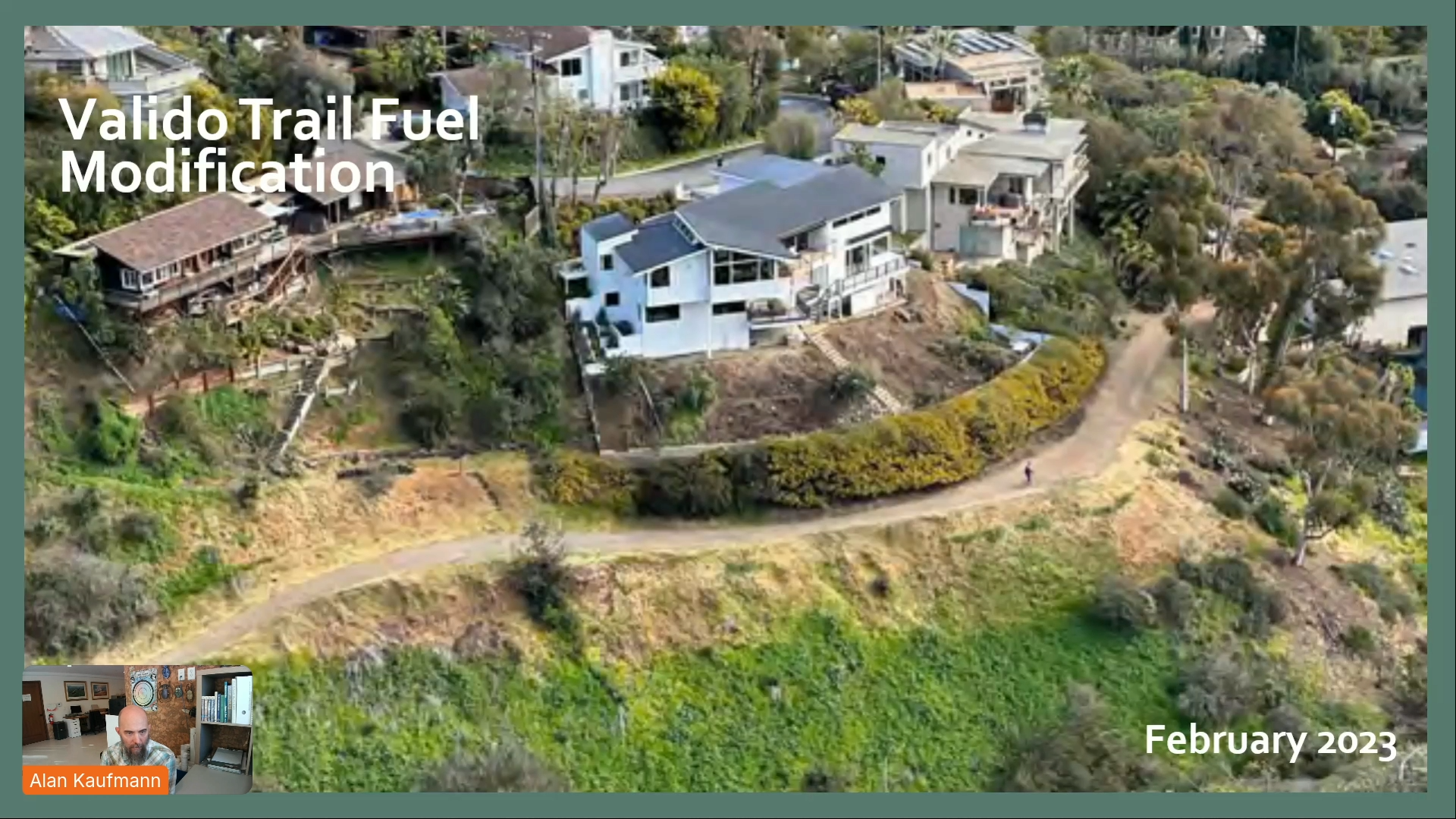
The Interim Deputy Director of the Laguna Canyon Foundation was the final presenter for the Symposium, speaking on a Friday afternoon at 4:30 pm, when there were less than 100 attendees left of the 690 registrants.  His presentation was about the blow back that his organization gets from the public about herbicide applications.  Criticism of herbicides escalated after a wet year that increased vegetation considered a fire hazard.  This photo (below) is an example of the visible effects of fuels management by Laguna Canyon Foundation using herbicides.

It seems likely that a fuels management project was selected for this presentation because it’s easier to justify herbicide use for fuels management than for eradicating harmless plants solely because they aren’t native. 

I recently supported Oakland’s Vegetation Management Plan that will use herbicides for the first time on 300 miles of roadsides and 2,000 acres of public parks and open space in Oakland.  Previously, herbicide applications were only allowed on medians in Oakland.  I tracked the development of the Vegetation Management Plan for 7 years through 4 revisions to avoid nativist versions of fuels management such as leaving dead thatch after herbicide applications on grassland or destroying non-native trees, while leaving highly flammable bay laurel trees behind or destroying broom, while leaving more flammable coyote brush behind.

However, using herbicides for the sole purpose of killing non-native plants is much harder to justify.  The irrational preference for native species has put us on the pesticide treadmill. Every plant species now targeted for eradication with herbicides should be re-evaluated, taking into consideration the following criteria:

  • Is it futile to attempt to eradicate a plant species that is deeply entrenched in plant communities?
  • Will the attempt to eradicate the plant species do more harm than good?
  • Is the targeted plant species better adapted to current environmental and climate conditions?
  • Is the targeted non-native plant making valuable contributions to the ecosystem and its animal inhabitants?

If these questions cannot be satisfactorily answered, the bulls-eye on the targeted plant should be removed. Limiting the number of plants now being sprayed with herbicide is the only way to reduce pesticide use. If the plant isn’t a problem, there is no legitimate reason to spray it with herbicide.

Pot calls kettle black

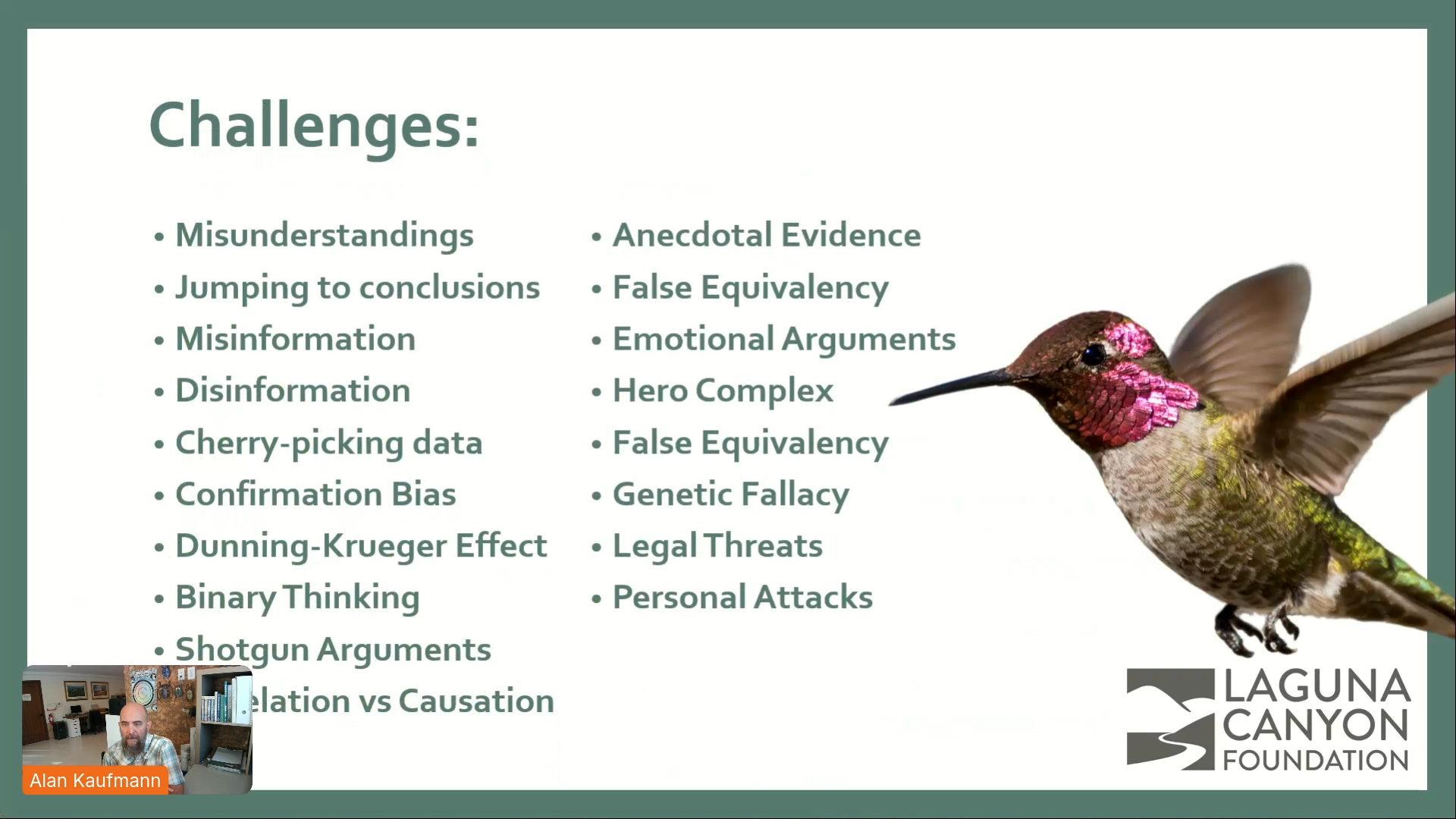
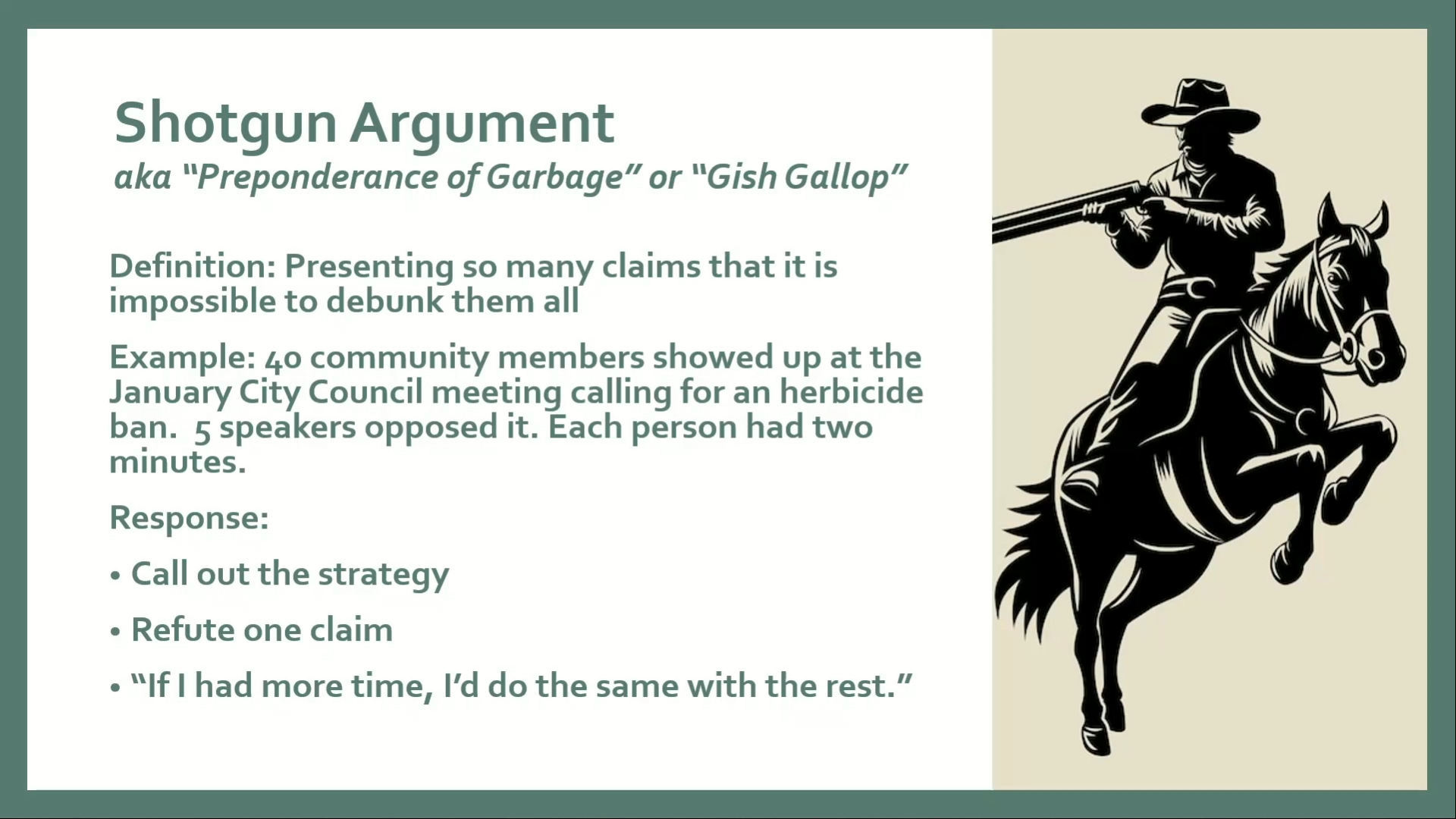
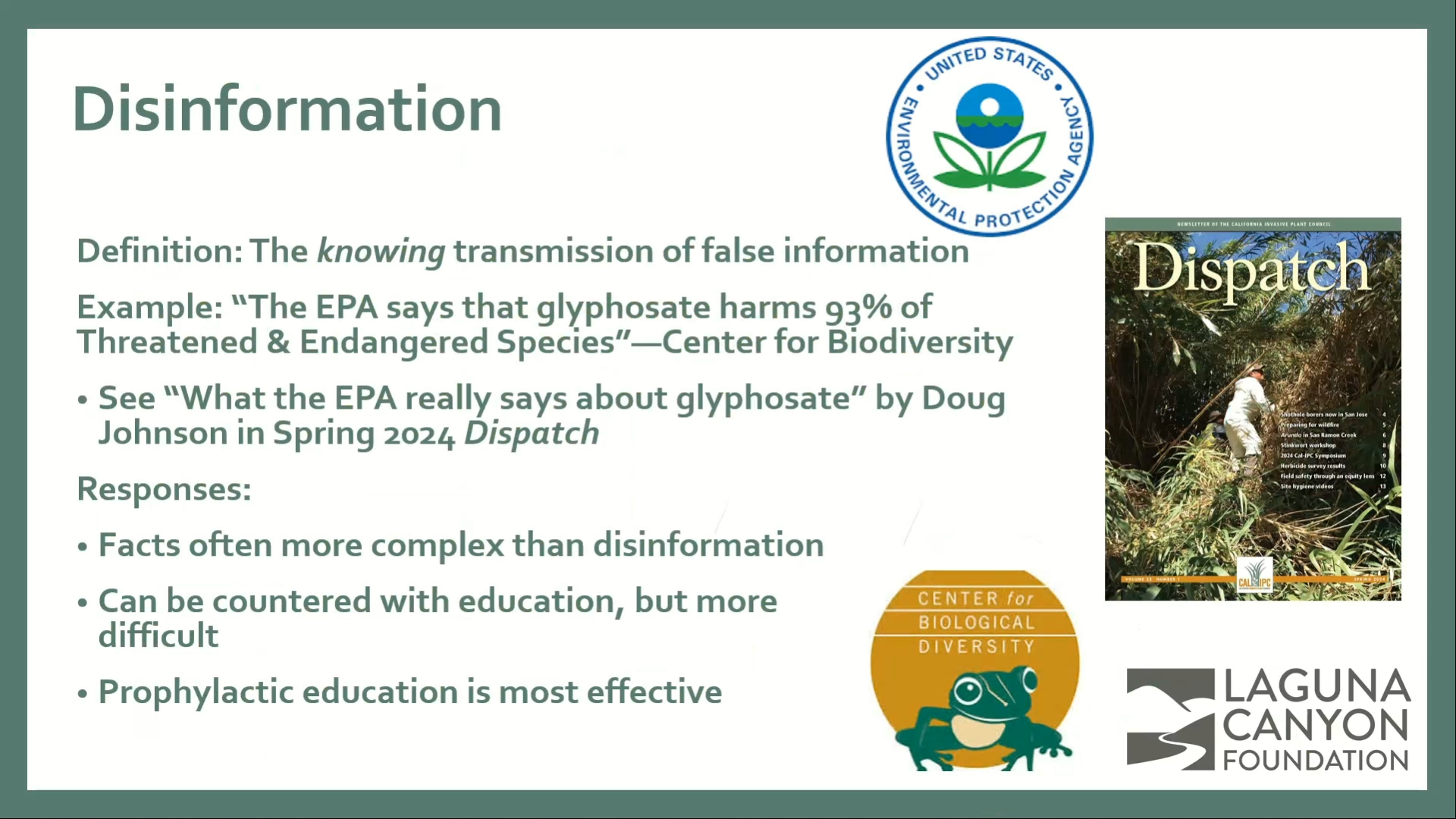
The Cal-IPC presentation was a detailed criticism of the public’s complaints about herbicides used in their community.  The intention of the presentation was to arm herbicide applicators with defenses against the public’s complaints.  Herbicide applicators were encouraged to recognize these arguments (below) and participate in the “education” of the public about the righteousness of their task.

The presenter then showed a series of slides making specific accusations, such as these:  (see below)

Those who object to the pointless destruction of nature can also cite similar distortions and misrepresentations of facts (AKA lies) by those who engage in these destructive projects;

  • Nativists fabricated a myth that eucalyptus kills birds to support their demand that eucalyptus in California be destroyed.  There is no evidence that myth is true
  • Nativists also fabricated a myth that burning eucalyptus in the 1991 firestorm in the East Bay cast embers that started spot fires 12 miles away from the fire front.  There is no evidence that myth is true.
  • Nativists exaggerate the success of their projects by setting a low bar for success, conducting no post-project monitoring, and restricting access to their completed projects.  
  • The EPA justified the dumping of rodenticides on off-shore islands by inaccurately claiming that the rodenticides do not end up in the water, killing marine animals.  There is ample evidence that island eradications have killed many marine animals because rodenticide lands in the water when applied by helicopters. 
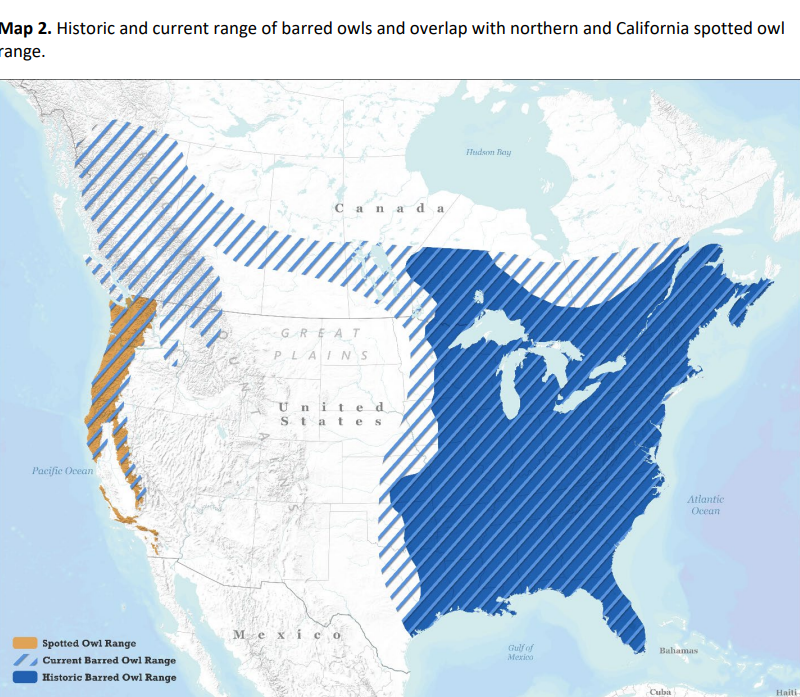
  • USFWS justified the killing of 500,000 barred owls in western forests by claiming they are an “invasive species.”  In fact, barred owls migrated from the East to the West Coasts via the boreal forests of Canada.  These forests were not planted by humans and have existed since the end of the last Ice Age, some 10,000 years ago.  The arrival of barred owls on the West Coast was a natural phenomenon.  Barred owls are therefore not “invasive species.” In a rapidly changing climate, many animals must move to survive.
  • Nativists claim that most insects are “specialists” that require native plants.  That claim is a gross exaggeration of the dependence of insects on native plants, which are sometimes confined to a family of plants containing thousands of both native and non-native species. 
  • Pesticide applicators also complain about “personal attacks.”  They are not alone.  I (and others) have been called “nature haters,” “chemophobes,” and “climate change deniers.”  Pesticide applicators feel abused.  So do I. 

I could go on.  The list of bogus claims of the superiority of native plants and animals is long and getting longer as more and more public money is available to conduct misnamed “restorations.”  Suffice to say, there is plenty of misinformation floating around invasion biology and most of it is used to defend destructive “restoration” projects.  The war on nature is also a war of words. 


(1) ­Justin Luong, et.al., “Lessons learned from an interdisciplinary evaluation of long-term restoration outcomes on 37 coastal grasslands in California.” Biological Conservation, February 2022.

The Light Eaters: Plants will find a way to survive…if we let them

“Life finds a way, if given a chance.” – The Light Eaters

The Light Eaters was written by Zoë Schlanger, a science journalist who covered climate change before writing Light Eaters. (1)  She explains her pivot to botanical science as a retreat from the oppressive gloom of climate change.  It proved a wise choice, as she found much to cheer us in the remarkable capabilities of plants to adapt to challenges, defend themselves against their predators and competitors, and collaborate with their plant and animal neighbors. 

Ms. Schlanger believes that botanical research has lagged behind other biological inquiry partly because of a detour unwisely taken by journalists in the 1960s and 70s that projected human traits onto plants, such as intelligence and consciousness.  Humanizing animals and plants is considered a dangerous source of bias by scientists.  When scientists described plant behavior in human terms, they were often ridiculed by their colleagues and their research projects weren’t funded.  Researchers of the capabilities of plants have been trained to avoid anthropomorphic terms to describe plant behavior.  Although Ms. Schlanger tried to observe that rule, I will give myself more leeway because most of my readers are not scientists.

Plants don’t have the mobility that enables them to fly or run away from threats.  We might think of them as handicapped compared to the mobility of animals.  But what they lack in mobility, they more than make up for with their ability to make they own food from sunlight by photosynthesizing. And with the energy that sunlight provides, plants can create the food—such as pollen, nectar, and fruit—that entices insects and other animals to help them reproduce.  So how do plants protect themselves without fleeing from their predators?  That’s what Light Eaters is about.

I don’t know the source of this photo. It was sent to me in an email by someone who found it on Facebook.

How do plants perceive threats and react to them?

Plants can sense that they are being attacked by an insect in a variety of ways.  They can sense the vibration of the chewing, which is closely related to how animals hear.  The attack can also trigger an electrical impulse which can travel throughout the entire plant. 

Plants emit chemicals in response to the attack on their leaves and roots. The chemicals can repel the insect by making the plant unpalatable.  In a sense, the plant is producing its own pesticide, which has the potential to replace synthetic pesticides. 

The chemicals are also wafted into the air to serve as warning signals to their plant neighbors, who can then produce their own chemicals in preparation for attack. Some plants can distinguish between an attack that threatens individuals and those that threaten the entire community. They can tailor their warning messages accordingly, to send messages only to their relatives or to the entire plant community.  When plants are sprayed with herbicides, these chemical messages are masked by herbicides. (2)  Likewise, pollution can also muddle the chemical messages of plants and reduce their ability to perceive and respond to threats. (3)

Plants sometimes demonstrate a preference for their relatives in other functions as well.  They can make room for the roots of close by relatives and move branches to avoid shading their relatives.  They can also vary these accommodations depending on available resources, making room when there is plenty of water, nutrients, and light, but not when there’s not enough.

Such warning signals can also be sent via the underground root network, which connects plants in a community to one another through the network of mycorrhizal fungi that attach themselves to plant roots.  That network is also used by the community of plants to share resources, such as moisture and carbohydrates produced by photosynthesis.  The fungal network enables both communication and sharing of resources.  Herbicides that are carried to the roots of trees damage the fungal network, depriving trees of the nutrients they need to survive. (4) The widespread use of these herbicides by native plant “restorations” is one of many reasons why these projects rarely result in new landscapes of native plants. 

Can plants hear?

One of the first discoveries of the ability of plants to find what they need is the ability of tree roots to grow in the direction of water sources.  Mycorrhizal fungi attached to the roots of plants are clearly involved in guiding that connection.  Over 450 million years ago, the evolution of fungi enabled plants to move from water to land by delivering moisture from soil to roots of plants, greatly increasing abundance and diversity of plants. About 80% of plants today receive much of their nutrients and moisture through mycorrhizal fungi. (5)

Now there is evidence that plants may also be able to hear the sound of water to direct the growth of roots.  The researcher who made that discovery encased the roots of a plant in plastic pipe so that the roots could not sense the availability of moisture.  The plastic pipe formed a “Y” to give the roots the option of growing in one direction or the other.  The researcher played a recording of running water at the end of one pipe.  The roots grew in the direction of the recording of running water.  This is still a controversial discovery, because other researchers have found it difficult to replicate. 

The replication of breakthrough scientific discoveries is one of the ways that science moves forward.  It is a not a reliable method of confirming or rejecting a new discovery because there are always many variables operating simultaneously that are difficult to control, particularly in field studies, and researchers have rarely identified all the variables involved in the phenomenon they are observing.

The academic career of David Rhoades is an example of the dangers of being too far ahead of your academic colleagues and a reminder of the conservatism inherent in academic science.  Rhoades was a chemist at University of Washington and the author of a study that made the first report of warning signals that plants under attack send to their neighbors via volatile chemicals in the atmosphere. 

The forest on Rhoades’ campus was being killed by tent caterpillars.  He studied the spread of the caterpillars until the insect infestation was stopped by the chemicals that the unaffected trees infused into their leaves.  The chemicals killed the caterpillars and the spread of the insect in the forest was stopped.  Backed by a mountain of carefully accumulated data, Rhoades concluded:  “This suggests that the results may be due to airborne pheromonal substances!”

Rhoades was met with resistance to this new information from his colleagues.  Then he had trouble replicating his original study.  When his grant applications were rejected, he gave up.  He left academia and taught chemistry in a local community college to make a living.  Years later, other researchers figured out why he was unable to replicate his original study.  The airborne chemicals that trees produce are seasonal.   Rhoades’ original study was done in the spring and Rhoades was trying to replicate the study in the fall.  The scientists who eventually confirmed Rhoades’ finding did so in the laboratory where conditions are easier to control.

Plants collaborate with animals to protect themselves and reproduce

The Light Eaters reports many remarkable observations of interactions of plants and animals.  Here is a sampling of these stories:

  • If bumblebees emerge from hibernation before plants begin to bloom, the hungry bee bites the plant’s leaves to trigger the bloom that delivers the nectar the bees need.
  • Plants must use their limited resources to make pollen and nectar.  Some plants can ration the delivery of the pollen and nectar that attracts their pollinators by timing the delivery with the anticipated arrival of the pollinator.  The plant estimates the time of arrival of the insects based on its memory of past visits. 
  • Bats find the plants they pollinate by using echolocation sonar to locate them in the dark.  Some plants that are pollinated by bats have evolved saucer-like petals that act like a satellite dish to receive the sonar ping to help bats find them. 
  • Some corn, cotton, tomato and tobacco plants can emit chemical distress signals to summon tiny parasitic wasps to kill caterpillars such as tobacco budworm and corn ear worm.
  • Many orchids are pollinated by wasps.  Some orchids attract wasps by mimicking the chemical pheromones of the female wasp.  The orchid is pollinated by the attempt of the male wasp to mate with what he supposes is a female wasp.
  • Some plants form partnerships with ants by secreting a sugary substance that feeds the ants, who eat the insect predators of the plant. 

Can plants see?

The observation that plants are capable of mimicking animals and other plants is not new.  In the early 1900s, a Russian agronomist observed that weeds in food crops have sometimes mimicked the food crop and thereby evaded the hand-weeding that was the method used by farmers to eliminate competition for their crop.  Rye, oats, and lentils were initially considered weeds of wheat and rice.  Over time, they evolved the seed heads that qualified them as food crops. 

More recently, weeds that are killed by herbicides within crops that have been genetically modified to be resistant to the herbicide have engaged in mimicry at the biochemical level to also become resistant to the herbicide.  Those who engage in chemical warfare against plants do not seem to understand that it’s a war they can’t win because evolution will enable plants to develop resistance to their poison. 

Like many of the remarkable capabilities of plants, scientists can observe the phenomenon, but they are rarely able to explain the mechanism that makes it possible, beyond the evolutionary force of natural selection, which achieves a better adapted plant or animal through a series of mutations and genetic and epigenetic drift.  Each change in the species is a trial balloon.  If the change works, it’s a keeper.  If it doesn’t, it’s in the dustbin with some 99% of the estimated 5 billion species that have lived on Earth.  The dominant evolutionary force is random, irrepressible, complex change.  The notion that humans are capable of stopping evolution is absurd.

In 2014, a Peruvian ecologist discovered a vine in the Chilean rain forest that is capable of quickly taking on the shape of almost any plant that it grows beside.  Nicknamed the chameleon plant, many tests proved that the vine can mimic many different species of plants.  Presumably this mimicry enables the vine to become invisible in the sense that it blends in with whatever plants it grows amongst.  It’s a disguise, if you will, that protects the plant from its predators. 

The chameleon vine is able to mimic plants that are native to their locations as well as plants that are foreign to the region.  In other words, mimicry is not the result of a long evolutionary co-existence.  This finding is another blow to the nativist myth that plant and insect associations are the result of co-evolution that makes insects dependent on native plants.  The associations between plants and insects evolved long before the plants and insects moved into new regions.  Plants and insects retain that association as they change in response to their new environment and as the result of mutations and genetic drift. 

Until recently, there was a debate among scientists about how the chameleon plant morphs itself into an entirely different shape.  One school of thought speculates that plants have an organ that performs much like our eyes.  Another school of thought is that horizontal gene transfer (6) from the bacteria inhabiting the plant being copied to the plant doing the copying achieves this transformation. 

A study (7) published in 2022 seems to support the hypothesis that some plants have some type of organ that functions like our eyes.  The study found that the chameleon vine was capable of mimicking an artificial leaf.  The plastic leaf contains no chemicals or bacteria. 

In conclusion

The Light Eaters reports many other capabilities of plants that aren’t covered in this article.  If it’s a topic of interest to you, the book is well worth reading.  It’s well researched and well written.  It is also thoughtful because it asks us to ponder the philosophical question of whether or not this new(ish) knowledge of plants adds up to intelligence, consciousness, and agency.  Ms. Schlanger dodges that question by reminding us that there is not consensus agreement about what any of those descriptions actually mean.

Now we must add a few caveats that we hope will put this important topic into perspective:

  • Not every plant species has all of the capabilities described in The Light Eaters.
  • Those that do have such capabilities may not consistently use them because every plant is responding to a specific environment in a specific place.  Plants are inseparable from their environment.  A plant that has plenty of water and plenty of light behaves differently than plants with less resources.  Sweeping generalizations about plants are usually ridiculous.  For example, it makes no sense to claim that native berries are more nutritious than non-native berries. (8)
  • Plants have the potential to develop such capabilities, depending on their specific circumstances.
  • Without a brain or a nervous system, plants seem to organize a response to stimuli by functioning as a decentralized network.    

The Light Eaters says as much about science as it does about plants.  There are fads in science, just as there are fads in every human endeavor.  Presently, much scientific investigation of botanical phenomenon is focused on genetics, which has misled the public to underestimate the plasticity of plants and animals.  In fact, the genome of a species is a flexible repertoire, with many genes unexpressed until triggered by a change in the environment in which the plant lives.  For many characteristics of species, the environment is a more powerful influence than genes. 

Science is better at observing than it is at explaining.  Explaining requires speculation and academic science studiously avoids speculation.  The reader of scientific studies is often left in a quandary.  Conclusions are often a contradictory list of maybes with a plea for funding for further investigations. That’s one of many reasons why science journalism is important to the general public’s understanding of scientific issues.  Ms. Schlanger goes out on a limb for us by speaking in comprehensible terms that many scientists refuse to use.  Thank you, Ms. Schlanger, for helping the public understand the plant world.


Shortly before publishing this article and after I had drafted my article, I received the following review of The Light Eaters from Arthur M. Shapiro, Professor Emeritus of Ecology and Evolution, UC Davis.  He has given permission to add his review to my article.
– Conservation Sense and Nonsense

Elizabeth Kolbert has a collective review of Schlanger and two other, similar books–“The Nation of Plants” by Gregory Conti and “Planta Sapiens” by Calso and Lawrence–in the new NY Review of Books (Oct.3). Her review is only lightly snarky because it’s clear she doesn’t know quite what to make of the “plant neurobiology” fad.

“When I read Schlanger (I haven’t read the others) I dug back into my library to find my copy of “The Secret Life of Plants” by Peter Tompkins and Christopher Bird (1973). I doubt that Kolbert realizes that the current fad is a rerun of the 70s!  Unlike Schlanger and perhaps the others reviewed by Kolbert, Tompkins and Bird is packed with overt woo-woo and makes little attempt to be “science-based.” The frank woo-woo is very 70s. But the underlying motivation for both waves is the same: philosophical panpsychism, the notion that consciousness is ubiquitous in Nature.

“There is nothing in the actual data discussed by Schlanger that obliges one to embrace panpsychism. The main reason to do so is that one WANTS to. That is, for some (many?) people it is very reassuring to believe that at least the biosphere, if not the entire universe, is sentient. (This has resonances with the Gaia Hypothesis.) This notion is an integral part of a number of cultural cosmologies, of which the most familiar to most Americans is probably Native American, broadly speaking. In the 70s many hippies embraced the Native American notions of “tree people,” “stone people,” etc. Some still do.

“Remember that I have taught community ecology for some 50 years, with an emphasis on coevolution. Things like inducible anti-herbivore defenses (chemical or morphological) and communicable defensive messages (plant pheromones, if you will) come as no surprise. Rather, they are predictable consequences of natural selection: if something can evolve, it probably will.  There is no logical necessity to invoke intelligence or consciousness to account for them. If you want to, go right ahead. But don’t call it science!

“I have never had a chance to pull up a mandrake plant. In the Middle Ages it was widely believed that if you did it would shriek, and the sound if heard would drive one mad. Thus one must cover one’s ears when doing so. Now, that is framed as a testable hypothesis!

“Are you familiar with the walking fern? If not, Google it. I am very fond of it, but never for a moment would I claim it has the property of wanderlust.

Arthur M. Shapiro, Professor Emeritus of Ecology and Evolution, UC Davis


  1. Zoë Schlanger, The Light Eaters: How the Unseen World of Plant Intelligence Offers a New Understanding of Life on EarthHarper Collins, 2024. The Light Eaters is the source of information in this article unless otherwise noted.
  2. Behrend*, J.E., & A.L. Rypstra (2018) Contact with a glyphosate-based herbicide has long-term effects on activity and foraging of an agrobiont wolf spider.  Chemosphere 194:714-721   doi: 10.1016/j.chemosphere.2017.12.038
  3. “Polluted Flowers Smell Less Sweet to Pollinators,” New York Times, February 16, 2024
  4. K. Hage-Ahmed, “Arbuscular mycorrhizal fungi and their responses to pesticides,” Pest Management Science, September 25, 2018
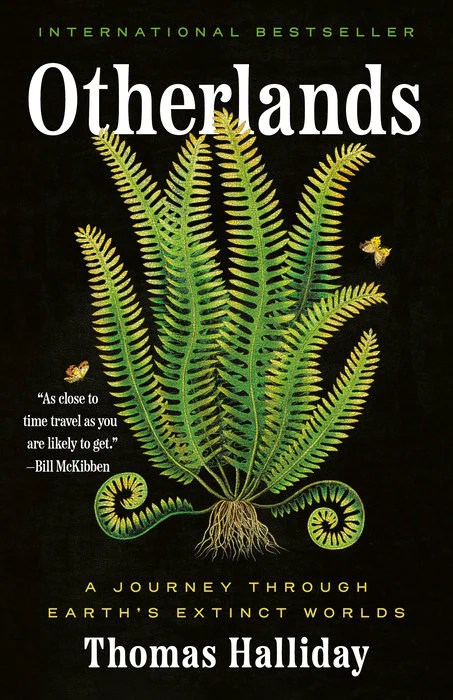
  5. Thomas Halliday, Otherlands, A Journey Through Earth’s Extinct Worlds, Random House, 2023
  6.  Conservation Sense and Nonsense, “All Life on Earth is Related
  7. Jacob White and Felipe Yamashita, “Boquila trifoliolata Mimics leaves of an artificial plastic host plant,” Plant Signaling Behavior, 2022
  8. Conservation Sense and Nonsense, “Baseless Generalizations in Doug Tallamy’s Nature’s Best Hope”

The Forever War on Non-Native Plants

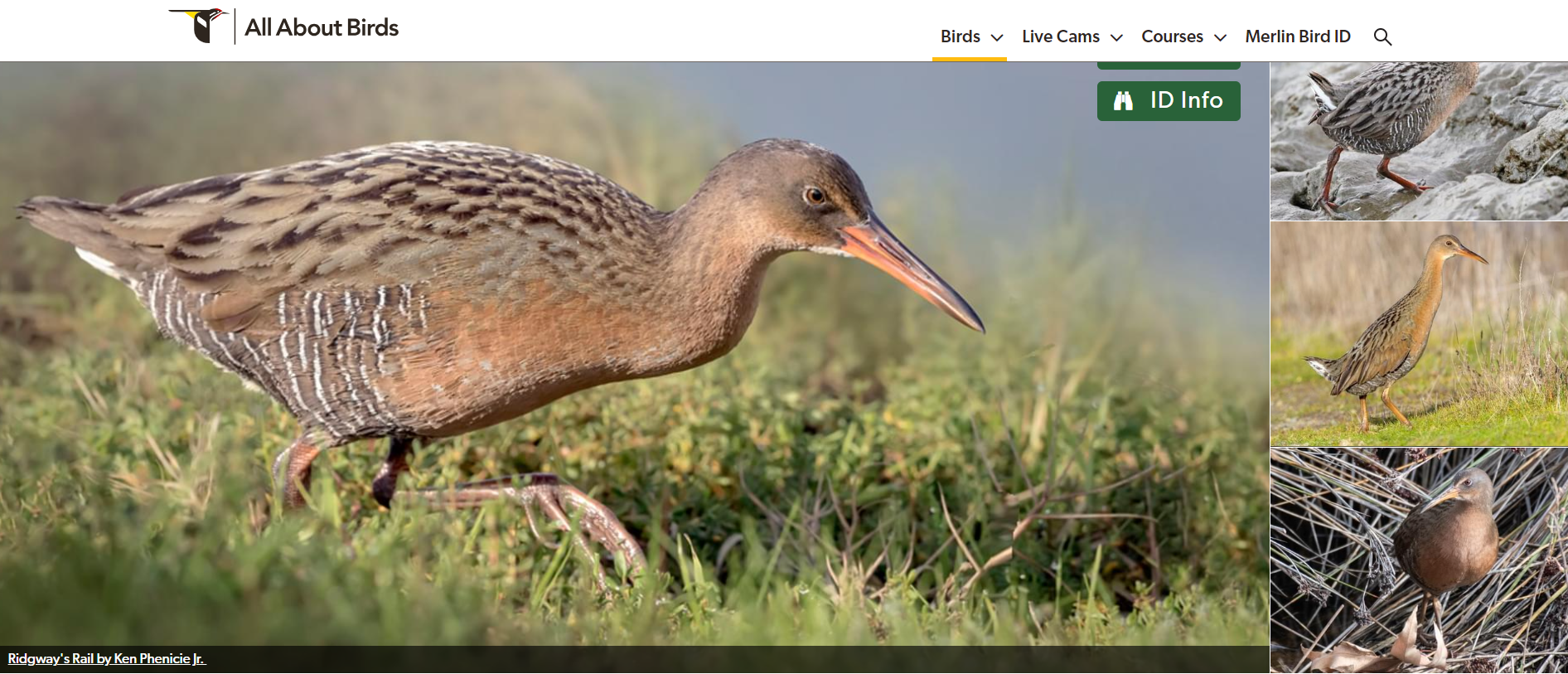
I spoke to California’s Wildlife Conservation Board at their August 2024 meeting about the Invasive Spartina Project. I asked the Board not to fund the eradication of non-native spartina and its hybrid, using herbicide. This project, which began 20 years ago, had cost over $50 million by 2023. (1)  Non-native spartina, native to the East and Gulf coasts (2), provides crucial habitat for Clapper rails (3), closely related to our endangered Ridgway rails.

Source: Cornell Laboratory of Ornithology

Non-native spartina grows taller, denser, and doesn’t die back in winter as native spartina does. Because early aerial spraying of herbicide eradicated most non-native spartina by 2010, Ridgway rail populations declined by 50% due to habitat loss. (4)

The project was temporarily paused in 2014 to plant native marsh plants and stabilize rail populations. When the project was resumed in most places the rail population continued to decline from 2018-2023. There were approximately 1,200 Ridgway rails in the Bay estuary before the project began. (5)  The most recent survey in 2022 found about 500. (6)

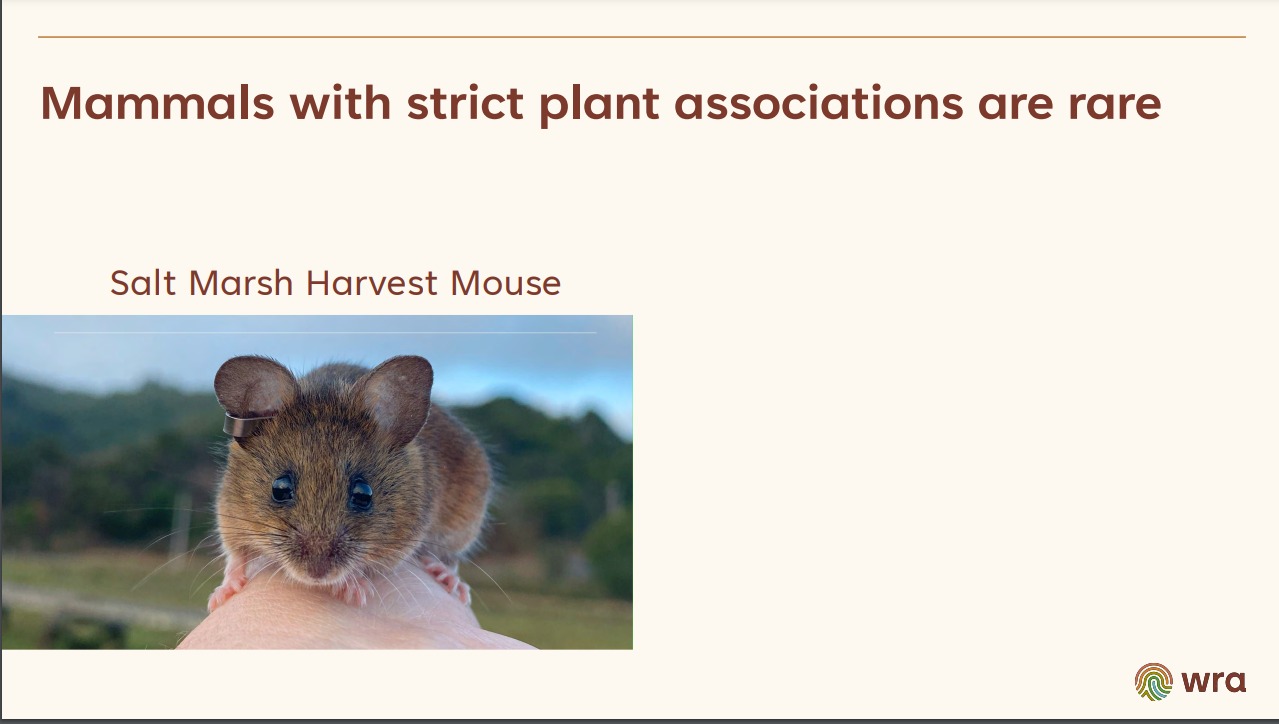
Native pickleweed was planted based on the mistaken assumption it would benefit endangered salt marsh harvest mice.  Recent studies show there are more mice in areas with less pickleweed and they eat both native and non-native plants. (7)

For the past 10 years, the focus has been on eradicating a hybrid of spartina, though it is indistinguishable from native spartina and 7,200 genetic tests were required from 2010 to 2022 to identify it. Hybridization is a natural evolutionary process that supports natural selection. (8)

Hybrid spartina could help to protect the Bay’s shoreline as sea level rises and extreme storm events cause erosion.  Where it is eradicated, gaps in vegetation are difficult to revegetate because the herbicide (imazapyr) that is used is very mobile and persistent in the soil. Imazapyr is also a non-selective herbicide that kills both native and non-native plants growing closely together, as they do in the San Francisco Bay Estuary. (9)

Although others spoke with me, there were an equal number of people who spoke in favor of granting nearly $7 million to continue the project for another 10 years. Some of the funding is granted to California Invasive Plant Council to administer the grants. Several of those speakers (including Marin Audubon) actually claimed that the project is benefiting endangered Ridgway rails, despite the fact that the project has killed at least 600 of them by destroying their nesting habitat and probably contaminating the food they eat, such as crustaceans and mollusks.

You might wonder why an organization such as Marin Audubon, which is committed to protecting birds, would advocate to continue a project that has killed at least 600 endangered birds, until you remember that Marin Audubon is also supportive of the project that plans to kill 500,000 barred owls. Marin Audubon also wants the Barred Owl Management Strategy to be mandatory instead of voluntary as proposed by USFWS.

Source: Staff Report for Invasive Spartina Project, WCB Board Meeting, August 22, 2024

The Wildlife Conservation Board approved grants to the Invasive Spartina Project with one dissenting vote. The dissenting Board member voted, “Hell, NO!” Her term on the Board will end after the May 2025 meeting.  She does not expect to be reappointed.  Her departure will be the end of the effort to prevent the Wildlife Conservation Board from granting funds to projects that use pesticides.  It’s another dead end for those who advocate on behalf of wildlife and against the use of pesticides on public lands.

Funding sources to continue the Invasive Spartina Project are the Greenhouse Gas Reduction Act and Climate Change Resilience fund. These funding sources are as inappropriate as the project itself.  Destroying vegetation does not reduce greenhouse gas emissions.  Destroying non-native vegetation that grows taller, denser, and doesn’t die back in winter does not make our shoreline more resilient as sea-levels rise and winter storms become more intense.

Invasive Spartina Project is typical, not unique

The Invasive Spartina Project is typical of other “restoration” projects in California that have been trying, unsuccessfully, to eradicate non-native plants for 20 years and more.  Thanks to the California Invasive Plant Council (Cal-IPC), we now have survey data that tells us where these projects have been done and for how long. (10)

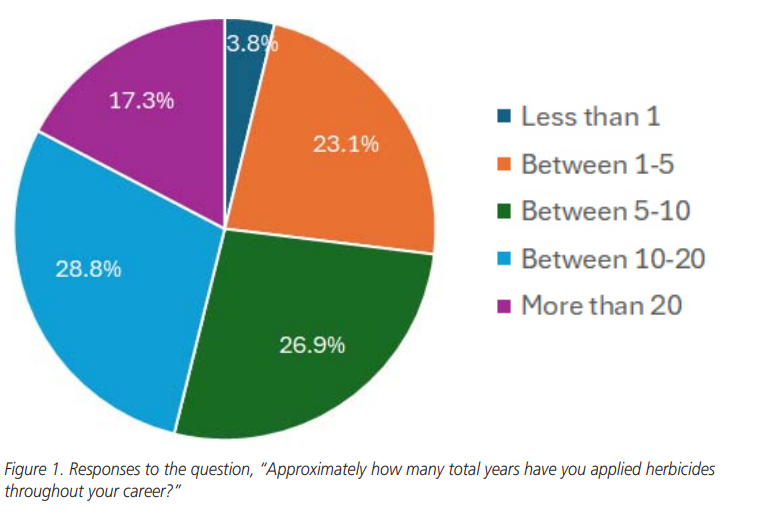
Cal-IPC sent more than 300 survey questionnaires to “practitioners” who had registered for Continuing Education credits for Cal-IPC classes and “land manager staff of organization throughout California.”  Over 100 practitioners replied to the survey.  This graph depicts their replies to the question, “Approximately how many total years have you applied herbicides throughout your career?”

Source: California Invasive Plant Council

Clearly, the Invasive Spartina Project is one of many “restoration” projects that have been applying herbicides for 20 years or more.  And the Invasive Spartina Project has secured State funding to continue spraying herbicides for another 10 years.  Spraying herbicides on public lands has created stable, life-long employment for an army of weed warriors. 

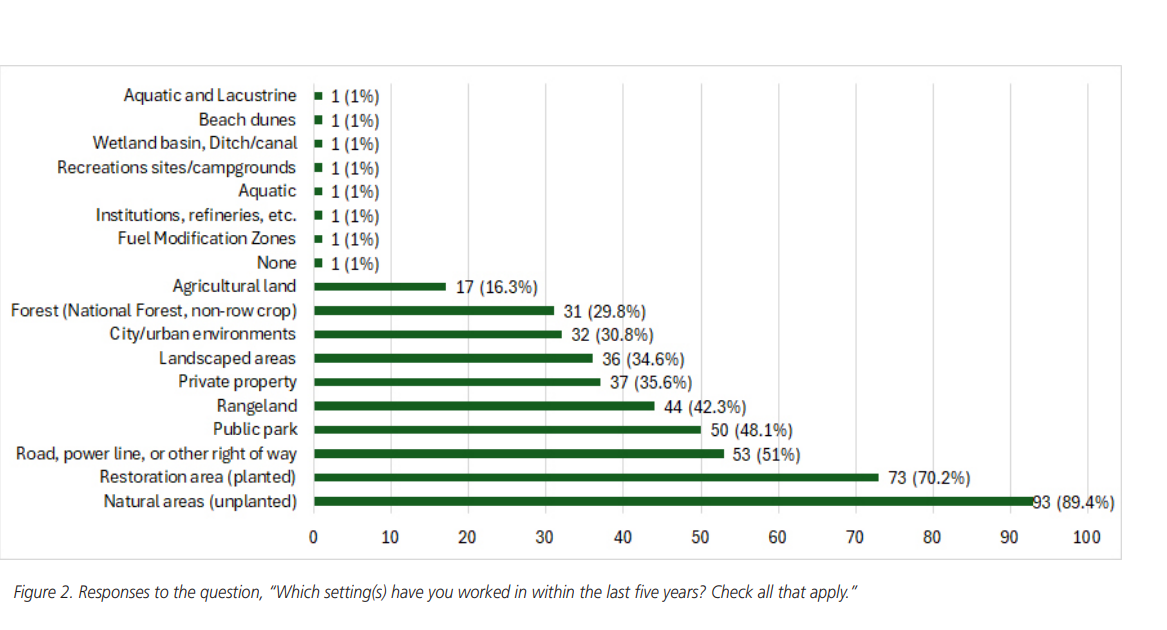
The survey also tells us where herbicides are being sprayed:

Source: California Invasive Plant Council

Virtually all (89%) herbicide applicators are spraying herbicides in “natural areas”—which we assume are wildlands—where no attempt has been made to plant native plants.  Most projects are more destructive than they are constructive. Nearly 50% of herbicide applicators are spraying in public parks.  70% of herbicide applicators spray in “restoration areas,” presumably to sustain the native plants that were planted.  If they are using non-selective herbicides, such as glyphosate and imazapyr, they are probably killing native plants too.

There are many other revelations in this survey and the details are available in the Cal-IPC publication (10):

  • Only 1.9% of respondents had not used herbicides or been part of a project that used herbicides.
  • The top three application methods were spot spraying (100%), cut stump (87%), and broadcast spray (70%).
  • 40% of respondents were not calibrating their herbicide use.  “Calibration is the process of adjusting and measuring the amount of pesticide that a piece of equipment will apply to a target area. It’s an important step in the pesticide application process to ensure that the equipment is applying the correct amount of pesticide at the right rate and in a uniform manner.” (Google search)
  • 28% of respondents had never received calibration training.  20% of respondents said they did not calibrate their herbicide application because “they did not know how.” Cal-IPC often claims that herbicides are being applied “judiciously.” If you don’t know how to apply herbicides, you are unlikely to apply them “judiciously.”

The Forever War on Non-Native Plants

Cal-IPC’s survey of “restoration” practitioners confirms our observations of their efforts in the past 25 years in the San Francisco Bay Area:

  • Attempts to eradicate non-native plants are a Forever War that has poisoned our public lands without eradicating non-native plants or restoring native vegetation, in most cases.
  • The war is futile because it is attempting to stop evolution, which is trying to help flora and fauna adapt to the changing climate and environment.  Humans cannot stop evolution, nor should we try.  The Forever War is a losing battle against evolution, which has sustained life on Earth for 3.7 billion years, without human “assistance.” 
  • The plants that we are trying to kill are also adapting to the poisonous war we pointlessly wage against them.  They have evolved and will continue to evolve resistance to the poisons we spray on them. Herbicides are less effective than they were 40 years ago and they will be continuously less effective. 
  • We are poisoning ourselves and other animals in our futile attempt to kill the plants that feed them.  Claims that wildlife eat only native plants is a fiction and a lie that sustains an industry with vested economic interests in that myth.
  • Many pesticide applicators are not properly trained or they are not following legally mandated instructions for pesticide applications on product labels. They are hurting themselves when they don’t wear legally required personal protection equipment. They are hurting the environment and everyone who lives in it when they use too much pesticide because they have not calibrated their applications as required by the product label. When they don’t post pesticide application notices in advance of their applications, they deprive the public of the opportunity to protect themselves by avoiding the area.  Even when they do, such signs would not be helpful to wildlife.
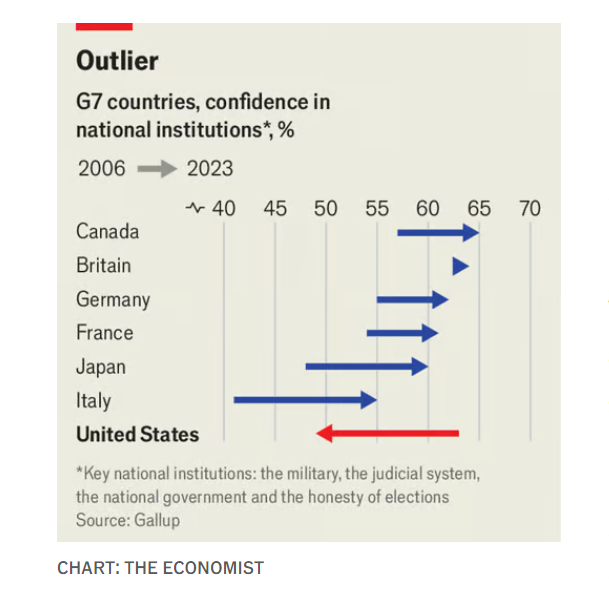
  • The money that is wasted on this Forever War could be used to address a multitude of other pressing needs.  For example, the lead pipes in Oakland that are delivering drinking water contaminated with lead to children in our public schools could be replaced with a fraction of what has been spent to eradicate non-native spartina marsh grass in the past 20 years. (11)  It’s no wonder that the public does not trust the American government:
Source: Economist Magazine

References:

  1. San Francisco Estuary News, “The Battle for Native Cordgrass,” Jacoba Charles, March 2023
  2. USDA Plant Database:  Spartina alterniflora  When the Invasive Spartina Project began, the USDA Plant Database  map of this species indicated that the species was introduced on the West Coast.  The current version of the map shows that this species is now native to the West Coast.
  3. Clapper rail, Cornell Laboratory of Ornithology  Status of Clapper rail is “Low Concern”
  4. Adam Lambert et.al., “Optimal approaches for balancing invasive species eradication and endangered species management,” Science, May 30, 2014, vol. 344 Issue 6187
  5. “Effects of Predation, Flooding, and Contamination on Reproductive Success of California Clapper Rails (Rallus Longirostris Obsoletus) in San Francisco Bay,” Steven E. Schwarzbach, Joy D. Albertson, Carmen M. Thomas, The Auk, 1 January 2006
  6. 2023 California Ridgway’s Rail Surveys for the San Francisco Estuary Invasive Spartina Project  (page 9)
  7. “Evaluating the plasticity of a ‘specialized’ rodent in a highly-invaded estuary,” Katie R. Smith, et.al.,  Presentation to California Invasive Plant Council Symposium, October 2023
  8. San Francisco Estuary Invasive Spartina Project   2021‐2022 Monitoring and Treatment Report (Appendix II, page 3)
  9. Journal of Pesticide Reform: https://assets.nationbuilder.com/ncap/pages/26/attachments/original/1428423389/imazapyr.pdf?1428423389#:~:text=Imazapyr%20can%20persist%20in%20soil,aerial%20and%20ground%20forestry%20applications
  10. Dispatch, Newsletter of California Invasive Plant Council, Spring 2024  (page 10-11)
  11. “In 2018, Oakland Unified School District (OUSD) estimated that it would cost $38 million to fix lead contamination in its schools. This included $22 million to replace water lines and $16 million to replace drinking water and sink fixtures. The OUSD blamed the aging infrastructure for the high lead levels and sought help from the state and federal government.” (Google Search)

A Reprieve for Wildlife on the Farallon Islands

This is a good news/bad news story.  First the bad news, because it contains kernels of good news.  The federal budgets of the entire National Wildlife Refuge System are being cut, including the budget for the Farallon Islands, which has funded the research of Point Blue Conservation on the islands for over 50 years.  This cut comes on the heels of a long-term decline in funding of the wildlife refuge system from $765 million in 2010 to $527 million in 2023.  It seems safe to assume that this loss of funding will have a negative impact on these fragile ecosystems, but in the case of the Farallon Islands, we also foresee some benefit to wildlife.

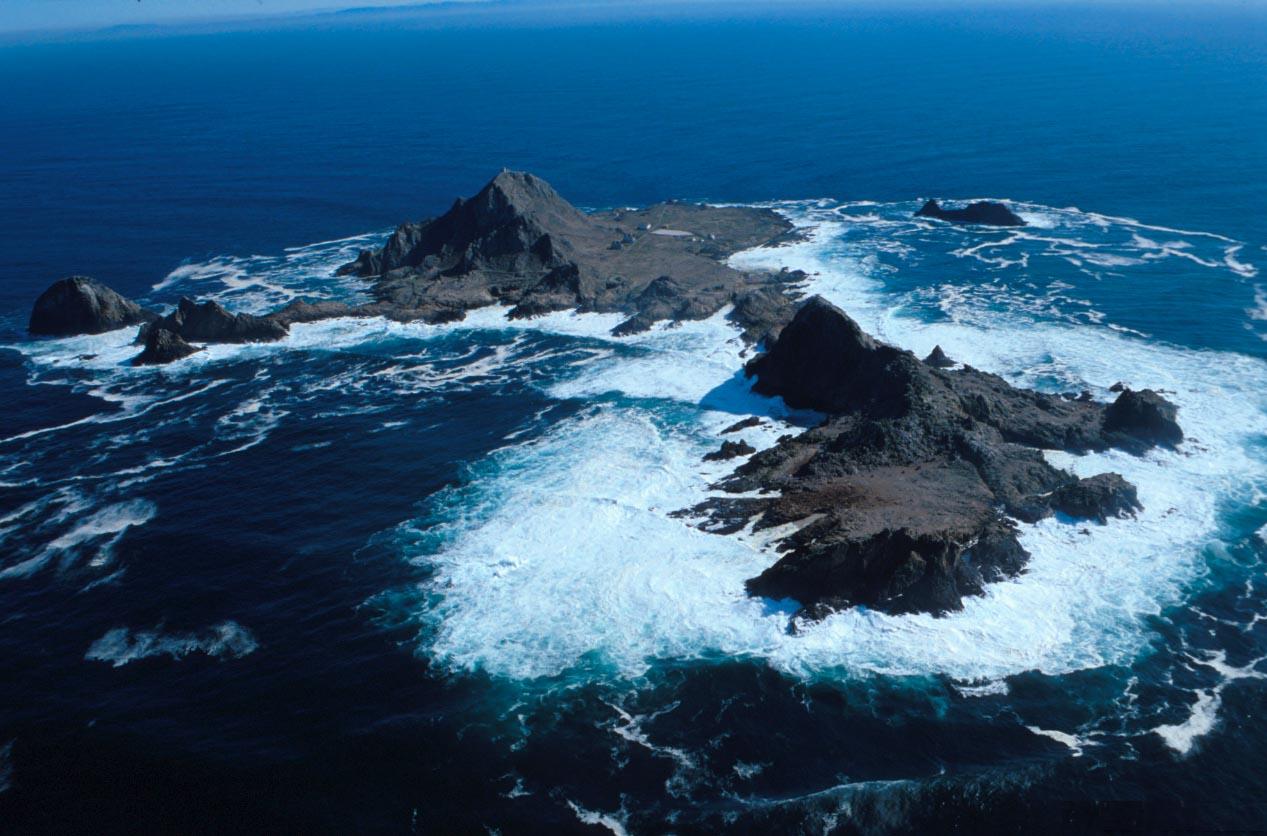
Farallon Islands, NOAA

Point Blue has maintained a year-round presence on the Farallons that will be curtailed in 2025 due to the loss of funding, leaving the island vulnerable to unauthorized visitors and activities in the winter.  It will reduce the ability to monitor wildlife populations and maintain long-term datasets that identify trends in wildlife populations. 

So, what is the good news?  For the moment, the plan to aerial broadcast nearly 2 tons of rodenticide bait on the islands to kill harmless house mice has been abandoned because it cannot be financed.  A brief reminder of why that is good news:

  • Thousands of non-target birds and marine animals are likely to have been killed by eating the bait directly or by eating poisoned house mice.  The plan and its Environmental Impact Statement (which has not been certified), predict 1,100 collateral deaths of Western gulls.  Delayed and inadequate reporting of non-target deaths by similar projects suggest numbers may be greater. 
  • House mice on the Farallons do not need to be eradicated because there is no evidence that they harm birds on the Farallons.  The only evidence of mice eating bird chicks of which I am aware were albatross chicks, a naive species that spends their life in the air except to nest in a few places in the Southern Hemisphere, but not on the Farallons.  Native mice live unmolested on other off-shore islands in California.  Native mice were removed from Anacapa Island prior to the rodenticide drop to kill rats and were returned after the drop.  House mice on the Farallons are targeted solely because they are non-native (and anecdotally because they are an annoyance to research staff who stay in dilapidated housing from which mice cannot be excluded).   
  • The bizarre explanation for killing house mice is that they attract a small population of burrowing owls, who allegedly eat bird chicks.  The burrowing owls could be removed from the Farallons, as Golden Eagles were removed from Santa Cruz Island to save the Channel Island Fox. 

More Good News

It seems likely that the budget cut will also reduce the application of herbicides on the islands to kill non-native vegetation.  Roundup (glyphosate) has been used by Point Blue Conservation on the Farallon Islands every year since 1988.  Between 2001-2005, an average of 226 gallons of herbicide were used annually (5.4 gallons per acre per year), according to the annual report of the Farallon National Wildlife Refuge. (1)

63%-80% of the vegetation on the Farallons is non-native. (2) The non-native vegetation that is being needlessly sprayed with herbicide was brought to the islands by birds who ate them elsewhere and/or by wind and ocean currents.  They cannot be eradicated because they cannot be excluded from an open ecosystem, just as house mice cannot be excluded from a dilapidated building. They are useful to wildlife and it is pointless to contaminate the ecosystem with herbicide. 

House mice on the Farallons are also accused of eating rare insects and competing with rare salamanders for food.  The study of the diet of mice on the Farallons (2) reports that mice also eat insects when vegetation becomes scarce in the fall.  If useful non-native vegetation weren’t being killed, there would be more food for all animals on the islands, including house mice, who prefer vegetation to insects.

In Conclusion

I am not in a position to evaluate the over-all impact of cuts in the budget to the National Wildlife Refuge System.  It seems likely that the overall impact on our refuges is negative.  I can only evaluate the impact on the only wildlife refuge system that I know well enough to say that the budget cut will be a reprieve for wildlife on the Farallon Islands because it is likely to reduce the unnecessary use of herbicides and it will spare the entire ecosystem from the planned aerial broadcast of anti-coagulant rodenticide bait. 

I am one of thousands of people who have vocally opposed the planned rodenticide drop for over 10 years.   We cannot claim credit for this reprieve.  The budget cut was not a surgical removal of the poison drop.  Rather it was a hatchet job.  That should not prevent us from celebrating the good fortune of the animals who will be spared.

Going Forward

I do not consider the issue of island eradications with rodenticides resolved, but I am grateful for a delay on the Farallon Islands.  The drop is likely to happen if private funding can be found for it and the federal budget for wildlife refuges could be increased in the future.

I always have hope that those who believe non-native plants and animals are harmful will come to their senses one day.  Non-native plants and animals are integral members of the food web.  As newcomers, they represent new opportunities for natural selection to find the adaptations needed to survive in our changed and changing environment.  We hope that US Fish and Wildlife Service will be deprived of the funding to continue their crusade against house mice long enough to figure this out.  They are smart, highly educated, and well-meaning people.  Surely they will figure it out eventually, hopefully in time to save wildlife on the Farallons.


Here are the articles about the mouse eradication project on the Farallons that I have published.  They provide more details about the damage done by other island eradications around the world:

The mouse eradication project on the Farallon Islands: The “con” in conservation
Island eradications in the Bay Area rear their ugly head again
It’s time to comment on the deadly project on the Farallon Islands
“When the Killing’s Done”  Maybe never
Deadly Dogma:  Revisiting the unnecessary project on the Farallon Islands
EPA’s biological evaluation of rodenticides is green wash for island eradications

References:
(1)https://drive.google.com/file/d/1XoPcS104SeOUIyfbPT_NbardctNyWAgs/view
(2) https://www.biorxiv.org/content/10.1101/2022.02.23.481645v1.full

Sources for this article: 
https://www.sfchronicle.com/climate/article/farallon-islands-research-19444987.php
https://www.pointblue.org/our-work/oceans/support-our-national-wildlife-refuges/
https://www.marinij.com/2024/06/04/farallon-islands-wildlife-research-is-in-trouble-2/

Assembly Bill 2509 has the potential to reduce pesticide use, IF it is revised

Below is my letter to California Assemblymember, Ash Kalra (District 25, San Jose), asking him to consider revising Assembly Bill 2509 so that it will reduce the use of pesticides in California to eradicate harmless and useful non-native plants.  Please consider making this suggestion to your elected representatives in the California Legislature.  AB2509 has the potential to reduce pesticide use in California if we make an effort to revise it as needed to accomplish that goal.


Dear Assemblymember Kalra

AB2509, your bill being considered by the California Legislature, will define “Integrated Pest Management” (IPM) and “invasive species.”  The bill has the potential to reduce pesticide use in California’s parks and open spaces, but only if it is revised to accomplish that purpose. AB2509 is also an opportunity to improve the success of ecological restorations that begin by eradicating non-native plants considered “invasive,” by narrowing the target to those few species that are actually doing any harm.

In its present form (April 4, 2024), AB2509 defines invasive species, “to mean nonnative organisms that cause, or are likely to cause, economic or environmental harm, excluding humans, domestic livestock, specified domestic or domesticated species, and nonharmful nonnative organisms.”

That definition is based on Federal Executive Order 13112, which was passed 25 years ago, in 1999.  We have learned a lot in the past 25 years about invasive species and the attempt to control them:

  • The climate has changed a great deal since 1999, and with it the environment, including the plants and animals that live in it.  The native ranges of many plants and animals have changed and will continue to change.
  • We have learned that many introduced plants are often functional substitutes for native plants that are no longer adapted to the changed environment. 
  • We have learned that insects are capable of rapidly adapting and evolving to make use of introduced plants.
  • We have learned, after trying to eradicate them for over 25 years, that most naturalized introduced plants cannot be eradicated.
  •  We have learned that the herbicides being used to eradicate introduced plants are doing a great deal of harm to the environment and the animals who live in it.  We now know that herbicides damage the soil, making it difficult for new plants to survive in sterilized soil, devoid of beneficial microbes and fungi. 
  • We have learned that native plants don’t necessarily return after introduced plants have been eradicated. The damage done by eradication projects is often greater than the anticipated benefit.
  • Despite dire predictions to the contrary, there is no evidence that any introduced plant species has caused the extinction of a native plant species in California.

We need a new definition of invasive species that reflects these changes and accommodates the movement of plant and animal species needed for survival.  We need a definition that does not attempt to stop adaptation and evolution.  Like dynamic nature, our attempts to conserve nature must constantly evolve in response.  We need a definition that distinguishes between actual harm and theoretical predictions of harm.  We need a definition that does not require us to poison our public lands unnecessarily.

Please consider revising the definition of “invasive species” in AB2509 to reflect what we now know about introduced plants, such as:

“AB2509 defines invasive species to mean pathogens, diseases, and insects that are known to cause harm to plants and animals, including humans.”

In its present form, AB2509 also defines Integrated Pest Management as:  “’Integrated pest management’ means an ecosystem-based strategy that focuses on long-term prevention of pests or their damage through a combination of techniques such as biological control, habitat manipulation, modification of cultural practices, and use of resistant varieties. Pesticides are used only after monitoring indicates they are needed according to established guidelines, and treatments are made with the goal of removing only the target organism. Pest control materials are selected and applied in a manner that minimizes risks to human health, beneficial and nontarget organisms, and the environment.”

Integrated Pest Management (IPM) is not a new concept.  Most public land managers have had IPM programs for over 25 years.  Some have resulted in reduced herbicide use in developed areas, without corresponding reductions in public open space and wildlands.

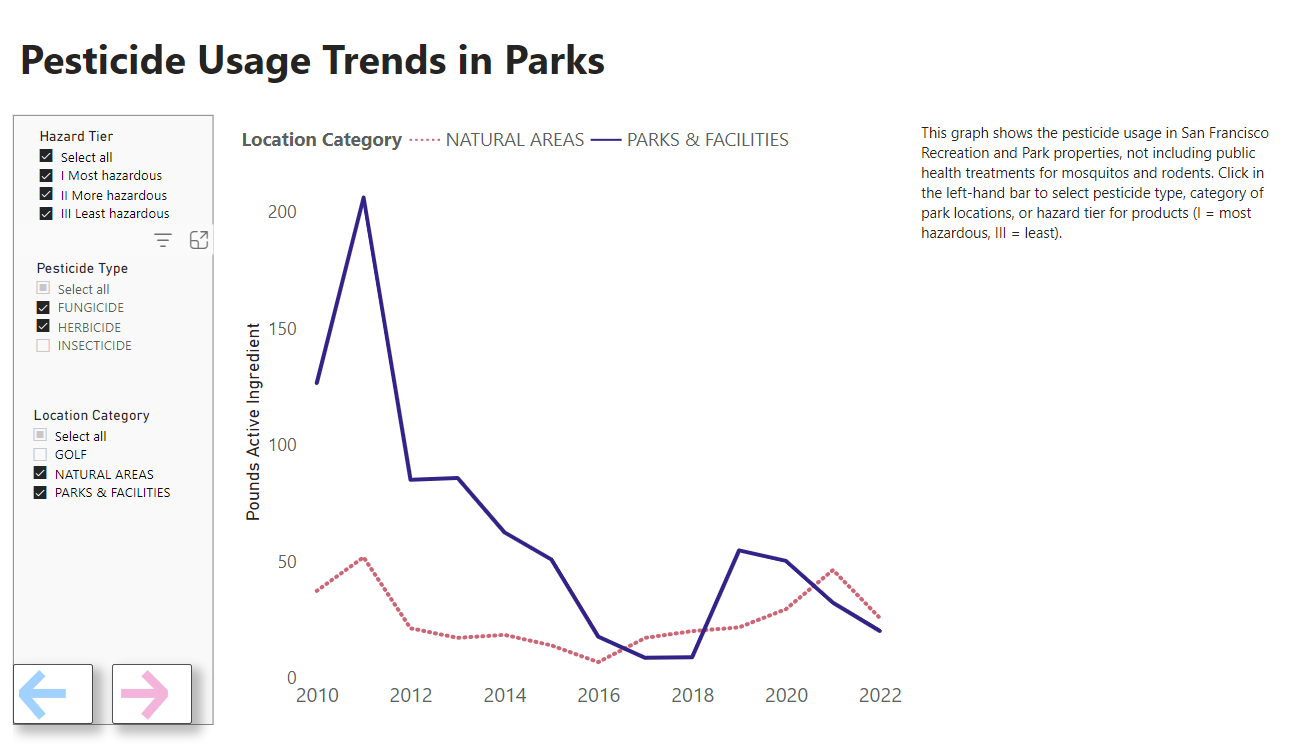
San Francisco’s IPM program has significantly reduced herbicide use on developed public land, but herbicide used to eradicate non-native plants in one-third of park acreage known as “natural areas” has changed little, as shown in this graph:

Source:  San Francisco Integrated Pest Management Program

East Bay Regional Park District has also reduced its use of herbicides in developed areas of the park, such as parking lots, picnic areas, and playgrounds, without reducing their use in wildlands where non-native plants and trees are eradicated:

If we want Integrated Pesticide Management Programs to reduce the use of pesticides in our public lands, we must define IPM to achieve that purpose by:

  • Changing the definition of “invasive species” to focus only on those introduced species that are known to cause actual harm.  The expectation of “likely” harm without evidence of actual harm should not be used to justify pesticide use. 
  • Explicitly defining the “guidelines” that determine if pesticides are needed in order to prevent their use on harmless and beneficial plants.
  • Avoiding the use of vague terms that can be interpreted differently from different perspectives, such as “use of resistant species.”  Resistant to what? In whose opinion? 
  • By not making empty promises such as claiming that pesticides can be used on non-native plants without doing any damage to non-target species.  Because of drift, persistence, and mobility of pesticides in the soil, it is not possible to make such assurances, which give the public the mistaken impression that herbicides can be used without unintended consequences

Please consider a revised definition of Integrated Pesticide Management that will reduce pesticide use and preserve the vegetation that is capable of growing in today’s environment, such as:

“’Integrated pest management’ means an ecosystem-based strategy that focuses on long-term prevention of pests or their damage through a combination of techniques such as biological control, habitat manipulation, and modification of cultural practices.  Pesticides are used only after harm is documented, benefits of existing vegetation have been identified and weighed against harm, the health risks and environmental damage caused by herbicides is considered, and the outcome of eradication is determined to be positive, on balance.”

In conclusion, I will briefly describe my interest in invasion biology and the ecological restoration industry it spawned.  My interest began over 25 years ago when my neighborhood park was designated a “natural area” by San Francisco’s Recreation and Park Department.  When I moved to the East Bay, I learned that the native plant movement is equally committed to the eradication of introduced plants and the pesticides needed to accomplish that goal.  I have visited many of these projects all over the Bay Area and elsewhere in California.  I read the publications and attend the conferences of California Invasive Plant Council and California Native Plant Society so that I am as informed of their objectives and beliefs as I am of the academic criticism of invasion biology.  I have had a website since 2010 that reports to the general public what I have learned about specific projects and the scientific evaluations of them.  I invite you to visit my website to help you evaluate the advice I am sending to you today about AB2509.  I can provide references for every statement I make in this letter, on request.

Thank you for your consideration and for your effort to reduce pesticide use in California.

Sincerely,
Webmaster, Conservation Sense and Nonsense

CC:
Patty Clary, Californians for Alternatives to Toxics
Damon Connolly, Assembleymember, District 12
Jay Feldman, Beyond Pesticides
Angel Garcia, Californians for Pesticide Reform
Doug Johnson, California Invasive Plant Council
Megan Kaun, Sonoma Safe, Ag Safe Schools
Melinda MacNaughton, El Granada Advocates
Margaret Reeves, Pesticide Action Network
Jane Sellen, Californians for Pesticide Reform
Nancy Skinner, Senator, District 9
Buffy Wicks, Assemblymember, District 15
Wildlife Conservation Board


Update, April 24, 2024: 

The Assembly Agriculture Committee voted unanimously to pass AB2509 to the Appropriations Committee with no amendments. 

Doug Johnson, Executive of Cal-IPC and Marc Landgraf, Santa Clara Valley Open Space Authority, spoke in favor of AB2509.  Johnson claimed that only “small amounts of pesticide are used.”  Landgraf said most plants are killed by grazing, mowing, and volunteers pulling my hand; herbicides are used only “when needed.” 

Damon Connolly was the only committee member to speak.  He expressed concern that AB2509 not conflict with his continuing support for AB99, which has the potential to reduce roadside spraying of herbicide by Cal Trans.

There were no speakers in opposition to AB2509.  There was no acknowledgment of the public’s concern about AB2509 or of the public’s concern about herbicides being used on our public lands.


Let Evolution Lead the Way to Adaptation and Survival of Life

“What exists now can only ever come from what came before.” –Thomas Halliday, Otherlands

Otherlands, A Journey Through Earth’s Extinct Worlds was written by a paleontologist using the latest scientific techniques available. (1)  Paleontology has advanced far beyond digging up fossils.  Computer and DNA analysis enables paleontologists to reconstruct models of whole animals from bone fragments as well as describe the lifestyle of extinct animals such as what they ate and what ate them. 

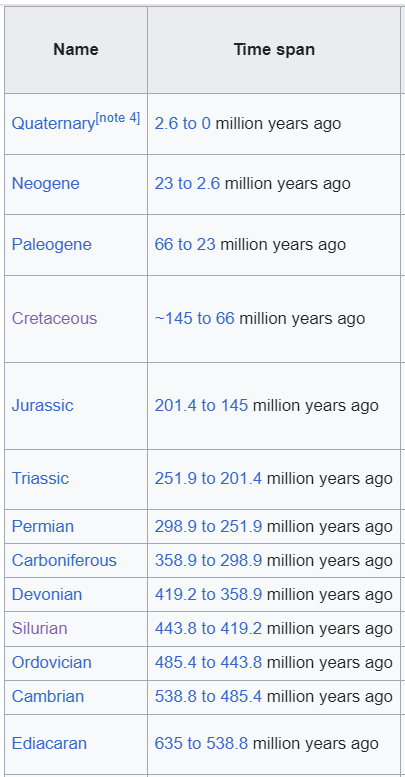
Geologic periods described by Otherlands. Source: Wikipedia

Thomas Halliday puts this knowledge of some of the 5 billion species that have gone extinct in the 4.6 billion years that Earth has existed into the context of geological and biological changes that caused their extinction.  He describes vivid scenes of specific places at specific times, starting 500 million years ago (mya), a geological period when we can recognize most of the phyla (major groups of animals sharing characteristics) that exist today. These snapshots of deep time illustrate that “Environments shape their inhabitants as much as their inhabitants shape them.” (1)

In this article, we will visit a few of these scenes that demonstrate the biological innovations resulting from evolution and the associated geological and atmospheric events.  And we will tell you about how modern conservation methods are often working at cross purposes against evolution and adaptation of life as it copes with catastrophic challenges. 

Biological Innovation

Primitive life is said to have existed on Earth 3.7 billion years ago (bya).  All life that presently exists on Earth is said to have evolved from the first life forms, although the common ancestor is yet to be identified.  No life on Earth is truly alien.

The diversification of life on Earth began to accelerate when cyanobacteria developed the ability to photosynthesize about 3 bya.  Photosynthesis converts sunlight to energy by consuming carbon dioxide, creating carbohydrates that feed plants and storing carbon in plants and the soil, while emitting oxygen into the atmosphere as a by-product.

This evolutionary innovation is responsible for the abundance and diversity of plants today. It is an important factor in the balance of carbon dioxide and oxygen in the atmosphere, which is one of the most important factors in the Earth’s climate.  More plants also mean more food for animals that evolve alongside plants, often forming relationships with one another. 

The first mass extinction, roughly 445 million years ago (mya), is the only mass extinction caused by a rapid change in the Earth’s climate from tropical to glacial, which is equivalent to saying the atmosphere changed from predominantly carbon dioxide to predominantly oxygen, the opposite of our currently changing atmosphere and climate. 

Carbon dioxide levels are said to have dropped from 7,000 parts per million (ppm) to 4,400 ppm during the Ordovician extinction event that killed about 85% of plant and animal species.  Currently our carbon dioxide level is about 420 ppm, just a fraction of what it was during the Ordovician period.  In the context of the history of Earth, the climate we are experiencing is mild, a reminder of the potential for a much more extreme climate in the near future.

This graph of global mean surface temperature on Earth in the past 485 million years tells us the Earth’s climate has been mild since humans evolved. The graph should help us understand the potential for the Earth’s climate to increase beyond the tolerance for human life.

Comparing contemporary sea levels with those in deep time is another way to appreciate the potential for devastating changes in the future.  20,000 years ago, at the height of the last ice age, sea levels were 120 meters lower than they are now.  Conversely, sea levels were highest during the mid-Silurian period, 430 mya, when sea levels were between 100-200 meters higher than they are now and atmospheric carbon dioxide concentrations were high. 

Although the causes of the drastic change in the atmosphere and therefore the climate during the Ordovician period are still debated, the advent of photosynthesis is considered a factor.  The development of fungi enabled plants to move from water to land by delivering moisture from soil to roots of plants, greatly increasing abundance and diversity of plants. About 80% of plants today receive much of their nutrients and moisture through mycorrhizal fungi. 

The photosynthesizing capabilities of plants is one of the ways greenhouse gas emissions, currently causing global warming, can be reduced.  Yet, we are using pesticides to kill plants that native plant advocates have arbitrarily decided “don’t belong.”  Pesticides also kill fungi in the soil that enable plants to survive during drought conditions created by global warming.  This is one of many examples of how management strategies used by humans are counteracting the accomplishments of evolution that occurred long before humans existed or began to think they were competent to “manage” nature.

Plant Evolution Timeline

To make a long, complicated story short, we’ll focus on the major plant groups we recognize today by starting with seedless land plants that reproduce by dispersing spores, such as mosses and ferns that evolved from algae about 460 mya. 

Gymnosperms, which we recognize today as conifers, cycads, and Gingkos, are seed-producing plants that evolved about 300 mya.  Early species of gymnosperms formed huge forests. The carbon they stored became the coal fields of today when they died during the Carboniferous period (360-300 mya).   Today, we draw our fossil fuels from these coal and oil basins.  They provide most of our energy, while releasing greenhouse gases causing climate change.

Continents were close together during the Cretaceous geologic period when angiosperms evolved. Source: Australian Museum

Angiosperms evolved from gymnosperms about 130 mya.  They are flowering plants whose seeds are often encased in fruit. They are by far the most diverse group of land plants.  The evolution of bees around the same time is an example of co-evolution: the flowers feed the bees and the bees pollinate the flowers, delivering pollen from the male anther to the female stigma.   This sexual method of reproduction creates greater genetic diversity than self-pollination.  Greater genetic diversity creates more opportunities for natural selection to operate on plant variations, which may result in species that are better adapted to existing conditions.   

A recent study (2) found that the decline in the population of bees has increased the frequency of self-pollination of some plant species that are capable of both methods of pollination.  This is an example of evolution at work today.  Plants are responding to the existential need to reproduce in the absence of bees by self-pollinating.   

What evolution has accomplished in the past can be undone.  In this case, our indiscriminate use of pesticides such as neonicotinoids has decimated bee populations. Some plants will adapt to the loss of bees by self-pollinating, but not without some loss of genetic diversity provided by sexual reproduction and consequently the long term fitness of plants to face challenges in the future. 

There’s another trade-off for both plants and bees. Producing nectar and attracting bees with colorful flowers is a big energy expense for plants.  Plants therefore save energy by reducing flower size and color, when they can rely solely on self-pollination for reproduction.  Obviously, self-pollination ultimately results in a loss of food for bees and may accelerate the decline in bee populations, a negative feed-back loop, if you will.

This example is a reminder that evolution is neither positive nor negative.  It is simultaneously both positive and negative.  It is what it is:  an inexorable force for change. 

Evolution of grasses

Grasses and grasslands are late comers to the Earth’s plant kingdom.  Grasses evolved from angiosperms about 70 mya, during the Age of Dinosaurs that abruptly ended 66 mya when an enormous asteroid collided with Earth.  Grasses are wind pollinated and their seeds are dispersed by the wind, which enables them to spread rapidly and widely. 

Grasslands became dominant ecosystems about 30 mya, replacing many forest ecosystems.  With the optimal combination of fuel, heat, and oxygen, wildfires were a factor in the transition from forests to grasslands in many places.  Once again, wildfires in conifer forests are presently playing a role in converting forests to grasslands, suitable to a warmer and drier climate.

The development of enhanced photosynthesis by C4 grasses gave them a competitive advantage in hot, dry places where photosynthesis is suppressed. C4 grasses are more drought tolerant and they store more carbon than their predecessors, C3 grasses. There are only about 60 groups of C4 grasses, including several important food crops, such as maize, sugarcane, and sorghum.  They are found in tropical and sub-tropical regions of Africa and South America and some deserts.  California’s native grasses as well as introduced grasses considered “invasive” are not C4 grasses, according to a list of C4 grasses available on Wikipedia. (3)

Because of their potential to improve drought tolerance and increase productivity and carbon storage, there is great scientific interest in converting C3 grasses to C4 grasses.  Despite decades of effort, agricultural science has not been able to duplicate what the natural forces of evolution have accomplished, reminding us that evolution is more powerful than we are.

The transition from forests to grasslands had a corresponding impact on the evolution of animals.  Some browsers of woody plants learned to be grazers, if they could, while others went hungry, and the diversity and abundance of grazers increased. 

Native plant advocates in California have selected grassland as their preferred ecosystem because it was the dominant ecosystem prior to the arrival of Europeans at the end of the 18th century. They have consistently failed to convert non-native grassland to native grassland in California.  Nor is it clear that there would be any benefit to the environment or to its inhabitants to return to the treeless landscapes of California that existed prior to settlement in the late 18th century.

Where populations of native grazers of grassland were reduced by the activities of humans, many grasslands in California naturally succeeded to shrubs and trees. “Restoration” projects attempt to prevent succession of grasslands. Some of these projects destroy native trees and shrubs (e.g. Douglas fir, coyote brush, juniper, etc.) mechanically and with pesticides to maintain ecosystems as grassland.  

Nativists also want to reintroduce the grazing animals of the pre-colonial period to replace domesticated animals humans introduced because nativists see them as competitors of native animals they consider superior. Where top predators have been killed, these herds of grazing animals outgrow available vegetation unless their numbers are controlled as domesticated animals are.

A recent meta-analysis of 221 studies of the impact of megafauna on plant abundance found, “no evidence that megafauna impacts were shaped by nativeness, “invasiveness,” “feralness,” coevolutionary history, or functional and phylogenetic novelty. Nor was there evidence that introduced megafauna facilitate introduced plants more than native megafauna. Instead, we found strong evidence that functional traits shaped megafauna impacts, with larger-bodied and bulk-feeding megafauna promoting plant diversity. Our work suggests that trait-based ecology provides better insight into interactions between megafauna and plants than do concepts of nativeness.”  (4)

The author of Otherlands agrees that the concept of nativeness is not a useful way to understand the environment or conduct conservation because:  “Where an animal or a plant from one part of the world appears in another, some might use the language of invasion, of a native ecosystem despoiled and rendered lesser by newcomers…In reality, species do move, and the notion of ‘native’ species is inevitably arbitrary, often tied to national identity…There is no such thing as a fixed ideal for an environment…To look into deep time is to see only an ever-changing list of inhabitants of one ecosystem or another…The concept of native that we so easily tie to a sense of place also applies to time…We must avoid putting our own ahistorical spin on what was, although certainly dangerous and unlikely, a journey guided entirely by chance.”  (1)

Migration

The history of evolution is also a history of migration.  The oscillation of the Earth’s climate between freezing cold and blistering heat created and destroyed land bridges that enabled or blocked migration as sea levels rose and fell.  When North America and South America were connected by Central America as a result of lower sea levels and geological events about 3 mya, the plants and animals of those continents were mixed by migration.  Likewise, aquatic life of the Pacific Ocean was separated from the Atlantic Ocean by the Central American land bridge until the Panama Canal was built in 1914.

Geological events also created or destroyed the same opportunities for migration.  The opening and closing of the Strait of Gibraltar is a case in point.  The Mediterranean Sea exists because the Strait of Gibraltar exists.  When the narrow Strait is open, the Atlantic Ocean flows into the Mediterranean Basin, creating the Mediterranean Sea, which is an obstacle for migration of plants and animals between Europe and Africa. 

About 6 mya the Strait of Gibraltar closed because the African tectonic plate moved north, colliding with the European tectonic plate.  The Mediterranean Sea slowly evaporated, concentrating ocean salt from the Atlantic Ocean, laying down a sea bed of salt in the Mediterranean Basin and ultimately creating a migration corridor between Africa and Europe. There is every reason to believe that the Strait could close again.  The Earth’s tectonic plates are in constant motion and there is no reason to believe they will stop moving.

The obsession with “where plants belong” seems to be based on ignorance of the history of dispersal and migration.  Much of China and North America have been in the same latitude since the evolution of angiosperms.  As a result, many of our plant species considered native in Eastern North America are also considered native in China.  These paired species in the same genus are called disjuncts.  There are many woody disjuncts in China and North America (magnolias, persimmons, hickory, catalpa, dogwood, sweetgum, tuliptree, tupelo, sassafras, Virginia creeper, etc) as well as many herbaceous disjuncts (ginseng, lopseed, mayapple, skunk cabbage, etc.). (5) They are different species because they have been separated long enough to change as a result of genetic drift, but are in the same plant lineage, therefore chemically similar and presumably used by the same insects.  The study of these disjuncts says, “Most scientists do not consider long-distance dispersal to have played much of a role.  The prevailing view is that most disjuncts are remnants of genera that were once widely distributed in the northern temperate zone during the Tertiary period [66 mya to 2.6 mya per Wikipedia].  These broad distributions in the northern hemisphere were made possible by recurring land bridges.” (5)

Lateral migration patterns of the past are changing in response to contemporary patterns of climate change.  The temperatures at different latitudes are becoming more similar because Polar Regions are warming at a much faster pace than temperate and tropical latitudes.  Plants and animals escaping extreme heat and associated changes in vegetation are moving to higher latitudes in the Northern Hemisphere and lower latitudes in the Southern Hemisphere.  The increasing similarity of the Earth’s climate is changing wind and ocean currents and contributing to the extreme weather events of our changing climate.  Although there are lessons in the events of deep time, we cannot assume that events in the past are entirely predictive of future events because of the complexity of natural processes and our limited understanding of them. 

Of all the nonsensical conservation strategies humans are presently using, perhaps one of the most damaging is the futile attempt to stop migration. It is one of few survival strategies of plants and animals needed in a rapidly changing climate and it cannot be stopped. 

The project that proposes to shoot barred owls in the Pacific Northwest is an example of a “conservation” project that does not deserve that honorific.  Barred owls have migrated from the East to the West Coasts of North America via the boreal forests of Canada.  This is another instance in which large contiguous stretches of land at the same latitude facilitate the migration of life because there is less variation in climate at the same latitude. 

Source: USFWS

Specialists vs. Generalists

Barred owls are more adaptable than their closely related relative in the same genus, spotted owls.  Barred owls have a more varied diet, they are willing to nest in less dense, second-growth forest, and they have greater reproductive success.  They are therefore perceived as competitors of endangered spotted owls. Instead of letting natural selection identify the winner of that competition, the US Fish & Wildlife Service intends to shoot 500,000 barred owls in the next 30 years based on their belief that spotted owls will benefit.  They do not expect to eradicate barred owls and they made a commitment to continue shooting barred owls in perpetuity.  While we continue to log old-growth forests in which spotted owls live, we will kill barred owls with no expectation that they can be eradicated.

This project is typical of American “conservation” projects that attempt to save a specialist species by killing a generalist species.  This strategy was enshrined in American law by the Endangered Species Act, which is now 50 years old.  Like many 50-year-old public policies, we now know that this conservation strategy is not working because it is inconsistent with evolutionary principles.  Change in nature is inexorable.  Legal mandates are not capable of stopping evolution.  If we had a functional political system, we could stop the greenhouse gas emissions causing climate change, but we don’t.  Therefore, we must rely on evolution to cope with the changes in the environment that we have caused.

The most recent mass extinction occurred 66 mya when an asteroid hit the Earth, ending the Age of Dinosaurs.  About 80% of all plant and animal species became extinct.  The species that survived were the most versatile and the most mobile.  Flying dinosaurs were the only dinosaurs that survived, as birds, perhaps because they were the most mobile.  “Of the specialized insects, 85% were lost and it was the generalists that survived.” (1) 

Mass extinctions have created many vacant ecological niches that are opportunities for experimentation, creating new species.  Some were better adapted than others.  Natural selection determined the winners of competition within ecological niches.  The end of the Age of Dinosaurs created the opportunity for the Age of Mammals, as well as bony fish, marsupials, and lizards. 

In other words, our outdated conservation strategy is wasting our limited resources to save specialized species that are probably doomed to extinction.  And we are doing so at the expense of generalist species that might survive if we would quit killing them.  Keep in mind that 99% of all life forms that have existed on Earth have gone extinct.  At a time when the climate is changing rapidly, the goal of saving every endangered species seems both unrealistic and wasteful of limited conservation resources.

Hybridization

Hybridization is one of the tools of evolution.  Closely related species, usually in the same genus and even family often mate and their offspring often survive to eventually give rise to new species.  Successful hybridization is a means of increasing biodiversity.  Hybridization is sometimes a means of improving adaptability and therefore survival.

Unfortunately, nativists see hybridization as a loss of biodiversity rather than an opportunity to improve adaptability and increase biodiversity.  Their “conservation” projects often attempt to prevent hybridization by killing hybrids.  For example, the plan to kill 500,000 barred owls includes all hybrids of barred and spotted owls.  Because barred owls are more versatile, hybridization with spotted owls could even the playing field with barred owls by expanding food sources and nesting habitats of spotted owls. 

The Spartina eradication project is another example of the pointless eradication of hybrids.  In the case of Spartina, the non-native species grows more densely and it doesn’t die back in winter.  Non-native Spartina provides better storm protection and better habitat for nesting birds.  The Invasive Spartina Project has been spraying hybrid Spartina with herbicides for over 20 years, without total success.  The hybrid looks so similar to native Spartina that 600 genetic tests are required every year to confirm their identification as hybrids before they are sprayed.  The Invasive Spartina Project is a waste of limited conservation resources and it serves no useful purpose.

Evolution vs. Conservation

Otherlands should be required reading for those who are engaged in the “restoration” industry.  Some of the methods and goals of conservation are at odds with the mechanisms of evolution that have ensured the survival of life on Earth for nearly 4 billion years. 

  • The use of pesticides by “restoration” projects is antithetical to the goal of conservation because they do more harm than good.
  • Migration is a means of species survival.  Natural migration of plants and animals cannot and should not be stopped.
  • Humans cannot duplicate the forces of evolution.  Natural selection is the most powerful, efficient, and effective method of determining the winners of competition.
  • Hybridization has the potential to improve adaptability of closely related plants and animals.  Hybridization cannot and should not be stopped.
  • Resources being wasted in the attempt to stop the natural forces of evolution should be redirected to reducing greenhouse gas emissions causing climate change.  Such efforts are appropriately called “conservation.”

  1. Thomas Halliday, Otherlands, A Journey Through Earth’s Extinct Worlds, Random House, 2023
  2. https://www.nytimes.com/2024/01/04/science/flower-sex-evolution-bees.html?searchResultPosition=1
  3. https://en.wikipedia.org/wiki/List_of_C4_plants
  4. Erik Lundgren et.al., “Functional traits—not nativeness-shape the effects of large mammalian herbivores on plant communities,” Science, February 2, 2024
  5. David Yih, “Land Bridge Travels of the Tertiary:  The Eastern Asian-Eastern North American Floristic Disjunction, Arnoldia, 2012

EPA’s Biological Evaluation of Rodenticides is Green Wash for Island Eradications

The Endangered Species Act requires that the Environmental Protection Agency (EPA) conduct biological evaluations (BE) of the impact of pesticides on threatened and endangered species protected by the ESA.  For example, when the EPA published its final evaluation of glyphosate in 2021, it informed us that glyphosate is “likely to adversely affect” 93% of legally protected endangered and threatened plants and animals.

Source: EPA Biological Evaluation for Glyphosate

The EPA published a draft of a biological evaluation (BE) of 11 rodenticides in November 2023, which is a free gift to the island eradication industry.  The deadline for making comment on this draft is February 13, 2024.  Public comment can be made HERE

The EPA’s biological evaluation for rodenticides reached the conclusion that rodenticides used in island eradications have “no effect” on any aquatic plant or animal, including birds in the aquatic food web and amphibians with a fully aquatic lifestyle.  They made this “no effect” determination without evaluating any of those species, based on their claim that the Product Label for the rodenticide used in island eradications prohibits its use in water, which is not true.  EPA also extended this “no effect” determination to all species under the jurisdiction of National Marine Fisheries Services.  (1)

In fact, the standard Product Label for brodifacoum does not explicitly prohibit the use of the product in water.  It merely warns of the deadly consequences for aquatic species if used in water:  “This product is extremely toxic to birds, mammals, and aquatic organisms.  Predatory and scavenging mammals and birds might be poisoned if they feed upon animals that have eaten bait. Runoff may be hazardous to aquatic organisms in water adjacent to treated areas.  DO NOT contaminate water when disposing of equipment wash water or rinsafe.”  The standard Product Label also explicitly allows aerial broadcast of rodenticides for island eradications.  (2)  In other words, it’s dangerous to apply rodenticides to water, but, in fact, it often happens during island eradications.  The biological evaluation asks the public to believe the EPA’s claim that rodenticides are not used in water despite ample evidence that rodenticides land in water during aerial broadcasts on islands.

Although the standard Product Label acknowledges the potential that rodenticide runoff “may be hazardous to aquatic organisms in water adjacent to treated areas,” EPA’s biological evaluation dismisses that possibility by claiming that “use patterns preclude spray drift and runoff exposure.”  EPA’s biological evaluation provides no evidence in support of that claim and that claim is explicitly contradicted by the EPA in its evaluation of the proposed island eradication on the Farallon Islands as well as the considerable record of contamination of the aquatic food web during completed island eradications, as explained below.

Supplemental Product Labels are required for island eradications because they require greater quantities of rodenticide bait than allowed by standard Product Labels and modifications in application methods. The Supplemental Product Label required for island eradications explicitly permits the use of brodifacoum on water (3):

  • Elevated and floating bait stations are allowed in intertidal zones above the mean low tide mark and below the mean high tide water mark.
  • Broadcast applications are allowed in coastal areas above the mean high tide water mark.  Conversely broadcast applications are prohibited below the mean high tide water mark. 

The cited Supplemental Product Label for Wake Island was recently published in preparation for a second attempt to eradicate rats on Wake and 2 adjacent islands.  The first attempt in 2012 was a failure.  Here is a photo of this complex of islands:

Wake Island. Source: NASA

As you can see, Wake Island is a narrow strip of land surrounding a lagoon that is open to the ocean.  Two-thirds of the island is surrounded by sandy, tidal beaches.  Scrub vegetation is in the intertidal zone.  A portion of the island’s vegetation is wetland.  It defies belief that it is possible to aerial broadcast rodenticide from helicopters (or float bait boxes in the intertidal zone) on Wake Island without getting rodenticide in the water. 

The published study about the failure of the first attempt to eradicate rats on Wake Island was written by the organizations that conducted the project.  It reports that rats were found on the island less than a year after the aerial broadcast and supplemental hand-applications were done. The study makes no mention of non-target deaths of any animals.  The study speculates that the failure of the attempt was the result of not applying the rodenticide everywhere rats were living.  They will soon try again, using the same methods.  Rodenticide bait will surely end up in the water.  More non-target animals will undoubtedly be killed.  But the public will not learn about either of those issues, because the monitoring and reporting is entirely controlled by the perpetrators of these projects. (4)

Keep in mind that there are 239 taxa living in the intertidal zone around the Farallon Islands, according to Appendix J of the Final Draft of the Environmental Impact Statement for the proposed Farallon Islands.  No Supplemental Product Label has been granted yet for the proposed island eradication on the Farallon Islands, but the Farallones are included on the list of 29 island eradications (below) in the EPA’s biological evaluation, which the BE says will be done within the next 5-7 years.

Source: EPA Biological Evaluation of Rodenticides

Contamination of the aquatic food web during island eradications is inevitable

EPA made a public record of its concerns about contaminating the aquatic food web during island eradications in its letter of December 9, 2013 regarding “EPA comments on the Revised Draft Environmental Impact Statement for the South Farallon Islands Invasive House Mouse Eradication Project.” (5)  In response to the claims of the DEIS for the proposed island eradication that “the bait deflector will minimize, and in several places, prevent bait drift into the marine environment,” the EPA said, “The EIS should be clear that bait drift would occur.”

The EPA’s letter of December 9, 2013, goes on to report previous experience with aerial broadcast applications on Palmyra Island and states:  “For future operations, the potential for bait to enter the marine environment must be a factor in the aquatic risk assessment and further methods to minimize the amount of bait entering the marine environment should be fully explored. The amount of bait that enters the aquatic environment from an aerial broadcast depends on shoreline configuration, island topography, overhanging vegetation, bird activity affecting flight lines, wind strength and direction, weather conditions, and pilot experience. On islands where these factors increase the potential for bait to enter marine environments, additional mitigation measures may be needed to protect sensitive marine environments.” (5)

Based on those concerns about contamination of the marine food web, the EPA’s letter of December 9, 2013 expresses these specific concerns about the proposed aerial broadcast application on the Farallon Islands:  “Discuss and consider the factors that increase the potential for bait to enter marine environments that are identified above. Especially relevant are the irregular shoreline, the excessive bird activity from gulls, and the proposal to fly steep areas a second time (shorelines on the Farallones are steep) to increase the application rate in these areas.” (5)

Given the EPA’s explicit admission that aerial broadcast of rodenticides on islands have contaminated the marine food web in the past and are likely to do so in the future, the EPA is not in a position to now categorically deny that “use patterns preclude spray drift and runoff exposure,” as it attempts to do in the draft biological evaluation.  Nor is the EPA in a position to categorically deny that aquatic species will be adversely affected by rodenticide bait that will inevitably land in the water surrounding the Farallon Islands, as it attempts to do in the draft biological evaluation.

Farallon Islands, NOAA

The deadly track record of island eradications

The aerial application of rodenticide to kill rats on Anacapa Island in 2001-2002 was the first of its kind in North America. The project was complicated by the need to spare a population of endemic native mice on Anacapa.  Over 1,000 native mice were captured before the aerial application of rodenticide and released back on the island after the poison was no longer effective. Clearly, mice aren’t considered a problem on islands, unless they have the bad luck of being non-native.  Whether native or non-native, they are prey for many bird species.

Most of the raptors on Anacapa were removed before the rodenticide drop.  Of those that were left behind, 3 barn owls, 6 burrowing owls, and a kestrel likely died from rodenticide bait or eating poisoned mice.  94 seed-eating birds were also found dead after the poison drop.  The study says that these collateral kills were consistent with other similar projects.

Bird scavengers such as gulls, vultures, and condors are also vulnerable to secondary poisoning by poisoned rodents.  Shortly after the Anacapa poison drop, dead seabirds washed up on the shore near the Santa Barbara harbor.  UC Santa Barbara’s daily newspaper said“…a strong correlation exists between the National Park Service’s most recent airdrop of pesticide on Anacapa Island and the dead birds.”  These deaths weren’t reported by the study of the success of the poison drop.  As usual, the study was done by supporters of the project, with little interest in finding more collateral death from the drop.  The public is not allowed to observe island eradications.  Therefore, the public’s only source of information is those who are directly involved in the aerial application of rodenticides. 

“In October 2008, two helicopters dropped approximately 46 metric tons of Brodifacoum 25-W bait on Rat Island’s 2800 hectares, supplemented by hand application of bait around the island’s freshwater lakes. This rodenticide is known to be highly toxic to birds. Some nontarget mortality was expected, but the actual mortality exceeded the predicted mortality. Forty six Bald Eagles died (exceeding the known population of 22 Bald Eagles on the island); toxicological analysis revealed lethal levels of brodifacoum in 12 of the sixteen carcasses tested. Of the 320 Glaucous winged Gull carcasses, toxicology tests implicated brodifacoum in 24 of the 34 tested. Carcasses of another 25 bird species were found; of these 54 individuals, three were determined by necropsy to have died of brodifacoum poisoning.” (6)

Palmyra Atoll was aerially broadcasted twice with brodifacoum rodenticide in 2011 as well as a follow-up hand broadcast application.  The study of that project reported:  “We documented brodifacoum residues in soil, water, and biota, and documented mortality of non-target organisms. Some bait (14–19% of the target application rate) entered the marine environment to distances 7 m from the shore. After the application commenced, carcasses of 84 animals representing 15 species of birds, fish, reptiles and invertebrates were collected opportunistically as potential non-target mortalities. In addition, fish, reptiles, and invertebrates were systematically collected for residue analysis. Brodifacoum residues were detected in most (84.3%) of the animal samples analyzed. Although detection of residues in samples was anticipated, the extent and concentrations in many parts of the food web were greater than expected.”

These published studies are helpful to understand the scale of water contamination and collateral deaths of non-target animals, including aquatic animals.  However, they are just the tip of the toxic iceberg because little monitoring and testing is done on the many marine animals that have been killed in proximity of these projects.  Robert Boesch is a retired pesticide regulator for the EPA and the Hawaii Department of Agriculture.  Presently, he is Visiting Colleague at University of Hawaii at Manoa.  He has written an unpublished discussion paper (7) that reports:

  • Strandings of whales, some hemorrhaging, occurred within 60 days following anticoagulant bombardment.
  • Unusual mass strandings of hemorrhaging dolphins occurred in San Diego and Hawaii years after anticoagulant bombardment.
  • There is very little known about the fate of anticoagulant residues in the oceans.
Source:  Robert Boesch discussion paper available HERE
.

The documented deaths of non-target animals caused by island eradications are direct poisonings by eating bait on the ground or by secondary poisoning by eating poisoned rodents.  The EPA biological evaluation attempts to dismiss the potential for secondary poisonings by citing a study (Baldwin 2021) that claims most rodents die in their burrows after eating the poison, making them unavailable to be eaten by other animals.  This study is not relevant to island eradications because it was conducted on ground squirrels (not rats or mice), it used a first generation rodenticide (diaphacinone) which is not used in island eradications, and most applications were burrow baits, rather than aerial broadcast. 

What’s at stake?

About 1,200 island eradications have been done all over the world over the last 30 years, with mixed success. The EPA’s biological evaluation announces the intention to approve 29 new island eradications in US waters within the next 5-7 years, including the Farallones.  In the case of Hawaii, the list says “all islands.”  Many of the listed islands are actually a complex of islands, such as those in Boston Harbor. Many of the islands are residential communities, such as Nantucket and Martha’s Vineyard. As presently drafted, the biological evaluation will make it possible to approve those projects without addressing the considerable evidence that these projects are killing thousands of birds and animals and contaminating the ocean surrounding island eradications.

The Bottom Line

The draft biological evaluation is unacceptable because it gives the public the false impression that island eradications with rodenticides are harmless, when they clearly are not. It confers EPA’s blessing on island eradications by refusing to evaluate endangered species that may be harmed by island eradications.  It ignores the evidence that rodenticide applications have killed many terrestrial and aquatic animals and contaminated the water.

The biological evaluation must be revised to correct these flaws in the present draft:

  • Exposure to rodenticides during island eradications must be based on Supplemental Product Labels for island eradications, not standard Product Labels that do not apply to island eradications. 
  • The revised biological evaluation must evaluate all legally protected animals exposed to rodenticides during island eradications, including aquatic animals.  Both bioconcentration and bioaccumulation must be considered in the determination of exposure to rodenticides.  “No effect” cannot be assumed without such evaluation.
  • The revision must provide evidence in support of the claim that there is no drift or run-off of pesticide from aerial broadcasts done on islands or delete that claim, which is contradicted by actual experience with island eradications. 
  • The revision must remove the claim that rodents die in their burrows after eating rodenticide bait (Baldwin 2021) because the study was done on a different animal, using a different rodenticide, and a different application method. 

Update:  The final version of the EPA biological evaluation of rodenticides is unchanged from the draft.  It continues to make “no effect” determinations for all aquatic species and critical habitats under the jurisdiction of the National Marine Fisheries Service.  It continues to list the same off-shore islands (including the Farallons) where “APHIS is planning to conduct rodent eradication projects for the benefit of seabirds and other wildlife on these islands in the next five to seven years.”

The only changes it acknowledges making are the removal of some of the mitigation measures from the draft.  December 9, 2024


  1. EPA Biological Evaluation of Rodenticide
  2. Label Amendment for Brodifacoum -25W Conservation, November 12, 2019
  3. Supplemental Label for second attempt to eradicate Polynesian rates on Wake Atoll following previous attempt in 2012, December 6, 2021
  4. “The Wake Island Rodent Eradication: Part Success, Part Failure, but Wholly Instructive,” Island Conservation, et.al., Proc. 26th Vertebr. Pest Conf. Published at Univ. of Calif., Davis. 2014
  5. “EPA comments on the Revised Draft Environmental Impact Statement for the South Farallon Islands Invasive House Mouse Eradication Project.” December 9, 2013
  6. “The rat island rat eradication project:  A critical evaluation of nontarget mortality,”  prepared by The Ornithological Council, December 2010 
  7. See attached file:

Deadly Dogma:  Revisiting the Farallon Islands Unnecessary Eradication Project

“The more we know about plans to eradicate harmless mice on the Farallon Islands with rodenticide, the less sense it makes.” – Conservation Sense and Nonsense

Plans to eradicate mice on the Farallon Islands with rodenticide were approved by the California Coastal Commission (CCC) two years ago, on December 16, 2021.  Although CCC approval was contingent on a few conditions intended to reduce the inevitable death of non-target birds and marine animals, it is unclear if CCC will be able to enforce the conditions. Plans seem to be moving forward behind closed doors, so Conservation Sense and Nonsense continues to be concerned about this project. 

First a brief reminder of the project and our objections to it.  House mice were introduced to the Farallon Islands over 100 years ago by ships visiting the island.  There is no evidence that mice harm birds on the Farallons.  The mice are an integral part of the food web, eating primarily vegetation and supplementing that diet with insects during summer months when vegetation is sparse.  The mice are also the prey of hundreds of thousands of birds that live on the islands as well as birds that stop over on their migratory routes.  The mouse population varies throughout the year, dwindling during winter months and increasing in the fall.  When the mouse population declines, food sources for their predators also decline.  That’s when burrowing owls are said to prey on the nestlings of ashy storm petrels.  Though the mice are blameless, the project proposes to kill them all based on the assumption that burrowing owls will not overstay their migratory stop over if food sources are significantly reduced.  The project is expected to kill hundreds—perhaps thousands—of non-target birds who will eat poisoned pellets directly and/or poisoned mice.

The project has always seemed absurd and nothing we’ve learned about it in the past 2 years has made it seem otherwise.  Our last article of 2023 will report new information learned since the project was approved.

Contamination of the food web

Robert Boesch is a retired Pesticide Regulator for the Environmental Protection Agency, region 9 and the Hawaii Department of Agriculture.  Presently, he is Visiting Colleague at University of Hawaii at Manoa.  Based on his research and experience, he has written a discussion paper about island eradications using rodenticides, which he has shared with the California Coastal Commission and many other agencies and organizations.  This entire discussion document is available below as a footnote and this is his summary of “Eradication Programs Eliminating Invasives and their Predators and Scavengers!”

  • Eradication programs for mice and Polynesian Rats are planned for the Farallon Islands, Midway and Wake Island.
  • Brodifacoum, a potent, persistent and bioaccumulative anticoagulant poison is the toxicant. [This is the rodenticide that will be used on the Farallon Islands to kill mice. There are no rats on the Farallons.]
  • Brodifacoum residues have been detected in almost all fish that were collected following treatment of Palmyra, and trace levels were found in 10 percent of the fish after treatment of Wake.
  • Brodifacoum residues in fish caught at Wake increased from trace levels to detectable residues over 3 years.
  • Diphacinone is a greater threat of secondary poisoning to mammals than brodifacoum.
  • Strandings of whales, some hemorrhaging, occurred within 60 days following anticoagulant bombardment.
  • Unusual mass strandings of hemorrhaging dolphins occurred in San Diego and Hawaii years after anticoagulant bombardment.
  • There is very little known about the fate of anticoagulant residues in the oceans.

Our knowledge of contamination of the food web caused by rodenticide drops on islands is limited because monitoring is usually short-term and frequently done by the same contractors who implemented the project, with little motivation to report the extent or persistence of contamination.  For the same reasons, we have limited knowledge of how successful the projects are.

Track record of island eradications

About 1,200 island eradications have been done all over the world over the last 30 years.  Our evaluation of the proposed project on the Farallon Islands is based on the success or failure of those projects.

The aerial application of rodenticide to kill rats on Anacapa Island in 2001-2002 was the first of its kind in North America.  The project was also unique because it was complicated by the need to spare a population of endemic native deer mice on Anacapa.  Over 1,000 native mice were captured before the aerial application of rodenticide and released back on the island after the poison was no longer effective.  Although post-project monitoring reported successful eradication of rats, they were not confident that all of the mice that were left on the island had been killed. (1)

Attempts to eradicate mice have been consistently less successful than attempts to eradicate rats.  A study of 139 attempted eradications of animals on 107 Mediterranean islands in eight countries found that eradication projects targeted 13 mammal species. The black rat was the target of over 75% of the known attempted eradications in the Mediterranean Basin. The most widely used technique was poisoning (77% of all eradications), followed by trapping (15%) and hunting (4%).  Techniques were largely target-specific.

The average failure rate of the projects was about 11%, but success was defined only as the death of animals living on the islands at the time of the project. However, this percentage varied according to species. The failure rate of house mouse eradication was 75%. Reinvasion occurred after 15% of eradications initially considered successful. (2)

Island eradications considered initially successful, are often failures in the long run.  A recent visitor to Anacapa Island has reported seeing two dead rodents as her escorted group was leaving the island. One was identified as a deer mouse. The other rodent was not identified. Have rats returned to Anacapa?  Are native deer mice still being killed by residues of rodenticide? (3)

The eradication of rats on Anacapa Island is relevant to the planned project on the Farallon Islands because rats were killed, but mice were saved.  Although the Anacapa project considered rats a threat to birds, it did not consider mice a problem.  Rats were killed, but mice were saved by trapping and removing them from the island before the rodenticide was dropped.  Mice on the Farallon Islands are not a threat to birds.  They will be killed only because they are non-native.

Mice are members of the food web

Mice on the Farallon Islands are as much a part of the food web as they are on Anacapa Island.  They are prey of the birds and they are mainly predators of vegetation.  On the Farallon Islands, mouse predation of vegetation is considered a problem, but on Anacapa Island it is not considered a problem.  On the Farallon Islands, the study of the diet of mice reports that mice also eat insects when vegetation becomes scarce in the fall.  (4)

The study of the mouse diet on the Farallons also reports that 63%-80% of the vegetation on the Farallons is non-native.  That’s why Roundup (glyphosate) has been used on the Farallon Islands every year since 1988.  Between 2001-2005, an average of 226 gallons of herbicide were used annually (5.4 gallons per acre per year), according to the annual report of the Farallon National Wildlife Refuge. (5)

I took this photo on Santa Cruz Island in 2010, while visiting with an escorted group.

The Farallon Islands have never been inhabited and there has been no public access to the islands for over 100 years.  Non-native plants were not brought to the Farallons by humans.  Their seeds were brought by birds in their stomachs, in their feathers, on their feet and by wind and ocean currents.  Non-native plants dominate vegetation on the Farallons partly because non-native plants are eaten by birds.  The plants are members of the food web and their eradication is depriving birds and other animals in the ecosystem of food.  If non-native plants were not being eradicated with herbicides, it probably would not be necessary for mice to eat insects, which are not their preferred food.  We can safely assume that herbicides are harmful to the animals that consume plants that have been sprayed. (6)

Consequences of fiddling with the food web

There were also feral cats on the Farallons before they were killed.  Predictably, the population of mice increased after the cats were killed.  When 6,000 feral pigs were killed by sharp shooters on Santa Cruz Island, Golden Eagles substituted for that plentiful food source by preying on the rare, native Channel Island Fox.  Golden Eagles were captured and relocated to the mainland.  The fox population was restored to the island by a captive breeding problem.  The same could be done on the Farallons to eliminate the only known threat to ashy storm petrels.  The small population (approximately 6-10) of burrowing owls that are the only known predators of the petrels could be trapped and removed to the mainland as the Golden Eagles were on Santa Cruz Island.

Restoration plans for any ecosystem should begin with a thorough analysis of the food web.  Plucking single species of plants and animals out of complex ecosystems without understanding their role in the food web results in unintended and harmful consequences.

The Farallons project is based on mistaken assumptions

The Farallons project is based on the mistaken assumptions of invasion biology.  Most of the vegetation on the island is being killed with herbicide because it is non-native.  The vegetation is clearly essential to all the animals living on the island, but invasion biology asks us to believe that it is not, solely because it is non-native.  If the mice are killed on the island, it is only because they are non-native, not because they are harmful to birds.  They are an important source of food for the birds, but invasion biology asks us to believe they are not, solely because they are not native.  These assumptions are wrong, yet 50 years of nativist ideology still has a death grip on our public lands. 

This deadly dogma is losing its grip, but apparently too slowly to prevent the destruction of the food web on the Farallon Islands.  I always attend the conferences of the California Invasive Plant Council (Cal-IPC) and the California Native Plant Society (CNPS) to give native plant advocates every opportunity to convince me of their ideology.  Consistently, I find more support for my contrarian viewpoint than I do for invasion biology.  A presentation about the salt marsh harvest mouse at the Cal-IPC conference in October 2023, is an example.

California Department of Fish and Wildlife collaborated with UC Davis to study the food preferences of salt marsh harvest mouse (SMHM), an endangered native animal that lives in the wetlands of the San Francisco Bay. It has always been presumed to be entirely dependent on native pickleweed for food and habitat. The legally mandated recovery plan is based on that mistaken assumption.

Presentation to California Invasive Plant Council conference in October 2023

The study reported to Cal-IPC shows clearly that SMHM is NOT dependent on pickleweed for either food or habitat. SMHM is an extreme omnivore. SMHM ate 39 species of native and non-native plants as well as insects in empirical trials. In fact, it ate EVERY plant it was offered. A fecal study of SMHM living in the wild confirmed that finding. Fecal analysis found SMHM had eaten 48 native and non-native plant genera as well as some insects.

Presentation to California Invasive Plant Council conference in October 2023

SMHM have no preference for native plants for either food or nesting habitat. The most SMHM’s captured in the study were found where there was less than 10% pickleweed.

This was an absurdly simple experiment in which SMHM were captured and fed a variety of plants. It could have been done by anyone with little knowledge or fancy equipment. Why does this foolish mistake, caused by nativist bias, matter? Because “restoration” projects all around the San Francisco Bay have been eradicating non-native plants, claiming it would benefit the endangered SMHM.

For example, the spartina eradication project has been hunting for and poisoning hybrid spartina marsh grass for nearly 20 years, as well as planting pickleweed for SMHM. Since herbicides are used to kill non-native plants before pickleweed is planted, there’s little doubt that SMHM populations were harmed by the eradication of their food and shelter, if not directly harmed by the pesticides that are used.

Nativism in the natural world is not benefiting wildlife. Rather it seems to benefit only the army of “restorationists” who earn their living killing harmless plants and animals.  As long as they continue to receive public funding for their projects, they have job security because they have spent over 20 years trying to do something that cannot be done. Evolution moves inexorably forward. The puny efforts of humans to regress landscapes to arbitrarily selected historical standards cannot change the forward trajectory.

There were two presentations about difficulties with native plant restorations on Anacapa and Santa Rosa Islands at the CNPS conference in October 2022.  More than 20 years after non-native iceplant, rabbits, and rats were killed on Anacapa, native flora and fauna are still described as degraded, “Due to the cumulative and severe impacts to the soil and native seedbank, native vegetation communities have not recovered on their own…”  On Santa Rosa Island the “restoration” community has installed artificial fog fences to replicate a historical cloud forest to improve survival of native chaparral plants. (7)

Alternatives to rodenticide drop on Farallon Islands

It is not necessary to kill mice on the Farallon Islands because they are not harmful to birds.  If non-native vegetation weren’t killed with herbicides, there would probably be enough vegetation for omnivorous house mice as well as birds.  Both mice and vegetation are being killed only because they are non-native.  If the nativist ideology were removed from the agenda, dumping rodenticides on mice and herbicides on non-native vegetation would not be necessary.

If the protection of ashy storm petrels really were the goal of the proposed project on the Farallon Islands, the most obvious solution would be to remove the small population of burrowing owls that are the only known predators of the petrels.  Keep in mind that ashy storm petrels are not considered threatened or endangered and that two applications for protected status have been denied. (8)

There is a non-lethal alternative to reducing populations of rodents using rodenticides that kill non-target birds and other animals.  Academic scientists at Arizona State University have developed birth control for rodents that can be used on the Farallons to reduce the population of mice.  (WISDOM Good Works)

In Summary

Killing house mice on the Farallon Islands with rodenticide is unnecessary and will be harmful to the ecosystem and its inhabitants because:

  • Aerial dropping 1.5 tons of rodenticide will poison the entire ecosystem, killing hundreds of non-target birds and marine animals.
  • House mice on the Farallon Islands do not need to be killed because they are food for birds and they are harmless.
  • If burrowing owls are killing nestlings of ashy storm petrels, they could be removed and relocated.
  • The nearly 40-year attempt to kill non-native vegetation with herbicide should be stopped because the vegetation is a vital element in the food web of the Farallon Islands.

Happy Holidays and thank you for your readership.


  1. https://www.cambridge.org/core/journals/oryx/article/eradication-of-black-rats-rattus-rattus-from-anacapa-island/F1E46767D0EEC9A6357D414DD84ABE28
  2. https://onlinelibrary.wiley.com/doi/abs/10.1111/mam.12190
  3. https://myricopia.com/2023/11/21/anacapa-island-conservation/
  4. https://www.biorxiv.org/content/10.1101/2022.02.23.481645v1.full
  5. https://drive.google.com/file/d/1XoPcS104SeOUIyfbPT_NbardctNyWAgs/view
  6. https://www.nrdc.org/sites/default/files/opinion-glyphosate-20220617.pdf “As to ecological risk, it finds potential risks to animals and plants and ‘requires’ mitigation in light of those risks, laying out specific language for glyphosate product labels.”
  7. https://www.nps.gov/chis/learn/nature/cloud-forest.htm
  8. https://www.endangeredspecieslawandpolicy.com/u-s-fish-and-wildlife-service-denies-endangered-species-act-protection-for-ashy-storm-petrel

https://wisdomgoodworks.org/2023/10/611/

Redefining Ecological Restoration

“Urban Jungle is breathtaking in its scope, both geographic and temporal… I can say I probably learned more per page in Urban Jungle than in any other book I have read at all recently.” –Professor Art Shapiro

As climate change makes many places uninhabitable, there is a new urgency to restore natural habitats damaged by human activities. 

After a lengthy and contentious battle, the European Union narrowly voted to make a commitment to restore 20% of nature areas on land and sea within their borders.  Farmers were the primary opposition to making this commitment, claiming it would severely reduce their ability to produce sufficient food.  6,000 scientists from several countries disagreed:  “They argued that in the long term, it was climate change and nature degradation that constituted the highest threat, and that the proposed policy would ensure sustainable food production.” (1)

The Biden administration has issued an executive order to conserve 30% of US lands and oceans by 2030.  This 30X30 commitment has been funded by the State of California and is in the early stages of implementation.  In the US, the commitment to “restore” land is often interpreted as a commitment to destroy non-native species with pesticides with the goal of restoring native plants and animals. 

“Restoration” could mean something entirely different and a recently published book, Urban Jungle:  The History and Future of Nature in the City, invites us to redefine restoration in a very different way.  In a nutshell, Urban Jungle proposes to let nature heal itself without a preconceived goal to replicate historical landscapes that aren’t adapted to the climate and the challenging conditions of the urban environment.  Left to its own devices, nature creates novel ecosystems, plant communities that are biodiverse and self-sustaining. 

World War II created a case study of novel ecosystems

When World War II ended in 1945, the Potsdam Agreement determined that Germany would be occupied by the allies that won the war:  United States, United Kingdom, France, and Soviet Union.  The map of post-war Germany (see below) shows the division of Germany among the allies.  The white portion of the map was administered by the Western Allies and the gray portion of the map by the Soviet Union.  Berlin (in red) was deep in Soviet controlled East Germany and was likewise divided into East and West Berlin.  The Soviet Union did whatever it could to isolate West Berlin by restricting access routes to West Berlin and ultimately building a wall around it in 1961.

Berlin was heavily bombed during the war and was largely a pile of rubble at the end of the war.  While other European cities were able to clear the rubble within a few years, West Berlin could not because the Soviets would not let them dispose of rubble outside city limits. 

The physical isolation of West Berlin and the restricted access of the population to the countryside turned West Berlin into an ecological island.  Scientists in West Berlin, with few other opportunities to pursue their interests in botany and ecology, studied and recorded the transition of many tons of building rubble into novel ecosystems populated by whatever plants could find their way there and survive the challenging conditions.  West Berlin was physically isolated from 1945 until the reunification of West and East Germany in 1990, creating a unique opportunity to study natural succession in an urban setting when nature is left alone for nearly 50 years. 

One of the first pioneer plants in West Berlin arrived with the Ukrainian army in the hay brought to feed their horses.  Salsola collina, a tumbleweed, is native to southern Russia and central Asia.  Its arrival was a preview of what was to come, a landscape that would be radically different from the pre-urban landscape.  The plants best adapted to the harsh conditions of the ruined city were hardy non-native species.

Non-native plants that thrived in West Berlin were more tolerant of higher temperatures in an urban setting, where hard surfaces absorb more solar radiation, buildings block the wind, and greater pollution traps heat.  This is known as the heat island effect.  By the 1960s, the temperature in Berlin was on average over 4⁰F higher than the surrounding countryside.

Südgelände Nature Park in Berlin was a railway yard that was abandoned in 1952 as a result of the division of East and West Berlin.  By 1984 there were 334 ferns and flowering plants and many animals, birds, and insects living in the park.  It is a novel ecosystem that was shaped by human activities then left to natural processes. It remains as a nature park today because the people of Berlin fought against developing it into a train station again. They had come to love its wild beauty during their long confinement during the Cold War and they weren’t willing to give it up. Source: Südgelände Natur Park

The naturally evolving novel ecosystems in West Berlin were also surprisingly biodiverse.  Where natural succession was allowed to occur over many years, 140 different plant species and 200 insect species were found in the 21st Century.  In nearby Tiergarten Park, which is carefully maintained as a park, only one-quarter as many insects were found in an area of comparable size.  By the end of the 20th century, 1,392 naturalized plant species were growing in Berlin, compared to 822 in the 18th century. 

21st Century equivalent to World War II

Climate change is the 21st Century equivalent of World War II in its potential to cause death and destruction.  Climate change will create similar requirements to restore environments that are destroyed.  Urban settings will be particularly vulnerable to the consequences of climate change because they are population centers and they are already compromised by urbanization. 

Tidal estuaries and wetlands are one of many ecosystems that are threatened by climate change, as sea-levels rise in a warming climate and intensity and frequency of storms increases flooding.  These threats are greater in urbanized areas because most of our largest cities were built on coastlines and rivers at a time when transportation and shipping was easier by water than by land.

Historically, cities were protected from storms by surrounding marshlands that filtered and cleansed runoff from the land, polluted by human waste. But as cities grew, marshlands were often destroyed to create more land.  In many cases, the landfill was composed of the garbage produced by city-dwellers. 

The closure of urban garbage landfills and the restoration of wetlands to buffer the city from the rising sea and extreme weather events is another opportunity to redefine restoration as a natural process that uses the healing powers of nature.  Urban Jungle uses Fresh Kills Landfill in New York City as an example of restoring nature by leaving it alone.

Historical map of Freshkills Park in 1912, before it was a landfill garbage dump. Source: https://www.nycgovparks.org/park-features/freshkills-park/about-the-site

Fresh Kills was a tidal estuary and marshland on the west side of Staten Island in New York City.  It was opened as a landfill to accept residential garbage in 1948.  By 1986 it had reached peak volume, receiving 26,000 tons of residential garbage per day.  When it was closed in March 2001, the garbage was from 90 to 225 feet tall, weighing 150 million short tons.  It was reopened in September 2001 to accept about one-third of the rubble from the collapse of the World Trade Center on September 11, 2001.  It was the largest garbage landfill in the world when it finally closed.

Fresh Kills Landfill is now in a 30-year process of being restored as a park, renamed Freshkills Park.  The garbage was capped (see below) and methane produced by the decomposing garbage is being captured and used to heat about 22,000 homes on Staten Island. 

The productive wetland ecosystem that was destroyed by the landfill cannot be restored.  Instead, a new ecosystem will slowly emerge on top of the toxic garbage.  The process began by seeding the slopes of garbage with fast-growing plants that were then plowed repeatedly back into the soil to add organic matter.  Then tough native grassland species were planted to provide habitat for initial colonizers, such as insects, small mammals and birds.  Now that basic conditions for life have been established, what happens next is in the hands of nature:  “Freshkills Park will be reclaimed by whatever species are attracted to the foundation of grasses.  Nature will do the bulk of the work, not human beings.  Biodiversity will steadily build as winds and birds bring seeds to the site.  This process of spontaneous successional growth is how nature rebounds from natural disasters such as forest fires, earthquakes, volcanic activity and climate upheaval.  Only in the case of Freshkills Park, the disaster was humanmade.” (2)

View of Downtown Manhattan from Freshkills Park. Licensed by Creative Commons

Getting off the pesticide treadmill

Allowing nature to heal the places humans have damaged is also an opportunity to get off the pesticide treadmill.  The natural process of succession does not require the use of herbicides to eradicate non-native plants that arrive naturally on the wind, in water currents, and in the stomachs of animals and birds.  When all plants are welcome, there is no need for herbicides and there is more biodiversity that supports more animals and is more resilient as the climate changes in unpredictable ways. 

In a place like Freshkills Park, it would defeat the purpose of turning a toxic landfill into a park public to use herbicides, insecticides, or rodenticides.  New York City banned the use of most pesticides in its public parks in 2021.   

In 2019, France banned the use of glyphosate-based herbicides for non-agricultural use.  The French city of Blois imposed the ban before the national ban was adopted:  “A study published in 2019 found more than 300 species of urban plants sprouting out of the pavements of the French city of Blois, which had recently phased out glyphosate weedkiller.”  (2)

Allowing nature to “manage” our public parks, makes them safer for us and for wildlife as well as more biodiverse than human management that wages a never-ending war on so-called “invasive” plants. There are more bees and bee species in cities than in surrounding countryside because there is more available food in its diverse vegetation:  “Analysis of honey from a bee in Boston, Massachusetts, found it had pollen taken from 411 different species of plants; nearby country honey contained traces from just eighty-two plants.  Cities are islands of biodiversity compared to rural monocultures, with a bigger and more diverse source of nectar even than nature reserves and forests…”  (2)

The takeaway message

Successful restoration of damaged land will take these facts into consideration:

  • Many hardy non-native plants are better adapted to challenging urban conditions than native plants: “If native plants can’t hack it in the metropolis, their place should be taken by specialist species drawn from around the world that find niches in the various microclimates of the concrete jungle.”  (2)
  • A diverse landscape of native and non-native plants is more resilient in a changing, variable, and unpredictable climate.
  • Novel ecosystems created by natural succession are more biodiverse than their historical predecessors.
  • When pesticides are used to kill non-native plants, disturbed land is damaged further and is even less likely to support a native landscape.  Killing non-native plants with herbicide also reduces biodiversity. 

(1) https://www.nytimes.com/2023/07/12/climate/europe-nature-restoration-law.html?searchResultPosition=1

(2) Urban Jungle:  The History and Future of Nature in the City, Ben Wilson, Doubleday, 2023